




Abstract
The concept of ‘sportswashing’ serves as a short-hand way of criticising non-democratic regimes for using investment in sport, sports clubs, and sports events to detract from illiberal practices in their home countries. This article makes a contribution to the extant literature and debates on ‘sportswashing’ in three key ways by (1) showing that, paradoxically, without the encouragement and opportunities afforded by notionally democratic global capitalism and the ‘West’, ‘sportswashing’ strategies would not be available to non-democratic regimes; (2) highlighting the ‘mechanisms’ by which ‘sportswashing’ actually occurs and how it ought to be understood as an initial step on a long-term journey towards ‘soft power’ gains. The article does this by (3) examining two empirical examples of ‘sportswashing’. First, we explore the 2022 Qatar World Cup and the broader international sports investment strategies pursued by Qatar and Saudi Arabia. Second, we introduce the WWE partnership with Saudi Arabia to demonstrate that ‘sportswashing’ can be rendered bidirectional such that both participants reap a reputational boost, inverting the presumed reputational damage that otherwise constitutes the main disincentive to participation by Western capital. Such a process embeds non-democratic regimes in the sports industry leading to their becoming ‘normalised’ in international business.
Introduction
‘Sportswashing’ is one of the most recent concepts to abruptly enter the political, media and popular lexicon, similar to ‘social capital’ and ‘soft power’ before it. Although ‘sportswashing’ lacks an agreed upon definition, it has nonetheless come to be a short-hand way of criticising (usually) non-democratic regimes or large corporations for using investment in world-renowned athletes, sports clubs, and sports events to detract from illiberal, non-democratic, and/or exploitative practices in their home countries or businesses (Ettinger, 2023). The concept’s emergence takes place against a backdrop of seismic political and economic change, with several commentators reporting that the global liberal order, which has served to keep peace for many years, is undergoing a process of major re-structuring (Ikenberry, 2018). Global institutions, such as the World Trade Organisation, the United Nations, and the North Atlantic Trade Agreement have governed the liberal world order, underpinned as they are, by Western norms and values, for decades. The re-structuring, according to commentators, is due to China’s rising influence in global affairs (World Politics Review (WPR), 2023), Russia’s invasion of Ukraine (especially in relation to security; Maddox, 2023), the growing strength of the ‘global south’ and the onslaught on the media and spread of so-called ‘fake news’ in a ‘post-truth’ world (linked to former US president, Donald Trump). All the above are placing the institutions of old under stress (Muggah, 2018).
It is in this era of ‘late capitalism’, characterised by, inter alia, regular crises, increased inequality, intrusive technologies, and social media (Espinoza, 2022; Jameson, 1991), where capital rich states weak in cultural prestige seek to invest and where states with high cultural prestige are happy to ‘trade’ their resource for capital. This is part of what Espinoza (2022) describes as ‘one of the main features of late capitalism . . .’, that is, ‘the increasing amounts of capital investments into non-traditional productive areas’ as capital seeks new avenues through which to generate profit or affect change. While differences between regime types and governance remain, most states are now active participants in the mechanisms of globalised capitalism. Thus, democracies trade with monarchies, authoritarian states and autocracies irrespective of the apparent differences in morals and values held by each state and their culture. A recent example that illustrates the complexity at play would be Germany, the United States, and the United Kingdom (democracies) signing deals for the delivery of liquid petroleum gas with Saudi Arabia and Qatar (autocracies), because of the gas cut off by Russia (authoritarian) due to their invasion of the Ukraine (Deutsche Welle, 2022; Rashad and Steitz, 2022; The New York Times, 2022a). Given the changes outlined earlier, the political manipulation of sport has become far less about the political system in which elite sport systems are developed (as was the case in the Cold War; see Houlihan and Green, 2005), and much more a part of a wider strategy of showcasing nations as participants in globalisation. This is either through first-order sports mega-events (usually the Olympics or the FIFA World Cup) or other second or third order sports events (e.g. Formula 1, Tennis, World Athletics Championships etc.; see Black, 2008); or investment in, or sponsorship of, well-known sports teams and athletes. The intention is to better ingratiate such nations into globalised flows of capital and people through associating themselves with sporting success.
This article makes an original contribution to the debate on ‘sportswashing’ in three ways: first, we seek to move beyond the one-dimensional understanding of ‘sportswashing’ as a reductive term with which to critique illiberal regimes for buying into sport to distract from homegrown human rights abuses (Forbes, 2023). We do this by advancing an understanding of such strategies as a reciprocal, bidirectional relationship that entails economic, cultural, and social capital gains for all parties involved. Such an opportunity would not be available to non-democratic regimes without the encouragement afforded by notionally democratic global capitalism and the ‘West’. Equally, it is disingenuous to suggest that only non-democratic regimes benefit from this arrangement. Using elements of sport as a distraction from negative aspects of a regime is not new having been around since the Ancient Greeks and was used in modern times by the Nazis (in 1936), the German Democratic Republic (especially from the 1970s on), and communist China in 2008 (see Boykoff, 2022; Dennis and Grix, 2012). However, one ought to be wary of retroactively denoting all political use of sport as ‘sportswashing’, given the impact of the information and digital revolution on how actors influence communication and the fact that there are a wide variety of reasons for politically manipulating sports and sports events (Grix, 2016). Second, we suggest that a ‘sportswashing’ arrangement is greater than the sum of its constituent parts; that is, you cannot ‘sportswash’ on your own; the very notion of ‘sportswashing’ only makes sense when you get to grips with the motives that underpin all actors’ involvement in it; and the context within which it takes place. We turn to ‘assemblage thinking’ (Müller, 2015) to clarify the symbiotic relations of such a relationship (see below). Third, through two empirical case studies, we clarify the conflation of ‘sportswashing’ and state ‘soft power’ strategies and show how ‘sportswashing’ functions. We analyse the Qatari and Saudi Arabia international sports investment strategies carried out by subsidiaries of both states’ sovereign wealth funds. The first case study introduces the hosting of the FIFA World Cup in Qatar and this state’s investment strategy in elite sports. The second case study investigates the Saudi state’s sports investment strategy, with a deeper analysis of their partnership with World Wrestling Entertainment (WWE), as this highlights how the ‘sportswashing’ arrangement can be manipulated to benefit both the nation state and their active partners.
The article unfolds as follows: first, we turn to a discussion of the key themes in the fledgling literature on ‘sportswashing’, including clarifying how it overlaps with, and is – eventually – part of, longer-term state ‘soft power’ strategies. We then briefly discuss the theoretical guiding principles that frame the arguments put forward in this article, in particular, the notion of ‘assemblage’, which helps understand the symbiotic nature of a ‘sportswashing’ arrangement. We then turn to the two empirical examples mentioned earlier in order to add weight to our theoretical argument and show how the mechanisms of such a relationship play out in practice. The article concludes by putting forward a more fine-grained understanding of ‘sportswashing’, one based on an understanding of the bidirectional relationship that underscores it, the motives of those who invest – and those who allow others to invest – in sport, and the context in which the practice takes place. Our recasting of the notion ‘sportswashing’ as the result of a relational ‘assemblage’ between actors, ideas, and aspirations within global capitalism leads to a more nuanced conception than that of simply an act of diversion through sport by illiberal states away from human rights abuses at home. The result may be no less self-serving than the current understanding of the phrase, however, it expands the term to include at least two sides pursuing their own interests.
Literature review
It is fair to say that not a great deal of literature exists on ‘sportswashing’ given that it is a ‘neologism’ (Skey, 2023), albeit one that denotes a practice going back thousands of years to the Ancient Greeks (Boykoff, 2022). Three immediate themes present themselves in the academic and media literatures available, where the concept is used most frequently, including (1) a discussion around what the term means, where it is from, how it is used, and who it involves; (2) the relationship between ‘sportswashing’ and ‘soft power’ – for some they overlap, for others they are indistinguishable (Chadwick, 2018); and (3) the politico-economic interconnectedness of the process of ‘sportswashing’ involving those who wish to invest in sport and those who wish to sell it discussed by some academics (Boykoff, 2022; Ettinger, 2023) and journalists (Wearing, 2022). This includes the strategic plans of oil rich countries which seek to diversify their economies for when the oil runs dry; ‘sport’ represents just one channel through which rich states invest excess capital (cf. Boykoff, 2022). As we argue below, this theme of ‘interconnectedness’ is a core part of the symbiotic relationship in a ‘sportswashing’ arrangement, showing through two empirical case studies that it takes two to tango.
What is ‘sportswashing’
Several commentators spend time explaining the ‘washing’ part of the concept and its multiple antecedents, including ‘greenwashing’ and ‘whitewashing’ (Davis et al., 2023; Fruh et al., 2022; Skey, 2023). In general, ‘washing’ in these examples tends to relate to an attempt to either cover up, gloss over or divert attention away from something negative by introducing or associating oneself with something positive. Thus, a firm with a poor environmental reputation may seek to flaunt its ‘green’ credentials by planting trees or similar, thereby engaging in ‘greenwashing’ (Bowen et al., 2014). Canniford and Hill (2022) point out that many fossil fuel and carbon intensive industries have moved on from ‘greenwashing’ and into ‘sportswashing’ as sport has ‘positive impacts’ with which ‘to wash off negative associations with problems such as environmental degradation and human rights abuses’. Elite sport is often thought of as ‘healthy’, ‘clean’, and ‘wholesome’ and something to be associated with, despite evidence to the contrary (Cashmore, 2010). While there is no consensus on what ‘sportswashing’ constitutes, early adopters, such as Amnesty International, a human rights organisation, interpret it as ‘a term that describes the use of sports to distract from unethical practices’ (cited in Business & Human Rights Resource Centre, 2022), which would incorporate both states and companies. Others understand the ‘washing’ process as an attempt by states to burnish a tarnished national image, something which is extremely difficult to alter (Grix, 2013). In general, the term is used pejoratively and is aimed at non-democratic regimes or large corporations with journalists making up one of the largest groups employing it (The Guardian, 2022a; The Independent, 2022; The Week, 2022; The New York Times, 2022). Boykoff (2022: 342) suggests that ‘Sportswashers use mega-events to try to foment national prestige and to convey economic or political advancement’ and, crucially, he goes on to state that ‘western’ states have also used sport in this manner. Fruh et al. (2022: 2) clarify the moral aspect of ‘sportswashing’ and its impact on the stakeholders within sport, including the fans, coaches, journalists, and athletes themselves, while others point to the fact that ‘sportswashing’ may be a ‘relatively new buzzword’ that ‘simply signifies a very old practice of attempting to burnish tarnished reputations through hosting sports events, sponsoring or buying up sports teams and events and even polishing a nation’s image’ (Grix et al., 2022).
One aspect that appears to be under-developed in the literature and media is to evidence the positive impact of the ‘washing’ part of using sport for non-sporting objectives. It is well known, for example, that altering a state’s image abroad is a difficult and slow process (Anholt, 2011) and national stereotypes are hard to shift (Grix, 2013). Yet, investing in a successful sports team (such as Newcastle United football club in the Premier League in the United Kingdom) or hosting a sports mega-event (such as the Olympics or FIFA World Cup) is often automatically thought to improve a state’s image. A quick glance at the most well-known nation branding survey by IPSOS-Anholt (2022) shows that this is not the case. The survey reports that both Qatar (53rd) and Saudi Arabia (57th – one place in front of Russia) languish at the bottom of the table of well-regarded nations (out of 60); their low positions unaffected by the billions of petro-dollars spent on burnishing their respective images. However, such events as the Qatar World Cup have certainly led to a greater international awareness of the Gulf nation’s presence and role as a key actor in a globalised economy and should be understood as a long-term strategy that will take years to have an impact on a state’s image.
Soft power and sportswashing
There are several reasons why authors equate ‘sportswashing’ with a state’s soft power strategy, or at least suggest that the terms overlap (Davis et al., 2023). The use of sport to enhance a country’s image would appear to be at the top of this list, especially if that country has a reputation in need of burnishing (see Boykoff, 2022). This is closely followed by the sportswasher attempting to gain an increase in prestige and power on the international stage, or, as Guttmann (2002) more poetically put it, unlock the ‘twin suns of prestige and profit’. Equally, the ‘washing’ element implies that through sport states can clean their tarnished reputations and divert from their malpractices (Boykoff, 2022; Skey, 2023). To add to the confusion, some conflate both concepts and suggest that ‘sportswashing’ equates to ‘. . . using sport as a tool of soft power, to clean up (and distract from) a murky political or humanitarian reputation’ (Manoli, 2022). The major difference between the two strategies, however, is clearly stated and best understood as two ends of a continuum of the use of sport for non-sporting aims and objectives. A state’s soft power strategy is usually much more complex and involves mobilising a state’s culture, trade relations, diplomacy, branding techniques and tourism with the express purpose of offering a ‘politics of attraction’ to foreign publics (see Grix and Brannagan, 2016; Jeong, 2021; Mattern, 2005). Joseph Nye’s concept of ‘soft power’ was coined just before the Cold War ended in 1991 (Nye, 2021) and relates to a non-coercive strategy to gain influence in world affairs (Nye, 1991). Key to Nye’s concept are the notions of ‘attractiveness’ and ‘credibility’ and for Nye a state’s soft power rests on its political values, its culture and its foreign policies (Nye, 2004: 11; our emphasis). Given the (western) widespread view that Qatar and Saudi Arabia’s domestic and foreign policy regimes constitute some of the most oppressive in the world (Human Rights Watch, 2022), attempts at soft power attraction on these grounds are likely to struggle to gain traction outside their geographical region.
However, in such circumstances, states often turn to ‘sportswashing’, which made its way into the media from 2015 onwards (according to Skey, 2023). It began to appear not too long after a turning point in the granting of hosting rights for major sports events, characterised by a shift from hosts in the global north to those in the global south. The Beijing Olympics in 2008 signalled the beginning of this trend, one which saw all BRICS 1 countries showcase themselves through sport (Brazil: 2014 and 2016; Russia: 2014 and 2018; India: 2010; China: 2008 and 2022; South Africa: 2010) with varying degrees of success in terms of improving their image. It is clear that states associated with political and social values deemed unattractive by others deriving from, inter alia, particular historical events (e.g. Nazism in Germany, Apartheid in South Africa), human rights abuses (e.g. Qatar and Saudi Arabia), or undemocratic governance (e.g. Russia or China) appear to have much more to gain from using sport to attempt to change their image. This is in great part an attempt to show the world that they are guardians of universal sporting norms and, in so doing, detract from domestic political values that are not easy to export. While a ‘sportswashing’ strategy is clearly different from a state’s ‘soft power’ strategy, the two are interlinked, we argue that the former is a precursor to the latter. States that do not (at present) fulfil Nye’s criteria of ‘credibility’ or ‘attractiveness’ may enter into a ‘sportswashing’ arrangement (see below) in the hope of long-term soft power gains. The immediate outcomes of ‘sportswashing’ strategies (for the states and corporations that employ them) do not appear to ‘wash’ anything; however, the longer term outcome does appear to be a process of embedding illiberal regimes in the global economy (or the global sports industry), which leads to their becoming ‘normalised’ in international business. Following the Qatar football world cup, for example, there has been little or no negative media coverage, but there has been a debate about a possible bid for either another world cup in the region (Saudi Arabia looks set to host the 2034 version) or even an Olympics (The Telegraph, 2022).
Conceptual framing
Given the complexity of the ‘sportswashing’ arrangement, we draw on the notion of ‘assemblage’ (Deleuze and Guattari, 1988) as a guiding principle to aid us in understanding what lies at the heart of the relationship. It is not our intention to offer a detailed overview of ‘assemblage thinking’ (Deleuze and Guattari, 1988), which is often abstract and contentious; we do, however, believe that this notion adds more nuance to our argument that ‘sportswashing’ per se is greater than the sum of its constituent parts. While it is correct to suggest that ‘sportswashing’ is a reciprocal, bidirectional relationship that entails economic, cultural and social capital gains for all parties involved, it is much more than this. An assemblage is ‘relational’, that is, ‘They are arrangements of different entities linked together to form a new whole’ (our emphasis; Müller, 2015: 28). The symbiotic nature of the relationship is important, as ‘the properties of the component parts can never explain the relations which constitute a whole’ (DeLanda, 2006: 10). Therefore, ‘sportswashing’ cannot be undertaken alone – rather, its very existence is the result of a dynamic coming together of a push and pull of interests between cultural prestige and economics. Employing concepts from Connell’s (1997) work on the centre-periphery logic that emerges from uneven capitalist globalisation, we can speak of a ‘centre’ and ‘periphery’ in both cultural and economic power and a mutually beneficial trade-off between the two. Assemblage thinking can offer us ‘. . . flexible arrangements of conceptual grip and creative association . . .’ of the key actors and the ‘structures, dynamics and ruptures . . .’ (Dewsbury, 2011: 149) that make up such a ‘sportswashing’ arrangement.
We conceptualise the arrangement of ‘sportswashing’ as consisting of those who possess cultural power and prestige (at the ‘centre’) and those who wish to have it (from the ‘periphery’); equally, those in possession of cultural power and prestige want economic capital and power in exchange. The greater value apportioned to cultural power generated at the geopolitical ‘centre’ (usually denoted as the ‘West’) allows it to be commodified and ‘sold’ to actors at ‘the periphery’ (usually non-Western states – including, for example, states such as Azerbeijan; The Guardian, 2016). Diagram 1 seeks to visualise (simplistically) this relationship which has a temporal dimension to it: initial investments in cultural power and prestige by capital rich countries usually takes place against a barrage of negative media coverage reporting voices against the arrangement (‘Wave 1’). This is followed by a prolonged period of negative narratives and counter-narratives about the incompatibility of ‘values’, ‘norms’ and differences in culture between those investing and the investee (‘Wave 2’; this period is shorter if it is a sports mega-event, for example, the Qatar World Cup; see below). ‘Wave 3’ represents the final phase in which the arrangement becomes ‘normalised’; that is, the critique dies down, media interest declines and the benefit of the injected economical capital begins to come to fruition (cf. the investment in multiple Premier League Football champions, Manchester City). This is part of the investors’ longer term strategy of moving away from ‘sportswashing’ towards, eventually, the acquisition of ‘soft power’ through the ‘mainstreaming’ properties of sport. Thus, we understand ‘sportswashing’ to sit at the beginning of a continuum that will, eventually, lead to ‘soft power’ gains over time. A number of cases could have been chosen to exemplify the sportswashing arrangement we seek to unpick: the best-known case – and most cited – is that of Manchester City which is clearly in ‘Wave 3’, that is, there is little negative media coverage on who owns and bankrolls it (see Davis et al., 2023; Ganji, 2023). Another case would be that of the LIV professional golf tournament which went through the three ‘waves’ we outline earlier. After the prolonged media outrage in ‘Wave 1’, ‘Wave 2’ saw both the Professional Golf Association (PGA) and LIV swap insults with one another, including specific golfers taking sides. ‘Wave 3’ arrived more abruptly than usual, as Saudi Arabia’s Public Investment Fund brokered a deal to merge the PGA Tour and the LIV tournament (The New York Times, 2023). While both the Manchester City and the LIV examples ‘fit’ with our three waves conceptualisation, they represent classic ‘sportswashing’ in so far as they are an investment in world-class elite sport. The two examples we highlight below offer a complementary side to this: our first case is a one-off global sports event which attracts more viewers than any other event on the planet. This case seeks to show how both the event hosts and the event ‘owners’ (FIFA) work to ensure they maximise their relationship through sport. Our second case is that of WWE, which is not elite sport, but rather sport entertainment, which is, incidentally, typically broadcast by conventional sports broadcasters. Alongside the key actors in a ‘sportswashing’ relationship, the media also play a crucial role in framing and presenting these relationships to the world. This is compounded by the use of modern technologies, including artificial intelligence (AI; see Klein, 2023), and social media by all parties attempting to steer and frame debates around potential purchases and deals.
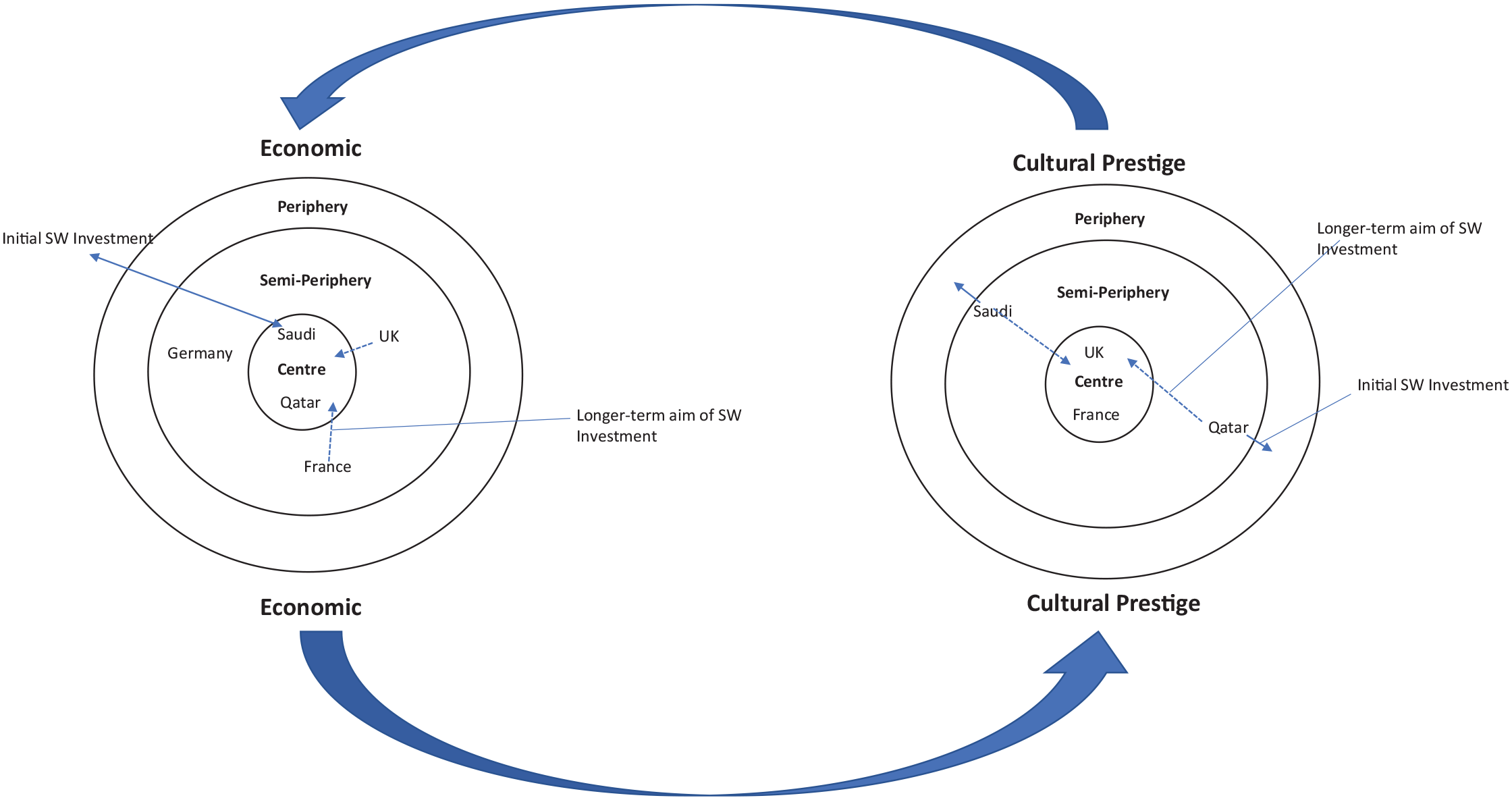
Unpacking the politics of sportswashing.
The bidirectional relationship of sportswashing
The following case studies seek to highlight the mechanisms of ‘sportswashing’ by introducing the wide-ranging Qatari and Saudi sports investment strategies. We begin with an analysis of Qatar’s hosting of the FIFA World Cup and their state’s wider sports investments strategy. This is followed by a discussion of Saudi Arabia’s own sports investment strategy and an analysis of their partnership with WWE.
Qatar
Qatar can be characterised as a ‘serial user’ (Black, 2014) of sports events and has hosted no less than 30 regional or international sporting events between 2000 and 2023 (Brannagan and Reiche, 2022). The 2022 FIFA World Cup, however, offered the smallest state ever to host this event unparalleled global exposure and clearly fulfilled Qatar’s ambition of both putting itself on the international map and strengthening its position within the region of the Arabian Gulf (The Times of India, 2022), in particular, vis-à-vis its large neighbour, Saudi Arabia (see Brannagan and Giulianotti, 2015).
The hosting of the FIFA World Cup itself was unique in a number of respects. It was the first sports mega-event to be hosted in the Arab world, over US$200 billion was spent on a wide programme of infrastructural renewal (Financial Times, 2022) – more than the last 21 versions of the event put together – and FIFA’s selection process for the event (with Qatar chosen ahead of such power-houses as the United States; New York Post, 2010) was held some 12 years before kick-off. This decade plus lead-in time to the event allowed penetrative media scrutiny of Qatar’s human rights abuses. In football terms, the uniqueness continues; Qatar is the only modern host to have never qualified for a previous World Cup and it possesses the lowest ranked team (since FIFA began its world ranking system); it was the first event to be held in winter, due to Qatar’s climate making summer games unsafe for players; it lacked suitable footballing infrastructure and grassroots culture, with a low-key domestic league (Theodorakis et al., 2017) and Qatari football fans often made up less than 1% of stadium capacity (Brannagan and Giulianotti, 2018).
Much of the above led to the 2022 World Cup in Qatar being widely regarded as a ‘sportswashing’ opportunity for the Gulf state by Western media (The Guardian: 2022a; The Independent, 2022; Snell, 2022), but they can also be understood as a prime example of the bidirectionality of the process. The FIFA World Cup is one of only two sports mega-events that exist (‘mega’ due to their size and audience capture; see Müller, 2018) and both are of Western European origin. The controversial choice of Qatar as host – the richest per capita globally (World Bank, 2021) – has its roots in the former FIFA president Sepp Blatter’s wistful ideas of discovering ‘new lands’ that the championship could conquer back in 2010. As a business model, this makes sense and FIFA – a registered charity – is no different in seeking out new markets for its cultural product to a state on the ‘periphery’. This was, however, not a charitable gesture, as FIFA actually earnt an additional £1 billion from the 2022 event (over and above the 2018 event), bringing their profits to £7.5 billion (The Guardian, 2022b). The FIFA World Cup is one of the ‘centre’s’ most prestigious global sporting events with a cumulative audience of around 5 billion viewers ‘following tournament content across an array of platforms and devices across the media universe’ (FIFA, 2023). This included 1.5 billion viewers who watched the final (FIFA, 2023). These stunning viewing figures benefit both FIFA (financially) and Qatar, a tiny Gulf state about the size of Yorkshire in England, offering it unparalleled global exposure. There is no other event – sporting or otherwise – that could offer such a global audience (e.g. the 2020(1) Tokyo Olympics drew 3 billion viewers; International Olympic Committee (IOC), 2021). The flip side to this, of course, is that many more people would have learned about Qatar’s – and the region’s – antiquated Kafala employment system, which was labelled as akin to a form of modern-day slavery by Amnesty International (2020).
Given that both parties (FIFA and Qatari authorities) generally benefitted from this arrangement, it is no surprise that FIFA revealed itself as a key advocate for the controversial Gulf state in the light of unprecedented criticism directed towards it. Their financial interconnectedness is mirrored in their reaction to criticism of the Gulf state’s human rights record: both dismissed criticisms of Qatar as ‘racist’ and ‘unprecedented’ (Begum, 2022); dismissals likely containing partial truth with respect to some media coverage, but which can also be invoked cynically to deflect valid criticism of FIFA/Qatar. Criticism stemmed mostly from media figures, pundits, individual politicians, and the athletes themselves – official government condemnations were rare, and no major footballing nation boycotted the tournament. FIFA’s defence of Qatar consisted of Gianni Infantino’s (FIFA’s president) bizarre speech and last-minute decisions that appeared to kowtow to Qatar’s wishes (The Guardian, 2022c). This included an 11th hour U-turn disallowing team captains from wearing a rainbow armband while playing (a symbol of solidarity with the lesbian, gay, bisexual, transgender (LGBT+) community, as homosexuality is illegal in Qatar; Reuters, 2022). The political activism displayed by athletes, pundits, and politicians was also unique, as it continued after the sport had begun. At most major sporting events, the politics stops when the sport starts. However, shortly after the armband ban by FIFA, the German football team protested demonstratively by covering their mouths during the team photo before their match with Japan to signify their distaste at having their ‘voice’ taken away from them (Insidethegames, 2022). During the game itself, the German minister of the interior wore the banned armband, clearly visible, while she sat next to the FIFA president. As discussed earlier, this is ‘Wave 1’ of most ‘sportswashing’ arrangements, albeit one of the most prolonged and intensive ever seen at a major sports event. At the time of writing, some 6 months after the event, there is little to no media discussion (negative or positive) about Qatar’s hosting of the FIFA World Cup (‘Wave 3’).
Outside of the 2022 World Cup, notable has also been Qatar’s significant investment in overseas sporting ventures. Crucial in this regard has been Qatar’s investment in the French Ligue 1 club, Paris Saint-Germain. Purchased in 2011 for a fee of €100 million, Qatar’s ownership of Paris Saint-Germain has led to a radical overhaul of the club, with major signings including the likes of David Beckham, Zlaten Ibrahimovic, and Lionel Messi; in 2017, Paris Saint-Germain broke the world-record transfer fee when they signed Brazilian forward Neymar Jr for €222 million (Reuters, 2012). In typical fashion, Qatar’s ongoing investment in Paris Saint-Germain – and other sports ventures – has generated at times various forms of global critique, most particular of which has been the charge that Qatar’s investment in European football is the result of ‘subtly laundering Qatar’s reputation and covering up extensive human rights abuses’ (see Deutsche Welle, 2021) back home. While this may, in part, be true, such a perspective masks the more complex plurality of the relationship here: on one hand, for Qatar, investment in Paris Saint-Germain is not just about reputation building, but also part of a long-term strategic plan to diversify its national economy away from a heavy dependence on natural resource wealth (see Brannagan and Reiche, 2022); while, on the other hand, for their French counterparts, Qatar’s investment in Paris Saint-Germain has not only helped significantly raise the profile of the French national football league, but so too has it helped to place Paris (one of the world’s leading and most prestigious cities) firmly in-and-among football’s global elite. For example, Paris Saint-Germain currently records the fifth highest annual revenue in world club football (Deloitte Football Money League, 2023), with its total value rising from €100 million in 2011, to just over €3 billion in 2022, making it the globe’s seventh most valuable professional football club (see Forbes, 2022).
Wearing (2022) makes a valid point – and touches on how the geopolitical ‘centre’ seeks to justify itself in entering such partnerships with the ‘periphery’ – by suggesting that ‘sportswashing’ benefits ‘Qatar and the West’, as the latter use a ‘self-serving mythology’ of an ‘enlightened west’ and ‘backward despotisms of the Middle East’ to criticise ‘human rights abuses in states like Qatar, while preserving a narcissistic sense of western innocence’. An added complication here is that FIFA (and the International Olympic Committee) remain the undemocratic, and unvoted, guardians of one of the most sought after ‘Western’ cultural products that they can ‘sell’ to whomever they wish. Therefore, such international sports federations play a disproportionate role in ‘mainstreaming’ ‘periphery’ states into the global economy.
Saudi Arabia
Like Qatar, so too has Saudi Arabia sought to invest in overseas sports markets. A key example of this strategy is the Saudi Arabian-backed 2021 takeover of English Premier League club Newcastle United FC by the sovereign wealth arm of the state, the Public Investment Fund (PIF). Since purchasing Newcastle for a fee of £305 million, Newcastle United has witnessed several high-profile signings, including the likes of Brazilian midfielder Bruno Guimaraes, and Swedish forward Alexender Isak for a club-record €70 million fee (BBC News, 2022). Initial reaction to the Saudi-led takeover of Newcastle was largely critical, with many claiming that this purported to a strategy which sought to clean Saudi’s poor human rights image, and to help re-build the state’s reputation after the assassination of Saudi journalist Jamal Khashoggi (‘Wave 1’; see The Guardian, 2021). However, the takeover of Newcastle goes beyond reputation building alone. Like its neighbour Qatar, Saudi Arabia is also mindful of the need to diversify its economy away from a reliance on natural resources, the sale of which contributes to roughly 87% of the state’s annual budget (see Al Naimi, 2022). Given this, investing in a football club that plays in the prestigious English Premier League acts as one way for Saudi to meaningfully invest its natural resource capital for long-term diversification. In turn, for the then Prime Minister, Boris Johnson and his Conservative Party, the Saudi takeover of Newcastle United was considered vital to ‘the UK’s strategic and economic interests’, and to the continued investment in major UK cities by states from the Gulf (The Guardian, 2022d).
The partnership between WWE and Saudi Arabia offers a further illustration of the mechanisms of sportswashing we seek to highlight. Since 2018, WWE have produced a series of biannual live events hosted in Saudi Arabia and broadcast internationally at the behest of the Saudi government. At first glance, this appears to be a straightforward exchange of economic for cultural capital characteristic of most sportswashing partnerships, with the Saudis exchanging cash for the reputational boost entailed by proximity to a globally recognised sports entertainment franchise. However, the Saudi–WWE partnership is unusual in that it has arguably generated cultural capital (cf. Bourdieu, 1984) for both parties. WWE have achieved this by framing the shows as a philanthropic export of Western cultural values, with WWE’s female performers – excluded entirely from the first three Saudi–WWE shows – presented as exemplars of ‘progress’ for women’s rights in the Saudi kingdom. This is a clear leveraging of the centre-periphery logic (cf. Connell, 1997, 2007) at the heart of many sportswashing partnerships for reputational gain, wherein the cultural development of geopolitically ‘peripheral’ nations is said to be aided by the import of Western values through sports and entertainment brands. The measured praise afforded WWE for its apparently liberalising influence on Saudi audiences mitigates the reputational damage that might otherwise disincentivise WWE from participating in sportswashing activities.
Origins of a sportswashing partnership
Professional wrestling is a choreographed mix of combat sports, soap opera, and immersive theatre which emerged out of what historians broadly agree were real athletic competitions in the late-19th century (Lindaman, 2000). Alongside jazz (Roth, 1952), comic books (Gabilliet, 2010), hip-hop (Williams, 2011), and techno music (Tsitsos, 2018), wrestling is one of the major pop culture forms to emerge in the United States with vibrant scenes also existing in Mexico, Japan, and parts of Europe. Wrestling has always featured choreographed fights between heroic ‘babyfaces’ and villainous ‘heels’ and – since the advent of cable television – has evolved to accommodate soap opera style storylines, such that backstage skits are as much a part of the show as the in-ring contests. Although bouts are scripted, WWE is typically televised by conventional sports broadcasters including Sky Sports and BT Sport in the United Kingdom (Potts, 2019) and Fox Sports Network in the United States (Fox Sports, 2020). With an estimated US$8 billion market capitalisation (Nasdaq, 2023), WWE have enjoyed a virtual monopoly over the American professional wrestling industry since their acquisition of Time-Warner’s World Championship Wrestling (WCW) franchise in 2001. Given the centrality of stage-managed antagonism to both domains, resemblances between pro wrestling and politics are frequently remarked upon in the press (e.g. Hendrickson, 2023) but little explored in the academic literature (see Moon, 2022, for an exception). Yet, one of wrestling’s key components ‘kayfabe’ (i.e. it’s predetermined nature) in fact makes WWE an ideal sportswashing partner (see Chow and Laine, 2014; cited in Moon, 2022) as the in-ring action can be scripted to accord with the precise political intentions of those putting on the show, unlike the inconveniently unpredictable outcomes of ‘real’ sporting contests.
On 5 March 2018, WWE and the Saudi Royal Family announced their intention to co-host 20 pay-per-view wrestling events over the coming 10 years. The new partnership was part of Saudi Vision 2030, a US$2 billion programme aiming to promote tourism, diversify the Saudi economy by reducing reliance on oil and gas revenues, and soften the image of the Kingdom around the world. Exercises in reputational management are necessary given widespread condemnation of the Saudis’ intervention in the Yemeni civil war and attendant humanitarian catastrophe; frequent crackdowns on intellectuals, reformers, and women’s rights activists; assassination of dissident journalist Jamal Khashoggi inside the Saudi Arabian consulate in Istanbul in October 2018; and laws regarding the rights of women and religious/ethnic/sexual minorities, among the most oppressive in the world (Human Rights Watch 2022: 572–573). SV2030 has included partnerships with Western sports brands including Newcastle United, and the LIV Golf tour (Moulton, 2022). The partnership was already worth a reported US$350 million to WWE as of 2022 (Thurston, 2023) while the announcement noted that the Saudis had acquired privileged access to the ‘1 billion television households’ reached by WWE in an average week across 180 countries (World Wrestling Entertainment (WWE), 2023).
The first Saudi–WWE shows: Pageantry and ‘progress’
The first Saudi–WWE show Greatest Royal Rumble took place in April 2018 at the King Abdullah International Stadium. The show featured all the pageantry and simulated violence usually associated with WWE, in addition to several naked propaganda elements produced in collaboration with the Saudi Royals. The visual grammar of WWE was intermingled with Saudi national iconography as wrestlers competed for belts and trophies decorated with Saudi national insignia. Some dressed in Saudi national colours. The live broadcast featured a video package promoting a then-recent legal ruling permitting Saudi women to drive for the first time in history (BBC News, 2017), containing tearful testimony from Saudi women claiming that they had ‘never been happier’ in the Kingdom. WWE attributed the credit for the ruling to Crown Prince Mohammed Bin Salman, with no mention of decades of grassroots campaigning by Saudi women’s groups such as the Women to Drive Movement (قيادة المرأة في السعودية). Later in the show, a performatively villainous Iranian wrestler declared to the live audience of Saudi nationals that Iran was ‘the greatest country on Earth’ before being ran off by a heroic cadre of Saudi wrestlers.
Significantly, this and all subsequent Saudi–WWE shows are presented as a fully integrated part of the WWE calendar. The shows are therefore broadcast internationally on the WWE Network, promoted on weekly WWE programming, and have direct consequences for later shows taking place in the United States and elsewhere. WWE’s largely Western, juvenile audience must therefore consume biannual Saudi propaganda to stay up to date with WWE storylines. Notably, by request of the Saudi government, WWE’s female performers were entirely absent from the first show, while female spectators could attend only if accompanied by a male guardian (Rappeport, 2019). This would remain the case on follow-up shows held in November 2018 and June 2019.
Despite the absence of female performers, commentators and on-screen graphics frequently invoked the idea that WWE’s arrival heralded ‘progress’ for Saudi Arabia. Initially, the nature of the ‘progress’ entailed by the shows was left intentionally vague. The very presence of WWE – established as an explicitly American entity from the first seconds of each broadcast with the singing of the US national anthem – apparently evidence that Saudi Arabia was undergoing a process of ‘modernisation’, with American popular culture implicitly presented as an endpoint to which others naturally aspire. The use of ‘progress’ as an intentionally ambiguous ‘floating signifier’ is common in political messaging (Laclau, 2000) and essential to WWE’s marketing of the shows as acts of progressive philanthropy.
Initial fan, media responses: Cash for criticism
Despite this marketing push, the early Saudi-WWE shows prompted a volume of negative press attention that appeared to surprise WWE, a period we have characterised as ‘Wave 1’ of the Saudi-WWE sportswashing relationship. Reports sharply critical of the partnership were published in the United States and abroad (e.g. Barrasso, 2018; Paddock, 2018). Two lengthy segments on HBO’s satirical late-night talk show Last Week with John Oliver examined the partnership and explicitly called on WWE to withdraw, as did several US Senators (Gartland, 2018). The fan-led #BoycottSaudi campaign implored the WWE audience to shun the broadcasts. Grievances ranged from those typical of sportswashing – that is, that the shows served to launder the reputation of an oppressive, authoritarian regime – to those specific to the Saudi-WWE relationship, with fans especially aggrieved at the exclusion of WWE’s female performers. While insisting that this was due to Saudi law beyond their control, WWE took active measures to assuage fan disquiet by promoting the first (and at the time of writing, only) all-female WWE Premium Live Event Evolution on 28 October 2018; five days before the second all-male Saudi-WWE show.
Negative press attention reached an apotheosis following the murder of Jamal Khashoggi inside the Saudi consulate in Istanbul in October 2018 (e.g. Dawson, 2018; Reed, 2018), prompting intense pressure on all sports and entertainment brands attached to Saudi Vision 2030 to withdraw their participation. Several WWE performers refused to appear at the next Saudi-WWE show Crown Jewel on 2 November 2018 (BBC News, 2018). A number of options were available to WWE at this point including wholesale withdrawal from SV2030, which would have mirrored contemporaneous actions taken by the Ultimate Fighting Championship (UFC) who returned US$400 million of Saudi sponsorship money (Kelly and Hubbard, 2019). Instead, WWE sought to cynically re-frame their participation; pressing ahead with the shows with a renewed focus on WWE’s female performers, who would finally appear on a Saudi-WWE broadcast at the fourth time of asking at the Crown Jewel 2 event in October 2019.
The marketing of Crown Jewel 2 differed from previous Saudi-WWE shows, foregrounding the idea that WWE’s belated presentation of women’s bouts constituted specifically feminist ‘progress’ in the Saudi kingdom. Asked by Bleacher Report (Snowden, 2019) whether the first women’s match in Saudi Arabia showed that ‘WWE could be the start of some change [in Saudi Arabia] and the spread of American ideals’ (emphasis added), WWE CBO Stephanie McMahon responded:
I think this is absolutely proof [. . .y]ou can either sit on the sidelines [. . .] or you can be a part of hopefully enacting change. You can be a part of progress. Nothing worthwhile is ever easy. It takes time. It takes perseverance. Now here we are with the first ever women’s match in Saudi Arabia. It’s pretty mind blowing.
WWE thereby sought to co-opt prior disquiet regarding the exclusion of its female performers, so as to generate positive reputational capital from a partnership that had hitherto caused nothing but damage to WWE’s brand. The nature of the previously ambiguous ‘progress’ heralded by the shows was now made explicit. The emergence of this ‘counter-narrative’ signalled the move to ‘Wave 2’ of the Saudi-WWE relationship, during which apologists for the partnership vied for air time with continuing criticism from the media and other commentators.
Changing the narrative: WWE as feminist modernisers
The first women’s bout held in Saudi Arabia took place on 31 October 2019 as Natalya Neidhart faced Lacey Evans in a match described by WWE as ‘another step [in] evolution for women worldwide’ (see WWE, 2019). Before the match, an on-screen graphic presented a selection of media headlines apparently praising the match on feminist grounds, though most of the articles contained only measured praise alongside condemnation of the Saudi-WWE partnership more broadly (e.g. Gartland, 2019; Konuwa, 2019). Once the bout began, several deviations from WWE’s usual presentation were apparent. Unlike the male competitors on the same show, the women wore black leotards entirely covering their bodies below the neckline. The women did not display the usual levels of performative aggression characteristic of a WWE contest; shaking hands before the match, stopping to applaud each other after executing their attacks, and visibly smiling throughout. As the match concluded, WWE announcer Michael Cole addressed the audience directly: ‘Ladies and Gentlemen, you cannot overstate the importance of this match-up . . . if you push and you push and you push enough, change is going to happen, and it happened here tonight’.
The framing of WWE’s female performers as exemplars of an apparently liberalising Saudi is problematic in several regards. First, and most obviously, it misrepresents a for-profit collaboration between Western capital and an oppressive regime as an act of progressive philanthropy. Second, it launders the Saudi government’s actual orientation to women’s rights, considered among the most oppressive in the world by Human Rights Watch (2022: 572–573). Crown Jewel 2 occurred near-simultaneously to an active crackdown on feminist protest in Saudi Arabia (Amnesty International, 2019) that prompted dozens of arrests and the torture of at least six women’s rights activists (Wintour and McKernan, 2019) some in the presence of Saud al-Qahtani, close adviser to the Crown Prince (The Telegraph, 2018).
Third, it complicates the ‘moral challenge’ (Fruh et al., 2022) extended to WWE’s audience by intertwining the shows’ propaganda function with an apparently feminist message, rendering the moral quality of the shows more difficult for audiences to parse. This resembles a confidence trick daring those with good-faith interest in women’s rights to object to the apparently ‘progressive’ content of the shows. The added complexity is apparent during several heart-warming moments in the Neidhart/Evans match, wherein the Saudi crowd was visibly, enthusiastically supportive of the female performers (a ‘Women’s wrestling’ chant proliferated throughout). Likewise, Neidhart, Evans and the commentators appeared genuinely moved by the reaction. The audience are impelled to feel that criticising the Saudi-WWE partnership would invalidate the laudable reaction of the crowd and the sincerity of the performers.
Finally, and perhaps most insidiously, WWE’s marketing of the Saudi shows recalls the ‘civilising mission’ discourses used to justify colonialism in previous eras (cf. Césaire, 1950). Invoking racist notions that peoples living at the geopolitical ‘periphery’ occupy a less advanced position on a linear continuum of ‘progress’ which necessarily culminates in the realisation of Western cultural ideals. This idea of unipolar ‘social evolution’ has been widely recognised as bad sociology since at least the time of the World Wars (Connell, 1997) but is evoked throughout the Saudi-WWE broadcasts and impressed upon WWE’s largely juvenile, Western audience. On an October 2021 podcast, former WWE World Champion Bill Goldberg – reportedly paid US$2 million-a-night to appear on four Saudi-WWE shows (Meltzer, 2023) – said of the partnership:
Every time we go, there’s seemingly a cloud of negativity, but I got to tell you, from the first trip to this last trip, what the Crown Prince is trying to do and what he’s actually doing is moving that country ahead exponentially. I don’t want to say it’s ‘westernizing’, but it’s westernizing [. . .] it’s making the Middle East move in the right direction.
The biannual Saudi events have become a normalised part of the WWE calendar in the years since Neidhart versus Evans, now featuring at least one match involving female performers as standard. The fan and media backlash of 2018/2019 has receded. WWE have partially reversed the reputational damage incurred by their involvement with Saudi Vision 2030, bidirectionally boosting both their own reputations and that of the Saudi Kingdom. The partnership has thereby moved through ‘Wave 2’ and on to ‘Wave 3’ of a sportswashing arrangement with the achievement of ‘normalisation’ here being key.
Conclusion
‘Sportswashing’ as a process is intrinsically political, as it touches on relations between states and cultures, it involves the exchange of cultural prestige and capital, and it is undertaken with the purpose of attempting to alter national images over time. In this article, we have moved beyond the standard tropes describing ‘sportswashing’ simply as a method of (usually illiberal regimes) ‘cleaning’ a reputation through the investment in elite sport athletes, teams, or events, as if they operated alone. By drawing on a novel notion of ‘assemblage’ and providing empirical examples of ‘sportswashing’ arrangements, we have conceptualised ‘sportswashing’ as a process involving an inherently bidirectional phenomenon which benefits both the illiberal regimes and the Western sports brands and organisations that collaborate in it. Furthermore, ‘sportswashing’ is ‘relational’, that is, only through the partners working together does the symbiotic relationship exist; its very existence is the result of a dynamic coming together of a push and pull of interests between cultural prestige and economics. A ‘sportswashing’ arrangement usually passes through three ‘Waves’: first, it encounters sustained critique, buoyed by the media and fuelled by feelings of betrayal by many of the actors affected by the relationship (fans, commentators, other possible investment partners etc.). The second ‘Wave’ is characterised by a prolonged period of negative narratives and counter-narratives fought out in the press and social media, raising concerns about the differences in values, norms, and culture of the actors involved. This was clear in the Qatar case, given it was awarded the FIFA World Cup some 12 years before it was due to take place. There was an unprecedented media probe into Qatar’s employment practices and treatment of foreign construction workers. The third ‘Wave’ marks the ‘normalisation’ of the arrangement in which the media coverage of ‘Wave 1’ and the critique of ‘Wave 2’ rarely feature. This period would, for example, pertain to Manchester City Football Club and its United Arab Emirates owners, a team whose fortunes changed dramatically with the influx of petro-dollars (winning five Premier League titles within 6 years). It also, now, pertains to Qatar, as media interest after the event has waned. Finally, while a ‘sportswashing’ arrangement is not the same as a state’s ‘soft power’ strategy – given the reliance of the latter on credibility and attractiveness – it could be understood as a first step on a journey towards greater acceptance by both the international community (in business) and by citizens. This process, effectively, aids the ‘mainstreaming’ of illiberal states in the global economy over time. Therefore, ‘sport’, often seen as a ‘hobby’ rather than a serious area of study for political scientists and international relations scholars, plays a crucial role in our understanding of how states attempt to use it for the glory, prestige, and excitement it generates and the global reach it commands.
Footnotes
Funding
The author(s) received no financial support for the research, authorship, and/or publication of this article.
