



Abstract
Disruptive protest has become increasingly studied and promoted across the social sciences, not least in relation to climate protests. This paper asks what the rationale and effects of disruptive protest are. It argues that disruptive protest carries a prefigurative legitimacy, envisaging a more democratic and just society while aiming for broader appeal and legitimacy rendered by liberal discourses. The paper takes a political theory perspective through both the literature on civil disobedience and the anarchist literature on direct action. It then explores how the key attributes of these literatures render legitimacy to the practices and discourses of two social movements that have made widespread use of disruptive protest in recent years: the Spanish anti-eviction movement Plataforma de Afectados por la Hipoteca (PAH) and the mainly British climate change movement Extinction Rebellion (XR).
Disruptive protest has become an increasingly frequent and contested aspect of political life in many countries around the world. On the one hand, movements like Occupy, Black Lives Matter, Extinction Rebellion (XR) or anti-extractivist protestors show that ‘collective actions of civil disobedience appear to be increasingly normal aspects of political life’ (Hayes and Ollitrault, 2019, p. 185). Indeed, disruptive protests in particular have become more common compared to traditional A-to-B marches (Bailey et al., 2021). On the other hand, there has been a response from states across the world to clamp down on such protest by further criminalising it with extended use of fines and prison sentences as well as expanded police powers to pre-empt and disband protests (Garea, 2015; Taylor, 2021).
Across academic disciplines, there is an increasing interest in exploring when and how disruptive protest is effective (e.g. Bailey et al., 2021; Jasny and Fisher, 2022; Simpson et al., 2022). This has included efforts to categorise different kinds of protest (Sovacool and Dunlap, 2022), as well as calls to encourage academics themselves to take part in disruptive protest (Capstick et al., 2022; Racimo et al., 2022). There have also been a number of surveys, smaller studies and experiments, not yet resulting in peer-reviewed publications, that have sought to explore the effects of disruptive protest on media attention and public attitudes (Akehurst, 2023; Davis, 2022; Ozden and Glover, 2022). These contributions are in addition to a whole subset of scholarship in Political Science, the Civil Resistance literature, that is dedicated to promote disruptive non-violent protest and which also seeks to explore when such protest is successful (Chenoweth and Stephan, 2011; Engler and Engler, 2017; Sharp, 1973). Key takeaways from these historical and more recent contributions include that disruptive protest (almost) always plays a part in progressive political change (Chenoweth and Stephan, 2011; Sharp, 2012; Sovacool, 2022), achieves more publicity with fewer activists (Davis, 2022) and achieves direct results under certain conditions (Bailey et al., 2021).
What I mean by disruptive protest is protest that is intended to physically disrupt people, institutions and/or processes of capital accumulation but that stay short of sabotage. This definition then excludes rallies or marches that last a few hours and are de jure or de facto accepted by authorities. It includes several of the types of protest brought up by Sovacool and Dunlap (2022) in their recent review, such as mass arrests, occupations, lock-ons, unpermitted demonstrations and trespassing. As such it broadly aligns with what Bailey et al. (2021) call ‘militant protest’ and which they have identified an increase of in countries across the Global North since 2010.
I contribute here to these ongoing discussions across the social sciences about the rationale and effects of disruptive protest by suggesting that the political theory literatures that engage with the ethics of these protests can help us understand what it is about disruption that makes it compelling for political actors. The first part of the paper thus briefly reviews these literatures and emphasises the focus on legitimacy in the largely liberal civil disobedience literature and the prefigurative ethos in the anarchist direct action literature. The second part then applies these lenses to two high-profile case studies to explore how claims to legitimacy and prefiguration play out in practice. These are the Spanish anti-eviction group Plataforma de Afectados por la Hipoteca (PAH) and the mainly British climate change organisation XR.
I argue that disruptive protest gives political actors seeking progressive change a prefigurative legitimacy. First, prefigurative legitimacy means that prefigurative acts carry an inherent legitimacy. This may seem contradictory since prefiguration is a primarily anarchist norm, central to the anarchist view of direct action. While anarchists and anarchism often lack legitimacy in the eyes of broader publics, their prefigurative ethos does carry such legitimacy. Second, by seemingly complying with liberal norms about what constitutes legitimate disruption, movements gain further legitimacy. This involves discourses that present the disruption as a last resort carried out under an overall fidelity to law, where liberal norms of democracy, deliberation and rule of law are respected and appealed to. It also involves a distancing from anarchism, which creates tensions within movements and between specific social movement organisations and broader left-wing social movements. Ultimately, disruptive protest allows for radical practices that prefigure a different and more democratic society and mode of production but in a way that seeks to go beyond the insularity of anarchist logics in its outward-looking broader appeal.
Liberal civil disobedience
Liberal and deliberative approaches to civil disobedience focus on the importance of legitimacy. It is about showing the public as a target audience that certain laws or practices are illegitimate. If the state violently represses non-violent civil disobedience, it loses legitimacy. This brought Jurgen Habermas (1985) to identify civil disobedience as the ‘litmus test of the democratic constitutional state’ (Habermas, 1985: 95) and those who practice it as the ‘guardian[s] of legitimacy’ (Habermas, 1985: 103). Despite consistent critique by political theorists that have studied civil disobedience in the last decade (Brownlee, 2012; Celikates, 2016; Pineda, 2021), John Rawls’ definition and justification of civil disobedience remain the most influential. For Rawls, civil disobedience is a: public, nonviolent, conscientious yet political act contrary to law usually done with the aim of bringing about a change in the law or policies of the government. (Rawls, 1971: 320)
While this definition is largely accepted in civil disobedience literature, Rawls is critiqued for having an excessively restrictive notion of when disobedience is justified. The way in which he requires disobedient acts to be announced in advance and considers destruction of property to be necessarily uncivil have both been challenged by contemporary theorists (Brownlee, 2012; Celikates, 2016). Not least, Rawls places his restrictions on the presumption of an imagined ‘nearly just society’, which is far from the present unjust societies in which disruptive protest actually takes place. Indeed, for Robert Jubb (2019), the fact that no existing society is ‘nearly just’ means that Rawls’ restrictions cannot apply to contemporary disobedience. That said, some of Rawls’ restrictions are undeniably important for how social movements justify their disruptive protests.
The criterion that civil disobedience must be a last resort is central to the liberal paradigm. For Rawls (1971: 373), it is a condition for civil disobedience ‘that the normal appeals to the political majority have already been made in good faith and that they have failed . . . [and] further attempts may reasonably be thought fruitless’. Another way of framing the last resort is to say that disobedience is a necessity. Kimberley Brownlee argues that it ‘may be justifiable as a matter of necessity only when lawful efforts have repeatedly shown the majority to be immovable or apathetic to this legitimate cause’ (Brownlee, 2012: 200).
A second important Rawlsian criterion is that civil disobedience should retain what Rawls (1971: 366) called ‘fidelity to law’. It echoes what Martin Luther King (1969: 79) called ‘the very highest respect for the law’. For both of them, this follows from the act being open, public, non-violent and accepting of the legal consequences. This, ‘helps to establish to the majority that the act is indeed politically conscientious and sincere, and that it is intended to address the public’s sense of justice’ (Rawls, 1971: 366–367). Fidelity to law thus involves an appeal to a higher justice (King, 1969; Rawls, 1971), a higher law, such as the constitution (Arendt, 1973) or a higher sense of morality (Brownlee, 2012). It can then be framed as aiming to improve governance and the rule of law, rather than threatening order as such. The openness is what distinguishes civil disobedience from other forms of disruptive protest. As Robin Celikates (2015) argues, however, the paradigmatic historical examples of civil disobedience (Thoreau, Gandhi & King) did never conform to this reformist understanding of the law. Instead, displaying fidelity to law has often been just that – a display – rather than a steadfast commitment to the law overall.
If Rawls was overly restrictive in his conceptualisation of fidelity to law, his notion of what causes are justifiably pursued through disobedience is showing to be more misleading in the 21st century. He believed that civil disobedience should be limited to questions of equal liberty (Rawls, 1971: 326). This was partly because it may be difficult to tell whether those practicing civil disobedience for socioeconomic causes may do so mainly out of self-interest. The separation of political and economic demands and their relative legitimacy is inherently liberal. Even at the time of writing, Rawls’ restrictive justification was part of broader liberal attempts to erase or diminish the critique of capitalism in the US Civil Rights movement. This erasure has taken the form of elevating the role of Martin Luther King in public memory at the expense of more explicitly anti-capitalist figures like Bayard Rustin or Malcolm X, as well diminishing the role of King’s own socioeconomic demands (Cornell, 2016; Pineda, 2021). Today, the separation of political and economic demands is no more tenable than it was then. Christina Flesher Fominaya (2015b, 2017) has shown how critiques of capitalism and representative democracy have been intertwined throughout the Global Justice Movement and the Movement of the Squares (Indignados, Occupy etc.), not least in Spain. Excluding socioeconomic demands from justifiable civil disobedience thus stems from the liberal separation of politics and economics, which many social movements contest and contemporary theorists of civil disobedience reject.
Despite the rather restrictive notion of civil disobedience set out by Rawls, social movements draw on the justifications that he identified to gain legitimacy for their actions. This is what Candice Delmas (2021: 219) calls ‘following the civil disobedience playbook’. These liberal justifications end up allowing movements to make disobedience and disruption an important part of their politics. Indeed, Hayes and Ollitrault (2019) highlight the promotion of disobedience as a central aim and function of the liberal civil disobedience literature, something which is also true of more contemporary deliberative and radical democracy civil disobedience authors. In this vein, Candice Delmas (2018) seeks to further expand how disobedience relates to democratic society by not only saying that it is justified, but also emphasising a duty to disobey oppressive laws and social structures. Moreover, she rejects the idea that such disobedience ought to be civil and directly counters Rawls’ limitations by showing how ‘covert, evasive, violent, or offensive’ (Delmas, 2018: 47) uncivil disobedience can also be legitimate. This expansive view of legitimate disobedience is rejected by William Scheuerman (2022b). He argues that much of what Delmas terms uncivil disobedience can be accommodated in more liberal definitions of civil disobedience while truly uncivil and violent protest has a poor historical track record in terms of strengthening democracy. In another recent article, Scheuerman (2022a) warns against how justifications of sabotage (e.g. Malm, 2021) are gaining increasing traction among climate activists.
Delmas’ expansive view of legitimate disobedience notwithstanding, efforts to justify disobedience provide the discursive tools that enable disruptive protest to be used efficiently and not marginalised. In other words, liberal (and sometimes more radical) civil disobedience offers a way of doing disruptive protest in a way that has the potential to be broadly accepted as legitimate, because of how it relates to the state, democracy, and the rule of law within a largely reformist framework with little to say about political economy.
Anarchist direct action
Anarchist approaches to disruptive protest focus on what separates anarchist direct action from other forms of protest (Franks, 2003; Gelderloos, 2013; Graeber, 2009). Where strengthening liberal or radical democracy is the sometimes-implicit aim in the civil disobedience literature, anarchist direct action literature explores how protest can undermine capital and state power while building a democratic future. Anarchist theorising and historicising of direct action has largely taken place parallel to and separate from the literature on civil disobedience. Individuals and movements have been claimed by both sides where liberals have sought to deradicalise the legacy of people like Henry David Thoreau (see Hanson, 2021) and Martin Luther King (see Pineda, 2021) in order to make them fit within a liberal framework (e.g. Bedau, 1969) while anarchists have highlighted the anti-state and anti-capitalist elements of the same figures (Cornell, 2016; Gelderloos, 2007; Wiley, 2014).
Prefiguration is the indispensable part of anarchist direct action. Often seen as an anarchist concept (Franks, 2003; Graeber, 2002; Ordóñez et al., 2018), more recent literature reviews have traced thinking about prefigurative politics to Gramscian and other non-Leninist Marxist currents from the 1970s (Gordon, 2018; Yates, 2021). It has as a concept gone beyond these Marxist and anarchist literatures and become much more widespread in both the practice and the study of social movements (Maeckelbergh, 2011; Yates, 2015). The significant academic attention that the concept has received is not least because of the role of prefigurative politics in both the Global Justice Movement and the Movement of the Squares (Davies, 2014; Newman, 2014). At its most basic, prefiguration must involve the ‘attempted construction of alternative or utopian social relations in the present’ (Yates, 2015: 1). An important part of the prefiguration of social movements has been horizontal democratic practices (Giugni and Nai, 2009; Maeckelbergh, 2012; Reiter, 2009). Those practices do not only have value in themselves but become prefigurative in that they challenge the lack of democracy in society at large (Flesher Fominaya, 2015a, 2015b).
Prefigurative protest is different from the consequentialism of Marxism-Leninism and the symbolism in liberal civil disobedience. For the anarchist theorist Benjamin Franks (2003: 18) prefigurative actions is where the means of the action are ‘in accordance with the aims’ whereas consequentialist protest may break the law or commit violence, but these acts become justified by the ends that they seek. Prefigurative direct action also necessarily ‘contains a small part that represents a larger whole’ (Franks, 2003: 19). Although this can be of important symbolic value, it ought to be more than merely symbolic. He further separates direct action from civil disobedience by pointing out that direct action is not necessarily non-violent or unlawful. To be sure, most direct action is non-violent against human beings although sabotage is common. Much prefigurative direct action is lawful, however, and is often not carried out in direct relation to the law or the state. That said, it is the disruptive forms of direct action that are relevant for this paper.
In breaking down what makes disruptive protest particularly prefigurative, Luke Yates’ (2021: 12) review of the different functions of prefiguration is helpful. Thus, disruption may be prefigurative if it is aimed at (1) ‘substituting or supplanting institutions’ in order to build alternative structures to those of the state; (2) ‘experimentation, innovation and learning’ that can inspire both participants and observers; (3) ‘preparing or resourcing collective actors’ so that a collective identity, ideology and purpose can be developed; (4) ‘directly achieving something in the here and now’ in what is the most obvious and well-known meaning of direct action; and (5) prioritising the ‘micropolitics of political activity’ where a more democratic and peaceful way that activists interact becomes an essential part of protest. To be sure, as Uri Gordon (2018) reminds us, although anarchists have done more than others to practice and theorise it, not all prefiguration is anarchist. Instead, what makes it anarchist, following classical anarchists like Bakunin or Goldman, is the rejection of instrumentalism and embrace of ethical anti-hierarchal practice. This is not to say that prefiguration is inconsistent with liberal notions of civil disobedience, but it is to say that a prefigurative ethos is ‘generally attributed to political anarchists’ (Delmas, 2018: 60) and that anarchist thinkers (and activists) prioritise prefiguration in a way that others do not.
In summary, if liberal civil disobedience puts high demands on protestors in terms of how they relate to democracy, the law and law enforcement, anarchist and prefigurative direct action is more concerned with how coherent the acts of protest are in relation to the goals and values of the protestors themselves. It thus carries a different kind of legitimacy, one that rests on the congruence between means an aims.
Methods
The purpose of this study is to explore what the political theory literatures about the ethics of disruptive protest can tell us about the rationale and effects of such protest. I therefore now turn to explore how the central aspects of these literatures play out in practice. The paper is based on two case studies, carried out through qualitative research over several years. The two cases were chosen precisely because they were high-profile movements in their respective countries that made explicit use of disruptive protest while seeking to appeal to broad segments of society. In other words, they sought to, and in many ways succeeded in, mainstreaming and popularising disruptive protest.
The first case study is of the Spanish anti-eviction movement PAH. PAH was founded in 2009 as Spanish households had started to get evicted in great numbers after the bursting of a housing bubble and mass unemployment. It originated in Barcelona but grew in 2011 with over 200 groups starting around the country, a third of which were in Catalonia (García-Lamarca, 2017; Romanos, 2013). PAH’s founders mainly came from the housing activist group V de Vivienda, which practised theatrical disruption to protest the lack of affordable housing for young people in the cities (Colau and Alemany, 2012). As the movement grew, it also came to incorporate many activists who had closer links to the anarchist squatters’ movement in Barcelona, Catalonia and Spain (Cattaneo and Martínez, 2014). PAH’s day-to-day practices are built on members carrying out their own individual struggle with their bank while also taking part in a broader political struggle where members support each others’ struggles and campaign for policy reform. Both the individual households’ demands to their bank and the movement’s policy demands are to pardon debt, stop evictions and secure social housing. To support both the individual and policy campaigns, PAH practise three forms of disruptive protest. They physically stop evictions by putting their bodies in the way, occupy bank branches to force the banks to open or move forward negotiations with indebted members and enable squatting in vacant bank-owned housing.
The second case study is of the mainly British climate change movement XR. XR was founded in 2018 and rose to fame in 2019 with an occupation of parts of central London. Apart from raising the alarm about climate change, XR want to reform the democratic system and establish a binding citizens’ assembly to address climate change. XR quickly spread around the world but have retained their strongest presence in Britain. XR call themselves a civil disobedience movement and put disruptive protest front and centre of their practices. XR practise both general disruption of public space, much like Occupy, and targeted disruption against industries with high carbon emissions or actors that they perceive to enable emissions, such as government, banks or media corporations. XR’s growth was hampered by less successful disruption in late 2019 and then by the COVID-19 pandemic in 2020. While officially without leaders, XR was strongly influenced by its co-founders Gail Bradbrook and Roger Hallam. Hallam’s theorising has been highly influential in how XR carry out and justify their disruptive protests. He has also been heavily involved in the off-shoot groups Insulate Britain and Just Stop Oil.
A key method applied here to understand the rationale of disruption is to study the primary material issued by the organisations themselves. Both PAH and XR have websites rich with information and justification, as well as published books and essays. I here follow a tradition of scholarship that takes movement theorising seriously. Like Michael Loadentahl (2017), I study a type of ‘political communiqué’ that does not amount to a coherent theoretical and strategic perspective but that nonetheless approximates such a perspective. Such printed texts ‘represent ideas individuals and groups feel ready to be made public’ (Mullenite, 2021: 207). They are more elaborated than much theorising among activists but also of course part of a political tactic in themselves. I have thus carried out a thematic analysis of such key documents while complementing this with observations and interviews.
I studied PAH as part of my doctoral research, which was carried out between 2013 and 2016. For PAH, the most relevant documents are the books Vidas Hipotecadas (Colau and Alemany, 2012) and Si se Puede! (Colau and Alemany, 2013), as well as the documentary Si se Puede!: 7 Days with PAH Barcelona (Comando Video, 2014). This means a particular focus on the discourses of co-founder, previous spokesperson and current Mayor of Barcelona, Ada Colau, along with fellow co-founder, advisor and partner, Adria Alemany. I also carried out 29 interviews with PAH activists, including other co-founders and spokespeople. I further observed disruptive protests and meetings during four separate weeks in the greater Barcelona area.
The study of XR has been carried out in 2019–2023. For XR, the key documents are the Non-Violent Direct Action Guide (XR, 2019a), the edited book This is not a drill (XR, 2019b), and Hallam’s (2019a) Common Sense for the 21st Century. To complement this, I interviewed 15 activists, all of whom had roles as organisers at different levels. In addition, participatory observation was carried out in London and Bristol, as well as in local, national, and international groups online.
The themes that were explored in the thematic analysis stem from the two sets of literature covered above. These are civil disobedience, legitimacy, last resort, fidelity to law, anarchism, direct action, and prefiguration. Only the interviews directly referred to in the text are listed at the end. The analysis first looks at how the two organisations draw legitimacy from a civil disobedience perspective and then proceeds to explore what kind of legitimacy they draw from the anarchist tradition and the contradictions and tensions that lie therein.
The legitimacy of civil disobedience
In order to consider the rationale and effects of disruption, this section explores the core claims regarding protest of PAH and XR and situates these in relation to the civil disobedience literature. As we shall see, both groups draw extensively on the idea of disruption being a last resort and taking place within a fidelity to law but reject the notion that it should be limited to questions of equal liberty and that the economic and the political can be separated.
Much discourse and political strategy around disruption is centred on it being a last resort. For PAH, disruptive protest becomes a last resort before households face homelessness. It is worth returning to PAH’s three forms of disruption here. First, they occupy bank branches to put pressure on banks to renegotiate the debts and housing provision of individual activists. However, this is not done in the first instance but instead takes place after several fruitless attempts of approaching the bank seeking negotiations: Sometimes people expect us all to rush out and protest at a branch straight away. But people have to take the lead in their own cases. They first need to show that they have done what they can to get the bank to negotiate. (Interview P2)
Second, when such attempts have failed and households have received eviction notices, PAH physically stop evictions by activists putting their bodies in the way of bailiffs and police. Third, households that have been evicted are supported to squat under PAH’s Obra Social programme. This can be in the same home that they have been evicted from or in empty bank-owned property (García-Lamarca, 2017; Gonick, 2016; Obra Social la PAH, 2013): When we recuperate [occupy] a new building, it is needs-based in terms of who gets to move in. Even if you haven’t been involved [in PAH] for long, we won’t let you end up on the street. (Interview P3)
Common to these forms of disruption is that in each individual case, all other means of securing housing have been exhausted. The disruptive protest thus becomes a last resort to avoid eviction and/or homelessness.
PAH have gone to some lengths to be able to credibly claim that their disruptive protests are indeed a last resort, such as in the case of the 2012–2013 campaign to change Spanish housing and debt legislation. Through collecting a million and a half signatures, PAH sought to show that it had ‘exhausted all the channels that the system offers’ (Colau and Alemany, 2013: 65). The proposals that because of the signatures were discussed in parliament in 2013 had no realistic chance of becoming law. The then right-wing majority in parliament, and the fact that Spanish MPs only rarely vote against their party, meant that PAH had no real hope of the proposals passing into law. Those of my respondents who were involved in decision-making at the time have conceded as much (Interviews P1; P2). Furthermore, Colau and Alemany (2013: 33) have stated that collecting that many signatures was hardly the easiest way to get PAH’s proposals debated in parliament since smaller sympathetic parliamentary parties have been willing to do so both before and after. Instead, collecting all those signatures was primarily a way of exhausting the channels that the system offers and thereby be able to denounce the lack of legitimacy of the political system and its representatives. For PAH then, it: was converted into an authentic indicator of the lack of legitimacy of the political parties who govern against the interests of the citizenry that they claim to represent (Colau and Alemany, 2013: 64).
It thus served to justify and legitimise further disruptive protests. It became a way of following the civil disobedience playbook.
For XR, their purpose is framed as a last resort to save humanity from extinction and civilisation from collapsing. Their ‘Declaration of Rebellion’ starts with the following:
This is our darkest hour. Humanity finds itself embroiled in an event unprecedented in its history, one which, unless immediately addressed, will catapult us further into the destruction of all that we hold dear: this nation, its peoples, our ecosystems and the future of generations to come (XR, 2019b: 1).
It later states that: [w]hen government and the law fail to provide any assurance of adequate protection of and security for its people’s well-being and the nation’s future, it becomes the right of citizens to seek redress in order to restore dutiful democracy and to secure the solutions needed to avert catastrophe and protect the future. It becomes not only our right but our sacred duty to rebel (XR, 2019b: 2).
In building their case, XR point to the extensive scientific evidence for urgent action on climate change. They then connect the lack of action on climate change to a broken democratic system. The critique of representative democracy draws on the claims and discourses developed during the Movement of the Squares (Fernández-Savater et al., 2017; Flesher Fominaya, 2017). Since they perceive the political system to be the obstacle to action, they identify the capital city and centre of political power as the most suitable target for their disruption: You have to go to the capital city. That is where the government is, that’s where the elites hang out and it’s also where the national and international media usually hang out (Hallam, 2019b: 101).
All this is framed as a right and a duty (Interview X1). This resonates with the idea of disobedience as a duty (Delmas, 2018) or a necessity, thus echoing Kimberley Brownlee who argues that civil disobedience ‘may be justifiable as a matter of necessity only when lawful efforts have repeatedly shown the majority to be immovable or apathetic to this legitimate cause’ (Brownlee, 2012: 200). In short then, disruptive protest is framed as a necessity and a last resort in order to justify and legitimise it.
Both PAH and XR have used the legitimacy rendered by fidelity to law to practise politics that go beyond the reformism imagined by Rawls, and there is a creative tension between reformist and revolutionary elements and activists (Berglund, 2020; Berglund and Schmidt, 2020). For XR, this tension is at the core of their strategy. On the one hand, XR have stood out for their embracing of arrests, thereby accepting law enforcement. On the other hand, XR’s civil resistance model (Hallam, 2019b), and the way in which they seek to overwhelm the police and criminal justice system, is based on Erica Chenoweth and Maria Stephan’s (2011) research into civil resistance campaigns that have aimed to topple governments, as well as similar arrest tactics being used by the US Civil Rights movements (Sovacool and Dunlap, 2022: 5). That regime toppling basis of XR’s civil resistance model does not conform with what Rawls meant by fidelity to law, but of course neither did the Civil Rights movement itself. PAH also have activists that seek a much deeper transformation of capitalism and the state than the notion of fidelity to law would allow for (Suarez, 2017).
In contrast to the legitimacy rendered by adherence to the principles of last resort and fidelity to law, Rawls’ contention that civil disobedience ought to be limited to questions of equal liberty to be legitimate appears to be less relevant. Rather than counting against them, PAH’s self-interested socioeconomic demands are a source of legitimacy. PAH draws strength from the fact that most activists are themselves victims of the housing crisis. Personal stories of poverty and eviction coupled with political demands for the right to housing and for changes to mortgage repayment legislation are central to how PAH seek to be portrayed in the media (Colau and Alemany, 2013): I think I’m something of the ideal poster-girl for the movement, somebody who was never very political but have become politicised and a spokesperson through being directly affected by the housing crisis and being part of this movement (Interview P5).
That personal experience of suffering that has been ended thanks to activism is then a greater source of legitimacy than having joined as an activist seeking to better society with marginal self-interest.
For XR, their image as a middle-class movement in the Global North, and thereby not the most vulnerable to the climate crisis, has been used to question their legitimacy as climate change activists: We know that as a movement putting arrests at the centre of what we do, there are limits to how inclusive we are. People use that against us. But to my mind, whilst it is a privilege to afford to be arrested, it is also a sacrifice that those of us who can should make (Interview X2).
Self-interest and socioeconomic injustice can then serve to render disruptive activists more, rather than less, legitimate. Moreover, both PAH and XR are examples of movements who contest the separation of democracy and economy. For XR: our government has shattered meaningful democracy and cast aside the common interest in favour of short-term gain and private profit (XR, 2019b: 2).
Indeed, one of XR’s key demands is a Citizen’s Assembly to find solutions to the climate crisis, which they claim representative democracy has proven itself incapable of doing (XR, 2020). Meanwhile, PAH decry: the lack of legitimacy of the political parties who govern against the interests of the citizenry that they claim to represent (Colau and Alemany, 2013: 64).
The right to housing and a habitable planet are thus not subordinated to, but instead inherently connected to a functioning democracy and just representation in the discourses of these social movement organisations.
In short, PAH and XR do draw legitimacy from framing their disruption as a last resort and to some extent within a fidelity to law. However, like much contemporary literature on civil disobedience, these examples can be used to dismiss much of Rawls’ restrictive approach to when disobedience may be justified.
Prefigurative direct action
To continue the interrogation of what the rationale and effects of disruptive protest can be, this section will consider the role of anarchist and prefigurative practices and discourses in PAH and XR. I argue here that the two organisations draw much legitimacy from prefigurative forms of direct action while actively distancing themselves from anarchism.
While calling PAH small-a anarchist, as Ordóñez et al. (2018: 87) have done on the basis of ‘anti-hierarchy and direct action’, is an exaggeration, their disruptive protest does nonetheless have significant prefigurative elements, some more anarchist than others. They physically stop individual evictions as part of a broader campaign to outlaw evictions. They house homeless households in bank-owned property demanding that it be turned to social housing as part of a broader campaign for the state to requisition empty bank-owned housing (García-Lamarca, 2017; Romanos, 2013). In the words of Benjamin Franks (2003: 20), this kind of action ‘stands both as a practical response to a given situation, but also as a symbol of the larger vision of societal change’. Yates’ (2021) five functions of prefiguration, are also all discernible in PAH’s practices to varying extent. We’ve created communal spaces that offer collective advice. When people first come to the PAH we never give them individual advice. People come to a communal space and they see that there are no hierarchies, that we all sit in a circle, and when people start to speak, they realise that many other people have the same problem or an even worse problem. This has a therapeutic effect (Colau in Comando Video, 2014).
Getting indebted households together to support each other and contest the banks, as indicated in the quote above, is innovative (2) and constitutes resourcing of collective actors (3). Moreover, the disruptive protest itself often achieves something there and then (4) in that members gain concessions in the form of debt forgiveness or social housing. In terms of the micropolitics (5), PAH do promote horizontality, as indicated above, but they largely lack the efforts visible in XR of doing away with oppression and violence in the way that activists interact with each other. Whether PAH seek to substitute or supplant state institutions (1) is a source of tension in the movement. In organising the squats and deciding which households have the greater need for somewhere to live, PAH have essentially taken on social housing duties from local governments: The government is ignoring its duties. It’s not doing its job. And we, as organized citizens, realise that we have to fend for ourselves. Social services call us and tell us that they are overwhelmed. They ask if we can help particular cases and send people to our meetings, as if we were a government department with funding, staff, but that’s not the case. We’re doing the work that the government isn’t doing anymore (Lucia Martinez in Comando Video, 2014).
Whether such supplanting of state function should be celebrated or lamented depends on how anarchist the prefigurative politics is here. It is a question of whether this is done to put pressure on the state to act or whether it is to supplant institutions in a more anarchist way. The dominant view in PAH has been the former while some local groups, such as the one in Sabadell, have pursued the latter: In Sabadell we have a different view of how radical we can be. We don’t really believe in seeking legislative change. We want to make change here and now (Interview P3).
Taken together, these prefigurative aspects of PAH’s practices and discourses give legitimacy both to the organisation itself and to the kinds of mutual aid politics and disruptive protest that it is involved in.
The prefiguration in XR’s protests looks rather different. XR actions are categorised as ‘disruptive’, ‘outreach’ or ‘visioning’. Disruptive actions involve disrupting the public or another target, often as much as possible. Outreach actions are aimed at informing the public about the climate and ecological emergency and bring people together. Visioning actions speak to the prefigurative ethos in that they: demonstrate the future [XR] want to see through beautiful, creative, collaborative action (XR, 2019a: 3).
However, prefigurative elements can fall under all categories. A disruptive road blocking can be prefigurative since it aims towards a car free city centre. A pop-up library and communal kitchen are perhaps primarily for outreach but also exemplify the kind of sharing economy that a utopian sustainable society may have more of. They are examples of what Michael Deflorian (2021) has called ‘refigurative politics’ in that these glimpses of utopian future practices are not meant to be lasting and permanent but that they nonetheless constitute a critique of the status quo. Nevertheless, the temporary, and therefore largely symbolic, nature of many such actions does make them rather less outright anarchist.
Again, looking to Yates’ prefigurative functions, the clothes-swap stands, pop-up libraries and communal kitchens of an XR camp are examples of experimentation, innovation, and learning (2). The camp as a site for workshops and public talks about climate and political change becomes a way of preparing and resourcing collective actors (3). The camp also becomes a place to practice the ‘regenerative culture’ of ‘self-care, people care and planet care’ (Westwell and Bunting, 2020: 546), thereby engaging in the micropolitics of political activity (5). What XR’s kind of disruptive protest does much less of is to achieve anything in the here and now (4) or indeed supplant state institutions (1). The aim is disruption (Interview X3), rather than direct outcomes, and the aim is to get the government to act or perhaps to transform the liberal democratic system (Interview X4), but not to directly supplant state institutions: We do organise People’s Assemblies during our rebellions in the same way we often do at meetings. But we are clear about how these are very different from the Citizen’s Assemblies that we want to be set up to deal with the climate emergency (Interview X4).
People’s Assemblies are a form of horizontal and deliberative decision-making body that was popularised in the Global Justice Movement around the turn of the millennium and through the Movement of the Squares in 2011 (Hardt and Negri, 2017). Citizen’s Assemblies is a type of citizens’ jury, chosen by sortition, that deliberates and makes decision around specific issues (Smith, 2021). Both People’s Assemblies and Citizen’s Assemblies are based on a deliberative kind of democracy. Hence, the practice of holding Peoples’ Assemblies spreads the ethos of deliberative democracy but does not amount to supplanting institutions.
Despite these prefigurative practices that to varying extent are (unintentionally perhaps) drawing on anarchist theorising, both XR and PAH have sought to distance themselves from anarchism and anarchist sub-culture. While anarchists are not the only ones to emphasise the value of prefiguration, when thinking about disruptive protests specifically, it has been anarchists that have highlighted the need for these to be prefigurative (Franks, 2003; Graeber, 2009; Ordóñez et al., 2018). It is also the case that both PAH and XR operate within a social movement ecology where their kinds of disruptive protests have been connected to anarchist movements. That is, both Catalan housing movements (Cattaneo and Martínez, 2014) and British environmental activism (Saunders, 2012) have had strong anarchist influences.
There was a deliberate attempt to use the anarchist label to smear and marginalise XR in 2019, which the movement has had to respond to. Following the April 2019 protests in London when XR’s occupation of central London was treated with relative leniency by the police, the right-wing thinktank Policy Exchange released a report that recommended harsher policing and an end to what the authors called XR’s ‘honeymoon period’ (Wilson and Walton, 2019: 5). The labelling of XR as anarchists was then taken up by various media outlets (Economist, 2019; Murray, 2019; Wood, 2019) among calls for more repressive policing. The October 2019 protests did indeed see more aggressive policing by the London Metropolitan Police (Dodd and Taylor, 2019) and there have been further attempts to enable harsher policing of the climate change movement (Dodd, 2020), culminating in the Police, Crime, Sentencing and Courts Act and the Public Order Bill. There is thus a strategic imperative to distance XR from anarchism in the eyes of the public to achieve greater legitimacy and make state repression more costly. One XR activist sought to do just that when writing in The Guardian: To my mind, anarchists are anti-government, are destructive in their aims, and are not afraid to use violence. We are none of those things: we are resolutely nonviolent, recognize the need for a government, act in the interests of the people and are trying not to destroy, but to save life on Earth (Rivett, 2019).
PAH have also sought to distance themselves from being labelled as anarchists. This has been particularly important because squatting has been an important element in their repertoire of contention. Emphasising the last resort criterion and coming up with a new vocabulary have both played a part in disassociating themselves from anarchist sub-culture in the eyes of the public. Spanish cities in general, and Barcelona in particular, have a tradition of an anarchist squatting movement, both for housing and social and cultural centres (Engel-Di Mauro and Cattaneo, 2014). Anarchist squatters are in Catalonia known as Okupas. Rather than squatting or occupying, PAH say that they recuperate homes (García-Lamarca, 2017; Gonick, 2016). This fits in a discourse where banks have unfairly repossessed homes that are then recuperated by their former residents. Alternatively, any housing stock owned by banks that is not being put to social use is construed as illegitimate and therefore open to recuperation by any homeless household. The discourse of recuperation emphasises the defensive nature of squatting as a just response to dispossession. This contrasts to the active practice of the Okupas where squatting is a preference rather than a last resort. This distancing of their own squatting from that of Okupas came up in several of my interviews. First our new neighbours thought that we were just Okupas. But then they saw that we had children and jobs and they started talking to us and treating us differently (Interview P4).
The distancing from anarchism came to the fore when members of the local Obra Social group in PAH Barcelona sought to move to a more active and less reactive form and discourse of squatting and occupying. This led to a split and the formation of a new group since PAH did not tolerate making squatting a right in itself rather than a last resort (Berglund, 2020: 860).
Prefiguration constitutes a contradiction or paradox in the relationships between disruptive protest movements, anarchism, and the perceived legitimacy of protest in media reporting or among political opponents. While the distancing from anarchism is intended to render the movements more legitimate in the eyes of the broader public, prefigurative forms of protest are often perceived as more legitimate than purely symbolic ones and certainly more legitimate than consequentialist ones. Movements know this well. The further removed an individual action is from the cause of action on climate change, democratic reform, or the right to housing, the stronger the media messaging must be. For XR, it is much easier to justify occupying a city centre and making it car free than justifying climbing on top of a train. In October 2019, the latter caused more publicity but seemed to most onlookers to be contrary to the aims of the movement (Rowlatt, 2019; Townsend, 2019). For PAH, the escraches, where protests were brought to the homes of governing party politicians, also created much publicity but of a kind that focused on the protests rather than their cause (Flesher Fominaya and Jimenéz, 2014). For a movement whose aim is the right to housing, the seeming violation of the safety of the homes of political opponents required much justification precisely because it was consequentialist rather than prefigurative. Ensuring that direct action is prefigurative is therefore something that gives movements legitimacy.
The two social movements being studied here reflect (albeit in different but overlapping ways) prefigurative values in their practices and discourses. Their disruptive protests seek to experiment, innovate, and lead to collective learning both for participants and observers. They also utilise their disruptive protests for building collective identities and resourcing activists. There is then both an inward-looking community-building aspect to these disruptive protests, as well as an outward-looking aspect targeted at observers. The fact that both movements then actively contest the anarchist label should not distract from the legitimacy that is gained from adhering to such anarchist-influenced prefigurative values.
Prefigurative legitimacy
The question that has guided this research is what the rationale and effects of engaging in disruptive protest are when we look at it through the lens of political theory. The answer has been that disruptive protest gives political actors prefigurative legitimacy. It presents an opportunity to build the new in the shell of the old, the very prefigurative principle that lies at the heart of the ethics of anarchist direct action. It allows movements to prefigure more democratic and just social relations and modes of production. But it does so in a way that transcends the insularity of anarchist logics in its outward-looking broader appeal. As such it can benefit from the legitimacy rendered by ‘following the civil disobedience playbook’, as Delmas (2021: 219) puts it. However, it also draws legitimacy from prefigurative ethics that in many cases are largely anarchist. This is because congruence between means and ends, so central to the anarchist ethics, has broad appeal and legitimacy. Ironically, that connection to anarchism often has to be disavowed so as not to lose legitimacy in the eyes of the public.
I have shown how PAH and XR in different but overlapping ways draw inspiration from both liberal and anarchist frameworks, logics and discourses when practising and justifying their respective forms of disruption. This is not to say that figures like Colau and Hallam have read these literatures in devising their approaches. Much of it comes from movement ecologies that have developed in a symbiotic relationship with theorising. Indeed, had they been more acutely aware of the benefits of the kind of the prefigurative legitimacy set out here, they may have made different choices along the way and avoided some of their less prefigurative actions.
Prefigurative legitimacy is of course not the only rationale or effect of disruptive protest. Instead, it comes from the perspective of political theory and is intended to add to research taking place across the social sciences that explores when and how disruption works. Much of that research focuses on what is directly measurable (public opinion, direct outcomes). The applied political theory used here provides a different perspective and can capture deeper political effects than many of the quantitative or mixed-methods studies mentioned in the introduction.
To say that these two organisations have benefitted from prefigurative legitimacy is not to make absolute claims about the extent of the legitimacy or support obtained by PAH or XR, but it does help to explain why these movements have reached a broader audience and had greater policy impact than more anarchist movements acting in the same spheres. PAH have achieved policy changes benefitting households in various Spanish regions and cities. XR’s April 2019 protests directly led to the British parliament declaring a climate emergency and establishing an advisory Citizens’ Assembly.
As political actors continue to disrupt and innovate the forms and extent of that disruption, they would do well to consider the prefigurative legitimacy of such protests. There is often a tension in movements between more mainstream and more radical activists. Prefigurative legitimacy stems from that tension and points to how legitimacy comes from both ends of that spectrum. Anarchist ethics, strange as it may sound to mainstream publics, can have a broad appeal.
Interviews
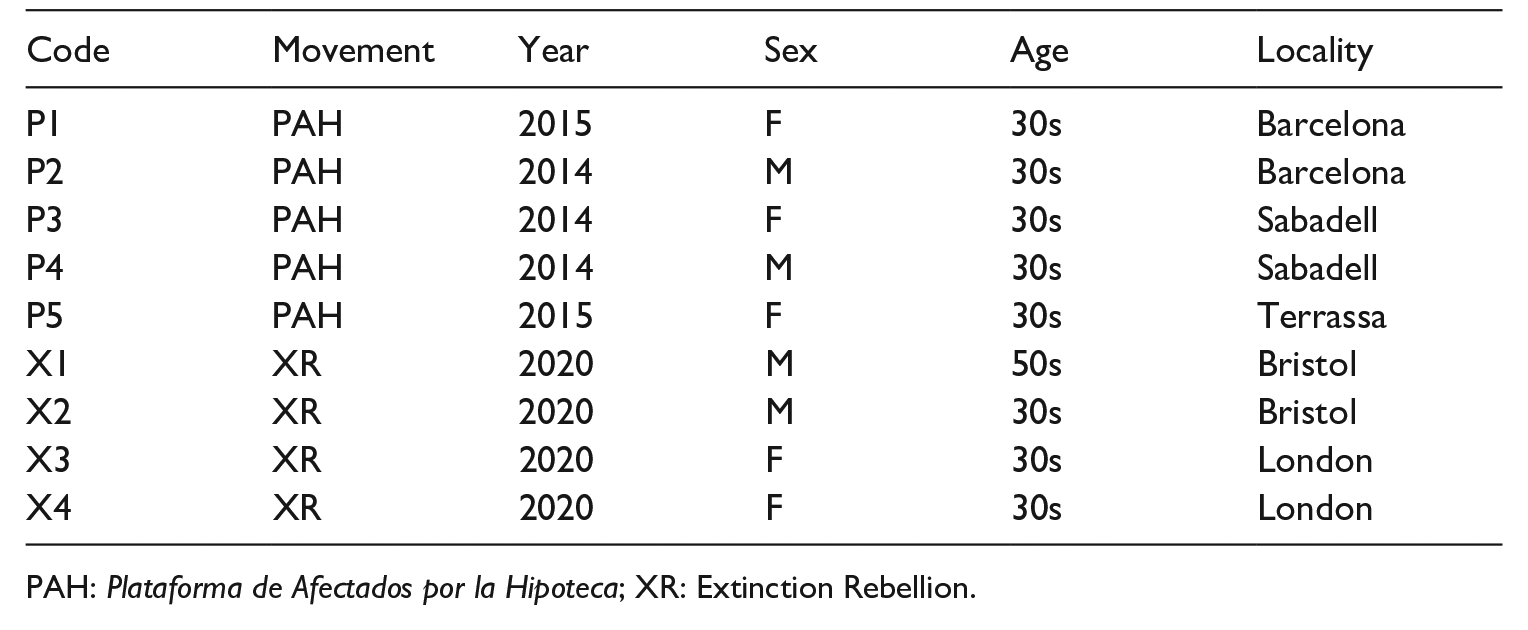
PAH: Plataforma de Afectados por la Hipoteca; XR: Extinction Rebellion.
Footnotes
Acknowledgements
An earlier version of this paper was presented at the European Sociological Association conference in 2021. Thanks to participants at that conference panel and to David Bailey for comments on an earlier draft. Thanks also to the anonymous reviewers, whose comments greatly strengthened the paper.
Funding
The author disclosed receipt of the following financial support for the research, authorship, and/or publication of this article:The doctoral research of PAH used in this paper was supported by the Economic and Social Research Council under Grant ES/J50015X/1.
