




Abstract
Research suggests that creating communities of learning (academic and social) leads to a better Higher Education (HE) experience for students, which, in turn, makes it more likely that they will persist in their studies. The concept of ‘student community’ in HE has become more prominent of late, partly due to the UK Government’s emphasis on retention. One way in which student community can be engendered is by working with ‘students as partners’ in their learning: students work with academics and each other to create and extend their learning, which, in turn, has a positive impact on student community and retention. This article discusses the opportunities and challenges of working with ‘students as partners’ within a Politics HE disciplinary context. In particular, it summarises an Open University Politics student engagement project, part of the University’s partnership with UK Parliament. In doing so, the article has implications for Politics HE practice generally, and online Politics HE practice in particular, and makes recommendations for working with Politics ‘students as partners’ within the current UK HE policy environment.
Keywords
Introduction
The concept and intrinsic value of ‘student community’ has long been the subject of academic discussion (see below discussion of key literature), but has risen in prominence in recent years in Higher Education (HE). A driving factor in this is the idea that creating communities of learning (academic and social) leads to a better HE experience, which, in turn, makes it more likely that students will persist in their studies. With the UK Government’s increased focus on student retention, this is important. Indeed, Condition B3 of the Teaching Excellence Framework (TEF) states that ‘the provider must deliver positive outcomes for students on its higher education courses’ (Office for Students (OFS), 2022a: 1). B3 assesses the actual outcomes delivered by a university to its students, with student continuation and completion (i.e. retention) key indicators (OFS, 2022a).
Seen by many as key to student continuation and completion (referred to as retention from now on) is student community, which can be formal and informal, and academic or more social (Tinto, 1993). Current TEF awards utilise student satisfaction data from the National Student Survey (NSS), which include questions on student learning community. In 2022, the questions were (1) ‘I feel part of a community of staff and students’ and (2) ‘I have had the right opportunities to work with other students as part of my course’ (National Student Survey (NSS), 2022). Getting student community right is thus important for institutions in terms of TEF, but also in itself. Indeed, ‘belonging’ research clearly indicates a positive relationship between students feeling they belong and academic success and advancement (De Sisto et al., 2021). This has been known for years, with Tinto’s (1993, but based on earlier research) ‘model of institutional departure’ recognising academic and social integration as a key variable impacting student achievement/lack of achievement, with social engagement leading to a sense of fit with the university which in turn impacts retention. Thus, according to Tinto to ‘persist’ with their studies, students need to be socially integrated formally (extracurricular activities) and informally (peer-to-peer integration). They need a sense of belonging.
One important aspect of student community that has risen in prominence in recent years is the idea of ‘students as partners’, with student community engendered by students working as partners in their learning. ‘Students as partners’ broadly refers to ‘a joint endeavour to shape and influence university teaching and learning’ (Matthews, 2017: 1) and generally refers to staff–student partnership but can also refer to student–student partnerships. There is a reciprocity to the relationship, with all parties benefitting. A useful way to conceptualise it is ‘pedagogic partnership’, ‘a collaborative, reciprocal process through which all participants have the opportunity to contribute equally, although not necessarily in the same ways, to curricular or pedagogical conceptualization, decision-making, implementation, investigation, or analysis’ (Cook-Sather et al., 2014: 6–7). Research has shown that ‘students as partners’ can have a positive impact on achievement, as well as things like confidence and motivation (Healey et al., 2014).
Within a Politics disciplinary context (which, for the purposes of this article, also refers to International Studies/Relations), the importance of creating communities of learning (academic and social) to improve students’ HE experience, which, in turn, makes it more likely that students will persist in their studies, is clear. Politics, and the social sciences more widely, has in recent years faced challenges in relation to the perceived value of HE study. Indeed, the UK Government’s (Department for Education (DfE), 2021: 6) response to the ‘Post-18 review of education and funding: independent panel report’ (commonly known as the Augar review) (DfE, 2019) stated that HE funding will be focused on ‘supporting provision which aligns with the priorities of the nation, such as healthcare, STEM and specific labour market needs’. Increasing the perceived monetary value (to the taxpayer/government) of politics courses is thus important. One way this can be done is by improving student retention. And as noted above, this can be facilitated by enhancing student community through working with ‘students as partners’.
An illustration of one way this challenge can be tackled is the work of the Politics and International Studies (POLIS) department at The Open University (OU), which took steps to enhance its student community by working with ‘students as partners’, as part of a partnership with UK Parliament. The project was called ‘Changemakers’ and aimed to improve the understanding that students and the general public have about the UK Parliament and politics more generally and how to make change inside and outside of parliamentary politics. As noted above, the project also aimed to enhance OU POLIS student community (and student–staff community). The project engendered political discussion and created resources within an ongoing dialogue with students, involving ‘students as partners’ in various ways, including employing students as paid consultants. These students commented on project drafts and worked on project communication and publicity. The POLIS student community more widely was given the opportunity to feed into the project by submitting their ideas and commenting on text via a project forum, as well as by interacting with each other on twitter and on the forum.
The article highlights the opportunities and challenges in working with ‘students as partners’ (for both universities and students), using the OU POLIS project as a work in practice exemplar. The article makes recommendations for working with Politics ‘students as partners’ within the current UK HE policy environment and in doing so engages with two main conceptual frameworks: Tinto’s (1993) ‘model of institutional departure’ and Bovill’s (2017) Student as Partners Framework. In doing so it outlines valuable lessons for Politics HE practice, a discipline which lacks published academic research in this area, as well as online Politics HE practice in particular
Student community and why it matters
As noted in the introduction, the retention (persistence) of students is high on the UK HE policy agenda. As well as the intrinsic importance of retention for students (in terms of student wellbeing and course value for money), the policy context behoves institutions to work to improve student retention. Tinto (1993) identified three main reasons why students depart their studies (i.e. they are not retained as students at a particular institution): (1) academic difficulties, (2) inability to resolve educational and occupational goals, and (3) failure to integrate into the institution intellectually and/or socially. The third component is of relevance here, the idea that integration academically and socially (which are independent but complementary to each other) leads to greater commitment and success. In terms of the social (the creation of relationships/connections outside of the actual classroom – which is usually conceptualised as a face to face setting), students need to be integrated formally (extracurricular activities) and informally (peer-to-peer interaction). In terms of academic integration (student attachment to the intellectual life of the institution at which they are studying), they also need to be integrated formally (academic performance) and informally (staff/student interaction). If students are integrated into the academic and social community of the institution at which they are studying, informally and formally, they are more likely to feel a sense of community – of belonging – and persist in their studies (see Figure 1). Crucial to this, Tinto (1993) notes, is institutional goal commitment, that is, the institution needs to dedicate time and money to student integration.
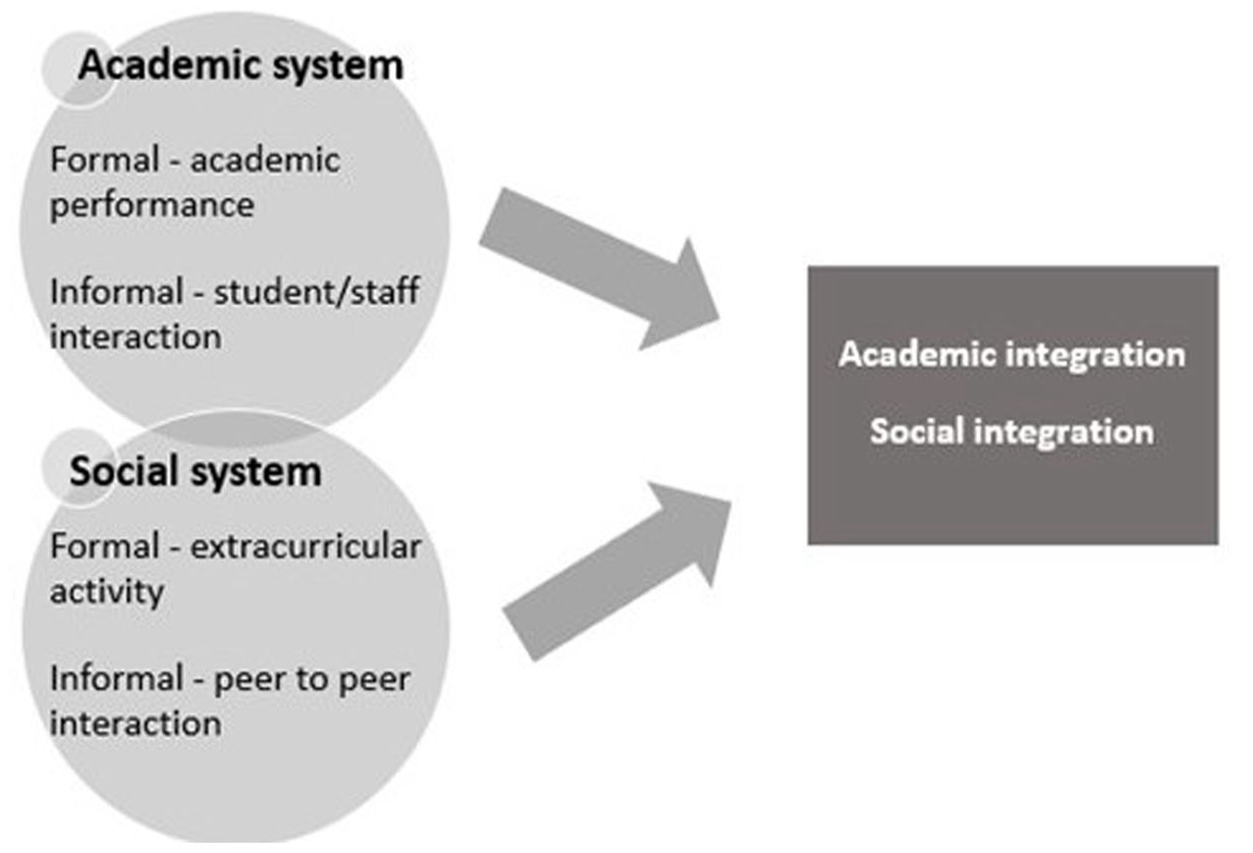
Summarising the key elements of Tinto’s integration model relevant to student community (modified from Tinto, 1993).
If students are in a community, they feel they belong. ‘Sense of belonging’ has been described in lots of different ways in academic research (Van Gijn-Grosvenor and Huisman, 2020), but one commonly accepted definition is ‘a subjective feeling of value and respect derived from a reciprocal relationship to an external referent that is built on a foundation of shared experiences, beliefs or personal characteristics’ (Mahar et al., 2013: 1031). So, there is a ‘feeling of connectedness and relatedness, and as a sense of feeling accepted, included and respected’, with student engagement key (De Sisto et al., 2021). A wealth of research has demonstrated the link between student belongingness and student success (see, among others: Ahn and Davis, 2020; Van Gijn-Grosvenor and Huisman, 2020). Indeed, Zumbrunn et al. (2014) found that students’ sense of belonging may have an impact on their self-efficacy in relation to study, which in turn has an impact on engagement and achievement.
Research has shown that some students find it easier to find a sense of belonging than others for structural reasons. Indeed, historically marginalised social groups (such as people of colour or people with disabilities) may find developing a sense of ‘belonging’ in education challenging (see Vaccaro et al. 2015, for a general discussion of the literature as well as a particular focus on students with disabilities), In relation to race and ethnicity, research shows that key to addressing this barrier is institutional commitment to ‘diversity efforts’ which can ‘diminish the negative effects of discrimination on sense of belonging’ (Hussain and Jones, 2021: 64). Hussain and Jones (2021) also summarise research showing that diverse and positive peer interactions can also have a positive impact on feelings of belonging for students of colour.
Indeed, more broadly, student interactions with each other at a peer-to-peer level and with members of staff are also known to be important in creating a sense of belonging (Li, 2020), something identified by Tinto (1993) in his model. Indeed, Van Gijn-Grosvenor and Huisman (2020) note that ‘people’ were most frequently reported by students as being instrumental in creating feelings of belonging, with opportunities to interact with other students important (at clubs, societies and events). In particular, student friendship networks were important: The current study showed that creating friendships, friendly interactions, and extracurricular opportunities to connect socially, in an environment in which people and their cultures are accepted and respected, were all identified by students as contributing to their feeling that they belong. (Van Gijn-Grosvenor and Huisman, 2020: 385)
In relation to the Politics discipline, a sense of community and the development of peer networks have been identified in research as having an impact on attendance and participation in Politics teaching. Indeed, Strong (2022: 13) writes of work with such students that ‘One implication of this is that time spent building social bonds among students studying together is likely time well spent, even if it is not directly focused on substantive material’.
The value of the ‘extracurricular’ – activities outside of formal academic learning/the course of study/the substantive material – in creating student community is also highlighted by Van Gijn-Grosvenor and Huisman (2020), discussed above. De Sisto et al. (2021) note that the integration of and student engagement with the academic and social is often done within curriculum, rather than outside it, but integrated extracurricular activities which are part of a well-planned programme can improve students’ sense of belonging. In fact, integrating the social/extracurricular and the academic/curricular can complement formal learning outcomes. The authors note ‘This aligns with the best practice approach of ensuring a connection to the course material’ (De Sisto et al., 2021: 1738). As such, it is useful to think of the academic and social as complementing each other, rather than rivalling, with ‘informal’ academic and social integration both of importance.
A lot of the research done so far relates to traditional face to face university settings, with students (~ 18–21 years) attending full time on campus. Indeed, Tinto (1993) noted that his work needed to be adapted to apply to non-traditional settings and students. This is something attempted by Bean and Metzner (1985) in relation to commuter students (part and full time) and Kember (1989, 1995) in relation to part-time online and open students. Bean and Metzner (1985) suggest that the main difference between the dropout rates of traditional and non-traditional students is that the latter are more affected by external factors rather than social integration. Kember (1989: 285) suggests that the social is of less importance to online and distance students, and when students study ‘in an environment away from the institution, background variables relating to the individual situation and family life assume greater importance’. As such, ‘the degree to which the student is able to integrate the demands of part-time off-campus study with family, work, and social commitments’ becomes crucial (Kember, 1989: 294). Kember et al. (2001), working with others, goes on to note various best practice examples which can help to create a sense of belonging for online/distance part-time students including class discussion, keeping students as a cohort, and getting teaching staff to interact with their students. Importantly, it is not the case that the social has no importance for part-time/online/distance students, but that component may have less importance compared with other factors or may compete with other factors which ‘traditional’ students are less likely to face.
Kember et al.’s (2001) work in fact make suggestions for encouraging a sense of belonging which are very similar to methods suggested for face to face ‘traditional’ settings. It should of course be recognised that in recent years there has been an increase in students studying online/at a distance (partly linked to the COVID-19 pandemic), with ‘traditional’ universities even offering online components alongside face to face elements. As such, the importance of the social to online and distance students may now have more relevance, as found by Peacock et al. (2020) who note the importance of peer-to-peer interaction in online learning in reducing isolation. Peacock et al. (2020: 21) write ‘Such interactions reduce anxiety, help learners to develop their ideas, and build connections’. Thomas et al. (2014: 76–77) sum this up well: Feelings of isolation [occur] when communities [are] not fostered within the online learning context, leading to dissatisfaction with the learning experience. The value of social interactions can easily be overlooked when content delivery and teaching become the primary focus, pushing aside opportunity for networking and friendship.
The impact of ‘students as partners’
One way in which student community can be engendered is by working with ‘students as partners’ in their teaching and learning. Healey et al’.s (2014: 7) definition is a useful starting point to better understand what partnership working in HE actually means: Partnership is framed as a process of student engagement, understood as staff and students learning and working together to foster engaged student learning and engaging learning and teaching enhancement. In this sense partnership is a relationship in which all participants are actively engaged in and stand to gain from the process of learning and working together.
In summary, students work with academics and each other to create and extend their learning. In relation to Figure 2, the aim is that this in turn has a positive impact on student community, which then has a positive impact on retention, something which is borne out by research (Healey et al., 2014). As noted above, one way to understand ‘students as partners’ is by viewing it as a ‘pedagogic partnership’ (Cook-Sather et al., 2014), in which all participants (staff and students) have the opportunity to contribute to their learning (e.g. design and implementation). It is thus a true partnership, albeit one in which the participants may contribute in different ways. Bovill (2017) makes the important point that ‘students as partners’ initiatives can be very diverse and one size does not fit all, in terms of the subject matter, the student cohort (small cohort vs large cohort, subset vs whole student cohort, and if students are invited to become partners election vs selection, etc.), and how the initiative is managed.
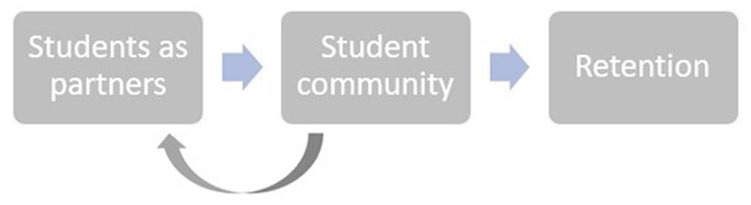
Importance of ‘students as partners’ in relation to retention.
In terms of Tinto (1993) and student community, ‘students as partners’ ticks multiple boxes: through it students can be better integrated into an institution both academically and socially. In relation to academic integration, ‘students as partners’ can be an opportunity to integrate students formally (academic performance) and/or informally (staff/student interaction). In terms of the social, ‘students as partners’ can be an opportunity to integrate students formally (extracurricular activities) and/or informally (peer-to-peer interaction). The type and level of integration depends on the design and management of the ‘students as partners’ initiative. In relation to social integration, working with ‘students as partners’ can ensure a connection between an extracurricular activity, course material, and skills development, and can therefore not only demonstrate best practice (De Sisto et al., 2021) but also provide a link between the social and the academic. Regarding skills development, enhancement of employability skills and attributes has been identified as a positive outcome of ‘students as partners’ ways of working (Jarvis et al., 2013). With employability high on the UK HE policy agenda (OFS, 2022a), institutions may therefore find a ‘students as partners’ approach a useful way of demonstrating that they take employability seriously as a student outcome.
In relation to employability, students are sometimes paid to act as partners. There is not much research on payment as a form of incentivisation, although it is discussed by Healey et al. (2014: 33) who note in relation to power relations that ‘it is important to reflect on how student contributions to partnership are recognised and rewarded’. Incentivisation can be through payment (the report lists various examples, including paying students to act as research interns via stipends and paying students for a fixed amount of time to develop educational development projects), or non-paid forms of recognition and reward (i.e. formal recognition of skills learnt as a partner) (Healey et al., 2014). A Politics-focused ‘students as partners’ project conducted at University College London (Arshad et al., 2021) is of particular relevance here, providing useful intel on the practical experiences of both students as paid partners, as well as the experiences of the staff member leading the project. Students were paid to help diversify and decolonise the Department of Political Science 2018/2019 reading lists by analysing and coding the current curriculum. The project was instigated by an academic who recruited the students, provided advice, and chaired meetings, but the students did the coding and analysis. Arshad et al. (2021) note ‘The collaborative approach was central throughout the project’, with practical experience of working on a project key to students’ developing their knowledge and skills and empowering them as ‘legitimate knowledge producers’. For the lead academic, there were also advantages: enabling her to take on a large project she could not complete on her own, bringing in student skills she did not possess, and dismantling the idea that ‘teacher knows best’. It was also a ‘vulnerable’ experience, as control was handed over (Arshad et al., 2021).
‘Students as partners’ can also be an opportunity to better involve hard-to-reach students and groups who have been excluded (Bovill, 2017; Cook-Sather and Agu, 2013). It also fulfils the move in recent years in the UK HE sector towards recognising the importance of students’ active engagement in their own learning (Healey et al., 2014) and the importance of the ‘student voice’ as a way of ‘empowering students and better understanding teaching and learning’ (Gibbs and Wood, 2021: 1). In relation to the latter, ‘students as partners’ is an opportunity for the student voice to be pro-active rather than re-active (i.e. based on student feedback), the latter described by Gibbs and Wood (2021: 3) as a ‘reductive’ approach exemplified by the sort of questions posed by the NSS. In relation to the benefits for staff, integrating ‘students as partners’ can help to improve staff–student relations (Gibbs and Wood, 2021), as well as providing an opportunity for staff to reconsider their philosophy and practice (Curran, 2017). ‘Students as partners’ can also be a way to effect institutional change. As Arshad et al. (2021) note, there is value in ‘working jointly on projects to effect change in universities, particularly by challenging traditional power structures between staff and students’.
That is not to say that a ‘students as partners’ approach is challenge free. Indeed, challenges include resistance of students/student preference for more didactic teaching, staff resistance/staff scepticism of the benefits, and limited staff–student contact/opportunity to interact which, in turn, has an impact on what can be achieved (Bovill, 2017). It is also essential that an institution commits to ‘students as partners’, in terms of embedding the practice into its ethos and culture (Healey et al., 2014). It is also important to recognise that while ‘students as partners’ suggests that participation is key – and ideally equal participation at that – academic staff may need to take final responsibility for some aspects of the process (Bovill, 2017). So, ‘equal’ does not mean that all actors are involved in the same way/have the same level of responsibility at all times.
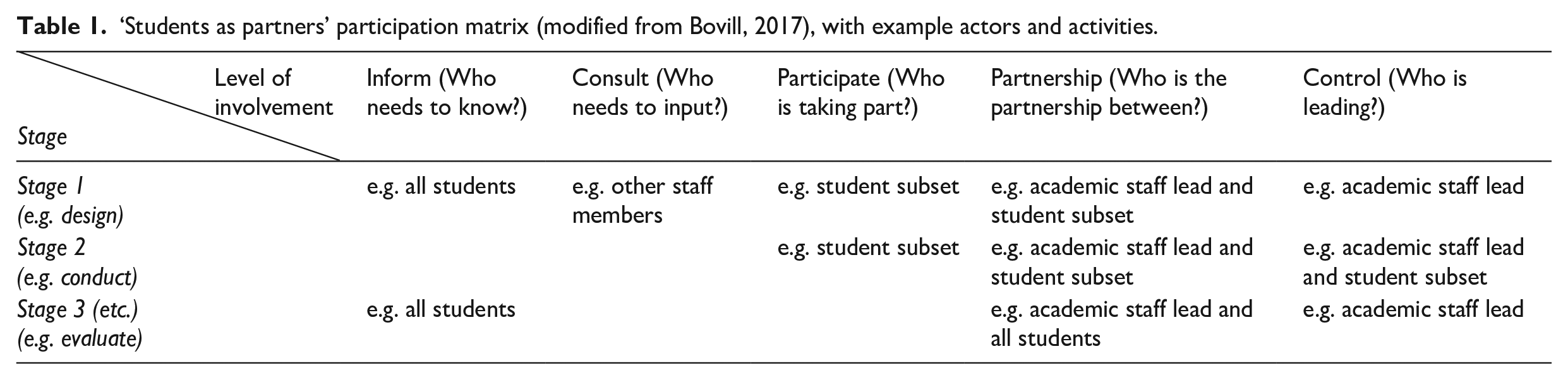
To explore this, there are many examples of ‘students as partners’ maps/frameworks, including Bovill’s (2017) participation matrix (see Table 1), which maps actor engagement in relation to the different stages of a ‘students as partners’ initiative, providing a useful and transparent way of mapping who is involved and who leads at different moments of the project. This is important, as key to partnership working is each party having an explicit understanding of their role and the partnership’s terms (Little, 2011). It is particularly useful in an HE context as there is a recognition built into the matrix that it may not be appropriate for all students to be involved all of the time (hence some of the boxes in a matrix are blank), something of particular importance perhaps in an online/distance HE context where students may be more likely to have outside commitments (work, caring responsibilities, etc.). It should also be noted that the ‘stages’ in the matrix will look different for each ‘students as partners’ project depending on the content of the project. The ‘levels’ in Table 1 can also be amended depending on the content of the project (e.g. a participation matrix could also have a ‘listen’ column); the ‘levels’ in Table 1 are in fact based on ones commonly used in the international development field (DfID, 2003 in Bovill, 2017). In relation to both the ‘stages’ and ‘levels of involvement’ of a participation matrix, the key benefit is transparency about action and roles across a project for all participants (Bovill, 2017).
‘Students as partners’ participation matrix (modified from Bovill, 2017), with example actors and activities.
Politics ‘students as partners’ case study: The OU and ‘Changemakers’
Bovill’s (2017) modified participation matrix served as both a theoretical grounding for and a tool to analyse an OU POLIS student engagement project linked to the University’s partnership with UK Parliament Week (UKPW). By engaging with this participation matrix, the opportunities and challenges of working with ‘students as partners’ within a Politics HE disciplinary context to build student community can be examined. Of relevance in this discussion is of course the OU’s educational model, as a distance-based/online university – what could be thought of as a ‘non-traditional’ university, using the terminology of Tinto (1993). As such, the OU project concentrated on ‘students as partners’ and building student community in an online-only context.
In 2020, OU POLIS agreed a partnership with the UK Parliament, focused on UKPW, an annual event which aims to spread the word about what the UK Parliament is, how it works, and how ordinary people can get involved. As part of our partnership the OU commits to publicising UKPW, and in return Parliament works with us on different activities, student and public facing. In autumn 2020 the OU, as part of UKPW, created and disseminated the ‘Changemakers’ project. This project, designed with OU POLIS students, sought to engage OU students and the wider public in learning about political and democratic engagement. The aim was to get people thinking about those who have made a change in our society and the impact they have had (politically, democratically, socially), thus inspiring others to make change/understand how to make change (inside and outside of traditional politics). It was a social media public engagement project, with students and others submitting their nominations (which could be international, national, or local public figures, or even someone they had a personal connection with) on Twitter. Another aim was to use this project to help to build up the OU POLIS community (peer-to-peer and staff/student).
We decided to take Changemakers further by extending this engagement project, by creating an online PDF guide (Open University (OU), 2021) to making political and democratic change, aimed at OU students as well as the general public, for UKPW November 2021. The guide used some of the submissions from 2020 as example changemakers. This element of the project had similar aims. Alongside the student community angle, one of the key aims of this part of the project was to improve the understanding that students and the wider public have about the UK Parliament and politics more generally, democratic engagement, and making change. To this end, the guide was promoted by OU and UKPW social media and follow up blogs and webinars. Both the 2020 and 2021 stages of the project were outside of our standard curriculum, although we advertised participation via module websites and tutors, thus emphasising the link with current curriculum.
A key feature of this project (both years) was involving ‘students as partners’. As such, for the 2020 UKPW project we advertised and hired two OU POLIS students (as part of an open and fair selection process, following OU recruitment and employment procedure) to draft social media communications about Changemakers, internal (for OU students) communications about Changemakers, and a video to advertise the project. As part of this the students helped to identify key themes which the project could focus on and public figures the project could reach out to, to further its reach. We also invited all students registered on OU POLIS modules and qualifications to nominate their changemaker on Twitter (if they did not have Twitter, they could add it on an internal forum and the OU would tweet it on their behalf). Members of OU staff could also nominate on Twitter, as could the general public. The nomination on Twitter could be anonymous or named, with students asked to use hashtags (created by the hired OU POLIS students) to identify their contribution. A limited number of Amazon vouchers were awarded to OU students and staff for best contribution. Examples nominations include the following: Greta Thunberg has mobilized over seven million children across the world to strike, like her, for climate justice. A healthy environment is essential to the survival, well-being and development of children, and therefore a precondition for the realization of the rights. [next tweet] At the same time, the fulfilment of children’s rights is a fundamental component of environmental protection. Greta’s school strike spread to other Swedish cities, to other European countries, and finally to other continents. My #Changemaker is @ MarcusRashford for his campaign to stop child poverty and hunger, which resulted in the government changing policy over its free school meal vouchers during lockdown.. and he continues his fight to protect the most vulnerable children #MakingChange #OUatUKPW.
For the 2021 UKPW project, we advertised and hired two OU POLIS students to act as critical readers of the Changemakers guide draft, and contribute to the launch of the guide via a webinar and blog post, as well as invited all students registered on OU POLIS modules and qualifications to feedback on/input into the Changemakers guide draft via an internal forum, and then attend the guide launch.
Regarding the project’s aim of enhancing OU POLIS community, Gibbs and Wood (2021) suggest that integrating ‘students as partners’ can help to improve staff–student relations. Indeed, one of the challenges of teaching and learning at the OU, as an online and distance institution, is creating opportunities for staff and student interaction as well as interaction between students. This project was one attempt to increase meaningful contact in an online context. In relation to Tinto (1993) and student community, the project aimed to better integrate students into the OU/OU POLIS both academically and socially. It ticked many boxes: academically, it was an opportunity to integrate students informally (staff/student interaction), and socially an opportunity to integrate students formally (through an extracurricular activity) and informally (peer-to-peer interaction). The project was less focused on formal academic integration (academic performance) as the project was outside of core curriculum, although we emphasised links to core curriculum.
As Changemakers was supplementary to OU POLIS students’ core-learning experiences, rather than embedded within module(s), incentivisation to take part was an important consideration. In line with Healey et al’.s (2014) discussion of incentivisation, and as noted above, a small number of students were paid to act as partners to the project. This was designed to even out the experience of staff and students. As Healey et al. (2014: 32–33) note about this issue: When working in partnership in learning and teaching, staff act in their role as paid employees of the institution, while for students the situation can be very different. This is a particular challenge when students work in partnership with staff outside of their core learning experiences; for example, in extra-curricular research projects, or quality enhancement work.
Of course, the staff/student experience was not completely even. As noted in Table 2 (below), the design, evaluation, and dissemination stages were controlled by the academic lead. This is in line with Bovill (2017) who notes that academic staff may need to take final responsibility for some aspects of the ‘students as partners’ process. However, the project meets Cook-Sather et al’.s (2014) definition of a ‘pedagogic partnership’, in which staff and students both have the opportunity to contribute to their learning (here, the design and implementation). It also gave students a pro-active rather than re-active voice, something identified as important by Gibbs and Wood (2021).
Mapping changemakers using Bovill’s (2017) ‘students as partners’ participation matrix.
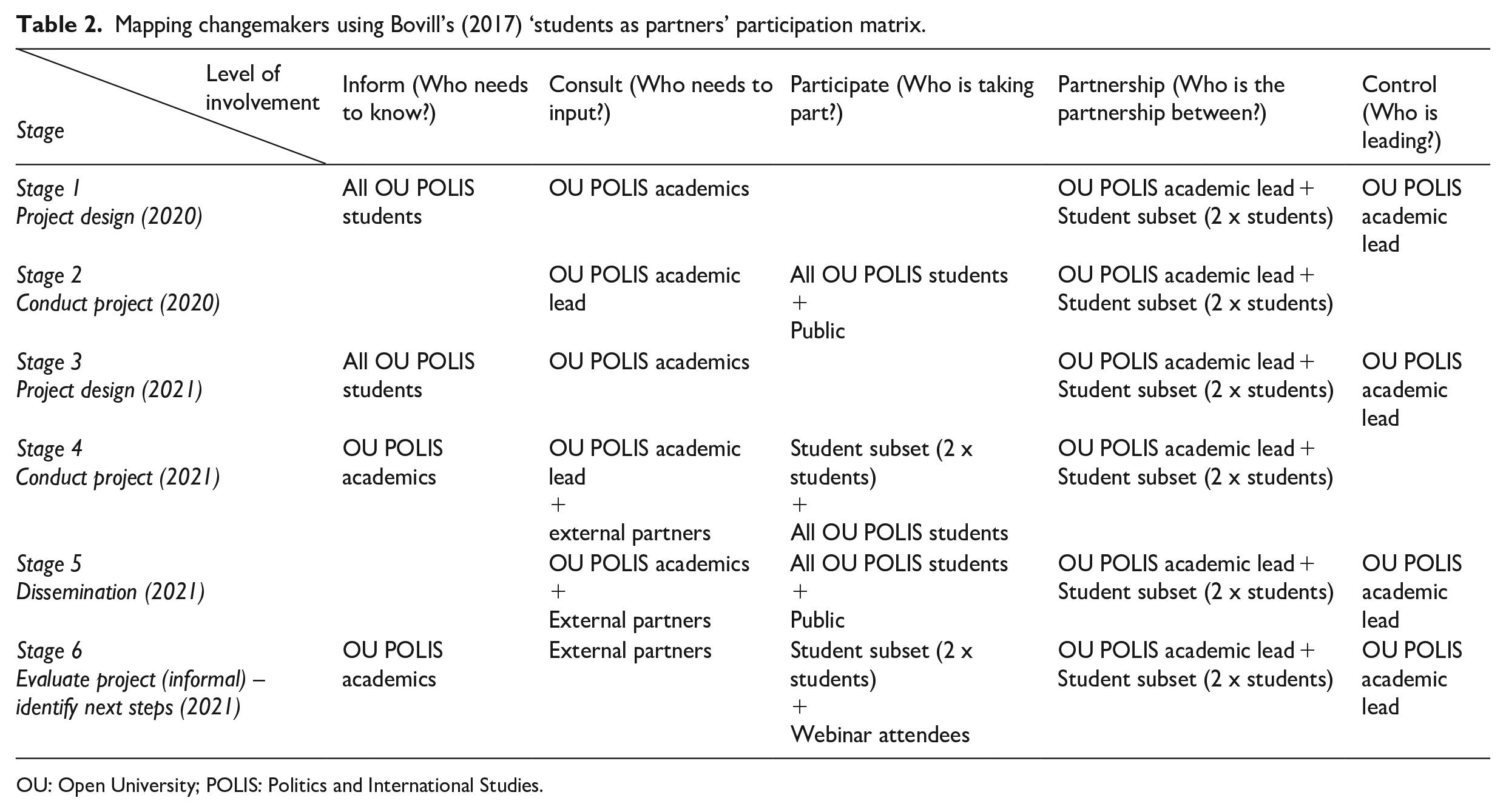
OU: Open University; POLIS: Politics and International Studies.
There are ethical issues to consider in only involving a small number of students as paid partners, that is, does this only engage those students who are already successfully engaged in their learning or who have the cultural capital and articulation to put themselves forward (Rudduck and Fielding, 2006; Taylor and Robinson, 2009). Issues of inclusivity and ethics (Healey et al., 2014) were balanced with the fact that one size does not fit all (Bovill, 2017) and it is common for ‘students as partners’ projects to work with subsets of students. While, on one hand, there is an exclusivity angle to only employing a small number of students, on the other hand, we made sure to run the student recruitment process in exactly the same way as the process for any other member of staff, in an open and fair manner (recruitment and selection), seeking to address structural and cultural barriers to participation which may limit partner involvement (Healey et al., 2014). We also invited the entire OU POLIS student cohort to contribute to both phases of the project, at a more informal level (for instance, inviting students to nominate their changemaker on Twitter). There was thus an ‘equality of opportunity’ (Healey et al., 2014: 30), which can be balanced with issues of inclusivity and scale.
For both the 2020 and 2021 student hires, we stressed the employability benefits to taking part as a paid partner (Jarvis et al., 2013), stating in the adverts: ‘Want to build your CV, enhance your project management skills, and improve your employability? Want to do something for UKPW? Can you help us design and curate this project?’. As such, and in relation to social integration (Tinto, 1993), the project is an example of connecting an extracurricular activity, course material (via advertising on a module level and through module tutors) and skills development. The social media aspect of the 2020 project also relates to employability. Dragseth (2020: 245), for instance, notes in relation to both undergraduate and postgraduate political science courses at a US university, that integrating social media into formal course design ‘can help students gain practical credentials to help them successfully find jobs’. It also helps with student engagement and aids the development of peer networks (Dragseth, 2020). While Dragseth’s (2020) research relates to formal course design (indeed, the author writes that social media use should ideally be closely linked to learning objectives rather than an independent activity), the findings are interesting more broadly.
It is important to understand that Changemakers developed iteratively. Not only was the final Changemakers guide developed and refined based on student input and feedback (the two student consultants but also the wider study body), but the overall project (both years) was also developed iteratively, allowing for staff–student feedback and review, collaboration, and partnership. Indeed, the final PDF guide was not the initial end-goal, but was identified as a useful product during the first phase of the project (Stage 2 of Table 2) and informal feedback from students. The project was developmental in nature and a learning experience for the department in terms of how to work with ‘students as partners’. It was certainly less structured than, for instance, the Arshad et al. (2021) example. That said, Bovill’s (2017) matrix (see Table 2) was a useful tool in the sense that it enabled us to think about how to embed students and staff and what level of participation was needed at each identified stage, as well as reflect on the overall process post-project. Indeed, in this sense we found that the matrix has a use in both project planning (in our case, planning the project stage by stage as part of the iterative and developmental project) and in project review (using it as a guide to map and assess how well each stage/group/level of participation worked).
On one hand, the developmental nature of the project gave us a freedom to explore and adapt the project as needed. On the other hand, this meant that evaluation was not built in at project outset and some data that would have been useful were not gathered and analysed, such as feedback on project impact (i.e. student understanding about how to make change as well as impact on student community) from students who submitted a changemaker on twitter or who fed into the Changemakers guide via the forum. As such, the project has not yet undergone a full evaluation (of the project itself, but also the impact on students, i.e. improved understanding of and engagement in how to make change, as well as impact on student community). Stage 6, evaluation, thus needs more work.
There has been a small amount of useful feedback gathered though. The Changemakers guide was launched with internal and external Teams events (Stage 5 of Table 2). Both events lasted an hour, and focused on a summary of the guide’s contents, how to make political and social change, and UK Parliament’s role in that. The first event was for OU Politics students only, the second event was open to the general public as well as students. For the first event, 10 students gave feedback. All ten said they would like ‘more events like this relevant to their course of study’. The majority of respondents (8/10) said they would or might now ‘take action as a result of the event’. Comments include: I wrote to my MP for the first time ever, on that same day. I’m hiring [X venue] . . . to start a new political . . . movement. It did make me think about the potential value and power of a petition. I really want to visit Parliament and have a guided tour. I will use the information I gleaned in my politics module. I have thought previously about petitioning on issues locally but not knowing how to go about it, what is involved or how this works, had not pursued this further, but with understanding I can now tackle this more confidently.
For the external event, 24 people gave feedback. Of the 24, 16 said they ‘would or might now “take action as a result of the event”’. 20 said ‘they would like more events like this’. This feedback was event-based and thus limited, but perhaps an initial indication from the respondents that (1) the content influenced understanding and action and (2) there is a community building element to this work that can be built on.
To build on the work done so far and to address the evaluation gap, the project academic lead and student consultants informally identified via post-project discussion (Stage 6 of Table 2) two further elements to the project (in relation to Table 2, these could be mapped as Stage 7 +), both aimed at increasing the project’s impact. First, to develop the PDF guide into a non-credit bearing virtual learning environment Open Learn course in partnership with our original partner UK Parliament, both expanding the content and creating more interactive learning opportunities for students. Second, undertaking research to uncover (1) the impact of this course on fostering active citizenship and political understanding among young people in the United Kingdom, that is, assessing understanding pre and post-course, and (2) the impact of working with ‘students as partners’ on OU POLIS student community (i.e. have feelings of community been engendered) and retention. In relation to the earlier point about student belonging and marginalised social groups, it would be particularly worthwhile to consider the impact of ‘students as partners’ on student community for such OU POLIS student groups.
Conclusions and recommendations
Implications for Politics HE practice are significant. It is clear from the literature that ‘students as partners’ has the ability to impact student community, which in turn can have a positive impact on student retention. This is an important benefit for students in and of itself, but is also important for universities in relation to UK Government HE policy (Wilson et al., 2021). Indeed, as noted above, the TEF has an explicit focus on student continuation and completion (Office for Students (OFS), 2022b), defined more generally in the TEF as ‘student outcomes’. In fact, there are two ‘key aspects’ to TEF: ‘student outcomes’ and the ‘student experience’ (OFS, 2022b), tying together the two key issues discussed in this article: student retention and student community (Figure 3).
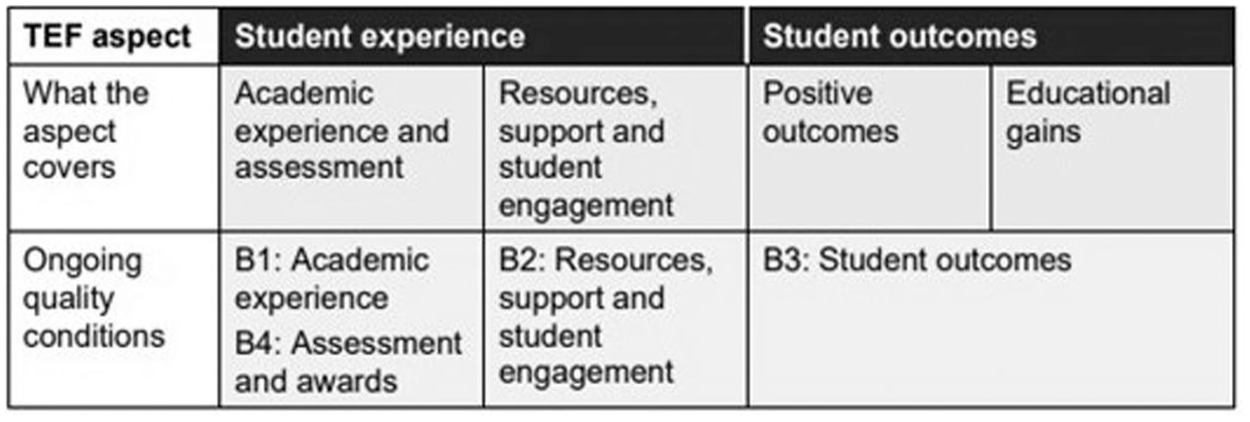
The two key aspects of TEF (OFS, 2022b).
The TEF does not assess activities which are primarily or purely social, but student community activities that ‘foster a sense of belonging and community’ and ‘contribute to the quality of the educational experience or outcomes’ may be relevant (OFS, 2022b: 10). As such, it is crucial for universities taking part in TEF to understand what their student community focused activities are (which includes ‘students as partners’ work) and the value of these activities – in relation to both the student experience, and potential impact on student outcomes.
To evidence this impact in a Politics UK HE setting, more research is needed on the impact of ‘students as partners’ on student community (and the impact of that on retention). The future OU POLIS research identified above will provide useful data and add to the conversation which has taken place in HE more widely. The OU research which has taken place so far is a good example of one of the issues which may be present in a lot of student community type work: it often develops iteratively, out of other pieces of work, and may therefore not be designed at the outset with a comprehensive evaluation plan, leading to the evaluation gap identified above. Bovill’s (2017) ‘students as partners’ participation matrix is therefore a useful way to both plan student community/’students as partners’ work, but also a tool for reviewing the work that has already taken place, that is, using it as a guide to map and assess how well each stage/group/level of participation worked. Bovill’s (2017) matrix is not the only tool available. The positives and negatives of many other student participation evaluation frameworks are well-discussed by Wilson et al. (2021), including how useful each framework was for understanding the process of evaluation and how relatable they were to the HE context. Bovill’s (2017) participation matrix was deemed to have a ‘high equity potential’ (Wilson et al., 2021: 10) in that it is useful in ensuring the ‘deep involvement’ (Wilson et al., 2021: 8) and empowerment of participants at different stages of a project. In particular, the matrix was useful for: Smaller scale interventions, where stakeholder involvement is itself an outcome, might be well served by using the SaP framework. For instance, enhancing a student’s sense of community via a partnership approach, used as a means to address satisfaction levels, is more likely to make students feel involved, which is an outcome in itself and likely to lead to increased satisfaction (Wilson et al., 2021: 10).
Broader lessons for other institutions, based on the OU POLIS experience and the wider literature and research, include the importance of understanding the value that a ‘students as partners’ approach can bring (to students as well as the wider institution), as well as the importance of having a framework – such as the participation matrix – for both planning and analysing the ‘students as partners’ activity. The latter ensures that the project engenders what Wilson et al. (2021: 8) call participant ‘deep involvement’. Furthermore, Politics-based research at other institutions would be useful to understand (1) the challenges and benefits of other Politics HE ‘students as partners’ projects in terms of student experience and student outcomes, (2) the use of a participation matrix (or other framework) to map student (and other participant) engagement in ‘students as partners’ projects, and (3) wider implications for HE practice including curriculum design and staff ways of working. It would also be useful to consider these issues in both traditional (i.e. face to face) and non-traditional (i.e. online) settings, to assess the similarities and differences in terms of challenges, benefits, opportunities, and outcomes.
Footnotes
Acknowledgements
The authors thank the OU students who helped to develop the Changemakers project. The authors thank the UK Parliament Week team/UK Parliament more broadly for helping to develop the Changemakers guide, and the Political Studies Association for helping to fund the guide.
Funding
The author(s) received no financial support for the research, authorship and/or publication of this article.
