




Abstract
This article studies the violent politics of stigmatisation and erasure of nationalist urban infrastructure. In general, urban infrastructure is a mechanism of state power. But, through the case of the imposing presence of Turkish nationalist infrastructure in the Kurdish city Diyarbakir, it demonstrates that when tied to an antagonistic nationalist political project, this infrastructure is often purposefully built to violently cleanse urban spaces of the national “other”. Be it a statue, a mural or a picture of a nationalist leader – this infrastructure is incapable of inflicting physical pain. Nonetheless, its violence is symbolic and meant to have a real effect on Diyarbakir’s Kurds’ ability and willingness to identify as Kurds. That said, violence does not entirely inform the spatial experience of those targeted by this nationalist infrastructure. The article demonstrates that Kurdish residents also found ways of remaining unaffected, even treating the infrastructure laden with Turkish nationalist iconography as a reminder of their own Kurdish identity. This article thus expands our understanding of what nationalist infrastructure does. It may be designed to be violent. However, it also reveals itself to be a site of contestation – equally inspiring the persistence of the counter-narrative of the national “other”.
Infrastructure is rarely apolitical. This was evident to me in December 2010 when I took a tour of Anıtkabir, the mausoleum of the founder of the Republic of Turkey (or Türkiye), Mustafa Kemal Atatürk. Ahmet,
1
a 45-year-old employee of the Turkish Radio and Television Corporation (TRT) and former ESL
2
student of mine, joined me on the tour. We met outside the mausoleum compound and walked up a winding path that led us to the top of Rasattepe (Observation Hill). We then went up a flight of stairs, walked through the Street of Lions lined with 24 stone sculptures of Hittite Lions and arrived at the ceremonial plaza in front of the mausoleum. On top of the hill, we had a 360 degree view of the capital city (Figure 1). And, as we stood in the shadow of Anıtkabir, I was struck by the sheer grandeur and the towering physicality of the mausoleum. With the words of Atatürk, Ne mutlu Türküm diyene [How happy is the one who says I am Turkish], written on its walls, and guarded by the Turkish armed forces, Anıtkabir is a celebration of Turkish nationhood as imagined and embodied by Ataturk, the father of the republic (Figure 2). But while I was taken by the opulence and grandeur of the mausoleum, Ahmet seemed unimpressed. During the tour he remained uncharacteristically quiet, only nodding slightly on occasions. And, as soon as we exited Anıtkabir, he, almost impatiently, said to me, ‘You know, I am Kurdish’. Having known him for a year, I was surprised by this revelation. So, I asked, ‘Why haven’t you ever mentioned this to me?’ He replied: To be honest, I don’t talk about it. Not even to my colleagues. I have worked in TRT for fifteen years and only two people know. Everyone there is a nationalist. Just like here [referring to Anıtkabir] there are pictures of Atatürk, his quotes, big Turkish flags everywhere and they don’t like Kurds. For them there are no Kurds. In my daughter’s school they are made to say Ne mutlu Türküm diyene in the morning. So, no one there knows that she is Kurdish. She has a Turkish name in school. At home she has a Kurdish name. In school she speaks Turkish. At home we speak Kurdish.
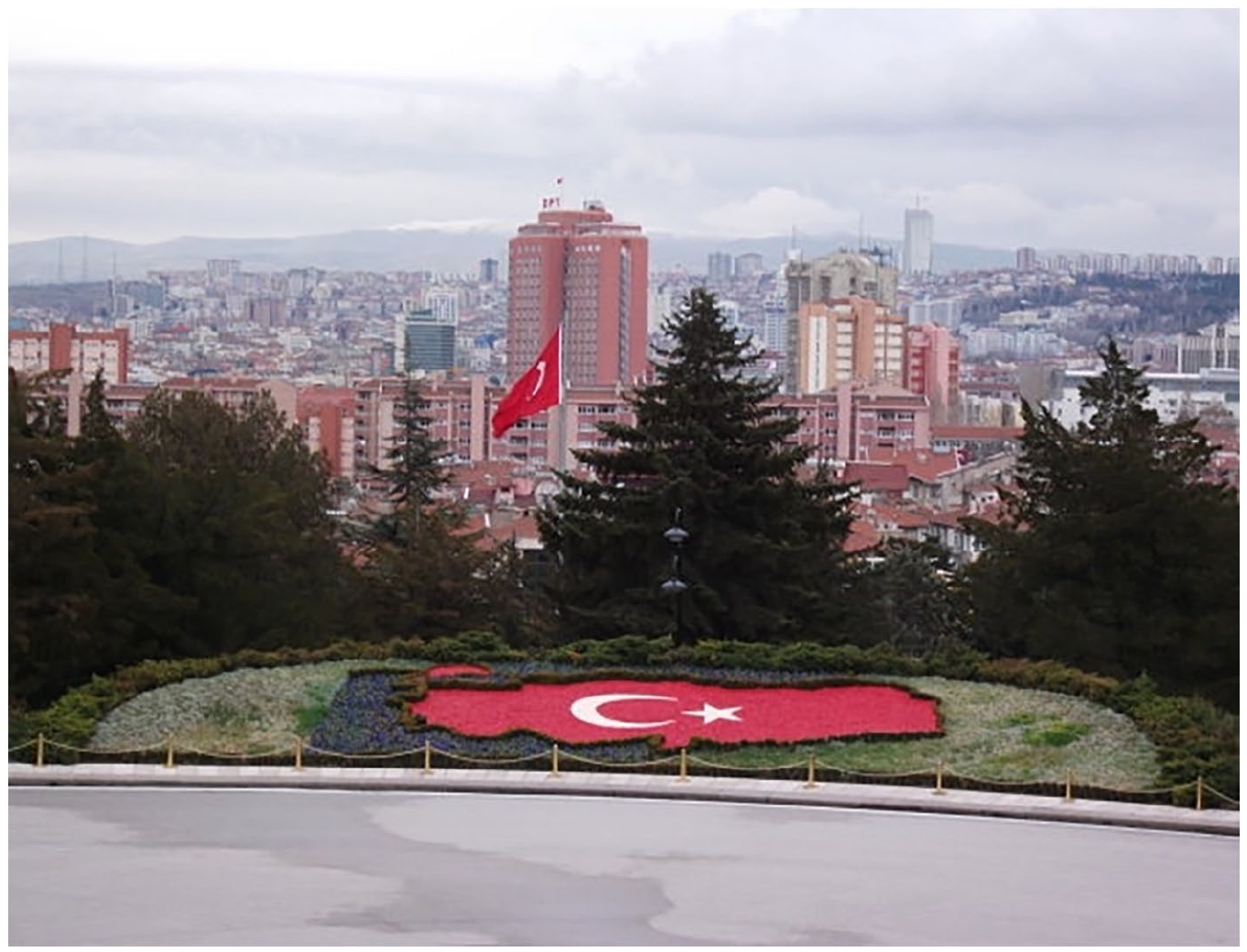
A view from Anıtkabir (Photo by author).
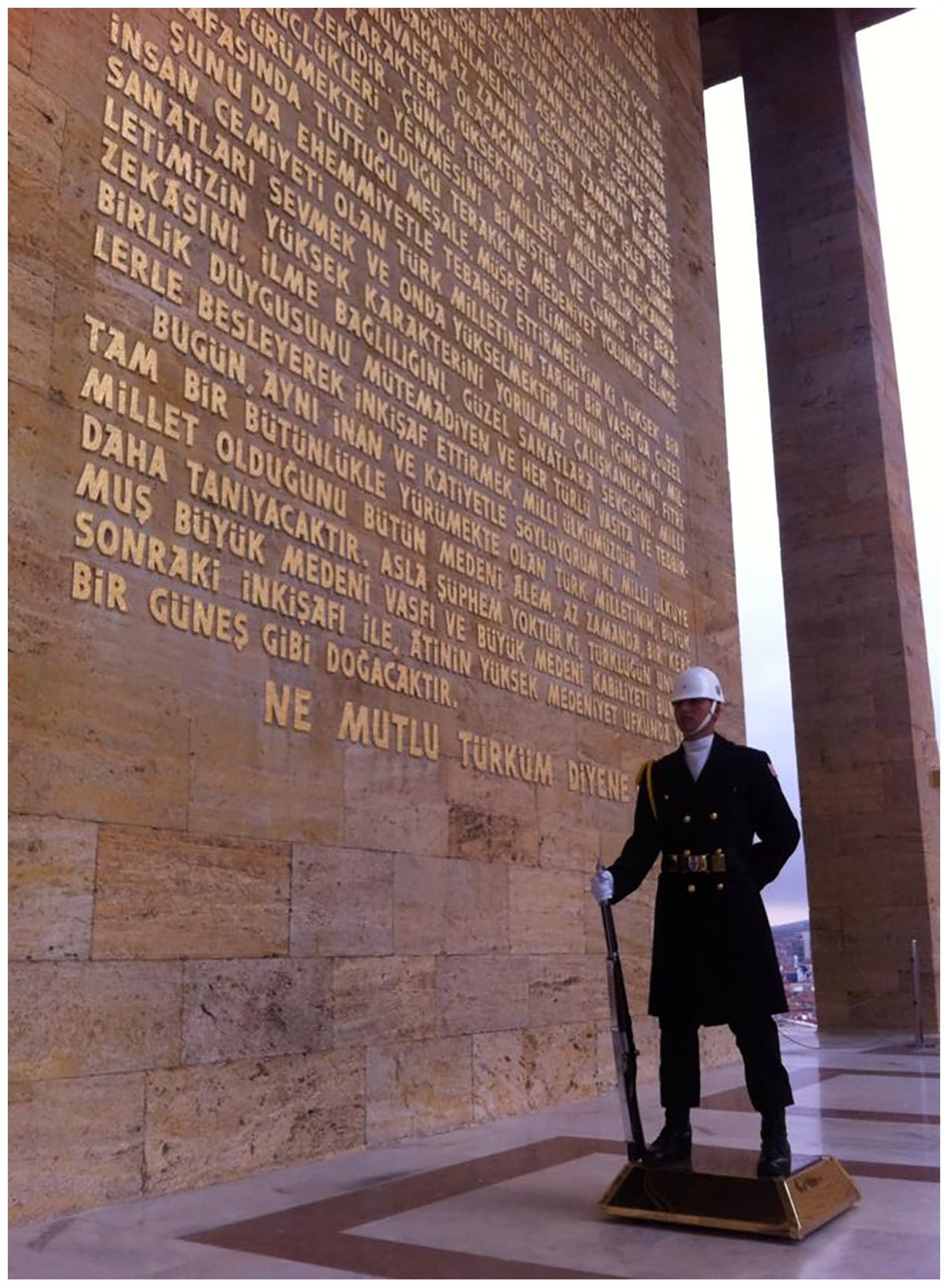
A soldier guarding Atatürk’s mausoleum in Ankara (Photo by author).
The mausoleum is just one of many examples of nationalist infrastructure that exist across Turkey (Wilson, 2009: 230). In this sense, Anıtkabir’s towering presence in Ankara mirrors the provocative etching of Turkish nationalist slogans on the hills and mountains of south-eastern Turkey and the images and words of Atatürk displayed in the built landscapes of Kurdish-majority cities. Seen together, these are not just mundane ‘physical interventions’ (Mitchell, 2008: 24). This infrastructure is deeply political and assists the Turkish nationalist enterprise by ensuring that the landscape perpetually expresses the story of the Turkish nation (Cosgrove, 1984; Gökarıksel and Secor, 2022; Küchler, 1993). But, while this infrastructure stands as an expression of Turkish nationalism, Ahmet’s encounter with the dominant physicality and grandeur of Anıtkabir reminds us that its political remit also entails an effort to stigmatise (Link and Phelan, 2001) and erase the “other” – namely those who do not adhere to the same national story. So, whether dwarfed by Anıtkabir, by the Turkified urban infrastructure of Kurdish-majority cities or by the hills of Turkish Kurdistan that have Ne mutlu Türküm diyene written on them, for Kurds this infrastructure represents a violent imposition of Turkish-ness on what they consider to be Kurdish landscapes. In this article, I therefore explore this violence of the nationalist urban infrastructure. Specifically, I focus on the violent politics of erasure that animates the Turkish nationalist infrastructure in the iconic Dağkapı Meydanı or Dağkapı Square in the Kurdish city of Diyarbakir in south-eastern Turkey.
Methodologically, this article draws on ethnographic fieldwork that I conducted in Diyarbakir in 2014–2015. Semi-structured interviews as well as participant observation were the primary means of data collection, and the focus was on the city’s Kurdish residents’ spatial experience of the Turkish nationalist infrastructure in Dağkapı Square. Theoretically, this article builds on works that politicise what infrastructure is and does (Anand et al., 2018; Appel, 2012; Coward, 2009; Graham, 2010; Li, 2018; Rodgers, 2012; Smith, 2002; Young and Keil, 2010). Herein, I recognise that urban infrastructure is a mechanism of state power, ordering and ‘political control’ that facilitates ‘effective state penetration of social life’ (Mann, 1984: 192). Though, when this infrastructure is tied to a deeply antagonistic (nationalist) political project it is purposefully ‘designed to be violent’ (Rodgers and O’Neill, 2012: 406), as it plays a particular role in controlling, policing and cleansing the urban spaces inhabited by the (national) “other”. Accordingly, the article begins by demonstrating the violence of the infrastructure in Dağkapı Square. This infrastructure includes, for instance, a statue of Kemal Atatürk that represents the benevolent (Turkish) leader bringing the city’s Kurds into the fold of Turkish-ness and a mural of Atatürk in a battlefield with a nationalist slogan that denies the existence of a distinct Kurdish national identity. A statue, a mural or a slogan may not be able to inflict physical harm on Diyarbakir’s Kurdish inhabitants. Nonetheless, I argue here that the violence of this infrastructure is expressed through its imposing presence in a Kurdish city and in its attempt to sieve out the Kurdish-ness of those who walk through the Dağkapı Square.
But does this represent the entirety of what this infrastructure does? In other words, when the Kurdish inhabitants of Diyarbakir walk through the city’s Turkish infrastructure, is its attempt to erase Kurdish-ness and impose Turkish-ness the only thing that defines their spatial experience? Undoubtedly, this infrastructure is an exposition of muscular nationalism and is indeed confirmation that infrastructure is a mechanism of political power, ordering and control. Yet, a landscape can also be ‘the spatial form that social justice takes’ (Mitchell, 2008: 45). To be sure, my Kurdish interlocutors in Diyarbakir acknowledged that the Kurdish landscape is dominated by the Turkish nationalist infrastructure that seeks to cleanse their Kurdish-ness. However, I demonstrate that they also found ways of remaining unaffected, even treating the infrastructure laden with Turkish nationalist iconography as a reminder of their own Kurdish identity. This article thus expands our understanding of what nationalist infrastructure does. It may be designed to be violent. However, in the case of Dağkapı Square, this infrastructure also reveals itself to be a site of contestation – equally inspiring the persistence of the counter-narrative of the national “other”.
Turkish infrastructure in Kurdish landscapes: The case of Dağkapı Meydanı
In mid-December 2014 I travelled to Diyarbakir. Before the journey a Turkish activist in Istanbul had reminded me that I was about to visit the “other Turkey”. She had said: It is the Turkey you don’t hear about. In fact, it’s like a different country. Not everyone there is Turkish. Not everyone there feels Turkish. Not everyone there speaks Turkish. And they don’t care for all this Turkish nationalism you see in Ankara or Istanbul. It is Kurdistan and Diyarbakir is the urban centre of the Kurdish struggle [in Turkey] (Author Interview, December 2014).
These words rang true to me when I arrived in Diyarbakir. Unlike Ahmet, who seemed somewhat burdened by the task of being Kurdish, the inhabitants of Diyarbakir appeared uninhibited in their Kurdish-ness. On my trip from the airport, I noticed that the Dolmuş (shared taxi) driver switched seamlessly between Turkish and Kurdish while speaking to his passengers. Men and women proudly donned the Kurdish traditional clothing. And, when meeting a foreigner like me, they were quick to recommend that I try Kurdish food before bidding farewell to me by saying ‘Welcome to Kurdistan!’
However, as soon as I stepped onto the premises of Dağkapı Square, in front of the walls of the old city, I was reminded that Diyarbakir continues to bear the scars of the violent process through which this Kurdish city was made Turkish. In 1924, Sheikh Said called for Kurdish liberation. He then led the rebellion of 1925 (Bruinessen, 1992: 280). The rebels made significant progress in the early days of the uprising and captured several towns in south-eastern Turkey. But while Sheikh Said was able to defeat the ‘local military units’, the rebellion was eventually suppressed when the Turkish government ‘mobilized and dispatched larger units’ (Özoğlu, 2009: 183). Subsequently, after being captured by Turkish forces, the Sheikh and 47 of his supporters were sentenced to death by the Court of Independence. Dağkapı Square was then chosen as the site of their unmarked graves. The gallows were constructed and installed in the square, and prisoners were chained and led to the site a single file. After the executions the bodies were left ‘hanging until noon the next day, when the soldiers took them down and carried them to a ditch not far away. There, the bodies were piled up, concrete poured on top, and the ditch was filled with dirt’. The precise location of the mass grave remains unknown (Ozsoy, 2013: 191–192).
The decision to dump the bodies of the Sheikh and his supporters in unmarked graves was meant to symbolise the unceremonious burial of their rebellious spirit and the challenge they presented to the territorial sanctity of the Turkish republic. Though, today’s Dağkapı Square is more than just a place where the memory of this historical episode of the Kurdish liberation struggle is buried (Ozsoy, 2013: 219). It is also a display of the still-persistent effort to animate Kurdish cities as Turkish – specifically, through ‘[t]he imposition of the architectonic signs of Republican power’ on the urban infrastructure (Houston, 2005: 104). This effort began in the aftermath of the establishment of the Turkish Republic in 1923. Nationalists, led by Atatürk, believed that ‘national sovereignty and national identity constituted the mode of modernity politically’. This then led to a manner of ‘Republican practice’ that occurred ‘in and through the built environments of the major and provincial Anatolian cities’ (Houston, 2005: 104).
When I walked through Dağkapı Square for the first time in 2014 I noticed three prominent emblems of Republican power displayed in and through the built environment. The first was a building located within the premises of an army compound overlooking the north-east corner of the square. On it was an iconic mural of Kemal Atatürk in army fatigues in Kocatepe during the Great Offensive of 1922, which was the last and decisive military operation of the Turkish War of Independence (Gingeras, 2016). Above this image were the words: Diyarbakirlı, Vanlı, Erzurumlu, İstanbullu, Trakyalı, Makedonyalı hep bir ırkın evlatları, hep aynı cevherin damarlarıdır [Diyarbakir, Van, Erzurum, Istanbul, Thrace, Macedonia – they are all children of the same race, (they are all) veins of the same gem.] (Figure 3). The second was a picture of Atatürk and the Turkish flag placed on top of a citadel east of the square (Figure 4). The third, placed on the western end of the square, was a statue of Atatürk embracing two children looking up towards him with reverence (Figure 5).
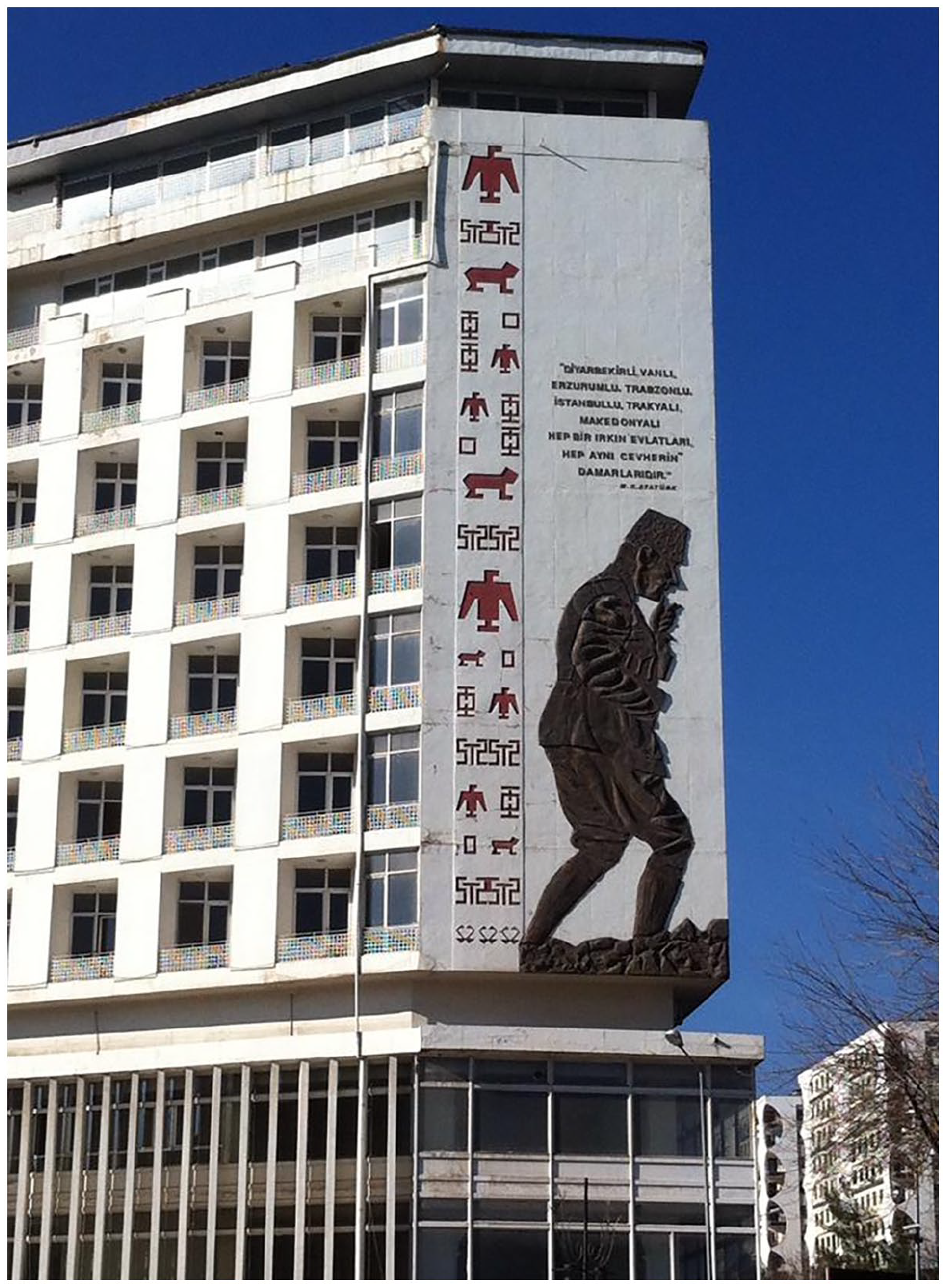
Mural of Atatürk during the Great Offensive of 1922 (Photo by author).
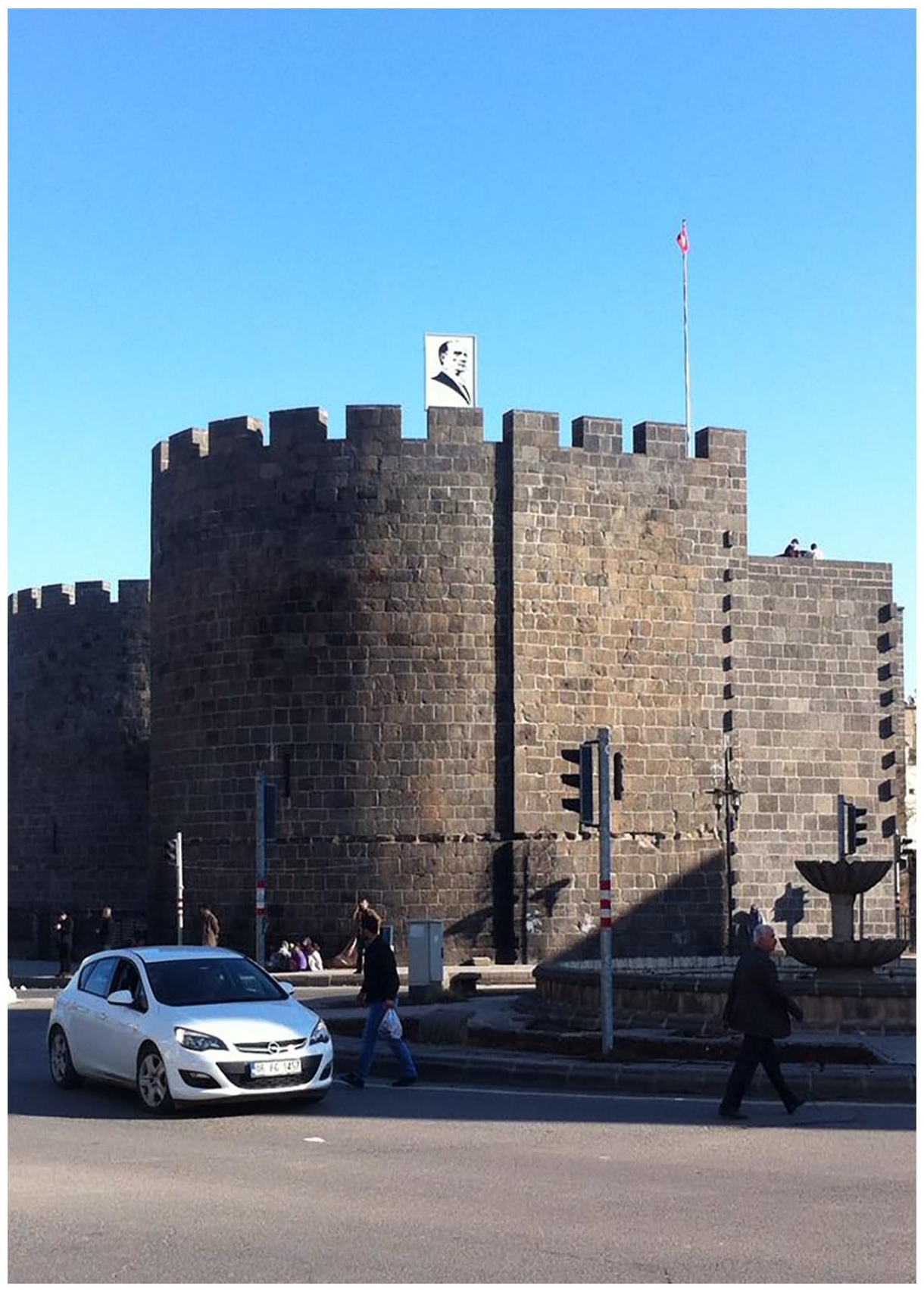
The picture of Atatürk and a Turkish flag on top of the citadel (Photo by author).
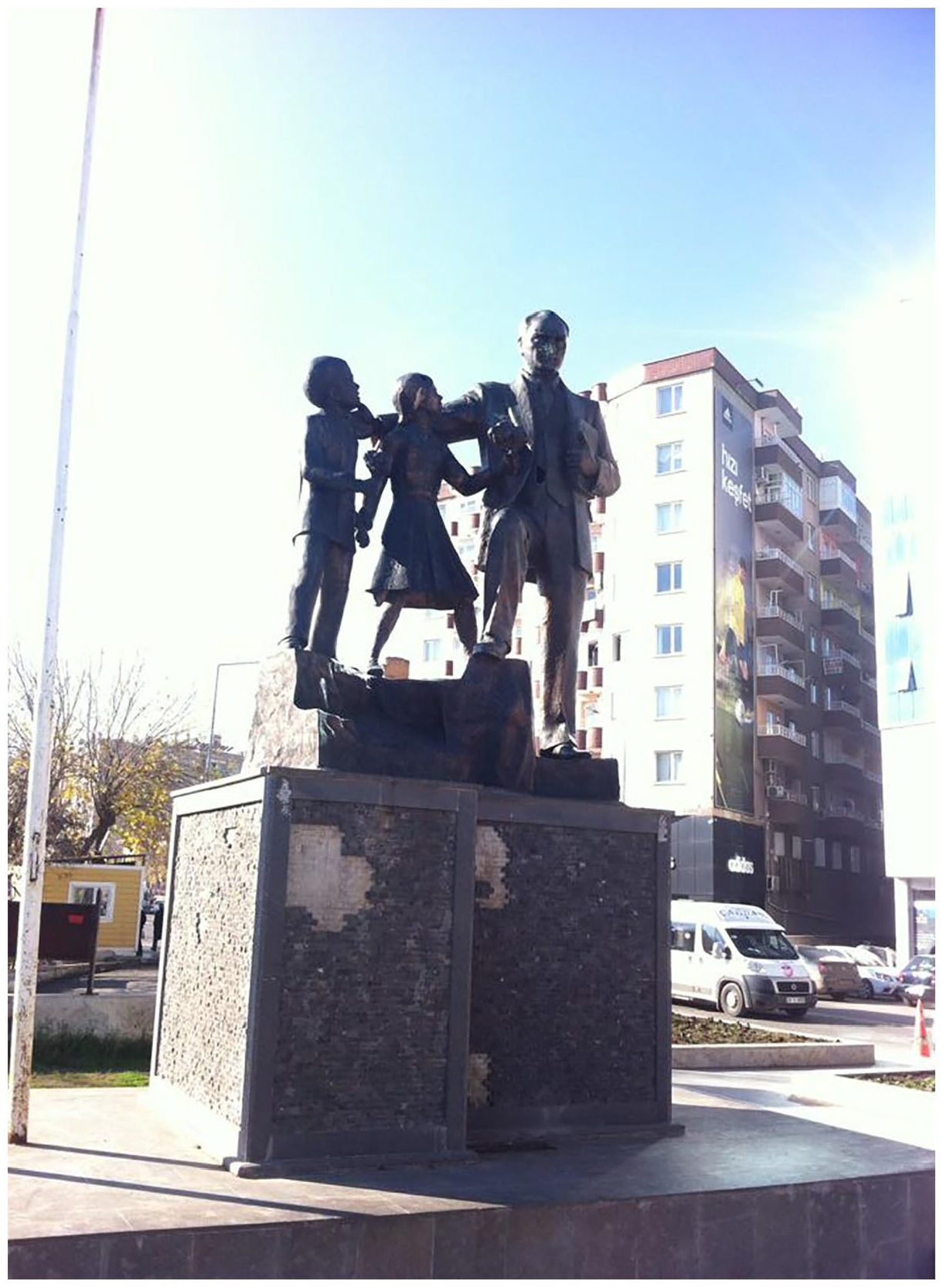
A statue of Atatürk (Photo by author).
In a sense, Dağkapı Square is now a space of ‘make-believe’ that seeks to erase and replace what existed. Yael Navaro-Yashin (2012: 3) witnessed the creation of a ‘make-believe’ space of Turkish-ness when Greek names of places were changed to Turkish in the aftermath of the establishment of the Turkish Republic of Northern Cyrus. The attempt to create a similar space was evident in Dağkapı in the message that those from Kurdish-majority cities such as Diyarbakir and Van are from the same race and, more importantly, are no different from the presumably Turkish residents of Erzurum and Istanbul. Meaning, according to this message, Kurdish-majority cities like Diyarbakir and Van were places where there are only Turks and no Kurds. These words were then placed next to an image of Atatürk from the scene of a historic battle and on a building within a military compound. This symbolised the fervent, militaristic spirit with which the Turkish nationalist is willing to defend this myth of Kurdish non-existence. The picture of Atatürk and the Turkish flag represent the same ideology – one that denies the existence of a Kurdish peoplehood. Finally, the statue of Atatürk, with one arm embracing the two children, can be seen as a signifier of the way the founding father of the Turkish republic, and the ideology he personifies, aim to embrace, and guide the childlike (Kurdish) inhabitants of Diyarbakir towards the ideals of Turkish nationalism and away from their Kurdish-ness.
That the Turkish infrastructure in Dağkapı Square is meant to be hostile towards Diyarbakir’s Kurdish residents became even more evident to me when, during my visit, I heard the roar of Turkish fighter jets flying over the city. Israel’s fighter jets ritually break the sound barrier when flying over Gaza as a way of constantly keeping the besieged Palestinian population in a state of unease, while simultaneously emphasising the material prowess of the State of Israel (Sen, 2020: 79). Similarly, in Dağkapı Square, the hostility and violence of the built environment is not solely evident in the message it delivers; it is equally evident in the way this message is delivered. That is to say, there is a certain continuity between the urban landscape that is experienced on earth and the sky above (Ingold, 2007: 19–38). In the sky there are Turkish fighter jets that, by ritually flying over a Kurdish city, establish the dominance of the Turkish state and its ideology from a higher vantage point (Olwig, 2018; Sen, 2021, 2022).
Contemporary Dağkapı Square (along with its Turkish infrastructure) is thus a materialisation of the muscular nationalism that projects itself from the Turkish national capital and imposes its ideology upon a rebellious Kurdish population from above i.e., a position of dominance. The building bearing the image of Atatürk in battle towers over Dağkapı Square. The picture of Atatürk and the Turkish flag stand on top of the citadel and look over the square from the east. Even the statue of Atatürk with the two children represents the supremacy of the Turkish nationalist ethos. Atatürk’s embrace could be seen as a sign of benevolence. Nonetheless, he – as a symbol of Turkish nationalism in the era of the republic – maintains his status of supremacy and dominance as the children look up to him, almost obediently waiting to be guided by the fatherly figure onto the righteous path of Turkish-ness.
On violent infrastructure
The Oxford Dictionary of English defines ‘infrastructure’ as ‘the basic physical and organizational structures and facilities (e.g. buildings, roads, power supplies) needed for the operation of a society or enterprise’ (Stevenson, 2010: 898). Such a conception limits the remit of infrastructure to being a ‘technical apparatus’ managed by public officials, engineers and planners (Rodgers and O’Neill, 2012: 403). However, Dağkapı Square reminds us that infrastructure is more than a technical apparatus. What it is and does is often an extension of a political enterprise. For instance, Michael Mann (1984: 189) argues that infrastructure is a matter of state power that plays a defining role in its ability to ‘actually penetrate civil society, and to implement logistically political decisions throughout the realm’. Among other things, he adds, this power involves the state’s control and sovereignty over roads, waterways and communication systems (Mann, 1984: 196–197). Similarly, Brian Larkin (2013: 329) describes infrastructures as ‘matter that enable the movement of other matter’. They are material objects that we can see and touch and that have specific technical functions. However, infrastructures are also reflections of individual and societal dreams, aspirations and fantasies and work towards making these fantasies real in a way that exceeds their technical functions (Larkin: 2013: 329, 333). Colin McFarlane and Jonathan Rutherford (2008: 370) thus conclude that the function of infrastructure is ‘socially constructed’ as it is both a means of governance and an arbitrator of the urban experience.
Returning to the infrastructure in Dağkapı Square, we could then argue that it is an extension of the Turkish national enterprise and meant to help govern and arbitrate the urban experience in accordance with its political remit. To be sure, statues, monuments and murals like those present in Dağkapı Square have long served as national memorials (Johnson 1995). Expounding on their affective qualities in Germany, Huyssen (1996: 181), for instance, proposed the notion of ‘monumental seduction’ to denote the ‘inflation of memory’ that was occurring in the 1980s in Germany when there was a proliferation of ‘Holocaust monuments and memorial sites’. As physical structures, these sites were meant to rekindle (and commemorate) the memories of the Second World War. Gurler and Ozer (2013: 861) thus conclude that ‘public memorial places’ are designed to shape ‘social memory’, identity and function as a means for inducing ‘mourning, learning a lesson from history, teaching and reminding the younger generation about past events, improving the dialogue between the past and present, etc.’. In Dağkapı Square, the infrastructure’s monumental seduction could then be viewed as evident in the politics imbued in its form and aesthetics as it displays the “story” of the Turkish nation. However, being placed in a Kurdish city, what this infrastructure is and does is far more accurately reflected in the violent manner that its Turkish-ness is meant to confront and suppress the Kurdish-ness of the city’s residents who encounter it in their everyday lives. Dağkapı Square then confirms that infrastructure serves as an ‘instrumental medium’ that ‘reinforce[s] social orders, thereby becoming a contributing factor to reoccurring forms of harm’ (Rodgers and O’Neill, 2012: 404). Equally, Rodgers and O’Neill’s (2012: 405) notion of ‘infrastructural violence’ finds relevance here, as the ‘material infrastructural forms’ of the square are meant to communicate the broader ‘structural forms of violence’ and perpetuate ‘social suffering’.
To be sure, the relationship between violence and infrastructure can take varied forms. In Disrupted Cities, Stephen Graham (2010: 2) explores the effects of the sudden disruption in the functioning of this infrastructure – say, due to a terror attack – to show that a presumed apolitical technical apparatus can indeed serve political ends (see also Graham, 2004). Of course, the intertwined relationship between infrastructure and violence is palpably visible in wartime targeting of urban infrastructure (Coward, 2008). In such instances, the destruction of ‘electrical grids, water supplies, and other [civilian] infrastructure’ is meant to inflict violence on both, those use this infrastructure to effectively govern and those who rely on it for their survival (Smith, 2002: 361). In her study of Equatorial Guinea, Hannah Appel (2012: 441) demonstrates that enclaves built for the expatriate community employed by ‘oil and gas companies’ enjoy an infrastructure that is largely inaccessible to the local population. She then terms this as a form of infrastructural violence as the enclaves allow for the ‘intentional abdication of responsibility’ (2012: 442) for the lack of essential infrastructure outside their walls. The violence of infrastructure is equally evident in Li’s (2018: 328–329) discussion of oil palm plantation zones in Indonesia. By comparing state and privately owned plantations, the author concludes that their orderly infrastructure is sustained by a ‘predatory system of channelling and capturing plantation wealth’ that in turn ‘entrench[es] violence’ onto the socio-political context in which they operate.
Evidently then, infrastructural violence can take different forms. In fact, just as violence exists on a continuum with a multiplicity of expressions (Scheper-Hughes and Bourgois, 2004: 21), so too can infrastructural violence have varied manifestations. This was apparent, for instance, in Rodgers’ (2012: 414) study of Managua in Nicaragua where, the author argues, ‘the extensive infrastructural transformation’ of the capital city has inflicted both physical and sociopsychological forms of violence. The question that then emerges is what kind of violence – say, on an infrastructural violence continuum – emanates from the Turkish infrastructure in Dağkapı Square? When asked, my Kurdish interlocutors viewed this infrastructure as an extension of the violence that is inflicted by the Turkish state on the lives of Kurds more generally. For instance, a Diyarbakir-based activist Deniz said: In many ways walking through Dağkapı this is a normal experience for me. We grew up with these statues and slogans. They all are there to tell us that we don’t matter. Our identity doesn’t matter to the Turks. So, for me, Dağkapı simply tells you that we are colonized people.
I then asked him, ‘You mentioned growing up around these statues and slogans. Can you tell me more about the effect this had on your childhood?’ Deniz replied: Some of this experience has to do with the stories we grew up with. My father grew up in a Kurdish village. All the teachers in these village schools are Turkish and they are there to make us become Turkish. So, when my father was in school, he was caught speaking Kurdish. The teacher beat him up very badly. He was so ashamed of being Kurdish. He was also ashamed of my grandmother because she was Kurdish and did not speak to her for a month. When the teacher beats you, you feel that your teacher is right. You feel an inferiority complex because of your identity and then you start hating your parents because they speak Kurdish. In many ways you start hating yourself for being Kurdish. I was born in Diyarbakir. I grew up these Turkish flags and statues and pictures of Atatürk. When I was a child and even now, these things in Dağkapı remind me how the Turkish state hates my Kurdish identity. It makes me feel bad about being Kurdish. Also, it reminds me of all the stories my father told me about how being Kurdish or speaking Kurdish only brought pain in his life (Author Interview, January 2015).
Mehmet, a photographer and filmmaker, similarly conflated his everyday experience of Dağkapı with the broader struggles of being Kurdish in Turkey. He insisted on speaking Kurdish during the interview and said: ‘when you walk around in a place like Dağkapı you can feel the tension. There are Turkish buildings, pictures and statues. But they are also standing on Kurdish land, in the capital city of the Kurdish struggle’. When I then asked him to elaborate on his personal experience of Dağkapı, Mehmet responded: This place reminds me of my childhood. When I was a child, I lived in a village near Nusaybin. It’s a Kurdish village. So, everyone around me there spoke Kurdish. But then I was sent to a boarding school set up by the government. The only purpose of this school was to assimilate Kurdish children. They wanted us to forget that we were Kurdish. They wanted us to forget our language and history. Instead, they wanted us to become Turkish and speak only Turkish. People from the west [of Turkey] also had this big campaign to send Kurdish girls to school. But these schools are Turkish schools and they were there to make Kurdish girls Turkish.
While recalling his time at the Turkish government school, Mehmet switched from Kurdish to Turkish and continued: In school we were surrounded by Turkish flags and pictures of Atatürk. We had to recite [Turkish] nationalist slogans. The teacher would also tell us that we are Turkish, not Kurdish. They would then hit us if we spoke Kurdish.
I then asked: ‘Earlier you were talking to me in Kurdish. But when talking about your time in school you switched to Turkish. Why did you do that?’ Mehmet smiled and responded in Kurdish: Our brains have been raped. Dağkapı is there to make us scared. They want to scare us into forgetting that we are Kurdish. When I walk through the square it feels like they want to clean out my Kurdish identity. I had the same experience at the Turkish school. There I was also afraid of being beaten, that’s why I learned Turkish. That is why now my mind has been polluted. I have two minds. One in Turkish and one in Kurdish. I would love to talk in Kurdish all the time but if you want to survive in Turkey you will have to speak Turkish (Author Interview, December 2014).
For some like Emre from Diyarbakir, who now works in Ankara, ‘the Turkish mind’ seemed to have entirely taken over. When I asked him about his experience growing up Diyarbakir and encountering Dağkapı in his everyday life, he said, ‘As a child I was very scared. My family has never been affected. But we heard stories from friends in school, neighbours, and I was always so scared that something bad would happen to us’. Emre then paused, before continuing: When I am back home in Diyarbakir, the square represents my childhood fear. I am still Kurdish and in many ways, I am proud to be Kurdish. But I am scared to speak Kurdish. I am Kurdish but I don’t like to speak Kurdish. If someone asks me, I always identify myself as Turkish. I have a Salwar [Kurdish traditional pants] at home but I only wear it during Halloween parties in Ankara (Author Interview, January 2015).
Statues, murals and slogans cannot injure, maim or kill (Sen, 2017). So, the Turkish infrastructure in Dağkapı Square does not result in any physical violence. Instead, my interlocutors’ experiences reveal that it inflicts a form of symbolic violence as the infrastructure works to stigmatise and erase their Kurdish identity. Though, this is not to say that symbolic violence does not have any real effects. In his 1979 piece ‘Symbolic Power’, Pierre Bourdieu (1979: 77) recognises the potency of ‘symbolic systems’ as a means of ‘constructing reality’. Specifically, he underlines the way symbolic systems can serve as a means of domination whereby the dominant class can use symbols to produce a ‘specific ideological effect’. Yet, under the guise of symbolic systems like ‘art, religion, [and] language’, it is able to conceal ‘its function’ (Bourdieu, 1979: 80). Of course, here one can notice notions of stigma in the way symbolic systems operate as a means of dominance. This involves an individual or community’s losing of status and facing stigmatisation based on negative beliefs that are an outcome of ‘structural discrimination’ (Link and Phelan, 2001: 379).
The infrastructure in Dağkapı Square similarly operates like a symbolic system of stigmatisation. And, for my interlocutors, it symbolises the way in which the dominant national community aims to proliferate its nationalist ideology as well as stigmatise and erase their Kurdish-ness. For Emre, Dağkapı represents his childhood fear of being censured by Turkish authorities. Today, he hesitates to speak Kurdish or identify as Kurdish. This may not be a direct effect of the infrastructure in the square. Nonetheless, Dağkapı Square represents the broader Turkish nationalist effort to efface the national “other” – not least in its claim that the Kurdish national community does not exist – that has now made Emre fearful of being Kurdish.
Mehmet was also quick to identify the politicised nature of the infrastructure Dağkapı Square. That the Turkish infrastructure was occupying Kurdish land, in and of itself, politicised its existence and effect. Yet, more critically, Mehmet also weaved the broader violence of the Turkish state that it directs towards its Kurdish citizens with the symbolic system that exists in the square. To this end, he argued, the fear that the Turkish infrastructure aims to instil operates in a way that is no different than the censorious conduct of Turkish teachers who aim to assimilate their Kurdish students into Turkish-ness. And, just as he, out of fear of being reprimanded, learned Turkish, so too does the Turkish infrastructure aim to Turkify the Kurdish residents of the city through fear and domination. Finally, for Deniz, Dağkapı was symbolic of the way a sense of stigma was associated with the Kurdish identity when his father was beaten in school for speaking Kurdish. The beating in school symbolised the state’s antagonism towards his Kurdish identity and consequently introduced an inferiority complex in Deniz’s father, who then became ashamed of his Kurdish identity. In the same way, as the political message of the Turkish infrastructure in Dağkapı also expresses a certain hostility towards the Kurdish-ness of the city’s residence. This may not have alienated Deniz from his Kurdish identity. Nonetheless, it reminded my interlocutor that the ‘Turkish state hates . . . [his] Kurdish identity’.
The symbolic violence of the Turkish infrastructure of in Dağkapı Square is thus very much real in the effects it has as it harks back to the broader Turkish nationalist effort to stigmatise Kurdish-ness, by claiming that the Kurdish do not exist as a distinct national community. In the following section, I then explore the extent to which this violence represents the entirety of the spatial experience of my Kurdish interlocutors in Dağkapı Square.
On navigating Turkish infrastructure
The intertwined relationship between land and power is well-documented. In fact, land is an expression of power as its materiality often ‘shapes individual and social behaviour, practices, and processes’. For instance, Don Mitchell argues (2008: 43), the presence ‘of a building on a lot changes how we interact on that lot’. This means, ‘the shape of the land has the power to shape social life’. W.J.T Mitchell (1994: 1–2) also writes that land is often ‘an instrument of cultural power, perhaps even an agent of power that is . . . independent of human interactions’. In the same vein, the presence of the Turkish infrastructure is an instrument of (Turkish nationalist) power and changes the way my interlocutors navigated Dağkapı Square. As is often the case with land that has national significance (Egoz, 2008; Gregory and Pred, 2007), the power and (symbolic) violence with which the Turkified infrastructure speaks to the city’s Kurdish residents is also evident in the words of my interlocutors. As I have demonstrated earlier, sometimes this violence, protracted through generations, is also able to ‘successfully’ stigmatise the Kurdish-ness of my interlocutors. Like Ahmet in Ankara, some hesitated to publicly display their Kurdish-ness. Others, like a Kurdish interlocutor from Istanbul, considered Dağkapı Square to be part of a broader Turkish infrastructure that has contributed to the loss of her Kurdish self. She said: I have been to Diyarbakir once. In general, it is a very Kurdish city. But when I saw Dağkapı Square it made me realize the struggle within me. We feel this pressure to be Turkish all the time. You see this struggle between Kurdish people and the Turkish state in Diyarbakir. But I also realized there that I wasn’t really raised as a Kurd. It is not that I was unaware of my Kurdish identity. But I was not connected to being Kurdish. Because of the attacks from the Turkish state, eventually many of us lose faith in our identity because we feel that holding on to our identity means that we will be terrorized (Author Interview, January 2015).
It may not be surprising that the Turkish infrastructure in Dağkapı Square aims to “sieve out” the Kurdish-ness of the residents of Diyarbakir. But, with regard to the ‘Kurdish issue’, Gambetti and Jongerden also remind us that spatial politics, ‘spatial transformations’ and, all in all, the ‘social production of space’ showcases not just trajectories of (antagonist) strategies of the Turkish state but also the nature of Kurdish resistance (Gambetti and Jongerden, 2015: 2–3). Some of my interlocutors also hinted at a spatial experience (of the square) that was not entirely inundated by the experience of stigmatisation. Specifically, while still acknowledging the violence of the Turkish infrastructure, my Kurdish interlocutors avowed that the (now, Turkified) Kurdish city remained their own and continued to buttress their Kurdish identity. In Ankara it was his encounter with Anıtkabir that compelled Ahmet to divulge to me his struggles as a Kurd. Nevertheless, faced with the Turkishness of the infrastructure in the public realm, Ahmet endeavoured to safeguard his Kurdish-ness at home. Ahmet’s external life in Ankara is dominated by the Turkish state. At work he pretends to be Turkish. In school his daughter uses a Turkish name, pledges allegiance to the Turkish nation and speaks only Turkish. Yet at home, Ahmet and his family speak Kurdish together. Their daughter uses her Kurdish name. In this sense, Ahmet – at home – creates a de-stigmatised environment, where his Kurdish-ness can flourish. Outside, he and his family act Turkish. But at home they embrace their Kurdish identity.
Those that I met in Diyarbakir also insisted on the existence of a clear separation between their everyday, public experiences of spatial stigma and the sanctity of their identity as Kurds. When I asked the manager of my hotel if the low-flying Turkish fighter hovering over the city ever bothered him, he replied, ‘[Pointing to the sky] That is Turkey. [Pointing to the ground] This is Kurdistan. This is Amed.
3
We are Kurds’ (Author Interview, December 2014). Similarly, when asked how she coped with a place like Dağkapı Square, Didem, a Kurdish student from Diyarbakir, refused to acknowledge that it had the ability to affect her. She said: It is nothing to deal with. It is there but it doesn’t change me or my life. Today it may not seem that we are struggling against Turkey and Dağkapı is still there. But I still hold on to my Kurdish language and Kurdish heritage. That is how I fight. This land remains ours (Author Interview, December 2014).
Mehmet also trivialised the impact Dağkapı had on his everyday life and insisted that the land remained his and an inalienable facet of his Kurdish-ness. Of Dağkapı Square, he said in a dismissive tone: They can say and do whatever they want. It doesn’t affect me. I know that for me and all Kurds this is Kurdistan. They can write on our mountains ‘Ne mutlu . . .’ but these are still our mountains. Throughout history and during all our rebellions we took shelter in these mountains. So Dağkapı tells me that it is we who own this land. At the end of the day if someone wants to occupy us they have to make show of it with statues, flags, writing. They have to visually and psychologically harass us. It shows that subconsciously the Turkish state knows that they don’t own this land and so they have to forcefully mark it as their own.
The Turkish infrastructure in Dağkapı Square aspires to convince the city’s Kurdish population that it is Turkish. In speaking from a position of dominance, it was meant to convince Kurds that it was indeed better to be Turkish. However, by remaining unaffected by its stigmatising message, the Kurds I encountered refused to acknowledge the loss of their claim to the land and instead saw their experience of a place like Dağkapı as an affirmation of their Kurdish identity. Noticing the irony, I asked Mehmet: ‘It is interesting that Dağkapı tries to say that there is nothing called Kurdish, but when you walk through the square you leave feeling more Kurdish?’ He smiled and replied: That is not abnormal. Remember how I used to be beaten up in school for speaking Kurdish? Before that I spoke Kurdish, but I never knew that I was Kurdish. But when I was beaten up I really understood that I was Kurdish, I felt Kurdish, and I wanted to say, ‘I am Kurdish’. When we lined up for lunch the teacher would say, Ne mutlu Türküm diyene. But we would whisper to each other Ne mutlu Kürdüm diyene [How happy is the one who says I am Kurdish] (Author Interview, January 2015).
Conclusion
A wide range of works have established the political nature of urban infrastructure. This article contributes to this existent literature by deliberating the role of infrastructure in the nationalist cleansing of urban environments. Empirically, it focuses on the politics of Turkish nationalist murals, statues, pictures and monuments in Dağkapı Square, located in the Kurdish-majority city of Diyarbakir. Laden with Turkish nationalist iconography, this infrastructure’s political function involves being a canvass that displays the “story” of the Turkish nation. However, I demonstrate that being placed in a Kurdish city means that its political remit also involves a certain antagonism towards the national “other” – namely the Kurdish inhabitants of the city. To this end, when viewed from the perspective of Diyarbakir’s Kurds who encounter its Turkish-ness in their everyday lives, this nationalist infrastructure is also violent and an extension of the wider efforts of the Turkish state to stigmatise and erase the Kurdish-ness of the city and its inhabitants. This infrastructure cannot physically inflict pain and suffering on Diyarbakir’s Kurds. Its effects are symbolic. Nonetheless, this symbolic violence is meant to have real effects on Kurds’ ability and willingness to identify as a distinct national community.
But while this article demonstrates the way violent politics of erasure informs what a nationalist infrastructure is and does, it also reveals that the effects of this infrastructure are not always as intended. Specifically, in the case of Dağkapı Square, stigma is not the only thing my interlocutors experienced as they insistently endeavoured to remain unaffected, within this space of stigmatisation. To this end, one of my interlocutors in Ankara created the homestead as a convivial environment, far from violent politics of the nationalist infrastructure in the public realm, where he and his family could be Kurdish without fear of censure. Similarly, in Diyarbakir, my interlocutors refused to acknowledge that the spatial experience of ‘walking through’ Dağkapı Square had a significant impact on their everyday lives. And, in spite of the Turkish nationalist aspiration that the built landscape of Dağkapı Square would ‘convince’ Kurds that it is better to be Turkish than Kurdish, my interlocutors left the square reaffirmed in their identity as Kurds and in their conviction that Diyarbakir (much like the rest of Kurdistan) belongs to the Kurdish people. In this way, their encounter with Dağkapı demonstrated that the spatial experience of the nationalist infrastructure is not entirely defined by the experience of stigmatisation and violent erasure. Inadvertently, the encounter with the nationalist infrastructure can also serve as an occasion when the stigmatised community’s sense of national self is reaffirmed.
Footnotes
Acknowledgements
The author thanks Don Mitchell, Rhys Machold and Shelley Egoz for their feedback on earlier drafts of this article.
Declaration of conflicting interests
The author(s) declared no potential conflicts of interest with respect to the research, authorship and/or publication of this article.
Funding
The author(s) disclosed receipt of the following financial support for the research, authorship, and/or publication of this article: Fieldwork for this project was funded by the Independent Research Fund Denmark.
