



Abstract
Vaccine hesitancy is one of the major obstacles for successfully combating the ongoing COVID-19 pandemic. To achieve a sufficiently high vaccination rate, calls for compulsory vaccinations have been discussed controversially. This study analyses what drives citizens’ attitudes towards compulsory vaccination during the COVID-19 pandemic. Specifically, we are interested in the impact of party- and expert cues on public attitudes. We further expect populist attitudes to be an important indicator of the rejection of compulsory vaccination due to their scepticism towards science. To test these expectations, we rely on a cueing experiment conducted on a sample of 2265 German citizens. We test for the effects of in-party and out-party cues as well as public health expert cues. We find evidence for in-party cues, meaning that respondents adjust their position on this issue in the direction of their most preferred party. Similar results can be found for public health expert cues. However, there is no evidence for out-party cues. Further analyses reveal that support for compulsory vaccinations is not affected by left-right placement directly. Instead, only the combination of right-wing attitudes and populism negatively affects support for compulsory vaccination.
Introduction
Vaccines are the most effective medical instrument to stop the current COVID-19 pandemic. The aim is to achieve herd immunity through a high vaccination rate to protect vulnerable groups that cannot be vaccinated themselves. Whether someone takes advantage of vaccination is usually a voluntary decision. However, large-scale refusal of voluntary vaccinations poses an issue to public health and has been a long-standing problem in many societies that intensified in recent years (MacDonald, 2015; Peretti-Watel et al., 2014; WHO, 2014). In this regard, reluctance towards COVID-19 vaccination is no exception (e.g. Neumann-Böhme et al., 2020). Consequently, debates about how a sufficient number of citizens can be vaccinated against COVID-19 have started in many countries, including voices that call for compulsory vaccinations. Examples include the United States, where many healthcare workers, federal government employees, and US military troops are now mandated to get vaccinated, 1 or also Italy, where compulsory vaccination is already introduced for healthcare workers but is also discussed for the whole population. 2 Also in Germany, where for instance, the Prime Minister of the State of Bavaria indicated that he would be ‘open’ to the idea of compulsory COVID-19 vaccination 3 and recently suggested compulsory vaccinations for certain groups of the society, 4 calls for compulsory vaccination exist.
These examples demonstrate that compulsory vaccinations against COVID-19 are not only seriously discussed in politics but are also partly introduced in some countries already. Compulsory COVID-19 vaccination is particularly discussed these days since we can observe stagnating numbers of vaccinations in most countries, that are far from the initially expected vaccination rates. Thus, while the evidence in favour of compulsory vaccinations is fairly clear, governments cannot implement such policies against the citizens’ will. Thus, public support for compulsory vaccinations is a necessary condition for its implementation. This article analyses citizens’ support for the idea of compulsory vaccination, and more specifically aims to shed light on the impact of party- and health expert cues on citizens when deciding about compulsory vaccination.
The question of whether certain vaccinations should be compulsory has already been addressed concerning various other diseases for which vaccines already exist (Betsch and Böhm, 2016; Draeger et al., 2019). Recent studies provide first insight on the impact of political factors on the willingness to get vaccinated (e.g. Debus and Tosun, 2021; Paul et al., 2021; Smith et al., 2021), and on attitudes towards compulsory vaccination (Paul et al., 2021; Graeber et al., 2021). With regard to this, and in order to provide a more profound insight on attitudes on compulsory vaccination, in this study, we argue that party cues as well as citizens’ ideological positions are the main drivers of compulsory vaccination attitudes. First, citizens frequently rely on cues when forming an opinion on a specific topic (Campbell et al., 1960; Druckman, 2001). This literature suggests that citizens update their views on compulsory vaccination when they learn about their most preferred party’s position on this topic. Similarly, citizens are not likely to adopt a position if endorsed by the least preferred party (‘out-party cue’). In the face of a national health crisis, the question arises whether party cues might be replaced by other relevant cues, such as the recommendations of health experts (‘expert cue’). Thus, we anticipate that calls against compulsory vaccinations should have negative effects, if coming from experts or the in-party cue, whereas we assume the opposite effect for out-party cues.
Beyond that, we expect that ideological positions play an important role. So far, only few studies considered political ideology as an influential factor for vaccination attitudes (e.g. Callaghan et al., 2020; Calvillo et al., 2020). Some recent studies have analyzed the impact of political ideologies on COVID-19 vaccination attitudes (Debus and Tosun, 2021; Paul et al., 2021; Smith et al., 2021). To provide further insight, this study aims to not only take into account the impact of left-right positions of citizens, but also the impact of populist attitudes. Concerning the latter, Kennedy (2019) as well as Edwards et al. (2021) demonstrate that populists tend to be more sceptical about vaccinations, suggesting that populists also oppose compulsory vaccinations. Regarding the effect of left-right positions, the expected relationship is less clear, but some previous work suggests that right-wing respondents might be more sceptical towards vaccinations than more left-wing respondents (Baumgaertner et al., 2018, 2020; Callaghan et al., 2020; Graeber et al., 2021; Paul et al., 2021).
To test our expectations, we rely on a survey experiment conducted among 2265 German citizens in Summer 2020. Specifically, we use a cueing experiment for analysing citizens’ support for compulsory vaccination depending on party and expert positions. Moreover, we include scales regarding populist attitudes and left-right positions in the survey to explore how these factors influence support for compulsory vaccination. The experimental results demonstrate that both in-party cues and expert cues shape citizens’ attitudes towards compulsory vaccination. We find that citizens rely on recommendations made by their most preferred party and public health experts. In addition, our findings indicate a strong influence of populist attitudes on compulsory vaccination attitudes. While left-wing respondents show stable support regardless of their level of populism, right-wing respondents with strong populist sentiments in contrast strongly oppose compulsory vaccination.
Theoretical expectations
Party and expert cues
It has been frequently demonstrated that public opinion on a certain issue can be affected by how the respective issue is presented (Druckman and Lupia, 2000). This is because many citizens are not well-informed about political issues and do not hold stable or cohesive belief systems (Achen and Bartels, 2016; Lupia, 2016). Citizens can try to compensate for their lack of knowledge on an issue by relying on specific cues (Zaller, 1992). Relying on cues when forming an opinion is often rational for citizens as cues reduce the costs of being well-informed about an issue (Lau and Redlawsk, 2001, 2006). Moreover, it has often been observed that relying on cues can help citizens to evaluate policies as if they were well-informed (Lupia, 1994; Lupia and McCubbins, 1998; Popkin, 1991; Sniderman et al., 1993). Such cue-taking might be particularly prevalent with regard to new issues for which voters lack information (Chong and Mullinix, 2019).
Partisanship provides a particularly powerful cue (Campbell et al., 1960). Various studies have demonstrated that voters are willing to support a wide range of candidates or policies as long as they belong to the party a respondent identifies with. However, how strongly citizens follow their preferred party on an issue is subject to scholarly debate. While a large corpus of literature suggests that cue-taking is common, recent work by Bechtel et al. (2015) highlights that framing and cueing effects are usually observed with regard to low-salience issues. As they demonstrate, cueing effects are substantially weaker when it comes to contested high-salience issues. Thus, while we can expect that citizens follow party cues, the work by Bechtel et al. (2015) reminds us that effects can be small or even non-existent when it comes to salient issues. Whether compulsory vaccinations during the pandemic are perceived as a salient issue is largely an empirical question. 5 However, we argue that citizens are likely to trust their preferred party the most and therefore support compulsory vaccination if their party recommends it.
Recently, Jones-Jang and Noland (2020) provide empirical evidence for the impact of partisan cues on risk perception of vaccinations in the United States. The findings suggest that partisans are likely to be in line with party positions on vaccination. In this regard, we expect similar effects for compulsory vaccination within the German population. However, existing research also suggests that party cues could have a polarizing effect when citizens are confronted with cues from a party they dislike (Nicholson, 2012). Such polarizing ‘out-party cues’ imply that citizens will take the position on an issue that opposes the position of their least preferred party (Bakker et al., 2020; Goren et al., 2009). Goren et al. (2009) as well as Nicholson (2012) find that out-party cues are often even larger in magnitude than in-party cues. This finding, however, might be specific for the US context in which polarization has increased in recent years (Fiorina and Abrams, 2008). Thus, our first two hypotheses read as follows:
Hypothesis 1. Citizens’ support for compulsory vaccination depends on the position of their most preferred party.
Hypothesis 2. Citizens’ support for compulsory vaccination depends on the position of their least preferred party.
During a pandemic, public opinion might not only be affected by the position taken by a party. While politicians are responsible for making tough decisions during a pandemic, they usually do so after extensively discussing policy responses with public health experts. In almost all countries, public health experts took an active and prominent role throughout the pandemic, and their advice has been widely shared in the media (Case et al., 2021). Even though public health experts do not unanimously agree on how to respond to a pandemic, including whether vaccinations should be made compulsory, their expertise can be a more relevant source for citizens to form their opinion on the pandemic than party cues (Case et al., 2021; Darmofal, 2005). As first empirical results on the acceptability of COVID-19 vaccination among US citizens demonstrate, vaccination support increased if recommended by healthcare providers (Reiter et al., 2020). Moreover, Verger and Dubé (2020: 991) point out that health authorities ‘play a central role in confidence in vaccines and their recommendations are strong drivers of vaccine acceptance’. Thus, in addition to party cues, citizens might be inclined to rely on public health experts’ advice on the question of whether COVID-19 vaccinations should be made compulsory. Thus, our third hypothesis reads as follows:
Hypothesis 3. Citizens’ support for compulsory vaccination depends on the position of public health experts.
The impact of political ideologies
Thus far, we explicitly discussed cues from various sources, emphasizing the role of party and health expert cues. However, while party cues imply that voters ‘blindly’ follow their preferred party, we now shift the focus to the question of how political ideologies can affect preferences for compulsory vaccinations among citizens.
We first consider the impact of populist attitudes, which have been identified in recent research as a crucial factor influencing vaccination attitudes. For example, Kennedy (2019: 515) demonstrates a ‘positive association between votes for populist parties and anti-vaccine sentiment’. This could be rooted in these citizens’ opposition in science-based policy. Following Mede and Schäfer (2020), ‘science-related populism’ mainly derives from strong anti-establishment sentiments regarding the academic elite. In this view, experts are a little more than part of the liberal elite that populist opposes. In addition, scientists are not legitimized by the people at all, leading to the perception that scientists only want to ‘realize personal gains’ (Mede and Schäfer, 2020: 482). This is similar to populists’ criticism towards the political elite, as established politicians are accused for being corrupt and only to act on behalf of their self-interest (Mudde, 2004). Recent studies also provide first empirical evidence on the effect of populist attitudes on trust in science and demonstrate that citizens with a high degree of populist attitudes tend to distrust science, which leads to belief in COVID-19 conspiracy theories (Eberl et al., 2021). In this regard, Edwards et al. (2021) demonstrate that high populist attitudes among citizens lead to less support for vaccination against COVID-19. With regard to our argument, Paul et al. (2021) find evidence that supporters of the populist radical-right party FPÖ in Austria are not only less willing to get vaccinated but also less likely to support compulsory vaccination. Building on this evidence, we expect that populists should be more critical of compulsory vaccination programmes. Hence,
Hypothesis 4. Stronger populist attitudes are associated with less support for compulsory vaccination.
Besides the impact of populist attitudes, we also expect an effect of citizens’ ideological left-right placement on their support for compulsory vaccinations. Existing empirical evidence suggests that conservative individuals are substantially more sceptical about the impact and threat of COVID-19 (Calvillo et al., 2020) and are substantially more likely to believe in conspiracy theories (Havey, 2020). Moreover, previous studies also find that conservatives are more likely to reject vaccinations in general (Baumgaertner et al., 2018, 2020; Callaghan et al., 2020; Hornsey et al., 2018; Ward et al., 2020). Hornsey et al. (2020) point out that politically conservative and right-wing voters tend to be opposed to vaccination due to their hostile attitudes towards science. First evidence from Europe additionally demonstrates that right-wing ideology is associated with COVID-19 conspiracy beliefs (Eberl et al., 2021) and also with opposition towards compulsory vaccination (Graeber et al., 2021; Paul et al., 2021). Based on these findings, it seems plausible to expect that right-wing respondents are more likely to oppose compulsory vaccinations. However, some of these previous findings, which usually come from the United States, might not be comparable to the European context. During the Trump era, right-wing attitudes, populism, and conspiracy beliefs have become strongly intertwined in the United States, and thus previous work might have incorrectly connected vaccine scepticism to right-wing attitudes. From a theoretical perspective, it would be plausible to expect that right-wing respondents are more authoritarian and thus show higher support for compulsory vaccination programmes. Therefore, it is not directly clear how left-right attitudes and support for compulsory vaccinations are connected. However, reflecting on the argument derived above and on previous findings on the relationship between citizens’ ideological left-right placement and their support for compulsory vaccinations, we formulate our fifth hypothesis as follows:
Hypothesis 5. Right-wing individuals are less supportive of compulsory COVID-19 vaccination.
With regard to the previous two hypotheses, we also expect an interaction between right-wing ideological positions and high levels of populism that often are not independent from each other. As outlined earlier, citizens holding right-wing ideological positions as well as citizens with high levels of populism are expected to be opposed to compulsory vaccination due to their distrust in science. More specifically, we expect that distrust in science and opposition to an imagined ‘scientific elite’ is prevalent among right-wing respondents with high levels of populist attitudes (Eberl et al., 2021; Mede and Schäfer, 2020). In contrast, such scepticism towards science and elites, more generally, should be less prevalent among right-wing respondents without populist attitudes. Such respondents are usually voters of conservative but non-populist parties (Van Hauwaert and Van Kessel, 2018) for which we cannot expect a hostile relationship towards science. From a populists’ view, these parties are part of the governing ‘elite’. In contrast, we do not expect opposition towards vaccination among left-wing voters with high levels of populist attitudes, as liberal and left-wing citizens are more trustful towards vaccines in general (Hornsey et al., 2020). We thus assume that populism does not moderate citizens’ left-wing political orientation, which also means that these citizens are more supportive of vaccination in general. Therefore, we expect that only the combination of high levels of populism and right-wing attitudes affects the support for compulsory vaccination. This is our sixth and final hypothesis:
Hypothesis 6. The negative effect of populist attitudes on compulsory vaccination is stronger among right-wing citizens.
Data and methods
The data used in this study were collected in an online survey fielded in Germany in July and August 2020. In total, we surveyed 2265 respondents. The sample was provided by respondi and we used quotas for gender, age, region, and education to guarantee that the sample has a sufficient degree of diversity and approximates the German population.
Cueing experiment
To test for the effect of in- and out-party as well as expert cues, we rely on a cueing experiment. In cueing experiments respondents are usually asked about their preferences regarding a certain issue but they receive some additional information, for example, which position their preferred party takes on the issue (‘party cue’). In our case, respondents were randomly assigned to one of four treatment conditions. In all four conditions, we provided the respondents with the following statement and question: Currently, there is a discussion about whether there should be compulsory vaccinations against COVID-19, once a vaccine has been developed. This means that it would be legally prescribed to get vaccinated against COVID-19. What is your opinion on this matter: Do you think getting vaccinated against COVID-19 should be made compulsory?
Respondents could indicate their position on a five-point scale ranging from (1) ‘fully disagree’ to (5) ‘fully agree’. Thus, higher levels on this scale, measuring the dependent variable, indicate stronger support for compulsory vaccination against COVID-19.
The four treatment conditions are as follows. In the first condition, the respondents saw the statement described earlier, meaning that no party- or expert - cue was given. The responses of this condition serve as the reference category in the empirical analysis. In the other three conditions, we added a sentence to the question in which it is indicated that either politicians from the most preferred party of a respondent (in-party cue), politicians from the least preferred party of a respondent (out-party cue), or public health experts (expert - cue) oppose the idea of compulsory vaccinations. It is important to note that we have not provided a party cue in which a party or public health experts indicate support for compulsory vaccination. While the effect of such a treatment would be interesting, we decided against this option because some parties had already publicly announced that they oppose compulsory vaccination. Thus, well-informed respondents about this issue could have identified such a statement as factually incorrect. In contrast, the statement that politicians from a party or public health experts oppose compulsory vaccinations is always correct because there was no party or public health institute which unanimously supported compulsory vaccinations.
For the in- and out-party cues, a respondent’s most and least preferred parties were identified based on a question in which respondents had to rate all major German parties on an 11-point scale from ‘very unfavourable’ to ‘very favourable’. The party with the highest rating, and thus the preferred party, was used for the in-party cue and the party with the lowest rating as out-party cue. The party-rating question was asked several questions before the experiment took place to avoid that respondents are aware that their response to the party-rating question was used in the question on compulsory vaccinations. For cases where a respondent rated two parties as equally (un)favourable, we randomly picked one of these parties. For the expert cue, the treatment stated that public health experts from the Robert Koch Institute (RKI) oppose the idea of compulsory vaccinations. The RKI in Germany is ‘the government’s central scientific institution in the field of biomedicine. It is one of the most important bodies for the safeguarding of public health in Germany’. 6 The RKI advises the German government during the COVID-19 pandemic and is publicly well-known as they release the number of new COVID-19 infections and deaths for each day. Thus, the RKI is well-suited to function as an expert cue.
Finally, a caveat has to be mentioned. The party and expert cues were formulated somewhat cautiously. Instead of saying that a party or the RKI as a whole opposes compulsory vaccinations, we used the formulation that some politicians from a party or scientists from the RKI oppose the idea of compulsory vaccinations. We are aware that this formulation weakens the treatment. However, by formulating the treatment in this way, we can rule out that respondents consider the experiment as unrealistic (Leeper, 2017). At the time of the experiment, only some parties had clearly opposed compulsory vaccinations, while it was still discussed in some parties. The statement that politicians from a party or scientists from the RKI oppose compulsory vaccinations is, however, always correct as there have been public statements regarding the opposition towards compulsory vaccinations from politicians of all parties. Furthermore, we could not formulate a realistic treatment that says that parties favour compulsory vaccinations as there have been parties that unanimously agree on their refusal of compulsory vaccinations.
Measuring ideological positions
For testing hypotheses 4 and 6, we also measured a respondent’s level of populist attitudes using the six-item scale developed by Akkerman et al. (2014). In this regard, we asked the respondents to place themselves on a five-point agreement-scale ranging from ‘fully disagree’ to ‘fully agree’ for the six statements. The items are based on the core dimensions of the concept of populism, which are people-centrism and anti-elitism, where ‘the people’ and ‘the elite’ are strongly opposed to each other (Akkerman et al., 2014; Mudde, 2004). 7 Based on these items, we build a populism score by aggregating all values using the average. For measuring the left-right positions, we rely on the general left-right scale. Respondents were asked to place themselves on an 11-point left-right scale ranging from (1) ‘far left’ to (11) ‘far right’.
Results
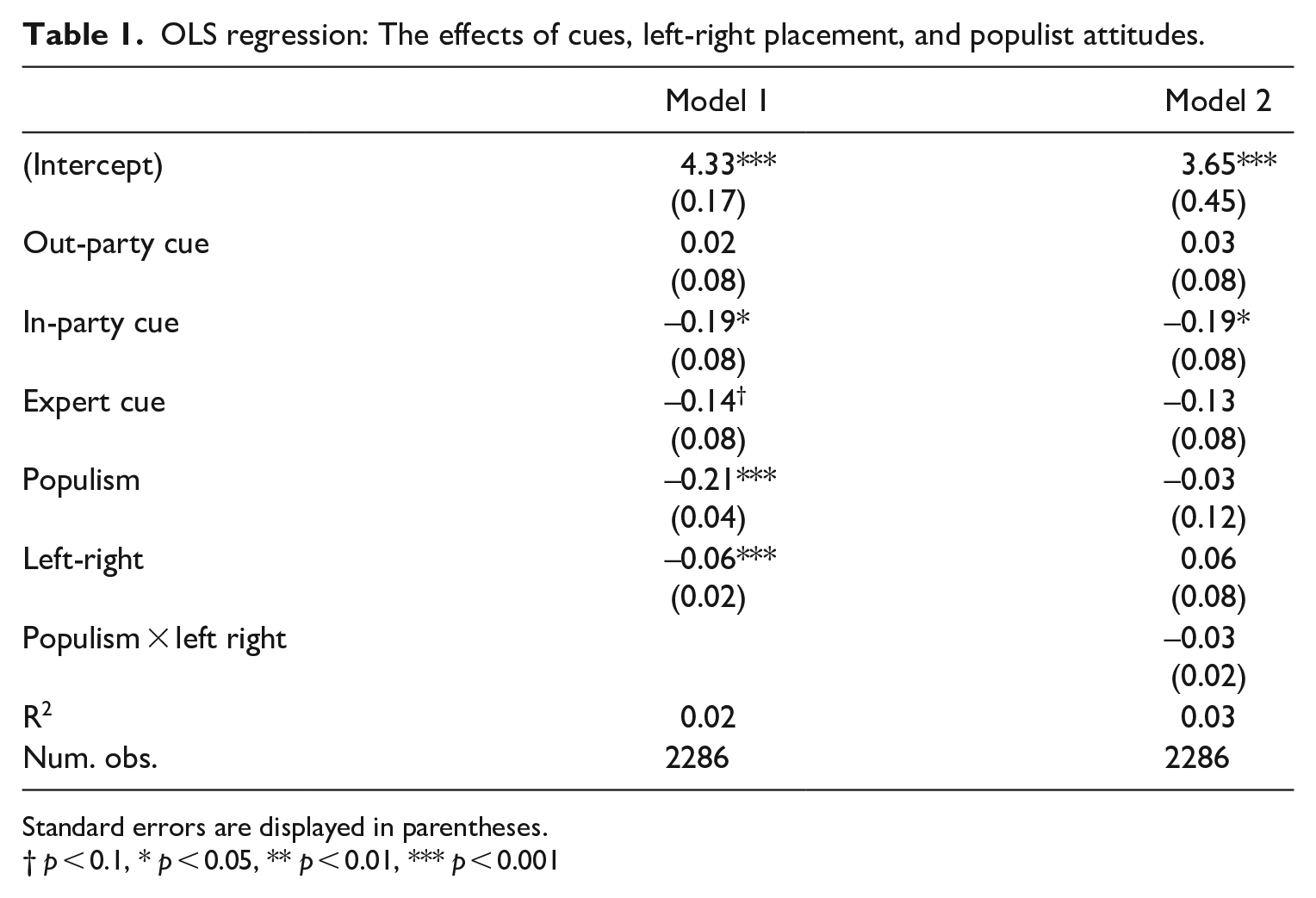
Table 1 displays the results of the analysis. Model 1 contains the effect of the cue treatments and a respondent’s level of populist attitudes and left-right placement. Unlike the treatment effects, the relationship between populism and support for compulsory vaccination has no causal interpretation. In Model 2, populist attitudes and left-right placement have been interacted.
OLS regression: The effects of cues, left-right placement, and populist attitudes.
Standard errors are displayed in parentheses.
† p < 0.1, * p < 0.05, ** p < 0.01, *** p < 0.001
Model 1 provides evidence for in-party and expert cues. The in-party cue is significant at p < 0.05 and the expert cue at p < 0.1. Both effects go in the expected direction as the support for compulsory vaccination decreases when respondents are informed that politicians from their most preferred party or health experts oppose compulsory vaccinations. One might interpret the effect sizes of −0.19 and −0.14 as relatively small. However, it should be kept in mind that we measured support on a five-point scale ranging from 1 to 5, meaning that the maximum effect size could be –4 (from full support to full opposition). Moreover, as described in the ‘Methods’ section, our treatment was rather cautiously formulated, that is, it was not intended to create strong treatment effects by using a less realistic treatment. Given these aspects, the size of the treatment effect appears appropriate.
In contrast, we do not find evidence for out-party cues. The point estimate is close to zero and not significant. This non-finding contrasts with previous literature that has identified out-party effects and which has even argued that out-party effects can have stronger effects than in-party cues. Potential reasons to explain these differences might be that findings on out-party cues often come from the US context in which polarization is very strong between Democrats and Republicans. Moreover, out-party cues might be affected by the issue salience and level of knowledge of respondents. When respondents hear that their least preferred party takes a certain position on an issue that they care little about, they might be inclined to take an opposing position to not agree with the other party.
However, COVID-19 and vaccination against it are arguably of high salience and thus respondents might not be inclined to change their existing position on this issue as a reaction to the position of their least preferred party. 8
In addition to the treatment effects, Model 1 also reports a strong negative effect of populism on support for compulsory vaccination. Populism is measured on a scale ranging from 1 to 5, which means that the effect of −0.21 implies that respondents with the highest populist attitudes show an almost one-scale point lower level of support for compulsory vaccination compared to respondents with the lowest level of populist attitudes. These findings confirm our expectations as expressed in Hypothesis 4. We also find support for Hypothesis 5, which states that right-wing respondents are opposed to compulsory vaccination. This effect of −0.06 is also quite strong considering that left-right placement is measured on an 11-point scale.
Model 2 in Table 1 and Figure 1 reports the results from the interaction between the level of populism and left-right placement. As described in Hypothesis 6, we expect that the effect of populism should be particularly strong among right-wing respondents. The results described in Table 1 are not that informative as none of the coefficients of the interaction is significant. However, as described in Brambor et al. (2006), this is not an indication that there is no interaction effect between the three variables. Therefore, Figure 1 presents predicted values for three different levels of populist attitudes (low, moderate, and high) and different levels of left-right placement (on the x-axis). As can be seen, there is a clear interaction effect. Left-right placement is basically irrelevant when respondents have low levels of populist attitudes, as indicated by the flat line. In other words, non-populists respondents show high levels of preference for compulsory vaccination, regardless of their left-right placement. However, left-right placement becomes more relevant the higher a respondent’s level of populist attitudes. Among left-wing respondents the predicted support for compulsory vaccination is roughly identical between populist and non-populist respondents. Among right-wing respondents, this pattern is very different. Right-wing populists show much lower levels of support for compulsory vaccinations. These results are in line with the expectation formulated in Hypothesis 6 that particularly right-wing populists tend to oppose compulsory vaccination programmes.
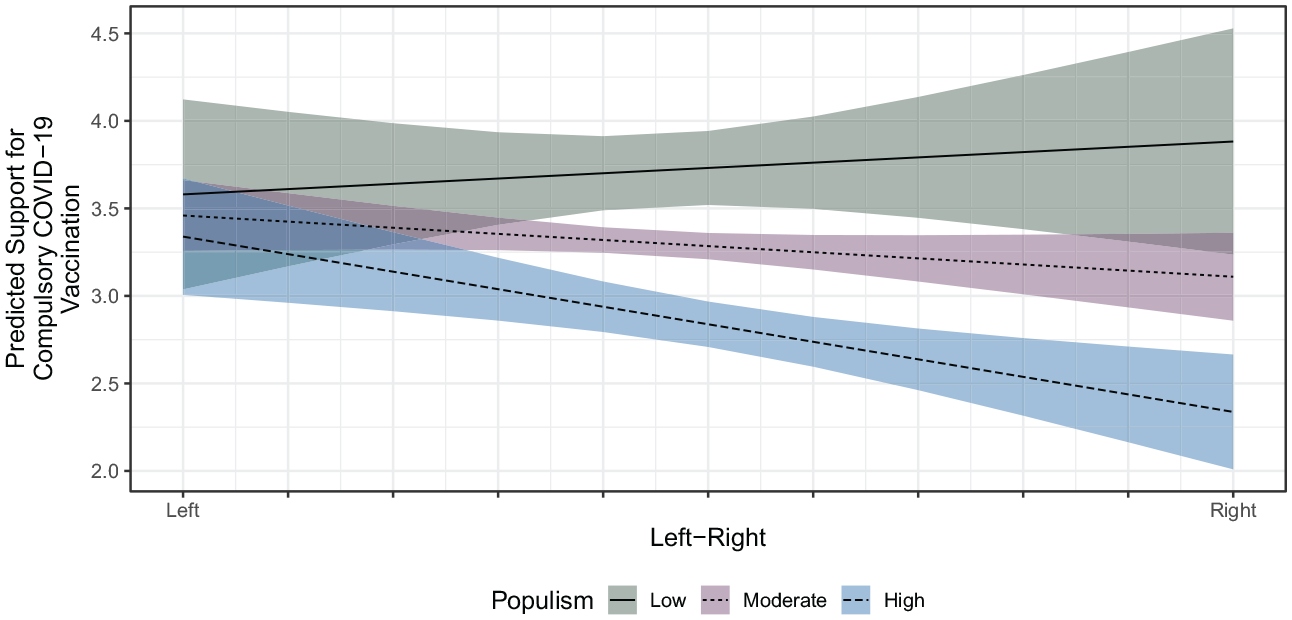
Interaction between populism and left-right placement.
Finally, we reestimated the interaction in Model 2 based on the advice given in Hainmueller et al. (2019: 170) to use Generalized Additive Models (GAMs), which can detect non-linearities in the interaction effects. The results are displayed in Figure A2 in Appendix 1 of this article. They confirm the results presented in Figure 1 that right-wing populists show the lowest level of support and that right-wing non-populists show very high levels of support for compulsory vaccination. Moreover, the GAM plot in Figure A2 in the Appendix also shows large confidence intervals for right-wing respondents with low levels of populist attitudes, as can also be seen in Figure 1. This is due to the fact that populism is not fully independent from ‘thick’ ideologies and correlates with left-right attitudes, implying that relatively few respondents are populist but not right-wing.
Probing deeper: Conditional treatment effects
In the sections earlier, we have demonstrated how ideological positions and the treatment effects have an impact on support for compulsory vaccinations against COVID-19. In this section, we probe deeper and test for potential interaction effects between the treatments and certain characteristics of the respondents. Specifically, we will scrutinize how party evaluations and political interest affect how citizens perceive the treatments.
Party evaluation
The in-party and out-party cue are based on the evaluation of the six main German parties by a respondent. Specifically, we use the party with the lowest (out-party cue) or highest (in-party cue) rating on a 11-point scale as the cue in the experiment. However, respondents potentially differ regarding the question of how favourable they are generally towards parties. For example, some respondents might evaluate all parties quite bad and their ‘best party’ only receives a moderate evaluation of 5 (on a 11-point scale). For such a respondent, the in-party cue might have a different effect than for a respondent who evaluates the most favoured party with a value of 11 (on the 11-point scale). Specifically, one might expect that the higher the evaluation of the most preferred party, the stronger the treatment effect of the in-party cue. Moreover, one could also argue that the lower the evaluation of the most preferred party that these respondents might be more inclined to react to the expert cue, because these respondents are sceptical of all parties. To test for this mechanism, we create a variable which measures the value of the best evaluated party of a respondent. Thus, this variable can also take values from 1 to 11 and indicates how much a respondent favours the most preferred party. Then we interact this variable with the four treatment conditions. The results are displayed in Figure 2. They do not indicate a different treatment effect for the expert-cue and the out-party cue. However, the pattern for the in-party cue suggests a certain degree of heterogeneity in the treatment effect. Especially respondents with a very favorable rating of their in-party react to the cue, which is in line with the expectations. Moreover, the absolute level of support for the most preferred party seems to be positively correlated with higher levels of support for compulsory vaccinations under all scenarios. This finding indicates that those respondents who are generally sceptical of political parties, and thus give a low value of support for the most preferred party, are also sceptical of compulsory vaccinations. In this regard, one can assume that the level of support for the most preferred party might measure the overall support and trust of respondents in political institutions and the state.
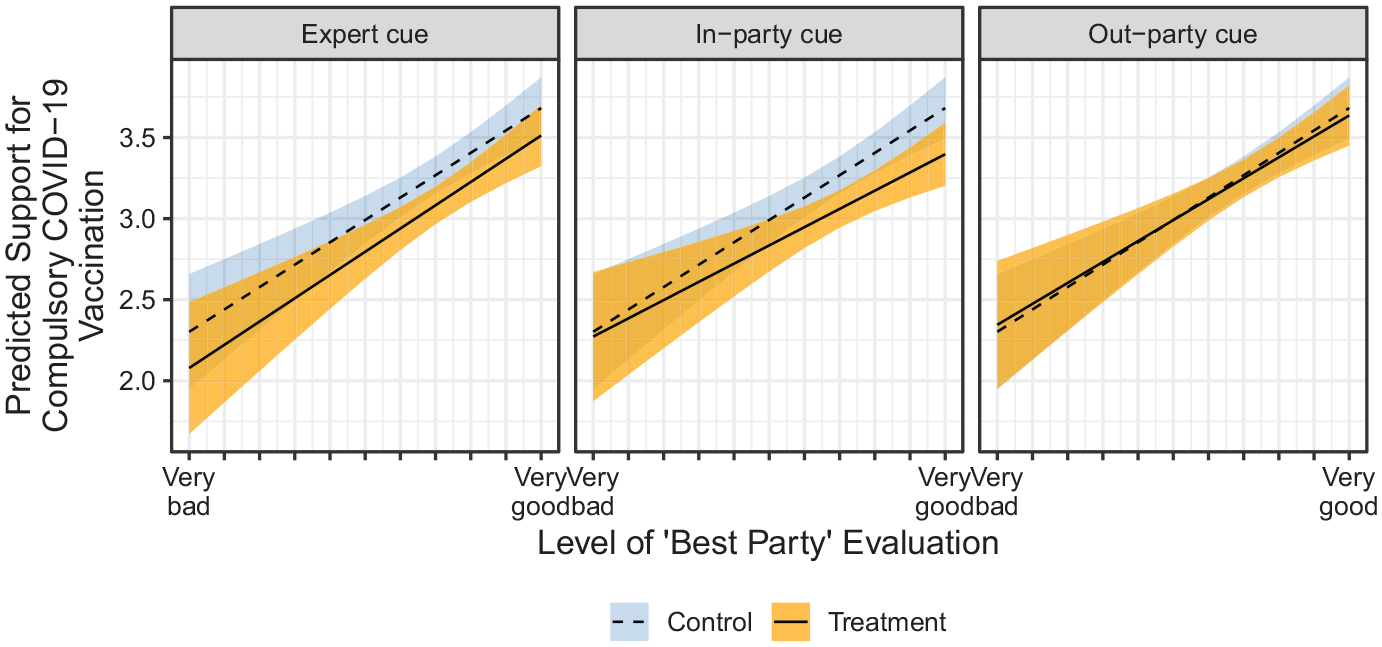
Interaction between cue treatments and value of highest rated party.
Moreover, the way our treatment was designed, one might also raise the question of how respondents react to the treatment when they evaluate multiple parties at the same level. For example, it could be possible that a respondent evaluates two parties as equally good or bad. In such a case, we have randomly selected one of the parties as cues. However, such a respondent might not react as strongly to the party cue as a respondent who clearly prefers one party over all other parties. To test this mechanism, we created a variable which measures the difference between the best evaluated party of a respondent and the second best evaluated party of a respondent. By definition, this variable has a minimum value of zero, when a respondent evaluates two parties as equally good. The maximum difference can be 10, when only one party is evaluated as very good and all the other parties are evaluated as very bad. We then interact this variable with the four treatment conditions and display the effects in Figure 3. One could anticipate that respondents react stronger to cues if they stem from their solely most preferred party, whereas they may react less to specific cues if they equally support several parties. The plot shows that there is no interaction between the treatments and this variable.
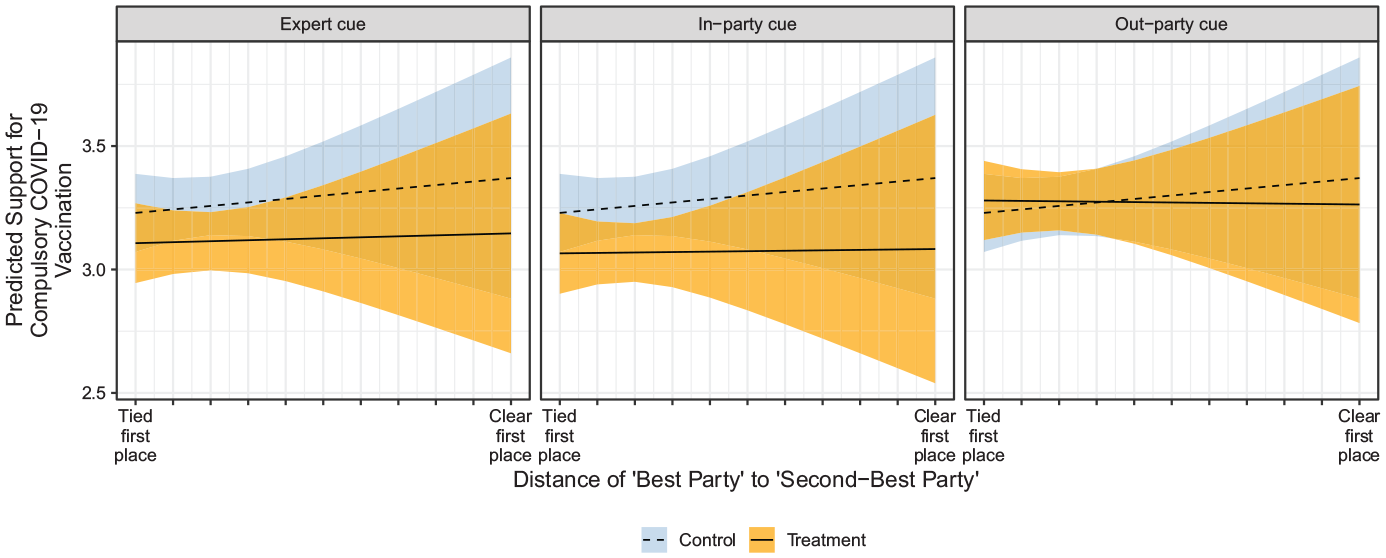
Interaction between cue treatments and difference between the two highest evaluated parties.
Political interest
Besides effects of the party evaluation, one might also expect that the level of political interest of the respondents can affect the support for compulsory vaccination. Citizens with low interest in politics are also often less informed about the political debate on certain issues. As we know from the research literature, low political interest as well as information among citizens is not an exception but rather is frequently observed (Sniderman et al., 1993). Furthermore, such citizens are also more likely to follow the opinion of their preferred party when they do not have enough information on a certain issue to form their opinion. Hence, party cues might be particularly influential for citizens with low political interest and thus information (Chong and Mullinix, 2019; Zaller, 1992). Although the preferred party’s positions are considered the most important cue, also other cues affect citizens’ opinion (Case et al., 2021; Darmofal, 2005). Given the high public presence of health experts during the pandemic, we also expect that their opinion serves as an important cue for especially citizens with low levels of political interest.
We thus interacted the treatments with the respondents’ level of political interest to test for the effect of political interest on support for compulsory vaccination. The findings are presented in Figure 4, and demonstrate that respondents with lower levels of political interest indeed are more likely to rely on cues of their preferred party and health experts. These respondents show less support towards compulsory vaccination in case their preferred party and health experts are against compulsory vaccination. Hence, party as well as expert cues seem to matter for respondents with lower levels of political interest, and thus for those with probably less information. Similar patterns can be observed for respondents with moderate levels of political interest, and to a lesser extent also for those with rather high levels of political interest. Respondents with a high level of political interest not only show the strongest support towards compulsory vaccination in general, but their support also do hinge less on cues. We only can see a slight increase in the support for compulsory vaccination for those respondents with the out-party cue treatment. These findings also speak for the theoretical expectations that less interested and informed citizens follow cues due to lacking information. Citizens with higher levels of political interest might are better informed about certain issues and thus less likely to react to certain cues.
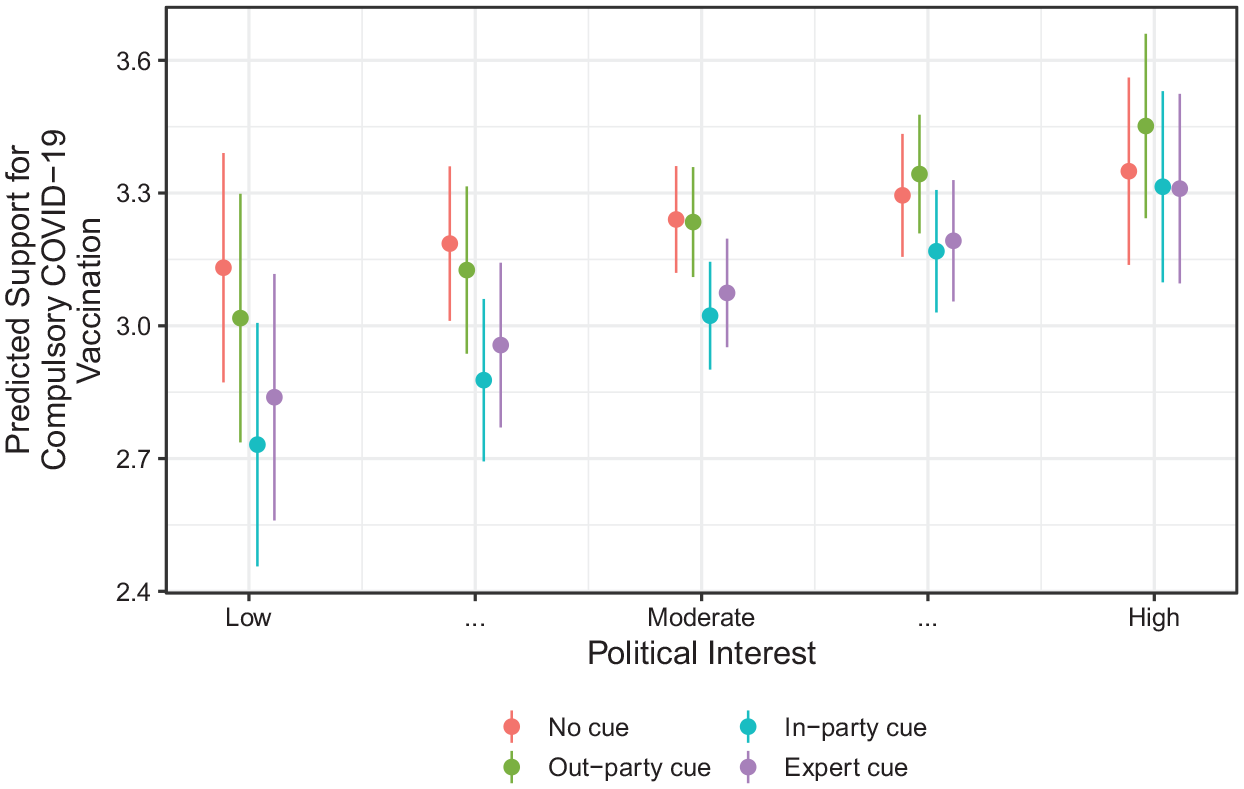
Interaction between cue treatments and political interest.
Conclusion
Due to the unprecedented impact of the COVID-19 pandemic on society, vaccination attitudes have gained rapid interest in recent months. In particular, due to the stagnating vaccination rates in many countries, the debates about compulsory COVID-19 vaccination are ongoing. However, the literature on attitudes towards a COVID-19 vaccination has primarily focused on the question of which citizens are willing to get vaccinated (e.g. Fisher et al., 2020; Neumann-Böhme et al., 2020; Rieger et al., 2020), but only a few studies shed light on the related, but substantially different question, of whether vaccinations should be compulsory (Paul et al., 2021). Moreover, only a few existing studies so far analyse the political factors that influence attitudes towards vaccination in general and compulsory vaccination more specifically (e.g. Debus and Tosun, 2021; Paul et al., 2021; Smith et al., 2021). Our article thus aims to provide further insight on political attitudes on compulsory vaccination by focusing on political ideologies and populism, and by using a survey experiment as well as attitudinal data.
Our empirical results can be summarized in two points: First, we find that public attitudes towards compulsory vaccinations are in fact driven by in-party- and expert cues. Respondents seem to follow the advice by their most preferred party and, to a smaller degree, public health experts. These results are important as they indicate that party communication about vaccination programmes can affect public attitudes towards vaccination policies. Crucially, however, they also demonstrate that not only parties but also public health experts can affect public opinion.
Second, concerning the non-experimental results, we find that ideological positions play an important role in explaining attitudes towards compulsory vaccinations. While left-wing respondents seem to agree on a certain level of support for compulsory vaccinations, populism is a strong moderator among right-wing respondents. This moderating role of populism indicates that populism directly affects policy attitudes instead of the traditional left-right conflict that is usually expected to structure political preferences. In this regard, our results contrast with previous findings, which have found evidence for a direct relationship between right-wing attitudes and vaccine attitudes. This might be because these studies have not considered the interaction between right-wing and populist attitudes. For example, when analysing the effect of left-right attitudes without the interaction with populism, our model also suggests that right-wing attitudes have an independent effect on support for compulsory vaccinations. In this respect, these findings might inspire future research to investigate in more detail how right-wing and populist attitudes have an impact on vaccination attitudes.
Our experiment’s findings are restricted by the fact that we analysed the treatment effects only in one direction, that is, when parties indicate that they oppose compulsory vaccinations. It remains an open question whether the same effects could be observed when parties recommend compulsory vaccinations. As described earlier, we refrained from this treatment in this article as we consider it unrealistic for the German case, and it could have negatively affected the experimental realism and thus the internal validity of our experimental approach (Druckman and Kam, 2011; McDermott, 2011). Nonetheless, future research could focus on cases and research designs that allow for addressing such questions.
Footnotes
Appendix 1

Declaration of conflicting interests
The author(s) declared no potential conflicts of interest with respect to the research, authorship, and/or publication of this article.
Funding
The author(s) disclosed receipt of the following financial support for the research, authorship, and/or publication of this article: This work was financially supported by the University of Oldenburg (FLiF+).