



Abstract
Popular sovereignty plays a central role in both the democratic and the populist ideology. While democracy’s version of qualified sovereignty is accepted as mutually constitutive with the rule of law, populism’s version of absolute sovereignty is seen as incompatible with this ideal. The article reconsiders this oversimplifying approach. By examining the interaction of these concepts with a nuanced account of the rule of law, it argues for the compatibility of both democracy and populism with different versions of this ideal. While this remains a key distinguishing factor between democracy and populism, the ambiguity of the rule of law still allows populism to claim that it complies with a thin version of this concept.
Keywords
The article explores the compatibility of two ‘essentially contested concepts’ (Gallie, 1956: 169), democracy (Spicer, 2019; Tilly, 2007) and populism (Mudde, 2017), with the equally ambiguous concept of the rule of law (Waldron, 2002). Scholars have long debated the relationship between populism and democracy and, indeed, much of the disagreement about the impact of populism on the latter is a direct result of different definitions used for these concepts. The argument of the article is that, contrary to the simplistic view that sees democracy as compatible and populism as irreconcilable with the rule of law, it is a prerequisite to elucidate the exact version of these concepts in order for valid conclusions to be drawn. 1
The article argues that democracy, especially in its currently dominant liberal form, aspires to be compatible with the thickest versions of the rule of law, while populism may only be compatible with the most minimal, thinner versions, often described as ‘rule by law’, that can possibly accommodate its putative endorsement of absolute sovereignty. This remains a key distinguishing factor between democracy and populism. Nevertheless, the ambiguity of the rule of law still allows populism to claim that it complies with (a thin version of) this concept.
Part I will concisely discuss accounts of democracy and populism and their interaction, to highlight their relative indeterminacy. The focus will be on their overlapping elements whose elucidation is essential to providing some definitional clarity of these concepts. In that respect (1) the different versions and meanings of (popular) sovereignty; (2) the question of inclusivity or, in other words, who are the ‘people’ of democracy and populism with whom sovereignty ought to rest; and (3) the dynamic or static nature of majority rule and permissibility of public contestation will be addressed.
In Part II, the typology of the rule of law will be analysed, before the compatibility of this ideal with (liberal) democracy and populism is examined (Part III). The conclusion of the article is that populism claims to prioritise an absolute version of popular sovereignty over (a thin version of) the rule of law, as opposed to democracy which reserves a prominent position for (a thick version of) the rule of law on a par with a qualified version of popular sovereignty.
I
An account of democracy
Far from being monolithic, the nature of democracy is ambivalent. Democracy sans adjectives is a political system whose pillars are popular sovereignty and majority rule (Mudde and Rovira Kaltwasser, 2018). However, a closer look at this minimal definition highlights its complexities. First, ‘popular sovereignty’ requires a certain ‘people’ to be based. This ‘people’, in addition to being the ‘constituent power’ (i.e. the original author and legitimating basis of the constitutional order), is also envisaged as the ever-present and abstract collective agent who has the power to model the state. Yet, this idea of an abstract ‘people’ has been seen as a foundational myth according legitimacy to the democratic regime (Kelsen, 1989: 256) since, consisting of individuals, this ‘people’ can be neither static nor homogeneous (Ochoa Espejo, 2017). Second, the notion of sovereignty is far from clear (Bourke and Skinner, 2016). If sovereignty is interpreted as absolute power wielded by the people, then democracy’s aspiration of a true sovereignty of the people is unattainable, since this is constrained by constitutionalism, the rule of law or individual rights. Alternatively, if sovereignty means that the polity is constituted by and power emanates from the people, then the idea of democracy approximates its modern representative character, with the locus of constituted power being left unoccupied and the people entering into a fiduciary relationship with trustees who exercise power on their behalf. Nevertheless, this is far from the idea of sovereignty as the ‘absolute and perpetual power of a commonwealth’ (Bodin, 1992) and needs to be revisited. Third, majority rule, the second pillar of democracy, as a method for the allocation and legitimation of power, hardly represents the whole people in practice. Quite often, it represents a coincidental majority which, depending on the populace’s inclusion and participation in the decision-making processes, might be narrow (Rosanvallon, 2018: 230).
Democracy in its liberal form seeks to resolve these complexities by revisiting and developing the fundamental elements of the minimalist form of democracy. Advocating a qualified version of popular sovereignty, liberal democracy endorses constitutionalism as a legal constraint on coercive state power. The people exercise power through their representatives who are decided in free elections, are held accountable via institutionalised means, and have their powers limited and controlled through a system of checks and balances. In addition, majority rule is implemented in a dynamic way which encourages pluralism, public contestation, and inclusiveness, thus allowing an open society to emerge. By reference to these features, in addition to a political system, democracy has been viewed as an ideal (Dahl, 1971); instead of a static, closed system, it is a dynamic and open-ended process – democratisation – (Whitehead, 2002) that aims to fulfil the ultimate promise of a (qualified) sovereignty for the people.
Democracy’s depiction as a system which welcomes and preserves indeterminacy originates from the symbolic representation of popular sovereignty as an empty ‘locus of power’ that was vacated after the mutation of the incarnated and absolute sovereignty of the monarch of the Ancien Regime into a disembodied and qualified sovereignty of the abstract people. The pre-modern notion of absolute sovereignty assumed the symbolic condensation of power, law, and knowledge in the body of the prince. The birth of democracy, conversely, required the dissolution of these features (Lefort, 1988: 16). In democracy, power emanates from the people. The power of all as the foundational democratic ideal is simultaneously the power of anyone and the power of nobody. The power of anyone is the power of every individual who has the right to have its rights protected and the means to make good on them. At the same time, the power of all is the power of nobody which emphasises the principle of impartiality and shelters the locus of power from appropriation (Rosanvallon, 2018: 237–239).
The disincorporation of sovereignty was accompanied by the disentanglement and liberation of the spheres of law and knowledge as separate from and irreducible to the sphere of power (Lefort, 1988: 17–18). In the liberal democratic context, law both warranties and delineates the sovereignty of the people. Far from being absolute, democratic sovereignty in that respect is defined by constitutionalism which encapsulates, inter alia, higher constitutional rules and principles as the formal source of state authority, the protection of individual and civil rights, and judicial review as an additional check on state power performed by an independent judiciary. In line with the main premises of liberal democracy, separation of powers and the rule of law act as warranties that there will be no overconcentration (and abuse) of state power and that the power of all will be preserved as the power of nobody and the power of anybody. 2
In representative democracies, knowledge of the will of the sovereign people is not being reserved as anyone’s prerogative; instead, it is discernible as the periodic outcome of an open debate taking place in the public sphere. For this to be meaningful, the endorsement of public contestation, as a system of political competition which implies the possibility to oppose the government and to offer alternative points of view, is essential (Rovira Kaltwasser, 2012: 196). Democracy is ‘a regime founded upon the legitimacy of a debate as to what is legitimate and what is illegitimate’ (Lefort, 1988: 39) – a debate which, since the locus of power remains empty and no one can take the place of the supreme judge, is necessarily indefinite. One precondition for the success of public contestation is the existence of a public space which, fertilised by fundamental liberties such as the freedom of expression and association, allows pluralism to flourish. In addition to being a prerequisite for public contestation (and thus for democratisation), this public space is meaningful as a forum for the constant reconsideration of opinions and decisions. 3
In liberal democracies, the provision of equal and inclusive suffrage contributes to the creation of a meaningful and extended public sphere that promotes pluralism. Far from seeing the people as static, the aspiration of democratisation is to promote inclusiveness and expand the public sphere to include the entire population (Canovan, 2002). 4 Advanced inclusivity, accompanied by genuine debate, validates the second pillar of democracy (majority rule) as a legitimate way of constantly and periodically discerning the general will of the people. While the reins of government are legitimately ‘handed to those who command more support’ (Schumpeter, 1974: 272–273), the right of any individual to denounce the opinion of the majority and contribute to the emergence of a different body of mass opinion is preserved. As Lefort notes, ‘the majority may prove to be wrong, but not the public space’ (Lefort, 1988: 41).
An attempt to see the democratic popular sovereignty as the re-unification of power, law, and knowledge, incarnated into a homogeneous ‘people’ occupying the locus of power and expressing a fixed general will, could lead to the degeneration of democracy into a ‘tyranny of the majority’ (de Tocqueville, 1954). Since the size and complexity of modern democratic states and societies make them irreducible into fixed and homogeneous uniformities, then a constant and meticulous observance of the public debate, a periodic and thorough portrayal of its pluralism, and an adequate representation of its participants and their views are preconditions for the credibility of the system and the advancement of democratisation (Habermas, 1996: 486).
To conclude, liberal democracy aims to give expression to a qualified, nuanced, and dynamic version of popular sovereignty and majority rule, which are the pillars of democracy sans adjectives, placing them within constitutional limits defined by concepts such as the rule of law and fundamental rights. While acknowledging that the people is a dynamic and changing group consisting of individuals with their own interests, will, and values, nevertheless they collectively remain sovereign not as the abstract, symbolic embodiment of the absolute ruler but as the constituent and legitimating power of the polity whose consent to the governing constitutional principles, including adherence to the rule of law, is required and presupposed (Habermas, 1996: 450).
An account of populism
The contested nature of populism has long been recognised (Ionescu and Gellner, 1969). The fact that a broad range of political phenomena are signified by the term and a plethora of definitions of populism exists has led to inflationary uses of the term, thus blurring its analytical sharpness and justifying its classification among the essentially contested concepts. Ranging from grassroots movements that claim to represent the interests of the common people and advocate limits on the power of the elite establishment, 5 to (quasi)authoritarian attempts to mobilise certain popular sentiments for undemocratic ends and pose a serious threat to liberal democratic constitutionalism, 6 the typology of populism varies.
The various definitions (as unique style (Moffitt, 2016), discursive frame (Aslanidis, 2016), strategy (Weyland, 2001), political logic (Laclau, 2005), or simply as a way of doing politics (Knight, 1998)) and approaches to populism (right/left; bad/good; inclusionary/exclusionary; political/economic) 7 often prioritise different key defining characteristics of this phenomenon and advance a relativism which precludes agreement on one single formula of populism.
The minimal definition of populism as a thin-centred ideology is – justifiably – the most broadly used in the field today. According to this, populism is defined as a thin-centred ideology that considers society to be ultimately separated into two homogeneous and antagonistic groups, the ‘pure people’ versus the ‘corrupt elite’, and which argues that politics should be an expression of the volonté générale (general will) of the people. (Mudde, 2004: 541)
This definition has been attacked from various directions (e.g. De la Torre and Mazzoleni, 2020; Schroeder, 2020), yet broad consensus exists as to the essential features of populism.
The populist ontology involves ‘the people’ and ‘the out-group(s)’ (be it an elite, an establishment, a certain ‘power bloc’) whose relationship represents an antagonistic struggle on a ‘friends and enemies’ basis (the populist cosmology) (Mudde and Rovira Kaltwasser, 2017; Taggart, 2018). Moreover, a tenacious recourse to ‘popular sovereignty’ or to ‘the general will of the people’ is central. Non-essential elements include, inter alia, the presence of a charismatic leader, anti-institutionalism, an aggressive style, and recourse to ‘unpolitics’ (Taggart, 2018).
The ‘people’ in populism is a static and homogeneous singular-collectivity with continuous existence over time, capable of action, of having common interests and a fixed general will (Canovan, 2002). This is an artificial construction, at best referring to a specific interpretation (and simplification) of reality (Mudde and Rovira Kaltwasser, 2017: 9). Yet, this ‘people’ is envisaged as the occupant of the locus of power and the embodiment of sovereignty as in ‘one supernatural body driven by one superhuman, irresistible general will’ (Arendt, 1963: 60). Populism does not score high in terms of inclusiveness; despite being only one part of the population, its ‘people’ symbolically appropriates the whole and claims for itself absolute and exclusive legitimacy (Ochoa Espejo, 2017: 783–784; Urbinati, 2019: 120). By virtue of its fiction of the People-as-One claiming unlimited and perpetual sovereignty, populism is in a liminal state between democracy and totalitarianism.
The definition and membership of ‘the people’ largely determine the ‘out-group(s)’. Since populism envisages politics as the implementation of the will of the (morally pure) people, the (morally corrupt) ‘out-group’ can be defined as the similarly homogeneous collectivity that restricts or negates popular sovereignty and ostensibly engages in a domineering attitude over them (Urbinati, 2019: 119). The distinction between the ‘people’ and the ‘elite’ may be based on a combination of class, ethnicity, and morality with the latter being the dominant factor (Mudde, 2017: 4).
The ‘people’ is envisaged as the incarnation of sovereignty in a pre-modern sense (condensing power, law, and knowledge) and the ultimate measure of political justice and legitimacy. 8 For populism, both as a sovereign-in-command and as the constituent power of the polity, insubordinate to the constituted legal order, the people legitimate the higher norms of the constitution which are presented, in teleological terms, as the expression of their fixed general will. Subordinate to the will of the people, law is often instrumentalised to protect and perpetuate its reign.
Populism bases itself on a conception of incarnation as the best form of representation in which both the people incarnate the sovereign and the leader is the embodiment of the people (Rosanvallon, 2018: 234). Knowing their true will, the populist leader is the voice of the people (vox populi) and offers the supremely authoritative correct interpretation of the common good, to the exclusion of other institutions, notably constitutional courts and independent authorities.
In sum, populism is a predominantly ideational phenomenon, which advocates an extreme majoritarian vision of democracy by claiming absolute, unlimited sovereignty for the morally pure people who share the same set of ideas. Parasitic to liberal democracy, populism aims to instrumentalise and infuse with new meaning democratic concepts and institutions, such as popular sovereignty and the rule of law, while promising a return to real democracy by claiming to empower the real people and by opposing the key idea of liberal democracy that the political majority may be limited by constitutional constraints.
Populists in power often make opportunistic use of democratic institutions and constitutional structures, frequently treating them as a mere façade that legitimates their power, taking advantage of them for as long as their purpose of perpetuating their power is served (Müller, 2016: 63). In that respect, populists seemingly embrace the ‘form’ of democracy and claim to represent the common people, though at the same time gradually erode the liberal elements of constitutional democracy. The rule of law is such a concept that populists aspire to add to their repertoire; the definitional ambiguity of the rule of law allows them to claim compliance with this ideal, even with a thin type that could possibly conform with the populist set of ideas.
II
Versions of the rule of law
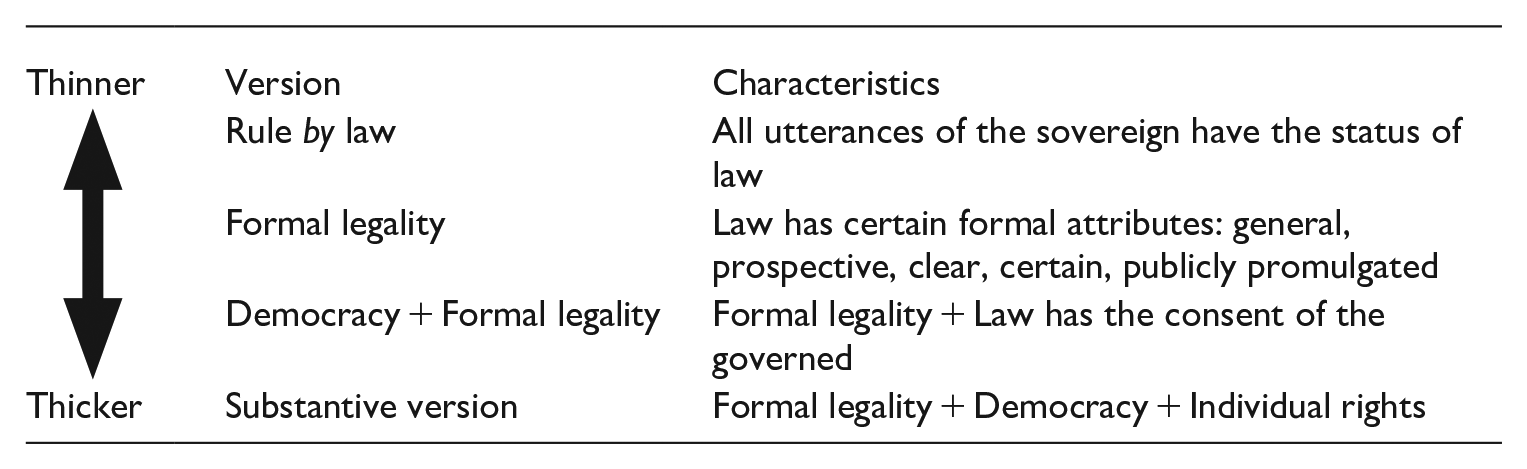
The ideal of the rule of law operates in a messy terrain, and thus, it is justifiably classified as an essentially contested concept (Waldron, 2019). Since the time of ancient Athens, a noble aspiration to be ruled by laws rather than men is present and came to inspire political and legal discourse. This tradition views law in teleological terms: as the means to protect individuals against the arbitrary exercise of power (Krygier, 2017). 9 In that sense, proper law is the impersonal and autonomous instrument, which ideally operates in relative detachment from contemporary state agents and has the objective of tempering their power. For the rule of law, then, to be achieved, both the telos (end) that the law serves must be appropriate and its substance adequate for the end’s attainment.
However, such a teleological approach to the rule of law might prove problematic. Who decides whether an end is noble or not, if not the people as the constituent power? What if law is instrumentalised to attain the perpetuation of popular sovereignty (and this is, at least for some, a noble objective)? If the law’s main objective is to protect individuals against the potential of arbitrary exercise of power, then the rule of law cannot be compatible with absolute sovereignty, even if this refers to the sovereignty of the constituent power (Tamanaha, 2004: 92). Alternatively, if the end of the legal system is to perpetuate the rule of the majority, then there is hardly anything that prevents a ‘rule by law’ to be rephrased into a ‘rule of law’, especially if the latter is understood in minimal, purely formalistic, terms (Fuller, 1957–1958: 630, 650; Krygier, 2018: 152; Peerenboom, 2004). In that sense, even the thinnest version of the rule of law (rule by law) can still be seen as the antithesis of rule by men, as long as any ruling is conducted according to basic principles of legality (Waldron, 2019: 18).
Closely connected to the identification of its ends, analysis of the operation of the rule of law is equally necessary (and unclear). Despite being presented as a good in itself (Harel, 2014: 2), the actual utility of this ideal remains nebulous. Does the rule of law operate as the inner soul of a legal system, as is apparently implied in the Constitutional Reform Act (UK) section 1(a), which highlights that the Act does not adversely affect ‘the existing constitutional principle of the rule of law’ (though without defining what this means)? Seeing it as such an undercurrent of integrity might imply that a more practical use for it is reserved, in that the rule of law should have a prominent place in the rulebooks as a normative ‘principle’ (Dworkin, 1977) that actually assists with the interpretive and doctrinal work in hard cases of constitutional and administrative law. Or, conversely, in Waldron’s witty words (Waldron, 2019: 2), should the rule of law be seen as a concept that just ‘operates decorously as part of the legal system’s PR’? These considerations notwithstanding, the rule of law appears to operate as an integral element of an enabling ecosystem that promotes the smooth and effective operation of the state.
Finally, analysis of the substance of the rule of law is equally necessary. In that respect, minimalist, ‘formal’ versions can be contrasted to ‘thicker’ and ‘substantive’. Formal theories focus on the proper sources of and procedures for legality, while the substantive complement these with conditions about the content of the law (usually that it must comport with justice or moral principles) and, therefore, envisage a rule of good law (Tamanaha, 2004: 92).
The thinnest formal version is the ‘rule by law’ in which all utterances of the sovereign, because they are utterances of the sovereign, are law and all government action is authorised by law (Neumann, 1996: 104). Understood in this way, the rule of law has no real meaning as it collapses into the notion of rule by the government, a feature that every modern state has (Tamanaha, 2004: 92). Although rule by law is generally seen as a debased version or a distortion of the rule of law, there is no consensus as to whether there is a difference of kind or degree between these concepts. This largely depends on the purpose that the law serves and on the existence of independent bodies empowered to hold the government to account. 10
The second version, ‘formal legality’, requires the presence of formal criteria (generality, clarity, public promulgation, certainty, prospectivity) (Møller, 2018; Raz, 1979: 211) that promote the predictability of rules as opposed to ad hoc orders. Having no content requirements, this version is politically neutral and renders it open to a range of ends (Fuller, 1977: 153). Saying nothing about how the law is to be made (by tyrants or democratic majorities) or about fundamental rights, equality, and justice, this account of the rule of law is amenable to abuse as it may give rise to a rule of bad law (Raz, 1977: 197, 214).
The thickest formal version, in addition to the aforementioned formal attributes, is concerned with how the content of law will be determined and adds ‘democracy’ to ‘formal legality’. Proponents of this version view these as mutually constitutive; for without formal legality, democracy can be circumvented (because government officials can undercut the law) and without democracy (or, the consent of the governed), formal legality may be stripped of its legitimacy (Tamanaha, 2004: 99–100). Nevertheless, these democratic participatory mechanisms do not guarantee expedient and benevolent laws though, by allowing an equal opportunity to participate and by securing everyone’s consent, they promote the law’s legitimacy. 11
The substantive version of the rule of law is an amalgam of democracy, formal legality, and individual rights (Allan, 1993: 21–22).
12
In that version, individual rights do not merely form the content of positive law, but they are the wider background and integral aspect of its fabric (Dworkin, 1978: 259, 262). This version reserves a central place for an independent judiciary. As the meaning and reach of moral and political principles are often unclear and go beyond the ‘rule book’ applied by judges, the latter are authorised to resolve controversies (by reference to the values of the community) (Dworkin, 1978: 268). Indicative of such a thick, substantive, and ambitious approach to the rule of law is the definition of the concept given in the recent 2020 Rule of Law Report of the European Commission: Under the rule of law, all public powers always act within the constraints set out by law, in accordance with the values of democracy and fundamental rights, and under the control of independent and impartial courts. The rule of law includes principles such as legality, implying a transparent, accountable, democratic and pluralistic process for enacting laws; legal certainty; prohibiting the arbitrary exercise of executive power; effective judicial protection by independent and impartial courts, effective judicial review including respect for fundamental rights; separation of powers; and equality before the law.
Although in Art. 2 of the Treaty on European Union, the rule of law is seen as separate from (though interconnected with) democracy and respect for human rights, there is an apparent shift towards the integration of these concepts as mutually constitutive under the general rubric of the ‘rule of law’. In this light, some of the key enablers for a thick rule of law also contribute to the improvement of democratic quality and accountability; these range from respect for judicial independence, free and pluralistic media, effective anti-corruption policies, a transparent and high-quality public administration, a free and active civil society allowed to scrutinise decision-makers, and robust institutional checks and balances.
III
Democracy, populism, and (which) rule of law
The rule of law is a compelling political ideal for liberal democracy, so the democratic aspiration is to be compatible with all its formal and substantive versions. Indeed, scoring high on the rule of law index is a valid indicator of the quality of a democracy. In principle, provided that the system comports with the procedural requirements envisaged by formal legality, implements sophisticated and rigorous accountability processes, and has a system of separation of powers and checks and balances which allows for an independent judiciary, democracy and the rule of law are ‘mutually constitutive’ (Habermas, 1995). Democratic law is binding not as an ‘utterance of the sovereign’ but as the product of the public sphere, periodically discerned, enacted, and promulgated by the people’s representatives after adequate consultation with the civil society. Conversely, expedited adoption of legislation (even through parliament) or limited consultation with stakeholders may put the rule of law under pressure. 13
Democracy’s dimensions of public contestation and inclusivity allow a fair chance for the civil society to contribute to law-making and demonstrate its consent. This realistic approach replaces unanimity, which is unattainable, with a qualified and dynamic version of majority rule. To prevent its arbitrary rule (which has the potential to destroy the rule of law in all – but its thinnest – forms), the undiluted will of the people is checked both by reference to individual rights and by shifting from a vote-based to a consent-based legitimation of decisions. The commitment of (liberal) democracy to individual liberty makes its potential to attain the thickest versions of the rule of law realistic (Hutchinson and Monahan, 1987: 100).
Nevertheless, ostensible limitations to the general will of the people (or, the will of the majority) caused, for example, by the rigorous protection of the rights of minorities, might be perceived as a democratic deficit. This is often attributed to non-representative and, to an extent, less obviously accountable institutions, such as ombudspersons or the courts that, nevertheless, provide essential institutional checks and balances at the core of a thick rule of law. For instance, legal protection of individual rights presupposes the empowerment of the judiciary with the (arguably, super-legislative) power of judicial review. Such a development might lead to a judicialisation of political issues, with unelected and democratically unaccountable judges ostensibly subverting popular sovereignty for the protection of rights. 14 In light of this, the populist promise of a return to pure democracy, envisaging real ‘popular sovereignty’, appears attractive.
Populism, as extreme majoritarianism, is possibly the ‘rule by law’ system par excellence. Its laws are legitimated as ostensibly grounded on popular sovereignty and majority rule, which are considered as the foundations of democracy. Frequently instrumentalising institutions, such as referendums, and conducting ‘national consultations’ ostensibly to allow the will of the people to be expressed, populists claim to be the ‘voice of the people’ as the ultimate interpreters of the latter’s will. 15 In this way, populists are then free to present independent institutions designed to promote a separation of powers and to perform checks and balances within the system, such as the courts or ombudspersons, as subordinate to the will of the people and even as the people’s enemies if their operation is seen as obstructing popular sovereignty. 16 Consequently, by monopolising for themselves, the correct interpretation of popular will and by placing pressure on other institutions to accept their version, 17 populists aim to rule by law, arguing that the laws enacted by their system are the utterances of the ‘sovereign people’. In that respect, not only government action is legitimated as authorised by law which is compliant to the popular will but also obedience to the (populist) law is essential for the perpetuation of the rule of the ‘people’, and any limitations to this are attacked as anti-popular.
In principle, populism may be compatible with most criteria of formal legality, since law can be certain, prospective, and universal in application. However, in a populist system that implements the will of the majority, legal certainty might prove difficult to attain due to the often rapid and unpredictable shifts of popular opinion unless, in line with the populist premises, the people’s will is consistently (albeit selfishly) interpreted by the leader as homogeneous and fixed, however detrimental this may be to the out-groups or minorities. 18 In systems of authoritarian populism in particular, legal certainty may also be undermined by an effort of the government to amend previous laws and decisions that inhibit their administration. For instance, in Poland, the recently established Supreme Court’s Chamber of the Extraordinary Control and Public Affairs, whose members are appointed at the request of the newly composed National Council for the Judiciary (now directly appointed by the Sejm instead of by their peers as previously), is empowered to overturn fully or in part any final judgement delivered by ordinary courts in the past 20 years. Considering that the power to lodge an appeal to the Chamber is vested inter alia in the Prosecutor General (who happens to be the Minister of Justice) and, therefore, such appeals may be instigated by political motives, it is likely that legal certainty is jeopardised and, possibly, sacrificed for political gains. Similarly, lack of transparency, 19 fusion of powers (frequently concentrated in the person of the leader or in institutions that are within populist control), and pressure exerted by the executive or the legislature on independent institutions, 20 such as greater control ostensibly to circumvent judicial corporativism (Smilov, 2007), are detrimental to checks and balances and a formal legality version of the rule of law, though any actions may be authorised and legitimated by law passed in accordance with established constitutional procedures.
In theory, the putative aspiration of populism is the attainment of the ‘Democracy + Formal legality’ version of the rule of law, notwithstanding the caveats concerning the compatibility of extreme majoritarianism with legal certainty, checks and balances, and an independent judiciary. Regarding the ‘democracy’ component, populism promises a return to its purest form in which sovereignty is absolute and politics is an expression of the general will of the people. However, as already been discussed, problems arise with populism’s curtailment of public contestation and inclusivity. 21 The ‘people’, predetermined, static and only a part of the populace leaves no scope for inclusiveness. The interpretation of the fixed ‘true’ will of the ‘people’ by the populist leader thwarts the ostensibly illegitimate views of the corrupt out-groups, rendering public contestation irrelevant. 22 Despite its pledge for a revival of real democracy, populism’s ontology and cosmology are incompatible with the ‘democracy’ element of the rule of law, if this is understood as the open-ended process which determines the conjunctural majority of the time and, thus, legitimates the outcome of a dynamic and indefinite debate. The populist premises which classify this concept as extreme majoritarian are equally irreconcilable with the substantive version of the rule of law which envisages legal guarantees to the rights of individuals and minorities alike. 23 Unless there is a strong communal belief in natural or divine law, any legal enactment of rights would be selective, fragile, tendentious, and vulnerable to shifts in popular opinion or the whim of the populist leader.
To conclude, the relationship of democracy and populism with the rule of law depends on two variables: the purpose that the rule of law is envisaged to serve and the version applied. Democracy often prioritises its liberal aspect which qualifies popular sovereignty by reference to individual rights and, thus, aspires to attain a thick, substantive rule of law. Populism, on the other hand, gives precedence to an absolute popular sovereignty and opts to instrumentalise a thin, formal version of the rule of law to serve that end. Democratic formal and substantive versions of the rule of law are incompatible with populism, as they appear to be incompatible with any ideology embracing a view of unlimited sovereignty. Although the populist instrumentalisation of law has been discussed in pejorative terms, it can still ‘be a rule of law success story in formal terms, while systematically violating the underlying values of the rule of law’ (Krygier, 2020).
Conclusion
A robust conceptualisation of populism is inseparable from a rigorous examination of its relationship with democracy and the rule of law. Democracy and populism are both grounded on popular sovereignty and majority rule. Yet, democracy’s liberal version which endorses pluralism as its cornerstone is clearly opposed to populism which suggests that the will of the people is fixed and indisputable. Similarly, democracy’s commitment to the protection of individual and minority rights is in stark contrast to populism’s view of an absolute and unlimited sovereignty for the majority (of its pure people).
Populism, nevertheless, is gradational and chameleonic. A novel conceptualisation of populism, in addition to acknowledging the malleability of this phenomenon, has to accept its potential compatibility with formal versions of the rule of law. Democracy’s adherence to a substantive version of the rule of law is certainly a distinguishing factor with populism, though the contested nature of the rule of law allows populism to claim its compliance with a thin version of this ideal and, thus, claim the legitimacy granted by this fact.
Footnotes
Funding
The author(s) received no financial support for the research, authorship, and/or publication of this article.
