




Abstract
In this article, we examine whether a deliberative mini-public can provide a trusted source of information in the context of a polarized referendum. Political polarization gives rise to selective distrust of those on the ‘other side’. The Citizens’ Jury on Referendum Options in Korsholm, Finland, was organized in conjunction with a polarized referendum on a municipal merger. Our analysis is based on a field experiment measuring the effects of reading the jury’s statement. We find that trust in all public actors was selective, that is, dependent on views on the merger, the Citizens’ Jury being the only exception. Overall, reading the jury’s statement increased trust in all public actors, including those perceived as being on the ‘other side’. With some caveats, our findings suggest that mini-publics can alleviate selective distrust in polarized contexts.
Introduction
This article examines whether deliberative mini-publics (Setälä and Smith, 2018) can enhance political trust in circumstances of political polarization. There are times in democracies when political trust and support for cooperation and compromise decrease profoundly. Arguably, referendum campaigns are instances that can undermine political trust (see, for example, Bauer and Fatke, 2014; Stojanovic, 2006), especially because voters are typically faced with a decision between two contrasting options (Hobolt et al., 2020). Referendum campaigns tend to concentrate on rallying support by spreading biased information that appeals to prospective voters (see, for example, Ford and Goodwin, 2017), which can raise scepticism towards the motivations of the opposing side and cultivate intergroup distrust. In addition, referendum campaigns rarely bring about meaningful democratic deliberation, that is, processes of mutual justification across different viewpoints (Chambers, 2001). The main purposes of referendum campaigns are to mobilize supporters and to spread information that benefits one side of an issue (see, for example, Chambers, 2001; LeDuc, 2015).
To remedy such problems, it has been suggested that referendums should be accompanied by venues of democratic deliberation that would enhance learning, reflection, and processes of mutual justification across different viewpoints (Ackerman and Fishkin, 2002; Barber, 1984). A promising model in this respect is the Citizens’ Initiative Review (CIR), originally developed to remedy the problems of direct democracy in the US. The CIR is a Citizens’ Jury that evaluates information regarding a ballot initiative and provides a summary of relevant and reliable arguments. The jury statement is then delivered to all voters in order to help them make more informed and considered ballot choices (Warren and Gastil, 2015: 569).
This article examines the Citizens’ Jury on Referendum Options pilot, modelled after the CIR and organized in the municipality of Korsholm, Finland, in early 2019. We study whether the Citizens’ Jury in this highly polarized context was regarded as a trusted source of information, as indicated in previous studies on similar processes (e.g. Gastil, 2014; Warren and Gastil, 2015). Moreover, we are interested in voters’ judgements of trustworthiness of different public actors in this context – or more precisely, to what extent voters’ trust was dependent on the congruence of positions on the referendum issue. Finally, we explore how reading the statement formulated by the Citizens’ Jury affected voters’ trust in different political actors, and whether this also helped create political trust in the political actors who were perceived to be on the other side of the issue.
The article begins with a discussion on previous theoretical and empirical research on political trust and the effects of political polarization on trust in public institutions. Thereafter, we offer an overview of the CIR processes and some previous findings concerning their effects on political trust. Based on previous literature, we formulate four expectations 1 regarding the Citizens’ Jury and trust. This is followed by a description of how the CIR process was adapted to the case of the referendum in Korsholm. In the empirical analyses, we examine the association between trust in different political actors and vote intention, and how these links were affected by reading the jury’s statement. The article concludes with a discussion on how CIR-type deliberative mini-publics could be used as trusted sources of information in polarized referendums, and the prospects of deliberative mechanisms to alleviate distrust in polarized political contexts.
The role of trust in polarized societies
Polarization and trust in public actors
Political trust can be understood as citizens’ confidence that political institutions and procedures function according to certain positive expectations (Norris, 2011; van der Meer, 2017). While trust is based on positive expectations, distrust is based on negative expectations, or fears, concerning the trustee’s conduct (Lewicki et al., 1998). Trust and distrust can thus be seen as ‘two sides of the same coin’, both varying between uncertainty and certainty. Representative democracies arguably require a certain level of healthy distrust, or ‘warranted trust’, in elected representatives (Warren, 1999). In other words, voters can withdraw their support if they are dissatisfied with their representatives. At the same time, the level of political trust can be regarded as one of the key measures of the performance of democracy and the quality of government. While the reasons for decreasing levels of political trust in many representative democracies remain contested, there are concerns that growing distrust can undermine the public will for cooperation and support for democratic institutions (van der Meer, 2017).
Citizens’ judgements about trustworthiness of public actors and institutions depend on them perceiving that these actors and institutions act according to the positive expectations of citizens (Warren, 1999; Warren and Gastil, 2015). These expectations can be instrumental or normative in character, or a mix of both. Typically, trust in civil servants, judiciaries and other public officials depends primarily on whether their performance fulfils normative expectations such as efficiency and impartiality, that is, respect for their duty and their capacity to deliver fair and balanced decisions (Grönlund and Setälä, 2012). Overall, perceptions of partialities caused by, for example, psychological biases, economic pressures, and corruption are likely to weaken trust in public officials (Rothstein and Teorell, 2008). Similarly, trust in public actors such as independent experts depends on normative expectations regarding their competence and integrity in providing reliable information in the public domain. Obviously, the knowledge gap between lay citizens and experts makes it particularly difficult for citizens to assess the trustworthiness of experts. In addition, especially in cases of strongly polarized contexts, expert information may be perceived through a (partisan) political lens. A similar phenomenon can also be observed in the media, which can be perceived as being partisan despite aiming for impartiality.
These examples show that trust in institutional actors who are expected to be independent or impartial may sometimes turn out to be selective. As Warren and Gastil (2015: 365; see also Keele, 2005; Mansbridge, 2003) point out, selective trust is instrumental in character. In particular, voters’ trust in elected representatives hinges on the perception that representatives’ and voters’ interests and values are congruent. Notably, while Warren and Gastil (2015) emphasize congruent interests as a basis of selective trust, judgements on the trustworthiness of elected representatives and other partisan actors are also based on affective factors, such as partisan identification. Affective identifications between us and them are likely to lead to selective trust judgements as well.
The trust relationship between voters and elected representatives is particularly fragile because, in order to be able to make decisions, elected representatives need to manage conflicts through compromises. Warren and Gastil (2015: 566) assert that ‘Representatives may find that doing the political work their job requires exposes them to charges of inconsistency, selling out, and even betrayal by those who have selectively trusted them’. Moreover, passing trust judgements on elected representatives and other partisan actors is cognitively demanding for voters, which may lead to mistrust, that is, withholding trust judgements.
Political polarization has been regarded as a potential reason for the erosion of overall trust in political institutions (Hetherington and Rudolph, 2015). It is possible to make a distinction between ideological or opinion polarization on one hand, and affective or identity-based polarization on the other. These two are related, yet independent, phenomena (Rejlan, 2020). Ideological polarization refers to the tendency of opinions to become more extreme, whereas affective polarization refers to a tendency for people to perceive those with different political affiliations in negative terms, or even as enemies. Affective polarization is thus likely to damage the prospects of public discourse across different viewpoints (Strickler, 2018) and can be a major source of social distrust and even hostility between various political groups (Iyengar and Westwood, 2015).
While tendencies towards both types of polarization exist in all representative democracies, referendum campaigns may sometimes be particularly prone to this type of division (see, for example, Bauer and Fatke, 2014; Stojanovic, 2006). As Hobolt et al. (2020) show in their recent study on the Brexit referendum, referendum campaigns may give rise, not only to opinion polarization, but also affective polarization based on the position on the referendum issue. In this case, the dichotomous nature of the referendum outcome brings about a sorting of voters into yes and no camps. Identifying as a yes- or no-voter can lead to prejudices and negative perceptions pertaining to the cognitive capacities of the people on the ‘other side’. In addition, such polarization may lead to the erosion of trust in political institutions more generally.
With this discussion in mind, we formulate our first two expectations that will guide our empirical analysis. Our first expectation states that the levels of trust in partisan actors, especially politicians, is lower in comparison to non-partisan actors such as civil servants, independent experts, or a CIR-type Citizens’ Jury as is in this article. This is based on the argument that voters trust partisan actors selectively, dependent on whether these actors’ political positions are aligned with those of the voters themselves, that is, whether they are perceived to be on the same side of the issue. In the particular case of this article, the level of trust in public actors is expected to be shaped by the congruence of their positions on the referendum issue.
Our second expectation is that it is possible to detect patterns of selective trust, not only in the case of partisan actors who explicitly take sides on the issue, but also in the case of other types of public actors. While this expectation may appear contradictory to the first expectation, it is motivated by the fact that our empirical case is a polarized referendum campaign. Polarization may lead voters to make selective judgements about the trustworthiness of all kinds of public actors on the basis of the perceived alignment of positions on the issue at hand, or in terms of affective polarization, whether they are on the same side of the issue. In such polarized situations, bases of institutional trust, such as the normative expectation of impartiality, may break down, leading to selective distrust of experts, professionals, and other non-partisan public actors.
Mini-publics as trusted sources of information in referendum campaigns
While the problems of referendums are widely recognized, there are different ways of organizing referendums that could help avoid potentially detrimental effects on deliberation and trust. Some authors (Cheneval and El-Wakil, 2018) have pointed out the capacity of citizen-initiated facultative referendums to enhance public deliberation. Moreover, other design features of referendums, such as voting rules, may have an impact, and especially multi-option referendums with preferential voting may help avoid excessive polarization (Levy et al., 2021).
Although these kinds of institutional designs may be desirable from a normative perspective, referendums are still organized top-down in most representative democracies, which means that they are initiated by governments and entail a binary choice. However, there are ways to facilitate democratic deliberation also in such referendums. Ackerman and Fishkin (2002) suggested the organization of a national ‘Deliberation Day’ that would engage all voters in a mass-scale deliberative process. There have also been proposals to organize smaller-scale deliberative forums – or deliberative mini-publics – that would help voters make more informed and better considered decisions. Barber (1984) proposed televising ‘town hall meetings’ prior to national referendums. Perhaps the most promising model is the CIR, which entails the use of a Citizens’ Jury as a source of information on a ballot initiative (Gastil and Richards, 2013; Knobloch et al., 2019). There is already plenty of evidence on the use of the CIR in the context of ballot initiatives, whereas in the case analysed in this article, this procedure was applied in a top-down referendum for the first time.
The CIR process has been developed by the non-profit organization Healthy Democracy Oregon to address the problems of ballot initiatives. The key component of the CIR process is a Citizens’ Jury tasked with assessing arguments related to an initiative and with providing voters with a Citizens’ Statement including relevant, reliable, and balanced information. The jury consists of 18–24 participants, selected through a process combining random sampling and stratification to reflect the general population. The jury convenes for 4 days to evaluate facts and arguments relevant to the ballot measure. The most relevant claims are then summarized in a one-page statement consisting of a description of the jury, the key findings and most important arguments for and against the ballot measure. The Citizens’ Statement is mailed to all households before voting (Healthy Democracy, 2019).
The fact that the statement is formulated by fellow citizens rather than politicians or experts may shape how it is received by the electorate. As Gastil (2014: 157) argues, the evidence on the CIR shows that ‘. . . voters appreciate hearing concise issue summaries from their peers’. Indeed, online surveys carried out in Oregon in 2014 further show that voters have quite a lot of trust in the CIR process. When respondents were asked to rate the quality of judgements made by different public bodies, they expressed more trust in criminal juries and the CIR than the Oregon State Legislature (Warren and Gastil, 2015: 570–571). Because the jury statement does not take a position on the issue, but only summarizes key findings as well as arguments on both sides of the issue, voters can trust the jury regardless of their view or – in more affective terms – their side of the issue. Therefore, our third expectation is that trust in the CIR is not selective and is thus trusted equally by all, regardless of one’s position a given issue.
Moreover, Warren and Gastil (2015: 570) point out that reading CIR recommendations does not necessarily make people more confident of their own position, but rather can lead them to investigate and reflect on various aspects of the issue. Furthermore, a study by Már and Gastil (2019) shows that reading a CIR statement can make voters more receptive to arguments from the opposing side and thus counteract the effects of partisan motivated reasoning. This seems to be contrary to earlier studies showing that voters use different cognitive shortcuts or cues, such as partisan messages, when making choices in elections and referendums (Lupia, 1994; Lupia and McCubbins, 1998). Because CIR-type mini-publics are different from partisan shortcuts as trusted sources of information, Gastil (2014: 156) argues that the CIR should be regarded as a voting aid rather than as a voting cue.
In other words, the CIR is considered to trigger more deliberative modes of reflection on factual information and pros and cons of policy alternatives. Warren and Gastil (2015) argue that the CIR exemplifies facilitative trust because it is designed to encourage further investigation, learning, and critical evaluation rather than blind deference (Lafont, 2015). Facilitative trust helps voters make better political judgements by lowering their cognitive costs. Because trust in the CIR is facilitative, reading a statement by a Citizens’ Jury enhances factual learning as well as the understanding of viewpoints and a variety of arguments, including those contrary to one’s own. Understanding views and rationales of those on the ‘other side’ and can be expected to alleviate selective distrust by increasing trust in actors with opposite viewpoints. Our fourth and final expectation is thus that reading the CIR statement will increase trust in all public actors as sources of information, including those perceived to be on the opposing side of the issue.
Context: The merger issue in Korsholm
In this article, we examine the impact of a deliberative mini-public on trust in the case of the Citizens’ Jury on Referendum Options organized in the municipality of Korsholm, Finland. The Citizens’ Jury followed the CIR model because it represents a well-developed method of embedding a small-scale deliberative process in a popular vote. In contrast to previous CIRs, the Citizens’ Jury in Korsholm was linked to a non-binding, top-down referendum initiated by the municipal council. The topic of the referendum involved a proposal for a municipal merger of the predominantly Swedish-speaking Korsholm with a population of around 19,000 inhabitants, with the neighbouring city of Vaasa with 65,000 inhabitants, a majority of whom are Finnish-speaking.
The merger issue has been a salient polarizing topic in Korsholm for several years, but it was only in 2017 that Korsholm and Vaasa started negotiations on a merger agreement. The municipal council in Korsholm decided to organize a non-binding referendum on the agreement, according to which Korsholm would become part of the city of Vaasa. The merger issue did not become equally politicized in Vaasa, and hence the city did not organize a referendum on the issue. The consultative referendum in Korsholm was organized in March 2019. In the referendum, a clear majority, 61.3%, voted against the agreement, 36.8% were in favour of it, and 1.9% chose the third option on the ballot to not choose either side (turnout 76.4%). Consequently, the municipal council in Korsholm rejected the merger. While the outcome was fairly clear in the end, it was by no means certain as the process got started, as several groups in the society were in favour of the merger.
This situation provides a suitable case for our purposes since there was a high level of polarization where there was a lot of distrust between proponents and opponents of the merger. Proponents argued that the merger was necessary in order to sustain the vitality of both Korsholm and the region as a whole, while the main fear among the opponents was that it would considerably weaken the position of the Swedish language group in the region. A survey sent to all adult citizens in Korsholm (n = 6686), commissioned by the municipality a year before the referendum in 2018, demonstrates opinion polarization on the merger issue. The survey measured opinions about the merger on a scale between 0 and 10 (0 being entirely against and 10 entirely for). The mean opinion on that scale was 4.81, but the standard deviation was 4.02, which means that the opinions were heavily distributed on either extreme of the opinion scale (see Strandberg and Lindell, 2020).
The public views concerning the merger were highly segregated, with the Swedish-speaking majority in Korsholm generally being more critical of the merger plan, and the Finnish-speaking minority having more positive attitudes towards it (Strandberg et al., 2018; Strandberg and Lindell, 2020). The above-mentioned survey shows that the mean opinion was only 3.71 among Swedish speakers, whereas it was 7.38 among Finnish speakers. In fact, separate analyses show that the strongest single factor explaining why citizens in Korsholm were in favour of the merger was being a Finnish speaker (see Strandberg and Lindell, 2020 for analyses). The support for the merger was highest in the municipal centre of Smedsby (M = 6.38), which lies just next to the municipal border with Vaasa. Attitudes became pronouncedly more reserved when moving to the more sparsely populated rural areas and to the archipelago (Strandberg et al., 2018; Strandberg and Lindell, 2020).
In the buildup to the referendum, polarization became highly affective since, for many, the merger was a question of linguistic and regional identity and independence. The survey conducted in 2018 shows that people only believed arguments supporting their own view on the merger, and dismissed opposing arguments entirely. Strong affective polarization can be further confirmed by instances of harassment and threats during the campaign (Yle News, 2019).
It is also notable that the merger issue divided the locally dominant Swedish People’s Party in Finland, which is supported by a vast majority of voters in Korsholm. 2 The leading figures on both sides of the campaign represented this party, and in this respect, divisions on the merger issue did not follow partisan alignments. The referendum campaign was rather personalized and centred on a few key figures on both sides of the campaign.
In addition to the issue of linguistic identity, the planned municipal merger could have had significant consequences on public services and local democracy, which made it even more of a salient issue among the public. The issue of municipal merger was particularly sensitive also because a large share of the population were employed by the municipality, and the merger could have posed a threat to their jobs in the long run (in a 2018 survey, 11% of respondents indicated that they were employed by the municipality). However, following the norm of impartiality of civil servants, the most prominent local officials did not publicly express their views on the merger.
Local media was very engaged in the debate concerning the merger from the outset. In this particular case, the two main local newspapers, the Swedish-language Vasabladet and Finnish-language Pohjalainen, were both based in Vaasa and published editorials expressing pro-merger positions. Like in case of the local media, the role of independent experts was also politicized. Several experts were involved in writing the reports related to the merger agreement between Korsholm and Vaasa. These reports examined the consequences of the potential merger on the economy, public services, administration, and linguistic rights. The media also reported that the leading investigator of the main report had expressed that a merger between closely connected municipalities could be considered ‘natural’, which may have contributed to a public perception that experts were leaning towards supporting the merger (Yle News, 2018).
The Citizens’ Jury on referendum options in Korsholm
The Citizens’ Jury in Korsholm was organized by a team of independent researchers without connection to either side of the process. This was the first time the CIR model was carried out in Europe, the first time it had been linked to a top-down, government-initiated referendum process, and the first time the process had been carried out bilingually. Following the CIR model, the participants of the Citizens’ Jury were recruited through a procedure combining random sampling and stratification. A recruitment survey was sent to 1400 randomly selected adults living in Korsholm. Of the sample, 23% (n = 320) answered the survey, and of the respondents, 73 individuals volunteered to participate in the jury. From those volunteers, the organizers formed a group of 24 people that was representative of the municipality’s population in terms of gender, age, language and area of residence. Of the people invited to join, 21 showed up and participated for the whole duration of the jury.
The jury met on two consecutive weekends, or 4 days in total. The preparations for the jury and the actual process followed the CIR facilitation guidelines and programme (Healthy Democracy, 2019). The jury listened to both leading proponents and opponents of the merger, as well as a broad range of independent experts. The jury collected and developed arguments related to the merger issue, and assessed them based on their relevance and reliability. Some adjustments to the CIR process needed to be made because of the bilingual nature of the jury (for more details, see Setälä et al., 2020).
The jury produced the Citizens’ Statement, which included a description of the jury process, eight key findings as well as three arguments for and against the merger (see Supplemental Appendix 5). The jury developed the statement in both Swedish and Finnish. After the jury work was completed, a week-long research period followed. Following that, the bilingual Citizens’ Statement was published. At this point, just before the beginning of the mail-in voting and about 3 weeks before the referendum day, the statement was mailed to all voters in the municipality and published online.
The CIR-type Citizens’ Jury was an entirely new form of political practice in Finland. The local media was highly interested in the process and followed it closely. The Citizens’ Jury was covered about 30 times in local and national news media. The media also published certain critical comments about the jury process. There were concerns about the close connections of some jury members to the yes campaign (Vasabladet, 2019). The main Finnish-speaking newspaper (Pohjalainen, 2019) raised the question of whether Finnish-speaking participants were sufficiently taken into account in the design of the jury process.
Data, variables, and methods
We used data from a field experiment with the aim of measuring the impact that reading the statement from the Citizens’ Jury had on voters before the referendum. To achieve this, one week before its public release on 25 February 2019, we pre-released the statement to a treatment group consisting of a random sample (n = 500), who received a survey accompanied by the statement and instructions to read it before filling in the survey. A control group was also randomly selected (n = 500) and received a survey with similar questions, but was not given the jury’s statement. Since the statement had not yet been made public at that time, and since the randomization eliminated potential competing explanations, any differences between the groups in attitudes and opinions can be attributed to reading the statement (Stoker, 2010: 304).
Randomization ensured that the treatment and control groups were identical from the outset. However, varying response rates could have created differences in the composition of the two groups since the research design entailed the control group returning the survey before the public release of the statement on 25 February 2019 to avoid contamination, that is, control group participants reading the statement or hearing about its contents. Respondents only had 4–5 days to return the survey, and all surveys returned after the public release of the statement had to be discarded.
In the treatment group, 127 respondents (25.4%) returned the survey by the deadline, while the corresponding figure in the control group was 130 (26.0%). Furthermore, delays in the postal service meant that it was impossible to verify whether some surveys in the control group were sent before the public release of the statement on 25 February 2019. To be certain that contamination did not affect the results, we decided to exclude all control group surveys received after 27 February 2019, meaning the valid n in this group was restricted to 77 respondents. The treatment group was less sensitive to the public release of the statement. However, to ensure that other factors (reporting in the news, etc.) did not affect answers, we excluded surveys received after 1 March 2019, reducing the valid n to 97 respondents. 3
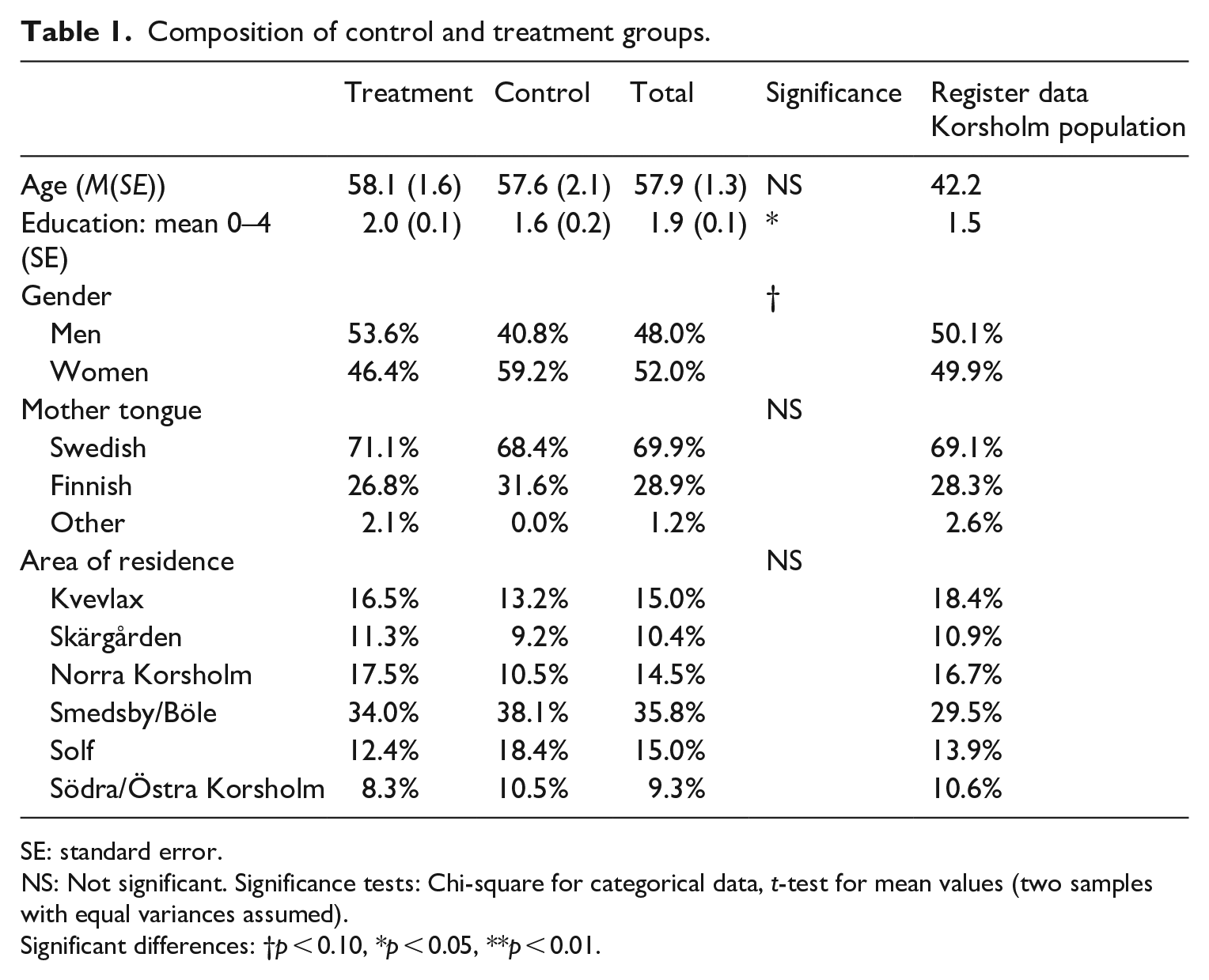
To explore how this affected the composition of the treatment and control groups, Table 1 shows the differences in key socio-demographics: age, gender, mother tongue, area of residence, and educational attainment.
Composition of control and treatment groups.
SE: standard error.
NS: Not significant. Significance tests: Chi-square for categorical data, t-test for mean values (two samples with equal variances assumed).
Significant differences: †p < 0.10, *p < 0.05, **p < 0.01.
The two groups were generally similar, with two exceptions. Regarding gender, the proportion of men was larger in the treatment group (p < 0.10). In terms of education, respondents in the treatment group on average had a slightly higher level of education (p < 0.05). To take this differences into account, we adjusted for gender and education where appropriate to ensure that this would not affect the reported results. 4
In the surveys, we asked respondents about their level of trust in a range of public actors as sources of merger-related information. These included politicians for and against the merger, local public officials, independent experts, the media, and the Citizens’ Jury. 5 These items were used to examine differences in levels of trust both across voting intentions and the treatment/control group, as stated in our four expectations.
To assess differences depending on voting intentions, one survey question asked respondents how they intended to vote. To restrict the analyses to those respondents with a clear position for or against the merger, we excluded those who were uncertain about how they would vote (n = 16). Although it cannot be ascertained that those who stated that they intended to vote yes or no did in fact follow through with that vote, we refer to these as yes- and no-voters for the sake of simplicity. Most results are presented in figures, while the underlying results are available in the Supplemental Appendix.
Analysis
Our empirical analysis is guided by the four expectations based on the theoretical discussion. Our analysis begins by the examination of the first expectation stating that there should more public trust in non-partisan or impartial actors than clearly partisan actors. This involves examining the mean levels of trust in different public actors as sources of merger-related information. Figure 1 shows the results.
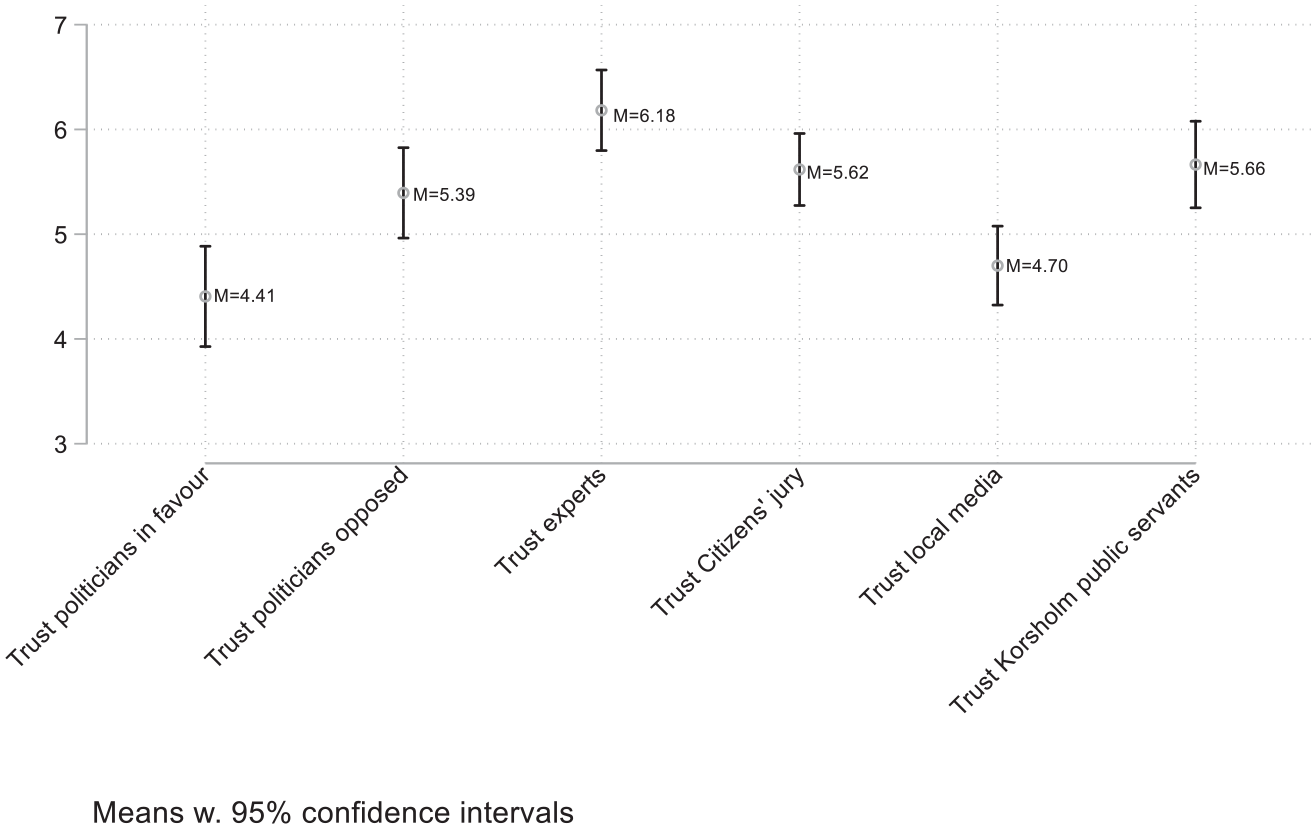
Mean scores for various trust in different institutions (0–10).
The results show that people on average had most trust in independent experts (M = 6.2), followed by local civil servants (M = 5.7), the Citizens’ Jury (M = 5.6), and politicians opposing the merger (M = 5.4). The lowest level of trust was in politicians in favour of the merger (M = 4.4), while the local media only received a slightly higher level of trust (M = 4.7). These results are partly in line with our first expectation that non-partisan actors such as independent experts and the Citizens’ Jury are most trusted as sources of merger-related information. The main exception is that there was a fairly high level of trust in politicians who opposed the merger; the level of trust in them was about the same as the level of trust in the Citizens’ Jury and civil servants, and only experts were clearly trusted to a greater extent.
Overall, the levels of trust in different sources of information were relatively low in a high-trust society like Finland. 6 In particular, the relatively low levels of trust in actors such as civil servants and the local media do not seem to be entirely in line with the first expectation. Considering the polarization on the merger issue and these actors’ perceived positions on the merger outlined above, these variances may indicate that there are substantial differences depending on whether respondents were for or against the merger, as suggested by our second expectation. We examine this in Figure 2, where we examine differences in mean levels of trust between prospective yes- and no-voters.
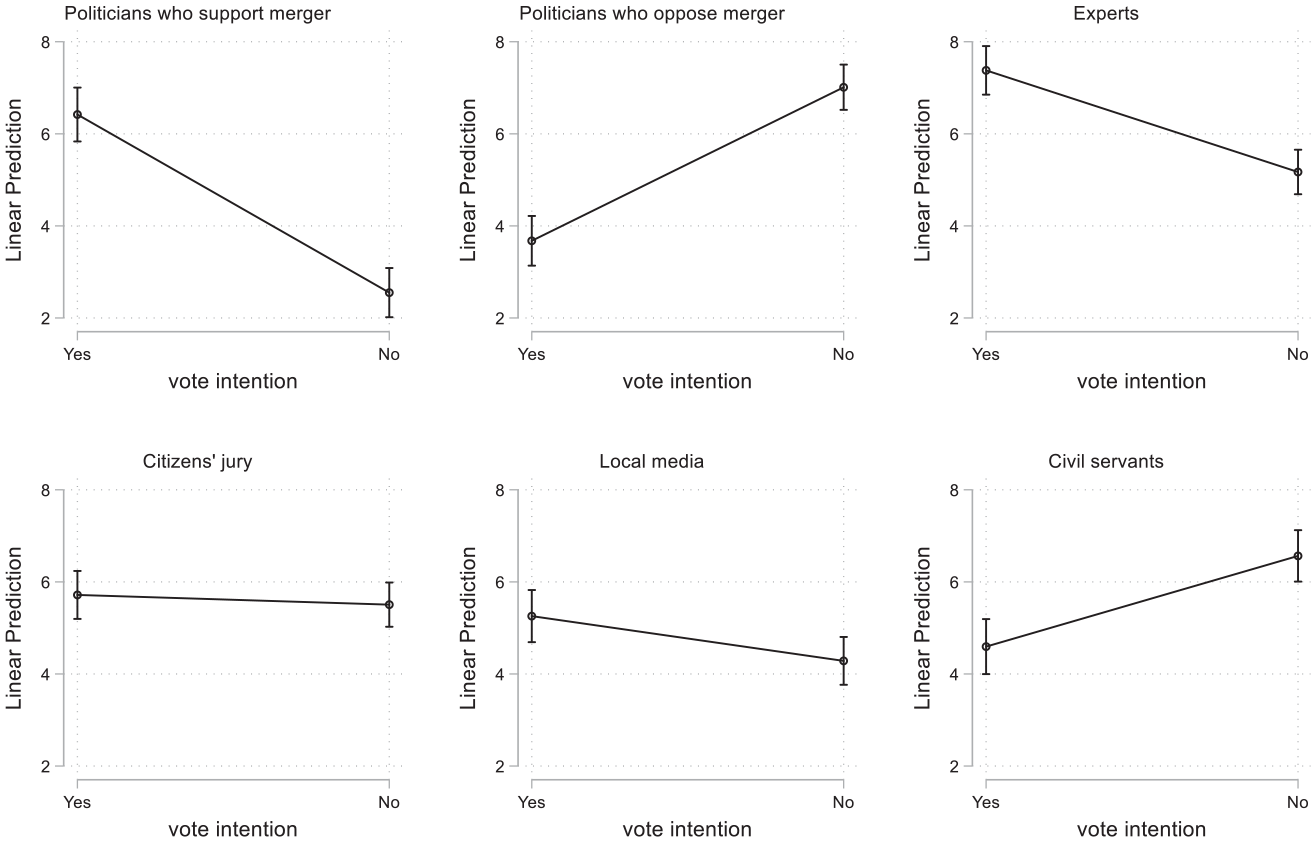
Differences in trust in institutions depending on vote intention (95% CI).
Systematic differences in trust were found, depending on vote intention, for most public actors. People who intended to vote yes were, on average, more likely to trust politicians who supported the merger (yes M = 6.4, no M = 2.6, p < 0.001), experts (yes M = 7.4, no M = 5.2, p < 0.001), and local media (yes M = 5.3, no M = 4.3, p = 0.007). The no-voters were more likely to trust politicians who opposed the merger (no M = 7.0, yes M = 3.7, p < 0.001) and civil servants (no M = 6.6, yes M = 4.6, p < 0.001). The only actor for which there were no significant differences is the Citizens’ Jury (no M = 5.5, yes M = 5.7, p = 0.721). This shows that evaluations of trust were closely connected to voting intentions, which is in line with our second expectation since trust in public actors was selective and dependent on the position on the merger issue.
Our third expectation was that the Citizens’ Jury was unaffected by this division. The results in Figure 2 show that the Citizens’ Jury was evaluated equally by both sides as both supporters and opponents of the merger seemed to put an equal amount of trust in the Citizens’ Jury. In other words, trust in the Citizens’ Jury did not show a pattern of selective trust, which is in line with our third expectation.
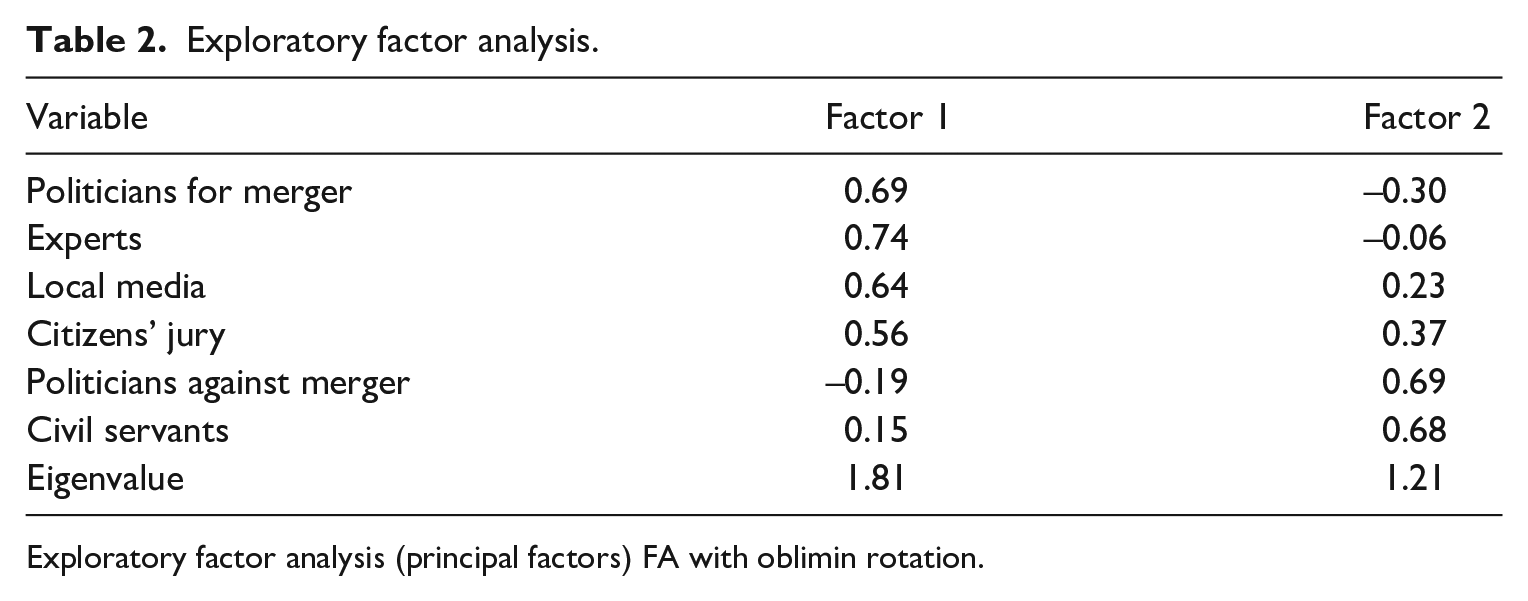
To further examine these differences in selective trust, we performed an exploratory factor analysis to examine the dimensionality of trust, as reported in Table 2.
Exploratory factor analysis.
Exploratory factor analysis (principal factors) FA with oblimin rotation.
These results show that trust in public institutions among the voters in Korsholm was structured along two underlying dimensions. Furthermore, these follow the yes/no divide, since the first dimension involves trust in politicians in favour of the merger, experts, and local media, who were all trusted to a higher extent by those intending to vote yes. The second dimension involves trust in politicians against the merger and civil servants, who were mainly trusted by prospective no-voters. The Citizens’ Jury again occupies an intermediate position, which further confirms that it was trusted to a similar extent by both sides. These results again support our second and third expectations, since trust in public actors as sources of merger-related information is structured according to positions on the merger issue, the Citizens’ Jury providing the only exception to the pattern of selective trust. This suggests that the Citizens’ Jury was regarded as the only impartial source of information.
Our fourth expectation concerns the effects of reading the statement by the Citizens’ Jury on voters’ evaluations of trustworthiness of public actors, especially those perceived to be of a contrary position. Figure 3 shows the results of regressing the two dimensions on vote intention, treatment (reading the statement), and an interaction effect between the two. This equals an analysis of covariance (ANCOVA) analysis that explores whether the mean scores of the trust dimensions differ for yes- and no-voters depending on treatment when adjusting for gender and education.
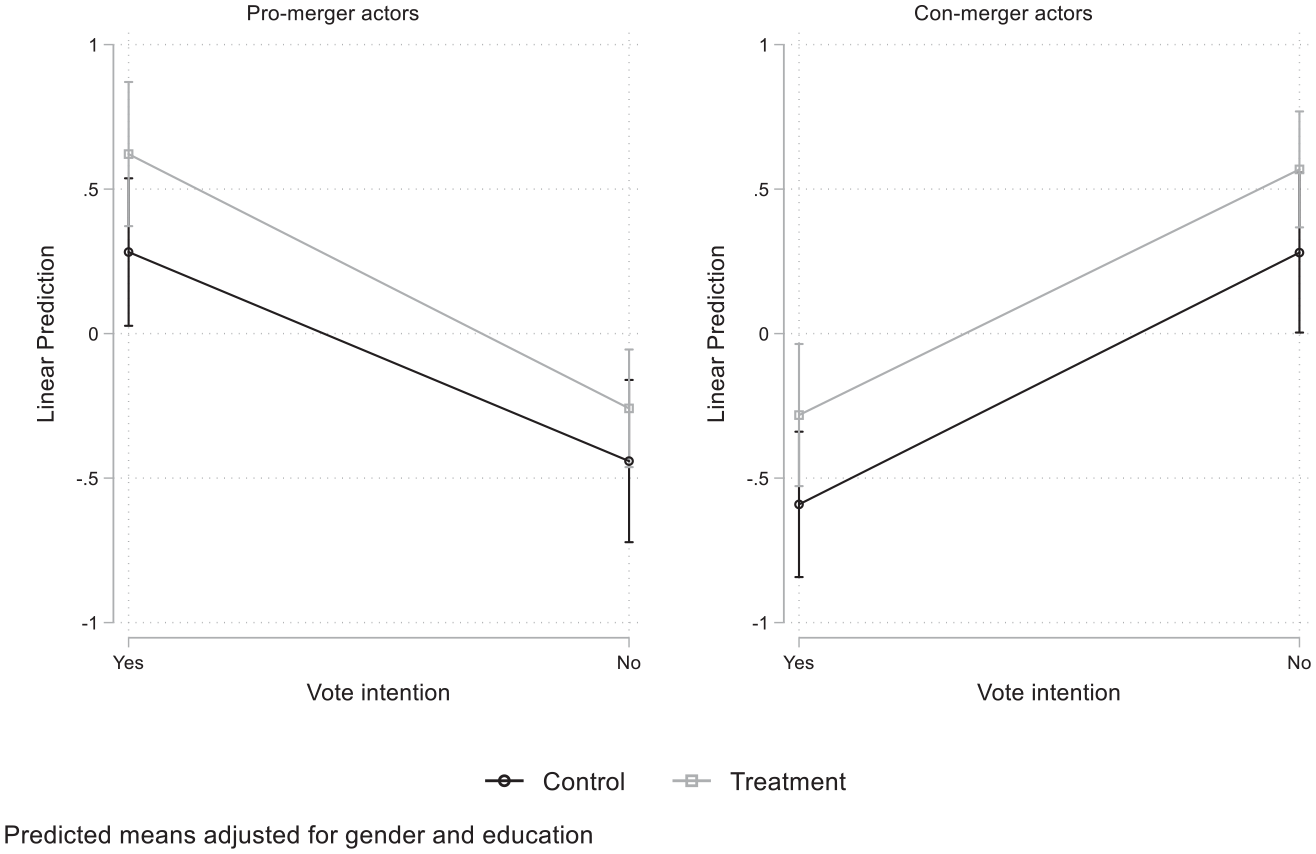
Differences in trust depending on treatment and vote intention (95% CI).
The results first show that, in both the treatment and control group, yes-voters tended to trust pro-merger actors over con-merger actors, while no-voters were more likely to trust con-merger actors over pro-merger actors. Second, reading the statement increased trust in pro-merger actors and con-merger actors, meaning the levels of trust were generally higher in the treatment group regardless of voting intention. 7 Finally, the effects of reading the statement on trust in public actors were similar across vote intention since neither of the moderating effects were significant (pro-merger: B = -0.16, p = 0.531; Con-merger: B = -0.02, p = 0.931). Although significance tests are unreliable when it comes to assessing interaction effects (Kam and Franzese, 2009), a visual inspection of Figure 3 leads to similar results since the lines are fairly parallel for all plots, indicating that the effects of reading the statement were similar regardless of whether respondents intended to vote yes or no on the merger. In other words, reading the statement increased levels of trust in all public actors as sources of merger-related information by a similar amount among both yes and no-voters, even in public actors who were perceived to be on the other side of the merger issue. Although people still trusted in actors perceived to be on their own side to a greater extent, reading the statement can be said to have at least alleviated selective distrust.
Discussion
In some circumstances, as in the case of the referendum on the municipal merger in Korsholm, voters’ trust in all public actors may have been shaped by attitudes on a particular issue. The situation in Korsholm can be explained by the fact that the merger issue was marred by both opinion-based and affective polarization, and voters’ opinions on the merger issue were entangled with factors such as identification with linguistic groups and areas of residence. The mechanisms of selective trust therefore played a much bigger role in this polarized context than in ‘everyday’ Finnish politics.
Voters’trust in different public actors as sources of information depended on the actor’s perceived position on the merger issue. This was the case, not only in case of local politicians, but also in case of (presumably) non-partisan public actors such as municipal officials, experts and the media. . In Warren and Gastil’s (2015) terms, the circumstances in Korsholm leading up to the referendum represent a situation of generalized distrust in which the normative bases of institutional trust, such as the perception of impartiality, had eroded. Against this backdrop, it is noteworthy that the Citizens’ Jury was quite highly trusted by both yes and no-voters. In fact, it was the only source of information that was regarded equally trustworthy by both those for and against the merger.
Hence, the Citizens’ Jury avoided becoming part of the divisions and provided a neutral source of information. Our findings thus seem to support the argument by Gastil (2014: 156) that reading the facts and the arguments summarized by a mini-public can help voters rise above the personalization of campaigns as well as manipulations and accusations put forward in campaign rhetoric. There are several explanations for our findings, the most obvious one being that the CIR process was specifically designed to be impartial and that the statement covered the key arguments of both pro and con camps. Moreover, the fact that information originated from fellow citizens, and that the organizers of the jury were university researchers not involved in local politics, may have contributed to the trustworthiness of the jury.
The fact that the information provided by the Citizens’ Jury was perceived as trustworthy had consequences since those who had the chance to read the statement expressed overall higher levels of trust compared to those who did not read the statement. Reading the statement increased both yes- and no-voters’ trust in all public actors, regardless of their perceived position on the merger affair. While trust in public actors remained selective in the sense that those who had read the statement still had more trust in political actors who were perceived to be on their side of the merger issue, reading the statement also increased trust in those political actors who were regarded to be on the opposing side. Reading the statement did not increase no-voters’ trust in pro-merger politicians, however, which suggests that exposure to opposing arguments may not always be a cure for selective distrust.
In a polarized environment such as Korsholm, familiarizing with the statement by the Citizens’ Jury may have, in fact, been the only occasion for many voters to learn and reflect on arguments on both sides. Reading the statement by the Korsholm jury facilitated learning and consideration of different merger-related facts and viewpoints (Setälä et al., 2020). The finding that reading the statement increased both yes- and no-voters’ trust in (almost) all public actors, regardless of their perceived position on the merger issue, further suggests that the exposure to its contents help broaden people’s understanding of different rationales related to the issue at hand.
From the viewpoint of democracy, trust can be regarded as problematic if it is ‘blind’ and impedes voters’ capacity to make independent, critical judgements on the quality of political arguments (Lafont, 2015). Because political polarization seems to hinder argument-based reasoning among voters (Druckman et al., 2013), there is a particular need for sources of facilitative trust that enhance learning and understanding about different sides of issues in such contexts. Although it may be unrealistic to expect that CIR-type procedures could help voters make impartial judgements of the quality of the arguments on both sides, at least they could increase the understanding that even those with opposing opinions may be reasonable people who have some sensible arguments that support their views.
There are some limitations to our study that call for further research. First, some of the (lack of) results may have been caused by the relatively small number of respondents included in the study, even if the results appear to be robust. Power calculations show that our current sample sizes (n = 174) should be sufficient to detect small effect sizes = 0.05 with a power = 0.90. Nevertheless, the sample size requirements may increase drastically when examining differences between the treatment and control group, although the exact sizes depend on several factors (Brookes et al., 2004). Second, while facilitative trust is a likely explanation for why reading the statement increased trust in different political actors, this mechanism should be examined further in future experimental studies. Third, the capacity of the statement to increase trust may be dependent on the fact that the CIR statement did not include any directional recommendation and, consequently, future studies should address the possible impact of such recommendations.
Regardless of these limitations and the need for future results, our results are rather optimistic in terms of the capacity of deliberative mini-publics, and CIR-type procedures in particular, to enhance public trust. When properly connected to mass publics, mini-publics can help enhance trust in public institutions, including those on the ‘other side’, in polarized contexts.
Supplemental Material
sj-pdf-1-pol-10.1177_02633957211024474 – Supplemental material for Beyond polarization and selective trust: A Citizen’s Jury as a trusted source of information
Supplemental material, sj-pdf-1-pol-10.1177_02633957211024474 for Beyond polarization and selective trust: A Citizen’s Jury as a trusted source of information by Maija Setälä, Henrik Serup Christensen, Mikko Leino and Kim Strandberg in Politics
Footnotes
Acknowledgements
The authors wish to thank the team involved in planning and implementing the Citizens’ Jury, especially Maria Bäck, Maija Jäske and Katariina Kulha. Special thanks belong to John Gastil who helped with the research design and the surveys, and Linn Davis from Healthy Democracy Oregon whose contribution was crucial for the CIR project.
Funding
The author(s) disclosed receipt of the following financial support for the research, authorship, and/or publication of this article: This work was supported by the Strategic Research Council at the Academy of Finland (grant number 312671).

Supplementary Information
Additional supplementary information may be found with the online version of this article.
Notes
Author biographies
References
Supplementary Material
Please find the following supplemental material available below.
For Open Access articles published under a Creative Commons License, all supplemental material carries the same license as the article it is associated with.
For non-Open Access articles published, all supplemental material carries a non-exclusive license, and permission requests for re-use of supplemental material or any part of supplemental material shall be sent directly to the copyright owner as specified in the copyright notice associated with the article.
