




Abstract
The continued relevance of the second-order elections (SOE) theory is one of the most widely debated issues in the study of European Parliament (EP) elections. While the theory has been criticised from many angles, the recent success of populist, extremist, and Eurosceptic parties raises additional questions about the applicability of a model that depicts EP elections as a low-stakes affair revolving around national issues. This article tests the SOE model with party-level data from all 175 EP elections held between 1979 and 2019. While turnout in EP elections remains well below participation rates in national elections, the 2019 EP elections were marked by a significant reduction in the average turnout gap. Across all election years, party size is the most potent predictor of electoral gains and losses in EP elections. Incumbency is associated with electoral losses in most EP election years. These effects are moderated by the electoral cycle and the electoral system in some but not all years. The expectation that the SOE model performs worse in countries with fragmented party systems was not confirmed. All in all, the SOE model continues to wield significant explanatory power in both the West and the East.
The continued viability of the 40-year-old second-order elections (SOE) theory is a much-discussed subject in the study of European Parliament (EP) elections (Nielsen and Franklin, 2017; Schmitt, 2005; Schmitt and Teperoglou, 2019; Van Der Brug et al., 2016). A year after the first direct elections to the EP, Reif and Schmitt (1980: 3) famously argued that European elections are additional national SOE ‘(a)s long as the national political systems decide most of what there is to be decided politically, and everything really important’. After decades of unprecedented widening and deepening of integration, and in the context of mounting transnational challenges, this condition no longer seems to apply. With strong supranational institutions and an ever-expanding body of community law, the EU now exercises great power over the lives of Europeans. The EP itself has undergone a metamorphosis from a representative body with ‘very little real power’ (Reif and Schmitt, 1980: 12) to a powerful co-legislator with significant budgetary and scrutiny powers (Costa, 2018).
The SOE model has been challenged on multiple accounts. A series of studies spanning several decades have argued that ‘Europe matters’ in EP elections (e.g. Beach et al., 2018; Carruba and Timpone, 2005; Hobolt, 2015). Tests of the SOE model conducted after the Eastern enlargement showed that while the model persists in Western Europe, it fails to explain patterns of electoral gains and losses in the new East European member states (Koepke and Ringe, 2006; Schmitt, 2005). More recently, doubts about the viability of the second-order model have been amplified by the apparent politicisation of European integration (Hooghe and Marks, 2009; Hutter and Kriesi, 2019; Kriesi, 2016) as well as the rise of populist, extremist, and Eurosceptic parties in EP elections. In 2014, such parties won a quarter of all seats in the EP while traditional liberal, conservative, and social-democratic parties suffered losses (Luo, 2017; Martín-Cubas et al., 2019). In 2019, populist, extremist, and Eurosceptic parties largely held the ground gained in 2014, with nationalist and far-right groups taking the majority of the vote in Hungary, Italy, and Poland. The EP became more fragmented than ever before, with the two largest political groups for the first time controlling less than half of the seats (Bolin et al., 2019). It is not clear whether and how increasingly prominent clashes over liberal-democratic Europeanism can be reconciled with a model that depicts EP elections as a second-order national affair.
This article tests the SOE model in the context of all EP elections held to date, while also seeking to ascertain whether the 2019 contests differed from previous EP elections and how. While our approach is conventional in the sense that it focusses on the original SOE hypotheses proposed by Reif and Schmitt (1980) and tests these with aggregate-level data, this test goes beyond existing studies in that it (a) systematically evaluates the performance of all core SOE hypotheses over a period of 40 years, (b) addresses a number of concerns related to party size effects by controlling for variation in electoral rules and conducting a robustness check focussing on relative, as opposed to absolute change in party vote shares, and (c) contributes to the debate on the performance of the SOE model in less consolidated party systems by controlling for party system fragmentation and comparing the model’s predictive power in Western and Eastern Europe. Although the extent to which the model’s key predictions are empirically corroborated varies from year to year, we conclude that, overall, the SOE model has withstood the test of time, and continues to wield significant explanatory power in both the old and the new member states of the EU.
The second-order model and its limitations
As a dominant paradigm for understanding EP elections, the SOE model has proven to be astoundingly durable. Because its main arguments are well known and have been extensively covered in the rich, diverse literature on EP elections, a brief summary will suffice here. Depicting EP elections as simultaneously held national contests between national parties, the model argues that because European elections do not determine political leadership, less is at stake for all relevant actors, including the voters and parties (Reif and Schmitt, 1980). In such a setting, voters are less likely to turn out, and more likely to engage in sincere or protest voting, as opposed to strategic voting (Oppenhuis et al., 1996). On the aggregate level, the relative inconsequentiality of EP elections is reflected in low turnout. Other major predictions of the SOE model include electoral losses of government parties and large parties, relative to preceding national elections, electoral gains of opposition parties and small parties, and variation in the magnitude of incumbent losses depending on the phase of the electoral cycle (Reif, 1984; Reif and Schmitt, 1980). The expectations associated with the SOE model have been extensively tested, and mostly corroborated, by studies using aggregate-level EP election data (e.g. Hix and Marsh, 2007, 2011; Marsh, 1998; Schmitt, 2005; Schmitt and Toygür, 2016). Individual-level evidence suggesting that voters are primarily concerned with national issues and that vote-switching is motivated by the desire to punish political incumbents adds additional support to the SOE thesis (e.g. Clark and Rohrschneider, 2009; Hobolt and Wittrock, 2011; Schmitt et al., 2008).
The conventional view of EP elections is challenged by several bodies of literature. Central to the increasingly dominant politicisation perspective in European integration theory is the understanding that the permissive consensus (Lindberg and Scheingold, 1970) that characterised public opinion on the EU in the pre-Maastricht era has been replaced by a ‘constraining dissensus’ (Hooghe and Marks, 2009). The question of Europe has been deliberately politicized by actors sensing opportunities for electoral gain, and party positions and public attitudes on the EU have become increasingly well-defined as well as polarised. Conflict over the speed and direction of European integration is played out in elections, referenda, public debates, and street protests (Hutter et al., 2016). The numerous crises that have shaken Europe have served as catalysts for the politicisation of integration (Hutter and Kriesi, 2019; Kriesi and Pappas, 2015). In sum, the politicisation approach argues that the question of Europe has entered mass politics, and constitutes an important political divide that structures party competition as well as voting behaviour alongside the traditional political cleavages.
The SOE argument that EP elections focus on national as opposed to European issues is challenged by the EU issue voting literature. EU attitudes have been shown to be an important determinant of vote choice in EP elections (Carrubba and Timpone, 2005; Hobolt, 2015; Hobolt and De Vries, 2016; Van Elsas et al., 2019; Van Spanje and De Vreese, 2011), especially when information on European integration is widely available (Hobolt and Wittrock, 2011) and when political campaigns inform and persuade voters about candidates, policies, and performance (Beach et al., 2018). On the aggregate level, studies testing the idea that ‘Europe matters’ in EP elections have focussed on party positions and ideologies. Ferrara and Weishaupt (2004) expected parties whose platforms give greater salience to European issues, as well as parties strongly opposed to European integration, to do better in EP elections than in national elections. Carrubba and Timpone (2005) suggested that voters could have different policy preferences for different levels of government. A study by Hix and Marsh (2011) sought to identify ‘European effects’ in EP elections by examining pan-European shifts in the behaviour of voters towards or away from particular party families. Analysing aggregate data from seven EP elections, the study identified several such swings – for example, for green parties, away from socialist parties – arguing that such reactions to common policy concerns could be regarded as ‘the first step in the evolution of European Parliament elections into genuine European-wide votes about the direction of the EU policy agenda’ (Hix and Marsh, 2011: 10).
Finally, empirical studies testing the SOE model in the context of the 2004 and subsequent EP elections have shown that while the model performs well in Western Europe, it fails to predict patterns of electoral gains and losses in the new member states. Koepke and Ringe (2006) demonstrated that in the 2004 EP elections, voters in the new member states did not cast protest votes against incumbent national governments. Schmitt (2005) showed that in the East, the losses of government parties did not follow the cyclical patterns found in the West. The observed East–West differences have generally been attributed to different levels of party system consolidation, although few studies have systematically examined the link between the performance of the SOE model and party system characteristics, including volatility and fragmentation.
In sum, this discussion leads us to posit a set of seven hypotheses. The first four are standard SOE expectations focussing on turnout as well as the effects of party size, incumbency, and the electoral cycle on electoral performance:
H1. Turnout in EP elections is lower than turnout in national elections (‘lower turnout’);
H2. Party size is negatively associated with electoral performance in EP elections relative to the preceding national election (‘large party losses’);
H3. Incumbency is negatively associated with electoral performance in EP elections relative to the preceding national election (‘incumbent losses’);
H4. The negative effect of incumbency on electoral performance is more pronounced when EP elections occur in the middle of the first-order electoral cycle (‘cycle effects’).
We also include a hypothesis focussing on party ideologies that is directly derived from the original formulation of the SOE model (Reif and Schmitt, 1980; see also Schmitt et al., 2020: 7) but has been, to date, rarely systematically tested:
H5. Ideologically extreme parties and protest parties gain votes in EP elections compared with the preceding national election (‘extremist and protest party gains’).
Going beyond previous tests of the second-order model, we account for the possibility that the effects of party size on the difference in party vote shares between national and EP election could be moderated by the type of electoral system used in national elections. While all EU countries use a form of proportional representation (party list or single transferable vote) in EP elections, national elections in some member states are conducted under single-member plurality, single-member majority or mixed systems. Because majoritarian and plurality systems may prompt voters to strategically vote for larger parties or disincentivize small parties to form or run (Blais and Carty, 1991; Duverger, 1954), a fair comparison between vote shares at national and EU elections should take into account whether national and EP elections are held under broadly similar rules or not. Thus, responding to recent calls to pay more attention to possible electoral system effects in the study of voting behaviour in EP elections (Farrell and Scully, 2005; Prosser, 2016), we add the following hypothesis:
H6. The negative effect of party size on electoral performance in EP elections is more pronounced in contexts where national elections are held under a single-member plurality or a single-member majority system (‘electoral system effects’).
In addition to electoral system effects, party system characteristics could also influence the performance of the SOE model. Acknowledging the debate about whether or not the SOE model holds in less consolidated, more fragmented party systems (Koepke and Ringe, 2006; Schmitt, 2005), we include the following hypothesis:
H7. The effects of incumbency, party size and the electoral cycle on electoral performance in EP elections are less pronounced in more fragmented party systems (‘party system effects’).
Data and methods
We constructed a database covering all EP elections to date, that is, 175 nationally organised EP elections held between 1979 and 2019. The unit of analysis is a party or electoral alliance that (a) competed in both the EP election as well as the preceding national parliamentary election and (b) obtained at least 2% of the vote in the national election. Because our dependent variable is defined as difference in vote shares obtained in EP and national elections, parties that competed in only one election but not the other were dropped from the analysis. Cases involving membership in electoral alliances were examined one-by-one. When parties competed separately in one election and as part of an alliance in the other election, vote shares of individual parties were added to calculate the vote difference for the alliance as a whole. However, cases entailing complex shifts of alliance membership from one election to another had to be dropped from analysis (unless separate vote shares for the parties constituting the alliance were available) because the unit of observation changed over time. The final number of parties and electoral alliances included in the analysis is 1413.
The dependent variable, difference in vote shares, is calculated by deducting the vote share obtained by the party in national elections from its vote share in the subsequent EP election. Information about parties’ electoral performance is obtained from the ParlGov database (Döring and Manow, 2019) which covers all EU and most Organisation for Economic Co-operation and Development (OECD) democracies.
We employ conventional measures to test the core propositions of the SOE model (H1–H4). Data on turnout in national and EP elections are obtained from ParlGov. The variable for incumbency is coded as 1 for parties that belonged to the national government when EP elections took place, and as 0 otherwise. For party size, we follow previous studies (e.g. Hix and Marsh, 2007) in using vote share in national elections as a proxy. The electoral cycle is operationalised as the percentage of the first-order electoral cycle completed by the time EP elections took place. Because the expected effect of the electoral cycle on party performance is curvilinear, we include the squared variable in our models. We also include an interaction term between incumbency status and the timing of the European election in the national cycle to account for the possibility that government parties lose more support in the middle of the cycle (Marsh, 1998).
To test the hypothesis that ideologically extreme and protest parties gain votes in EP elections (H5), we rely on the PopuList database, a resource providing a list of populist, far-right, far-left, and Eurosceptic parties in Europe since 1989 (Rooduijn et al., 2019). The coding of parties in the database is based on widely accepted definitions and has been peer-reviewed by more than 80 academics. The definition of far-right parties combines a subscription to a nativist ideology with an endorsement of authoritarianism (Mudde, 2007). Building on March (2012), the database defines the far-left in terms of the rejection of capitalism and advocation of alternative economic and power structures as well as redistribution of resources from existing political elites. Populism is defined as endorsement of the idea that society is separated into two homogeneous and antagonistic groups, ‘the pure people’ and ‘the corrupt elite’, and that politics should be an expression of the ‘general will’ of the people (Mudde, 2004). Our measure of ‘extremist or protest parties’ includes all parties that are categorised as far-right or far-left in the PopuList, as well as populist parties not in government. 1 Descriptive statistics are presented in Table A1 in the Online Appendix.
To test the hypothesis that the effect of party size on vote difference is moderated by the electoral system (H6), we include a dummy variable coded as 1 for countries that use proportional representation (party list or single transferable vote) or mixed systems in national elections, and as 0 for countries where national elections are held under a single-member plurality or a single-member majority system. 2 This variable is then interacted with party size to determine whether large parties suffer more in countries belonging to the latter category.
To test the hypothesis that the performance of the SOE model varies across party system characteristics (H7), we include a measure of party system fragmentation, operationalised in terms of the effective number of parties (ENP; Laakso and Taagepera, 1979), and calculated based on vote share in national elections preceding EP elections. The data are obtained from ParlGov.
To test the lower turnout hypothesis, we present data on turnout in national and EP elections and graph the turnout differential over time and across groups of member states. To test the remaining six hypotheses, we regress the difference in party vote shares on incumbency, party size, electoral system, ENP, electoral cycle, electoral cycle squared, extremist and protest stance, and a number of interaction terms. To account for the nested structure of our data, we estimate multi-level regression models with parties nested in countries. Because of our interest in whether and how the performance of the SOE model has changed over time, we run separate regression models for each of the nine EP election years.
Results
Between 1979 and 2019, turnout in EP elections has almost always been significantly lower than turnout in national elections (Table 1). Exceptions are found mostly in countries with enforced compulsory voting, such as Belgium and Luxembourg. However, recent electoral outcomes raise questions about the continued accuracy of this core prediction of the SOE model. In 2019, EP election turnout exceeded electoral participation rates in preceding national elections in five member states, including one with compulsory voting (Belgium) as well as four countries distinguished by notably low turnout in national contests (France, Greece, Lithuania, and Romania). In Romania, EP election turnout exceeded the national election participation rate by a remarkable 12 percentage points. Across the EU, the average turnout difference was around 25% between 1999 and 2014, before dropping back to pre-1990s levels in 2019 (Table 1).
Turnout in EP elections and preceding national elections, 1979–2019.
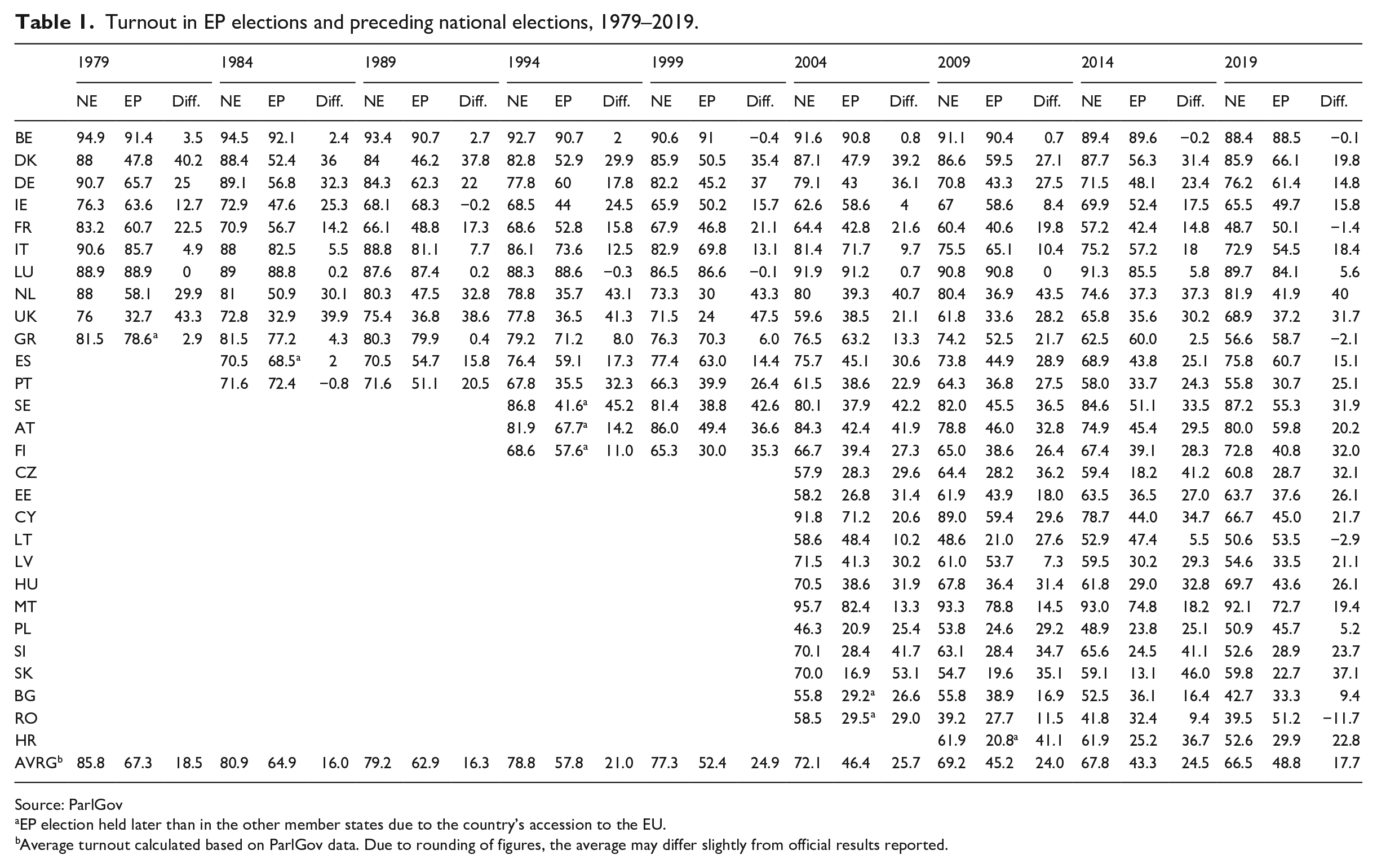
Source: ParlGov
EP election held later than in the other member states due to the country’s accession to the EU.
Average turnout calculated based on ParlGov data. Due to rounding of figures, the average may differ slightly from official results reported.
Figure 1 depicts the dynamics of the turnout gap over time and across groups of countries. As expected, the turnout difference is smallest in countries with enforced compulsory voting. While the founding members of the EU have had, overall, smaller turnout gaps than countries that acceded later, this difference is largely due to the use of compulsory voting in Belgium, Luxembourg, and Italy. Figure 1 also suggests that the reduction of the turnout gap in recent EP elections is happening across the EU – that is, the trend is not attributable to a few exceptional cases. In sum, this analysis confirms the existence of the turnout gap predicted by the SOE model, while suggesting that the gap may be diminishing as a result of growing participation in EP elections as well as declining turnout in national contests in several member states.
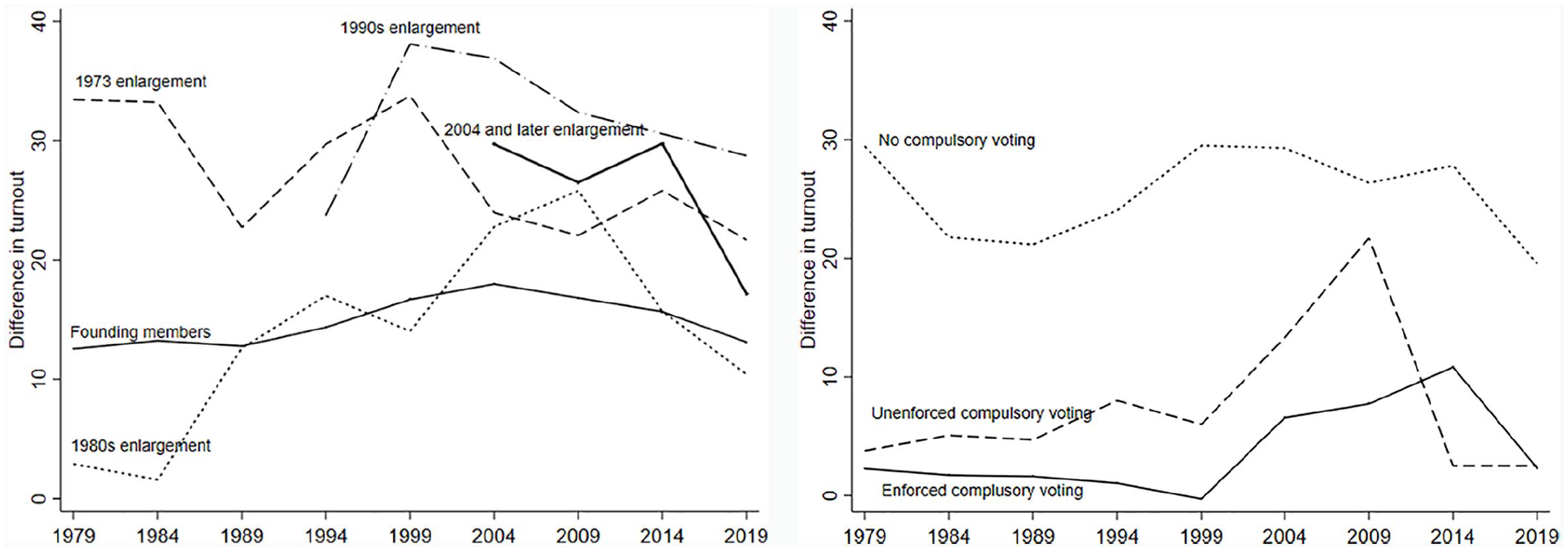
Dynamics of the turnout differential, 1979–2019.
To test the remaining hypotheses, we first estimate models for each year with variables central to the SOE theory: incumbency status, party size, and two measures of the electoral cycle. At this stage, we do not yet include the interaction term that isolates cycle effects for parties in government because incumbency main effects in such models are much less intuitive to interpret, referring to effect sizes of government status when electoral cycle equals zero. The results in Table 2 lend, overall, considerable support to the SOE model. Large parties and government parties lost votes in EP elections in most years. The two central SOE expectations (H2 and H3), however, are not substantiated for the early rounds of EP elections. When we add an interaction term between incumbency status and election timing, we also find some support to H4, according to which governing parties lose more votes than opposition parties in EP elections that are held in the middle of the first-order election cycle (see models for 1994, 2004, and 2014 in Table 3). The only SOE expectation, however, that yielded significant effects in 2019 was large party losses.
Effects of core SOE variables on party performance in EP elections.
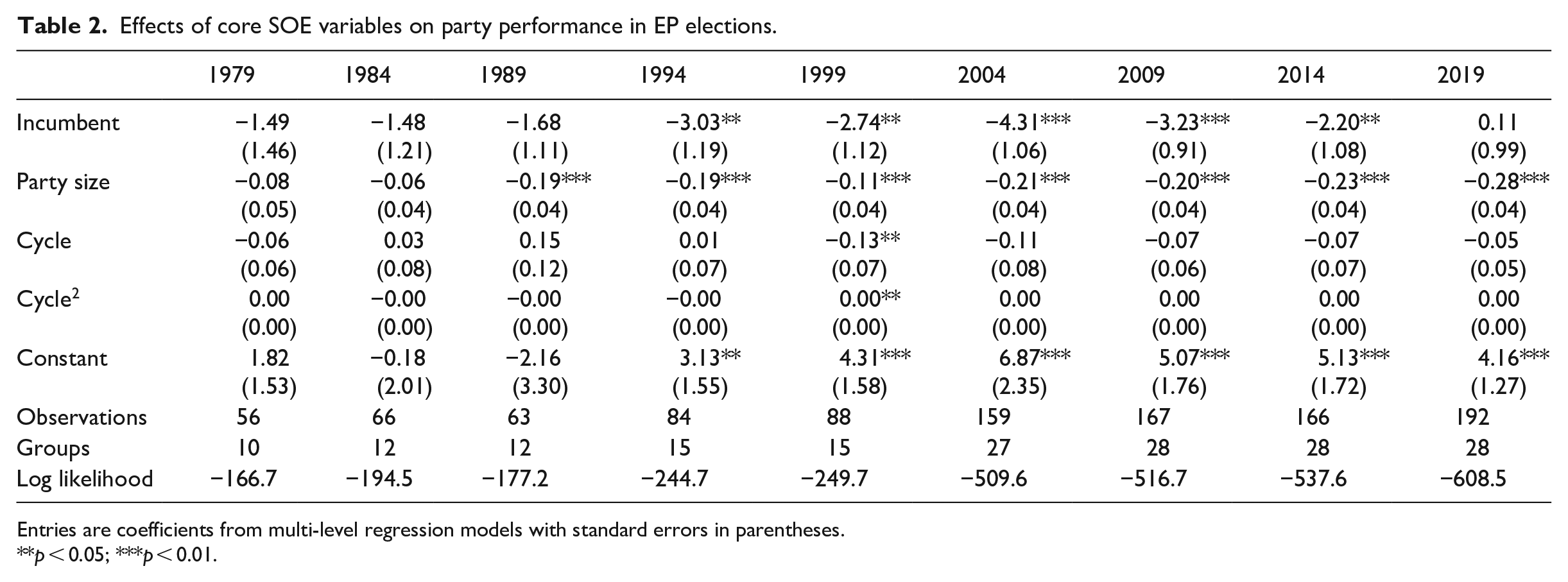
Entries are coefficients from multi-level regression models with standard errors in parentheses.
**p < 0.05; ***p < 0.01.
Effects of core SOE variables and the interaction term for cycle and incumbency on party performance in EP elections.
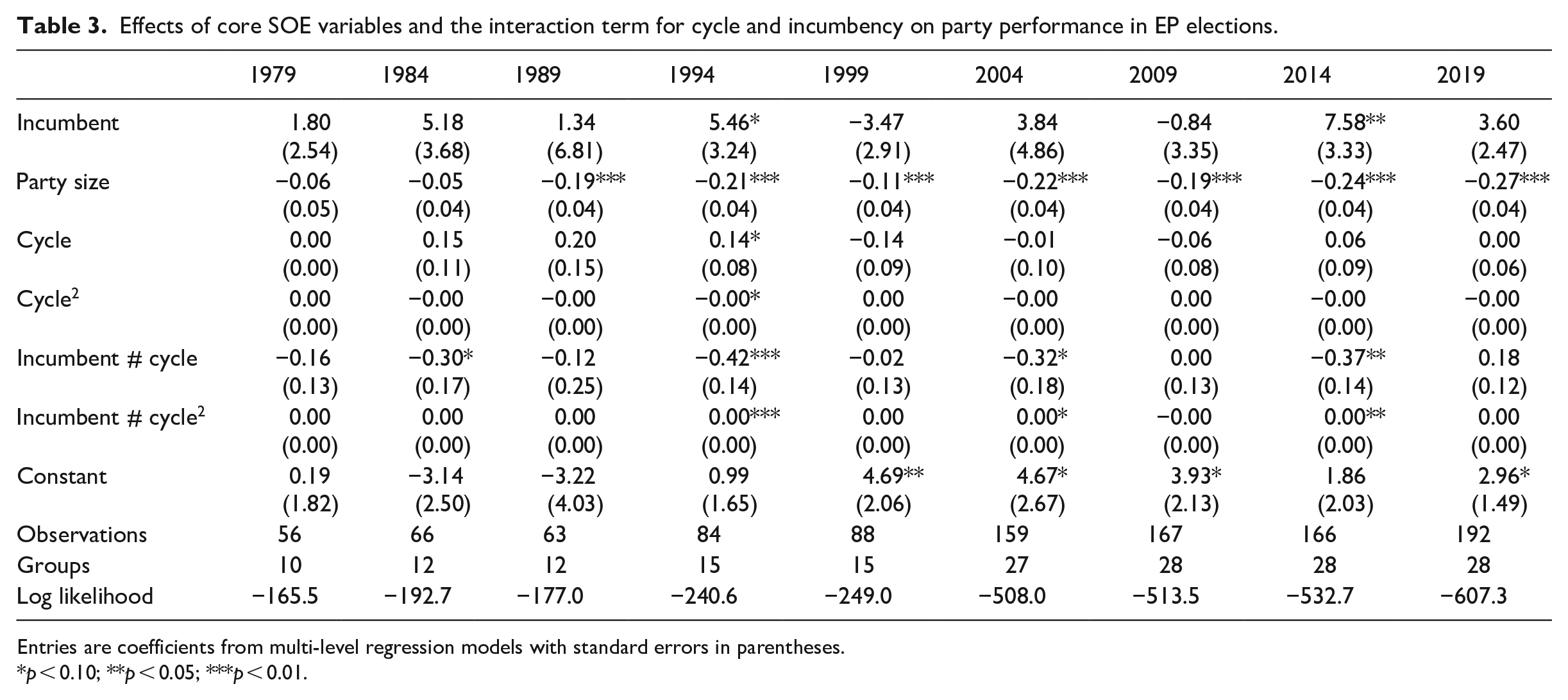
Entries are coefficients from multi-level regression models with standard errors in parentheses.
p < 0.10; **p < 0.05; ***p < 0.01.
To account for the possibility that party size effects could be partly mechanical, considering that larger parties have a greater range of possible negative values in the dependent variable than smaller parties, we conduct a robustness test, running the models with relative as opposed to absolute percentage change in vote shares as the dependent variable. The key findings remain robust in that party size continues to be the most stable predictor of electoral performance at the European level (see Table A2 in the Online Appendix).
As the next step, we add the electoral system variable to the models, and interact it with party size to assess whether large party losses are moderated by the type of electoral system used in national elections (H6). Results in Table 4 suggest that this is true for three election years – 2009, 2014, and 2019. Figure 2, illustrating the results for 2019, shows that in countries that use a PR or mixed system in national elections, the predicted vote difference ranged from + 1.6 percentage points for the smallest parties to −9.8 percentage points for the largest parties. In countries that use single-member plurality or single-member majority systems in national elections, however, the smallest parties gained 6.5 and the largest parties lost as much as 38.7 percentage points. In other words, large parties suffered greater losses when EP elections were held under electoral rules dissimilar to those used in national elections.
Effects of SOE variables and national electoral systems on party performance in EP elections.
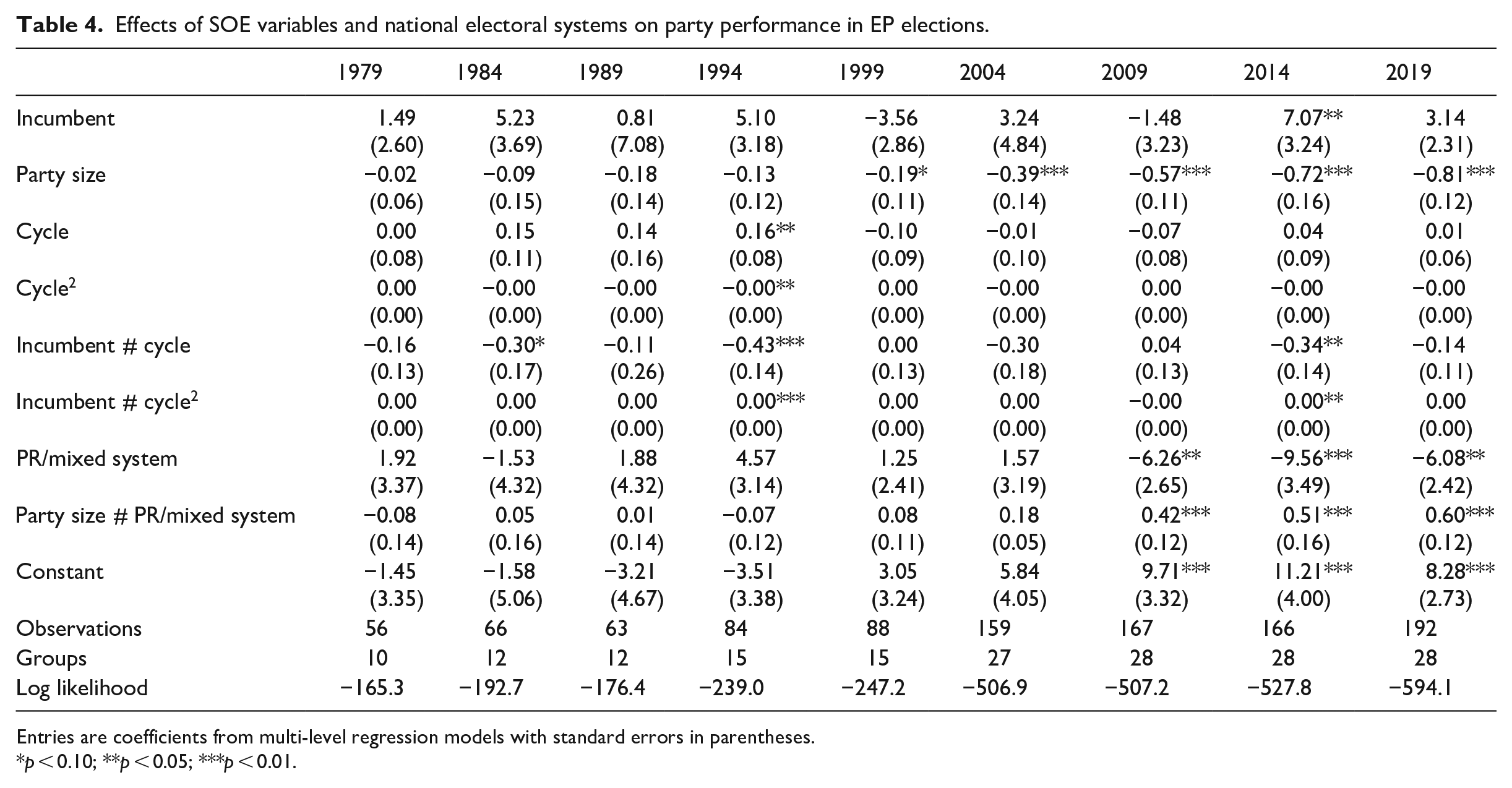
Entries are coefficients from multi-level regression models with standard errors in parentheses.
p < 0.10; **p < 0.05; ***p < 0.01.
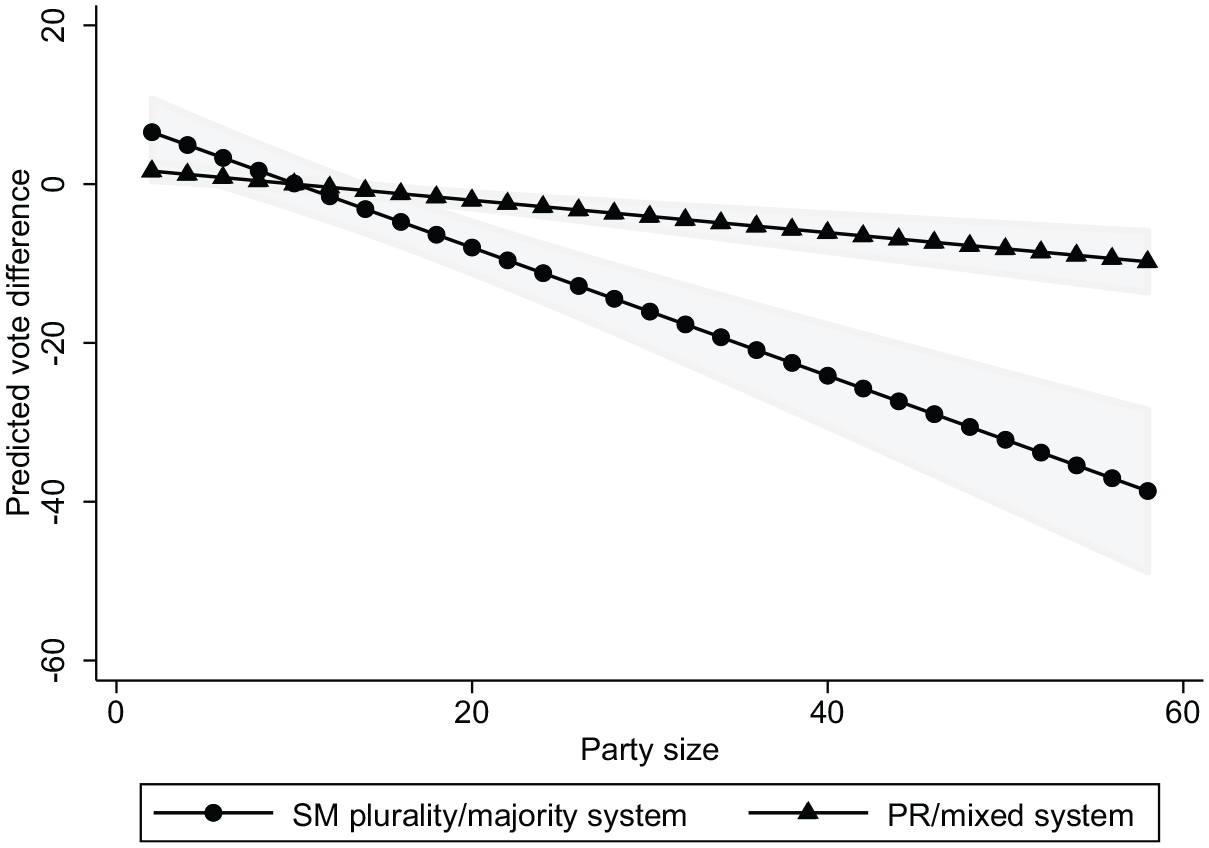
Electoral system effects on party performance in the 2019 EP elections.
Next, we examine the question of whether gains and losses in EP elections vary as a function of party ideology (H5). Models are estimated for the period 1989–2019 only because no data for ideational markers is available for earlier years. A baseline model with just one predictor – a dummy for extremist and protest parties – lends considerable support to the hypothesis (Table A3 in the Online Appendix). The variable has statistically significant positive effects in 1994, 2009, and 2014. After controlling for incumbency, party size, cycle, and the electoral system, however, an extremist or protest stance had a statistically significant effect only in 2019. The effect was negative, suggesting that extremist and protest parties lost votes compared with preceding national elections (Table 5).
Effects of SOE variables, national electoral systems and party ideology on party performance in EP elections, 1989−2019.
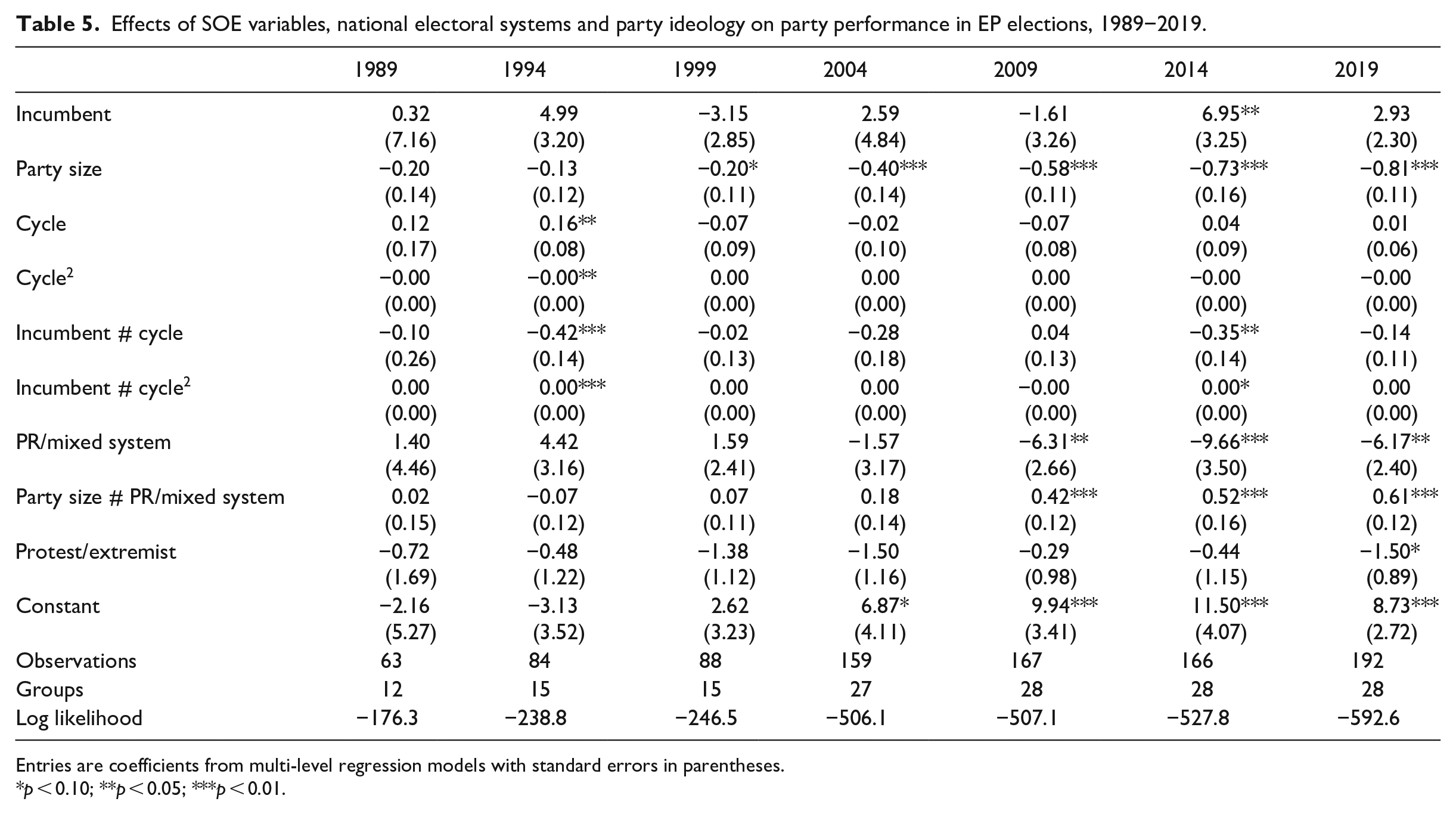
Entries are coefficients from multi-level regression models with standard errors in parentheses.
p < 0.10; **p < 0.05; ***p < 0.01.
Finally, to test the hypothesis that the SOE model performs better in more consolidated, less fragmented party systems (H7), we estimate a series of regression models. The first of these introduces party system fragmentation, measured in terms of the ENP, as a control variable, while three subsequent models interact ENP with incumbency, party size, as well as both incumbency and cycle (Tables A4–A7 in the Online Appendix). While in most models, party system fragmentation does not predict electoral gains and losses, we find that fragmentation was associated with greater gains for incumbent parties in 1989 and 1994, while in 2004 and 2014, greater fragmentation was associated with more pronounced losses for large parties (Tables A5 and A6 in the Online Appendix). A three-way interaction term for fragmentation, cycle, and incumbency has statistically significant effects in 1989, 1994, and 1999 (Table A7 in the Online Appendix). In sum, the results are inconclusive with regard to H7: while the effects of SOE variables appear to vary across levels of party system fragmentation, we do not detect a clear pattern that would allow us to confirm the proposition that the SOE model performs better in less fragmented systems.
Acknowledging that party system fragmentation is only weakly linked to the East–West divide, notably due to electoral realignment and party system destabilisation in Western Europe along with growing party system consolidation in Eastern Europe, we ran the SOE baseline models separately for the West and the East (Table 6). We find that the SOE effects are slightly more consistent in Western Europe: incumbency has a statistically significant negative effect in three out of the four elections held between 2004 and 2019 in the West, while in the East, the effect is significant only in 2004 and 2009. The negative effect of party size is significant in all four elections in the West, while in the East, this is the case for three election years. Overall, however, the results reported in Table 6 suggest that the second-order model continues to have significant explanatory power in both old and new member states.
Effects of core SOE variables on party performance in Western and Eastern Europe, 2004–2019.
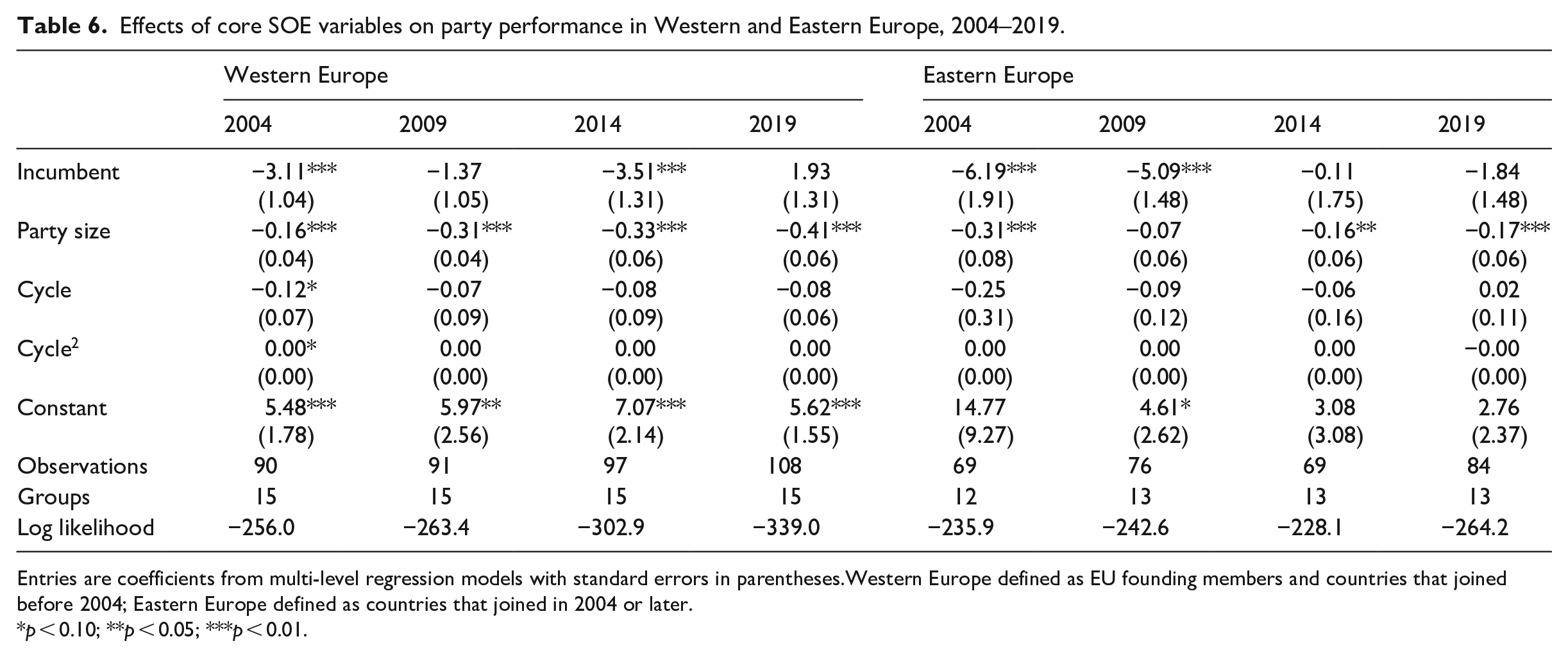
Entries are coefficients from multi-level regression models with standard errors in parentheses.Western Europe defined as EU founding members and countries that joined before 2004; Eastern Europe defined as countries that joined in 2004 or later.
p < 0.10; **p < 0.05; ***p < 0.01.
As a final robustness test, we ran the model containing core SOE predictors as well as electoral system effects for the 10 countries that have held EP elections since 1979 (Greece, which held its first EP election in 1981, is included). The results are reported in Table A8 in the Online Appendix. We find statistically significant party size effects in the expected direction for about half of the election years. Incumbency effects vary according to the phase of the electoral cycle in four out of nine election years. The interaction term for national electoral system and party size has a statistically significant positive effect between 2004 and 2019, suggesting that large party losses are more pronounced in countries that use single-member plurality or majority systems to elect national legislatures. Altogether, these findings lend additional support to H2, H3, H4, and H6.
Discussion
An analysis of electoral gains and losses in all EP elections held between 1979 and 2019 suggests that the SOE model continues to wield significant explanatory power. Turnout in EP elections has almost always been significantly lower than turnout in preceding national elections, except in countries with enforced compulsory voting. The turnout gap was particularly pronounced between 1999 and 2014 when it averaged about 25 percentage points. The 2019 EP election, however, saw a reduction of the average turnout gap to about 18 percentage points. In five member states, turnout in the 2019 EP elections exceeded electoral participation rates in the preceding national election – sometimes by a large margin. The reduction of the turnout gap appears to be driven both by growing participation in EP elections as well as declining turnout in national elections. An erosion of the turnout gap would undermine the conventional distinction between first-order elections and SOE. Forty years after the first direct elections to the EP, however, a significant turnout gap remains an undeniable electoral reality.
Our results also lend significant support to the core SOE prediction that government parties and large parties lose votes in EP elections. Party size appears to be a robust predictor of electoral performance in all EP elections held since 1989: parties that did well in national elections were systematically punished in EP elections. When party size was accounted for, incumbency was associated with electoral losses in all EP elections except those held in 1979, 1989, and 2019. The proposition that incumbent losses are more pronounced in a mid- or late phase of the national electoral cycle appears to hold in four out of nine election years (1984, 1994, 2004, and 2014). In 2019, voters across Europe abandoned large parties but the resulting fragmentation of the vote did not seem to be driven by the desire to punish incumbents.
The SOE model predicts electoral gains for extremist and protest parties because the lesser relevance of EP elections is associated with a greater prevalence of sincere and protest voting, and because vote shifting from large and governing parties to smaller and opposition parties is likely to boost the electoral performance of fringe parties. Our analysis lends some support to this conjecture: an extremist or protest stance was associated with electoral gains, relative to preceding national elections, in 1994, 2009, and 2014. When incumbency, party size, and cycle effects are controlled for, however, these effects disappear; instead, the negative effect of party ideology in 2019 becomes statistically significant.
Conventional tests of the proposition that party size is associated with losses in EP elections are susceptible to criticism for two main reasons. First, the effect of party size could be purely mechanical: parties that won a larger share of the vote in national elections can lose more in absolute terms than small vote-getters. Second, large party losses could stem, at least partially, from the fact that in several European countries, national and European elections are held under very different electoral rules. Because non-proportional systems give an advantage to larger parties, such parties would be expected to lose votes in contests where proportional representation is applied. Our analysis addressed both concerns. We ran a regression model in which the dependent variable was measured in terms of relative, as opposed to absolute change in vote shares, and found that the effect of party size remained robust across different operationalizations of the dependent variable. In addition, we controlled for electoral system effects and found that in 2009, 2014, and 2019, large party losses were more pronounced in countries where national elections are conducted using plurality or majority rule in single-member districts. However, the main effect of party size remained significant, suggesting that large party losses cannot be reduced to electoral system effects. Recognising that a fair comparison of vote shares across different types of elections should take into account variation in institutional rules, we suggest that future aggregate-level tests of the SOE model control for electoral system effects.
This article also engaged with the question of how the expansion of the EU has affected the performance of the SOE model. Previous studies have suggested that core SOE predictions do not hold in Eastern Europe, citing unconsolidated party systems in new democracies as the most likely explanation for the observed differences. Our analysis incorporated a measure of party system fragmentation. While the effects of SOE variables appear to vary across levels of party system fragmentation, we do not detect a clear pattern that would allow us to confirm the proposition that the SOE model performs better in less fragmented systems. Furthermore, a comparison of the performance of core SOE predictions in Western and Eastern Europe in four elections conducted between 2004 and 2019 strongly suggests that the explanatory scope of the SOE model is not limited to the West: incumbency and party size are potent predictors of electoral gains and losses also in countries that joined the EU in 2004 or later.
In sum, this analysis leads us to conclude that while the performance of the SOE model varies from election to election, rumours about the death of the model are greatly exaggerated, as the theory exhibits signs of remarkable vitality despite its advanced age, the profound transformation of both the EU and the EP, and a myriad of contextual changes. The persistence of the model, however, does not constitute good news for representation and accountability in the EU, as the second-order electoral logic is associated with a range of risks and problems, including a fragmented parliament with a questionable mandate to determine the extent and course of European integration, a strong representation of extremist and protest parties and built-in friction between the EP and the EU’s intergovernmental institutions controlled by national political incumbents. A likely implication of the persisting gap between the EP’s vastly increased powers and its questionable mandate is that efforts to turn EP elections into genuine European contests – for example, via electoral reforms or the revival of the Spitzenkandidaten process – will be renewed. Breaking the second-order spell, however, may require nothing short of major institutional reforms.
Supplemental Material
sj-pdf-1-pol-10.1177_0263395720986026 – Supplemental material for Still second-order? European elections in the era of populism, extremism, and euroskepticism
Supplemental material, sj-pdf-1-pol-10.1177_0263395720986026 for Still second-order? European elections in the era of populism, extremism, and euroskepticism by Piret Ehin and Liisa Talving in Politics
Footnotes
Acknowledgements
The authors thank three anonymous reviewers for their valuable comments and suggestions on previous drafts of this article, as well as Tatiana Lupacheva for compiling the data used for this research.
Funding
The research has been funded by the European Commission (grant agreement 822682) and by the Estonian Research Council (project MOBTP132).

Supplemental Information
Additional supplementary information may be found with the online version of this article.
Notes
Author biography
References
Supplementary Material
Please find the following supplemental material available below.
For Open Access articles published under a Creative Commons License, all supplemental material carries the same license as the article it is associated with.
For non-Open Access articles published, all supplemental material carries a non-exclusive license, and permission requests for re-use of supplemental material or any part of supplemental material shall be sent directly to the copyright owner as specified in the copyright notice associated with the article.
