




Abstract
The rise of pirate parties in Europe since 2006 has been tempestuous and uneven. One may question whether the reasons citizens vote for these parties are the same between different countries. This article identifies two reasons citizens may vote for these parties: political distrust and concerns about privacy. This article tests which of these two underlies support for pirate parties. It uses six surveys covering 11 countries with a total 43,786 respondents. These analyses show that political distrust primarily drives support for pirate parties.
Introduction
In a globalized world with digital connections between countries, new political parties can spread quickly. A clear example of this is the pirate party family: after the Pirate Party was founded in Sweden in 2006, it was copied in more than 50 countries (Burkart, 2014: 2). This growth is remarkable. It stands in contrast to the slower growth of other new party families, such as the populist radical right. One might question what unites this family of ‘flash parties’ (Hartleb, 2013: 358). On one hand, one might expect that these parties appeal to different constituencies as they are marginal parties in many countries. The larger ones may have won support for specific national reasons. On the other hand, these parties have been characterized as single-issue parties (Niedermayer, 2010: 850; Zolleis et al., 2010). Perhaps different pirate parties appeal to voters in a consistent way due to their focus on privacy. The central question of this article is as follows: Under what conditions do voters vote for pirate parties and are these conditions similar between countries?
Research into pirate parties is underdeveloped (Maškarinec, 2017: 6). Comparative research has examined the election manifestos of pirate parties (Jääsaari and Hildén, 2015b), their organization (Bolleyer et al., 2015) and their development from the perspective of the social movement literature (Burkart, 2014; Cammaerts, 2015). This gives us an insight into what these parties want, how they operate, and how they seek to mobilize voters. We know little about why voters vote for pirate parties. Yet, mobilizing voters is crucial for the continued existence of a party and its ability to realize its programme. The only comparative study in the field looks at country-level explanations (Zulianello, 2017). Most international academic attention has focused on the first pirate party (from Sweden) (Demker, 2014; Erlingsson and Persson, 2011). This study builds further on the work of Erlingsson and Persson (2011) as it seeks to determine whether voters support pirate parties because of its programme or because of its protest appeal.
One might question why one would study voting for a ‘waning’ party family (Frederiksson Almqvist, 2016b). There are three reasons to do this. First, these parties have not uniformly lost support. The Pirates have become a stable feature in Icelandic politics, and the Czech Pirate Party came third in the 2017 national election. The development of pirate parties does not appear to be one of linear growth. This makes it even more important to understand to what extent the appeal of these parties is consistent between countries and periods.
Second, the rise of pirate parties should be understood in the context of new forms of online political engagement, such as social media revolutions like the Arab Spring or information freedom communities like WikiLeaks (Beyer, 2014). By understanding what drives voting for a pirate party, one can understand how digital culture and the political sphere interact.
Third, by studying whether political distrust or policy preferences drive voting for pirate parties, one can shed light on an issue that has fascinated political scientists for decades: whether new party support reflects general political dissatisfaction or specific policy concerns (Lago and Martínez, 2011; Van der Brug et al., 2000). Pirate parties offer an important case to study, as they can be linked to both clear programmatic appeals, in terms of the protection of digital rights, and to political distrust, as ‘anti-party’ parties.
This article will have the following structure. The first section introduces the pirate party family, their development, and shared programme. The second section looks at two specific hypotheses concerning voting for pirate parties. The methodological section introduces six surveys that are used here. This article examines voting for pirate parties in 11 different countries from Northern, Central, and Western Europe. After the discussion of the results, conclusions will be drawn about the hypotheses and the role of programme and protest in the parties’ appeal.
The pirate family
The pirate party family has its roots in Sweden. Rick Falkvinge founded the Swedish Pirate Party in January 2006 in response to government policies regarding file sharing (Erlingsson and Persson, 2011: 122). Sweden has an active pirate movement around The Pirate Bay, a website that facilitates the online peer-to-peer file sharing, and Piratbyrån (the Bureau of Piracy), a loosely organized think tank on copyright-related issues (Miegel and Olsson, 2008: 203). The term ‘pirate’ itself was reappropriated from the representatives of music and film industry that label people that share copyrighted files peer-to-peer as ‘pirates’ (Bartels, 2012: 20–21). The Swedish Pirate Party gained public attention in May 2006, when it protested against a police raid on the facility hosting the Pirate Bay. Its membership grew spectacularly (Beyer, 2014). In that year, however, the party only gained 0.6% of the vote in the general election. The party grew further in Sweden as privacy and copyright issues were in the public eye: in 2009, individuals behind the Pirate Bay were found guilty of illegal file-sharing. In that year, the party won 7.1% of the vote in the European Parliament election (Erlingsson and Persson, 2011: 122–123). It joined the Green Group in the European Parliament (Burkart, 2014: 2).
Within weeks, the Swedish Pirate Party inspired the foundation of pirate parties elsewhere. Burkart (2014) counts 56 pirate parties. Table 1 gives an overview of the results of pirate parties in national-level elections in Europe. The German Pirate Party won representation in the European Parliament and four Land parliaments between 2009 and 2014 (Hartleb, 2013: 364). By 2017, it had lost all the seats in the Länder. Pirate parties won national-level representation in Iceland, the Czech Republic, and Luxembourg. Elsewhere they won representation in municipal and regional councils (Cammaerts, 2015: 20). At the transnational level, there is a Pirate Party International and a European Pirate Party (Jääsaari and Hildén, 2015b).
Election results of pirate parties in Europe.
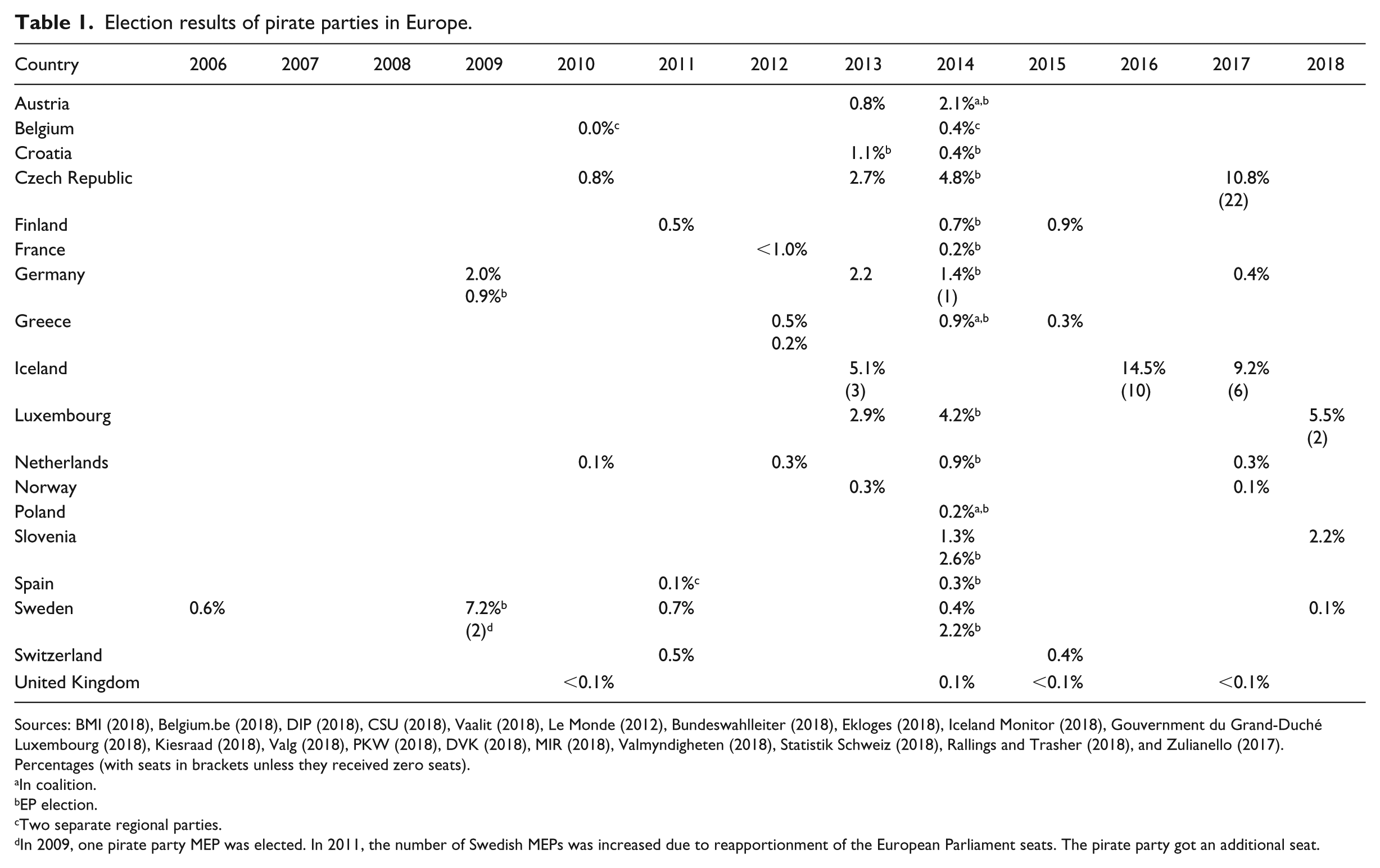
Sources: BMI (2018), Belgium.be (2018), DIP (2018), CSU (2018), Vaalit (2018), Le Monde (2012), Bundeswahlleiter (2018), Ekloges (2018), Iceland Monitor (2018), Gouvernment du Grand-Duché Luxembourg (2018), Kiesraad (2018), Valg (2018), PKW (2018), DVK (2018), MIR (2018), Valmyndigheten (2018), Statistik Schweiz (2018), Rallings and Trasher (2018), and Zulianello (2017).
Percentages (with seats in brackets unless they received zero seats).
In coalition.
EP election.
Two separate regional parties.
In 2009, one pirate party MEP was elected. In 2011, the number of Swedish MEPs was increased due to reapportionment of the European Parliament seats. The pirate party got an additional seat.
The Icelandic Pirates are the most successful party in the family as they have won parliamentary representation in three consecutive elections. It was formed on 24 November 2012 by a group around Birgitta Jónsdóttir, a sitting MP who had been elected for the Citizens’ Movement (Fontaine, 2018). This party had its roots in the ‘pots and pans revolution’. This was a series of protests against the austerity policies that the right-wing Icelandic government had implemented to deal with the financial crisis (Jochem, 2014: 637). Iceland was strongly affected by the crisis due to its overgrown financial sector (Jonsson, 2016). In order to address the crisis, the government implemented austerity policies (Jonsson, 2016: 146). After the 2009 election, a new left-wing government started a process of constitutional reform (Jochem, 2014: 638–641). This process was led by civic leaders instead of political leaders. It used digital means to foster public participation. The left-wing government continued with austerity politics however (Jonsson, 2016). After the 2013 elections, in which the Pirates won representation, a new right-wing government aborted the process of constitutional reform (Jochem, 2014: 632–633). Meanwhile, the Icelandic political landscape was shaken up by scandal (Leruth, 2016). All these forces, austerity, political scandals, and the halting of the constitutional reform, have eroded public distrust in the government (Leruth, 2016). The Pirates have been able to capitalize on this dissatisfaction to become a serious threat to established political parties (Jonsson, 2016).
Resistance to the criminalization file-sharing is the raison d’être for the party family. Pirate parties want to reform copyright and legalize non-commercial peer-to-peer file sharing (Zolleis et al., 2010: 12). They are not just opposed to the current copyright system but seek reform of intellectual property rights in general. For instance, they are opposed to the current patent system, which allows for the development of monopolies for patent holders (Jääsaari and Hildén 2015a: 27–28). All in all, pirate parties are committed to the freedom of information.
Their second priority is protection of the private sphere. There is a clear link to file-sharing: in order to combat file-sharing, right holders have to invade the privacy of individuals (Burkart, 2014: 46). The concern of pirate parties is broader, however: they seek to protect privacy both online and offline (Jääsaari and Hildén, 2015b: 884). They are opposed to far-reaching intrusions into the private sphere of citizens by the government, which were implemented in order to fight terrorism (Frederiksson, 2015: 912).
Finally, pirate parties are concerned about the state of the traditional representative democratic system (Zulianello, 2017: 8). They fear a ‘dystopian top-down big brother-like society’ where politicians gain their power by striking fear in the hearts of citizens (Cammaerts, 2015: 23). Pirate parties believe that political decision-making has become too far removed from the people (Cammaerts, 2015: 23). They desire the implementation of direct democracy (Zolleis et al., 2010: 12). They also demand more transparency from their government. They see a clear distinction between a public sphere that should be ruled by transparency and a personal sphere that should be protected by privacy (Cammaerts, 2015: 24).
The extent to which pirate parties are single-issue parties is subject to debate within the parties themselves. In the German and the Swedish pirate parties, there have been debates between ‘Kernis’ who wanted to focus on the digital issues that led to the foundation of the party and ‘Vollis’ who called for a more complete programme (Frederiksson Almqvist, 2016a). This is also reflected in the academic debate about these parties. On one hand, there are authors like Demker (2014), Burkart (2014), and Zulianello (2017) who see these parties as offering a consistent value-driven cyberlibertarian project; Zulianello (2017: 6–7) specifically characterizes the parties as niche parties. These are parties that focus on non-economic issues, do not mobilize voters along class lines, and have an issue-based appeal that cuts through the left-right dimension (cf. Meguid, 2005). On the other hand, there are authors like Hartleb (2013: 364) and Niedermayer (2010: 850) who characterize pirate parties as single-issue parties that lack a coherent and comprehensive programme and focus instead on a limited number of political reforms.
The core positions that pirate parties have on copyright, privacy, and democratic reform can lead them to positions on other issues. For instance, their opposition to patent-based monopolies gives them a particular economic profile: they favour government control over natural monopolies, such as infrastructure (Zolleis et al., 2010: 13). The fact that they favour freedom of information and thus are opposed to its commodification makes them critical of contemporary capitalism (Cammaerts, 2015: 22; Demker, 2014). Yet, they are not fundamentally opposed to the capitalist system (Jonsson, 2016: 148): they seek to promote competition without monopolies (Burkart, 2014: 31). Yet, the core pirate policy do not necessarily lead to one agenda: supporting a pirate party can be consistent with both neoliberalism and a syndicalism (Frederiksson and Arvanitakis, 2015: 143). This makes it difficult to pinpoint pirate parties on the left-right spectrum (Uszkai and Vică, 2012). Instead, pirate party activists characterize themselves as forward, as in forward-thinking, or bottom-up, reflecting their emphasis on direct democracy (Haas and Hilmer, 2012: 75).
Pirate parties also share a particular organizational structure, which reflects their values. Pirate party organizations tend to emphasize direct influence for members and online participation in decision-making (Bolleyer et al., 2015). The German Pirate Party has instituted ‘liquid democracy’: members can vote directly on issues or they can delegate proxies to vote for them (Cammaerts, 2015: 25).
Theory and hypotheses
So why do voters vote Pirate parties? Here, two alternatives are evaluated: policy preferences and protest. 1
Policy preferences
Pirate parties politicize a specific set of non-economic issues: intellectual property, direct democracy, and privacy. The evidence so far suggests that issue voting is an important driver of voting for these parties: Erlingsson and Persson (2011) and Demker (2014) show that issue voting is the main explanation of why voters voted for the Swedish Pirate Party in 2009. Onken and Schneider (2012: 623) show that German Pirate Party voters were strongly committed to personal freedom. This study look at attitudes towards privacy and surveillance, because Demker (2014), Onken and Schneider (2012), and Jääsaari and Hildén (2015a, 2015b) all indicate that this more general issue is more important in the appeal of pirate parties than intellectual property rights.
Privacy Hypothesis: the more opposed to government surveillance voters are, the more likely that they will vote for a pirate party.
Given the importance of direct democracy for the profile of pirate parties, this article also seeks to test whether attitudes towards democratic reform lead voters to vote for these parties. The availability of items concerning direct democracy is much more limited, however.
If pirate parties are niche parties with their own appeal separate from the left-right dimension and economic issues, these issues should not drive voting for them (Demker, 2014). Evidence so far suggests that their voters indeed are neither left nor right (Onken and Schneider, 2012: 620).
Protest
The success of new political parties is often seen as a sign of the failure of established parties (Hauss and Rayside, 1978). Lago and Martínez (2011) show that the more dissatisfied voters are with the supply of established parties, the more likely they will vote for new parties. Protest voting can be an important driver of voting, in particular for new or third political parties (Miller and Listhaug, 1998; Van der Brug et al., 2000). Protest voting is understood as a positive relationship between indicators of political distrust and support for a particular party (Bergh, 2004).
Distrust of representative politics is an important feature of pirate parties (Frederiksson Almqvist, 2016b). Hartleb (2013: 364) notes that the political style of the German Pirate Party has been characterized as ‘good populist’. 2 This supposedly stands in contrast to both right-wing populism, because of the pirates’ libertarian policy positions, and to established politics, because of their anti-elitism. Pirate parties have been described as ‘anti-party parties’ (Haas and Hilmer, 2012: 76). They critique representative democracy. They favour direct participation of citizens in political decision-making. They have ‘alternative’ mode of party organization (Frederiksson Almqvist, 2016a; Zulianello, 2017: 8). Therefore, pirate parties should appeal to voters who distrust the current, representative democratic system in their country. According to Onken and Schneider (2012: 618), Baldini and Bolgerini (2015: 195), and Niedermayer (2012: 64), the German Pirate Party attracts voters who are dissatisfied with established political parties. In contrast, Erlingsson and Persson (2011) and Demker (2014) do not find this for the Swedish Pirate Party.
Protest Hypothesis: The less trust voters have in politics, the more likely that they will vote for a pirate party.
Control variables
The analyses will include a number of control variables: Internet usage, year of birth, gender, education level, and religiosity. Pirate party voters have been characterized as ‘digital natives’ (Zolleis et al., 2010: 28): for this generation online activities form a major part of their life. Therefore, one can expect that pirate parties perform better under those who use the Internet more often. As being a digital native is associated with one’s year of birth, it is not counter-intuitive that previous research has shown that pirate parties are particularly strong among younger voters (Baldini and Bolgerini, 2015: 193; Erlingsson and Persson, 2011: 122; Maškarinec, 2017: 26; Niedermayer, 2010: 843; Onken and Schneider, 2012: 616; Zolleis et al., 2010: 28; Zulianello, 2017: 8). Previous results also show that pirate parties poll better among men (Baldini and Bolgerini, 2015: 193; Erlingsson and Persson, 2011: 122; Kulick, 2012; Niedermayer, 2010: 843; Onken and Schneider, 2012: 616; Zolleis et al., 2010: 29). This may reflect the male dominance of computer culture (Herring et al., 1995). One should note here that many pirate parties, such as the Icelandic Pirates have had female leadership. No specific expectation is formulated about how support for pirate parties is related to education level, as the existing data is contradictory (Maškarinec, 2017: 26–27). This may have to do with the fact that the party polls well among students, who are in the process of getting their higher education (Baldini and Bolgerini, 2015: 193). Because of their libertarianism, one would expect that pirate parties perform worse under religious voters.
Methodology
This study looks at voting for pirate parties from a comparative perspective. Therefore, comparative surveys are used that cover a substantial number of countries that have pirate parties. There are five such surveys: the fourth wave (2011–2016) of the Comparative Study of Election Systems (CSES, 2018), the 2014 European Election Studies (EES) (Schmitt et al., 2016) and the sixth, seventh, and eighth wave of the European Social Survey (ESS, 2012, 2014, 2016). In addition to the comparative work, special attention is paid to the Icelandic Pirates, who have been particularly successful using the 2013 Icelandic National Election Study (ICENES) (Harðarson et al., 2013). 3
Country surveys are only included where at least one voter voted for a pirate party. Six different independent variables are used: in the CSES, there is a vote choice for the lower house variable. There are four countries in the CSES where people expressed a preference for pirate parties: Iceland (2013), Germany (2013), Finland (2015), and the Czech Republic (2013). The CSES has 6608 respondents in these countries. A total of 1479 of these are also part of the ICENES, which is used to further examine voting for the Icelandic Pirates. This survey has the same dependent variable on vote choice, but also allows one to look at voter sympathy for the Icelandic Pirates on an 11-point scale. This is an indirect measure of how likely voters are to vote for a party. The ICENES also offers some additional independent variables. The European Election Survey has three different questions about party choice: about respondents’ choice in the European Parliament election, their hypothetical choice if the national election were held on that day, and their real choice in the last national election. Respondents that voted for a pirate party in the 2014 European Parliament election were present in Sweden and Germany. The pirate party was mentioned as a first preference for a hypothetical election in Austria, the Czech Republic, Denmark, 4 Germany, Luxembourg, and Sweden. Respondents that voted for a pirate party in the most recent national election were present in Belgium, Czech Republic, Finland, Germany, Luxembourg, Sweden, and the Netherlands. In Germany, respondents were also asked to indicate their propensity to vote for a pirate party. Like sympathy, this is another measure of likelihood to vote for the party. The EES has differing sample sizes. A total of 8902 respondents are used in at least one of the analyses. The ESS also has questions about voting for pirate parties in the most recent election. It has data from Switzerland, Austria, Germany, Finland, the Netherlands, Sweden, and Iceland. From the three waves of the ESS, a total of 28,276 respondents are used. Tables A1 to A4 in the Supplemental Appendix show the descriptive statistics for these surveys. These tables also show that all scales used in this article are sufficiently strong. The wording of opinion questions is listed in Table A7 of the Supplemental Appendix.
For the key variables, the different surveys offer different options. First, one needs to measure attitudes towards surveillance for the Privacy Hypothesis. The EES offers a direct item on privacy. The CSES offers an indirect measure: voters could indicate whether they want to spend more or less on police and law enforcement, the institutions that actually execute mass surveillance ( ‘police item’). The ESS has asked three questions about how respondents felt about security, which together form an authoritarianism scale. 5
To test the Protest Hypothesis, the EES allows one to construct a two-item political trust scale that consists out of the questions whether respondents trust the national parliament and whether they feel that the national parliament takes the views of citizens into account. For the ESS, a four-item scale was constructed that concerned respondents’ trust in parliament, politicians, parties, and their satisfaction with democracy. The CSES only has a measure of satisfaction with democracy. 6 In the ICENES, one can create a scale with additional items on whether respondents think Icelandic politicians are corrupt and whether they trust politicians.
The following control variables are included: first, left-right self-placement. This is available in the CSES, ICENES, EES, and ESS as an 11-point scale. Second, economic policy preferences. The CSES and the ESS offer a five-point scale on whether respondents believe that the government should reduce differences in income levels. In addition, for the ICENES, a scale is constructed with a second item that concerns whether the government should increase income equality. The EES offers an 11-point scale on income equality. Where it comes to items concerning Internet usage, the measures differ. The CSES has an item whether respondents signed up for online information or alerts from parties or candidates themselves. This item does not measure Internet usage in general but only whether respondents actively sought information about the elections. Admittedly, this is an imperfect proxy of online activity. This item is dichotomous. The ICENES has a scale on Internet usage in general. Given the distribution, this is split between those who do and those who do not use the Internet every day. The EES has an item on whether respondents use the Internet at home. Again, this is split between daily and non-daily usage. The ESS only has an item for Internet usage in the eighth wave which is split between daily and non-daily usage. Every survey has a year of birth and gender item. For education level, the different available scales are recalculated to a dichotomy that differentiates between those that have higher levels of education and those that do not. For religiosity, a two-item scale is constructed on the basis of the CSES and ESS that measures religiosity in terms of church attendance and self-identification. These two items scale well. The EES has a single item on church attendance. Finally, the ICENES and the sixth wave of the ESS offer a separate item measuring support for direct democracy.
All items have been recalculated so that their minima are zero and their maxima are one in order to aid interpretation. To allow for a good comparison between surveys, the year of birth variable is standardized in the exact same way between surveys. Multilevel logistic regression is employed for all studies concerning voting behaviour in more than one country in order to compensate for unmeasured differences between countries. For the two single-country studies of interval variables, ordinary logistic regression is used.
Results
A total of 12 models are examined here: One uses the data for the four countries in the CSES (in Table 2). Four models concern Iceland: Two on vote choice and two on sympathy for the pirate party. Two of these use the same variables as the CSES model and two include additional variables (also in Table 2). Table 3 offers four models for the EES data: one for each dependent variable. Three models for the ESS are shown in Table 4, one without items on direct democracy and Internet usage, and one with an item on direct democracy and one with an item on Internet usage (these were asked in separate waves). 7
Models on the basis of the CSES and ICENES data.
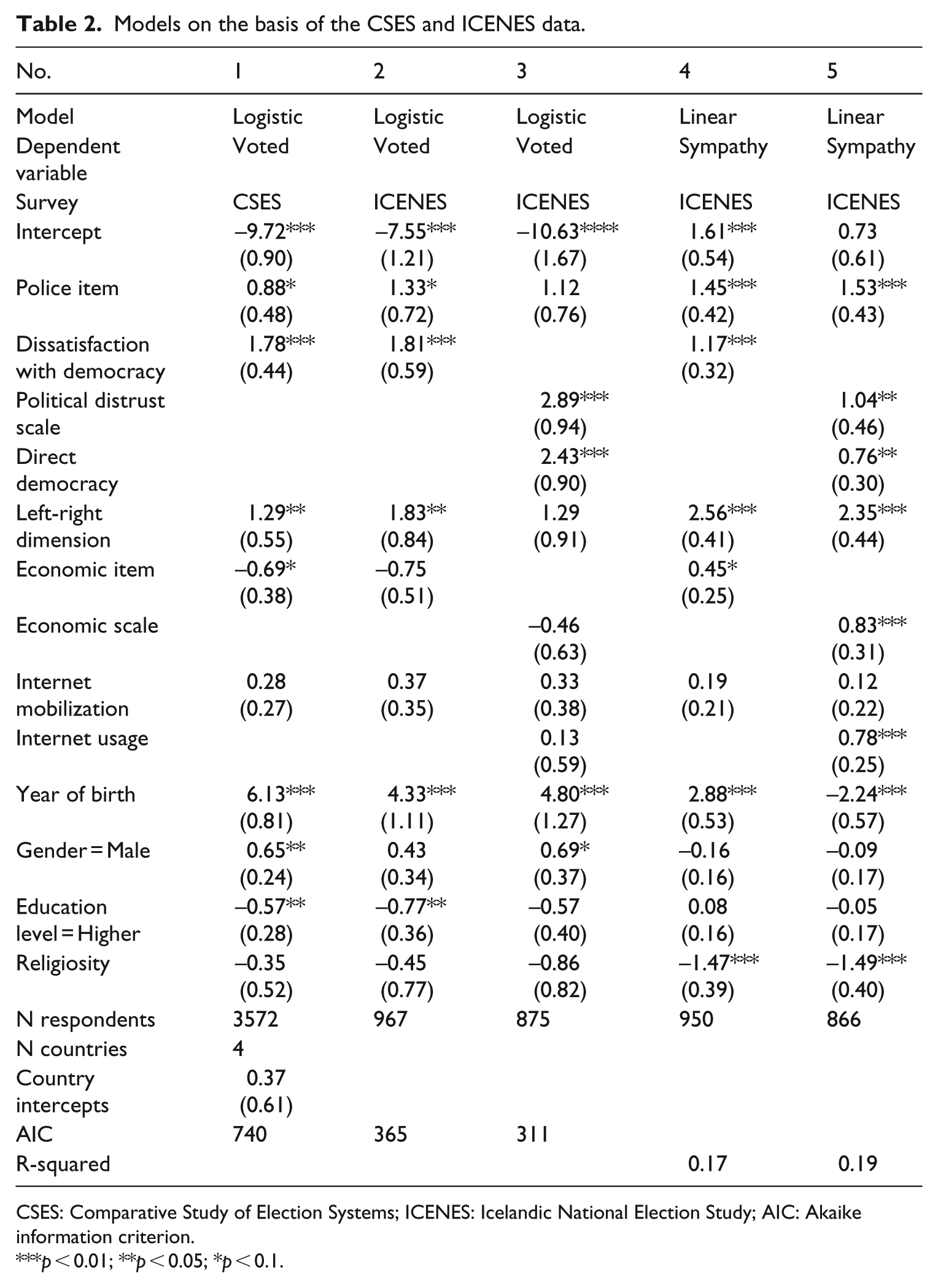
CSES: Comparative Study of Election Systems; ICENES: Icelandic National Election Study; AIC: Akaike information criterion.
p < 0.01; **p < 0.05; *p < 0.1.
Models on the basis of the 2014 EES data.
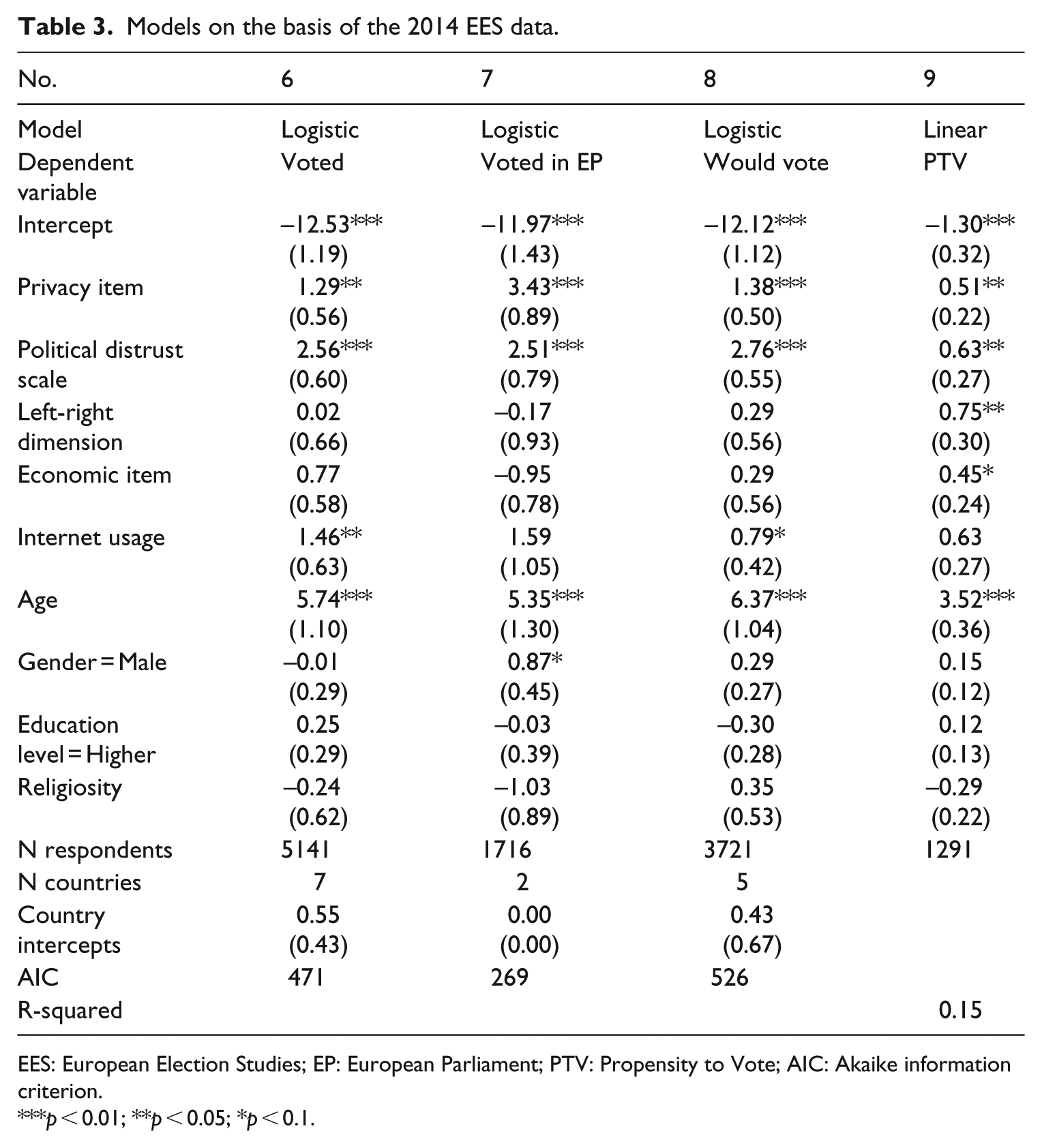
EES: European Election Studies; EP: European Parliament; PTV: Propensity to Vote; AIC: Akaike information criterion.
p < 0.01; **p < 0.05; *p < 0.1.
Models on the basis of the ESS 6, 7, and 8.
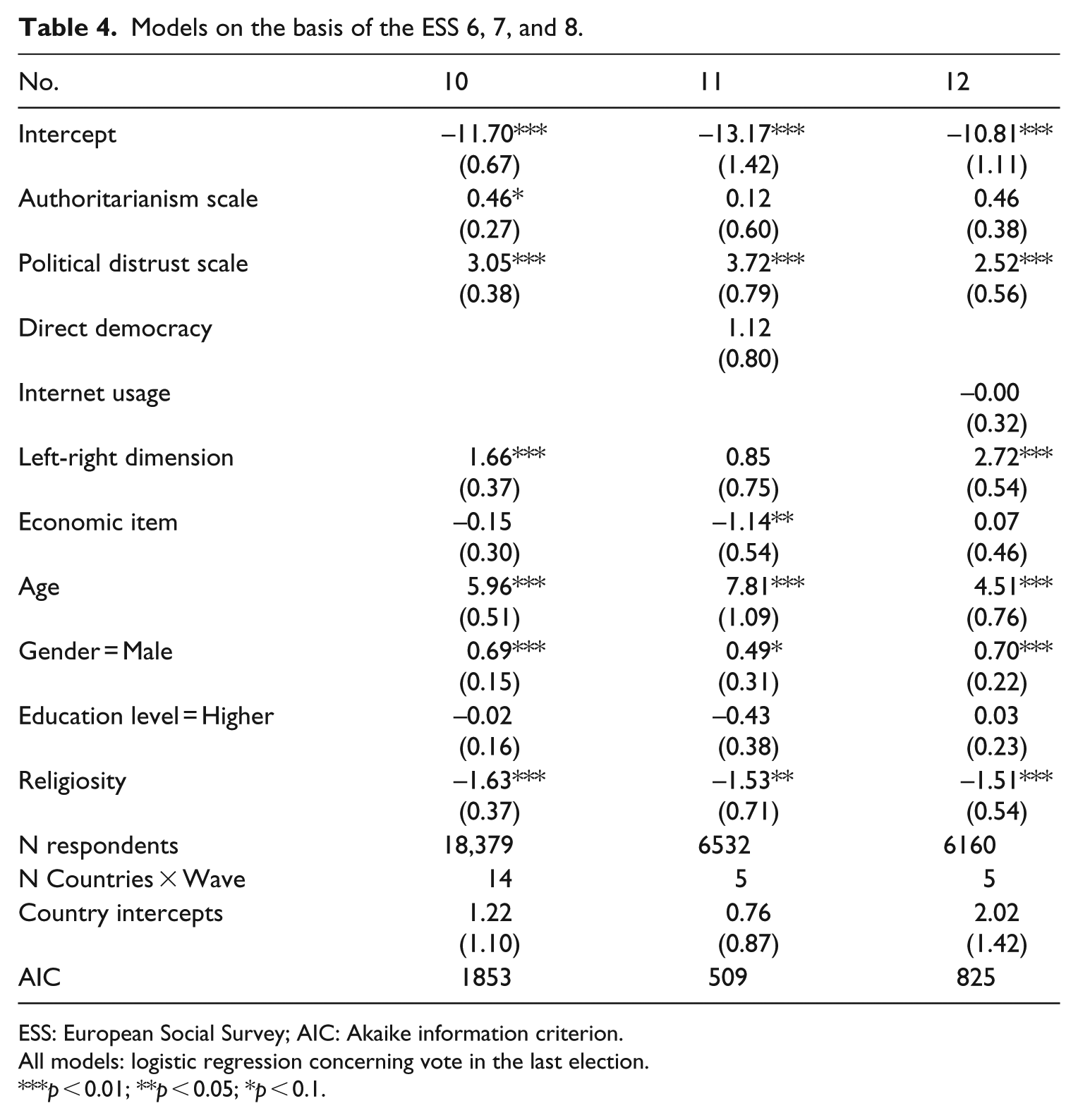
ESS: European Social Survey; AIC: Akaike information criterion.
All models: logistic regression concerning vote in the last election.
p < 0.01; **p < 0.05; *p < 0.1.
The Privacy Hypothesis proposed that attitudes towards privacy predicted the likelihood that voters vote a pirate party. The cyberlibertarian profile of the parties is reflected in their electorate. In all but three models, we find a significant relationship between the item measuring libertarian attitudes and voting for pirate parties. In the three ICENES models, one of the ESS models and the EES model the relations are strong and significant: voters with the most libertarian attitudes are more than twice as likely to vote for a pirate party than those with the most authoritarian attitudes. The relationship is strong for voting for pirate parties in the 2014 European Parliament elections in Germany and Sweden: the most pro-privacy voters are 30 times as likely to vote for a pirate party than the least pro-privacy voters. In the CSES, the relationship is weaker: voters with the most pro-privacy attitudes are twice as likely to vote for a pirate party. The linear models that concern voters’ own estimation of their chance to vote for these parties show a similar relationship in terms of strength and significance. There are three exceptions, which we can understand due to specific circumstances: two models in ICENES and ESS that use a measure of direct democracy do not yield significant results. This may indicate that direct democracy better discriminates between supporters and non-supporters of pirate parties than their libertarianism. Two ESS models also show no significant effect: in both those analyses, only a third of the total respondents was used.
The Protest Hypothesis proposed that voting for pirate parties was motivated by distrust of established politics. In every model, there is a strong and significant relationship between voting for pirate parties and political distrust. In the CSES and ICENES, the most dissatisfied voters are five times more likely to vote for a pirate party than the most satisfied voter. The more nuanced measure of political distrust in ICENES shows an even stronger result. In the EES and the ESS, the voters with the least political trust are more than 10 times more likely to vote for a pirate party than the voters with the most political trust. The ordinary least squares (OLS) models concerning sympathy and propensity to vote show similarly strong and significant relationships. The ICENES and the ESS (only available for the sixth wave) include items concerning democratic reform. In the ICENES, the direct democracy scale is a strong predictor of voting for pirate parties, but not in the ESS. This may indicate that preference for direct democracy is a particularly strong predictor of voting for pirate parties in Iceland but not on the continent.
Looking at the two hypothesized predictors of voting for pirate parties (political distrust and concerns about privacy), political distrust is often the stronger predictor than attitudes towards privacy. It is also always highly significant. Only in three cases is the relationship between libertarian attitudes and voting for pirate parties stronger than the relationship between political trust and voting for them: in the EES analyses concerning European Parliament vote choice and in the sympathy models looking at the ICENES data. On the whole, however, political distrust is a better predictor of voting for pirate parties than attitudes towards privacy.
Another expectation was that pirate parties would not have a consistent appeal in terms of the left-right dimension or economic policy preferences. The CSES, the ICENES, and the ESS show a positive relationship between voting for pirate parties and left-wing policy preferences in all but two models. The EES does not support these patterns except where it comes to sympathy for the German Pirate Party. The results are even less consistent where it comes to economic policy preferences: in the CSES and ESS, pirate party voters have inegalitarian preferences. The indirect measures of party preference in the ICENES and the EES show a positive relationship with egalitarian preferences. This indicates that instead of not appealing along left-right lines at all, pirate party’s left-right appeal is context-dependent. Moreover, it is more closely related to sympathy for these parties than to party choice.
Of the control variables, year of birth is by far the strongest predictor: there are practically no pirate party voters among those born before 1985 according to the logistic regressions. Year of birth is a better predictor of voting for pirate parties than political distrust or attitudes towards privacy. The linear models show a similar pattern. Internet usage does not show a significant result in most models. 8 In all CSES and ESS models, men are more likely to vote for pirate parties than women. We do not find such a pattern in Iceland, where the party had prominent female leadership. Low religiosity predicts support for pirate parties in the ESS models, as well as two of the ICENES models. All in all, there is no consistent effect of religiosity on support for pirate parties. Education does not show a consistent pattern neither in terms of significance nor in terms of direction. This lack of clear results for education level may also be a reflection of age: given their young age, many pirate party voters may not have finished their education and may have been categorized as lower educated, depending on how surveys approach education level.
Conclusion
Using multiple surveys and different indicators, this article shows that there are consistent patterns behind voting for pirate parties all over Europe. The three key findings of this study are that voting for pirate parties can be understood in terms of year of birth, political distrust, and support for cyberlibertarian policies. By far, the strongest predictor of voting for pirate parties is year of birth. This supports previous research. Pirate parties are a party for the generation of digital natives. Out of the two hypotheses (privacy and protest), the protest hypothesis performed better: every model indicated that pirate party voters express low trust in politics. Libertarian attitudes are of tertiary importance, and in some cases, libertarian attitudes did not significantly affect the likelihood of voting for this party. The expectation was that other dimensions, such as the left-right dimension or the economic dimension, did not matter, but the evidence suggests that the extent to which the appeal of pirate parties follows the economic or the left-right dimension differs from system to system. The parties that were studied most in-depth, the Icelandic Pirate and the German Pirate Party, attract most sympathy from left-wing voters.
The results do not conclusively dismiss either the privacy or the protest hypotheses but do show that, on the whole, the voters were mobilized more by dissatisfaction with the state of democracy in their country than by concerns about privacy. Sadly, the surveys used here only allowed for a limited test of the direct democratic appeal of these parties and no test of the issue of intellectual property reform. The choice to focus on privacy was reasonable given that most existing research indicates that the core of the appeal of pirate parties is their pro-privacy position (Demker, 2014; Jääsaari and Hildén, 2015a; Onken and Schneider, 2012). Where the concerns for democracy could be incorporated, this study indicated that at least for the Icelandic Pirates its views on democratic reform were an important driver of support for the party. Pirate parties’ support for democratic reform and the fact that political distrust boosts support for them is not accidental (Zulianello, 2017). Research also indicates that support for government surveillance and political trust are closely tied (Trüdinger and Steckmeier, 2017). Moreover, Erlingsson and Persson (2011) show that attitudes concerning Internet piracy are an important predictor of voting for the Swedish Pirate Party in 2009. 9 It could be that the item for attitudes towards piracy is a better measure of the kind of attitudes that would lead one to vote for a pirate party than the items used here. This would indicate that instead of a generally libertarian attitudes support for pirate parties is linked to specific elements of their policy agenda. Future research into the support of pirate parties may want to look at all three elements of their core programme.
The question that emerges from these results is why pirate parties have been unable to persist in appealing to voters? One may argue that file sharing is increasingly a non-issue (Jääsaari and Hildén, 2015b: 883) or that pirate parties have been unable to sustain a separate cleavage (Niedermayer, 2010: 851). These results, however, point to the importance of political distrust. In the country where they have been most successful (Iceland), their appeal is quite similar to that of other countries. Their success occurred in the context of an ongoing crisis of political trust. The root of their success may lie in the ability of these parties to mobilize voters who are disillusioned with established politics. Contrariwise, in Sweden and Germany, radical right-wing populist parties have mobilized voters specifically on distrust of the political elite. Moreover, the appeal of the party family of the Internet age is limited to the generation of digital natives: it is only those born after 1985, those who grew up in a digital world, who will vote for a pirate party. The age effect is so strong that it swamped out the effect for Internet usage. Pirate parties may have developed too early and there may be a greater potential for cyberlibertarian parties when the share of digital natives is greater.
Supplemental Material
POL833274_appendix – Supplemental material for All on the same boat? Voting for pirate parties in comparative perspective
Supplemental material, POL833274_appendix for All on the same boat? Voting for pirate parties in comparative perspective by Simon Otjes in Politics
Footnotes
Acknowledgements
The author would like to thank the anonymous reviewers, as well as Melissa Koutouzis and Paul Lucardie for their comments and suggestions.
Funding
The author(s) received no financial support for the research, authorship, and/or publication of this article.
Supplemental Material
Supplemental material for this article is available online.
Notes

Author biography
References
Supplementary Material
Please find the following supplemental material available below.
For Open Access articles published under a Creative Commons License, all supplemental material carries the same license as the article it is associated with.
For non-Open Access articles published, all supplemental material carries a non-exclusive license, and permission requests for re-use of supplemental material or any part of supplemental material shall be sent directly to the copyright owner as specified in the copyright notice associated with the article.
