




Abstract
This article addresses the largely neglected issue of the decline of ethnic cleavages in plural societies as expressed in voting behaviour. It argues that theoretically, Creolization, a specific form of acculturation, accounts for the erosion of ethnic bonding but finds that the application of the concept is limited. Hence, the article combines the current concept of Creolization with that of political hegemony, while broadening Creolization to comprise the acculturation of several ethnic groups. However, the paper considers that actual voting patterns may be countervailed by party characteristics and election campaigns. Using multiple fieldwork methods, the erosion of ethnic voting loyalties is analysed in a case study of Suriname, a Caribbean society that is representative of a class of plural societies. The paper centres on the conceptual apparatus to analyse the erosion of ethnic voting loyalties rather than making comparisons. It claims that its argument is applicable to plural societies that are characterized by the erosion of voting loyalties and decline of ethnic cleavages, notably Trinidad and to a lesser degree in Mauritius and Fiji, and increasingly in Suriname and Guyana.
Many theories in comparative political science are founded on the assumption of demarcated ethnic groups that are represented by ethnic political parties. These theories include ethnic competition (Despres, 1975), democratic stability and power-sharing (Roeder and Rothschild, 2005), and increasing ethnicization (Posner, 2004). In ethnically plural societies, the distribution of public goods – especially scholarships, jobs, housing, licences, and land – are largely driven by ethnic group loyalties. This feature is widely acknowledged as intrinsic to the conceptual makeup of plural societies (Dew, 1978; Horowitz, 1985). The case of Suriname demonstrates that political science theories equating plural societies with ethnic voting do not hold.
The classic account of ethnic bonding stems from Geertz (1971), who argued that civic bonds in plural societies originate from primordial loyalties regarding region, caste, race, tribe, family, language, and religion. These communal attachments originate from socialization in the ethnic community (Geertz 1971; Hale, 2004). These attachments are not static since they may change. For example, primordial attachments may be affected by modernization, political rivalry or demographic growth (Hale, 2004; Hoben and Heffner, 1991; Horowitz, 1985). That said, this line of thinking regarding primordial attachments has been discredited owing to its alleged ethnic essentialism by constructionist scholars who emphasize the malleability and instrumentality of ethnicity (Chandra, 2012). From either perspective, however, ethnic loyalty and voting appear to remain pivotal in politics.
Plural societies are characterized by racial, religious, regional, linguistic, regional, cultural divisions, called ethnic cleavages, that are reflected in political support (Lijphart, 1977). In some Caribbean plural societies notably Trinidad, Guyana, and Suriname, where the major ethnic communities are represented by ethnic political parties, ethnic voting patterns have declined due to an erosion of the ethnic loyalty. In Western plural societies such as Ireland, Belgium, Switzerland, and Canada, ethnic loyalties and related cleavages have largely disappeared, although new ethnic bonding has emerged such as regionalism and nationalism, as the cases of Catalonia, the Netherlands, and the United Kingdom illustrate.
Despite the major implications for political party support of the decline of ethnic cleavages in plural societies, the phenomenon has hardly been addressed in political science. The neglect of the decline voting patterns represents a serious theoretical limitation, as it signals a political meltdown of the ethnic group as a political actor, though the ethnic group may persist socially (Horowitz, 1985). The erosion of ethnic loyalty is reflected in several forms of crossovers, particularly voting on different ethnic political parties. Theoretically, without ethnic loyalty there are no ethnic political parties and no empirical foundation for political theories of ethnicity. Empirically, however, diminishing electoral support or shifts in voting patterns away from ethnic parties is rarely absolute since these parties still exist. Nevertheless, the decline of ethnic cleavages calls for reflection on current concepts in political science that presupposes ethnic actors consisting of neatly demarcated ethnic groups.
Ethnic cleavages in Western plural societies were unidimensionally based on religion, ideology, class or region and are largely dissolved (Franklin et al., 1992; cf. Johnston, 2006; Van Dam, 2015). These cleavages differed from those in developing plural societies that are characterized by multidimensional differences, comprising simultaneously race, language, religion, and ethnic life (Banton, 2008). The breakdown of ethnic cleavages in Western Europe occurred after World War II (WWII) as a result of increased education, social and spatial mobility and individualization (Beck and Beck-Gernsheim, 2001; Van der Eijck and Franklin, 2009). While socially the ethnic boundaries have been blurred, the cleavages often persist politically since the segments are still organized in religious and ideological based political parties. However, in the same period the Caribbean societies mentioned above also witnessed an increase in educational level and income, but ethnic groupings were consolidated and ethnic politics thrived rather than declined (Bissessar and La Guerre, 2013; Dew, 1978). This calls for a different explanation of the erosion of ethnic group bonding in plural societies than the current account from mobility and individualization so typical of Western societies.
This article addresses the largely neglected issue of the decline of ethnic cleavages in plural societies as expressed in voting behaviour. It argues that theoretically, Creolization, a specific form of acculturation, accounts for the erosion of ethnic bonding but finds that the application of the concept is limited. Hence, the article combines the current concept of Creolization with that of political hegemony, while broadening Creolization to comprise the acculturation of several ethnic groups. However, the article considers that actual voting patterns may be countervailed by party characteristics and election campaigns. Using multiple fieldwork methods, the erosion of ethnic loyalties is analysed in a case study of Suriname, a Caribbean society that is representative of a class of plural societies. The article centres on the conceptual apparatus to analyse the erosion of ethnic loyalties rather than making comparisons. It claims that its argument is applicable to plural societies that are characterized by the erosion of loyalties and decline of ethnic cleavages, notably Trinidad and to a lesser degree in Mauritius and Fiji, and increasingly in Suriname and Guyana.
Methodologically, the article departs from the historical process of Creolization, the independent variable, which accounts for the erosion of ethnic loyalties as manifested in voting crossovers. The decline of ethnic cleavages because of Creolization reflects a major transformation from a plural society to a Creole society (Gowricharn, 2015). As a consequence, the distribution of public goods cannot be derived from pre-existing ethnic loyalties because such forces have been substantially weakened.
Creolization of ethnic bonding
Most of the scholarly literature deals with change in ethnic bonding without addressing ethnic crossovers. To give a few examples, ethnic bonding is reported to be subject to variation, albeit for disparate reasons (Barreto, 2007; Eifert et al., 2010; Posner, 2004). Ethnic bonding may also be based on patron-client relationships and changes because of underlying shifts. Though long-standing, this idea persists in contemporary explanations of ethnic voting patterns (Hicken, 2011; Johnston, 2006). Clientelism, viewed as a reciprocal dyadic-hierarchical relationship that enables ‘vote buying’, presupposes that voting preferences are malleable and that voters are calculating (see also Hidalgo and Nichter, 2015). In this context, Long and Gibson (2015) observed in Kenya that voters support co-ethnics and tend to forgive incumbent co-ethnics’ poor performance. Lindberg and Morrison (2008) found that patron–client relationships had a limited impact because of resource constraints in Ghana, while Dunning and Harrison (2009) reported the diminished significance of ethnicity in Mali that they attributed to cross-cutting kinship. In addition, Hempel (2009) argued that in Mauritius, access to resources was only marginally related to ethnic identification, and that ethnic identification varied significantly across groups.
These studies deal with existing and fluctuating ethnic loyalties rather than with ethnic voting crossover. In political science, group-related voting has traditionally been framed as voter alignments based on class, ideology, and religion (Lipset and Rokkan, 1967), or so-called pillars, as was characteristic of some European societies, notably the Netherlands (Van der Eijck and Franklin, 2009; cf. Van Dam, 2015). The erosion of these constituencies, which were unequal in space, was labelled the decline of cleavage politics (Franklin et al., 1992; cf. Johnston, 2006). Their dissolution has been attributed to forces that detach individuals from their groups – individualization, education, and increased welfare – that are all considered typical of Western societies (Beck and Beck-Gernsheim, 2001; Franklin et al., 1992). Van Dam (2015) argues that this dissolution was not absolute since relations between individuals and institutions in the realm of civil society, politics and religion became lose but persisted, hence his suggestion to use the concepts of heavy and light community to capture community ties both before and after depillarization. Cornell and Hartmann (2007) denoted a similar internal loosening of ethnic communities as thick and thin ethnicity.
In contrast, in Caribbean plural societies ethnic politics thrived in the three post-WWII decades when education and income levels increased across the whole population. In these societies, despite some erosion of ethnic bonding during the post WW II period (through Western education, for example), acculturation did not undermine the ethnic loyalties at large. The term ‘acculturation’ describes a cultural flow from one group to another, originally in colonial situations. Nowadays, it is often used to account for several forms of immigrant adaptation in Western societies (cf. Berry, 1997). It is conceived as the consequence of myriad individual actions and choices in the process of social participation. Consequently, Gans (2007: 153) described acculturation as something that ‘happens virtually automatically and is usually unintentional’. Acculturation affects value orientations, attitudes, loyalties and identifications, life styles and eventually behaviour.
Considering that primordial loyalties are cultural loyalties, the acculturation perspective, focussing on cultural change, offers the best account of the erosion and shifts of ethnic voting patterns. A specific form of acculturation is Creolization that in the Caribbean refers to the mixing of black and white people and culture (Shepherd and Richards, 2002). The application of the Creolization concept requires the clarification of two issues to account for the decline of ethnic cleavages. First, in local speech the word ‘Creole’ refers to both an ethnic group as well as a specific acculturation process (Munasinghe, 2006). Ethnic Creoles consist of the descendants of black and mixed race peoples, thus transcending the original usage of the term. Ideologically, Creoles in the Caribbean (as well as in the plural societies of Mauritius and Fiji) claim nativity and that they represent the nation. Indo-Caribbean parties do not claim to be nationalist (at least not overtly), and therefore, Creoles dominate the national discourse (Bissessar and La Guerre, 2013; Gowricharn, 2015).
In many accounts of acculturation or Creolization, it is posited that the flow is determined by an ethnic hierarchy, thus presupposing a dominant and a subordinated group (i.e. Berry, 1997). Since acculturation can be resisted because of ethnic chauvinism or ideological reasons, a steady flow of culture from the dominant culture requires an acceptance by the subordinated group. Therefore, a long-lasting Creolizing flow presupposes hegemony. The concept of hegemony has been described as a complex unity of coercion and consent, characterized by a temporary and fragile equilibrium (Gramsci, 1971; see also Roseberry, 1996). Hegemonic forms can be intended or unintended by dominant groups, not classes per se. As such, it affects all ethnic cleavages.
Second, considering Creole hegemony, the concept of Creolization is broadened since in plural societies it impacts the lifestyles of several ethnic groups. The political constellation presupposed here is a public predominance of one ethnic group, something that was practically absent in a previous political era in Suriname in which a ‘unity in diversity’ ideology prevailed (see section ‘Campaign strategy’). This ideology referred to the equality between ethnic groups rather than a hegemonic Creole nationalism.
These conceptual adjustments, which abstract from the colonial origins of the Creole concept (similar to the acculturation concept), raise the question of why it should be restricted to the colonial context of plural societies. Some scholars suggest extending its validity to all types of acculturation, including those in Western societies (i.e. Cohen, 2007). However, the concept of Creolization is fruitful in plural societies with competing ethnic pillars, parties and cleavages, while the concept of acculturation is mostly applied to (tiny) ethnic minorities in Western societies that are expected to end up being assimilated (Cornell and Hartmann, 2007). For this reason, the concept of Creolization is difficult to employ in Western societies and better reserved for plural societies.
The theoretical broadening of the Creole concept, together with hegemony of the Creole (ethnic) group, accounts for the Creolization of other ethnic groups. Without these two conceptual adjustments, it would be difficult to explain that the non-Creole groups are being acculturated in a Creole hegemonic culture and to clarify the loosening of ethnic bonding. In this context, researchers often overlook the fact that Creolization is an unequal process that is engendered by differences between ethnic sections representing different class interests, educational levels, religious background, racial mixing, degrees of participation, prior acculturation, and the favouring or resisting of Creolization (Bissessar and La Guerre, 2013). As a result, ethnic groups display an internal variation (in the intensity) of ethnic bonding and degree of erosion.
Creolization may be manifested in the adoption of the language of the Creole group and other elements of the lifestyle. That does not suggest that the ethnic group is dissolving. In most cases, they are transforming from communities with strong internal cohesion to loosen cohesion (Cornell and Hartmann, 2007; Van Dam, 2015). The loosening is a precondition for voting cross over as prior political loyalties are eroded. In this perspective, the shift in voting behaviour reflects ongoing underlying social changes, that is, Creolization. In addition, individuals and families may turn to other parties because of nationalism, religion, lifestyles, or internal ethnic discord. One specific manifestation of the loosening of ethnic party bonding is the rise of identifications and loyalties towards the Creole party. This process may occur in stages, including a prior floating of voters and eventually settling for the Creole party or continue floating. Politically, the traditional ethnic units start to crumble, but this is rarely a complete erosion since in most cases the traditional ethnic party persist. The Creole party floated to may accommodate this inflow by mixing culturally or establishing ethnic compartments (Bogaards, 2005).
Creole hegemony suggests that voting crossover will flow to the dominant group, but there are also counterforces or intervening forces to consider that might keep up the ethnic cleavages. Thus, floating voters can be persuaded to stay in the ethnic camp. I hypothesize that this ‘migration’ also depends on the attractiveness of the competing party and the election campaign to persuade the floating voter. Regarding the party, Johnston (2006), predominantly discussing studies pertaining to developed societies, described their attraction as issue preferences, perceptions of candidates, and the link between candidates and issues, arguing that voter identification moves these features. However, Eifert et al. (2010) found in a unique study on African societies that the ethnic identification of voters increases, while class and occupational identities decline in competitive elections, implying that ethnic forces were stronger than class interests in the quest for power.
Regarding campaign strategy, Jacobson (2015) argued that election campaigns matter, albeit not for all categories of voters. Campaigns usually influence only swing, floating, or persuadable voters. Jacobson further argued that persuadable voters have no strong opinions because the information they have access to has impact, and that such voters are characterized by limited political knowledge. He overlooked the possibility that ethnic voters may have strong opinions (about their ethnic group or party), even though they have access to information, or that their convictions may have little to do with available information. In this context, Mainwaring and Toscal (2005) argued that voter swing in less developed societies is eased by weak political institutions and personal attachments between candidates and voters.
Summarizing the argument so far, the traditional account of ethnic politics presupposes ethnic loyalty and voting patterns along ethnic lines. Creole hegemony is used as the central concept to account for an erosion of ethnic loyalty, the emergence of floating voters, and the breakdown of ethnic cleavages. However, floating voters still can be part of the ethnic group depending on additional forces. The actual voting behaviour, therefore, may be impacted by potential countering or intervening forces during elections, notably party characteristics and the election campaign.
This argument will be substantiated with a case study. Based on the preceding review, the case selection requires three methodological preconditions. First, ethnic groups should have multiple ethnic cleavages, preferably race, language, religion, and daily culture. Second, ethnic groups should be represented by their own ethnic political party. Third, the group members should have been displaying a shift in voting patterns towards other ethnic groups. These three preconditions strongly narrow down the range of suitable societies. Mauritius does not fit the preconditions since it is dominated by an Indian majority (Caroll and Caroll, 2000). In societies such as Fiji and Guyana, ethnic relations between the Indo and Afro segments are polarized and represent less obvious cases to study (Bissessar and La Guerre, 2013; Reddy, 2011). In Trinidad, by virtue of the island’s small size, the degree of Creolization has always been high (Meighoo, 2008) and does not initially reveal multiple cleavages. A suitable case is Suriname, a former Dutch colony in the Caribbean, where ethnic loyalties have been preserved and gradually started to erode in the early 1990s. This became manifest in shifting voting behaviour, making Suriname methodologically a suitable case to study the decline of ethnic voting behaviour (Sedney, 2017).
Methodology
In 2010, I happened to witness the parliamentary elections in Suriname and like many observers was surprised by the victory of the Nationale Democratische Partij (NDP). The NDP had beaten the New Front government, a coalition consisting of the Hindustani Vooruitstrevende Hindostaanse Partij (VHP) and the ethnic Creole Nationale Partij Suriname (NPS). As the NPS was the major loser, the following election campaign in 2015 became a battle between the NDP and a broad coalition of seven (mostly small) political parties (later reduced to six). This coalition called themselves ‘V-7’ and were led by the VHP. Since the primary electoral contest turned out to be effectively between the NDP and the Hindustani VHP, my data collection and analysis concentrated on these two political parties.
While my witnessing of the 2010 elections was a matter of happenstance, I prepared for the 2015 polls by monitoring Surinamese politics closely – not only during the three times a year that I was in Suriname, but also from my residence in the Netherlands. I focussed on the three variables of Creolization, party characteristics, and campaign strategy. All variables were identified on the basis of literature: the first variable was selected from the literature dealing with Caribbean societies, and the second and third from the political science literature. Party characteristics and election campaigns were specific to the Surinamese situation, enabling me to observe how public debate was waged, how arguments and accusations were presented to the public, and how the public responded to this discourse. I concentrated on Creolizing forces as the pivotal variable that ethnic constituencies had been subjected to. Table 1 presents an overview of the variables I focussed on and their related data sources.
Relevant variables and related sources.
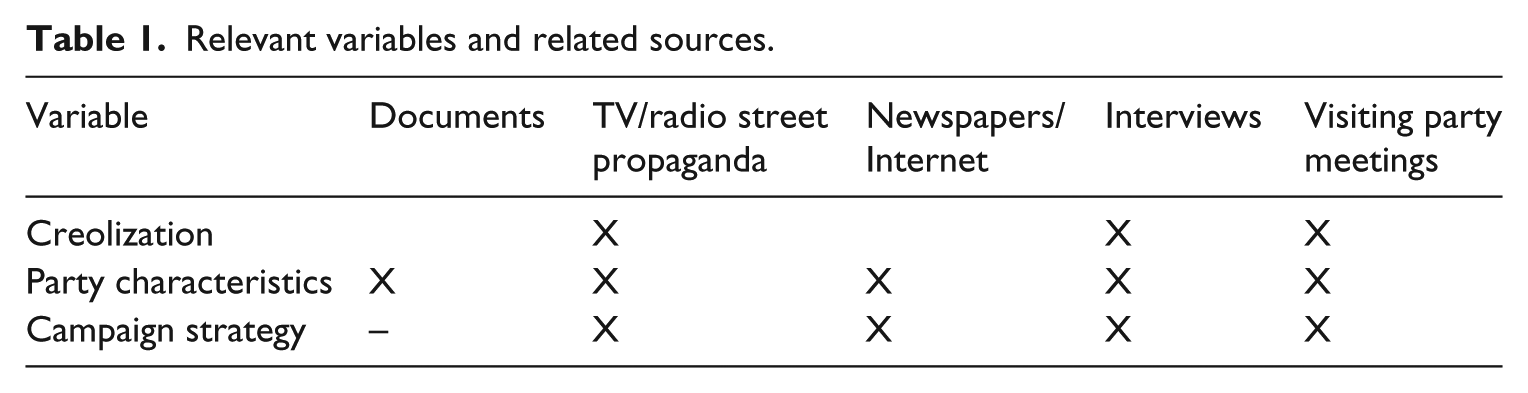
The phenomenon of Creolization was theoretically researched based on scholarly literature and empirically observed during fieldwork. To assess party characteristics, I collected written documents such as party programmes, e-mails sent regularly by the VHP, and reports of previous election results that were published by the Ministry of Domestic Affairs. Some party characteristics were familiar because of past performance. I studied the websites and propaganda material of political parties. I also read Surinamese newspapers, especially the leading daily de Ware Tijd that publishes an online edition as well, and I perused another online newspaper known as Starnieuws.com. I regularly discussed my evolving findings and other relevant news items with opinion makers and scholars in the Netherlands.
Regarding the campaign strategy, most of the data were obtained through fieldwork that began 2 weeks before the 2015 elections. That part consisted predominantly of TV, radio, newspapers, street propaganda (sound trucks, the distribution of flyers), and visiting political party gatherings. Because the media concentrated their reports of the campaign on the ethnically mixed but Creole dominated capital city of Paramaribo, that according to the latest census (Census, 2012) comprises 44% of the total population, I frequently visited other districts. The most densely (and ethnically mixed) districts visited were Wanica (predominantly Creole and Hindustani), Commewijne (predominantly Javanese and Hindustani), and Saramacca (predominantly Hindustani and Javanese), which together account for 31% of the total population. The predominantly Hindustani district of Nickerie (6%), located in the outer part of West-Suriname, has been closely monitored through media. The other districts (totalling 18%) were Creole or Maroon districts and less relevant for the Creolization process, but also monitored via media.
The observations in the field enabled me to check and re-check how Creolization was manifested in party characteristics and campaign strategy. I discussed this relationship and the indicators with Surinamese political observers, poll researchers, journalists, politicians, and active members of political parties in both formal and informal interviews. Major topics included whether Hindustanis and Javanese will continue to vote for the Creole nationalists as in the 2010 election, why they would do that, what impact the government’s past record would have, how many seats each party would obtain, what party characteristics matter for the constituencies, and the campaign strategy adopted by the various parties. Therefore, the issues crystallized during the fieldwork, while much of the data analysis occurred stepwise and mostly in interaction with key informants. As a result, the framework of this article underwent several iterations, and followed an exploratory path.
In addition, I had about 30 informal conversations with people who attended party meetings in all visited districts about their opinions regarding the competing parties, the popularity of the NDP and its leader, their perspectives on ethnic crossover, their judgements about past performances of the political parties, and their expectations for the future. These conversations were also helpful either to corroborate my previous insights or to shift my position. In addition, these data helped me cross-check the findings I had previously obtained from documents and other observations.
Creolization: The erosion of ethnic bonding
Suriname is a former Dutch plantation colony in which African slaves worked until 1863. From 1863 to 1916, British Indians (later called Hindustanis) worked on the plantations; from 1891 to 1940, Javanese indentured labourers and peasants were imported. By and large, all three groups had their own areas of residence and trades. As a result, there was little interaction among them (Van Lier, 1971). When the first general elections were held in 1949, these ethnic groups founded their own parties. The dominant party was the NPS, at that time ruled by the light-skinned Creole colonial elite that was dethroned in 1955 by black Creoles. The Hindostanis formed the VHP, and the Javanese organized themselves into the Kaum Tani Persatuan Indonesia (KTPI). Except for a brief period in the 1960s, the NPS and VHP entered into coalitions with smaller ethnic parties. To indicate their relative parliamentary strength, in the elections of 1977, out of a total number of 36 parliamentary seats, the NPS obtained 15, the VHP 13, and the KTPI 3 seats (Sedney, 2017). The political order was characterized by ‘unity in diversity’. It was a perfect model of ethnic politics since there were hardly any ethnic crossover, and all parties endeavoured to serve the interests of their own ethnic group (Dew, 1978).
Up until 1973, there was no appeal to nationalist sentiment. Ethnic politics dominated (Dew, 1978). Between 1969 and 1973, the relationship between the VHP and NPS became strained. In the elections of 1973, the NPS entered into a coalition with a Black nationalist party PNR (Partij Nationalistische Republiek) that aimed for constitutional independence (Dew, 1978). There were no Hindostanis in that government. When the NPS declared its desire to realize constitutional independence in 1975, the VHP resisted such a transfer, arguing that Suriname, considering its dependence on development aid and exports of raw materials, was not ready. The NPS persisted in its aims, supported by the Dutch government. Mass demonstrations were held outside the parliament, and a government building was set on fire. The fear of race riots, as had occurred in neighbouring British Guyana, emerged and caused mass migration to the Netherlands. In Surinamese society and politics, this emigration is still felt and understood today as a desertion. These emigrants do not feature in Suriname’s politics, despite the tight transnational relations between the two communities (Sedney, 2017).
In 1980, a wage conflict between the predominantly Creole Surinamese military and the predominantly Creole incumbent government escalated into a coup d’état, led by Desi Bouterse. In due course, the military violated human rights, engendering increasing opposition from various sectors of society including lawyers, journalists, entrepreneurs, and scholars. The military claimed that this opposition was directed by the United States and Dutch governments and destroyed it in 1982 by killing 15 of its most influential members. In response to these killings, the Dutch suspended development aid, which was an important pillar of investment capital and foreign exchange for the Surinamese economy.
During its time in power, the military established a Creole nationalist hegemony that legitimized their rule. They repudiated ‘ethnic politics’, including that of the Creole NPS and advocated a racially and culturally-mixed social order under the banner of nationalism. The distinguishing features of this Creole nationalism were as follows: an increase in the official use of the Creole vernacular, Sranan Tongo, thus unofficially replacing Dutch as public language; the propagation of racial blending and cultural mixing, emphasizing that the Surinamese were one people (‘wan pipel’, thereby countering ‘ethnic politics’ that allegedly stood for a lack of national unity); an urban Creole lifestyle, notably Creole modes of entertainment, conviviality, dancing styles, and speech; a Creole public culture, expressed in official radio and television programmes in which Creoles dominated, preferably using Sranan Tongo as the medium of communication; Creole names given to major roads and buildings in the capital city; and the fostering of anti-Western sentiment. These became the constituent elements of a Creole citizenship and Surinamese nationhood. The public emphasis was on ‘national unity’ and being ‘wan pipel’ (one people) rather than on ‘unity in diversity’ (Gowricharn, 2015; Sedney, 2017). The persistence of this Creole hegemonic nationalist culture became the major driving force in the Creolization process, the independent variable, which affected the loyalty of all ethnic groups.
Following their unpunished retreat in 1987, the military established its own political party, the NDP, led by Bouterse. The Hindustani VHP and the Creole NPS, supported by its Western allies, entered into a coalition called ‘New Front’ to combat the NDP. The New Front assumed power from 1987 till 1996, while from 1996 to 2000, the NDP formed a cabinet with a Hindustani splinter group (Sedney, 2017). The New Front cabinets were all dominated by the NPS, which adopted the Creole nationalism of the military (now NDP) without the anti-Western sentiment. Consequently, the Creole-nationalist preponderance became entrenched in politics and public culture. The Hindustani, Javanese, and Maroon political parties did not question the Creole preponderance, thus implicitly endorsing the subjugation of their ethnic constituency to nationalistic Creolization. Because the ethnic groups accepted the Creole predominance, the traditional ethnic loyalty was eroded in favour of nationalism.
Note that since 1961 the VHP has splintered four times which has proved it to be too small to survive. The last Hindustani splinter originated out of dissatisfaction with the VHP when it formed a government with the NDP in 1996. At that time, Creolization was less advanced and the NDP consisted almost entirely of Creole members (Sedney, 2017). Fourteen years later, Creolization had progressed and the NDP had attracted many Creolized Hindustanis and Javanese, even in the Hindustani district of Nickerie (Marchand, 2012).
The decline of ethnic loyalties became manifest by a few indicators. Hindustanis and Javanese increasingly testified in public discussions that they were ‘first and foremost Surinamese and second Hindustani’, used Sranan Tongo as a token of their Creole nationalist orientation, and stressed they were ‘wan pipel’. Creolization occurred not only in speech: interethnic unions and friendships, as well as Creole modes of conviviality and taste (in music, fashion, and recreation), were widely adopted by Hindustanis and Javanese, varying in spatial location, class, ethnic chauvinism and educational level. This convergence represented a crumbling of the existing ethnic cleavages (cf. Van Dam, 2015). That is not to say that the ethnic cultures were blending, but it should be emphasized that the erosion of ethnic loyalty to ethnic political parties was part of an encompassing process of acculturation, rendering an unmistakeable convergence of taste and lifestyle between the ethnic groups.
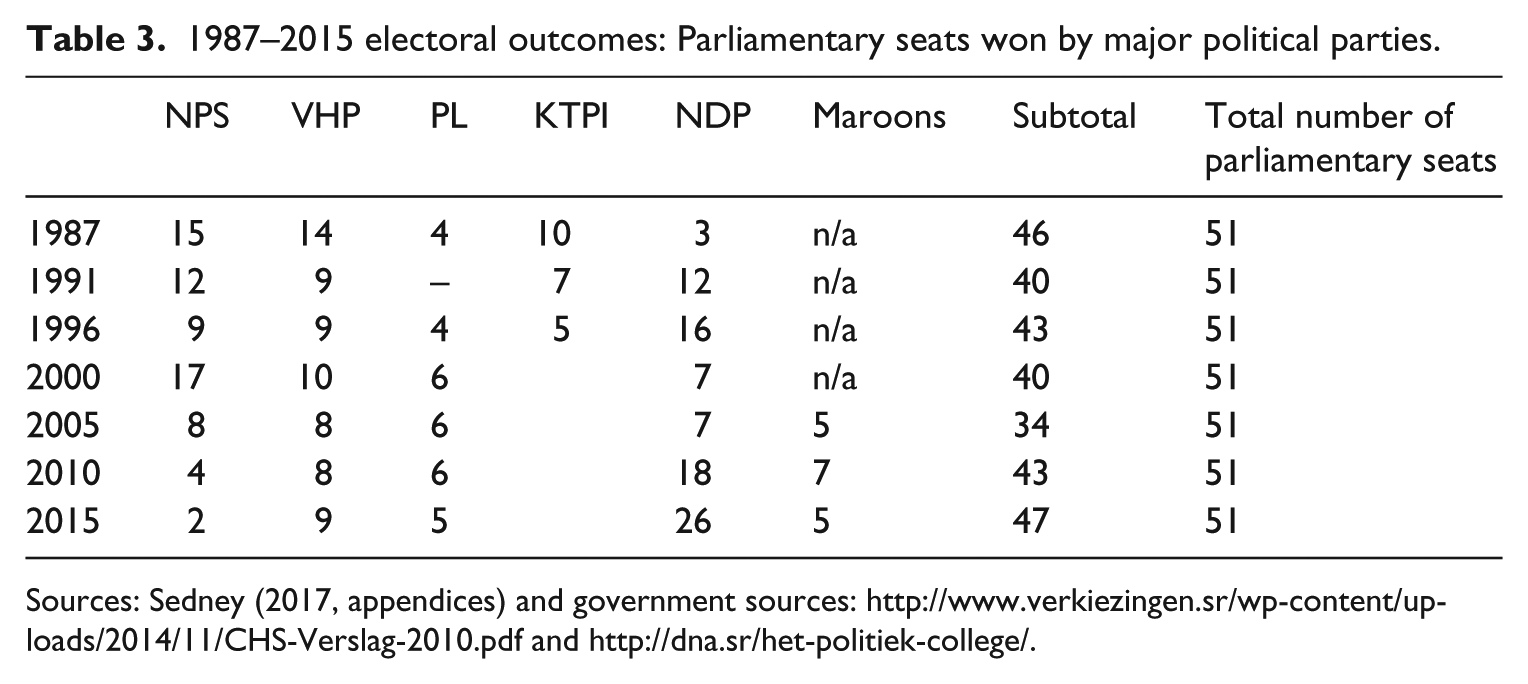
Politically, Creolization was gradually manifested in the increasing number of Hindustanis (and Javanese) on the NDP list of candidates, their growing open public support for the NDP, and the increasing number of traditional ethnic voters (Sedney, 2017). An increasing proportion of the Hindustanis, Javanese, ethnic Creoles (of the NPS) and Maroons floated away from their ethnic groups and sought shelter with the nationalist NDP. Table 3 highlights a substantial decline in parliamentary seats from 1987 to 1991 in favour of the NDP.
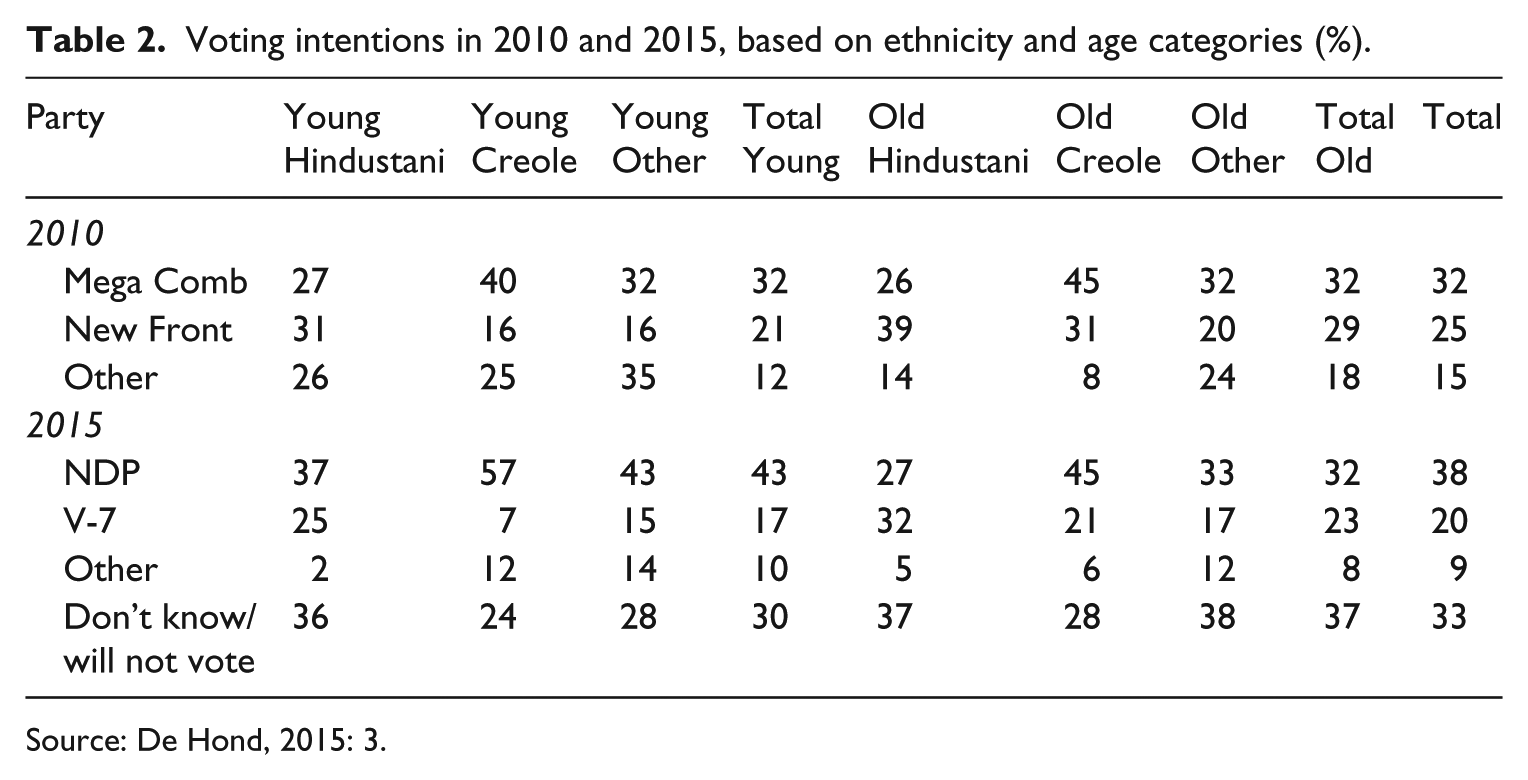
A study illuminating the presence and size of floating voters was conducted by a well-known Dutch researcher a month before the 2015 elections (De Hond, 2015). His sample included 1700 interviews, using the ‘random walk method’ drawn from 6 of the 10 most ethnically mixed districts that together accounted for 86% of the total population. De Hond differentiated the responses to ethnic group and focussed on ‘young people’, defined as those aged between 18 and 40 years and compared 2010 voting behaviour with 2015 voting intentions. Table 2, corroborating the qualitatively observed trends of the past three decades, is an abridged version of his elaborate table.
Voting intentions in 2010 and 2015, based on ethnicity and age categories (%).
Source: De Hond, 2015: 3.
Table 2 (with a turnout in both elections, according to the Ministry of Domestic Affairs, of about 75%) reveals that Creole and non-Creole ethnic support for the NDP was already substantial in 2010, reflecting a prior erosion of ethnic bonds and of floating voters. The ‘Mega Combination’ was a coalition of four small parties that was led by the NDP. This party had the smallest cleavage with the NPS and the Maroons since they represented a ‘family of Creole cultures’ and related multiple party identifications (Johnston, 2006). The support of the NPS and the Maroons for the NDP was arguably the largest. The large numbers of both old and young Hindustanis already supporting the NDP in 2010 suggest that the weakening of the ethnic bonds had materialized in this group long before. Among the older generation, support remained substantial and stable, while the support by the younger Hindustanis increased from 2010 to 2015. In contrast, support for the Hindustani party among young Hindustanis decreased from 31% to 25% and among older Hindustanis from 39% to 32%. Most revealing, however, was the fact that both segments of the Hindustani group displayed a high degree of indecisiveness (see last row). Similar trends can be seen in the other ethnic groups.
Viewed over the long term, the size of ethnic crossovers, as expressed by support for the NDP, is summarized in Table 3.
1987–2015 electoral outcomes: Parliamentary seats won by major political parties.
Sources: Sedney (2017, appendices) and government sources: http://www.verkiezingen.sr/wp-content/uploads/2014/11/CHS-Verslag-2010.pdf and http://dna.sr/het-politiek-college/.
Table 3 reflects that the NDP primarily (though not exclusively) grew at the expense of the NPS. The decline of the NPS was temporarily reversed in the election of 2000. The administration of 1996 to 2000 was dominated by the NDP, which invoked grave dissatisfaction, culminating in mass strikes. Many NDP-voters turned back to the ethnic NPS in the election of 2000. The table also reflects the almost total demise of the ethnic Creoles (NPS) after 2000, part of which appeared as a separate Maroon constituency from 2005 onwards. The VHP declined from 14 seats in 1987 to 9 in 1996; it recovered slightly, but the number of seats remained at a low level. The Javanese (PL and KTPI) won 14 seats in 1987 but did not reach that level again. The NDP grew, suffered from a temporary decline, then reached unprecedented levels in 2010 and 2015.
The claim that crossovers from all ethnic parties contributed to the growth of the NDP is also supported by the demographic growth of the ethnic groups. According to the latest census (Census, 2012), Maroons and Creoles represented 22% and 16% of the population and changed by 62% and −2.6%, respectively, in the period of 2004–2012. The changes in size of the Maroons and Creoles are probably related, as many who previously classified themselves as Creoles actually shifted their identity to Maroons. Despite their spectacular population size increase, the Maroons’ representation fluctuated between five and seven seats. In the same period, the Javanese (PL and KTPI), representing 14% of the population, grew by 2.9% while losing one seat. The Hindustani VHP represented 27% of the population and grew by 9.9%. However, the VHP remained at a level of 8–9 seats, while in 1987 it won 14 seats. The stagnation in terms of seats won after 1987 contrasted with the demographic growth and proved that all parties, especially the VHP, have a significantly larger ethnic potential (Ramadhin, 2014).
Party characteristics
While the Creolization process materializes in floating voters and a preference for the NDP, the tendency could have been reversed if the ethnic parties’ characteristics would have been favourable (Johnston, 2006). For a number of reasons that was unlikely. NDP’s victory was partly attributed to the rise of a new generation raised after the 1982 killings whose members were aged 18 years or older in 2000 (De Hond, 2015; Singh, 2008). But the NDP’s consolidation reflected more than the demographic expansion of the constituency. In the post-1987 period, there was no public discussion of the 1982 killings and no history lessons taught that memorialized these occurrences in the same way as was done with regard to slavery in the Caribbean or the Jewish persecution in Europe. As a result, the new generation that came of age in the post-military period was much less concerned about the killings in the 1980s. This generation grew up with the nationalist ideology that favoured the NDP. Although in 1999, Bouterse was convicted for drug trafficking by a Dutch court, an argument used against him by his opponents, this had hardly any effect on his popularity. He was overtly admired (Lindberg and Morrison, 2008).
The NDP emphasized many of its features vis-a-vis ethnic parties. It continued to repudiate ethnic political parties and repeatedly declared that, in contrast to the New Front parties, it was not a servant of the Dutch and US governments. NDP politicians pointed out in parliament, on television, on radio, and in newspapers that Suriname had developed profitable foreign relations with Brazil, China, and India during their rule and that direct foreign investment, along with exports of gold, oil, and bauxite had provided income and foreign exchange. On television, the NDP showed Bouterse in the company of world leaders, notably President Obama and the Pope. Their general claim was that Suriname became a developing nation under their rule, that it was far from being internationally isolated, and it had acquired national unity, dignity, respect, and welfare.
This developmentalist identity was mixed with the supply of welfare provisions. During the 2010–2015 period, the NDP increased pensions and child allowances, as well as introduced a minimum wage, parental leave, and after-school care. In addition, the party improved basic infrastructure and services, including street lighting, roads, and water and energy supplies for people in rural (residential areas of predominantly Hindustanis and Javanese) and Maroon areas that are generally less developed. They built elementary schools and recreation centres, and also issued ownership titles of land to hundreds of tenants and farmers across ethnic groups. The achievements of the prior NDP-administrations (1996–2000 and 2010–2015) were heavily advertised on television and the Internet. The supply of basic needs provisions and infrastructural provisions to the benefit of Hindustani, Javanese, and Maroon voters can be labelled as vote buying (Hidalgo and Nichter, 2015), but they were generally interpreted as an act of nationalism.
The efforts of the ethnic parties to offer an alternative to the NDP were ineffective, a weakness that became clear long before the 2015 election. Being more reactive than proactive, they remained a powerless opposition. The VHP and PL were rurally oriented, and in parliament and later in the campaign they raised issues related to agrarian problems and infrastructure. They brought up issues such as education, corruption, government overspending, and the violation of democracy, but in public discussion they were ill-received as the VHP, PL, and Maroons suffered from the public image that in prior administrations they had been favouring only their ethnic constituency. The voter swing could hardly be attributed to the lesser institutionalization of party systems. Provided the ethnic bonding has eroded, it can be accounted for by the leadership of the NDP, its ideology, and past performance that contrasted favourably with the ethnic parties (cf. Mainwaring and Toscal, 2005).
Campaign strategy
The crossover of Hindustani, Javanese, Creole, and Maroon voters to the NDP could signal the shrinking of ethnic politics, but two alternative interpretations are available. The first is that the NDP comprises ethnic compartments that dealt with their corresponding ethnic constituencies (Bogaards, 2005). The alternative possibility is that the NDP is ethnically mixed but takes into account the ethnic background of candidates when positioning them. With this perspective, candidates would be positioned in areas that are inhabited predominantly by their ethnic groups (Marchand, 2012). Only the VHP and the NDP chose this second ‘ethnic strategy’.
The VHP attempted a strategy by means of a ‘meet the people’ campaign, in which the VHP leader was shown in photographs, newsletters, and television spots visiting mostly Hindustanis, Maroons, and Chinese people. The results, however, indicate that this strategy was a grave miscalculation, especially since the direction of Creolization was headed away from these ethnic groups and towards the NDP. The ethnic strategy proved most effective for the NDP, as only this party managed to win seats in all constituencies (including in the Maroon districts).
Apart from the ethnic campaign strategy, there was a marked difference in the way the campaign was waged. The V-7 had neither a common ideology nor a programme and only shared their grievances regarding Bouterse. On television talk programmes, the V-7 repeated complaints and accusations about the government’s wrongdoings. The communication itself made use of an excessive amount of jargon and clichés. For example, in a V-7 television talk show about primary education, panel participants discussed the need for ‘innovation’ and a better ‘quality’ of education. In a similar television spot about education, the NDP messages showing buildings that they had financed and a school that was in the middle of construction turned out to be compelling. The NDP campaign was also markedly different by virtue of its higher broadcasting frequency, longer TV spots, the professionalism of individual candidates, and parades.
In the campaign speeches, both parties made little reference to party programmes, and yet the differences between the VHP (the leading party of the V-7) and the NDP were striking. While the VHP only discussed problems, the NDP proposed solutions. NDP speeches focussed on victory, the party’s achievements, and what tasks were yet outstanding. By contrast, the VHP offered only thin future prospects. The atmosphere at NDP meetings was festive, with music playing, food provided, and people dancing. Bouterse himself, ever the entertainer, cracked jokes and danced and sang on the stage, all of which appealed to young voters. The V-7 tried to copy the NDP image but had dismal results. At the V-7 meetings, food and music were also provided, but the atmosphere was cheerless and they attracted fewer young people.
At party meetings and on radio and television, when Hindustanis and Javanese attendees were asked about their reasons for voting for the NDP, two types of answers were given: the bulk said that there was no point in voting for ethnic parties since they were all Surinamese. To this nationalist answer was added the argument that ethnic politicians had done nothing for the people. In contrast, the phrase ‘Bouterse did something for the people’ was quite commonly heard for the duration of his last administration and especially in the run-up to the elections. The second and much smaller category of people answered that they had not deserted their ethnic community or party since they were voting for an (NDP) ethnic candidate and thus were loyal to co-ethnics (Long and Gibson, 2015). The first type of answer reveals the erosion of the ethnic voting loyalty of Hindustanis and Javanese, while the second testifies to a shifting loyalty from the ethnic political party to individual co-ethnics in the Creole nationalist party.
Conclusion
In comparative political science, the assumption of ethnic cleavages is pivotal for accounting for ethnic competition, conflict, and power-sharing as well as comprehending the distribution of public goods across ethnic groups. In this perspective, ethnic group membership equals ethnic loyalty and accounts for ethnic voting behaviour. However, the decline of ethnic cleavages has scarcely been discussed in the scholarly literature on the presumption that, although party loyalty may change, the bonding remains within the realm of the ethnic group. The present article addresses the erosion of ethnic bonds and breakdown of cleavages. While developing a theoretical framework for plural societies, the article uses the Surinamese society as a case study to elucidate how these cleavages declined and gave way to floating voters and shifting voting patterns.
The perspective of Creole hegemony accounted for the adoption of the Creole lifestyle, diminishing ethnic cleavages and erosion of loyalties. However, given a Creole predominance, there have been counter and intervening forces to reckon with during elections, notably party characteristics and conducted election campaigns that may countervail the shift of voting patterns. The direction of floating voters may have been impacted by these intervening forces, but it hardly occurred in the studied case. Consequently, the findings of Eifert et al. (2010) that voters’ ethnic identification increases when they are exposed to political competition, or Johnstons’ (2006) claim that voters’ identification moves voters’ preferences and the link between candidates and issues could not be corroborated in the context of Creole hegemony as voters floated to the hegemonic Creole party. Nor were weak institutions in play as Mainwaring and Toscal (2005) suggested. These were stable and their operations were uncontested. On the other hand, vote buying (Hidalgo and Nichter, 2015) did occur but was generally felt as a nationalist public service rather than a party interest. Based on the case study, it may be underscored that electoral outcomes are effects of prior long-term social processes rather than short-term electoral campaign strategies.
Theoretically, the article has engaged with a fundamental assumption regarding ethnicity in theory and politics. Specifically theories of consociational democracy and power sharing presuppose that ethnic groups are neatly demarcated. This assumption has been eroded, raising questions about the validity of the general theory. Regarding theories of ethnic competition and distribution of public goods and services, these were often derived from the presence of ethnic loyalties. However, with the Creolization of ethnic bonding, it becomes less obvious what mechanisms account for public distribution, thus impacting conventional notions about ‘who gets what’ in plural societies. Consequently, the Creolization process calls for a critical reflection on these concepts and their implications.
Footnotes
Funding
The author(s) received no financial support for the research, authorship, and/or publication of this article.