




Abstract
Accusations of treason and disloyalty have been increasingly visible in both western and international politics in recent years, from Russia and Turkey, to Brexit and the 2016 US presidential election. This article explores ‘traitor’ accusations in modern politics, with evidence from British and American newspapers for 2011–2016. Besides British and American politics, results reveal reported ‘fifth column’ accusations in over 40 countries. I identify three dominant patterns: authoritarian states describing opposition movements as a ‘fifth column’; suspicion of western Muslim populations as potential terrorists; and the use of traitor language to denote party dissent in western politics. Employed across the political spectrum, and not only by right-wing or populist movements, accusations of treason and betrayal point at a deeper breakdown of social trust and communicate collective securitizing responses to perceived threats.
Introduction
Brexit and the election of Donald Trump have sparked widespread debates on post-truth politics, conspiracies, fake news, and propaganda. Both events and the debates preceding them have revealed political mistrust, deep tensions, and suspicions that split societies into ‘Brexiteers’ and ‘Remainers’, Trump supporters and opponents, locals and migrants. These tensions involved accusations of disloyalty and betrayal, intertwining these campaigns with other events and security threats: the rise of the Islamic State, the refugee crisis, speculations of a ‘new cold war’, and suspicions of foreign interference. The rise in threat narratives and accusations of betrayal, which help isolate these threats to particular objects, can signal growing anti-migrant sentiments, the rise of populist movements, and mistrust in democracy.
This article brings together recent ‘traitor’ accusations to evaluate how the political language of betrayal and infiltration by ‘fifth columns’ has been called on to prohibit, exclude, and defile a variety of societal objects and groups. The term ‘fifth column’ originated in the Spanish Civil war, when nationalist General Mola announced that although four columns of troops surrounded Madrid, the city would fall to a fifth column ready to strike from within (Thurlow, 1999). The Spanish government responded with a search and arrest operation in the city looking for traitors (Loeffel, 2015: 9). The label became widely used with the hunt for ‘Nazi sympathizers’ in the 1940s and communist agents in 1950s. Since then, it has meant an internal enemy, an insider with questionable loyalty and identity, such as a traitor or a spy. Yet, it is not simply the language from the past, although most ‘fifth column’ studies confine it to the 1940s–1950s period (Loeffel, 2015; MacDonnell, 1995; Prysor, 2005; Saunders and Taylor, 1988; Thurlow, 1999). More recent notable ‘fifth columnists’ included Tutsi women as seducers ‘in cahoots with Hutu enemies’ in Hutu propaganda in Rwanda (Hudson, 2014: 109), ‘new Danes’ as potential security threats (Agius, 2013), and mainstream political elites accused of betraying the nation by right-wing parties in Denmark (see Agius, 2017).
The traitor accusations of today draw heavily on the easily recognizable ‘fifth column’ label, but the speakers and objects of the accusation are new. This article employs newspaper content and discourse analysis to explore the contemporary contours of traitor narratives in the United Kingdom and the United States in 2011–2016, including the speakers and objects of the ‘fifth column’ accusations, their dynamics, connections to particular events, and political significance. As an extreme expression of expulsion, traitor narratives point to the most acute political and societal insecurities.
The article puts forward three arguments. First, I demonstrate that even before Brexit and the election of Donald Trump, British and American media reported traitor accusations in both domestic and international politics. Threat narratives and ‘fifth column’ accusations have found new applications in western politics, including dissent within major political parties and fear of Muslims as terrorists. Second, accusations of betrayal offer suitable targets to blame to populist movements and anti-migrant campaigns. Yet, I also show that the current ‘fifth column’ language is not confined to right-wing or populist movements as may have been expected; it is found across the political spectrum and in over 40 countries. Third, the article offers a theoretical argument on how traitor accusations help draw in- and out-group boundaries, create uneven power relations, attach threats to particular objects and thus build the feelings of certainty and security.
‘Fifth column’, identity and security
The widespread and similar use of the ‘fifth column’ label in 1940–1950s, both in the United States and the United Kingdom, created a recognizable cultural symbol that carries particular associations. Over the years, it has included a variety of individuals, groups, and objects to suit different political agendas. As such, its exact boundary is not easy to define. It has widely been associated with the conflicting loyalties of foreign nationals as ‘their country of residence is seen to be in conflict with their country of origin’ (Poynting and Mason, 2006: 366). The modern use, as demonstrated in this article, spreads beyond ethnicity, citizenship, and migration. A common point between the historical and contemporary ‘fifth columns’ is in their position of being expelled from the larger group which suspects them of disloyalty. The ‘fifth column’ has, as Loeffel (2015: 9) notes, been ‘ill-defined as to include and account for a range of activities and purposes … It essentially replaced previous terms such as “traitor” and “spy” and was therefore a modern adaptation of a timeless practice’.
Since it represents expulsion and betrayal, the ‘fifth column’ label is not merely a description of its object; instead, it points at a relationship that involves the expelled object, the group that expels it, and public discourse that turned this object into a threat. The use of the label in political speech or media thus bears significance for the speaker as well as the object, and should not be regarded in isolation from the speaker’s collective identity. This means that the focus should not solely be on whether the accusation is true or not, but on what motivates the larger group to revert to this act of expulsion and ‘enforce a particular reading of a threat according to which people and groups are defined’ (Foucault, 1980: 201; Kinnvall, 2004: 745).
Identity and its security are central to the power of the ‘fifth column’ accusation. Identity is understood here as a subjective and imprecise experience of sameness (Campbell, 1998; Volkan, 1988). This experience relies on imagining the community as a whole, united through valued symbolic traits that represent membership (Anderson, 1983). For example, to be accepted as a member of a nation, a person needs ‘to be recognisable as living up to the national ideal in the first place’ (Ahmed, 2004: 133). Identities are therefore constantly performed and (re)negotiated, including performance through narratives and media representations, particularly in times of uncertainty or threat. Shared cultural experiences, historical memories, and symbols are important as ‘different persons must be able to nourish their imagination from the same source’ (Boltanski, 1999: 50) and share established referents. ‘Fifth column’ presents such a recognizable symbol that suggests deviation from acceptable norms of belonging (disloyalty) and affirms the boundary of the group against an expelled object. The attributes of the ‘enemy within’ can differ as an imprint of various cultural and historical contexts (e.g. suspicion of Muslims after 9/11 or mistrust of opposition after the history of instability in authoritarian states). ‘Fifth column’ language is a form of othering that contains ‘effects of histories that have stayed open’ (Ahmed, 2004: 59) and emphasizes difference in order to build up ‘feelings of we-ness’ (Appadurai, 2006: 59) – a ‘specific form of life [that] is considered worthy’ (Hudson, 2014: 106).
Communities aim to construct ‘secure’ identities – a sense of ‘home’ (Kinnvall, 2004: 747), which would rule out uncertainty and avoid questioning the self. To achieve this, in times of threat, communities expel outsiders and tend towards more ‘secure’ (and often nationalist) identities. In this sense, the discovery of a ‘fifth column’ is a symptom of a bigger crisis. Expelling parts of a community as treacherous restores the sense of security and empowerment and appeals to the community’s desire to have a continuously positive view of themselves (Chernobrov, 2016). For example, the ‘fifth column’ scare in 1940s became widely accepted as it offered a comforting explanation for ‘Nazi success, not in terms of superior military tactics, but as the result of the work of agents infiltrated as aliens’ (Thurlow, 1999: 484).
The ‘fifth column’ label is a symbolic language that contains associated meanings and constructs boundaries and identities at the moment of speaking (Ahmed, 2004). Its use in media or political speech brings together speakers, topic, and audience into a ‘rhetorical performance’ of identity (Atkins and Finlayson, 2016: 174), or ‘rhetorical situations’ more broadly (Bitzer, 1999), which are shaped by particular occasion and expectation. I argue that a significant number of political references to a ‘fifth column’ were made in response to crises, threats or political competition, where the expectation of the audience is in the provision of security, understood here as certainty, clear identification of threatening objects, and their expulsion/disempowerment.
In identifying threatening objects, expelling them and securing the speaker’s identity, the ‘fifth column’ label acts as a frame – the ‘central organizing idea’ (Gamson and Modigliani, 1989) that promotes ‘a particular problem definition, causal interpretation, moral evaluation, and/or treatment recommendation’ (Entman, 1993: 52). Framing by political elites can be particularly powerful in an environment where multiple actors compete to define societal problems (Chong and Druckman, 2007). Public opinion and political behaviour are influenced by media (Ladd and Lenz, 2009), including the creation of associations between threats (and other negative traits) and particular communities (Gilliam and Iyengar, 2000). Even when consciously rejected, media reminders of these associations can still inform judgement (Berinsky and Mendelberg, 2005). This makes political and media discourse on the construction of threats, identity, and expelled objects crucial in understanding societal insecurities and tensions. A ‘fifth column’ accusation in politics can then be viewed as part of collective identity securitization which involves speakers, media, and audience. It manifests a deeper social and political process than simply an accusation of disloyalty, and should be analysed as part of the broader public discourse of threats.
Method
This study combines content and discourse analysis of newspaper articles. Although quantification of traitor accusations is not my ultimate aim, quantitative content analysis helped discover the dominant speakers and objects of the traitor claims and their connection to particular events. I identify three dominant patterns: authoritarian states describing undesired objects; suspicions of western Muslim populations as potential terrorists, and use of traitor language to denote political party dissent. These are further explored discursively with the understanding that political and media language helps negotiate societal relations (Krippendorf, 2004), including the construction of agency and inequality (Van Dijk, 2008).
Data
Materials were collected via LexisNexis database, using the keywords ‘fifth column’ and ‘fifth columnist(s)’ 1 to search through major UK and US newspapers 2 between 1 January 2011 and 30 June 2016. The choice of British and American newspapers and the timeline achieves two aims. This period started with the Arab Spring events, included the refugee crisis, and ended with Brexit vote and Donald Trump winning the Republican Party presidential primaries. The focus of the emergent scholarship on the divisive rhetoric in the aftermath of the Brexit vote and Trump’s election, and on the accompanying activization of the European and American far right underestimates the presence of threat and traitor narratives prior to these campaigns and outside them. This study fills this gap. The period of over 5 years also captured more prolonged applications of the label than single speech acts. On the other hand, in their wide international coverage, British and American newspapers reported ‘fifth column’ accusations in over 40 countries between 2011 and 2016, enabling me to draw conclusions not only about the two countries’ politics, but also about modern ‘traitors’ in various national contexts and their construction in western media.
The keywords occurred in 826 (596 UK/230 US) original articles, but some of these mentions were unrelated to the politics of today and invoked the term in historical contexts, from Nazi sympathizers to anti-communist work of the US House Committee on Un-American Activities. These mentions help maintain collective identities as ‘narrated selves’ through shared cultural memories (Subotić, 2016: 7) and make the ‘fifth column’ label recognizable. The total of 609 (427 UK/182 US) articles were analysed, capturing all relevant mentions. News stories, editorials, and opinion pieces were included as they present media content available to readers and form part of the wider societal discourse in which the label in used.
Coding
Coding focused on several elements: speakers invoking the label, objects accused of being a ‘fifth column’, temporal dynamics; occurrence in home or international news, and the presence or absence of the fifth column’s responding voice in the article.
Speakers were coded in three main categories: politicians of different calibre reported as making the ‘fifth column’ claim, journalist/writer invoking the label themselves, and other quoted journalists, activists, and academics. Politicians were further coded into sub-categories that identified particular leaders, their incumbent or oppositional status, and whether they come from the right to far-right of the political spectrum. 3
Seven main categories were used to code for objects of the accusation: political opponent/opposition, anti-Muslim to anti-terrorism rhetoric, migrants, local ethnic minorities, foreign military or spy, other, or not specified. Anti-Muslim and anti-terrorism rhetoric was further subdivided into (a) Muslim population, (b) Islamists/terrorists, and (c) terrorists/no religion mentioned. These subcategories allowed a more nuanced insight into the claims about western Muslims and their potential connection to terrorism. In particular, this allowed me to differentiate the more nationalist arguments about the ‘fifth column’ threat of multiculturalism, Muslim neighbourhoods, traditions and Sharia law looming over western schools, from the conservative/national security concerns about the threat of small Islamist cells rather than British or American Muslim populations in general. There was also a less frequent connection between the Muslim/terrorist theme and migration. Coding followed the way the threat had been represented in the article. 4 Intercoder reliability between two coders on a 10% sample ranged from Cohen’s Kappa 0.80 to 0.95 (Lombard et al., 2002).
Finally, articles were also coded according to whether the ‘fifth column’ was mentioned in UK or US home politics or internationally (other countries using the term). It was also noted if the voice of the group or individual who had been called a ‘fifth column’ was present in the article. Its absence could suggest the power of the label as symbolic prohibition to engage with the ‘other’.
Results
Dynamics and underlying events
Articles containing ‘fifth column’ mentions were spread unevenly over the five-and-a-half-year period (Table 1).
‘Fifth column’ in home and international coverage in British and American articles by year.
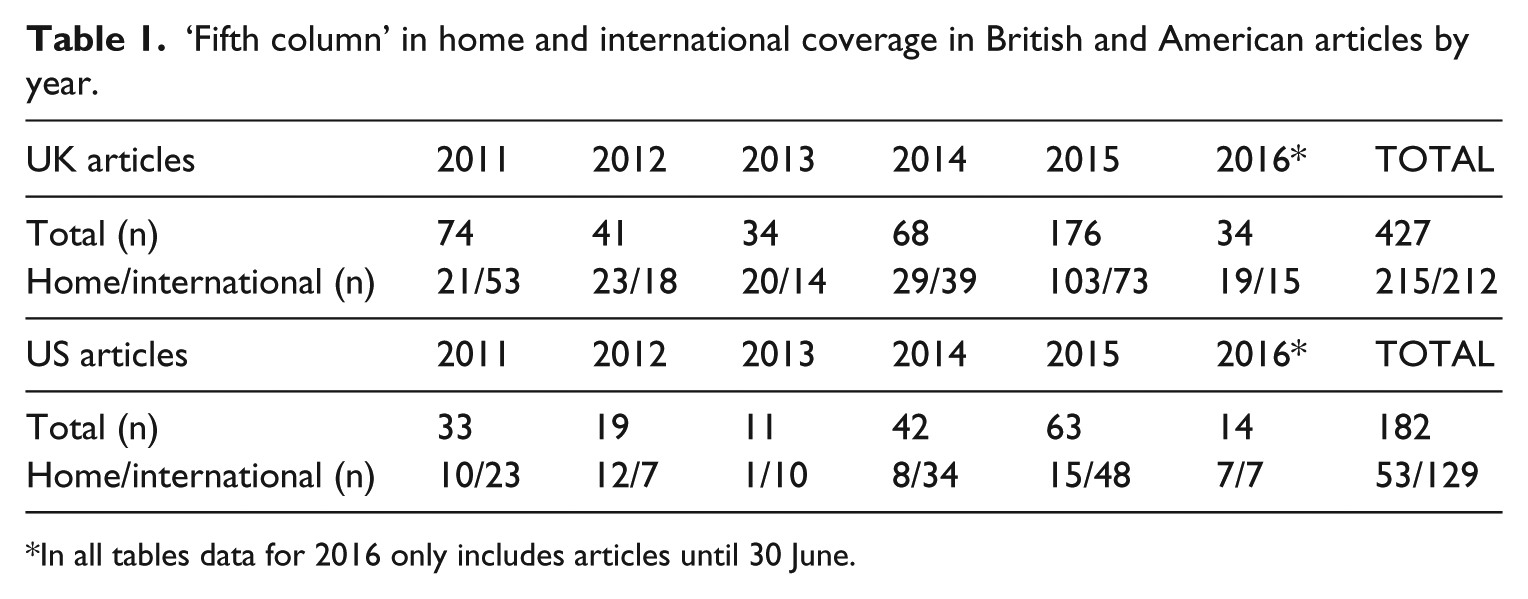
In all tables data for 2016 only includes articles until 30 June.
Analysis of the frequency of ‘fifth column’ mentions in home vs international coverage can help connect them to particular events. In 2011, the ‘fifth columns’ predominantly occurred in international news. In all, 71% of the British articles and 65% of American articles with an international ‘fifth column’ reference in 2011 were reporting the Libyan uprising and a variety of rebel statements about the ‘fifth columns’ of ‘Gaddafi loyalists’.
By 2015, the use of ‘fifth column’ language in domestic politics became particularly visible in British newspapers as home mentions exceeded international. The home ‘fifth column’ suspicions were intensifying in the wake of Charlie Hebdo shootings, Paris attacks, the refugee crisis, Brexit and the growing hostility to migrants.
Two major political developments underlie international references to ‘fifth columns’ in both British and American newspapers in 2014–2015. Amid growing tensions with the West, a number of Russian official statements described political opposition and western non-governmental organizations (NGOs) as a ‘fifth column’, followed by the assassination of a prominent opposition figure Boris Nemtsov in February 2015. These statements were widely reported in British and American newspapers, amounting to 48% and 58% of international ‘fifth column’ mentions in 2015 respectively. This is also the time of the Ukrainian crisis, western sanctions, and media speculations of a ‘new cold war’ that built up the ‘Russian threat’ and underpinned references to a Russian ‘fifth column’ inside Ukraine, the Baltics, the European Union (EU), and the United States.
Speakers and objects
There were two clearly dominant categories of speakers, or initiators of the ‘fifth column’ label, in both British and American newspapers (Table 2): politicians reported to be using the label (40% and 39%, respectively) and journalists/writers of the articles themselves (39.1% and 37.4%). Importantly, this signifies the presence of the ‘fifth column’ label in both political speech and societal narratives of exclusion. Among politicians, UK Independence Party (UKIP) leader Nigel Farage and Russian president Vladimir Putin were the main speakers in the British sample. Statements by Farage were barely noted in the US newspapers (only 3.1% among politicians), while Putin’s ‘fifth column’ claims were covered more closely than in the British sample. Given that Farage is less known in the United States, this is not surprising. In addition, the US media had a stronger focus on Russian politics in the wake of the Ukrainian crisis, rather than on the British immigration debate. Other politicians using the label were reported less frequently and ranged from the US Republican candidate Donald Trump to Israel’s Foreign Minister of the time Avigdor Lieberman and Christian Estrosi, the right-wing Mayor of Nice. 5
Speakers of the ‘fifth column’ claim.
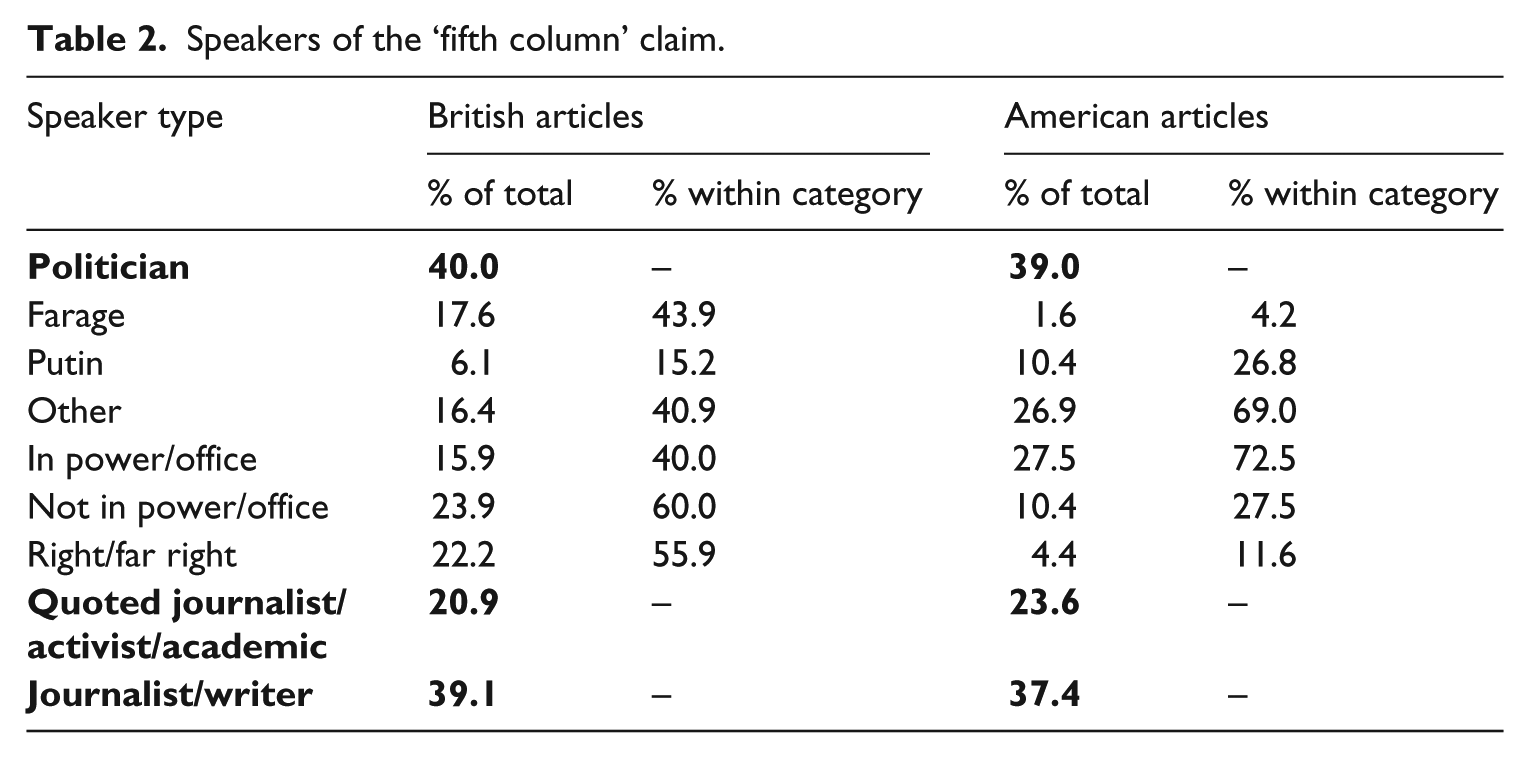
In British newspapers, politicians using the label tended to represent opposition (60%) from the right to far-right side of the political spectrum (55.9%). This result was largely stimulated by the intensive coverage of particular statements (such as Farage’s “fifth column” speech in January 2015) and the wider debate that they stirred. In the US newspapers, domestic and international politicians using the label were predominantly in power/office (72.5%) and unlikely to be far-right (only 11.6% of politicians). This suggests that the modern ‘fifth column’ label in political speech is not exclusively the language of the right or far-right groups as may have been expected. Neither is it entirely marginal, as a significant proportion of political speakers were in a position of power.
The wide use of the label by journalists and writers themselves, and by other quoted societal actors (other journalists, activists, experts), suggests that the ‘fifth column’ has become if not frequent, then a more normalized term across societal layers. As a ‘rhetorical performance’ (Atkins and Finlayson, 2016), it is used by all members of the community and not only in political speech.
The main objects, or individuals and groups being called ‘fifth column’ (Table 3), were opposition leaders and opposition in general (48.7% and 58.2% in the UK and US newspapers). This made political struggle the dominant theme where ‘fifth column’ accusations were reported. The term was applied in home and international coverage in much the same way – to suggest externally dictated loyalties (e.g. a ‘fifth column’ of Cruz or Trump supporters inside the US Republican Party, a UKIP ‘fifth column’ inside the UK Conservative party, or Russian opposition manipulated by the West).
Objects of the ‘fifth column’ claim.
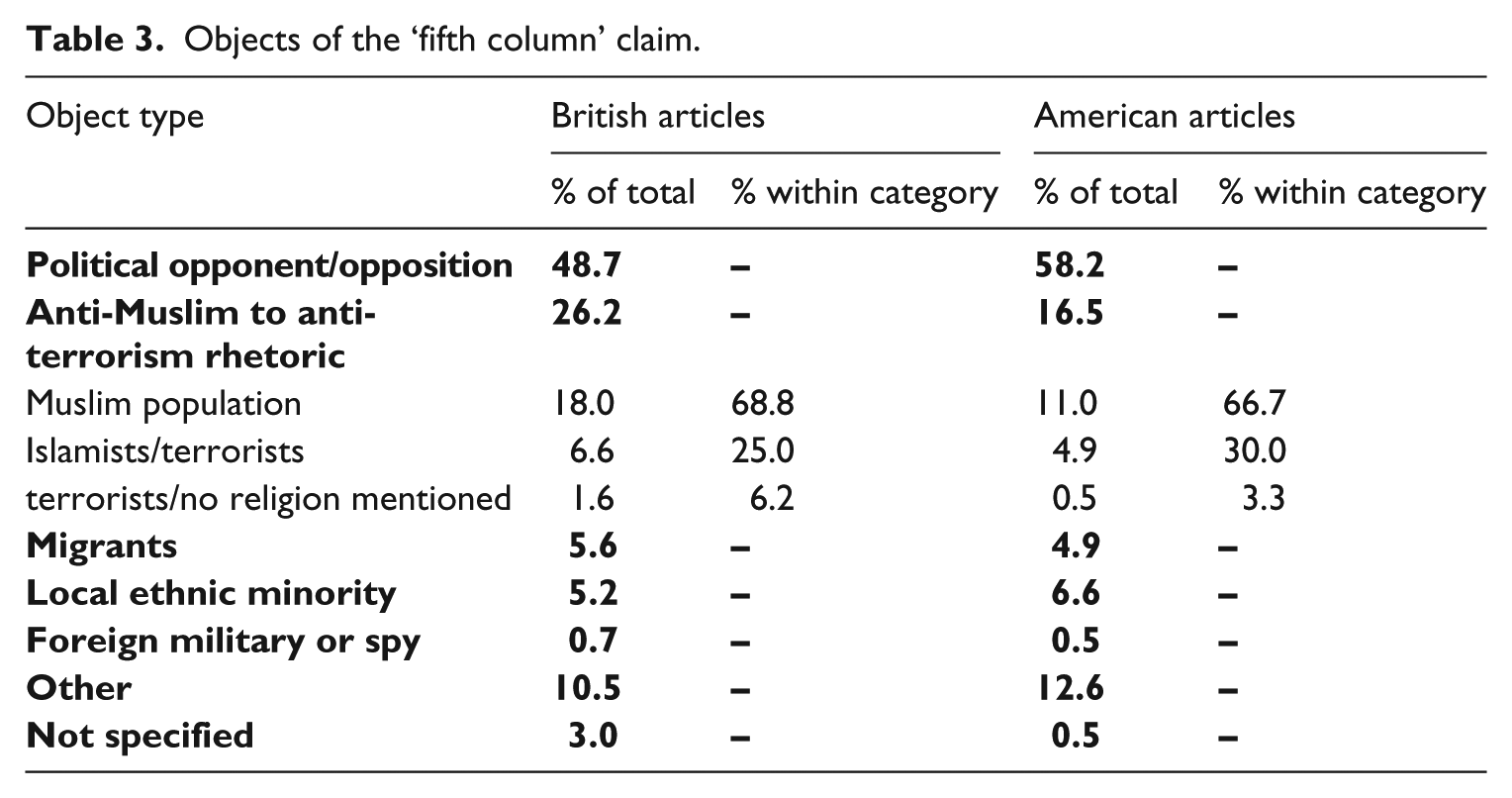
Growing anti-Muslim sentiments came second (26.2% and 16.5%, respectively), largely in the context of terrorism. Suspicion about British, American, or European Muslims as a whole dominated British and American coverage almost equally (68.8% and 66.7%). This finding supports and updates the evidence from other studies that after 9/11 whole Muslim communities have gained ‘unwelcome visibility’ (Tsagarousianou, 2012) and been criminalized (Poynting and Mason, 2006) in the Anglophone press and portrayed alongside, rather than as part of western communities (Croft, 2012). A distinction between Islamists and whole Muslim populations was made in only a quarter of terrorist ‘fifth column’ mentions, and still fewer articles (6.2% and 3.3%) did not connect terrorism to any religion.
The description of migrants as a ‘fifth column’ in most instances also suggested conflicted identities which could jeopardize national security (such as being opposed to western democratic and secular ideals or sympathizing with Paris attackers). All of the migrant ‘fifth column’ mentions in the UK press and 88.8% of US press mentions took place in 2014–2016, confidently connecting them to the refugee crisis and the perceived threat of terrorism. The connection between anti-migrant sentiments and the fear of Muslims as terrorists is not surprising as most incoming refugees in Europe for that period were Muslim (Hackett, 2015).
‘Fifth column’ accusations mostly meant the creation of an excluded and silenced group. Only 30% of British and 39% of American articles reported the response of those accused (for example, statements from the Russian opposition, British Muslims, or party defectors). This points at the highly prohibitive nature of the ‘fifth column’ description, when by excluding the disloyal object, the speaker prevents potential dialogue with ‘fifth columnists’ and rules out engagement with their logic or motivation. ‘A rigid boundary explicitly precludes any possibility of engaging the ‘other’’ (Murer, 2009: 117), and depicting the ‘fifth column’ in the language of betrayal means that listening to its arguments would mean being unfaithful to the remaining group (a historical parallel to Un-American activities comes to mind).
Based on the results above, I was able to identify three main patterns in how, by whom, and to whom the ‘fifth column’ label was applied. All three patterns are novel, compared to the initial or well-documented political ‘traitors’ and ‘fifth columns’.
Pattern 1. Authoritarian states speaking about political opposition
A large proportion of the international mentions of the ‘fifth column’ emerged from reporting how governments and media in authoritarian states portrayed their political opposition (Table 4). The labelling of political opponents as ‘fifth columnists’ was most frequently reported in Russia, Libya, Egypt, and Turkey.
International references to a ‘fifth column’ by country, with year dynamics and the ‘fifth column’ object.
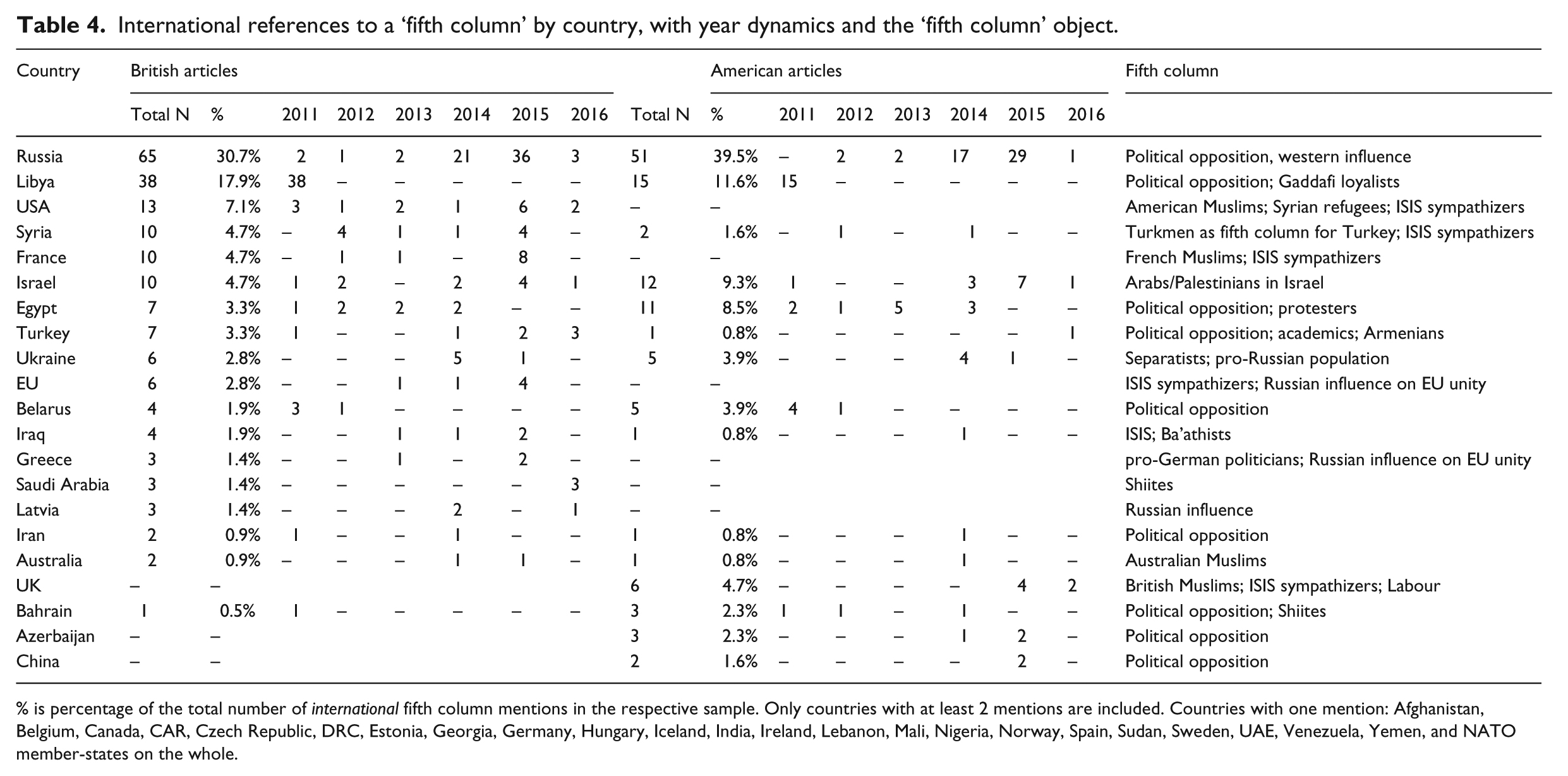
% is percentage of the total number of international fifth column mentions in the respective sample. Only countries with at least 2 mentions are included. Countries with one mention: Afghanistan, Belgium, Canada, CAR, Czech Republic, DRC, Estonia, Georgia, Germany, Hungary, Iceland, India, Ireland, Lebanon, Mali, Nigeria, Norway, Spain, Sudan, Sweden, UAE, Venezuela, Yemen, and NATO member-states on the whole.
Political opposition was typically blamed as externally funded, destabilizing, and treacherous. It was described as a ‘fifth column of Western-oriented Russians’ and ‘national traitors working for foreign interests’ (Russia); ‘belligerent’ and ‘paid agents of enemy powers’ (Egypt); ‘plotting a revolution’ (Azerbaijan); ‘in the pay of foreign enemies out to destabilise Belarus’ (Belarus); ‘treasonous fifth columnists of foreign powers’ (Turkey); or ‘backed by Iran and bent on toppling the Khalifa dynasty’ (Bahrain). These claims and their connection to authoritarianism can be understood within the broader context of the construction of threats and security. ‘Fifth column’ accusation can act as a ‘securitizing move’ (Buzan et al., 1998) by agents in power. By portraying the opposition as an existential threat to the nation, authorities transform political competition into rhetoric of national survival and stability. As the result, they assert their own legitimacy and equate national identity with support for the existing institutions of power.
Lexical analysis (Richardson, 2007) reveals that the language in which these accusations were reported in the British and American newspapers was no less prohibitive and self-securitizing in its criticism of the authoritarian model. Reporting the accusation was accompanied by words ‘paranoia’, ‘dangerous’, ‘ridiculous’, ‘unsettled’, ‘repression’, ‘gambit’, ‘linchpin’, ‘propaganda-brainwashed’, ‘jingoistic vibe’, ‘grim tales’, or ‘dictator’s fix’. Parallel to this, the opposition was constructed as a victim deserving sympathy of a western reader. This was achieved through words that create associations and mobilize emotions by relating to social and cultural practices (Ahmed, 2004: 46). For example, opposition was widely described as ‘pro-democracy’, ‘pro-western’, ‘muzzled’, ‘beleaguered’, ‘besieged’, ‘slain’, ‘suppressed’, and ‘suffocated’. The persuasive power of these metaphors of physical harm is in their ability to arouse feelings of fear and emotional connection to the victim (Charteris-Black, 2011: 15). Besides pointing at familiar and repelled symbols of physical violence, these words also appealed to the western acceptance of political opposition as a democratic practice that needs to be protected.
The relationship between the authoritarian governments and opposition was often portrayed as amoral, dirty, monstrous, or otherwise repelling. For example, The Guardian wrote after Nemtsov’s murder: ‘Muddying the waters, pro-Kremlin figures rushed to come up with apparently outlandish theories that the killing was meant to frame Putin’ (Walker, 2015). A few years earlier, The Guardian dismissed Putin’s accusations of Russian opposition as a ‘fifth column’ as ‘classic KGB stuff’ (Harding, 2011). The Washington Post (2015) spoke of ‘a tired and stale fear of authoritarian bosses, in China and elsewhere’, comparing Chinese anti-opposition laws with Putin ‘cracking the whip’ ( ‘China’s insatiable appetite for power’). Speaking of Belarus, the American newspaper contrasted ‘Europe’s last dictator’ with ‘pro-democracy opponents’ (Weymouth, 2011). Placing complex political realities into a familiar democracy-oppression frame helped securitize a western democratic identity as the positive contrast from authoritarian others.
Pattern 2. Fear of Muslims as terrorists
This pattern could be observed in both home and international ‘fifth column’ language. While stimulated by particular political speeches (by Farage, Trump, Estrosi and others), claims of western Muslims as potential ‘terrorist sympathizers’ were widely debated within the broader themes of multiculturalism, security, and immigration.
In the British sample, a polemic between two opinion pieces can offer insights into this use of language, while being illustrative of the wider Muslim ‘fifth column’ debate. The first, written by Mehdi Hasan (2015), appeared in The Guardian and clearly rejected Farage’s ‘fifth column’ accusation as ‘Islamophobic bullying’. British Muslims were depicted as ‘spied on, stopped and searched, stripped of citizenship, and subjected to control’. The other piece (Pearson, 2015), in conservative The Daily Telegraph, supported the use of the label and constructed two parallel identities: a progressive British identity (‘advantages of growing up in our country’, ‘liberal’, ‘democratic’, ‘education’) and a non-performing Muslim identity ( ‘hated our way of life’; ‘murdered’; ‘lack of understanding’; ‘failure to accept our values’). While representative of other articles in tone and means of expression, both pieces appeal to the ‘ever-changing notions of what constitutes the acceptable attributes of citizenship and belonging’, or ‘gradations’ of acceptance (Skrbis, 2006: 182). The formal (gaining citizenship) and social levels of acceptance are not the same (Hage, 1998: 50); and the ‘fifth column’ label manifests a conflict between these levels. A looming threat (either physical or perceived) may lead identities to redraw their ‘acceptable attributes’ of performance or intensify the existing ones. Loyalty to the group is then seen in a successful performance of belonging, with ‘disloyal’ members becoming expelled. Both articles speak of Islamophobia in the context of terrorism. When faced with a threat, a society in need of security escapes into familiar and therefore controllable relationships, even if they present an unnecessary escalation or exaggeration (Chernobrov, 2016). This can motivate the ‘fifth column’ claim as a way to expel blame on familiar targets, those with whom the accusers may have lived side by side for years, but who retained familiar and easily identifiable elements of otherness. Pre-existing schema about religion or race is frequently ‘activated’ in response to threat (Higgins and Bargh, 1987). This is also where previous historical and cultural contexts may be particularly influential in shaping traitor narratives.
‘Fifth column’ accusations also create a particular form of agency and power relations. Both articles speak of overpowering actions ( ‘stop’, ‘subject to detention’, ‘murder’) that deprive the victim of its agency. Denigration of the other as traitor or the counter-accusation of ‘Islamophobic bullying’ restore agency as they denote the power to judge, grant or withdraw acceptance to one’s group. Progressive British identity in The Daily Telegraph article assumes recognition as the model self to be imitated by aspiring others. The use of the ‘fifth column’ label can then be seen as self-securitization of the speaker’s identity, both through expelling blame on familiar targets, and through the restoration of the speaker’s agency.
In the United States, the traitor/treason accusations have been particularly visible in the 2016 presidential election campaign, and included, but also spread beyond anti-Muslim sentiments. Donald Trump repeatedly questioned the loyalties of American Muslims and called Muslim immigrants a threat to national security: for example, with his suggestions of a ‘Muslim fifth column in the United States’ in response to the Orlando mass murder (Mahler and Flegenheimer, 2016), and with the travel ban once assuming office. During his campaign, Trump also accused President Obama of having ‘a soft spot for jihadis … if he doesn’t use the words radical Islam … With a broad brush, [Trump] painted American Muslims as a fifth column who knew about jihadi attacks but kept the information secret’ (Rubin, 2016). Yet unlike Nigel Farage in the United Kingdom, Trump was rarely directly quoted using the ‘fifth column’ or ‘traitor’ language during his campaign. As The Washington Post noted, ‘this isn’t what Trump is saying – because he’s not saying what he’s saying’ (Bump, 2016). For example, when accusing Obama of avoiding the words ‘Islamic terrorism’, 6 Trump suggested that the President ‘doesn’t get it or he gets it better than anybody understands’, ‘doesn’t want to know about it’, and further tweeted about Obama’s possible ‘support’ for Islamic State of Iraq and Syria (Bump, 2016), thus creating ambiguity which invited treason/fifth column interpretations. This explains why Trump has not been more visible among politicians invoking the ‘fifth column’ label, although the build-up of the treason theme has recently marked American politics. Other US politicians also used the label, for example, Louisiana Governor Bobby Jindal spoke about ‘a Muslim fifth column, intent on establishing sharia law … and conquering the country’ (Gerson, 2015). However, at least in newspaper coverage, the use of the term in political speech has been more widespread in Britain than in the United States in recent years.
Pattern 3. Inside parties: Metaphor for party dissent
‘Fifth column’ was widely used in home politics as a metaphor to describe dissent within political parties and infiltration of undesired or treacherous opponents into political institutions. In the United States, ‘traitors’ were reported on several occasions inside the Republican Party. The Republican presidential hopeful Ted Cruz was accused of smuggling his supporters into Trump delegate seats, while top Republicans who had endorsed Trump were accused of being ‘traitors’ and ‘sellouts’. At the opposite end of the political spectrum, several articles applied the label to the American ‘Left’, particularly claiming their infiltration in American journalism.
However, it was in the British newspapers where this pattern was particularly visible. This was largely stimulated by several events even prior to Brexit: the general elections in 2015, a number of high-ranking ‘defections’ (such as Mark Reckless MP leaving the Conservative Party to join UKIP), Labour leadership elections in 2015, and divisions about the 2014 Scottish independence referendum. Interestingly, traitor accusations were not limited to one political camp: all main parties were reported to have unfaithful members. There were a ‘Farage’s fifth column’ and ‘Tory Euro-rebels’ inside the Conservative Party; a ‘Tory fifth column’ inside UKIP; Blairite, Tory, and hard left ‘fifth columns’ inside Labour; a ‘fifth column’ of Liberal Democrats in the Coalition government, and other similar statements. In addition, the Left/Labour as a whole were accused of having insiders within political bodies, charities, and media, while the Scottish National Party (SNP) was mentioned twice as a ‘fifth column undermining the stability of the nation’. The label was also reported in connection to Brexit (Labour leader Jeremy Corbyn was accused of half-hearted support for Remain), 2016 London mayoral elections (a ‘Khan-Corbynite fifth column’ taking over London 7 ), and Labour takeover by the ‘hard left’ and a surge of new members after Corbyn’s election as party leader in 2015. Altogether, these ‘fifth columns’ accounted for 29.3% of the home application of the label in British newspapers.
The accompanying language was again highly prohibitive, although different from the reports of authoritarian governments and their silencing of political opponents. Instead of metaphors of physical violence, newspapers tended towards the language of impurity and dishonesty: ‘despicable assault’, ‘disloyal’, ‘danced on the grave’, ‘saboteur’, ‘sinister’, ‘selfish’, ‘shameless’, ‘obsessive’, ‘brilliant at manipulating’, ‘dreadful’. For example, The Telegraph spoke of disloyal ‘Blairite zombies’ (Hodges, 2013) inside Labour; while Daily Mail wrote about the Left: ‘These people are everywhere … the stealthy acquisition of power by the Left in areas previously unpolluted by party politics’ (Letts, 2013). Unlike previous patterns where traitor narratives were connected to historical experiences of instability or terrorism, here the disloyal political other was constructed through culturally symbolic language of socially and morally unacceptable behaviour. This wide application of the ‘fifth column’ label in domestic politics demonstrates that it has developed into an overarching metaphor to describe complex party infighting across the political spectrum.
Conclusion
Traitor and ‘fifth column’ language may at first glance seem to be the forgotten language of leaders and political realities long gone. This study has demonstrated that it is still a powerful symbol with a clear interpretation and a vast variety of objects to which it is applied today. The modern ‘traitors’ are mainly found in internal politics (opposition in authoritarian states or party dissent in western democracies) and in attitudes to minorities (fear of Muslims as terrorists).
While most international ‘fifth column’ mentions in British and American newspapers were generally associated with authoritarianism and oppression, the presence of traitor language in western democracies should not be underestimated. Importantly, the ‘enemies within’ had been increasingly present in British and American political rhetoric before Brexit and the election of Donald Trump, and not only in the aftermath of the two campaigns. Neither is ‘fifth column’ framing only employed by the right/far-right populist movements, although there is close association of the ‘enemy within’ with racism, xenophobia, and fear of immigration and terrorism. The normalization of traitor language through its use by all parties in and out of government suggests unresolved popular concerns and a shift of the political spectrum in some western democracies towards the ‘us’ versus ‘them’ perspectives, previously largely attributed to authoritarian or populist politics.
Traitor narratives securitize the key political and societal issues (such as immigration, the handling of the refugee crisis, political divisions, and counter-terrorism measures) where the existing policies seem ineffective or cause public mistrust. In this regard, the emergence of collective identity markers which contrast the majority against disloyal members (‘fifth columns’) suggests that these issues are no longer framed as merely political (requiring a governmental response), but as a matter of security that the existing policies and mechanisms fail to provide. This transformation, as Buzan et al. (1998: 24) suggest, reframes the issue as an existential threat to a community, identity or group, and justifies ‘actions outside the normal bounds of political procedure’.
A major consequence of this is that the political framing of ‘traitors’ and ‘fifth columns’ creates silenced and excluded groups in democratic, as well as authoritarian states. Accusing religious, ethnic, migrant, political and other groups of betrayal establishes symbolic power, which facilitates and justifies the redrawing of in- and out-group boundaries and affirms the legitimacy of certain political actors and policies. And although authoritarian and democratic states generally accused different objects of being ‘fifth columns’, ‘traitor’ narratives were employed similarly, as a form of securitization, in both political systems.
Footnotes
Funding
The author(s) received no financial support for the research, authorship, and/or publication of this article.
