




Abstract
Political parties have historically provided a key means by which citizens gain representation in the state, with parties enabling participation, integration, aggregation, conflict management, and linkage. Over recent years, parties’ representative credentials have declined and new organisations have emerged as vehicles of representation. What is, however, unclear is the extent to which these new organisations have taken on the representative functions parties are traditionally seen to have performed. In this article, we examine Citizens UK and 38 Degrees as indicative examples to argue that, while opportunities for participation and integration can be found, aspects of aggregation, conflict management and linkage are no longer being performed. Diagnosing this change, we argue that these shifts in representation are having significant but as yet unrecognised consequences for how citizens relate to and engage with contemporary politics.
Keywords
Schattschneider’s observation that ‘modern democracy is unthinkable save in terms of the parties’ (Schattschneider, 1942: 1) has become something of a truism in political science, but is it true anymore? Political representation has historically been advanced through political parties, which ‘resolve the basic representational dilemma of articulating and aggregating otherwise disparate interests, so that electoral majorities could be welded together and countries could be governed’ (Mudge and Chen, 2014: 11). Located between citizens and the state, parties have a unique capacity to advance both representative functions as vehicles for political participation and expression and procedural functions relating to the formation and maintenance of government (Mair, 2009: 5). They provide, in short, democratic ‘linkage’ (Lawson, 1980), forging a ‘solid and durable’ bond connecting the electorate and policymakers (Cayrol and Jaffré, 1980: 27). The representative functions they perform, therefore, extend beyond the formal role of elected representatives, encompassing wider concerns including participation, the integration of communities, and the relationship between citizens and the state.
However, two significant trends have had critical implications for parties’ performance of this dual role. First, is the idea that political parties have de-emphasised their representative functions in favour of procedural ones (Mair, 2013). As parties have evolved, they have become more professionalised and marketing-oriented (Lees-Marshment, 2008) and in many cases more like state-oriented ‘cartels’ increasingly distant from civil society (Katz and Mair, 1995). Second, while there has been recent notable membership growth in some UK political parties – with Labour, the Scottish National Party, and Green Party all reporting significant increases – this professionalisation has been accompanied by long-term declines in party membership (Van Biezen and Poguntke, 2014) and weakening party identification (Dalton, 2008), which remains a durable trend (Poguntke et al., 2016). Thus, while parties had in the past managed to combine both roles, we have now arrived at a point at which ‘they emphasize procedural functions alone’ (Mair, 2013: 90). This leaves a gap where their representative functions, important ingredients of a working representative democracy, are left unperformed.
While some scholars suggest that this points towards a potential crisis for contemporary representation (Enyedi, 2014; Van Biezen and Poguntke, 2014), others are more optimistic. The growth of interest group membership including social movements and online campaigning platforms provide evidence that, far from being in decline, representation is alive and well. The representative functions traditionally attributed to parties have simply been taken over by new kinds of organisation. Accounts of, for example, the rise of online participation (Shane, 2004), new social movements (Savyasaachi, 2014), pressure groups (Grant, 2008), and campaign organisations (Jordan and Maloney, 1997) therefore appear reassuring. However, political representation is a multi-faceted phenomenon that can be played out in different ways (Pitkin, 1967) and what is not clear is the extent to which alternative forms of political organisation fulfil the representative functions that have traditionally been attributed to parties. Thus, we are less concerned in this article with the fortunes of political parties themselves and instead ask to what extent have these representative functions been taken up by others?
Outline
In order to answer this question, we examine two organisations that represent emerging and popular forms of non-party political participation – Citizens UK and 38 Degrees – as indicative examples of the kind of bodies that have moved into the representative gaps left behind by political parties. We have chosen these two examples because they exemplify growing modes of popular political campaigning, community organising (Citizens UK), and digitally oriented activism (38 Degrees). Unlike pressure groups, they do not limit themselves to single issues but seek to provide an organised voice in the political system for communities with a range of interests and needs. Their approaches differ from each other in key ways – for instance, Citizens UK organises on a largely geographical basis, whilst 38 Degrees builds communities of interest using digital communications technology – and although some level of comparison between the two is unavoidable, we do not suggest that one is normatively more desirable than the other. Nor are we suggesting that between them they represent the full spectrum of activism. They are part of a wider infrastructure of groups, organisations, and movements. Instead, we assess whether and how each performs the representative functions outlined below. In the rest of this section, we briefly outline the cases before introducing our analytical framework.
Citizens UK
Citizens UK exemplifies a form of community-based interest group (Jordan and Maloney, 2007), centred on an approach to grass-roots campaigning known as ‘community organising’ developed by Saul Alinsky (1989), a 20th century American activist and campaigner. Citizens UK is an umbrella group covering several regional chapters including Wales, Birmingham, Milton Keynes, Nottingham, Leeds, and London. These chapters work with and through existing local civil society organisations including churches, trade unions, mosques, community groups, and schools, encouraging them to work on issues that concern them and their members. Key to the community organising ethos is participation in local communities, the cultivation of civic capacities by developing the leadership skills of members, the facilitation of dialogue between citizens and decision makers, and bringing together diverse members of often economically disadvantaged communities.
38 Degrees
38 Degrees is one of a growing number of largely online campaigning organisations – like GetUp in Australia, MoveOn and Avaaz in the United States – that utilise individualised engagements to enable communication and activism ‘with large numbers of people across time and geographic boundaries’ (Ward et al., 2003). Founded in 2009, 38 Degrees seeks to harness the organising and mobilising power of the Internet to facilitate campaigns on behalf of 2.5 million members (38 Degrees, 2016b). It is a ‘hybrid’ organisation (Chadwick, 2013) which uses new media and electronic communication as a kind of organisational infrastructure – a means of sourcing campaigning priorities from members, supporting decision-making, and organising members in pursuit of campaign goals – which, in turn, supports a more conventional mass media-driven campaign directed by its central team of staff. It runs often high-profile sustained campaigns on issues of concern to its members, for example, between 2014 and 2016 it campaigned against TTIP, the Transatlantic Trade and Investment Partnership, a trade deal that was being negotiated between the United States and the European Union (EU). As well as this, the ‘Campaigns by You’ service provides resources for members to set up and manage (often locally oriented) campaigns of their own.
We examine the extent to which these two organisations perform the representative functions that political parties have apparently abandoned. In order to do so, we draw on Giovanni Sartori’s ‘tentative inventory’ of eight ‘system-related functions’ that political parties – to differing degrees – perform in a democratic political system (Sartori, 2005: 21–22). Three of these – electioneering, policy-making and recruitment – are more ‘procedural’ concerns and are not directly considered here. This distinction between procedural and representative functions is outlined by Mair (2013). He posits that representative functions are twofold – to ‘integrate and mobilise’ citizens and to act as an ‘articulator and aggregator of social and political interests’ (Mair, 2013: 90–91). While Sartori does not make the distinction as clear, he delineates the representative elements in his ‘inventory’ into five identifiable functions. This therefore provides us with more thorough tools for analysis than Mair’s outline. We focus on the five functions that, according to Sartori, constitute parties’ representative role. They are as follows:
Participation – the encouragement of active citizenship and engagement in politics.
Integration – shaping and giving voice to communities of interest, providing citizens with a stake in the political process.
Aggregation – mediating between different priorities and interests to formulate a coherent vision and political programme.
Conflict management – managing and resolving conflict within communities (through the integrative and aggregative functions above), promoting and engineering conflict with competing visions or articulations.
Expression/linkage – continuously communicating the demands of citizens to the state, enabling citizens to take part or be ’present’ in the state’s decision-making processes.
Central to our argument is that, more than just things that parties may or may not be doing, these representative functions are in fact essential parts of a flourishing democracy per se – they are together key to ensuring that government accounts for the interests of its citizens and that the latter’s voices are heard in the decision-making process. Thus, if parties have abandoned them (as Mair argues), then either parties must rediscover them or they must be taken up by alternative bodies. What this article focuses on is the latter. It takes these functions and uses them as a framework to address whether 38 Degrees and Citizens UK might be two such alternatives. It does so by, first, defining what the essential components or elements of these functions are; second, how each contributes towards the operation of a participatory, representative democracy; and third, examining the extent to which the two organisations are performing them.
The analysis draws on material from three main sources: first, directly from 38 Degrees and Citizens UK themselves. Inspired by the ‘official story’ approach used for the study of political party organisation (Katz and Mair, 1992; Poguntke et al., 2016), we identified sources through which each organisation offered an ‘official’ account of their activities. This involved analysing organisational websites containing detail of organisational ethos, organisation, and campaigns. Press releases, blogs, and newsletters were also examined. Authors also signed up to receive updates on organisational activity. In addition, supplementary material was located from offline sources and from academic scholarship published on these two organisations. Local and national newspaper coverage was used to develop rich accounts of organisational activities, with key word searches in Nexis UK and ProQuest used to identify articles.
In analysing these sources, we searched for activities and examples that illustrated, first, whether Sartori’s five functions were performed and, second, the manner in which they were performed, using the criteria outlined in the tables below. To verify interpretations, multiple sources were examined independently by the authors and cross-referenced to ensure validity. Presenting this analysis, we indicate whether the organisation fulfills each element fully, partially, or not at all (indicated by ‘Yes’, ‘Partly’, or ‘No’), accompanied by a brief explanation for the designation based on the source material. This is accompanied by a discussion that supports each of these judgements.
Discussion and analysis
Participation
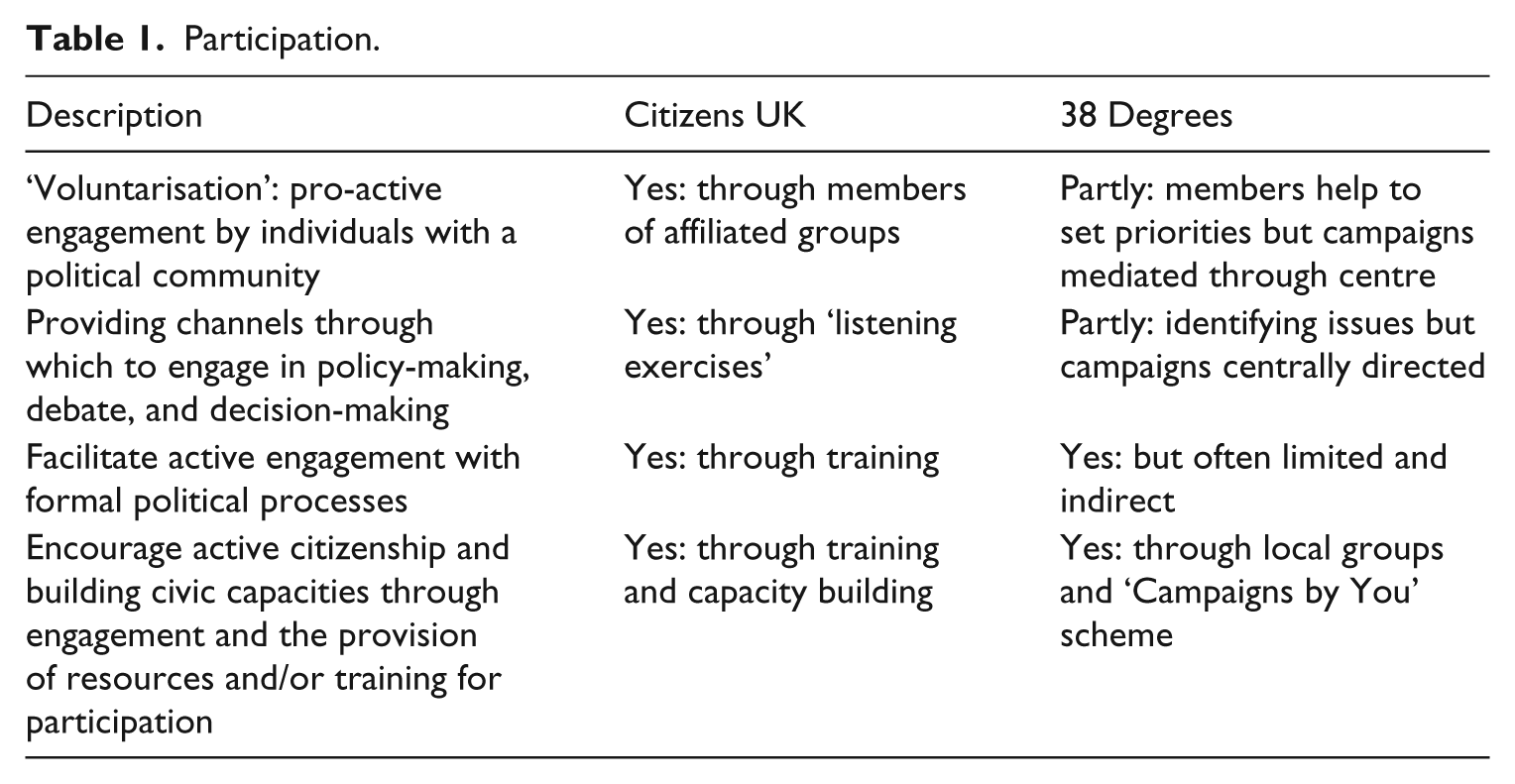
As Sartori argues, ‘real’ participation is not simply concerned with activating the predispositions of a passive electorate. It refers to the shaping of active, engaged political citizens – a ‘practising electorate’ – in which a willing agent becomes ‘an attentive and interested member of the political community’, what he calls ‘voluntarisation’ (Sartori, 2005: 23). As Table 1 indicates, the four elements of participation are in the main fulfilled by our two organisations, but the centralised campaign structures of 38 Degrees may inhibit some of them.
Participation.
Citizens UK
Citizens UK aims ‘to get people more active in public life on issues that they care about’ (Citizens UK, 2016d). That is, it seeks to nurture engaged citizens, working through existing local networks to identify and build support for campaigns originating in local communities, which correlates closely with each element outlined in Table 1. In addition to ‘voluntarisation’, Citizens UK provides channels through which communities can engage in debate, influence decision-making, and push for policy change on issues that affect them. Operating mainly through existing community organisations, like churches, mosques, and trade unions, participants act as agents for identifying local community concerns which are then translated into priorities for action. For example, ‘listening exercises’ conducted by Leeds Citizens – including ‘one-to-one conversations, group meetings and community activities’ (Leeds for Change, 2015) – were used to inform priority setting at a delegates assembly (Moortown Baptist Church, 2014; Yorkshire Evening Post, 2015). Following these activities, Citizens UK organises community assemblies that allow organisational representatives to meet, question, and lobby politicians, businessmen, and public officials with a view to pressing for desired change (London Citizens, 2016). Such activities bring citizens into contact with decision makers and political processes, addressing the third element. Finally, Citizens UK advances an ethos of deliberation and representation centred on building and developing civic capacities in community networks and organisations. Vital to this is training participants in lobbying, community organising techniques and leadership (Baskerville and Stears, 2010: 65).
38 Degrees
The first element, voluntarisation, is partially satisfied. Membership participation in 38 Degrees, while not passive, is coordinated by and mediated through the central organisation. Professional campaigners identify priorities (often based on members’ suggestions), usually on the basis of likely salience for traditional, mass news-based media (Chadwick and Dennis, 2016: 6). Membership endorsement is sought for those decisions through online surveys and polls, as was the case with TTIP (38 Degrees, 2014e). This provides legitimacy for the organisation’s campaign choices, as well as indicating likely levels of participation and hence the campaign’s viability.
Similarly, the second element is partially satisfied. The structure and management of the organisation’s main activities encourages members to participate in ‘simple, powerful actions’ such as signing a petition or emailing a Member of Parliament (MP) (38 Degrees, 2016) rather than political debate or direct decision-making. These actions provide legitimation, strength, and ‘resonance’ to the centrally driven media-oriented campaign strategy (Chadwick and Dennis, 2016: 8). Citizens’ individual actions are therefore pivotal to the organisation’s capacity to exert influence over formal political processes, the third element. However, ‘off-line’ collective activities, such as organising or participating in ‘Days of Action’, are also encouraged and supported with advice and resources (like pre-printed leaflets). As part of the TTIP campaign, a number of local groups organised their own days of action (38 Degrees, 2015a), and over 400 groups participated in a national equivalent (38 Degrees, 2015c). Another key element of this campaign was to encourage local groups to contact MPs and Members of the European Parliament (MEPs) directly, and in many cases, to meet with them to share their concerns (38 Degrees, 2014a), thus supporting an element of direct engagement with decision makers.
The organisation’s capacity to promote the fourth element of participation, building capacity, is therefore quite significant in some respects, depending on the level and type of activity that members engage in. The relatively undemanding nature of much online activism means that the involvement of many members may be sporadic and relatively shallow (Lewis et al., 2014). However, a more active citizenship is evident at the level of local groups, who are encouraged to develop and share their own initiatives around national campaigns – the Cambridge group, for instance, produced a ‘party neutral’ election leaflet in 2015, summarising candidate positions on issues including TTIP (38 Degrees, 2015b). In combination, these two levels of activity can be very effective: the mass-scale low-intensity ‘clicktivism’ providing a supportive ‘air war’ to the high-intensity ‘ground war’ of localised campaigning.
The organisation’s ‘Campaigns by You’ initiative adds a greater level of pro-activity to this by providing technical support and resources to locally initiated campaigns (often focused on specific issues of concern to local communities including traffic and local transport issues, local services, and the like). As such, it supports all four elements of participation, but on a localised and more limited level.
While both organisations provide channels for active political participation and provide a means by which citizens can initiate their own campaigns and address their own priorities, they differ somewhat in how they do so. Citizens UK’s focus is on shaping active participatory communities through existing local voluntary networks and as such is engaged in a process of training and capacity building. 38 Degrees seeks to activate and link virtual communities of interest together around member-initiated campaigns, providing the platform and the resources through which such campaigns can be effective. This necessarily requires more central organisation and direction, although there is also some scope for local groups to develop their own initiatives. Thus, they both contribute in important ways to support this function, but Citizens UK in particular provides the basis for a more permanent community of active citizens.
Integration
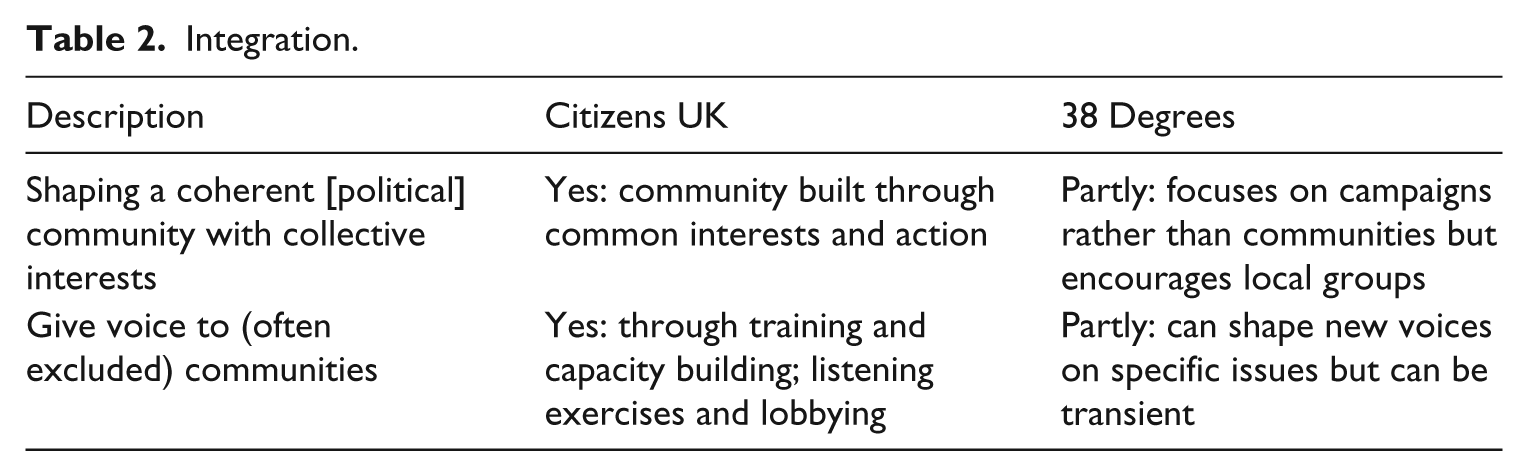
Integration is concerned with the shaping of coherent political communities with clear interests that can be communicated. There are two relevant aspects distilled from Sartori’s outline that these organisations address in important ways, although integration and cohesion – a central part of community organising – are more of a challenge for digitally oriented organisations like 38 Degrees (Table 2).
Integration.
Citizens UK
Citizens UK explicitly advances integration, emphasising the practice of community organising which promotes ‘organising around relationships’ (Graf, 2015: 73) as key to building sustainable power and campaigning capacity in communities with identifiable collective interests. Citizens UK does this partly by building on existing community networks, engaging diverse communities on the basis of ‘mutual differentiation (Wills, 2009: 158). Citizens UK’s listening exercises, assemblies, and training programmes seek to build the capacity of these communities to engage with policy and decision-making processes themselves, providing a means by which their voices can be channelled into political campaigns. These might include ‘micro’ local issues like securing a zebra crossing and better lighting near a youth club in Merthyr Tydfil (Citizens UK, 2016c) or persuading a local Nando’s in Cardiff to provide Halal food (Citizens UK, 2015b), to ‘macro’ issues like refugee resettlement and the Living Wage campaign. The organisation itself stresses the importance of giving voice to excluded communities in particular by developing: the capacity and skills of the members of the socially and economically disadvantaged communities of Britain and Ireland in such a way that such members are better able to identify and meet their needs and participate more fully in society. (Citizens UK, 2016a, emphasis added)
In this way, it works proactively with groups from underrepresented backgrounds and areas, bringing ‘diverse communities together for powerful social action’ (North London Citizens, 2011), a point apparent from the body’s diverse membership. 1
38 Degrees
38 Degrees’ capacity to perform integrative functions is limited by the relatively issue-to-issue nature of participation. Rather than shaping, building, and sustaining coherent communities as such, 38 Degrees is more of a strategic organisation that articulates, directs, and manages the ‘personally defined’ issues of members. It thus focuses on creating coherent campaigns advancing specific interests or causes. In this way, it works like interest groups to capture ‘the intensity of interest of a fragmented public’ (Jordan and Maloney, 2007: 7). This suggests a deeper level of commitment than for some online campaigns, but means that the organisation only partially advances the first element, since ‘community’ is built around a finite campaign. Nonetheless, these initiatives may help facilitate more permanent political communities with the capacity to develop their own agendas and campaign priorities, as local groups like Cambridge demonstrate.
As for the second element, the fact that 38 Degrees’ campaign priorities are determined by the membership provides a mechanism for citizen voices to be heard. This is an important way in which (potentially) non-elite voices and issue priorities can be brought into the political debate. However, the relatively centralised approach to campaigns means that these voices are directed, mediated, and filtered to a degree. Furthermore, the extent to which the channel it provides is used by socially excluded and economically marginalised communities or addresses their priorities is less clear.
In this case, the different strategies each organisation pursues impacts on the performance of the integration function. Citizens UK’s geographically organised, community-based approach – centred on building long-term relationships and networks – seeks to align interests and develop shared goals, as well as getting them heard in the political process. There is potential therefore to shape relatively long-lasting relationships and ongoing grass-roots collaboration. 38 Degrees seeks to maximise impact through the short-term mobilisation of resources behind a specific campaign which is largely organised online. Integration, therefore, is a more temporary, issue-specific affair. However, such campaigns can provide a basis for ongoing face-to-face collaboration in local groups.
Aggregation
Whereas integration refers to the shaping of communities of interest, aggregation refers to the need for institutions to mediate between different priorities and interests, in order to ‘meld the separate interests of individual groups into broader, if not more universalistic, appeals’ (Gunther and Diamond, 2001: 8). Aggregation ‘reconciles diversity with harmony by coordinating the private interests with the general interest’ (Sartori, 2005: 24). Fundamental to this is a process of ‘brokering’ between different interests and priorities and shaping them into coherent, competing political programmes. This was an important way in which parties were seen to give voice to and provide a platform for identifiable social groups (Mair, 2013: 92) (Table 3).
Aggregation.
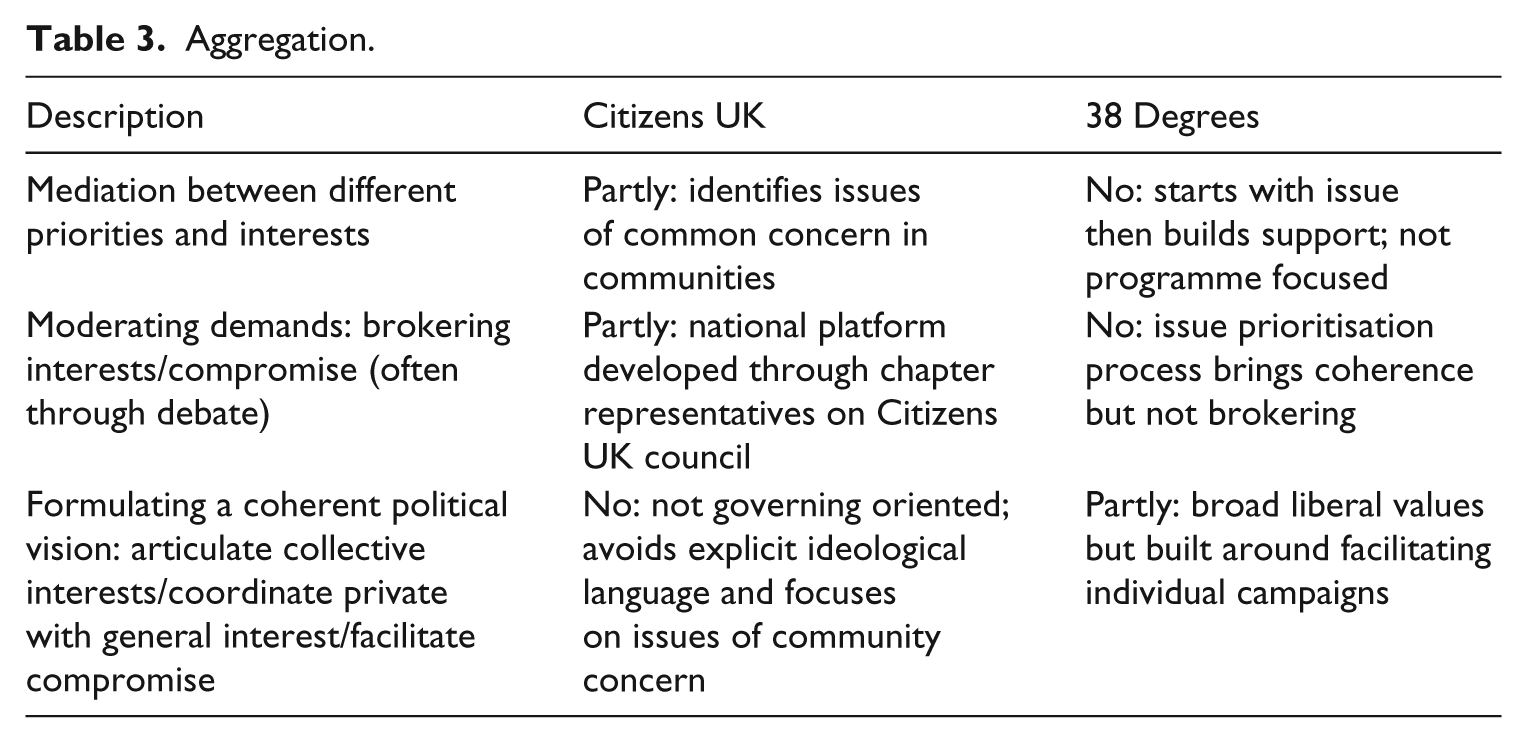
Neither Citizens UK nor 38 Degrees fully advance this function’s three elements, which is not surprising given that they are not parties seeking to govern. Nonetheless, these organisations do need to mediate demands, broker interests, and formulate agendas on some level, since they work with diverse groups and individuals to develop coherent campaigns.
Citizens UK
Citizens UK chapters identify their campaigning priorities via a process of mediation between often diverse local groups. This means that local priorities often differ. For example, Leeds Citizens focuses on poverty, public transport, and mental health, while North London Citizens focuses on Street Safety, Opportunities for Young People, Living Wage, and Care and Isolation. An element of prioritisation is required in setting objectives, but since Citizens UK does not seek to develop a coherent programme for government, it does not need to moderate demands in the same way as a party. Their focus is on ‘cross-community relationships, on voluntarism, tradition, and faith, rather than on partisan campaigning and state-centred action’ (Baskerville and Stears, 2010: 66), stimulating a different kind of representation. In making this observation, it is, however, important to note that brokering is not entirely absent. Indeed, in 2015, the organisation developed the Citizens UK Manifesto, outlining eight priorities that reflected the goals of its ‘member communities’ while seeking to increase national coordination (Citizens UK, 2015a). The process of developing this platform involved moderating and brokering, although on a far smaller scale than the party context.
Turning to the final element, while Citizens UK appears to take a relatively liberal position on important issues (e.g. the Living Wage campaign and Refugees Welcome), it has no official or published statement of values or political position as such. Indeed, attempting to do this might undermine the broad and often effective alliances organisations like Citizens UK and its chapters have been able to forge. London Citizens, for instance, have stressed the need to ‘put aside ideology or theology or whatever else drives you’ in order to build ‘a coalition broad and strong enough to secure real social and political change’ (Baskerville and Stears, 2010: 67) and it is arguably this which has contributed to their success. The organisation thus does not need to resolve conflicting views into a coherent agenda and, moreover, might actually be damaged by the attempt to do so.
38 Degrees
While 38 Degrees organises individual voices, provides structure, and activates latent ties, its focus on individual issues means that there is little impetus to expend effort on mediating between different priorities. This is not a failure on the part of the organisation, since there is no reason why it should do so. Members who do not support a particular campaign can simply sit it out. For instance, according to the organisation themselves over 180,000 members took part in polls shaping the TTIP campaign, more than 700,000 signed the petition, while 50,000 contributed to the EU consultation. These are substantial numbers, but 38 Degrees claims two and a half million members, which means that there were many who did not participate at all.
For similar reasons, there is little need to moderate demands or broker interests through debate or other means. The nearest the organisation comes to this would be in the sifting and prioritisation of membership-identified issues by the organisation’s central staff. While it thus provides structure to ‘the inchoate, individualised and often affective responses of members to matters of public concern’ (Chadwick and Dennis, 2016: 13), this is not directed to the production of a coherent programme that meets overall interests, but to identifying the most effective campaign priorities.
As regards ‘vision’, 38 Degrees professes broadly liberal social ‘values’ based on ‘fairness’, ‘rights’, ‘peace’, ‘conservation’ and ‘democracy’ (38 Degrees, 2016), and campaign suggestions put to the membership, tend to focus on issues like welfare, poverty, public services, and economic justice. These are often expressed in emotive language, such as ‘stopping the government’s dangerous plans’ for the National Health Service, or suggesting TTIP ‘threatens our public services with permanent privatisation’ (38 Degrees, 2015e). Ultimately, however, it is built around facilitating individual campaigns rather than a coherent political vision or programme and at best only partially fulfills this third element of the aggregation function.
In our analysis, we begin to see something of what may be lost when organisations not oriented towards governing become primary vehicles for fulfilling representative functions. The process of managing competing demands, while not entirely unnecessary, is simply less of a concern for organisations that are not political parties seeking to govern by building broad coalitions of electoral support. As participation shifts from parties to these kinds of organisation, the management of competing demands and the process of reconciling different priorities diminishes as an aspect of citizens’ engagement with politics. This is problematic because failing to educate citizens in the necessity for compromise and the balancing of competing demands may give rise to unrealistic expectations about what politics can achieve and thus disappointment and disillusion when it fails to do so (Flinders, 2012).
Conflict management
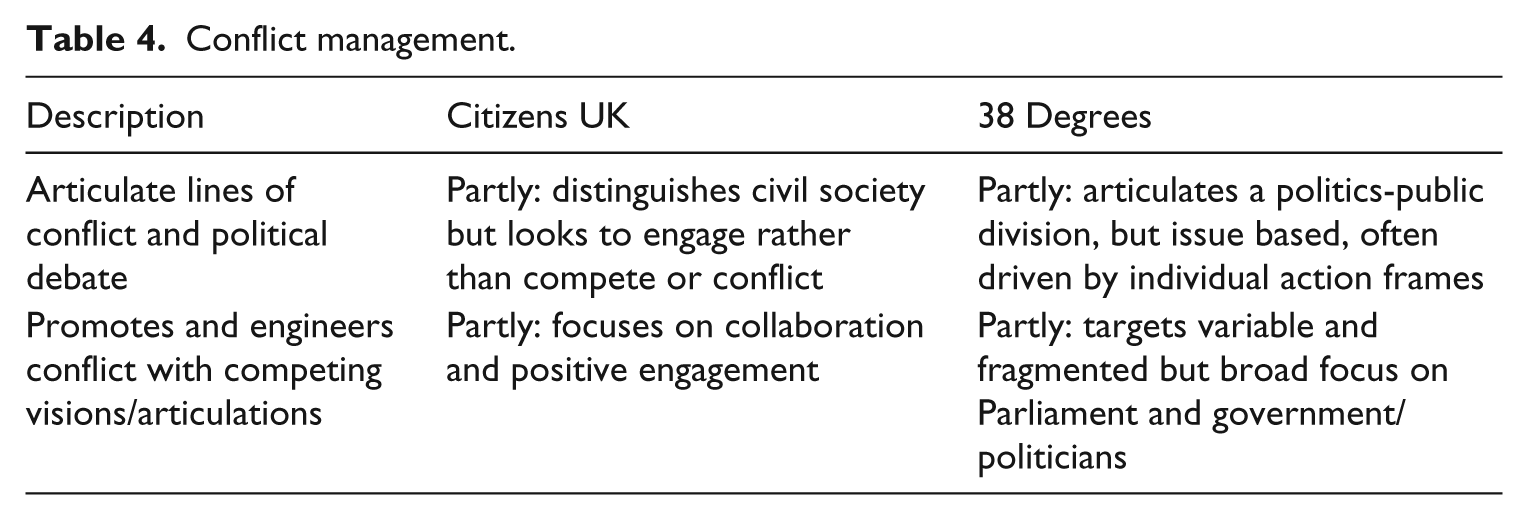
Conflict management ‘highlights the very essence of competitive politics’ (Sartori, 2005: 24) and captures something distinctive about parties and the role they play in democracies. It includes two overlapping elements: first, closely linked to the integrative and aggregative functions, the management and resolution of conflict and second, the active engineering of conflict by promoting specific visions of society and distinctive policy agendas in competition with other parties in the struggle for power. This is a role, our analysis suggests, that our two example organisations fulfil in only a partial way (Table 4).
Conflict management.
Citizens UK
While Citizens UK seeks to cohere a community of interest, it is not strictly for the purpose of engaging in political conflict as political parties do in the struggle for power. Citizens UK seeks to distinguish civil society as a distinct realm from the state and the market. It focuses on using and developing community organising techniques to build strength and capacity in civil society, not because it identifies these others as an enemy to be defeated, but because it seeks to provide a counterweight, to ‘ensure that civil society is at the negotiating table alongside the market and state, so that our communities are included in the decisions that affect them’ (Citizens UK, 2016a). This is consistent with the way community organising seeks to complement, rather than replace, existing power structures. It ‘constructively negotiates with power to define and accomplish shared goals’ (Durose et al., 2013). Thus, it is more about seeking to create local power in order to share it, to develop consensus and engage in ‘co-production’ of policy and services in local communities. It seeks to engage positively with decision makers and powerful market players (e.g. businesses and industries) rather than articulate permanent lines of conflict. The Living Wage Foundation (an initiative of Citizens’ UK which co-ordinates the Living Wage campaign), for instance, ‘provides advice and support to employers’ (Citizens UK, 2016b) as much as Citizens UK seeks to pressure them. This approach in turn relates to the second element of this function since, although it certainly does not avoid conflict altogether, it means the organisation is focused on achieving collaboration and positive engagement and is less oriented towards engineering conflict.
38 Degrees
While 38 Degrees coheres communities around specific issues, it does not necessarily articulate a wider political vision. David Babbs, the organisation’s Chief Executive, says ‘there is no rigid agenda’ except to be ‘an organisation seeking to hold the government to account’ and press them to ‘involve more different voices in their deliberation’. This is made possible by the use of technology which enables people ‘to interact with Parliament in a way that hasn’t been possible before’ (Allen, 2012).
This points to a different kind of divide which is articulated in the organisation’s campaigning materials and publications. A consistent narrative appears to be that politicians, while having the power to effect change, cannot quite be trusted to do so in the interests of ‘ordinary people’ without the kind of scrutiny and pressure that 38 Degrees provides. A petition, for instance, was designed to show the Secretary of State, Vince Cable ‘that we’re watching him closely’ (38 Degrees, 2014f); sending e-mails and letters is a way of ‘piling the pressure’ on MEPs, who can be persuaded to reject TTIP ‘if we can make it politically poisonous’ (38 Degrees, 2014b, emphasis added).
This engineers a sense of conflict, then, not between competing ideological visions or articulations of socio-economic interests but between politicians and the public. However, paradoxically, the purpose of this is to stimulate cooperation. Rather than overturn it, 38 Degrees seeks, through campaigning, to scrutinise and steer political power to the benefit of its campaign goals. The underlying approach to politicians may be characterised as a kind of ‘engaged scepticism’, which, while wary, is more collaborative than explicitly conflictual.
Campaigns are not exclusively directed towards national government, however. Browsing through the list of over 9000 live campaigns on the organisation’s website, local government, employers, zoos, police services, shops, and transport companies among others are all targeted (38 Degrees, 2016a). Conflict is therefore often episodic, fragmented, and focused on specific goals, which may reflect more contemporary engagement norms in a highly individualised (digital) culture (Jensen and Bang, 2013).
Conflict is at the centre of any kind of campaigning, and the activities of Citizens UK and 38 Degrees reflect that. However, the role that conflict plays differs in these organisations both from Sartori’s description and from each other. For Citizens UK, the importance of ‘conflict’ is to distinguish and articulate specific interests to push for change, often through face-to-face confrontation. 38 Degrees take a different approach, using campaigning methods like petitions, e-mails, and letters, targeted mostly – but not always – at government or parliamentarians to build pressure for change, but this conflict is fragmented and often indirect. In both cases, however, confrontation is not built around a coherent conflicting vision of society, but rather is focused on specific issues.
Expression/linkage
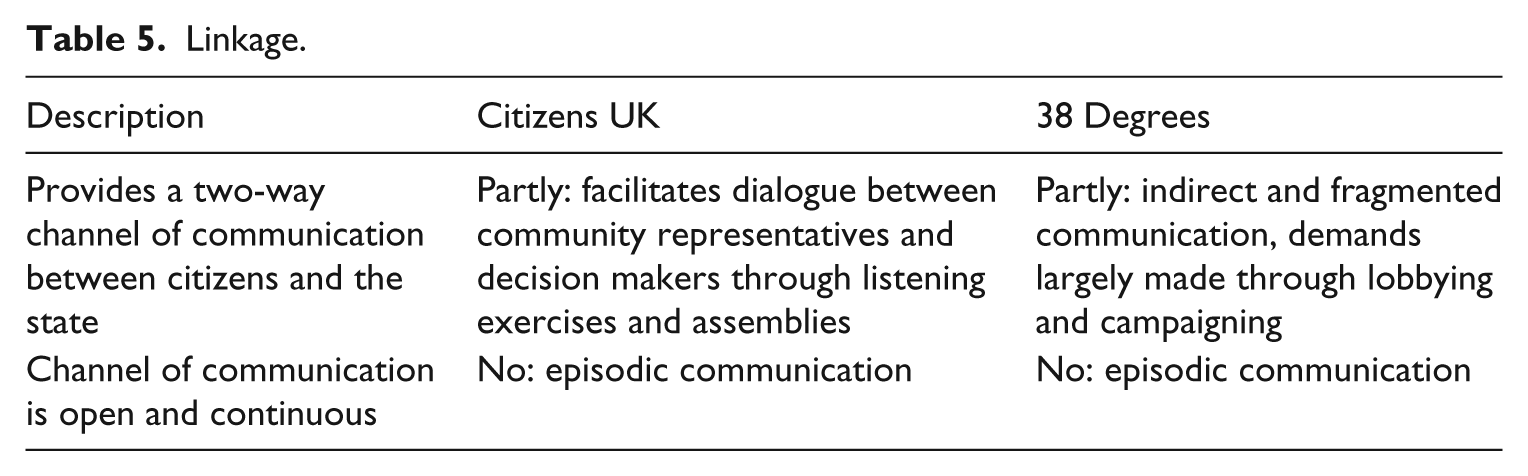
A representative democracy requires that citizens are in some sense ‘present’ in government decision-making (Pitkin, 1967) and parties are a key channel through which the voice of citizens can be heard. In Sartori’s scheme, the ‘expressive function’ of parties refers to the ‘ascending flow’ of political communication by which societal demands are communicated to the state. As such, parties provide ‘the basic link or connector between a society and its government’ (Sartori, 2005: 24). This is sometimes referred to as ‘linkage’ (Dalton et al., 2011), a term which captures something closer to an organic relationship in which the voice of the people is heard in government and government’s voice is transmitted to the people. It is a function elemental to all the others outlined in this article and in which they all meet. Without some means of linkage, participation has less purpose and prospect of outcome, an integrated political community may struggle to find legitimate ways of engaging with decision makers, aggregated demands may find scarce avenues for expression and conflict lacks direction. As Table 5 demonstrates, linkage is manifest in two distinctive elements, neither of which are fully enacted within our cases.
Linkage.
Citizens UK
Citizens UK is designed less to represent the interests of citizens than to build their capacity to represent themselves, providing infrastructure and training to support this. However, the organisation does play an active role in identifying and communicating community concerns through the processes of issue and priority identification and via assemblies. By such means, communities can directly engage with decision makers. However, this is not a continuous process. Citizens UK does not, of course, have a permanent presence in a formal political arena like Parliament (since it does not seek to govern). Instead (and similar to other lobby groups), it facilitates relationships with representatives, government (at various levels), and its agencies, which vary according to issue, finance, and organisation. This means that its interactions with those in power are episodic rather than continuous and usually defined by a specific campaign goal. Moreover, the state, the government, or formal political arenas are not the only target of Citizens UK’s campaigns. Depending on the subject, other types of institution may be targeted, including businesses, employers (in the Living Wage campaign), and universities (in the call to provide university places for refugees). Thus, although in specific instances an organisation like Citizens UK can support the communication of citizen demands to the state, often directly, it is not continuous or comprehensive, but intermittent and issue by issue.
38 Degrees
Through lobbying techniques like petitions and crowdfunding (to pay for research, reports, and legal support), 38 Degrees provides a channel for collective voices on specific issues, albeit a mediated one. However, it also facilitates direct contact between the public and decision makers themselves through correspondence and face-to-face meetings. Furthermore, its national representatives sometimes represent the membership in key arenas of decision-making or scrutiny. For instance, David Babbs, the chief executive, was questioned by the Business Select Committee on the concerns raised by the TTIP campaign and members were polled on ‘what he should say’ to MPs (38 Degrees, 2014d). However, the continuous communication that characterises linkage is associated with an ongoing presence in the formal political system (a parliamentary party, for instance), which a lobbying organisation like 38 Degrees clearly does not have. The ‘communication’ that takes place is episodic, largely indirect, and media centred. Moreover, campaigns may be targeted at a variety of actors in other spheres as well as government.
38 Degrees’ approach consists of putting pressure on decision makers in the manner of an ‘outsider’ lobby group (Grant, 2008), consistent with its ‘engaged scepticism’. Communication with members is a crucial element of 38 Degrees’ mobilisation strategy and updates tend to be positive and combative, providing a sense of momentum and achievement on the campaign and encouragement to continue the fight (see, for example, 38 Degrees, 2014c, 2015d). While evidently a key attraction for members, how effective it is at actually ‘making them present’ in the decision-making process is questionable. At best, it provides a temporary collective identity based on a particular campaign, but whether voices are heard or not depends on levels of media attention and success in penetrating the decision-making process from outside, rather than because those voices are permanently represented in the system.
The capacity of both organisations to communicate with government and key parts of the state makes them without doubt important vehicles for political participation and expression. However, central to the idea of ‘linkage’ is the continuous nature of that communication. Because they do not have a permanent presence in the political system, neither of these organisations can fully perform this role. To different degrees they display elements of this function, but it is intermittent or temporary, and channels of communication and expression are relatively narrow.
Discussion and conclusion
In response to analysts such as Mair (2013) who have argued that parties have increasingly abandoned their representative functions, we have sought to examine the extent to which ‘new’ organisations have taken them on. Our analysis indicates that two such organisations – Citizens UK and 38 Degrees – are providing avenues and platforms for political participation and, to some degree, integration. Citizens UK and 38 Degrees both enable citizens to engage in political action on issues of concern to them and provide frameworks to help them realise it. Citizens UK’s approach is consciously collective and community-oriented in character, based around building relationships in geographical communities and identifying areas of common interest, building coalitions within and across those communities. 38 Degrees’ approach is more individualised and dispersed, seeking to build coalitions of interested individuals around particular campaigns often in virtual communities, although local groups also play an important role. Despite these different approaches, both serve as means of engaging members of the public in the political process, in policy-making and issues of concern to them and their communities.
However, as crucial as these vehicles for participation are, they are not in themselves enough to secure a functioning representative democratic system. The remaining three functions – aggregation, conflict resolution, and expression/linkage – are important too, and although not completely neglected, they are roles to which these organisations are less well suited. Such organisations are less concerned with mediating and moderating between competing demands to produce coherent political programmes. Campaigns are therefore often episodic and fragmented. While Citizens UK, because of its community-oriented approach, goes some way to satisfying elements of the aggregative function, its consensual approach means that many areas of potential disagreement within communities are avoided, with a focus on relatively specific issues on which a consensus can be forged. Fragmentation, however, is particularly accentuated in 38 Degrees’ issue-by-issue approach which, despite a statement of values and broadly common themes in its headline campaigns, does not seek to develop a coherent programme. The performance of conflict management functions is also incomplete: while Citizens UK seeks to articulate the interests of civil society and distinguish the latter from the political realm, it seeks to engage and collaborate with political representatives and officials in a relatively consensual way. 38 Degrees is more obviously confrontational in its ‘outsider’ approach, and usually (but not exclusively) targets parliament and decision makers, articulating a division between them and ordinary citizens. However, its issue-by-issue approach means that in terms of the vision they articulate and the voices they represent, the lines of conflict shift from campaign to campaign. Finally, although both provide means of communicating the demands of citizens, neither maintain that continuous linkage which ensures an ongoing dialogue between the state and citizens.
What we have sought to demonstrate here is that by focusing on the performance of representative functions that Sartori attributed to parties, we can reflect on the manner in which representation is being advanced by new kinds of organisation. On the basis of this analysis, the effects of the retreat of parties are not fully compensated for by the emergence of organisations like Citizens UK and 38 Degrees. Key representative functions that help to secure a stable, consensual democratic society are neglected or at best weakly and partially performed.
One question that merits some brief discussion, however, is whether parties themselves can learn anything from these organisations that might compensate for their own representative inadequacies. A key lesson surely lies in organisation. Traditionally, the British Labour and Conservative Parties were linked to civil society through affiliated organisations – trade unions and socialist societies in the former’s case and Conservative Associations in the latter’s. The story of modern parties has been one of centralisation and the weakening of such ties. If modern parties are serious about reconnecting with citizens, they need to find ways of refreshing their organisation in ways that are more reflective of contemporary social norms and that might reconnect with civil society.
Parties might seek to emulate different models for political organisation that Citizens UK and 38 Degrees represent by, for example, drawing on community organising techniques to work within existing community networks and help build sustainable communities of interest for which the party can speak. In the Labour Party, David Miliband’s Movement for Change and reforms to the party under Ed Miliband’s leadership emphasised this kind of approach in the early 2010s. Alternatively, parties could adopt more porous organisational structures, seeking to work alongside cognate bodies to pursue a common aim. Again within the Labour Party, the emergence of Momentum as a separate and yet aligned organisation has helped to revitalise party membership and activism, connecting the party to new audiences and ideas. Yet less partisan affiliations could also be pursued, with parties seeking to form relationships or looser kinds of association via forums and assemblies. As examples like Podemos in Spain, the UK Independence Party (UKIP) between 2013 and 2015, or the Labour Party since then indicate, there may be an appetite still for citizens to express themselves politically through parties that they feel to be more in tune with their outlook. The advent of such an approach would draw on the participatory strengths of grass-roots organisations and facilitate linkage by working with those outside the party to aggregate ideas (brokering compromise and formulating a vision), articulate a programme, and engineer constructive conflict. This could have the advantage of playing on the key strengths of parties and civil society organisations, helping to overcome the narratives of decline outlined at the beginning of this article. However, while some parties (notably Labour) appear to show an interest in such strategies, there seems little uptake of these ideas across the party spectrum.
The willingness of parties to embrace such reforms therefore appears limited, but our findings also have implications for campaigning organisations themselves. In arguing that certain functions are being neglected by these bodies, we raise new questions that should underpin future research. In thinking about the implications of this work scholars therefore need to ask: Is it possible for organisations such as Citizens UK or 38 Degrees to adapt their current practices to take up these functions? Can processes for conflict resolution or prioritisation be integrated into their current practices? Should we look to other organisations or perhaps formal political institutions to fulfil these roles instead? Do alternative and deliberative democratic methods like participatory budgeting, citizens juries, and assemblies, for instance, have a role to play? These questions suggest that before administering a cure for the travails of contemporary democracy, a correct diagnosis of what is wrong and reflection on who should respond is needed. We hope that this discussion may have gone some way towards addressing this.
Footnotes
Acknowledgements
The authors would like to thank Professor Alan Ware and Dr Holly Ryan for their comments on an earlier draft of this piece. They also wish to recognise the insightful comments of their reviewers in helping to refine this piece.
Funding
The author(s) disclosed receipt of the following financial support for the research, authorship, and/or publication of this article: This study is supported by ESRC Grant ES/N01667X/1.