



Abstract
This article explores the methodological dimension of Gilbert Simondon’s technical thought, focusing on the ‘genetic method’ he introduced to analyse the evolution of technical objects. While holding significant promise, this approach has been largely underutilized, a fact that can be attributed to its perceived tensions with dominant social constructivist perspectives and even with his own theory of individuation. To address these tensions, this article situates Simondon’s method within a broader intellectual context and weaves together his theory of evolution and invention with insights from George Kubler and Alfred Gell on the succession of artifacts, thereby developing an ‘ecology of time’. This framework, characterized by both its operational viability for empirical inquiry and its fidelity to Simondon’s original project, holds the potential to render his profound insights more accessible to a wider scholarly audience and to catalyse new reverberations between his technical thought and our contemporary technical realities.
An object is also that which, in history, can be lost, abandoned, and rediscovered. In short, that which has a certain autonomy and an individual destiny. (Simondon, 2014: 400)
Introduction
The past decade has witnessed a renewed interest in the work of Gilbert Simondon, not only as a philosopher of technology but also, in his own words, as a ‘psychologist or sociologist of machines’ (Simondon, 2017: 132), with a distinctive approach to empirical research. Scholars have increasingly drawn on Simondon’s methodological framework, either to analyse contemporary technical objects through it (e.g. Aires, 2025; Ash, 2017; Hui, 2016) or, more directly, to examine and develop it (e.g. Iliadis, 2015; Omena, 2021). Yet despite the remarkable explanatory power and analytical granularity Simondon demonstrated in works like On the Mode of Existence of Technical Objects and Imagination and Invention – a level that remains impressive, perhaps even unmatched, today – his distinctive approach, which depends on ‘both engagement with tangible objects and the diagrammatic illustration of how machines work’ (Simondon, 2009: 104–5), has yet to be recognized as part of the standard methodological toolkit in contemporary technology studies.
This article aims to explore the possibility of thinking as Simondon rather than merely thinking through him. More specifically, it asks whether the analytical approach Simondon applied to his case studies of car engines, early telephones, bulb turbines and vacuum tubes can be productively deployed in contemporary empirical research and in dialogue with other methods. Indeed, many aspects of Simondon’s thought anticipated cutting-edge approaches to studying artifacts (e.g. Geels, 2005; Malafouris, 2013) while being increasingly recognized for its methodological strengths (Ferrarato, 2020; Fisch, 2018; Rieder, 2020). Yet from a social constructivist perspective, which has become influential in technology studies in recent decades, his methods risk appearing as ‘old-fashioned deterministic philosophy of technology’ (Feenberg, 2017: 74), creating barriers to wider adoption. Rather than viewing these tensions as stable obstacles, this article recognizes them as catalysts for a symbiotic relationship between Simondon’s thought and contemporary empirical enquiry, creating a system of reverberations in which both can co-evolve.
The article proceeds in three parts. The first part revisits Simondon’s genetic method and its key concepts to demonstrate their explanatory power and analytical granularity, while also addressing the major criticisms levelled against the method, particularly its alleged neglect of social factors in the evolution of technical objects. The second part situates Simondon’s method within a broader ‘phylogenetic’ episteme to diagnose its internal tensions. It argues that while Simondon’s theories of individuation and transduction indeed offer a resolution, this solution is primarily applicable to living beings and struggles to account for technical objects. The third part returns to Simondon’s concepts of invention and the transindividual, positing that they provide a robust response to his critics but require an operational dimension. Through dialogue with the work of George Kubler and Alfred Gell, the article develops this dimension in the form of an ‘ecology of time’, which is not a radical overhaul, but a re-actualization of the unexhausted methodological virtuality within Simondon’s own work.
The Evolution of Machines
In a footnote at the beginning of On the Mode of Existence of Technical Objects, Simondon (2017: 25–6) contrasts two approaches to studying technical objects. The first, which he terms the ‘static specificity’ method, categorizes technical objects by their uses, functions, or structures. However, this approach proves inadequate since different structures can serve similar functions (steam, gasoline, and spring engines), while similar structures can perform entirely different functions (pendulums versus winches, or electric clocks versus door bells). This method thus fails to capture the constantly evolving individuality and specificity of technical objects. The second approach, which Simondon calls the ‘genetic method’, understands the individuality of technical objects through their genesis rather than their current, unstable characteristics. A technical object, in this view, is ‘not . . . this or that thing, given hic et nunc, but that of which there is genesis’ (Simondon, 2017: 26), that is, a being undergoing its own growth, as well as a node in a continuously evolving lineage.
The point of using a genetic method is precisely to avoid using classification as a way of thinking that occurs after genesis only to distribute the totality of objects into genera and species suitable for discourse. The technical being retains the essence of its past evolution in the form of its technicity. According to the approach we shall call analectic, the technical being, as bearer of this technicity, can be the object of adequate knowledge only if the latter grasps the temporal sense of its evolution. (Simondon, 2017: 26)
When Simondon invokes concepts like lineage and evolution, he does not mean a linear succession of ancestors and descendants. Rather, he posits a more substantial order of priority and posteriority, one that can only be established through an ‘internal examination of the regimes of causality and forms’, based on the object’s degree of concretization (Simondon, 2017: 26). The concept of concretization, standing at the heart of Simondon’s empirical analysis, describes the process by which a technical object’s internal coherence increases. This manifests as an enhanced synergy, or ‘internal resonance’, among its structures (2005: 85). In a more concrete object, its parts ‘hold together’ more organically (2014: 432), with fewer structures conflicting with themselves or producing negative effects. Moreover, this process entails a greater functional integration: a single structure might fulfill multiple synergetic functions, different structures may combine to perform one (2017: 37–8), and the object as a whole might give rise to ‘novel properties, complementary functions that were not sought after’ (2023: 170–1).
To illustrate the genetic method and concretization in practice, Simondon (2017: 29–48) offers a detailed analysis of the vacuum tube’s evolution. The diode, as ancestor to later tubes, enables unidirectional current flow but cannot regulate it independently of anode voltage. A major leap occurred with the triode, which, by introducing a control grid that operates in synergy with the cathode and anode, resolves this limitation while also achieving the novel function of signal amplification. Yet the triode itself harbours an internal contradiction: its anode must perform two functions with incompatible voltage requirements. The tetrode attempts to resolve this by introducing a screen grid to handle field creation, but this produces a new problem of secondary emission. As Simondon notes, the tetrode is thus ‘no more concrete than a triode’ (2017: 35). A higher degree of concretization arrives only with the pentode, which adds yet another grid to resolve the contradictions inherited from both predecessors, redistributing functions into highly synergetic subsystems with no internal conflicts.
The vacuum tube, like other case studies in Simondon’s works, reveals a great strength of his genetic method: its capacity for empirical analysis that is at once far-reaching and forensically detailed. Indeed, the very granularity of his analysis often surpasses that of many works in science and technology studies, allowing researchers to ‘approach some of the most complex techniques . . . from a humanistic perspective with regard to their technicity 1 . . . [as] their specific operational and epistemological character merit attention in their own right’ (Rieder, 2020: 54). However, many scholars find this method of analysing the evolution of technical objects through their degree of concretization to be ‘incomplete’, arguing that it portrays an evolution driven by forces that ‘reside exclusively in the technical object’s internal imperfections’ (Hughes, 2014) and is ultimately ‘governed by its own internal, necessary logic responding to purely technical problems’ (Voss, 2019: 288), thereby neglecting how technical objects are deeply entangled with their broader natural, social, political, and economic milieu.
A first response to such critiques of technological ‘purism’ can be found in Simondon’s analysis of the Guimbal turbine, a case where concretization involves a ‘relational adaptation’ between the technical object and its milieu (Simondon, 2017: 57). Unlike a conventional generator requiring a separate cooling module, the Guimbal turbine, as a type of bulb turbine, is a self-contained unit, with its turbine and generator encapsulated in a crankcase of pressurized oil and submerged directly within the penstock. The ingenuity of this design lies in its creative integration of the external elements from the milieu into the object’s internal causality, thereby endowing these elements with pluri-functionality, as if they were always internal to the object or, conversely, as if the object itself were always part of the milieu. The water flow, for instance, serves not only as the energy source driving the turbine but also as its natural coolant. Similarly, the pressurized oil acts simultaneously as a lubricant, insulator, coolant, and waterproof barrier (Simondon, 2017: 57–8).
While the concretization of the Guimbal turbine certainly involves an increase in internal synergy, its most salient feature, as Simondon (2017: 59) points out, is the ‘recurrent causality’ it establishes between the technical object and its milieu: on the one hand, the turbine’s operation depends on the pluri-functionality of the water and oil; on the other hand, it is precisely the turbine’s operation that constitutes the very techno-geographic milieu upon which it depends, namely, the oil and water in turbulence. A technical object like the Guimbal turbine is therefore self-conditioned; the milieu it requires ‘only exists virtually before the invention’. One cannot claim it simply adapted to a pre-existing environment. Rather, it is through the very process of ‘adaptation-concretization’ that the turbine brings into being its own ‘associated milieu’, thereby making its own existence possible (2017: 57–8). In other words, to paraphrase Simondon (2014: 431–2), for the Guimbal turbine, it was necessary to suppose it existed for it to be existable.
Concretization is here conditioned by an invention that presupposes the problem to be resolved; indeed it is due to the new conditions created by concretization that this concretization is possible. . . . The technical object is thus its own condition, as a condition of existence of this mixed milieu which is simultaneously both technical and geographical . . . it creates its own associated milieu from itself and is really individualized in it. (2017: 59)
The concept of the associated milieu demonstrates that the analysis of concretization can extend beyond the object’s internal dynamics to encompass its co-becoming with the external environment. However, the idea of the associated milieu, as exemplified by the Guimbal turbine, represents a rare case of perfect synergy between concretization and adaptation. In contrast, far more common is the state of hypertely, which signifies an unresolved tension between the technical object and its milieu (2017: 53–5), and can manifest in several ways. On the one hand, an object might become over-adapted to a specific environment, thereby sacrificing its versatility; an aircraft designed for high altitudes, for example, may struggle with takeoff at lower ones. On the other hand, the process of concretization ‘can go so far that . . . adaptations are thereby broken’ (2005: 252–3). The ramjet engine, for instance, is technically and scientifically perfect but incapable of getting an aircraft off the ground, since its efficiency only becomes valuable at near-sonic speeds, making it useful only for cruising.
The emergence of an associated milieu can thus be seen as a limit-state, an ideal scenario with a normative undertone. In more empirical cases, what Simondon (2005: 229–30) finds is a dynamic balance between ‘auto-correlation’ – another term for concretization – and adaptation. As ‘two essential aspects of invention . . . that call for the other’, they ‘constitute, in a way, halves of an invention in waiting; the complete invention is the product of their coherent assembly’. Therefore, alongside concretization, environmental adaptation is also a crucial component of Simondon’s genetic method. And while his focus is often techno-geographical, his own definition of adaptation is remarkably open, encompassing all scenarios that allow the invention ‘to be inserted into the milieu’ (2005: 229), by no means precluding the possibility of a social milieu. Indeed, Simondon himself substantiated this point by conducting just such an analysis, taking social, cultural, and economic factors into account when examining the evolution of the engine (2005: 310–16).
Nevertheless, even accounting for sentences like ‘invention intervenes when the social filter allows it to pass through’ (2005: 312), it is difficult to sustain the argument, advanced by thinkers like Feenberg (2002: 186–8), that concretization can be seen as a quest for synergy, not just within a technical object but among diverse technical, social, cultural, and political systems. The difficulty is not theoretical but methodological. It is not that one cannot conceive of a more social associated milieu; it is that one can hardly analyse the circular causality within such a milieu with the same granularity Simondon achieved in his own empirical cases. This methodological difficulty stems, in part, from how concretization is conceived as a process that pushes an artificial object to become ‘increasingly similar to a natural object’ (2014: 432, 2017: 50–1), with living beings as its conceptual limit. The analysis of concretization accordingly draws on a structural analogy 2 to the morphogenetic analysis in biology, in which morphological aspects are given far greater weight than social ones.
Beyond these practical difficulties, integrating social factors more systematically into the genetic method would also create tensions with certain theoretical commitments in Simondon’s work. In Imagination and Invention, Simondon reformulates concretization and adaptation as ‘internal compatibility’ and ‘external compatibility’ respectively, a pairing that makes their tension more explicit. While he acknowledges social needs and cultural trends as factors in external compatibility (2023: 176–7), he establishes a clear hierarchical relationship, in which the ‘enhancement of its level of internal compatibility produces an external adaptability’, but not the reverse. This hierarchy is mirrored in a three-layer structure of ‘internal-intermediate-external’ that appears for the first time in his works. 3 Here, the external layer, serving as supplementary means of display, and the intermediate layer, which expresses internal functions while mediating between interior and exterior, both deal with ‘the organization of external compatibility’. The innermost layer, by contrast, carries the operational functions and the process of concretization that enables ‘real invention’ (Simondon, 2023: 166–8).
If we take the object of the so-called ‘touring’ car . . . we find several layers ranging from the object of display (exterior) to the almost purely created technical object (in the scarcely visible or unknown parts) . . . [and] the intermediary layer . . . is also that of the partially visible and describable organs. . . . The display (external layer) and the expression (the middle layer) could not exist if they were not supported by the internal layer – the nexus of productive and resistant technicity upon which the external and middle layers develop like parasites, with an importance that varies in accordance with social and psychosocial circumstances. (Simondon, 2023: 164–7)
With this three-layer model, Simondon attempts to develop a more nuanced theory – one capable of accommodating a wider range of empirical cases – to explain how a technical object can simultaneously adapt to socio-cultural demands while maintaining its autonomy. Yet it is at this very juncture that the distance between Simondon and contemporary empirical researchers becomes most apparent. For what Simondon classifies as the innermost technical core, such as the gears or engine of a car, scholars in science and technology studies or the history of technology would argue that its evolution is still significantly shaped by social forces, such as manufacturers seeking greater control over profit chains and consumer behaviour (e.g. Franz, 2011). Given this divergence between the two explanatory frameworks, claims that Simondon is a technological ‘purist’ (Chabot, 2013: 121) or criticisms that his theory neglects social factors (e.g. Hughes, 2014; Mills, 2011; Voss, 2019) are not merely conceptual disagreements stemming from different premises. Rather, they point to a substantive methodological divide.
From a standpoint of methodological pragmatism, the crux of this divide lies not in whether Simondon’s ontological and epistemological commitments are compatible with today’s prevailing social constructivism, 4 but rather in the tension between his practical application of genetic method and those aspects of ever-emerging technical reality that are often interpreted through a constructivist lens. To better understand this tension, the next section will situate Simondon’s genetic method within a broader intellectual context and his philosophy as a whole. The purpose of this ‘positioning’ is not to evaluate the merits of different approaches, much less to rehearse the endless debate between technological determinism and social constructivism. The aim, instead, is to ask to what extent Simondon’s genetic method, with its astonishing analytical granularity and tangible engagement with artifacts, can still be applied to contemporary empirical studies, thereby fostering new and productive encounters between his thought and the technical objects of our time, just as Simondon himself achieved in his own era.
The Episteme of Phylogeny
Like many of Simondon’s subsequent works, On the Mode of Existence features numerous illustrations, two of which are dedicated to the evolution of the vacuum tube (Figures 1 and 2). When placed alongside the standard developmental charts (Figure 3) and phylogenetic trees (see Levit and Hossfeld, 2019) that emerged in biology from the mid-19th century onwards, these diagrams reveal a strikingly similar visual logic for presenting the relationships between developmental stages (or different individuals within the same lineage). Given the prevalence of organic analogies in Simondon’s work, this visual echo of biology is perhaps unsurprising. It can be seen as a response to his mentor Canguilhem’s (2008: 75–97) call to ‘inscribe the mechanical within the organic’ rather than the other way around. Yet, this practice of using biological cartographic methods to represent the evolution of artifacts, as a methodological choice, was neither original to Simondon nor derived directly from Canguilhem. Similar approaches, in fact, can be found across a range of studies of artifacts.
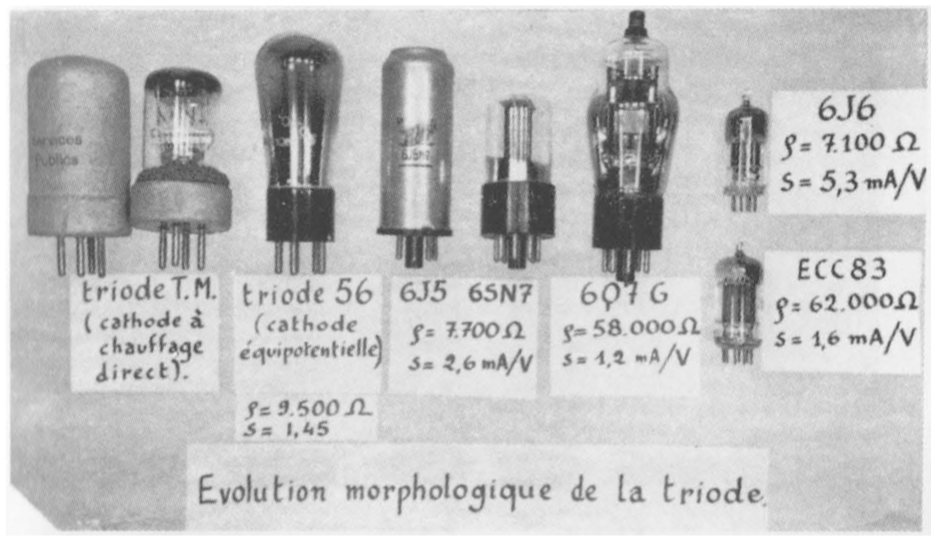
Morphological evolution of the triode (Simondon, 1989: Plate 4).
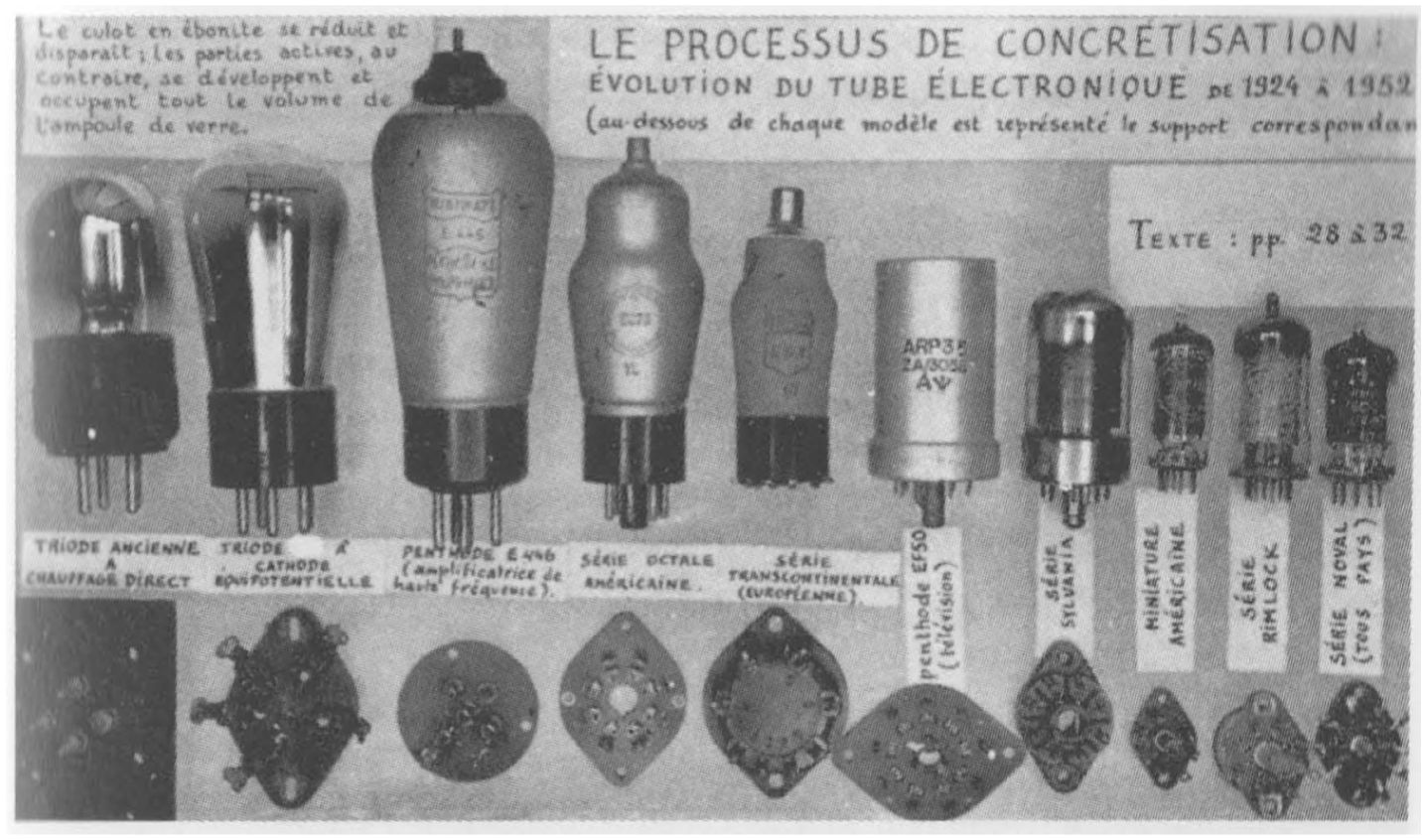
The process of concretization: Evolution of the electronic tube from 1924 to 1960 (Simondon, 1989: Plate 4).
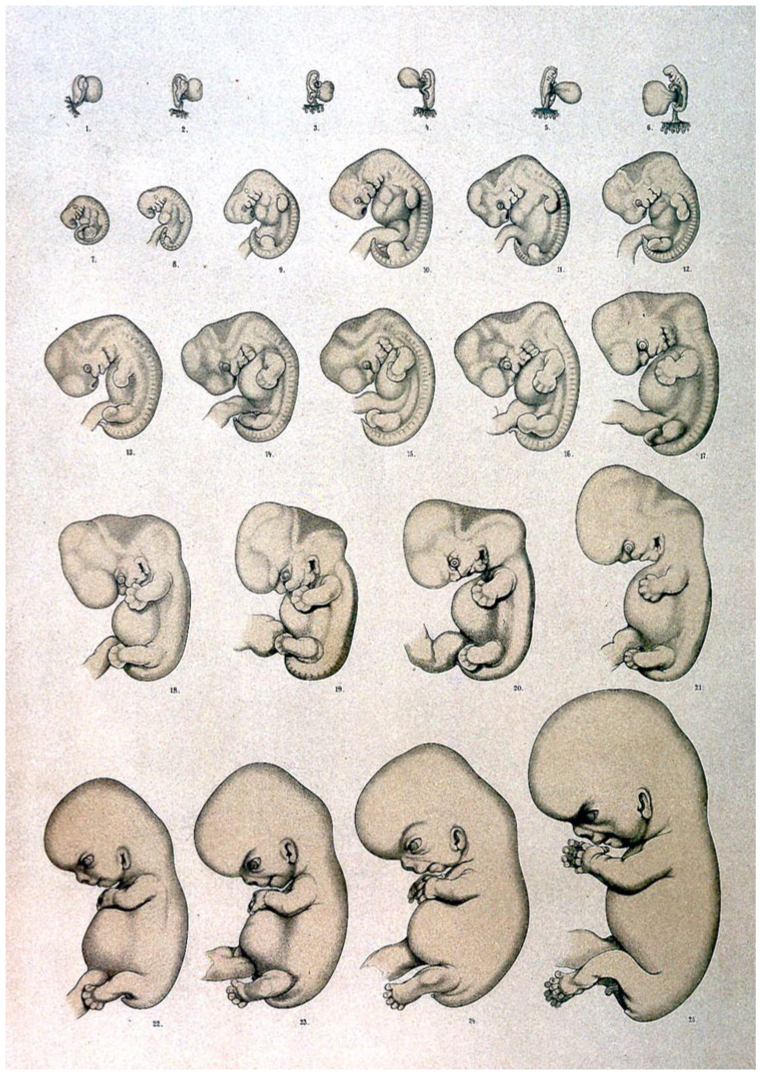
Standard table of human development in the early 20th century (His, 1880, Plate X; Wellcome collection, London; see also Hopwood, 2000).
In the mid-19th century, a reversal occurred in how machines and organisms were analogized. As George Basalla (1988: 14–21) notes, rather than comparing the human body to a machine or nature to a clock, an intellectual current emerged that sought to understand the evolution of technical objects, and artifacts more broadly, through the lens of biological evolution. Some scholars, like Samuel Butler, pursued this analogy more explicitly, arguing for the construction of evolutionary trees for different ‘genera and species’ of machines, a vision soon actualized by Augustus Pitt-Rivers in his analyses of weapons and pottery (Figure 4). Others, while not using direct biological analogies, were clearly influenced by this mode of thought. The archaeologist Oscar Montelius, for instance, revolutionized traditional chronology by using evolutionary time rather than absolute time to connect discrete periods (Trigger, 1996: 224–32). Similarly, early 20th-century art historians introduced the tracing of spatio-temporal evolutions of forms and styles as a key analytical element (e.g. Wölfflin, 1950: 1–17).
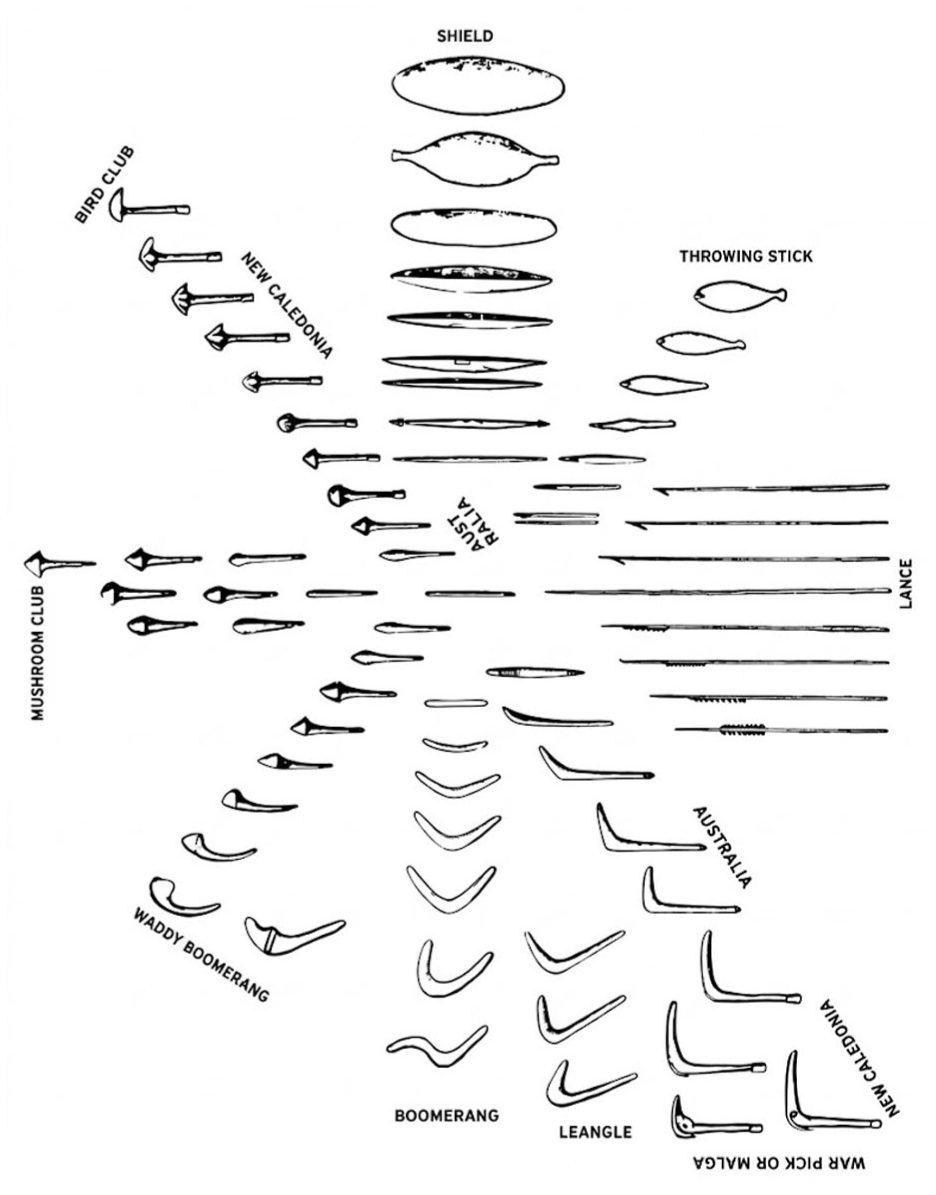
The evolution of Australian aboriginal weapons (redrawn from Pitt-Rivers, 1906 [1875]).
While these analytical and cartographical similarities do not prove a direct line of influence on Simondon, they do suggest that his methodological shift from taxonomy to genetic method is part of a broader, long-term intellectual movement, what Michel Foucault (2001: 272–327) later termed the ‘modern episteme’, that sought to move beyond the superficial classification and description of subjects and objects to uncover their inner depth, with the study of the organism serving as its prototype. Much like Simondon, most researchers of artifacts within this episteme grasp the ‘individual’ not as what it is, but as ‘that of which there is a genesis’, that is, as the intersection of a spatial environment for growth (ontogeny) and a temporal lineage of evolution (phylogeny). This conception of dual depth, in both time and space, naturally entails a methodological imperative that a true understanding of any being and its evolution demands a dual exploration of its organizational structure (morphology, organology) and its temporal sequence (auxology, genetics).
To distinguish this particular approach to the individual’s dual depth from other methods within the modern episteme (such as modern economics), this article terms it ‘phylogenetic thinking’. The claim that Simondon’s method has a phylogenetic dimension rests not merely on the fact that it conceptualizes the individual in a similar way, but more fundamentally, on its confrontation with the same core tensions when explaining the evolution of artifacts: the tensions between external environment and internal logic, and between ontogeny and phylogeny, which are themselves a legacy from 19th-century biological methods. In Simondon’s work, these tensions manifest, for example, in the dynamic between concretization and adaptation, in his attempt to resolve this very dynamic when theorizing the associated milieu, and in the analogies he deploys, where his textual analysis often uses phylogenetic terms like ‘family’ and ‘ancestor’ (2017: 46), while his diagrams draw on ontogenetic ones, depicting evolution as stages in a single being’s development (Figures 1 and 2).
As Simondon’s work demonstrates, the ability to navigate these tensions grants phylogenetic thinking a key advantage in empirical research: it allows for the temporary bracketing of social factors to meticulously examine the artifact itself across both time and space. 5 This focus, in turn, enables it to account for both the continuity of artifacts across different eras (e.g. the carriage and the automobile), a challenge social constructivist methods often struggle to explain (Basalla, 1988), and their diversity across cultures. This article deliberately terms this approach phylogenetic rather than ontogenetic thinking, not only to distinguish it from the concept of ontogenesis that Simondon discusses so intensively, but also because within this intellectual tradition, most thinkers, when dealing with the aforementioned tensions, tend to prioritize the aspects of phylogeny and internal logic. Riegl (2018: 48–96), for instance, subordinates local variations in art forms to their overarching developmental trajectory, just as Simondon (2023: 166–8) argues that internal compatibility takes precedence over external adaptation.
This emphasis on phylogeny and internal logic, common to nearly all phylogenetic thinkers, resonates with the teleological and normative dimensions in Simondon’s own theory of technological evolution (Mills, 2016: 142–9). Like many theories with teleological overtones in modern biology, Simondon and the phylogenetic thinkers do not adopt a traditional teleology that attributes evolution to a designer’s intent, nor do they subscribe to a post-Darwinian theory of purely natural selection (e.g. Dennett, 1995; Okasha, 2018). Instead, they adopt what can be called a ‘quasi-teleological’ stance, which posits that specific forms or structures emerge on living beings or artifacts to fulfill a particular function (Lennox, 1993; Neander, 1991), including what Simondon terms internal or external compatibility. 6 In this view, the goal-directedness of the evolutionary process arises from the thematic or creative quality of morphogenesis (Ruyer, 1980, 2017), the operation of a program (Mayr, 1992), or even a non-teleological process that appears teleological under the influence of multiple factors (Waddington, 2014: 30–47).
Whether applied to living beings or artifacts, such a quasi-teleological evolutionary theory is highly susceptible to misunderstanding and simplification. Consequently, although Simondon is by no means a determinist – and his theory in fact contains a ‘fundamental duality of tendencies’ (Bardin, 2015: 209) that transcends the oppositions between mechanism and teleology, and between continuity and discontinuity (Barthélémy, 2012: 122–4) – he, like Riegl and Waddington (see Oyama, 1981; Verstegen, 2023), can hardly avoid being labelled a ‘determinist’ 7 (Feenberg, 2017: 74). However, Simondon’s thought contains a complementary, ‘inventive’ dimension that sets him apart from other phylogenetic thinkers, introducing a theoretical complexity to the individual-milieu relationship that offers greater potential to resist such deterministic critiques. The key to this inventiveness lies in his theory of ‘individuation’ from his other major work, Individuation in Light of Notions of Form and Information, a theory that had virtually germinated in other phylogenetic thought, yet was never fully realized.
[I]t is necessary to reverse the search for the principle of individuation by considering the operation of individuation as primordial, on the basis of which the individual comes to exist and whose unfolding regimes and modalities the individual reflects in its characteristics . . .[M]oreover, what individuation manifests is not merely the individual but the individual-milieu coupling. (2020: 3)
In the introduction to Part III of On the Mode of Existence, Simondon (2017: 168) states that the very notion of genesis must be understood through his theory of ‘individuation’ from Individuation in Light. According to this theory, the individual is not an absolute entity but a relative reality: a moment or a phase of being that emerges from a pre-individual reality and remains open to further individuation. Within this ‘theory of the phases of being’ (2020: 363), each individuation is a phase-shift, an ‘individual-milieu coupling’ that resolves the ‘problems of the milieu that surrounds it and that is its milieu’ (2020: 292) posed by the preceding phase, which in turn gives rise to a new, tension-filled, metastable individual. In stark contrast to phylogenetic thinking, the concept of individuation thus emphasizes ontogeny over phylogeny. It posits a radical non-determinism where evolution is understood not as adaptation to the environment, nor even as a stable co-construction between individual and milieu (e.g. von Uexküll, 2013), but as the emergent result of their metastable relationship, a continuous process of problem-solving.
In the language of Individuation in Light, the successive individuations that constitute evolution can be understood as a form of transduction. Much like transduction in engineering (e.g. a capacitor microphone converting speech into current), individuation involves transmitting and transforming one form of energy and signal into another, and, in the process, giving the difference between them – in the case of evolution, the difference between the internal structure and the external milieu – a new topological and temporal form. Moreover, as a transductive process, individuation is not a gradual change but an ‘all-or-nothing’ leap (Simondon, 2010: 164), in which a new metastable state is established without exhausting the system’s pre-individual potential, thereby maintaining a ‘margin of indeterminacy’ and remaining open to the next individuation. As numerous studies have shown (e.g. Lapworth, 2016; Morgan, 2023), approaching artifacts through the concepts of individuation and transduction is not only compatible with social analysis but is often far more open than existing social constructivist theories that tend to reify the individual in its current state.
The problem, however, lies in the relationship between these two facets of Simondon’s thought – one facing criticisms of determinism, the other being radically non-deterministic – and his theory of technological evolution. In fact, instead of using individuation, Simondon uses only individualization to describe the evolution of technical objects in On the Mode of Existence. Drawing on Yuk Hui’s (2016: 14–15, 109) distinction, individualization concerns functions and a progression of form, whereas individuation ‘accounts for the genesis and resolution of tensions to arrive at a metastable equilibrium’ and ‘a transformation in the operation of relations and structures’. This distinction also corresponds to two dimensions of evolution in Simondon’s work: individualization is analogous to phylogenesis (Simondon, 2017: 26), while individuation concerns ontogenesis (2020: 4). Consequently, individualization, especially in the analysis of concretization, suggests a temporal sequence, whereas individuation is discontinuous and should not be understood as an ‘alteration or a succession of states comparable to a serial development’ (2020: 363).
Therefore, the compatibility of the theory of individuation with both the theory of concretization and the empirical cases of technical objects is not self-evident. To open up On the Mode of Existence’s evolutionary picture with the concept of individuation, or to prove Stiegler’s (1998: 72) claim that concretization is the individuation of technical objects, one must first untangle the complex relationship between individuation, individualization and concretization. One way to explore this complex is through Simondon’s discussion of three amplifications of information, where the concept of ‘organizational amplification’, as the synthesis of discontinuous transduction amplifications (akin to individuation) and continuous modulatory amplification (akin to individualization), is used to understand growth and evolution in living beings (2010: 159–76). However, since organizational amplification operates as a response to ‘vital problems’ with consciousness – ‘a function of life’ – as its source (2010: 172–3), it can hardly be used to analyse the evolution of technical objects, much less serve as a direct counterpart to the process of concretization.
Is it then possible to argue, as Barthélémy (2015: 20) suggests, that just as a born-to-be-concrete natural object represents the limit of concretization in terms of its result, individuation represents its limit in terms of operation? If so, concretization, situated on a continuum between individualization and individuation, could be seen as a form of individuation to a greater or lesser degree, with cases involving an associated milieu being closest to the side of individuation and thus the most open. While elegant and theoretically coherent, this solution is ultimately insufficient for solving the empirical issues as it lacks an operational dimension, one with a granularity similar to Simondon’s own analyses, to explain which technical objects (and in which scenarios) have a concretization process that is more akin to individuation and why such differences exist. Without resolving this issue, the solution cannot be applied to empirical research to address the constructivist critiques mentioned earlier, thus failing to enhance its external adaptability to contemporary technical realities and other research approaches.
To further explore the individuation of technical objects – or more precisely, to develop an evolutionary model more aligned with the idea of individuation – this article will now turn to the distinction Simondon draws between technical objects and living beings, as well as the most crucial connection between them, the fact that technical objects are creations of living beings. Combining these insights with the more recent phylogenetic thinking from Kubler and Gell, this article aims to develop what it calls an ‘ecology of time’ which can be seen as a new theoretical individuation emerging from the unexhausted pre-individual potential of Simondon’s original theory of technological evolution. The following section should thus be read as an attempt to introduce empirical cases and external theoretical elements as ‘new oscillators’ into Simondon’s technical thought – an already metastable system that oscillates between individuation and individualization, ontogeny and phylogeny, the inventive and the normative (Bardin, 2015: 140, 155; Mills, 2016: 131–49) – and to observe how these additions might alter the synchronization of the entire system.
The Ecology of Time
In ‘Topology and Ontogenesis’, a subsection in Part II of Individuation in Light, Simondon (2020: 253–6) elaborates with remarkable density on the difference between physical and vital individuation, paving the way for his discussion of the psycho-collective. He points out that the key distinction between inert matter and life lies in the role of time in their morphogenesis – that is, the relationship between topology and chronology – which he sees as the unfolding of an individual’s dimensions of interiority and exteriority. For non-living beings, ‘the past doesn’t serve a purpose . . . it merely plays a role of bare support and does not provide the availability of an information signal: the succession of time is not condensed’. In other words, the past, embodied in the present form, does not actively shape the next morphological change. For living beings, conversely, ‘all the products of the past individuation are present immediately and without distance’ and ‘play a role for the perpetuation of individuation throughout the whole being’. The operation of vital individuation is therefore inherently spatiotemporal.
The technical object, however, occupies a peculiar hybrid state within this dichotomy. In On the Mode of Existence, Simondon (2017: 68) argues that beyond the direct synergy between technical elements, there exists a ‘historical solidarity’ with a temporal dimension of evolution. This suggests that, like living beings, 8 a technical object’s structures, its form-matter relations, and the technicity mediating these relations – all serving as resolutions to past tensions – can actively shape the next evolution (2017: 71–3). This is particularly evident in ‘how the internal schema of the technical object is modified in leaps rather than following a continuous line’, thereby allowing abandoned technical objects or unfinished inventions to ‘remain as an open virtuality and could be taken up again . . . according to their deep intention, their technical essence’ (2017: 43). The 19th-century steam turbine, for instance, integrated both the tubular boiler from 18th-century water wheels and the long-dormant schema of the aeolipile, invented by Heron of Alexandria over a millennium earlier (Simondon, 2005: 330–1).
The particular rhythm of technological evolution stems from the specificity of its genesis. On the one hand, technical objects are not organisms born concrete; they cannot individuate on their own. Therefore, although this evolution exhibits a relationship between topology and chronology similar to that in living beings, the technical object possesses ‘no true virtuality . . . [and] cannot reform its forms in order to solve a problem’ (Simondon, 2017: 156). It always requires an encounter between human inventors and the technicity as the instrument of technical evolution. On the other hand, this inventive encounter is by no means accidental. It is itself a part of human individuation, a form of morphogenesis occurring outside the living body. Much like a termite’s nest or a coral’s coenenchyme, the technical object functions as a mediator between the living being and its milieu, serving as a solution to the problems humans face during their own vital individuation. It thus embodies ‘the continuity between functions of growth and the activity of creation’ and their convergence in the production of the network of created objects (2023: 188–9): Invention . . . does not stay within the living being as a component of its mental equipment but steps over the spatio-temporal limits of the living to connect with the milieu which it organises. . . . A created object is . . . a linkage system between the living and its milieu, a double point in which the subjective world and the objective world communicate. Among social species, this point is triple since it becomes a pathway of relations between individuals, organising their reciprocal functions. In this case, the triple point is also a social organiser. (Simondon, 2023: 185–6)
The invention of a technical object, therefore, involves two sets of individual-milieu tensions 9 driving its evolution: one manifesting within the object’s own process of concretization and adaptation, the other within its inventor’s individuation. According to Simondon (2017: 62, 150–1), the morphogenesis of the technical object – as the intersection of chronology and topology – is incomprehensible without grasping the analogy between these two tensional relationships, for the structure of technical objects is a transductive exteriorization of the matter-form relationship internal to human thought and life. And since the images and symbols upon which thought and life depend are themselves products of psychic and collective individuation (2020: 239–43, 2023: 15–18), serving as a group’s solution to its own tensions and the foundation of its ‘transindividual’ world (see Bardin, 2015: 153–7), then it follows that the technical object, as a triple point of communication between subjective, objective and collective worlds, is inherently social. It requires no further search for ‘social factors’ within its evolutionary process.
Situating Simondon’s theory of invention within his theory of the transindividual 10 alleviates much of the tension in his thought, but it does not yet offer a concrete methodological solution. It remains unclear how the hypothesis – that social factors intervene in the evolution of technical objects through the process of invention – can be operationalized and integrated with Simondon’s empirical analyses in works like On the Mode of Existence or Imagination and Invention, thereby forming a methodology that retains the granular advantage of his original approach. Nevertheless, Simondon’s own theoretical framework, with its margin of indeterminacy, contains enough virtuality for a new leap. Perhaps all it needs is a new theoretical ‘seed crystal’ to precipitate the next phase-shift. And such a seed happens to exist in the work of one of his contemporaries, who developed another theory of artifactual evolution with a strikingly similar path. Yet, instead of relying on the biological analogies of On the Mode of Existence and Imagination and Invention, this theory draws on the very physical models that served as Simondon’s starting point for thinking about transduction in Individuation in Light.
The biological model was not the most appropriate one for a history of things. Perhaps a system of metaphors drawn from physical science would have clothed the situation of art more adequately . . . especially if we are dealing in art with the transmission of some kind of energy; with impulses, generating centers, and relay points; with increments and losses in transit; with resistances and transformers in the circuit. (Kubler, 1962: 9)
One might find that many terms used by the art historian George Kubler to describe the evolution of artifacts – such as energy transmission, impulses, or increments and losses – apply seamlessly to Simondon’s empirical analysis, which is unsurprising given they are part of Simondon’s own vocabulary too (e.g. 2020: 240, 250–1). Indeed, their theories can be seen as different instantiations of the same evolutionary model. Though using different languages and cases, they share a similar structure: both argue that it is the unique relationship between an artifact and its ‘organs’ that allows not the individual artifact, but its constituent traits or elements, to transmit, obscure, replicate, and relay signals (such as technicity) across historical periods, thereby creating a rhythm of relaxation in evolution (Kubler, 1962: 20–4, 99; Simondon, 2017: 67–71). However, by turning explicitly to physics-based analogies, Kubler is able to tightly integrate the morphological dimension of artifacts (concretization) with the socio-psychological dimension of their creation (transindividual) by focusing on the different types of signals an artifact can carry.
Just as Simondon distinguishes the technical object into an inner layer embodying technicity and an outer layer pursuing sociality, Kubler differentiates the signals transmitted by artifacts into ‘self-signals’ and ‘adherent signals’. The former (like the shape of an axe) originate from an object’s intrinsic function and can be transmitted on their own, while the latter (like a car’s logo) require a socio-cultural context for their interpretation and transmission. Kubler’s analysis, however, also implies what might be called ‘meta-signals’. If a self-signal transmits the solution to a specific problem, a meta-signal indicates the existence of that solution. This concept is crucial because, as both Kubler and Simondon realized, a creator must grapple not only with internal and external compatibilities but also with their creation’s relationship to what already exists and what might yet come – that is, its ‘position’ within the entire evolutionary landscape. It is precisely this consideration of position that directly links the seemingly asocial morphospace of artifacts to the realm of collective consciousness.
Every succession may be stated in the following propositions: (I) in the course of an irreversible finite series the use of any position reduces the number of remaining positions; (2) each position in a series affords only a limited number of possibilities of action; (3) the choice of an action commits the corresponding position; (4) taking a position both defines and reduces the range of possibilities in the succeeding position. (Kubler, 1962: 54)
Kubler’s propositions can be summarized thus: the morphogenesis of an artifact, and the creative process associated with it, can only be fully understood within the ecology of other artifacts. Here, the concept of position within morphospace – the space of possible forms – transforms the theory entirely, because every trait of an artifact, as an exteriorization of thought in a specific time and space, occupies a position that influences all past and future creations, and is thus necessarily transindividual. It can be said that Kubler does not focus on the social life of artifacts; instead, he finds that the morphospace of artifacts is a social world, for the very act of creation itself – carrying the indispensable process of finding one’s position within an ecology of creations and influencing the positioning of others – must be understood as an interaction between the subjective world and the social world. 11 As Simondon (2020: 254) writes, ‘every topological characteristic has a chronological correlate’; in artifacts, every chronological correlate is necessarily a transindividual one.
In this light, the positional relationship between artifacts is not merely an objective one within morphospace; it is the result of intentional acts that, mediated by artifacts, transcend time and space. As the anthropologist Alfred Gell (1998: 232–51) argues, this relationship is therefore metastable, constantly changing with the broader phylogenetic process depending on the angle of observation. A work, for instance, might be an intentional ‘preparatory study’ for another, or it could be a ‘pilot’ work that, unforeseen at the time, later proves to have opened a new creative direction. Within this system of anachronic relationships, the position of an individual artifact within the collective morphospace becomes a map of the relationship between individual thought and collective consciousness; 12 and the artifact, as a mediating term between the individual and the collective, indexes two aspects simultaneously, where the phylogeny of artifacts constitutes a macro ‘temporal object’ – a network of interwoven intentions, thoughts, and ideas – while the very act of creation itself becomes an endeavour to preserve one’s thoughts within the collective consciousness.
Thus we are enabled to see the totality of Maori meeting houses as a cognitive process writ large, a movement of inner durée as well as a collection of existing objects, and documents appertaining to objects which time has obliterated. The Maori meeting house (in its totalized form) is an object which we are able to trace as a movement of thought, a movement of memory reaching down into the past and a movement of aspiration, probing towards an unrealized, and perhaps unrealizable futurity. Through the study of these artefacts, we are able to grasp ‘mind’ as an external (and eternal) disposition of public acts of objectification, and simultaneously as the evolving consciousness of a collectivity, transcending the individual cogito and the coordinates of any particular here and now. (Gell, 1998: 258)
More importantly, resonating with Simondon’s theories of invention and individuation, the concept of ‘position’ developed by Kubler and Gell offers a concrete method for empirical research. Revisiting the evolution of the vacuum tube, a case Simondon himself discussed, reveals how these metastable positional relationships operate and actively drive evolution. For example, when Hull invented the magnetron, he envisioned using it to create an AM transmitter different from a triode; he was considering not only its technical principles but also its positional relationship. Although this invention failed to occupy this position, engineers discovered its excellent capabilities in microwave generation, revealing a new, open domain of ‘microwave tubes’ within the morphospace. In response, and working from entirely different principles, the Varian brothers invented the klystron in the late 1930s as a more controllable and intelligible ‘magnetron’. Subsequently, Kompfner invented the traveling-wave tube as a higher-power ‘magnetron’ or ‘klystron’ (see Morton and Gabriel, 2007; Tyne, 1977).
As Figure 5 shows, an evolutionary tree based on positional relationships, instead of unfolding along the lines of concretization, embodies the intentional act of ‘positioning’. This focus on position, however, does not require sacrificing the analysis of concretization and invention; they are fully compatible. 13 Indeed, one could argue that only by understanding the processes of concretization and invention, only by grasping the morphospace an inventor confronts and how, in creating a specific form, they simultaneously look back at existing objects and imagine those yet to come, situating their work within a complex network – as peers, descendants, or ancestors; as copies, optimizations, or prophecies – can one fully comprehend the positional relationships between artifacts. In this sense, introducing the concept of position can be read as a theoretical concretization that, at minimal cost – requiring almost no modification to Simondon’s empirical methods and retaining their full strength – allows the various parts of his thought to fulfill a greater but synergetic number of functions.
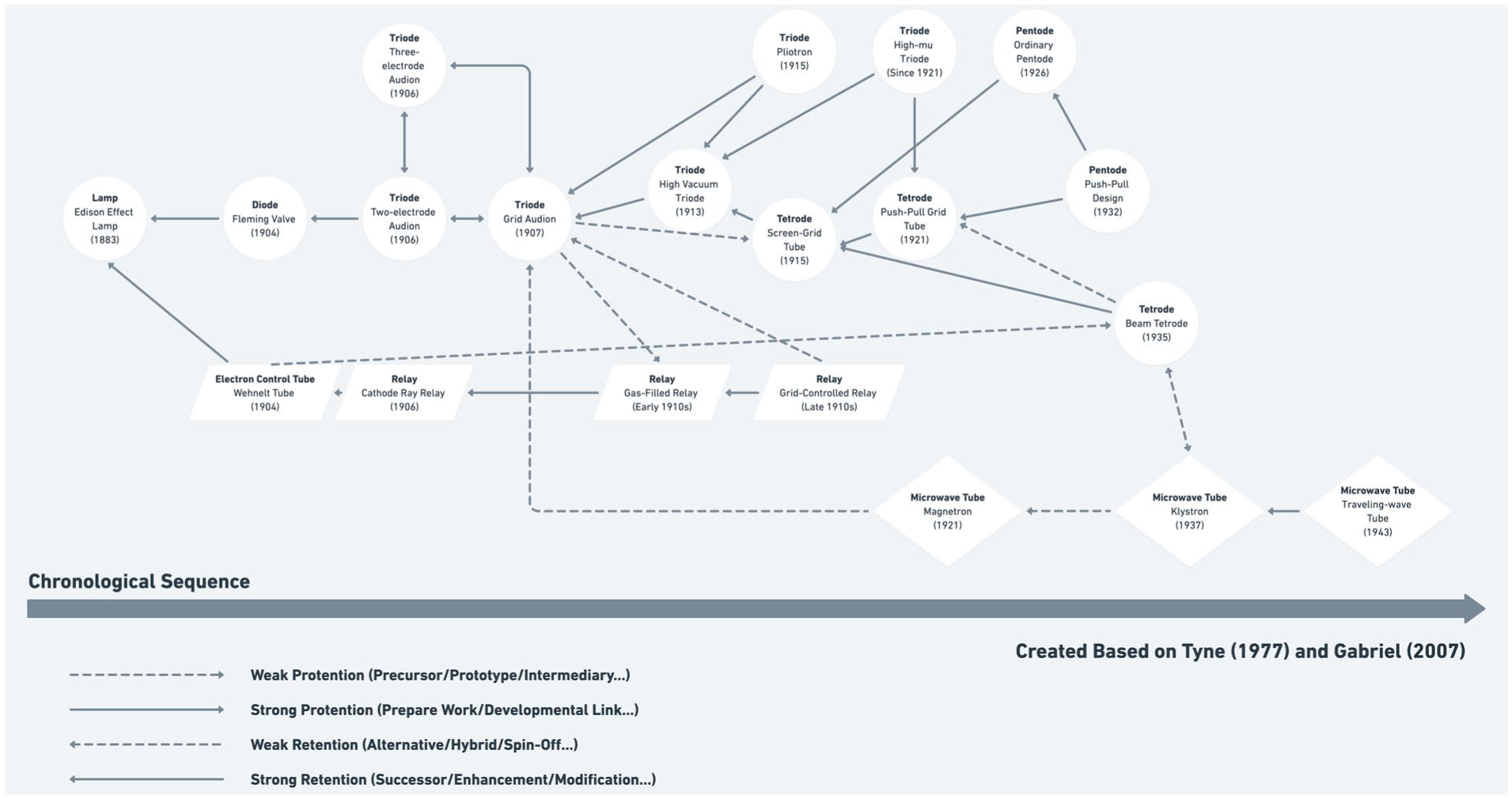
A section of phylogenetic tree of vacuum tubes.
This operation of concretizing – what might be called an ‘ecology of time’ – is not an invention of this article; rather, it has always existed virtually in Simondon’s thought, just waiting to be realized, thus enabling the transduction of the different facets of invention, individuation and concretization into the same plane of empirical studies, instead of abstractly applying them in different scenarios. In essence, this operation shows that Simondon’s (2020: 208–9) description of the vital individual as ‘not a being but an act . . . [that] condenses information, transports it, and then modulates a new milieu’ applies not only to organisms but also to artifacts. This, in turn, allows one to see every created object as an action oriented towards both the past and the future, for it always needs to condense the entire evolutionary tree and the associated socio-cultural context into its seemingly stable form. And then, it waits. It waits, like a pulsar, for a future signal to trigger its hot, fluctuating internal energies to burst forth again in the technical universe.
In an ecology of time, the artifact is not a being but an act oriented toward the collective consciousness; while the phylogeny of artifacts, as the confluence of all such acts, is a grand cognitive process writ large, a movement of thought, memory, and aspiration shared by humans who possess love for their creations. In this sense, the evolution of artifacts can be seen as a dual collective individuation of both the artifacts themselves and their creators through them. At its core lies a circular causality between two self-conditioned, mediating relationships, where the technical object mediates between individual and collective consciousness, while this very individual and collective consciousness mediates between the ontogeny and phylogeny of the technical object. All factors, whether technical or social – if such a distinction can even be made – cannot directly affect the artifact or its elements; they must operate through this dual mediation. That is to say, within an ecology of time, the evolutionary process of technical objects no longer needs to prove its sociality, for society already dwells within.
Conclusion
In the introduction to On the Mode of Existence of Technical Objects, Simondon (2017: 19) articulated a vision for restoring culture’s ‘truly general character’ by reintegrating technology into culture and fostering a technical culture. This, he argued, required ‘the existence of a technologist or mechanologist, alongside the psychologist and the sociologist’. Drawing on this vision, this article situates Simondon’s empirical analyses of technical objects within what it terms a ‘phylogenetic’ episteme, arguing that his approach offers an invaluable contribution to contemporary technology studies, particularly in its capacity to analyse the specific morphological and operational character of technical objects with astonishing granularity. Furthermore, drawing on Waddington’s (2014: 6–7) distinction of three timescales, Simondon’s genetic method also provides a crucial supplement at the longest timescale of the evolutionary series, moving beyond the dominant focus on the intermediate scale of social life (e.g. Appadurai, 1988) and the shortest scale of material interaction (e.g. Dant, 2005).
This method, however, with all these strengths, exists in tension with other parts of Simondon’s own thought and with the facets of empirical realities prioritized by social constructivist approaches, risking hindering a collaborative inquiry into ‘the nature of machines, their reciprocal relations, their relations to man, and the values implicit in these relations’ (Simondon, 2017: 19). To articulate this method’s place within contemporary empirical research, this article, with the aid of external theoretical ‘seed crystals’, has attempted to take up again the unexhausted pre-individual potential latent within it, allowing it to individuate further into an ‘ecology of time’. The result is a model of collective individuation of technical objects themselves and, through them, one that, without sacrificing the methodological advantages of Simondon’s approach, enhances both the internal compatibility within his thought and its external adaptability to other empirical cases and theoretical frameworks; one that depicts a living universe woven from the intentions, thoughts, and ideas carried by artifacts, a universe in which all artifacts and their creators dwell.
As Simondon recognized, different types of artifacts – technical versus art, industrial versus handcrafted, hardware versus software – may follow distinct evolutionary logics, with some having greater freedom while others are more constrained by internal principles. Thus, this article should be understood not as offering a complete solution but rather as proposing a research initiative to examine how different factors operate, across various temporal and spatial scales, in the evolution of different types of technical objects. Following Simondon’s (2017: 248–9) suggestion, we must ‘enter the mold with the clay, to be both mold and clay’ – to understand what shapes the evolution of technical objects, we need to immerse ourselves in these objects, to ‘live and feel’ their evolution and the virtualities embedded within. If this article finds anything after the long detour, it is not a better or more contemporary version of Simondon’s idea, but rather the idea of Simondon itself, which continues to individuate in the theoretical world shared by Simondon as well as by many interpreters.
Footnotes
Acknowledgements
The author would like to thank the four reviewers and the editor for their constructive feedback and support, Stephen Kemp and Nick Prior for their supervision, and Li Kang, Zhang Bolun, Fu Shanchao and Han Song for their helpful comments. Earlier versions of this article were presented at the BSA Theory Symposium (Cambridge, May 2025), AsSIST (Edinburgh, June 2025), and ISA RC16 Midterm Conference (Innsbruck, July 2025), where the author received valuable suggestions. Parts of this article build on the author’s earlier thesis at Peking University.
Funding
The author disclosed receipt of the following financial support for the research, authorship, and/or publication of this article: This work was supported by the Key Project of the National Social Science Fund of China (Grant No. 21ASH002) and the School of Social and Political Science PhD Scholarship, University of Edinburgh.
