



Abstract
While the Palestinian home has been a target of relentless demolition and displacement, it has historically also been a place of care, culture, labour, and resistance. Indeed, the home is always becoming, constantly remade with every demolition and every displacement. The home embodies these contradictions: both a crime scene and a revolutionary space; a site of colonial surveillance and destruction, and a grounding site of labour and reconstruction. To engage with these tensions, I return to the revolution of 1936–9 against the British Mandate, a snapshot in the long and ongoing Palestinian revolution. But instead of only looking for revolutionaries in the barricades and the mountains, I look for them in the kitchens, in the bedrooms and in the living rooms. In that sense, I propose that the production of the home space is itself a conceptual site of theorization for what can be called insurgent social reproduction.
There is an image of four Israeli soldiers sitting on the floor of a living room, snacking on some fruits as they’re watching television. The image is from a refugee camp near Ramallah in the year 2002. Ariella Azoulay rereads this image when it later makes its way into different family archives marking its rediscovery. One day, she writes, someone recognized ‘a crime committed, a deed that never should have been done, a violation, a disaster, a horror – something that had been previously ignored and suddenly appeared in a different light’ (Azoulay, 2010: 240). This rediscovery of a crime scene in an image of soldiers watching television – with no blood, no beating, no threats, but only army boots, resting guns, fruits, and a television set – came with a testimony of one of the soldiers:
It was during the World Cup and we were carrying out searches in a certain village. We had to enter one of the houses. Now you got a really cool platoon commander who’s a fan of the Argentinian team too, and he too wants to watch the game. So you tell him, ‘Listen, bro’, you know . . . this house or that house, it’s all the same but this one’s got a television set, man.’ So we went into the house with the TV set, and just took a family out of its home so we could watch the Argentina–Nigeria game. (Breaking the Silence website; Azoulay, 2010: 242)
The rediscovery of that image as a crime scene is one of the many iterations of dispossession since the early days of European settlement in Palestine. A Palestinian family can be displaced out of their home for a few hours so that Israeli soldiers could watch a football game as they raid the fridge for snacks. One can hardly imagine the Palestinian home without this carceral imagery of the settler state. The home has always been a site of the most audacious forms of dispossession. Indeed, home demolition has been a primary tool of settler colonial erasure and the racial hierarchies embedded within urban planning (Jabareen, 2010). In Palestine, it has a determinate/indeterminate character, whereby there is always a certainty of demolition that is yet to come at an unknown time (Joronen and Griffiths, 2019: 563). The anticipation of a future violence of home demolition becomes ‘an affective condition of present’ (Azoulay and Ophir, 2005; Joronen and Griffiths, 2019: 566). Indeed, the persistent Zionist attack on the home space is ‘inseparable from attacks on the homeland’ and the settler project of dispossession (Shalhoub-Kevorkian and Ihmoud, 2014: 380).
While the home has been a target of relentless demolition, and displacement from its stable physical structure – as manifested most concretely in the precariousness of the refugee tent from 1948 onwards – it has historically also been a place of care, culture, labour, and resistance. Indeed, the home is always becoming, constantly remade with every demolition and every displacement. In this article, I argue that the home embodies these contradictions: both a crime scene and a revolutionary space; a site of colonial surveillance and destruction, and a grounding site of labour and reconstruction. To engage with these tensions within the home, I return to the revolution of 1936–9 against the British Mandate, a snapshot in the long and ongoing Palestinian revolution. But instead of only looking for revolutionaries in the barricades and the mountains, I look for them in the kitchens, in the bedrooms and in the living rooms. In that sense, I propose that the production of the home space is itself a conceptual site of theorization for what can be called insurgent social reproduction – from the mundane to the spectacular quotidian details.
There is a long line of Marxist-feminist literature on social reproduction theory. This article pivots off this tradition to argue not only that socially reproductive labour has been historically undervalued, but that it has also played a revolutionary role. I imagine the home as a space of resistance –almost like a battlefield, it harbours weapons, food, water, and rebels. The home became a zone of engagement during the revolution and became a space from which an alternative political imaginary of anti-colonialism was assembled and practised. It is hard to find the quotidian details of the home in the traditional state archive; so, instead, I draw primarily on oral history narratives, specifically from the brilliant project led by Faihaa Abdulahdi and a team of researchers who in the early 2000s published and archived oral history interviews made with Palestinian women who participated in the 1936 revolution as well as the Palestine Oral History Archive (POHA), which documented the experiences of Palestinians in refugee camps in Lebanon. In addition to oral history, I also draw on literary works and photography, which together form an archive of the home.
In what follows, I first situate the home across time in Palestine within a series of signposts that mark its infrastructure of violence. I think about the constantly mediated relationship between the past and the present, and the ways in which the home today, both as a physical structure and as a social life, mirrors the home during the years when Palestine became a settler colony. Importantly, this mirroring of the past from the present situates the home within a wider set of processes operating during the years of the revolution, framing it as both a political space and an historical one. Second, I go inside the home through thinking with ‘the minor’ – teasing out the daily details, the secrets, and the stories of Palestinian women during the revolution. The article concludes with an examination of some of the broader implications that emerge from this analysis that centres the home as a space that partakes in struggle through the quotidian.
Memory and Mirroring: Situating the Home within an Infrastructure of Violence
The task of remembering from the present is ‘an active construction of the past’ (Hajyahya, 2024). Elias Khoury asks: How do we write a story from a present that does not yet have an ending? When a story ends, it opens up the possibilities for different readings, interpretations, and re-readings, where the ending breathes a second life into the story (Khoury, 2023: 82). But what happens when we can’t see the ending yet? Khoury is talking about the ongoing Nakba, as not simply an event, but as a structure (Kēhaulani, 2016; Wolfe, 1999) that changes its meaning across time, operating as an historically-differentiated process. 1 Importantly, the Nakba has no ending yet, but is constantly reshaped by the present and its memory of the past. If the Nakba is not an event, then it also did not start in 1948 either, just as it did not end with the Oslo Accords in 1993; it simply took different forms across time. But it was always in tension with the long Palestinian revolution that has also lived several lives. The 1936–9 Arab revolution in Palestine against the settler project is recalled and reassembled from a present shaped by the unremitting viciousness of settler colonialism that feeds off of the destruction of Palestinian homes. In that sense, the return to the home in 1936 is not simply out of historical interest, but out of a very present political urgency. Israel’s security regime that suffocates and infiltrates Arab homes mirrors that of the British Mandate in the early years of settlement and colonization. Today, life in Palestine could only be described as a perpetual maze of crossing barriers (Abourahme, 2011). The most obvious manifestation of this is the construction of the Separation Wall that runs inside the West Bank, passing through its streets and its homes, separating friends, families and comrades. This wall operates on both the material and the symbolic registers. 2 Symbolically, the construction of a concrete wall has a completeness to it, as if marking an ending, albeit an unhappy one. The wall represents a fait accompli situation: as if colonialism happened in the past and was resolved by partition. It is as if the temporalities of settler colonialism have been paused or stopped completely to announce a new order governed by this ‘surreal architecture’ of security and checkpoints (Abourahme, 2011: 454). But one can see fragments of the past in the image of the wall today, as if recognizing some of its features in the security regime founded by the British Mandate during the interwar years. British watchtowers (Khalili, 2014), security walls, checkpoints and the ransacking of Arab homes during the mandate also yield new meanings as one reads them in light of today’s horror, professing a dialectical relationship between the imagery of the past and that of the present (Benjamin, 2002). The home continues to be embedded within this securitized and surveilled architecture that imposes itself on the everyday – city and village.
During the early months of the revolution, the mandate government was already instituting an infrastructure of violence across all of Palestine (Yassin, 1961: 128, 129). The revolution itself was sparked by a series of street fights between the two communities in Jaffa and other cities, which eventually culminated in a call for an Arab general strike by 19 April 1936 (Z’eiter, 1981: 64). One of the strike’s main drivers was the increase in Jewish immigration and settlement that transformed Palestine’s political economy. This was happening in parallel with a slow transfer of agricultural land ownership, alienating Arab peasants from their means of subsistence and creating a growing class of dispossessed peasants who would turn to waged labour (Kanafani, 2023; Mansour, 2012: 192). This process had been happening slowly since the turn of the century when early Zionists resorted to American agriculturalists for advice on the best programme for agricultural development based on the perceived similarity between the settler colonial projects in California and in Palestine (Bhandar, 2018). These changes in land tenure and labour relations were the material basis for understanding the political economy of the creation of a settler colony (Kanafani, 2023). 3
While the current wall seems very far in time from the arrangements that were present during the 1936 Arab revolution, there is a strange, even if prophetic, mirroring of the walled present and the tumultuous past. Yet as time passes, there are slightly different reflections of the past – after all, mirrors do break. The partitioning of Palestine would later trigger infinite projects of walling (Dubnov and Robson, 2019) that pass through Palestinian streets, neighbourhoods, homes, and entire cities. 4 The home then is not an insular space but one that mingles and fuses into the street, city, and village life. It is implicated in planning, labour, and security arrangements. To approach the home in this way is to tie it to a set of different processes that operate inside, outside and through the home. Returning to Palestinian homes in the 1930s means a return to the years in which Palestine became a settler colony, and importantly the years when Palestinians staged a chain of refusals: refusal of the British Mandate and its security apparatus, of increasing numbers of settlers arriving in Palestine, of poor labour conditions, including the creation of a racially segregated labour force, as well as the colonial surveillance of the Arab home, and its constant invasion by everyday acts of violence that arise from this colonial/settler-colonial arrangement of 1930s Palestine.
The years of the 1936–9 Arab Revolution also witnessed the articulation of one of the earlier partition plans – a decade before the 1947 UN Partition Plan – in the Peel Commission report, which on some level is still present today, acting almost as a palimpsest of the geographies of Israeli apartheid. 5 Lord Peel arrived with his commission in Palestine to investigate the ‘disturbances’ that started with an Arab general strike in 1936, lasting for six months, and turning into a three year revolution. 6
More than a year after the Peel Commission, the new Palestine Partition Commission stated that the ‘Arabs remain inflexibly hostile to partition. During our stay in Palestine, no Arab came forward to submit evidence or to co-operate in any way with us: the boycott was complete’ (Takriti, 2019: 74). But for the boycott to be truly complete, the home space was used to make up for the lost market from boycotting British commodities. The home was not only a site for plotting and planning, but it was also the space from which an alternative market of commercial goods was created within the Arab community during the boycott. The steadfastness of the rebellion for three years, and its rejection of the different ‘solutions’ offered by the mandate government, show that the revolution aimed at dismantling the very logics of settler colonialism. The rebels were not interested in partition. In fact, they imagined an alternative to the colonial state altogether, and enacted it on some level during the years of the revolution. Like every revolution, such enactments were mired in contradictions; still, the rebels created an entirely parallel system to that of the mandate: from parallel institutions to rebel courts to the Arab boycott. Without the Palestinian home, this parallel system would not have been possible. The home was also the space for storing weapons, hiding rebels, and for sending secret messages between the revolutionaries. The home reproduced the revolutionaries, making it just as central a space to revolutionary action as the rebels’ barricades on the mountains. In that sense, Palestinian women who occupied and managed the homeplace were creative agents who reimagined the Arab home as a space of resistance and repurposed their labour of social reproduction as struggle.
Here, my return to women within the homeplace in Palestine’s revolutionary history is not about painting a picture of history as it really was, to use Ranke’s expression, somehow correcting or completing the literature on the history of the revolution (Benjamin, 2002: 463). It is instead about searching for an opening in time, a moment from which to seek refuge (Marx, 2023). It is about seizing the memory of revolution ‘as it flashes up at a moment of danger’ (Benjamin, 2002: 463). The return to the home from this perspective then is not really a literal return but a potentiality. It is a way to rethink what is at stake in Palestine.
This entails thinking about capital, class and gender, as well as racial segregation ‘at the same time and at once’ (Bannerji, 1995: 30). And the home somehow captures those together. It is a site of labour, reproduction, leisure, rest and recuperation, food, song, culture, and also a site of revolution and potentiality. If Marxist-feminists showed that, without women’s reproductive labour, workers simply won’t go to the factory (Dalla Costa, 2019; Federici, 1975; Mies, 2014), then perhaps it also shows that, without women’s labour, workers won’t ‘go’ to the revolution. But importantly, this poses another underlying question: who indeed is a revolutionary? And what is revolutionary action? In thinking about those two questions, I keep returning to bell hooks’ evocative text on the homeplace (Hooks, 1997: 383). She paints a picture of the homeplace as shelter and warmth, as a site of labour: ‘feeding our bodies, nurturing our souls’. At the same time, the homeplace is also a site of resistance. Indeed, she recounts how Black people saw the construction of a homeplace, regardless of its fragility and tenuousness (imagine the slave hut or the wooden shack), as having ‘a radical political dimension’ (Hooks, 1997: 383). It is precisely this perspective on the home as a space with a ‘powerful force’ (Shalhoub-Keborkian and Ihmoud, 2014: 377) that I see in 1930s Palestine. This seemingly erratic spatial-temporal movement is methodological for it is not only the history of Black–Palestinian solidarity that informs this (Erakat and Hill, 2019), but it is also informed by approaching Palestine with specificity yet without exceptionality (Bhandar and Ziadah, 2016). The long Palestinian revolution has its specific details, but it is also unexceptional – universal, so to speak (Adorno, 2007; Buck-Morss, 2009; Tomba, 2019). Centring women in the homeplace in revolutionary times could create a different history of resistance through what I call insurgent social reproduction. In that sense, I build on Marxist-feminist theory to reimagine today’s sites of transformative change.
The Home, the Minor, the Secret
Histories of revolutions are often associated with certain forms of actions, affects, sensibilities, and heroisms. Carrying weapons, leading demonstrations, and building clandestine networks of communication rightly populate histories of revolutions. And the 1936 revolution is no exception. Many Palestinian women were revolutionaries in that traditional sense of the term, something which is vastly underrated in the historiography of the revolution and most certainly in state archives and in the archives of international institutions. But here, I am also interested in the role that was/and is deemed minor. I am interested in the minor because it gets us inside the home, the space often deemed to be outside of history and politics. The minor here is an accumulation of details, reminiscent of the narrative structure of Adania Shibli’s novel, Minor Detail, which moves across time in Palestine with a grim yet gripping account of quotidian minor details (Shibli, 2017). Shibli inhabits those minor details that become almost like a secret because nobody gives attention to them (Bhutto and Shibli, 2020; Garcia and Shibli, 2017). The minor in the novel shows the ritualistic, often mundane, sometimes spectacular violence of life under settler colonialism. One could also imagine the minor as a space of freedom and possibility, where ‘things can be known and seen differently’ (Silmi, 2023: 73). To ‘know and see things differently’ here is to rearticulate the home within history and politics. The minor details in the home are both ones of colonial violence and revolutionary possibility. The ‘secrets’ or the details recall women, who were neither heroes nor unwitting victims: they were active agents who organically made the homeplace a space of resistance.
Most of the traditional history of the revolution documented that woman had one primary role: provide the revolutionaries with food and water. I engage with this claim on two levels. First, as oral history narratives show, women also contributed to what would be deemed ‘regular’ revolutionary activity, such as handling weapons and leading demonstrations against the mandate. Second, while deemed essential, the labour of ‘food and water’ was considered a mere marginal contribution to the struggle, or indeed minor. But what is it about minor details that could retell the histories of revolutions?
The rebels of Palestine reimagined an alternative to the colonial state. They not only focused their efforts on organizing protests, but on reclaiming community autonomy and organization (Anderson, 2013: 629). It should be noted, however, that none of the leaders from the Palestinian elite supported the movement leading up to the strike initially (Abu Rish, 2007). It was peasants and workers who established rebel courts instead of the British court system that was under boycott (Z’eiter, 1981: 84). They established local administrations, guerrilla bands, collected taxes, again in parallel with the Arab boycott and the tax strike against the mandate government, and they developed an impressive intelligence system, which was mostly led by women (Anderson, 2013: 625). Through their appropriation of the traditional symbols of state power, the rebellion ‘blur[ed] the lines between “mimicry” and “mockery”’ of the colonial administration, as Ghandour (2010: 86) argues. They even stole typewriters from the British government offices to help them go about their business. By ‘appropriating the paraphernalia of British justice’ (Ghandour, 2010: 102), the rebels marked a new symbolic order where colonial legal structures, from the courts system to the mundane practicality of its typewriters, became up for grabs to be reimagined, repurposed, or simply revolutionized. While appropriating the paraphernalia of British injustice was one side of the story, the repurposing of domestic paraphernalia was the other side. In Arab homes, women would hide the weapons in buckets of wheat and men in wells. They would make flags and protest signs out of bed sheets. And women’s dresses with their veil acted as the perfect masquerade for hiding men (Abdulhadi, 2005: 83). Typically, ‘we are unable to seize the human facts. We fail to see them where they are, namely in humble, familiar, everyday objects’ (Lefebvre, 2014: 132). But it was precisely those everyday objects that helped configure the relationship between the home and the struggle. Food itself became a weapon. One of the most common memories of Arab women that was repeated in several oral history accounts, including most recently in Isabella Hammad’s family oral history-based novel The Parisian, was the following: the protagonist says, ‘they come into the village, they arrest people and they smash everything. They mix all the food together, the flour with the rice and the sugar . . . into a pile [and then] they usually add olive oil or petrol’ (Hammad, 2019: 533, 534). This concocted recipe of flour, uncooked rice and a pile of sugar all mixed up together with olive oil is but one symbolic manifestation of the infiltration of the infrastructures of colonial violence into the home, whereby even food items get implicated in the fight. Importantly, it reminds us that the fight is at home.
The imagery of home destruction that is available to us today is haunting and unsettling. In one instance, Figure 1 appears to be incredibly posed with a victimizing gaze yet without any trace of the revolution, showing an image of Palestinians sitting in front of their home in ruins with bleak stares after a night raid by British forces in search for weapons. In another instance, the image appears to capture the sheer exhaustion of a life of constant destruction, as if they’re pausing to take a breath before they start again. The sheets and blankets lie soiled on the ground, along with scattered pots and pans. The raid has passed. They’re still there.
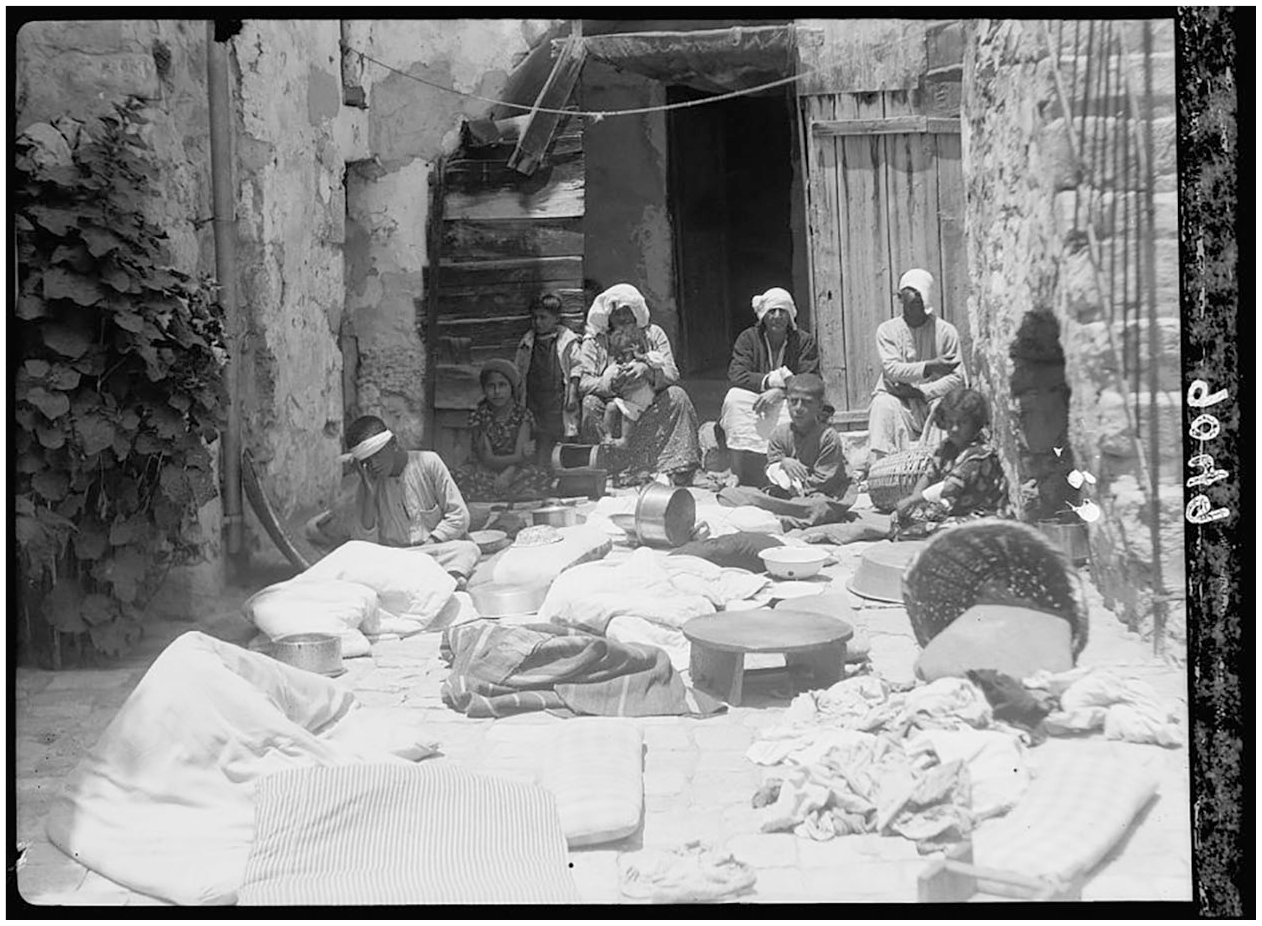
Scene in a Bab Hutta home after an official night raid in a search for arms. Library of Congress.
Figure 2 is also unsettling, not only because it shows an injured child crying and sitting above the broken pots of his home, clearly frightened by the invasion. It is unsettling also because it appears as if there were no agents orchestrating this raid, as if the child broke the pots, injured himself, and just started crying. Like the image of broken grain bins (Figure 3), perhaps the writing on the photo as stored in the Library of Congress today captures enough by its cold description: ‘Halhul village, near Hebron. Interior of a house showing broken grain bins, said to have been wrecked by army in search of arms. Library of Congress.’
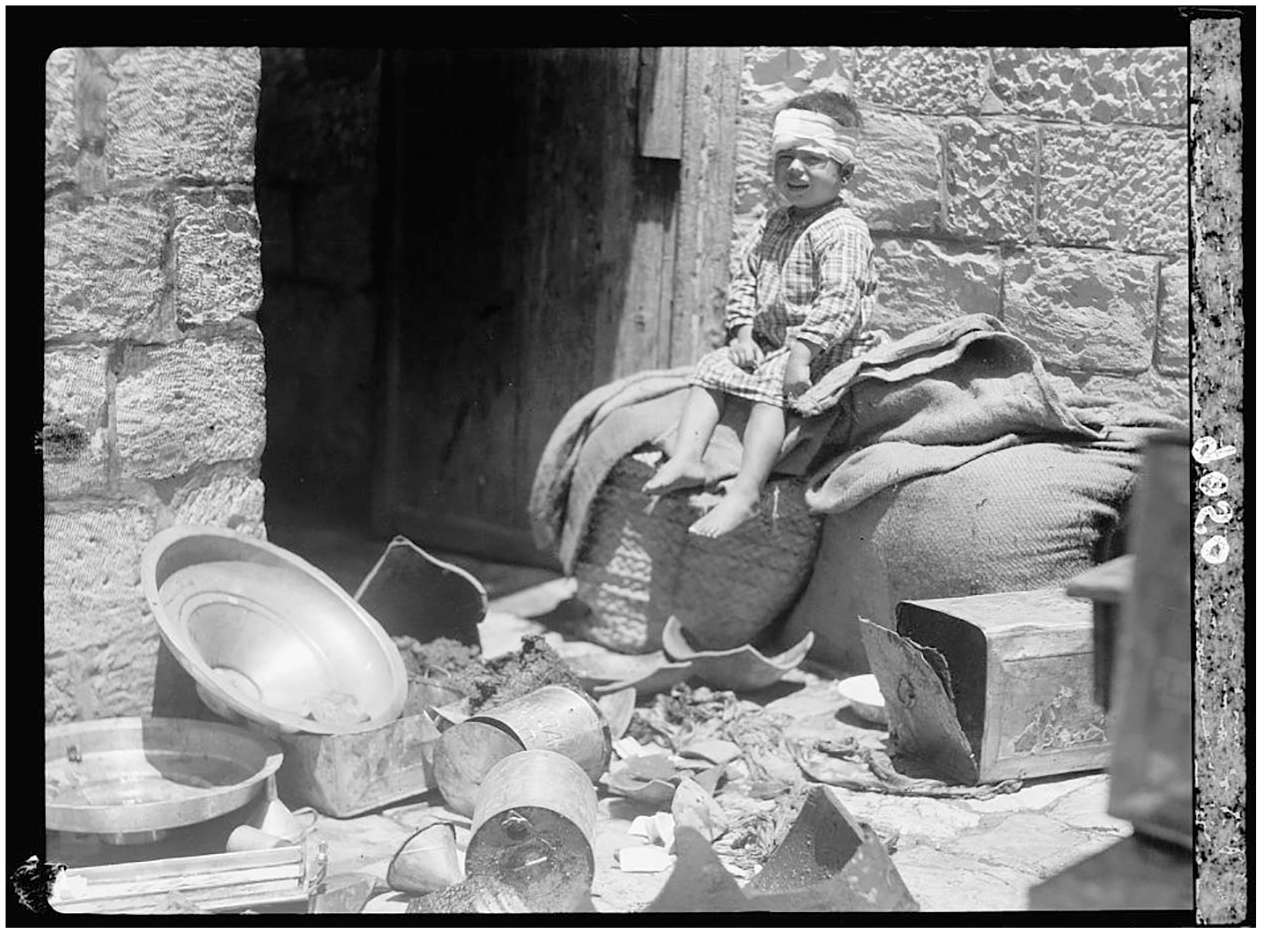
Palestine disturbances, 1936. Broken pots and pans, said to be the effect of an official raid in an Arab house. Library of Congress.
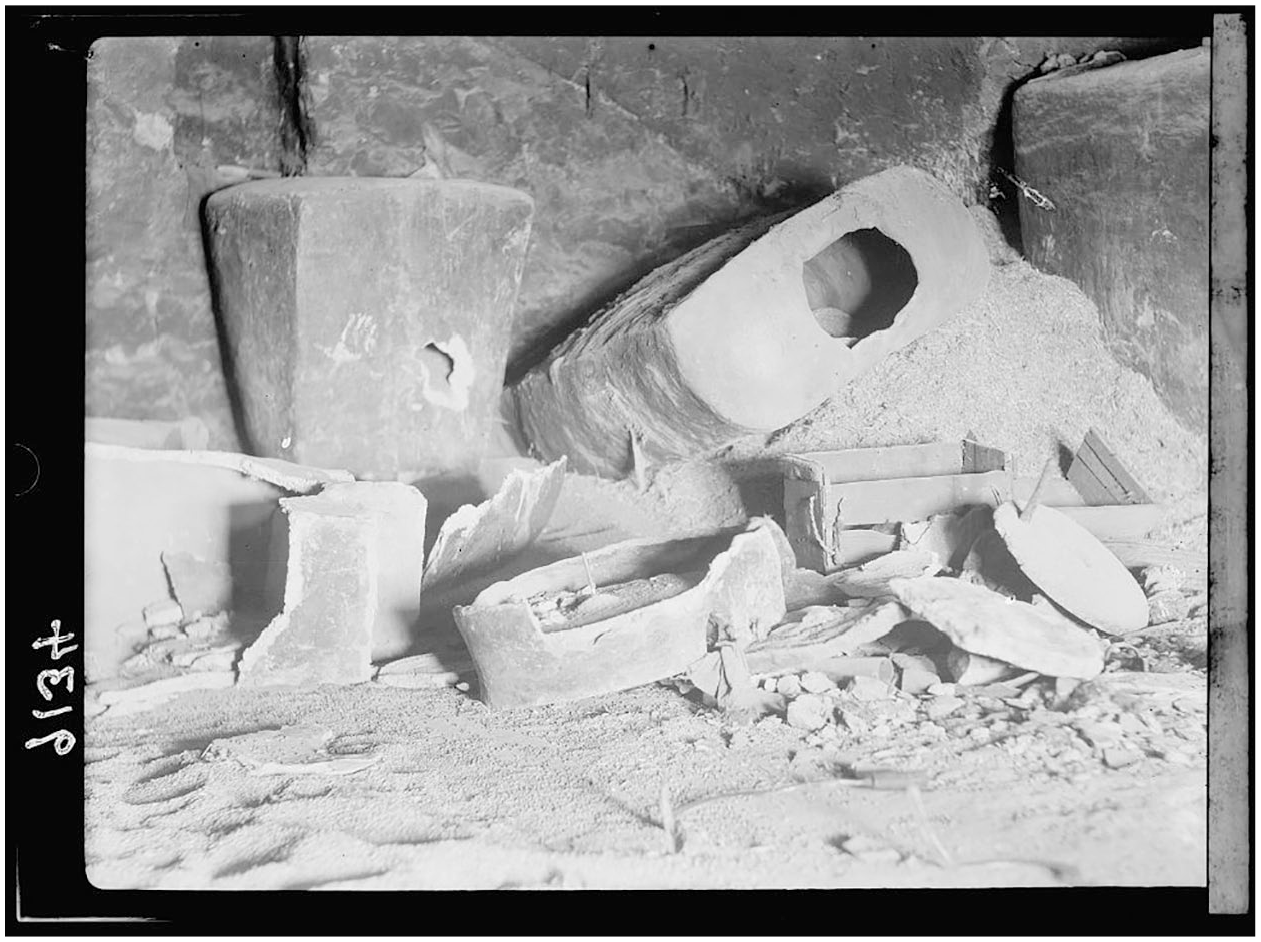
Halhul village, near Hebron. Interior of a house showing broken grain bins, said to have been wrecked by army in search of arms. Library of Congress.
The women would later pick up the broken pots and soiled blankets, wash, fold, and store them back in their places, reversing this spectacle to the mundane order of a household. The repetition of this process would be enacted again with every search party and every night raid. Indeed, the production of the home space is a constant process of making and remaking. While the home is a physical construction of some form, here it is always precarious and subject to threats of invasion and demolition. In resisting that precarity, the home is always becoming, relentlessly reconstituted with every act of violence.
The impressive Marxist-feminist scholarship that has developed from the 1970s until today on social reproduction explains that women’s reproductive labour has been historically devalued under capitalism. While this scholarship is particularly instructive in contesting the traditional gendered Marxist analysis of labour, including the history of primitive accumulation, it is intended to nuance the worker-capitalist relationship by highlighting the centrality of women’s unpaid reproductive labour in capitalist society. Following the tradition that centres this labour in our analysis of exploitation and oppression, I centre the labour of ‘food and water’ to revolutionary action and argue that socially reproductive labour has indeed played a revolutionary role. 7
Many women themselves did not consider this as significant enough to be even mentioned in the oral history narratives collected over the years. When asked about the role of women in the revolution, many peasant women said ‘women did nothing’ (Abdulhadi, 2005: 30; my translation). And in the next breath they would say, ‘we cooked for the revolutionaries, climbed up the hills to deliver the food in hiding, we would dress the men in women’s clothes to hide them from the British and we collected donations for the revolutionaries and their families’ (Abdulhadi, 2005: 30, 47; my translation). One of the women said: ‘[women] would follow them [the revolutionaries] with water, run with them; the one who falls, they help back up; the one who is thirsty, they give water . . . and courageous women used to carry weapons. I myself carried weapons’ (Abdulhadi, 2005: 26; my translation). Salimah Abu ‘Assaf from Haifa remembers that: ‘the revolutionaries were at [their] home, and [she] had prepared milk and bread for them, then the shooting started, killing them all with British guns’ (Palestine Oral History Archive [POHA], 2006; my translation). The wife of Abu Raja also remembers that the rebels would come to her house in the evening with ‘their guns cradled in their arms and their muddy boots on their feet’ (Swedenburg, 2003: 130). They would ask for food, so she would get up and cook for them and give them space to sleep the night. In fact, one of the most common memories of the revolution is the celebration of the rebels’ visit, sometimes even resembling a wedding feast, where people would sing songs and offer food and drink. Many remember the revolution as an event that ‘forged new forms of collective struggle’ and built solidarity within the Arab community (Swedenburg, 2003: 131).
Rasmiyya Al-Barghouthi known by Um al-‘abd narrates the daily schedule of the household during the revolution: ‘we have a system: we would wake up earlier . . . wash and get dressed, and we start distributing [the food items], we finish at 10 am, we go out to the demonstration, and at night we deliver the food to the revolutionaries’ (Abdulhadi, 2005: 33; my translation). Kamilia Shnaik and Fatma Khalil also had a rigid schedule of baking and gathering as much food as possible from the surrounding homes to send to the revolutionaries (Abdulhadi, 2005: 33). While those are familiar and regular everyday acts, they are not necessarily known and seen. ‘It is in the most familiar things that the unknown . . . is at its richest’ (Lefebvre, 2014: 132). Indeed, women were using regular household items to hide their participation in the revolution. In the mountains, and the villages, there was guerrilla fighting, so in places like Bal’a near Tulkarm, a group of women would pass after 10 or 11 at night, carrying bread, water, cheese, and they would ask: ‘young men, who didn’t have dinner yet?’ (Abdulhadi, 2005: 35; my translation). Running the revolution like running the household, women organically created a parallel system that effectively reproduced the revolution for three years. Here, the home becomes a principal site of the social, political, and cultural reproduction of society.
The system was not only about cooking but about devising strategies to circumvent British colonial surveillance of the revolutionaries. For example, Latifa Mahmoud Derbas from Bla’a retold the story of women taking food and water to the revolutionaries. The revolutionaries would eat and move from mountain to mountain, and the women would follow them. When the British army would ask them where they were going with all this water they would say: ‘we are going to the coal mine, we are going to put down the burning coal with the water on our heads . . . we would put a bundle of firewood together and hide bullets inside it and carry it on our heads so that the revolutionaries could share the ammunitions’ (Abdulhadi, 2005: 33, 34; my translation).
This insurgent reproductive work also entailed financing and budgeting for the revolution. Indeed, peasant women would sell their family jewelry to buy weapons for the revolutionaries (Abdulhadi, 2005: 36). During the early months of the strike, women had to manage the home economics of daily life, cutting the household budget in half by relying more creatively on growing food at home, and on mutual aid support between neighbors and family members. As one narrator puts it: ‘If I have more of something, I give to my neighbor, if she has more of something, she gives to me.’ (Abdulhadi, 2005: 60; my translation). Sometimes it’s bread, milk, or any other necessary food item.
The extent to which the rebels relied on the village economy centred the home as a space for hiding, planning, eating, drinking, storing weapons, and building communication networks through the women of the household. Notably also, when the British authorities ordered Arabs to carry identity cards and traffic passes in November 1938, which was one of the early attempts at building a bureaucratic infrastructure of securitization, in response, the Arabs organized a boycott of all British commercial goods. This boycott meant that they had to avoid the road system that was patrolled by the British army to transport commodities, which were brought to the market on the ‘heads of women’ (Swedenburg, 2003: 131). In women’s oral history narratives, they say that once the strike was called for in 1936, all village homes would grow vegetables, grains, and raise chickens, which they would send to the city to avoid buying from the shops and to respect the strike. ‘Tomatoes, cucumbers, radishes, zucchinis . . . with rice, some lentils, and burghul. That’s it’ (Abdulhadi, 2005: 56, 61; my translation). Figure 4 shows fruit baskets being ‘smuggled’ in 1936, demonstrating how women in the villages operated in those parallel networks of self-sufficiency that sustained and reproduced the strike and the revolution that followed. Indeed, peasant women never closed the route between the home and the fields during the strike.
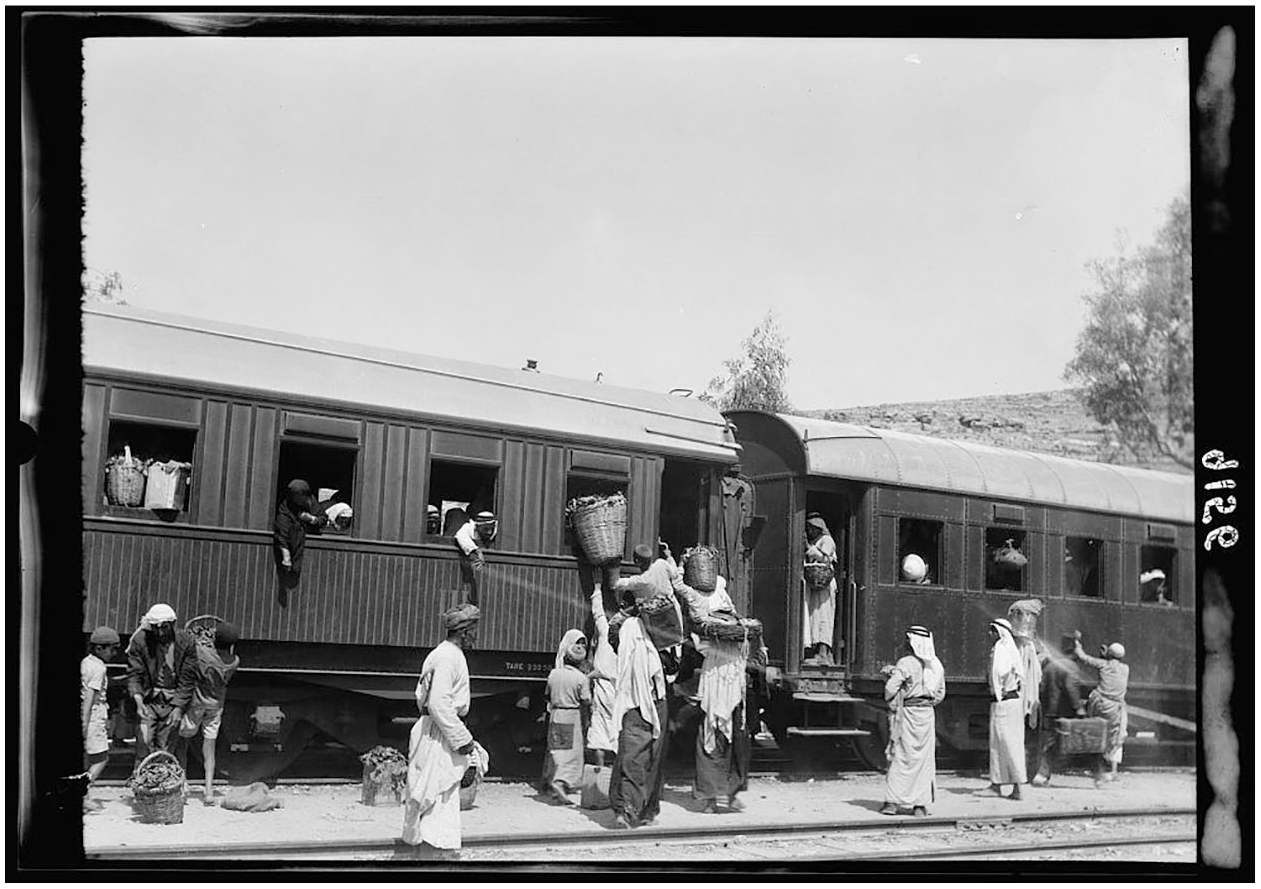
Fruit baskets ‘smuggled’ in passenger cars, 1936. Library of Congress.
Thus the home was connected to the circuit of commercial goods, as it became one of the central fronts of the revolution. See, for example, the temporary vegetable market in Figure 5 that created a transitory economy connecting the home to these forms of makeshift exchange. Indeed, as Maria Mies has put it: ‘[w]ithout women’s responsibility for the continuation of the economy, no successful liberation war can be fought’ (Mies, 2014: 195; Swedenburg, 2003: 179). The revolution helped generate a new infrastructure of social relations, creating different meanings of the homeplace.
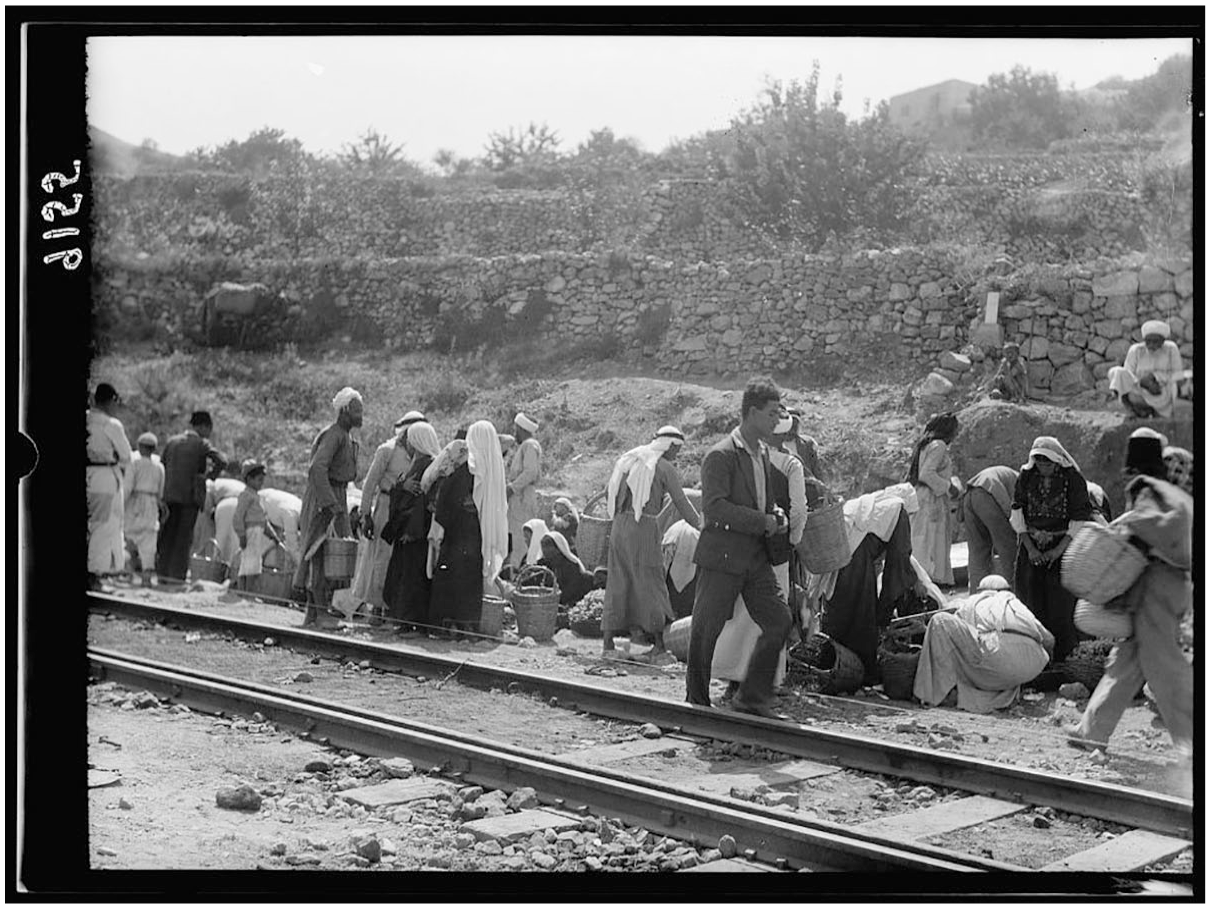
New and temporary vegetable market along the Jerusalem Jaffa railroad line. Scene at the Bittir station. Library of Congress.
In another narrative, Jamila Badran remembers: ‘my mother was a messenger between the revolutionaries. My mother would go from ‘Aroura to Ramallah to Em-Safa to Birzeit and back to Ramallah to deliver the oral messages. My mother couldn’t read and write, so she would only deliver oral messages, such as how to safely move from one place to another, what was the next step, where are the weapons, etc. . . . My mother was a member of the communication network created to deliver messages during the revolution’ (Abdulhadi, 2005: 46; my translation). The narrator Khadra al-Sary remembers women who would beat the British with their hands to release the men caught by the officers. Suad Abul Saud spoke about how young women would throw stones at the British army, a role that became emblematic of Palestinian resistance in the First Intifada of 1987 (Abdulhadi, 2005: 49, 50). Women were central to the revolution that completely paralyzed the country for three years. In fact, the Arab revolt puzzled people in the meeting of the Permanent Mandates Commission (PMC) at the League of Nations. The PMC claimed that it was ‘given a task that was entirely new to it’. Its task was to evaluate the intentions of the mandatory power on the termination of its then 15-year-old mandate, not because of the ‘attainment of maturity by the ward’ but because of ‘the difficulties of guardianship’ (Report of the Commission, 1937: 1090). Palestine was in an open rebellion.
On some level, Palestinian women were also part of this open rebellion. ‘They struggled to create autonomous and beautiful lives . . . and to live as if they were free’ (Hartman, 2019: xiii). The hesitation is because they did not articulate it in those terms, yet our relationship with the past and how we make sense of it changes as time passes. Perhaps reading the Arab home as a revolutionary space could mean rethinking the agents of transformative change today. The revolution did mark a different form of organizing that had to grapple with the complexities of living under patriarchal colonialism as well as local forms of patriarchy in its different manifestations.
In the urban centres, oral history narratives show that there were protests against the forced veil. The rebels had started issuing new ethical and moral edicts that forbade Arab women to follow European hair and dress style, and they imposed on them a forced veil, including the Christian Arab population (Fleischmann, 2003: 133). In fact, many Christian women remember that the veil marked them as Arabs on the streets and presented them as supporters of the revolution. The narrator Samira Khoury remembers: ‘Some women, including my own mother, used to wear the veil during the time of the revolution, but at some point they said this [forced] veil is not for us and we have to fight for our rights and our work . . . at the same time, these same women struggled against colonialism . . . and protested for women’s rights’ (Abdulhadi, 2005: 43; my translation).
The moral edicts forced on women by some of the rebels were also manifested in slogans such as that remembered by Ruqayya Khuri:
‘Umm al-bunya, al-raqqasa
Bidha bomba wa rasasa.’
[The woman who wears a hat, the dancer Deserves a bomb and a bullet.] (Swedenburg, 2003: 181)
This slogan basically threatened women in Haifa with ‘a bomb and bullet’ if one wears a hat, like the Westerners, and behaves promiscuously, like the dancers. Still several accounts describe the women of Haifa going to the market with their children and forcing shopkeepers to observe the strike organized by the rebels. There are clearly class dynamics at play here articulated in the division between the city and the village, but many women were even arrested and charged by the British authorities with ‘intimidating merchants and smashing shop windows’ (Swedenburg, 2003: 177). These class dynamics were articulated in the different memories of women in the village and the city. While peasant woman remembered their role during the revolution through growing vegetables and grains to sustain the strike and later the boycott, in the cities, women’s roles included organizing demonstrations, working with women’s organizations, and supporting detainees. One narrator from a group of urban women said that her father was a trader and, during the strike, they went to Beirut because all Arabs were supporting the strike and no one was working (see Figure 6). Her father and mother stayed in Palestine and sent the rest of the family to Lebanon. While this clear class distinction is very present in oral history narratives, some women in the urban centres continued to do reproductive revolutionary labour by opening their homes to the revolutionaries, giving them food, shelter and a place of hiding (Abdulhadi, 2005: 57, 58).
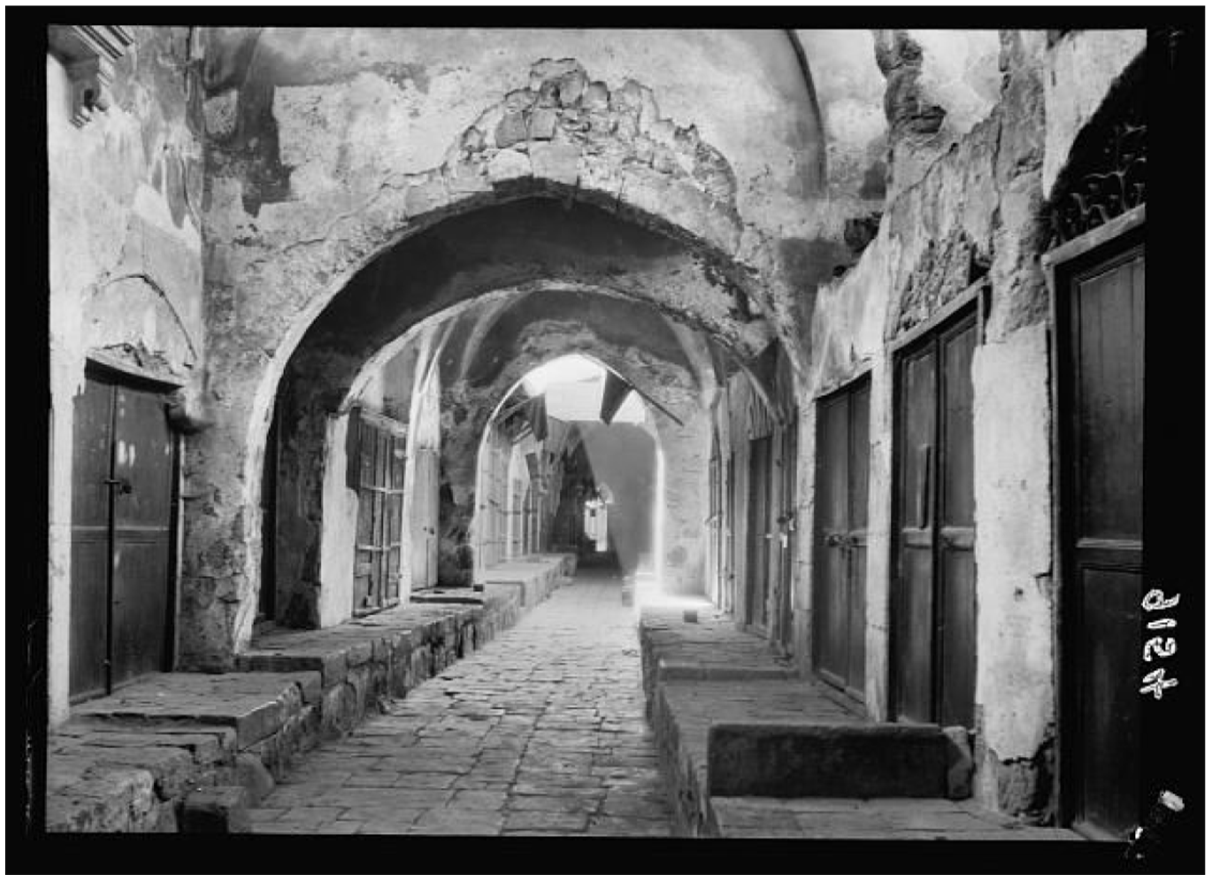
Palestine disturbances, 1936. Deserted scene in jewellers market as it appeared during the months of strike, otherwise a crowded bazaar. Library of Congress.
The narrator Ahmed al-Essawy spoke about the role of Jamila Abdul Jawad from ‘Anata in monitoring the roads and in alerting the revolutionaries of the close arrival of the British army patrols. She would run from her home and stand in the middle of the village and chant a Palestinian folk riddle to warn the revolutionaries:
ياسامعين الصوت صلواعلى محمد، اللي شاف، اللي قام اللي حط يجعله من قلة الأولاد، من قلة شو! من قلة الصغار يلاعب
.الغار،من قلة اللي ينط يداعب القط، نط يا قرد نط
[Those who can hear my voice, pray on Mohammed’s soul. The one who sees, who rises, who puts, make him from the few children, from the few what! From the few little ones who play with the laurel, from the few who tease the cat, jump monkey, jump.] (Abdulhadi, 2005: 48; my translation)
That little riddle rescued many rebels, or so they remember.
This memory is almost like a dream sequence that engages the senses, laying claim on this call as a gesture of indigeneity, and as intimacy with the place and its soundscapes. The imagery of Jamila Abdul Jawad, running from her home to the middle of the village, looking up as she uses her voice that echoes riddles to the hidden barracks of the revolutionaries marks the home as an anchor, a corridor that the revolution both relies on and passes through. 8 These fragments of narratives, gestures and soundscapes of resistance are not in the official state archives. They are assembled as if by montage (Benjamin, 2002: Konvolut N) from family histories, oral narratives, art, and literature. And they show how this archive of the homeplace becomes legible again today in different ways and in a different time. Contemporary dancer Farah Saleh engages with Palestinian memories through an ‘archive of gestures’, a performance which curates hidden stories and movements, a kind of non-linear, subverted mimesis, through dance re-enactments of Palestinian memories of displacement, siege, and partition (Saleh, 2018). Saleh’s work makes us imagine that there is a possibility for life beyond life, or as Kristin Ross would put it in French, ‘survie’, for Jamila’s gestures, an opening that starts a conversation with the past from the present. Ross, writing about the Paris Commune, explains that survie means not the memory or legacy of the event, ‘but its prolongation . . . It is a continuation of combat by other means. In the dialectic of the lived and the conceived . . . the thought of a movement is generated only with and after it: unleashed by the creation and excess of the movement itself. Actions produce dreams and ideas, not the reverse’ (Ross, 2016: 6). By re-enacting those gestures from the past, Saleh brings back those openings in history, the moments from which to seek refuge. Perhaps this conversation of bodily gestures from the past to the present and back is an invitation to rethink the role of the home in times of revolution. Acting in and through the home necessarily implicates it in the struggle. Somehow Jamila’s gestures and the soundscapes of resistance of 1936 become legible then and today in different ways, and in a different time.
Conclusion
Both as a crime scene and as a site of revolution, the Palestinian home is recalled from the past to disrupt a present that is still mired in similar yet new infrastructures of violence. Rediscovering the image of Israeli soldiers watching television as a crime scene is an invitation to rethink our sources of knowledge production that become legible differently as time passes. These rereadings and rediscoveries together assemble a visual and literary archive that not only complicates the traditional narrative of the revolution, but also intervenes in a present danger. Indeed, these fragments of narratives remembered by women who witnessed the revolution are recalled from a present that is yet to escape colonialism in its different manifestations. As Khoury reminds us, the story does not yet have an ending. Today’s security regime that sends bulldozers for home demolitions and soldiers for search parties essentially holds women at the forefront, and places them as the first line of defence. The home then lies at the heart of this ‘dispossessive logic’ (Medien, 2019: 51) of settler colonialism. But the home, as I have argued, is also central to revolutionary history. And here, I want to return to the question of who is a revolutionary and what is revolutionary action?
The history of the 1936 revolution could be read as universal history in the sense that it redeems the past from what was deemed random and insignificant (Adorno, 2006: Lectures 9 and 10). The labour of food and water, often seen as marginal or minor, has its specificities in Palestine but is indeed central to the reproduction of any liberation struggle. To see this, ‘all we need to do’, as Henri Lefebvre reminds us, ‘is simply to open our eyes . . . and we will discover the immense human wealth that the humblest facts of everyday life contain’ (Lefebvre, 2014: 132). The study of the home during the 1936 revolution through the facts of everyday life builds on social reproduction theory to centre the home as a site of theorization and critique. It also complicates the traditional Marxist understanding of revolutionary subjectivity as embodied solely in the sphere of production, showing how other sites of hybridity between production, reproduction, and consumption – manifested here in the home space – have also been central to revolutionary action. This theoretical and political intervention is as much historical as it is urgent. Perhaps the home could be one space from which we can think about resistance to the gendered division of reproductive labour as a fundamental project of liberation against the colonial technologies of the past and the present: against the British watchtowers and their recipes of uncooked rice and olive oil, and against the realities of settler colonial horror today that, once again, makes it all the way to the Arab kitchen. But also, if the home is the space from which we can rethink historical difference dialectically, we cannot ‘only accommodate indigenous difference but also arm a critical project against indigenous versions of domination’ (Chaudhary, 2012: 175). Maybe only when the home becomes a front of the revolution can it partake in this critical project that is both anticolonial and that rejects indigenous versions of domination where the home is still tied up with various projects of colonial capital accumulation orchestrated by the ruling class.
Footnotes
Acknowledgements
I would like to thank colleagues at the Gendering the Arab Archive Workshop, ACSS, Beirut, 2022; Reassessing the British Mandate in Palestine, the Institute for Palestine Studies Conference, Birzeit University, 2022; the Radical Critical Theory Circle, Nisyros, 2024; the Historical Materialism Conference, London, 2024; and colleagues at LSE Sociology for their valuable engagement with my work. I am also particularly grateful to Hashem Abushama, Mahvish Ahmed, Ayça Çubukçu, Hazem Jamjoum, Rami Rmeileh, and Sara Salem for their feedback on this piece at various stages of writing. I thank Faihaa Abdulhadi for sharing with me the incredible oral history project on the role of women in the 1936 Revolution in Palestine.
