



Abstract
Critical commentary about player freedom in videogames usually begins and ends with a critique of the ideology of free will. This focus misses a key way in which actual player freedom differs from the ideology of free will. Actual player freedom lies in the unconscious drive to fail rather than the capacity to make self-interested choices. When players satisfy their drive to fail, they experience a surplus of what Jacques Lacan calls jouissance, or enjoyment. Most videogames mystify our enjoyment by encouraging us to identify with fantasies of pleasure and mastery. But there are exceptions. Killer7 is an example of a game that exposes players to their enjoyment and, in so doing, draws attention to the freedom latent in the drive to fail.
The idea that players could, should, or do have freedom in videogames seems empirically and philosophically dubious. It implies that videogames facilitate boundless interactivity, but even the most ostensibly open-world games are designed to limit player agency in some way. The idea of player freedom nonetheless persists, according to its detractors, because it taps into the liberal ideology of free will. It is in this sense that many would consider the idea philosophically unsalvageable. While some theorists have attempted to save the concept of player agency by drawing on new materialist and realist notions of ‘distributed agency’ (Fizek, 2018; Giddings, 2009; Keogh, 2018; Muriel and Crawford, 2020) and ‘agential realism’ (Janik, 2018; McKeown, 2019; Sicart, 2022; Williams, 2019), it is telling just how few have come to the defence of player freedom. More than player agency, player freedom seems too closely wedded to philosophically outdated – and politically suspect – ideals of autonomy and choice to be of any critical value. Even Zhu (2020: 116), one of few theorists to engage seriously with the idea of player freedom, concludes that videogames can only come close to offering authentic freedom if they ‘compromise [their] “gameness”’. In the face of such unanimous criticism, a theoretical commitment to player freedom seems untenable.
But the problem with this criticism is that it does not adequately distinguish the ideology of free will from actual player freedom. While the liberal conception of free will dominates commonsensical understandings of player freedom, it should never be conflated with actual player freedom. Whenever we define player freedom as a possibility to be realized, as a capacity to do (or not do) something in or outside a videogame, we cede the idea of player freedom to the ideology of free will. As Ruda (2016: 2) puts it, ‘by defining freedom as a personal capacity, we turn freedom into something that a person has and owns, something that is someone’s property and can be invested in multiple ways’. From this perspective, even theorists who promote a politics of videogame play founded on freedom from programmed and industrial constraints remain caught in a liberal conception of free will (see, for example, Boluk and LeMieux, 2017; Consalvo, 2007; Galloway, 2006; Stang, 2019). Player freedom is not a possibility to be realized, nor a capacity to act in one’s self-interest, nor a negation of externally imposed constraints. Whenever we think of player freedom along these lines, we are in the ideology of free will.
Actual player freedom is retroactive rather than futural. It is experienced in videogame play as a choice that has already been made rather than a choice that could be made. More precisely, it is experienced when the player’s unconscious drive to fail, or what Freud (1961) would call their death drive, retroactively exceeds their conscious wish for pleasure. The drive to fail can only be grasped retroactively, after it has derailed the subject’s conscious intentions. As Freud (1958: 299) puts it, ‘[a] choice is made where in reality there is obedience to a compulsion’. The phrase ‘obedience to a compulsion’ seems to suggest that our choices are unconsciously determined and thus radically unfree. But the drive to fail is freeing precisely because of its indifference to the egoistic and social imperative to pursue one’s self-interest (McGowan, 2019a, 2024). Whenever we recognize in our videogame play a drive to fail – and it is my contention that the satisfaction of playing games consists in the repetition of this drive – we also recognize in ourselves an ‘obedience to a compulsion’ that retroactively frees us from our wishful pursuit of pleasure.
When we satisfy our drive to fail, we experience a surplus of what Lacan (1991: 19–20) calls jouissance, or enjoyment. Enjoyment is the ‘horror at pleasure’ of bearing witness to one’s self-destructive patterns and behaviours like a helpless onlooker (Freud, 1955a: 167). The idea that we might be deriving enjoyment from our repetition compulsions is disturbing. But it is also freeing because it reveals that the source of our satisfaction lies not in a yet-to-be-realized future (as the ideology of free will suggests it does) but in a repetition compulsion that retroactively remains in front of any act of self-interest. As Johnston (2002: n.p.) puts it, ‘[j]ouissance is “beyond the pleasure principle” precisely to the extent that it breaks off negotiations with the reality principle, that it bypasses the moderating/mitigating influence of the ego on the drives’. By refusing to bend to egoistic and social pressures alike, enjoyment ‘breaks off negotiations with the reality principle’ (Johnston, 2002: n.p.). To enjoy is not simply to act transgressively or with carnivalesque abandon, however. Enjoyment is instead the index of a self-destructive act. It is political because it reveals that the basis of our solidarity is a shared negativity rather than a shared capacity to act according to our individual interests (McGowan, 2013).
The psychical satisfaction of playing videogames comes from the enjoyment of failure rather than the attainment of pleasure (Nicoll, 2023, 2024). When, for example, we repeatedly play an arcade game only to run up against the same stumbling block, or when our losses in a competitive game drive us to continue playing – and failing – despite ourselves, we know that our unconscious choice to enjoy has retroactively exceeded our conscious wish for pleasure. Most games mystify our enjoyment by encouraging us to identify with fantasies of pleasure and mastery. But there are some that counter this trend by using their ludonarrative structures to expose us to our enjoyment. The political potential of videogame play lies in its capacity to expose us to the freedom of our enjoyment. Although the unconscious choice to enjoy is freeing in any context, videogames are a privileged medium through which to encounter it.
Killer7 (Grasshopper Manufacture, 2005) is an example of a game that exposes players to their enjoyment and, in so doing, draws attention to the freedom latent in the drive to fail. In what follows, I derive a theory of the freedom of player enjoyment from Killer7. My point is not that we can observe our enjoyment while playing Killer7, or even that we can apply psychoanalytic theory to Killer7 to better understand its complex ludonarrative structure, but that Killer7 is itself a theory of the freedom of player enjoyment in textual form.
From Agency to Freedom
Player freedom is rarely theorized on its own terms (for notable exceptions see Gualeni, 2014; Gualeni and Vella, 2020; Zhu, 2020). As Jennings (2019: 89) observes, player freedom is one of several terms, including ‘choice, control, autonomy, and action’, that often gets conflated with the – far more extensively theorized – concept of player agency. For Jennings (2019: 89), the point of this observation is not that we should better distinguish between freedom and agency in videogame play, but that player freedom and related notions are ‘muddling’ the concept of player agency. According to this view, player freedom is a ‘hegemonic discourse’ that corrupts the concept of player agency by reducing the latter to the liberal conception of free will (Muriel and Crawford, 2020: 153). My aim here is not only to demonstrate that a more robust theorization of player freedom is warranted. I also want to reverse the above formulation by claiming that dominant theorizations of player agency, most of which draw on new materialist and realist frameworks, have limited our understanding of player freedom.
Theorists of player agency are right to distinguish the phenomenon of agency from the ideology of free will. If we think of player agency as an individual capacity to act in or outside a videogame, we have already ceded too much ground to the ideology of free will. The fundamental fantasy of free will is that of unrestricted autonomy. This fantasy is politically dangerous because it figures any perceived constraint on individual autonomy as an enemy standing in the way of free will. Of course, there are situations where the desire to overcome external forces in the name of individual or group autonomy is warranted. Indeed, for psychoanalysis, the desire to transgress social authority is a founding gesture of subjectivity (Freud, 1955b; see also McGowan, 2019b: 154–5). But a genuine political project for emancipation cannot be founded on such acts of transgression because transgression always begets more transgression. One cannot attain absolute independence from social authority because while transgression is a founding gesture of subjectivity, subjectivity is ultimately constituted in and through what Lacan (1998: 210) calls its ‘alienation’ in social authority (Flisfeder, 2022; McGowan, 2024; see also Zhu, 2020). Thus, any political project organized around the fantasy of attaining unrestricted autonomy will inevitably encounter an endless series of enemies to fight, just as any videogame player invested in the ideology of free will will inevitably find that even the most open-world games are never open-world enough. It is no surprise that the ideology of free will is core to liberal capitalism, where it works to pit the individual’s ‘freedom of choice’ against a litany of external enemies (the state, socialists, other capitalists, etc.).
To counter the ideology of free will, many videogame theorists advocate for a new materialist or realist conception of agency, wherein agency does not belong to the player but is instead circumscribed in a network of human and non-human relations. According to this line of thought, we feel alienated from our agency not because our access to it is restricted by external forces but because agency is itself a fundamentally alienated phenomenon. As Muriel and Crawford (2020: 144) put it in an article on player agency, ‘the fact that the individual can almost never do what they want to do is not explained by attributing this to an external social force [. . . t]he explanation lies in the idea that action is dislocated’. Agency is not, in other words, the provenance of any one being but is instead a matter of co-constitutive becoming. For many new materialist and realist theorists (and fellow travellers), agency is a ‘distributed’ phenomenon that, in the context of videogame play, consists in the ‘hybrid’ relations between players, developers, computers, texts, and contexts (Fizek, 2018; Giddings, 2009; Keogh, 2018; Muriel and Crawford, 2020; Sicart, 2022; Taylor, 2009). By de-individualizing agency in this way, these theorists aim to decouple the phenomenon of agency from the ideology of free will, revealing that the former is a relational process rather than a player entitlement.
The relational conception of player agency claims to describe ‘a more democratic, more truthful vision of agency’ by virtue of its focus on material arrangements rather than abstract ideals (Keever, 2022: n.p.; see also Sicart, 2022). But for Keever (2022), the problem with this materialist focus is that it is not materialist enough. He argues that notions of ‘distributed agency’ and ‘agential realism’ are really just mystifications of ideological interpellation. Drawing on Louis Althusser, Keever (2022: n.p.) defines ideological interpellation as a sociotechnical process where the ‘corporeal movement’ of living bodies is made ‘legible as a form of “agency”’. Where new materialist and realist theorists see ‘videogames as an entangling of human and nonhuman agencies in democratic assemblages’, then, Keever (2022: n.p.) sees the same old ideological process where ‘concrete individuals’ are interpellated as agential subjects. While astute, Keever’s observation leaves us in the same bind that new materialist and realist theorists sought to get us out of in the first place. He inherits from Althusser (2014: 190) an assumption that, prior to undergoing ideological interpellation, there exists a ‘concrete individual’ – a mythical, unalienated human being.
From a psychoanalytic perspective, new materialist and realist theorists are correct to claim that we are alienated from our agency. However, psychoanalysis offers a very different explanation from those just described as to why this is the case. For psychoanalysis, agency is experienced as alienating not because it is relational or ideological but because it is unconscious. A psychoanalytic theory of the unconscious makes it possible to conceive of an agency, or indeed a form of freedom, that emerges from the subject but is not reducible to the liberal conception of free will. To understand how psychoanalysis makes this move possible, it is important to grasp what it means by the subject.
The subject of psychoanalysis is not the consciously thinking human being or person (Sbriglia and Žižek, 2020). When new materialist and realist theorists take aim at the self-interested subject of liberal capitalism or, in the context of videogame studies, the overentitled player of masculinist gamer culture, they have in mind a historically and culturally constructed notion of the subject as sovereign and self-mastering. While this construction of the subject should be critiqued, the idea that subjectivity is ontologically sovereign and self-mastering has held no philosophical currency since Freud’s discovery of the unconscious at the turn of the 20th century. Freud’s major discovery is that the subject of the unconscious acts contrary to rather than in the interests of the consciously thinking person. The subject of the unconscious satisfies itself by repeating failure rather than attaining pleasure. As Johnston (2002: n.p.) puts it, ‘Neurotics frequently “choose” to repeat painful experiences at the behest of the aspect of Trieb [drive] that unreasonably disregards empirical circumstances’.
By Trieb, Johnston is tacitly referring to the death drive. The subject is impelled by its death drive to circle but never attain its object (Freud, 1961; see Lacan (1998: 178) for a schematic representation of this process). The death drive manifests itself most clearly in what Freud (1960) calls ‘bungled actions’ – acts of self-sabotage that only become identifiable as such after their (oftentimes repeated) occurrence. Bungled actions and other death-driven repetition compulsions are the medium through which the subject of the unconscious asserts its agency. As Lacan (2006: 430) puts it, the subject of the unconscious asserts itself by appearing ‘where I do not think I am thinking’. It is not a mechanism buried deep within the psyche but, as Lacan (see, for example, Lacan, 2014: 131–4) sees it, a topological form that effaces inside-outside distinctions, which is why it so often takes on the uncanny appearance of an external force. In this sense, agency is experienced as alienating not because it is relational or ideological but because it is unconscious.
The freedom of subjectivity is a freedom to unconsciously choose how to destroy oneself. The subject is free because its death drive renders it capable of exceeding its biological and social determinants. Language inaugurates a split in subjectivity that ensures the subject’s unconscious drive to fail exceeds its conscious wish for self-mastery (see Fink, 1995). Rather than defining freedom as a potentiality that is restricted by external forces, then, psychoanalysis locates freedom in the subject’s propensity to retroactively negate itself. As McGowan (2019b: 158) puts it, ‘[f]reedom is the recognition that the subject is the source of its own opposition, that its negation does not rely on any external authority but involves instead its own self-relation’. In place of an external enemy who stands between the individual and their free will, psychoanalysis posits an enemy within – the death drive – that forces the subject to be free from the dictates of their conscious will. In this sense, the subject is free not because it is morally or spiritually superior to other objects and beings but because it can ‘undermine itself rather than just submit to its ruin as other entities do’ (McGowan, 2020: 74).
Enjoyment is the index of our freedom. When the subject satisfies its death drive, it receives a surplus of enjoyment. Most of us would deny that we derive any sort of satisfaction from repeating painful experiences. But as Freud (1961) recognized, if we did not derive satisfaction from our self-destructive patterns and behaviours, we would not find ways of repeating them in ever more elaborate guises. The enjoyment of self-destruction exceeds the pleasure of acting upon one’s self-interest in both a psychical sense (in that enjoyment offers a far greater psychical satisfaction than pleasure) and a temporal sense (in that the unconscious choice to enjoy retroactively exceeds the wishful pursuit of pleasure). Psychoanalysis identifies an opening for emancipatory politics in the negativity of enjoyment, and this is what differentiates it from – and makes it an important supplement to – other theories of political emancipation (McGowan, 2013). Most theories of political emancipation attempt to mobilize subjects around the promise of a better future. But as Freud revealed over a century ago, and Hegel a century before him, the subject ultimately has no interest in pursuing a better future for itself. While the death drive creates a stumbling block for traditional notions of emancipation – how can our political projects be organized around self-negation rather than self-actualization? – it cannot be ignored as it is the condition of possibility for the subject’s freedom. The challenge, as psychoanalysis sees it, is to incorporate the negativity of enjoyment into our political projects in the name of achieving what McGowan (2019b: iii) calls ‘a contradictory revolution’.
Videogame players experience freedom when their unconscious choice to enjoy retroactively exceeds their wishful pursuit of pleasure. Freedom is therefore immanent to the enjoyment of videogame play. It consists in the unconscious choice to repeat experiences of loss and failure rather than the conscious wish to attain unrestricted autonomy. While players know that they find videogames satisfying, my contention is that they typically conceal the source of their satisfaction from themselves by misidentifying it with the attainment of pleasure and mastery. Most games are complicit in this concealment. Just as ‘[c]apitalism’s adherence to the fantasy of success at the expense of the necessity of failure is essential to its functioning’, the fantasy that the satisfaction of playing games lies in the attainment of success rather than the repetition of failure is essential to the game industry (McGowan, 2016: 39). By keeping us focused on our wishful pursuit of pleasure, the game industry, like capitalism more broadly, blinds us to the shared negativity of our enjoyment (see McGowan, 2013, 2016). In this sense, the political potential of videogame play lies in its capacity to not just facilitate enjoyment but to lure players into a confrontation with it. Because the unconscious choice to enjoy can only become apparent retroactively, and because many players are invested in the fantasy that they play games for pleasure, staging an encounter between the player and their enjoyment in videogame play is no easy feat. One game that attempts this task is Killer7, developed by Grasshopper Manufacturer and first published for the Nintendo GameCube in 2005. My aim in what follows is not simply to apply my theorization to Killer7 but to derive a more elaborate theory of the freedom of player enjoyment from Killer7.
Approaching Killer7
Killer7 is a disorienting game. Its narrative skirts around an obscure geopolitical conflict between Japan and the US. Its characters are implicated in this conflict, but it is not immediately clear how. It is surreal – it collapses fantasy into reality in the vein of a noir film. Its play structure remains singular. It takes place in three-dimensional space, but movement is confined to predetermined paths. Holding the A button on the GameCube controller ushers the player character along these paths, while the B button turns them around. The world is depicted from a third-person perspective when the player character is moving (Figure 1), but it is also possible to enter a first-person shooting mode when the player character is stationary (Figure 2). Killer7’s disorienting ludonarrative structure is not simply a product of poor game design. It is a deliberate attempt to disrupt the fantasies of pleasure and mastery that normally inform videogame play. Killer7 tries to expose players to what normally remains unconscious in videogame play – the enjoyment of self-negation – and this is why it is difficult to make sense of at first blush.
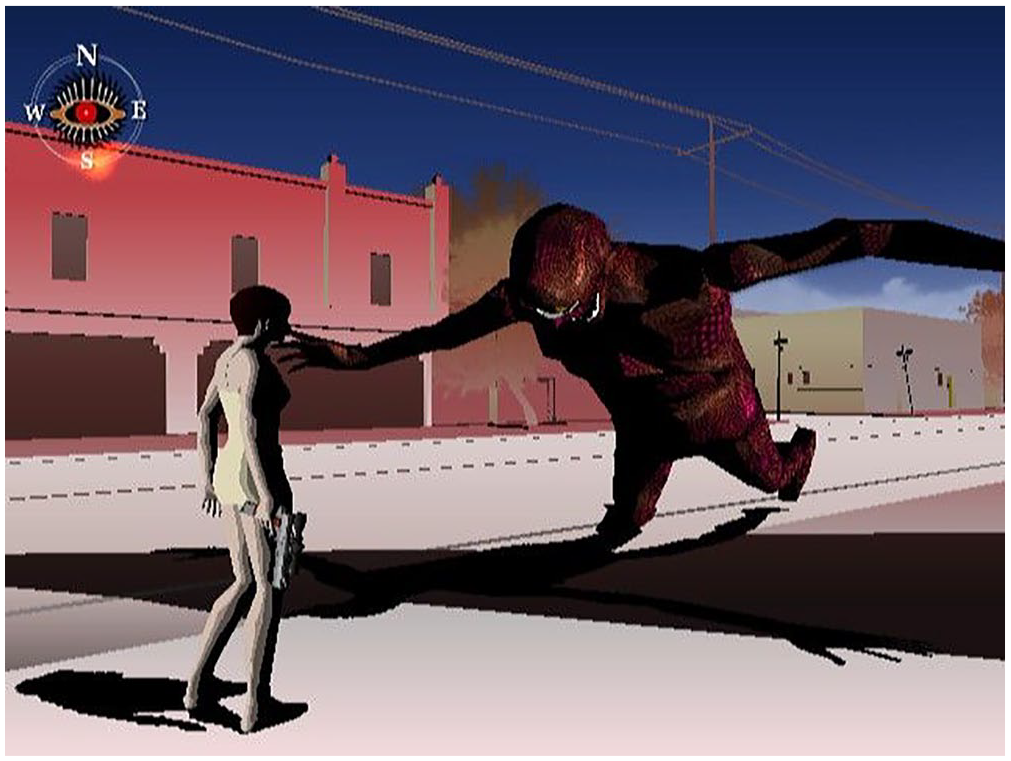
Killer7 screenshot, depicting a Heaven Smile lunging at the player character (Grasshopper Manufacture, 2005). Screenshot from 2005 press kit, retrieved from: https://www.mobygames.com/game/18931/killer7/promo/group-4067/image-49985/
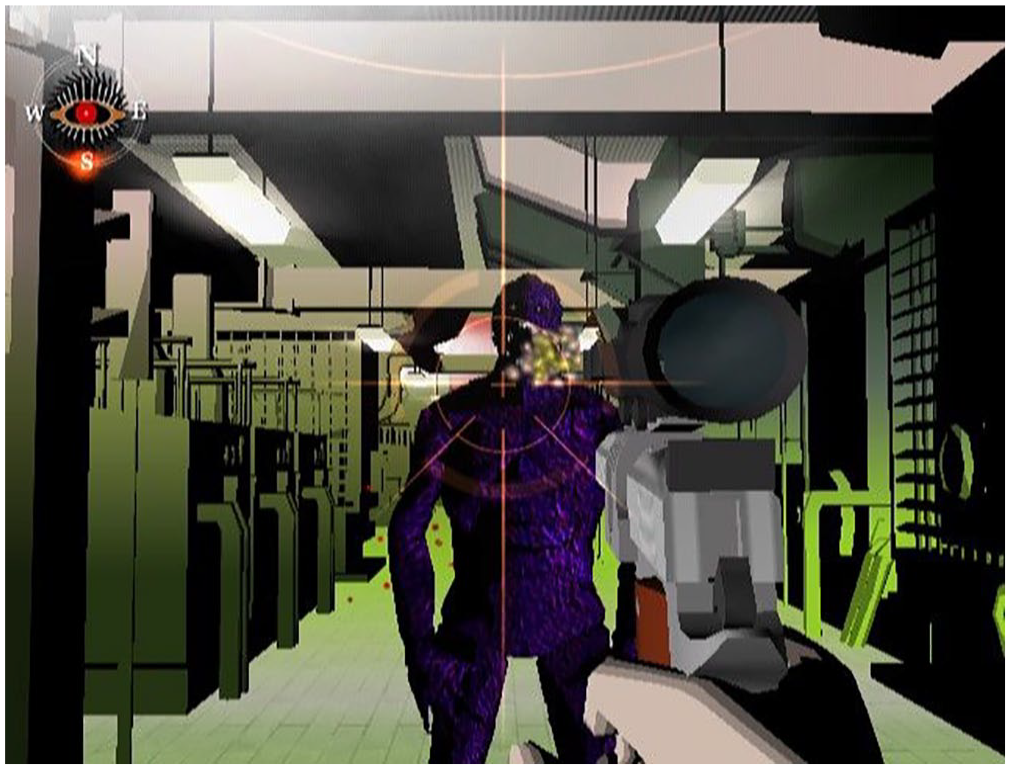
Killer7 screenshot, depicting first-person mode (Grasshopper Manufacture, 2005). Screenshot from 2005 press kit, retrieved from: https://www.mobygames.com/game/18931/killer7/promo/group-4067/image-49992/
Videogames construct experiences wherein players can strive for but repeatedly fail to attain their object (Nicoll, 2023, 2024). This reproduces the process of subjectivation we all undergo as subjects of language. As subjects of language, we are driven to repeat a constitutive loss that marked our entry into the social order (see Fink, 1995). We satisfy ourselves through the repetition and re-enactment of this loss (see Freud, 1961: 8–11 for a famous case study of this phenomenon). The idea that we play videogames to overcome the unpleasure of failure and attain the pleasure of mastery is a fantasy that hides the actual source of player satisfaction – the repetition of loss and failure – in plain sight. Even when we attain the object of our conscious desire by, for example, overcoming a difficult in-game challenge, the pleasure never lives up to the fantasized promise. In this sense, the wishful pursuit of pleasure maps neatly onto the ideology of free will, in that it is premised on a future possibility of unencumbered satisfaction. The enjoyment of loss and failure is where actual player freedom is located, as it points to a kernel of subjectivity that retroactively exceeds the egoistic and social imperative to pursue one’s self-interest.
It is rare for a videogame to penetrate the fantasy structure that alienates players from their enjoyment, but Killer7 does so by allowing enjoyment to permeate the play experience. For this reason, it is best approached as a noir text. Killer7 is noir not only at the level of its content – although its visuals are strikingly noir – but more significantly at the level of its form. According to McGowan (2022), the formal aim of film noir is to reveal how we are implicated in the enjoyment we normally feel distant from in our fantasies. The enjoyment we fantasize as being confined to the corrupt underside of reality is shown in film noir to be immanent to reality. ‘In film noir’, as McGowan (2022: 187) explains, ‘enjoyment doesn’t just remain confined to a separate fantasy space [. . .] but penetrates every aspect of the filmic experience for the spectator’. The classic movement of a noir text is one where the main character comes to recognize their involvement in the corrupt enjoyment they are investigating. ‘As a result’, writes McGowan (2022: 187), ‘one cannot watch a film noir from a safe distance but finds one’s viewing position implicated in the fantasmatic enjoyment one watches’. Killer7 contains many noir narrative tropes. For example, its characters investigate an underground crime network that seems far removed from their reality, only to realize they are investigating themselves. But Killer7 also has a noir play structure, in that it tries to implicate the player in the enjoyment they normally dissociate from in videogame play. I begin by looking at how Killer7 implicates the player in the enjoyment of their death drive. This enables me to establish the groundwork for a theory of player freedom centred on repetition and atemporality.
Repetition and Atemporality
In the fictional world of Killer7, global unease over terrorist violence in the late 20th century precipitates an international effort to end violent conflict. A series of peacekeeping initiatives culminates in global nuclear disarmament in the early 21st century. A period of global peace follows; however, it is cut short by the emergence of an extranational terrorist threat known as the Heaven Smile. The Heaven Smile is a virus of seemingly spontaneous origin that compels its hosts (‘Heaven Smiles’) to suicide bomb uninfected targets. The US government attempts to eliminate this threat by calling upon a special operations group known as the killer7. Playing as members of the killer7, players are tasked with assassinating various figures implicated in the spread of the virus. However, this mission serves only to draw the killer7 – and the player, by extension – into a confrontation with what Lacan (1997: 139) would call the ‘extimacy’, or intimate exteriority, of the Heaven Smile virus. Killer7 thus begins with a speculative scenario where the successful elimination of external threats to global peace precipitates the emergence of an immanent threat in the form of the Heaven Smile. In so doing, it sets the stage for a confrontation between the player and their death drive. But it starts out on familiar ground by locating the death drive in an external enemy rather than in the player.
Through the Heaven Smiles, Killer7 depicts the death drive not simply as a will to destruction but as an ‘uncanny excess of life’ that persists beyond death (Žižek, 2007: 62). The Heaven Smiles are zombie-like creatures that attempt to explode their targets by sneaking up on them undetected (Figure 1). They are characterized by their excessive laughter. The sound of their laughter is the player’s cue to stop what they are doing and enter first-person shooting mode to scan for and shoot at approaching Heaven Smiles (Figure 2). When a Heaven Smile is killed, it lets out a laugh that persists even after its body has disappeared. The Heaven Smiles embody the death drive not simply because they blindly pursue death but because even death fails to put an end to their excessive enjoyment. The death drive is not simply an impulse toward negation. Such a definition is more befitting of the pleasure principle, which holds that pleasure is attained once the subject successfully reduces its excitation. The death drive is instead the repetition of a failure to negate excitation. Enjoyment is the index of this death-driven imperative to repeat. Like the Cheshire Cat’s smile in Alice’s Adventures in Wonderland, which carries on even after the Cat’s body has left the scene, the Heaven Smiles’ laughter in Killer7 is indexical of an undead enjoyment that ‘persists beyond the “biological” cycle of life and death’ (Žižek, 2007: 62–3). In this sense, we might say that the Heaven Smiles are pure subject matter of the death drive. They embody the surplus of enjoyment that persists even when the subject is reduced to a husk of self-relating negativity.
The Heaven Smiles are not the only figures in Killer7 beset by a death-driven compulsion to repeat; so too are the protagonists, the titular killer7. Although the killer7 appear to both the player and the in-game characters as seven individual assassins, they are in fact one assassin – Emir Parkreiner – split into multiple personas. The personas are ‘remnant psyches’ of figures Parkreiner assassinated in a past hit job. The player can switch between these personas to access different abilities. For example, persona Coyote is a master thief who can pick locks and scale tall structures, while persona Con has an acute sense of hearing. Parkreiner is unconscious of his status as the dominant personality – he has no recollection of assassinating the personas and believes he is just another member of the killer7 team – until a series of events late in the game triggers his memories. Through flashbacks, we learn that the way in which each member was assassinated has significance for the special abilities they bring to the killer7 team as remnant psyches. Coyote, for example, dies trying to ambush Parkreiner by anticipating his arrival at a hotel room, but Parkreiner outwits Coyote by emerging through the hotel window rather than the main entrance. Coyote’s lack of cunning returns in the form of the thief abilities he possesses as a remnant psyche. Likewise, Con dies because he is too distracted by his music to notice Parkreiner stalking him. As a remnant psyche, Con brings a heightened sense of awareness to the killer7 arsenal. In this way, Killer7 represents its main characters not as temporal beings moving linearly through time but as atemporal subjects repeatedly returning to the same set of failures without hope of successfully moving beyond them.
Like Heaven Smiles, remnant psyches seem like the stuff of fantasy, but the underlying idea of an atemporal subject who finds satisfaction in the repetition of failure is not a fantasy. The ideology of free will suggests we are unified individuals moving with calculated purpose toward a future in which our desires can be realized. But the subject of the death drive follows a circular temporality rather than a chronological one. This is Freud’s (1961) fundamental observation in Beyond the Pleasure Principle. Freud (1961: 8–11) theorizes that we are driven to return to painful experiences (indirectly, via dreams and symptoms) out of a wish to master them. But because the subject is defined by a constitutive loss that no amount of repetition will propel them beyond, they inevitably get stuck on their repetition compulsions. Enjoyment is the by-product of the subject’s failure to bring repetition to a close. While the subject’s empirical circumstances inevitably change over time, their drive to repeat ultimately resists temporal change (McGowan, 2011: 12). The point here is not that the subject is outside of time – as McGowan (2011: xi) emphasizes, the subject ‘is atemporal and not nontemporal’ – but that the future holds no possibility of escape from repetition. Whereas ‘the subject of desire’ buys into the ideology of a future pregnant with possibilities for fulfilment, ‘the subject of the drive’ recognizes that its enjoyment will always arrive retroactively, by way of a repetition compulsion it cannot master (McGowan, 2011: 26; 16).
The drive to repeat is brought into even sharper focus in Killer7’s play structure. Killer7’s play structure stands out for its blatant disregard for player agency. First, there is the way it limits player movement. Movement in Killer7 is confined to predetermined paths. When the player character hits a fork in the path, it is possible to choose a direction, but this is the only meaningful movement option the game affords. There is also the first-person shooting mode, which can only be accessed when the player character is stationary. Unlike in a typical first-person shooter, then, in Killer7 it is impossible to move and shoot at the same time. There are absurdly simple puzzles to solve – so simple, in fact, that they reinforce the player’s lack of agency rather than enhance it. There are also bosses to fight, but several bosses are so trivial that they require barely any input. Those that do present a challenge tend to test the player on their ability to endure repetition rather than their skill.
The clearest example of Killer7’s critique of traditional notions of player agency is a design mechanic it withdraws from the player within the first few missions. The main challenge of playing Killer7 comes from shooting Heaven Smiles in first-person mode. To survive the opening missions, it is necessary to target the Heaven Smiles’ weak points. This requires precision aiming. But by the third mission, an automatic lock-on skill is imposed on the player. This skill removes the need for manual aiming by making the aiming crosshair automatically target the Heaven Smiles’ weak points. Unlockable skills in videogames usually enhance agency by giving players more tools to work with. Killer7’s automatic lock-on skill, which cannot be disabled once unlocked, has the opposite effect. It strips players of any pleasure associated with mastering the game’s shooting mechanics.
Killer7 is disorienting and repetitive, but much like the Heaven Smiles, whose enjoyment somehow persists despite their repeated attempts at self-negation, player enjoyment somehow persists despite the game’s various affronts to player agency. In this way, Killer7 advances a theory of player subjectivity centred on the enjoyable repetition of loss and failure. Like its remnant psyches, Killer7 perceives the player not as a unified individual moving linearly toward self-mastery but as an atemporal subject caught in the repetition of their death drive. By constantly frustrating the player’s wish to exercise their free will, Killer7 draws attention to the fact that player enjoyment consists in the drive to repeat rather than the attainment of pleasure. I mentioned earlier that Killer7 is a noir text because it implicates us in the enjoyment we normally feel distant from in our fantasies. The primary way it achieves this is through a dialectical convergence of friend and enemy, revealing that the death-driven enjoyment that appeared at first to be on the side of the enemy is homologous with the player’s enjoyment. It is through this dialectical convergence that Killer7 reveals the freedom latent in this enjoyment.
The Enemy Within
Killer7 routinely confuses the distinction between friend and enemy. In the opening mission, the killer7 set out to capture Kun Lan, the leader of the Heaven Smiles. But in a bizarre sequence, the mission culminates not in Kun Lan’s capture but in a friendly conversation between Kun Lan and a member of the killer7 team. In the second mission, the killer7 are contracted by the US government to investigate a Japanese restaurant in Washington, DC. This mission introduces the geopolitical conflict between Japan and the US that drives much of the game’s plot. The killer7 are tasked with assassinating the restaurant’s owner, a former Japanese politician. But as the mission progresses, it becomes clear that assassinating the restaurant owner would significantly exacerbate the conflict. The mission itself takes place in the most Japanese of settings, despite its location in the US capital. These opening missions set the tone for the entirety of the game. It is never quite clear whose side the killer7 are on, what they are fighting for, what the stakes of this fight are, and what the consequences of their actions might be. But Killer7’s confusion of friend and enemy serves an important formal function. Just as the characters are drawn into a confrontation with their involvement in the corrupt enjoyment they are trying to eliminate, so too is the player drawn into a confrontation with the enjoyment they usually dissociate from in videogame play.
The dialectical convergence of friend and enemy takes on broader theoretical significance in Killer7’s ending. In the final mission, Parkreiner discovers his identity as the dominant psyche of the killer7 and, in so doing, realizes that he is nothing but a pawn in the complex workings of the game’s geopolitical conflict. But it is in the epilogue where the dialectical convergence of friend and enemy is made to matter not only for the game’s narrative but for the player and their enjoyment.
In the epilogue, Parkreiner sets out to assassinate Kenjiro Matsuoka, the leader of a Japanese imperialist movement. Matsuoka is found seemingly awaiting Parkreiner in a bunker on Hashima Island (see Gallagher, 2018: 150–2 for an analysis of the significance of this setting). When confronted, he explains that the last Heaven Smile, ‘the big boss’, lies in wait behind a door he is guarding. ‘If you do him, then it means you’ve eradicated all of them’, Matsuoka explains. ‘No more terrorism. Hail to the free world’. But before he lets Parkreiner through the door, he gives the player a choice. Let him live, and he will lead a Japanese attack on the US. Kill him, and the US will seize its opportunity to obliterate Japan. This seems at first to be a deeply consequential choice. However, both options lead to failure – mutual assured destruction – and regardless of the path taken, the door Matsuoka is guarding becomes accessible. In Lacan’s (1998: 212) terms, we might say that this is a ‘forced choice’, in that although the player is given a semblance of free choice – something they have been denied throughout the game – it is a choice that takes the form of an imperative to follow the developer’s intentions (see Jackson, 2014; Stang, 2019). If Killer7 ended here, we could conclude that it amounts to little more than a garden-variety critique of player agency. But it goes a step further.
Behind the door, the player finds Iwazaru, a non-playable remnant psyche who has acted as a mentor to both the killer7 and the player throughout the game. Although he is a psychical apparition, Iwazaru is the killer7’s closest confidant. Behind the door, Iwazaru’s normally obscured face becomes visible as that of Kun Lan’s. Kun Lan is the figure responsible for the spread of the Heaven Smile virus. By depicting the last Heaven Smile as an enemy within rather than an external adversary, Killer7 makes visible the link between the enjoyment of the Heaven Smiles and the player’s own enjoyment. Just as Killer7’s noir narrative reveals Parkreiner’s involvement in the corrupt enjoyment he spends most of the game investigating, its noir play structure reveals that the player’s enjoyment is homologous with that of the death-driven enemies they have fought throughout the game.
Killer7 mounts a scathing critique of free will. By the game’s end, Parkreiner is not even master of his own house, let alone the obscure political forces buffeting him around. The game’s repetitive action, mindless puzzles, and fake boss encounters are designed to frustrate the desire for agency. Free will in videogame play is indeed an ideological myth, as Matsuoka’s forced choice implies. Free will is always and already foreclosed by forces beyond the player’s control. But the unconscious choice to enjoy retroactively exceeds the unfreedom of the forced choice, which is why the discovery of Iwazaru’s identity occurs immediately after the forced choice has taken place. Despite Matsuoka’s promise, behind the curtain of the forced choice we do not find an ‘Other of the Other’, a ‘big boss’ who was pulling the strings all along. The actual discovery is far more horrifying: we are the source of our own opposition. Freedom in videogame play is this capacity to retroactively negate oneself. Enjoyment is the mark of this freedom, but the problem is that players do not typically identify this enjoyment as their own. They tend instead to impute their enjoyment to an external enemy, which enables them to continue investing in the fantasy that they are playing for pleasure and mastery.
The confrontation with Iwazaru forces the player to take responsibility for their enjoyment and the freedom it imposes on them. To end the game, the player must shoot Iwazaru by entering first-person mode. The final act of play therefore constitutes what Žižek calls a ‘strike at oneself’:
In a situation of a forced choice, the subject makes the ‘crazy’ impossible choice of, in a way, striking at himself [. . .] This act, far from amounting to a case of impotent aggressivity turned against oneself, rather changes the co-ordinates of the situation in which the subject finds himself: by cutting himself loose from the precious object whose possession the enemy kept him in check [sic], the subject gains the space of free action. (Žižek, 2000: 150, emphasis in original)
Rather than conceptualizing freedom as a ‘precious object’ withheld from us by forces beyond our control, in Killer7 freedom is an act of self-negation. By striking at Iwazaru, the player symbolically strikes at themselves. In so doing, they undermine the ideology that satisfaction can only be attained by overcoming external obstacles. The discovery of Iwazaru’s identity as the enemy within, and the subsequent act of striking at this extimate figure, suggests that the player’s enjoyment was always and already a matter of self-negation.
The ideology of free will suggests that the only thing standing between the individual and their freedom is external negation, but actual freedom lies in the recognition that negation is immanent to subjectivity rather than external to it (McGowan, 2019b: 158). The appropriate response to this recognition is not to dispense with external authority by retreating into a private universe of self-negating enjoyment. As Flisfeder writes, ‘Authentic freedom [. . .] is not the freedom to surpass or resist the law, but that of giving it to ourselves – to assert our own self-limitations, or the inherent affirmation produced out of the fundamental negation’ (2022: 142, emphasis in original). Zupančič (2000: 41) articulates this seemingly contradictory position as follows:
the subject of freedom is indeed the effect of the Other, but not in the sense of being an effect of some cause that exists in the Other. Instead, the subject is the effect of the fact that there is a cause which will never be discovered in the Other; she is the effect of the absence of this cause, the effect of the lack in the Other.
When we take inventory of the social determinants that produce the subject (what Zupančič here calls the Other), we inevitably hit a point where such determinants fail to explain why the subject does what it does (what Zupančič here calls the lack in the Other; see also Rothenberg, 2010). When the subject encounters this lack in the Other – this point at which their determinants fail to explain why they do what they do – they have an opening through which to retroactively come into being as their own cause. As Fink (1995: xiii, 62) puts it, ‘where the Other pulls the strings (acting as my cause), I must come into being as my own cause [. . .n]ot “It happened to me,” or “They did this to me,” or “Fate had it in store for me,” but “I was,” “I did,” “I saw,” “I cried out.”’ Žižek sees this retroactive act of coming into being as one’s own cause as inherently freeing. As he puts it, ‘“Freedom” [. . .] is not simply a free act which, out of nowhere, initiates a new causal link, but is a retroactive act of endorsing which link or sequence of necessities will determine me’ (Žižek, 2010: xiii).
The Iwazaru encounter in Killer7’s epilogue provides an opening for such a retroactive act. It enables the player to recognize the role their enjoyment has played in the very negations that seemed at first to be externally imposed on them and, in so doing, to come into being as the cause of these negations. For McGowan (2019b: 167), this retroactive act of ‘seeing oneself in absolute otherness’ is consonant with ‘recognizing the insubstantiality of the Other’. Where the ideology of free will sees external authority as an enemy to overcome, psychoanalysis sees external authority as a necessary obstacle through which to come into being as the source of one’s own opposition. In this sense, it is only by encountering limitations in videogame play – the very limitations that many decry as obstacles to free will – that players can discover the freedom latent in the enjoyment of self-negation.
Conclusion
If the idea of freedom as self-negation seems counterintuitive, it is only because we have ceded too much ground to the liberal conception of free will as doing whatever you feel or want. Self-negation is freeing because it points to a kernel of subjectivity that retroactively exceeds the egoistic and social imperative to pursue one’s self-interest. Enjoyment, as I have argued, is the index of this freedom. When we enjoy, we recognize in ourselves a choice to repeat negativity – a choice that always arrives retroactively, as if it were made in ‘a past that was never present’ (Dolar, 1996: 132, emphasis in original). Instead of identifying player freedom in the fantasmatic pleasure of doing whatever you feel or want, psychoanalysis identifies it in the enjoyable compulsion to repeat negativity. Enjoyment is not simply a term for transgressive or carnivalesque hedonism. If it were, it would be a matter of free will, as the ideology of free will always depends on the figure of an external enemy to transgress. Enjoyment is instead the index of a self-destructive act. While enjoyment in videogame play is normally obscured by fantasies of pleasure and mastery, games such as Killer7 attempt to expose us to it. It is no coincidence that a game that so fiercely critiques free will is among the most freeing to play. Killer7 foregrounds the fallacy of free will to facilitate an encounter with the freedom of enjoyment.
It is about as unfashionable today to claim that videogames have a fundamentally political potential as it is to defend player freedom. While early videogame theorists celebrated the medium’s potential to facilitate playful spontaneity, many contemporary theorists would consider this idea naïvely, or perhaps even dangerously, utopian (see, for example, Soderman, 2021; Trammel, 2023). The idea that videogames facilitate playful spontaneity does indeed hew too closely to the liberal conception of free will. But we should not give up entirely on the idea that videogame play harbours a fundamentally political potential. We must look for this potential where we are neither theoretically accustomed nor psychically disposed to looking for it: in our enjoyment of failure. As McGowan (2019a: n.p.) argues, the political orientation we must adopt in relation to our enjoyment is one of reconciliation. When we reconcile ourselves to our enjoyment, we undermine the fantasy of free will that maintains an ideological hold over us. By recognizing that negation is immanent to subjectivity rather than external to it, we hit up against a lack in the Other, a shared negativity through which to act politically (see McGowan, 2013). Videogames are the ideal medium through which to reconcile ourselves to our enjoyment in this sense.
Footnotes
Acknowledgements
I would like to thank Rob Gallagher, Brendan Keogh, Laurent Shervington, Erix Verkaaik, Britt Wilkins, Feng Zhu, the anonymous reviewers, and the TCS editors for their helpful feedback on earlier drafts of this article. This work was supported in part by an Australian Research Council Discovery Grant (DP230102727).
