




Abstract
The messy politics of combating the COVID-19 pandemic, compounded by the confusion caused by the global (dis)infodemic, have propelled conspiracism from the fringes of society into the public mainstream. Despite the growing political impact of digitally enabled conspiracy theories, they are predominantly delegitimized on three fronts – as psychopathology, pseudoscience, and/or parapolitics. In contrast, this article employs three non-pathologizing conceptual counteroffers borrowed from critical theory, deconstructionist historiography, and citizenship studies – namely, cognitive mapping, narrative emplotment, and performative citizenship – to politicize conspiracy theorizing ‘from below’. Using QAnon as a case-in-point, the article introduces two novel concepts that invite a sociological approach to conspiracism: first, the epistemic communities of the unreal, which designates the participatory, interactive, and decentralized nature of collaboratively creating unreal explanations of the real world; and second, grassroots conspiracism, which denotes the ways in which these bottom-up, horizontal, and collective meaning-making practices and knowledge-production processes are expanding spaces of and for politics.
Keywords
Introduction: From Pathologizing to Politicizing Conspiracy Theories
Conspiracists have hitherto only interpreted the world in various ways; now, their goal is to change it. Two decades ago, Anthony Giddens (2002: 71) addressed the unpredictable and destabilizing nature of globalization, arguing that its ultimate outcome would be a global society ‘fraught with anxieties’ and ‘scarred by deep divisions’, one in which ordinary people would be ensnared in the ‘grip of forces over which [they] have no control’. Nevertheless, by focusing on the tectonic shifts initiated by national governments, international organizations, and transnational corporations, Giddens ignored the incremental disruptions generated by new information and communication technologies (Mason, 2022; Rogers, 2023). With social media platforms as a key nexus of social interactions today, we now face these low-intensity subversions on a daily basis, which in turn foster the emergence of global movements challenging the official narratives of just about everything: from the necessity of vaccines to the shape of our planet.
Isolated in their homes and constantly bombarded with contradictory (mis)information during the COVID-19 pandemic, people around the world have been confronted with competing, shifting, and often conflicting expert-informed national strategies to combat the spread of the coronavirus. Their ensuing mistrust in official institutions mirrored the recognition of inherent imperfections in scientific knowledge and the inadequate preparedness of public authorities in tackling unfamiliar threats (Jennings et al., 2021; Kużelewska and Tomaszuk, 2022; Philipp-Mullera et al., 2022). 1 Algorithm-driven data designed to target specific demographic groups eventually transformed their skepticism-turned-denialism into lenses through which they began to see completely different realities (Birchall and Knight, 2023; Zoglauer, 2023). Ultimately, the messy politics of combating the global pandemic, coupled with the noise generated by the associated (dis)infodemic, led to an unintended consequence – a perfect storm of populism, pseudoscientism, and conspiracism within the public sphere (Ringe and Rennó, 2023; Thompson and Smulewicz-Zucker, 2018). Instead of fostering critical reflexivity among the citizenry, I argue that Giddens’ (2002) proposed solution to global challenges has become a political issue in its own right: the engagement of laypersons with experts in issues characterized by imperfect knowledge has escalated information-cum-symbolic pollution, giving conspiracist overtones to various civic initiatives aimed at regaining a sense of control in the face of a growing feeling of unreality (Butter and Knight, 2023; Rogers, 2023). Namely, the combined acts of questioning political values, debating civic duties, updating imperfect knowledge, and redefining social norms in the pursuit of ‘democratizing democracy’ during times of uncertainty have inadvertently paved the way for the proliferation of conspiracy theorizing ‘from below’.
While QAnon can be politically described as a ‘distasteful social movement’ (Eyerman and Esseveld, 1992), epistemically it can be seen as an ‘inevitable outgrowth of the Unreal’, which refers to ‘an approach to politics that forsakes interpretation of a common set of facts in favor of creating closed universes of mutually reinforcing facts and interpretations’ (Zuckerman, 2019: 4). The idea around which this cult-like movement emerged – that a secret cabal of Satan-worshipping and cannibalistic pedophiles is controlling the world through the deep state – may sound absurd; yet, what seems unreal to some may gradually become a phenomenological reality for others (Aaronovitch, 2010; Dentith, 2018; Zoglauer, 2023). Notwithstanding their ideological distance from the political mainstream, conspiracists are still comprehensible human beings. 2 Accordingly, I use QAnon as a case-in-point to illustrate the ways in which bottom-up, horizontal, and collaborative conspiracy theorizing, powered by platformization and gamification, meets the inherent needs of its adherents for meaning, purpose, certainty, community, and agency in instances when official institutions fail to provide these essentials. In the deeply disturbing conspiratorial scenario where an all-powerful satanic secret society of child-blood drinkers is believed to be running the world, a sense of epistemic comfort and political consolation for QAnon believers lies precisely in the existence of a network of likeminded peers who come together to expose and thwart this evil (Bloom and Moskalenko, 2021; Rothschild, 2021). By depathologizing conspiracism, I argue, we can gain a deeper understanding of the reality of political (dis)alienation in today’s, to borrow Giddens’ (2002) expression, ‘runaway world’.
Given that conspiracy theories are not only deemed ‘something we are not permitted to think but also the very subject is something we are not permitted to take seriously’ (Robertson, 2017: 6), the meaning-making practices and knowledge-production processes through which conspiracists understand, frame, and justify their phenomenological (un)reality remain yet to be explored. 3 For that reason, this article approaches conspiracism as an ‘epistemic community’ – that is, a network of individuals from diverse backgrounds who share intersubjective understandings, patterns of reasoning, and ways of viewing the world, and who are committed to creating, applying, and validating knowledge based on their shared communal beliefs, symbolic codes, and discursive practices (Haas, 1992; Meyer and Molyneux-Hodgson, 2010). By scrutinizing the most conspicuous manifestation of right-wing conspiracism in the digital era, this article postulates a non-pathologizing conceptual toolkit for understanding how conspiracy theories arise, spread, and persist at the grassroots level. 4
Accordingly, the article begins with a critical assessment of the pathologizing analytical vocabulary currently in use. It then employs three non-pathologizing conceptual counteroffers borrowed from critical theory, deconstructionist historiography, and citizenship studies – specifically, cognitive mapping, narrative emplotment, and performative citizenship – to address this issue. Finally, it introduces two novel concepts that invite a sociological approach to conspiracism: first, epistemic communities of the unreal to designate the participatory, interactive, and decentralized nature of collaboratively creating unreal explanations of the real world; and second, grassroots conspiracism to denote the ways in which these bottom-up, horizontal, and collective meaning-making practices and knowledge-production processes are expanding spaces of and for politics.
The Conspiracist Zeitgeist: Politicizing Knowledge ‘From Below’ in the Post-Political Condition of the Post-Truth Era
The contestation of official knowledge has emerged as a critical concern in the ‘post-truth era’ (McIntyre, 2018; Zoglauer, 2023). Online actors are free to weaponize new media technologies to propagate pseudoscientific ideas, foster anti-intellectual sentiments, spread misinformation and disinformation, and create manipulated text, images, and statistics about major problems (Bradshaw and Howard, 2018; Woolley and Howard, 2018). These actions obscure the factual verification of crucial socio-political challenges, rendering evidence less influential in shaping public opinion than appeals to personal emotions and beliefs (Dahlgren, 2018; Nichols, 2017). Moreover, the COVID-19 pandemic has mainstreamed previously fringe debates on who decides what is true, on what grounds, and by what means (Birchall and Knight, 2023; Ringe and Rennó, 2023). The result was a unique global (dis)infodemic that transformed even ‘technical issues’ like mask-wearing and vaccination into matters of ideological disputes on personal freedoms, civil liberties, and human rights.
This epistemic crisis coincided with the ‘post-political condition’ that exacerbates the political ramifications of such skepticism-turned-dissent. This condition is characterized by highly formalized procedures of representative democracy that effectively reduce political action to public administration and, through the delegation of authority to seemingly neutral experts who often legitimize the interests of the establishment, expunge numerous political issues from public debate (Crouch, 2004; Žižek, 1999). As elected officials and business interests influence politics beyond the scrutiny of the public, political activity becomes confined to the technocratic functions of administering social, economic, political, cultural, and other issues within parameters set by elite consensus (Brown, 2005; Rancière, 1999). Consequently, post-political societies become less receptive to radical ideas expressed through collective actions, leaving politics hollowed of its substance (Mair, 2013; Wilson and Swyngedouw, 2014). It is important to note that the democratic quality of these subversive ideologies and contentious actions coming ‘from below’ is dependent on a well-informed citizenry – a quality that has sharply declined during the COVID-19 (dis)infodemic.
Algorithm-driven ‘filter bubbles’, ‘feedback loops’, and ‘echo chambers’ within ideologically and epistemologically closed ‘communities of belief’ have created a politically charged ‘denial industry’ among ordinary people (Nichols, 2017; Rogers, 2023). Consequently, instead of functioning as the ‘marketplace of ideas’ – a utopian ideal in which ‘the truth’ emerges from the competition of different (evidence-based) opinions – social media has become a space where ‘alternative facts’ and ‘fake news’ circulate as truth-claims (Kim and Gil de Zúñiga, 2021; Smith and Wanless, 2020). When public debates are defined by ‘competing conceptions of the real’ (Dean, 1998: 24; see also Kużelewska and Tomaszuk, 2022), growing suspicion targets not only political elites but also scientific authorities. Within distrustful segments of society, ‘mainstream science’ becomes viewed as equally corrupt, leading to its diminished ability to legitimize what counts as genuine knowledge and good policy among these demographics (Thompson, 2008; Ylä-Anttila, 2018). The digital citizenship emerging from this radical doubt is characterized by a lack of confidence in scientific institutions, suspicion, if not outright rejection, of democratic dialogue with mainstream political actors, and an inclination towards adopting conspiracism as a worldview (Hellinger, 2019; Rosenblum and Muirhead, 2019). Hence, one could argue that the post-political condition of the post-truth era has ushered in a conspiracist zeitgeist, wherein personal emotions, perceptions, and beliefs serve as instruments in the (collective) quest for gnosis about conspiracies shaping our social world. The militant conviction that obtaining this esoteric knowledge is the sole path to the liberation of the people infuses highly politicized conspiracist content into the post-political void.
In summary, the gradual erosion of consensus on what was previously considered a shared reality has resulted in fragmented (political) unrealities. With ‘truth’ imagined as being hidden behind veils of deception and machinations of the establishment, it is unsurprising that right-wing conspiracism has become entrenched as an alternative mode of explanation for the non-transparent workings of the power elite – an idea which has traditionally been critiqued from the left as a structural problem of late capitalism. Grassroots conspiracism, exemplified by movements like QAnon, has proven to be a powerful vehicle for reflexive musings on ‘democratizing democracy’ in the post-political condition of the post-truth era. By recognizing the dissensus on what collective reality is, which only highlights inconsistencies in shared truths, conspiracists assert epistemic control about how the world works and articulate radically different political ideas about how it should work. Studying their symbolic, discursive, and material practices as political – not pathological – is of utmost importance.
The Three Stigmas of Conspiracist Ideation: Psychopathology, Pseudoscience, Parapolitics
Throughout history, conspiracy theories have been regarded as legitimate means for interpreting reality within various segments of society (Butter, 2014), appealing to ‘both marginalized groups and the power elite’ (Melley, 2000: 7). By the end of the 20th century, however, there was a notable shift in public perception towards conspiracism, which came to be seen as an illegitimate form of knowledge (Thalmann, 2019). Despite its epistemic delegitimization, conspiracist narratives retained political relevance, remaining ‘many people’s normal way of thinking about who they are and how the world works’ (Knight, 2000: 2). The rapid surge of populist politics in the past decade has witnessed the convergence of its key ideologemes, such as the ‘oppressed but moral people against the corrupt and self-serving elite’, with fundamental conspiracist tropes, thereby propelling conspiracism from the fringes of society into the public mainstream (Fenster, 2008; Hellinger, 2019). 5 Given the recent relegitimization of conspiracy theories by right-wing populist politicians and their mainstream media mouthpieces, we can indeed speak of the conspiracist zeitgeist.
Yet, must there not surely be something real that fuels this ‘culture of conspiracy’ (Barkun, 2003; Knight, 2000; Melley, 2000)? We live in an age in which abuses of power by authority figures have effectively weakened the fabric of social trust, and repeated failure to correct ongoing ethical breaches makes it harder to rebuild. In recent decades, individuals like Julian Assange and Edward Snowden have brought to light numerous covert government activities. Before that, public disclosure of the US government-supported programs such as MK-Ultra, COINTELPRO, and Operation Northwoods gave legitimacy to long-standing Cold War conspiracy theories about mind-control experiments, infiltration activities, and false flag operations (Melley, 2008; Olmsted, 2009; Willman, 2002). These cases demonstrate that, empirically speaking, it is implausible to argue that belief in conspiracy theories is entirely delusional (Brotherton, 2015; Coady, 2006; Dentith, 2018). 6 It is thus crucial to distinguish between conspiracies as ‘typical social phenomena’ (Popper, 2013: 307), as seen in these clandestine government operations, and the idea of a ‘“vast” or “gigantic” conspiracy as the motive force in historical events’ (Hofstadter, 1996: 29), such as the narratives espoused by movements like QAnon. Nonetheless, despite the widespread presence of conspiracy beliefs across all societies and their capacity to transcend cultural barriers (Aaronovitch, 2010; Andrade, 2020; Brotherton, 2015; West and Sanders, 2003), scholarly literature has predominantly framed conspiracist ideation in a pathologizing manner, resulting in its stigmatization on three main fronts: psychological, epistemological, and political.
The first approach often diagnoses conspiratorial thinking using psychopathological vocabulary. For instance, the clinical framework of paranoia is frequently employed to explain the presence of conspiracy beliefs, even though the term was initially used figuratively to describe conspiracists’ Manichaean worldview (Hofstadter, 1996). The focus on how a delusional mind copes with and navigates an unfamiliar environment – or, more precisely, articulates the ‘fear of a nonexistent conspiracy’ (Pipes, 1997: 21) – has eventually established a relationship between conspiratorial thinking and paranoia ‘so strong that the two terms are now treated as almost synonymous’ (Byford, 2011: 121). This psychopathological association was further extended to encompass various types of conspiracy mentality, schizotypy, and even psychosis (Darwin et al., 2011; Galbraith, 2021; Robins and Post, 1997). Despite facing frequent criticism for suggesting that various segments of society suffer from psychological issues, the ‘notion that there is something mentally “wrong” (or at least deviating from “normal”) with conspiracy theorists is still widespread in these research traditions’ (Harambam, 2020: 15). This emphasis on psychological factors tends to detach conspiracist ideation from the nexus of social, cultural, and political dynamics that give rise to conspiracy theories, confining it to the clinical realm of personality traits, cognitive challenges, and mental disorders.
The second approach highlights the pseudoscientific nature of conspiracy theories. Within this research tradition, conspiracy theories are treated as the secularized form of religious superstition, where the role of gods is replaced by ‘sinister pressure groups whose wickedness is responsible for all the evils we suffer from’ (Popper, 2013: 306). To maintain a ‘unified explanation’ accounting for the ‘ordered universe’ (Keeley, 1999: 119–23) – which is seen as ‘governed by design’ (Barkun, 2003: 3) – conspiracy theories exhibit three pseudoscientific traits: first, they are ‘highly selective both in their approach to evidence and in deciding what question they want to ask’ (Byford, 2011: 92); second, they ‘indiscriminately accept any argument that points to conspiracy’ (Pipes, 1997: 41); and third, they are ‘resistant and in extreme cases invulnerable to contrary evidence’ (Sunstein and Vermeule, 2009: 223). Conspiracists reject randomness, multicausality, complexity, falsifiability, verifiability, and plausibility, thereby introducing into their accounts unwarranted explanatory interventions that detach truth from knowledge (Barkun, 2003; Hristov, 2019; Keeley, 1999). However, as conspiracy theories mimic scientific scholarship (Barkun, 2003; Byford, 2011; Pipes, 1997), it becomes challenging for the general public to ‘distinguish between the scholarly and the slap-dash, the committed researcher and the careless loudmouth, the scrupulous and the demagogic’ (Aaronovitch, 2010: 334). This emphasis on conspiracy theories as quasi-religious ‘bad science’ – predicated upon ‘crippled epistemology’ (Sunstein and Vermeule, 2009) – pathologizes not only ‘professional deceivers’ who propagate them but also those who subscribe to and advocate for these theories, overlooking their intricate political appeal.
The third approach focuses solely on aspects of conspiracism that contravene modern political norms and their negative consequences, effectively delegitimizing conspiracism as a parapolitical phenomenon. Starting from the premise that ‘the most sincere and well-intentioned conspiracy theorists contribute to dangerous social dynamics of demonization and scapegoating – dynamics which are toxic to democracy’ (Berlet, 2009: 7), this research tradition views conspiracism as a persistent (and often violence-fueling) threat to the democratic virtues of moderation, deliberation, and consensus (Berlet, 2009; Robins and Post, 1997; Sunstein and Vermeule, 2009). There is a widespread consensus that conspiracism ‘has been the staple ingredient of discriminatory, antidemocratic and populist politics, a trademark of the rhetoric of oppressive regimes’ (Byford, 2011: 144), consistently distorting the health of the body politic and contributing to nearly all the atrocities of the past century (Aaronovitch, 2010; Barkun, 2003; Pipes, 1997; Robins and Post, 1997). However, by disregarding the potential relevance of conspiracism in reflecting genuine grievances and articulating valid concerns, these stigmatizations – themselves being ‘political statements reflecting particular interests’ (Melley, 2000: 13) – simply serve as a ‘means to enforce a normative definition of political belief and practice’ (Fenster, 2008: 25). As a result, this approach reduces conspiracism to an irrational – and therefore always-already dangerous – antithesis of ‘good’ politics.
The proposed depathologization-through-politicization does not indicate sympathy with conspiracists; instead, it involves the theoretical reframing of conspiracism at the grassroots level – ‘with whom the researchers shares neither political orientation nor way of life and whose politics and/or way of life are found objectionable’ (Esseveld and Eyerman, 1992: 217) – as a means to develop a conceptual toolkit to understand how conspiracists ‘make sense of the world regardless of the researcher’s own political alignment’ (Pilkington, 2016: 14; see also Ezekiel, 1995). While this theoretical recalibration may eventually lead to politically and ethically uncomfortable research within an academic environment that harbors institutionalized distaste – if not outright ‘contagion of stigma’ – towards interpretivist, and thus mostly non-normative, approaches to ‘distasteful communities’ (Esseveld and Eyerman, 1992; Pilkington, 2016), it nonetheless enhances ‘the capacity of qualitative research to adapt and develop with the research process’ (Pilkington, 2016: 34–5). 7 Hence, to produce novel insights about the controversial subject in question, it is crucial, first, to approach the object of study, no matter how ‘distasteful’ it may be, ‘as it is found rather than as it is imagined’ (Pilkington, 2016: 34–5); second, to diligently examine its manifestations as ‘they develop, by taking them seriously and rigorously analyzing their characteristics’ (Bertuzzi, 2021: 11); and third, to recognize how the conflicts they generate ‘might also have a generative value and a power to strengthen social structures’ (Drążkiewicz, 2023: 20). Drawing on scholarly calls for a serious academic examination of conspiracy theories (Barkun, 2003; Bratich, 2008; Coady, 2006; Dentith, 2018; Harambam, 2020) – particularly regarding how they resonate with the political environment and reflect social relations (Boltanski, 2014; Dean, 1998; Drążkiewicz, 2023; Fenster, 2008) – I will continue to propose a conceptual toolkit for a sociology of conspiracy theorizing ‘from below’ in the digital age.
Towards a Sociology of Grassroots Conspiracism: Cognitive Mapping, Narrative Emplotment, Performative Citizenship
From a strictly formal perspective, conspiracy theory operates similarly to any other social theory, by ‘[constructing] an ideologically coherent social reality rooted in social fantasy’ (Willman, 2002: 21). On a more substantive side, conspiracists’ ‘faith in the fundamental connectedness of everything’ is also evident in several other rational approaches to understanding the modern world, such as ‘epidemiology, ecology, risk theory, systems theory, complexity theory, theories of globalization, boosterism for the internet, and even poststructuralist literary theories about intertextuality’ (Knight, 2000: 205). That is to say, until the scientific method unearths ‘some magically unmediated access to reality, conspiracy theory cannot simply be pathologized in one sweeping gesture’ (Melley, 2000: 13–14). But what about the process through which conspiracy theories are produced – conspiracy theorizing? Before the digital era, these theories were primarily conveyed in a top-down and paternalistic manner by prominent conspiracists, treating them as final products for passive consumption by audiences. The advent of information and communication technologies has facilitated the continuous production, diffusion, and evaluation of conspiratorial ideas, tropes, and narratives ‘from below’ (Mason, 2022; Rosenblum and Muirhead, 2019). Essentially, the social media revolution has democratized – and thus politicized – the very process of constructing conspiracy theories.
QAnon did not initially emerge as a cohesive conspiracy theory; rather, it was articulated in the tradition of fanfiction or, more accurately, enacted as an online narrative game with its own vernacular (Reinhard et al., 2021; Rothschild, 2021). From October 2017 to December 2020, a person operating under the pseudonym Q, who claimed to be a top-secret government operative, posted cryptic clues – referred to by his followers as ‘Q-drops’ or ‘(bread)crumbs’ – on 4chan and subsequently other imageboards like 8chan/8kun (see Figure 1). 8 These posts indicated, in brief, that a cabal of Satan-worshiping and child-abusing elites runs the world through the nefarious ‘deep state’ and claimed that Donald Trump and his allies were working clandestinely to undermine this secret society (‘the coming storm’). Instead of providing a ready-made conspiracy theory, Q urged followers (‘the bakers’) to cease trusting authorities, especially the so-called experts, and encouraged them to ‘do their own research’ (Bloom and Moskalenko, 2021; Hughey, 2021). By pointing out that the cabal’s ‘need for symbolism will be their downfall’, Q exposed symbols as the key ‘clue’ for his devotees to look for when attempting to uncover the deep state’s covert operations (Packer and Stoneman, 2021: 268; Sommer, 2023). The emerging conspiracy theory was thus mainly the product of interpretative activities of Q’s disciples, where every sign became a symbol, each symbol carried meaning, and all meaning pointed toward a grand conspiracy scheme (‘dough’ or ‘bread’). The absence of any attribution of coincidence eventually transformed everything into a source of information on the workings of the cabal (‘red pill’). As Q’s message spread across social networking platforms, so did the doubts of his followers regarding the mechanisms – and, most importantly, the mainstream explanations – of their social reality. By the time Q stopped posting, the conspiracist imaginaries of his followers had been fully unleashed, becoming all-encompassing in its interpretive power (‘Q-awareness’). 9
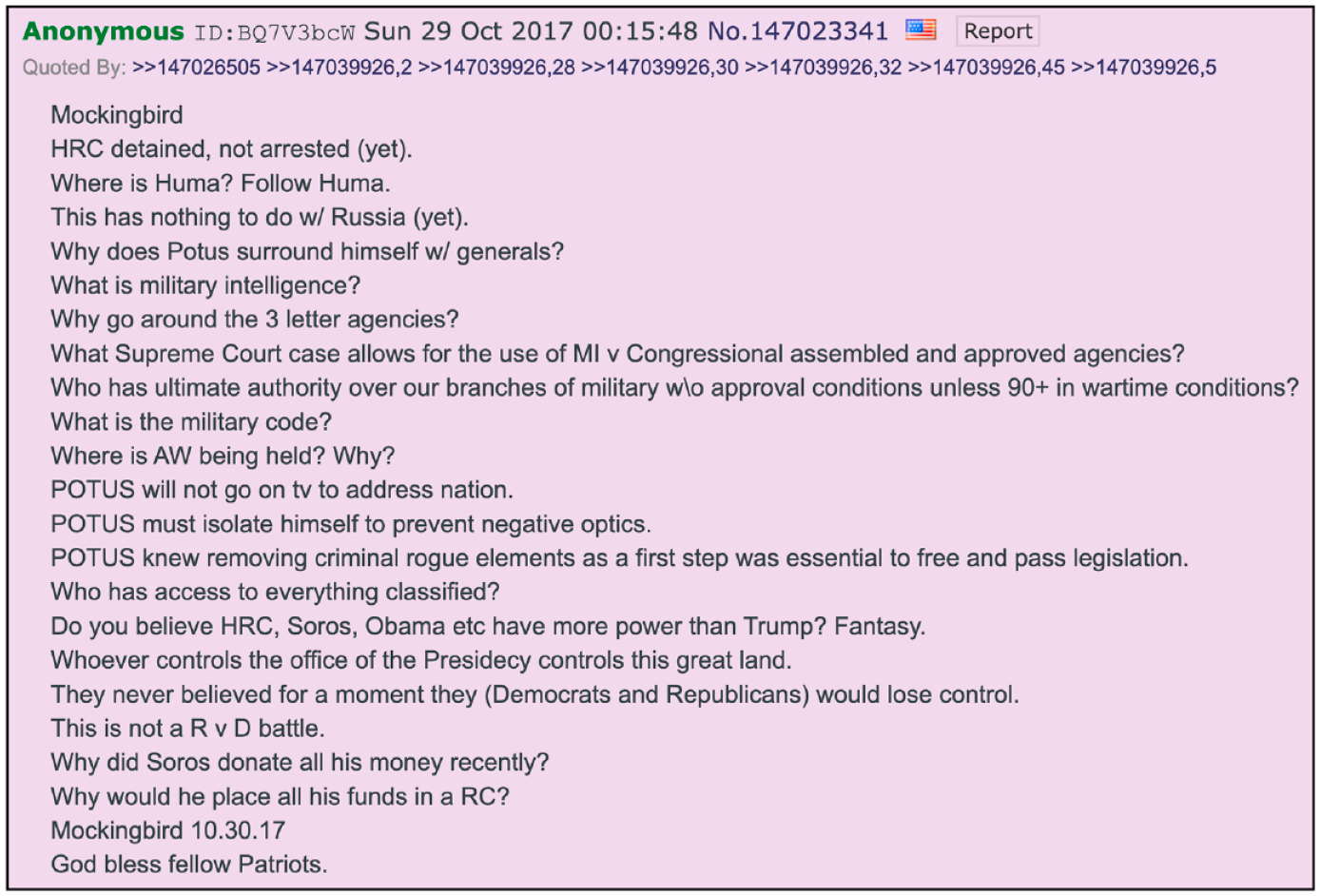
An example of an early ‘Q-drop’ posted on the 4chan imageboard.
Emerging as a new collective actor on the public stage (‘Where we go one, we go all!’), QAnon utilized online spaces to proactively search for ‘hidden messages’, collaboratively interpret and piece together scattered ‘conspiracy clues’, engage in question-and-answer exchanges, share ‘their own research findings’ for feedback, and network with like-minded individuals. Through hermeneutic and evaluative processes, unified through a hivemind storytelling approach, numerous participants provided connective tissue to ‘Q-drops’ and other ‘crumbs’, thereby constituting a distinct epistemic community of the unreal. 10 Over time, a novel conspiracy theory began to unravel globally, adapting itself to the socio-political context in which it was (re)interpreted, often acquiring distinct local socio-cultural characteristics (Butter and Knight, 2023; Jones, 2023; Sommer, 2023). 11 By reaching conclusions on their own and through interactions with their peers, every new ‘discovery’ about and for the cause instilled a sense of importance, influence, and competence in each member of QAnon, thereby giving rise to grassroots conspiracism. Despite the failure of any of Q’s predictions to materialize, his followers persevered in retrospectively crafting a satisfying narrative that provided newfound credibility to their ideas and beliefs (‘trust the plan’) (Hughey, 2021; Packer and Stoneman, 2021). 12 For instance, they referred to the COVID-19 pandemic as ‘the Plandemic’ and ‘COVID-1984’, depicting it as a carefully planned hoax orchestrated by the cabal to restrict personal freedoms, stifle popular dissent, and usher in a new world order – a narrative that strongly resonated with scared and resentful individuals around the world.
Considering these basic features of QAnon, I contend that the three pathologizing analytical frameworks lack the capacity to account for the collective nature of conspiracy theorizing and fail to recognize the global appeal of conspiracism in the digital age (Bertuzzi, 2021; Bloom and Moskalenko, 2021; Butter and Knight, 2023; Sommer, 2023). Therefore, I propose non-pathologizing alternatives drawn from the works of Fredric Jameson, Hayden White, and Engin Isin as politicizing conceptual counteroffers to these approaches.
Seeing Like a Conspiracist: Conspiratorial Thinking as Cognitive Mapping
As a symbolic practice through which individuals orientate themselves not only in geographical but also ideological space, cognitive mapping entails a ‘practical reconquest of a sense of place’ within and of a ‘vaster and properly unrepresentable totality’ (Jameson, 1991: 51). In the fragmented media landscape of the pandemic, the ideological problematization of information validity has increasingly diminished its practical utility, resulting in a growing sense of disorientation in everyday experience, both epistemically and politically. This feeling is akin to being lost in a postmodern hyperspace – a realm that ‘[transcends] the capacities of the individual human body to locate itself, to organize its immediate surroundings perceptually, and cognitively to map its position in a mappable external world’ (Jameson, 1991: 44). In an era where the credibility of official institutions to legitimize what constitutes scientific knowledge and sound policy becomes a subject of public controversies and social disputes, perplexed individuals often find themselves in situations where they no longer know with complete certainty what is true, nor whom to trust. This confusion has led many to turn to alternative, radical, and often anti-mainstream explanations of their epistemically dubious and politically uncertain reality (Birchall and Knight, 2023; Kużelewska and Tomaszuk, 2022). By embracing epistemic standpoints with radically different perspectives on the social world, conspiratorial thinking has demonstrated its effectiveness in translating this prevailing suspicion into individual and collective agency.
On one hand, conspiracists strongly believe that their voices are excluded from the public mainstream as part of a conspiracy to silence them for ‘speaking truth to power’; on the other hand, their acts of challenging the validity of the ‘official truth’ through crowdsourcing activities give rise to a conspiracist counterpublic. While QAnon’s collective efforts create a symbolic toolkit for representing an imagined reality, its decentralized structure enables its more passive adherents – who personally endorse its key ideas but often merely observe without directly engaging in collaborative storytelling – to autonomously reinterpret, deconstruct, and reconstruct ‘Q-drops’ into personalized tools for charting the social world as experienced from the epistemic margins of the political fringe. Driven by the ‘desire called cognitive mapping’ (Jameson, 1992: 3), conspiracists alleviate their unease with the mainstream accounts of reality by creating simple – but not simplistic – cartographies that reveal power relations within their phenomenological (un)reality. Accordingly, this conspiratorial mapping facilitates the projection of people, places, things, associations, and events into idiosyncratic symbolic frameworks that represent the imagined social environment, thereby enabling individuals to ‘think a system so vast that it cannot be encompassed by the natural and historically developed categories of perception with which human beings normally orient themselves’ (Jameson, 1992: 2). Through exchanges with like-minded peers, conspiracists find themselves situated on their own cognitive maps of this open-source unreality: epistemically as ‘those who know what is transpiring’ and politically as ‘those who act upon this knowledge’.
In this regard, conspiratorial thinking is not merely a product of ‘delusional minds’ coping with the ‘fear of a nonexistent conspiracy’. Instead, it exemplifies yearning for epistemic reorientation and political disalienation in the post-political condition of the post-truth era. For example, in (re)charting the COVID-19 pandemic into the ‘Plandemic’, conspiracists symbolically bridge the rift ‘between existential experience and scientific knowledge’ through invention of ways for ‘articulating those two distinct dimensions with each other’ (Jameson, 1991: 53). By focusing solely on elements and relations relevant to the map’s political purpose, the cartographic minimalism of QAnon’s conspiratorial mapping transforms a non-transparent, complex, and often chaotic reality into a relatively straightforward representation. This symbolic unification of fragmented experiences restores a sense of epistemic certainty and political empowerment to individuals endowed with ‘Q-awareness’. It effectively becomes a ‘code word for [a new kind of] “class consciousness”’ (Jameson, 1991: 418), particularly evident in QAnon’s interactions with out-groups. Nevetheless, the ‘do it yourself’ philosophy underlying grassroots conspiracism prevents blind adherence to the official narrative canonized by the epistemic community of the unreal. Instead, it encourages an intimate relationship with truth, allowing personalized knowledge to modify the conspiracist narrative, albeit within the ideological constraints that ensure communal belonging; conversely, a radically different cognitive map gives rise to a new conspiracy theory. These instances of dissent regarding the ‘hidden truth’ – such as viewing COVID-19 as a bioweapon rather than a hoax – not only foster a sense of epistemic credibility among QAnon adherents but also enable them to signal political autonomy within their respective counterpublics.
In summary, although some psychological factors may predispose certain personalities to embrace conspiracy beliefs, reducing conspiratorial thinking to a mental issue overlooks its personal significance for those who use it to cognitively chart their phenomenological (un)reality in the post-political condition of the post-truth era. By scrutinizing why and how various political, cultural, and social resources are employed to establish imaginary connections between unrelated elements into internally meaningful patterns offers insights into the cartographic epistemology of conspiracist ideation. Conspiratorial mapping is thus a symbolic practice for navigating and overcoming a sense of epistemic-cum-political disorientation through the establishment of fictional relationships between individuals and their environment, which can then be further explored and developed through collective conspiracy theorizing.
Speaking Like a Conspiracist: Conspiracy Theorizing as Narrative Emplotment
As a discursive practice through which historiographical accounts gain their explanatory power, narrative emplotment designates the agency of historians – or, conversely, of any historical storytellers – to compose, in more or less conscious ways, a coherent and meaningful story. Events in and of themselves provide no inherent motivation for a particular coding, so every historical account, through the careful ‘selection and arrangement of data from the unprocessed historical record in the interest of rendering that record more comprehensible to an audience of a particular kind’, becomes a narrative imposition on and narrative rendering of the past (White, 1973: 5). This quality of being empirical and speculative at the same time positions historiography as an art as much as a science – an ‘ideological construct’ that is ‘constantly being re-worked and re-ordered by all those who are variously affected by power relationships’ (Jenkins, 2004: 21). Similarly, conspiracy theorizing employs political and poetical elements in (re)interpreting and (re)constructing past events into contingent forms of coherence, unified by a plot structure that serves a specific ideological purpose.
Like other narrative forms of explanation, conspiracy theories are also organized through ‘culturally provided categories, such as metaphysical concepts, religious beliefs, or story forms’, aiming to ‘familiarize the unfamiliar’ (White, 1978: 86). The platformization and gamification of conspiracy theorizing have enabled conspiracists to harness collaborative means of figurative encoding and to collectively create narrative emplotments. Through deliberative processes and joint initiatives of deconstructing conventional knowledge and establishing counternarratives – where, understandably, not all contributions carry equal weight – QAnon employs multiple symbolic toolkits and discursive strategies to devise conspiratorial emplotment. By reconciling ‘the collective and the epistemological’ (Jameson, 1992: 9), the resulting narrative validates a preferred political standpoint, irrespective of its factual accuracy. Conspiracy theories, therefore, do not simply mimic scientific epistemology; they are grounded in mobilization of counterknowledge – or, better yet, ‘stigmatized knowledge’ (Barkun, 2003) – that challenges accepted ‘epistemic authority by advocating alternative knowledge authorities’ (Ylä-Anttila, 2018: 358–9). These non-mainstream sources and rejected forms of knowledge are considered uncorrupted and genuine within the epistemic communities of the unreal (McIntyre, 2018; Thompson, 2008). Ultimately, collective narrativization ideologically validates numerous individual representations: while ‘Q-drops’ may serve as the raw materials for individual-level conspiratorial mapping of the imagined reality, their explanatory value is fully realized once they are collectively woven into a political narrative that provides QAnon with a collective identity.
Just as the ideology and aesthetics of narrative emplotment shape historiographical accounts (Jenkins, 2004; White, 1973, 1978), QAnon’s symbolic and discursive practices fuse historical and fictitious events – or, more precisely, the realities of past and current events and their semantic positioning within the ideological framework – into a story that blurs conventional dichotomies of proof and figuration, thus challenging distinctions between fact and fiction. It is through these ‘curious leap[s] in imagination’ made ‘at some critical point in the recital of events’ (Hofstadter, 1996: 37) that evidence and non-evidence are interwoven into a narrative, aiming to reveal a particular ‘hidden history’ that simultaneously legitimizes the ‘secret present’. For instance, ‘the Plandemic’ was conveniently interpreted as yet another deep state scheme designed to prevent the president of the US and his allies from liberating the country – and, in some accounts, even the world itself – from the clutches of the satanic cabal. However, the inherently collaborative nature of conspiracy theorizing within the epistemic communities of the unreal inevitably leads to internal disputes over the meaning of ‘clues’, thereby expanding the space of and for politics. Varied ideological beliefs, political positions, geographical locations, personal preferences, conspiracy maps, and other variables inform diverse and, at times, even contradictory conspiratorial emplotments within QAnon – such as viewing COVID-19 as both a hoax and a bioweapon simultaneously. These semantic disputes over ‘Q-drops’ and their intertextual position in relation to other ‘crumbs’ and cultural artifacts have fostered the emergence of numerous factions within QAnon and spawned its offshoots globally (Butter and Knight, 2023; Jones, 2023; Sommer, 2023). 13 Nevertheless, conspiracists’ unwavering commitment to the overarching conspiratorial plot grants political identity to an epistemic community of the unreal. Through crowdsourced storytelling – which facilitates the actual process of conspiracy theorizing within these communities – personal beliefs, shared perspectives, conspiracy rumors, historical (non-)events, empirical (non-)evidence, conspiracist mythology, popular culture, and other fragments are interwoven into a (political) story that simultaneously functions as a (conspiracy) theory.
In summary, while conspiracy theorizing emulates scientific discourse, it is not necessarily employed with the intent of deliberately creating disinformation. Instead, in the post-political condition of the post-truth era, conspiracists use remarkable imaginative abilities to fill gaps in data and construct compelling narratives that offer gratifying solutions to intricate political problems, which often lack straightforward or definitive answers. Differentiating between moral and epistemic relativism prevents oversimplification of conspiracy theories as intentionally deceptive pseudoscientific accounts lacking value due to their strategic falsehoods. Conversely, viewing them as post-factual counternarratives challenging the dominant épistémè – framed by their proponents as ‘untainted by the corrupt elites’ and thus considered to be made ‘for the people, by the people’ – aids in better understanding why and how various segments of society engage in conspiracy theorizing to articulate legitimate concerns and express authentic grievances, thereby rendering conspiracism a political phenomenon par excellence.
Acting Like a Conspiracist: Conspiracism as Performative Citizenship
In scholarly literature, political subjectivity is often attributed to active citizens: virtuous members of society who remain proactive in public life between elections. Various terms – such as ‘radical’ (Mouffe, 1993), ‘monitorial’ (Schudson, 1998), and ‘critical’ (Norris, 2011), among others – have been used to describe how and to what extent these citizens exercise their agency outside of conventional political channels. When citizens are collectively and contentiously ‘exercising, claiming, and performing rights and duties’, they ‘creatively transform [citizenship’s] meanings and functions’ (Isin, 2017: 502), shifting it from a predefined legal condition into a performative political action that ‘disrupts already defined orders, practices and statuses’ (Isin, 2009: 384). As it has been demonstrated that conspiracy theories often articulate a desire for individual agency and democratic participation (Bratich, 2008; Dean, 1998; Fenster, 2008), it is unsurprising that conspiracism is increasingly being expressed through various forms of performative citizenship in the post-political condition of the post-truth era (Birchall and Knight, 2023; Rothschild, 2021). More than any other instance of grassroots conspiracism, QAnon has established itself as a recognizable political actor on the global stage not only by rejecting traditional norms and conventional forms of liberal politics – especially the principles of deliberation and moderation in reaching consensus – but also by embracing radical and militant ways of ‘doing politics’.
Despite attracting mainstream attention for challenging principles of ‘good citizenship’ – sometimes even earning the label of a ‘fascist cult’ – QAnon’s significance lies in its questioning of the structural and cultural parameters of the political community it inhabits. The infamous storming of the US Capitol, which showcased its zealous conviction and extremist methods aimed at ‘saving democracy from the clutches of the deep state’, serves as evidence of its uncompromising ambition to reorder the political landscape itself. Nevertheless, while historically significant, these headline-grabbing uprisings mark a notable departure from less eventful instances of activism and everyday acts of resistance through which QAnon primarily performs its political subjectivity across the globe (Jones, 2023; Sommer, 2023). During the pandemic, for instance, QAnon found various avenues to exercise its agency by contesting scientific expertise and the rule of law predicated upon it. Engaging in their own ‘research’ endowed its adherents with a sense of epistemic credibility, collectively translated into evidentiary politics aimed at uncovering the ‘hidden truth’ they believe is concealed by the ideological veil of ‘mainstream expertise’. Due to their perceived ownership of this gnosis, QAnon adamantly rejects any notion of insignificance. Its members often look down on the uninitiated (‘normies’) as indoctrinated individuals who blindly accept and reproduce what they have been taught (‘sheeple’), while priding themselves on being critical thinkers and responsible citizens engaged in a struggle for freedom, democracy, and truth.
In response to public reprimands for promoting ‘absurd but dangerous fantasies’, conspiracism becomes political precisely to the extent that its adherents invoke higher principles to defend their cause and prove their competencies (Baća, 2022; Boltanski, 2014). When QAnon employs a combination of political populism filtered through conspiracist imaginary (Hellinger, 2019), and epistemic populism that ‘eschews expertise altogether and seeks knowledge in the “hearts” or experiences of the “common people”’ (Ylä-Anttila, 2018: 358), to define what is at stake and justify their positions regarding the ‘common good’, its post-factual argumentation becomes a de facto political statement. That is to say, in engaging with authorities on an equal footing during scenes of dispute, QAnon undergoes political subjectification, a process that entails citizens’ performative disidentification from existing political allegiances in pursuit of ‘common goals under new symbolic unifiers’ (Baća, 2023: 189–90).Through these acts of performative conspiracism, conspiracists not only achieve an individual sense of political disalienation (Heins, 2007), but also cultivate a collective belief in moral righteousness for epistemically debunking and politically defying an alleged conspiracy that threatens or undermines the values they hold dear (Jones, 2023). Therefore, grassroots conspiracism is characterized not only by the social construction of (un)reality but also by politically acting upon it: not as pathologized individuals but as a politicized collective – a conspiracist (counter)movement.
In summary, while conspiracism may display certain parapolitical traits, it primarily constitutes an alternative, dissenting, and often radical mode of political practice stemming from profound distrust in one’s own political community. Pathologizing it not only excludes its grassroots manifestations from the normative boundaries of civil society but also obscures the empirical reality of actually existing civil societies. Like the diverse composition of the political arena, civil societies encompass a broader spectrum of actors beyond the progressive contributors to civic cultures and liberal regimes, including those deemed ‘uncivil’ and ‘distasteful’ (Baća, 2022; Kopecký and Mudde, 2003). Therefore, in a world without a centralized, equally distributed, and universally accepted truth, where the power elite often decides which ideas are permissible, understanding the political weight of conspiracism involves carefully examining why and how the structural problems of the system are personified into non-transparent and sinister workings of the alienated and dehumanized elite.
Conclusion: Explanation before Condemnation?
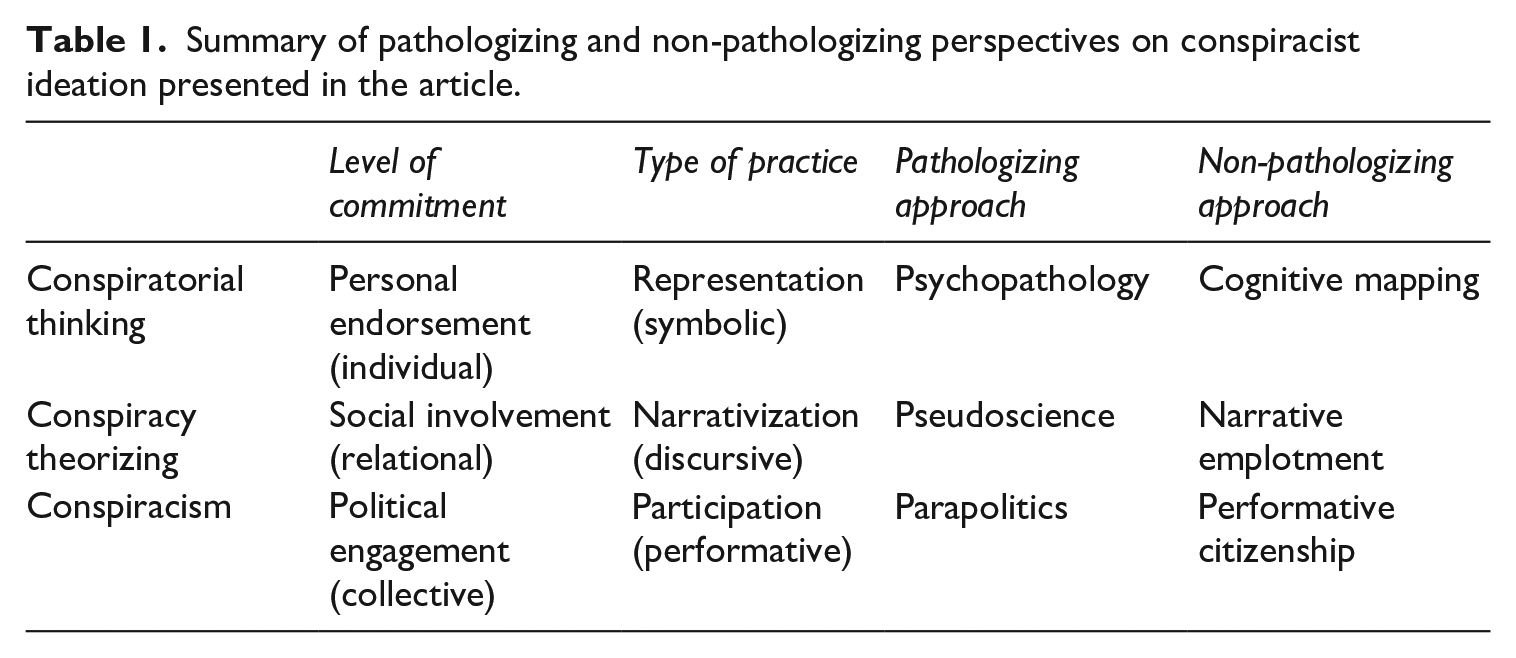
This article has examined QAnon – whose formal and substantive features have been refined to the basics for the sake of brevity and clarity – as a case-in-point for developing a novel conceptual framework to study conspiracy theorizing ‘from below’ within the digital public sphere. It argues that the cross-cultural appeal and worldwide presence of QAnon cannot be adequately explained using the pathologizing analytical tools currently at our disposal, especially when it comes to analyzing the ‘discursive practices that channel, shape, incite and deploy conspiracy theories as meaningful’ (Bratich, 2008: 7). 14 Therefore, rather than reducing conspiratorial thinking to an individual mental issue, conspiracy theories to manipulative bad science, and conspiracism to dangerous parapolitical behavior, this article proposes non-pathologizing conceptual alternatives that recognize conspiratorial thinking as a practice of cognitive mapping, conspiracy theorizing as a practice of narrative emplotment, and conspiracism as a practice of performative citizenship (see Table 1). In doing so, it introduces two novel concepts that open avenues for a sociological approach to conspiracist ideation, showcasing how QAnon is simultaneously articulated within epistemic communities of the unreal via participatory, interactive, and decentralized meaning-making practices and knowledge-production processes, and enacted through grassroots conspiracism via bottom-up, horizontal, and collective political procedures.
Summary of pathologizing and non-pathologizing perspectives on conspiracist ideation presented in the article.
Advancing this non-pathologizing shift involves carefully examining counterknowledge, counternarratives, counterdiscourses, counterpublics, counterspaces, and countermovements arising from conspiracist ideation, aimed at understanding the ways in which the unreal of the outside feels quite real on the inside. Only by studying actual manifestations of grassroots conspiracism, rather than relying on preconceived notions, can researchers truly comprehend why and how the social dynamics of the digital age are displacing meaning from the level of (primary) referentiality to that of (secondary) signification and, in the process, (re)defining ‘collective lifestyles as a form of legitimate politics’ (Bertuzzi, 2021: 7). When information and communication technologies are transforming conspiracy theories into political praxis, taking stock of the conspiracist zeitgeist emerging in the post-political condition of the post-truth era is crucial. It does not indicate an era dominated by conspiracy theories, but rather one where conspiracy theorizing is widespread. Therefore, it is not a specific conspiracy theory that defines this condition, but instead the mainstreaming of the epistemic communities of the unreal and increased engagement in grassroots conspiracism.
Footnotes
Acknowledgements
This article has been a long time in the making, primarily developed as a side-project during the COVID-19 lockdowns. Its initial drafts were crafted during my postdoctoral research stays at the Max Weber Institute of Sociology at Heidelberg University (Re:constitution Fellowship) and the Art, Science, and Business Program at the Akademie Schloss Solitude (Solitude Fellowship). It was completed in its current form during my research fellowship at the Corvinus Institute for Advanced Studies at Corvinus University of Budapest. I am grateful to all participants who provided constructive criticism during colloquia, seminars, and workshops at these institutions. The article also greatly benefited from my research project funded by the European Union’s Horizon 2020 research and innovation program under the Marie Skłodowska-Curie grant agreement no. 897686, as well as from the national scientific research project grant funded by the Ministry of Education, Science, and Innovation of Montenegro. I am exceptionally grateful to the four anonymous reviewers who provided invaluable comments and suggestions to improve the quality of the paper. I extend special appreciation to my outstanding students who participated in the course Populism, Pseudoscientism, and Conspiracism in the Age of Social Media at Heidelberg University; their questions, dilemmas, and insights inspired me to write this article. All errors and opinions expressed in this work are solely mine.
