




Abstract
In an age of apparent disrepair as the climate crisis takes hold and neoliberalism fails to liberate, as the cost of living rises and rights are retracted, the need for a reparative turn is overdue. But what is repair? If repair is contained in moments of total breakdown, then the reparative acts of care that sustain the world are denied. Countering these forces and the urgency prescribed by the crisis of disrepair and in what too often appears as the proprietary epistemology of repair, in this paper I offer an account of ‘repairability’. Structured in relation to the reparative gaze of feminist theory and poetic thinking, repairability assumes a material trace, I contend, through the vernacular archive of Cuban artist-ethnographer Ernesto Oroza. Oroza’s work offers a compelling case study through which to think the possibility of repair as an act of worldly becoming.
I
In a moment of apparent disrepair, as the climate crisis takes hold and neoliberalism fails to liberate, as the cost of living rises and rights are retracted, the need for a reparative turn is overdue. Over 20 years have passed since Eve Kosofsky Sedgwick first introduced the idea of ‘reparative reading’ in a short introductory essay in 1996, but it seems that since that time, suspicion and paranoia, the two conditions that Sedgwick sought to counter, have only increased. 1 Nevertheless, the call to repair grows louder in response. It is heard in the decolonial demands of ‘land back’ and in the reparative building projects of social housing and prison abolition. Repairability sits behind Ta Nehisi Coates’ (2014) appeal to begin reparations by looking ourselves squarely in the mirror, and Miranda Fricker’s (2009) confrontation with the ‘epistemic injustice’ of refusing to repair the conditions of justice. Across each of these domains, the notion of repair is invested with a radical interruptive potential: to imagine the world otherwise. Yet repair is not a panacea, though the reparative may create a moment of suspension in which an alternative future might be imagined, the romanticisation of repair risks cultivating a nostalgic politics of lament and a preservation of normativity to the point of its naturalisation. Repair can figure in the exclusion of the other, repair can conserve problematic national inheritances, and repair can be deployed in acts that cannot rightly be understood as care but as the justification for denying, paralysing, and refusing the hybrid forms to which repair might otherwise give rise. A distinction must thus be drawn between the reparative act that marks its difference, that centres the cracks through which light shines or gold glows, to take Leonard Cohen and the Japanese art of kintsugi as exemplary, and the regressive politics of repair as the conservative retreat from the future into the past. 2
Teasing out the question of repairability and a reparative world, in this essay I turn to the reparative archive of vernacular ‘things’ produced by the Cuban artist and archivist Ernesto Oroza. Educated as an industrial designer, Oroza’s work now documents the design objects produced by quotidian acts of repair. Rather than produce art as either separate from or belatedly responsive to social conditions, Oroza’s work pivots around the collection of objects ‘that are at the same time an understanding of a need and the answer to it’ (Weiss, 2018). What thus appears as the ‘oddity’ of his collections is their indexing of something that is at once in repair and disrepair. Described by Gil (2016) as an ‘impromptu ethnographer of Cuba’s DIY culture’ (p. 185), Oroza’s work foregrounds the relationality of repair and invites an encounter with the world as repairable. Archiving instances of reparative intervention in the living environment of Havana, Oroza’s work moves towards a mode of aesthetic resistance, acting, as it does, against the logic of object utility and the incessant demand to ‘use it all up’. Against the speed of consumption, his archive of the broken and wayward relocates reparative relations in the material world. Situated within the Cuban context, Oroza’s work highlights the contradiction of a broader capitalist framework premised upon paradigms of extraction-production-consumption-disposal. Indeed, working at the periphery of a consumerist world, his archive rebounds onto a system of production that has refused to acknowledge its own repairability. Like the reparative encounter with the mirror that Coates describes, Oroza’s archival project sits with the global backdrop of production that coordinates the force of its intervention. Effecting Donna Haraway’s (2016) ethical imperative to ‘stay with the trouble’, his archival work can be read as working through and exposing the entrenched commitments of the normative to destructive disrepair.
Situating Oroza’s Cuban archive in a broader context of global production, this paper is organised by the claim that repair, despite the specificity of its situated context, might operate within the broader fissures of worldly dis/repair by marking those moments of suspension through which another future might be imagined. This ambivalent dis/repair invites a world that is not determined by the linearity of global history or the hegemonic simplicity of progression. Throughout this essay then, I repair to and seek refuge in the reparative political writings of Walter Benjamin, Amir Eshel, Bruno Latour, and Eve Kosofsky Sedgwick. And so, while the essay departs from an age of disrepair, it advances in pursuit of its own reparative methodology. Borrowing from Benjamin’s constellational methodology, Eshel’s poetic thinking, Latour’s compositionist manifesto, and Sedgwick’s reparative reading, what emerges in the wake of this coming towards Oroza’s reparative archive is at the same time a work in reparative theory, a hybrid composition of rebeginning the world anew, theoretical and material alike.
In what follows, repairability emerges as a quality that cannot be reduced to the singularity of the object nor even to the presence of the repairer. Instead ‘repairability’ relates to the possibility of recognising reparative potential in the world of things. Rather than an attribute of the repairer themselves, repairability exists in the meeting between the speculative imagination of the reparative gaze and the world of dis/repair. Putting into abeyance the necessary priority of reparative knowledge, in this paper I look to the conditions of dis/repair that bring an object into reparative consideration. Clarifying questions necessarily emerge. Is disrepair breakdown, a moment of complete rupture and ruination that presupposes everything preceding breakage is mechanical perfection? Surely not, for if so, then repair cannot be understood in terms of the reparative acts of care, maintenance, object awareness and responsibility that unfold in relation to an object throughout its life. If there were only ever working and broken objects then repair could only ever be reactionary, and the project of reparative relations suspended until such a moment.
Alternatively, we might ask, is repairability a matter of value, of the axiological I that says this is worth repairing but not that? In such a framework, the unrepairable risks either being designed into the object, as in the ready disposability of the object that cannot be repaired because it cannot break, or being reduced to the mere contingency of passing fads which surreptitiously pick some objects up and cast others aside. Or, if the determining ‘I’ is replaced in this equation, repairability may come to be determined by the existence of an object-specialist trained in repair. The question thus posed is whether there is some one person able and allowed to repair. Such a question demands considerations of warranty and mechanical blackboxing, of conditions where ‘unrepairability’ may be imposed by commercial ownership or by heat-sealed designs that cannot be repaired without being broken or indeed by the mechanically functional but technologically defunct objects that die a living death as software support expires. 3
In each of these instances, what determines repairability exists somewhere beyond the object, in the boardroom decisions of private companies or in the public commons of reparative knowledge. Going further still, and moving beyond this epistemic binary, repairability, as I understand it, implicates a reparative comportment to the world that reimagines a new function in the object, producing a hybrid thing outside the realm of warranty or intended use, drawing closer to a bricolage of things rather than a silo of the one. In these cases, repair and the reparative presuppose the recognition of disrepair and breakage, of care and resurrection, of sustained labour and radical intervention. Yet insofar as each of these instances emerges as a site of inquiry, what becomes apparent is that the reparative can only ever exist in conditions that exceed the subject-object relation. Defined by neither one nor the other, to recognise repairability is to be attuned to the object as existing within a broader constellation of relations. Rather than be oriented by the specificity of the object – as in the methodological paradigm of object-oriented-ontology – to inquire after the repairability of the object is to consider the constellation of organising conditions that disclose the object as capable of repair. To think repairability is to rest with the paratextual rather than the text, the forest not the tree, the realm of possibility rather than the prescriptive ‘solution’. In an age when decay is proscribed at the moment of design and a productive regime prioritises replaceability over repairability, to disrupt this logic, to see reparability where it is not intended, is to enact a sort of messianic feat, to see another world that does not yet, or perhaps no longer, exists. Such, I will argue, can be traced in the vernacular archive of Oroza.
II
It is telling that in the literature of repair studies, Steven J. Jackson’s 2014 essay ‘Rethinking Repair’ has assumed the status of a ‘classic’. 4 In the seemingly short history of repair studies, the world of things, of broken and unrepairable objects, has quickly moved on. Repair, after all, is an act produced in the rift of two conflicting timelines: one of perpetual growth and one that seeks to slow, to inspect, and to begin a practice of degrowth. And yet, looking back on the long-short history of the almost decade since Jackson’s essay, it is clear that the reparative has never been confined to the realm of objects alone. Jackson notes this tension, pointing out that reparative labour, the work of carers, decolonisers, parents, cleaners, is constant, their work unglamourous and peripheral, and so often hidden from view. 5 Building on a tradition of design thinking that can be traced to Ukeles’ (1969) ‘Maintenance Manifesto’ which described avant-garde art as ‘infected’ by the maintenance work of cleaning, washing, and mending, and to Papanek’s (1984) commitment that those same activities of care are the matrix of design, Jackson shows that the status of repair as an organising attribute of design remains tenuous. This ambivalence is heightened given the proximity of repair to the feminised labours of care. Where the romanticisation of these workers risks continually viewing them through a lens of naturalised benevolence towards women (though not always women) as willing participants in a care economy that does not pay them, protect them, or liberate them, forgetting the caring dimension of repair loses the reparative dimension of reparability.
Part of this work of not forgetting means remembering the dirty conditions that can pervade the work of repair, the muck and detritus that have been demonised as impure and invisible. The equivalence that is staged between waste and dirt, something Mary Douglas made explicit in her pioneering study of the 1960s, Purity and Danger (1966), has led to a peculiar negation of reparative labour: it is naturalised to some other realm of the cleaners over there, such that this world over here remains clean. As garbage trucks work before dawn to dispose of waste beyond city limits, and the waste animals that will soon become steaks and sausages are transported to abattoirs out of sight and out of mind, or recycling is deported to the so-called Third World to assume its new life, repairability stays with the images of dirt to see the moments where suspension might intervene. Part of this staying with contests the near total denial of repairability as an object quality today, one that performs the peculiar function of alienating the object from its afterlife. While objects always already exist as breaking and broken, as sustained by invisible labour, once they do break, their status as fetishised utility vanishes, such that the waste-iPhone, waste-computer, waste-object that arrives in the ‘over there’ of repair workers was, in the context of its afterlife, always over there (see Houston, 2017).
Against the fated future of the waste-object of extraction, repairability reaffirms the object beyond a logic of utility. Drawing the object out of a limited and object-oriented conception of use, repairability recentres thingliness as a predicate of the world at large. Disposability of the singular thus becomes a refraction of the world, use and waste recapitulated as the unrepairability of the world. Picking up on the futureless fate of the unrepairable thing in and of the world, at the close of his essay Jackson turns to Walter Benjamin’s infamous use of Paul Klee’s Angelus Novus. Carrying on Benjamin’s engagement with the angel as a motif of modernity, Jackson (2014) describes it as ‘one of our most vivid and shocking indictments of a progressivist history’ (p. 237). The angel, who looks at the detritus of modernity as they are swept back into the future, lends itself to ready deployment in discussions of the waste economy and worldly unrepairabiltiy. The text in which the angel appears, Benjamin’s collected theses ‘On the Concept of History’ (2006), is framed through the language of a ‘Messianic arrest of happening’, a moment of suspension that seeks anachronistically to challenge what Frichot (2021) has called the ‘wasteocene’ of the modern era (p. 296). It is in these interruptive cessations that Jackson stages an elective affinity between Benjamin and repair, redescribing the cracks and fissure of modernity as the sites through which a new history of repair might emerge. 6 Indeed, Jackson describes Benjamin as developing the kind of ‘broken world thinking’ that is required to put the modern world back together. Such thinking, which Jackson describes as ‘both normative and ontological’ and ‘empirical and methodological’, finds further ground in Benjamin’s methodology of ‘constellational thinking’, a framework that anticipates the archival constellation that Oroza develops in the Cuban context.
Like repair, constellations embody a critical elasticity that corresponds to the imagination of collating the different and disparate. A method for conducting ‘critical materialist historiography’, constellations disclose a methodological hermeneutics that incorporates the responsibility of attentive care (Pensky, 2004: 179). 7 The febrility of maintenance that Ukeles and Papanek first attributed to the worldly function of art echoes this constellational paradigm, namely, that by bringing the disparate into proximity what is revealed is the hidden and invisible labour of reparative work. To bring into constellation then is to perform a constructive act described by Baeza (2015) as indexing ‘the capacity not only to recognize non-representational similarities and draw correspondences, but also mimetically to reproduce the experiential content inscribed in the object in a new act of creative repetition’ (p. 40). Bringing into question the necessity of worldly givenness, constellations function as precise critiques of the given. Indeed, insofar as they expose and suspend the normal as the naturalised, constellations disrupt the paradigms of use – historical and material – that coordinate the present. In relation to the hybridity of reparative projects, which reckon with the consequences of the world not in order to deny them but to live with them and organise an ethics in, or perhaps in spite of, their wake, constellations create a setting in which meaning can jump forward from what has otherwise been disparate or alien. It is in this sense that Gary Wilder (2015) deploys the language of constellational thinking to trace the anti-coloniality in Aimé Cesaire and Leopold Senghor through to contemporary hauntings of colonial violence. A disruptive and reparative historiography of suspension and gathering, Wilder’s project echoes the shift towards an alternative future that is glimpsed in the fissures of the past. This dynamic condition of division and redemption corresponds to the act of material repair, which deconstructs in order to reconstruct, producing a composite form that indexes care and function, irreducible to neither one and yet necessarily reliant on both.
The ontological paradox of Benjamin’s constellation, as that which comes into being – i.e. is realised, made actual – as it defies the grips of a totalising essentialism, will be central to understanding the function of repairability in the context of Oroza’s archival work. Hinged between two or more temporalities, the Cuban Special Period of restrained formal production and the creative intervention of intersecting creative timelines, Oroza’s archive continually subverts the affinity between use and presentism. And so, when Oroza describes his practice as reconsidering ‘the capitalist notion that merchandise as a finished product is prêt-à-porter’, what he is allowing for is precisely another glimpse of a material future, a moment that is equally a confrontation with the past as extractive and the present as ready to hand (Butoliya, 2022: 51). Such claims resurface in global contexts similar to Cuba, where ‘urban life is the result of continuous efforts of infrastructural improvisation’, prompting Graham and Thrift (2007) to point out that in these instances ‘repair is too overwhelming and visible to be ignored’ (p. 11). Indeed, as becomes apparent through an investigation of Oroza’s vernacular archive, it is the blurring of dis/repair that assumes a reparative function. Part of Oroza’s (2012) broader project aimed at exploring what he calls ‘technological disobedience’, a notion he introduces as a way to analyse the ‘accumulation, repair, and reuse that occurred due to the political upheaval and economic sanctions in Cuba since the 1970s’, the archive traces a world lying in the shadows of the repaired object. This glimpse of an alternative repairable world emerges in Oroza’s attention to the suspension of imposed equivalences between disrepair and waste. In this moment, what is ‘repaired’ is the world itself, which assumes a new reparative register, determined, as Oroza notes, ‘by collective work and by non-exclusive and non-exploitative relations of production’ (Butoliya, 2022: 51).
III
As an archivist of the quotidian and an artist and designer in his own right, Oroza’s work transgresses categories. This ambivalent status between art, architecture, and industrial design informs the broader project of his work within a context of repairability. A compositor of generic forms and structures, Oroza’s documentation produces a constellation of things that, as in Benjamin’s use of the term, demonstrates an alternate dialectics. As Oroza (2012) writes in one instance, the political dimension that underlies his work hinges on the refusal to accept the domination of a single methodology over another. Rather than fall into the trap identified by Honig (2021) of aestheticising and depoliticising refusal, Oroza plays with the forms of refusal that the archive, and his work, represent. Noting in one instance that ‘almost all archive materials can be considered’, insofar as they question the legitimacy of contemporary capitalism by archiving the malevolence of the repaired, ‘forms of dissent’, he goes on to describe the way in which the archive recuperates a narrative of the past that is inherently difficult to assimilate with the ideals of the future (Butoliya, 2022: 54). Staying with this difficulty, Oroza refuses the fictional utopia of immanent progress and resituates the future in its commitment to present reality. When asked in an interview to confront the question of self-categorisation and genre-form, Oroza replied: ‘to use a common term today, I could say that I am a cultural critic/worker. But why try to restrict my practice by creating a precise framework? I believe in reuse and in the “potential object.” I side with not confining or limiting possibilities’ (Weiss, 2018). This attention to the processes of possibility inheres in attention to the conditions of necessity that permeate the reality of design as a condition of the lived world. Part of the archival work of documenting the subversive and repaired form, an object that indexes a direct confrontation with progressivist frames of production, is thus to foreground the processes that coordinate design as a matrix of social and ecological life.
Guillermina De Ferrari (2021) describes Oroza’s ‘repair practice’ as having been elevated to an art form, yet Oroza himself writes that he’s more interested in developing systems to articulate the process information than in producing ‘definitive’ works: ‘I neither desire nor need to produce objects with the expected attributes of autonomy, authorship, originality, unity or physical limits, that is, the qualities intrinsic to the traditional artwork’ (p. 29). In other words, what he documents cannot be understood in relation to a telos of aesthetic form but only in the context of a rebeginning in meaning. Realising a reparative social project as one that challenges the conditions of entry into the academic art world as well as what he calls the ‘stigmatization of necessity’ in Western culture, Oroza points to a practice of reparative care and material reimagining as a mode of world-making. Reclaiming the idea of necessity, his introduction of the awareness and freedom to ask for help, demand aid, and seek shelter is made concrete in his ‘objects of necessity’ which spring up in moments of disrepair and creative ingenuity. The hybridity of form in his archive, which documents the infinitely large in housing or the infinitely small in toy cars, fans, and bikes, reflects the imaginative thinking that is realised in the recognition of object repairability. It is this critical function served by the archival form that is perhaps better understood through Bruno Latour’s paradigm of composition rather than critique.
In his ‘Compositionist Manifesto,’ Latour writes that ‘with a hammer (or a sledgehammer) in hand you can do a lot of things: break down walls, destroy idols, ridicule prejudice, but you cannot repair, take care, assemble, reassemble, stitch together. It is no more possible to compose with the paraphernalia of critique than it is to cook with a seesaw’ (Latour, 2010: 475). Out of the ruins of the things that already exist, the compositionist discloses a fragile world (one that is always capable of decomposing again). The ebb and flow of the compositionist’s intervention, like that of the ethnographer of waste, is to bring into consideration the wasted paraphernalia cast aside by critique. What each figure stands against is the necessity of that logic that denies object-necessity: planned obsolescence and the waste economy. In such a mechanical age, where alienation has pervaded the very systems of production themselves, collapsing the distinction between commodity and waste, the recognition of repairability threatens the very infrastructure of production. What thus emerges as the malevolence of the repaired object is complemented by Oroza’s reparative intervention in the manifesto-like text ‘Statement of Necessity: For an Architecture of the Necessity and the Disobedience’. Here he writes of ‘one of the most contradictive problems of contemporary life: the insensibility we have acquired to elude our true needs, and the ability we have gained to fabricate pseudo necessities or accept that others do it for us’ in order to subvert it (Oroza, 2006).
In the context of architecture then, Oroza recuperates themes of the reparative through the introduction of a ‘Moral Modulor’ into conceptions of dwelling, a notion that he recovers (or perhaps repairs) from Le Corbusier’s ‘Modulor’. Where the latter describes the human being as a measuring tool, which regulates the organisation of the built environment, Oroza’s (2006) ‘Moral Modulor’ ‘embodies the human potential to understand urgency and inscribe it in space’. Beyond the physicality of embodied experience, the Moral Modulor ‘adds to the order established by human dimensions the moral dimension that necessity recovers’ (Oroza, 2006). A synecdoche for the social infrastructures of care, responsibility, and vulnerability, necessity locates Oroza’s architectural intervention in the context of repairability rather than reactive disposability or commercialised ‘repair’ through renovation. And so, when he writes that ‘form follows necessity’ he anticipates the kind of aesthetic disobedience that Jonathan Neufield (2015) describes, both in relation to the Cuban context and more broadly, as retaining a connection to civil disobedience, namely, of breaking with aesthetic norms in order to show their entrenched claim to power. Rendering the static dimension of the built environment through its living inhabitants ‘architectural necessity’ responds to ‘every sexual or physiological impulse, every birth and even death’ in the form of ‘new walls, columns, stairways, new windows or plumbing and electrical systems’ (Oroza, 2006). What Oroza (2006) calls the ‘Potential House’, a structure marked by ‘a living state of awareness’ is one that, in the face of the persistent urgency to repair and respond, ‘produces a constant way of looking at the world, a radical perspective and an architectural pragmatism: everything will be a house’. Rather than reifying a logic of housing commodification through repair, as in the incessant demand to renovate to innovate, Oroza’s ‘everything will be a house’ attains to another reality, one in which dwelling is responsive to and reparative of the social and political conditions of its production. Like Neufield’s (2015) account of aesthetic disobedience as a refraction of civil disobedience, where artistic transgressions intervene in the ‘public and deliberative backdrop against which they occur and they aim to shape’, the ‘potential house’ demands its own state of awareness (p. 116). The living status of the house equally informs the ongoing work of repair, which sustains and cares for the house, realising the industrial work of labouring with and maintaining its potentiality as ‘potential house’.
IV
While interrogation of architectures of necessity forms one important branch of Oroza’s work, his archival interventions are equally premised on the recording of vernacular objects. Of these, his 2012 series ‘Chairs and Benches of Havana’ highlights both the repairability of the object whilst also pointing to something that cannot be determined by the status of the object alone, namely the reparative potential of the world. To return again to Jackson’s (2014) early essay on repair, what forms of repair reference in this instance is the ‘routinely forgotten relationship of humans to things in the world: namely, an ethics of mutual care and responsibility’ (p. 231). The chair, which at its most simplistic serves as an object of rest, gathering, eating, conversing, and writing, assumes a heightened status in the constellation of repairable objects. Though an easily overlooked object of repair, the chairs that Oroza documents offer a compelling addition to what it means to consider the repairability of the object. Both impersonal and personal, chairs signify those same tropes inherent to a politics of responsibility, vulnerability, and care. Chairs simultaneously signify power and importance as in the throne or ‘head of the table’, and vulnerability and fragility as in the seats reserved for the sick and elderly. Chairs transport children and babies in prams and chairs allow differently abled bodies access to spaces. To ‘offer up your chair’ is to recognise a structure of dependence and to rise from your chair is to signal respect. To have a chair around the table is to be included and to lose your seat is to be excluded. Chairs are sites of invitation and inclusion, which facilitate and produce relations. Set within a broader constellation of relations, chairs enter into a discourse that extends beyond being seated or standing.
The chairs, which are photographed here as though posing for their own family portraits (Figures 1, 2 and 3), stand alongside one another in a range of settings: by footpaths, in empty rooms, in garden spaces. Choreographed by Oroza into these settings as photographic subjects, the chairs remain unoccupied, their status as sites of potential waiting, potential meeting, and potential rest gesturing to the conditions of community that Oroza’s documenting of repair seeks to articulate. Indeed, Oroza describes welding the legs of the chairs together as a way of ‘making them an object of collective use’ (personal correspondence). In these instances, the chair serves as a threshold moment of connection and beginning that is always a connecting and beginning with. Francisco Martínez’s (2022) description of possession and tools as ‘everyday elements of sense-making’ echoes the function they serve (p. 5). For what these particular chairs evidence is not simply the list of attributes described above between seating and standing but the recognition of repairability and so something that is already in excess of the mere use of the chair. What Martínez writes in the opening pages of his ‘Insiders’ Manual to Breakdown’ can be translated to them; namely, that ‘to repair is an act on the world: to engage in mending and fixing entails a relational world-building that materialises affective forms’ (p. 2). Indeed, the chairs might equally be read through Lauren Berlant’s politics of the commons which offers ‘incitements to imagining a liveable provisional life’ such that they constitute Berlant’s (2016) ideal of ‘learning to live with messed up yet shared and ongoing infrastructures of experience’ (p. 395). The composition of the chairs, which reflects the process Oroza describes of form following necessity, exists in the fissure of object-being as permanently in a state of dis/repair. When he thus describes these chairs as offering a ‘glimpse of the future’, the future that is seen is one that privileges an infrastructure of care and ongoing responsibility or sensitivity to the repairable world (Butoliya, 2022: 51). Rather than seen merely as objects of disposal or waste, the archival recording of these liminal objects is a refraction of a broader condition of social repairability.
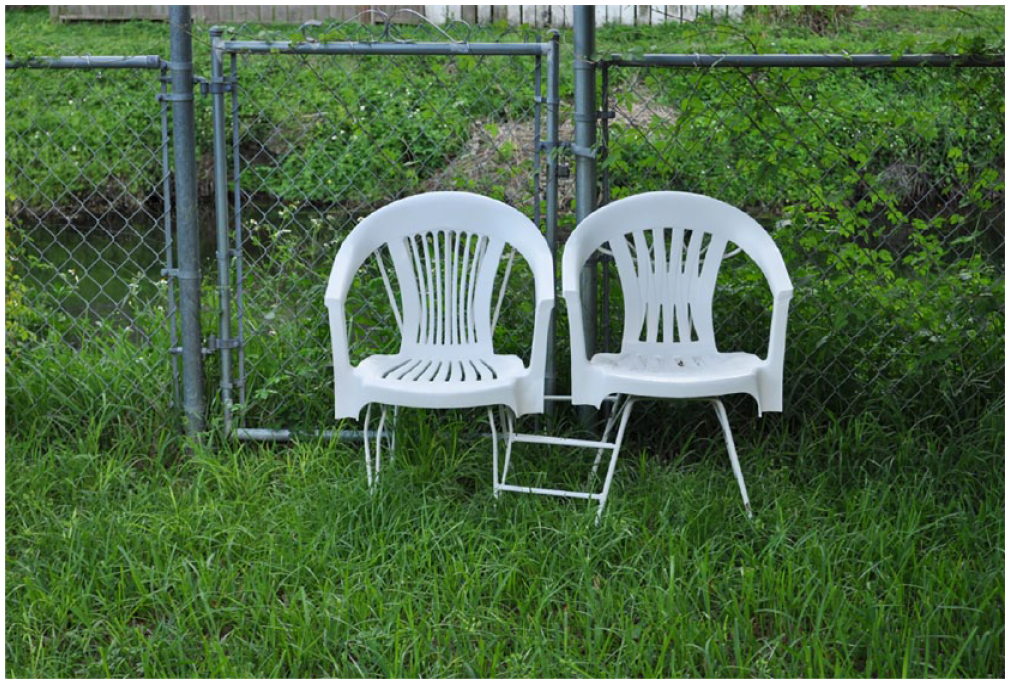
Ernesto Oroza, Monobloc plastic chair, Objects of Necessity, Updating City, 2012 Courtesy of the artist.
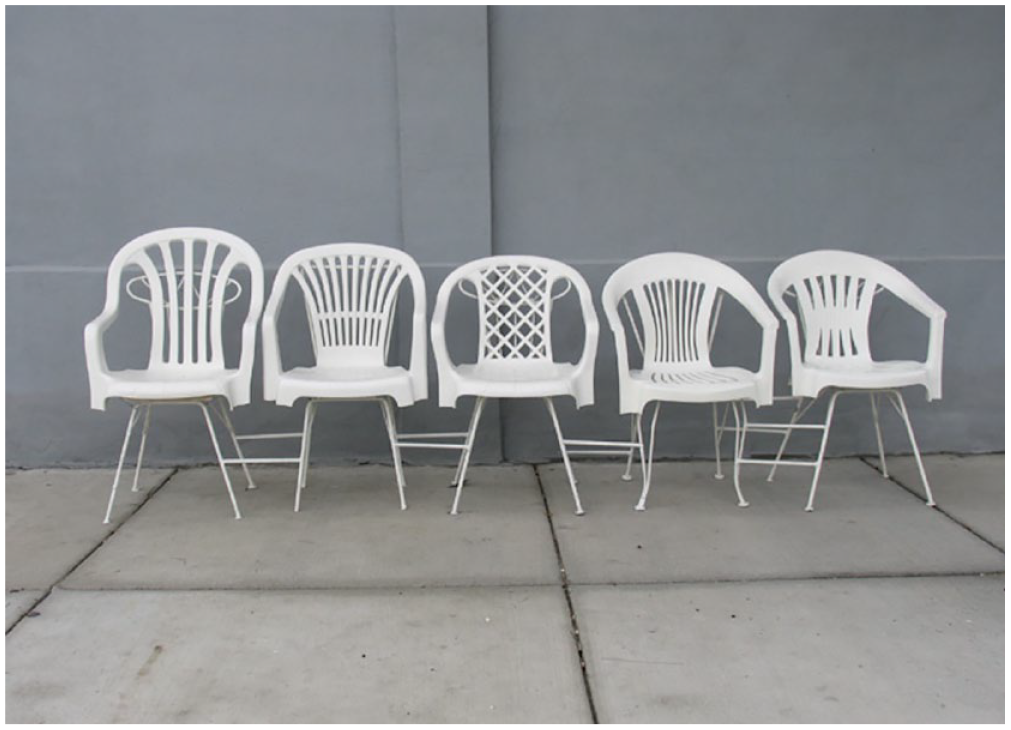
Ernesto Oroza, Updating City (theorem), 2000–2010. Courtesy of the artist.
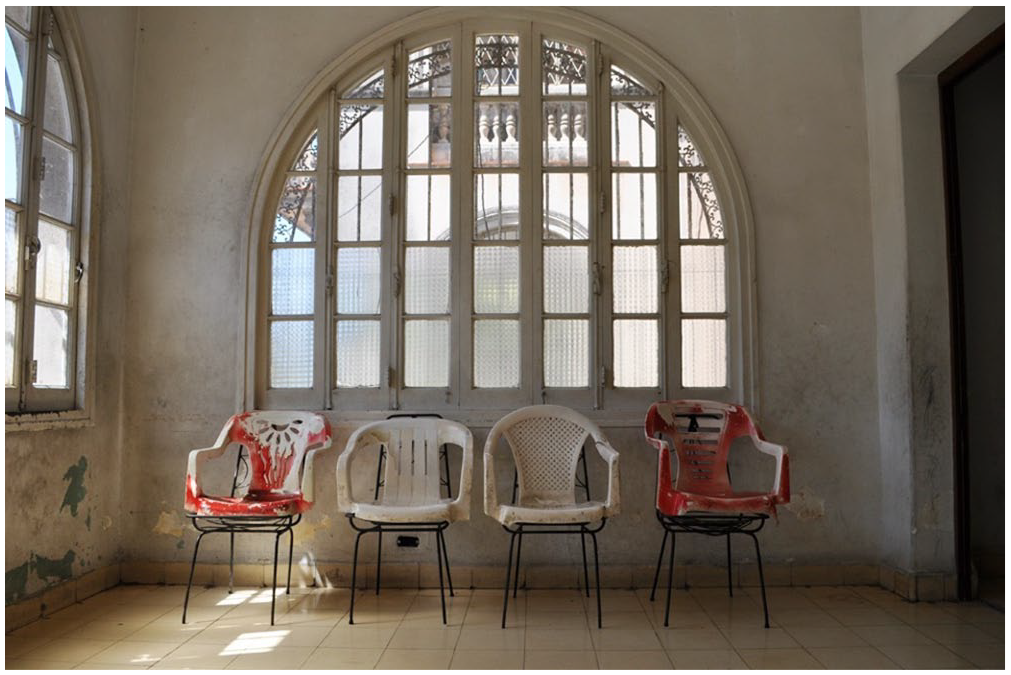
Ernesto Oroza, Objects of Necessity. Chairs and Benches – Havana 2012. Courtesy of the artist.
V
What becomes apparent in these instances of recognising and recording repairability is the contingent need for a community of caring, witnessing, and gathering, each of those activities first articulated as part of the project of living, artistic maintenance. Perhaps not always formulated in such explicit language of social relations and infrastructures of dependence, what repairability elicits is a turning away from the object as only a locus of (replaceable) use and a calling into being of a creative and poetic mode of thinking the thing. Aaron Perzanowski (2021) describes this multi-layered nature of repair as a social practice, noting that it ‘demands analytic reasoning, strategic thinking, and creativity’ (p. 10). In similar terms, the repairability of the object calls forth not only the analytic skills of the repairer but, as Perzanowski (2021) writes, it solicits an ‘awareness of the world around us’ (p. 10). Such awareness, which recognises the thing as in the world, or borrowing from Baltrusch’s (2010) vocabulary of aesthetic resistance, its becoming-thing-in-the-world, draws repair out of the object and into the world. Repair, then, is not always logical. It is often inventive before it is ingenious, betraying a step away from the clinical dispossession of broken, wayward, and malevolent objects. To see within something its repairability, namely, the possibility of its rebecoming in dialogue with some action, idea, or thought, is to reject the despotic logic of utility and insist upon another imaginary. Amir Eshel’s (2019) reflections on poetic thinking, a mode of thought that he develops following Hannah Arendt as having ‘the potential to counter the rise of tyranny’, prompts the question as to whether there is not already something tyrannical in the intentional production of objects-as-waste and with it the unrepairable world (p. xvi). What such a question suggests is that even before the ecological impacts of object waste are felt, before batteries leach into soil or polyester fibres enter waterways, the unthinking production of objects-as-waste might be linked to a refusal to think the becoming world that will still be marked, no matter how far away it is placed, how deep it is buried, how hurriedly it is burnt, by the intentional if unthinking production of waste.
Assuming this kind of spatial imaginary, Eshel (2019) describes poetic thinking as a praxis of dwelling, of ‘[stepping] out of our daily, habitual manner of thinking’, inviting an encounter with the repairable if malevolent object of waste (p. 6). Described as a suspension of thought’s inclination to hurry, he writes of poetic thinking as a means ‘to stop, to dwell for a while in uncertainty’ (Eshel, 2019: 15). Creating space for ambivalence and the reorientation of historical forces, poetic thinking turns from the phenomenal to the hermeneutic. Returning to the force of the object relation, Eshel’s own discussion progresses in dialogue with various poems, paintings, and sculptures, recuperating the composite form of Oroza’s archive as he does. And in apparent dialogue with Oroza’s same critique of progressivist absolutism, Eshel notes that ‘a piece of art in and of itself, cannot change the world. Yet the way we engage with the art can effect change – both within ourselves and eventually within the public worlds we inhabit’ (Eshel, 2019: 3). It is this moment of recognition, one that approaches art as a return to the world that recurs in the recognition of repairability, recalling the object to the world and in so doing disclosing the world in the object. What thus ‘becomes’ in each is an instantiation of the world. As a poetic form in its own right then, repair dwells with the potential of material form in a way that parallels the linguistic play within poetry. Indeed, as each reimagines the world through the materiality of object, word, and the manual relation of rending each anew, they disrupt the aesthetic dominance that Oroza first accounted for as the capitalist fiction of material prêt-à-porter.
Staying with the fiction of presentism and returning to Benjamin’s imagery of a historical constellation, Jackson notes that:
repair inherits an old and layered world, making history but not in the circumstances of its choosing. It accounts for the durability of the old, but also the appearance of the new (a different way of approaching the problem of innovation, as will be discussed: behind and prior to the origin stands the fix). Above all, repair occupies and constitutes an aftermath, growing at the margins, breakpoints, and interstices of complex sociotechnical systems as they creak, flex, and bend their way through time. (Jackson, 2014: 223)
The interstitial quality of repairability qualifies descriptions of repair such as those given by Tim Dant (2010) that if ‘repair is successful, then there is no trace of the complexity of the work that has achieved the transformation’. As a liminal act, repair brings into being the world that contains the repairable object. No longer merely an object of disposability or mere utility, the dis/repair of the object as a condition of worldly being – a being that includes a set of social relations and infrastructures of care – is disclosed by the reparative mode that recognises and, perhaps more importantly, realises the repairability of the object in the world. While the complexity of work may not persist in the object, the knowledge and composition of object and care endure. The afterlife of the object becomes the trace of a reparative world.
Repairability in this instance, both as a quality proper to the object but equally contingent on a broader mode of being in relation to the object, foregrounds the sensibility of the ‘repairer’ to hear the call for repair, thereby disclosing and affirming a mode of reparative being in the world. It is worthwhile, however, to suspend the certainty of the repairer’s existence, disrupting their singularity to bring into consideration their status as a relational being. Indeed, it is precisely this status that Oroza’s archival work foregrounds. Suspending the cult of the designer, Oroza’s archivist labour echoes longstanding accounts of relationality seen in feminist literature on repair. What Oroza describes as the imposed synonymy in Western politics between need and weakness, seeking help and vulgarity, is already taken up by those building on the so-called ‘reparative turn’ after Eve Sedgwick’s critique of paranoid reading and the political potential of repair. Here Robyn Wiegman (2014) attests to the power of reparative reading to ‘[repair] the value and agency of interpretative practice itself’ (p. 7). Yet Wiegman’s (2014) description of reparative reading as ‘about learning how to build small worlds of sustenance that cultivate a different present and future for the losses that one has suffered’ while directed at the project of queering gender, assumes a similarly radical potential when brought into dialogue with the reparative world of things (p. 11). As we see after Oroza, in such a world it is not the immediacy of the use-object that is brought back into the fold of constant use but the unfolding world of possible historical becomings. Like the project of queering dominant power relations, the reparative project of literal object-bound repair is the project of cultivating a different present of worldly things. When Oroza then repeats the staging of the chairs multiple times over, photographing various different assemblies, he introduces a mode of repetition into the archive that offers a plurality of relational forms. What he describes as the ‘altered, reused, [and] contaminated archive’, assuming as he does a language of ‘infection’ that Ukeles first attributed to the aesthetics of care in art, thus becomes a way of reimagining the ongoing encounters with the archive as a site of care that prescribes a form of caring reciprocity in turn (personal correspondence).
VI
As the repairer works in the world, attuning a sensibility that is as much their own as it is a mode realised in the living environment of the material world, the force of a reparative project lies in the capacity to recognise repair without re-interpolating a system of extractive use. Against a system of extraction, repair has clear ethical stakes – environmentally, politically, geographically. As a mode of worldly being, however, repair augurs a question of morality. These questions are woven into the reparative fabric of Benjamin’s constellating, Eshel’s thinking, Latour’s composing, and Sedgwick’s reading. They appear acutely in Richard Rorty’s philosophical discourse on ‘progress’. By way of conclusion to this paper of composite and reparative fragments then, I want to suggest that Oroza’s revision of progressivist futures realises Rorty’s (1999) position that ‘it is best to think of moral progress as a matter of increasing sensitivity, increasing responsiveness to the needs of a larger and larger variety of people and things’ (p. 81). 8 Giving teeth to Rorty’s inclusion of ‘things’ in the context of moral progress, Oroza’s archive of reparative sensitivities opens the world to the abstract ideal of ‘inclusion’, which is now given material and ontological assurance. Like Eshel’s earlier discussion of poetry, repair aspires towards a more inclusive frame of reference. In the confrontation Eshel describes between poetry and the vast possibilities of language, he writes that poetry ‘prompts us to consider our willingness to broaden the circle of our experience’, simultaneously inviting a political sensibility of reciprocal plurality. This move is achieved in part by invoking the first-person plural ‘we’ as a provocatory invitation to inclusion. In this sense, Eshel (2019) suggests that it is through poetry then that ‘we may recognise those whom modern tyrants have classed as subhumans, deprived of any rights, as full members of the circle of humanity’ (p. 47). In much the same way, the repairable object offers itself up for recognition in the context of its being, inviting consideration of its supply chain from both extractive origin, through to present use and on to disposal. In this extended matrix, artisan, designer, and layperson are all called upon, such that the creative resources of the one who assumes the status ‘repairer’ become a matter of worldly sensibility.
From the broken object to the labour of seeking out repairability, repair challenges the repairer to encounter disrepair as the fissure through which a reparative future irreducible to the object form might emerge. Suspending the malevolence of disrepair and seeing the world as always already in a state of reparative disrepair, repairability invites another conception of what it means to dwell with the ambivalence of a world that is yet to fully emerge. As we look back to the dis/repair of Oroza’s archival form, the dis/repair of the documented chairs becomes a reparative provocation. While the chair in itself cannot index the repairability of the world at large, the aim is not to assume this complete picture. As De Ferrari (2021) writes, repair does not magically erase all social ills, but it can ‘uncover the potential for hopeful and fulfilling entanglements’ (p. 547). If we then return to Eshel (2019) and accept his claim that ‘the humanities are most powerful when they take on a facilitating role: suggesting connections, synergies, and manners of thought’, then there is perhaps room to think design, doing, using, and those other actions embedded in the material world of things with a similar slowness and poetic form in mind (p. 156). Taking time to let the light shine in those moments between use and disposal, function and waste, will not recalibrate the organising arbiters for worldly life, but it will offer an alternative, bring into abeyance, and temporarily suspend the speed of using it all up. There is no answer to a worldly life, no blueprint that might realise what it means to dwell in ambivalence and no reason to think that my not buying a new thing would coincide with the rebeginning of the world. But there is reason to consider the ways in which we repair to the world, seek refuge in the constellation of things that care for and sustain us. To recognise the quality of repairability as a condition of this life remains a possibility. A reparative return to the world, a dwelling at the edge of the forest of utility and seeking out of that echo that will speak back to the original order of things – it is such acts that offer a golden path in the fragmented world of broken disrepair.
