




Abstract
In this essay, I explore non-human multispecies interactions in soils polluted by electronic waste and subsequently bioremediated by plants and microbes. I argue that regenerative transformation in polluted soil environments is principally through microbial degradation, a significant process for survival amidst disaster. In doing so, I combine two separate research areas – the materiality of electronic waste and of soils – thus contributing to theorization on the persistent problem of anthropogenically polluted soils. I do so by examining the process of bioremediation, which ties anthropogenic pollution with underground soil processes, notably those that occur at the soil interface surrounding plant roots, the rhizosphere. Using empirical examples from scientific literature on the bioremediation of electronic waste-contaminated soils in China, I demonstrate that degradation, symbiosis, and sequestration are instrumental processes in polluted soils. The micro-scaled perspective of these relational processes and their toxic alterlives contributes to materialist, chemosocial understandings of toxic and polluted environments.
Keywords
Introduction
The expansion of scholarly investigation and discussion into non-human and multispecies subjectivity over the last two decades has allowed for greater exploration of subjects that were previously considered ‘inert’ objects, or were ‘invisible’ from human practice (Granjou and Salazar, 2019). Scholarly work in the fields of new materialism and science and technology studies have demonstrated the relational affectivity of many non-human and multispecies subjects, bringing to light worlds that exist beyond human processes. These studies have been able to link humans to environmental issues, such as waste proliferation and soil depletion, incorporating our human actions as part of a larger earth-system; one that sees environmental issues as part of an interconnected eco-social assemblage. These insights are important to develop thinking around toxicity and chemical pollution from an eco-social perspective.
This essay is about soils polluted by electronic waste (e-waste) and subsequently bioremediated by plants and microbes, and the non-human, multispecies and material interactions that occur within these affected soils. Bioremediation is a method using plants and microbes, such as bacteria and fungi, to rid the soil of chemical pollutants, often from anthropogenic sources such as electronic waste, mining, and landfill sites. According to Anna Tsing and Donna Haraway, ‘making worlds is not limited to humans’ (Haraway, 2016; Tsing, 2015: 53), and this essay will use the example of bioremediation to explore the belowground soil interface surrounding plant roots – known as the rhizosphere. I will describe how materiality around pollution, toxicity, and its alleviation interacts with and is transformed by plants and microbes. Main contributions of this paper include the promotion of nonhuman ways of seeing, and the advancement of material understandings of polluted soil as an ‘undead’ and ‘mutating’ (Gabrys, 2013: 2; Parikka, 2015: 48) multispecies dynamic of living with, and life beyond, pollution.
The fields of new materialism and science and technology studies have covered materialities in topics such as e-waste, soil, and toxicity. Understandings of e-waste have recognized the material flow of electronics from their mobilization from earth materials to media machines (Parikka, 2015), the global trade and ubiquity of electronics in contemporary culture, and their localized, toxic lingerings in nature (Gabrys, 2013). Similarly, examinations of other forms of hazardous waste and their toxicity often focus on their material effects on bodies, long durations, and societal impacts, such as from neo-colonialist perspectives (Balayannis and Garnett, 2020; Hird, 2017), chemical ethnography (Shapiro and Kirksey, 2017), or permanent and ubiquitous pollution (Liboiron et al., 2018). Soils, on the other hand, have largely been analysed in terms of their heterogenous, dynamic nature – of unpolluted soil ‘as living’ (Granjou and Salazar, 2019; Puig de la Bellacasa, 2014; Meulemans, 2020), although there is research on degraded and spent soils (Worster, 2004 [1979]), the agency of damaged soils (Zee, 2020), and emerging scholarship on vulnerable soils as alive through ‘rot, decay, and regeneration’ (Lyons, 2020: 113).
Despite extensive scholarship on the materiality/ies of waste, soils, and toxicity, there has been little to no work that combines the materiality of e-waste and its toxicity in polluted soils with the multispecies nature of soil interactions. This study therefore asks what non-human, multispecies interactions and processes can be found in soils polluted by anthropogenic sources, such as e-waste? And how do these soil microbial interactions and processes relate to understandings of waste, pollution, soils, and humans? By ‘non-human’ I am referring to non-human and more-than-human e-waste, soil, and microbes; and by ‘multispecies’ to different species of plants and soil microbes. While I do not delimit a realm completely removed from humans, these terms are meant to show us more-than-human worlds that are distant from human spatial and temporal scales, but which are nonetheless indirectly shaped by human activity. Bioremediation is a direct attempt to shape the processes of the rhizosphere, but it requires an understanding different than simple production, recycling or waste management processes – one that recognizes that plant-microbe relationality and microbial action and metabolism shape the soil and human relations to it.
There are two strategies that are deployed in this paper – the first is methodological and the second is theoretical: Firstly, I employ a rhizosphere approach that attempts to understand belowground microbe interactions from a micro-scale perspective. This method is derived from scientific microbiological studies of soil and bioremediation, which study microbe-plant interactions at the molecular level. Studying the rhizosphere interactions of plants and microbes in bioremediation considers the material processes of toxicity and detoxification. This allows us to interrogate what is happening to soils affected by anthropogenic pollution: are these lifeless wastelands, or are they emergent spaces for life, a site of integration between non-human waste and multispecies bacteria and fungi? A belowground investigation of plant-microbe interactions in polluted soils can support as well as challenge existing materialist thinking on soils, e-waste, and their shared toxicity.
Undertaking engagement with zones where ‘we are absent’ by using scientific findings has been common in the field of science and technology studies (Barad, 2003; Clark, 2011; Latour, 1988). Scientific soil and bioremediation studies measure microbial populations and pollutant types and amounts over time. The observed results are then used to infer belowground interactions and processes. Thus, I interpret the results of empirical (mainly lab) research on bioremediation in terms of multispecies, non-human interactions to compare and contrast with materialist theories. I have identified 12 research studies that have used bioremediation on e-waste contaminated soils in China; many of these will be covered later along with other scientific literature on plant-microbe interactions. I focus on China because it has been the site of damaging e-waste pollution as well as research on nature-based methods for pollution alleviation.
The second strategy is to merge materialist understandings of e-waste and multispecies soil interaction. Drawing on Shapiro and Kirksey’s (2017) work on chemosociality, the ‘altered, attenuated, or augmented relationships that emerge with chemical exposures’ (Kirskey, 2020: 24) and Tsing’s (2015; Tsing et al., 2017) examination of world-making within ruins and damaged landscapes, this paper will dig down into non-human, multispecies interactions in e-waste affected soils. In conjunction with the rhizosphere approach to examine up-close material and chemical exchanges, this strategy will illustrate the possibilities of life, and the alterations life takes, in damaged and polluted environments. This provokes more diverse ways of understanding the materiality of, and material interactions in, soils as it includes microbial life and pollution from technological discards. In short, this paper will explore processes of contamination, symbiosis, and decay at the level of the rhizosphere and how they inform a non-human multispecies understanding of soil interactions.
The beginning of this movement downwards into the soil will start with the globalized assemblage of e-waste – how it became a significant issue in China, its pollutive potential, and how this has been interpreted theoretically. This is followed by bioremediation – how this decontamination method bridges e-waste and soil materiality and the processes that occur between plants and microbes. Digging deeper, we will examine research on bioremediation and plant-microbe interactions, and from those findings, make observations from those that can be applied to materialist understandings of e-waste and soil. These observations will focus on processes such as decay and mutualist symbiosis, which have hitherto not been addressed in the context of technological discards and their belowground chemical transformations.
Grounding Electronic Waste: E-waste in Context
Waste electrical and electronic equipment (electronic waste, or simply e-waste), made up of discarded electronic technical devices from refrigerators to smartphones, is the world’s most rapidly growing waste stream (Lepawsky, 2015: 150). Driven by the consumption of electronics, as well as other factors such as built-in planned obsolescence (Gabrys, 2013), the cycles of consumption and waste culture continue to create e-waste. China has received the majority of the world’s electronic waste, while it currently grapples with its own growing domestic e-waste (Li and Achal, 2020). In China, the towns of Guiyu in Guangdong Province and Taizhou in Zhejiang Province have become infamous sites of chemical electronic pollution. For years, they have been major destinations of informal recycling of electronics from around the world, despite recent government clampdown and regulation. These activities over the decades have created highly polluted areas, where multiple types of contaminants, such as heavy metals and a broad range of organic compounds, are incorporated into soils (Chi et al., 2011; Leung et al., 2015; Robinson, 2009).
E-waste is made up of an amalgamation of discarded electronic products and machines, from miniscule chipboards and semiconductors to entire personal electronics and consumables like mobile phones and laptops, to larger appliances such as refrigerators and televisions. E-waste therefore can be viewed from several material perspectives, such as the types of electronic waste just described to the combinations of different minerals and metalloids – common and rare earth – as well as plastics, glass, other compounds and elements (rubber, gases) that are contained within an electronic (see Figure 1). Although the material of e-waste can also include the discursive aspects of media (see Parikka, 2015), the biochemical material perspective will be taken up here, because the degradative processes that e-waste encounters at a dismantling site or in a landfill break it down slowly from its constitutive parts into interactions of a chemical nature.
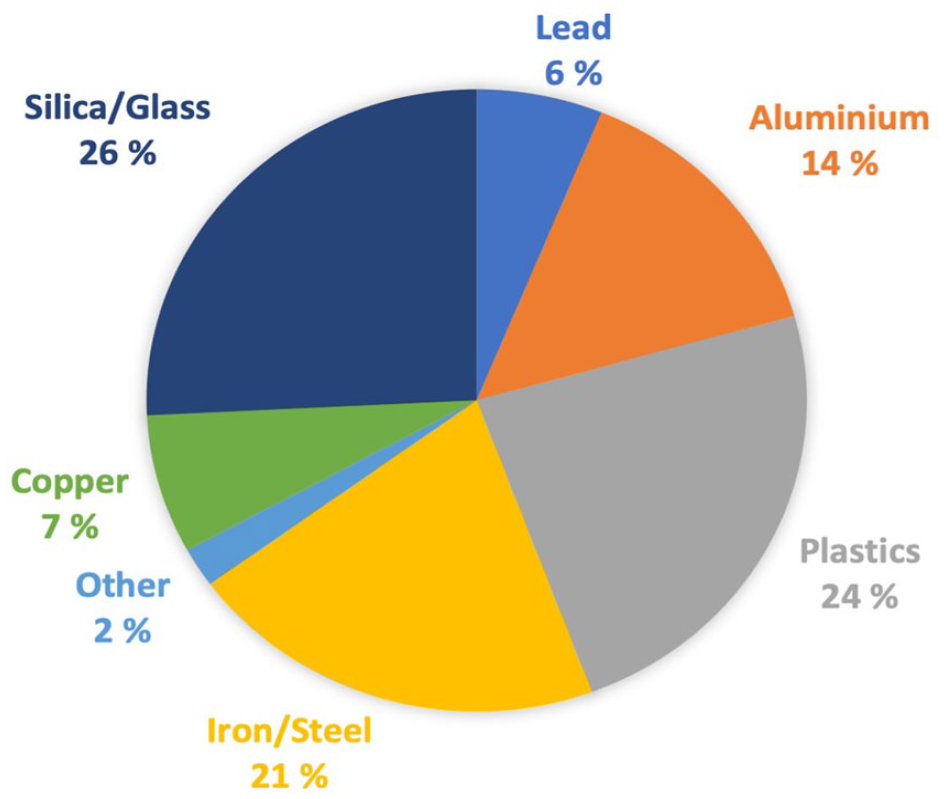
Composition of a PC based on recoverable materials, by percentage of total weight. Data sourced from UNEP, 2007.
Some materials in electronics, such as copper and gold, are of resale value, but these have to be stripped and excavated from the machine first and scaled up (i.e. a large number have to be dismantled) to make any kind of profit. This dismantling for scrap, in addition to the second-hand use of electronics, drove the establishment of many informal e-waste recycling sites in the 1990s and 2000s in China and other developing countries, and many did earn a profit. Informal recycling includes the practices of dismantling that have been commonly used in e-waste sites like Guiyu and Taizhou, which are often small-scale, non-regulated, and crude or primitive methods to dismantle an electronic into separate materials in order to acquire the most valuable components. Informal recycling was primarily organized within family workshops, where family members conducted business at home on the ground level (Wang et al., 2021). This was common in cities like Guiyu prior to state-regulated formalization and centralization of recycling practices. Informal recycling methods include the open burning of wires to recover copper, acid stripping of circuit boards, and the chipping and melting of plastics, all conducted in the absence of proper safety equipment or ventilation (Wong et al., 2007). Dismantling or dumping of waste materials has also occurred directly on, or near, open ground and waterways (Leung et al., 2006, 2015).
During the 1990s and into the mid-2010s, informal recycling in China had a near monopoly on the sector. In 2012 the central government implemented a regulatory system for e-waste management, to formalize e-waste dismantling practices and control waste flows. This culminated in the 2018 Waste Import Ban, which made the illegal direct shipment of e-waste into China incredibly difficult (Lin et al., 2020; Wang et al., 2021). Despite regulatory changes that have affected e-waste practices in China, the growth of domestic e-waste remains a concern and the dismantling methods conducted by informal recyclers were, and continue to be, highly pollutive. This does not mean that informal recycling is inherently pollutive, nor that government-led recycling is inherently greener (Losa and Bindschedler, 2018). However, it does mean that pollutive e-waste practices lead to local environmental effects from globally derived materials and products. These effects, and their implications for local human populations, are similar to other environmental issues in China such as air pollution and dust storms, where the environment is creating literal and metaphorical deserts, places devoid of life (Povinelli, 2016; Zee, 2017). E-waste pollution reflects the lived reality for most people in China, as many are already living with pollution (Lora-Wainwright, 2017; Wang et al., 2021; Zhang, 2021), embedded within a ‘shared condition’ that crosses ‘sociological boundaries of class, rural and urban’ (Zhang, 2021: 3).
Informal recycling dismantling methods have contributed to the release of a number of hazardous and persistent chemicals that are present in e-waste, including organic chemical compounds – polycyclic aromatic hydrocarbons (PAHs), polybrominated diphenyl ethers (PBDEs), polychlorinated dibenzo-p-dioxins (PCDDs), polychlorinated dibenzofurans (PCDFs), polychlorinated biphenyls (PCBs) – and heavy metals (e.g. ‘inorganics’) – arsenic (As), chromium (Cr), cadmium (Cd), copper (Cu), mercury (Hg) and lead (Pb) – which have caused severe pollution in air, dust, soil, river water and sediment in Guiyu (Leung et al., 2006, 2015; Tao et al., 2015; Wong et al., 2007) and Taizhou (Shen et al., 2009; Tang et al., 2010). Some PAHs are known carcinogens (Leung et al., 2015), while PCBs and PBDEs are known persistent organic pollutants that remain in the environment for a long period of time and can accumulate in toxicity. The presence of a mix of pollutants is significant and is challenging to remediate.
Theoretical Ground: E-waste, Toxicity, and Soils
E-waste and waste toxicity have been studied extensively in terms of their human-technological impacts on the environment, such as in scientific research on chemical pollutants found at e-waste sites (see Leung et al., 2006, 2015; Tao et al., 2015). E-waste and toxicity from waste have also been studied for the connection their harmful materiality has to ‘long and uneven networks’ of capitalism, labour, development, and pollution (Gabrys, 2013: 141), often disadvantaging emerging and less developed countries like China, Ghana, and Vietnam. For both e-waste and toxicity scholars, toxic waste harbours the potential for material change and transformation that can unpredictably and negatively affect ecosystem and human health – its ‘perverse performativity’ (Brown, 2001: 10). This potentiality born of toxic circumstances is rationalized in terms of an altered state, analogous to an alterlife (Murphy, 2017) where life is ‘already altered’ and ‘open to alteration’ (p. 497).
The pollutive effects of e-waste have been described in terms of spaces of remainder (Gabrys, 2013) and as zombie media (Parikka, 2015). Spaces of remainder are the ‘irreversible effects of pollution’ that are left behind by electronic waste (Gabrys, 2013: 141), but also include the whole lifecycle of electronics, from mining to manufacture to consumption, and what is left behind by them. Zombie media are media that do not die but remain as ‘toxic waste residue’ if not repurposed or reused (Parikka, 2015: 48). E-waste is semi-permanent, always leaving its residual mark wherever it passes through; thus, it is understood as undead or mutating matter (Gabrys, 2013; Parikka, 2015). This matter continues, often over a long period of time, to belong to ‘processes of pollution, remainder, and decay’ (Gabrys, 2013: vi). These are strong material sentiments that stress e-waste’s degradative nature, yet further description of these particular processes is truncated and never really explored in-depth.
Despite the fact that e-waste is buried in or burned on top of soils (Leung et al., 2015), and the fact that air and water pollution from e-waste can settle and become soil pollution (Robinson, 2009), e-waste has been theorized in geological terms (see Parikka, 2015; Zalasiewicz et al., 2014) but not in the context of soil. Unlike geology, soil is a more common term that refers to ground typically not more than some tens of centimetres below the earth, not meters or kilometres as in geologic terms. Soil also refers to other living and non-living occupants of the substrate that are part of soil’s organic matter, not mineral stratifications and the mined substrate from which electronics were sourced. Indeed, soil is often understood in terms of its life-giving properties, which has been the antithesis to how e-waste pollution has largely been framed.
According to Germain Meulemans and echoed by other authors (Granjou and Salazar, 2019; Melo Zurita et al., 2018; Puig de la Bellacasa, 2014), soil can be considered as a ‘living compound’ (Meulemans, 2020: 93). Meulemans has considered this life-giving process within the activities of a soil organism, the earthworm. Referred to as ‘soil engineers’, earthworms are generative organisms that allow soil to ‘carry life and plants durably’ (Meulemans, 2020: 99). Earthworms are therefore not just part of the soil, they are the soil in their generative capacity (Meulemans, 2020: 96) – a symbiotic self-producing of making-with and worlding-with (Haraway, 2016) via processes based in growth. However, chemicalised and degraded soils are often not regarded as living substrates but instead embed ‘altering states, the not dead’, that represent the ‘relational vulnerabilities, cyclical process, and potentiating force’ of such soils (Lyons, 2020: 176). Soils, especially deserted soils and dusts, have also been used to highlight the toxic agency of soils (Zee, 2020), their ability to envelope and surround humans in spaces denuded of life in part due to human activity (Povinelli, 2016).
Anthropogenically polluted worlds and the unexpected dynamic processes that emerge from toxicity and decay have been analysed by DeSilvey (2017), Kirksey (2020), and Lyons (2020). Relevant to the microbial bioremediation of e-waste, these authors have argued that soil is not a ‘stable entity’ but a mass of ‘continuous relations of composure and decomposure’ (Lyons, 2020: 134), and the death that is found in polluted spaces can beget life through the degradative processes of enzymes and microorganisms (DeSilvey, 2017). Their work informs the belowground and chemical understandings of toxicity and its potential alterlives – the figuring of ‘life and responsibilities beyond the individualized body’ that acknowledges ‘extensive chemical relations’ (Murphy, 2017: 496) amongst humans and non-humans. An up-close perspective on these processes and toxic alterlives contributes and adds further nuance to these chemosocial understandings where altered, attenuated, or augmented relationships from chemical exposures are not only found amongst e-waste workers, local inhabitants of e-waste villages, Western media and NGOs but also within multispecies, non-human, and belowground rhizosphere communities. Examining these belowground relations and processes includes bacteria and fungi who are ‘inescapably entangled’ with chemical pollutants while displaying novel, as well as durable, ‘symbiotic associations and social formations’ (Kirksey, 2020: 46).
My pursuit to observe chemosociality in damaged and ruined landscapes follows e-waste all the way down to the rhizosphere, where lines of connection are observed at molecular and cellular levels. From this microscopic vantage point, we get an intimate picture of materials, where things like soil and e-waste are pared down to chemical transformations and exchanges. These chemical exchanges are enabled by microbes, that are not just part of the soil but arguably are soil in their transformative capacity with polluted soils. Viewing materiality from this microscopic scale can be beneficial; by viewing interaction and intra-action (Barad, 2003) from microbial and chemical microscales, we are less wedded to the necessity to relate interactions to human processes. Although a relation to human interaction and socio-cultural processes is inevitable, we open ourselves up more to non-human and more-than-human interactions – interactions that explore decay and alterlife within chemosocial landscapes of electronic discards.
Digging into Plant-Microbe Interactions: Insights from Bioremediation Studies in China
Soils affected by e-waste pollution are sites of technological and multispecies encounters within complex systems. There is a particular soil interface in which these contaminated soil interactions can be examined: the rhizosphere. This topsoil interface that ‘surrounds and is influenced by’ plant roots (Phillipot et al., 2013: 789) hosts microorganisms and invertebrates (see Figure 2). A narrow range of soil, the rhizosphere is one of the most dynamic interfaces on earth because of the sheer number and variety of microbes (microflora; microorganisms: bacteria, fungi, viruses, archaea, oomycetes), microfauna (protozoa, nematodes) and macrofauna (earthworms/annelids)(Barea et al., 2005; Lynch and Whipps, 1990). For example, bacteria alone can be extremely abundant, with up to 1010 in just one gram of soil (Schloss et al., 2006).
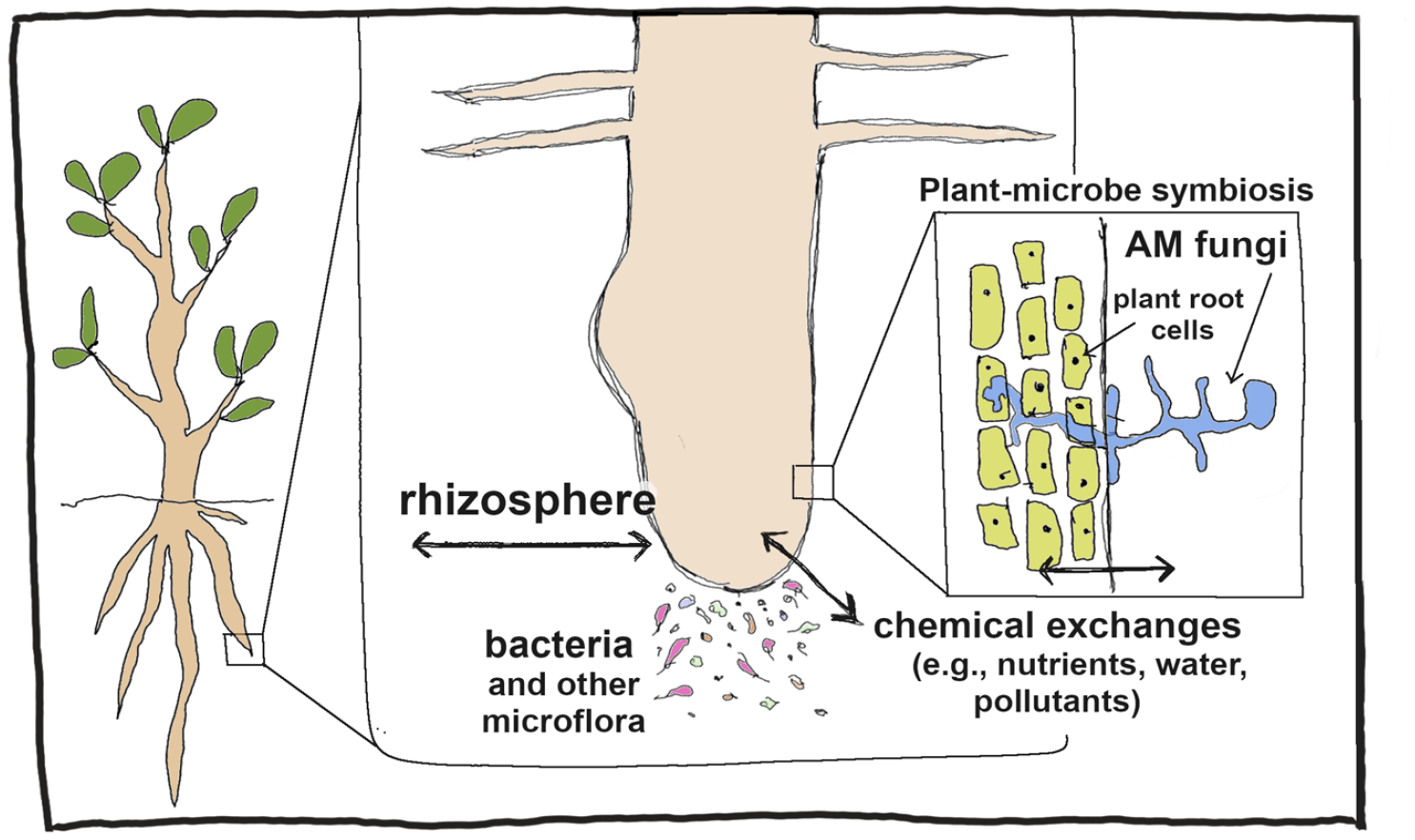
The rhizosphere, the dynamic soil-plant-microbe interface surrounding plant roots. Image attributed to Phillipot et al. (2013).
Many multispecies interactions occur within the rhizosphere, mainly in the form of nutrient, but also contaminant, exchange: microbes and invertebrates feed off nutrients, exudates, border cells and mucilage that the plant root gives off. In return, they can aid in providing nutrients, minerals, and water to the plant, and in decomposition – generally creating beneficial mutualist-symbiotic but sometimes also pathogenic responses and relations. In other words, a chemical exchange results from plants supplying microflora and fauna with energy derived from photosynthesis, and in turn microbes and invertebrates allow for the bio-availability of soil content previously unavailable to plant roots. Soil content made bioavailable by plant-microbe relations includes mineral nutrients useful to all plants, but also contaminants such as heavy metals and pollutive organic compounds. Persistent toxic substances do not easily degrade and can bioaccumulate in living organisms. They include both heavy metals and organic compounds, which are part of the e-waste assemblage. Regarding the persistent toxicity of e-waste materials, heavy metals do not biodegrade; they cannot be biologically or chemically transformed but can go from one oxidation state to another in soil. Other persistent toxic substances can change into more lethal compounds; among the aforementioned polybrominated diphenyl ethers (PBDEs), the highest in production is deca-BDE (also known as BDE-209), which has the capacity to debrominate into more harmful PBDE types that can then cause harmful health effects in human and non-human organisms (Lopez et al., 2011). The addition of toxins, including persistent toxic substances, to ecosystems via waste streams such as e-waste therefore typically stresses, and in the worst-case kills, plants and microbiota living in the affected soil.
China, where waste and pollution issues wrought by e-waste have affected both ecosystems and human health, has seen scientific interest in the degradative processes of bioremediation for the alleviation of soil pollution. Bioremediation, a method using plants and microbes as remediative actors, has been gaining interest as a practical tool for the remediation of contaminated soils (Liu et al., 2017). Bioremediation methods have been used on different soil and water sites in and around Guiyu and Taizhou, as well as non-e-waste sites such as agricultural land, landfills, mine tailings, and gasworks, some near Guiyu and Taizhou or in other places in China. Overall, bioremediation is argued to be less ecologically damaging to soil, less expensive, and a sustainable choice for soil remediation compared with other remediation methods (Leung et al., 2019; Shah and Daverey, 2020). Having faced criticism for being a means of ‘forgetting waste’ (Hird, 2013: 116) as it emphasizes treatment and, by extension, technological optimism, bioremediation can nonetheless displace the idea that waste management is solely done by humans, conversely bringing attention to human vulnerability to environmental waste issues.
Unlike most physical soil remediation and treatment methods, bioremediation is in-situ (soil is not moved to another site) and uses plants and microbes. Bioremediation uses a combination of plant and microbe species to remediate an area; consequently, plants and microbes are chosen for their tolerance capabilities and their ability to degrade or transfer and store toxins out of soils. Common microbes used in e-waste bioremediation are bacteria and fungi (often arbuscular mycorrhizal fungi; AM fungi; AMF) species. Microbial degradation, often conducted by bacteria, breaks down many pollutants into less toxic forms. Species of Acinetobacter and Pseudomonas bacteria, for example, can degrade organic compounds found in e-waste, such as PCBs and PBDEs. These genera of bacteria have also been proven to be resistant to heavy metals such as arsenic, cadmium, and copper (Liu et al., 2015).
The transfer of toxins out of soils can be accomplished by bacteria and fungi (Khonsue et al., 2013; Ma et al., 2006) and toxins are stored, or sequestered, in microbial or plant tissues. Degradation and sequestration can be accomplished in a multitude of ways, but they are often performed by mutualistic-symbiotic relations between plant and microbe, or microbe to microbe. AM fungi, for instance, are a useful candidate for bioremediation because they are known mutualists, forming a symbiosis with over 80 per cent of known plants (Phillipot et al., 2013) and can cooperate with other beneficial microorganisms (Hashem et al., 2016). The natural processes and interactions of these plants and microbes in polluted environments illustrate their chemosocial nature, their ability to ‘create ongoing possibilities for life’ despite chemical exposures that enfeeble other life (Kirksey, 2020: 24).
Amongst scientific work identifying pollution-tolerant plant and microbe species, the last two decades have seen significant progress in the field of bioremediation in China; developing from studies on the toxicology of a contaminated site and/or studying one species of plant that tolerates contaminated soil, to reporting on multiple species of plant and microbe – often bacteria and AM fungi in tandem. Although the contaminates measured are predominantly limited to one type (e.g. only heavy metals or one type of organic), this shows a steady progression towards understanding the broader milieu of soil interactions occurring in the rhizosphere that might affect contamination. I have examined a total of 12 reports focused on the bioremediation of e-waste pollution in China and have found that many not only point to the potential role plants and microbes have in alleviating anthropogenic pollution but also illustrate the role of processes like degradation and sequestration in post-polluted, chemosocial worlds. All of these studies were conducted by bioremediation scientists based in Chinese (including Hong Kong) universities in the fields of natural and environmental sciences. These studies recognize the issue of soil pollution and the need to find solutions to it, and many reference the pollution wrought by e-waste as an impetus for their study (see He et al., 2015; Li et al., 2018, 2021; Meng et al., 2021; Shen et al., 2009).
Degradation and sequestration are instrumental processes in the removal of pollutants from soils. For instance, a 2009 study conducted by Shen and colleagues on an e-waste site in Taizhou found that polychlorinated biphenyls (PCBs) were removed by plants, bacteria and fungi at the end of the study. The researchers noted enhanced degradation of the pollutant in the rhizosphere, and attributed this to increased biologically available components of the pollutant in addition to observed ‘biostimulation of microbial communities’, which occurs in the highly active and microbially-dense space of the rhizosphere (Shen et al., 2009: 1674). Similar findings were found in the Teng et al. (2010) study that used nitrogen-fixing bacteria and AM fungi to move and sequester PCBs, the Li et al. (2021) study on ureolytic bacteria to sequester heavy metals, the Song et al. (2015) study using degradative bacteria on PCBs and PBDEs, as well as the Li et al. (2018) study using AM fungi to degrade and sequester PBDEs and the heavy metal cadmium.
Degradation and sequestration are also facilitated by chemosocial multispecies interactions, with different plant, bacteria, and fungi species adapting to altered natural environments. Taking the Yu et al. (2011) study as an example, it employed polycyclic aromatic hydrocarbon (PAH)-degrading bacteria on contaminated soil from Guiyu and found a high dissipation rate of PAHs in soils with the bacteria. The study also employed plants and AM fungi and found that the PAH compound pyrene was degraded more in the interaction of bacteria, plant, and fungi rather than the PAH-degrading bacteria on its own. The pyrene concentrations in plants at the end of the study were higher in interactions that included bacteria and fungi than without, suggesting that the pollutant was degraded by the bacteria and, additionally, that the fungi transferred PAHs to the plant. This and other studies demonstrate that degradation and sequestration occur due to plant-microbe multispecies interactions in polluted soil (see also He et al., 2015; Teng et al., 2010; Li et al., 2018).
As some of these studies further illustrate, a symbiosis of plant and microbe does not always equal a decrease in soil toxicity, even where there is mutualistic-beneficial symbiosis. The Meng et al. (2021) study results showed that AM fungi could immobilize cadmium and zinc heavy metals, but in a way that was not optimal as it affected plant growth and toxin uptake. The Li et al. (2018) study, also using AM fungi, found that one species translocated more cadmium and PBDE type BDE-209 to the plant, whereas another AM fungal species sequestered more of those toxins within itself. These results suggest that the removal of pollution is contingent; symbiosis and degradative or sequestrative processes do not determine a pollution-free outcome. The differing reactions towards pollutants by these fungal species shows that ‘life is open to alteration’ (Murphy, 2017: 497) – there exist variable paths of adaptation and ongoing possibilities of life that open up in post-polluted worlds – and this can include life with less pollution but, more importantly, the implications of ‘emergent worlds’ and ecologies that learn to live with pollution (Kirksey, 2020: 46).
Accordingly, rhizosphere soil is a substrate from which techno-social pollution and plant-microbial dynamics can be ascertained. The process of degradation is a natural process; however, this paper has illustrated that degradation shaped by multispecies connections, often mutualistic-symbiotic, allows for adaptation to new environments. Similar to decomposition and decay, there is regenerative, transformative potential in the breakdown of chemical bonds and, ultimately, matter (Granjou and Salazar, 2019; Lorimer, 2016; Lyons, 2020; Meulemans, 2020). This breakdown must occur for eventual growth. Unlike the decomposition and decay of organic material such as compost and leaf mould, anthropogenic discards like e-waste present novel challenges to microbial resilience and adaptation.
Scientific studies of these soil microbes have shown their capacity for adaptation and resilience in substrates polluted by diverse and toxic pollutants derived from anthropogenic electronic waste. Microbial communities adapt and change over time in response to pollution events; anthropogenic pollution is another cataclysm to overcome, but what long-lasting processes, relationalities, and forms of life will emerge out of this is to be seen. Their altered natures and emerging ecologies in these soils therefore must make us consider what future life in post-polluted worlds will be like, and how life continues from anthropogenic environmental catastrophes.
Conclusion
In this paper I have explored the unusual assemblage of e-waste, chemical contamination, and soil bioremediation together to observe materiality from the novel, chemosocial perspective of small-scale rhizosphere soil processes in polluted ecological systems. From this study I have argued that thinking on soils should increasingly take part in the reality of soils within anthropogenic systems, such as chemical pollution. Generative and symbiotic aspects of soil and soil organisms add to the idea of a multispecies commons that is essential for ‘raising awareness of soil as a key matter of concern in need of more engaged modes of response-ability ahead of major threats’ (Granjou and Salazar, 2019: 54). However, soils are increasingly burdened and changed by human activity, from agriculture to deforestation to pollution. This in turn can affect the long-term health of soil biomes, such as nutrient cycling and soil biodiversity loss, which in turn can have knock-on effects on aboveground ecosystems.
Human technologies and waste practices in the past century have left behind zombie media (Parikka, 2015), spaces of remainder (Gabrys, 2013), and other toxic after-effects that linger on amongst living soil organisms. These technological discards have exposed their toxic residues, showing the toxic agency of waste and soils. Yet their afterlives have subsequently revealed the entwinement of humans with waste (see Chen, 2019), soils (Lyons, 2020; Worster, 2004 [1979]), and microbes, as well as the regenerative potentialities in belowground microbial worlds. Materials mutate and transform; anthropogenic waste is not necessarily embedded forever, as chemical transformations amongst belowground multispecies communities, such as found in the rhizosphere, attest. Regeneration, transformation, and the spread of materialities in polluted soil environments is principally through degradation and sequestration, processes found to be significant for survival amidst disaster (Wakefield, 2018; Tsing, 2015).
Polluted soils have typically been regarded as spaces denuded of life (Povinelli, 2016), yet bioremediation presents possibilities for life and resilience in degraded environments. In toxic and polluted soils where only highly tolerant plant and microbe species can survive, these transformations typify regeneration amid destruction (Stengers, 2015: 153), akin to the ‘regenerative decay of decomposing leaves’ (Lyons, 2020: 113). Although e-waste sites like Guiyu and Taizhou are incredibly difficult to fully remediate due to the highly complex interactions of multiple pollutants, this paper has shown that plant and microbial specialists can contribute to transforming chemical materiality for life to continue in damaged and altered environments.
The rhizosphere approach of observing materiality at the microscale of chemical interactions has introduced a deeper exploration of nonhuman and multispecies exchange involving microbes, plants, soils, and waste pollution. This has implications for materialist theory: the criss-crossing of materialities merges waste and soils, soil and soil microbes in a chemosocial entanglement illustrating that ‘[m]ateriality leaks in many directions’ (Parikka, 2012: 98). This includes the damaging, degradative, and regenerative ways materiality spreads amongst technological artefacts and multispecies soil organisms. The relations and processes encountered with the rhizosphere approach – degradation, sequestration, and symbiosis – are therefore significant because they illustrate that the alterlives of disturbed landscapes are more complex than mere growth and generation. It also agrees with previous research that degradation leads to transformation, but takes this a step further, contending that mutualistic symbiosis between plant-microbe or microbe-microbe is key to transformative processes in polluted environments. These relational processes are instrumental in leading polluted soils from precarity, stress, and degraded life to new, emergent alternatives and ongoing possibilities of life.
The combination of e-waste research with research on soil pollution contributes to the visibility of typically unseen soils and environmental issues (Balayannis and Garnett, 2020), illustrating that the soil is a site of technological and bio-based encounters – alive with microbial life and anthropogenic discards. This has implications beyond materialist theory, such as how bioremediation scientists, as well as local residents and governments of e-waste villages, might approach or understand polluted sites in terms of more-than-human worlds, and how pollution can and should be managed. This also affects the distinction and constitution between polluted and unpolluted soils, which has materialist and scientific implications, such as whether healthy soils can hold anthropogenic discards and still be considered healthy or unpolluted, and if polluted soils should not be considered ‘dead’ if they hold microbial life. In other words, these sites of discard and decay display a potentiality apart from the limited scenarios of permanent toxicity in polluted areas versus outright growth in untouched spaces.
The take-away message I want to make is that processes such as degradation contribute to materialist ideas of (re)generation, symbiosis, chemosociality, and the alterlives of toxins. Empirical understandings of belowground microbe interactions were drawn from the rhizosphere approach, which allowed for materialist theory to approach rhizosphere-level realities: the chemical interactions between e-waste discards, bacteria, fungi, and plants and the transformation of toxic materialities into other material forms. This regeneration illustrates the unexpected, belowground potentialities in polluted, damaged landscapes between material discards and processes of decay. In other words, tracking the ‘lines of living and dying’ within damaged landscapes (Haraway, 2016: 36) such as e-waste environments opens up altered, post-polluted environments where life and collaboration continue, although not in straightforward ways.
