




Abstract
Several scholars have noted parallels between the online communicative tactics of the American alt-right and those of industrial musicians in the 1970s and 1980s. This article explores these connections further by analysing the informational media that industrial musicians developed. Between the mid-1980s and 1990s, these zines, handbooks, and websites made a strenuous break with the values of democracy, egalitarianism, and grassroots authenticity that were the default ideological ‘mode’ of DIY. Where the Californian ideology would centre the summer of love and the politics of the New Left, the zines ambiguously celebrated the nihilistic, authoritarian, and occult vectors of psychedelia – tendencies that have been associated with the late 1960s fate of the counterculture rather than its earlier heyday. The article tracks these themes from Vague magazine and Rapid Eye, to the Cybernetic Culture Research Unit in the 1990s, to neoreaction and the Dark Enlightenment, asking whether communicational utopianism should be considered a blip rather than the internet’s default state.
Keywords
Introduction
Many journalists and scholars have noted the rapid transformation in fortunes the worldwide web has undergone in its short life, from early optimism about its power to turbocharge participatory democracy through to more recent fears that it may have brought about democracy’s end. In Fred Turner’s (2019) account, the shift represents the far right’s exploitation of liberal efforts to decentralise media and reshape mass communications around cybernetic and systems theoretical principles. ‘[T]hat effort’, he writes, is ‘animated by a deep faith that when engineering replaces politics, the alienation of mass society and the threat of totalitarianism will melt away [. . .]. Yet [e]ven as they grant us the power to communicate with others around the globe, our social media networks have spawned a new form of authoritarianism’ (Turner, 2019). Some authors (Bridle, 2018; Hannah, 2021) have used the metaphor of an intellectual ‘dark age’ to describe the risks communications technologies pose to democracy (understood in terms of cultural and intellectual decline rather than a lack of historical sources). For Hannah (2021), ‘[w]hereas early Internet advocates predicted a utopian age of information access and literacy, the twenty-first century has witnessed a paradoxical technological expansion of communications technologies and, at the same time, the growth and spread of bizarre, vast, complex conspiracies’. Yet not all have been convinced of a solid distinction between early and present-day web ideologies. Chun (2021: 7) reminds us that in 1990s representations of cyberspace, dystopia was ‘the goal, not an error’. Rooted in the apocalyptic and Orientalist visions of cyberpunk, cyberspace figured the internet not as empowering-enabling but as an addictive and hallucinatory technology like that depicted in William Gibson’s Neuromancer, from which cyberspace famously took its name. Drawing attention to the settler-colonialist, frontier mythology that it animated, Chun writes that it ‘was the Wild West meets speed meets Yellow Peril meets capitalism on steroids. This bodiless exultation and stealthy, rebellious power explain why “pioneers” mislabelled the internet “cyberspace’” (Chun, 2021).
Indeed, to those for whom cyberculture was primarily an artistic concern, the consistencies between the information dark age and the giddy 1990s have proven to be more salient than the distinctions. Italian and Dutch new media scholars were quick to note the parallels between today’s far-right conspiracy theories online and ‘cultural sabotage’ techniques developed by ‘tactical media’ art groups active in Italy, Britain and the Netherlands – most notably in the case of QAnon and its links to the Italian media activists, Luther Blissett (Wu Ming 1, 2021). In its strange narrative about Donald Trump fighting to expose and punish a shadowy elite that controls society, the QAnon conspiracy bore narrative similarities to the novel ‘Q’ that the group collectively authored in 1999 – to the extent that the Twitter account of Wu Ming, a collective pseudonym formed from a subset of Luther Blissett, suggested QAnon might be a Q-inspired prank invented to troll the alt-right (Wu Ming 1, 2018). Related to these currents has been the rediscovery of the 1990s British cybertheory collective the Cybernetic Culture Research Unit (CCRU) in the context of present-day accelerationism. In contrast to the extropian optimism of what Barbrook and Cameron (1995) famously termed the Californian ideology, the CCRU tried to bed down a gloomy, dystopian ‘British cyberpunk’ that emphasised the capacity of interconnected global media to generate disinformation, political polarisation, and culture war. The critical theorist Benjamin Noys has written that this: was a prescient thinking. Before our familiarity with the meme and the capacity of the global Internet to generate fake news [Nick] Land and the CCRU, drawing on science fiction and theory, had already captured something of the world to come. (Noys, 2022: 4)
Closer examination of the subcultures that influenced artistic cybercultures like the CCRU closes the information utopianism-dystopian gap still further. Right after Trump’s election, Cramer (2016) linked the alt-right’s visual culture and uses of irony to the transgressive positions taken by ‘extreme’ industrial, noise, and neofolk groups active largely in Britain in the 1970s and 1980s. Figure 1 comparing a détourned comic strip by Throbbing Gristle (TG) with a Pepe the Frog meme displays the types of affinities he identified. In the suggestion that TG’s notorious ‘anti-music’ might drive someone to suicide, or that a frog might harbour suicidal ideations, there is clearly dark humour and irony. At the same time, they each hint at the psychological consequences of extreme politics: the TG strip through the presence of the group’s insignia (which famously recalls the Nazi Schutzstaffel symbol), and the Pepe meme via the character’s assimilation into far-right symbolism. Yet considering their content alone is insufficient to understanding how they signify. Appearing in the San Francisco-based zine Re/Search in 1983, the TG comic strip is unlikely to have been seen beyond fans of punk and industrial music. Thus, any audience is likely to be literate in its codes and therefore able to resolve its symbolic ambiguity as neither fascist nor pro-suicide. The same cannot be said of readers of Pepe memes, which thrive on platforms like Twitter where multiple perspectives are assimilated to one – a phenomenon danah boyd termed ‘context collapse’. 1 Indeed, the ability of Pepe to point in multiple directions at once was removed when it was added to the Anti-Defamation League’s database of hate symbols in 2016. And differences in political context also matter. Subcultural posturing in the 1970s and 1980s, when explicit far-right politics had no direct path to power in Britain and America, is not equivalent to the same gestures after the 2010s, when it does.
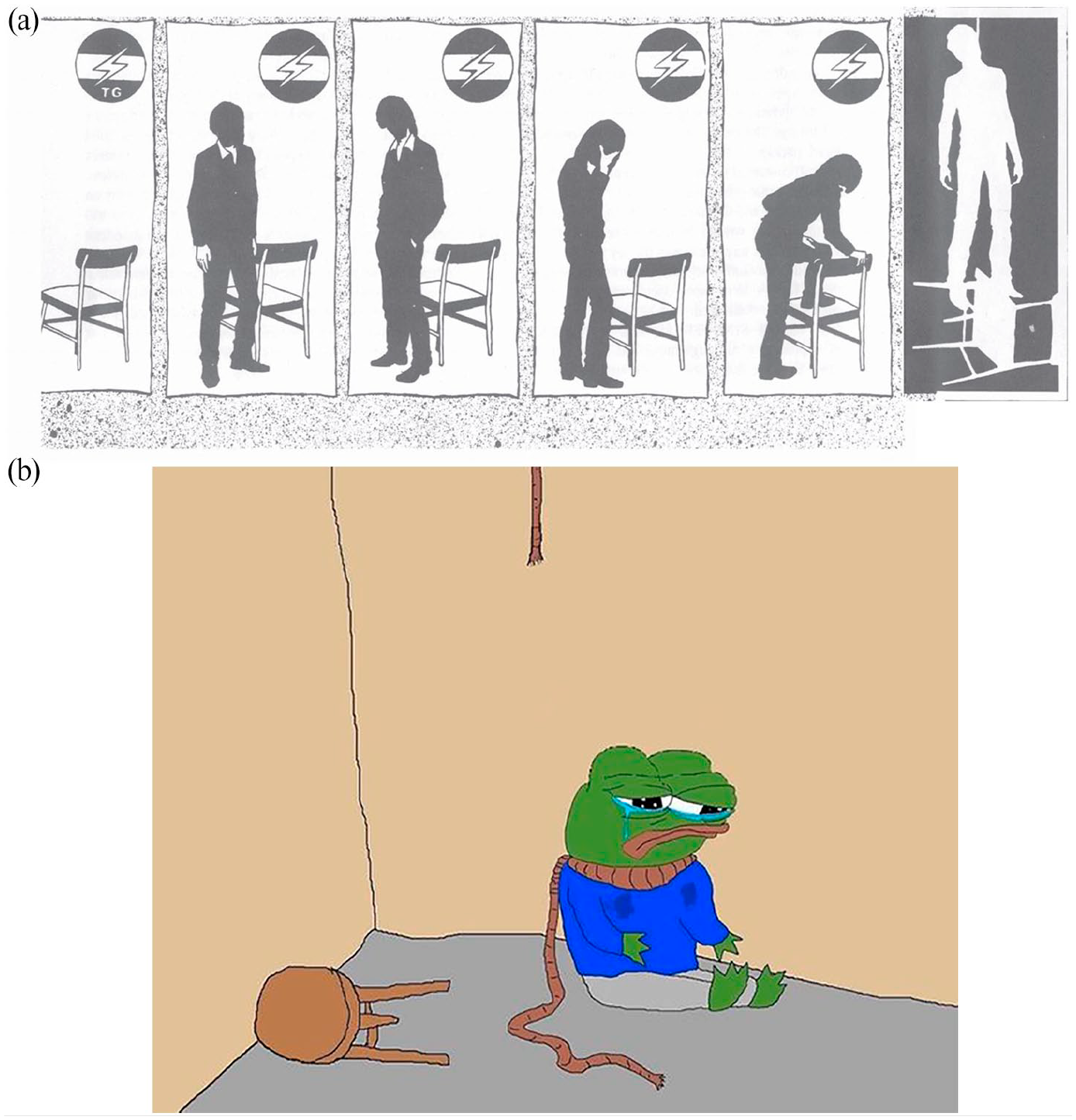
(a) Throbbing Gristle cartoon strip, first published in Re/Search #6/7: in Industrial Culture Handbook (Vale and Juno, 1983), used with permission of Cosey Fan Tutti and Chris Cosey; (b) Pepe the Frog suicide meme, derived from KnowYourMeme.com (2016).
However, one can perhaps charge the extreme music subcultures with complacency, in not being attuned to the threat the far right posed in the 1970s and 1980s. For if both the alt-right and extreme music subcultures made proliferate use of irony, then they equally provided subterfuge for those who, in the words of Tuters (2021: 173), use youth-cultural posturing ‘to dissimulate their true (political) intentions’. Indeed, reading the American Neo-Nazi Andrew Anglin describe his grift as ‘[n]on-ironic Nazism masquerading as ironic Nazism’ (O’Brien, 2017), it is hard to ignore the parallels with long-celebrated extreme artists who used the cover of artistic libertarianism to toy with fascist aesthetics, and who since have been outed as ‘true believers’ (Tuters, 2021: 173) – Tony Wakeford of Death in June being the most famous case. The recent spate of exposés and ‘painful reflections’ published in the online music press attest to just how rapidly opinion has turned on underground music’s transgressive past in light of the growing influence of the far right. 2
To date, these associations between past and present subcultures have gone unexplored beyond superficial observations. Yet they raise an intriguing possibility: that in narrating the story of contemporary communications along the lines of a utopia spoiled, scholars may have overlooked alternative ideologies of media that provide equally compelling explanations for cultural politics in our digital present. This article explores this question by analysing the changing media ideologies and aesthetics that developed around British post-punk zines in the 1970s, 1980s, and 1990s, leading to the early subcultural embrace of the worldwide web. A key stepping-stone from past to present subcultures is the aforementioned Cybernetic Culture Research Unit (CCRU), whose lead figure Nick Land became an intellectual figurehead of the neoreaction subculture, considered a precursor to the alt-right (Kirchick, 2016). Noys’ assessment (cited earlier) of the CCRU’s prescience in a world of memes and fake news is widely shared among theorists, both advocates and critics. However, as this article shows, the media ideology they adopted was far from new. It was inherited practically wholesale, not from 1990s rave and jungle as is popularly assumed (Holt, 2019; Noys, 2014), but from left-libertarian new musick and industrial culture fanzines of the previous decade. During the mid-1980s these zines made a strenuous break with the values of democracy, egalitarianism, and grassroots authenticity which were the default ideological ‘mode’ of DIY production, growing to concentrate instead on the romantic-visionary personae of the zines’ editors and their eclectic interests in esotericism and the occult. Where the Californian ideology would centre the summer of love and the politics of the New Left (or ‘new communalists’, Turner, 2006), the zines ambiguously celebrated the nihilistic, authoritarian, and occult vectors of psychedelia – tendencies that have been associated with the late 1960s and 1970s fate of the counterculture rather than its earlier heyday (Davis, 2014).
The data aesthetic that prevailed in these resources was the sublime-inflected quality of ‘immersion’ in esoteric phenomena. Knowledge acquisition was framed as at once a personal adventure in gnostic study and a suspension of criticality and reason. The configuration of the ‘user’ as an independent-minded knowledge seeker was of course ubiquitous in early internet culture, manifest in encyclopaedic links pages that point to strange and arcane destinations on the web, and traceable at least as far back as the Whole Earth Catalogue, with its emphasis on self-education (cf. Turner, 2006: 80). Yet the artistic libertarianism of the zines shifted the emphasis towards transgression through contact with censored or samizdat literature. Immersion therefore implies a kind of radicalisation through media. My contention is that this same rhetorical understanding of media can be found in online political subcultures of the present. The illustrations I discuss are Vague and Rapid Eye, two British post-punk-cum industrial culture zines from the 1980s; the subcultural web directory Internet. Underground.Guide; and the web 1.0 site for the Cybernetic Culture Research Unit. As well as demonstrating a direct line of historical influence from industrial culture zines to the CCRU, the artefacts show how consistent media imaginaries were remediated amid profound changes in their underlying conditions – from zines printed on paper, to links directories, to digital websites. Building on recent historical work on zines in Britain (Bland, 2018; Worley, 2015), my analysis shows how the zines developed into independent media entities in their own right, whose effects could be as influential as the groups they chronicled.
From Post-punk to Cyberpunk: Vague
Vague magazine was founded in 1979 at Salisbury College of Technology and Art by Tom Vague together with the illustrator Perry Harris and the photographer Iggy Zevenbergen. While most of the independent punk zines covered ‘real punk’, Vague followed the ‘more experimental or avant-garde’ strand that at the time would have been understood to lie between new wave and new musick (see Cateforis, 2011: 27), but retrospectively was categorised as post-punk. Vague’s first issue featured Siouxsie and the Banshees, Adam and the Ants, The Cure, The Specials, Madness, Swell Maps, and Red Crayola, with most of the features being interviews and reviews (Figure 2). Despite the differences in musical coverage, however, the zine’s aesthetic and ideological positioning was closely related to the wider punk zine ecosystem which it distinguished itself from. 3 It emphasised democracy, claiming to ‘create an alternative media in which ordinary people can get their views across’; egalitarianism, in its stated aim to try to ‘make this one relate to the layman more and not the big music scholars that read the music press’; and radical left politics, via its purported kinship with ‘the tradition of radical pamphlets’, in contrast to ‘DIY style mags or Big Issue prototypes’. 4 Prefiguring the imaginary that would later be animated by the web, and that has been celebrated by authors such as Shirky (2009) and Duncombe (1997), Vague therefore offered a kind of informational utopianism.
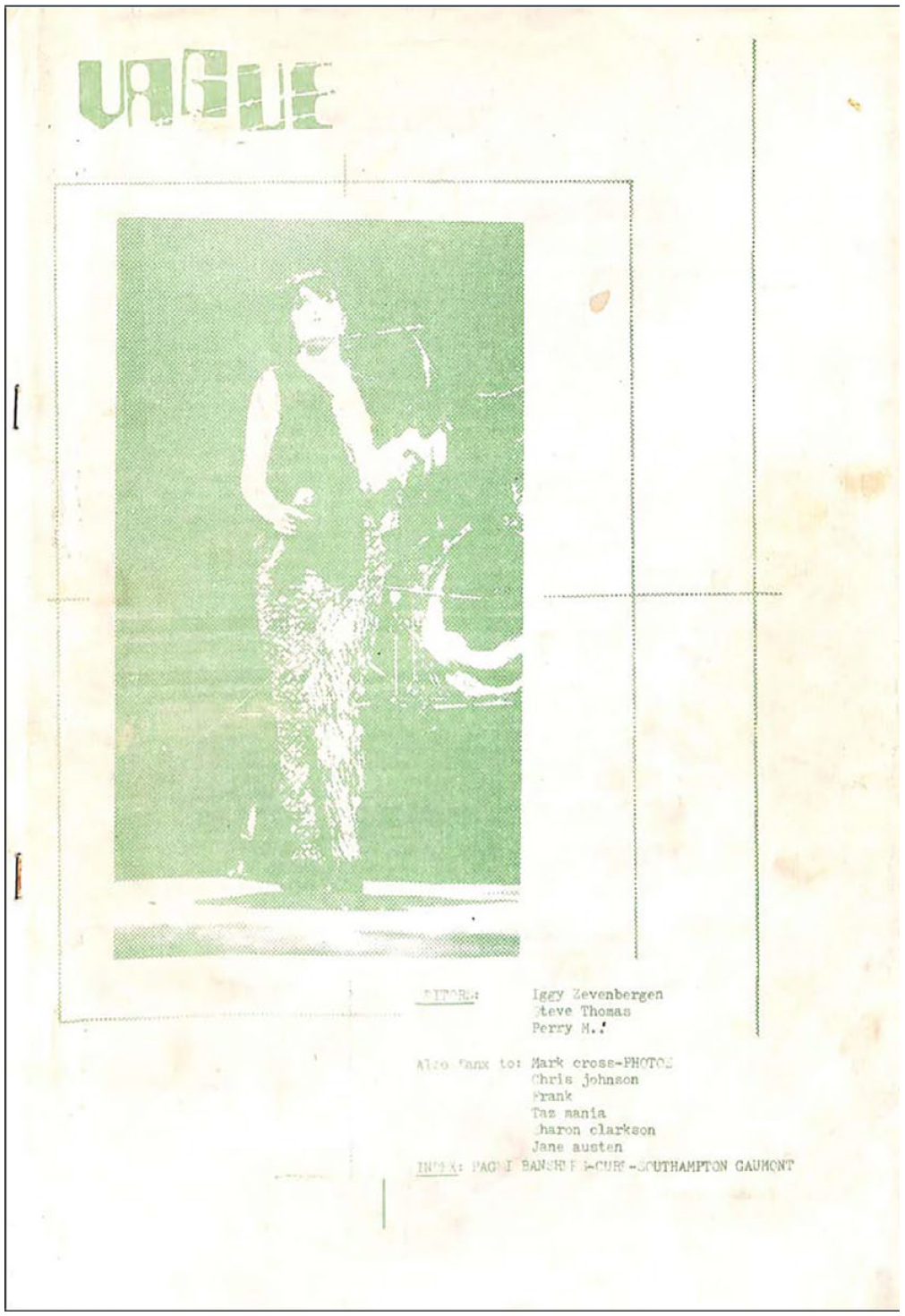
Cover of Vague 1, November 1979 edition, used with permission of Tom Vague.
Tom Vague later narrated the zine’s early period as one characterised by his own, ultimately failed, attempt to break into mainstream music journalism. 5 Yet a series of changes pushed him away from this aim. The most important was the mutation of elements of new wave and new musick into the more commercially oriented ‘new pop’. Adam Ant, the pre-eminent figure of the early Vague and the subject of Tom Vague’s unpublished book, pivoted strongly towards new pop, famously declaring to Sounds in 1980 that ‘cult is just a safe word meaning “loser” [. . .] I want success’ (Reynolds, 2005: 312). Seeking a more sustainable underground, Vague went the other way, leaning into the darker, more esoteric elements of new musick. Contemporary critics and historians often elide new musick with the later category of post-punk (see Cateforis, 2011; Reynolds, 2009 Beckett, 2016). 6 Yet, as Haddon (2020: 25) notes, teleological readings of this kind smooth out the tensions and inconsistencies that were in play during the period when these terms were under negotiation. For Jon Savage, who alongside Jane Suck and Sandy Robertson coined the term, the definition was largely driven by the pop-avant-garde crossings of Throbbing Gristle and Cabaret Voltaire, even if later they would be more enduringly associated with ‘industrial’. Reflecting in the Industrial Culture Handbook issue of Re/Search, itself an important influence on Vague and Rapid Eye, Savage described five principles that industrial took from new musick: organisational autonomy; access to information; use of synthesizers and anti-music; extra-musical elements; and shock tactics. Savage’s description is useful for understanding the formal development of Vague, for two reasons. First, it imagines a non-hierarchical relationship between music and other media, where zines exceed their role as secondary ‘fan’ media to dwell in a flattened ‘information’ space of music, text and image. Second, it gives the zines a renewed purpose, from reports on scenes and subcultures to providing a platform for ‘extra-musical elements’, defined as ‘literary elements (discussed) in a thorough – as opposed to typical pop dilettantism – manner’ (Savage, 1983: 5). For new musick musicians, zines embracing ‘literary elements’ would provide a crucial plank of the crossover from pop into avant-garde. For magazines like Vague, it would supply them with an independent purpose untethered to the wax and wane of subcultural styles.
After 1984 Vague shed the punk-ish cut-and-paste aesthetic, its design incorporating artistic photography and its commentary roving further into analysis of the urban environment, youth culture, Situationist theory, and anarchist politics. Vague was also forging alliances with the fringes of other fields, many of which were central to the industrial universe. An issue from 1984, titled CONTROL DATA MANUAL: Programming Phenomena and Conspiracy Theory, lists conspiracy theories, William Burroughs, the Situationists, cyberpunk, Red Army Faction, Charles Manson, the occult, and Data Control as its features, suggesting an underground culture defined across literature, politics, theory, the arts and theology (Vague, 1984). And where previously Vague himself had tended to disappear into the bands and scenes the zine chronicled, the new curatorial eclecticism served to turn attention towards his authorial persona, which increasingly resembled the ‘visionary’ romanticism of figures like William Burroughs and William Blake. What I want to highlight, however, is the aesthetic and ideological transformations that the post-1984 ‘turn’ brought. Like most zines Vague had been hand cut-and-pasted, mixing image and text in a way that could occasionally be hard to read. However, with the departure from post-punk this collision of image and text became more oppressive and psychedelic – the images more solarised, the text often bordering on the illegible. One piece in the 1984 issue demonstrates this atmosphere. In a review article on The Family: The Story of Charles Manson’s Dune Buggy Attack Battalion by Ed Sanders, the author Lucian K. Truscott IV describes the descent of the values of the counterculture into authoritarianism and ‘psychedelic fascism’: Psychedelic fascism. In a way it was inevitable. The drugs, beginning in the fIower-power days of yesteryear, and their accompanying expanded consciousness, got weirder and weirder. As Ken Kesey predicted on the front of his bus in the early days, everything went further. (Truscott, 1970)
The author predicts a growing ‘age of psychedelic fascism’ that, inaugurated by the Manson Family killings, was now incubating in the new religions of the early 1970s and the subcultural trend for video trading of snuff movies. His moral position is clearly expressed throughout in the warnings about ‘a locust-swarm of eviloids [sic] that are devouring some of the best young minds of the country at this very moment’. Yet its presentation in Vague makes it provocatively ambiguous. First, it is printed in black atop a dark red and white print of Manson’s face, which gives it an oppressive, immersive intermediality, making the text difficult to read and aestheticizing the concept of psychedelic fascism (Figure 3). Second, Truscott’s text is followed by an excerpt from Manson’s ‘Last Will and Judgement’, allowing Manson to have the final say on the killings, and implicitly making the murders into a two-sided affair that the reader can arbitrate between. The horrors of the Manson Family killings are first simulated in the détourned Truscott text, and then equivocated via the presentation of Manson’s response.
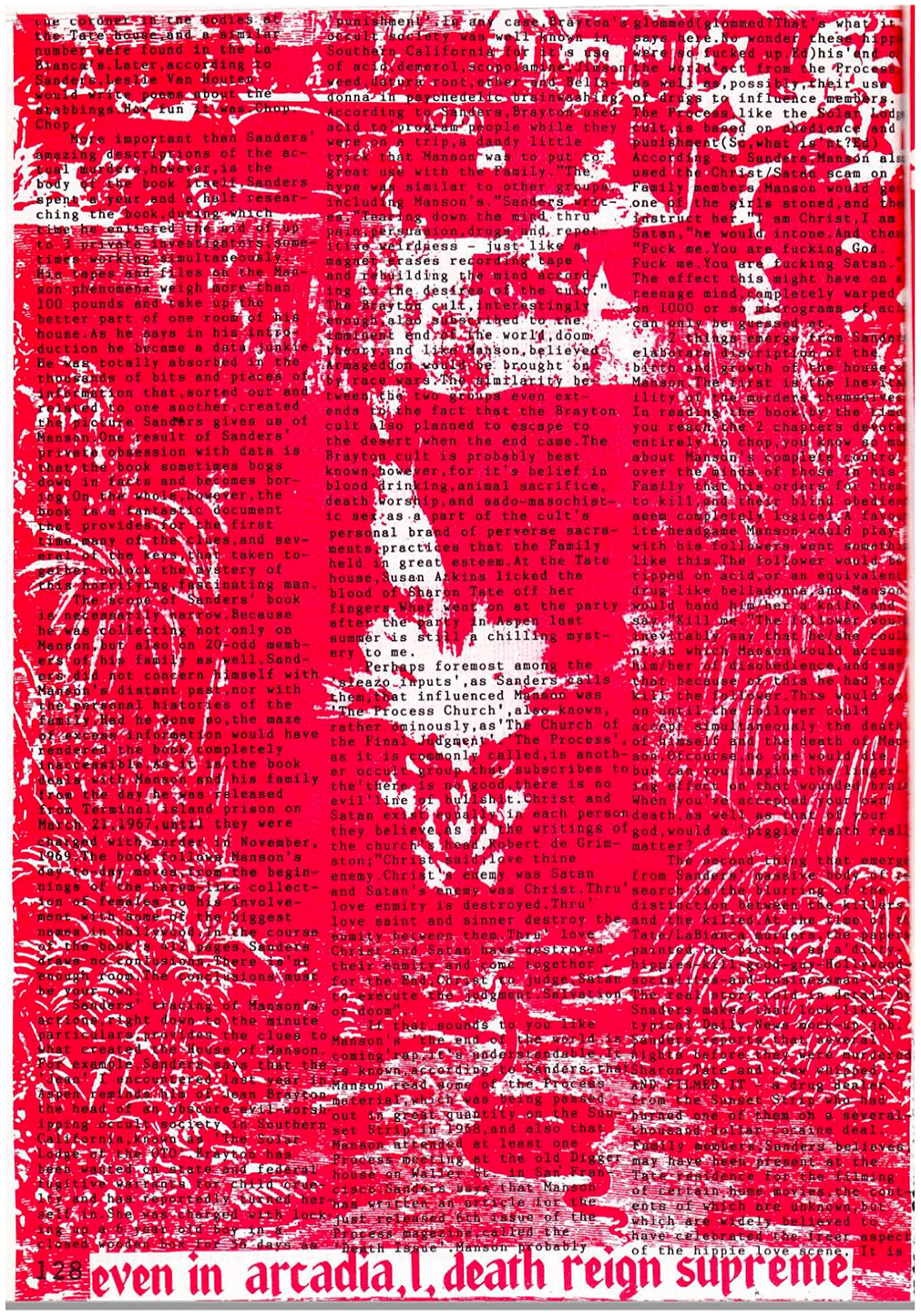
‘Psychedelic Fascism’, Vague 18/19 (1984): CONTROL DATA MANUAL: Programming Phenomena and Conspiracy Theory, used with permission of Tom Vague.
Although music was de-emphasised in the later Vague, projects like Psychic TV and the Temple Ov Psychick Youth still featured on the grounds that they were ideologically aligned. The nature of that alignment can be seen in the next, related illustration: Rapid Eye Movement.
Proto-web Occulture: Rapid Eye Movement
Rapid Eye Movement (REM) was a contemporary of Vague, and there are similarities between the two. Both started in 1979 as new-wave-cum-new-musick zines, and both went in radically different, more experimental and literary directions, all but abandoning music in the 1980s. Both, too, were edited by writers with close relationships to the bands and musicians they wrote about — in REM’s case this was Simon Dwyer. Like Vague, Rapid Eye Movement stressed its commitment to independence and distinction from the mainstream music press, asserting that ‘we are not interested in sales graphs and charts [. . .] more ideas, less lists’ (Dwyer, 1979: 3). However, the zine undeniably had a more professional, more legitimate feel than Vague. Dwyer’s early writing on the anarcho-punk band Crass landed him a job writing for the weekly music magazine Sounds, and this proximity to the mainstream meant he could draw on his contacts for interviews and articles at REM. The first issue featured a discussion between NME writers Julie Burchill and Tony Parsons, for instance, which lent the zine an overground legitimacy that Vague never achieved.
The REM archive is spotty so it is difficult to assess how it developed after the first few instalments in the late 1970s and early 1980s. Those issues show a punk, anarcho-punk, and post-punk emphasis in coverage, which is framed by fine art photography bearing a Victorian gothic aesthetic (Figure 4). Sometime in the 1980s REM ceased, being relaunched as Rapid Eye in 1989. In keeping with Savage’s definition of industrial culture, the renewed zine embraced an expanded informational space as literature, poetry, philosophy, film, television, and visual art were introduced alongside or in place of music, and in issues that were closer in length to journals. This was aligned with an editorial-stylistic shift from ‘reportage’ to actively defining the culture that it addressed. This can be observed in the introduction to the first issue, in which Dwyer defines the category of ‘occulture’: This new word obviously suggests both Culture and the Occult. To me, this ‘oculture’ is not a secret culture as the word might suggest, but a culture that is in some way hidden and ignored, or wilfully marginalised to the extremities of our society. A culture of individuality and sub-cults, a culture of questions that have not been properly identified – let alone answered – and therefore, do not get a fair representation in the mainstream media. It is a culture that has been misinterpreted. Not because it is ‘evil’ or wrong, but because it is generally apolitical and amoral, unashamedly artistic, experimental, undogmatic, intellectual and oddly evolutionary. It is a sub-culture that is forming a question that ‘reality’ alone cannot answer. Which is why it makes people nervous. (Dwyer, 1989: 3)
7
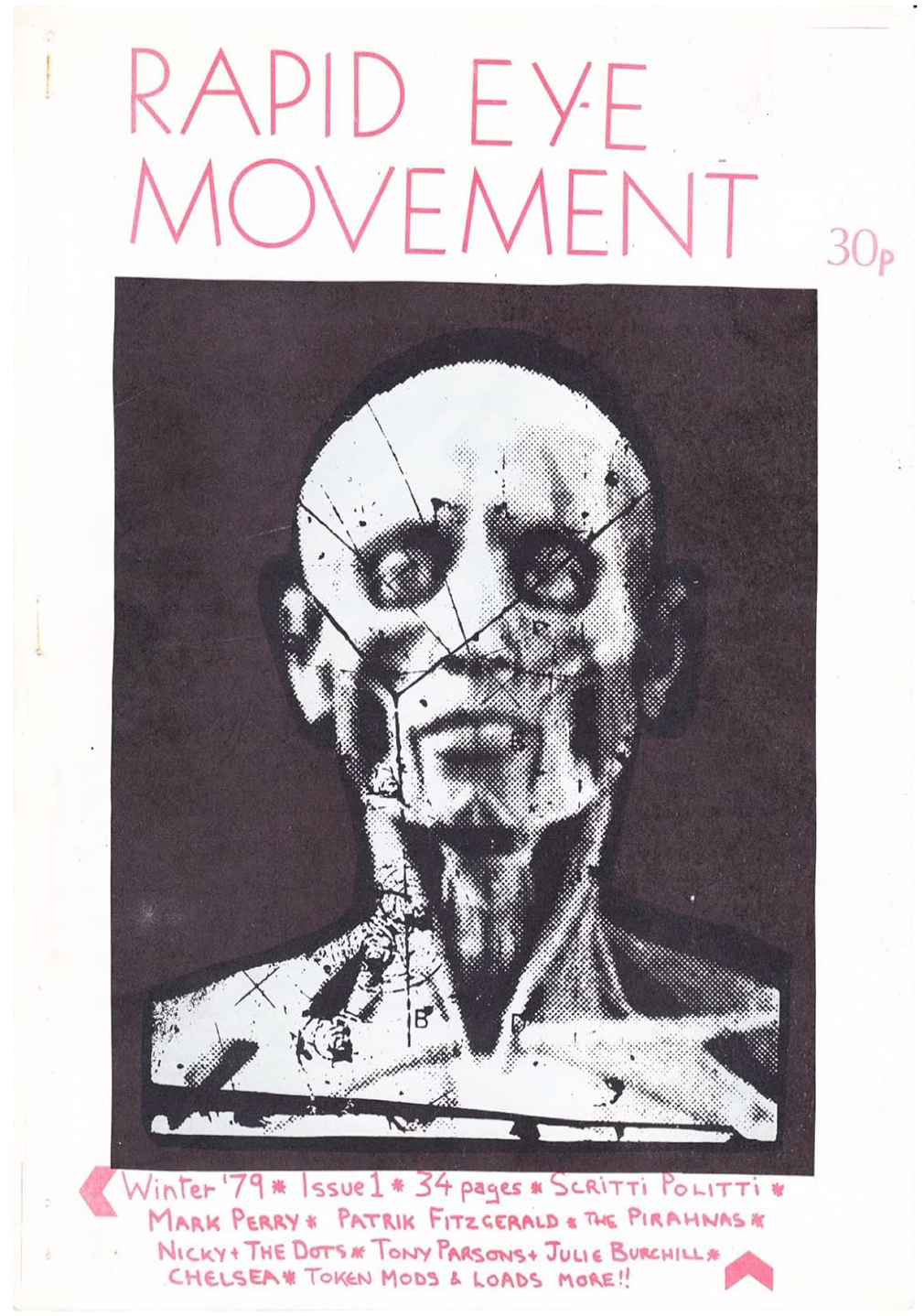
Rapid Eye Movement, Issue 1, Winter 1979.
Going by the content of the first issue, the category of occulture traversed anti-human theory (William S. Burroughs, Brion Gysin), Western occultism (Aleister Crowley), Eastern esotericism (Tantra), fictional or reality-hacking art movements (‘Situationism’, Neoism), outsider art (Austin Osman Spare), conspiracy theories (Nazi UFOs), experimental and ‘transgressive’ writers and artists (Kathy Acker, Derek Jarman, Mr Sebastian), new religions and cults (Charles Manson, Jim Jones and The People’s Temple of Christ). To the extent that music was covered, the focus was overwhelmingly on industrial music – particularly Psychic TV (PTV) and the associated artistic collective and self-styled ‘cult’, the Temple Ov Psychick Youth (TOPY). The appeal of these projects to the industrial culture and new musick zines was threefold. First, they can be seen to have performed the same extra-musical expansion that Rapid Eye and Vague had participated in, and that was described by Savage in the Industrial Culture Handbook. Although TOPY is often remembered as a secondary ‘fanclub’ to PTV, the relationship between the two was more complex, and certain TOPY ‘access points’ (city-based nodes in the TOPY mail network) were almost entirely independent of PTV and Genesis P-Orridge. 8 Rapid Eye followed suit. It was the most forceful advocate for TOPY and PTV among the British industrial culture zines, and it reported on its activities as a magazine would. However, it was also an independent component in it, feeding in extra-musical contents. The concept of occulture, for instance, was absorbed by TOPY after Dwyer defined it. In this way, TOPY were seen to harbour the same relation to PTV as the reformed punk zines did to ‘popular music’ – as collaborators in a flattened-out information space.
Second, TOPY and its related projects appealed on the grounds of their infamy and related under-representation in the mainstream press. Beyond Belief (Addicott, 1992), a Dispatches documentary, helped cement the view that TOPY were a depraved, brainwashed cult who engaged in erotic rituals mixing sex, violence, and child abuse. After this, mainstream outlets became nervous around the group, with record deals and pending shows being cancelled and the police, HM Customs, Royal Mail and BT investigating the group on separate grounds. To Rapid Eye and Vague, this secured their underground and countercultural credentials. Put simply, there was no danger of PTV migrating to the mainstream as Adam Ant had done in 1981.
Finally, TOPY represented a particular way of remembering the 1960s, which emphasised the darker, more paranoid, anti-human qualities of the counterculture. This is best represented by Psychic TV’s 1985 single, ‘Godstar’. A tribute to the late Rolling Stone Brian Jones, the song both propagates the conspiracy theory that he was murdered rather than drowned, and tries to create a deity of him. Seen on TOPY’s own terms the song was a piece of cultural engineering that ‘hacks’ into mainstream media – the charts – in order to unsettle with images of conspiracy and cultism. Within Rapid Eye and Vague it offered one plank of an assemblage of references that, together with such artefacts as Charles Manson’s testimony to the courts about the Tate-LaBianca murder and William Burroughs’s anti-human literature, created a 1960s ‘darkside’.
Occulture Remediated: From Zines to the Worldwide Web
Dwyer’s ‘occulture’ echoed Savage’s definition of industrial culture. Yet the coinage added something important, which was to frame the zine format less as a bearer of content than as a particular kind of technology – one that, like the non-Western spiritualisms that often featured on its pages, demanded personal experience and discovery on the part of the user. This configuration of the zine audience as a ‘user’ rather than a ‘fan’ would be an important point of ideological contact between the zines of the 1980s and the early web. ‘Transitional’ media artefacts like Internet.Underground.Guide (Ludovico, 1995) integrated the two, fusing the zine with the more ‘practical’ technology of the hyperlinks directory, and privileging the arcane and hidden knowledge that could be found online. My final illustration shows how this same ethos was carried across to the web: it is the website belonging to the Cybernetic Culture Research Unit, and dating from 1999. The CCRU were a group of philosophy lecturers and PhD students based at Warwick University whose core group, at the time their website was created, included the cultural critic and music journalist Mark Fisher; the electronic musician and founder of Hyperdub records Steve Goodman/Kode9; the theorist and art curator Suzanne Livingston; the media scholars Anna Greenspan and Luciana Parisi; and the philosopher Nick Land. As an academic research group whose discipline is philosophy, the CCRU stand out from the examples discussed so far, but from another perspective they are similar. First, music, and particularly the popular electronic dance music of the 1990s, was at the heart of the CCRU’s collective writing and thought, and it is in large part thanks to the later music-related activities of Goodman and Fisher that the group have received any attention at all. Second, although the group was born in an academic philosophy department, it acquired notoriety as an interdisciplinary art-theory collective operating beyond academia, an ethos that was embodied in the group’s publications, which were typically either zines or web texts – the former being sold in the same independent bookstores as Vague and Rapid Eye. 9 Third, following the exit from academia the ‘research interests’ of the CCRU underwent a self-conscious shift from a postmodern mix of cybernetics, continental philosophy, dance music, sci fi and cyberpunk literature, feminism and gaming, to esotericism and occulture.
This shift from academia to subculture was narrated by the CCRU themselves as a ‘descent into madness’. Later, those at the centre of things revealed it to have been partly driven by the real psychological breakdown experienced by the group’s academic lead, Nick Land. 10 Either way, it had a strong literary-aesthetic dimension. The 1997 web page retrieved from the Wayback Machine (Figure 5), and advertising a work in progress seminar, shows the CCRU as an open, democratically organised group. By contrast, the independently hosted web page from the same year, produced following the group’s departure from the university, keeps the reader at a distance (Figure 5). Written in the third person, and offering cryptic evasions as to its function and membership (the group were anonymous in the style of tactical media groups like Luther Blissett), it presents the CCRU not as an open research group but as a clandestine and cult-like organisation. Although conveyed through radically different media, institutional arrangements, and organisational forms, the shift therefore mirrors that of the post-punk zines: from informational democracy to enclosure and immersion.
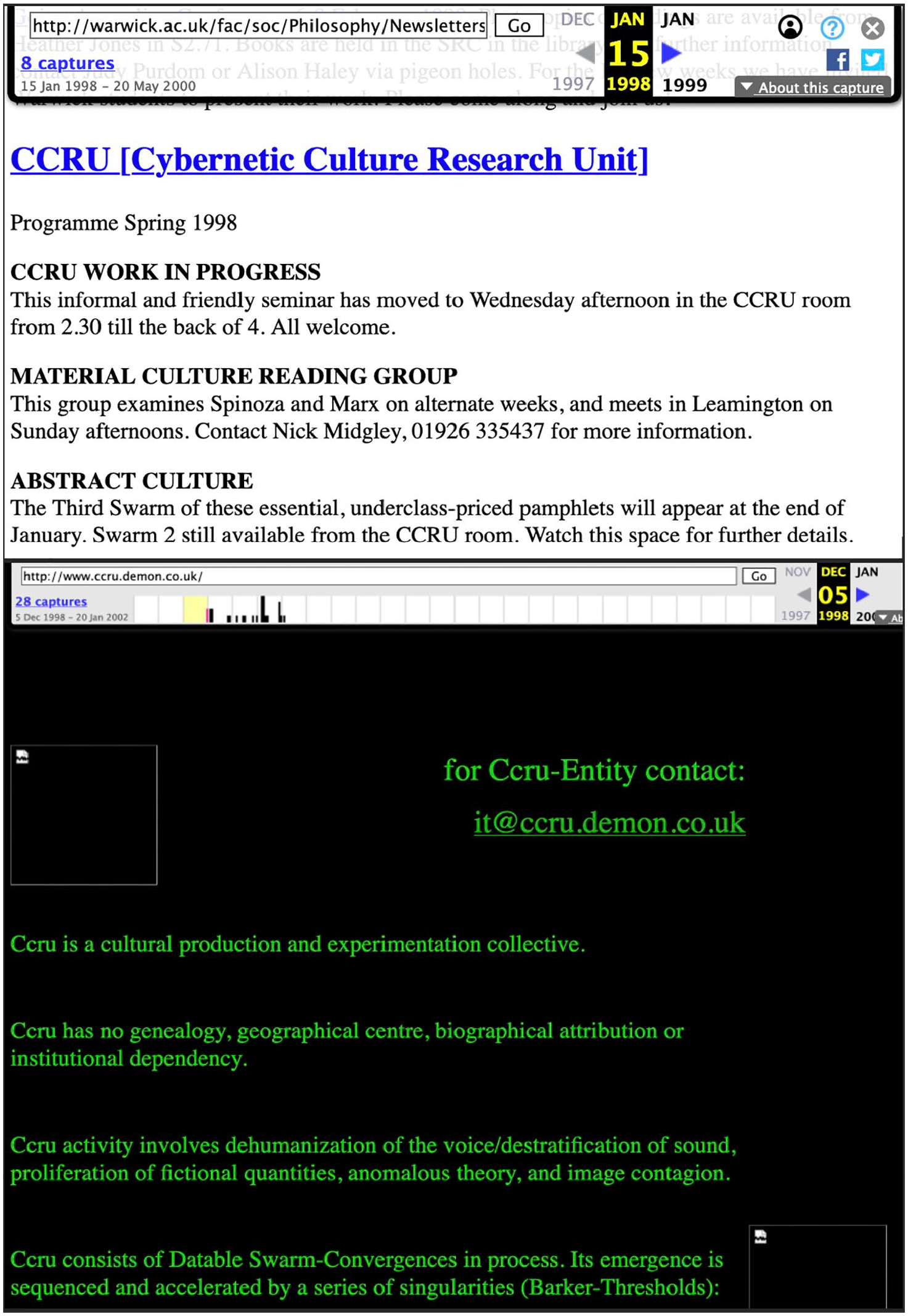
(a) CCRU institutional website (top), vs (b) CCRU independent website (bottom). Both date from 1998 and were retrieved via the Wayback Machine.
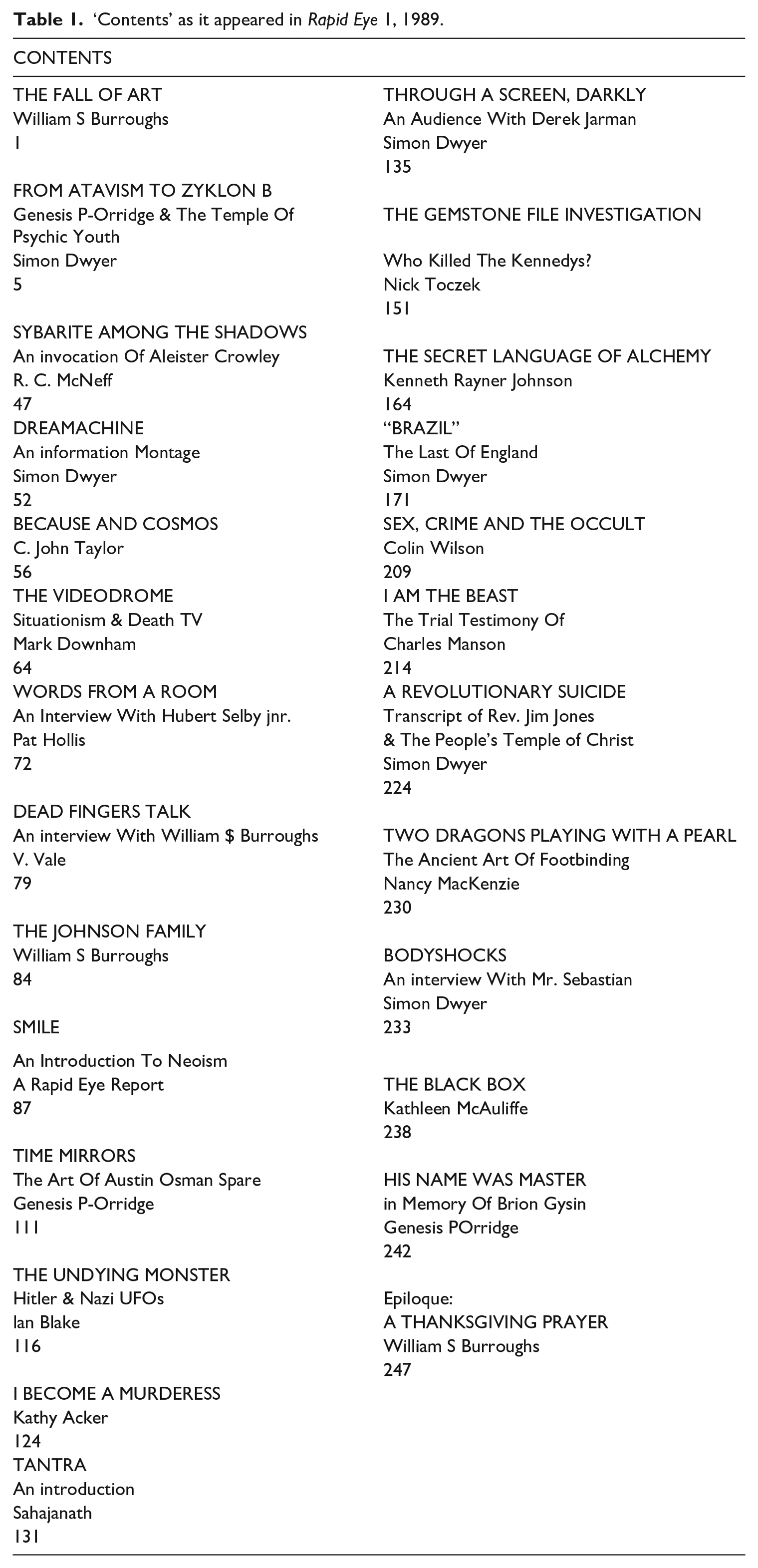
Aesthetically and ludically, the post-university web presence clearly draws influences from the occultural zine ecosystem. We see this in the 1999 iteration of the site pictured in Figure 6. In the banner at the top, the name ‘Cybernetic Culture Research Unit’ is written alongside a hand-drawn spiral pattern symbol recalling the secret society imagery commonly used by industrial musicians. Below it is a row of seven categories, one of which is notably titled ‘occultures’ and contains descriptions of invented ‘subcultures’ the CCRU experimented with in their writing (e.g. AOE, Hyper-C, Lemurs). Below that sits a self-authored occult system for summoning demons called the Numogram. However, it is on the humble links page that we find the clearest retention of 1980s occulture. Already the vernacular metaphors associated with web experience conjure images of ludic immersion in information, from the ‘information superhighway’ to ‘web surfing’. ‘Liminal’ artefacts like the aforementioned Internet.Underground.Guide sought to swerve links directories towards the darker side of occulture with its pages on UFOs, conspiracy theories, and the occult. The CCRU links page amplified these qualities, aligning web surfing with sublime revelations of unconcealment and gnosis. Navigating the web with ccru.net as the starting point, one would be guided towards arcane destinations such as: the Aleister Crowley library; the Ordo Templi Orientis Phenomenon; the horology index; the I Ching and number theory; maps of plate tectonics; a chronology of H.P. Lovecraft’s mythos; artificial intelligence and robotics research pages; conspiracism on alien abduction; cyberpunk resources; Mesopotamian magic and myth; and more – 70 destinations in fact. As Table 1 and Figure 7 show, the blizzard of strange and esoteric references remediate those that could be found in the aforementioned 1980s post-counterculture revival zines. And like those zines, the experience that is invited oscillates between the epistemological and the aesthetic – between the personal acquisition of ‘knowledge’ and an anti-critical immersion in the arcane and otherworldly.
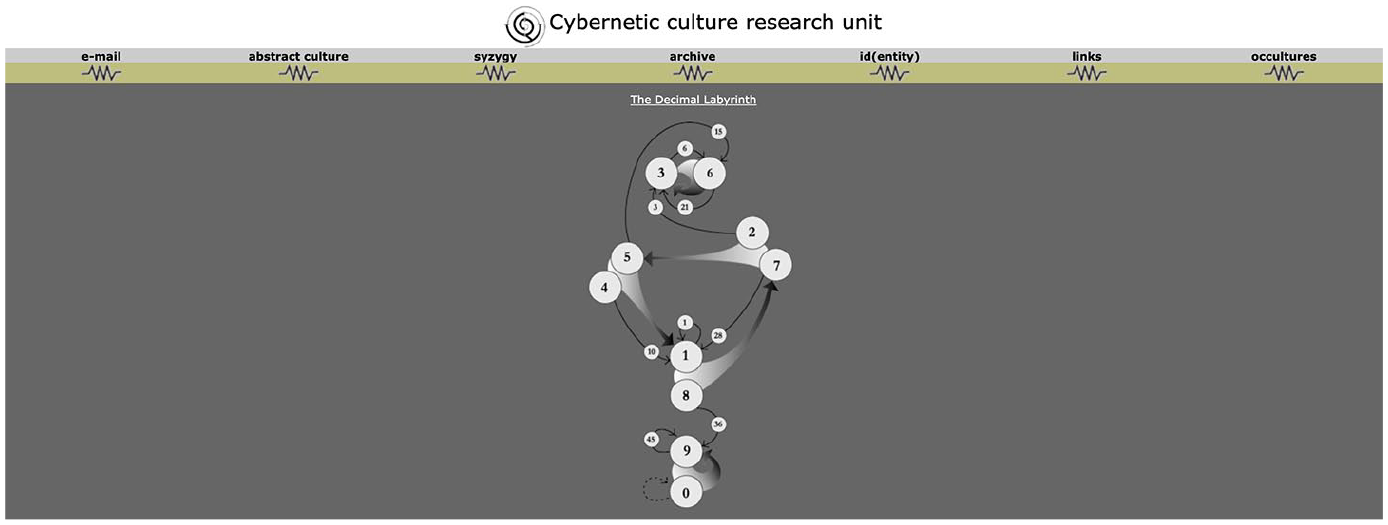
CCRU independent website (1999). Ccru.net. Used with permission of Suzanne Livingston.
‘Contents’ as it appeared in Rapid Eye 1, 1989.
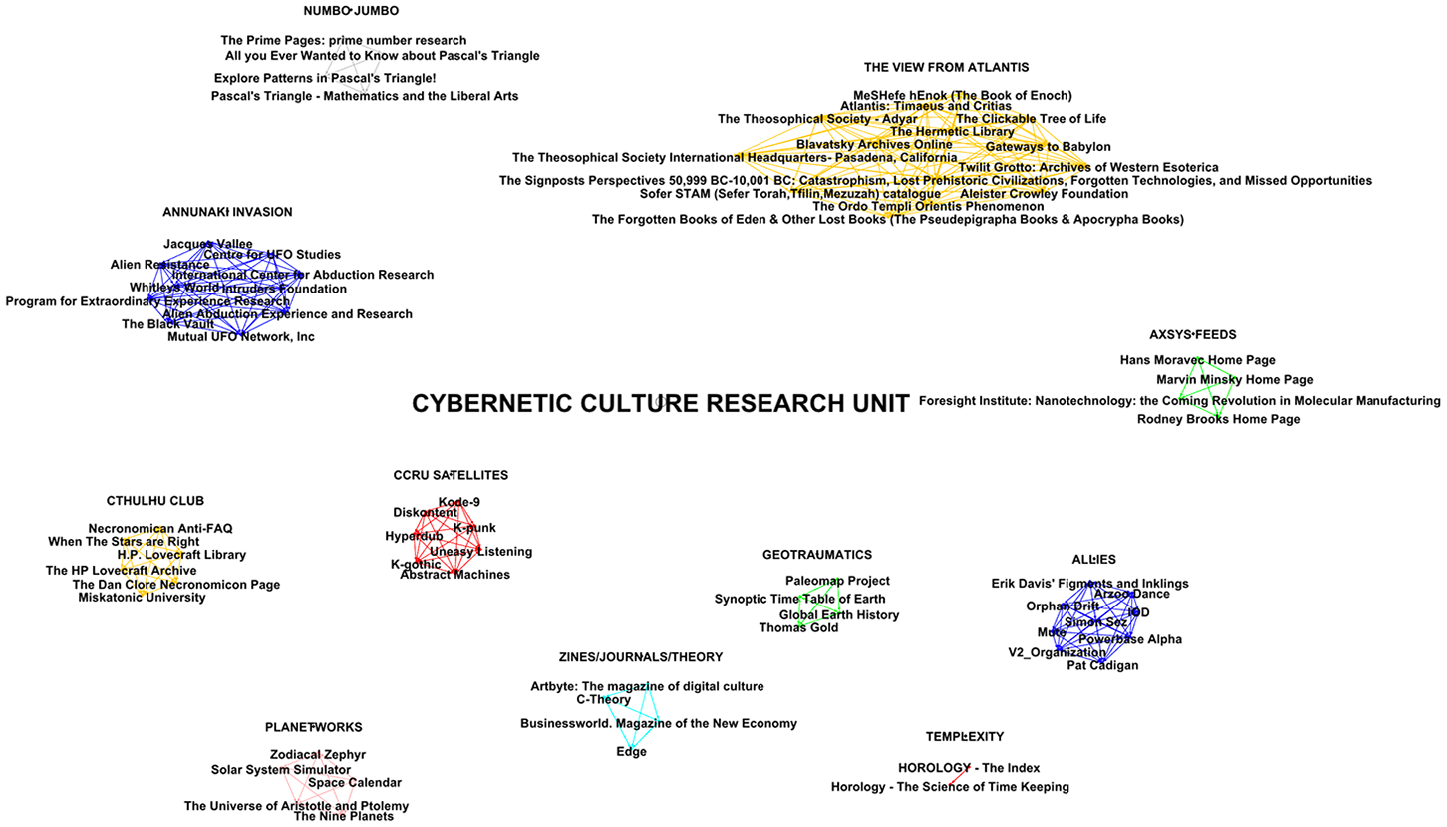
Visualisation of visible links from links page of ccru.net.
Positioning links pages as immersive media shows the remediation of the aesthetics and ludics of zine media for the early web. After Bolter and Grusin (2000), remediation is the representation of one medium in another, and a common logic of development in the design of media technologies – arguably more so with digital media. However, immersion was not only remediated via the re-presentation in another medium of its signifying content. Closer examination of the CCRU’s web page shows that it was also redeployed using web-idiomatic means. Listed inside the page source code, visible in Figure 8, are 53 keywords that the site designer scripted into the page. Surprisingly, the keywords give names to the anonymous members and associates of the CCRU, alongside musical genres, critics and publications that the group oriented their work towards (breakbeat culture, garage, jungle, 2-step, darkside and drum ’n bass; The Wire and i-D mag; Simon Reynolds and Kodwo Eshun); essays, concepts, institutions and theorists that members of the CCRU might be known for (e.g. ‘Meltdown’ by Nick Land; Steve Goodman’s Katasonix label; Y2K; Deleuze, Guattari, DeLanda and Virilio); and more overt references to Cold War paranoia and psychedelia (‘drugs’, ‘Nato’, ‘CIA’)., alongside musical genres, critics and publications that the group oriented their work towards (breakbeat culture, garage, jungle, 2-step, darkside and drum ’n bass; The Wire and i-D mag; Simon Reynolds and Kodwo Eshun); essays, concepts, institutions and theorists that members of the CCRU might be known for (e.g. ‘Meltdown’ by Nick Land; Steve Goodman’s Katasonix label; Y2K; Deleuze, Guattari, DeLanda and Virilio); and more overt references to Cold War paranoia and psychedelia (‘drugs’ ‘Nato’, ‘CIA’). Not all of these are hidden on the public face of the website (especially Kode9 and Orphan Drift), but most are, so it is a strange thing to encounter for a group whose commitment to collective anonymous authorship has retrospectively provoked such intrigue. In fact, the hidden keywords offer exactly what one might expect to find on a conventional links page – the personnel, interests, and associates of the group. Indeed, they offer examples of aspirational hyperlinking: ‘the anticipatory projection by one party of wished-for relations with and valorization by another – relations that are not (yet) reciprocated or actualized, but in which the potential for an inflationary cycle [of prestige/cultural capital] is sought’ (Born and Haworth, 2017: 612)
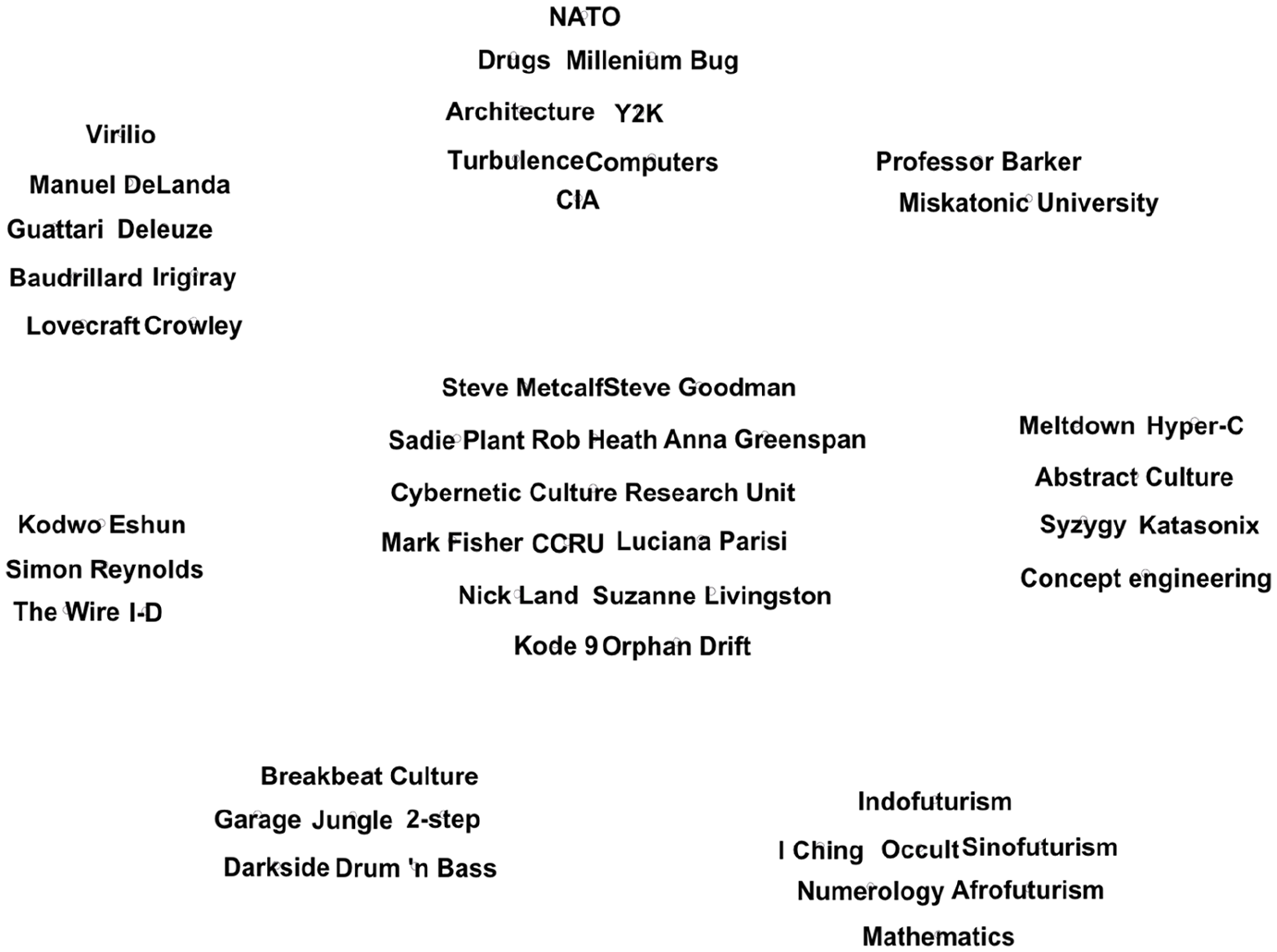
Visualisation of ‘named entities’ hidden in source code of ccru.net.
Why did whichever member designed the website choose to undermine the cool secrecy and closure of the CCRU? One interpretation is that the source code contains traces of a tactic – now obsolete – to influence search engine results. The functionality this relies on was deprecated with the ascent of Google’s PageRank technology after about 1998, but in a pre-Google world a site designer could hard-code ‘named entities’ into a website so that they would be discoverable via search. (Indeed, the presence of ‘cybernetic culture research unit’ and ‘ccru’ in the keywords suggests a designer trying to anticipate various possible queries.) This means that a search for ‘The Wire’, ‘Simon Reynolds’, or ‘2-Step’, for example, could lead a web user to ccru.net, from where they would find occultism, conspiracy, number theory, time travel and so on. Thus, rather than arriving at The Wire or i-D from ccru.net, the site appears as a detour, or better, interrupt, upon searching for these music-related organisations. A naïve visitor to the site via this route might be aware that the CCRU had some relationship to underground and experimental music, but quite what their function or purpose is remains unclear.
The CCRU’s website therefore performs a kind of web-based subcultural infiltration, where music and other subcultural interests are switched out for esoterica. To continue the analysis begun with Vague, we can say that the naïve visitor to ccru.net is immersed – the term conjuring both aesthetic immersion and a kind of radicalisation into the symbolism and mythos of the CCRU. 11
Conclusion: From 1990s Occulture to the 2016 Culture Wars
When the alt-right emerged into the mainstream during the 2016 US presidential election it drew legitimacy from a host of far-right intellectuals, from contemporary neo-reactionaries (NRx) like Curis Yarvin (aka Mencius Moldbug) to more traditional conservatives like Jordan Peterson. Somewhere among them were a handful of figures who had made their name amid the political upheavals of the late 1980s and early 1990s and were being rediscovered: the Russian political analyst and philosopher Aleksandr Gelyevich Dugin was one, and Nick Land of the CCRU was another. As has been widely discussed (cf. Hawley, 2018; Hermansson et al., 2020; Nagle, 2017), the chief driver of Land’s new popularity was ‘The Dark Enlightenment’, a blog series starting in 2013 that critiqued liberal democracy’s ‘relentless trend to (intellectual) degeneration’ and toys with neo-reactionary themes including ‘race realism’ and ‘human bio diversity’ (Land, 2013). At the same time, the fact that Land was listened to at all was a product of the cultural prestige he had amassed as a philosophy lecturer and guru to a new generation of cultural theorists. In article after article across both liberal and right-wing media, Land’s background as the expelled Warwick academic-turned-crazed-leader of the CCRU featured strongly. Users of political forums like the 4chan/pol (‘politically incorrect’) board in turn mythologised the connection, producing esoteric memes that positioned Land as a William Blake-like visionary who had glimpsed the neofeudalist future (Dean, 2021) at a time when others were talking up the dotcom boom.
We see this in a meme posted to the /pol/ board, a political forum on the Reddit platform (Figure 9). In the image, a pyramid is depicted upon which various online subcultures are ironically piled up in an ‘interlocking chain of command which constitute(s) the power structure of our invisible world government’ – they include the ‘Land-Dugin Syncretic Brotherhood’, the ‘CCRU Remnant Enclave (Shanghai)’, and other CCRU references (e.g. ‘Architectonic Order of the Eschaton’). The title of the meme is ‘Who Runs the World?’, a reference to the varyingly anti-socialist, anti-semitic New World Order conspiracy theory which posits a totalitarian political system run by either Marxists or Jews. Thus, while it would be poor historicism to suggest, as Noys and others have done, that Land and the CCRU gave rise to extreme right political subcultures of the last ten years, we can nevertheless assert that the subcultural esteem Land enjoys turned attention backwards, to the strange, remediated new-religion atmosphere that the CCRU cultivated following TOPY. Rather than see the path of historical succession between the occultural web and the forms of occulture that characterise subcultural communication among the far right as a linear and molecular line of ‘influence’, then, we might instead characterise it in terms of a structure of protentions and retentions. 12 The traces of 1980s and 1990s occulture in today’s subcultural communication act upon the earlier occulture ‘in such a way as to frame it, retroactively, as being a more or less straightforward cause of the later’ occulture’s effect (Haworth, 2018: 618; see also Born, 2005).
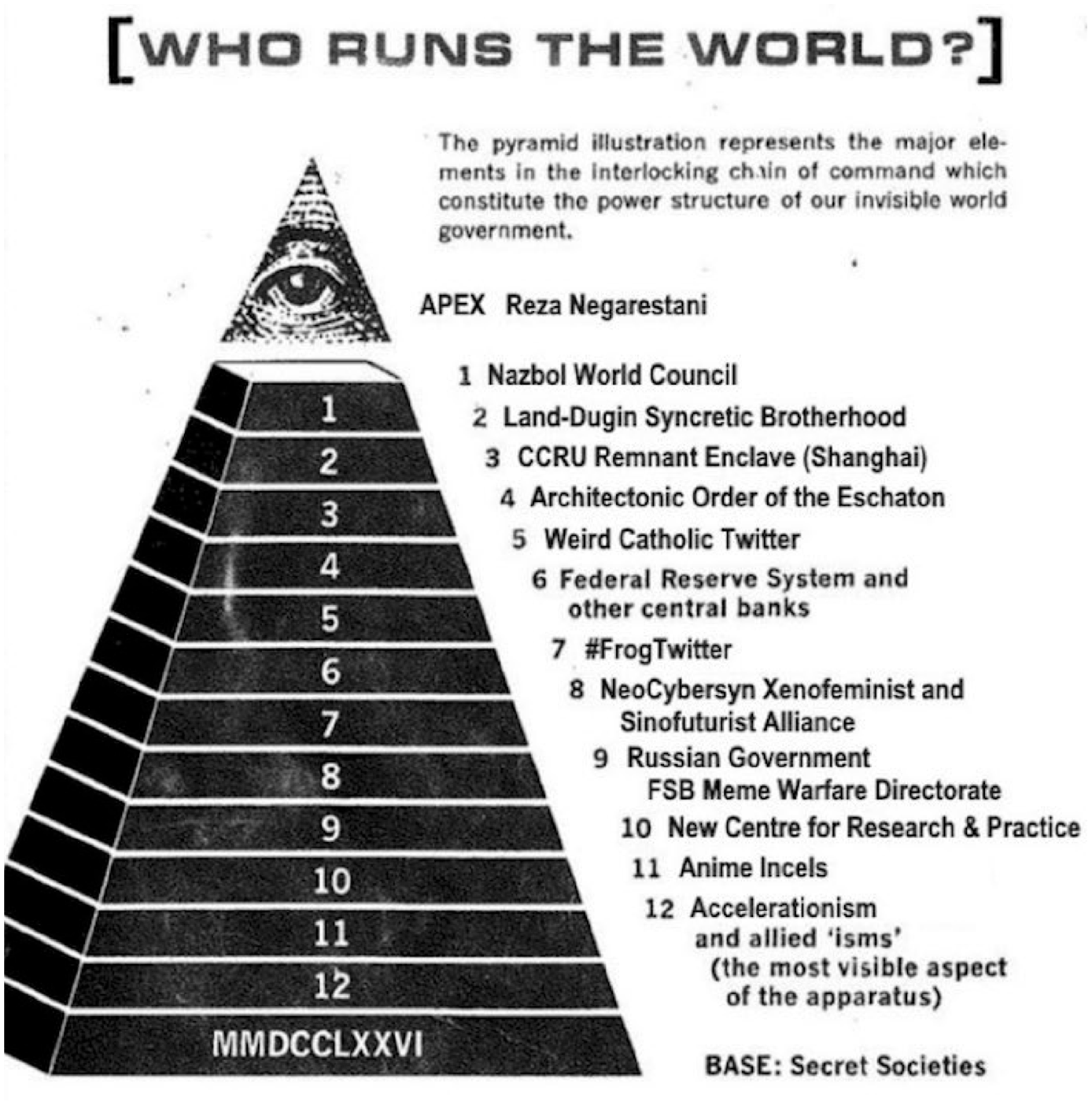
[WHO RUNS THE WORLD?] (2020), CCRU meme.
Yet although figures like Land might like to believe that there is an inevitability between their acts in the present and their future repercussions, historical criticism should return our attention to the contingent and unsettled nature of events during their own present. This article has attempted to foreground this uncertainty by situating 1990s occulture within a much wider subcultural network that grew out of punk, and was to an extent a reaction to punk’s ideological emphasis on democracy, egalitarianism, and grassroots authenticity. 13 The industrial dimension of what Savage, Suck and Robertson termed ‘new musick’ retained punk’s organisational autonomy, augmenting it with an elevating turn to the ‘extra-musical’ fields of outsider art and literature. Later, when subcultural groups in Britain turned their attention to the web, this ‘extra-musical’ culture – later termed occulture – informed what they found there. 14 One of the continuous logics I have tried to emphasise within this turn is an aesthetic of immersion. In Tom Vague’s Vague, immersion describes the textual-visual sublime that transforms a text about Charles Manson into an aesthetic cipher of psychedelic fascism. In Dwyer’s (1989) Rapid Eye, it describes venturing into ‘apolitical and amoral’ thoughtforms that have been ‘hidden and ignored, or wilfully marginalised to the extremities of our society’ (p. 3). In Nick Land’s CCRU, occulture is remediated and immersion augmented with the disorienting tactic of subcultural infiltration.
Immersion should put us in mind of contemporary far-right memes that sit at the intersection between media and politics. Key NRx concepts are the notion of the cathedral and of ‘taking the red pill’: the former describing the liberal-progressive-elite whose power in terms of its control of the media, higher education, and institutions of power serves to suppress independent thought and enforce conformity (Tait, 2019: 194), and the latter describing the perspective-shift required to see the world outside of this prism. Typically, this entails becoming ‘aware’ of purported Jewish media control (as with the racist George Soros conspiracy theories), ‘innate’ biological racial or sexual differences, or social problems associated with multiculturalism (Hawley, 2018: 83). Both concepts evoke the libertarian ethos of the zines, and particularly Rapid Eye in its desire to catalyse ‘experimental, undogmatic, intellectual and oddly evolutionary’ thinkers, unbeholden to mainstream taste and opinion. As much as content, however, it is the ideologies they carry as media that ensure contact with enlightenment. From underground zines and handbooks to the contemporary ‘deep vernacular web’ (de Zeeuw and Tuters, 2020), each styles itself as a portal to gnosis. Indeed, it is possible to see media being imbued with magic and mysticism, a theme that has animated analyses of the internet both in its early stages and in the present (cf. Davis, 1998; Lachman, 2018).
Immersion, in my understanding, differs from the merely sensory-aesthetic definition that dominates in contemporary art scholarship, and that is usually contrasted with the mental-conceptual. What is important is not only the implied desire to suspend ‘critical thought and differentiation’ (Schrimshaw, 2015: 156), but the imaginaries that inform immersion in the unknown. Arun Saldhana’s Psychedelic White compellingly describes how ‘white people become white’ through their ‘constant urge’ to engage with spaces different to them, whether they be surreal, exotic or otherworldly (Saldanha, 2007: 17). Indeed, the desire for transcendence can come at the risk of losing their bearings entirely (Saldanha, 2007). After their ‘visionary’ turns, Tom Vague, Simon Dwyer and Nick Land used everything from structural anthropology to Victorian-era new religions to ‘make strange’ the new media, so that reading a zine or surfing the web could become akin to a state of altered consciousness – similar to Aldous Huxley’s experiments with mescaline or Timothy Leary’s with LSD. To talk of whiteness in relation to digital media of course recalls longer debates on cyberculture, from the ‘white liberal in disguise’ figure of the posthuman that Weheliye (2002) describes to the frontier-settler rhetoric that was grafted onto early encounters with cyberspace, and that has been analysed by many (cf. Barbrook and Cameron, 1995; Streeter, 2011; Turner, 2006). What I have tried to do here, however, is to analyse the localised cultural politics of British and European cyberculture, where the digital vanguard was chiefly associated with artists, theorists and creators (Barbrook, 1998), and where zines and other music media of the previous decade provided the most important subcultural coordinates. In these contexts, whiteness manifested in the protection from harm it provided to authors and artists to immerse themselves in the anti-rational, abject, and censored – including explorations of right-wing esotericism or the supernatural thinking that informed the Third Reich.
Political theorists like Nancy Love and Ana Teixeira Pinto have highlighted how easily art worlds were infiltrated by new right-wing movements like NRx and the alt-right after 2016 (Love, 2016; Pinto, 2017, 2020). Love has stressed the need to develop ‘critical listening publics’ who are able to ‘crack the not-so-hidden codes of white supremacy’ that have coursed through alternative musics in the last ten years. To this I would add that we also need to develop historical and media literacy. Because although 21st-century fascism seemed to emerge in an entirely different way in the previous decade – most notably in the strong role played by culture and cultural politics – this is not to say that there were not precedents.
Footnotes
Acknowledgements
The author would like to thank John Eden, Niall Gallen, Michael Haworth, Mimi Haddon, Patrick Quick, Ed Spencer and Marie Thompson for comments, suggestions and dialogue that helped to improve this article. Funding for this research was provided by the AHRC Leadership Fellowship Music and the Internet: Towards a Digital Sociology of Music, grant number AH/S00744X/1.
