




Abstract
This article presents a dialogue between Roland Barthes and Paolo Fabbri, which took place on 18 December 1965 in Florence, Italy. Barthes offers an engaging account of his structuralist approach to narrative, as was later published in essay form, ‘Introduction to the Structural Analysis of Narrative’, included in a special issue of Communications (Issue 8, 1966). In a cordial exchange with Fabbri, Barthes provides a more candid presentation of method than found in print, along with critical reflection of the underlying importance of the structuralist approach, as perceived at the time. The interview took place as part of a small conference on narrativity. Participants included Algirdas Julien Greimas, Claude Bremond, Umberto Eco, Jules Gritti, Violette Morin, Christian Metz, and Tzvetan Todorov. Subsequently, a number of these participants contributed articles to the same issue of Communications, on the structural analysis of narrative.
Introduction
The dialogue presented here between Roland Barthes and Paolo Fabbri took place on 18 December 1965 in Florence, Italy. Barthes provides a very lucid and engaging account of his structuralist approach to narrative. However, as much as it is a presentation on method, it is also a reflection of the underlying importance of the approach, certainly as it was perceived at the time. As Fabbri (2019) recalls, Barthes had been invited to give a series of lectures at the universities of Bologna and Florence in 1965, as is also documented in his biography (Samoyault, 2017: 272–3). It was following one of these lectures, in this case a conference for a small audience on narrativity, that the interview took place. Among the audience were Pierpaolo Giglioli, Cesare Luporini, Aldo Rossi, Gilberto Tinacci Mannelli, Algirdas Julien Greimas, Claude Bremond, Umberto Eco, Jules Gritti, Violette Morin, Christian Metz, and Tzvetan Todorov. A number of these participants contributed articles to a special issue of Communications (Issue 8, published in January 1966) on the structural analysis of narrative (Figure 1). Included in the collection is Barthes’ (1977) lengthy essay, ‘Introduction to the Structural Analysis of Narrative’, which is one of the clearest examples of the structuralist approach and considered a key contribution to the overall project being directed at the time at the École Prâtique des Hautes Études (Allen, 2003: 55–6).
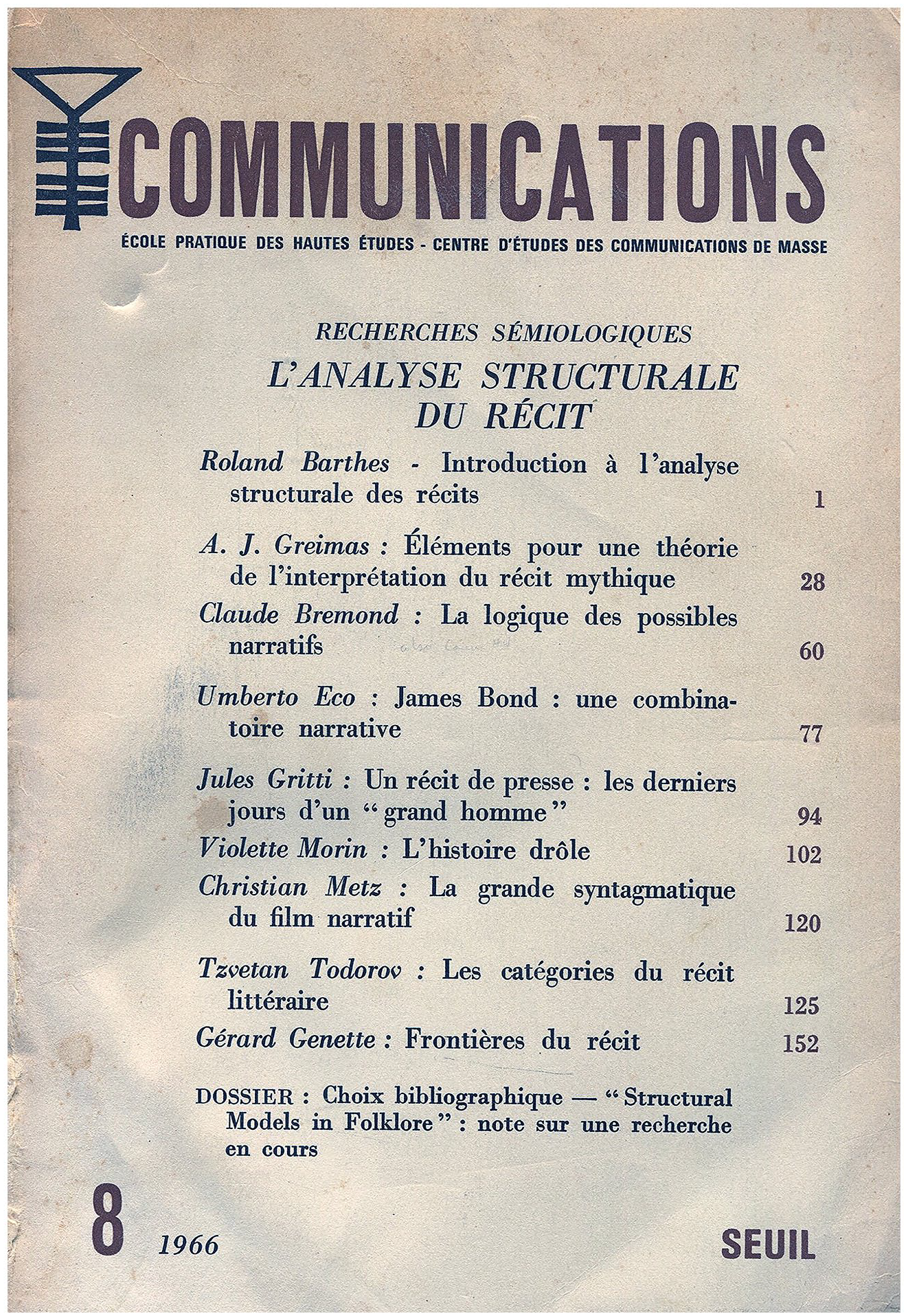
Cover of Communications, No. 8, 1966; special issue on the structural analysis of narrative. Published by École Prâtique des Hautes Études.
Given that the journal issue came out only a month after the talk, it is clear Barthes was speaking of the work he had already researched and written up. Thus, in response to the various prompts from Fabbri, Barthes duly provides an accessible precis of his essay. However, in the format of a dialogue, Barthes is perhaps freer to assert what is at stake in upholding the structuralist approach. Historically, the interview text is a keen reminder of the ‘project’ of structuralism as it pertained to literature and popular culture. In formulating the approach, Barthes acknowledges his debt to Claude Lévi-Strauss. (NB: between 1962 and 1964 he had published two essays specifically on Lévi-Strauss’ work; Barthes, 1986, 1988.) As Samoyault (2017: 231–66) charts, the two were in dialogue over a number of years, but it was a somewhat cordial relationship. Despite a polite exchange of letters, Lévi-Strauss (who famously declined to supervise Barthes’ thesis on fashion) kept his distance and took issue with Barthes’ interest in variations of meaning, against Lévi-Strauss’ own interest in looking at cultural invariance and universal structures. Samoyault remarks boldly that ‘Barthes’ greatness, evident in “Myth Today” onwards, is that he overcame the contrast between anthropology and history, and endeavored to bring them together’ (2017: 253) – a point that is worth reflecting upon when reading the interview, since Barthes makes repeated if enigmatic references to taking an ‘anthropological approach’ (cf. Lévi-Strauss’ (2001: 29–37) lecture, ‘When Myth Becomes History’, in Myth and Meaning).
Perhaps it is because the talk took place so close to the publication of the special issue of Communications that the transcript lay dormant. It was 50 years before the text resurfaced, first in Italian (Barthes, 2019), and now in English here in Theory, Culture & Society. It was a somewhat circuitous and serendipitous route to publication. As it turned out, Barthes had written a brief note about the interview in one of his notebooks, mentioning a ‘conversation improvisée’ with Paolo Fabbri. Access to archival material was limited until at least 2003, after which Barthes’ estate began working with Éric Marty, when numerous late works began to be authorized for publication, including the final lecture courses held at the Collége de France (Manghani, 2020). It was as late as 2012 that Barthes’ preparatory materials, index cards and notebooks were consolidated as a collection held by the Bibliothèque Nationale de France, prompting a new wave of biographical studies in the lead-up to Barthes’ centenary in 2015 (Samoyault, 2017). By chance, in 2018, Paolo Fabbri received an email from Thomas Broden of Purdue University, who had found Barthes’ specific, if cursory, note while doing research at the Bibliothèque Nationale. He was keen to know if the text was available, prompting Fabbri to think back to what had transpired. Fortunately, and much to his surprise, while he was unable to recover the recording itself, Fabbri located an Italian transcript he had produced at the time for the Centre of Audiovisual Studies at the Faculty of Political Science of the University of Florence. It should be noted that, at the time of the interview, Fabbri was a young assistant; it is perhaps unsurprising the text was never then destined for publication. It was finally published in Italian in 2019, sadly only months before Fabbri’s death.
In reflecting upon the interview, 50 years later, Fabbri (2019) notes two particular issues that warrant continued interest today. The first of these is a technical matter, arising from the theoretical disagreement between Claude Lévi-Strauss and Algirdas Julius Greimas. For the former, the syntagmatic sequence of mythological narrations had little value, arguing that the only way to render meaning was to identify ‘mythemes’ as gross constituent units of narrative structure. By contrast, Greimas was the proponent of a phonological model, which requires a paradigmatic as well as a syntagmatic definition (to mythemes one needs to add ‘narremes’). Greimas’ view found favour among scholars of literature (including Barthes), and the result was an emphasis on the sequential dimension of narrativity, arguably to the detriment of reflection on hierarchies of value (Fabbri, 2017; see also Jonathan Culler’s contribution, ‘Analyzing Narrative’, in this issue). As Fabbri (2019: 11–12) notes, the various disagreements are well documented, while the second issue he draws out is perhaps less often discussed, which concerns the relationship between narration and history. More specifically, he refers to the discordancy among historians regarding the narrative nature of textuality. It is relatively recently that proper acknowledgement has been given to the textuality of historical writing. As Fabbri reminds us, Barthes (1987), as a scholar of Michelet, did much to render this issue relevant.
From 1962, in the years just prior to the Florence interview in 1965, Barthes had taken the role of Directeur d’études in the sociology of signs, symbols and representations at the École Prâtique des Hautes Études (which was to become the École des Hautes Études en Sciences Sociales). His seminars at the time concerned contemporary systems of signification – of objects, clothes, food and so on. Fabbri had been following the seminars and was also collaborating with the structuralist sociologist Lucien Goldmann, who is mentioned in the interview. It was through Goldmann that Fabbri met Umberto Eco, with whom he was to begin a lifelong friendship and collaboration. Fabbri notes how at the time it was ‘a very open moment of research during which narrative theory, that had its precedents in studies of anthropological and folklore mythology, classic and contemporary, took shape’ (Fabbri, 2019: 9–10). Such open moments are not devoid of disagreements. On the contrary, such sites of contest are often where significant turns are eventually taken, shaping future research. The interview, detailing some of the questions that were then still open, demonstrates the root of both the vision that prevailed and hints at the roads not taken. Both the proximity of the interview text to the lively debates of the time and the more candid nature of the dialogue make this conversation improvisée of continued relevance to research today.
Monica Sassatelli
 Sunil Manghani
On Narrative
Perhaps we could organise this conversation by asking Barthes to explain his current research, which is important not just for analysing mass communications but also, and perhaps above all, for analysing ideological language in general – the language of political doctrine, for instance. It might also be interesting to apply it to the language of law, which in some sense offers a privileged field for semiological analysis. The topic is the analysis of narrative (in its most general sense). Professor Barthes, could you summarise the fundamental démarche of your discourse, the basic epistemological and methodological approach – that is, the analysis of the récit as translinguistic analysis?
If you like, I’ll happily say a few words about my work on the structural analysis of narrative. This line of research is currently developing in France, in a very modest way. There are already two or three researchers working on the topic, which was first identified 30 years ago by the Russian folklorist Vladimir Propp, who analysed Russian folk tales using a method that was already a sort of structural analysis. As you know, Propp was completely forgotten for 20 years or so, until he was taken up and, in a sense, reintroduced by Lévi-Strauss, who used his thinking while improving it on certain points.
Starting from Propp’s analysis and Lévi-Strauss’s improvements, then, we are now beginning to make some progress on the structural analysis of narrative. I want to emphasise that such analysis is necessary. That is because narratives are a sort of human material, a class of thing which humans produce. At first glance, they are simply impossible to organise. There are millions and millions of narratives, developed over an indefinite period of time, the origins of which are unknown. In every possible and imaginable human society, there has always been, and always will be, narrative. Narrative exists at every level of culture: in the most elaborate, advanced literature, in mass literature, in novels, cinema, ‘comics’, and particular series of images. Narrative is everywhere: in every epoch, in every country, in every culture. It uses any material it can: the written or spoken word, the moving or still image. Narrative is everywhere.
So we encounter a problem in trying to impose some type of scientific order on a body of material which appears, at first sight, to be impossible to master. This somewhat resembles the situation in linguistics 30 years ago, when Ferdinand de Saussure wanted to construct a linguistics, and to do so had to confront linguistic facts which were so numerous, so varied, so heterogeneous, that at first sight they seemed impossible to master. There are psychological and sociological phenomena even in language. How is one to grasp all this? Fundamentally, it is from this sensation, this need to grasp something that at first sight seems impossible to grasp, that Saussure developed his theory of langue, which contrasts with the sheer multiplicity that characterises it – and so allows the human mind to master language through langue.
Similarly, we believe that, faced with an infinite number of narratives, we can start from a working hypothesis much like that of linguistics. Faced with this infinity of narratives, we attempt, that is to say, we have the courage – or dare, or have the effrontery – to select a descriptive model. For our purposes, this is the model of linguistics. In other words, we try to apply to this enormous mass of narrative a descriptive model which, by tweaking certain features, we can derive from our knowledge of linguistics. This is obviously a choice, and something of a gamble, but it is based, so to speak, on a number of reasonable considerations. Why? Well, linguistics stops at the level of sentences: it deals with the units of language below that of the sentence, and nothing beyond that. So far, linguistics has paid no attention to utterances involving groups of sentences, or series of sentences. This is quite deliberate and conscious on the part of linguists, because, if we go beyond the level of the sentence, we still end up dealing with repetitions of words at the sub-sentence level, or else (accepting that sentences have their own structure) encounter nothing but aggregations of sentences. Consequently, once we get beyond the sentence, the methods of linguistics aren’t dealing with a world with a structure of its own, and, as a result, there is currently no linguistics of discourse – that is, of anything beyond the level of sentences. Such a linguistics is quite possible, however. Indeed, it is already in play once we accept that linguistic principles can be adapted to sets of sentences, or to discourse. This project isn’t yet truly underway, but a number of linguists have suggested it as a possibility. Émile Benveniste, in particular, after explaining that linguistics stops at sentences, nonetheless suggested the possibility of eventually developing a linguistics of discourse. Zellig Harris, an American linguist, has begun using his own distributionalist method to analyse discourse as a sequence of sentences. And there is a young linguist, Nicolas Ruwet, who has started to analyse poetry, the poetic message, and so is already moving closer to a linguistics of discourse.
Well, in the same way, we’re proposing a linguistics of narrative as the linguistics of a particular type of discourse. But we can tighten up the linguistic model even more, and it can provide us with even more assistance. Suppose, as an initial working hypothesis, that the story, the structure of the story, of any story whatsoever, reproduces in a certain way the structure of the sentence. Suppose, in short, that it’s helpful for our inquiry to consider narratives as immense sentences – and, vice versa, to consider sentences as little narratives. If I say ‘Peter beats Paul’, that’s a model of a sentence, but it may also be a model of a little story. It’s from this sort of basis, which is obviously largely arbitrary, that we’ve developed our working hypothesis, and are trying to develop a method for analysing narrative, starting from the linguistic model.
As things stand at present, what we can develop is only a theory, in the entirely unambitious, unpretentious sense that Americans use the word. In French – and in Italian too, I suppose – the word ‘theory’ is a majestic one, and a great deal of presumption would be required to claim to build that sort of theory. In the American sense, though, a theory of narrative just means that we’re trying to figure out a hypothetical descriptive model. And this really is a necessary task, because, faced with this infinite number of narratives, if we’re going to start seeing clearly, and find our way through, we need a hypothetical descriptive model.
That’s the problem from an epistemological point of view.
This is almost a return to Lévi-Strauss’s hypothesis that myth is an intermediate object between a statistical aggregate of molecules (parole) and the molecular structure itself (langue). In any case, it seems that, to support your work, you’ve used the first linguistics of discourse ever conceived, in a very improper sense of course – that is, ancient rhetoric.
Right, Aristotle’s Poetics, fleshed out by parts of the Rhetoric, can clearly be considered the first structural analysis. Obviously, though, if we now come back to the structural analysis of narrative – that is, of imitation, of mimesis – we’ll be using somewhat different methods, insofar as we can now use refined instruments of analysis, which allow us to descend very far, into the most delicate structure of the story, all the way to the basic units.
You mentioned Vladimir Propp, a Russian formalist. I believe, however, that other formalists also made substantial contributions to narrative analysis: Shklovsky, Eikhenbaum, Tynyanov, and so on. What does formalist discourse have to offer right now? Perhaps even a linguistic reinterpretation of the movement itself?
First of all, there’s a practical problem: the formalists aren’t yet well known in France. They have now been partially translated, in an anthology. But perhaps one isn’t ready to talk about them when, as in my own case, one doesn’t know Russian. My sense is that the Russians were extraordinarily prescient about what we’re doing now, what we’re currently trying to do, but also that they didn’t offer any real instruments of analysis. They function rather as a guarantee, an authority. They’ve warned us about some things, and adopted others in a really admirable way – but, in spite of all that, for a period, at least, it will be the linguistic model that allows us to solve our problems, I think.
I mentioned the formalists as a way of introducing another subject. The best Russian formalist research (I am thinking of Shklovsky’s work on short stories and novels, and Skaftimov’s work on epic Russian songs) focuses on largely repetitive, popular, mythical material – that language, to quote Lévi-Strauss, in which the ‘translator’ is not a ‘traitor’. Similarly, mass communications today, as I think you said, form a sort of privileged field. Because of the lack of impact of individual subjectivity, among other things, the problems that structural narrative analysis typically poses about great authors, say, arise in very simple forms in such discourse. The mythic narratives of mass communication play the same role, so to speak, as crystals do in mineralogical analysis: they possess a structure, an apparently simple one, from which it should be possible to draw conclusions which also hold for great literature. In this sense, your analysis of ‘advertising narratives’, as well as your current work on Goldfinger, seem like a good fit for the sociology of mass communication.
Naturally, when we try to find a form, a very general structure of the story, it’s with the hope that we’ll later be able to descend towards more specific forms of culture. That is, once we have the broad outline of a langue of the story (in the Saussurian sense of the word langue), a fairly formalised system of the story, we’ll have a principle of classification and specification. In that sense, mass narratives could prove valuable. But I’ll have to explain a little more, very quickly and roughly – as long as it’s not boring, of course.
Perhaps you could draw your examples from the field of mass communications?
You talk as though example are the easiest things, when in fact they’re the hardest ones of all!
Let’s start things very simply. Suppose we’re very ‘innocent’, but with some linguistic training – the linguistic training we just talked about – and we’re now presented with a story. I take Goldfinger because it is, incontestably, a mass media product. I’m presented with this story, and obviously my first task is to subdivide these 500 pages into units, into segments, so that I can then classify them, determine classes of units, and observe the links between them. Whatever the system of signification, the same series of operations is always necessary: subdivide, classify, add.
Faced with the uninterrupted, or apparently uninterrupted, series of annotations that is Goldfinger, or even just a chapter of this book, how will I decide to mark a section break after a particular word or sentence?
There are several possible criteria. If I were a distributionalist linguist, I would try to observe any repetitions and the contexts in which they occur, without any reference to meaning or signification. Since, for any number of reasons, I am instead a Saussurian – or a Hjelmslevian, in this instance – I use a criterion called commutation, which consists in artificially varying a form, to see if this variation produces a change in meaning.
If the result is a change of sense, I consider this unit to be the signifier. In French, for example, I might vary the word poison. (This is a very simple example, and one I’ve used a lot.) Suppose I want to know if the s of poison is a signifying sign, one that has a significant effect on meaning. Well, I vary this s, I strengthen it and make it into a soft s, and so from poison I get poisson. Clearly, the meaning changes – and, consequently the form which I varied has a signifying force, and so I recognise it as a unit.
Now, more or less the same method can be applied to narrative. For example, take a sentence, a segment of a sentence, or sometimes even a word, or else a group of sentences, and imagine what would happen if you took it out. If it changes the rest of the story, in terms of intelligibility, in our understanding of the story, then you have a signifying unit. If not, you have to enlarge your unit, or else place it in a separate category, that of non-signifying units. Similarly, when confronted with a segment of texts, you can ask yourself, without removing it, whether the story would have varied significantly if the author had said something different, or even the opposite.
To put it another way, the criterion for determining when something is a unit is, in a broad sense, one of functionality: a unit is something that possesses a functional value, one that will vary greatly, of course, depending on the story’s meaning and how it relates to it. In fact, it was the Russian formalists who first laid down this criterion of functionality, illustrating it by saying that, in a Chekhov novella, if a nail gets hammered in at the beginning, it’s because the hero hangs himself from it at the end. In other words, when the nail gets hammered in, you don’t know what it’s going to be used for at all, you have the impression that it’s a random event – and then, 100 pages later, you realise that it had to be hammered in. Well, this is roughly and very simply how one determines the units of a story.
Of course, narrative units can have very different dimensions. In some cases they might be a word, or a part of a sentence; but if we observe our criterion of functionality exactly, we are freed, at least for a while, from a number of prejudices. For instance, the narrative units of the story system, of its langue, need no longer coincide with the linguistic system itself. It’s quite possible that the units of the two systems do coincide, in the case of words or phrases, but sometimes they don’t at all. But that is indifferent to us, because our criterion is about narrative function, rather than linguistics. Moreover, we are freed from certain ‘false signifiers’.
Let me go into more detail. When texts are explained using traditional methods – and such methods resemble structural analysis closely – the possible units of explanation which are taken into consideration include, for instance, categories of events like behaviours, feelings, interior monologues. All of these are possible categories of the story. But none of this interests us any more, because our criterion is different.
Clearly, our next task is to classify our segments, and introduce some principle of order and classification. Briefly, then: always, from our first analyses, we acquire a fact – and it’s here that we encounter the linguistic model, the model of the sentence – we acquire a story, composed of certain absolutely necessary units, or nuclei, and of complementary or filling units, which we call expansions. We know from linguistics that the sentence, too, is constructed using this model. The nucleus of an utterance is that which cannot be eliminated without making the utterance disappear altogether. Suppose I say, for example: ‘Tomorrow, if the weather’s good, I’ll take the train to my place in the country’. Well, you can eliminate ‘tomorrow’, and ‘if the weather’s good’, and ‘place in the country’, but not ‘I’ll take the train’. If you delete that, the whole utterance dissolves. So there is a nucleus, and then there are expansions grouped around it. In narratives, too, there are nuclei and expansions. That is, there are some pieces of information that have an absolutely fundamental structural value, generally separated from each other by further pieces of information that function as expansions.
Take a very brief episode in Goldfinger. It is nighttime, and the hero, James Bond, is in a secret service office; the telephone rings; he picks it up, receives a coded message, decodes it, and then acts. All this takes up a few pages, in which we are told a lot about the characters in Goldfinger, about the atmosphere of that night, about spycraft, and so on. In reality, though, there are at most four or five pieces of information in these pages which support almost the entire story. There’s a call, a message is sent out, Bond receives it, it gets deciphered, and finally it’s carried out. These four or five nuclei form a sequence – a skeleton of sequences, so to speak, which you can fill in with any number of expansions.
What interests us here is precisely the fact that the story is defined by this kind of economy or balance, between a closed structure, which is the sequence of essential nuclei, a power, and an extraordinary freedom to fill these nuclei – to catalyse them, as they say – with an infinite number of notations. Narratives are like expandable structures. This is a phenomenon we observe on a daily basis – that is, we know very well that narratives can be crammed with an almost infinite number of notations and yet remain intelligible, precisely because there are these nuclei, these cardinal functions, which essentially have a bifurcating or ‘dispatching’ role: a nucleus is defined by posing an alternative in which one term or another can be chosen. What I mean by this is that, if the telephone rings, you have two possibilities: either Bond picks up the receiver or not – and, of course, this steers the story in two completely different directions. So, as at a railway station, there are points which dispatch the story in one direction or another. This happens every time there is a nucleus. Within a story, a nucleus represents a risk, the possibility of orientation, direction, even purpose within the story.
By contrast, expansions generally do not have the same structural value. Typically, they are either informants, providing information about the status of the characters; or they are identifiers, temporal units, which locate identities in time or place; or else they are clues to character or atmosphere, which refer to essentially parametric meanings pertaining to the whole story.
For instance, suppose you have a notation which says that the night is stormy – well, in this case, all you have is a sign, a particular signifier referring to the idea of the storm. But the idea of the storm isn’t connected to any of the hero’s actions during the chapter. On the other hand, this sign remains the same over the course of a whole series of actions, and as a result we are dealing with very different types of units. I present this as an example of the classes of units we might look for. The problem here is obviously one of definition, but we haven’t yet reached the point where we can precisely define the logic that governs the succession of nuclei – that is, the way sequences are constituted. It will be a substantial victory when we do so, and we will have learnt a great deal about mankind. I’ve talked about the phone call, accepting the message, the end of the message, and so on. Well, that’s just one possible sequence. If you analyse narratives, however, you encounter thousands of sequences. The challenge is to break this huge number down into logical relationships, or at least to get it down to a manageable number.
There are several hypotheses about this. We might think that there is a certain anthropological logic here – that is, a logic of human actions, of the stimulus-response or preparation-act-result type. This would be an anthropological type of logic, one that hasn’t yet been defined. This is the main thrust of the work of one of our friends and collaborators, Claude Bremond.
We could also imagine organising the sequences, I mean the series of nuclei, using a paradigmatic approach – that is, trying to identify in each sequence two poles, two nuclei (or super-nuclei) that are opposed, just like the two terms of a paradigm. By this I mean that there are many sequences, particularly in detective and adventure stories, where there is clearly a first pole, one of menace, that is reabsorbed at the end of the sequence into relief – or, on the contrary, into a situation of tranquillity versus menace. This is the structure that Sceglov claimed to identify in the Sherlock Holmes novels he analysed, and which he reduced to a basic opposition between ‘calm’ and ‘danger’. Here we have the outline of a paradigmatic reconstruction of the sequence: the two terms of a pair of oppositions, extended to the level of the syntagm by the Jakobsonian law that poetry, literature, and even narration consist in ‘syntagmatising’ paradigmatic oppositions . . .
This is also Lévi-Strauss’s hypothesis about mythical narration in Structural Anthropology, where he applies it to the Oedipus myth and Pueblo or Zuni rites. The organisation of the Oedipus myth is based on an opposition that stands in a particular, proportional relationship to another. The overvaluation of kinship relations versus the undervaluation of these relations is in homological relation to the belief in the autochthony of man towards that of non-autochthony, according to the scheme A/not A = B/not B. This is the core of the paradigmatic relation from which the successive variations are ‘generated’. In the sociology of mass communications, such a view is revolutionary, compared to the traditional methods of content analysis which are current in Italian sociology. These seem to be purely distributionalist, and always stand on the other side of the wall of meaning. This might be one direction a semiological analysis of mass communications could go in.
I’m limiting myself here to narratives. Clearly, if we want to move on to other types of discourse, non-mimetic discourse, rational or political discourse, we have to pose the question again from the ground up. We know nothing of the units found in non-narrative discourse. Here, in particular, there emerge all the Aristotelian problems about the kinds of reasoning that can normally be found in narrative.
But what I wanted to say is that, once we’ve identified these units, once we’ve classified them into groups, and when, one day, we successfully approximate or define a logic which, in turn, allows us to define the relations between these nuclei, these strong terms of the structure – well, from that moment, we’ll begin to see how narratives are constructed by chaining sequences together, and by nesting sequences within others. In many cases, after all, new sequences begin even when the previous sequence hasn’t yet finished. Let’s go back to the telephone sequence. The telephone rings. Bond is about to pick up the phone. The sequence here might unfold all the way to the end, but it might well start with another sequence, between the phone call and the Bond sequence proper. The story is constructed through nesting, through a syntax of sequential insertions. Certain sequences delegate, so to speak, their fate and their power to serve the ends of another, more extended sequence – and this means that story is constructed as an architecture, a stratigraphy of sequences. I believe that, by refining these approaches, we’ll be able to describe the level of functions – that is, the level of narration in which annotations are given in relation to other, more distant terms in the narrative, or terms whose intelligibility lies elsewhere, in the form of implicit meanings.
Having said that, even when we’ve described all these functional levels of the story, we clearly still won’t have accounted for the narrative as a whole. In my view, there are still two other, very important levels left to describe – after which we’ll have to understand how all three levels are connected.
The second level is that of character. This level is defined as actantial, since we’re trying to define characters as classes of actants – not as psychological essences, but as participants in certain actions. Even in this case, as Fabbri mentioned, there is a long history of trying to classify the infinite number of characters who appear in narratives. Every era has laid out its own typologies of characters. The most recent are Propp’s, who managed to reduce all the characters of Russian folk tales to seven main ones – or, rather, to seven classes. Meanwhile, Étienne Souriau, the aesthetician, arrived quite independently at more or less the same result, with six classes of characters; our friend Julien Greimas, a linguist, also had a go, and also came up with six classes. Each class can of course be divided into several actants. Broadly speaking, these six classes are six archetypal characters, so to speak, divided into three pairs. The pair of desire and quest: that is, a certain character sets out in search of a certain object because they desire it. This character is the subject of the narrative, and what he’s looking for is the object, which can be either a material object (in some narratives, for example, a ring), or a living character (a woman he loves, for instance). This is the first pair: quest and desire. A second pair is constituted by the character who gives, the sender-addresser of the good which the subject is seeking. This is the arbiter, a sort of divinity of the situation, before whom the character who receives this good represents the receiver of the good. This is the pair, and the axis is that of communication. The third pair is composed of the character (or characters, of course) who help the subject in his quest: they are the helpers, while the characters who oppose him are the opponents.
Armed with this sort of provisional matrix, we can begin to unravel the problem. Already, we can establish some rules for transforming these six units of characters, and these allow us to explain a great number of narratives. Such rules of transformation include, for instance, the rules which govern substitutions regarding the nature of actants, whether they are animate beings, objects, forces, or concepts. For example, in the Odyssey we have a subject, Ulysses, who is the subject of desire, of the quest, and we have an object: Ithaca, the hearth, Penelope. My point is that you have the right to make substitutions: the object can be the wife, the island, and the hearth, all at the same time. You then have a sender, the gods, who give Ulysses the right to regain his hearth; you have a receiver who is the same subject, Ulysses; and of course you have a helper, Athena, and an opponent, Poseidon. This is a classic case, in that it is almost complete. We can then imagine rules of transformation: for example, it is likely that, in a story, the subject and receiver of the good are the same person: the subject seeks the good, and the good is destined for him. This is the case in the Odyssey, where Ulysses is both subject and receiver.
But we can also imagine – this is much rarer, but we can imagine it – narratives where the subject isn’t the receiver of the object, and instead is only a kind of mediator. For instance, in the myth of the Grail, Parsifal is the subject – he’s the one who sets out in search of the Grail – but the receiver is humanity itself. Parsifal isn’t acting on his own behalf; rather, he is, so to speak, acting as an intermediary. This also gives you an idea on the ideological level, because, if we decide to pursue formalism, we do so in order to ultimately discover ideological meanings, living meanings, senses of responsibility. Well, it is certain that every story or novel in which the subject merges with the receiver already involves a loss of transcendence, insofar as the subject is the beneficiary of his own quest. This applies especially (perhaps this is the second transformative rule) to narratives which have no sender.
And indeed, you can imagine that your actants might be missing. Novels in which there are no characters representing the giver of the good or the arbiter of the situation are novels without transcendence. In general, this is true of the novels of modernity: coming in the wake of Don Quixote and the start of the modern era, these are novels in which the sender is absent, and the receiver is, in a sense, the only one with the power to give himself the good he’s seeking.
Quite clearly, for example, a universe like the one Flaubert creates in his fiction is characterised by certain actantial formulas. There is no sender in Flaubert – that is, we have a world without transcendence. For Flaubert’s heroes, there’s no one there to do what they’re looking for, and Flaubert’s universe is one in which there are never any helpers: the hero is alone in his quest, and no one ever comes to help him. This is what constitutes the ‘noir’ character of these novels. We can also imagine certain characters splitting into different actants – for example, a character can be his own opponent in his quest. And we can think of psychic subdivisions: all the characters who struggle against themselves morally – that is, whose inner morality tries to stop them fulfilling a desire – are split characters, with their super-egos acting as the opponent. With this actantial matrix and a very few rules of transformation, we are already in a position to explain a great number of narratives.
Finally, we have to recognise a third level, even higher than the functional and actantial ones. This is what I want to call the level of narration – that is, the level that brings together all the signs of narrativity. In rather archaic forms of narration, these signs of narrativity were genuine protocols, often based on traditional formulas which were used to indicate, for example, that a story was beginning. The expression ‘once upon a time’ clearly has a narrative meaning. It functions as a story’s opening theme song, and in this sense a story presents itself as a code. At this point, we find ourselves on a somewhat metalinguistic level. So, obviously, the work that needs to be done is to bring together all these signifiers of narrativity, to classify them, to observe them, and, last of all, to reflect on them.
Ultimately, this is what our building would look like, this hypothetical descriptive model. It has three levels: 1) functional; 2) actantial; 3) narrational. These three levels clearly have a hierarchical and integrative value – that is, the functions only make sense when the reader includes them in the actions of the characters, and those actions themselves only acquire human and social meaning because the story is defined as a story.
Are there other levels beyond narration? Yes, certainly. But they are no longer immanent to the object. For example, a narrative is connected to a narrative situation, its social origin, which depends on society and changes as society does. In traditional or rural societies, narratives were told in well-defined circumstances. Myth itself is subject to fixed, established, highly rigid protocols of narration, and even in modern societies there are protocols of reading, through things like institutions. At this point, though, we leave behind our immanent analysis of the object ‘story’, moving onto systems of the world, and not systems of narrative. After all, the last level, that of narration, is the level at which the system of narration touches the world and ceases to be a system.
Speaking very roughly and recklessly, then, that’s how I currently see things within this research framework.
[To a question from Professor Luporini, not recorded.] They’re trying to save storytelling from cybernetics, and that poses immense problems.
But isn’t all this a bit like trying to find a ‘degree zero’ of history?
In any case, the structure described should make it possible, in principle, to go back to the frontier of structure, and so explain the most distant eventualities. But we would have to identify precise cases. I’ve thought about this problem a little with Philippe Sollers’ latest novel, Drame, in which there’s no story at all – that is, the functional level, so to speak, no longer exists. Perhaps out of bias, though, I believe, I’ve tried to show that the actantial level continues to provide the structure. That is to say that there was a subject, there was an object for the opponents, there were helpers, and so on. This can happen on a purely linguistic level, as well as that of dreams, or pure verbal oneiricism. It doesn’t matter: in each case, there is an actantial structure. I believe that this level is hierarchically superior to the functional one, but all this has to be verified, and all this has to be done many times over, so that everyone can present some particular story they’ve read, to see what can be done.
Do you think that semiological analysis can serve as a pivot, a way to extend the ideological analysis of narrative?
Well, I think you’d have to get there first. And I’m not sure it would be possible to catch up with Goldmann’s analysis like that. (That’s what you’re thinking about, isn’t it?) For instance, I think that Lukács’s account of the novel has some affinities with actantial analysis: the problem of the hero’s authenticity could be defined in structural terms – but those are much less rich than Lukács’s analyses, that’s for sure. But it must also be said that while Lukács is much richer in that sense, he is also much poorer when it comes to explaining the form of functions, microform, dynamics, and narrative energy.
Do you think that the structural analysis of narrative is useful for the study of political messages?
I think that structural analysis can be applied fairly easily to any symbolic system, including value systems. Take for example the case of Marxism, where we can identify the actants, lato sensu: the subject is mankind, the good sought is a classless society, the opponent is the bourgeoisie, and the helper is the proletariat. I should clarify immediately that my intention isn’t to reduce Marxism to this one elementary system – but to claim that, if one day Marxism is able to locate itself symbolically, to rely on a symbolic type of representation like a literary or theatrical work, it will have to approach the actantial level. This can be done with greater or lesser wisdom – I’m thinking of Brecht, of course. He didn’t just accept the scheme as I just described it (the bourgeoisie as opponent, the working class as helper, etc.). Rather, he made an extremely clever and skilful use of it, mixing up the actantial game – but nevertheless, when he transcribed Gorky’s Mother, he preserved these elements, so that the main actants can easily be identified. But the ideological system only becomes a literary work, a work of art, if it passes through the relais of a symbolic system.
In essays like Michelet, you adopted a method of substantial psychoanalysis which you subsequently abandoned, although it was partially preserved in Mythologies. Don’t you think that such a method is applicable, to some extent, to the sociology of mass communication and to certain fundamental myths? And how does this method relate to your current work?
This is a major problem, because it concerns the relationship between thematic and structural description. This is an ambiguous relationship, one that hasn’t yet found a stable place. However you look at it, thematicism paved the way for structural analysis. At the same time, though, I don’t find it fully satisfying, because it doesn’t account for the syntax of substances, and . . . Well, that’s more or less the way things stand. It finds the units, describes them – sometimes in a profound, sapid way, with great poetic resonance. But it’s always a question of somehow providing a lexical or symbolic version of the work. There still remains the problem of interconnections, of the discourse itself as a mechanism.
In any case, you remain in favour of a parametric approach to such work.
I’ve taken that position so that I don’t get stuck. There are works that require particular sorts of criticism. What I’m proposing now, for narrative, is to focus on the anthropological level. We’re very far from literature, although perhaps one day this will give us a way to understand what literature is.
Thank you very much for your attention.
Translated by Jon Templeman.
Footnotes
