




Abstract
This introduction to the special issue ‘Foucault Before the Collège de France’ surveys Foucault’s work in the first part of his career. While there is a familiar chronology to the books he published in the 1960s – from History of Madness to The Archaeology of Knowledge – the story can be developed in relation to his articles, his translations, his early publications and manuscripts, and his teaching. Looking at the programme of posthumous publication of many of his courses and unfinished manuscripts, this introduction discusses key themes, and introduces the papers of the special issue which analyse these texts in detail. It concludes with some general thoughts about what these hitherto neglected or hidden sources tell us about the work of Foucault. Although it adds some cautions about their use, we believe the texts and lectures analysed in this issue and others from the period before the Collège de France add valuable insights into our understanding of Foucault’s intellectual development, his interests and plans, and his enduring influence on a variety of fields in the humanities and social sciences.
Introduction
On 2 December 1970, Michel Foucault gave his inaugural lecture at the Collège de France, in a chair entitled ‘History of Systems of Thought’. As Foucault began his lecture, he told his audience: ‘I wish that I could have slipped myself surreptitiously into the talk that I will deliver today, and into those that I will, perhaps, come to deliver here in years to come’ (1971: 7; 2019c: 141). The status of such a position, of course, meant that he was hardly anonymous before, and he would gain a whole new level of national and international recognition in the chair – especially with the publication of Discipline and Punish (1975, 1977) and the first volume of his History of Sexuality (1976, 1978).
But what had Foucault done in the years before this moment? In his privately printed CV and manifesto for the position, Titres et travaux (1969c; part-reprinted in 1994, vol. I: 843–6; 1997–2000, vol. 1: 5–10), Foucault outlines a familiar chronology. It encompasses his major books from the 1960s – from History of Madness (1961, 1972a, 2006), through Birth of the Clinic (1972 [1963], 1973) and The Order of Things (1966, 1970), to The Archaeology of Knowledge (1969a, 1972b). Those works were well known at the time and remain central to any understanding of Foucault’s intellectual development. Foucault then moves on to discuss what he would do were he elected to this position. But the outline he provides of his earlier work is also notable for its several absences. Foucault says nothing about his work on art and literature, two key themes in the 1960s: the most striking omission is perhaps his book on the novelist Raymond Roussel (1963, 1986). Nor does he talk about his early work on psychology, including the short book Maladie mentale et personnalité and its later revision as Mental Illness and Psychology (1954, 1962, 1987 [1976]). He does not mention his long-standing interest in the thought of Friedrich Nietzsche, his work as a translator, or his role as a cultural ambassador outside of France. And perhaps surprisingly for what was effectively a job application (albeit a very peculiar one), while he discusses some possible themes of future courses, he says nothing about his previous teaching.
***
Over the past two decades, all of Foucault’s lecture courses from his time at the Collège de France (1970–84) have been published. Thirteen volumes of courses are now available in French, English translation, and several other languages. These courses were for the most part transcribed from tape recordings of the lectures, in some cases supplemented by manuscript materials. For early courses, where no recordings were extant, Foucault’s lecture notes were edited instead. The last of these volumes to be published, Penal Theories and Institutions, appeared in French in 2015 and English in 2019 (Foucault, 2015a, 2019a). A range of other texts from this period, including lectures and seminars from Berkeley, Toronto, Louvain and elsewhere, have also been published in critical editions (see, for example, Foucault, 2012, 2014, 2015b, 2016a, 2019d, 2021d, 2024a, 2023c). In early 2018, the fourth volume of The History of Sexuality, left nearly complete at the time of his death, was published and translated into English in 2021 (Foucault, 2018a, 2021a). These materials have radically transformed our understanding of Foucault’s work in the second half of his career. 1
The next stage in the posthumous publication of Foucault’s oeuvre consists in turning to the first half of his career. Most of Foucault’s manuscripts are now held at the Bibliothèque nationale de France, and the availability of material to researchers allows a much deeper analysis of Foucault’s various projects in their early stages – some he published in different form, some unfinished at the time of his death, and some of which he chose not to complete. The main collection or fonds comprises some 37,000 pages of material, left in his apartment at the time of his death, and sold to the Bibliothèque nationale by Foucault’s partner, Daniel Defert, in 2013. 2 An earlier collection, comprising an early draft of The Archaeology of Knowledge and preparatory materials for the second and third volumes of The History of Sexuality, has been available for some time, though has been little used in the scholarship on Foucault. 3 A third fonds, of material from the 1940s and 1950s which Foucault left at his mother’s house, was donated to the Bibliothèque nationale by Foucault’s nephew, Henri-Paul Fruchaud. It contains many valuable documents, though it remains largely uncatalogued. 4 There are also some newly deposited papers, including correspondence and material from his early 1970s visits to SUNY Buffalo. 5 Finally, there are materials at the Bancroft library at the University of California, Berkeley, mainly relating to Foucault’s time in North America, and at the Institut Mémoires de l’édition contemporaine (IMEC), near Caen in Normandy. The latter contains the archive of the old Centre Michel Foucault, previously held at the Bibliothèque du Saulchoir, and the papers of the Groupe d’information sur les prisons, among other material.
The initial aspects of Foucault’s career have been discussed in a range of biographical and historical studies (Eribon, 2011 [1989]; Macey, 2019 [1993]; Pestaña, 2006; Elden, 2021, 2023), but a brief sketch may be useful.
Foucault qualified to teach in 1951, when he passed the competitive agrégation in philosophy on the second attempt. While he initially entered the Fondation Thiers in Paris as a researcher, Louis Althusser also asked him to teach psychology at the École normale superiéure (ENS). The next year he left the Fondation and took up a teaching position at the University of Lille, while continuing his role at the ENS. In Lille, like the ENS, he was principally appointed to teach psychology to philosophy students.
In 1955 Foucault moved to the University of Uppsala, where he taught for three years, combining a role as a director of a cultural programme with courses on French literature and theatre. In 1958 he held a similar post in Warsaw, and between 1959 and 1960 he was director of the Institut Français in Hamburg. Foucault returned to France in 1960, defended his doctoral theses in May 1961, and taught psychology for some years at the University of Clermont-Ferrand, before taking a secondment to the University of Tunis between 1966 and 1968. There, for the first time in his career, he officially taught philosophy, but also courses on Western culture and art. In 1965 he taught his first course in Brazil, and through the 1960s was increasingly invited to give lectures elsewhere. While the events of May 1968 in Paris are well known, Foucault’s experience in Tunisia that year was also politically important for him. After protests against the Habib Bourguiba regime, 134 students of the GEAST (Groupe d’études et d’action socialiste tunisien) were arrested, including many whom Foucault taught. Foucault lent them support before and after their imprisonment and supported the clandestine printing and distribution of their magazine, Perspectives. Later that year, he was forced – due to intimidations and threats by the Tunisian police – to leave the country and return to France. 6 He returned to lead the philosophy programme at the newly founded University of Vincennes outside of Paris, recruiting a number of the teachers in the programme, including Alain Badiou, Étienne Balibar, Jacques Rancière and, later, Gilles Deleuze (see Soulié, 1998, 2012; Dosse, 1997: ch. 14). His time there was short as he was elected to the Collège de France mid-way through his second academic year at Vincennes.
Through the late 1950s and 1960s Foucault wrote several of his main books: History of Madness, originally submitted as his doctoral thesis, Birth of the Clinic, Raymond Roussel, The Order of Things and The Archaeology of Knowledge. He produced a range of other writings and lectures on literature, art and philosophy.
Until relatively recently, the accessible material from this part of Foucault’s career was what he had published himself. The first volume of the original edition of Dits et écrits collected these pieces, many hard to find, some of which were first published in languages other than French (1994, vol. I). Of material not published by Foucault, the most important text which was discussed was his long introduction to his translation of Immanuel Kant’s Anthropology (see recently Vaccarino Bremner, 2020; Louden, 2020). It had originally been submitted, along with the translation, as his secondary thesis in 1961. The translation itself was published in 1964 (Kant, 1964), along with a brief historical note by Foucault. The full Introduction, though long available at the Sorbonne and later also at IMEC, was only published in 2009 (Foucault, 2009a).
Yet his lecture courses and unpublished manuscripts from this period show that Foucault was interested in a range of other topics, from philosophical anthropology to Husserlian phenomenology, from psychology and Daseinsanalysis to Descartes, Nietzsche and others. Many of these materials are due to be published over the next several years. The first volume of a new series, comprising two courses on sexuality from the 1960s, came out in late 2018 and was translated into English in 2021 (Foucault, 2018b, 2021c; see Moore and Elden, this issue). It was followed by a long manuscript on Ludwig Binswanger (Foucault, 2021b; see Basso, this issue) and a manuscript on phenomenology and psychology (Foucault, 2021e; see Sabot, this issue). Some of Foucault’s lectures on literature have been published, adding substantially to our understanding of this part of his career (Foucault, 2013, 2015c, 2019b; 2022b; see Blanco, this issue). 7 On art, the most important posthumous publication to date is a lecture on Édouard Manet (Foucault, 2004, 2009b; see Soussloff, 2017, this issue). There is also a text on Picasso and other material on Manet included in the Cahier de l’Herne devoted to Foucault (Artières et al., 2011: 14–32, 378–95). A volume collecting Foucault’s texts on painting will be published in the near future (Foucault, forthcoming). The archive also contains unpublished pieces on Andy Warhol, Cubism and Renaissance art. 8 Some of these relate to his teaching at the University of Tunis, where he gave public lectures alongside his regular courses. The manuscript of Foucault’s diploma thesis on Hegel, dating from 1949 and long thought lost, is part of the archive of papers from his mother’s house (see Macherey, this issue; Elden, 2021: 11–17). 9
While Foucault usually did not keep draft manuscripts of his books, either discarding them or using them as scrap paper, two of his books from the 1960s do exist in early form. One is Les mots et les choses, translated as The Order of Things. Foucault used an earlier draft of this book as the basis for his 1965 lectures in Brazil. This manuscript mainly concentrates on the central parts of the book, tracing the development of modern biology, linguistics, and political economy from natural history, general grammar, and the analysis of wealth. From the available material, it seems the book at this point had neither the later chapters on the figure of man and human sciences nor the dazzling opening analysis of Diego Velázquez’s painting Las Meninas. 10 The manuscript of Foucault’s 1965 lectures is due to be published in a few years (Foucault, 2025b), as is a volume of materials relating to The Archaeology of Knowledge, for which one complete and one fragmentary draft remain (Foucault, 2025a). 11 Some material from these drafts has already appeared in French (in Artières et al., 2011: 70–91; Foucault, 2015d, 2016c).
A few months after the publication of The Order of Things in April 1966, while fierce debates were raging over that book and inflaming the French intellectual world, Foucault moved to Sidi Bou Saïd near Tunis and taught philosophy at the University of Tunis from the autumn of 1966 until October 1968. During the summer, in Vendeuvre du Poitou, he wrote an important manuscript (probably the first version of an essay) devoted to ‘Philosophical Discourse’: there, starting from the observation of the death of Man, which he had announced in the last famous pages of The Order of Things, Foucault prolongs his archaeological investigation to analyse, for the first time, the field of philosophy, defined both as a discourse and as a task – the task of diagnosing the present moment (actualité). The first page of this manuscript is reproduced in Figure 1.
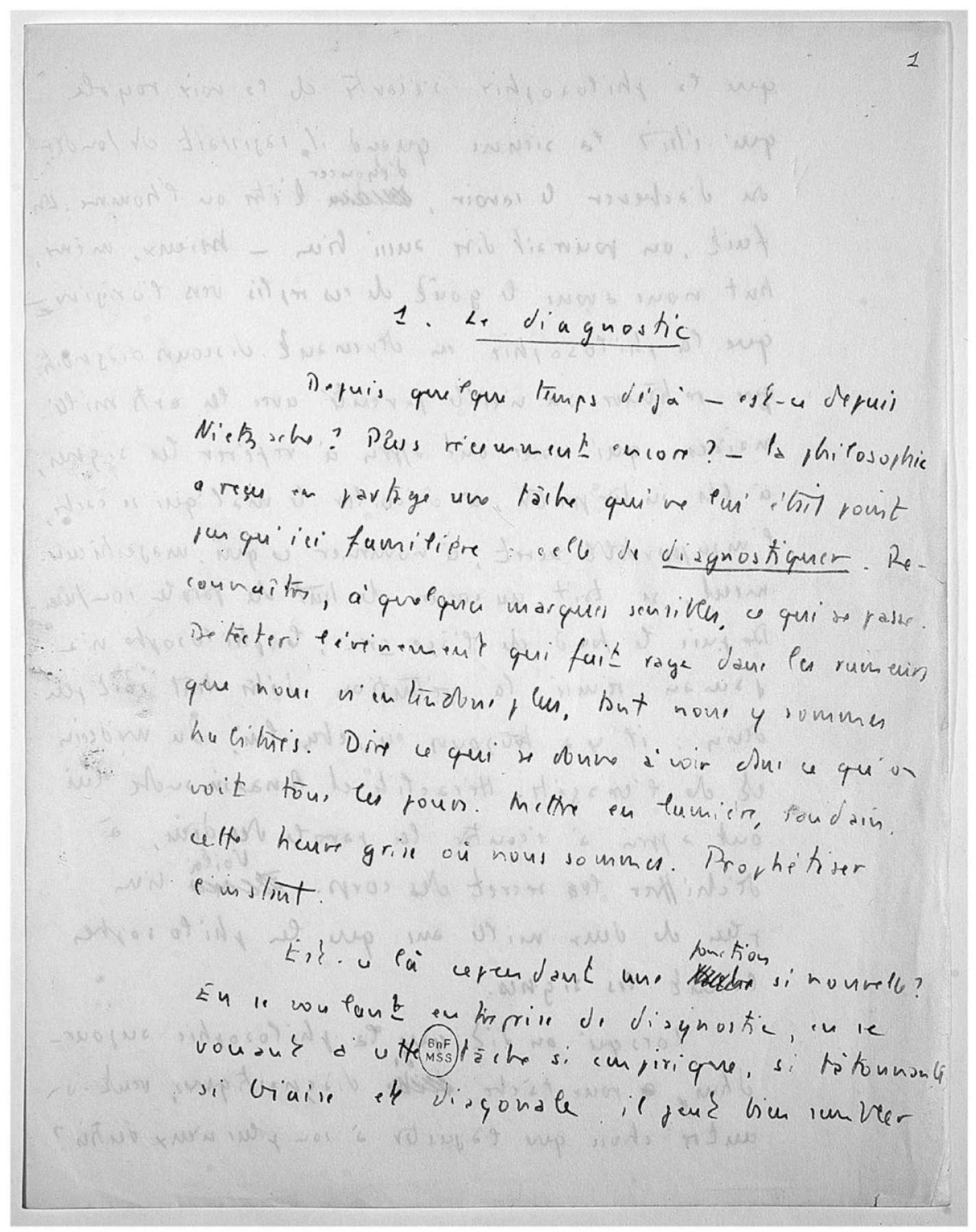
First page of Foucault’s manuscript Le discours philosophique.
Later that year, as part of his teaching duties at the University of Tunis, Foucault gave a history of philosophy course on Descartes for undergraduates, but it was his Friday lecture course, open to the general public as well as students, that attracted the widest interest and fuelled his popularity in the country. Entitled ‘The Place of Man in Modern Western Thought’, it focused on the relationship between the idea of Man and philosophical discourse within modern Western culture, or what Foucault calls the ‘anthropological-humanistic structure of the 19th century’. During his stay in Tunisia, Foucault also started reading several works by Anglo-American philosophers of language that he found in the library of one of his new colleagues, Gérard Deledalle, a John Dewey scholar (Lorenzini, 2019). In this period, he struggled to elaborate a theory of discourse and utterance (énoncé) – a struggle whose traces can be found in several lectures and texts from his Tunisian years (Foucault, 2019b) as well as in the two preliminary versions of The Archaeology of Knowledge, which was eventually published in March 1969.
As these indications show, there is more to come from these rich archives, and to our mind there is no doubt that the publication of these materials will deeply transform our understanding of the first half of Foucault’s career, in a similar way to how the Collège de France courses and the lectures delivered outside France in the 1980s have for the second half. It remains to be seen whether they will have the same generative impact on the use of his work. Many of the most utilised and debated ideas of the later Foucault – biopower, governmentality, technologies of the self, parrēsia, and others – are either proposed or greatly developed in lecture courses.
The aim of this special issue of Theory, Culture & Society is to provide – for the very first time – an initial but comprehensive assessment of this material, drawing on both the work already published and as-yet-unpublished sources. Our contributors use the riches of the archive of Foucault’s papers, and other available sources, to fill in a lot of detail about what Foucault was doing in this period.
There are discussions here of all the extant teaching records from the first part of Foucault’s career, his work on literature and art, his work as a translator, and his engagement with Nietzsche. Some papers discuss manuscripts which he chose not to publish, often developing from his teaching, or written as a thesis. Taken together they provide a thorough discussion of Foucault’s career before the Collège de France, largely focusing on the lesser-known aspects of his work in this period.
***
The first essay is a newly translated piece by Pierre Macherey, ‘Foucault Find a “Way Out” of Hegel?’, recently published in French in a collection of essays on Foucault (Brossat and Lorenzini, 2021). Macherey’s essay reads Foucault’s engagement with Hegel throughout his career through the newly available prism of his 1949 diploma thesis on Hegel, supervised by Jean Hyppolite. This essay is translated by Sue Ruddick, Professor of Geography at the University of Toronto, and translator of Macherey’s book Hegel or Spinoza (2011).
There follow three essays on the most substantial manuscripts kept by Foucault from his years at the ENS and the University of Lille. 12 The essays are written by the editors of these manuscripts in the new EHESS/Gallimard/Seuil series, ‘Cours et travaux’. 13 While one of these manuscripts is undoubtedly a lecture course, the other two are unlikely to have been used in the classroom, even if they relate to themes of Foucault’s teaching. Rather, as these texts’ editors discuss, it is possible they were planned as theses, which Foucault abandoned as his interests moved elsewhere.
In ‘Foucault and the History of Anthropology: Man, before the “Death of Man”’, Arianna Sforzini addresses a lecture course on philosophical anthropology that Foucault gave in the mid-1950s, both at the University of Lille and at the ENS, and whose critical edition was recently published (Foucault, 2022a). As Sforzini shows, there Foucault not only retraces the history of anthropological knowledge from Descartes and Malebranche to Jaspers and Heidegger, but already develops – thanks to his encounter with Nietzsche’s philosophy – a critique of the figure of ‘man’ that The Order of Things would later famously declare ‘dead’.
Philippe Sabot’s essay, ‘Michel Foucault in the 1950s: Beyond Psychology towards Radical Ontology’, is devoted to the analysis of Foucault’s unpublished manuscript entitled ‘Phenomenology and Psychology’, written in 1953–4 and whose critical edition has recently appeared (Foucault, 2021e). After exploring the role that phenomenology plays in Foucault’s critique of psychology, Sabot offers a close reading of Foucault’s interpretation of Husserl’s philosophy and discusses its impact on Foucault’s later work, in particular its archaeological writings on madness, language and knowledge.
Finally, in ‘Foucault’s Critique of the Human Sciences in the 1950s: Between Psychology and Philosophy’, Elisabetta Basso focuses on the main features of Foucault’s reflection on anthropology and phenomenology in the 1950s. Relying on a detailed analysis of the manuscripts from Foucault’s years at the ENS and Lille, including that of an unpublished book manuscript on Binswanger’s existential analysis (Foucault, 2021b), Basso argues that his interest in phenomenological anthropology and existential psychopathology is a crucial aspect of Foucault’s intellectual journey: there, one can find the roots of his critique of the human sciences, which he would develop further in his 1960s ‘archaeological’ writings.
In the early-mid 1950s, as well as teaching and beginning his writing career, Foucault worked with family friends Georges and Jacqueline Verdeaux in a psychiatric hospital, and a new assessment centre in a prison outside of Paris. He also did some work as a translator of German texts. In ‘Foucault as a Translator of Binswanger and von Weizsäcker’, Stuart Elden explores two of these translations. One of these is best known for Foucault’s long introduction, but here the focus is on his crucial advisory role to Jacqueline Verdeaux’s translation of Binswanger’s ‘Traum und Existenz’ essay (Binswanger, 1954; for English versions see Binswanger and Foucault, 1993). The other is much less known: a co-translation, with Daniel Rocher, of Viktor von Weizsäcker’s book Der Gestaltkreis as Le cycle de structure (1958; 1973 [1940]). Binswanger’s short text was part of his work in Daseinsanalysis, using ideas from Heidegger and others to enhance his psychoanalytic work. Von Weizsäcker was a physician and medical anthropologist, and the text combined work on psychology and physiology in a discussion of perception and movement. Exploring both translation choices, and Foucault’s notes to the translations, Elden shows how German becomes French in the hands of Foucault and his colleagues.
Rainer Nicolaysen’s (2016) essay, ‘Foucault in Hamburg: Notes on a One-Year Stay, 1959–60’, explores Foucault’s year in Hamburg. It provides new documentary evidence, drawn from archives in Hamburg, about Foucault’s teaching, the cultural programmes he ran, and his life in the city outside of work. This is a substantial excerpt from a piece which originally appeared in German (2016), translated for this issue by Melissa Pawelski, who has recently completed a PhD, entitled Languages of Punishment: Translating Michel Foucault’s Surveiller et punir into English and German, at the University of Warwick (2021).
After defending his doctoral theses and teaching psychology for a few years at the University of Clermont-Ferrand, Foucault left France once again. But during the summer of 1966, right before leaving for Tunisia and immediately after the publication of The Order of Things, he wrote a manuscript, entitled Le discours philosophique, which he left unpublished. In his essay, ‘Philosophical Discourse and Ascetic Practice: On Foucault’s Readings of Descartes’ Meditations’, Daniele Lorenzini addresses the multiple interpretations that Foucault offered of Descartes’ Meditations during the whole span of his intellectual career, starting precisely with the manuscript on philosophical discourse and the notes that Foucault used to teach a course on Descartes at Tunis. Together with the preparatory manuscript for his public lectures on the place of Man in modern Western thought, the critical edition of this material is due to appear soon (Foucault, 2023b).
The two following papers discuss Foucault’s work on literature and art.
In ‘Foucault on Raymond Roussel: The Extralinguistic Outside of Literature’, Azucena González Blanco discusses the texts on literature that have recently been collected in Madness, Language, Literature (Foucault, 2019b, 2023a), focusing in particular on Foucault’s characterisation of madness as social partition or ‘outside’, and on his reflections on the concept of ‘extralinguistic’. Blanco can thus show that, in the 1960s, literature functions for Foucault as a laboratory in which to raise questions concerning what he would later call a political history of truth and to elaborate possibilities of resistance and novel forms of being.
Building on her earlier book, Foucault on Painting (2017), in ‘Painting for Fools’, Catherine M. Soussloff draws on archival material to explore the depth of Foucault’s interest in the history, theory and practice of painting, especially in the second half of the 1960s and early 1970s. She focuses her attention on Foucault’s analyses of self-portraits and writings by artists, particularly Pierre Klossowski, nuancing the different status Foucault gave to those sources and arguing that they are relevant not only as rhetorical markers in his historical argumentation, but as crucial elements of his theoretical thinking.
In two quite different papers, Aner Barzilay and Bernard E. Harcourt discuss the ways in which Foucault engaged with Nietzsche. A range of materials on Nietzsche are preserved in the archives, from Foucault’s early drafts from the 1950s, through lectures on him at Vincennes in 1969–70, to early 1970s lectures in Paris, Montréal, Buffalo and Brazil. 14 They are due to be published in a few years in the ‘Cours et travaux’ series (Foucault, 2024b).
Aner Barzilay’s essay, ‘Nietzsche, Ontology, and Foucault’s Critical Project: To Perish from Absolute Knowledge’, looks at Foucault’s reading of Nietzsche at several moments in his career. A key theme, Barzilay shows, is Nietzsche’s claim in Beyond Good and Evil that ‘to perish from absolute knowledge may well form a part of the basis of being’. Following this ‘red thread’, through published and unpublished materials, Barzilay sheds valuable new light on Foucault’s engagement with and use of Nietzsche.
In his essay ‘Five Modalities of Michel Foucault’s Use of Nietzsche’s Writings’, Bernard E. Harcourt addresses Foucault’s engagement with Nietzsche in a series of published and unpublished texts and lectures over the period 1959–73. He argues that this engagement takes five rather different forms – what he calls a critical, an epistemological, a linguistic, an alethurgic and a political form – each of which corresponds to an intellectual turning point in Foucault’s philosophical journey.
The issue also includes two translations of texts by Foucault. ‘Literature and Madness: Madness in the Baroque Theatre and the Theatre of Artaud’ is the English translation of a text that Foucault wrote sometime around the mid-1960s, which was first published in French in the journal Critique and then in the volume on madness, language and literature (Foucault, 2016b, 2019b, 2023a). This piece constitutes a remarkable example of the ways in which literature offered Foucault a privileged means to explore the experience of madness. It is here introduced and translated by Nancy Luxon, Professor in the Political Science department at the University of Minnesota. Among other works, Luxon is editor of the English translation of Foucault and Arlette Farge’s Disorderly Families and a companion book of essays (Foucault and Farge, 2016; Luxon, 2019).
‘Linguistics and Social Sciences’ is a lecture delivered in Tunisia in March 1968 and first published in the Revue tunisienne des sciences sociales in December 1969 (reprinted in Foucault, 1994, vol. I: 821–2). Along with another Tunisian lecture, ‘Structuralism and Literary Analysis’ (Foucault, 2019b: 171–222, 2019e), this piece offers a valuable insight into Foucault’s engagement with linguistics and structuralism in the late 1960s, around the time of The Archaeology of Knowledge and his lecture ‘What Is an Author?’ It is here introduced by Jonathan Schroeder, Assistant Professor of American Studies and English at Brandeis University, and translated by him and Chantal Wright, reader in Translation as a Literary Practice at Warwick.
The final text is a review of Foucault’s two 1960s lecture courses on sexuality (2018b, 2021c) by Stuart Elden and Alison Downham Moore. These two courses were delivered at Clermont-Ferrand in 1964 and at Vincennes in 1969. In these lectures Foucault explores some themes he would later revisit in his History of Sexuality, but also discusses sexuality in relation to plant and animal biology, sex differentiation and medicine. The review essay discusses the lectures and the editorial material by Claude-Olivier Doron and situates them in relation to Foucault’s intellectual project and more recent developments in the history and philosophy of biology, gender and sexuality.
***
The material discussed in this special issue is often unpublished, sometimes incomplete and with several questions about dating and purpose. As such, these essays do not pretend to be definitive, but rather to give a sense of the current state of scholarship on these different aspects of the first half of Foucault’s career. In terms of key themes, we would indicate the following.
Foucault’s engagement with the Western philosophical tradition is more detailed and appreciative than is often recognised. As the papers here discuss, he wrote extensive manuscripts on, among others, Descartes, Kant, Hegel, Nietzsche and Husserl. With some of these figures, perhaps notably Hegel and Husserl, his later comments in interviews or other texts obscures the depth of his knowledge and the detail of his engagement. Even with figures whose importance to Foucault is well known, such as Descartes and Nietzsche, the archives open up new ways to consider the evolution of his reading of their work throughout his career. His lectures in Tunis on the emergence of the notion of Man in modern Western thought are also highly significant because for the first – and perhaps the only – time Foucault reflects on the status of ‘Western’ culture vis-à-vis other cultures and analyses the historical process through which it was constituted and ‘universalised’ during the 18th and 19th centuries.
Foucault’s knowledge of debates in psychology was clear from his early publications, but unpublished manuscripts and extant teaching materials show the breadth of his concerns, as well as the depth of his engagement with Ludwig Binswanger and Daseinsanalysis. His work as a translator, of Binswanger, Viktor von Weizsäcker and Kant, as elsewhere of Leo Spitzer, is an important minor theme in his early career. The discussions of art and literature add to our understanding of these themes in Foucault’s work in the 1960s and show their enduring relevance for him even in the 1970s and 1980s. Our knowledge of his reflections on literature is also enhanced by the new translation of his text on Artaud, while the translation of his lecture on linguistics adds to our understanding of his engagement with contemporary work in France and elsewhere, which informs the development of The Archaeology of Knowledge and other, better-known texts. Finally, the sexuality lectures show how Foucault was thinking about these questions well before developing the project of writing his History of Sexuality.
In addition, materials from the classroom show something of how Foucault worked with students. It should be remembered that if his Collège de France courses were research-led, presenting his ongoing projects and related ideas to the general public, before 1970 Foucault’s teaching was almost entirely for students enrolled in university degrees or studying for other kinds of examinations.
A note of caution is in order, however, as the difference in genre of Foucault’s texts is not always respected. Indeed, there are significant differences between a book he published, an interview he gave, and a lecture he delivered. A text he chose not to publish has an entirely different status to one he did. In the latter part of his career, there is today sometimes a tendency to treat the Collège de France courses as equivalent to his books, but we should always keep in mind that Foucault’s unpublished texts and lectures, while they can be a valuable supplement to his published work, are in no way a replacement. This is perhaps even more the case for the material in the first part of his career. Some of these texts are written for self-clarification more than anything else, abandoned because Foucault chose to go in another direction, or intended for a small audience or for students. From the mid-1960s Foucault’s fame was such, and recording technology sufficiently developed in the early 1970s, that he knew that any lecture or pronouncement was likely to be widely shared and discussed. This is not the case in the early part of his career, and he did not even keep a personal copy of one of the texts discussed here, the diploma thesis on Hegel. With these considerations in mind, however, we firmly believe that the texts and lectures analysed in this issue and others from the period before the Collège de France add valuable detail to our understanding of Foucault’s intellectual development, his interests and plans, and his enduring influence on a variety of fields in the humanities and social sciences (Irrera, 2019).
Many of the contributions to this special issue are written by the editors of the newly published or forthcoming volumes of Foucault’s posthumous lectures and manuscripts. Their editorial apparatus alongside the transcriptions of the material, together with the papers included in this issue, begin the process of contextualisation, interpretation and critique. Whether through that editorial work, or by otherwise using the archives, the papers in this issue offer privileged insights into material which is often not yet widely accessible. We look forward to reading further engagements with Foucault’s work before the Collège de France.
Footnotes
Acknowledgements
As special issue editors we are grateful to the Theory, Culture & Society editorial team, especially Mike Featherstone, Sunil Manghani, Rainer Winter, Tahmina Ashraf, Susan Manthorpe and Fern Bryant. We thank Henri-Paul Fruchaud, Pierre Macherey, Vrin and Gallimard for permissions to translate material. We thank Laurence le Bras of the Bibliothèque nationale de France and Henri-Paul Fruchaud for permission to use the manuscript page in this Introduction, and the family of Lütfi Özkök for permission to use his photograph of Foucault on the cover. We also thank all our contributors and translators, and those that reviewed these submissions and this Introduction for the journal.
This article is part of the Theory, Culture & Society special issue on ‘Foucault Before the Collège de France’, edited by Stuart Elden, Orazio Irrera and Daniele Lorenzini.
