




Abstract
The political public sphere is important for democracy, and it is changing – this is how the quintessence of Jürgen Habermas’s monumental study on The Structural Transformation of the Public Sphere (1989) could be summarized in simple words. In the fields of political sociology and social theory, history, but also research on social movements, cultural studies, and media and communication studies, his conception of the public sphere as a sphere mediating between the state and civil society has had a decisive influence on the debate about the potential of collective reason for modern democracy. In this introduction we give a short overview of Habermas’s arguments on the rise and fall of the bourgeois public sphere, demonstrate the necessary link between the public sphere and democracy and, referring to the contributions to this special issue, sketch current transformations of the public sphere along three basic processes – digitalization, commodification, and globalization.
The political public sphere is important for democracy, and it is changing – this is how the quintessence of Jürgen Habermas’s monumental study on The Structural Transformation of the Public Sphere (1989) could be summarized in simple words. In the fields of political sociology and theory, history, but also research on social movements, cultural studies, and media and communication studies, his conception of the public sphere as a sphere mediating between the state and civil society has had a decisive influence on the debate about the potential of collective reason for modern democracy. The contributions in this special issue take a close look at the current transformations of the public sphere regarding possible implications for democracy. They critically emphasize the central role of functioning and lively public spheres for the legitimacy and effectiveness of democracy and seek various connections to the work of Jürgen Habermas. In doing so, the fruitfulness and contentiousness as well as the topicality of his transdisciplinary theory of the public sphere is impressively demonstrated, e.g. from theoretical perspectives such as Marxism, critical theory / the Frankfurt School, the Gramscian theory of hegemony, poststructuralism, and critical political economy. As a conclusion to this issue, Habermas (2022) himself presents his own ideas on the current transformation of the political public sphere, which we choose not to anticipate in this introduction.
The Rise of the Bourgeois Public Sphere
In his seminal book, Jürgen Habermas poses the question of the possibility of the formation of social order through reasonable communication, a question that is successively elaborated in the course of his further work. To answer this question, Habermas reconstructs the development of the political public sphere from the late 17th century in England to the present day of German corporatism in the 1960s, with a view to the development of political mass communication. The formation of the modern political public sphere follows at the beginning from two central moments: first, the institution of the bourgeois nuclear family as an intimate sphere offers its members the space of a ‘voluntary community of love and education’ (Hartmann, 2006: 169) through which its members learn – free from immediate economic constraints – an ‘ideal of unconstrained humanity’ (Hartmann, 2006: 169). Second, at least for the male heads of families, ‘the bourgeois public sphere of an initially relatively small audience of private individuals interested in art and literate, who soon also demanded a political voice’ (Habermas, 2020: 105), was opened up – first through an increasingly lively correspondence and later through newspaper reading and participation in (exclusive) rounds in clubs and coffeehouses (see Table 1). The establishment of a general (high) school and education system finally completes the ‘connection between democracy, public education and citizenship’ (Binder and Oelkers, 2017: 9) through the comparison of opinions and positions in public debate. The political public sphere thus emerges as the sphere that Habermas will conceptualize as the mediating instance between society and parliament.
The rise and fall of the bourgeois public sphere according to Habermas (1989).
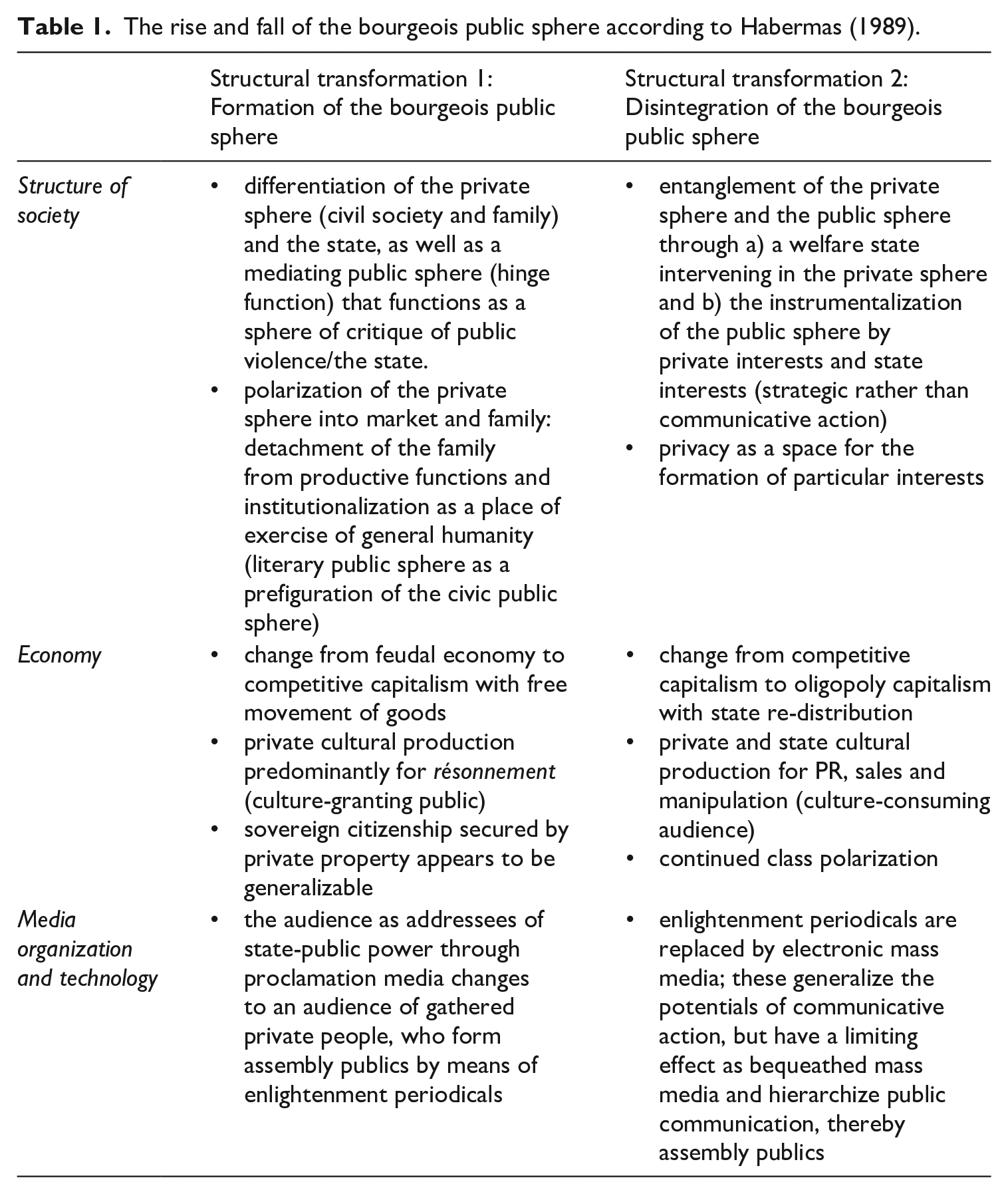
This sphere experiences a consolidation in the course of the further social modernization of the 18th century, which assigns ‘eo ipso a political significance’ (Heming, 1997: 60) to the public debate between conflicting interests. At the same time, the socioeconomic contrasts in society open up a scope for economic and socio-political intervention by the state. Within these political fields, a constellation emerges during the 19th century through which parties and associations organize a collective representation of societal interests. For Habermas, the transformation of the liberal constitutional state into a social state framed in terms of interest politics – together with the development of the electronic mass media as a relatively centralistic, nationally framed conglomerate which, in his view, limits ‘the reactions of their recipients in a peculiar way’ (Habermas, 1989: 171) – form the developmental moment of a second structural transformation of the public sphere.
By contrasting two (stylized) stages of development of the political public sphere, Habermas gains the standard of comparison for his ideology critique of a ‘re-feudalized’ society. The comparison of the different phases thus serves him as an (empirical and normative) basis for a democratic-theoretical critique of public decision-making in the bequeathed political systems of Western post-war democracies and beyond.
Unlike in later writings, the public sphere in structural change is thus not only assigned the character of an institutional sphere of its own with a key significance for the functioning of democratic polities. The contribution of the study lies rather in the fact that Habermas describes the process character of this sphere as a structural transformation of the public sphere. Habermas develops the parameters of this structural transformation within three dimensions of analysis, which he does not explicitly name as such: within the (socio-)spatial frame of reference, the first structural transformation involves the differentiation of the private sphere (civil society and family) and the (national) state as well as a mediating public sphere as the sphere of its critique. Here, the family becomes the place where a general humanity is practised. In the second structural transformation, the private sphere and the public sphere are again intertwined by a welfare state intervening in the private sphere and the instrumentalization of the public sphere by private and state interests (Habermas will later define this as an excess of strategic action in place of communicative action).
In a second dimension of analysis, Habermas considers the impact of the economic conditions on the structural transformation. In the first sequence from a feudal economy to capitalism, private cultural production takes place above all for the bourgeois public of the coffee houses and salons, whose citizenship, secured by the ownership of private property, Habermas generalizes here as an ideal. The second structural transformation then takes place in the transition from competitive capitalism to oligopoly capitalism supported by state redistribution. Here, cultural production takes place in both state and private as public relations work and under conditions of continued class polarization.
As the technical media of dissemination change in a third dimension, the citizens as addressees of state-public violence are transformed into a group of private citizens assembled as a public, who form assembly publics by means of educational periodicals. In the second developmental sequence of structural transformation, these educational periodicals are replaced by electronic mass media. Although these generalize the potential for communicative action, they have the effect of restricting and hierarchizing public communication. Under the influence of public relations media, collective publics are transformed into manufactured publics.
Democracy and the Public Sphere
Generally, the fundamental concept of democracy refers to a political order based on the ‘rule of the people’. In the history of ideas as well as in political practice, three essential rationales legitimize this system of rule. While a republican idea highlights participation of citizens in the procedures of political decision-making (Arendt, 2009), representatives of liberalism defend the possibility of individual freedom within a diverse society (Mill, 1991). A third social democratic line of tradition finally proclaims the necessity of material redistribution, to stabilize economic living conditions (e.g. via labour market regulation or the welfare state; see Marshall and Bottomore, 1992). Drawing on Rosanvallon (2013: 29), four spheres of democracy can be distinguished. As a practice carried out by citizens, it consists of the general right to vote, which was gradually extended through additional needs and entitlements. These rights then consolidated within democracy as a political system, whose institutions and procedures were to maintain the common good under the aspects spelled out in the first dimension. Thirdly, as a societal form, democracy is meant to realize an idea of equality and community. And finally, as a mode of governance, it is supposed to ensure moderation between conflicting interests within society. Regarding its legitimacy as a form of governance, Fritz Scharpf (1999) highlights two dimensions of democracy. While an input-oriented perspective on the people’s impact on state politics must focus their authentic preferences, an output-oriented approach highlights the effectiveness of political measures. To generate an effective output, one could now assume, what is required is an effective input. The intensity of the linkage between the people’s preferences can, according to Pitkin (1967), be identified as responsiveness of democratic rule.
A critique of the lack of responsiveness of the prevailing democratic politics towards the people of the state has become the starting point of a series of crisis diagnoses from the field of social science in the last two decades, which attests to a series of structural dysfunctions (Crouch, 2004, 2020; Streeck, 2014, Geiselberger, 2017; Brown, 2015). Following the dimensional distinction proposed by Rosanvallon (2018), the current crisis of democracy is expressed in the dimensions presented here both in practice as civic activity (declining voter turnout and citizens’ identification with parties), as well as in the dynamics of the political system (volatile voter preferences translate into difficulties in finding majorities with a general loss of importance of parliaments), its form of society (increasing inequality and social exclusion), and its form of government (one-sided privileging of capital interests).
At this point the concept of the public sphere becomes important. It derives from the German term ‘Öffentlichkeit’ (a state of general perceptibility). This term stands out through multiple meanings. Not only did the modernization of the state bring about citizen rights, such as public property (e.g. a public bench in a public park). Moreover, public communication (and its social preconditions) became one cornerstone of modern society. As a fundamental problem of democratic rule, we have defined the question to be how a pluralistic society can justify a social order that is resting on self-determination and equality of its members. In the constitutional state these problems are being solved via formal institutionalization of rules meant to structure collective decision-making. However, due to permanent social chance, a durable fixation of such rules is impossible. Another form of moderating conflicting interests in the mode of collective learning is provided through the framework of the public sphere. As a central medium of bourgeois emancipation, the liberal public can enable debates, through which participants can change their interests or even reach consensus. In line with Neidhardt (1994: 10), we can – most generally – understand public spheres to be emerging where speakers communicate to an audience whose limits they cannot determine. Thus, public communication is often uncertain and bears a strong chance of creating surprises. Due to the general open-endedness of deliberative processes, the quality of democratic rule depends on the organization of the public sphere. From the angle of democratic theory, we can – according to Fraser (2007) and in line with Scharpf’s (1999) in-put/output-model – draw on two ends of the public sphere: its normative legitimacy and its political effectiveness: ‘Without them’, so Fraser (2007: 8) concludes, ‘the concept loses its critical force and its political point.’
This normative requirement can be traced back to three principles (or functions) of public spheres addressed by Neidhardt (1994: 8). For the purpose of general transparency, the public sphere should be open for all social groups, topics, and opinions that hold collective relevance. To ensure collective validation, actors who participate in the public sphere should (have to) deal with topics and opinions of other participants, in order to (possibly) change their own standpoints. Finally, for the cause of general orientation, the public sphere brings about public opinions (which, in practice, however, become diversely effective). Tightly connected to this third dimension is the collective identity of the audience, whose participants are connected via similar patterns of media consumption. Only insofar as it identifies itself as a public sphere does a context emerge that enables mutual addressing, understanding, and responding within public discourses (Weßler and Wingert, 2007: 22). As a sphere of private people coming together, the public sphere thus does not only require a shared practice of performative co-construction, but also a shared imagination among its participants. While this rather narrow idea of social inequality refers to discrepancies among active participants, Fraser (1992) proposes a more profound analysis of the nexus between inequality and the public sphere. In ‘societies whose basic institutional framework generates unequal social groups in structural relations of dominance and subordination’, Fraser (1992: 122) states, ‘full parity of participation in public debate and deliberation is not within the reach of possibility.’ Therefore, the question arises as to which form of political public sphere (and public life in toto) serves best to secure equality in participation between privileged and disadvantaged groups (or between the dominating and the dominated). This triad of public sphere functions was developed following the normatively demanding discursive public sphere model of Jürgen Habermas, which is also the most important reference point of this special issue. It should be mentioned here – and in part there are also corresponding references in the contributions to this issue – that, with Ritzi (2013: 179ff.), in addition to the discursive public sphere model at least two alternatives can also be distinguished: the less sophisticated mirror model (e.g. Luhmann, 2010) and the post-structurally informed model of politicizing publics (e.g. Mouffe, 2005). While the former places the transparency function of the public sphere at the centre and remains normatively sceptical about the validation and orientation or identity function, the latter emphasizes the orientation or identity function of the public sphere. We could also add the pragmatist theory of the public sphere and democracy as a separate approach (e.g. Dewey, 1946) to the tableau of public sphere theories. Pragmatist public sphere theory, in turn, clearly focuses on validation.
The emerging public sphere of interlinking publics thus bears the central burden for the functioning of democracy – a lively public sphere is supposed to, first, make and control decisions (politics); second, identify problems and find solutions for them (epistemology); and third, include and form opinions (culture). From this background, we can ask not only to what degree publics exist and the principles of the public sphere extend to society, but also what (democratic) qualities do they have. As far as the political role of the public is concerned, a two-track understanding of democracy is at issue. The distinction between publics, where the will of those affected by political decisions is articulated, and political institutions and representative bodies, which carry out those decisions, inevitably returns (cf. Fraser, 2014: 142). However, this does not rule out any radical and participatory models of democracy. These propose the closest possible linkage of political institutions to the public sphere and are sometimes oriented toward the possibility of self-socialization through strong publics (Sevignani, this issue). Publics then not only identify domination as legitimate but become the source of domination themselves. It also becomes clear that the assumption that publics themselves cannot rule does not prevent us from democratizing the ruling institutions and increasingly organizing them in accordance with the public principle (Seeliger et al., this issue). This also implies that the constitutional conditions of the public sphere, i.e. the technical and media infrastructures, would have to be publicly appropriated and that a new public media system would have to be developed. The problem of democratization then becomes one of extending the public sphere principle and determining the relationship between strong and weak publics.
In addition to this focus on politically institutionalized rule (making and controlling decisions), the epistemic and identity-constructive function of the public sphere must also be kept in mind from a democratic theory perspective. The public sphere should be able to pose and order problems in the first place, before they are dealt with politically. This forum function of the public sphere, according to which public spheres should enable the collective perception and discussion of generally relevant problems and the cooperative search for common solutions to problems, corresponds to the epistemic dimension of democracy of producing solutions to problems that are as efficient as possible and at the same time capable of being agreed upon. Public spheres, especially when they are organized in a participatory and egalitarian manner, thus contribute to the effectiveness of democracies in this way as well.
The effectiveness of weak, deliberative public spheres refers to their problem-solving competence, as well as to the possibility of generating legitimacy for political decisions made elsewhere and thus of exercising control and criticism vis-à-vis the ruling power. The effectiveness of strong, decisive publics refers to their problem-finding and problem-solving competence, as well as to their ability to generate legitimacy for these procedures at the same time. For them to be dealt with politically, problems must be interpreted in a process of opinion formation. In public spheres, people speak, ideally listen, and, in the best case, a mutual irritation emerges from this communication process, followed by a change that does not leave both speakers and listeners unchanged (Rosa and Sevignani, this issue). Questions then arise from a democratic theory perspective, about access to (input), articulation and attention in (throughput), and (will and opinion) formation through publics (output). Being able to speak alone is not enough to set the transformative potential of publics in motion; it also requires listeners. But even the meeting of speaker and listener does not establish deliberation; their communicative exchange must make a difference and trigger subject- and opinion-transformative (learning) processes. Habermas’s deliberative theory of democracy understands this well and thus focuses on the through- and output-processes of public communication.
So, does deliberation exist in publics? And if so, what quality does it assume? The former has been discussed by Habermas as communication displacement in the (acclamatory) public sphere and its ‘re-feudalization’; a kind of communication situation emerges without actual communication, where communication flows uni- rather than bi-directionally. Actors make strategic use of publics. But if there is bi-directional communication, some deliberative effects can be expected. The diagnoses of fragmentation and polarization of the public sphere both refer to the quality of understanding and opinion formation. In the first case, it takes place in sub-publics that are separated from each other, without overlaps; in the second case, however, there are overlaps in the sense of a centrifugal repulsion between the sub-publics. The idea of a concurrence of speaking and listening, as well as the possibility of identity formation and learning in publics, keeps pushing critical public sphere theory to ask what communication participants have in common before or after deliberation, and what they should have. A critical theory of the public sphere assumes a specific subjectivity, according to which people want to shape history (cf. Fraser, 2014; Rosa, this issue). In a functionalist twist on this rationale, it can be argued that once the interplay between the modern public sphere and sociality has settled in, the actors involved in it cannot simply decide to roll back the public sphere or suspend reason (cf. Trenz, 2021). Even more universally, Habermas argues that in order to communicate one has to pose and necessarily refer to basic validity claims that may create the social bond of the public sphere. However, all such assumptions become tested anew when the principle of justification as a bond between different points of view and opinions is eroded, e.g. in the course of ‘post-factual politics’ (Van Dyk, this issue).
The Current Structural Transformation of the Public Sphere
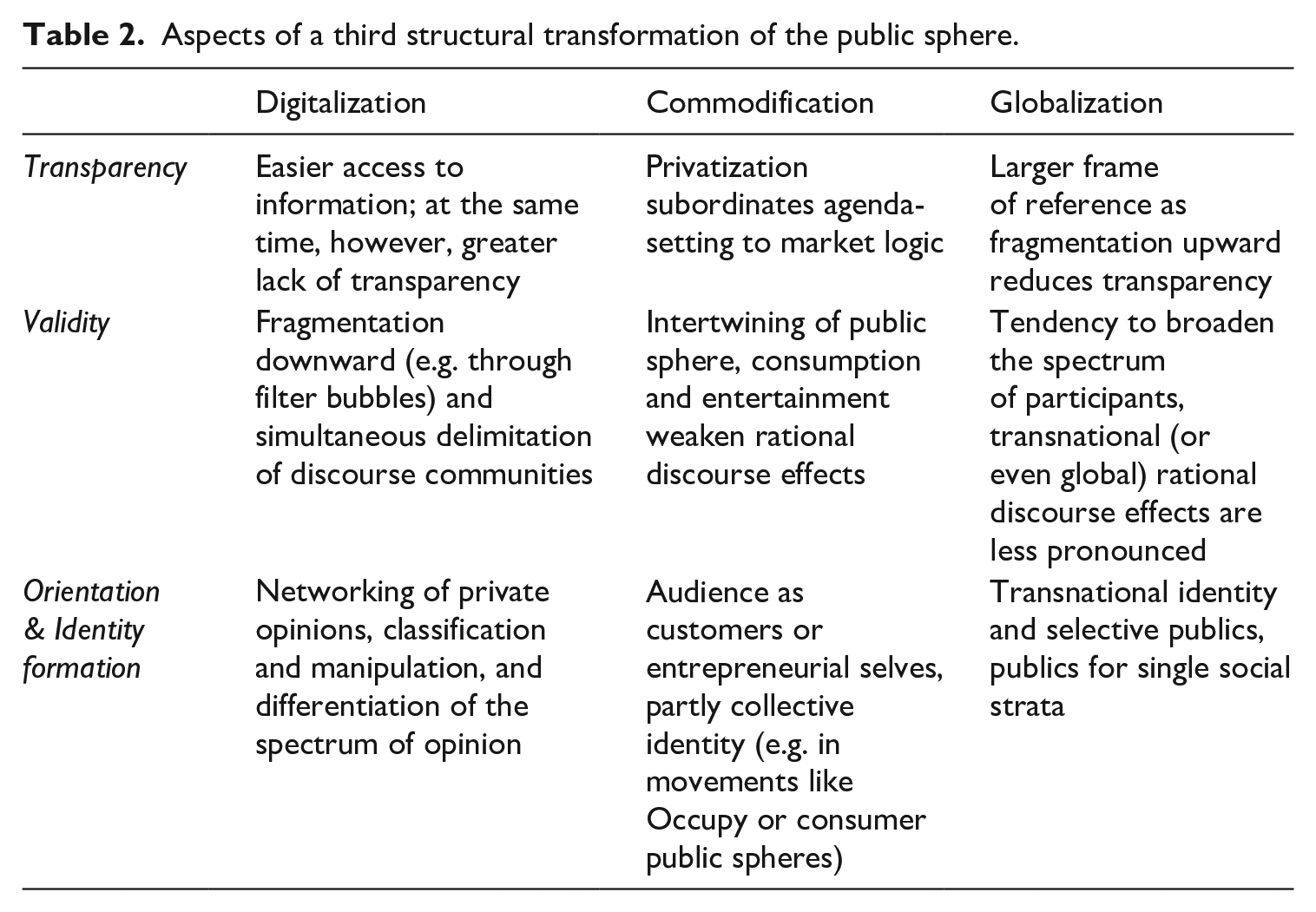
The starting thesis of this contribution is that within the three dimensions that Habermas’s sociological analysis focuses on – the (socio-)spatial frame of reference, the economic framework, and the technical media of dissemination – a new, if you will, a third structural transformation of the public sphere is currently taking place. This structural transformation, we will argue further, is directly related to the crisis phenomena of contemporary democracies described at the beginning of this introduction (see Table 2). Against this background, the new structural transformation of the public sphere is taking place in the field of tension between three institutional developments – digitalization, commodification, and globalization of the social.
Aspects of a third structural transformation of the public sphere.
Digitalization
The way public spheres are organized technically and institutionally in a media system has implications for the possibilities and quality of deliberation and opinion formation. Digital structural change takes place in interconnected processes of disintermediation and re-intermediation through new platforms. In this process, professional journalism, and traditional mass media, which largely organized publics, are increasingly bypassed as gatekeepers of public communication flows with the help of digital and social media (see Sevignani, this issue). Digital media facilitate access to publics and contain the promise of bi-directional communication. As a result of easier access, public spheres subsequently expand, blurring the boundaries of different levels of public sphere between individual, group, and mass communication – semi-publics at the interface with the private sphere and personal issues. This expansion leads to a pluralization of public spheres, as individual media or communicators tend to achieve decreasing reach.
These changes on the input side of the public sphere have effects on deliberation practices and their results. The ambivalences of the structural change of the political public sphere, which have already been mentioned in the context of the expansion of its socio-spatial frame of reference, come to light even more strongly in its digitalization. While the traditional mass media were still able to focus public attention relatively well on a few specific topics, this appears to be increasingly difficult to realize under the new conditions. The upgrading of the user role from readers to authors increases the number of concerns fed into the public discussion process and thus also the complexity of public communication as a whole. While the articulation of political concerns and their mutual validation becomes potentially more representative, it also appears to be more difficult to consider comprehensively. Contrary to the consideration of an expanded spectrum of opinion, however, is the thesis of a fragmentation of the public sphere into homosocial filter bubbles and echo chambers. The extent to which the digitalization of political communication is able to shape collective patterns of orientation and broadly inclusive public identities as reference elements of democratic public spheres is also an open question.
It is, however, certainly true that this question and the democratic implications of digital communication cannot be answered appropriately without taking into account new forms of (re-)intermediation. Communication streams increasingly run through digital platforms that curate them in an automated way according to criteria other than those applied in journalism. Real restrictions, excommunications (as happened in Trump’s case in January 2021) rarely occur; rather digitalization strongly merges with commodification. As private arcana areas, the new switching points of the public sphere are largely withdrawn from public negotiation (Beyes, this issue). The new platform intermediaries are strongly organized according to profit considerations and apply surveillance-based business models.
Their monitoring and evaluation of digital communication serves a cybernetic logic of control where communicative action becomes more effectively controllable, or even enables feedback-logical propaganda in the interest of those who have the data or know how to use them. This sets the course either toward a shutdown of deliberation in the sense of a mere networking of private opinions (Sevignani, this issue) or an increasingly acclamatory form of the public sphere, as expressed, for example, in simple ‘like’ or ‘dislike’ expressions, within a mode of ‘privatized representation’ (Staab and Thiel, this issue). Or digital communication organized in this way leads to more fragmented and polarized deliberative outcomes. In terms of democratic theory, we are then dealing with a tension between pluralization on the one hand and the problems of disintegration through the displacement of the public sphere, its fragmentation and polarization on the other. The strong fragmentation thesis of a lack of socio-spatial overlap and of publics isolated from one another, however, has so far found little empirical foundation. More plausible seems to be the polarization problem of disintegrating public spheres. Partial publics do seek out dissenting opinions – not in order to take them as learning occasions but in a repulsive mode (Rosa, this issue). Through reciprocal references, the division of the audience is advanced. In addition to new possibilities for popular critique and control (Sevignani, this issue), the dis- and re-intermediation of public communication with its own ‘toxic economy of political immediacy’ (Van Dyk, this issue) also supports a tendency toward populism, which can be studied as a specific flow of communication streams and interplay of publics after the erosion of mass media gatekeepers.
Commodification
The current structural change of the public sphere and its implications for democracy cannot be understood solely with reference to the changed technical media of dissemination, nor solely by considering the political economy of digital media. For instance, the populist tendency and the rise of postfactual politics have roots in a preceding phase of technocratic ‘factual post-politics’ in the sense of radical politics of the market without any alternative (Van Dyk, this issue). It is thus the apparently deeper crisis of political representation, as detached from its attachment to democratic deliberation, that populism is working on.
In addition to (de)commodification in the sense of a displacement of the public sphere and communication, the commodification of the communication arenas as well as of the communicators must be taken into account. Thus, tendencies of political instrumentalization (Van Dyk, this issue) and economic exploitation of the public sphere can be observed not only in the workplace but also in the field of digital and social media. A qualitatively new characteristic of the current structural change of the public sphere, however, is a restriction of democracy through communicative abundance and activation (cf. Dean, 2009; Beyes, this issue). An economic-exploitative dimension is inherent to all communication performed on platforms that follow surveillance-based business models. In any case, the question that arises more urgently today is how, in a situation of communicative abundance, not (only) the displacement or unidirectionality of communication can be problematized but how different qualities and forms of communicative unfolding can be identified and evaluated. On the one hand, we are dealing with an intensification of long-discussed tendencies toward the commodification of the media (e.g. Cagé, 2016), but many commercial mass media are currently facing existential financing problems, among other things, because they are losing advertising revenues to digital media platforms whose logics are rubbing off on journalism.
In contrast, the extension of democracy to economic organizations and the arcane spheres of the digital world would act as a thrust into the ‘heart’ of the commodification movement: property would be less removed from co-determination and workers would be addressed as political subjects. From a critical public theory point of view, it would then not first be a matter of democratization for the workers but by the workers (Seeliger et al., this issue). So far, the topic of economic democracy has only been incompletely dealt with by narrowing it down to co-determination in companies. Not only a thorough reconsideration of the concepts of the proletarian public sphere (cf. Negt and Kluge, 1993), but also challenging (maybe in the perspective of reconciliation) it with approaches to epistemic violence and to subaltern publics (see Seeliger and Villa Braslavsky, 2022) seems timely.
Globalization
With regard to the normative functions of the public sphere, the following picture emerges: With regard to the necessity of transparency for social introspection, globalization increases the complexity of social facts to the highest degree. If the functionally differentiated society – insofar as this appears to make sense at all in view of cross-border interdependencies – already represents a context that is difficult to understand in detail, even for observers equipped with expert knowledge, then the complexity increases even further on a transnational scale. The consequences concerning the validation function of public communication are ambivalent. A higher number of participants can increase the complexity of the constellation just as much as its potential problem-solving capacity. Thirdly, the expansion of the socio-spatial frame of reference requires a multiplication of the concerns fed into the public sphere, at least insofar as the increasing interdependencies are themselves thematized there. The fact that the mutual observation and confrontation of different compatriots in a cross-border context results in socialization effects that make transnational communitarization probable does not seem to be ruled out.
Changes in the socio-spatial frame of reference of public spheres can be seen firstly in the relationship between the access of economic and political government structures on the one hand and the possibilities of civil society criticism and control on the other. While forms of government have become transnationalized and global concerns have become very clear, there are only rudiments of a transnationalization of the public sphere (cf. Nash, 2014; see Della Porta, this issue).
If one focuses not on governance structures but on the socio-cultural level (identifying and solving problems, including and forming opinions), the challenges of transnational publics turn out to be quite similar to the challenges of pluralization, fragmentation, and polarization of national publics. When national attitudes undermine cosmopolitan public sphere potentials and when national public spheres become increasingly socially and culturally fragmented, both cases pose the overarching problem of creating successful democratic public spheres in the face of socio-cultural differentiation of audience members (Rosa, this issue). Globalization, one might say, also affects nation-states in the form of fragmentation, individualization, and singularization, and poses challenges to the democratic public sphere. The tension between liberal and republican models of society, which Habermas has dealt with but probably not resolved in his deliberative and procedural theory of the public sphere, gives rise to the central problem of whether generalizable interpretations, interests, and principles in a society should only be proven and formed in the public sphere, or to what degree they can or must already be presupposed.
Footnotes
