



Abstract
The epistemological challenges of the Anthropocene trouble distinctions of solid and fluid. In this contribution, the author proposes, after Gabrielle Hecht, that the nuclearity of the Anthropocene contributes significantly to destabilising these categories. Nuclear materials and ideas of nuclearity force (re)consideration of deep timescales and imperceptible processes, problematising fixed material ontologies. The article engages with nuclear matters and queries the logic of solids and fluids by developing the notion of elemental memory. An attention to elemental memory – an element’s capacity to auto-affect over time – reveals the inadequacy of terms like solid and fluid, and highlights the expressiveness of solid fluid substances. Empirically, the author demonstrates, first, how elemental memory informs the solid-fluid processuality of radioactive glasses, especially trinitite. Second, engaging with the work of artists Mari Keto and Erich Berger, she addresses the slow auto-transformations of radioactive minerals.
Introduction
In their research on Solid Fluids in the Anthropocene, Tim Ingold and Cristián Simonetti (2018: 1) suggest that ‘traditional divisions couched in terms of the “softness” or “hardness” of the phenomena under investigation, and the “shorter” or “longer” durations of their formation, have dissolved.’ They argue that the epistemological challenges of the Anthropocene trouble historical distinctions of the solid and fluid (see Ingold and Simonetti’s introduction to this special issue). My intervention is to suggest that the nuclearity (Hecht, 2012) of the Anthropocene contributes significantly to destabilising these categories. This is not only because the fission or fusion of unstable isotopes releases enormous energy and produces radical state changes in matter. It is also because the shocks of the nuclear era have compelled scholars, artists and citizens to ask: ‘what makes things “nuclear”, and how do we know?’ (p. 13). These questions probe matters of ontology: ‘questions about the things and categories of things that exist’. They complicate the assumption that materials, technologies or landscapes can be classified in fixed, transparently empirical and essentialist terms.
For these reasons, debates on solid fluids in the Anthropocene can be informed by nuclear material cultures. For Ele Carpenter (2016: 9), nuclear material cultures are ‘technological infrastructures and aesthetic practices’ charting the everyday experience of radiation in the 20th and 21st centuries. Although, as Noi Sawargi (2016: 79) argues, radioactivity is a relatively abstract concept describing the emission of particles and photons from the nucleus of an unstable (radioactive) isotope, radiation is a ‘concrete force with substantial effects’ that ‘manifests depending on how … particles or waves affect their surroundings’. Tracing these affects, Cornelia Hess-Honegger (1989) illustrates malformed insects living in the shadow of the Gösgen nuclear power plant, and Tanya H Lee (2018) writes of the elevated levels of cancer in indigenous communities located within 50 miles of the Trinity Test Site near Alamagordo, New Mexico, where the first nuclear weapon was detonated on 16 July 1945. For Susan Schuppli (2016: 40), irradiated materials, like the shoe of an engineer at the Forsmark Nuclear Power Station, are ‘material witnesses’ to the incalculable crimes of nuclear accident and attempted cover-up. While a fuller engagement with nuclear material cultures is beyond the scope of this article, these diverse engagements indicate that scholars, artists and activists are probing the ontology of nuclear matter and searching for vocabularies to express its (in)stability. The implications of this work are not confined to material culture studies but have purchase for other ontological inquiries, including those of solids and fluids.
In this article, I query the binary logic of solids and fluids by developing the notion of elemental memory. In doing so, I follow Crownshaw (2014) and Szerszynski (2019) in decoupling memory from the conscious subject or reflective mind. Instead of conceptualising memory as the recall of individual persons, or as social processes of remembrance, I learn from Szerszynski (2019) in understanding memory to be an auto-relation: a capacity to auto-affect over time. To think about elemental memory is to explore how the elements exhibit this auto-affection, where the elements are understood in four ways: as ontological categories of matter, molecular units, environmental milieus or media (see Engelmann and McCormack, 2021). Bringing together humanities scholarship on the elements as repositories of memory and trauma with elemental geographies and nuclear forensics, I explore how the elements remember their inscription into the nuclear age, whether in the case of a radioactive isotope emitting alpha particles in a rock substrate and thus simultaneously remembering and forgetting its fission-event origins, or in that of a piece of green glass mounted on the wall of a mining company’s dressing room. Elemental memory operates in two ways in relation to the solid-fluid binary. First, the elemental memory of nuclear explosions ties irradiated materials to the singularities of atomic events and the rapid phase transitions they catalyse. Second, elemental memory problematises the limited constructs of time on which categories of hardness and softness, or solid and fluid, depend. In the space of this article, I specifically demonstrate how elemental memory can help us to understand the solid-fluid processuality of radioactive glasses and minerals. To do so, I examine the work of artists Mari Keto and Erich Berger, who experiment with elemental memory in their crafting of radioactive jewels. Berger and Keto’s practice accesses a deep-time form of elemental memory that transcends the atomic age.
The article unfolds in the following way. First, I further develop the notion of elemental memory. Second, following work by Karen Barad and Vanessa Agard-Jones, and the findings of geology and nuclear forensics, I argue that attending to the elemental memory of the sands and soils at the Trinity Test Site requires an appreciation of solid fluids. Third, I propose that the practices of artists including Mari Keto and Erich Berger challenge dichotomies of solid and fluid while choreographing encounters with the slow transformations of radioactive minerals. I argue that artistic practices engaging the ‘ground zeros’ of atomic violence or the ‘zero time’ of Anthropocene discourses play a vital role in challenging myths of the solid and the fluid and associated bifurcations in post-Enlightenment thought.
Notes toward Elemental Memory
This work is an action at a distance; I am fumbling down the Highway of the Atom, looking for an art of memory. (Van Wyck, 2002: 100)
Similar memory devices have featured in the constellation of scholarship known as environmental memory studies, where texts become ‘carriers’ of ‘biogeological memory’ (Buell, 2017), and ‘multidirectional eco-memory’ describes ‘an expanded multispecies frame of remembrance’ (Kennedy in Craps et al., 2018: 505). Recent dialogues on the elements can contribute to environmental memory studies and, more specifically, inform an ‘art of memory’ in the nuclear era (Yates, 1966). In elemental studies, stretching across geography, anthropology, media studies and the environmental humanities, the term ‘element’ may refer to material ontologies diagrammed in different cultural traditions (Cohen and Duckert, 2015; Furuhata, 2019); scientifically classified substances that compose and recompose into molecules with consequences for life and death (Neale et al., 2019; Shapiro and Kirksey, 2017); environmental milieus in which life forms are embedded and immersed (Ingold, 2010; Jue, 2020); and media that facilitate various forms of sensing and signalling across spaces and scales (Peters, 2015; Staroskielski, 2016; see Engelmann and McCormack, 2021, for a fuller account of the elements as matters, molecules, milieus and media).
Several contributions to these interdisciplinary dialogues address the elements as archives of history, memory and trauma. For example, Christina Sharpe (2016) expands the notion of ‘residence time’ from fluid dynamics research, defined as the amount of time that nutrients exist in water, to consider the temporality of black suffering in and through the waters of the Atlantic. A similar approach, Sharpe and Lambert (2017) suggest, could be applied to the sands of the Sahara Desert, which are another inhospitable sea that migrating bodies must cross to reach the Mediterranean. In an article entitled ‘What the Sands Remember’, about ‘ephemeral archives’ of same-sex desire in Martinique, Vanessa Agard-Jones (2012: 325) figures ‘sand as a repository both of feeling and of experience, of affect and of history’. These works advance ideas of memory and the elements in several important ways. First, without diminishing the ethical import of anthropic memory for histories of violence, they suggest memory is not necessarily enclosed by the human brain but may be swirling around in the ocean or migrating with a sand dune. Second, these authors are not only interested in ‘finding a place for the memory, and finding a memory for the place’, as in Van Wyck’s highway of the atom. Rather, in these works, forensic attentions to the elements (for example, tracing the presence of nutrients) are complemented with imaginative approaches to the elements as ever-changing substances that can remember and forget (residence time can be a measure of remembrance as well as gradual amnesia). For Sharpe, Agard-Jones and others, forensic scrutiny is only one way of apprehending elemental memories.
These works also suggest that elemental memory means something different depending on the scale and property of the element in question. In relation to the scientifically classified elements of the Periodic Table, memory (the capacity to auto-relate) is a function of stability. A helium atom exhibits what Szerszynski (2019) calls ‘hypermnesia’ or ‘over-remembering’: its two-proton nucleus balanced with two electrons makes a stable arrangement, holding together as a self-organised system over time. In contrast, a radioactive isotope of iron such as Fe-55, released in large quantities into the biosphere as a result of atmospheric nuclear tests of the 1950s, decays over a short period (its half-life is 2.737 years) as its nucleus absorbs an electron and emits an electron neutrino to produce the stable isotope Manganese-55. Over this elemental transition, Fe-55 simultaneously remembers its origins (the process of decay auto-relates the atom to the event of its formation) while it forgets (decay leads ultimately to a new, stable isotope).
For the elements conceived as media, memory is a function of energy and movement. For example, Szerszynski proposes that a rock medium is a ‘great archive’ and it has ‘conformational memory’: even when it is stretched, the energy of the deformation is stored in molecular bonds. Similarly, rocks can contain fossilised, melted, dissolved or sedimented substances that auto-relate the medium to (past) processes and events. The situation is different for fluids: Insofar as fluids such as air have their own powers of remembering these take the form of a living, ‘oral’ or working memory – a memory of energy, stored in motion and intensivity, that has to be continually maintained in action or it almost literally evaporates. (p. 229)
Citing Ilya Prigogine and Isabelle Stengers, Szerszynski describes the formation of cyclones and anti-cyclones ‘that maintain their identity and shape over time’, thus exhibiting ‘a memory of energy’ that is vulnerable to dissipation and loss (p. 229). These arguments suggest that the memory of the mediating elements is related to particular material-energetic properties and mobilities, and on distinctions between solids and fluids. However, as Szerszynski qualifies, it is also at the interface of solid and fluid media that these memory systems communicate via transductions in matter and energy: where air and earth meet, erosion creates watersheds that manifest memories of fractal pathways to the sea. Tremors in the earth substrate (like those of the Tōhoku earthquake that precipitated the Fukushima nuclear meltdown) can send seismic ‘perturbations’ far into the atmosphere and ionosphere (Rolland et al., 2011).
How might we think about the memory of elemental ontologies? In other words, what is the memory of wood and metal in the Wu Xing cosmological system? Yuriko Furuhata (2019) explains that the Wu Xing elemental philosophy of ‘five phases’ privileges mixtures and interactions, following logics of generation and subjugation. In Japan, practitioners of folk traditions attempt to calm strong winds by hanging iron sickles on tree branches, following the logic that ‘metal conquers wood’ (np). These ‘enchanted techniques of elemental control’ persist in everyday exercises, inter-generational teachings and are imprinted in the designs of apartment buildings (np). In some ways, these techniques indicate the tertiary form of memory that Bernard Stiegler (1998) called epiphylogenesis, ‘consisting of material artefacts … that enable the conservation and transmission of acquired (individual) memory’ (Haworth, 2016: 154). Yet aphorisms like ‘earth generates metal’ and ‘metal conquers wood’ indicate relationships and properties that exceed the ‘technicity’ of humans (Stiegler, 1998). Thus, the memory of the five elemental phases is less about categories of matter or material artefacts than it is about how substances auto- and inter-relate over time, relations that are apprehended and performed in Wu Xing and other traditions. Somewhat like Hecht’s (2012) technopolitical notion of nuclearity, then, elemental memory is distributed in materials and devices, and among humans and nonhumans. Hecht (2007) writes that the inspections of nuclear sites are like rituals. Similarly, in Furuhata’s articulation, it is through the ritual of hanging an iron sickle on a branch that the elements’ capacities to auto- and inter-relate are established and rehearsed.
Elemental memory will be further elaborated in the remainder of this article through an attention to radioactive isotopes, phase-shifting media and solid-fluid substances. In the following section I consider the elemental memory of trinitite glass. Through engagements with geologists and nuclear forensics experts, who have provided guidance for this research, I have come to understand trinitite as an unstable repository of memory, affect and history. As will be elaborated further, the glass expresses the ongoing physical presence of the sandstone bedrock of the Jornado del Muerto desert as well as pieces of the first atomic weapon. It is irrevocably linked to the Trinity Test and the rapid phase transitions of melted and viscous states that occurred in its wake. However, trinitite is also bound to decay rates of radionuclides that transcend human lifetimes and invite us to consider the material as an unfolding, auto-relating process. Addressing what the sands and soils of the Trinity Test Site remember is one way of attending to the solid fluid properties of matter in the nuclear era.
What the Soils and Sands Remember
Memory is not merely a subjective capacity of the human mind; rather, ‘human’ and ‘mind’ are part of the landtimescape – spacetimemattering – of the world. Memory is written into the worlding of the world in its specificity, the ineliminable trace of the sedimenting historicity of its iterative reconfiguring. (Barad, 2017: 83)
The sands and soils of irradiated landscapes have a range of additional properties that further complicate essentialist definitions of solid and fluid. Let us consider the sands of the Trinity Test Site, near the White Sands National Monument in the Jornada del Muerto desert of New Mexico, where the first atomic weapon, nicknamed Gadget, was detonated at 5:29:45 a.m. on 16 July 1945. Gadget was an ‘implosion type’ nuclear fission weapon with a Plutonium-239 core. It was placed on a 100-foot-high scaffold. Nevertheless, as eyewitnesses report, the detonation ‘was so close to the ground that it picked up the soil, which was drawn up into the mushroom cloud by hot air currents’ (Lee, 2014: np). Hans Bethe, a physicist and participant in the Manhattan Project, recounted: ‘The white ball grew and after a few seconds became clouded with dust whipped up by the explosion from the ground and rose and left behind a black trail of dust particles’ (Bethe, cited in Eby et al., 2010: 181). Los Alamos scientist Kenneth Grisen described how the radioactive cloud ‘slowly assumed a zigzag shape because of the changing wind velocity at different altitudes’ and noted that, ‘A sort of dust haze seemed to cover the area’ (Grisen, cited in Lee, 2014: np). Hot clouds of radioactive soil, black trails of dust particles and ‘dust haze’ are not only frightening descriptions of this event. They are also accounts of materials in rapid phase transitions. Instead of ‘solid’ and ‘fluid’, the phrase ‘solid fluids’ better describes these blasted, melted, mixed and phase-shifting substances.
The materials produced during the explosion of Gadget absorbed a new relationship to time. At the moment of Gadget’s detonation, a single neutron struck the nucleus of an atom of Plutonium-239, knocking two or three neutrons free and generating energy. The free neutrons struck other Plutonium-239 nuclei, releasing more energy and neutrons in a chain reaction. In the midst of the resulting explosion, matter at the Trinity Test Site was inscribed with fission products or ‘daughters’ of Plutonium-239. More specifically, glass and mineral samples found near the Trinity Test contain a mix of Cobalt-60, Barium-133, Europium-152 and 154, Americium-241, Cesium-137, Potassium-40, as well as Thorium-232 and Uranium-238 (Siegel, 2018). As sand is to human bodies, so radioactive isotopes are to sand and soil, intruding into the interstices of molecules and media, and staying there. Karen Barad (2017: 59) writes: ‘Time has been shattered, exploded into bits, dispersed by the wind. Moments caught up in turbulent flows forming eddies, circling back around, returning, reconfiguring what might yet have been.’
In large part due to linear abstractions that are the legacy of the Enlightenment, we rarely think of time as a material that can be ‘caught up in turbulent flows’. Yet Barad writes of irradiated materials as pieces of shattered time. Although these materials may eventually fall to earth, or be blown into the stratosphere, they will be irrevocably linked to this moment of phase transition. They will be auto-affected by processes born out of Gadget’s neutron cascade. They will possess a form of memory, one that does not reside in the human mind but is written into the chemistry, decay-rates and mediations of the elements.
The sand of the Trinity Test Site is known for another phase transition within the blast crater created by the explosion. The Trinity Site is covered with arkosic sand, a type of sand that consists of angular grains of quartz, K-feldspar, plagioclase, muscovite, calcite, pyroxene, amphibole and sparse rock fragments (Ross, 1948). This sand was melted during the atomic detonation, forming a green glass subsequently named trinitite. Trinitite resembles a class of glasses known as ‘tektites’ (Giuli et al., 2010). These glasses, once a mystery to science due to their low water content (and therefore the belief that they could not have originated on Earth), are now known to form from lightning strikes and the impact of meteorites on Earth’s surface. During the Trinity Test, mineralogical data suggests that temperatures rose to ∼1600℃ and pressures reached at least 8 GPa (Eby et al., 2015). Because of its high melting point (∼1670℃), only quartz is found in unmelted and semi-melted form in trinitite glass. In other words, the memory of the sandstone bedrock of the Jornada del Muerto desert persists in trinitite via unmelted quartz. All other minerals are entirely melted so as to be recognisable only via scanning electron microscopy or X-ray absorption–near–edge spectroscopy (XANES). Somewhat ironically, only by undergoing a further series of radiation events does the glass reveal more of its elemental qualities.
Scientists originally thought that trinitite glass was formed as the surface of the earth melted during the nuclear explosion. However, further research indicates that much of the material was ‘entrained in the rising cloud of hot gases and subsequently rained down onto the surface as molten droplets’ (Eby et al., 2010: 183). Barad (2017: 59) writes: ‘moments continue to pour down like black rain and settle on charred bodies and buildings.’ Trinitite fragments remember their entrainment in the cloud and their molten state. Let’s consider a 2mm trinitite bead. Eby et al (2010: 184) write: This sphere represents a droplet of melted sand that was transported through the air for some distance from the blast site. The small quartz grains were embedded in this droplet during transportation. (my emphasis)
As the sand-droplet moved in the cloud and the wind, it engulfed tiny quartz particles in its outer surface. They ring the circumference like a halo, some of them partially melted (see Figure 1). They are records of the passage of this sandy-liquid through hot air. Inside another trinitite bead there is a ‘“swirly” texture … reminiscent of marble cake’ (p. 184). These swirls are the traces of the highly viscous melting of different minerals, between 10 and 100 micrometres. Geologists call these ‘micromelts’, or, evidence of individual minerals that melted and ‘partly mingled’ with others (Eby et al., 2010). Each fragment of trinitite manifests a process of melting and mingling, and a fusing of mineral into mineral, entity into entity. Thus, micromelts are indicators of the solid fluidity of trinitite glass. They are also the traces of some materials losing the capacity to auto-relate, self-organise and thus remember their origins, while others retain it.
Images of a trinitite bead. Note the dark areas of the images, which are partially melted quartz grains. Also note the small quartz grains embedded along the outer rim of the bead. These grains were picked up during atmospheric transport of the melted material. Source: Eby et al. (2010: 184).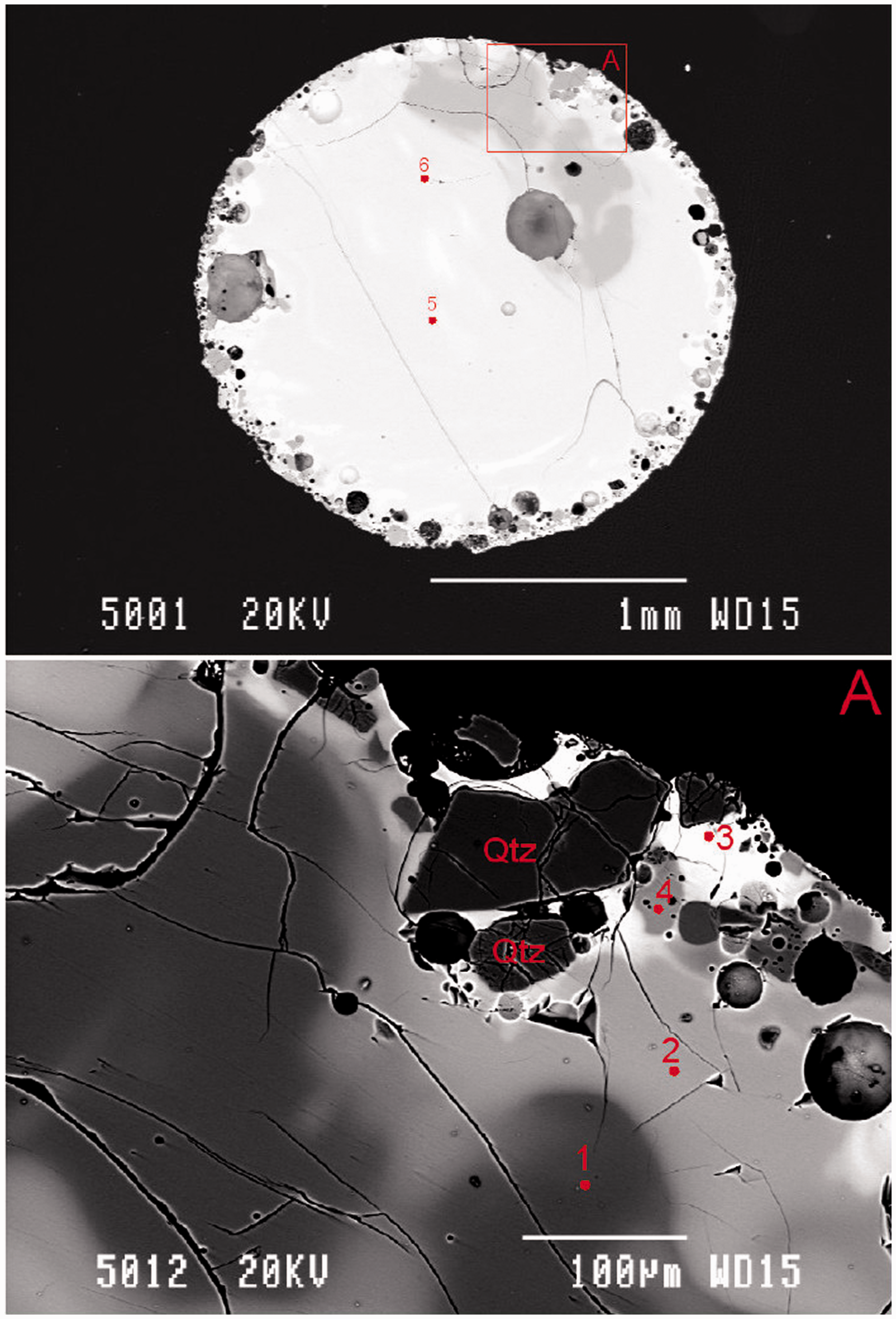
A distinct form of ‘red trinitite’ is found north of Ground Zero. The red colour is due to the presence of copper. Close inspection reveals that this kind of trinitite contains ‘metallic chondrules’, which show up as bright white dots in scanning electron microscope images (see Figure 2). As geologists write, the chondrules contain ‘blobs’ of iron, copper and lead. They explain: ‘These metallic chondrules are melted bits of the first atomic bomb and the surrounding support structures — history encased in glass’ (Eby et al., 2010: 182, emphasis added). While the lead and iron came from the bomb, the copper probably derived from power lines strung from the Trinity Test Site to the north. The bomb, its scaffolding, and relics of energy infrastructure are fused together among the micromelts, chondrules and vesicles. In other words, the material assemblage of the bomb is expressed in the melt. This is not ‘history encased in glass’, as if the trinitite bead were a transparent vitrine through which we can gaze at a ‘solid’ presentation of events; it is a memory of solid fluidity that tells a story of rapid transformation and process.
Red trinitite. Upper left, macroscopic view of glass fragment. Note the bright bits which are metallic chondrules. Upper right, the same fragment imaged by a scanning electron microscope (SEM) using back-scattered electrons (BSE). Brightness corresponds to the average atomic number, the brighter the image the higher the atomic number. Lower left, close-up SEM BSE image of one of the chondrules. Note the three distinct phases (based on brightness) that can be seen in this image. Lower right, element maps of one of the metallic chondrules showing the distribution of lead, iron and copper. The grey areas in the BSE image correspond to blobs of melted iron. The lighter grey is copper (copper wire from the Trinity Site, which also gives the glass its red colour) and the brightest areas are lead. These are bits and pieces of the first atomic bomb and the support structure. Source: Eby et al. (2010: 182).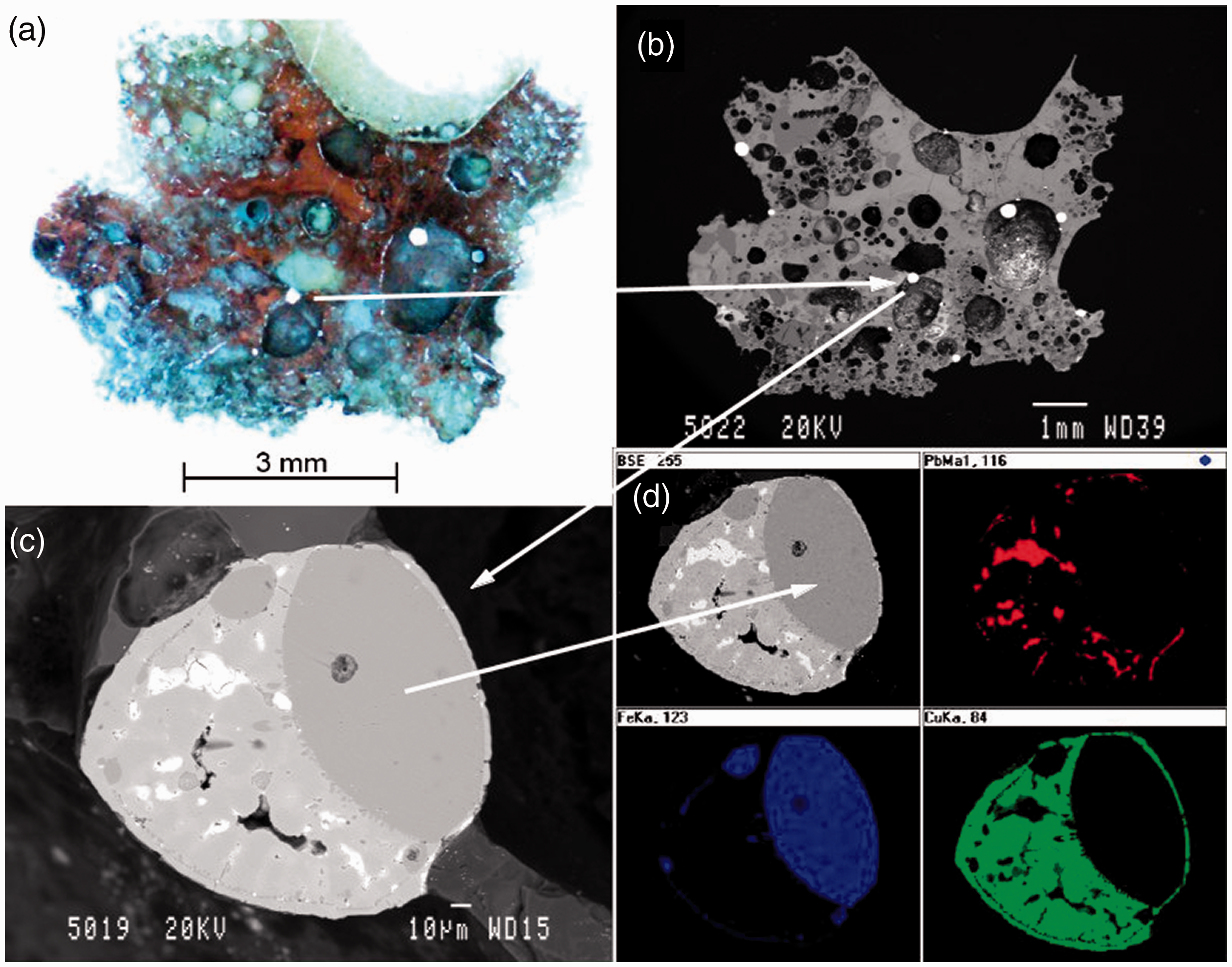
Hermes and Strickfaden (2005) hypothesise that the duration of the fireball produced by the Trinity test was 3.1 seconds and the total time the ‘hot cloud’ persisted was 14–20 seconds. Based on films and photographs of the blast, Semkow et al. (2006) estimate trinitite glass solidified in 8–11 seconds. Thus, trinitite glass was formed in an event that played out in a temporal ‘present’ that was observable by humans, including those directly implicated as active perpetrators of the event or as victims of the fallout. Yet, as a result, trinitite contains a stunning variety of radioactive isotopes, including: fission products Sr-90 and Cs-137, activation products Co-60, Ba-133, Eu-152, Eu-154, Pu-238, and Pu-241, the remains of the nuclear fuel Pu-239 and Pu-240, as well as natural radionuclides K-40, Th-232, and U-238 (Parekh et al., 2006). The half-lives (and auto-relations) of these isotopes differ dramatically, from 30 years for Cesium-137 to 24,110 years for Plutonium-239 (over twice as long as the Holocene era). As noted earlier, trinitite contains partially melted grains of quartz that derive from the bedrock of the Jornada de Muerto (see Figure 3). Thus, the rapid melting and fusing of trinitite glass brings materials into new relations with themselves and with other materials. In the words of Barad (2017: 74), trinitite is ‘a superposition of dispersed times cut together-apart’. The presence of multiple radionuclides and the glass composition imbue trinitite with elemental memory. This is an elemental memory that merges different senses of the elements, from radioactive isotopes to the solid-fluid medium. It is therefore insufficient to think of trinitite fragments as snow-globes of the past. They are rather unfolding events or ‘spacetimematters’ (Barad, 2007) that continue to perform their memories and nuclearity in the wake of atomic violence.
Thin section images of trinitite glass. Gypsum plate inserted to enhance contrast: (a) partially melted quartz grain showing glass embayments; (b) linear features in quartz grain interpreted as planar deformation features (PDFs). These features are indicative of high pressure. Source: Eby et al. (2015: 436).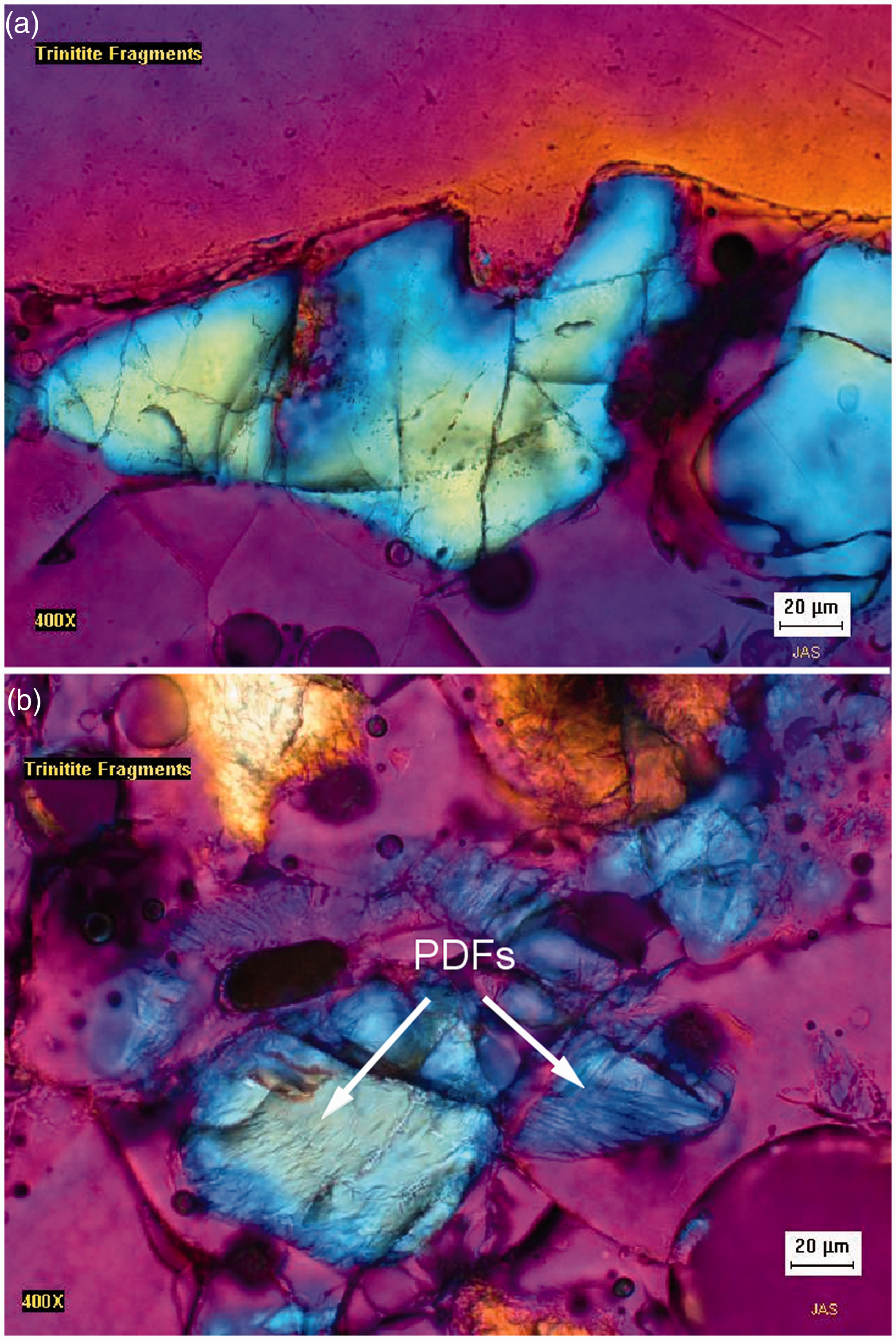
In March 1952, the Atomic Energy Commission (AEC) announced a plan to clean up the trinitite at the Trinity Test Site. Most of the remaining trinitite was ‘graded up’ and buried while the crater was smoothed over with a shallow mix of sand and trinitite shards (Eby et al., 2015). Trinitite is employed by scientists in research that often includes slicing, grinding up and re-radiating the glass. In many ways, then, trinitite is already returning to sand. Other samples have had different fates. Van Wyck (2002) writes of a trinitite sample displayed in a jar in the workers’ changing room of the mine at Port Radium. Far removed from its origins, it is a repository of memory that is entangled with miners’ labouring bodies as well as those of their parents and children. What forms of contact and intimacy exist between this trinitite fragment and those who spend time with it? What is the ephemeral archive that is bound to this piece of glass? Like the encounters witnessed and imagined by Agard-Jones (2012), elemental memory alerts us to the presence of affects, histories and gestures that otherwise go undocumented and untraced. At the same time, thinking about this trinitite fragment at Port Radium reminds us that distributed memory and matter is not distributed responsibility: the ethics of elemental memory lies in the apprehension of elemental expressions of processes and events that specific humans and human societies have set in motion.
Radionuclear Inheritance
Through constant decay / Uranium creates the radioactive ray (Kraftwerk, 1975)
As Mari Keto told me in personal communication, her interest in radioactivity stems from her childhood growing up in East Finland close to the border with the USSR. She vividly remembers the Chernobyl nuclear meltdown. During weekly solo camping trips to the forest when she was a teenager, she began to practise shaping the mineral Spectrolite. This interest led to degrees from Copenhagen’s institute for precious metals and from Pirkanmaa Vocational Institute, where she studied as a blacksmith with a specialty in forging. Keto is based in Copenhagen and works as a professional artist and jeweller, exploring the ‘limits of artefacts’ and ‘the fine line between sustainability and perishableness’ (Keto, 2020: np). In other words, she works at the limit of solidity and fluidity. Her solo works and her collaborations with Erich Berger have been exhibited internationally.
As Keto related to me, she first became interested in creating jewels and objects from radioactive materials when Berger showed her some radioactive stones that were cut like diamonds. At the time, she thought: That was just an absurd thing to do since: (a) cutting is made to [let] light enter the stone in [a] specific angle to shimmer. These stones were ugly black; (b) [cut] stones are only used in jewellery. So why [would] anybody … willingly [make] something that is so harmful if carried on the body? (c) [doing] this cutting work is terribl[y] harmful for the worker. Didn’t they know what they [were] doing? We [were] able to trace the stone cutter to Myanmar and it turned out that he was aware of the risk. He said that it was still less risky than working in the mines … (Keto, personal communication)
Keto’s first encounter with radioactive jewels gives relevant context for her work while also raising issues of risk and nuclearity. Her initial question about why anyone would (willingly) make something so harmful conjures an image of sharply faceted jewels worn on the soft, porous human body. In contrast, the response of the unnamed jeweller from Myanmar indicates a different perception of harm, links these perceptions to geography and inequality, and connects the jewels to their extractive earth-origins. Indeed, questions of nuclearity are especially pertinent for Myanmar, a state alleged to be ‘going nuclear’ by some, and ‘non-nuclear’ by others (Kelley et al., 2010). In other words, Myanmar’s nuclearity is a ‘regularly contested technopolitical category’ that shifts in time and space (Hecht, 2007). As Hecht shows, the nuclearity assigned to states, processes and substances matters for miners whose access to care and compensation is dependent on measurement practices, health infrastructure and the ‘twin rituals of safeguards and inspections’ (p. 104). The Myanmar jeweller’s gesture to the riskiness of the mines as opposed to the risk of radioactive jewels is thus heavily weighted with issues of nuclearity: ontological issues concerning the things and categories of things that exist.
With better understanding of the relationship between radioactive materials and the body, a relationship she discovered cannot be reduced to hard/soft or harmful/vulnerable binaries, Keto ultimately acquired a degree of comfort in working with radioactive matter. Still, how does one cut or facet a radioactive substance like uraninite? To do so is to place one’s body in intimate proximity to a substance made of radioactive isotopes that have been decaying for millennia. It is to enter into the deep-time story of a mineral. While most of the radionuclides in trinitite began their process of decay in 1945, the radionuclides in uraninite ore (for example, Protactinium-231, a decay product of Uranium-235, with a half-life of 32,760 years) have been decaying for over 60,000 years. In addition, Keto and Berger learned that minerals like thorite, thorianite and uraninite are very brittle. Most of the samples they managed to find straddled the edges of hard and soft, granular and flaky. This had implications for safety since chipped fragments or dust particles could be toxic if inhaled. Although at one stage Berger and Keto discussed grinding up the minerals with silver clay to make porcelain, they quickly realised how dangerous this would be. Keto says, ‘we dropped all kinds of modifying of materials and decided simply to use it as it was’ (personal communication). In order to track the quasi-imperceptible shedding of the minerals indoors, Berger made a DIY Geiger counter that was used to ‘sweep’ Keto’s workshop before, during and after each day’s work. The readings of the Geiger counter displayed the invisible creep of radiation moving through surfaces, across boundaries, and into material spaces and voids.
The Inheritance Project is a series of collaborative works by Keto and Berger that engage with the problem of the storage of radioactive matter. The work is animated by the questions: ‘How can we as individuals and society deal with the scales and scope of deep time? How can we make sense of the vast time-scales involved?’ (Berger and Keto, 2016b: np). Within the Inheritance Project are two separate works called Inheritance and Open Care. In Inheritance, a set of jewellery including a necklace, earring and brooch made of gold, silver, thorite, thorianite and uraninite is presented within stackable concrete containers that also hold an electroscope, a glass rod with a piece of fur, a Persian water clock, or Fenjaan, and a set of instructions engraved on a copper plate (see Figure 4). This series of objects, together with the concrete container, are gifted to a fictional family. Echoing Hecht, Berger and Keto write: each time the jewellery is handed over from one generation to the next, the ritual of measurement determines if the jewellery can finally be brought into use … or if it has to be stored away until the next generation. (emphasis added)
Erich Berger and Mari Keto, radioactive jewellery composed of gold, thorianite, thorite and uraninite. Part of Inheritance Project. © Image by Anders Boggild. Reproduced courtesy of the artists.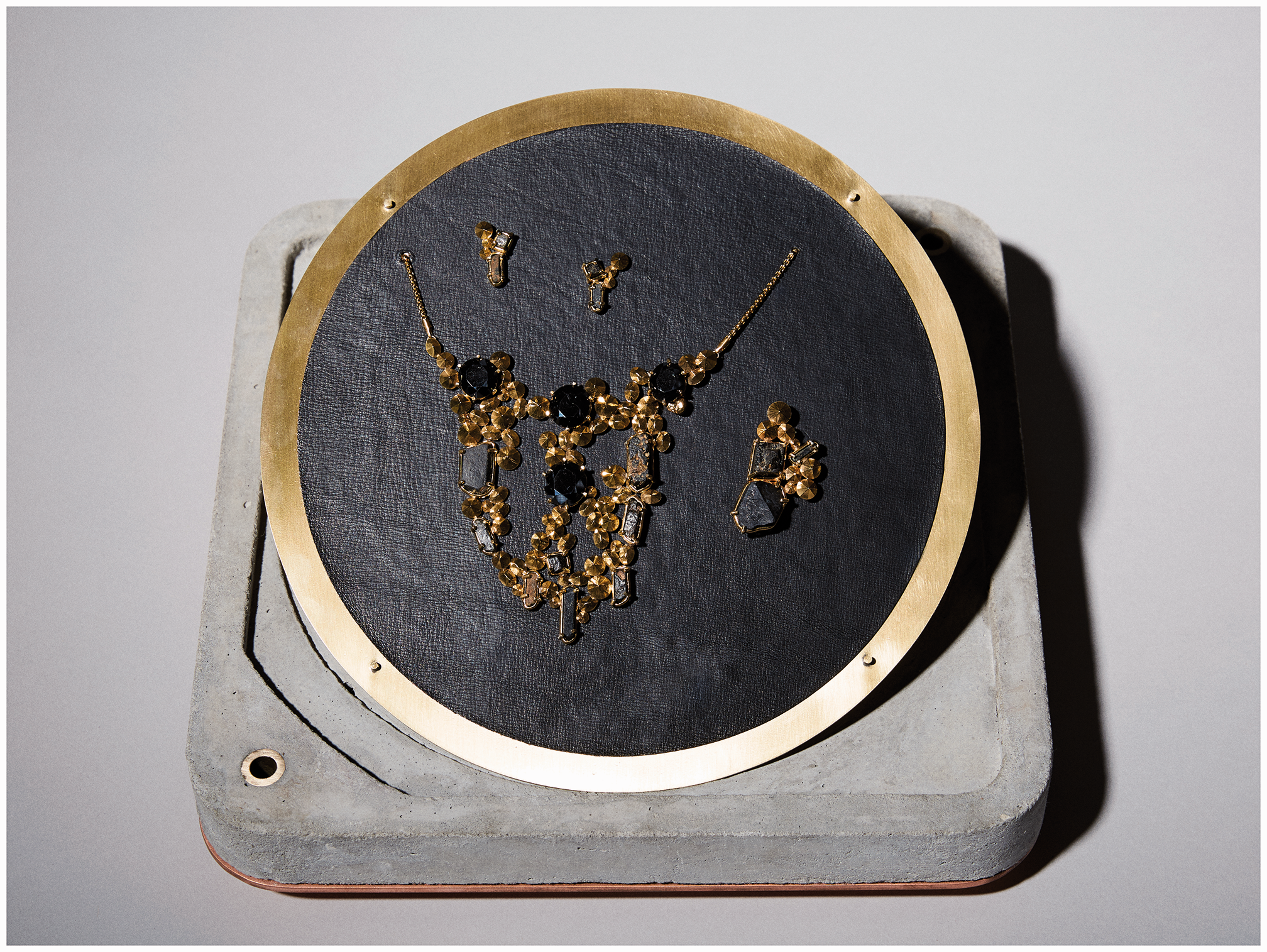
The instructions for the ritual are engraved into the copper plate and include the following lines: If there is no leaf in the electroscope then mount one from the spare leaves. Rub the charging rod with the fur and transfer its electro-static charge onto the electroscope until the leaf reaches maximum horizontal deflection. Use the timer to measure the time until the leaf is back in the original vertical position. Put the electroscope onto the plate with the jewellery and repeat the measurement. If the measured time with the jewellery is shorter than the time without, then the jewellery is not ready for use. (Berger and Keto, 2016a: np)
An electroscope is a device that can measure electrostatic charge (see Figure 5). Its use in this ritual is based on the principle that radioactivity can discharge an electrostatically charged body. In other words, the radioactive jewels discharge the positive electrostatic charge imparted to the gold leaf by the charged rod. Time is measured with the Fenjaan by the rate it takes water to fill a bowl. If the radioactive jewels discharge the charge from the gold leaf in the electroscope faster than the gold leaf would otherwise lose its charge without them, the jewels are still too radioactive to wear.
Erich Berger and Mari Keto, electroscope. Part of Inheritance Project. © Image by Anders Boggild. Reproduced courtesy of the artists.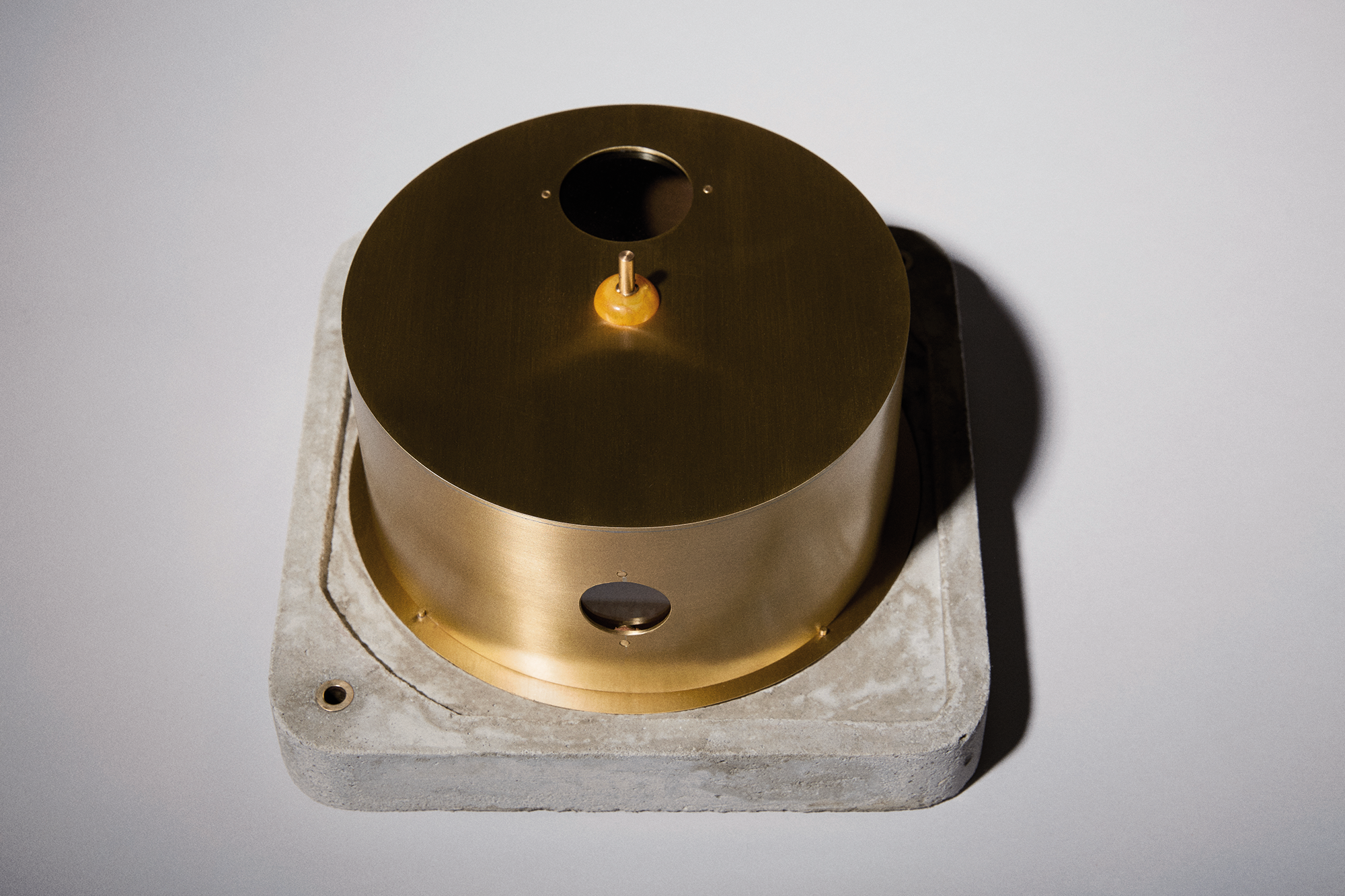
The ritual of measurement offers several insights for the notion of elemental memory and relationships of solid and fluids. First, the ritual is a performance that relies on relatively stable properties of materials and works to ‘(re)stabilise the world’ (Hecht, 2007: 104). Friction between the fur and the rod produces a positive charge on the rod. This electrostatic charge is transferred to the gold leaf. As the bowl is filling with water, the gold leaf wavers from its angle of deflection. This arrangement of objects, textures, fluids and vessels depends on the endurance of materials that are variably hard, porous, soft, fibrous, smooth, round or fluid. If this constellation of material properties were to change, the ritual of measurement would not work. The ritual of measurement thus plays on distinctions of the solid-fluid kind, and works to stabilise these distinctions. However, secondly, the ritual of measurement is a way of sensing and monitoring the deep time elemental memory of radioactive materials. Uraninite is filled with Uranium-235 (half-life 704 million years) and Uranium-238 (half-life 4.47 billion years) as well as their decay products. This includes Pb-206 and Pb-207, the Protactinium-231 mentioned earlier and Radium-226, which has a half-life of 1600 years. Like the rituals described by Hecht (2007), Berger and Keto’s ritual of measurement is thus a choreographed encounter with elemental histories and temporalities that make material binaries difficult to sustain. It also brings attention to the material and forensic properties of the jewels together with affective experiences. ‘Nobody remembers why it was radioactive in the first place’, Berger and Keto (2016b) write, ventriloquising a fictional family member. The ritual of measurement in Berger and Keto’s Inheritance proposes a model for an ephemeral generational encounter between humans and the deep-time memories (auto-relations) of rock and mineral.
In the second work of the Inheritance Project, Open Care (see Figure 6), Berger and Keto apply the principle of a measurement ritual, except the water clock is replaced with an hourglass of sand and, in place of the radioactive jewels, there is a ‘nuclear waste container’ housing 95 pellets of Americium-241, an artificial element and product of nuclear fuel. Americium-241 is the most common isotope of Americium in nuclear waste. It has a half-life of 432.2 years. As Keto related, the duo did not get permission to exhibit the piece with the Americium pellets attached, so Keto stores them in her studio in a lead box. In the eyes of cultural authorities, Americium-241 possesses a nuclearity that ‘natural’ radioactive minerals do not. Furthermore, the emphasis on ‘open’ forms of ‘care’ in this project links the ritualised act of measurement to affective and experiential registers: an archive of contact between humans and radioactive materials. It proposes another model of living with nuclear waste, where the care of this waste becomes the personal responsibility of citizens. Both Inheritance and Open Care experiment with the elemental memory of radioactive minerals, molecules and substances, suggesting ritualisation as a platform for ongoing affective interactions between humans and materials undergoing slow auto-transformation. In part because of the physical process of working with radioactive materials that prove to be surprisingly soft or fluid, leaking and shedding into their surroundings, and in part because of the temporalities and (in)stabilities inscribed in the ritual of measurement, Berger and Keto’s work furthers an account of the processuality, transmutation and auto-affection of rock and mineral. In conclusion, I return briefly to the development of solid fluids and further highlight the ethical contributions of elemental memory.
Erich Berger and Mari Keto, Open Care (2016). National Library of Riga, Latvia. Open Fields Exhibition. Part of Inheritance Project. © Image by Berger and Keto. Reproduced courtesy of the artists.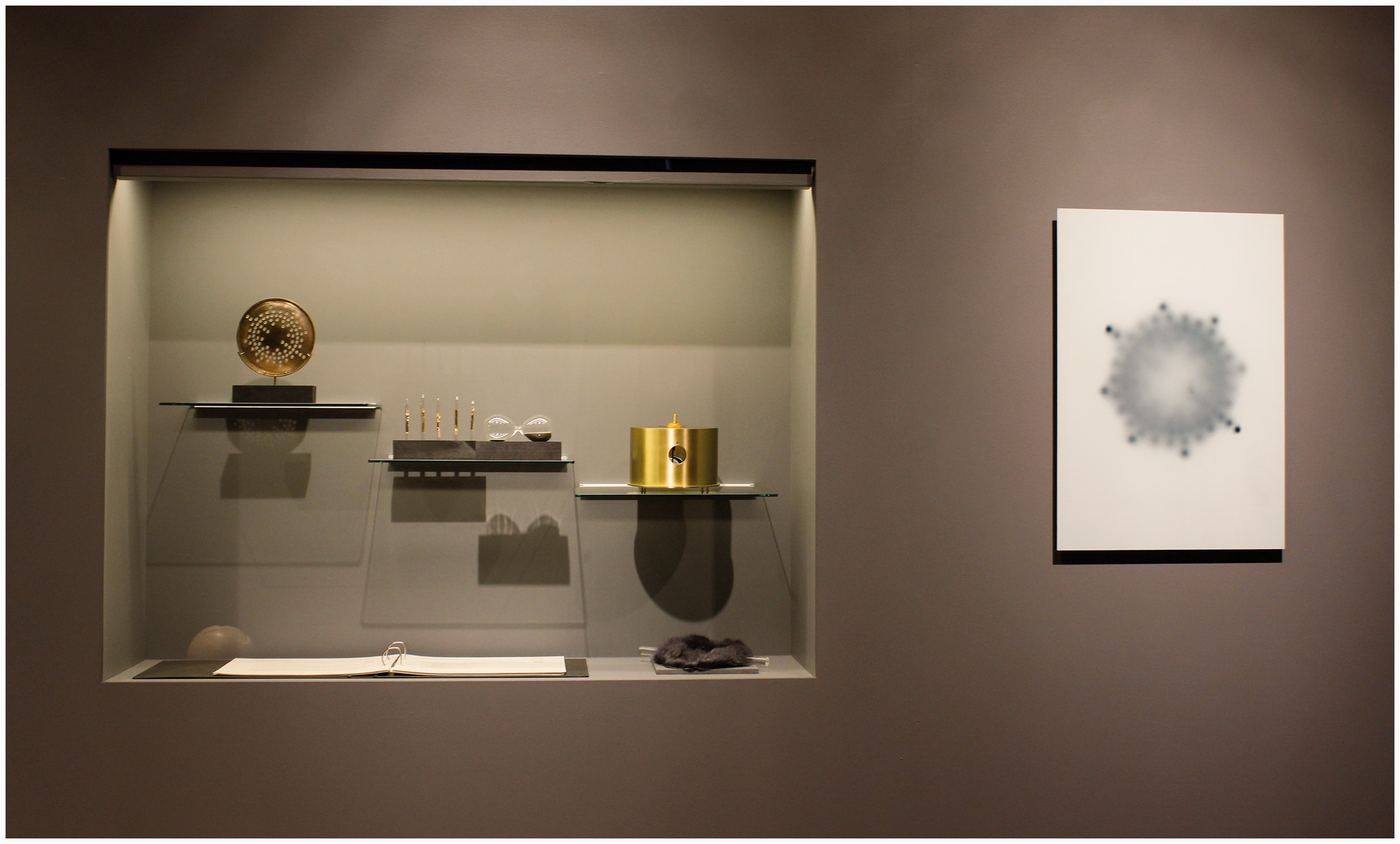
Conclusion
The term ‘solid fluids’ has immediate relevance for describing materials undergoing rapid phase transitions, like molten trinitite during the 8–11 seconds after the Trinity Test. It also has obvious relevance for glass: a material that forms in the liquid phase and, when cooled, easily breaks, shatters and disintegrates. Although I explored the solid-fluid properties of soil, sand and glass through geology and nuclear forensics, I also gestured to a more capacious notion of solid fluidity that applies to other forms of matter, whether born of nuclear events or earth processes. My argument is that an attention to elemental memory, or an element’s capacity to auto-affect over time, reveals the inadequacy of terms like solid and fluid, and highlights the expressiveness of solid fluid substances. Moreover, in relation to the debates around the Anthropocene that frame Ingold and Simonetti’s (2018) exploration of solid fluids, nuclear materials and nuclearity deserve recognition for their role in forcing consideration of deep timescales and imperceptible processes, thus destabilising fixed material ontologies and categories.
Although they emerge from different disciplinary traditions and empirical concerns, elemental memory and nuclearity are allied concepts. In related ways, they (re)configure the ontological stability of materials, (re)contextualise the act of measurement and probe imaginaries of classification and categorisation. The elements (understood as matters, molecules, milieus and media) through which different nuclear entities emerge and decay are implicated in ‘set[s] of practices, of rituals to enact participation in the world’ (Hecht, 2007: 102). These ‘sets of practices’ include the Non-Proliferation of Nuclear Weapons (NPT) Treaty, which ‘prescribes’ rituals of inspection to ensure ‘safeguards’ in nuclear assemblages. These practices also include Keto and Berger’s artwork, in which the measurement ritual ensures ongoing participation between humans, radioactive elements and nuclear waste. The arts of elemental memory, therefore, express how the nuclearity of materials, their socialisation and techno-political capacities are implicated in, and affected by, human-nonhuman assemblages over deep time and space. Through the repetitions and rhythms of ritual – a form of inheritance – humans may apprehend the nuclearity and elemental memory of materials as old as the Earth.
An attention to solid fluids has wider purchase for an ethics of responsibility and accountability in the nuclear era. Several scholars have proposed vocabularies for attending to the legacies of atomic violence. For example, Karen Barad (2017) has advanced the notion of the ‘void’ for grasping the material-discursive entanglements of physics and the testing of atomic weapons on landscapes figured ‘empty’ or ‘barren’ by Western military science. Elizabeth DeLoughrey (2019) has developed the ‘heliotrope’ from Jacques Derrida to query allegories of light that present nuclear experiments as achievements in harnessing the power of the sun. These insidious allegories, DeLoughrey argues, obscure a geography of nuclear weapons testing on indigenous lands while glorifying atomic violence. Distinctions between the solid and fluid, which map easily onto notions of substance and its lack, or presence and absence, are deeply implicated in creating the material-discursive and imaginative conditions for deserts, islands, oceans and indigenous territories to become the ‘ground zeros’ for atomic weapons tests and the ‘zero time’ of nuclear waste disposal. As I have shown, by working at the limit of the solid fluid binary, artists and practitioners of different kinds are challenging these colonial and racist assumptions underpinning nuclear geographies. As scholars, we can become allies of this work by further exposing the problems of post-Enlightenment metaphysics, generating alternative grammars and conceptual imaginaries, and sharing these resources across academic and non-academic spheres. In this way, a lexicon of solid fluids, like that published alongside this special issue, has a specific ethical as well as epistemological import for our irradiated planet.
Footnotes
Acknowledgements
The writing of this article was supported by a sabbatical at Royal Holloway, University of London. My thanks to Sunil Manghani, Mike Featherstone and three anonymous reviewers for their discerning and helpful comments on the article. Thanks also to Nelson Eby, Professor of Geosciences at the University of Massachusetts, for answering my questions on the composition of trinitite glass, and to Mari Keto for a fascinating conversation about working with radioactive minerals and developing the Inheritance Project. Finally, I extend my enduring gratitude to Tim Ingold and Cristián Simonetti who invited me to participate in the Solid Fluids workshop in Aberdeen from 27–29 August 2018, where the ideas in this article initially took shape. Special thanks to Tim for encouraging me to pursue notions of the elements across different practical and philosophical registers in my DPhil Viva at the University of Oxford.
