




Abstract
The design office of Charles and Ray Eames was a collaborative, interdisciplinary, multimedia affair linking Hollywood, the State Department, universities, the corporate sector and international fairs during the height of the Cold War. Bringing together design, furniture, cutting-edge technology and experimental, avant-garde informed-multiscreen projections, the Eames Office operated as a humanities/IT/media/arts lab. For the 1964 World’s Fair, the Eameses created ‘The Information Machine’ for IBM. The techniques of display and experimental juxtaposition of images, sound and new media capacities later migrated to the many ‘happenings’ following in the wake of Allan Kaprow’s medial and performative experiments. The Eames Office crafted for the 1964 World’s Fair a vision of global change and possibility grounded in avant-garde visual techniques and aesthetics that continue to constitute a specific globe crafted by the US Cold War military-industrial-university-entertainment complex that remains the grounds for our current collective nomos.
Introduction: Welcome to the Shrinking Globe in an Expanding Universe of Remote Rule and Control for the Greater Good of All
Our interests have included many aspects of communication – photography, exhibitions, writings and motion pictures. Our work in education has intensified this and has provided a natural overlap with several governmental agencies. (Charles and Ray Eames in 1969, quoted in Lipstadt, 2005: 151) The Unisphere, 1964 file image. WikiCommons.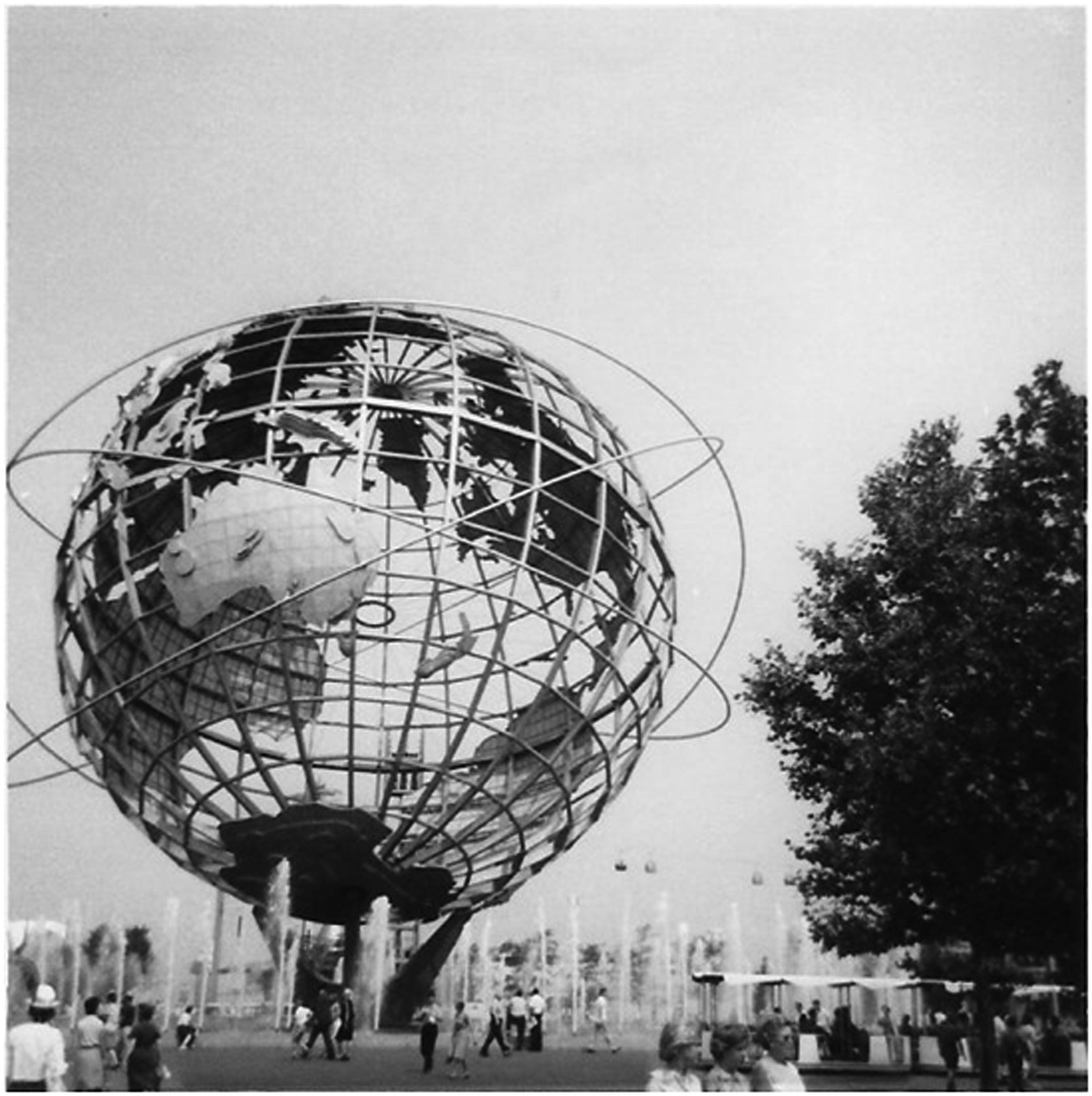
The IBM Pavilion was largely the product of the very successful design office of Charles and Ray Eames. From the multimedia experience of Think to the robotic puppet display to the large-scale information boards complete with photos and timelines to the signage and graphics and even the furniture that tired fair-goers were able to relax on, the pavilion essentially provided a 3-D multi-sensory display of the Eames Office in action. The highlight of their offerings was Think, a multimedia projection and immersive educational experience that furthered the overall pavilion theme: the increased import of computing in daily life. Part of what the Eameses referred to as ‘the Information Machine’, Think used a hydraulic lift called the ‘people wall’ that pushed some 500 spectators 50 feet in the air into the suspended theater. The audience was physically thrust into the theater, itself strung with randomly arranged non-uniformly sized screens (14 long and 8 smaller ones in the shape of rectangles, circles, squares and triangles). The Eameses had been experimenting for several years with expanding the cinematic technological format with lenses, throw, screen-shape as well as editing and narrative techniques. The effect of the space was like being in a control room or TV studio (Colomina, 2001: 7–8) and thus anticipates our dashboard-driven computer navigation.
The experimental multimedia immersive environment as well as the editing techniques deployed had antecedents in early 20th-century avant-garde film and helped generate the interest in 1960s multimedia extravaganzas. Allan Kaprow’s ‘happenings’ expanded cinema and various experiments in non-linear capabilities of screen information organization. The stated purpose of Think was to highlight the role of computing in daily life in relation to problem-solving at multiple scales, from the home to complex engineering and aerospace/defense demands. The building and exhibition performed the very material and immaterial formation of computing’s complex embeddedness in the world, one that the spectacle indicated would only grow and deepen. If the technologies, techniques, media, information and information delivery systems were experimental while drawing on earlier avant-garde techniques and pointing toward experimental artists emergent in the '60 s, then the general content and ideology of the exhibit and of Think supported, furthered and indeed manifested the general US Cold War ethos of futuristic idealism.
The Eames Office made a short promotional film pitching the IBM Pavilion while also, indirectly, pitching the office. The film used as the soundtrack ‘A Nice Day’ by the Chico Hamilton Quintet, thus displaying another Eames Office aesthetic-intellectual collaboration indicative of their values: here combining progressive jazz dialogues with classical music grammar. This documentary continued a kind of global event tradition initiated by Edison for the 1901 Pan-American Exposition. Like all international expositions, the one in 1901 intended to promote commerce between the Americas in a more profound manner than the 19th century had accorded and with an agenda suggesting that the US clearly would lead the technological way to a better and brighter future. Thus the exposition provided an extended advertisement for one of the US’s leading technological lights, literally: Thomas Edison. The many inventions by the Wizard of Menlo Park, including Edison’s kinetoscope camera and electric light bulb, contributed to the self-representation and presentation of the event as it became a site of motion pictures, phonograph recordings and electrical illumination. The content of Edison’s short reels featured the work of his lab, much as that by the Eameses featured the work of their office, itself a model for the labs springing up in the ’60 s at universities and in corporations.
More importantly, this documentary and the work done by the Eames Office over the two decades prior to the 1964 World’s Fair revealed an articulation of the ways in which aesthetics, art, technology and ideology combined in the interdisciplinary collaborative lab devised by the Eameses to express US Cold War ideology at multiple levels and scales, one that helped replicate and authenticate a Cold War nomos of power, control and law that continues into the present as much as it emerged from the avant-garde experimentations of Dadaism and cinema of the early 20th century. The earlier experiments in technology and artistic expression had attempted to derail the systems and machines of violence that surrounded them and did so with an explicit political agenda. The Eameses had hoped to do the same while their office nonetheless represented what one could call ‘the military-industrial-university-entertainment complex’ in all of its interconnectedness and shared interests (Bishop, 2006: 564). If Think proved an integral part of the information machine, then the Eames Office provided a propaganda machine for US values, ideals and policies through experimental strategies that embraced the latest technologies and sources of power, including information and information theory through communications, computing and tele-technological control. As such, much of the work of the Eames Office presented, designed, performed and embodied the Cold War nomos they helped shape: a speculative techno-utopianism shot through with nuclear dread and constructed through planetary-scaled universal computation.
The nomos is the foundational and self-organizing measure from which all other measures emerge. It constitutes a story of origins concerning how the division and partitioning of the world occur – coming as it does from the verb nemein: to divide and thus distribute and allocate (see Schmitt, 2006 [1950]: 67–72). The nomos is simultaneously physical, conceptual, institutional and political for it provides the originary concept of the Law and becomes constitutive of tradition. Writing in the aftermath of the Second World War and trying to make sense of the suddenly and irrevocably altered relationship between territory and sovereignty in the early days of the Cold War, Schmitt claims the nomos provides the means by which land has traditionally been ‘divided and situated’. The nomos, he argues, ‘is also the political, social and religious order determined by the process’ of dividing and conceptualizing the land that ‘turns a part of the earth’s surface into the force field of a particular order’ (2006 [1950]: 70). Part of the power of the nomos resides in its inceptionary and generative qualities that move rapidly from materiality to immateriality, from literal divisions to conceptual and institutional justifications of them.
The emergent Cold War nomos that Schmitt intended to theorize found form in the Eames Office’s productions. These helped design and convey an extension of US power through the creation of a globe divided by the two nuclear superpowers and controlled through increasingly powerful tele-technologies that helped establish real-time surveillance of the entire planet at all times. In this new Cold War scenario, all places mattered and were directly part of US global security, as codified in the Truman Doctrine. Thus while the public discursive sphere highlighted the technological promises of the future, the recent past and very immediate present was indeed one of nuclear anxiety and a collective psyche occupied by mutually assured destruction. The Cold War arms race had delivered into the hands of humans the capacity previously accorded to the gods or nature: the capacity to destroy all human life on the face of the earth. Nuclear weapons had shaped the collective noetic world since their explosion, having vaporized humans and imprinted them in cement (making the built environment a target as well as a surface for the darkest of human images; see Beck and Bishop, 2020)
The soft, progressive, innovative and entertaining side of the US Cold War nomos featured at the 1964–5 World’s Fair fueled the vision of the US and the world’s future as intertwined if not synonymous, as assumed in the multimedia infotainments crafted by the Eameses. Despite the Eameses’ optimistic humanist vision regarding a better and greater future through technology of all kinds, they projected a nomos of post-human geopolitics that remains thoroughly entrenched in the present. The views, values, hopes and dreams held by the Eames Office were those of the US federal government too, of course. President Kennedy, mere months after the Cuban Missile Crisis, spoke at the groundbreaking ceremony for the US Federal Pavilion and underscored the rapidly emergent and solidly undergirded nomos found in the Eameses IBM work. The fair, he said, would be: a chance for us in 1964 to show seventy-five million people … from all over the world … what kind of country we are … and what is coming in the future. That is what a World’s Fair should be about and the theme of this World’s Fair – Peace Through Understanding – is most appropriate in these years of the Sixties. (Kennedy, 1964)
This globe of remote control and power is neatly represented by the Unisphere, which greeted visitors to the World’s Fair and was the marketing icon of the fair. Developed at the request of Robert Moses, the 140-foot-high globe is 120 feet in diameter and constructed from 700,000 pounds of stainless steel. The continents are topographically rendered while the oceans are open space. The Unisphere is a piece of see-through sculpture upon which topographical representations of the earth’s continents form coherent slabs and the longitudinal and latitudinal lines of mapping demarcate the sphere and hold it together with the world’s oceans providing the empty sculptural spaces. Schmitt links nomos to land and constitutes the seas as lawless and unbounded, which means they are irrelevant to the constitution of the nomos, thus allowing the Unisphere to mimetically provide unintentionally a physical model of his theory of post-Second World War governance.
The three rings of communications satellite trajectories pertain to what had changed in military and geopolitical imaginaries since the war while positing a future of fear as much as wonder. If the Unisphere provided an iconic representation of the US Cold War nomos, then the IBM Pavilion and the Eames Office’s contributions to it provided the means by which this global political structure would be realized: namely information, computation, complex systems, tele-technological surveillance and control coupled with multimedia spectacles and avant-garde aesthetics with cool design features generated as a package to dazzle the masses while delivering a singular vision of a collective future. That vision of a collective future is the present we currently occupy a half century later. Using Schmitt’s theoretical construct of the nomos in its attempt to reconsider the new relations between territory and sovereignty in an increasingly deterritorialized and tele-technologically controlled Cold War moment, we can read a specific geopolitical imaginary emergent and operative in the mid 1960s that became the US vision of itself on the world stage. Examining the geopolitical imaginary of Cold War power on display at this unique confluence of tele-technologies, avant-garde design spectacle, global computation and broadcast of US power – all neatly wrapped in beneficent democratic capitalism – found in the Eameses’ Think allows us to understand a moment in which much that dominates our daily contemporary moment emerged as a new and exciting vision of the future, a future which is our quotidian existence now.
The Eames Office as Cold War Art and Design Lab: Experimental Aesthetics, Techne and American Idealism into Ideology
Through a number of commissions for global fairs and representing US and/or corporate interests, the Eames Office designed visions of the future through avant-garde techniques of the past that have helped form the global nomos we have inherited from US Cold War efforts. The Eames Office operated as a humanities/IT/media/arts lab avant la lettre, not unlike those officially founded around the same time, such as that established by Billy Klüver with Robert Rauschenberg at Bell Labs or the one at MIT under the aegis of György Kepes, the Center for Advanced Visual Studies (CAVS), itself a precursor to the MIT Media Lab, founded by Kepes’ student Nicholas Negroponte. 2 The Eames Office, though, held no singular institutional frame or constituency, while such was not the case for Klüver or Kepes’ operations. The Eames Office’s ability to work with and for a range of clients across the corporate, university, entertainment and government sectors echoes the relationships between these sectors emergent in and essential to the new Cold War world, relationships connected by technology, aesthetics, global computing and geopolitical agendas.
The Eameses noted ‘the natural overlap’ between their endeavours and those of the US government. The overlap essentially transformed the Eameses into ‘cultural ambassadors’ during and for the Cold War representation of the US ‘as their design agenda aligned with the political agenda the US government wished to communicate’ (Schuldenfrei, 2015: 43) – and communication became their new mode of design. Many designers as well as occupants of the government expressed surprise that the outwardly ‘non-ideological’ and ‘cutting-edge’ design firm/lab would fit with and continue to work for the US federal government for many years (Lipstadt, 2005: 151–2). It is difficult to distinguish cause from effect with regard to the Eames Office and its various patrons or commissions and the Office’s interests, especially when one considers the Eameses’ stated criterion not to work on projects with which they did not ethically agree. The Office served as a singularly well-positioned platform that allowed for deft movement across educational, corporate, governmental, entertainment and technological collaborations, all of it grounded on a solid fine arts base. The Eames Office received much high-profile patronage from many corporate clients, including IBM, while maintaining links to many university scientists, heads of major corporations and public as well as private cultural institutions.
Collaborators/clients included the US Information Agency, the RAND Corporation, The Department of State, the Smithsonian, the Department of the Interior, PanAm, the Ford Foundation, Columbia Broadcasting System, the MoMA, Cummings Engines, Westinghouse and Herman Miller Furniture. Long-time collaborators included architect Eero Saarinen, designer and US government exhibition organizer George Nelson, cinema director Billy Wilder, cinema composer Elmer Bernstein, architect and futurist Buckminster Fuller, and designer Alexandro (Sandro) Girard (Lipstadt, 2005: 152). To further exemplify their import, Charles served on the National Council of the Arts and as a Library of Congress advisory committee. In particular, the RAND Corporation links proved pivotal for the Eameses in their work on various US pavilions abroad for exhibitions of technology, urbanism, post-war visions of the future and US consumer market economy democratic beliefs during the Cold War.
From their geographically marginal site on the West Coast, the influence of their office marked a larger shift in the US that had begun during the Second World War from East Coast control to the West due to war efforts in aerospace industries both in terms of design and manufacture, not to mention the siting of the RAND office, and Hollywood and television production. It is useful to remember that in the early days of their marriage in the first years of the 1940s, Charles worked as a set designer for MGM while also experimenting with molding plywood for a host of uses in the war effort, from plane parts to splints for wounded limbs, thus emphasizing design and materials in the service of a range of applications from military technology to field medicine to cinema production and art. The biomorphic shapes afforded by molded plywood made their way into Ray’s sculptures. Some of these in September 1942 featured on the cover of an issue of Arts and Architecture. The convoluted and folded wooden structures evoked a Möbius strip of planes that aesthetically bore the same interest in perspective found in Braque’s and Picasso’s cubist sculptures (Giovanni, 2005: 60). The process of molded plywood also found its way on to MGM sets as well as into furniture (Figure 2) and industrial design, so that from the outset the Eameses’ work cut across art, architecture, cinema, military and industrial production: a materiality that physically links the military-industrial-university-entertainment complex, rendering it and the Eames Office another kind of Möbius strip. The plasticity of the material allowed it the potentialities plasticity provides. And plasticity of materials and aesthetics as well as topics, ideas and clients proved central to the Eames Office.
Charles and Ray Eames: Plywood chairs and leg splint. WikiCommons.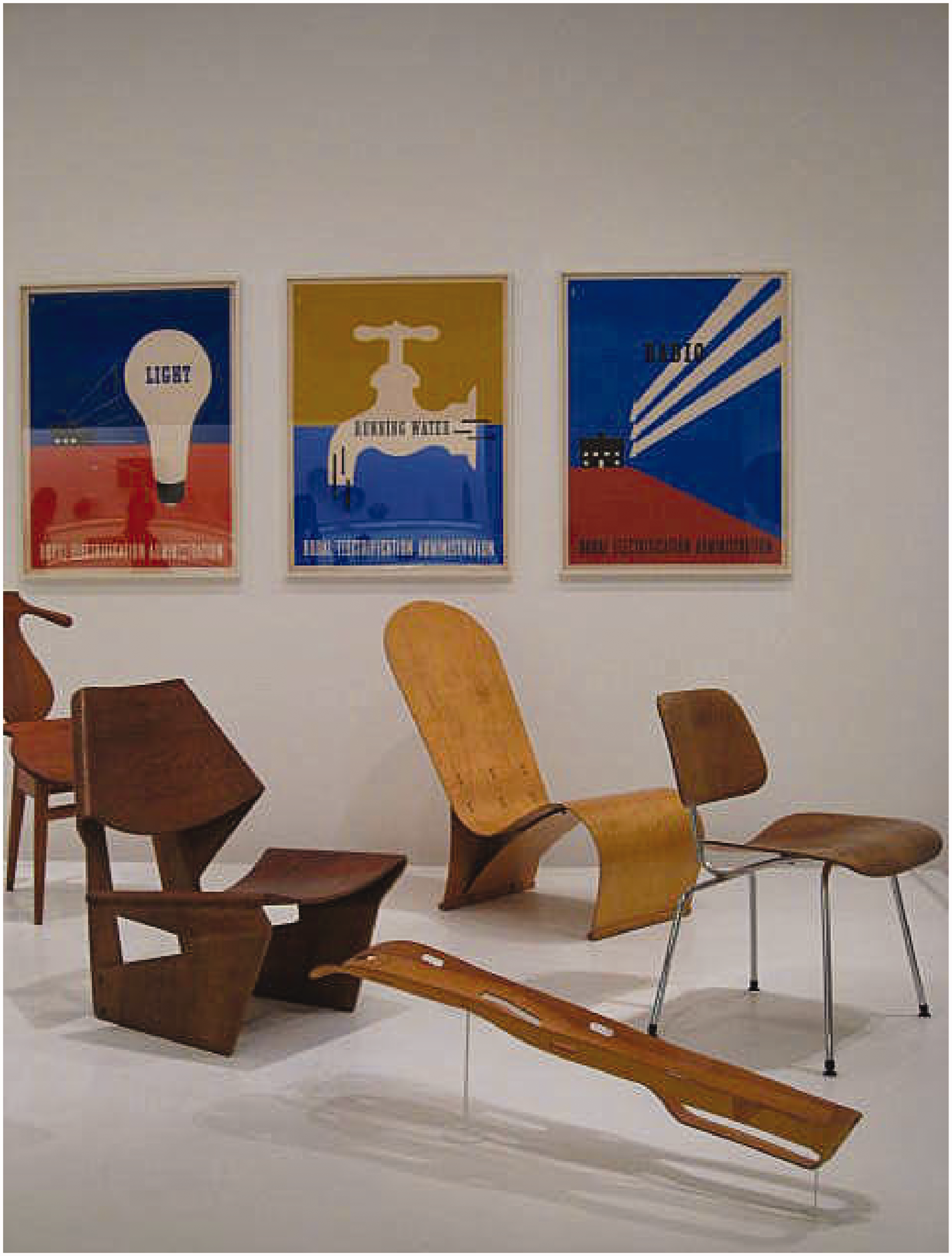
With lab and studio seamlessly merging, the sculpted plywood chairs that populated the 1946 MoMA show ‘New Furniture Designed by Charles Eames’ were tested physically and aesthetically at the Eames Office in laboratory fashion. Photos of the chairs were taken next to works by Alexander Calder to underscore their abstract, sculptural and biomorphic qualities, as well as to place the Office’s design work explicitly in dialogue with contemporary art (Giovanni, 2005: 61). Greatly inspired by information and communications theory in the early 1950s, the Eames Office led by Charles’s enthusiasms for these areas turned from primarily working on furniture design to films, information visualization and multimedia installations. The 1953 Eames film A Communications Primer was essentially an animated version of Claude Shannon’s 1949 work, The Mathematical Theory of Communication. The films also served as experiments in the filmic medium, as well as its installation. At the same time, the films propagated the Eames Office as an embodiment of a creative and experimental lab delivering information theory in a profit-led model of benign US corporate and American Cold War idealism of progress. The Eames Office was a platform of experimentation for the materiality of ideas and the immateriality of thought articulated through objects and images capable of effecting socio-political change.
In the early 1950s and into the ’60 s, the laboratory of ideas was clearly in the air at the time, and not just at MIT or universities but in the corporate sector as well as in the arts and the government, with the Eames office operating very much in the fecund and profitable interstices. 3 And the Eameses were early off the mark with it. A key element operative in most of these lab formations is a strong and sustained link to some of the larger aesthetic and formal concerns of early 20th-century avant-garde movements, but usually without their political, social and radical agendas. Charles might have gotten the most credit for the Office’s success and been its public face, but it was Ray Eames’ background in and knowledge of the syntax found in the avant-garde and experimental art milieu of NYC in the early part of the 20th century, in which she was deeply involved, that provided much of the visual and technological knowledge they updated, recontextualized and domesticated. In much the same way surrealism became part of the Disney studio and popular culture toolbox, the Eames Office brought this same domesticated syntax to various institutions and spaces. The various forces at play in the emergence of the Cold War nomos made it difficult, if not almost impossible, to maintain fully any alternative political agendas for the different art and design movements that inspired the Eames Office or other experimental labs. Despite ideological instability or the ineffectiveness of radical politics, the idealistic belief in art’s efficacy for social change barely wavered. Andre Breton, vigilant to the end, devoted his aptly titled final publishing endeavor, The Breach, to such larger goals. Running from 1961 to 1965 and offering images and new art by various artists still involved in surrealism’s transformations, the publication also included discussions of Pop Art and film as well as pieces about the increasing political demands and pressures of the Cold War (Gale, 1997: 414–15). The Eames Office, various politically-charged art movements and art/technology labs in university and corporate settings were clearly not alone. All of these enterprises held varying agendas though with an oddly singular goal: to end the Cold War (or war generally) through aesthetic, technological and information experimentation.
The idealistic (and ideological) spirit of the Eames Office remains in the present. Although no longer functioning, The Eames Office still maintains an official website with links to archival material, photographs, films, and historical information about the Eameses’ house and their exhibitions. The site includes the ethos of the Office which reads: ‘Charles and Ray’s work was a manifestation of one broad, all-encompassing goal: to positively impact people’s lives and environments’ (Eames Office website). The site also provides a shop where people can purchase products such as prints, toys, wearables, books, furniture, memorabilia and an Eames app – the singular vision of a collective future made material and consumable.
The Avant-Garde Foundations of 1960s Future-Building
A long cycle of repetitions of avant-garde techniques and strategies, though stripped of a significant element of their political critique, can be found in the multi-screen immersive experiences used by the Eameses in the 1959 USIA-sponsored pavilion in Moscow, and most intensively in the IBM Pavilion. Especially influential for them was the narrative avant-garde cinematic developments of Abel Gance in the first decades of the 20th century (an influence noted by Colomina, Kirkham and others). The comparisons between Gance and the Eameses’ film work are extensive, including the editing techniques, the screen expansion and developments for solely projected film and image work. Most importantly for both, these formal experiments served the significantly idealistic, conservative, even melodramatic nature of the content of the work offered by these filmmakers. Both Gance and the Eameses were lauded for their formal innovation while simultaneously derided for their capitulation to genre demands, nationalist cheerleading and general celebration of bourgeois values. Norman King describes Gance’s work as ‘reactionary innovation’ in so far as it wedded melodrama with formal innovation (1984: 3) – both a phrase and a critique applicable to the Eameses’ screen work as well. Before discussing these links with Gance, it is worth noting other avant-garde influences that crept into international pavilion displays during the 1950s with significantly different Cold War agendas, though still recycled by the Eameses for their corporate clients.
Gance had commercial and critical success with his rapid montage and varied and contrasting rhythms of film that seemed to point toward areas in which cinema could compete with poetry and music in terms of artistic and aesthetic expression (King, 1984: 4). Working from a spot squarely within and contributing to the burgeoning experimental avant-garde of the early 20th century, Gance in the 1920s used many of the techniques that the Eameses deployed in Glimpses and Think (Kirkham, 1995: 328), including rapid cutting and multiple screens. Gance’s close friends and collaborators included Blaise Cendrars, Antonin Artaud and Max Honegger while his experiments were in conversation with those by Picasso, Léger, Delaunay and Apollinaire (Abel, 1987: 4). Along with Marcel L’Herbier, Louis Delluc and Germaine Dulac Richard, Gance was part of what Richard Abel called ‘the narrative surrealists’, or the First Avant-Garde (1919–24). The films by these directors mixed styles and modes, generated complex narrative structures and used patterns of images for rhetorical purposes (Abel, 1987: 280–1). Gance melded melodrama with polyvision (multiple screens), allegorical image superimposition, wild camera movement, montage editing and color filter overlays for emotional resonance. As with Gance, all of these filmmakers were interested in image perception and how sensory data through technologically-generated means could be deployed as a goal in and of itself. Abel argues that the more experimental avant-garde that left narrative behind completely found many of its strategies and tools in this earlier moment (Abel, 1987: 281), including iconic later films such as Clair’s Entr’acte, Buñuel and Dalí’s Un chien andalou and Léger’s Ballet mécanique. The poetic or impressionist avant-garde admired Gance for ‘his work on the sensations constructed by the image’ (King, 1984: 21) But this later avant-garde also found his output deeply schizophrenic. Indeed René Clair wrote a 1923 article on Gance’s experimental melodrama La roué that offered a very early take on the form/content split that dogged Gance’s career.
Nonetheless, Gance’s experimentation and theorization of it provided a profound base for thinking through the capacity of images to create a new visual syntax, experimentation and theorization that directly informed the Eames Office’s own engagement with a demotic visual syntax of complex relations. In 1923 the director writes: One has to judge images not on their material quality but also on what they express – the value of cinema is to be found not in the photography on the surface of the images, but in the rhythm between the images, and in the idea, behind the image. (quoted in King, 1984: 56, emphasis in the original)
Gance’s triptych effect of layered images stacked horizontally and vertically on the screen – borrowed by the Eameses – also can be found in the experimental work of other early 20th-century film directors. The montage editing developed fully by Gance emerged most powerfully in Eisenstein, who acknowledged the debt. Eisenstein’s correspondence with Ezra Pound linked montage with Imagism as an explicitly symbolic and non-narrative means of juxtaposing images to create meaning in the minds of the audience through spatial proximity. The rapid cutting of images intended to overwhelm and affect the senses not by a logic of argumentation but by on onslaught of information, and perceptual input became essential to the Eameses’ Think. The formal editing capacities and opportunities afforded through Gance’s innovations resulted in both immersive efficacy and rather frequent befuddlement on the part of the pavilion attendees.
The multiscreen strategy the Eameses first used in Moscow with Glimpses, and again later for Think, clearly owes a debt to the innovations of Gance. However, they also draw on another strand of European avant-garde theater and performance, more recent iterations of which they encountered at the 1958 Brussels World’s Fair. There Le Corbusier’s multimedia show entitled Poème électronique provided an explicit display of Phillips’ technology in the service of social commentary and political critique of 20th-century injustice – all of it combined with a veiled suggestion that humanity’s rifts might be healed with his architectural designs. Also at the Brussels fair were displays by the Czech avant-garde theater designer Josef Svoboda, one of which, Polyekran, arranged screens at unconventional angles, shapes and sizes for projection, allowing the viewer to be bombarded by projected images in an immersive and disorienting manner. Both Le Corbusier and Svoboda owed a great deal to the projection experiments by graphic designer Herbert Bayer’s 1930 Diagram of the Field of Vision, whose alternative exhibition practices had been on display at the MOMA in the 1940s and ’50 s, and projected theater works from the 1920s by Erwin Piscator in collaboration with Walter Gropius. Various scholars, including Colomina, Kirkham, Schuldenfrei and (much earlier) Paul Schrader, have traced specific elements of these longer-range influences displayed by Le Corbusier and Svobda that trace back to early 20th-century avant-garde experiments in projective technologies that found their way into the Eameses’ installations, though in a much tamer fashion and with a markedly different ideological agenda in 1959, but more clearly in 1964. These displays in Brussels, as well as the earlier models from the ’20 s, spoke neatly to the Eameses’ experimentations with informational and rhetorical display provided in their 1952 ‘A Rough Sketch or a Sample Lesson for a Hypothetical Course’ and confirmed similar formalist desires and interests made possible through technological innovation (see ‘The Sample Lessons’ section in Ince and Johnson, 2015: 225–65).
But perhaps the most influential avant-garde influence for the Eames Office was Ray Eames and her artistic career in early 20th-century New York. Ray Eames, according to Joseph Giovanni, was an integral player in an important moment of US abstraction and its development out of the European avant-garde through the American Abstract Artists movement. This movement, largely populated by students of Hans Hofmann, began meeting in 1936, and sought to explore and combine ‘Expressionist, biomorphic and geometric elements’ with a thorough knowledge but eschewal of Realist and Surrealist tendencies (Giovanni, 2005: 58). She worked with this group for years and was at its core when the 1941 Abstract Expressionism show was held, which featured works by Fernand Léger and Laszlo Moholy-Nagy, amongst others. The group also kept close ties with de Kooning and Gorky. All of this grew out of Ray Eames’ immersion in the early 1930s NYC avant-garde and artist-as-activist scene, taking classes with Hofmann and visiting exhibitions by Boccioni, Cezanne, Picasso, Matisse, Miró, Léger and Calder (Giovanni, 2005: 45). She also had a profound interest in dance (both modern American and classical Indian), working with form and movement in space as it pertained to bodies and the built environment. Studying dance, architecture, design, painting and music as iterations of the same kinds of impulses, Ray Eames charted an immersive career in the arts prior to meeting Charles and starting up the Eames Office.
Hofmann, for his part, had lived in Paris from 1904 until 1914, engaging with the Fauvist and Cubist movements and circulating with Braque, Delaunay, Picasso, Picabia and Matisse. After getting his own classes up and running in New York, he counted among his students Arshile Gorky, Jackson Pollack, Willem de Kooning and Clement Greenberg (Giovanni, 2005: 56). Giovanni argues that Hofmann provided an integral link between pre-First World War Paris and post-Second World War New York (p. 56). Hofmann taught Ray Eames a great deal about space, within the plane of the image but also the image broken into parts and redistributed to create different senses and sensations of space. The plasticity of molded plywood finds some initial theoretical and formal engagement in Hofmann’s classes about the plasticity of the image, the plane and the frame. These ideas about plasticity proved especially useful for Ray Eames as he encouraged students ‘to test color tensions by moving and pinning small pieces of colored paper on their canvases’ (p. 56). This method foreshadows the ways in which the Eameses broke with single-projector filmic images and scattered screens about a space of installation (in Moscow or New York) to alter relationships between the spectators, space and the images being viewed. For Hofmann, perspective presents problems because it is only concerned with ‘one movement in depth, while plastic experience goes in and comes back to the observer’ (quoted in Giovanni, Ray Eames’ notes from a Hofmann lecture, August 1936). With Ray Eames neatly moving between different genres and kinds of depth, the Eames Office brought the avant-garde past and present to the promotional aid of IBM and the US government, an avant-garde in form and to a certain extent in spirit, but by no means revolutionary.
Think: Immersive Media and Expanded Cinema at the IBM Pavilion
Peace of mind in a profit-oriented context. (DeLillo, 1985: 87)
The Moscow Exhibition brought together a number of notable Eames collaborators under the auspices of their old friend George Nelson. The others included Billy Wilder, Jack Massey and Buckminster Fuller, whose geodesic domes protected the US missile-siting perimeter and early warning system stations but also projected US construction and engineering prowess. Fuller constructed a massive golden dome on site in Moscow, a construction project that Khrushchev watched intently. The USIA team was hired to exhibit highlights of US ‘science, technology and culture’ with Nelson receiving the commission from USIA to put together the US exhibition
Housed near Disney’s 360-degree film Circarama and Steichen’s ‘The Family of Man’ photo series, the Eameses’ film Glimpses of the USA was projected onto several 20 x 30 foot screens suspended inside Fuller’s geodesic dome. The film showed a ‘typical workday’ in nine minutes and a ‘typical weekend day’ in three minutes. Schuldenfrei connects Glimpses to the city symphony genre of the 1920s, the early 20th-century non-fiction genre that loosely includes Dziga Vertov’s classic 1929 avant-garde paean to posthuman vision, Man with a Movie Camera (Schuldenfrei, 2015: 71). Nelson described the series of images as not so much a film but ‘a projection of data’, rapidly moving and on such a scale so as to prevent Soviet criticism of objects portrayed as a Potemkin film set (Turner, 2013: 250). The purpose of the USIA exhibit was to promote the advantages of consumer goods within the material economy of the US (as the Nixon-Khrushchev kitchen debate displayed). In what amounted to a sustained act of ‘product placement’ with the daily doings of US life being augmented by its massive bounty of gadgets and appliances, the Eameses’ multi-screen film contained images of many of the objects on display in the pavilion: 2200 still and moving images with saturated editing were shown on the massive screens by seven interlocked projectors with each screen showing a different but occasionally synched scene. 5 Most of the images in the film are still, with the majority of the movement resultant from the rapid editing that deployed Gance and Eisenstein-inflected montage to create a kind of audiovisual immersion. Glimpses worked with scale and speed, such that the term ‘glimpses’ in the title refers not only to the brevity of the ‘average day of life’ synecdoche approach but also more importantly to the fast-cutting technique deployed for the shifting images. The ‘high speed technique’ is designed to overwhelm with detail and rapidity in a deluge of evanescence.
The Eameses learned early the power of juxtaposition that Gance and Eisenstein found through juxtaposition of images and sequencing in montage editing, as exemplified in their 1953 exhibition ‘The Giant House of Cards’, in which the capacity of the cards containing images or letter or information could be moved around horizontally and/or vertically to create different meanings of relationship pertaining to the same topic (Schuldenfrei, 2015: 33). The content of Glimpses occupies a space only viewable through the advanced optical technologies of telescopes, zoom lenses, airplanes, night-vision cameras. etc., projecting ‘a hyperviewing mechanism’ (Colomina, 2001: 13). The visual prostheses perform and display the technological power of rendering the invisible visible, and the performance of these visual technologies is what is on display, rather as Gunning argues about the popularity of early cinema. Though the film played with scale and the operations of the quotidian, it did so in an age of viewing technologies of surveillance deployed for the Cold War. Of Glimpses Beatriz Colomina states that ‘intimate domesticity is suspended within an entirely new spatial system – a system that was the product of esoteric scientific military research that had entered the everyday public imagination with the launching of Sputnik in 1957’ (2001: 12). Emergent from the Eameses’ multimedia events comes a new visual and spatial norm, one in which the vast scales of micro and macro viewing found in Cold War teletechnologies become the basis of ubiquitous screen culture as the source of information and control.
Prior to the Moscow event, the Eames Office began to shift increasingly toward a different understanding of space and the built environment. They concentrated their focus on modeling and imaging work and away from the Renaissance architects such as Brunelleschi in order to address what they believed to be the pressing demand of 20th-century architecture: the ‘organization of information’. As cybernetics, systems theory and information theory began to change the intellectual landscape, so the Eames Office responded with a full engagement of how best to visually and spatially convey these developments. Think becomes their most direct, and indeed audacious, manifestation of these concerns. The purpose of Think was to educate the public about problem-solving, how computers operate and to connect their workings to the daily activities of the general public. It was intended to make the public feel more ‘at home’ with an increasingly ‘changing and complex’ world (Schuldenfrei, 2015: 162–3). Further, it connected information theory and communication theory to larger systems that supposedly allowed for individual choice in spite of their scale and complexity. Their earlier film, A Communications Primer, contains an ideologically-laden voice-over assertion that ‘no matter where it occurs, communication means the responsibility of decision all the way down the line’ (Turner, 2013: 255). The method of problem solving delineated in the presentation also served to redefine IBM’s public profile by foregrounding its role in universal computation and downplaying its role as a major defense provider; in other words, universal computation could be used in daily life as well as for military purposes, and the corporation attempted to highlight the former, rather than the latter. IBM’s desire for the exhibition was for attendees to come away with an image of the corporation as helping the average citizen attain the negative capability required to be comfortable in a world guided by information, abstraction, consumer wealth, material gain and nuclear destruction capacity – while conveniently eliding the fact that the same systems and technologies made possible all of these contemporary phenomena.
In order to achieve this PR sleight-of-hand, the Eameses dug deep into the avant-garde aesthetic store of formal experimentation. Reaching back to the 1920s, Think’s screen angles borrowed the innovations of screen placement, arrangements and relationships found in Svoboda’s Polyekran. The fully immersive space also owed a great deal to Herbert Bayer’s 1935 design sketch ‘Diagram of 360 Degrees of Vision’, in which projection screens cover the full spectrum of any viewer in the room (Turner, 2013: 87--90). If Glimpses was still an early stab at multi-screen use with rapid editing, Think took it and the angled screens much further, an experience the general public found equally entertaining and perplexing. Orit Halpern argues that the strategy deployed by the Eameses built on Kepes’ algorithmic design, which accords with the Cold War moment of emergent global computation that the exhibition foregrounded (2014: 125–33). More than 40 years earlier, in his groundbreaking work of experimental cinema made possible by technological developments, Expanded Cinema, Gene Youngblood called the same techniques deployed by Eames and Kepes, as well as Stan VanDerBeek, ‘cybernetic cinema’ (1970: 179–256). Drawing on still earlier sources, Colomina likens the Eameses’ multiscreen performances to the grid space of a newspaper, ‘a space where continuities are made through “cutting”’ (2001: 22). Of course Gance’s and Eisenstein’s montage and non-linear editing were in visual dialogue with the earliest of Picasso/Braque’s collage works, which used the newspaper grid as inspiration, structure and content. Although the ‘people wall’ provided enforced immersion in the media and mediated environment, the rapid editing on the oddly-shaped screens flashing contradictory images sometimes overwhelmed the simple method about complex universal computing that the Eameses wished to convey. In spite of half a century of collage-driven aesthetics in a host of print and visual culture productions, the speed of this enclosed environment and expanded frame of the cinematic projection made for an uncanny and confusing experience for many who witnessed it. Trained as they were within the single screen image space of cinema (and TV) and the singular narrative trajectory of popular culture production, it is no wonder audiences were confused.
The space the Eames Office created for IBM and Think also evokes the immersive environments of the moving images of the panoramic spectacles that so preoccupied the 19th and early 20th century. Media archaeologist Erkki Huhtamo points out that the vast majority of these media spectacle domains addressed geography and not narrative per se (e.g. drama, folklore, novels, etc.) (Huhtamo, 2013: 363). One reason could be an entirely new visual domain that panoramas helped construct, a reliance on images and sequential relations that prefigured cinema (esp. the actualities of Edison and others) in which the sheer operation of the visual spectacle overwhelms everything else (p. 363). The panoramas often included a live lecturer or guide as mediator of the events, explaining what the audience was engaging in or witnessing in this fully immersive environment (p. 363). Think had a very similar but disjointed visual domain and also deployed a live emcee to help spectators navigate the medial space. Moving panoramas relied on loose narration and seamless flitting from space to space through images, sound and light. Both types feature in the Think exhibition and clearly both were part of the media culture of the Eameses’ youth. Charles Eames’ fascination with the circus and other forms of entertainment spectacle and play feature in the panoramic media milieu of his youth. And when Eames made films about circuses leading up to his multilayered and filmic experimentations for the USIA and IBM, it resulted in Charles Eames becoming a kind of barker for the emergent Cold War nomos of complex information, computing and systems.
Colomina argues that the Eameses created a space with their multi-screen images that emerges out of a Cold War mentality that has become a norm for us today: in terms of architecture, experience, space and imagination (Colomina, 2001: 25). Think becomes the model of the control room: the multimedia/multi-screen space of the War Room/control room for space flight, situation rooms, tele-governance of the globe, TV studios, avant-garde Happenings and Youngblood’s many examples of ‘expanded cinema’ (1970: 7--8). The kind of multimedia experiences the Eameses generated in Moscow and New York belong to a larger trajectory of media and ideological formation that Turner calls ‘the democratic surround’, but which I argue has even larger geopolitical ramifications through the perpetuation of the material and immaterial effects of universal computing and the normative constitution of Cold War systems.
To be thrust up in the air and into Think was to enter a sphere of knowledge, influence and control made possible by universal computation, a sphere of the future today presented through domesticated avant-garde techniques. It was to enter a sphere of immaterial processes rendering the world into a sphere, a globe, a nomos of information and screens birthed during and becoming constitutive of the Cold War that has been amplified in the present. To enter into Think is to enter our present and its constituted tomorrow.
Conclusion: The Nomos of the Unisphere
In aesthetic terms, terrestrial globalization was the victory of the interesting over the ideal. Its result, the earth made known, was the unsmooth orb, which disappoints as a form but attracts attention as an interesting body. (Sloterdijk, 2014: 772)
Similarly, the metaphysical lineage of the globe as human goal and achievement remains intact, he argues, even in the post-Heidegger moment such that at no time, however – not even in the age of space travel – could the enterprise of visualizing the earth deny its semi-metaphysical quality. Anyone who wished to attempt a portrait of the whole earth after the downfall of heaven stood, knowingly or not, in the tradition of ancient occidental metaphysical cosmography. (2014: 774)
During the age of European empire-building, Sloterdijk highlights the import of financial speculation of distant lands as the driving force of colonial conquest, witness 15th-century treaties that divvied up imagined lands and speculative gain in great chunks of the ‘undiscovered’ globe by European maritime powers. ‘From the first moment on’, he suggests, ‘the world system of capitalism was established under the interwoven auspices of the globe and speculation’ (2014: 812). Capital, then and now, required an extended, expansive, controlling and (im)material nomos of tele-technological and ideological control, much as we see on display in the present moment and much as we find operative in the Eameses’ multimedia installations, especially Glimpses and Think.
The Unisphere, which greeted the throngs at the New York World’s Fair, boasts the kinds of visions – material, geopolitical, teletechnological, corporate and military – found in Sloterdijk’s globe as aesthetic idea and modern(ist) object of interest and exploitation as well as in the Cold War nomos circumscribed by Think. The massive, transparent, roughly-textured, cartographically-grided globe circumscribed by satellites portrays Sloterdijk’s store of global imaginaries of the earth, with each epoch present in a single piece. It offers a spatial, freeze-frame embodiment of all of Sloterdijk’s temporal periods co-existing simultaneously. Strong but fragile, viewable inside and out simultaneously, the mathematical and computational prowess required to produce the work evokes the Greeks as much as IBM. The ancient cosmology has been refitted and recodified through modernist empirical exploration of the earth back to an ideal whole: a technologically reformulated tele-viewing and sensing capacities into an ideal ideological whole.
As a piece of public sculpture and open architecture, it was criticized and openly reviled when the designs were initially launched. It remains a monument to Robert Moses’ World’s Fair desires and repository for millennia-long global formulations. The Unisphere embodies the Eames Office’s aspirations in relation to those of their clients in Moscow and New York, the USIA and IBM. And it stands alone in an area underused, on the same site as the 1939 World’s Fair – a reminder of both fairs’ projections onto the future. 7 But the globe the Unisphere represents is the globe of the Cold War nomos we currently physically and imaginatively inhabit.
Footnotes

Notes