




Abstract
In Documentality (2013), Maurizio Ferraris argues that documents are at the heart of social institutions. Taking this notion as a cue, this piece considers a key organisation in the resistance to state violence and Pinochet's dictatorship in Chile, the Vicaría de la Solidaridad, and focuses on the remarkable document where the desperate stories of people detained, disappeared and murdered following the coup in 1973 were recorded. This process of registration adopted an overtly rational, administrative response akin to the ‘bio-political’ modes of governing life that Foucault described. As such, it was also built upon a refusal to allow the lives of a section of the population to be cast as without value. Moreover, it ‘deferred’ to a future, in which such documentation would be an invaluable record of injustice. Its legacy is not confined to legal forums, however; academic work and Nicolás Franco's artwork La Sábana (The Sheet, 2017) have also emerged.
A black and white photograph shows a corridor in a grand building, with marble floors, high ceilings and elegant wooden doors. People are gathered here; some – mostly women, from young to older – are standing in a line, arms folded as if they have been waiting a while, while others are sitting on a bench arranged along the corridor underneath the tall windows that reach up to the ceiling (Figure 1). An anxious atmosphere pervades the scene. Almost all are turned away from the camera, as if watching for a door to open and call them in for their turn. Makeshift signs number the offices and indicate their function (we can make out ‘Amparos (Habeas Corpus)’, ‘Justicía Ordinaría (Legal)’ and ‘Procuradoría (Attorney)’); these, and the bare lamp-bulb, signal that the building has been repurposed. Once grandiose, it has become functional, an improvised home to a bureaucratic institution.
Reproduced with permission of FUNVISOL.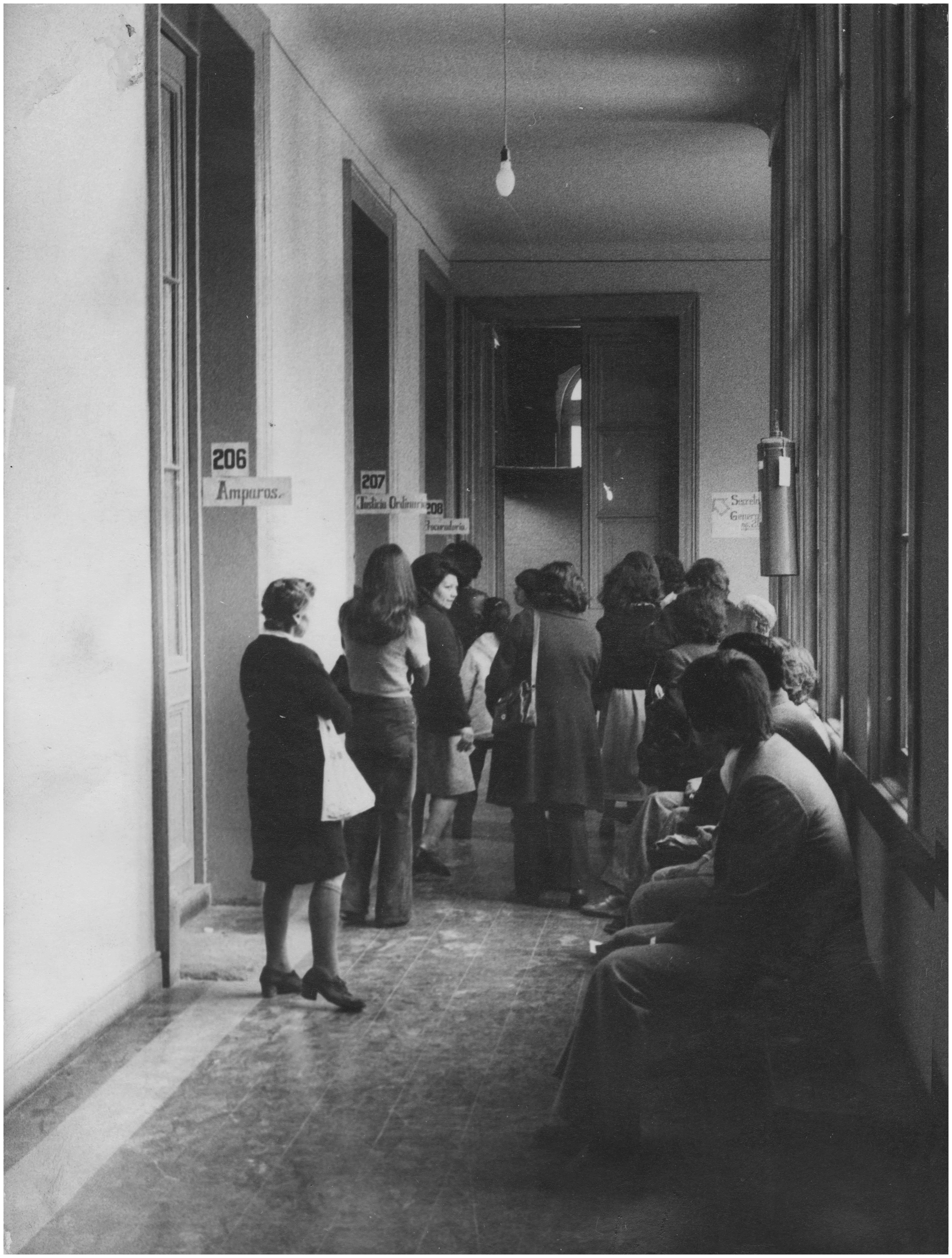
This indeed is what happened here, for the photograph dates from the 1970s and these are the offices of the Vicaría de la Solidaridad, a remarkable organisation set up under the auspices of the Catholic Church to help the people whose families and lives had been turned upside down by the military coup of September 1973. The building is the Palacio Arzobispal, situated next to the Cathedral in the Plaza de Armas, the central square in Santiago, Chile, and the people are here waiting to speak to the office workers, a team of priests, nuns, lawyers, social workers, psychologists and others, to tell their stories, ask advice and request help. The stories were of the dramatic and shocking events that accompanied and followed the coup: of loved ones detained without justification, of people sacked from their jobs, forced to leave their homes and move elsewhere or into exile, of kidnappings, torture and murder.
This article considers the response of the Vicaría to the crimes of the Pinochet dictatorship in Chile in order to raise some questions about how to conceptualise such civic organisation and resistance in times of the most extreme use of state violence. In particular, it is concerned to consider the efforts of an organisation such as the Vicaría as an attempt to maintain the civilian population within the lines of bio-political administration, and to continue to insist on society's need to ‘administer life’ in the face of a regime which was articulating itself around the caesura that Foucault named as such in his influential account of biopolitics. Foucault famously outlined this concept in a lecture delivered in 1976, at around the same time that the photograph of the Vicaría offices was taken, and three years after the military's dramatic aerial bombardment and attack on La Moneda, the presidential palace in Santiago, that left over 1500, including the elected socialist president Salvador Allende, dead (and just a week before the coup in Argentina, although as I’ve noted before, it is unlikely that Foucault had these events of the Southern Cone in mind (see Bell, 2010), despite his reference in the lecture to the death, in November 1975, of Spain's Franco). 1
Indeed, as is well rehearsed, Foucault's discussion raised the issue of how, in an era where sovereign power is in retreat, and power no longer operates through the threat of death but aims instead at the life of its population, is it possible for a ‘political power to kill, to call for deaths, to demand deaths, to give the order to kill, and to expose not only its enemies but its own citizens to the risk of death?’ (1976, 2003: 254). Answering his own question, Foucault suggested that one has to understand the ‘intervention’ of racism at this point, a racism which functions to fragment the population. It creates a caesura such as that, arguably, practised by the Pinochet dictatorship, which spoke from its beginnings through metaphors of the nation's sickness and health, decay and recovery, bloodlines and ancestry, justifying its ‘death-functions’ through an appeal to the biological. Once a state functions in bio-political mode, Foucault argued, it is racism alone that ‘can justify the murderous function of the state’ (1976, 2003: 256). Its logic is that some must die in order that ‘we’ will flourish, be those the external enemy in a war, the soldiers fighting on ‘our’ behalf, or, indeed, those considered the ‘internal enemy’.
The Vicaría's role – as I will explain further below – was in clear opposition to such actions, terms and division of the citizenry. It was set up in haste precisely to respond to the people who sought its help as citizens, performatively insisting that the structures of modern government that had been existent in Chile before the coup – especially the social and judicial system – had to maintain their duty of governance of the lives of these people. The Vicaría worked within a governmentality that was being fragmented by the military dictatorship, which cast out swathes of people, first with massive detentions, internments in concentration camps, executions, torture and other modes of ‘social cleansing’, then in a second stage through the increasing use of forced disappearance, and in a third, through targeted assassinations and attacks on mass protests (as identified by the Rettig Report, see Ortíz, 2003: 188). The calm, overtly bureaucratic response from this organisation may seem a somewhat muted response to this dreadful period of violence, but I want to suggest that it can nevertheless be understood as a forthright mode of resistance to the violences of the regime, one exercised through the making of bio-political claims and demands. As one reflects on their work by reading the documents and data collected in the archive that now holds the institution's records (FUNVISOL, the foundation and archive created in 1992 when the organisation finally closed), one can understand the institution as a refusal to allow these citizens to be rendered disposable. Through the meticulous recording of the events as they were reported to their offices, the Vicaría practised their tenacious response, attempting to keep the victims of Pinochet's actions within the parameters of state obligations and responsibility.
The article adopts the following structure: first, I will discuss the work of the Vicaría, to give a little more context and explain the emergence and historical significance of their work. Secondly, I wish to offer an analysis and appreciation of their work of documentation through a focus on one particular document, a handwritten spreadsheet on which the workers collated information about those reported detained and disappeared. 2 Here I will also draw on the work of Maurizio Ferraris, who has argued that the lowly document is at the heart of social institutions – and of all social life in fact – and who thereby allows me to argue that the registration of these events was an act with real significance insofar as there is an inscription involved that, inter alia, allows for future recall of these details. Emphasising Ferraris’ Derridean allegiances here, 3 I want to argue that such registration also marks out a faith in a Justice ‘yet to come’. Thirdly, I will briefly consider the affective dimensions that speak through these acts of registering violent acts, and consider a recent work of art that responds to this very document, allowing these aesthetic and embodied dimensions of Vicaría's work to resonate. I will end with some concluding comments.
After the Coup, the Emergence of the Vicaría
In the days, weeks and months following the military coup in Chile in 1973, the most intense period of violence and human rights abuses of the Pinochet dictatorship, people turned, as one would expect, to their churches and religious leaders to seek protection. 4 Just days after the coup, in October 1973, the Comité de Cooperación para la Paz (the ecumenical Committee of Cooperation for Peace, COPACHI) was established to provide a wide variety of support for those affected by these events. Its work was continued under the remit of its successor organisation, which was inaugurated in Santiago in January 1976 by Catholic Cardinal Raúl Silva Henríquez, the Vicaría de la Solidaridad.
Among the several tasks that these groups undertook – which included providing medical, psychological, social, economic and legal support – was the task of recording what they were being told, registering the repressive actions and experiences of violence. If ‘data’ means ‘what is given’, they engaged in the task of receiving the gift of information and presenting it in the form of tables, spreadsheets and narratives, as ‘data’ in the sense we generally understand it. This role was to become crucial in providing a picture of what was happening in Chile, as the workers received the terrifying stories from families, friends, witnesses and those who had themselves been detained and tortured. 5 Since COPACHI's inception, a key objective of the group was articulated as ‘to catalogue irregular events that occur and seriously damage the dignity of people’. 6 But beyond the notion of defending the dignity of the victims, the amalgamation of information from the individual stories was able to show the extent and similarities of these experiences. By gathering this data, the workers were even able to locate clandestine centres where the disappeared were held, find information about disappeared persons for their families and identify perpetrators who were involved in the repression and violence. The work certainly had enormous impact. In April 1974, their first report – requested by the Chilean Episcopal Conference of Bishops – detailed the imprisonment, torture and extrajudicial killings that the COPACHI had recorded, prompting the Bishops to include this information in a seven-page pastoral letter distributed at Sunday mass across Chile and to new recruits of the Armed Forces that same month. The letter linked Pope Paul VI's call for 1974 to be a year of reconciliation to the need for the ‘effective rule of law’ and proposed, inter alia, that this encompassed the need for an ‘unconditional respect’ for human rights as formulated by the United Nations and the Vatican, which were ‘inherent and above the State’. The Bishops referred to their concerns that in Chile there was currently a ‘climate of insecurity and fear’, with cases of ‘arbitrary arrests or excessively long imprisonment’, ‘interrogations accompanied by physical or moral mistreatment’ and limited access to legal defence and lack of the right of appeal (quoted in Bernasconi, 2019: 49).
The production of such information and documents was, needless to say, dangerous work. The Bishops’ letter received much attention, and the information cited was eventually traced to the report prepared by COPACHI, leading to arrests and attacks on the organisation's staff. Pinochet ordered that it be closed down, and in December 1975 Cardinal Silva Henríquez obeyed, 7 while also promising the formation of new organisations to continue such ‘charitable and religious work … within our own and respective ecclesiastical organisations’ (quoted in Salazar, 2011: 271, quoted in Bernasconi, 2019: 52). The Vicaría de la Solidaridad instantiated this promise. With its head offices located defiantly in the central square in Santiago, and a further 24 offices located across Chile, it continued its work throughout the dictatorship, recording accounts of the violence, publishing regular reports, helping the victims’ families, and denouncing the dictatorship's policies and its denials in the courts and the media. 8
Hector Contreras, a lawyer with the Vicaría from its inception, has explained that at first the organisation was mostly involved in filing writs of habeus corpus (hence the title of the documentary Habeus Corpus about the work of the organisation in which he is interviewed; Barril and Moreno, 2015). Later, when the detainees were released from camps, and it became clear some had not been released but remained missing, the Vicaría started to call those so affected by the term ‘detained-disappeared’ and formed a unit to address this. This unit interviewed the family members, and also tried to interview those who had themselves been detained, often tortured, and survived. The data they collected included facts about the kidnappers such as descriptions of the perpetrators or details such as the type of car they used. The interviews with families and the survivors were difficult, explains the lawyer Carmen Hertz, because they were also asked to discuss their, or their relatives’, associations with political groups, which was dangerous information to give. Indeed, the Vicaría were obliged to ask for much the same information that the feared secret intelligence directorate (the Dirección Nacional de Inteligencia, or DINA) must have had in order for these people to have been targeted. People were understandably anxious to give these answers, but they did, and from the data, cases could be linked together. Not least, represors could be identified. Normas Rojas, archivist, gives the example in the documentary of a man of whom someone said ‘he was tall, with a deep voice, and they called him Grunter’; later they discover that his name was Moren Brito, so each time ‘Grunter’ is mentioned they knew to whom the nickname referred. 9
Places were also identified. Londres 38, for example, the house in central Santiago where prisoners were held, was identified because despite their blindfolds, the survivors could hear the church bells and the sound of the cobbled street outside as cars arrived. Carmen Hertz explains how those who were held at another house, located on the corner of Iran and Los Platanos streets, enabled it to be located through their accounts of the possible direction they were taken on the drive there, as well as the feel of velvet curtains, some stairs they were taken down into a basement and the shape of a bathroom window. Having heard those accounts, Hertz knew when she visited the house – which was ostensibly a private house at that time – that this was the one the survivors had described. The survivors also described suffering the same sort of sexual torture there, another manner in which the collection of data showed the patterns of the repressors' strategies, as Ramiro Olivares, a doctor, explains. Moreover, the secret police used systematic forms of torture and restraint, revealing the organised nature of the events, with patterns emerging such as the fact that different locations were seemingly using different modes of torture.
In these ways the Vicaría built their understanding of what was taking place, establishing order in the otherwise messy and incomprehensible violence. Sometimes acting like detectives, they identified perpetrators and patterns and attempted to pursue cases. With not only lawyers but their team of social workers, counsellors, clergy, nuns, psychologists and others, they supported numerous families through their darkest hours. When, in 1978, the bodies of 15 disappeared persons were discovered in the disused limestone kilns at Lonquén, the first mass grave to prove the callous, murderous strategies being pursued by the Pinochet regime, the Vicaría were involved, and undertook the sensitive work of asking the families to produce details about the bodies of their missing – height, teeth, scars, etc. – to aid them in the identification of the bodies.
Furthermore, the organisation acted as an alternative news report centre and, in this role, the Vicaría produced magazines and circulated monthly reports of the information they had garnered regarding deaths, arrests, sightings, etc., sending it out into the country, delivering it by hand at church and through their networks, while also making microfiche copies of the files and hiding their most sensitive information in the vaults of the Archbishops’ Palace. With their information they were able to refute the dictatorship's claims. For example, when the Chilean ambassador to the UN, Sergio Diez, attempted to suggest that some supposedly disappeared persons had never existed, referring to a list contained in a report prepared by the military government for the UN Commission on Human Rights in December 1977, that named those having ‘no legal existence’ (according to the military government's own records), the Vicaría was able to show it had indeed dealt with cases included in this list and could give details on them (Lira, 2017: 193). This work of collating information also extended outside Chile, as the data the organisation produced became a trusted source for foreign reportage.
Unsurprisingly, throughout this period the Pinochet regime continued to intimidate and attack the organisation, harassing the workers, arresting them, summoning them to court, raiding its offices, of which there were more than 20 across the country, and expelling or refusing re-entry to its workers. 10 In 1985, Jose Manuel Parada, director of the Vicaría's analysis department, paid with his life for the work of the group, abducted in broad daylight in one of the more affluent neighbourhoods of Santiago, along with Manuel Guerrero, a teacher and Communist Party member; their bodies were discovered the next day abandoned alongside a road near the airport. 11
When the Vicaría closed in December 1992, its documents were brought together to become the ‘Documentation Foundation and Archive of the Vicariate of Solidarity’ (FUNVISOL, Fundación de Documentación y Archivo de la Vicaría de la Solidaridad). Holding some 47,000 individual case files and more than 80,000 legal documents, it has become the main archive for human rights abuses of the period and, along with other important archives, has played a key role in research and continues to be a crucial source in legal cases pertaining to those crimes (see their website at http://www.vicariadelasolidaridad.cl, accessed 7 October 2019; also see Accatino and Collins, 2016, and the chapter by Hau, Lessa and Rojas in Bernsaconi, 2019, which carefully notes how the archives have been quoted by legal representatives in written evidence submitted to the courts).
Documentality, or Inscriptions as (Ir)responsibility
In this section I will read the work of the Vicaría as a mode of response to state violence that, as hinted already, sought to help and protect the victims of the military repression in Chile by insisting that their lives were valued, that their experiences were worthy of collection and response; in the absence of the state, but like an institution of the state, the Vicaría collected the details and accounts, premised on a commitment to these fellow citizens and their families. The workers did so not least by the simple acts of registering what they were being told about what was happening, producing data and reports that included both individual and aggregate information about the cases and circumstances reported to them. Especially given that the usual legal routes were non-existent for the victims and families at that time, which is not to say that the workers did not try everything in their power to seek action of the authorities within that framework, the systematic recording of the cases may have seemed futile. But as we have indicated above, the systematic work of the institution was ultimately crucial for juridical and other accounts.
In his ambitious and provocative book Documentality: Why It Is Necessary to Leave Traces (2013), Maurizio Ferraris placed inscription (in terms of an ‘ichnology’, a science of traces) at the heart of his theory. Inscription, for Ferraris, is a highly social act, giving the traces of our existence the possibility of an afterlife because it involves the movement of thought into the shared world. A key distinction is between thought, which is a ‘movement of the soul’, and is vague, fleeting and insubstantial, and inscription, which not only allows the fleeting to be recalled, saved for future memory, but also allows the appearance of a ‘shared object, whose existence does not depend only on one or other of us’ (2013: 31). While anything that is inscribed becomes a social object, Ferraris argues that documents – which are more than inscriptions because they also include something idiomatic, such as a signature or digital code, that guarantees authenticity (2013: 251), and because they are by design to be shown – allow our institutions to function. Indeed, more than this, documents are the very conditions of possibility for social institutions. For it is literally true, he argues, that ‘the social world is constituted of documents, of those inscriptions that … precede and produce spirit’ (2013: 247).
What is intriguing in this context is that Ferraris grants us permission to consider the documents available in the FUNVISOL archive as both indicative of and as techniques towards achieving the larger social commitments and hopes of the organisation. We may be looking at files of documents pertaining to individual cases, but we are also looking at the traces of a profound collective response to the military coup and the direction the dictatorship was taking in Chile. Before institutions, before documents, and so ‘lower’ on Ferraris’ hierarchy, there must be acts of inscription and registration. And it is on these that I wish to focus, not least because the creation of systems of registration – of templates, forms, categorisations – has been the somewhat unusual and intriguing focus of the research project on the work of the Vicaría, ‘Tecnologías Políticas de la Memoria: una Genealogía de los Dispositivos de Registro y Denuncia de la Violación a los Derechos Humanos (1973–2013)’ 12 and also of the artwork The Sheet by Nicolás Franco, which has been made in response to it (and that I will discuss in the next section). So my attention here is on the mundane level of inscription, the writing and recording of details and facts, the very gestures of registering that incredible violence, where you can almost hear the pen scratching on the paper. How might we understand this impulse to write in the face of state violence?
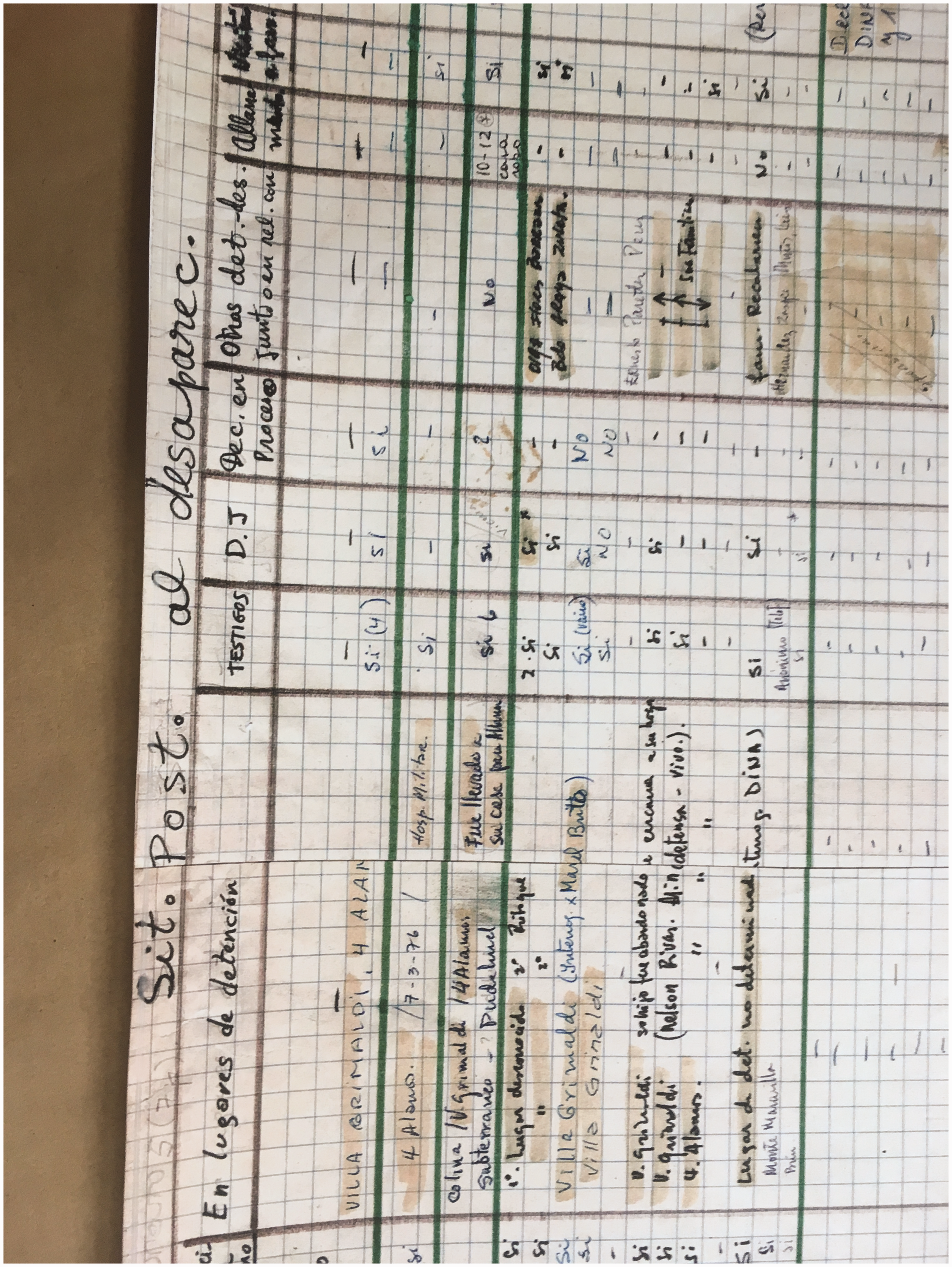
Figures 2, 3 and 4 show details of one of the early ledgers that the Vicaría produced. This is the spreadsheet that the research project chanced upon in the archives, and that caught their attention as it beautifully captures the process of registration that the organisation engaged in. Hand-drawn lines create columns into which are recorded the data pertaining to each case – including the date, place, the individual's affiliation to a political grouping or the previous government, facts about those who apprehended the individual, the place in which they were held (if detained), whether there were witnesses, and the names of others detained with them.
Facsimiles of the original spreadsheet created by the Vicaría de la Solidaridad (detail). Images: Vikki Bell.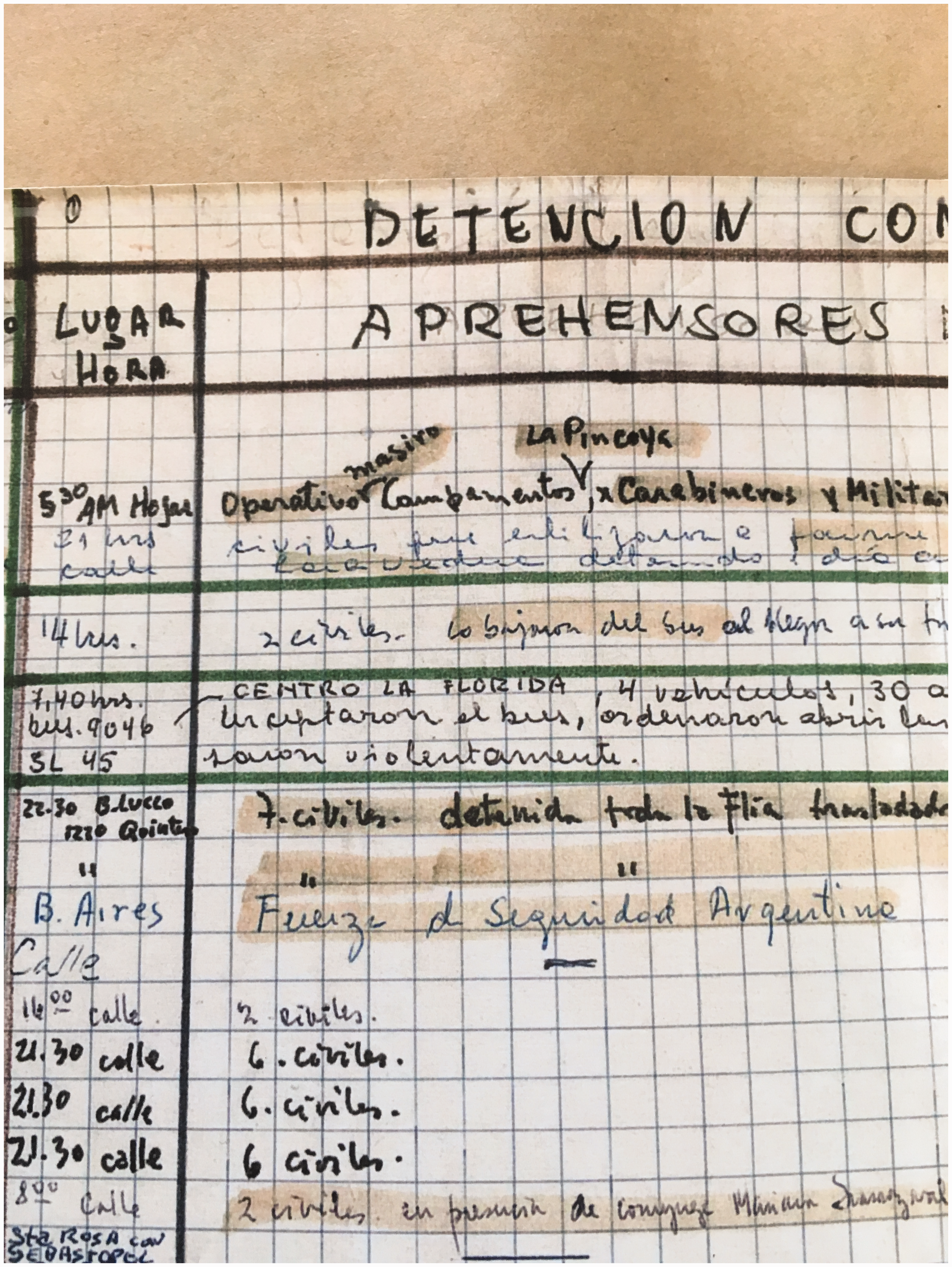
To inscribe in this way – to return continually to a list to record information, in order to record each case, case by case – is, on the one hand, a repetitive, disciplined activity associated in Foucault's influential work with the anatomo-politics of bureaucracy and the enfolding of norms into an embodied obedience. For Foucault, as has been well rehearsed, disciplined activity is one pole of ‘bio-politics’, and is a form of power that envelops the body through practices of training, examination and normalisation. But while the figure of the scribe, and indeed the hand itself, may be thoroughly disciplined, as in the image that accompanies Foucault's arguments in Discipline and Punish – where the precise angle of the student's pen is to be monitored and compared according to the rules of handwriting – we can also argue that this activity of repetitive inscription is, in the case of the Vicaría’s ledger, a form of registration in Ferraris’ sense. That is, the stories told to the workers at the Vicaría were not just communicated to the workers but they were registered there. The details were inscribed onto paper, entered onto spread-sheets like the one in Figures 2, 3 and 4 and put into files, so that they became what Ferraris calls ‘social objects’. Indeed, he writes: ‘the constitutive rule of social objects is Object = Inscribed Act’ (2013: 318).
The list that was being compiled by each entry onto this spreadsheet was not a pointlessly repetitive list for training purposes. Rather, it harnessed the power of registration; it was, in Ferraris’ words, a mode of ‘transforming the volatility of words and processes into the solidity and permanence of social objects’ (2013: 185). This permanence is key. Although the ledger is not accusatory in content, it is a methodical response built upon a confidence that these inscriptions will survive in order to command attention at some time and place in the future. The inscription of what occurred – and if ‘what’ and ‘where’ were not available, as often they were not, then at least to whom and when – was frequently minimal. But the inscription of this minimal information was an acknowledgement of what had been shared – both the knowns and the unknowns, i.e. both the written and the unavailable, that appear as blank entries in the spreadsheet's columns of data – so that these traces could then be gathered, aggregated and stand a chance of existing through time and space, with potential to take these cases forwards or elsewhere.
Ferraris acknowledges his debt to Derrida's emphasis on the relation between différance – which Ferraris prefers to term ‘differing’ in order to keep its ‘verbal, participial aspect’ uppermost – and deferral (2013: 185). Differing, he notes, refers not just to diversity but also to the act of deferring or putting off, and it is the power to allow that deferring that, he argues, makes registration so powerful. As I have argued elsewhere (Bell, 2018), it is noteworthy that Ferraris uses the example of Hamlet to illustrate his arguments about inscription. For the reason that Hamlet not only speaks his commitment to honour his dead father's commandment to avenge his murder but writes it down, is arguably not only because ‘verba volant, scripta manent’, as Ferraris suggests (2013: 199), but because there is a question of justice at stake. This is more important than all the other ‘trivial fond records’ that Hamlet holds in his head. Likewise, I would argue, the spreadsheet not only gave a lasting form to the multiple stories that the Vicaría received, it also allowed that form to be consulted as part of the battles for justice that were to come. And as such it is the material trace of a commitment, and an expression of faith that those future battles would arrive.
I am also thinking here of Derrida, and his provocations around what he terms the ‘wager’ that strategies necessarily make with the future. Any strategy implies a wager, ‘a certain way of giving ourselves over to the not-knowing, to the incalculable. We calculate because there is something incalculable’ (Derrida and Ferraris, 2001: 13). In disjointed presents, which is another way of saying unjust presents, where time is ‘out of joint’, and in dark times, times that are dislocated, disordered, unjust, etc., one cannot promise, let alone give, justice. ‘How can one give what one does not have?’ – Heidegger's question (in ‘The Anaximander Fragment’) – was important for so much of Derrida's thinking. When this impossibility of being able to give or to receive justice is felt acutely, as in times of state-perpetrated violence, we give ourselves over to the decision. In the ledger, as in all the documents of recorded information that exist in the archives at FUNVISOL, there is a sense of this giving over and giving order. In attempting to calculate in the midst of incalculability, the sheets of information bespeak a strategy that seeks to restore order(s). It is a form of mimesis, one might say, mimicking the order of bureaucracy, of the police, of routine information processing; it is an inscription and documentation that call for a future in which (legal and social) institutions administer justice once again. But if their work mimicked the bio-political strategies of administering life, it is because, as I suggested in the introduction, they were acting in defence of those who had been and were in danger of being placed across the ‘caesura’ of which Foucault spoke. The crimes being reported to the Vicaría were those that showed how the dictatorship's actions attempted to remove and to abandon those it targeted. Detention without charge, kidnappings, camps, torture, murders: those subject to the violence of the military dictatorship were akin to Arendt's (1958) refugee in this sense, who as Agamben (1998) has argued, allows the assumption of bare life within the assumption of rights to appear in the realm of politics, if momentarily. By building the information and resources that would enable the challenge of these actions, the Vicaría was an important part of civil society's demands that insisted that the vast majority of these people were citizens, part of the polity, and that they and their families were entitled to the state's care.
Another way of putting this would be to see their work as one of exposure, showing the labour that is required in order to make ‘the People’ out of the people. The constitution of a political body, Agamben reminds us, passes through a fundamental division … [so] that in the concept ‘people’ we can easily recognise the categorical pairs that we have seen to define the original structure: bare life (people) and political existence (People), exclusion and inclusion, zoē and bios. The ‘people’ thus always already carries the fundamental biopolitical fracture within itself … It is what always already is and yet must, nevertheless, be realised. (Agamben, 1998: 177)
As the dictatorship operated on this fracture-line, casting former citizens into camps, removing their access to protection and denying their very existence, the workers of the Vicaría fought against such exclusion.
Given this context, of course these inscriptions also suggest what Derrida calls an ‘exacerbated responsibility’ in his discussion of the ‘wager’ (Derrida and Ferraris, 2001: 13). The decision made by the workers at the Vicaría to produce documents such as the ledger as a form of accounting that adopts the posture and officiousness of the bureaucrat, and that produces an artefact that becomes a roll call of facts – names, dates, locations, etc. – intends to mimic other forms of accounting. It adopts a manifestly bio-political governmentality precisely in order to allow the victims of the regime to retain their status as People; it was an extraordinary response because it was so ‘rational’. That said, it also carries, and by the same token, what Derrida terms a ‘part of shadow, of irresponsibility’ (Derrida and Ferraris, 2001: 13). Let this not be misunderstood. This was a wager that gave itself over to the decision since the context was so volatile – a context that had to be taken into account but that was also ‘not absolutely determinable’ (2001: 13). Both closed and completely open at that time, as Derrida argues all contexts are, the context meant the pledge of the Vicaría was a wager, ‘without knowing, without being sure that it will pay off … a bet on a future [un avenir]’ (2001: 13). The wager entails both exacerbated responsibility and the acceptance of some irresponsibility as a result of having to act without guarantees in this sense: ‘the decision to wager is what it is precisely because we do not know whether, at the end of the day, the pari stratégique will prove to be the right one, the best one possible’ (2001: 13). Moreover, there were, as always, other possibilities and forms of response; people decide to act and to react, to resist in many different ways, including, for example, through organised militant struggle, by taking leave of the country or through sinking into despair.
In the next section I suggest that these other possibilities and forms of response ‘haunt’ this work, as they do the whole archive it flowed from – that is that decision – in ways that are not exactly present within it. When we sit in the archive and we read the names, consider the inscriptions, the habeus corpus requests, the notes and so on, we cannot help, I suggest, but wonder about these other responses that were contemporaneous with this endeavour, ones that the documents of this organisation performatively held at bay, by choosing to do this, not that.
Documents Becoming Artworks
There is much that these ledgers and records cannot say but that is betrayed within their lines somehow, embodied in the inscriptions that result from the decision not to revolt, to ignore or despair. The ruling of the lines of the tables, the handwritten answers to the questions in columns – ‘name’, ‘political affiliation’, ‘place of detention’, ‘were there witnesses?’, to name a few – are ‘factual’ but point to the attempt to respond calmly and systematically in the face of the incomprehensible violence to which the population was being subjected. The decision had been taken to channel the deepest of human emotions in order to produce legible, succinct, and mobile information. No doubt aided by the context of religious faith, these documents trace that choice. 13 They signal a decision to commit energy to a particular sort of text, i.e. records with categories that make them comparable with each other, that make the details of events, as I have mentioned, into data – not only who was taken or killed, but when and sometimes by whom, whether they had been taken before, who were their dependants, who else they saw in detention, and so on. Thus while some comments on the table suggest moments of feeling constrained by the categories that had been decided upon – as, for example, where someone has written ‘her son was abandoned alone in his bed’ in a column ostensibly recording ‘place of detention’, presumably because this fact felt intensely important to record but was beyond the categories – the table as a whole functions to allow the basic facts of these events to be gathered, their characteristics collated and compared. In the face of that scrutiny, the injustice of the systematic campaign of state violence emerges as an incontrovertible wrong. If abiding by these rules is what allows the ledger to incorporate and maintain the hope for a future in which it is usable as a document of some scale, it is not just one person's individual hoping in the dark, as it were, but is a collective inscription – unlike narrative or (auto)biography, for example – that is necessarily collectively produced such that its weight is not dependent upon one author or opinion. The different coloured pens, the different scripts, the writing across days and years, attest to this collective effort.
Given the importance that the data and the FUNVISOL archive has had, and continues to have, one can say that this ‘exacerbated responsibility’ and collective effort was successful in its intentions to have the information the Vicaría collected contribute to the return of democratic social and especially legal process. Its methodical approach meant that in due course it was able to present convincing evidence, not only narratives and memories of what had happened, but also the records of these collected accounts as they were recounted at the time, with their ability to cross-reference and corroborate each other. Still, as the inclusion of a high-quality facsimile of the original in the exhibition of the artwork commissioned by the project suggests, the ledger could also be regarded not as a document but as a sort of collective drawing. There is nothing intrinsic about its composition that prevents us from approaching it in this manner. Even though they must follow the decisions and rules of the table that they have decided upon, the lines of handwritten words are arguably akin to line drawing; they are sensitive, expressive, lines that ‘move’ (as Tim Ingold (2007: 129), quoting Rosemary Sassoon then Nicolette Gray, has described it). Indeed, I would almost want to regard the spreadsheet as the record of an intense embodied, affective response, as stories of loved ones abducted, missing or illegally detained are transferred from the speech of the relative to the pen of the Vicaría worker. Looking at the ledger is like looking at calligraphy where, as Ingold has suggested of the ancient Chinese practice, ‘the calligrapher is absorbed in the action with the whole of his being, indissolubly body and mind’ (2007: 144). Indeed, likening calligraphy to dance, Ingold suggests that ‘as in the dance, the performer concentrates all his energies and sensibilities into a sequence of highly controlled gestures. … In both, too, the entire body is caught up in the action’ (2007: 134).
And while the ledger's stark details both attest to a life and unavoidably reduce each life's complexity, for those for whom the names mean something personally, beyond the data, these bald facts – perhaps precisely because they become ‘bald’ and stark in such records – are no doubt intensely moving. For those who knew and know these names, they will forever retain a singularity. And to read ‘for’ that singularity – to go searching for it – prompts all that is intentionally or unintentionally bracketed from this form of inscription; it ‘calls’ it back from the ‘ditto, ditto’ of the ledger. (Christina Sharpe (2016: 52), borrowing from NourbeSe Philip, draws our attention to the ‘ditto, ditto’ in archives of systematic violence – in her case, that of slavery.) Like the memorial walls that list names of the disappeared or fallen, visitors touch and are touched by the name of their loved one inscribed onto a monument, one amongst the multitude (as with the wall at the Parque de la memoria in Buenos Aires; Bell, 2014).
The artwork ‘La Sábana (The Sheet)’, by Nicolás Franco, was commissioned by and responds to the ‘Political Technologies of Memory’ project; it is a large rectangular work (2.6m by 7.8m) for which the artist has copied, enlarged and superimposed a version of the handwritten ledger onto the canvas, layering it over some enlarged proof-images from a roll of film belonging to his own family history, from a family holiday in 1976. The work appears weathered, like a wall that has had posters pasted and removed many times, as Franco employed a chemical process that randomly removed some of the top layer, revealing fragments of the photographs underneath. The words that impede our access to the familial images conjure its confusing, foreboding atmosphere as proper names of people and of militant groups, or terms such as ‘witnesses’ and ‘detained’, suggest something dangerous but without lending it clarity.
As Ana María Risco (2017) notes in her commentary in the catalogue, the work is reminiscent of the work of Gerhard Richter insofar as it seeks to combine the photographic and painterly in addressing catastrophic violent events of the 20th century. La Sábana incorporates a photograph that shows the artist's mother. She emerges from behind the writing of the details on the Vicaría's ledger, here enlarged and worked on; she is somewhat apprehensively looking up at the camera, and hence at ‘us’ (Figure 5). Franco has explained that he incorporated these photographs into the artwork from the family vacation in January 1976, to entwine a personal record of relaxed and happy times with the lists of events that the ledger records. Elsewhere, the partial image of a little boy – Nicolás Franco himself – appears, alongside a column of names of political affiliations of the detained-disappeared taken from the ledger (Figure 6).
Facsimiles of the original spreadsheet created by the Vicaría de la Solidaridad (detail). Images: Vikki Bell. Facsimiles of the original spreadsheet created by the Vicaría de la Solidaridad (detail). Images: Vikki Bell. La Sábana (The Sheet) by Nicolás Franco, 2017 (detail). Reproduced with permission of the artist. La Sábana (The Sheet) by Nicolás Franco, 2017 (detail). Reproduced with permission of the artist.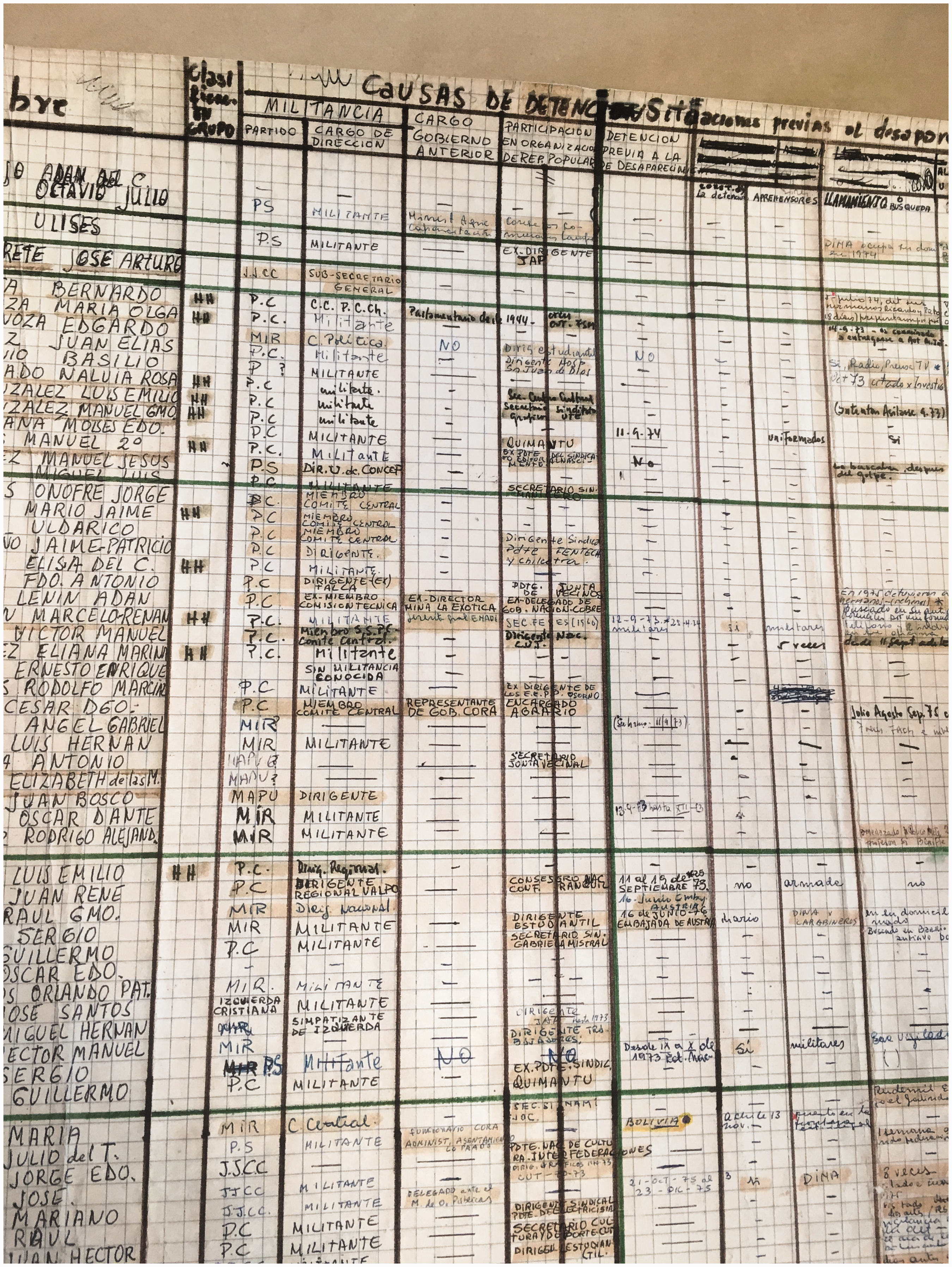
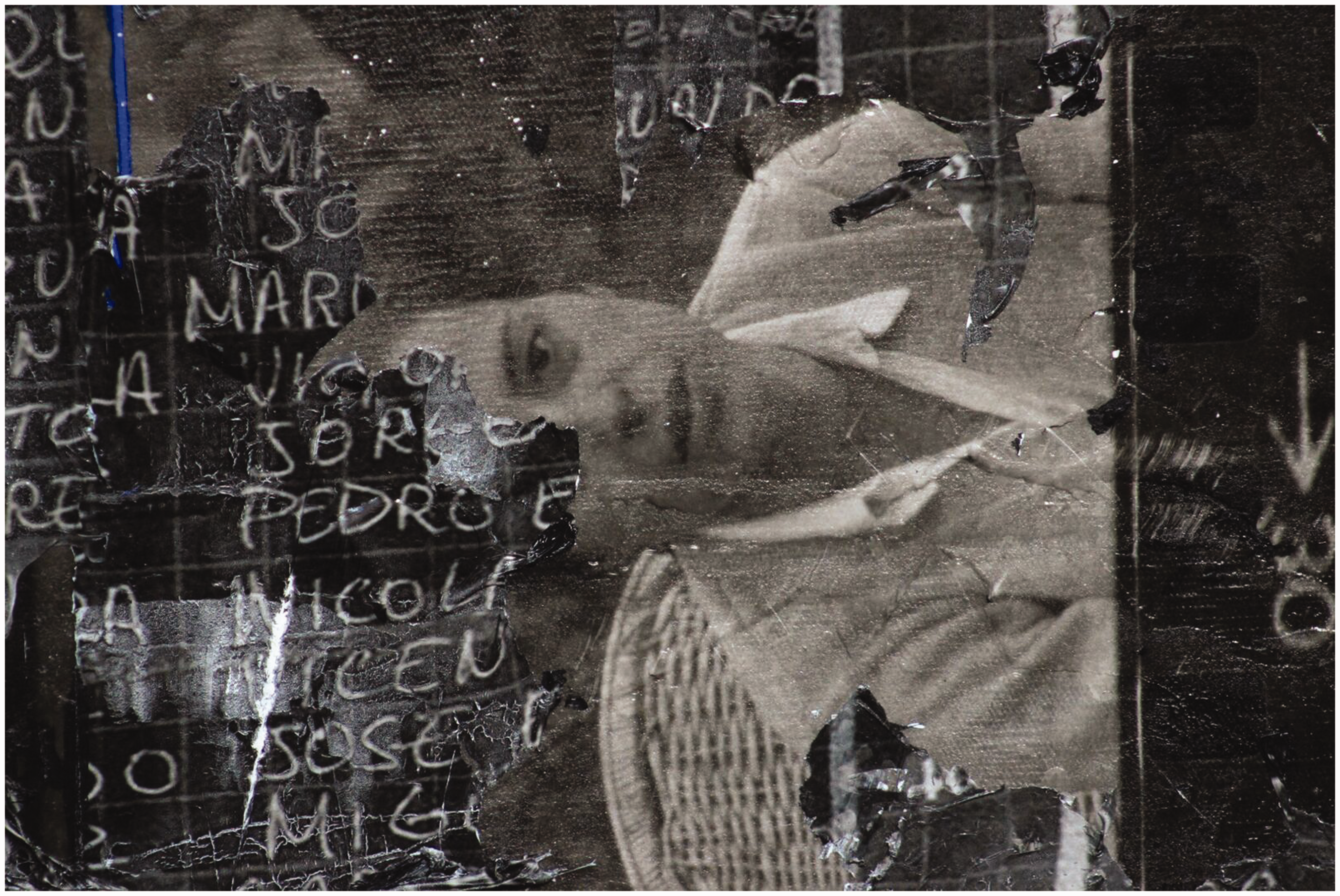
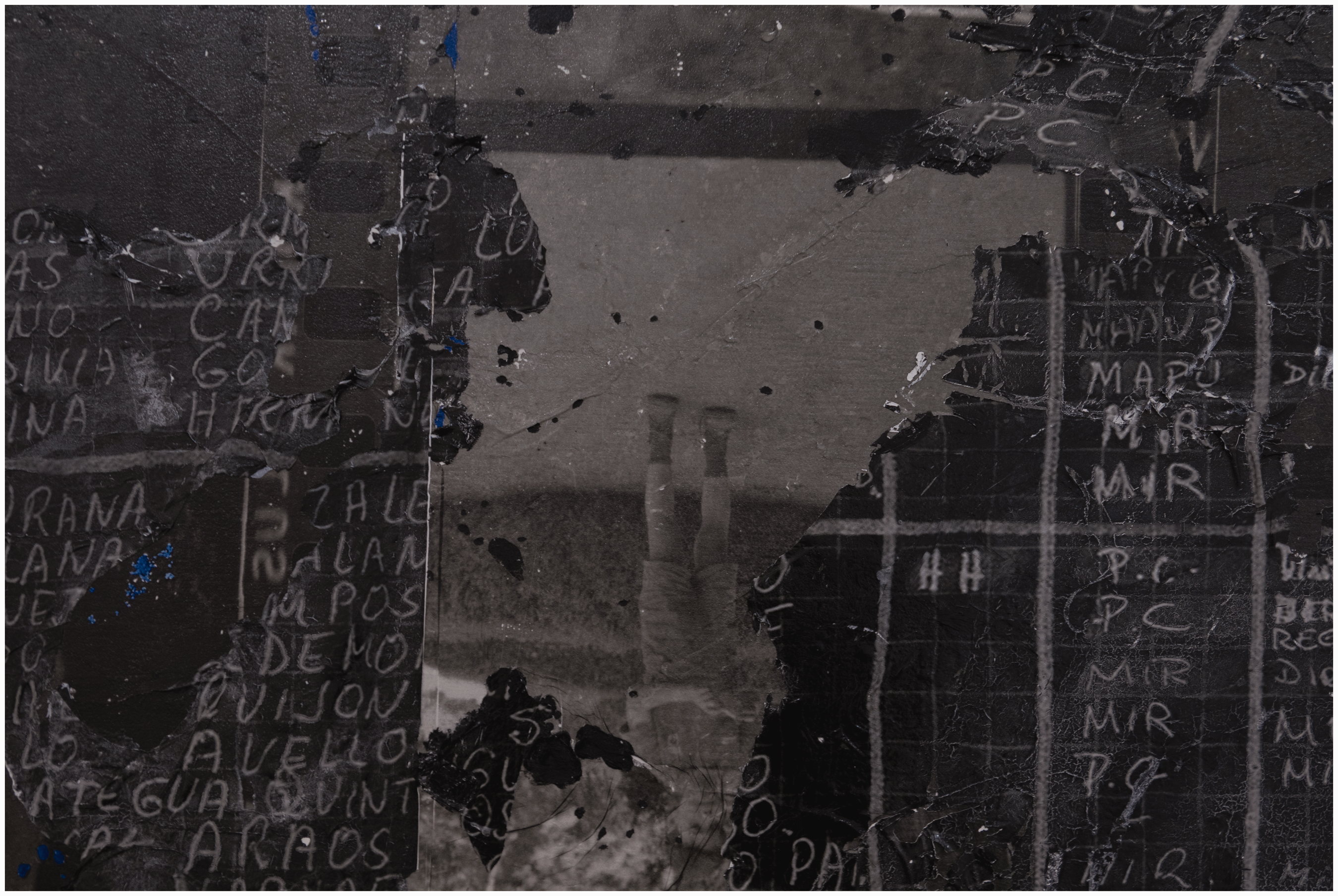
But the photographs appear only as fragments, incomplete, as they are submerged by the writing, fading away like dream-images. In this way the artwork suggests something of the people of whom these inscriptions speak but who they cannot fully (re)present, of the memory-images that live between the lines of the ‘facts’ recorded in the rows and columns. Indeed, the artwork suggests that these memory-images belong not only to the survivors and their relatives, but to those who, like the artist, are provoked to remember that period in their own lives. As the curator of the exhibition where the artwork was first shown, in 2017, writes: ‘many of us experienced dictatorship as children … [yet] the dictatorship's influence could be concealed by a game of sorts’ (Valenzuela, 2017: 7). And another contributor to the catalogue recalls that ‘as children, we were “protected” from repression and its social repercussions … [yet] during adolescence, many of us felt deceived and even guilty when we heard stories and testimonies about what happened in the country. But that pain and that shame actually were fuelled by persistently happy memories’ (Chateau, 2017: 20). The artwork seeks to convey something of this, as the photographs of familial scenes vie for our attention with the lists of the ledger, both fragmentary and incomplete, evoking the puzzle that faced the workers at the Vicaría who recorded the no doubt deeply affecting stories of loved ones detained or disappeared, and attempted to impose order on the chaos, to bring it ‘to order’, while beyond their offices, a semblance of everyday life continued for those unaffected. As Valenzuela nicely points out, there are many uses to which a ‘sheet’ is put, beyond being a sheet of paper on which to record events: bedsheets are used with care and concern as adults tuck children into bed; a sheet is used by mourners to wrap a shroud around a loved one's body; a sheet is used to cover things up, whether to protect or to hide them (2017: 6). The artwork ‘shows’ or ‘suggests’ these tensions and connections, but does not pronounce upon them; its proposition, if you will, is about the entwinement of these issues of recording, covering, care, concern, shrouding and mourning.
I do not mean to suggest a preference for artworks or for ‘data’, for vivid affective accounts over sober accounting; my point is not to value one more than the other. (The value of each will depend upon many things, including the forum into which one seeks to enter or intervene, and what pleasure or outcome one seeks from the encounter.) But Franco's piece is an intriguing exploration of how the person or people disappears or fades into the actualisation of the written document. The artwork, then, although it is also ‘about’ the same facts, seeks to re-actualise, or re-visualise if you prefer, the image of living persons, re-presenting glimpses of human life alongside, betwixt and between the inscribed surface of the document's paper-now-artwork.
Some may assume a strong contrast between documents – such as the files and ledgers of the Vicaría – and artworks. Maurizio Ferraris, whose work I have drawn upon above, discusses both, and it is interesting to consider how he theorises connections and distinctions between the two. Let me mention a few pertinent aspects of his argument. Ferraris’ argument suggests that inscription is central to artworks, as it is to documents; the act of inscribing allows the passage of a thing towards becoming an ‘artwork’ and it is a necessary – if not sufficient – condition. He points to the crucial role of inscription in producing an art-thing (2013: 274); the gallery and institutions of art inscribe the status of artwork, giving passage for ‘some thing’ to become ‘art’. While both documents and artworks are inscribed acts, however, an important difference between documents and artworks is that while both can produce sentiment and emotion in us – Ferraris’ example is a parking ticket, which can produce as much emotion as a romantic film – the artwork is not directed at us individually and its address is (relatively, I want to add) disinterested. Moreover, argues Ferraris, the artwork becomes a social object whose address is idiomatic, like a person's; even, Ferraris suggests, the artwork ‘pretends to be a person’ insofar as the artwork itself – and not its author – seems to promote its own ‘representations, thoughts and intentions’ (2013: 277). Thus we tend to judge artworks in terms independent of their creators and in terms somewhat similar to those we use to judge people, rather than those we use to judge documents or objects (2013: 277).
Clearly, although they may not ‘aim’ to become so, documents such as the Vicaría's ledger can become artworks. When I look at it and I sense the emotion of the narrative being told to the writer, when I ‘hear’ the pen writing the names, I engage in an act of imagination that treats the information aesthetically, that makes it to do with aisthesis and my own perception and elaboration of its form. The inclusion of the facsimile of the ledger in the exhibition alongside Franco's La Sábana anticipates this possibility, inscribing it as art, and inviting one's response to it as such. Indeed, we have seen how the artwork may call up, or recall, those aspects of the experience that the ledger as document pushes aside or to the margins, allowing the unsaid, the unrequested details and the un-listable emotion – which I have suggested must have accompanied this very special listing of names and facts, but that are not recorded linguistically as such – to once again take centre stage. The handwritten lists and ledgers that remain in the artwork, now torn away from their institutional inscription as a document in the archive or evidence in a legal process, demonstrate that the marking down of these names, dates, places, and events in this form did not confine the ledger to a bureaucratic role.
Concluding Remarks
To conclude, when the workers at the Vicaría were producing their datasets, they were organising a collective response to injustices in an urgent response to the violence around them. Their response was, I have suggested, an attempt to refuse to allow the Pinochet regime to cast their fellow citizens outside the realm of civil society. By administering to them, by forging an administrative institution around these exceptional circumstances, they maintained their status as traceable and valuable lives. The resultant accounts appear to be a bureaucratic response, even a mimicry of the bio-political administration of life. But their insistence that these victims and survivors were, precisely, to be administered to was a radical gesture. They were, crucially, acting for the sake of a future in which they imagined the return of a just society with its structures of governance in place. The Vicaría's documentation attests to a continued faith in law, as they continued to create the files that are fundamental for a functioning legal process (Vismann, 2008) despite the coup and the military regime's blatant use of what Pinochet and the right continued to characterise as a sort of founding violence required to save the Chilean nation from left wing extremists. Indeed, such documentation insisted upon the importance of ‘the record’ for law to be practised, as opposed to a deferral to the word of the leader (characteristic of dictatorships). 14 Their records, in this sense, created the possibility that they were hoping for, as the files can and have taken on a crucial role in documenting the violence and providing evidence since the return of democracy.
As well as the ‘success’ of the Vicaría's work in this sense of becoming a record to be consulted by those, such as lawyers or historians, seeking to establish facts and figures about events in the past, we have also seen here how the archive can become a source of approaching and understanding the past through its ability to invite re-inscriptions in the present. Whether by academics, artists or other actors, the story of the Vicaría, and the lives of those who interacted with it over two decades, become resources and provocations for further modes of intervention. This ‘curatorial’ work forms propositions with these traces – caring for them, choosing, arranging and presenting them – in order to pose and explore contemporary concerns. Remnants from the past are creatively re-worked, carefully re-arranged, as new generations come to make sense of them, testing and (re)forming their notions of right and wrong, justice and injustice, of past and future, in response to them. 15
Footnotes
Acknowledgements
An earlier version of this article was delivered at the Museum of Memory and Human Rights in Santiago at the international conference ‘Registrando violencia política: tecnologías, usos, effectos’ (January 2018), organised by the interdisciplinary research project ‘Tecnologías políticas de la memoria’ at the Universidad Alberto Hurtado, led by Dr Oriana Bernasconi and funded by CONICYT (Chile) and the Newton Fund (UK). With thanks to the whole team there for inviting me to take part. The author’s research has been funded recently by the Economic and Social Research Council (2015–17) and is currently funded by the British Academy (2018–20).
