




Abstract
Much has been written about how Foucault's archaeology of the modern episteme, emerging from early 19th-century Europe, was curiously divorced from its context of colonialism. Media archaeology, as Foucault's legacy, has also remained rather geopolitically insular and race agnostic in its epistemological reverse engineering of media modernity. Using screenwriting history as a case study, this article demonstrates how bringing decolonial thinking and media archaeology together can challenge linear narratives of modernity/coloniality in media history. The article connects two seemingly disparate histories of archival absence and human obsolescence to reveal the construction of an elusive screenwriting modernity that has historically obscured parallel scripting practices and pre-existing scribal traditions.
Introduction
Decolonial thinkers from Latin America have argued that modernity and coloniality are co-constitutive in their subjugation of alternative knowledge systems and cosmologies. The concept of ‘modernity/coloniality’ was first used by Aníbal Quijano and subsequently developed by Walter Mignolo. According to Quijano (2007), it is impossible to separate colonial domination from modernity since the latter is the very basis for an epistemic hierarchy that has historically privileged Western epistemologies over non-Western ones. Mignolo (2009) extended this argument by proposing ‘epistemic de-linking’ as a decolonial strategy wherein knowledge production from the Global South departs from Western universalist models of modernity, rationality and economic progress. Epistemes, in the Foucauldian sense, are unconscious rules that govern the conditions of possibility of knowledge in a particular era. At the heart of decolonial thinking therefore lies the excavation of subjugated knowledges though a reappraisal of dominant epistemic categories along the geopolitical vectors of knowledge.
‘Epistemic thresholds’ (Parikka, 2012: 33) operate as heuristic tools of historical inquiry in media archaeology as well. The task of the media archaeologist is an excavation of the hidden layers of media history along epistemic fault lines. Following the Foucauldian notion of archaeology, media archaeology serves both as a method for recovering forgotten media pasts and a critique of dominant linear narratives of technical progress. While some media archaeologists have highlighted the epistemological centrality of human physiology in rethinking media-historical narratives, other scholars have stressed mathematical processes as more telling of contemporary media environments. Both sets of scholars have, however, largely overlooked global power asymmetries in their media archaeological pursuits and appeared rather geopolitically insular and race agnostic in their epistemological reverse engineering.
Decolonial thinking foregrounds a geopolitics of knowledge rather than local exceptionalisms. 1 As Willems (2014: 8) has argued, media scholarship from the Global South should cease to be ‘negative imprints’ of the West and instead ‘deal with the question of epistemology’. I argue in this article that decolonial media archaeology offers a conduit for such epistemological interventions in media histories. If media archaeology reveals the various epistemological conditions that have historically privileged certain media forms and practices at the expense of others, I argue that a decolonial media archaeology would investigate how coloniality/modernity may have informed many of those epistemological conditions. Any decolonial historical revisionism would have to take the epistemic violence of coloniality into account – a Foucauldian omission long pointed out by Spivak (1988) but largely overlooked in Foucault-inspired approaches to media archaeology.
Using screenwriting history as a case study, this article demonstrates how bringing decolonial thinking and media archaeology together can challenge linear narratives of modernity/coloniality in media history. Through an epistemology of the film script archive, the first half of the article shall explain why a study of the historical development of the screenplay form is not possible in Global South contexts. In the second half, my inquiry into the professional genealogy of the munshi, from the early modern court scribe to the screenwriter in talkie studios, will be an attempt to provincialize the Hollywood-centric discourse of screenwriting that often becomes an uncontested universal frame of reference. The article shall finally connect these two seemingly disparate histories of archival absence and human obsolescence to reveal the construction of an elusive screenwriting modernity that has historically obscured parallel scripting practices and pre-existing scribal traditions.
The Archive Problem
Last year when I asked the veteran screenwriter and teacher Anjum Rajabali about the pedagogic value of an Indian screenwriting history, I was pleasantly surprised by his implicit reference to T. S. Eliot's (1932) seminal essay through which he described screenwriting history as an encounter of the tradition and the individual. I tell my students that you have to position yourself as a person who is part of a tradition. The tradition and the individual – that is what is combining for you to do what you do. Within this tradition of storytelling is also the tradition of Indian screenwriting and its evolution, and we are somewhere along in this tradition. (Anjum Rajabali, personal communication, 2 January 2019)
Steven Maras (2009: 11) has defined the ‘object problem’ in screenwriting studies as ‘the difficulty of both defining screenwriting as an object, and identifying an object for screenwriting’. Strangely, the ‘object problem’ has a deeper resonance with the archival absence of early Indian film scripts since the very object under academic scrutiny is missing. How does one write screenwriting history without film scripts? And how can Indian screenwriting scholarship graduate from complaints and caveats of archival constraints to a more critical understanding of the material absence of writing? Writing, as we traditionally understand, leaves a material trail. In literary studies, textual scholarship thrives and survives on the accessibility of written material, whether in the form of popular printed books or rare handwritten manuscripts. The deconstructive appeal to investigate absences and silences in writing often presupposes that writing always already exists. Nonetheless, the Derridean notion of trace as ‘the mark of the absence of a presence’ (Spivak, 1976: xvii) becomes quite useful here if its project is turned outward to study the absences and silences of writing itself. In other words, if a form of writing does not exist, the conditions of its invisibilization bear its traces. As Lisa Gitelman (2014) has pointed out, the mnemonic function of writing is always extended to its material formats, beyond the act of writing itself. Writing is mnemonic, the history of communication tells us; it is preservative. And so are printing and bookmaking. … If writing is preservative, these books preserved preservation. Their design, manufacture, and adoption worked to conserve patterns of inscription and expression. (2014: 22) It is a different document for every person reading it. To the producer it is a story that he weighs for audience appeal, to the director it is a progression of images and scenes in a dance rhythm that he or she may or may not want to dance to, to the art director, it is a list of locations and sets, to the wardrobe people it is a list of costumes, to the prop man a list of props, to the actor a list of lines to learn, to the assistant director a schedule, to the transportation guy a list of cars, trucks, maps and times. (K. Pandey, personal communication, 24 June 2016) … the Hollywood continuity script was not only a form of screenwriting; it was also a method by which the studios kept a record of the production, and therefore Hollywood studios were creating screenplay archives almost by default, dating in some cases as far back as the 1910s. Some of these, such as those of MGM and Warners, have been made available to scholars in major research centres. (2013: 20)
The archival condition has direct bearing on the kind of historiography that is not possible in South Asia. 6 The vast body of historical scholarship on screenwriting includes classical historiography of the practice in Hollywood (Staiger, 1976; Azlant, 1980; Hamilton, 1990; Stempel, 1991), revisionist histories 7 through closer analysis (Maras, 2009; Price, 2013; Macdonald, 2013; Horton and Hoxter, 2014), and explorations of the practice through the locus of creative labour (Conor, 2013; Banks, 2015) as well as literature (Nannicelli, 2013). This body of scholarship is, however, circumscribed within ‘Northern screenwriting practices’, calling to attention the need for ‘a theory of the screenplay in Southern media industries’ (Arellano, 2016: 114). Broadly speaking, the mainstream history of screenwriting in the West is premised on the formal development of the screenplay. Maras (2009: 80–81) has referred to this predisposition of screenwriting historians as ‘screenplay-centrism’ – a condition materially facilitated by extensive archives. 8
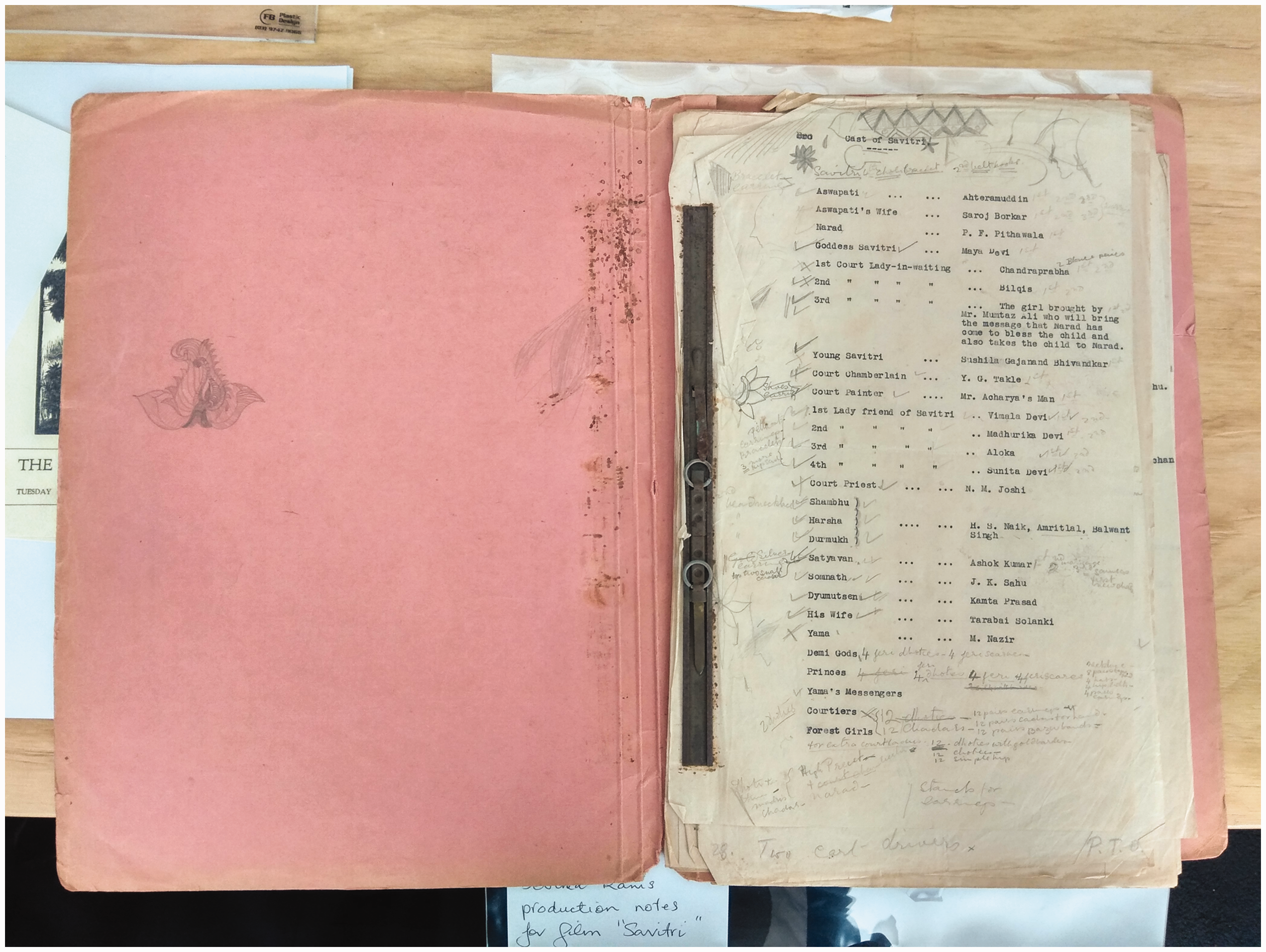
On the other hand, the absence of early Indian film scripts has so far been a deterrent for a historiography based on close archival scholarship. Stray archival finds such as the silent film script of Gul-e-Bakavali (1924; see Dharamsey, 2012) or the continuity script fragments of Savitri (1937) in private collections do not support a sequential historiography of screenwriting; they only testify to the presence of bound scripts in early Bombay cinema and give us a sense of the practice within a particular studio at a particular time. Nonetheless, my intention so far has not been to present the situation as an entirely unyielding one. A great deal of attention has been paid to writing history ‘along the archival grain’ (Stoler, 2002: 100), and how such historiography may provide rich conceptual dividends. 9 The task here is to critically reconsider the idealized screenwriting archive against which we define our absences. It is worth investigating how dominant media practices shape archival imaginaries and epistemic claims, and whether laments of archival absence stem from the doomed search for a screenwriting modernity wherein alternative practices are largely obscured.
Provincializing the Continuity Script
Around 1913–14, Thomas Ince had introduced a system of screenwriting in Hollywood studios that would allow studio proprietors to micromanage every step of the production process. It was the ‘continuity script’ – a fully fleshed out plan for shooting a film. Janet Staiger (1979) has studied the continuity script as a studio document that streamlined the production of films in the assembly line mode, introducing unprecedented levels of corporate rigour and rationality into film production through documentation and execution. The continuity script works because it is an external manifestation of a more fundamental structure inextricable from modern corporate business – the separation of the conception and production phases of work and the pyramid of divided labour. (Staiger, 1979: 23)
Bombay Talkies was a film studio founded in 1934 by Himanshu Rai and Devika Rani, an erudite Bengali couple who had originally met in London. The studio combined the technical prowess of an experienced German crew with the rising stardom of Ashok Kumar and Devika Rani to emerge as an extremely successful production house during the 1930s–40s. Due to their international approach towards filmmaking, the studio's operations were carried out highly systematically using the continuity script. In fact, some of their extant continuity scripts can be accessed at the Dietze Family Archive 11 in Melbourne. In her dissertation, Mukherjee's access to the invaluable Bombay Talkies papers allows her to launch a critique of an earlier thesis about the pre-capitalist nature of the Hindi film industry. 12 She argues that the absence of the ‘bound script’ has been ‘fetishized over the last few decades to characterise “Bollywood” as a culturally curious, messy, cottage industry’ (2015: 127) to the extent that the academic community has also taken the myth seriously. Mukherjee highlights Madhava Prasad's misreading of the ‘script’ as a written, coherent story instead of Staiger's intended notion of the script as a blueprint – ‘an administrative and logistical tool to dictate production, and not a qualitative marker of creative integrity’ (2015: 129).
While Mukherjee's critique of Prasad is well intentioned, her reading of the continuity script as a harbinger of ‘corporate modernity’ (2015: 80) in Bombay Talkies runs certain risks. How do we understand indigenous agency in transnational screenwriting histories when more enlightened film studios such as the Bombay Talkies become passive beneficiaries of technology developed by pioneers like Thomas Ince? At what point does the search for the continuity script become a search for a screenwriting modernity à la Hollywood? Most importantly, what kind of scriptural economies does such an investigation exclude and what kind of epistemic violence does it perpetuate? Ravi Vasudevan (2010: 140) has argued that early Bombay cinema's connection with Iranian and other Southern film cultures calls attention to other ‘global trends of modernization than those circulated by Hollywood’. An epistemic de-linking from the perceived global hegemony of the continuity script therefore becomes essential for such South–South transnational interfaces to emerge as parallel constitutive forces of early screenwriting practices. In the following sections, I shall try to complicate the easy understanding of the continuity script as a marker of screenwriting modernity that emerged in the West and was diffused in South Asia through the transmission of prescriptive manuals (Sengupta, 2018: 121–2) and other discursive flows. This is not to undermine the transnational movement of ideas or the trailblazing practices of Bombay Talkies but to attain a deeper understanding of how ‘rational’ practices that travel to new cultures negotiate with pre-existing systems that tend to persist.
From Object to Practice
Thomas Elsaesser understands media archaeology to be ‘a response to various kinds of crises’ (2016a: 183) rather than a methodology or a discipline. Arguably, apart from ‘the crisis in history and causality’ (2016: 188), media archaeology in the Global South also addresses the crisis in the archives. While film historians working in the generous archives of the West arrived at media archaeology after a period of disenchantment with positivist histories of cinema, film scholars in South Asia have had little choice but to take recourse to parallel histories of the moving image in the absence of early films (see Mukherjee, 2013; Chatterjee, 2014). Likewise, the failure of an archival excavation of the screenwriting object has prompted in my research an archaeological inquiry into its practice. My arguments in the paper are significantly informed by the increased understanding of film history as a media archaeological project of studying discontinuities, convergences and networks against the grain of teleological histories of industrial progress. The activity of recovering this diversity and to account for such multiplicity, to trace these parallel histories and explore alternative trajectories, is what is meant by ‘film history as media archaeology’. (Elsaesser, 2016b: 25)
In his media archaeology of Indian cinema, Sudhir Mahadevan (2015: 15) explains the contemporaneity of old and new media in South Asia as an ‘obviation of obsolescence’ – a condition markedly different from the planned obsolescence of media artefacts in the West. It is well known how sustainable practices of repair and recycling continue to shape new media consumption in the Global South (Sundaram, 1999; Rosner and Ames, 2014). However, most ironically, humans as well as nonhumans in the developing countries incur significant ecological costs when electronic waste is transported from the North to the South for dumping (Pellow 2007: 185–224). Also, in a context where the direct human costs of accelerated automation 14 are certainly greater than in the Global North (Norton, 2017; Ilavarasan, 2018), I argue that decolonial media archaeology ought to depart from purely materialist approaches and radically write the human back into media histories. In the following sections, I attempt to do this with a short history of the munshi’s scribal and screenwriting practices.
Munshi as a Topos
While film scripts from the early years are largely missing, even a cursory look at screenwriting credits during the 1930s–40s introduces us to the munshi – a scribal profession as old as the early 1600s. As per records, 15 at least 12 screenwriters from 1932 to 1952 have munshi prefixed before their names. Munshi Ismail Faroque, Munshi Ashiq, Munshi Sefta, Munshi Zameer, Munshi Sagar Hussain, Munshi Ehsan Lucknowi, Munshi Sarfaraz, Munshi Arzoo Lucknowi, Munshi Dil, Munshi Sham, Munshi Khanjar and Munshi Abdul Baqui worked in different studios in Bombay, Calcutta and Pune during this period.
Who is a munshi? A considerable body of scholarship on early modern scribal professions in pre-colonial and colonial South Asia has largely located the munshi in two historical offices: i) the 17th–18th century Mughal court (Alam and Subrahmanyam, 2004; Kinra, 2010, 2015), and ii) the 18th–19th century colonial language-learning institutions (Bayly, 1996; Ogborn, 2007). Apart from the pop-cultural imagination of the munshi as a scheming accountant and accomplice of the evil zamindar (landowner) in Hindi films, the munshis of the 20th century were arguably a part of the political and cultural decline of Urdu-speaking elites in North India (Robinson, 2007: 33–83). In the context of some of the broader concerns I have raised in this paper, it becomes important to trace the decline of the munshi from his venerated position as a court scribe to his obsolete status as a dialogue writer in film studios. A note of caution is due here though. My engagement with the early modern 16 category of munshi is not a clarion call for a civilizational return to an essentially indigenous form of screenwriting but an attempt to provincialize the Hollywood-centric discourse of screenwriting. Erkki Huhtamo's (2011: 43) media archaeological notion of the topos as a ‘temporary manifestation of a persisting cultural tradition’ has helped me think about the transhistorical category of the munshi from the Mughal court and colonial language institutions to the film studio and online accounting software (see: http://www.e-munshi.com/index.html). In lieu of reading the continuity script as a modern tool of screenwriting that diffused into the subcontinent through an enlightened film studio, I suggest that a decolonial archaeology of screenwriting practice, through the topos of munshi, could help us reposition Indian screenwriting history against the archival determinisms of the continuity script.
I begin with a brief history of the early modern munshi. It was during the Mughal emperor Akbar's reign (1556–1605 AD) that Persian was formally declared the language of the court – a proclamation that was ‘accompanied by a reorganisation of the revenue department as well as the other administrative departments’ (Alam and Subrahmanyam, 2004: 62). The original Hindavi system of accounting was gradually restructured through the acquisition of new rules and regulations from Iranian scribes. The introduction of Persian as the court language radically ‘streamlined and rationalized’ bureaucratic and administrative practices ‘to levels unprecedented in the history of the subcontinent and unsurpassed in all but a handful of states elsewhere in the world for some time to come’ (Kinra, 2015: 3). Due to Akbar's secular educational policies, both noble Muslims and upper-caste Hindus undertook voracious training in Persian language and literature to secure the coveted administrative position of the munshi (secretary).
The word munshi comes from the Arabic verb insha, which means ‘“to compose” a written document’ (Yule and Burnell, 1886: 444). According to a number of early modern manuals (also known as ‘mirrors for munshis’), the Mughal munshi was required to possess excellent penmanship (khwush-nawisi), scribal skills (navisindagi), accounting abilities (siyaq), draftsmanship (insha) and the ability to use coded language (sukhan-i marmuz) (Alam and Subrahmanyam, 2004: 62; Kinra, 2015: 65). A true munshi’s job often went beyond the drudgeries of taking dictation and tallying accounts, and required him to ‘participate in the cultural life of the court, to be one of the elite literati who composed and recited poetry for special occasions and important public functions’ (Kinra, 2015: 38). The whole nobility had been brought up to revere the art of insha or letter-writing as a tool of literacy and as a form of regulating proper social relations. … Thus the munshi should be regarded as more than a secretary; he was an expert in diplomatics and social deportment. (Bayly, 1996: 76) Nobody could possibly place a higher value upon his own services than does the erudite aboriginal who sees us safely through the various languages of India. And nobody, of all the vast horde of creditors, is more particular about the timely settlement of his ‘little bill’. (The Times of India, 1887: 5, emphasis added)
The Munshi in Modern Times
Sound introduced language barriers for Indian film studios. The coming of the talkies gradually restructured national distribution patterns along linguistic and regional lines. New Theatres in Calcutta and Prabhat Studios in Pune, for instance, remade most of their successful Bengali and Marathi talkies in other regional languages to ensure an almost pan-Indian audience. Quick remakes necessitated authoritative translators, and therefore a number of munshis and pandits were hired for writing as well as translating dialogues and songs. The relationship between Hindi and Urdu had been ‘symbiotic in the field of commercial publishing and theatre’ (Orsini, 2009: 4), and this spirit of bonhomie was extended to the new medium of talkies where munshis and pandits together contributed to ‘an expansive and inclusive register of Hindustani’ (Lunn, 2015: 2), combining the two North Indian languages in an equal, secular measure. The recruitment of Parsi theatre playwrights (also referred to as munshis in theatre companies) to write the first Indian talkies had imbued the novelty of sound with a rich textual quality through frequent songs and theatrical dialogues, laying the aesthetic foundations of Hindi cinema for decades to come (Sengupta, 2018: 126–30). Why was the munshi then frequently recalled and represented through imageries of obsolescence and incompetence? There was a time when ‘the writer’ in a film studio meant a shabby-looking Munshi, who would chew paan
20
and spit out what passed for stories in those days. In a six-pice exercise book the literary inspirations of the Munshi would be recorded with the stub of a pencil and handed over to the director who would immediately start shooting, only skipping through ‘the story’ to make sure that there was in it a role each of Sulochana, Billimoria and Gulam Mohamed […] Now and then, of course, youthful enthusiasts like Naval Gandhi would get hold of a story by a real writer like Tagore and make a film of sorts, like ‘Sacrifice’. But these were exceptions that only proved the rule. In the studio, the Munshi still reigned supreme. (Filmindia, 1940: 3)
While many eminent personalities worked closely with munshis in the film studios,
25
the illustrious early modern scribes had become an object of mockery by late modern times.
26
The early 20th century witnessed several news reports that sensationalized petty crimes, usually of theft, committed by munshis.
27
The film world didn't accord high status to the munshis either, often inscribing obsolescence into the descriptions of their practices. In a review of Baghdad Ka Chor (1948), the dialogue writer was criticized for using a ‘pseudo-literary jargon regardless of the spoken idiom’, which looked like ‘the work of some Munshi who is used to coaching British officers for the Army examination in Roman Urdu!’ (Filmindia, 1948a: 66) The concerns of medium specificity raised in Filmindia, through a consistent denigration of the munshi as the archaic scribe with little knowledge of the new medium, were aimed at expediting the imminent displacement of obsolete writing systems with more modern scriptwriting techniques. Pandit Indra, a well-known dialogue writer and lyricist, wrote an article about the maligned status of munshis and pandits, likening themselves to Shakespearean fools who always know better. The film studios are supposed to have their ‘prize-fools’ and this uncomplimentary title is generally awarded to the Munshis and Pandits who write the dialogues. By common consent almost every one tacitly believes this. […] The Munshi or the Pandit is a dialogue writer and naturally a man of letters. His education gives him the right to think more than the others and when a dialogue writer finds himself in a crowd of block-head directors and producers, he must surely think himself to be in the land of fools. (Indra, 1938: 45) I learnt […] on turning up for my first day of work that my name wasn't Saadat Hasan Manto, but for some reason, not apparent to me, ‘Munshi’. My tasks, and this was made clear, were three. First, getting a paan for the director every five minutes (or so it seemed). Second, to not speak. Third, if these two were performed competently, to write, every so often, a dialogue in incorrect Urdu. And then to not speak. (Manto, 2014: 149)
Absence and Obsolescence
My inquiry into the professional genealogy of the munshi, from the Mughal scribe to the dialogue writer in talkie studios, finally brings me to a pertinent media archaeological question: Is media obsolescence solely an object-oriented concern, or can we also map it on to human practices? Here it is worth inquiring briefly into the contrastive appreciation of early screenwriting practices that distinguished the modern from the obsolete, and by extension, the visible from the invisibilized. While the old order of munshis had become the subject of derision, modernized studios such as the New Theatres and Bombay Talkies were exclusively accorded distinction. An editorial piece on screenwriting in Indian film studios celebrated the technically sound Debaki Bose of New Theatres as ‘the first real screen writer in India […] for getting the actual shooting scripts written’ (Filmindia, 1940: 3). The same article also articulated a glimmer of hope in the practices of Bombay Talkies as their young and efficient scenarists served to redress the archaic ‘studio Munshi stage’ of Indian screenwriting. A commendable example has been recently provided by Bombay Talkies who have organized an efficient group of young and educated scenarists. […] In most of the other studios […] the technique of scenario-writing seems to have advanced very little beyond the studio Munshi stage. (1940: 5) Dialogue script in Urdu. Courtesy: Peter Dietze, Dietze Family Archive. Production file of Savitri (1937). Courtesy: Peter Dietze, Dietze Family Archive.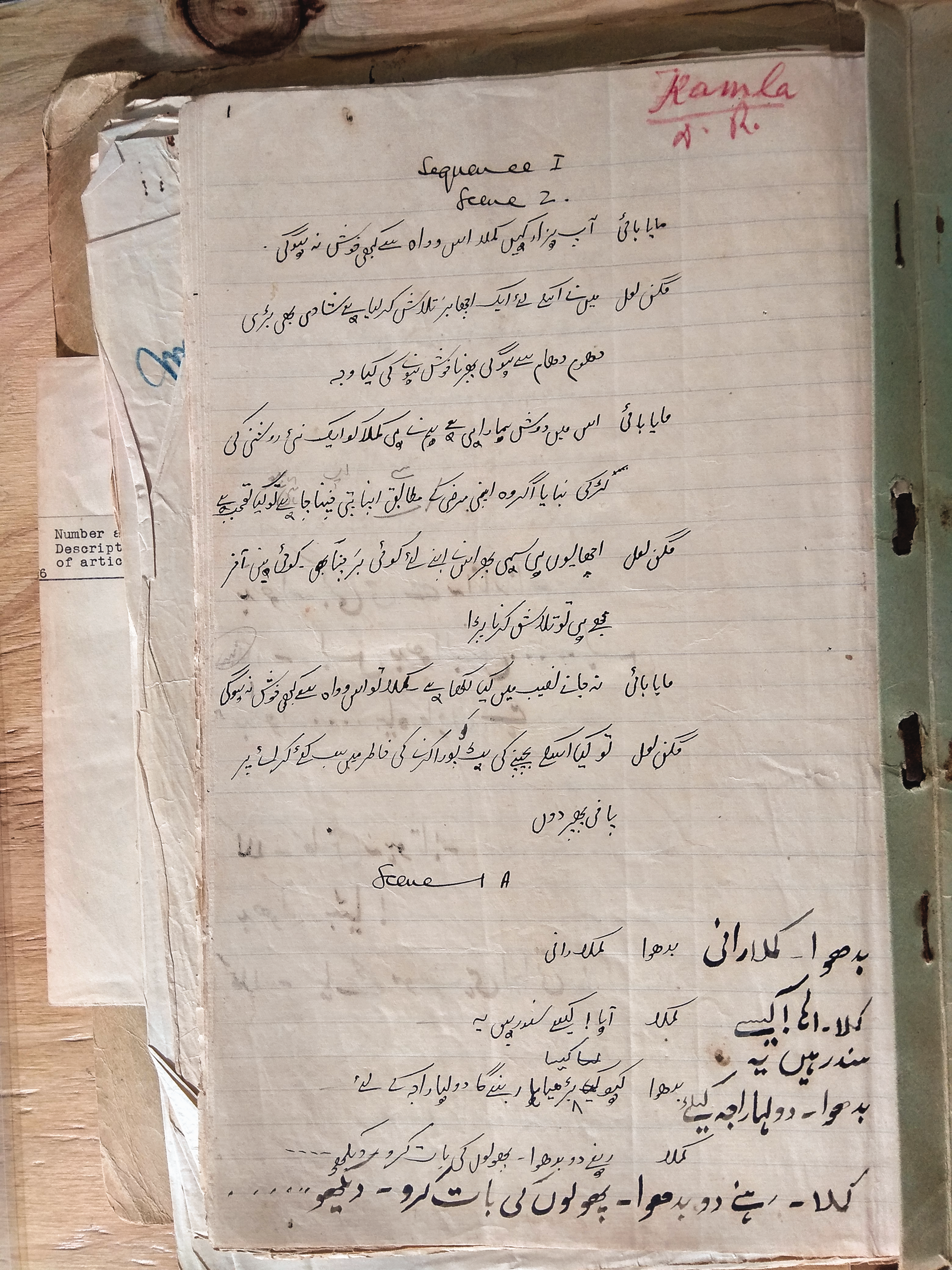
The Hollywood continuity script was an assiduously formatted document that had rapidly become the industrial standard for screenwriting, setting itself apart from oral and handwritten scripting practices in other film cultures whose palimpsestuous quality laid greater emphasis on improvisation. The search for the ‘bound’ script is therefore the search for an archive-oriented screenwriting modernity. It is symptomatic of the historiographic desire for a retroactive reorganization of film practices around the logics of the Hollywood studio system, especially in the face of recurrent stereotypical descriptions of the Hindi film industry as an unorganized one. However, if bound scripts from the early years are largely missing, it may be more constructive to ask whether the continuity script (also a form of recordkeeping) was ever a predominant mode of scripting. Arguably, archival laments and expeditions fail to historicize the contingent nature of scripting in a film industry that continues to promote pre-production narrations 28 and on-set improvisations. While the excavation of bound scripts that testify to modernizing impulses in studios such as Bombay Talkies is a promising start, more parallel practices and pre-existing traditions are yet to be recovered, some of which were obscured by the very privileging of archival technologies such as the continuity script. A failure to do so would charge the ‘screenplay-centrism’ of screenwriting history not only with a colonial amnesia of early modern writing traditions but also an epistemic misrecognition of an industrial order of orality and handwriting where spontaneous on-set textual production has historically co-existed with continuity script-like recordkeeping techniques.
Conclusion
Much has been written about how Foucault's archaeology of the modern episteme, emerging from early 19th-century Europe, was curiously divorced from its context of colonialism (See Alcoff, 2007; Legg, 2007). Media archaeology, as Foucault's legacy, has also overlooked racial epistemologies of media modernity. Decolonial media archaeology brings together the spatial politics of decolonial thinking with the temporal poetics of media archaeology, and allows us to embark on alternative trajectories of historical inquiry and recover forgotten futures of media practices from the Global South.
Through the case study, I have tried to tie together several strands of screenwriting and scribal history in South Asia to problematize the notion of the continuity script as a harbinger of filmic modernity, and by extension, the epistemological implications of a universalized archive of screenwriting. The article has attempted not only to rethink the possibility of historicizing a media practice in the supposed absence of its archive but also to reveal a colonial unconscious that has undermined the heterogeneity of such practices in the first place. The two lost histories of screenwriting object and practice are not mutually exclusive, though it is often an uncritical lament for the former that fails to join the dots. On a more optimistic concluding note, the Mughal munshi's deep appreciation of literature and sound knowledge of accounting arguably represent the perfect skillset for the present-day screenwriter who must combine a creative sensibility with a commercial one – an early modern legacy that should reassure Anjum Rajabali and his students that they are indeed part of a very special tradition.
Footnotes
Acknowledgements
I would like to thank Sudhir Mahadevan, Jussi Parikka, Ian W. Macdonald, Rachel Dwyer, Ravikant, Francesca Orsini and Stephen Hughes for their helpful comments on earlier drafts of this paper. I also thank the anonymous reviewers and the editorial board of Theory, Culture & Society for their valuable suggestions.
