




Abstract

If I were a painter, I should paint only colors: this field seems to me freed of both the Law (no Imitation, no Analogy) and Nature (for after all, do not all the colors in Nature come from the painters?). (Barthes, 1977: 143)
Roland Barthes, No. 159, 15 Dec ’71 (20.8 × 26.2 cm). Reproduced courtesy of Bibliothèque nationale de France.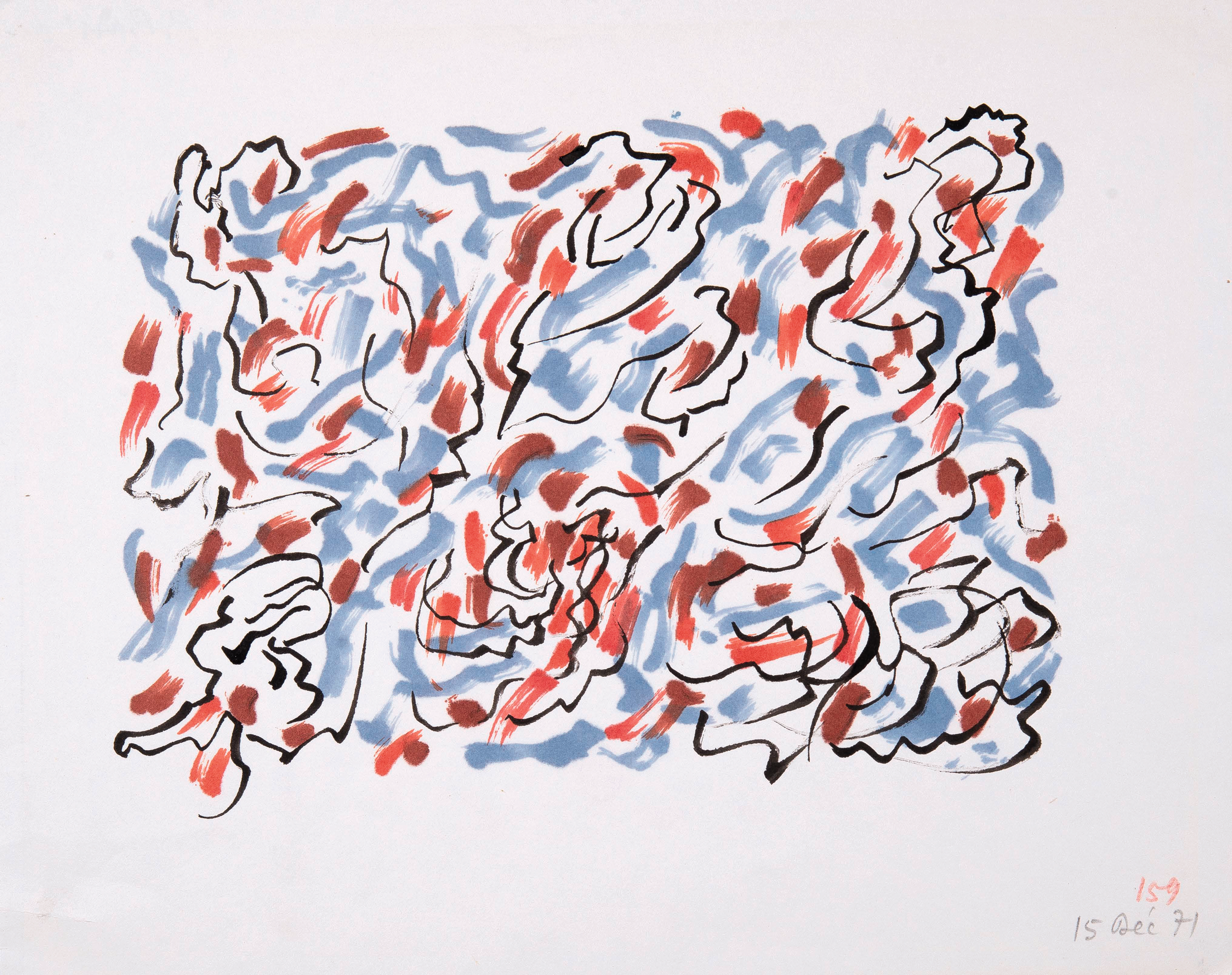
Colouring, Degree Zero
From time to time, I like to do … but here the difficulty begins – to do what? Drawing, painting, graphic art … ? What I do barely has a name. It’s more of the order of colouring, of graffiti. It’s not, assuredly, a second-rate thing but it is a by-product, a spin-off, even though it’s always subject, more or less, to cultural values that I derive, without thinking, from all the paintings or forms of handwriting I’ve seen. I like the process of production itself, but I also like to be able to view the product with pleasure, the proof being that, if I think it hasn’t ‘worked’, I throw it away. In this incidental operation, there is then, all the same, a sort of aesthetic aim. With no illusions, but with some joy, I play the artist.
There are no doubt many reasons for this amateur practice. Perhaps it’s the dream of being a complete artist, a painter and writer, as certain men of the Renaissance were. Or the desire to extend the use of my body, to ‘turn my hand to something else’ (even if it’s still the right hand). Or the need to express a little of the drive that’s in this body (they say that colour equates in some way with the drive [pulsion]). Or, conversely, the pleasure of a sort of cosy sense of craft-work (laying out one’s pastels, inks, brushes and sheets of paper on a workbench). Or even the relief (the restfulness) of being able to create something that isn’t directly caught in the trap of language and dodges the responsibility each sentence inevitably carries with it – in short, a sort of innocence that writing denies me.*
*Translation by Chris Turner, courtesy of Seagull Books, 2016. This text appears, along with another 19 articles on the translation of visual arts, in Signs and Images: Writings on Art, Cinema and Photography, Vol. 4, of newly translated essays and interviews by Roland Barthes, published by Seagull Books. See also an interview with the translator in Badmington (2015).
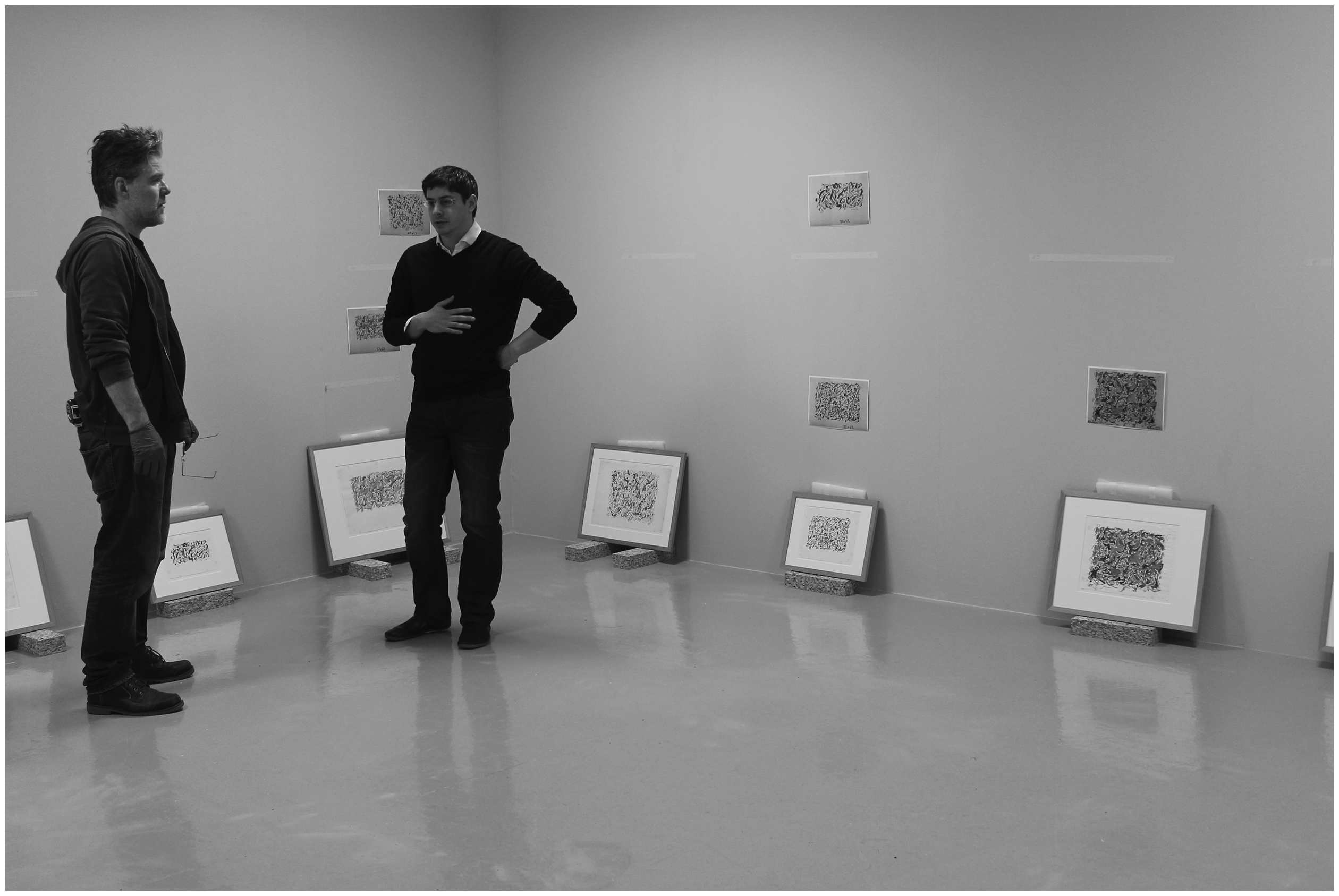
In preparation: Julian Grater (left) and Sunil Manghani (right) hanging a selection of Roland Barthes’ paintings for the Barthes/Burgin exhibition at the John Hansard Gallery, 2016. Barthes would never have considered himself an artist worthy of exhibition. Indeed, he described his ‘amateur’ activity of painting as ‘marginal’, as a hobby (violon d’Ingres), citing the painter J.D. Ingres who famously played a violin as a hobby (Barthes, 2005: 140). We can take a cue from Barthes’ (1985b: 207–42) commentary on the artist Bernard Réquichot, which he describes in terms of the figure of the Amateur: ‘He is the one who does not exhibit, the one who does not make himself heard … the amateur seeks to produce only his own enjoyment (but nothing forbids it to become ours in addition, without his knowing it)’ (1985b: 230, emphasis in original). Photograph courtesy of Ros Carter, 2016.
Editor’s Note
The following remarks draw upon the preparations undertaken to exhibit a selection of Roland Barthes’ paintings rarely seen outside of France, and which have received very little critical commentary (Manghani, 2016). While Barthes’ love of stationery and writing as a physical, practical engagement is well-documented (Barthes, 1985a: 177–182; see also Badmington, 2008), what is less remarked upon is that he sustained a practice of drawing and painting throughout the 1970s. It is difficult to know how to refer to this practice. Barthes queries this himself in the note provided here, ‘Colouring, Degree Zero’, which originally appeared in Les Nouvelles Littéraires in 1978. The entry was one of several responses from a survey of writers on their practice of drawing and painting. It appears to be a deliberately short text, opening with the very failure of language that Barthes is alert to in his review ‘Is Painting a Language?’ from 1969. Here, Barthes refers to the ‘rigged question of art’, whereby, he suggests, ‘to ask if painting is a language is already an ethical question’ (Barthes, 1985b: 150). In this earlier article Barthes appears to settle on the side of language, ‘the language inevitably used in order to read [painting] – i.e., in order (implicitly) to write it’ (p. 150). However, just a few years later, following his trip to Japan, which fuelled an interest in Japanese calligraphy and brushwork, Barthes begins a regular practice of drawing and painting. The ‘process of production’, as he puts it in the entry on colouring, would appear to offer a different answer to the thorny problem of language and painting. Barthes refers instead to the ‘relief (the restfulness) of being able to create something that isn’t directly caught in the trap of language’ – the latter a phrase he uses again in the same year when addressing his audience at the Collège de France during his lecture course on the Neutral (Barthes, 2005: 57).
Whether it is drawing, painting or graphics, as Barthes wonders, or more simply colouring, it is nonetheless a sustained endeavour spanning a decade. Working mainly in the holiday periods, he would sit to paint using paper always of a scale convenient to working on the flat or slightly inclined surface of a small table or desk. It was an activity not far removed from writing. The works are like drawings in that they are formed mainly of lines, yet painterly too, with an eclectic use of inks, acrylics, felt pens and pastels. Some of the pieces are produced on college letter-headed paper, which Barthes describes as a form of ‘squandering’ (Barthes, 1977: 113). A large collection of the works are held in Paris at the Bibliothèque nationale de France. There are said to be some 700 in existence (Clerc, 2011), but with the library holding around half of these. They are kept in three large, plain archive boxes. Box 1 contains works exclusively from 1971. In boxes 2 and 3 are works ranging from 1972 through 1978. Despite having produced many hundreds of paintings over a decade, there is very little variation. Barthes would restrict his palette to three or four colours and build up a collection of the same interleaving lines and marks. He appears to have considered the paintings a body of work of sorts, however modestly. Almost all of the drawings are dated, and he also numbered each piece in a continuous sequence, often using a different pen or pencil, which might suggest an operation undertaken at the end of a painting session. Perhaps this was the moment in which he reflected on the works, discarding those that had not ‘worked’.
Among the collection of photographs that form the preface to Roland Barthes (1977), a set of three show him working at a desk or table, the caption reading: ‘My body is free of its image-repertoire only when it establishes its work space. This space is the same everywhere, patiently adapted to the pleasure of painting, writing, sorting’. And it is the references and associations with ‘pleasure’ that is also notable in the entry here on colouring. Pleasure is an important and complex term in Barthes’ critical lexicon,
1
which he renders in two different and complex ways: as plaisir (understood as a form of happiness, completeness) and jouissance (which, with its sexual connotations, refers to a sensation of pleasure through loss, dissipation or release). In a filmed interview3 following the publication of Le Plaisir du texte, in 1973, Barthes can be seen at his painting table. In the background a set of cups hold a variety of paint brushes, with other related paraphernalia strewn around. For a few seconds, just before the interview begins (with a cigarette in his mouth, and smoke wafting around him), Barthes appears to be concentrating on something at his painting table. He then takes his cigarette to stub it out, lifts off his glasses and turns a little self-consciously, adjusting his chair slightly, to face the camera. It is as if, as the smoke clears, he emerges back in the ‘area’ of work, ready to begin the interview about his writing, about his literary theory. The Pleasure of the Text, he explains, is written against a ‘reactionary context’, whereby pleasure must be exorcised in order to be critical. ‘[T]he purpose of my book’, he says, ‘is to persuade those writers, intellectuals, researchers from the Left that they must assume the notion of pleasure in the theory of the text.’ The book sets out two types of pleasure: Text of pleasure: the text that contents, fills, grants euphoria; the text that comes from culture and does not break with it, is linked to a comfortable practice of reading. Text of jouissance: the text that imposes a state of loss, the text that discomforts (perhaps to the point of a certain boredom), unsettles the reader’s historical, cultural, psychological assumptions, the consistency of his tastes, values, memories, brings to a crisis his relation with language. (Barthes, 1975: 14, translation modified)
However, it would be wrong to make direct comparisons. Barthes’ engagement in painting is a more private undertaking. He may well have explored his interest in the aforementioned artists in this way, but not to echo them – if anything, more to unravel them. In writing on Cy Twombly, for example, an artist he clearly admired, Barthes describes looking slowly through a book of reproductions: ‘I frequently stop in order to attempt, quite quickly, on slips of paper, to make certain scribbles; I am not directly imitating [Twombly] (what would be the use of that?), I am imitating his gesture, which I, if not unconsciously, at least dreamily, infer from my reading; I am not copying the product, but the producing’ (1985b: 171). Similarly, in reference to ‘colouring’, it is the verb form that is significant. We can see – in playing the artist – the shift is towards a pleasure of dissipation. And it is a bodily engagement, a matter of handwriting: We read of his desires to extend the body, to express a drive, to experience joy (without illusion). Again, Twombly helps us understand Barthes’ thinking on pleasure – which is not about ‘taking’ pleasure so much perhaps, but allowing it to unfold: An extraordinary thing: [Twombly’s] work manifests no aggression (a feature, it has been remarked, which differentiates him from Paul Klee). I believe I know the reason for this effect, so contrary to all art in which the body is engaged: [Twombly] seems to proceed in the manner of certain Chinese painters who must triumph over the line, the form, the figure, at the first stroke, without being able to correct themselves, by reason of the fragility of the paper, of the silk: this is painting alla prima. [Twombly], too, seems to work alla prima, but while the Chinese touch involves a great danger, that of ‘spoiling’ the figure (by missing the analogy), [Twombly’s] line or trace involves nothing of the kind: it is without goal, without model, without instance; it is without telos, and consequently without risk: why ‘correct yourself,’ since there is no master? From which it follows that any aggression is somehow futile. (Barthes, 1985b: 174). To see engendered at one’s fingertip, at the verge of vision, something that is both expected (I know that this crayon I am holding is blue) and unexpected (not only do I not know which blue is going to come out, but even if I knew, I would still be surprised, because color, like the event, is new each time: it is precisely the stroke which makes the color – as it produces jouissance). (Barthes, 1985b: 174, translation modified)
Footnotes

Note