




Abstract
This paper explores the deep historical contexts for imagining natural disasters. By focusing on a foundational event in the Western disaster imaginary – the eruption of Vesuvius in AD 79 – and its remediation across centuries, the paper suggests that the real-time aesthetic of the mediation of extreme nature events that now abounds in contemporary culture is profoundly embedded in processes of historical intermediality. The term remediation is used to denote a genuinely historical mechanism by which past and present (process and event) are simultaneously made visible. Empirically, the paper investigates the superimposition of temporal dimensions in recreations of the ancient disaster from the late 18th century to the present. Using the insights gained from this spectacular case study, the paper ends by arguing that a re-temporalization of historical analysis itself is needed for history to contribute to contemporary concerns with the present as a conjuncture of multiple and conflicting time scales.
In the Memory of Real Time
When the Denver Museum of Nature and Science opened the exhibition ‘A Day in Pompeii’ in September 2012, it included a digital recreation inviting the visitors to ‘relive the final 24 hours of Pompeii through the only eyewitness account of the eruption of Mount Vesuvius in AD 79’. The eyewitness was Pliny the Elder, whose death in the ancient disaster is accounted for in one of the two letters that his nephew, Pliny the Younger, wrote on the eruption to the historian Cornelius Tacitus about two decades later.
1
It was not by simply quoting from the letters, however, that the story was retold in the exhibition. Instead, a Twitter account was opened in the name of Pliny the Elder, sending real time updates as the nature drama evolved. It was not long before news sites picked up on the stunt and announced: ‘Pliny the Elder is live-tweeting the fall of Pompeii’ (Figure 1).
2
Screenshot from the exhibition ‘A Day in Pompeii’.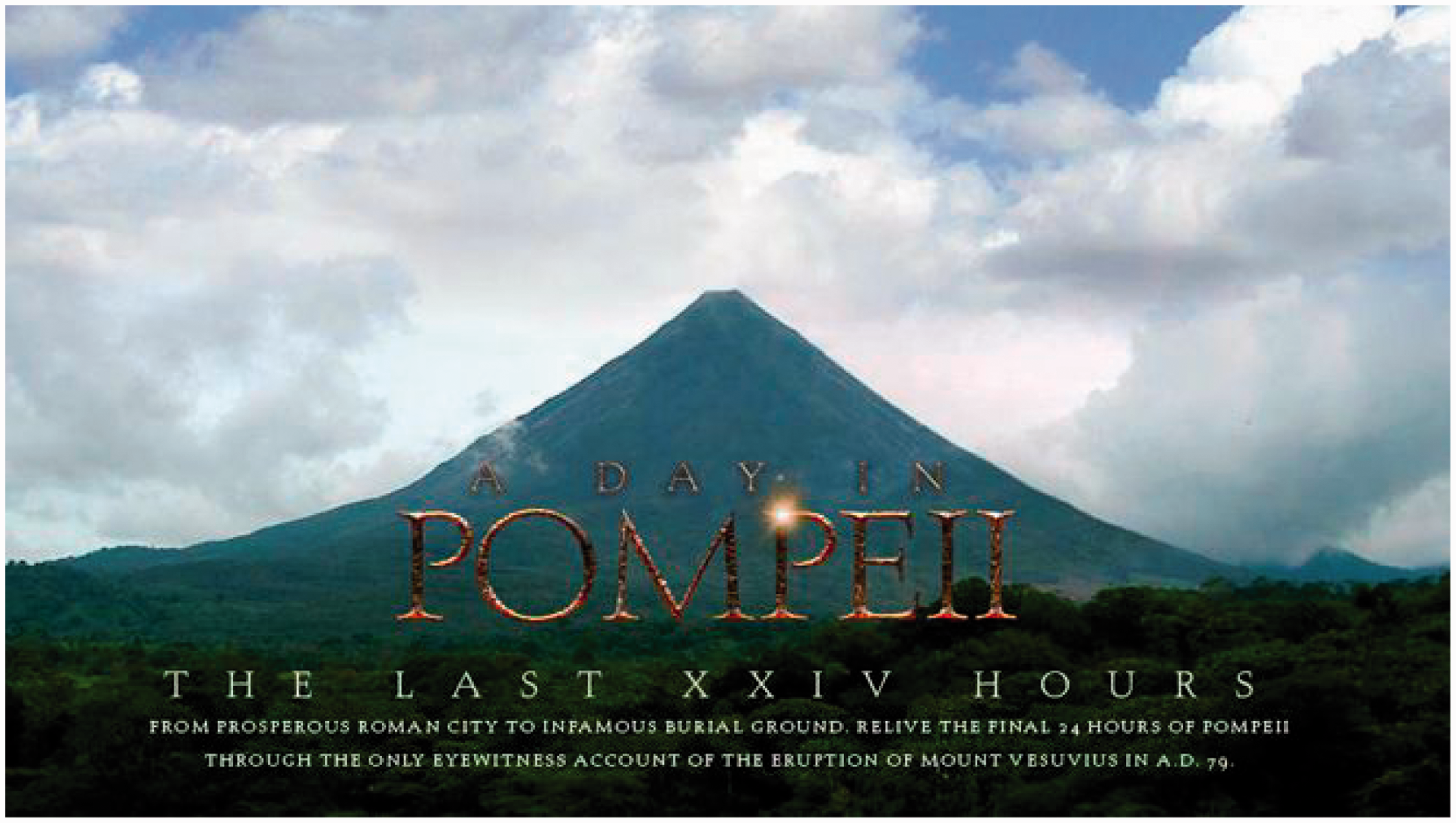
This episode captures the contemporary expectation that remote disasters are ideally reported in small screen media and through the modes of liveness that they enable. Today, this expectation is reinforced by the new genres of visual reporting that emerge from the use of portable technologies such as smartphones, digital cameras and mobile internet connections (see, for example, Andén-Papadopoulos and Pantti, 2011; Frosh and Pinchevski, 2011; Pantti et al., 2012; Cottle, 2014). In relation to extreme nature events, the production and circulation of such images tend to blur the distinctions between media witnesses and victims, between virtual and non-virtual spectatorship, between an aesthetic of detachment and the experience of physical presence. Think, for example, of news images of floods taken from fatal viewpoints, or, as in connection with the Fukushima disaster in 2011, real-time visual reporting from web TV cameras attached to the helmets of engineers inside the devastated nuclear plant.
But the live-tweets from the fall of Pompeii should also remind us that real time is, inevitably, traversed by historical time. This is most apparent in the extent to which news images of contemporary events draw on genres that have developed across media and eras (Ekström, 2012: 474). Another instance of the superimposition of different temporal dimensions in disaster imagery is – as in the digital recreation of the ancient eruption of Vesuvius – when technologies for articulating the now are used to engage with the past. For example, this is a striking feature of the dominant template for representing calamities online – short videos and web TV clips framed by a real-time aesthetic – which is also increasingly used by news sites to look back upon and remediate historical events.
A pervasive line of thought in media and cultural theory holds that modern societies experience a flattening of time, which is reinforced by new media and communication technologies. This view was elaborated already in 19th-century discourses on a distinctively modern acceleration of time and the emergence of a media-driven culture of simultaneity (Kern, 1983). In the l990s and early 2000s, theorists as different as Jean Baudrillard (1994), Paul Virilio (1997), Fredric Jameson (2003), and François Hartog (2003) all diagnosed a growing presentism in late capitalism that, in Jameson’s phrase, was synonymous with ‘the end of temporality’. The notion of a particular affinity between ‘new’ (media) and ‘now’ (time) has been further accentuated in relation to the digital turn, both in early work on the information age and what Castells (2000) refers to as ‘timeless time’, and in more recent discussions on the ‘eternal now’ of online streams (cf. Weltevrede et al., 2014: 128–9).
This essay takes issue with this understanding of the relation between media and time on two very different grounds. First, by offering a case study of the deep historicity of how media works in dealing with the catastrophic now, and more precisely, the mechanisms that connect old and new through remediation, and how this promotes a multiplicity of times and temporalities. Second, and more generally, the essay works from the proposition that the post-1989 context in which ‘the regime of the present’ was most intensely experienced has been irreversibly altered by the historical rhythms and cross-temporal continuities of anthropogenic climate change (Ekström and Svensen, 2014: 12–15; Chakrabarty, 2009).
The climate crisis thickens the present by embedding it in many different times and time scales simultaneously, activating notions of geological deep time as much as visions of the future as rushing towards us. The present ubiquity of images of extreme nature events – climate-related hazards such as floods and heatwaves as well as weather extremes and earthquakes and volcanic eruptions – is topical for ‘the temporality of emergency’ (Fassin and Pandolfi, 2010: 10) that has come to define the nature-culture nexus. 3 But such images also engage with and activate deep cultural contexts, which are used to comprehend and negotiate contemporary disasters in ways that make disruption and repetition coexist.
It is thus to the temporalities and conflicting time scales of the cultural and technological mediation of nature emergencies that this essay turns. More precisely, it explores the organization of time in the history of disaster imagery by focusing on how an historic event became known to Western audiences as the most frequently mediated natural disaster from the late 18th century onwards. The foundational role of the eruption of Vesuvius in AD 79 for a modern, mediatized disaster imaginary is established and evidenced, I argue, through an extremely rich history of interpretations, media adaptations and theatrical re-enactments. 4 This meant, among other things, that more recent and contemporary disasters – such as the Mount Pelée eruption in 1902 or the San Francisco earthquake and fire in 1906 – were imagined in cultural forms that to a considerable extent emerged from the popular reception of the story of Pompeii’s destruction. For example, in the aftermath of the 1906 San Francisco earthquake, a disaster museum in Chinatown was advertised as ‘Pompeii in America’ with relics ‘Dug from the Ruins’. 5
Here, however, I am particularly interested in how different temporalities interact in recreations of the disaster. The essay discusses the intermingling of temporal layers in 18th- and 19th-century representations of the eruption. It also investigates the recurrent engagement with the notion that the ancient catastrophe was able to break through time and come alive. This, in turn, is discussed in terms of how deep historical contexts were made present through an aesthetics of real time, but also how modern modes of ‘liveness’ in mediated disasters grew out of recreations of past events.
By sketching out how the story of the AD 79 eruption travelled across media forms and genres, I mean to suggest that its foundational importance to modern disaster imaginaries is closely linked to its intense and continuous remediation. 6 In this context, remediation refers to the tendency of any medium to incorporate and develop the characteristics of other media. One crucial aspect of this cultural phenomenon – as was hinted at by Walter Benjamin, made explicit by Marshall McLuhan (1964) (‘the “content” of any medium is always another medium’), and further developed by more recent media theorists (Bolter and Grusin, 1999; Guillory, 2010: 322) – lies in its way of simultaneously making the past and present visible. In an attempt to problematize and overcome various critiques of a media-induced fixation on the now – especially in discourses on news and, more broadly, new media coverage of extreme events – I deploy the term to refer to a genuinely historical mechanism. In this understanding, remediation is defined exactly by its way of creating and multiplying cross-temporal links between different events and mediascapes.
Further, this approach counteracts what has been referred to as the ‘repression of the medial identity of literature and other “fine arts”’ (Guillory, 2010: 322). 7 In the case of the ancient eruption of Vesuvius, the digital adaptation of the story has the effect of making visible the medial identity of its own sources, including Pliny’s letters, as well as earlier recreations of the drama, for example in novels and panoramas. The very diversity of medial forms used to recreate the event also points to the importance of not privileging one medium over another when investigating the intermedial links between them.
It is, as John Guillory notes, ‘much easier to see what a medium does […] when the same expressive or communicative contents are transposed from one medium into another’ (2010: 324). What is exceptional about the history of the remediation of the ancient disaster is not, however, that it covers many genres and medial forms. The most remarkable aspect lies in the time frame it spans and the different temporalities it mediates. This is also why the story opens up some of the deep contexts of modern disaster imaginary.
Deep Contexts Come Alive
There is already a remarkable conjuncture of past, present and future in Pliny’s description of the eruption in the two letters to Tacitus. Famously asked by Tacitus to report on the death of his uncle – the natural philosopher Pliny the Elder who himself became a victim of the cataclysm – Pliny the Younger self-consciously appears in these letters as the author of one of the earliest eyewitness accounts of a major natural disaster in Western history. Indeed, the importance of the act of witnessing in this context was made explicit by Pliny. At the end of the first letter, he assured Tacitus that he was only relating first-hand experiences or memories told to him immediately after the eruption. In the same vein, he chose to evoke the now of the event by emphasizing his own bodily and sensual impressions of the disaster, its sounds and sights and how the ash felt on his skin. 8
However, in spite of Pliny’s insistence on the importance of the testimony being close to the catastrophe in time, the letters were written more than two decades after the eruption (cf. Gardner Coates, 2011: 50). Thus, it was not the heightened sense of the moment that created the pervasive presence in Pliny’s description of the disaster. In recreating the ash grey skies and the horror of the victims, he not only made use of his bodily memories and rhetorical skills, but also of historical sources. Most notably, the second letter made reference to Virgil’s description of the fall of Troy, connecting the narrative of the eruption to a history of catastrophic events (Gardner Coates, 2011: 53). Also, by addressing Tacitus, the celebrated historian, Pliny quite deliberately addressed posterity and his own role in creating the history of the event. The immediacy of his account was in this sense mediated both through myth and future. One disaster echoed another at the same time as the description anticipated any future recreations of the cataclysm.
These temporal interventions were the beginning of a remarkable history of recreating the ancient disaster that continues today. Ironically enough it was not Tacitus’ adaptation of the letters that survived, but Pliny’s own version, transferred in different medieval manuscripts (see, for example, Beard, 2010: 17). The letters were well known through the Renaissance, but the interest increased considerably after the rediscovery of the buried cities of Herculaneum and Pompeii in the first half of the 18th century (Gilman, 2007). It was further boosted by new eruptions of Mount Vesuvius, for example in the late 1770s, which ‘allowed contemporary viewers to compare what they witnessed to Pliny’s historic text’ (Gardner Coates, 2011: 54). A new edition of the letters was published in the 1780s. Together with archaeological guidebooks – most significantly William Gell’s and John Peter Gandy’s lavishly illustrated Pompeiana, which appeared in several editions from 1817 – and an increasing amount of travel writing, Pliny’s account of the eruption continued to be an important source of imagination for visitors to the site from the turn of the 19th century onwards.
Clearly, the survival of Pliny’s letters was an event of immense cultural significance. It is important to note that it was not its geological magnitude (Sigurdsson et al., 1982) or the number of its victims that turned the eruption of Vesuvius in AD 79 into a key event in the history of Western disasters. People living in Pompeii and the surrounding area at the time were still recovering from the damaging effects of an earthquake in AD 62 (or 63) (Beard, 2010: 12–13, 118–19), and there were many other Roman disasters that caused massive human suffering (Toner, 2013). What made the eruption in AD 79 different was the cultural force of its mediation.
In the 19th and early 20th centuries the eruption of Vesuvius in AD 79 – and what became framed as ‘the fall of Pompeii’ or ‘the last days of Pompeii’ – was depicted in numerous paintings, historical novels, melodramas, operas, panorama theatres, moving images and re-enactments, for example at European and North American amusement parks and world fairs (see, for example, Gardner Coates and Seydl, 2007; Gardner Coates et al., 2012; Hales and Paul, 2011; Leppmann, 1968; Wyke, 1997). By the end of the 19th century, it constituted a standard frame of reference for depictions of more recent natural and other disasters, such as the Johnstown flood in 1889, the Mount Pelée earthquake in 1902, and the San Francisco earthquake in 1906. Indeed, the extent to which the ancient eruption was on show in 19th-century visual culture, and continued to be circulated in turn-of-the-century media culture, suggests that the excavations in the 18th century were not only unearthing the remnants of the lost cities but also the spectacle of catastrophe itself (Ekström, 2012: 477).
The reception of Pompeii in 19th-century arts and popular culture is extensively documented in historical research. Much of this research takes as its point of departure the blockbuster success of the English novelist Edward Bulwer-Lytton’s The Last Days of Pompeii from 1834 (Figure 2). Bulwer-Lytton’s book became one of the most popular historical novels written in English in the 19th century. It took its inspiration from the author’s visits to the historic site and the archaeological details in the work by William Gell, but also from the genre of historical adventure stories most fully represented by Sir Walter Scott, who had died in 1832 and visited the ruins of Pompeii in the company of his friend Gell in his last year (Bulwer-Lytton, 1834; Harrison, 2011; St Clair and Bautz, 2012).
9
Edward Bulwer-Lytton’s The Last Days of Pompeii, first published in 1834.
But Bulwer-Lytton was also influenced by the spectacular representation of the devastated city in contemporary visual media. One example was the two panoramas of Pompeii by John Burford that were exhibited in London in the mid-1820s (Donaldson and Burford, 1824a, 1824b). Another was the painting The Last Day of Pompeii by the Russian artist Karl Bryullov, a leading proponent of what has properly been designated ‘the school of catastrophe’ in the early 19th-century arts (Dahl, 1953, 1959). In the preface to the first edition of the novel, Bulwer-Lytton praised the history of the city that ‘supplied [him] with so superb and awful a catastrophe’ (Bulwer-Lytton, 1834: viii). Only a month before its publication, nature again intervened in the history of the novel when a new eruption of Vesuvius occurred in August 1834.
More than anything, however, it was in panoramas, theatre shows and open-air re-enactments that 19th-century audiences encountered the imaginary power of disasters and extreme nature events. If Bulwer-Lytton’s readership was large, the audiences that viewed the story in the theatres were enormous. In the 1830s, the number of visitors in London theatres such as the Adelphi and Pavilion meant, according to the careful calculations of William St Clair and Annika Bautz, that ‘more people saw a version of the story in a single night than read it in a year’ (St Clair and Bautz, 2012: 375).
Another spectacular context for the re-enactment of natural disasters was the emergence of the genre of disaster displays at late 19th-century temporary exhibitions and amusement grounds. In the early years of the 1900s, it was possible in a single day for visitors to Coney Island in New York City to see and participate in re-enactments of several historical disasters, war scenes, naval battles and urban fires, as well as re-creations of more recent and contemporary earthquakes and floods (Rabinovitz, 2012: 54). The eruption of Vesuvius in AD 79 and the fall of Pompeii reappeared as a major attraction in such settings at least until the time of the First World War, when the genre of disaster displays fades away.
There was already a theatrical re-enactment of the fall of Pompeii on display at Coney Island in the 1880s. It was created by James Pain, a British entertainments entrepreneur who was part of a family that had been in the fireworks business for centuries. Pain specialized in pyrotechnic displays and grand-scale open-air re-enactments of war and historical disasters. Starting in June 1885, he attracted large crowds to Manhattan Beach with a show that culminated in the explosive eruption of Vesuvius and the city of Pompeii being buried under a pyrotechnically-generated ash cloud (Mayer, 1994; Yablon, 2007).
Pain’s pyrodrama was intended as yet another cross-medial adaptation of Bulwer-Lytton’s novel. In contrast to the melodramatic and operatic versions of Bulwer-Lytton’s story, the focus of Pain’s re-enactments was not on the characters of the novel – or on the Christian moral tale and the decadence of the Romans – but rather on the spectacle of the volcanic eruption itself (Daly, 2011: 271–7; Yablon, 2007: 194–7).
An early version of Pain’s show was performed in London in the 1870s. On Coney Island various pyrodramas on The Last Days of Pompeii remained on the program until 1914. The shows were performed in open air with artificial landscapes and backdrops in the shape of authentic buildings, and hundreds of actors and dancers performing large-scale tableaux and pantomimes (see Figure 3). The spectators were incorporated into the scene. In some versions of the show they were placed in an amphitheatre, emphasizing the parallel between the role of spectacle in ancient and modern societies. In other versions, an artificial lake separated the spectators from the stage. Having some distance between the audience and the display enhanced the aesthetic effects and protected the spectators from the sparking. It also created the illusion that they were witnessing the disaster unfold from the other side of the Bay of Naples, much in the same way, that is, as the earliest source of the story, Pliny the Younger.
Re-enactment of the last days of Pompeii at Coney Island, 1903.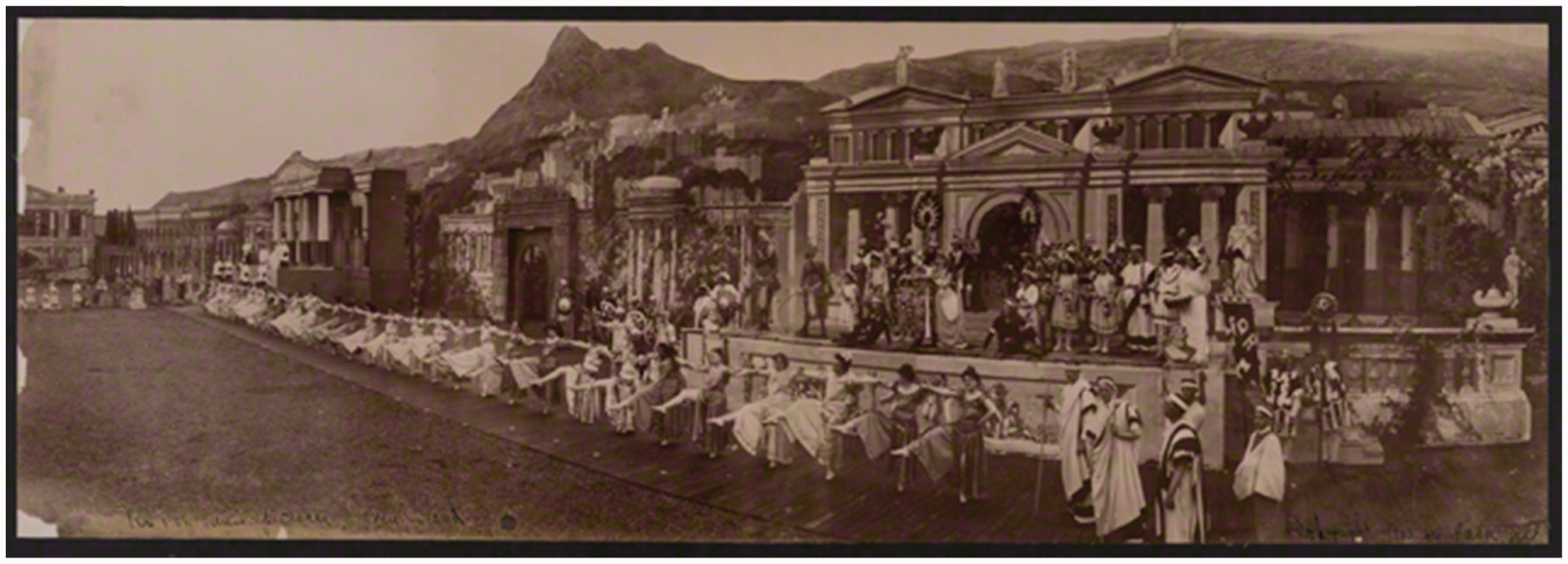
James Pain’s pyrodrama took the volcano show, and the re-creation of the eruption of Vesuvius, back to its origins in 18th-century firework displays (Daly, 2011: 257–61, 276). But it was also an important link in the transformation of Bulwer-Lytton’s The Last Days of Pompeii into moving pictures. The first film on the theme appeared in 1900, and was directed by the English film pioneer Walter R. Booth. Before the mid-century there were nine film adaptations of The Last Days of Pompeii (Daly, 2011: 276; Stähli, 2012; Wyke, 1997: 157–9). Given the popularity of the story in turn-of-the-century visual culture, it was no surprise that it became a recurrent theme in early 20th-century toga films. In some aspects, the process of remediation was as concrete as it could be. For example, in 1907 some of the background designs that Pain used in the pyrodramas on the destruction of Pompeii reappeared on screen in the silent film Ben Hur (Daly, 2011: 277–8; Mayer, 1994: 99).
The history of the remediation of the eruption of Vesuvius and the disaster that followed continues into the 20th and 21st centuries. In 2013 a new exhibition on Herculaneum and Pompeii opened at the British Museum in London. A few months earlier the Getty Museum and the Cleveland Museum of Art had launched an exhibition on the reception history of Pompeii, reflexively entitled The Last Days of Pompeii. Just in the last decade, several other exhibitions on Pompeii’s destruction have toured museums around the world, some of them attracting very large numbers of visitors (Gardner Coates et al., 2012: 242–50; Lapatin, 2012a). These exhibitions in turn enable digital and other media recreations of the eruption, such as the real-time recreation of Pliny’s testimony which was referred to in the introduction. Another example is the BBC production Pompeii: The Mystery of the People Frozen in Time (www.bbc.co.uk/programmes/p016v5g0), which engages modern scientific technologies to reconstruct the impact of the explosive eruption on its victims. Without going into detail, it is reasonable to argue that these recreations remediate previous mediations of the disaster as much as they depend on the character of the event itself. Today, however, the ancient cataclysm is taken to echo contemporary concerns with a new order of extreme nature events connected with climate change.
Temporal Interventions: Deep Time, Repeat Time, Frozen Time
There are five aspects of the organization of time in the history of remediations of the ancient disaster that I would like to emphasize. First, it is worth repeating that an historic event – the eruption of Vesuvius in AD 79 and the devastation of Pompeii – remained one of the most frequently mediated natural disasters throughout the 19th and 20th centuries. New technologies of communication, increasing information speeds, the globalization of telegraph networks, and the flourishing business of news from the mid-19th century onwards (see, for example, O’Hara, 2010; Potter, 2007; Winder, 2010), did not necessarily steer attention towards the present at the expense of the past. Rather to the contrary, I suggest, because when connections between media and genres multiplied, the cultural mechanisms of remediation – and with them the exchange between different temporal dimensions in recreating extreme nature events – intensified. Building on these historical insights, something similar can be argued with regard to contemporary new media practices, and how deep contexts and real-time aesthetics combine in disaster imagery.
A second observation of a more general nature is that recreations of contemporary floods, volcanic eruptions and earthquakes were often made in similar forms as the recreation of historical disasters. Western audiences who experienced the eruption of Vesuvius in early 19th-century panoramas, late 19th-century disaster shows, or early 20th-century films were likely to have seen more recent extreme events reconstructed in a similar way. Through these intermedial and cross-temporal practices natural disasters were made to mirror each other over time.
Third, it is interesting to note that the superimposition of temporal layers – or the time arrows – in late 18th- and 19th-century representations of nature dramas went in two directions. It is well studied how 19th-century social, religious, and political contexts were written into the stories and recreations of the destruction of Pompeii by Bulwer-Lytton and others who in novels, operas, melodramas, paintings and moving images had their critique of modern excess and materialism masquerade in Roman costume (see, for example, Malamud, 2011; Moormann, 2011).
But this interweaving of times also worked in the other direction, so that the past was superimposed on recreations of contemporary events. For example, several 18th- and 19th-century artists working in the exploding genre of the volcanic sublime (cf. Duffy, 2013) incorporated fragments of the story of the ancient cataclysm in depictions of eruptions that they witnessed themselves. Others used their observations of the lava flows from the continuously erupting volcano to refine their classicist paintings of scenes from Pliny. One example was the Scottish artist Jacob More who lived in Rome from 1773. More witnessed a series of eruptions of Vesuvius in the late 18th century. In Mount Vesuvius in Eruption from 1780, he combined his knowledge of the mountain with one of the scenes from Pliny’s first letter on the AD 79 eruption, depicting Pliny the Elder expiring in the arms of two slaves in front of an erupting volcano that was both past and present (cf. Gardner Coates, 2012).
In other volcano paintings from around the turn of the 19th century, the notion of a distance in time between ancient and modern seems to be completely dissolved. Kenneth Lapatin (2012b) points to the intriguing example of a painting from 1824 by Sebastian Pether, bearing the temporally imprecise title Eruption of Vesuvius with Destruction of a Roman City. In the centre of the painting, streams of lava from the erupting volcano run into an ancient city, supposedly Herculaneum. In the left corner, however, a man and woman curiously dressed in early 19th-century fashion are watching the oncoming catastrophe. Given the spectatorial nature of the interest in the ancient disaster, it should not come as a surprise that the act of witnessing the eruption from a distance not only in space but also in time surfaced in recreations of the event.
The extent to which different times intermingled and influenced each other in turn-of-the-19th-century engagement with the AD 79 eruption conveys a strong sense of proximity between past and present. The ease with which the volcanic sublime as well as narratives of cataclysm moved across times cannot be separated from the nature of the event itself. Throughout the 18th- and 19th-century reception of the ancient disaster there is a recurrent sense of dealing with experiences breaking through time. It was as if the explosive force of nature was bringing distant worlds closer to each other precisely by taking them out of time.
This leads to a fourth aspect of the organization of time in the modern engagement with the ancient disaster. A recurrent theme in the 18th- and 19th-century reception of Pompeii and Herculaneum was that the disaster had suddenly interrupted history and brought time to a standstill. Covered in volcanic ash for 1700 years, it was, according to this view, as if the site of the disaster had been preserved outside not only of historical time but also of chronology and the time of nature as well. This was the notion of the ancient cities as moments of history ‘frozen in time’, which – once they were rediscovered – offered immediate access to a distant past. 10
This idea went hand-in-hand with the understanding that, once rediscovered, this frozen moment in time was calling upon the present to set history in motion again. One of the first to repopulate Pompeii was Francesco Piranesi, who had living figures inhabit the ruins of the city in a series of engravings printed in 1804 (Piranesi, 1804). Piranesi’s prints were widely distributed and became, as Jon L. Seydl notes, an important ‘move toward projection and revivification’ in the reception of the ancient cities (Seydl, 2012: 17).
Authors such as Walter Scott and Edward Bulwer-Lytton made a genre out of inserting fictional characters into real historical settings and situations (Hamnett, 2011; St Clair and Bautz, 2012: 364–6). Bulwer-Lytton – who kept two skulls from Pompeii in his private collection, tagged with the names of two of the characters from his own novel – made a point of filling The Last Days of Pompeii with archaeological details, conjuring up connections between individual skeletons found at the site and his fictional characters (Goldhill, 2012: see esp. 93).
In the preface to the first edition of the novel from 1834, Bulwer-Lytton explained that when confronted with the historic site he felt ‘a keen desire to people once more those deserted streets’ and ‘to reanimate [italics added] the bones which were yet spared’. The most important thing, however, was ‘to make the characters introduced “live and move” before the eye of the reader’. To further emphasize his commitment to the historical real, Bulwer-Lytton explained that most of the novel had been written in situ with ‘the fatal mountain of Vesuvius, still breathing forth smoke and fire, constantly before his eyes!’ (Bulwer-Lytton, 1834: v, ix.).
The quickly increasing numbers of visitors to Pompeii approached the ruins through the stories and metaphors that they brought to the site. Soon after the publication of The Last Days of Pompeii, visitors were reported to inhabit the site with Bulwer-Lytton’s fictional characters, looking for the houses that could be located in the plot of the novel (St Clair and Bautz, 2012: 370–1). Coming back to Pompeii in 1843, Mary Shelley wrote that Bulwer-Lytton had ‘peopled its silence’: ‘I have been reading his book, and I have felt on visiting the place much more as if really it had been once full of stirring life, now that he has attributed names and possessors of its houses, passengers to its streets. Such is the power of imagination’ (Shelley, 1841; quoted in St Clair and Bautz, 2012: 371).
The notion of the site of the destruction as a moment frozen in time, and the emphasis on revivification in its early reception, anticipate the more recent move towards recreating the eruption in a digital real-time aesthetic. In the long history of receptions and adaptations of Pompeii – from Piranesi’s engravings and early visitors’ accounts to Pain’s pyrotechnic re-enactments and the reappearance of the disaster in early 20th-century toga films – there is thus a recurrent and pervasive element not only of ‘living history’, but also of the deep past coming alive again after the interruption caused by the disaster.
Fifth, and finally, this takes us back to the issue of mediated time, and especially the history of different modes of real time. As referred to in the introduction to this essay, the relation between mediated forms of liveness and catastrophe – and natural disasters as a privileged object of liveness – is extensively discussed in research on television and digital media. It is therefore important to note that this relation in many ways transcends the history of contemporary media technologies. As exemplified by the long history of receptions of the ancient disaster, notions of immediacy and liveness in relation to disasters evolves over time through intermedial copying and exchange across forms and genres, both within and between historical mediascapes.
Throughout this history we are also reminded of the extent to which almost every new medium has been explored and advertised through recreations of floods, heavy storms, volcanic eruptions, and earthquakes. This connection between disaster and media innovation can equally be traced in, for example, the development of special effects in late 18th-century theatrical volcano shows, the exploration of movement in so-called reconstructed film actualities of natural disasters around the turn of the 20th century, or the new amateur production of moving images of extreme nature events in early 21st century small-screen culture.
This means that the tension between repetition and disruption (and between event and process) that is at the heart of disaster discourse is also reinforced by the process of remediation itself (cf. Ekström, 2012: 473–4). More than anything, this is exemplified by the competing temporalities involved in narratives and visual reports that singularize extreme events and yet draw on genres and modes of address developed over time and across different media.
Conclusion: After the End of Temporality
The main contribution of this essay has been to explore the deep historicity of the modern disaster imaginary, and the interweaving of times in past and present accounts of the catastrophic now. I have argued that the persistence of the ancient eruption of Vesuvius in Western disaster discourse has been established through the history of its remediation. Rather than isolating the present from the past or the future, this ongoing process of cultural and technological mediation creates multiple links between contemporary and historical events. Based on this case-study, I would like to conclude by emphasizing two more general points that arise from it.
The first is the profound historical intermediality and deep contexts of the images of nature emergencies that now abound in contemporary society. This is not to say that the present repeats the past, but an argument about how repetition and disruption (past and present, process and event) coexist in the experience of extreme nature events. The second is the need for a re-temporalization of historical analysis itself. History is a mode of knowledge that is fundamentally about time and cross-temporal relations. This does not automatically mean, however, that historical analysis is conceived of as an investigation of how events and actions are bound up in and affect different temporal scales simultaneously. And yet, this is exactly where history as a form of knowledge feeds into political and environmental concerns with how to imagine and act on the presence of times not yet encountered. Today there are many calls for enlarging the time scales of historical inquiry (see, for example, Guldi and Armitage, 2014), but in this particular respect it is more to the point to reconnect with the strands of modern historical thinking that have taken issue with a linear concept of time, and focused instead on the layering of different temporalities and historical rhythms (see, for example, Jordheim, 2014).
It has been forcefully argued that ours is a time increasingly defined by a ‘temporality of emergency’ (Fassin and Pandolfi, 2010: 10). Political and social theorists, from Beck (1992) to Agamben (2005) and beyond, discuss how this temporal regime shapes contemporary societies by justifying a politics of intervention on a global scale. This tendency is further reinforced by a wider cultural discourse of crisis – or what Adi Ophir (2010) describes as a discursive ‘catastrophization’, a new optics through which society is managed as if in a permanent state of emergency – and the metaphorically as well as objectively connected nature of disasters in late modern society. In the daily flow of news images, this ‘emergency imaginary’ (Calhoun, 2010: 30–2) draws together reports on catastrophes, extreme nature events, conflicts and financial crises into a common frame of reference, emphasizing the sudden and disruptive nature of the events.
But as much as this imaginary is characterized by its focus on the present – introducing a rhythm of crisis into the normal pace of the world – it builds on a long history of spectacular aesthetics. Recent scholarship also suggests that critical emergency thinking in the wake of Carl Schmitt and Agamben, focusing on the politics of exception in the context of contemporary crises, ‘has not been deeply informed by historical studies’ (Orihara and Clancey, 2012: 106). In a case study of the Great Kanto earthquake in 1923 and its consequences in political discourse, Minami Orihara and Gregory Clancey argue that, as a result of this neglect, the importance of natural disasters in the crafting of modern emergency language has been overlooked: ‘Contemporary legal and political writings about emergency nearly always neglect the emergency of nature, as though it were an epiphenomenon of the emergency of state’ (Orihara and Clancey, 2012: 107).
More general discussions on modern temporal experiences and media time have equally tended to isolate the present. In the 1990s, it was widely argued that increasing information speeds, and the experience of a global mediated simultaneity, coincided with a temporal regime exclusively oriented towards the present. For example, cultural theorists such as Paul Virilio persistently insisted that the era of global satellite networks and ‘real-time televised broadcasts’ was ‘mono-chronic’ and technologically forced to privilege the present over the past and the future (Virilio, 1997: 28). 11
In the 1990s, this ‘reduction to the present’, to use Jameson’s term (2003: 709), also resonated with the political discourse on the end of history. This was the no less utopian conception that post-Cold War global capitalism promised to take society out of historical time altogether. In his 2003 essay ‘The End of Temporality’, Jameson suggested that the postmodern fixation with the present was to be understood in relation to ‘the deeper tendency of the socioeconomic order itself […] to reduce the historical dimensions of existential experience as such’ (2003: 713).
However, when temporality now reappears as a theme in different theoretical contexts, this is not motivated by an attempt to restore the subject or to inject a sense of history in contemporary self-perceptions. Rather, this turn derives from a growing sense that life in the early 21st century is punctuated by multiple and conflicting time scales. For example, media theorist Richard Grusin argues that the mediation of extreme events has taken on a new temporality of anticipation. This tendency is visible in the manner in which news services use technologies of immediacy to ‘premediate future catastrophic events’ (Grusin, 2010: 144). In the context of natural hazards and climate-related weather extremes, what Grusin refers to as premediation works in at least two ways. First, expected storms, floods, eruptions and landslides are preceded by extensive media build-ups; and second, such events are increasingly understood as a portent of future disasters.
In Grusin’s view this shift towards premediation is a post-9/11 development, connected with the securitization of politics and everyday life that followed in the aftermath of the war on terror. But in relation to nature emergencies, this prognostic element of contemporary disaster discourse can better be seen as reintroducing the non-modern historical link between nature dramas, on the one hand, and an eschatological notion of time, on the other.
The move into climate times thus brings an emphasis on the present as a conjuncture of different temporalities. How can we think about the coexistence of different times and what can historical analysis bring to such thinking? One concept that comes to mind is what Reinhart Koselleck in his essays on the semantics of historical time describes in terms of ‘the contemporaneity of the noncontemporaneous’. In Koselleck’s work, this notion refers both to the ‘historical depth’ of concepts and the anticipatory or ‘prognostic structure of historical time’ by which some future events ‘are certainly rooted in the present and in this respect are already existent, although they have not actually occurred’ (2004: 95). 12
Reconnecting with and developing such a multi-layered understanding of time now seems more crucial than ever. The temporally distant suddenly looks closer through the lens of anthropogenic climate change. This shift of scale has profound implications for the way we think about history. First, it works as an impulse not only to expand the time frame of historical work but to foster a new sense of the complex layering of historical time; second, it forces us to rethink the nature–culture divide in the modernist conception of historical change; and third, it encourages an exploration of cross-temporal connections and dependencies from a new ground. It is, I suggest, by addressing these fundamental issues that history can contribute to a politics of time that redistributes attention across different temporal dimensions, and that works to redefine the notion of acting at a distance into a relation in time as much as in space.
Footnotes
Acknowledgement
The research for this essay was funded by the Bank of Sweden Tercentenary Foundation (Riksbankens Jubileumsfond), and is part of a larger project called ‘From Pompeii to Fukushima: Time, Intermediality and Transregional Imaginaries in Disaster Discourse’. A first draft of the essay was written and discussed in a seminar during a Visiting Fellowship at the Centre for Research in the Arts, Social Sciences and Humanities (CRASSH) at the University of Cambridge in 2013. I thank my co-fellows at CRASSH, its staff and director (and Bulwer-Lytton fan) Simon Goldhill for their generous support and for creating an ideal atmosphere for cross-disciplinary work. A fuller version of the paper was presented in a keynote for the conference ‘Regimes of Temporality’, organized by Helge Jordheim and Espen Ytreberg at the University of Oslo. Comments and critiques from the audience made an important contribution to my understanding of temporality. I also wish to thank three anonymous referees and the editorial board of Theory, Culture & Society for very helpful comments and suggestions.