




Abstract
While most studies of low-carbon transitions focus on green niche-innovations, this paper shifts attention to the resistance by incumbent regime actors to fundamental change. Drawing on insights from political economy, the paper introduces politics and power into the multi-level perspective. Instrumental, discursive, material and institutional forms of power and resistance are distinguished and illustrated with examples from the UK electricity system. The paper concludes that the resistance and resilience of coal, gas and nuclear production regimes currently negates the benefits from increasing renewables deployment. It further suggests that policymakers and many transition-scholars have too high hopes that ‘green’ innovation will be sufficient to bring about low-carbon transitions. Future agendas in research and policy should therefore pay much more attention to the destabilization and decline of existing fossil fuel regimes.
Climate Change and Socio-Technical Transitions
A recent report by the International Energy Agency warns that: ‘The world is not on track to meet the target agreed by governments to limit the long-term rise in the average global temperature to 2 degrees Celsius’ (2013: 9). In May 2013 carbon-dioxide levels exceeded 400 parts per million, moving steadily towards the 450 ppm threshold that, according to climate scientists, should not be passed in order to have a 50 per cent chance of reaching the 2-degree target. Despite the 1997 Kyoto protocol and various other climate change policies in the last 20 years, global carbon-dioxide emissions have continued to rise (Figure 1). If present trends continue, temperature increase is predicted to be between 3.5 and 5.3 degrees Celsius (IEA, 2013).
Energy-related carbon-dioxide emissions by country (from: Redrawing the Energy Climate Map, World Energy Outlook Special Report ©OECD/IEA, 2013, fig. 1.11, p. 30, source: Boden et al., 2013).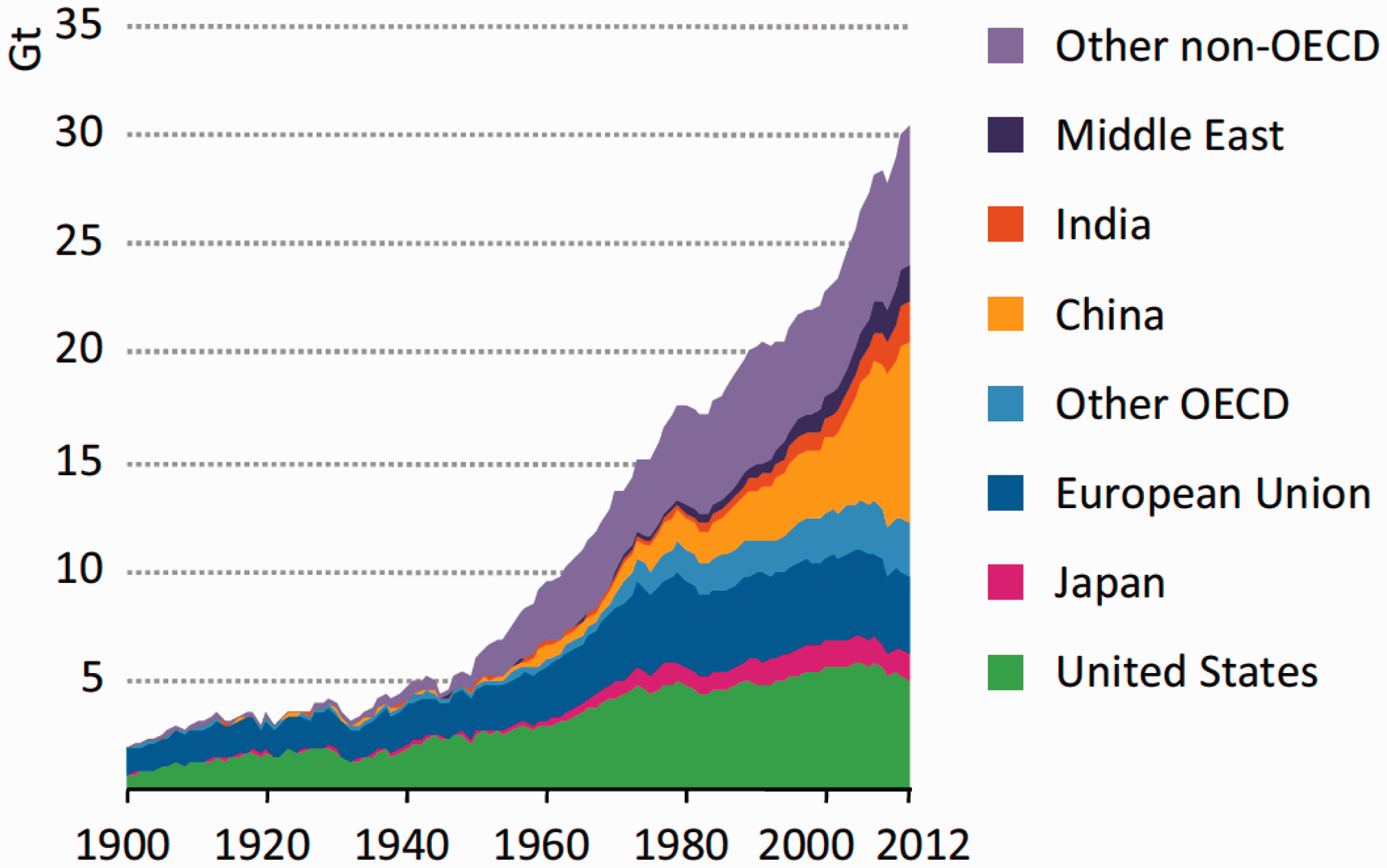
A positive development in Figure 1 is that emissions in the United States and Europe have recently decreased, partly because of the recession and the relocation of manufacturing industries to other countries, partly because of a shift from coal to gas (in the United States) and partly because of increasing penetration of renewable electricity (especially in Europe, where relative contributions increased from 12.2% in 1990 to 22.1% in 2011). In China, India, and other non-OECD countries, however, emissions have been rising very fast because of industrialization, urbanization, increasing car-based transport, increasing coal-based energy and dietary changes (e.g. more meat and dairy). These developments increasingly lead to the realization that addressing climate change (and other environmental problems) requires transitions from existing fossil fuel-based energy, agro-food, and transport systems towards low-carbon systems based on ‘green’ technologies (e.g. wind, solar photovoltaic, battery-electric vehicles, bicycles, organic farming) and new infrastructures, user practices, policies and cultural meanings (Elzen et al., 2004; Verbong and Geels, 2010).
A popular framework to understand the dynamics of such socio-technical transitions is the multi-level perspective (Geels, 2002, 2012; Smith et al., 2005; Geels and Schot, 2007), which understands transitions as arising from the interplay between multi-dimensional developments at three analytical levels: niches (the locus of radical innovations), socio-technical regimes (the locus of established practices and associated rules that enable and constrain incumbent actors in relation to existing systems), and an exogenous socio-technical landscape. 1 In a nutshell, the core logic is that niche-innovations build up internal momentum (through learning processes, price/performance improvements, and support from powerful groups); changes at the landscape level create pressures on the regime; and destabilization of the regime creates windows of opportunity for the diffusion of niche-innovations. The alignment of these processes enables the breakthrough of ‘green’ innovations in mainstream markets where they struggle with the existing regime on multiple dimensions (economic, technical, political, cultural, infrastructural).
While the MLP has been used in many analyses of ‘green’ innovations and transitions, there are various problems in the way this has been done. One criticism is the lack of explicit attention for power and politics that underpin the development and implementation of specific policies (Smith et al., 2005; Meadowcroft, 2011). Second, because most transition-scholars focus on ‘green’ niche-innovations, they pay less attention to existing regimes and incumbent actors, or conceptualize regimes as monolithic ‘barriers to be overcome’. This asymmetry runs counter to the initial MLP-formulations and the emphasis on multi-level alignments. 2 Third, the stability of existing regimes is often conceptualized in terms of lock-in, path dependence, and inertia, sometimes with reference to Hughes’s (1994) metaphor of ‘technological momentum’. It is problematic, however, to portray regimes as following Newton’s second law and to suggest that regime stability is automatic.
Against this background, the paper focuses on existing regimes rather than ‘green’ niche-innovations. The specific contribution to the transitions debate is to conceptualize regime stability as the outcome of active resistance by incumbent actors. Furthermore, the paper will discuss various ways in which these actors use power and politics to resist fundamental transitions to new low-carbon systems.
The paper is structured as follows. The next section discusses how power and politics can be introduced into the MLP, drawing on insights from political economy. The subsequent section adds dynamics by discussing four ways in which regime actors resist fundamental system change, using instrumental, discursive, material and institutional forms of power and resistance. These resistance strategies will be illustrated with examples from the UK electricity system in the last decade.
The UK was chosen for empirical illustrations because successive governments have formulated ambitious climate change targets. The Labour Party made climate change an important issue in the 1997 election campaign. In 2000, an influential report by the UK Royal Commission on Environmental Pollution further catalysed the climate change debate, suggesting the need for a 60 per cent reduction of GHG emissions by 2050. The 2003 White Paper Our Energy Future: Creating a Low-Carbon Economy adopted climate change as a central policy problem and highlighted renewable energy as the most important low-carbon strategy. The 2008 Climate Change Act, which is one of the most ambitious policy frameworks in the world, adopted 80 per cent reduction of greenhouse gas emissions as a long-term goal for 2050, compared to 1990, and a 34 per cent reduction by 2020.
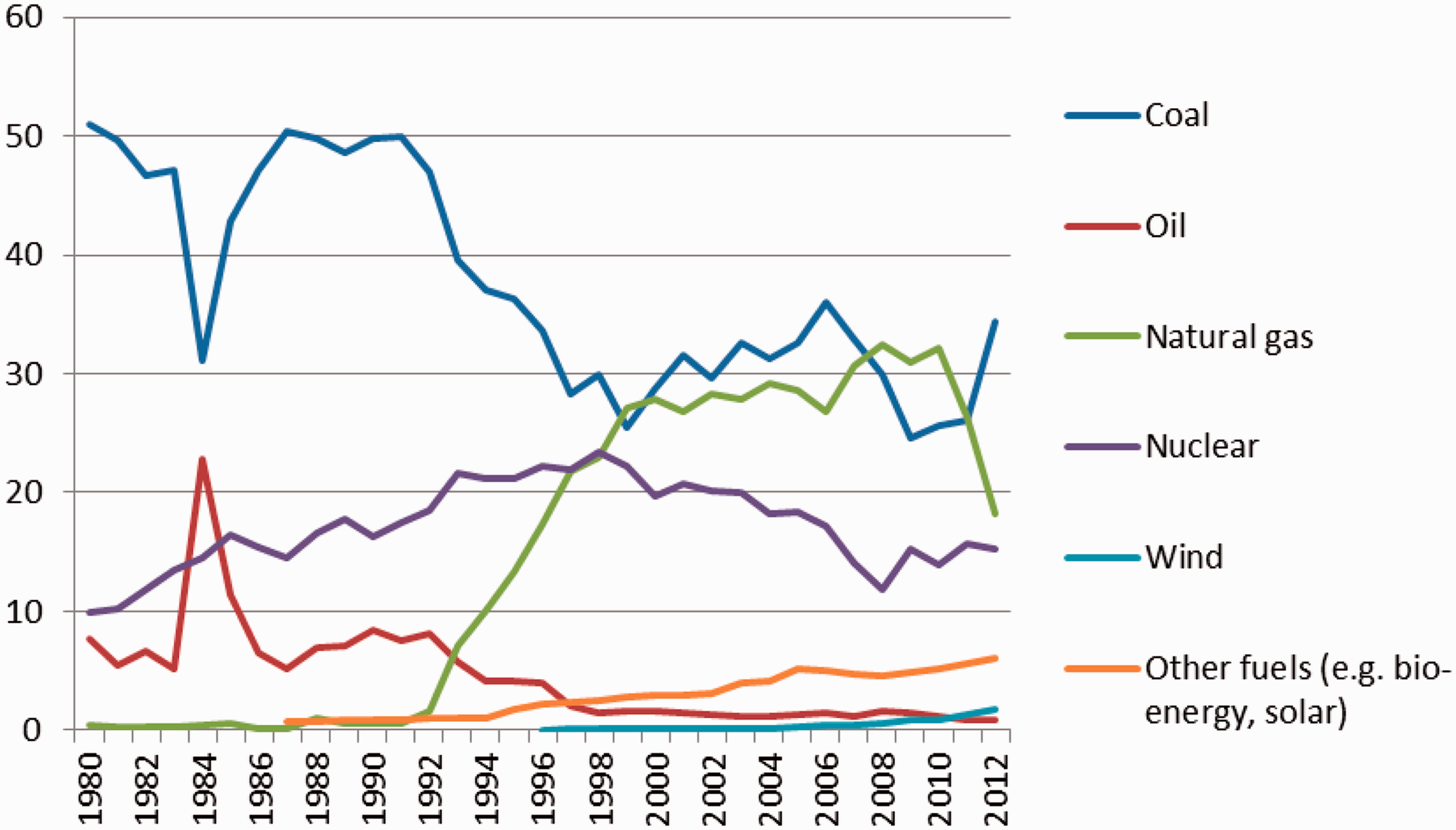
Electricity production was chosen for empirical illustrations, because this sector makes the highest relative contribution (32%) to UK carbon-dioxide emissions. Furthermore, electricity production is often seen as the sector where most progress has been made so far, and where there is most scope for further carbon reductions. Relative electricity production from renewable sources, for instance, has increased from 4.3 per cent in 2005 to 11.3 per cent in 2012. However, overall carbon emissions from electricity generation have not improved between 2000 and 2012 (Figure 2), because of increased coal use, especially between 1999–2006 and 2010–2012 (Figure 3) The coal regime has so far resisted climate change pressures through a ‘clean coal’ discourse and the innovation promise of carbon capture and storage (CCS). Nuclear energy actors also repositioned themselves as low-carbon energy, giving rise to a ‘nuclear renaissance’ discourse. Natural gas has similarly been able to gather new support from the UK government, which is gearing up to ‘become a leader in the shale gas revolution’ in the words of the Chancellor (cited in The Guardian, 19 July 2013). These brief descriptions indicate that the electricity domain is an appropriate sector to provide illustrations of the resilience and resistance of incumbent regimes (coal, gas, nuclear).
UK carbon-dioxide emissions from electricity generation, Mt (constructed from energy statistics data from Department of Energy and Climate Change, https://www.gov.uk/government/uploads/system/uploads/attachment_data/file/193414/280313_ghg_national_statistics_release_2012_provisional.pdf; accessed 22 July 2013). Fuel input to central power generation in the UK, million tons of oil equivalent (constructed from historical electricity data from the Department of Energy and Climate Change; www.decc.gov.uk/, accessed 22 July 2013).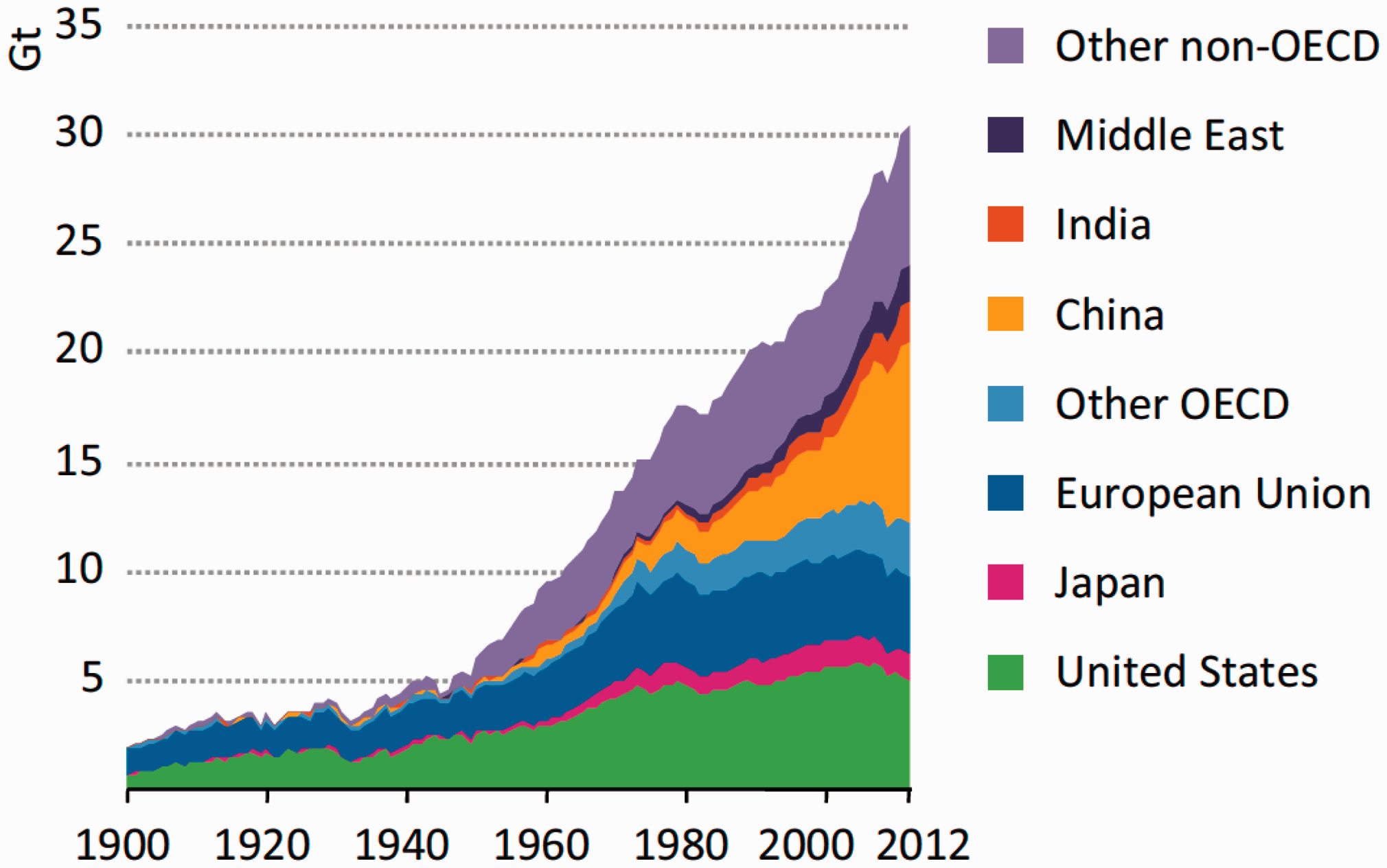
The paper ends with suggestions for a new policy and research agenda. Whereas most attention with regard to low-carbon transitions focuses on stimulating ‘green’ niche-innovations, this paper suggests that it is equally important to understand and enact the destabilization and decline of fossil fuel-based regimes. Phrased differently, this agenda would mean that we should better understand the ‘destruction’ part of Schumpeter’s ‘creative destruction’ concept. The analytical problem is that regime actors will resist this destruction, which is the topic of this paper. Before addressing various resistance strategies, the next section will first discuss ways of introducing power and politics into the MLP.
Introducing Power and Political Economy into the MLP
The socio-technical regime concept contains ‘policy’ as one dimension, in addition to technology, user practices, science, cultural meaning, infrastructure and industry (Geels, 2002). But, as critics have argued, the underlying politics and power have remained under-theorized. One reason for this relative neglect may be that the MLP draws closely on structuration theory, which pays insufficient attention to collective actors because of its emphasis on knowledgeable actors, recursive action and reflexivity (Mouzelis, 1995). Field-level rules and resources can also be shaped, however, through policing, defence or alteration attempts by collective actors such as industry associations, government departments, social movement organizations, and special-interest groups.
To accommodate this in the MLP, it is useful to enrich the regime concept with insights from political economy, which explicitly bring in collective actors and allow for a differentiated view of power, which spans politics, economics and cultural meanings and discourses. The basic idea is that policymakers and incumbent firms can be conceptualized as often forming a core alliance at the regime level, oriented towards maintaining the status quo. This alliance has been noted previously with concepts such as the ‘techno-institutional complex’ (Unruh, 2000) and a ‘historical bloc’ (Levy and Newell, 2002). Empirically, this alliance has also been noted for fossil fuel industries with concepts such as: a) the ‘minerals-energy complex’, which refers to capital accumulation by fossil fuel industries supported by policymakers (Fine and Rustomjee, 1996); b) ‘carbon lock-in’, which refers to the self-perpetuating inertia related to technical, economic and institutional aspects of fossil fuel-based energy systems (Unruh, 2000); c) ‘carbon capital’, which refers to fossil fuel configurations with economic, political, cultural and military dimensions of power (Urry, 2013); and d) a ‘fossil fuel historical bloc’, comprising fossil fuel corporations, industry representative organizations, and governments (Phelan et al., 2012).
The underlying analytical argument is that policymakers and incumbent business actors tend to form close alliances because of mutual dependencies. On the one hand, firms and industries depend on governments for establishing property rights, rules of exchange (obligations of contracts), and general governance structures that establish legal and illegal forms of corporate behaviour (Fligstein, 1996). Governments also support and shape economic sectors in specific ways, e.g. through tariff protection, loans, cash grants, government purchases, patents, tax concessions, information and research services. Highlighting this dependency, Lindblom (2001: 42) therefore quips that: ‘If the market system is a dance, the state provides the dance floor and the orchestra.’
On the other hand, capitalist societies are systematically dependent on economic growth, which implies that a central role of the state is to advance the general interests of capital (Burnham, 1990). Newell and Paterson (1998) argue that big business has ‘structural power’, because states depend on industries to provide jobs, taxes, economic growth and dynamism. I suggest there are, at least, three ways in which firms influence policymakers. First, dependency leads to relational networks and close contacts between big business and senior policymakers, which provide policy access to firms. With regard to fossil fuel industries, Newell and Paterson (1998: 684) found that: ‘Governments routinely consult and take account of the interests of energy lobbies when proposals are being formulated.’ Second, frequent contacts may lead policymakers to internalize the ideas and interests of industries, which is a more subtle mechanism of influence. Market elites and governmental elites may have conflicts about specific policy instruments but generally agree about basic directions, problem definitions and desired solutions (Lindblom, 2001). Third, firms use ‘corporate political strategies’ to influence policymakers, which may contain information strategies, financial incentives strategy, organized pressure strategies, direct lobbying strategy, and confrontational strategies such as litigation (Hillman and Hitt, 1999).
The power of firms to shape specific policies and wider political debates has increased since the 1970 s, first because of the emergence of a pro-business neo-liberal discourse, which highlights free markets, privatization, and de-regulation, and, second, because of the political mobilization of corporate interests in response to social and environmental regulations. For the United States, Barley (2010) showed empirically how firms since the 1970 s have rapidly expanded the creation of foundations, think tanks, political action committees, government affairs offices, public relation firms, and advisory committees to corral governments and shape public opinion. In relation to increasing corporate power Fligstein (1996: 662) notes that ‘laws and accepted practices often reflect the interests of the most organized forces in society’. Lindblom (2001: 223) further warns that the alliance of business and political elites often dominates wider discourses and debates: Compared to those elites, the voices, say, of consumer and environmental groups are infrequent and weak. The voice of labor unions, though strong in some nations, rarely speaks so frequently and loudly as the voices of entrepreneurial and governmental elites. The two elites overwhelm all other contributors to what consequently fails to become an illuminating competition of ideas.
In sum, one way to introduce power and politics into the MLP is to conceptualize relations between policymakers and incumbent firms as a core regime level alliance, which often resists fundamental change. The neo-Gramscian political economy framework, developed by Levy and Newell (2002: 87), suggests that the alliance between policymakers and business can turn into a stable and hegemonic ‘historical bloc’ if it also achieves consensual legitimacy in civil society via widely accepted discourses. This multi-dimensional approach to power suggests that the stability of historical blocs derives from ‘specific alignments of material, organizational, and discursive formations which stabilize and reproduce relations of production and meaning’ (Levy and Newell, 2002: 87). With regard to transitions, this multi-dimensionality means that existing regime actors can defend themselves and resist transitions in various ways, which is the topic of the next section. This resistance is increasingly perceived as important, as highlighted by Hess (2013: 279) in a recent commentary: ‘In the case of the green-energy transition in the twenty-first century United States, the political contestation by the incumbent industrial regime is so well organized that it should be at the center of the analytical framework’.
Regime Resistance against Low-Carbon Transitions
Various distinctions of power.
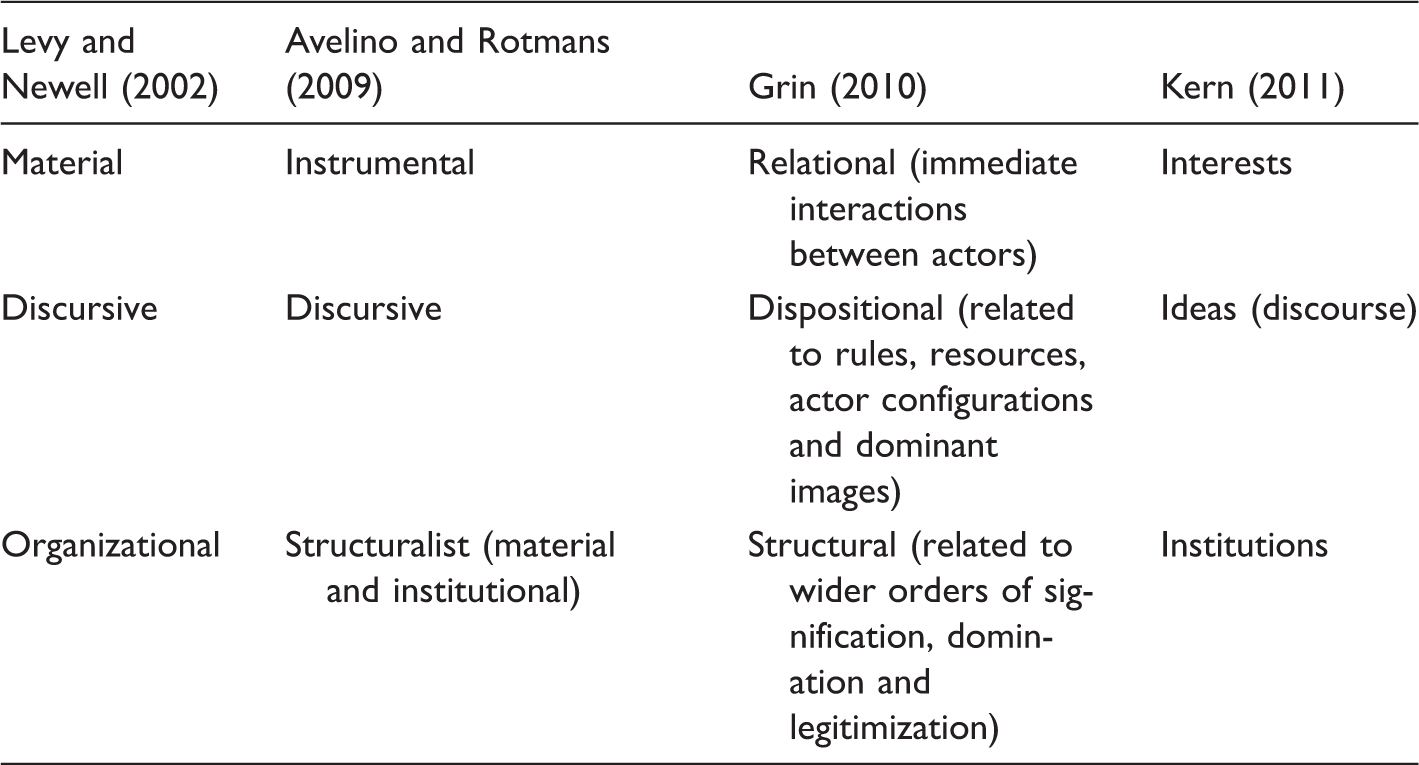
Combining various distinctions, this section will discuss instrumental, discursive, material and institutional forms of power and resistance. The various resistance strategies will be illustrated with examples from the UK electricity sector, where coal, gas and nuclear regimes faced serious challenges from the 2003 White Paper (Our Energy Future) and the 2008 Climate Change Act.
Instrumental forms of power refer to actors using resources (e.g. positions of authority, money, access to media, personnel, capabilities) in immediate interactions with other actors to achieve their goals and interests. Avelino and Rotmans (2009: 559) suggest that ‘the regime usually has more power than niches, in the sense that the regime mobilizes more resources than niches do’.
One example is that Prime Minister Tony Blair used his position and authority to push nuclear energy back on the agenda, after the 2003 White Paper proclaimed that nuclear power was ‘an unattractive option for new, carbon-free generating capacity’ and that possible future decisions to build new nuclear power stations would require ‘the fullest public consultation’. By 2005, Blair began calling for a ‘nuclear renaissance’ as an answer to climate change and rising gas and oil prices. Subsequently, a 2006 energy review (The Energy Challenge) announced plans to build new nuclear stations over the next two decades. Greenpeace challenged these plans, arguing that the government had failed to engage in ‘the fullest public consultation’. In 2007, Greenpeace won its legal case, forcing the government to launch a public consultation. In advance of the consultation, however, Blair announced that he would go ahead anyway, claiming that ‘this won’t affect policy at all’. This example illustrates direct use of power and indicates that the nuclear regime enjoyed protection from the highest political level.
Another example relates to the dubious economic performance of nuclear power plants, which relates not just to operating and construction costs (and notorious budget overruns and construction delays), but also to costs associated with waste storage and processing, decommissioning and accident insurance. Because of these economic uncertainties, utilities have not invested in nuclear power since energy sector privatization in the 1990s. Having decided to push through nuclear power in the mid-2000s, politicians faced the difficult task of persuading private firms to invest and reassuring the public that the tax payer’s money would not be wasted. To address this task, politicians first promised the public that nuclear energy would not be subsidized, but subsequently broke this promise in negotiations with EDF (Electricité de France), agreeing to pay a high guaranteed electricity price (twice the current wholesale price) for 35 years. To disguise their ploy, politicians called this subsidy a ‘contract for difference’.
Regime actors can also resist via discursive strategies, which can be powerful when they result in dominant discourses that shape not only what is being discussed (thus setting agendas) but also how issues are discussed. Although social movement organizations, citizens, labour unions and other groups also try to shape public discourses, the ‘discourse coalition’ (Hajer, 1995) of policymakers and incumbent firms is particularly powerful in this respect (Lindblom, 2001), because of their positions and media access. Building on Snow and Benford (1988), I suggest that regime resistance can occur on three different framing dimensions: a) diagnostic framing, which identifies and defines problems; b) prognostic framing, which advances solutions to problems; and c) motivational framing, which provides a rationale for action and serves as a ‘call to arms’. For each dimension, examples will show how framings have changed since the 2003 White Paper in ways that enhance the legitimacy of existing regimes.
The diagnostic framing changed in terms of problem definitions and policy goals. The 2003 White Paper portrayed climate change as the central problem and renewable energy as the main solution. Since about 2005, however, energy security and affordability (low costs) have been emphasized as additional, and perhaps even more important, problems. These changes were partly related to rising oil and gas prices (Figure 4) and Russian gas supply problems (related to a 2005 conflict between Russia and Ukraine), but also benefitted existing regimes.
Average fuel prices (pence per kWh) paid by UK power producers (constructed from energy price statistics data from the Department of Energy and Climate Change; https://www.gov.uk/government/uploads/system/…/qep_mar_2013.pdfhttp://www.decc.gov.uk/assets/decc/Statistics/publications/prices/1085-qepdec10.pdf; accessed 22 July 2013).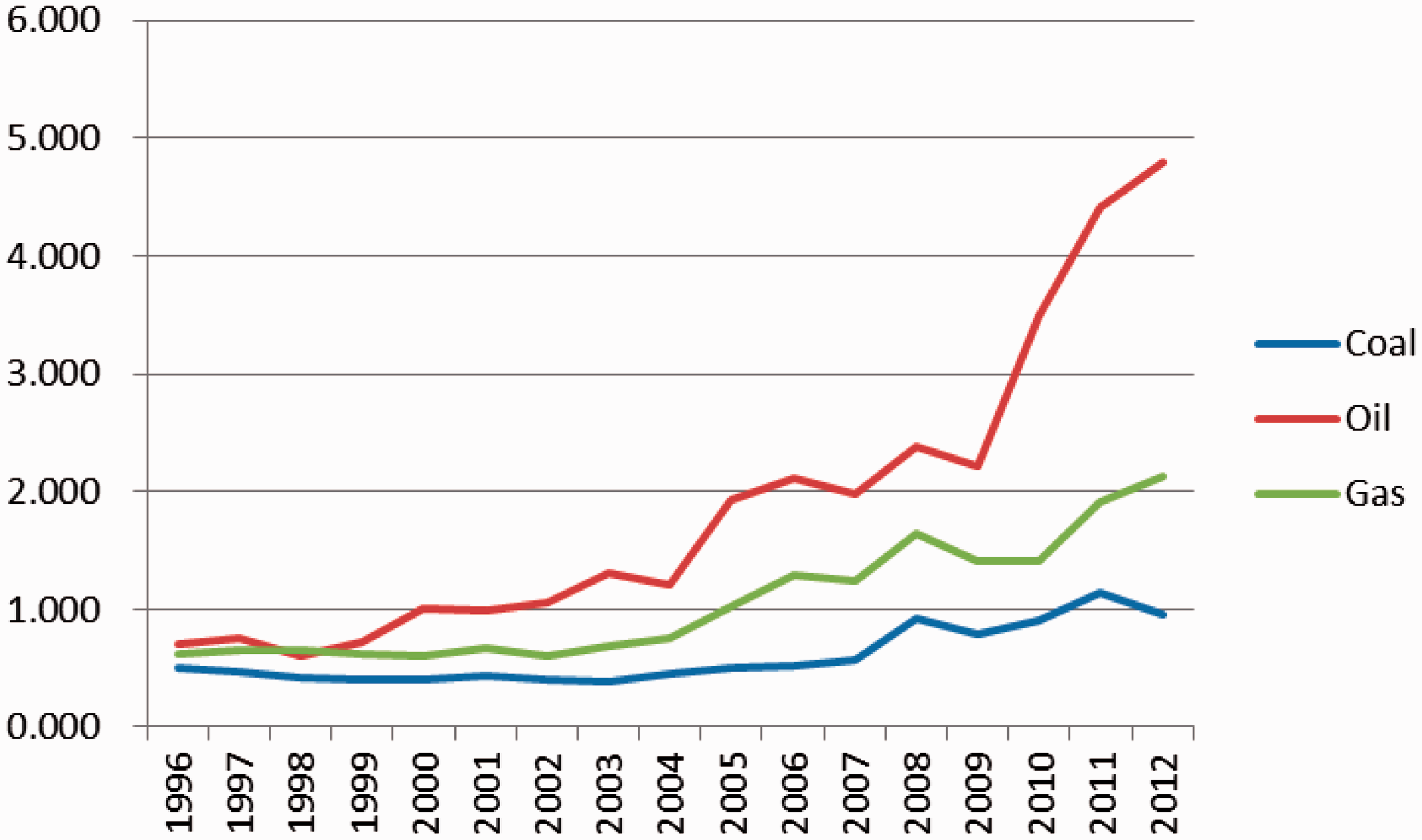
Coal was increasingly (re)positioned as an answer to energy security and affordability, as is visible in the explanation of the trade and industry secretary (Alan Johnson) of the government’s decision to stimulate coal: ‘If a new, cleaner coal generation is viable, then I think it could have an important part to play in making sure we have diverse generation in the future. Coal is easy to store and it comes from a variety of well-established sources around the world’ (reported in The Guardian, 21 February 2006). Low prices also made utilities more interested in coal, leading to increased coal use between 1999–2006 and 2010–2012 (Figure 3).
Nuclear power, in turn, became framed as a possible answer to energy security and climate change. For example, David King, the Government’s Chief Scientific Advisor, argued that: ‘We need indigenous sources so we don’t rely on imported gas from Russia.… Indigenous supplies include all renewables and nuclear. Relying on renewable sources to replace lost capacity when existing nuclear power stations close would be a tough challenge’ (reported in The Guardian, 21 October 2005).
These discursive changes became embedded in the 2007 White Paper (Meeting the Energy Challenge), which established energy security and affordability as strategic policy issues besides climate change. It also endorsed nuclear power and carbon capture and storage (CCS) for fossil fuels (coal, gas) as low-carbon options, in addition to renewables.
Affordability, jobs, and employment have gained salience since the financial-economic crisis. These new concerns have been used to criticize renewable options, as noted by Pearson and Watson (2012: 31): ‘The public debate about energy has started to focus on the costs of the low carbon transition’. These concerns are also used to legitimate increasing use of cheap coal since 2010 and the UK’s new focus on shale gas which, according to the Chancellor, ‘has the potential to create thousands of jobs and keep energy bills low for millions of people’ (cited in The Guardian, 19 July 2013). These examples indicate that the diagnostic discourse (problems and goals) has changed in favour of coal, gas and nuclear regimes.
In the autumn of 2013, consumer bill rises of 8–10 per cent led to a rapid politicization of the energy debate, after Labour promised to freeze energy bills for 20 months if it was elected in 2015. Although the political discourse initially focused on pricing policies of utilities, the government and electricity firms managed to reorient the debate towards green levies and eco-efficiency programmes, which were subsequently scrapped, delayed or watered down in exchange for utilities promising to cut energy bills by £50. So, the politicization of energy bills and fuel poverty led to a substantial weakening of green ambitions and policies, which fits well with vested regime interests.
The prognostic framing changed in the sense that renewable energy, which the 2003 White Paper advocated as the main solution, was increasingly positioned as one of the options besides nuclear energy and CCS (for coal and gas), for instance, in the 2007 White Paper. Another, more subtle dimension of the new framing was that the proposed solutions (including large offshore windparks) mainly entail large-scale technical options, which fit relatively well with the practices and interests of utilities and national governments. Other potential transition pathways are side-lined or marginalized on policy agendas (both in terms of attention and funding). One such alternative pathway consists of civil society initiatives, for example the Transition Towns movement in which citizens develop local projects (e.g. low-carbon lifestyles, eco-housing projects, local car-sharing projects) in response to climate change and peak oil concerns. The Transition Town movement started in 2007 in the UK, and now claims to encompass more than 400 projects in many countries. Another example are the hundreds of UK community energy projects, in which local neighbourhoods develop initiatives to generate their own energy with wind turbines, solar panels, and biomass digestion (Walker and Devine-Wright, 2008).
Urban initiatives form another kind of alternative transition pathway (Bulkeley, 2010), focusing, for example, on co-generation of heat and power (e.g. Aberdeen, Birmingham, Milton Keynes) or on local renewable energy generation with wind turbines or biomass digestion (e.g. Birmingham, London, Manchester). These urban initiatives, of which there are dozens in the UK, are enacted by professional actors such as transport planners, urban planners, and civil engineers employed by public works departments, who can act as ‘system builders’ in specific localities. Both alternative pathways concern transitions ‘on the ground’, entailing interactions between firms, citizens, policymakers, and social movements. These pathways focus less on ‘upstream’ large-scale technologies and more on reconfiguring local energy and transport systems. These alternative transition pathways receive less attention and resources, which shows that the dominant prognostic discourse privileges the interests of centralized incumbent actors rather than those of less organized and local actors. 3
The motivational framing changed in the sense that public concerns about climate change have weakened since the financial-economic crisis. A word-count analysis of British newspapers (Figure 5) shows that public attention to climate change increased from 2004 to 2008–2009, fuelled by events such as Hurricane Katrina (2005), Al Gore’s movie An Inconvenient Truth (2006), the Stern Review (2006), and the Fourth Assessment Report from the International Panel on Climate Change (2007). But public attention subsequently nose-dived, because of concerns about austerity and unemployment. A public attitudes survey by the UK Department of Energy and Climate Change (March, 2012) confirms that most citizens now worry more about economic issues than about climate change. The sense of urgency and motivation to enact a low-carbon transition has similarly decreased, with policymakers now paying more attention to issues such as the costs of energy transitions, energy prices and new jobs, which are promised in relation to shale gas.
Yearly number of articles in UK national newspapers containing the words ‘climate change’.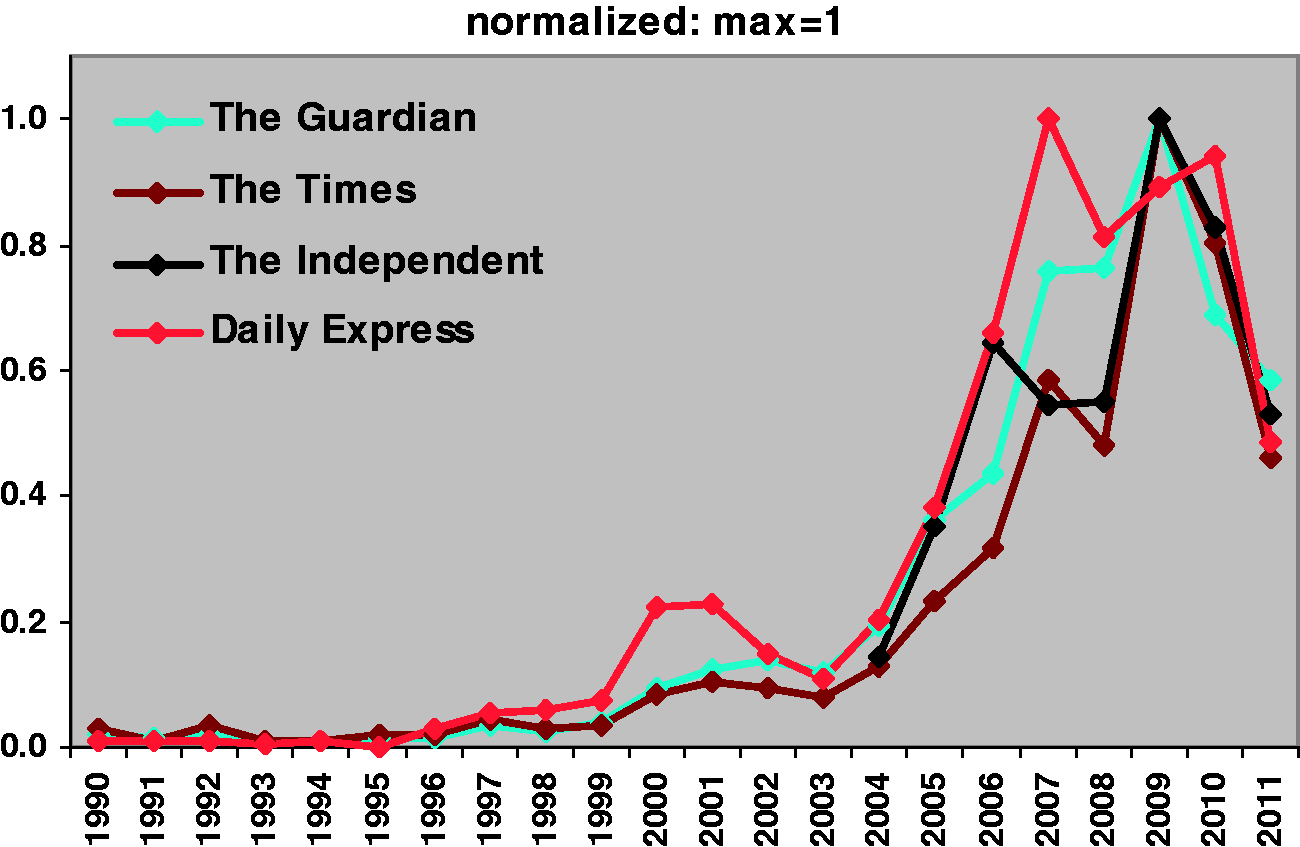
One indication of the change in motivation is mounting criticism of the 2008 Climate Change Act, which enshrined ambitious carbon targets in law. Chancellor George Osborne, for instance, argued at the Conservative Party conference (2–5 October 2011) that the UK should not pursue green policies that would ‘pile costs on the energy bills of households and companies’ and might put the country ‘out of business’. He further suggested that the UK’s post-2020 carbon targets should be subject to review and pledged that the UK should not cut carbon emissions faster than other European countries. Another indication is that on 21 November 2013 Prime Minister Cameron apparently ordered his aides to ‘get rid of all the “green crap”’ (i.e. green levies and eco-efficiency programmes) to reduce energy bills. Both examples are not just indications of weakening political motivation, but also an instance of the common tactic to use economic problems to argue for a weakening of social or environmental policies. 4
Regime actors can also defend themselves with material strategies, drawing on technical capabilities and financial resources to improve the technical dimension of socio-technical regimes. These technical innovation efforts are often accompanied by promises and discourses (Van Lente, 1993), which can be used to attract attention and resources from external funders or to ward off possible regulation by promising that solutions are ‘just around the corner’. 5
A salient example concerns technical innovation in coal-fired power generation, e.g. flue gas desulfurization devices, supercritical pulverized coal technologies, coal gasification, and carbon capture and storage (CCS). These innovations, particularly CCS, gave rise to a ‘clean coal’ discourse, which the government used to legitimate its support for coal. Although CCS is now technically feasible, there is much uncertainty about commercial viability. Utilities are not keen to deploy the technology and look for government support and hand-outs (Bowen, 2011). The 2007 White Paper therefore provided a £1 billion subsidy for a large-scale CCS demonstration programme. In 2008, four consortia (Peel Energy, BP, E.ON, Scottish Power) showed an interest in participation. But subsequent negotiations proved difficult and, in October 2011, the last consortium pulled out. Nevertheless, the government continues to assume that CCS will diffuse widely in the coming years. Opponents, however, argue that CCS is a technological promise that will never materialize and is used to delay carbon abatement. The latest part of this controversy is the proposal by CCS proponents that new-built coal plants can be designed to be ‘capture-ready’, so that firms can add CCS when it becomes feasible in the future (Bowen, 2011). But opponents see this as a flimsy promise, which the industry uses to get permits to build new coal-fired plants. They fear that ‘capture-ready’ plants will never retrofit CCS because of the high costs involved. So far, however, CCS and associated promises have effectively defended coal-fired power plants against climate change threats.
The fourth kind of resistance relates to broader institutional power, which is embedded in political cultures, ideology and governance structures. These wider institutional contexts facilitate the strategies of incumbent actors and thus assist regime resistance. For example, the UK has a liberal market economy (Hall and Soskice, 2001) in which the perceived role of the state is limited to rule-setting and where coordination of activities occurs mainly via market competition. The presumed failure of ‘picking winners’ in the 1970s and 1980s led to a preference for the market to decide about innovations, including low-carbon options. While this ideological hands-off approach sounds neutral, it in effect means that the government privileges powerful regime actors with more capabilities, financial resources and established market positions. It also means that the government is reluctant to take action when market trends go in ‘wrong’ directions, e.g. when price developments (Figure 4) lead utilities to steeply increase their coal use, as has happened since 2010 (Figure 3), even though this development clearly undermines carbon reduction efforts.
The liberal market economy also means that policymakers sympathize with businesses and often identify with their goals and problems. This fits well with a UK policy culture, which Bailey (2007) characterizes as a paternalistic and technocratic style of decision-making dominated by techno-economic arguments and cost-benefit analyses; informal consultation networks that give industry groups privileged positions as providers of technical knowledge and advice, with limited access for outsiders to close-knit policy networks. This policy style has made UK policymakers more skilful in dealing with incumbent firms and technical experts than with citizens, cities, and social movements, which helps explain why large-scale technical options receive more attention and funding than alternative transition pathways.
The political dimensions of these preferences are masked by a ‘post-political’ discourse, which frames climate change and low-carbon transitions as a techno-economic management challenge. This post-political discourse avoids the ‘agonistic confrontation of competing visions of a different socio-ecological order’ (Swyngedouw, 2010: 226), and instead presents the preferred pathway as the only alternative. Stirling (2010) criticizes this de-politicization of low-carbon transitions with reference to an article in The Independent (13 July 2006) by David King, the Government’s Chief Scientific Adviser, which was titled: ‘Why We Have no Alternative to Nuclear Power’. With regard to this article, Stirling (2010: 1624) argues that: ‘The crucial role for deliberate social choice is seriously downplayed by current official and incumbent discourses in energy policy. Senior figures routinely understate the scope for agency, for instance promoting nuclear strategies for the paradoxically contradictory reasons that there is “no alternative”.’ So, while claiming to follow neutral expert advice, the government often supports low-carbon options that fit incumbent interests.
This post-political technocratic style therefore favours existing regimes and makes it difficult to open up choices for wider political and cultural debate, which again helps explain why alternative transition pathways are side-lined. In the second half of 2013, energy policy suddenly became highly politicized, first because of heated local opposition against fracking and shale gas, and second because of a controversy about energy bills. Neither issue did, however, lead to an open debate about different low-carbon futures. With regard to shale gas the government pushed ahead, dismissing opponents as uninformed NIMBY-activists (‘not in my backyard’), and attempting to ‘bribe’ local authorities by promising them 1 per cent of revenues. With regard to energy bills, both Labour and the Conservative Party tried to position themselves as being on the side of consumers, promising a price freeze or reduction, rather than using the concerns to start a broader debate about pros and cons, costs and benefits of low-carbon energy transitions. Despite the political heat, both debates thus remained technocratic, closed in terms of participation, and narrow in terms of framing, which suited existing regime actors.
Conclusions and Wider Implications
The previous discussion has shown how incumbent regime actors in the UK have used instrumental, discursive, material and institutional forms of power to resist climate change-related pressures and to reposition themselves for low-carbon futures without fundamental system change. The discussion also showed the usefulness of the paper’s contributions to the socio-technical transitions debate: 1) seriously studying regime dynamics, rather than focusing only on green niche-innovations; 2) conceptualizing existing regime actors as actively resisting fundamental change, rather than as locked-in and inert; and 3) introducing power and politics into the MLP, both in a general sense, by articulating relations between incumbent firms and policymakers at the regime level, and in a specific sense, by distinguishing four ways in which regime actors can mobilize power to resist fundamental change.
To finish the paper, I discuss wider empirical implications for low-carbon transition and implications for future research. With regard to low-carbon transitions in the UK electricity system, the paper has shown that the resistance and resilience of fossil fuel regimes largely negated positive developments such as increasing power generation from renewables. This finding also has relevance for global electricity generation, where coal-fired generation increased by 45 per cent between 2000 and 2010 to almost 8700 TWh, leaving coal as the main source of electricity generation by far. Despite climate change debates and policies, coal’s relative contribution to electricity generation expanded from 39 per cent in 2000 to 42 per cent in 2010 (IEA, 2013). Renewable electricity sources have so far been mainly additional to fossil fuels with no (or limited) substitution effects. So, the resistance of existing regimes is clearly hindering the progress of low-carbon transitions. Although climate change has been a high-level policy issue since the 1997 Kyoto protocol, carbon-dioxide emissions continue to increase, leading the International Energy Agency (2013) to conclude that the world is not on track to meet the 2-degree target. Despite this policy failure, incumbent regime actors such as national governments and utilities remain firmly committed to nuclear, gas and coal (with the promise of CCS).
The resistance and expansion of fossil fuel regimes is a major problem, because they rapidly consume the remaining ‘carbon budget’. Climate scientists have calculated that carbon-dioxide concentrations should stay below 450 parts per million (ppm) to have a 50 per cent chance of staying below the 2-degree target (Berners-Lee and Clark, 2013). The remaining ‘carbon budget’ associated with 450 ppm is about 1440 Gt of carbon-dioxide, of which 420 Gt has already been emitted between 2000 and 2011 (International Energy Agency, 2013). Because another 136 Gt is estimated to be emitted from non-energy-related sources before 2050 (e.g. from agriculture), the remaining budget is about 884 Gt carbon-dioxide by 2050 (International Energy Agency, 2013). The big problem is that the world’s proven fossil fuel reserves are much larger than the 884 Gt carbon budget, namely about 2800 Gt (International Energy Agency, 2013), with about 1870 Gt coal, 610 Gt oil, and 410 Gt gas. 6 So, the resistance of existing fossil fuel regimes is a major threat, because if the world burns all these reserves, the 2-degree target will be far exceeded (Berners-Lee and Clark, 2013).
In terms of conceptual and policy agendas this means that discussions of low-carbon transition should not just focus on stimulating ‘green’ alternatives but also on preventing existing fossil fuel reserves from being burned or on stimulating the widespread adoption of CCS. At present, policymakers (and many academics) have high (probably unrealistic) hopes that ‘green’ innovation will be sufficient to bring about low-carbon transitions. While stimulating green alternatives remains important, a strong focus on new innovations may serve to protect existing regimes by detracting attention from the fossil fuel burning problem. So, an important topic for future research is to better understand not just regime resistance but also the destabilization and decline of existing regimes, i.e. the ‘destruction’ part of Schumpeter’s ‘creative destruction’ concept (see Turnheim and Geels, 2013, for initial conceptualizations and research). While Schumpeter mainly saw new technologies as drivers of creative destruction, I suggest that socio-political struggles with fossil fuel companies and other incumbent firms (e.g. electric utilities, car companies) will be crucial in the case of low-carbon transitions. In fact, politically-inspired regime destabilization may be necessary to create opportunities for the wider diffusion of renewables, which now face uphill struggles against resistant regimes, as this paper has shown. So, rather than following the normal ‘David versus Goliath’ storyline, in which heroic green innovations overthrow the giant, this new agenda would shift the analytical agenda to better understand how ‘Goliath’ can be weakened, eroded and destabilized, to enhance the chances of green Davids.
Another important topic for future research is to better understand the rise of alternative ‘Davids’, i.e. not just upstream green electricity production technologies (e.g. wind, solar, bio-energy), but also broader socio-technical innovations such as the civil society and urban initiatives discussed above. This would entail a relative shift from the dominant STI-mode of innovation (Science, Technology and Innovation), which emphasizes upstream research and development investment in ‘green’ technologies, to a DUI-mode of innovation (Doing, Using and Interacting) (Jensen et al., 2007), which emphasizes ‘learning by doing’, ‘learning by using’ and broader social interactions in green reconfigurations of concrete transport and energy systems. Although these broader innovations have more sustainability promise, such a shift in the mode of innovation is likely to be resisted by incumbent regime actors, which underlines the importance of the topic of this paper.
Footnotes
Acknowledgements
I would like to thank five reviewers, the special issue editors (John Urry and David Tyfield) and the TCS editors for their very insightful and constructive advice on a previous version of this paper. The underlying work for this paper has been supported by a grant (number 603942) from the European Commission for the research proposal ‘Exploring Transition Pathways to Sustainable, Low Carbon Societies’ and by the Centre for Innovation and Energy Demand, funded by an EPSRC/ESRC grant (number EP/KO11790/1).
Notes
 ) and one of the world-leading scholars on socio-technical transitions and radical innovation.