




Abstract
In this paper, an effective procedure of shaping the vibro-isolation properties of seat suspension system is presented. The simulation model is created to determine the dependence of evaluation criteria to the design parameters by means of which the system characteristics are formed. The developed optimisation procedure allows to find Pareto-optimal system configuration for the conflicted vibro-isolating criteria, i.e. the frequency weighted transmissibility factor used to evaluate dynamic seat comfort based on acceleration signals and the suspension travel. In order to optimise both the conflicted vibro-isolation criteria, a minimising of the transmissibility factor (primary criterion) is proposed taking into account the suspension travel that is transferred to a non-linear inequality constraint. The correctness of proposed procedure is evaluated using experimental research of the best solution of horizontal seat suspension. This research is performed using the passive system with optimal visco-elastic characteristics, which are selected especially for the well-defined input vibration. The satisfactory agreement of experimental and numerical results is obtained for the analysed vibration reduction system.
Introduction
The design process of seat suspension systems is difficult due to the conflicted criteria for evaluating their effectiveness. For example, it is desired to limit the vibrations transmitted from the cabin floor to the machine operator of the earth moving machinery. 1 Then the vibration isolation of operator can be realised by using a seat suspension. 2 On the one hand, the seat motion regarding the inertial reference point should be minimal to protect the machine operators against harmful vibrations.3,4 In order to control the seat vibration, the transmissibility factor can be calculated as a percentage ratio of the frequency-weighted acceleration on the seat surface to the frequency-weighted acceleration on the floor. 5 As the risks to health from whole-body vibration is not the same at all frequencies, the frequency weightings are used to represent the varied sensitivity of the human body in different frequency ranges. 6 Unfortunately, only this kind of vibration control contributes to the increase of the suspension travel. 7 A machine operator can lose contact with control gears mounted to the cabin, so the controllability of such machines becomes difficult. On the other hand, the suspension travel has to be minimised as well. Both these objectives conflict, therefore an improvement in one objective requires a degradation of another.8,9 Consequently, the design of seat suspension systems can be treated as an optimisation problem.10,11
The main goal of the multi-criteria optimisation approach is to find the compromising solutions between several conflicted criteria. Such compromising solutions guarantee the best system performance for the opposite objectives. There are some works presented in the existing literature wherein seat suspension systems are considered in relation to the conflicted system requirements. In the papers,12,13 the most ‘comfortable’ trade-off between the effective acceleration of isolated body and the relative displacement of suspension system is selected with the help of weighted sum method. In the paper, 14 a constraint method is employed to solve the problem of the multi-objective optimisation of passive seat suspension vibro-isolating properties. However, an application of the Pareto-optimal approach has been used for selecting dynamic characteristics of seat suspension systems, and it has been employed only for improving vertical whole body vibration isolation. The research presented in the papers15–17 clearly shows that the horizontal seat suspensions are ineffective in many cases. Although they provide energy dissipation at the sufficiently high frequencies, the low-frequency vibrations are amplified due to the resonance effect. As the consequence of this undesirable effect, it is difficult to achieve the minimum health and safety requirements regarding the exposure of workers to the risks arising from the horizontal vibrations. 18
The objective of this paper is to formulate and verify an appropriate method for selecting the vibro-isolation properties of horizontal seat suspension. At first, a model of the seat suspension system and the isolated body is created in order to determine the values of conflicted vibro-isolation criteria. Secondly, the optimisation procedure is proposed that ensures finding a set of the compromise solutions (Pareto-otimal solutions). The proposed procedure allows to adjust the vibro-isolation properties of horizontal seat suspension for the individual requirements defined by the driver. The required configurability of passive systems is obtained by proper selecting their non-linear visco-elastic characteristics.
Model of the horizontal suspension with seated human body
In Figure 1(a), a physical model of the horizontal suspension with seated human body is shown. A simple 3-DOF model is employed to describe the biodynamic response of the system – seated human body and cushioned seat.
19
The object of vibration isolation is assumed as the lumped mass body which consists of three interconnected masses by means of linear springs and dampers. The first mass corresponds to the seat upper part frame ( Physical model of the horizontal seat suspension with seated human body (a) and laboratory experimental set-up (b).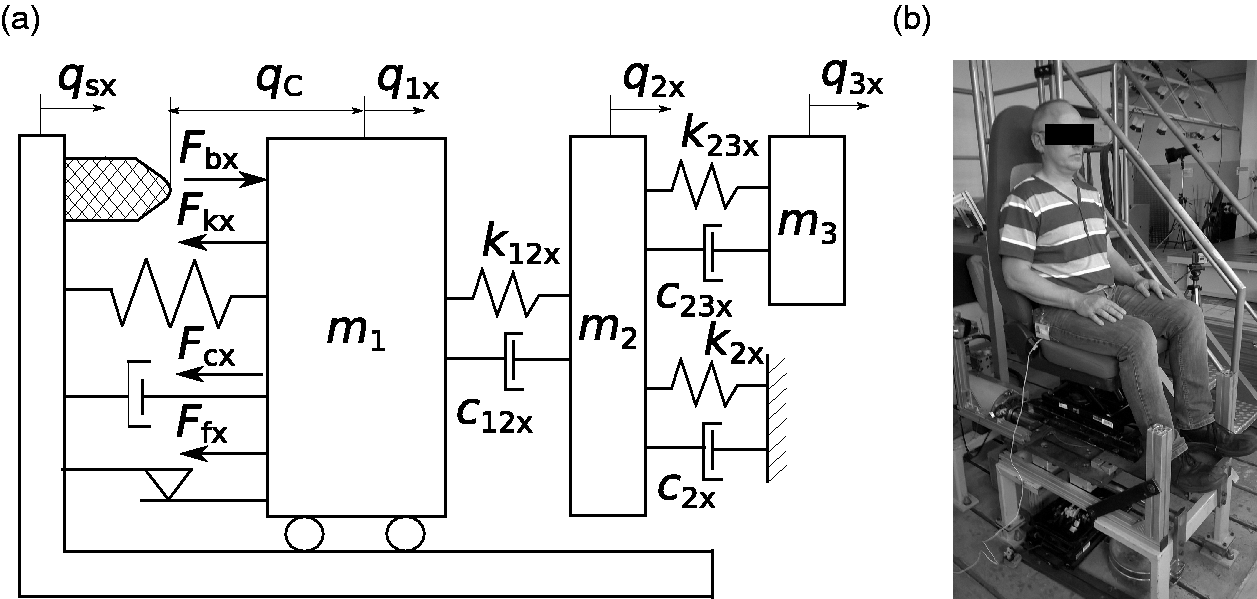
The corresponding equations of motion are defined in the matrix form as follows



Numerical values for the model parameters – seated human body and cushioned seat. 19
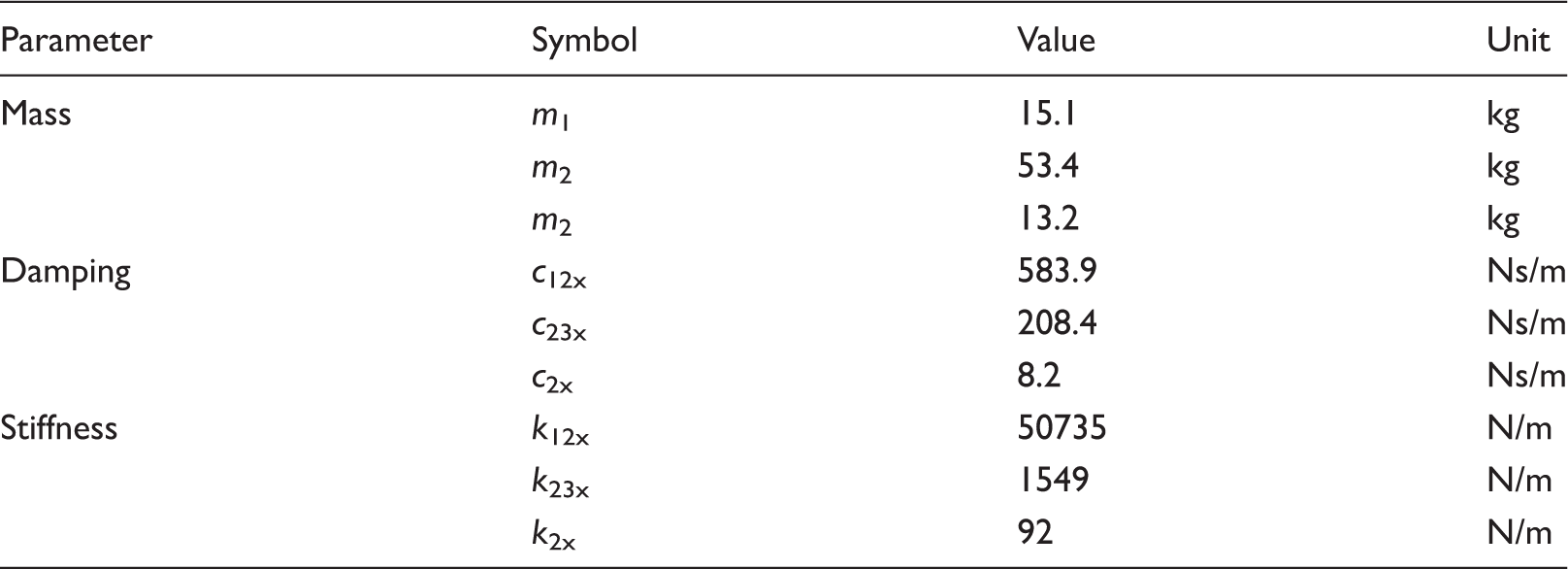
The vectors describing the human body displacements and applied forces are set in the following order:

Assuming pure torsion of the coils, the mechanical spring force can be described as a function of the suspension deflection 
The force of end-stop buffer is described using a combination of the equivalent linear and non-linear springs
21
acting only in a specified range of the suspension travel

The shock-absorber force is related to the pressure loss across a simple throttle valve.22,23 The pressure loss is connected with the volume flows 
The 

The Reynolds number (
In order to simulate the dynamic behaviour of seat suspension system, the Coulomb friction model is characterised by a discontinuous arrangement in the following form
26

According to the Bouc–Wen model, the kinetic friction force 

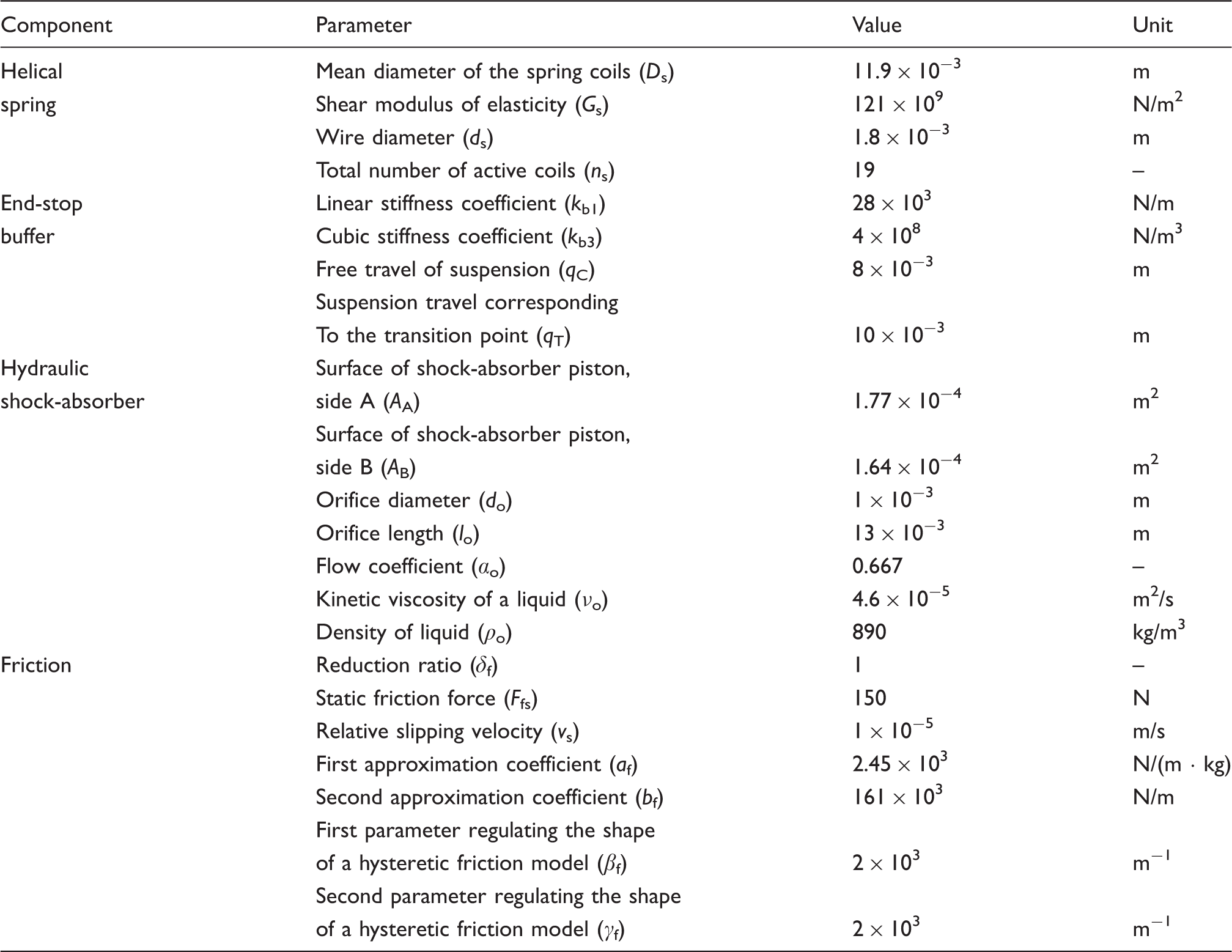
Nominal parameter values used by the horizontal seat suspension model.
Nonlinear shaping of the force characteristics: Force characteristics 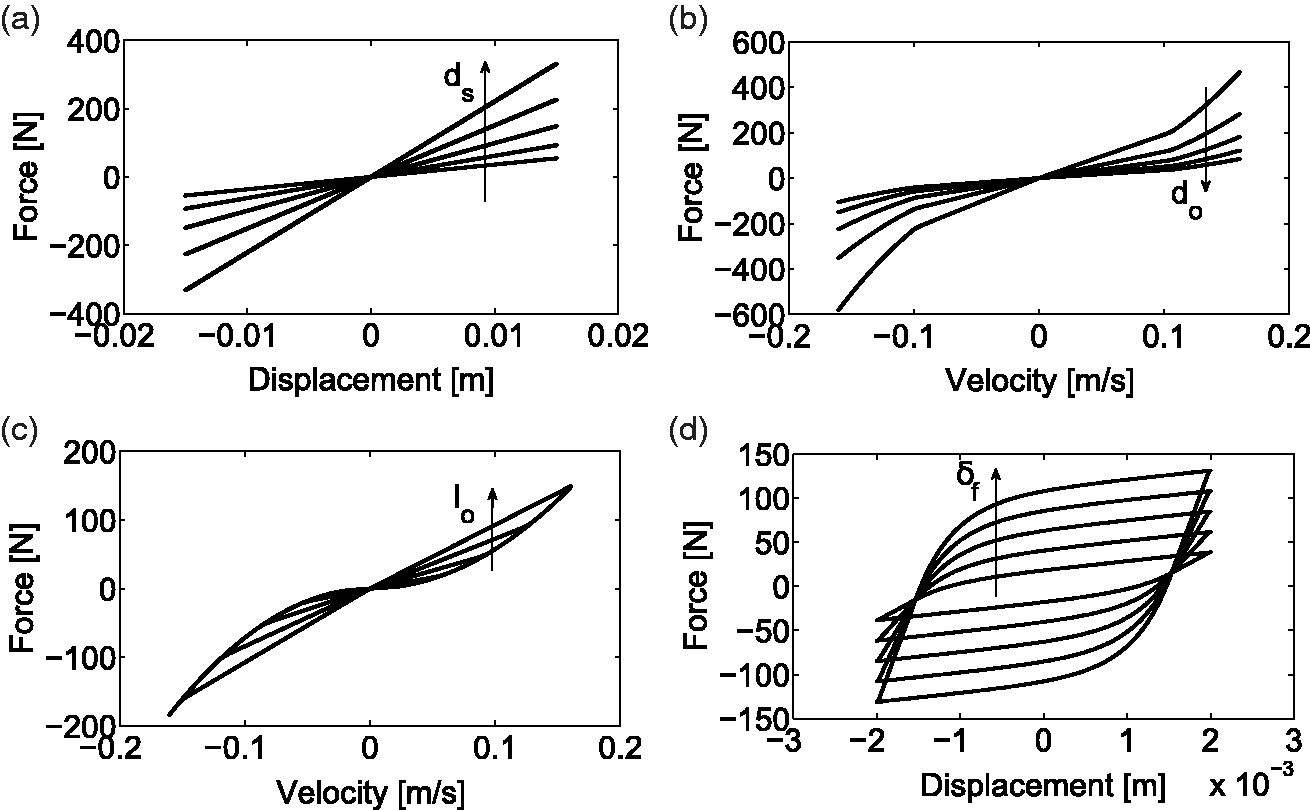
Optimisation of the vibro-isolation properties
Optimisation of the seat suspension vibro-isolation properties is realised using simulation model of the passive system. Dynamic behaviour of the seat suspension system is modelled in the MATLAB-Simulink® software package. The system equations are programmed using the interactive graphical environment, which allows to simulate and test a variety of the time-varying systems. The non-linear ordinary differential equations (ODE) in the model are solved numerically using the fixed-step (step time of 1 ms) Bogacki-Shampine solver. 27
The wire diameter 
The frequency weighted transmissibility factor 
The suspension travel is second numerical assessment of the system performance and can be defined in the following form
12

In order to solve the optimisation problem, the concept of Pareto optimality is used in this paper. Therefore, non-dominated solutions should be separated from an area of the feasible solutions.8,9 Each of the Pareto-optimal system configurations ensures the optimality of investigated systems in the conflicted criteria domains. An application of the multi-criteria optimisation procedure for the two-dimensional problem is graphically illustrated in Figure 3. Each of the Pareto-optimal solutions (Figure 3(a)) are represented by the value set of the decision variables (Figure 3(b)) that define a force characteristics of the mechanical spring, hydraulic shock absorber and suspension friction.
Graphical illustration of minimising both of the conflicted vibro-isolation criteria: (a) criterion space and (b) decision variable space.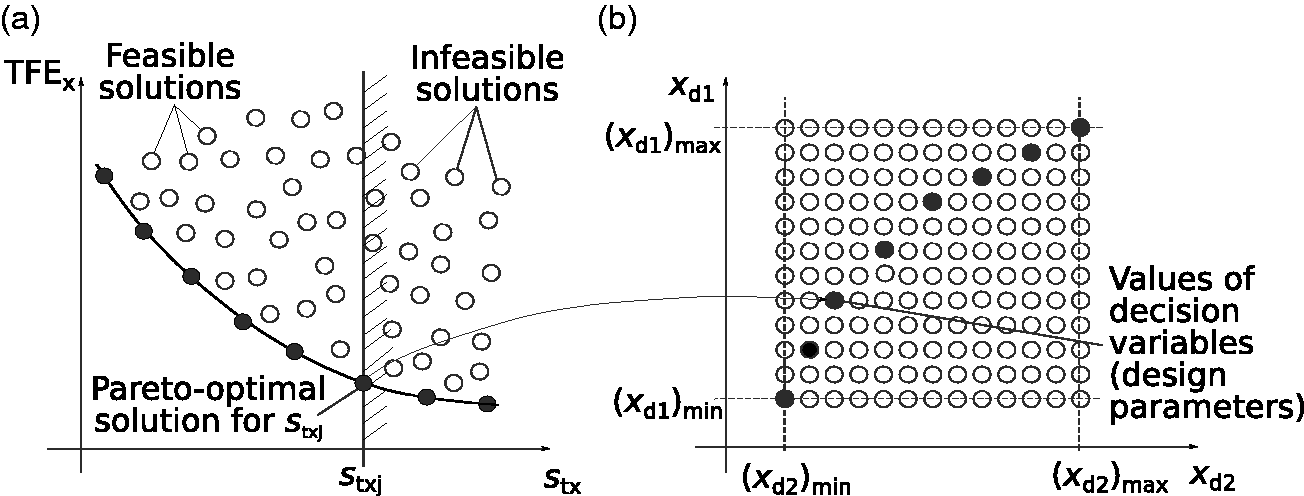
The

subject to the previously defined suspension travel


An appropriate selection of the constraint value
The vibro-isolation properties of horizontal seat suspension are optimised for an exemplary excitation signal which is similar to white band limited noise in the range of frequency 0.5–10 Hz. Ten non-dominated solutions are separated from an area of the feasible solutions (Figure 4(a)). Each individual Pareto-optimal solution corresponds to the set of decision variables which defines the different force characteristics of the mechanical spring (Figure 4(b)), hydraulic shock-absorber (Figure 4(c)) and suspension friction (Figure 4(d)). Only selected Pareto-optimal system configurations, which are marked by the point nos. 1, 5 and 10 in Figure 4(a), are discussed in this paper. The first Pareto-optimal configuration (point no. 1) corresponds to the stiff suspension system in which a high limitation of the suspension travel Pareto-optimal point distribution (a) and corresponding force characteristics of the mechanical spring (b), hydraulic shock-absorber (c) and suspension friction (d), power spectral densities (e) and transmissibility functions (f) of the Pareto-optimal seat suspension at different system configurations.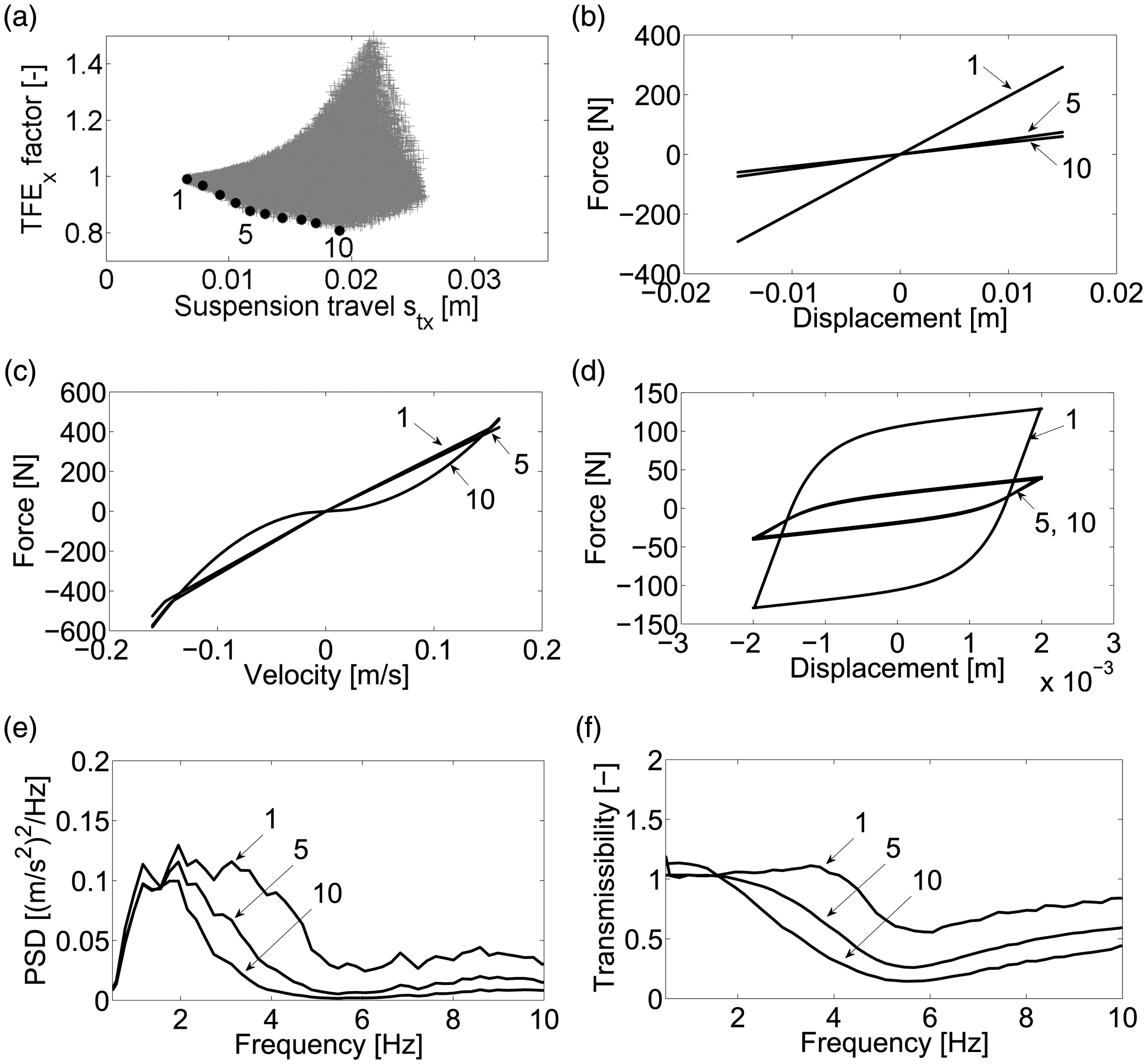
As shown in Figure 4, force characteristics of the mechanical spring (Figure 4(b)), hydraulic shock-absorber (Figure 4(c)) and suspension friction (Figure 4(d)) for the 5th and 10th Pareto-optimal solutions are close to each other. Although the low stiffness and friction are required for both system configurations, an application of the progressive damping characteristics increases the system effectiveness in reducing the whole-body vibration. This results in lowering the transmissibility factor
Experimental investigation of the optimised horizontal suspension with seated human body
Two different seat suspensions, i.e. conventional and optimal system, are measured during the laboratory tests. The optimised system uses lower stiffness, harder damping and reduced friction in order to obtain the vibro-isolation criteria evaluated in the previous section. The system configuration close to the Pareto-optimal solution no. 10 (Figure 4) is experimentally investigated for which the transmissibility factor
The stiffness characteristics of mechanical spring are evaluated by using the force–deflection measurement of suspension system (Figure 5(a)). The motion of the horizontal suspension is excited slowly with the triangle cycling at a frequency of 0.1 Hz and an amplitude of Conventional and optimal force characteristics of the helical spring (a), hydraulic shock-absorber (b) and suspension friction (c) obtained using simulation model (solid line), force–deflection measurement of the horizontal seat suspension (dotted line) and force–velocity measurement of the damper (circles).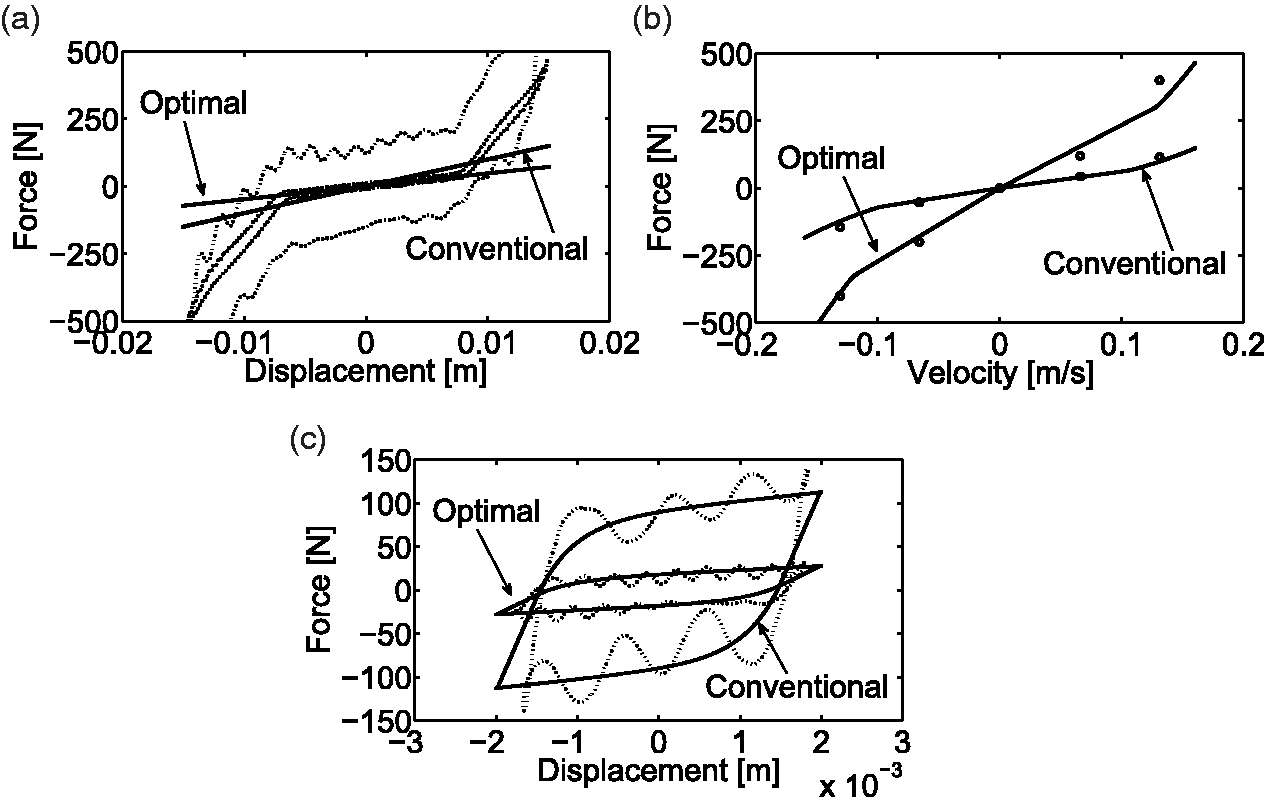
The measured force–deflection characteristics of the helical spring do not agree with the simulation results for displacements more than
In Figure 6, power spectral densities and transmissibility functions of the conventional and optimal horizontal seat suspensions are presented. As shown in this figure, the optimised seat suspension considerably reduces human exposure to the harmful effects of vibration in comparison with the conventional system. Lower amplitudes of the human vibration are observed in the considered frequency range between 0.5 and 10 Hz. Numerical values of the transmissibility factor and suspension travel are presented in Table 3. The measured vibro-isolation criteria demonstrate the improved system effectiveness due to optimal characteristics of the mechanical spring, hydraulic shock-absorber and suspension friction. Both vibro-isolation criteria, i.e. the transmissibility factor Power spectral density (a) and transmissibility function (b) of the conventional (dashed line) and optimal (solid line) horizontal seat suspension. Numerical values of the transmissibility factor and suspension travel measured for the conventional and optimised systems.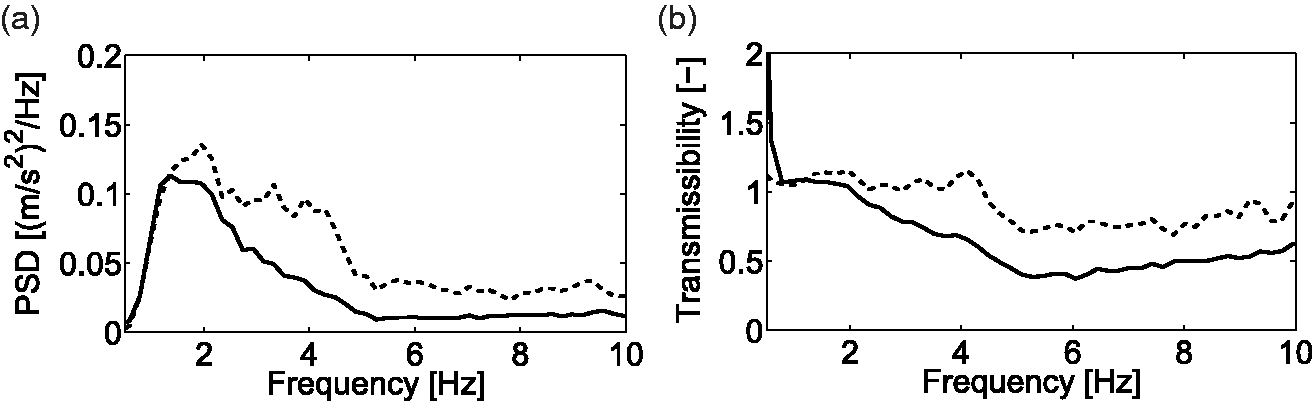

Conclusions
An application of the method for shaping vibro-isolation properties of seat suspension system leads to the reduction of harmful vibrations across a wide frequency range of the excitation signal with a slight amplification of the vibration amplitude in resonance. In addition, amplitudes of the system (relative) displacement are lowered to provide a proper vibration isolation of the driver in horizontal direction. The optimisation procedure proposed in the paper assists in selecting between the desired reduction of vibrations transmitted to the driver and the conflicting requirement for limitation of the suspension travel. Such a system design contributes both to the improved driver comfort and the enhanced ability to drive a vehicle.
Footnotes
Declaration of conflicting interests
The author(s) declared no potential conflicts of interest with respect to the research, authorship, and/or publication of this article.
Funding
The author(s) disclosed receipt of the following financial support for the research, authorship, and/or publication of this article: This work was a part of the research project ‘Methods and procedures of selecting vibro-isolation properties of vibration reduction systems’ funded by the National Science Center of Poland (contract no. UMO-2013/11/B/ST8/03881).