




Abstract
The ocean ambient noise is one of interference fields of underwater acoustic channel. The design and use of any sonar system are bound to be affected by ocean ambient noise, so to research the spatial correlation characteristics of noise field is of positive significance to improving the performance of sonar system. Only wind-generated noise is considered in most existing ambient noise models. In this case, the noise field is isotropic in horizontal direction. However, due to those influencing factors, like rainfall, ships and windstorm, etc. for a real ocean environment, noise field becomes anisotropic horizontally and the spatial structure of ambient field also changes correspondingly. This paper presents a spatial correlation of the acoustic vector field of anisotropic field by introducing Von Mises probability distribution to describe horizontal directivity. Closed-form expressions are derived which relate the cross-correlation among the sound pressure and three orthogonal components of vibration velocity, besides, the influence of the non-uniformity of noise field on the correlation characteristics of noise vector field was analysed. The model presented in this paper can provide theoretical guidance for the design and application of vector sensors array. Furthermore, the achievement could be applied to front extraction, Green’s function extraction, inversion for ocean bottom parameters, and so on.
Introduction
Ambient sound in the ocean is a combination of natural and man-made sounds. Various geophysical processes including wind, rain and bubbles,1,2 as well as geological processes including earthquakes, 3 as well as man-made noise generated radiating from offshore, 4 are the primary sound sources in the frequency range from a few hundred Hertz to 50 kHz. Such noise interacts with sea surface, sea floor and water column in propagation process and forms a complex interference background field. It disturbs sonar equipment’s detection and serves as a major factor that restricts the passive sonar performance. Making full use of the time–frequency–space statistical properties of underwater noise can effectively improve the performance of sonar equipment. In addition, since underwater noise field is a random process in which lots of noise sources interact with ocean environment, it is inevitable that the spatial structure of ambient noise field includes some ocean environment parameter information, so the ocean ambient noise can be inverted to return information such as bottom sound speed,5–7 water attenuation, 8 and so on. Besides, a more recent application is noise interference, whereby the Green’s function for acoustic propagation between two points in the ocean is recovered from the cross-correlation function of the noise fluctuations observed at two points,9,10 which can be applied to inversion and passive fathometer.11,12 Over all, it is of important practical significance to research the spatial characteristics of ambient noise field.
If we only consider ideal wind-generated noise in horizontal stratified waveguide, noise field is isotropic in horizontal direction, but actual ocean ambient noise consists of not only surface wind-generated noise, but also biological noise, sailing noise, and so on. The uneven spatial distribution of noise sources makes noise field appear non-isotropic in horizontal plane. 13 Only wind-generated noise source was considered in most of the existing models,14,15 with the non-uniformity of noise field in horizontal direction ignored, which might result in errors between actual result and theoretic result. Walker and Buckingham 16 introduced Von Mises circular distribution from directional statistics to represent the noise directionality in the horizontal plane, whilst the vertical component is consistent with a surface distribution of vertical dipoles. An analysis of the coherence and cross-correlation of the noise at two horizontally aligned sensors in deep ocean is developed. Barclay and Buckingham 17 improved the traditional spatial correlation of deep water by using Von Mises circular distribution function to incorporate non-uniform noise components caused by trench shading and ship; simulations by advanced model are in agreement with the experimental data. Walker 13 made a further improvement and complement to Walker and Buckingham 16 and Barclay and Buckingham, 17 proposing a spatial correlation of arbitrarily directive noise in the depth-stratified shallow ocean.
The study mentioned above concentrates on sound pressure field characteristic of ambient noise, while little attention is given to vibration velocity field. Compared to traditional hydrophone arrays, the acoustic vector sensors array has lots of advantages, for example, better direction of arrival (DOA) estimation performance for a given aperture, full azimuth/elevation estimation with a linear array and they can be used in a sparse configuration with uniform geometry. Much work is currently being done on the development of velocity sensors. 18 Therefore, the research of spatial correlation characteristics of noise vector field has great significance. In this regard, Abdi and Guo 19 developed a statistical framework for mathematical characterization of different types of correlations in acoustic vector sensor arrays. Closed-form expressions for correlations between the pressure and velocity channels of the sensors are derived, but his research focused on vector correlation of signal field but not noise field, besides, only influence of part channel parameters such as mean angle of arrivals and angle spreads was incorporated in his model, while other ocean physical parameters such as speed, density and attenuation of water and bottom were ignored. Huang et al., 20 Huang and Guo 21 and Ting 22 have done some research and exploration on correlation of acoustic vector field for isotropic noise field where only wind-generated noise was considered. Both of their models are some different from actual ocean environment. Therefore, this paper will present a more realistic spatial correlation of acoustic vector model of arbitrarily directive noise field based on the work of Walker 13 and Huang et al., 20 Huang and Guo 21 and Ting. 22 Closed-form expressions are derived which relate the cross-correlation between sound pressure and vibration velocity after a series of deductions. Compared to the model in Walker, 13 the model presented in this paper not only can forecast the correlation of pressure field, but also can predict cross-correlation characteristics of sound pressure and vibration velocity. This result can provide theoretical references for the design of vector hydrophone array and make it possible to detect targets in a low SNR environment. Then, the spatial characteristics of horizontally isotropic and non-isotropic noise vector fields are contrastively studied. Finally, influences of the non-uniformity of noise field in horizontal direction on the spatial correlation characteristics of noise vector field are summarized.
Derivation of the spatial properties of noise vector field
Consider the horizontally homogenous, depth stratified ocean medium where the sound speed


It is important to note that
Euler equation shows the relationship between particle vibration velocity and velocity potential function by

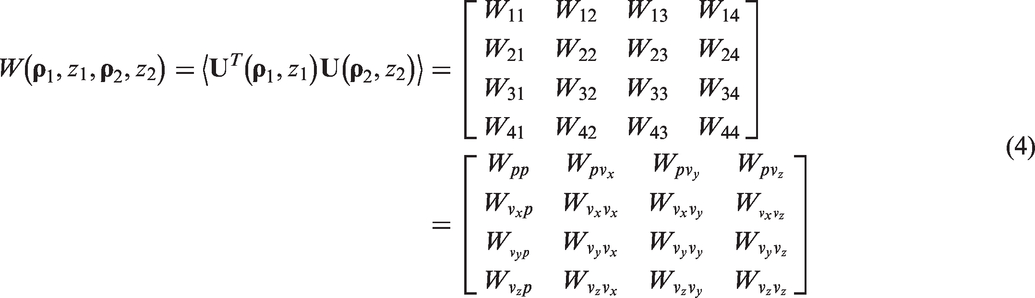
Suppose noise sources are uncorrelated, the correlation function of noise source intensity at any two points

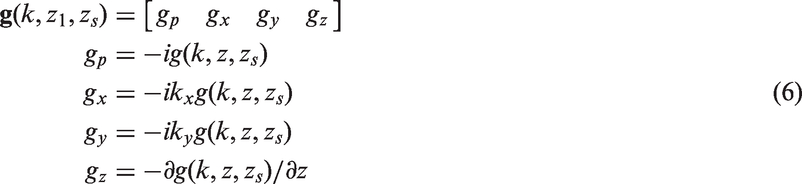
In equation (6),

Equation (5) can be written as


It can be seen from equations (7) and (9) that, when
By using the integral property of special function (the derivation process is listed in Appendix 1), the various elements of




The Green’s function in horizontally stratified media is
15











Constant term is ignored for the various elements in the above equations, but this does not affect the spatial correlation characteristics of noise field. Since media are generally absorbent, eigenvalue is generally a complex number, in the form of 










For the case

As mentioned above, the horizontal directivity of any ambient noise field always can be approximated by the sum of several Von Mises distributions:

When For horizontally isotropic noise field, the horizontal CSD functions only depend on the horizontal separation d, which is decided by the horizontally uniform distribution characteristics of noise source. When noise field is horizontally non-isotropic ( When
When
Simulating calculation of the correlation of noise vector field
The model geometry is shown in Figure 1. With a layer of water overlying a semi-infinite bottom, the water depth is H, the density and sound speed of the water and the bottom given by The model geometry showing the ocean waveguide.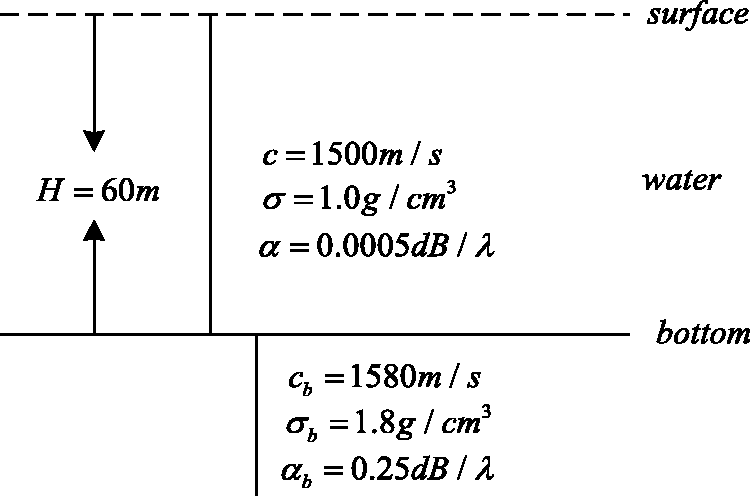
An impact analysis of Von Mises parameters on pressure spatial correlation of noise field
First, we present three cases which illustrate the various parameters of Von Mises distribution on the spatial correlation of noise field. In all three cases the sound frequency is 500 Hz. Figure 2(a) shows the pressure horizontal correlation function as γ varies from 0 to The impact of Von Mises distribution parameters on the correlation characteristics of sound pressure. (a) Influence of bearing of the peak parameters γ, γ varies from 0 to Polar schematic of superposition of Von Mises components, each directional feature is characterized by bearing of the peak parameters γ, an angular width parameter u and a relative power parameter a, feature 0–feature 3 represent isotropic wind-generated noise, a distant storm from direction 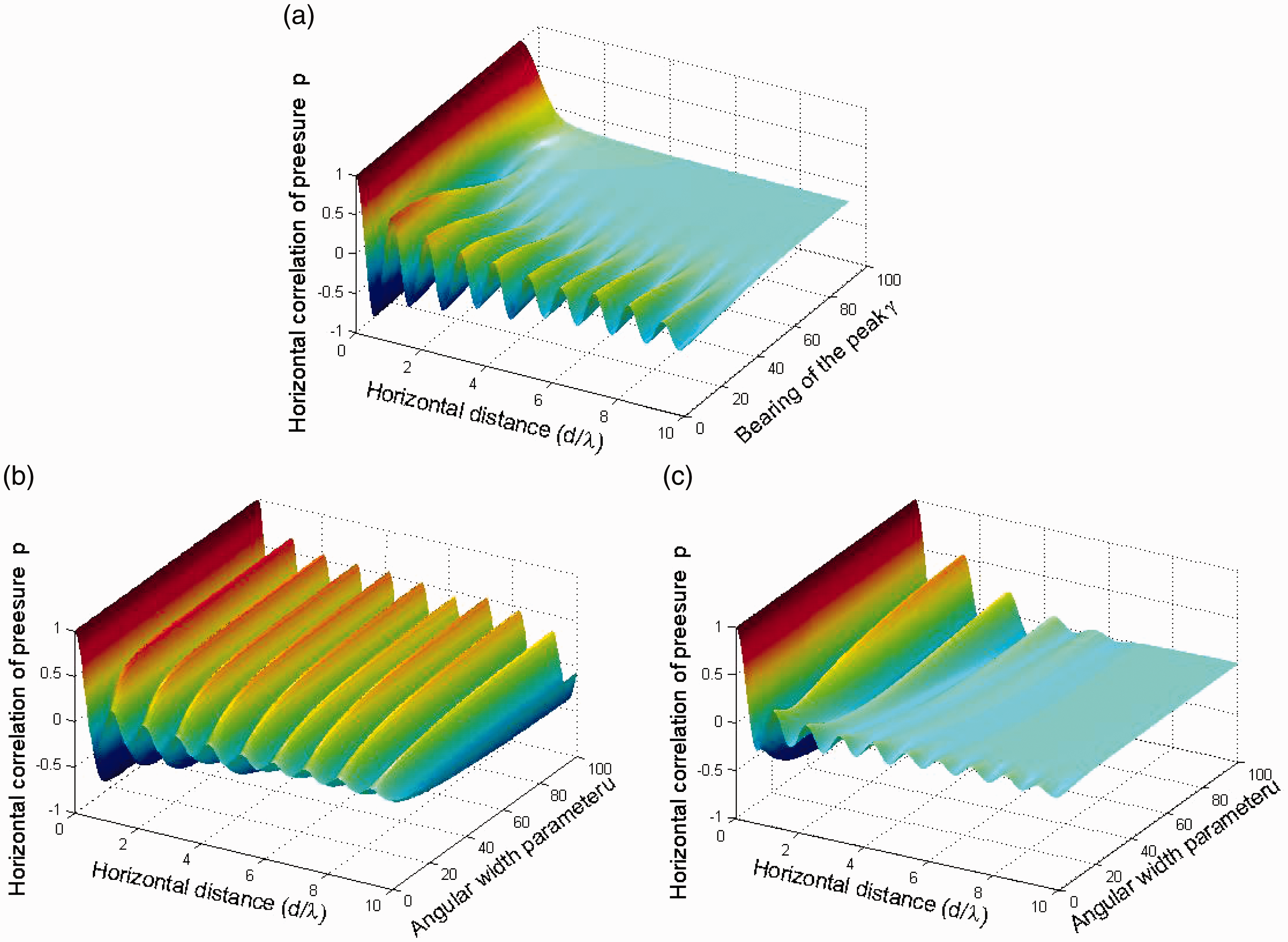
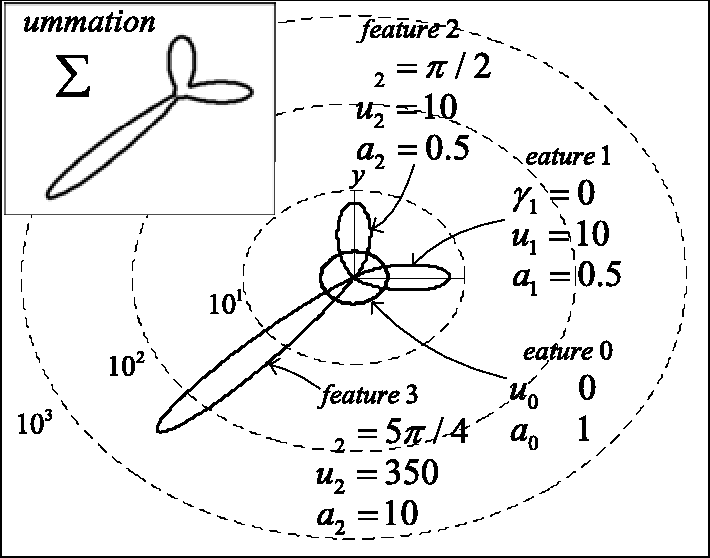
Figure 2(b) and (c) demonstrates the influence on the pressure horizontal correlation associated with angular width parameters u varying from 0 to 100,
Simulation analyses on spatial correlation of horizontal directivity vector field
We use the test case previously modelled in Walker.
13
Figure 3 presents an example of the approach applied in a shallow ocean Pekeris waveguide. The horizontal sound distribution model incorporates various directivity features consistent with a realistic ocean soundscape. One feature (labelled feature 0) arises from the canonical scenario involving wind-generated noise uniformly distributed throughout the surface (u0 = 0) whose relative intensity is 1. Other features (labelled features 1–3, respectively) include horizontally directive contributions typical of a distant storm from direction
Figure 4(a) to (d) shows the horizontal correlation coefficients of The horizontal correlation coefficients of noise vector field for the individual directional of wind-generated noise, distant storm, coastal wave breaking and a ship. (a) Horizontal correlation coefficient of pressure p, (b) horizontal correlation coefficient of velocity vx, (c) horizontal correlation coefficient of velocity vy and (d) horizontal correlation coefficient of velocity vz.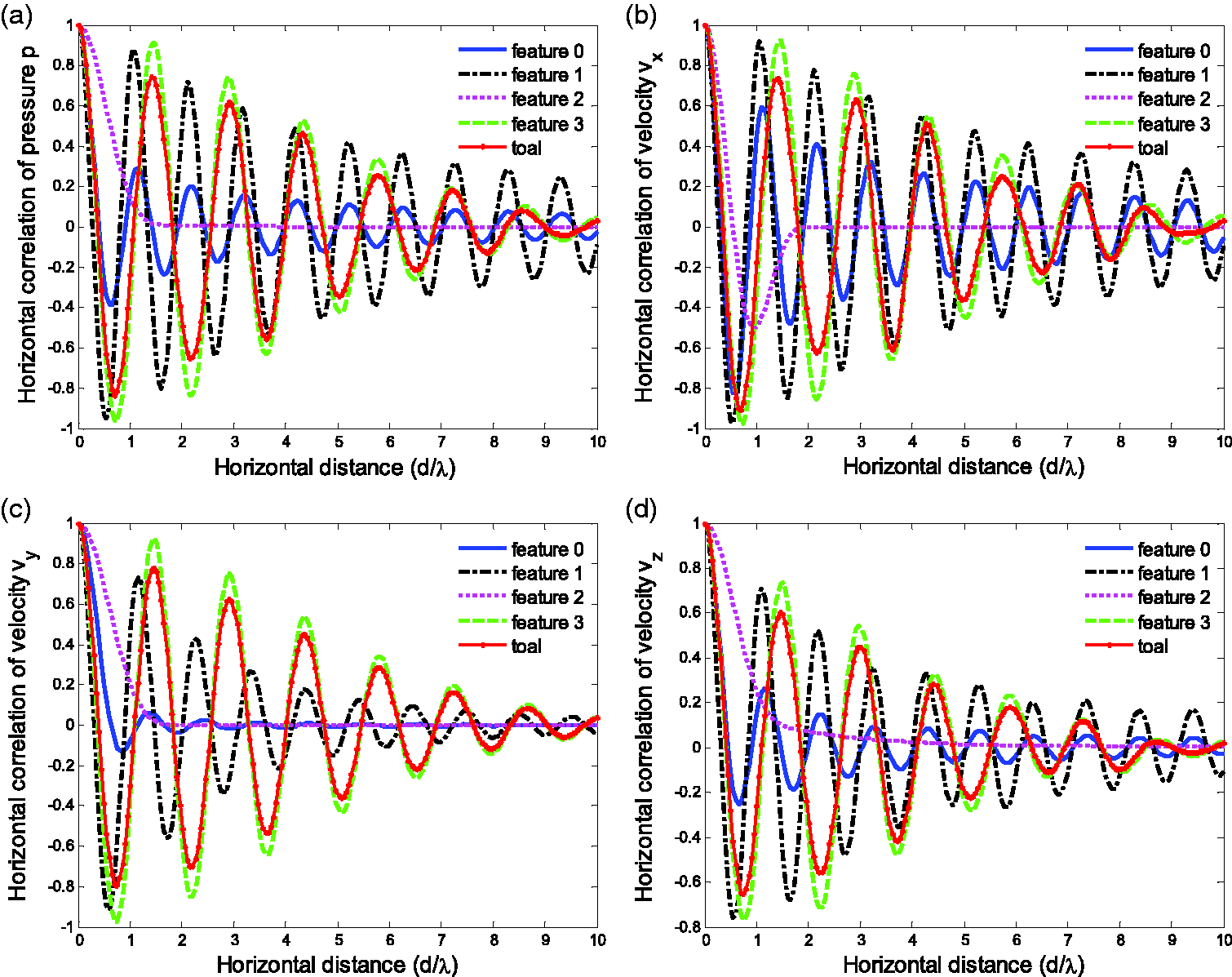
Compared with the correlation of p, the correlation of
An impact analysis of noise source depth on pressure spatial correlation of noise field
For wind-generated noise source, it is generally assumed that a plane of monopoles lying immediately beneath the pressure-release ocean surface, which forms negative images of the monopoles to create, in effect, a surface layer of dipoles. In this case, the spatial correlation of wind-generated noise field is barely related to noise source depth; however, when such noise sources as storms and ships, etc. are considered, since noise sources are not always distributed near sea surface, they cannot be approximately regarded as a monopole. How does the noise source depth affect the correlation characteristic of noise field? Simulation result is presented below.
Figure 5(a) shows the correlation function when the depth of storm noise source varies from 0.5 to 10 m. As can be seen from the figure, when the depth of noise source changes within the range of a wavelength near sea surface, the horizontal correlation of noise field fluctuates obviously, but as the noise source depth continues to increase, almost no change happens to the horizontal correlation of noise field (because most realistic noise sources are far away from the floor of ocean, the case that noise sources near bottom is irrespective here). To get a better look at the impact of noise depth, Figure 5(b) gives the horizontal correlation function for storm noise source is equal to 1, 3, 5 m. When storm centre depth varies from 1 to 3 m, the amplitude of horizontal correlation coefficient increases by an estimated 0.2, as storm centre depth increases further, the horizontal correlation coefficient of sound pressure was nearly unchanged.
The horizontal correlation as a function of the noise source depth. (a) Horizontal correlation of p as storm noise depth changes from 0.5 to 10 m and (b) horizontal correlation coefficient of p for storm noise depth 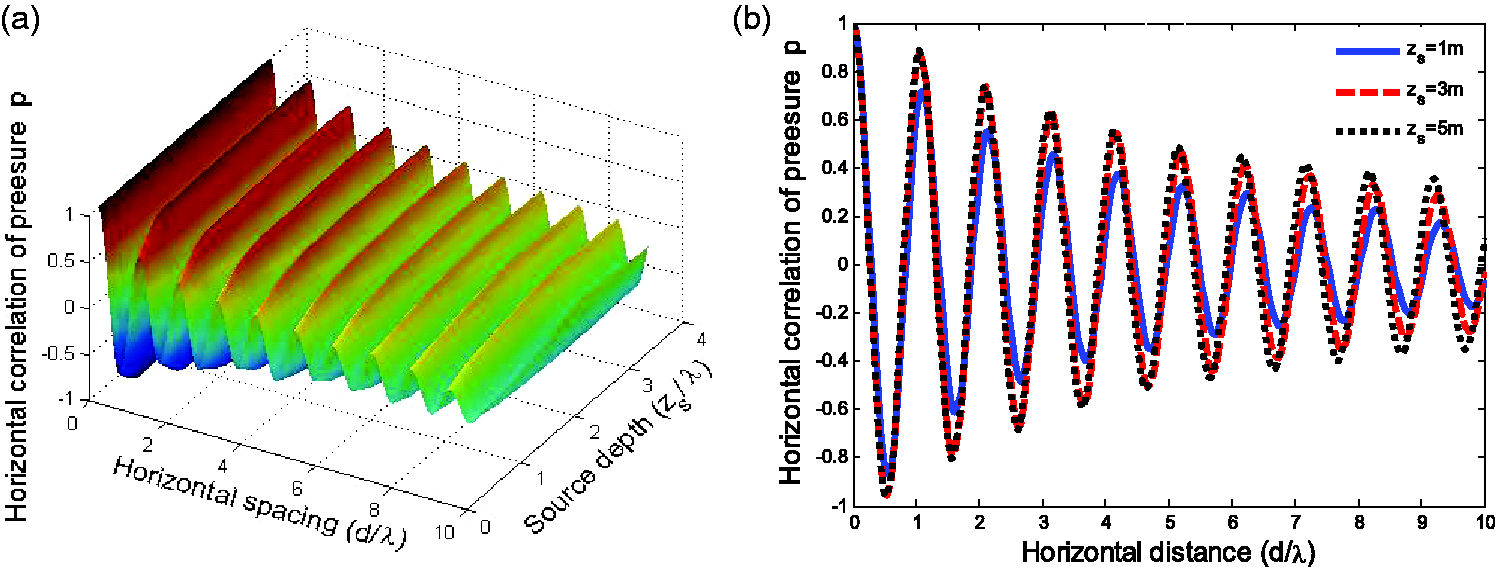
Conclusions
By introducing Von Mises distribution to describe the horizontal non-uniformity of noise field, a spatial correlation model for horizontally non-isotropic noise vector field was presented. Compared with the existing models, the model in this document can consider not only wind-generated noise source, but can also storm noise source, ship noise source, biological noise source, etc. Furthermore, this model can forecast the cross-correlation properties of sound pressure and vibration velocity, which may lead to a better performance of DOA. So this model can achieve more widespread applications than traditional ambient noise models. The main conclusions of this paper are shown as follows:
In a horizontal isotropic noise field, sound pressure and vertical vibration velocity are completely uncorrelated to the two components of horizontal vibration velocity, and the horizontal correlation of sound pressure relies only on the distance among receiving points. However, in a horizontal non-isotropic noise field, correlation between sound pressure and the three orthogonal components of vibration velocity is non-zero; moreover, the horizontal correlated characteristics of noise field are not only related to the horizontal distance but also susceptible to the character of noise source. When components originating from an endfire orientation with respect to the sensors result in strong sound pressure horizontal correlation, the sound pressure horizontal correlation power originating from off endfire orientations is relatively weak and attenuates rapidly. When strong noise source exists, the correlation properties of the total noise field will rely largely on the spatial correlation properties of strong source. However, when the noise sources are comparable in intensity, the correlation properties of the total noise field will depend on the relative intensity of the various noise sources and their relative position to receiving array. For horizontally stratified homogeneous media, the horizontal correlation of noise field will fluctuate obviously when the noise source depth varies in a wavelength range, but if noise source depth continues to increase, the horizontal correlation of noise field has no obvious variation.
Due to space limitations, this paper focuses on the impact of horizontal non-uniformity of noise field on the spatial correlation of sound pressure field, while little simulation was done about the impact of noise field horizontal non-uniformity on spatial correlation of vibration velocity field. However, the CSD function expressions for combination-type three-dimensional vector hydrophone was presented in this paper, with those analytic expressions, the cross-correlation properties of sound pressure and vibration velocity of arbitrarily directive noise field can be analysed easily. The results of this paper are useful for the design and performance analysis of vector sensors systems and array processing algorithms. Besides, the model might prove useful as a tool in the analysis of experimental efforts aimed at Green’s function extraction, 9 wave front extraction 10 and passive target location. 12 All in all, this model has wide applications prospect on engineering application.
Footnotes
Declaration of conflicting interests
The author(s) declared no potential conflicts of interest with respect to the research, authorship, and/or publication of this article.
Funding
The author(s) disclosed receipt of the following financial support for the research, authorship, and/or publication of this article: This work was supported by the Science and Technology Foundation of State Key Laboratory, China (Grant No.9140C200103120C2001), the Natural Science Foundation of GuangDong province under the contract 2014A030310256.