




Abstract
The low-frequency noise generated by wind turbines is known as one of the risk factors for health. The aim of this study was to study the noise effect of wind turbine on the general health of staff at Manjil wind farm. For this purpose, workers were divided into three groups: maintenance, security, and office staff. Equivalent sound levels were measured for each group. Individual’s health data were assessed using the 28-item General Health Questionnaire. Pearson correlation, analysis of variance, and multiple regression tests were used for data analysis in the R software. Statistical analysis results showed that the noise exposure is significantly correlated to all sub-scales of general health, except for depression. The low-frequency noise from wind turbines can cause harmful effects on the health of workers that are too close to the wind turbine and receive very intense noise.
Keywords
Introduction
Wind energy is a renewable energy source that contributes little to global warming, and has few harmful effects on the environment and fewer hazardous products than those produced by fossil fuels. This energy has very low harmful health effects than other traditional energy sources. 1 However, this new technology may lead to adverse health effects on the people living near wind turbines. 2 According to observations in areas where outdoor noise levels exceed 35 dBA, complaints of adverse health effects are more common when related to low-frequency audible sound produced by wind turbines. 3 Although there are various opinions about this topic, previous studies have reported that low-frequency noise generated by wind turbines can directly affect people’s health.4–6
The noise sources of wind turbines may be divided into two types: machinery noise (including noise from the gear box, the generator, ventilation equipment, hydraulic pumps, and yawing machinery) with low frequency fluctuations and aerodynamic rotor noise giving the typical “swishing” sound and also generating infrasound.7,8
The noise emitted by wind turbines especially the larger ones, contains characteristics of low frequency sound, which may have a very annoying effect on people at even low levels. The frequency range 20–200 Hz defines the low frequency range; upper limit may be a little different.9,10
Regardless of the type of sound source, noise exposure is a psychological stressor that can cause mental disorders by interactions between the autonomic nervous system, neuroendocrine system, and the immune system. 11
Previous studies have shown a negative relation between noise generated by wind turbines and general well-being.4–6,12 World Health Organization (WHO) introduced low-frequency noise as an environmental stressor which has health effects such as noise-induced hearing loss, interference with communication, and sleep and rest, psycho-physiological disorders, disturbance in mental health and functions, effects on behavior, annoyance and disturbance of activities. 13 Some of the symptoms such as sleep disorders, headaches, tinnitus, nausea, vibratory sensation, irritability, loss of memory and concentration, nervousness, rapid heart rate, blood pressure, weight changes, abnormal heartbeat rhythms, mood problems, fatigue, and depression in residents living close to industrial wind turbines cluster form what is known as Wind Turbine Syndrome. 14 There are two views about these symptoms, in association with wind turbine noise exposure. One of them is that audible and inaudible infrasound noise generated by wind turbines is harmful for people with a risk of noise exposure, and another is psychological factors such as nocebo responses to the circulation of negative information about putative side effects of wind turbine noise. 15
Previous studies suggest that psychological factors such as having a negative personality, holding negative beliefs about wind turbines or perceiving them as ugly, are associated with noise annoyance and increased complaints by people living near the wind turbines.2,16,17 Harry 18 showed that people living approximately 400 m near the wind turbines complained about poor sleep, headaches, stress, and anxiety.
Increased anxiety and stress in people who are concerned about their health may lead to illness. Thus, even if wind turbines have no direct harmful effect, residents’ concerns about adverse effects of the wind turbine noise may potentially cause adverse health effects. 19 Pedersen et al. 20 indicated that the visual impact of wind turbines is a strong predictor of noise annoyance and people who will benefit economically from wind turbines show less annoyance than other people.
Low-frequency noise effects on cognition and performance including attention tasks, speech, and accuracy have been demonstrated. 21 As regards cognitive tasks, role of proximity to the wind farm becomes so important. Ruotolo et al. 22 found that the performance in executive control and semantic memory deteriorated with increasing proximity to the wind farm.
Due to the special acoustic characteristics of wind turbines such as low-frequency noise, amplitude modulation, impulsive, and intermittent noise, further study on effects of wind turbine noise on human health is needed. Preceding studies have focused on the general population that are relatively far from wind farms and only occasionally exposed to wind turbine noise. Neglected from these studies are wind farm staffs that are close to the wind turbines and are regularly exposed to very high level of sound during their shifts. The aim of this study was to assess of the noise effects of wind turbine on general health of staff at wind power plant Manjil, Iran. The present study aimed to investigate the long-term effect of occupational noise exposure from wind farm on well-being of individuals by considering different ranges of noise exposure. In particular, the study has the merit of assessing in situ the wind power plant workers who are exposed to high sound pressure levels: this would provide new data that add to the literature.
Material and methods
Study area
This cross-sectional study was conducted on the workers of the Manjil wind farm. This power plant has more than 170 active horizontal axis wind turbines (300, 500, 550, 600, and 660 kW) and is one of the largest wind power plants in the Middle East. Manjil has a great potential for capturing wind and it is the best region for investing in the wind turbine industry. Manjil is known as the windy city of Iran: a reputation caused by its geographical position in the Alborz mountains. The Manjil site is in the north of Iran, 220 km from Tehran, the capital of Iran, and 80 km south of the Caspian Sea in the province of Gilan. Manjil is about 800 m above sea level and the average wind speed is 14 m/s (at 40 m above ground).
Participants
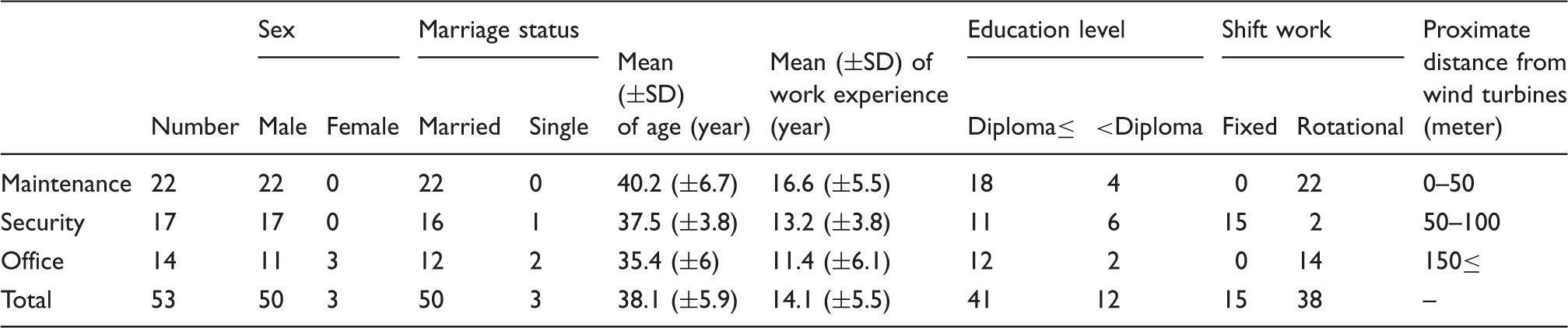
Demographic information of understudy groups.
Procedure
For determination of noise exposure levels, the equivalent sound level (LAeq) was measured in each shift work and in different working parts including guard station, office building, warehouse, room for rest breaks, the turbine body, and commute places according to the standard ISO 9612: 2009.23,24 Noise measurements were carried out in five work stations for maintenance, five for office, and two for security staff. All the current work stations were considered for understudy groups and these measurement stations were different for each one.
For accurate determination of individual’s noise exposure, the sensing microphone on the sound level meter was placed approximately 10 cm away from a worker’s ear and all measurements were performed for 15 min. With respect to similarity of tasks in each occupational group, the results from field measurements in each group were extended to all staff in the same group. Finally, the 8-h equivalent sound exposure level for each job group was obtained based on field measurements and the following formula

In areas where people had the greatest noise exposure, information about characteristics of wind turbine sound were obtained by one-third octave band sound frequency analysis. In this study, a calibrated sound level meter analyzer (model TES 1358, China) was used.
Demographic information for each person was collected with a general questionnaire, and general health information was obtained using the 28-item General Health Questionnaire (GHQ-28). This questionnaire was used as a screening tool for determination of the probability of a mental disorder. The questionnaire is divided into four subscales including somatic symptoms, anxiety and insomnia, social dysfunction, and depression. For each individual, five scores are obtained, four scores are related to subscales and the fifth score is the sum of all sub-scales and is related to overall general health. Somatic symptoms are a person’s feelings about his/her health status and fatigue that is accompanied with physical signs. Anxiety and insomnia items cover symptoms of distress sleeplessness. The social dysfunction subscale measures the individual’s ability to cope with job demands and everyday life problems and reveals their feelings about common daily situations. Depression is related to items that can cause severe melancholy. 25
The GHQ scale consists of 24 questions with a three-point Likert scale (1 = never, 2 = occasionally, 3 = much more than usual). Each subscale consists of seven questions. The obtained scores of each of the four subscales (somatic/anxiety-insomnia/social dysfunction/depression) and questionnaire total score were 0–21 and 0–84 respectively, with lower scores indicating better mental health. Reliability and validity questionnaire has been demonstrated by Goldberg and Williams 26 and Noorbala et al. 27
Statistical analysis was performed using R software (ver. 3.0.1). Data were examined by Pearson’s correlation, one-way analysis of variance (ANOVA) tests, the multiple regression analysis, and independent-samples t-test with an alpha level of 5% (p < 0.05). ANOVA and t-test were used to compare the mean differences across independent variables including demographic date and noise exposure. Correlation between the variables studied and GHQ scores were examined using Pearson’s correlation test. Moreover, multiple regression analysis with the dummy coding method was used to study the effects of independent variables like noise exposure on the GHQ total score and its subscales.
Results
In this cross-sectional study, 53 staff of the Manjil wind farm participated. The mean (standard deviation) age and work experience were 30.8 (±5.9) and 14.1 (±5.5) years, respectively. Demographic information of participants is presented in Table 1.
As regards noise measurement, LAeq was determined 83 dBA, 66 dBA, and 60 dBA for maintenance, security, and administrative staff, respectively. Based on frequency analysis results, the sound pressure level at lower frequency of the octave band was higher compared with higher frequency, which suggests the wind turbine sound contains a low-frequency signature.
Effect of independent variables on GHQ scores.
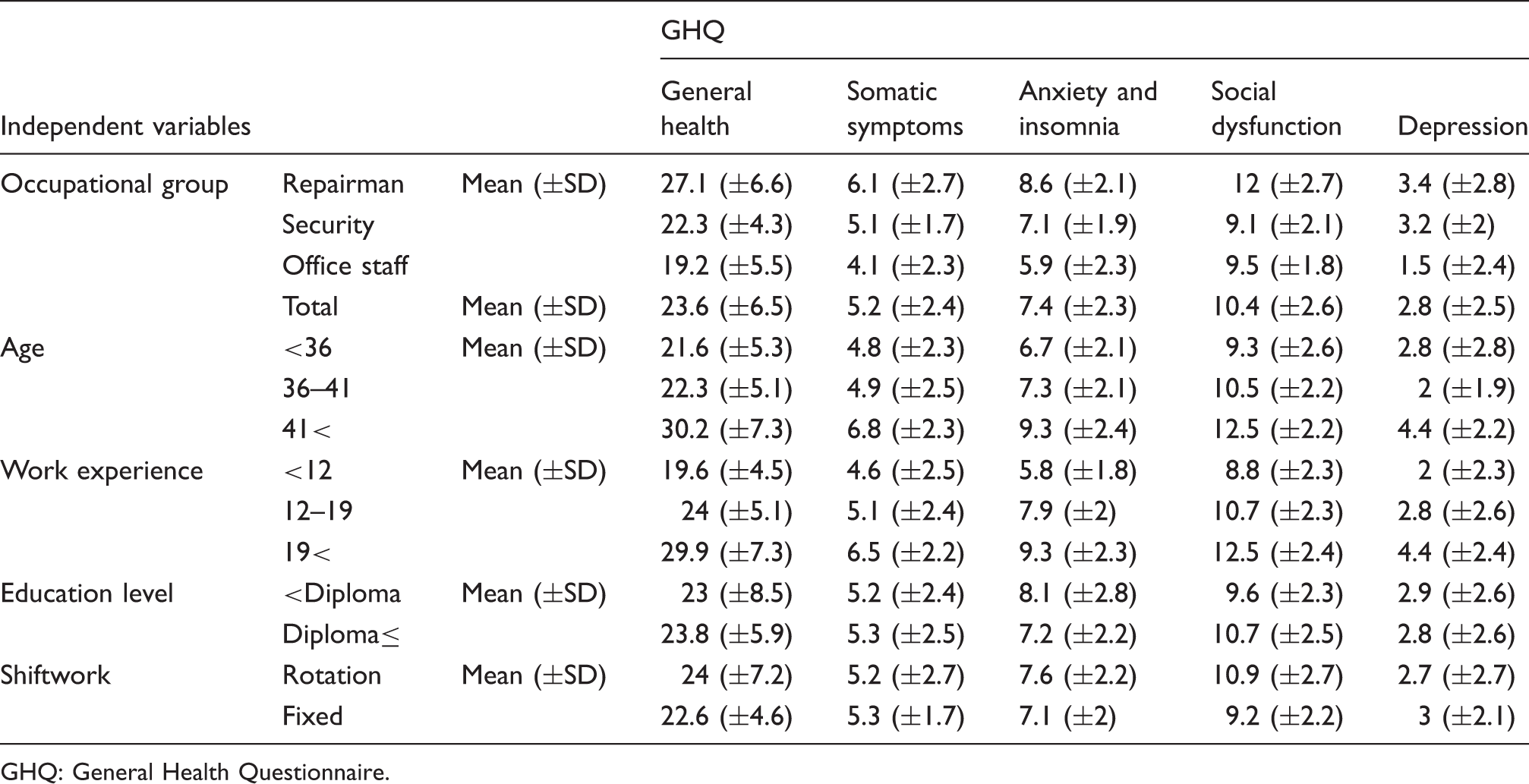
GHQ: General Health Questionnaire.
The ANOVA was used to compare the general health status across job groups, age, and work experience and the independent-samples t-test was used to compare the GHQ means for educational level and working shift. The results showed that there were only significant differences between general health scores with job groups, age, and work experience groups (p < 0.05). Therefore, the general health score was not equal among the occupational, age, and work experience groups. This means that these variables may be affecting general health of staff.
Correlational analysis showed significant correlation between LAeq and age with GHQ scores of workers (p < 0.05), except depression (p > 0.05). Also, work experience showed a positive significant correlation with general health, anxiety and insomnia and social dysfunction (p < 0.05).
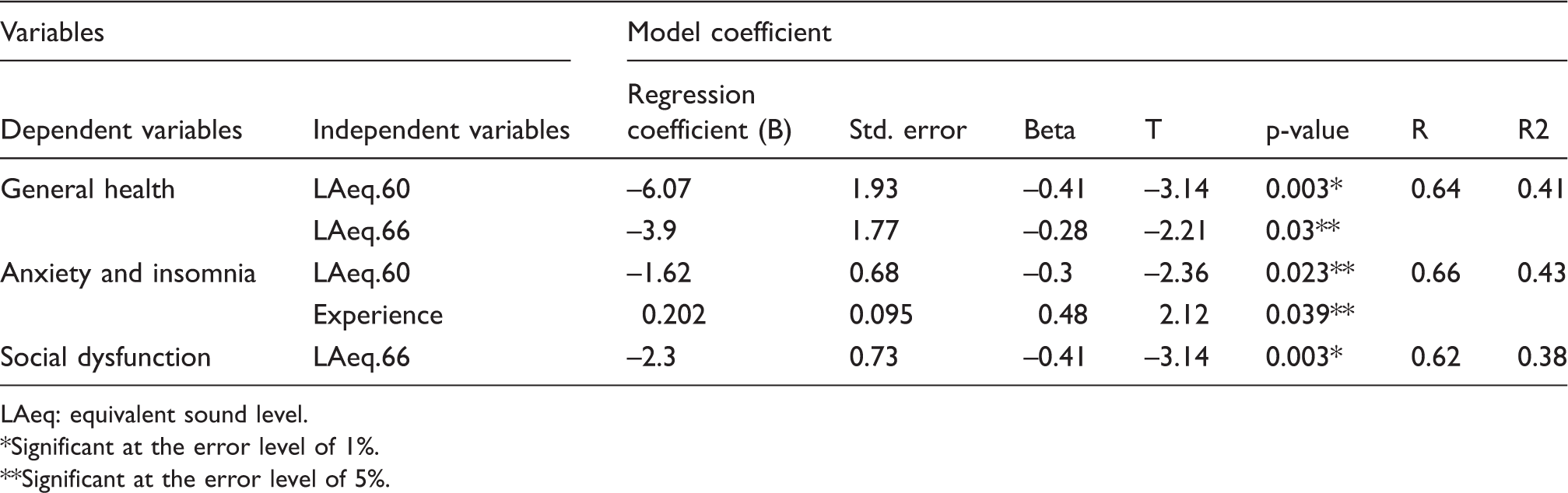
The multiple linear regression analysis with the dummy coding method was used to investigate effects of noise exposure on the general health measure and its subscales. Since the main focus of the present study was an investigation of the effect of noise exposure on the general health and its subscales, the group with highest noise exposure (maintenance) was considered as a reference group. The effect of noise exposure on general health in all groups was measured relative to this control group.
Effect of age, work experience, and LAeq on the general health and its subscales.
LAeq: equivalent sound level.
Significant at the error level of 1%.
Significant at the error level of 5%.
Discussion and conclusion
The present study was conducted to assess the effects of wind turbine noise on general health among the Manjil wind farm staff, Iran. For this purpose, the workers were divided into three job groups and equivalent sound levels were measured for them. The GHQ-28 was the assessment tool of the individual’s health. The study was conducted in the field with different job groups and different occupational noise levels, from moderate to high; this had the merit for presenting useful data to the literature.
The finding indicates that the average (±SD) GHQ of staff was 23.6 (±6.5) which is better health status in comparison with previous studies.4–6 The reasons may be due to the economic benefits of workers of wind power plants. 20 Also the workers are adapted to their working conditions, so they are stronger than the general population.
Maintenance workers received more sound level because they are in the vicinity of wind turbines, and they had also higher scores of GHQ. Therefore, it can be argued that the harmful health effects of wind turbine noise on maintenance workers are stronger than office and security staff with lower sound level.
The results of this study show that the general health scale and its subscales except depression had a significant positive correlation with equivalent sound level. These results agree with study of Krogh et al. 28 Krogh et al. indicated that people living near wind turbines reported various health complaints such as sleep disturbance, excessive fatigue, headaches, stress, and depression. At increasing distance from wind turbines, these affects were decreased. 28 In the present study, it has been found that with increasing distance, (e.g. office staff) the mean score of GHQ decreased. Nissenbaum et al. 29 declared that increased distance from wind turbines can discount adverse effects and this relationship is consistent with the physics of sound, its absorption by the atmosphere and terrain.
Previous studies concluded that low-frequency sound produced by wind turbines has adverse health effects.6,30,31 Leventhall 31 stated that long-term exposure to low-frequency noise can cause psychophysiological impairment. The other possible causes of health effects linked to wind turbine sound would be amplitude modulation, low frequency, and impulsive noise.6,20,32 Relating to the physiology of the ear and its interaction with the brain, Salt and Kaltenbach 33 showed that the adverse health effects of low-frequency noise are scientifically possible. Miedema 34 reported that sound can affect health through the disruption of communication, concentration, recreational activities, and stimulation of adverse emotional reactions. Anxiety is another reason for other adverse health effects in people who live near wind farms, which can result from several mechanisms, including visual impact, turbine noise, sleep disorder, and other factors.6,11,12
The ANOVA results showed that the GHQ score is statistically not equivalent across variables: age and work experience, so that the higher the age and work experience, the higher GHQ score and the lower health status. Multiple regression results indicated that noise exposure is the only significant predictor on the general health status and its subscales. Despite significant correlations between both age and experience with general health, these two factors have no significant influence on general health. The effect of experience on the anxiety and insomnia subscale was 0.2 times less than noise exposure of 83 dBA. This finding indicates that poorer health status is not related to increasing age but may be due to working conditions and chronic exposure to occupational risk factors like noise.
This study has shown that the impact of sound exposure of 83 dBA on general health and its significant subscales is several times greater than the effects of 66 dBA and 60 dBA (Table 2). Many studies have been performed to examine the effect of wind turbine noise on health indicators such as depression, anxiety and insomnia, and physical symptoms28,35 but the mechanisms of this effect have not yet been agreed. Several hypothetical mechanisms have been proposed to account for the effect of wind turbine noise on the health, especially anxiety, including the effect of infrasonic exposure, visual impact, noise sensitivity, noise annoyance, attitude to sound sources, personality, and other individual characteristics.6,12,30,36 Health-related quality of life is one of the basic concepts that the WHO has introduced as an index of the health because it is related to the physical, psychological, and social aspects of the well-being. 37 Various studies have shown the detrimental effects of wind turbine noise on health-related quality of life,38–40 with which the results of the present study agree.
The WHO reported that chronic noise exposure can cause annoyance and sleep disturbance, and these two factors can affect health and health-related quality of life.13,37,41 Shepherd et al. 41 stated that noise annoyance arises from mental states associated with anxiety and conflict and if it continues to increase could cause deterioration of the health and well-being. Joo et al. 42 stated that sleep disturbance is associated with increased levels of stress hormones. Wind turbine noise can influence health indicators such as stress, anxiety and insomnia directly or indirectly, and degrade health. According to the WHO, health is a state of complete physical, mental, and social well-being and not merely the absence of disease or infirmity. 43 Here it can be concluded that wind turbine noise has negative impacts on the health of directly exposed people. Long-term noise exposure is a psychological stressor that can cause mentally abnormal responses and adverse health effects through interactions between autonomic nervous system, neuroendocrine system, and the immune system. 11
In this study, LAeq was the most effective factor on GHQ among the variables studied. According to this finding, wind turbine noise may be effective on workers’ health, as shown through its impact on the general health subscale. The visual effects, turbine’s color, shadow flicker, electromagnetic waves and turbine-induced earth electric current, noise sensitivity, and other factors, are all potential influences on the health of people living close to wind farms.12,44–46 These factors are outside the scope of this paper. Moreover, small sample size (53 participants) may be another limitation of present work. It is recommended that in future research, further attention is paid to these factors. For drawing definite conclusion, further enquiry is necessary.
Footnotes
Acknowledgment
The authors would like to thank all the honorable managers and hardworking staff of the Manjil wind farm, who were helpful for conducting this study.
Declaration of conflicting interests
The author(s) declared no potential conflicts of interest with respect to the research, authorship, and/or publication of this article.
Funding
This article is extracted from Master's Thesis No.25306. The authors would like to acknowledge the financial support of Tehran University of medical sciences for this research.