




Abstract
The Covid-19 restrictions have limited the access of face-to face therapies for many people and continues to effect how Dramatherapists operate. The following article offers reflections around adapting to an on-line medium, focusing more specifically around the software of ProReal. Limitations and considerations are acknowledged, including technological difficulties, computer efficacy, ambiguity tolerance and the need for careful contracting and reassurance of autonomy and control when using on-line platforms. The article ends with a short selection of vignettes from ProReal sessions.
This article aims to outline the practical and ethical considerations when working online with clients as a Dramatherapist, specifically considering the value of an online platform called ProReal®, an avatar-based virtual world platform that helps people communicate in a dynamic and visual way. Drawing on my clinical experience and the experiences of my clients, I will discuss the potentiality of ProReal® as a therapeutic tool against the limitations of remote working in Dramatherapy. Consent was obtained from my clients to use their experiences and work; names have been anonymised for confidentiality. Consent has also been obtained from ProReal® to reproduce images from their worlds.
The COVID-19 pandemic accelerated the need for Dramatherapists to adapt their clinical work to digital platforms as the demand for online therapy surged within clinical, educational and research settings. There was no lecture during my master’s, which prepared me to conduct Dramatherapy online; this was new to us all. Dramatherapists suddenly found themselves as Pendzik (2020) states, ‘. . . having to invent the wheel while driving full speed at the same time’ (p. 70).
Despite our modality being creative and adaptable, the two biggest questions I felt facing this transition for online work were as follows:
1. How can I work safely and ethically? This falls into three subcategories:
• Technology
• Containment
• Safeguarding.
2. How would a process that focuses so much on embodiment work in a digital space?
Technology
Initially, I was aware of the very human fear that I wasn’t ‘ready’ for this work. Hill (2020) suggests that this parallel process of technophobic anxiety can also be shared by our clients. This consideration supported my ability to be compassionate to both my clients and myself. We are all facing new challenges, ‘grist for the mill’ as Yalom (2010: 36) says.
Technology is fallible. The advantages and disadvantages of online therapy must be acknowledged and discussed with clients when contracting (American Psychological Association, 2013). One of the most common issues facing online work is the loss of or poor Internet connection during a session. Kingwill (2020) observes that loss of connection also includes lost words, sentences and even ideas. Co-creating alternatives when faced with external obstacles, for example, setting up a new Zoom® link or even having a phone call session if the Internet connection fails. These ‘Plan Bs’ not only support the therapeutic relationship (Clarkson, 2003), but stand to increase frustration-tolerance and resilience in a client (Levy et al., 2018). I have found that navigating these technological disconnections has become an important shared experience and part of the therapeutic process. Paradoxically, these digital disconnections have created opportunities of connection between client and therapist through universality: both are fallible to technological malfunctions.
Safety
How can we hold and contain our clients online? We must consider the socioeconomic situations and potential limitations facing our clients as well as define and make clear our own boundaries, which for me, constitutes creating our own safe, confidential space where we can work, and hold time limitations for communication, similar to face-to-face work. Contracting these considerations with our clients helps to manage and maintain their commitment to the therapeutic relationship Pendzik (2020).
Privacy, as Stavrou (2020) observes, is an obvious rule, yet not the easiest to manage. As we are no longer in the safety of the therapeutic space, the client is now responsible for their privacy. Adges (2020) states that holding space virtually feels very different to holding space in person. I have found encouraging clients to ‘de-role’, or even leave their space after a session, a valuable means of diffusing any transferential energy from permeating into their homes.
Unfortunately, not everyone has access to a room of their own or a space where they feel safe and at ease. Equally, considerations need to be made around what technology a client has access to and to what extent privacy can be achieved; not everyone has their own device, a computer or tablet may be shared between family members. As accessible and universal as online work may appear, for many, working online poses great challenges. These considerations need to be addressed within the initial assessment stage.
Safeguarding
The other major ethical consideration I faced was identifying a secure platform for confidentiality. I needed to know how to safeguard the client’s privacy and ensure that they were fully informed of how their data might be used (General Data Protection Regulation, 2018). Anthony and Nagel (2010: 58) acknowledge the importance of choosing secure platforms when working with clients online and discuss the limitations of confidentiality in this regard. They summarise these obstacles by saying, ‘where there were previously four walls, a ceiling and floor . . . to contain the therapeutic relationship, there is now an ephemeral space with no physical limits . . .’
In order to protect clients, therapists must have sufficient encryption and password protection as well as firewalls and knowledge of appropriate hardware and software. Security considerations need to be made around the robustness of these online platforms (Cooke and Doyle, 2002). Measures such as secure invitation links and password-protected ‘waiting rooms’ where clients are held before entering their session enhance security. Functionality such as lockable ‘rooms’ to protect against others joining a session accidentally and having ‘end to end’ encrypted website links for confidentiality are also important considerations (Levy et al., 2018).
Dramatherapy is an embodied, creative approach (Jones, 2007). Questions and anxieties arise around creative expressive techniques being lost in the transition to an online sphere. The lack of technological platforms that support and communicate the nuances of complex feelings, spontaneous social interaction and the embodied presence of ‘other’ experienced within the face-to-face encounter has been one of many continued concerns (Adges, 2020; Pendzik, 2020; Sajnani, 2020). Arguably, on the Internet we can still create roles and stories, draw, use objects, make masks and use costumes, and so on. Creativity is unlimited; we still have access to low-tech resources that our clients will also have around their space. We can, as Stavrou (2020) offers, use technology in the same way as we use our kit bag in our normal practice. All of these technologies can be our ‘new’ material combined with our ‘traditional’ material.
Embodiment is equally possible, as described in Adges (2020), who incorporated yoga and movement in their warm-ups, which supported clients in ‘connecting with their bodies’ (p. 34). This gentle encouragement to connect with somatic experience can be supported at all points during the online session. Improvisation, mirroring and role-play can be enabled by feelings of safety within the therapeutic relationship, as highlighted by Kingwill (2020), which then allows for embodied play. I have observed that clients appear to be more comfortable using their bodies and becoming embodied, when I have initially offered gestures and movement back to them, along with the invitation to participate. It feels that by witnessing the therapist using movement, the client’s confidence is enhanced and they contribute towards a shared experience, which deepens connection and attunement within the therapeutic relationship.
However, the absence of co-presence is the important issue surrounding virtual practice. Baird (2016) describes the inherent difficulties in reading non-verbal cues within the online sphere, and Pendzik (2020) highlights the importance of acknowledging the differences between virtual and dramatic realities, as well as creating and maintaining intimacy through the screen. In this respect, ‘understanding and accepting our limitations is critical for making good choices’ (Kingwill, 2020: 42). It is about the ‘good enough’ process that we can offer in the online therapy space.
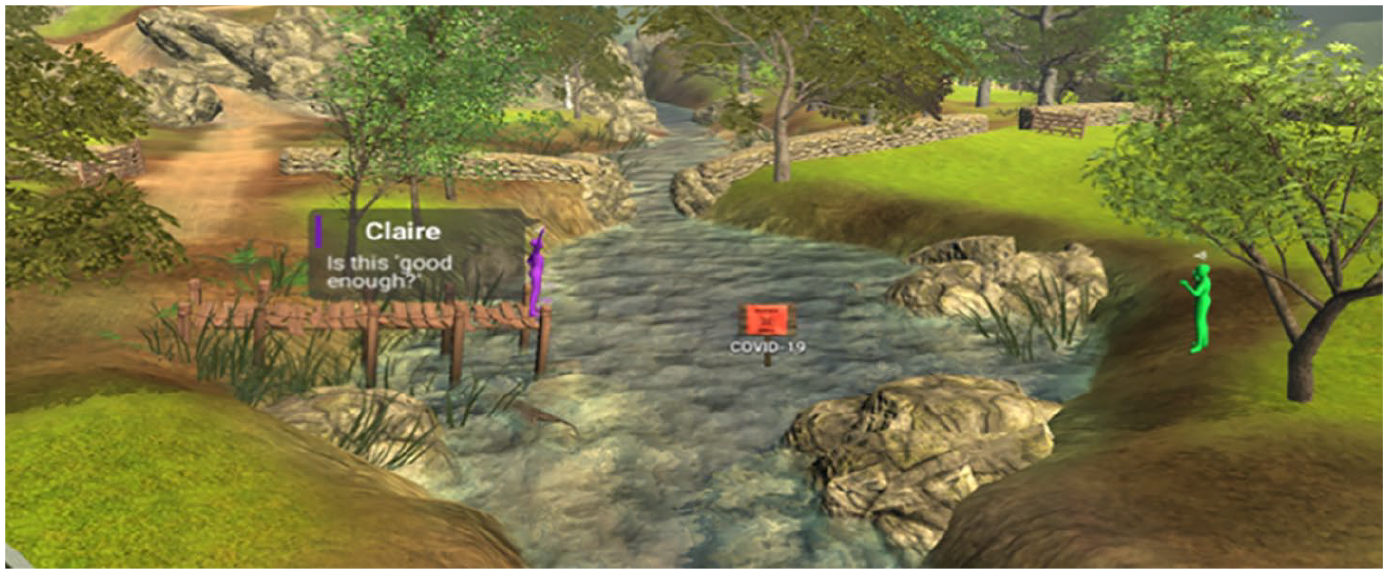
Quigley, C. (2021), The therapist explores disconnection with her clients during COVID-19. Photograph of a ProReal® World: Private collection.
ProReal®
Although this article is specifically focused on using ProReal® in the therapy space, there are of course a variety of other digital platforms which have also been utilised throughout the pandemic – Zoom®, Microsoft Teams® and Skype®, as well as social media platforms such as WhatsApp® and Messenger®, have all been embraced as ways to stay connected both professionally and privately.
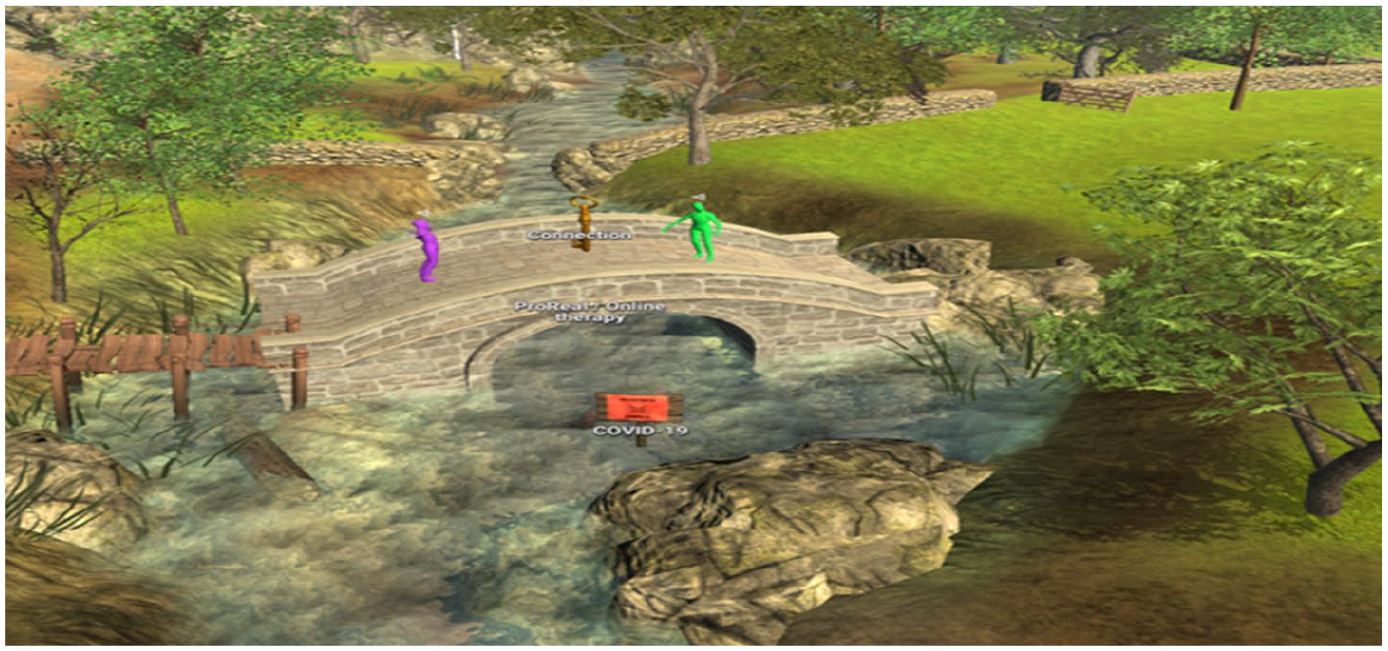
ProReal® is an immersive, avatar-based virtual world platform that helps people communicate in a dynamic and visual way. ‘Avatar’ refers to a representation of the self, or a digital human form. ProReal® has been building up a solid body of research of its utility in a variety of situations (ProReal, 2020). Essentially, avatar therapy is a projective technique (Jones, 2007) allowing clients to project their inner world, conflicts and ‘life-drama’ into the space. The software can be thought of in terms of psychodrama, where we can use concretisation: ‘giving concrete form to situations or dynamics that would otherwise be expressed abstractly, in words’ (Chesner, 2019: 31). The client places their avatars into a world of rich metaphors: forests, castles, waterfalls, crossroads. Items can be inserted which contain rich and varied symbolism, complementing the metaphorical landscape. Alternatively, there is the choice of an ‘empty room’, which, similar to Brook’s Empty Space (1968: 110), acts ‘like a magnifying glass, and also like a reducing lens’.
Avatars can change in size, colour and position as well as assume gestures that are congruent with the expression the client wishes to embody. The client may also choose to give voice to their avatar, providing words and even adding ‘inner voices’: smaller heads that ‘perch’ on the avatar’s shoulder. Worlds can be revisited as often as necessary and there is also potential for change. All of these qualities mirror the core principles of Dramatherapy: projection, role, metaphor, symbolism and, most importantly, the use of aesthetic distance (Jones, 2007), which allows our clients the safety of perspective, the ‘as if’ quality, promoting both insight and transformation.
ProReal® also contains a roaming camera option, which means that therapists can literally provide perspective for the client, allowing them to see their problem from further away or to focus in on areas where they may feel disconnected. Chesner (2019: 31) observes that landscapes can be literally and metaphorically viewed from numerous perspectives by moving it or moving around. ‘It can be described as is or transformed into a future possibility’: Avatar-based Interventions [ABIs] affected the use of time by accelerating the speed of accessing and processing client material. Participants found that using ABIs had similar outcomes in a shorter amount of time than traditional forms of therapy. (Baker, 2018: 135)
Accessing the ProReal world for clients can be done twofold: either via a link to register and download the software onto their device or be sent a unique URL code by the therapist, allowing clients to enter the world instantly. Clients can be sent a short ‘getting started’ instruction video which outlines how to use ProReal, as well as initial orienteering sessions to gain familiarity and confidence around using the software.
Quigley, C. (2021), The therapist transforms the disconnection. Photograph of a ProReal® World. Private Collection
Limitations
Due to the immersive experience of ProReal®, therapists and clients need to be aware of the potential for disinhibition. This is when ‘people say and do things in cyberspace that they wouldn’t ordinarily say or do in the face-to-face world’ (Suler, 2004: 321). This may result in feelings being expressed more openly than the client might expect. Disinhibition can be a resource, allowing emancipation from potentially repressed feelings or thoughts, which are allowed a safe space to be processed. However, it is equally important to be aware that clients may feel exposed, vulnerable or shameful having communicated these feelings (Suler, 2004).
Of equal importance is the need for ambiguity tolerance; solutions and insights are sometimes hidden or revealed in what can initially appear as complex and vague imagery (Pendzik, 2020). The locus of control is predominantly in the hands of the client with the support of the therapist to nurture awareness. Another consideration is computer literacy; clients who have limited skill in using computers will require more support in the early stages, as the therapeutic process may be overshadowed by anxiety around navigating and understanding the software (Joinson, 2007; ProReal, 2020).
Vignettes
In the height of lockdown, I was approached by a Greater Manchester–based charity, to be a part of a project funded by Manchester Council. The following examples are from several clients who utilised ProReal® within their Dramatherapy sessions.
Familial dynamics
Blue created a scene about her siblings, father and stepmother, with walls separating them. Blue shared she felt ‘locked out’. She animated her avatar to look ‘as if’ it was trying to get attention – jumping, its arms waving just about visible over the wall.
Blue’s scene after adding shields and colours to her siblings (2020). Photograph of a ProReal® world.
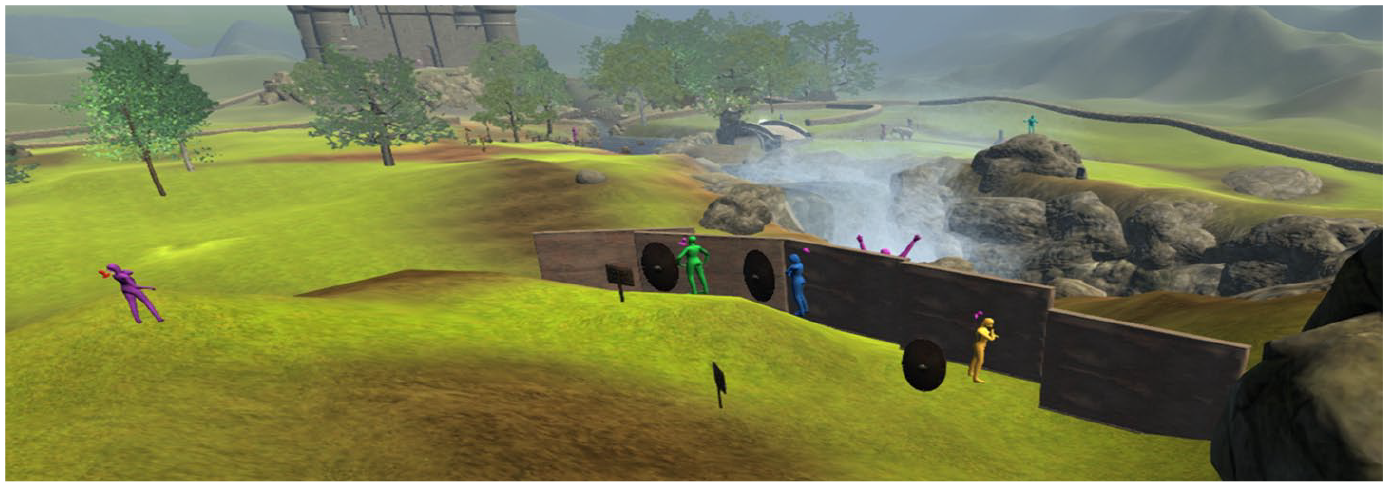
After a while discussing, sharing feelings and viewing from various perspectives (including the avatars), I was able to offer an observation Blue hadn’t considered. Although she felt segregated and ‘excommunicated’, she wasn’t locked out, that in fact she has vast space in which she is free to explore, with people who willingly want to connect with her. It appeared more that the rest of her family were the ones confined and ‘locked in’.
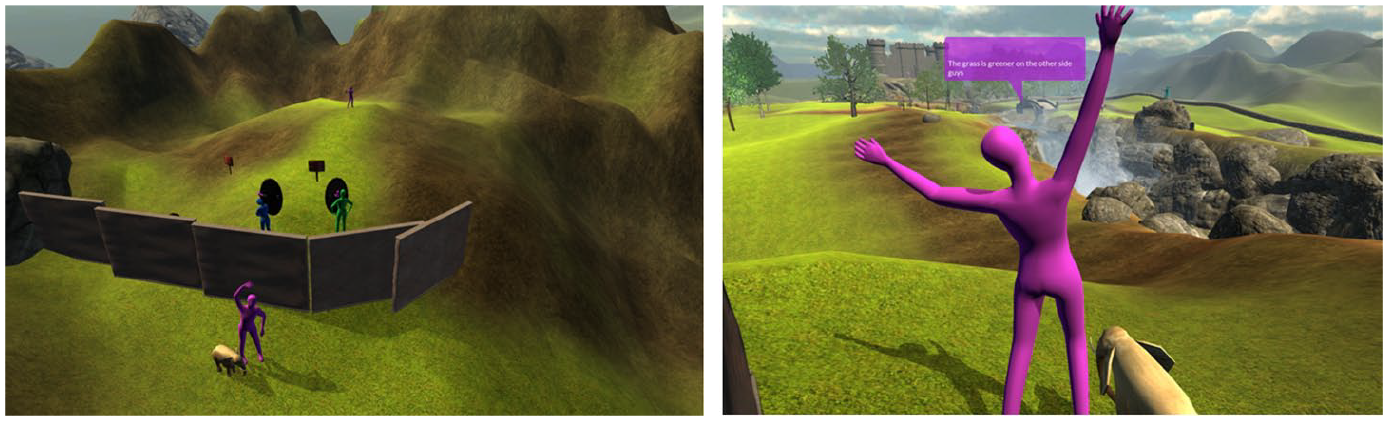
In a later session, Blue was more able to empathise with her siblings. Blue gave their avatars the words of support that she felt she needed when she was once in their situation, providing them with shields for protection and more vibrant colours – their own people, not just ‘grey subordinates’. In revisiting the scene, Blue noticed a gap in the wall and considered ‘Perhaps they can’t or won’t see that they can escape from that situation?’ We discussed that they may feel limited in their resources or ability to remove themselves. Blue then made her avatar bigger after reflecting and amending the scene. ‘I feel better – less small’. She shared that this image had been very helpful and that she discussed this scene’s significance with her partner between sessions.
Blue was able to reflect back and remember that she was on the right side of the wall, having previously wanted to be on the other side, trapped and miserable. She shared that this dynamic felt a lot less toxic to her now – she said her siblings were also starting to ‘get closer to the wall now’ and that ‘letters are getting posted through the cracks’ [to her].
Blue seeing new perspectives (2020). Photograph of a ProReal® world.
Restriction
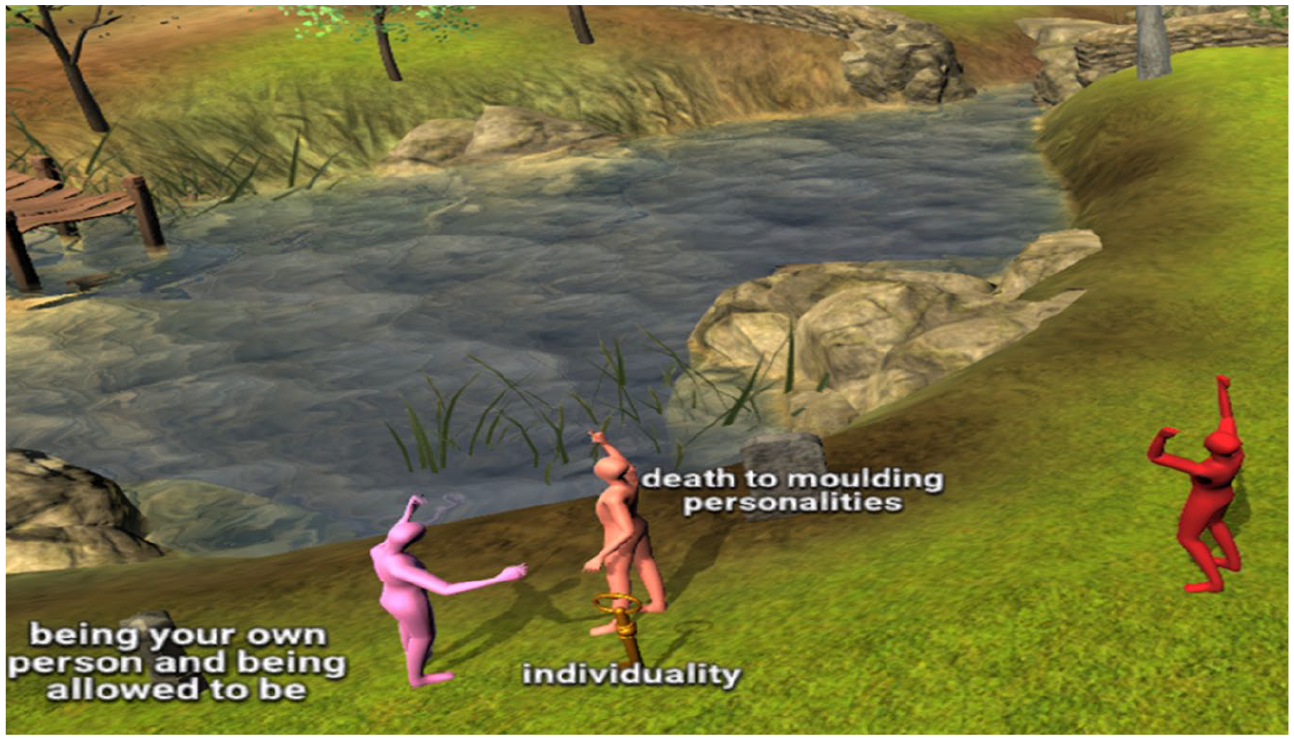
For several weeks, I had been working with Green around her issues of feeling unable to express herself and wanting to be able to ‘stand up for myself and my opinions’. Green had been drawn to a section of the river which had a restricted capacity for the river to flow through. It was in viewing this scene that Green made her connection ‘It’s not that I’ve not been able to speak, it’s that I’ve not been allowed to communicate . . . being so used to being enclosed’. Green came to a realisation regarding her somatic experience of not being able to speak, think or articulate herself. She was able to identify that this was the result of reinforced behaviours having been repeatedly shut down by family and ex-partners; her opinions and thoughts reduced, through public and private shaming, and fear of rejection. She then added in symbols to represent these realisations: a milestone, a key and a tombstone.
Green’s ‘Realisation river’ (2020). Photograph of a ProReal world.
Conclusion
The pandemic has forced us to develop an online Dramatherapy space and this space is fraught with challenges. There are certainly huge considerations in terms of ethics and confidentiality of working in this sphere and these cannot be ignored.
As Dramatherapists, we learn to work with what we have and to innovate alternatives (Kingwill, 2020). Perhaps it is our ability to work within these restrictions, that deepen the therapeutic relationship and create authentic connections, even when the digital connection falters, or the wrong buttons get pushed (Hill, 2020).
For Dramatherapists, the availability of digital resources during the pandemic has clearly made a difference, allowing us to remain connected with clients and within our Dramatherapy community. What has become evident throughout this juncture is that creativity is infinite. We have opportunities to combine ideas and approaches around digital mental health, within the metamorphosis of practice in virtual Dramatherapy (Stavrou, 2020).
As this clinical comment demonstrated, ProReal encapsulates the dynamics and qualities of Dramatherapy, to offer a creative and transformative process for our clients, via an online medium. Equally by working online, we remove many barriers that may stop clients from accessing therapy (Bashur, 2016; Kingwill, 2020). Whether in times of COVID-19 or beyond, creating access to online therapeutic spaces is vital.
In this era of disconnection and disempowerment, let us choose to connect with our clients in meaningful ways, whether that is in the same physical space, or somewhere virtual (Hill, 2020). As with the Hero’s Journey (Campbell, 2012), we have heeded the call to this technological adventure, a call which we may never have wanted or asked for, yet still we crossed the threshold into the unknown. Let us respond as always with curiosity, imagination and empathy, encountering our clients wherever they are.
Footnotes
Funding
The author(s) received no financial support for the research, authorship and/or publication of this article.
