



Abstract
This paper presents the results of an accent rating study of Welsh in which 59 raters were asked to listen to speech samples of three speaker groups (Welsh home language speakers, immersion education learners, and adult learners). The study aimed to ascertain (a) whether these groups are identifiable based on their accents, (b) how raters evaluate the three speaker groups socially, and (c) what phonetic features they associate with them. The results revealed that all groups could be identified well above chance and received positive social evaluations. However, traditional speakers were correctly identified significantly more often and were perceived more favorably in the social evaluations. In the feature analysis, new speakers’ accents were largely described as deviant from traditional speakers’ although some distinctive patterns were also identified. These findings have important implications for discussions surrounding accent bias and the perception of new speakers’ accents in the context of minority language revitalization.
Introduction
An abundance of research has shown that speakers with different social characteristics mark out their identity through their accent. In language revitalization contexts, there is increasing evidence for variation in the speech of different speaker groups in the minority language. Specifically, it has been shown that traditional speakers, who acquire a minority language through inter-generational transmission in the home and/or community, tend to differ in their pronunciation patterns from new speakers (O’Rourke & Ramallo, 2013; O’Rourke et al., 2015), i.e., “individuals with little or no home or community exposure to a minority language but who instead acquire it through immersion or bilingual educational programs, revitalisation projects or as adult language learners” (O’Rourke et al., 2015, p. 1). Evidence comes from a wide range of settings, including Galicia (Mayr et al., 2019; Tomé Lourido & Evans, 2019), Ireland (O’Rourke & Walsh, 2015), Scotland (Nance, 2020; Nance & Moran, 2022) and Wales (Gruffydd, 2022; Mayr et al., 2017; Mennen et al., 2020; Morris, 2017, 2021, 2022).
The notion of new speaker (O’Rourke et al., 2015) stands in opposition to the more traditional concepts of “non-native speaker” and “L2 learner.” However, unlike the latter, they commonly constitute the majority of speakers of a minority language and hold positions of power in the social hierarchy of the language. Together with the fact that they introduce “new forms of language and new modes of communication” (O’Rourke et al., 2015, p. 2), this challenges the idea that native speakers are the only legitimate authority of speakerhood. Nevertheless, the accentual differences between new speakers and traditional speakers may be socially significant in that the former have reported feeling stigmatized and being considered less “authentic” by traditional speakers (O’Rourke & Ramallo, 2013).
While we are starting to gain an understanding of the characteristics of new speaker varieties, little is known about raters’ ability to identify new and traditional speakers in accent perception studies (but see Tomé Lourido & Evans, 2021), nor do we know much about the specific social evaluations associated with these speakers. A further complication is that both the terms “traditional” and “new speakers” assume a categorical approach to the definition of bilingualism (Kremin & Byers-Heinlein, 2021) which may fail to capture the differing linguistic experiences of those who acquire minority languages, particularly in contexts where the majority language is prevalent in the wider community or where new speakers may acquire the minority language in markedly different ways. In the case of the latter, there are few examples of work which compare the production or perception of new speakers who have acquired the language in different ways.
To address this gap in the literature, the present study focuses on the perception of new and traditional speakers in Wales, and investigates (a) the extent to which traditional speakers of Welsh and two groups of new speakers of the language who differ markedly in their linguistic experience (those who acquired the language through immersion education as young children in a Welsh-speaking community and proficient adult learners with little exposure to Welsh before the age of 18) are identifiable in an accent perception experiment, (b) what phonetic features are associated with the three speaker groups, and (c) how the Welsh accents of new and traditional speakers are socially evaluated. The ability to discern the linguistic background of a speaker provides evidence for the existence of specific new speaker accents whilst social evaluations are particularly significant in the context of ongoing work on the social consequences of accent bias in English which have shown that speakers of certain varieties may be perceived as being less competent (e.g., Levon et al., 2021). The Welsh Government's ambition to raise the Welsh-speaking population to one million by 2050 (Welsh Government, 2017) heavily relies on increases among new speakers and focuses on achieving functional ability rather than high levels of linguistic competence. It remains to be seen, however, whether they are stigmatized in the wider speech community.
Accent Perception Studies in Bilingual Settings
Accent perception has been explored in bilingual settings in two principal lines of research: (1) accent identification studies in which raters’ ability to identify speakers and speaker groups based on their accents is assessed, alongside their conscious awareness of the phonetic characteristics associated with them, and (2) social perception studies of accents, in which raters’ evaluations of accents are assessed along a range of social dimensions. With respect to (1), there is an abundance of work in the second language speech learning literature, which has shown that individuals perceived to have a “foreign” or “non-native” accent can be easily differentiated from “native speakers” (see e.g., Bent et al., 2016; Munro et al., 2010). Research in this line of enquiry focuses both on individual features of pronunciation and on global accent perceptions, and has shown that some features of non-nativeness appear to be universal, such as a slower speaking rate, while others are influenced by the specific L1‒L2 constellations. More recently, work on accent identification has been extended to bilingual children (Kupisch et al., 2024), adult heritage speakers (Kupisch et al., 2020), L1 attriters (Ditewig et al., 2025; Mayr et al., 2020a) and, importantly for the present study, new speakers (Tomé Lourido & Evans, 2021). The latter study showed that Galician-Spanish bilingual raters were much more accurate in their identification of Galician-dominant and Spanish-dominant bilinguals than Galician new speakers, so-called neofalantes, in a Galician accent identification task. The authors argue that this is due to uncertainty surrounding the specific features associated with the new speakers’ accent.
With respect to the second line of enquiry, there is a long tradition of research on the social perceptions of accents in bilingual settings. This research has shown that accents are salient markers of in-group and out-group identity, and can evoke strong positive and negative stereotypes (Neuliep & Speten-Hansen, 2013). Evidence suggests that preference for one's own accent starts in early childhood (Kinzler et al., 2009) and can affect cognitive processing throughout life (Stevenage et al., 2012). Such instances of accent bias, in turn, can lead to prejudice, which can be wide-ranging and affect educational outcomes, employment and personal relationships (Levon et al., 2021).
To examine social perceptions of accents, a number of methodologies have been proposed (see Giles & Billings, 2004, for an overview). The most influential of these is the matched guise technique (MGT), originally devised by Lambert et al. (1960) to investigate inter-ethnic attitudes in Montreal. In its traditional form, it involves bilingual speakers producing speech samples in their two languages, which are then played to raters without making them aware that they are listening to the same speakers in matched guises. The raters’ task is to judge each sample along the social judgment clusters of status (e.g., confidence) and solidarity (e.g., friendliness) on a scale. Lambert et al. (1960) showed that both Canadian English and Canadian French raters responded more positively to Canadian English than Canadian French guises, which was interpreted as perceived linguistic inferiority on the part of French Canadians at the time. Since then, social evaluations of accents, using the MGT in its original form or with modifications such as the verbal guise technique (VGT) where each speaker produces a single guise (e.g., Tucker & Lambert, 1969), have been conducted in a vast number of linguistic contexts, including Wales.
Traditional and New Speakers of Welsh
The sociolinguistic situation in Wales is complex (see Morris & MacGiolla Chriost, fc for further details). Welsh, the minority language, is spoken by some 851,700 people over the age of three years, i.e., 27% of the population, while English, the majority language, is spoken by the entire population of approximately 3.2 million (Statistics Wales, 2025). Welsh speakers are hence always bilingual with English. The number of Welsh speakers varies considerably across different regions, with the highest percentage in northern and western areas and lower percentages elsewhere. In addition to traditional Welsh speakers who acquire the language in the home and community, there are significant numbers of Welsh new speakers. On the one hand, they encompass individuals who acquire the language through immersion education. However, Welsh new speakers cannot be limited to those attending Welsh-medium education (without home language support). Indeed, Welsh Second Language is a statutory subject for all pupils in English-medium schools in Wales until the age of sixteen although it has been acknowledged that most pupils feel unable to use the language outside of the classroom (Welsh Government, 2013). There is also systematic provision for adult learners of Welsh, overseen by the National Centre for Learning Welsh, alongside a host of pathways to fluency through independent learning.
A number of studies have examined the Welsh speech productions of adolescents in Welsh-medium education in order to examine the influence of linguistic background on phonetic and phonological variation (Gruffydd, 2022; Mayr et al., 2017; Mennen et al., 2020; Morris, 2017, 2021, 2022). Note that some of these studies also report participants’ English speech patterns, but for present purposes we will limit our discussion to Welsh. Overall, the studies provide a mixed picture with respect to the speech of traditional versus new speakers. On the one hand, there are some that suggest that home language background is inconsequential. Mayr et al. (2017) and Mennen et al. (2020) did not detect any differences in the realization of Welsh monophthongs and lexical stress patterns, respectively, by male adolescents from Welsh-speaking and non-Welsh-speaking homes in Carmarthenshire. With both sets of adolescents being part of the same friendship group, Mayr et al. (2017, p. 261) concluded that “the effects of linguistic experience can be overridden under certain circumstances, and […] one of these may be a highly homogeneous peer group with shared values and social practices.” This claim has been supported in work on Cardiff Welsh, which found no home language differences in the production of the Welsh/uː/and/ʊ/vowels among adolescents (Gruffydd, 2022).
On the other hand, other studies provided evidence for different pronunciation patterns by traditional and new speakers, especially in communities with higher proportions of Welsh speakers. Morris (2021) found that those from non-Welsh-speaking homes in a majority Welsh-speaking community were more likely to use the post-alveolar approximant [ɹ], the predominant realization in English, in their Welsh but that speaker gender and speech context were also significant factors. Morris (2022) also showed that females from Welsh-speaking homes in the same area exhibited a higher fundamental frequency level and a greater fundamental frequency span than those from non-Welsh-speaking homes. Finally, Morris and Hejná (2020) reported home-language differences in the production of Welsh pre-aspiration by young speakers from north-west Wales, with those from English-speaking homes producing shorter pre-aspiration than those from Welsh-speaking homes. Such studies indicate that home language might be a more significant predictor of variation where Welsh is more salient in the local community and where peer group networks are also language-based (see, Gruffydd, 2023, however, who found home language differences in Cardiff and who suggests that a community of practice approach might be more fruitful).
In contrast to studies in Welsh-medium education settings, little is known about the pronunciation patterns of adult learners of Welsh. Indeed, Pulman-Slater's (2023) study, which focuses on two suprasegmental features, is the only one that directly compared adult learners (both from within and outside Wales) to Welsh home language speakers. The results revealed between-group differences in temporal measures of lexical stress and word-level pitch contours, with adult learners from outside Wales differing more from Welsh home language speakers than adult learners who had grown up with Welsh English in Wales.
Perception Studies of Welsh Accents
Many accent perception studies in Wales have focused on the perceived prestige of Welsh English accents versus RP (see e.g., Garrett, 2001; Garrett et al., 1999), while others also included judgements of Welsh speech samples. For example, using the MGT, Price et al. (1983) showed that pre-adolescents from West Wales judged Welsh language samples and RP more favorably than Welsh-accented English samples. Their results also exhibited an effect of testing language, with the Welsh English accent being perceived as more selfish than Welsh and RP when the testing language was Welsh, but less intelligent than the two other accents when it was English. Similarly, in another study using the MGT, Bourhis et al. (1973) found that Welsh speakers were perceived more favorably than RP-accented ones. Finally, Bourhis and Giles (1976) examined how two sets of theatre audiences, a monolingual English one and a Welsh-English bilingual one, responded to announcements in different accents during the interval that asked them to complete a questionnaire. The percentage of completed questionnaires was then taken as a proxy for how positively different accents were perceived. The results suggested that the monolingual audience favored a mild South Walian accent and RP over a broad South Walian accent, while the bilingual audience strongly favored the announcement in Standard Welsh and reacted particularly negatively towards RP. These studies hence suggest that Welsh speakers hold positive views of Welsh accents, a finding that aligns with more general language attitude research which showed that positive attitudes towards Welsh are correlated with self-rated ability in the language (Baker, 1992).
However, despite an abundance of literature on evaluations of L1 and L2 speech in other contexts (e.g., McKenzie, 2010), we know little about perceptions of traditional versus new speakers of Welsh. The only study to date that has done so is Robert (2009). In it, 85 Welsh-speaking raters, varying in sex, area, and age, judged the Welsh speech samples of six 16-to-18-year-old female students, two traditional Welsh speakers, and four new speakers attending a Welsh-medium secondary school. For each sample, the raters needed to answer questions on a 7-point scale that tap into perceptions of the speakers’ Welsh language competence, their social attractiveness, their status, and their ethnicity. The results revealed that the traditional speakers could be readily distinguished from the new speakers and were perceived as the most Welsh sounding. Robert's (2009) sample, however, is limited to only six speakers and is not equally stratified in terms of language background and geographical area. The only other study that has examined to what extent Welsh speakers’ accents are identifiable is Mayr et al. (2020b). However, it focused on raters’ ability to identify Welsh speakers and non-Welsh speakers on the basis of their English accent, and only included samples from traditional Welsh speakers.
No prior work has assessed the social perceptions of adult Welsh learners’ accents. However, two studies have gauged perceptions of learners’ pronunciation difficulties. Specifically, Rees and Morris (2018) investigated which features Welsh tutors considered difficult for adult learners to produce on the basis of a questionnaire and focus group. The results predominantly revealed comments on consonants and vowels not shared with English, such as [ɬ], [χ], [r̥] and [ɨu]/[iu], with fewer comments on suprasegmentals. Williams and Cooper (2021) subsequently assessed learners’ perceptions of these items and found that they did not perceive Welsh-specific consonants as particularly challenging. They conclude that in view of the discrepancy with some of the items in Rees and Morris (2018) “learners may not perceive differences in their speech that are important for traditional […] speakers” (Williams & Cooper, 2021, p. 16). Taken together then, we know little about listeners’ ability to identify traditional and new speakers based on their accents, what phonetic features affect their decisions, and what social perceptions traditional and new speaker accents attract.
Research Aims and Questions
The aim of the present study is to enhance our understanding of the linguistic and social perceptions of accents of Welsh. Specifically, we seek to examine for the first time whether traditional Welsh speakers and two groups of new speakers of the language are identifiable by their accents, on what basis these identifications are made, and what social attributes are associated with the accents of new and traditional Welsh speakers.
Accordingly, we aim to address the following research questions (RQs): RQ1: To what extent are traditional Welsh speakers (Welsh at Home) and two groups of Welsh new speakers (Welsh at School; Welsh as Adults) identifiable on the basis of their accent? RQ2: Which accentual features do raters consider when deciding on Welsh speakers’ linguistic background? RQ3: To what extent do social evaluations toward traditional Welsh speakers and the two groups of new speakers differ?
Methods
Speakers
The speech samples to be used in the accent perception experiment were extracted from recordings of a picture story telling task produced by bilingual Welsh-English speakers between the ages of 18–38 years from North Wales. A total of 42 speakers from three language learning backgrounds were recruited to provide speech samples, namely: speakers who learned Welsh at home from at least one parent (n = 14, 7 females, mean age: 25.93 years); speakers who learned Welsh through immersion education at school (n = 14, 6 females, mean age: 25.79 years) and speakers who had some exposure to Welsh in English-medium schools but who had further acquired the language as adults through formal learning or community immersion (n = 14, 8 females; mean age: 31.86 years). 1
Previous work has shown that speaker competency, whether self-reported or objectively measured, often highly correlates with linguistic background (e.g., Thomas et al., 2014). It is therefore to be expected that there will be in-group and between-group differences in competency. Whether raters perceive differences in competence will be shown in the results, but no attempts were made to formalize competency in the recruitment of speakers. Rather, all speakers were regular users of Welsh, irrespective of the way in which they acquired the language, and undertook all aspects of the data collection in Welsh.
Speech Stimulus
Participants were recorded telling the “I will help you” (Abbott et al., 2015) story with a Zoom H2 Handy Recorder with integrated microphone. “I will help you” is originally a children's book that was converted to a picture book by removing all of the writing on Adobe Photoshop by the third author. This method was decided upon so as to collect more natural speech whilst maintaining consistent lexical material across speaker groups and keeping grammatical variation to a minimum. Moreover, this story was selected as it had been successfully used in previous work (Mayr et al., 2020a). Participants were instructed to read the picture story for 5 min before being recorded telling the story twice, once with the researcher present, and once without. This was decided upon as some people preferred to tell the story to another person and others preferred not to have anyone listen to them, thus ensuring enough extractable, natural, spontaneous speech for stimulus production. Hence, either recording could be extracted as speech sample for stimulus production. Although participants were allowed to ask for linguistic feedback, for example asking what a specific word was in Welsh, they were instructed to only use it if it was familiar to them, and participants were instructed to speak as naturally as possible.
The story book is 12 pages long, with participants instructed to spend between 10 to 20 s on each page, therefore typically producing recordings that were approximately between 2 and 4 min in length. Long pauses and other hesitation phenomena were avoided in extracted speech samples.
Subsequently, a 9-to-11 s speech sample was extracted in PRAAT (Boersma & Weenink, 2023) from one of the two recordings from each participant. The samples were normalized in Audacity(R) version 2.4.2 (Audacity Team, 2023) to −1.0dbs peak amplitude for consistency across speech samples. The samples extracted were matched in duration across the three language learning background groups: [mean: 10.925 s (SD: 0.565); one-way ANOVA: F(2, 39) = .162, p = .851].
The experiment was designed in Qualtrics XM software (Qualtrics, 2023) and was carried out online. Three sets of 14 speech samples equally split by language background (5 + 5 + 4) were curated and implemented into three separate versions in order to avoid fatigue effects, and each rater received one of the sets. Sample 1 was completed by 22 raters; sample 2 by 19 raters and sample 3 by 18 raters.
Raters
A total of 59 raters, recruited online, participated in the experiment. They were all home language Welsh-speakers between the ages of 18 and 40 years (n = 33 females, n = 1 preferred not to say, Mage: 28.70 years) from across Wales. Of these, 29 were local to the area from which speakers were selected while the remainder were from Mid, South, and West Wales. The raters’ regional background was deliberately stratified in this way to allow us to test whether accent familiarity affects identification accuracy in the perception experiment, in line with similar studies (e.g., Mayr et al., 2020a, 2020b).
Procedure
Raters were firstly (RQ1) tasked with determining (a) the language background of each speaker (response categories: “learned Welsh at home”; “learned Welsh at school”; “learned Welsh as an adult”). Secondly (RQ2), they were asked to specify which aspect of pronunciation in the speech samples led them to categorize a given speaker in terms of language background group (response category: free response box). Thirdly (RQ3), a VGT was employed where the participants were tasked with scoring each speaker for 6 different social traits identified in previous research (e.g., Lambert et al., 1960), specifically funny, open-minded, polite, friendly, intelligent and attractive, which they scored using a continuous scale from 0–100.
Raters were instructed that there was no time restriction and that they could take breaks as they pleased, but that they should set aside a single block of time in a quiet place for participation. Including background questionnaire and instructions, the experiment typically lasted approximately 60 min.
Results
The results are organized as follows. First, we present the overall identification accuracy by the raters and consider whether accuracy is predicted by the speakers’ language background (Welsh at Home; Welsh at School; Welsh as an Adult), and the raters’ local area (North Wales or other). The latter was included on the basis that local raters might be more familiar with local accents, and might therefore be more accurate, as has been shown in previous studies (e.g., Floccia et al., 2009). Rater gender was initially included in the statistical modelling but failed to reach significance or significantly improve the models. We later excluded gender in the modelling on the basis that there is no theoretical assumption or empirical evidence that males and females behave differently. Second, we proceed to the analysis of the quantitative social evaluations of the data to show whether certain speaker groups are evaluated more positively or negatively than other speaker groups by the raters. Because our design includes categorical, continuous, and multinomial predictors, and in order to account for individual variability, mixed-effects regressions were used to analyze our data quantitatively. Finally, we present the results of the feature analysis, showing which accentual features are associated with speakers’ language background. All data, analysis code, and supplementary details on model specifications are hosted as open access on the OSF at https://osf.io/5msvf/?view_only = c8b5ed223a0d4a469761e825d10e265e.
Identification
Table 1 shows a cross-tabulation of actual versus perceived language background with percentages in brackets. A total of 88.1% of Welsh at Home speaker samples were identified correctly by the raters (n = 238) compared to 52.3% of the Welsh at School speaker samples (n = 145) and 52.9% of the Welsh as an Adult speaker samples (n = 146).
Cross-Tabulation of Actual Versus Perceived Welsh Language Background with Percentages in Brackets (n = 823).
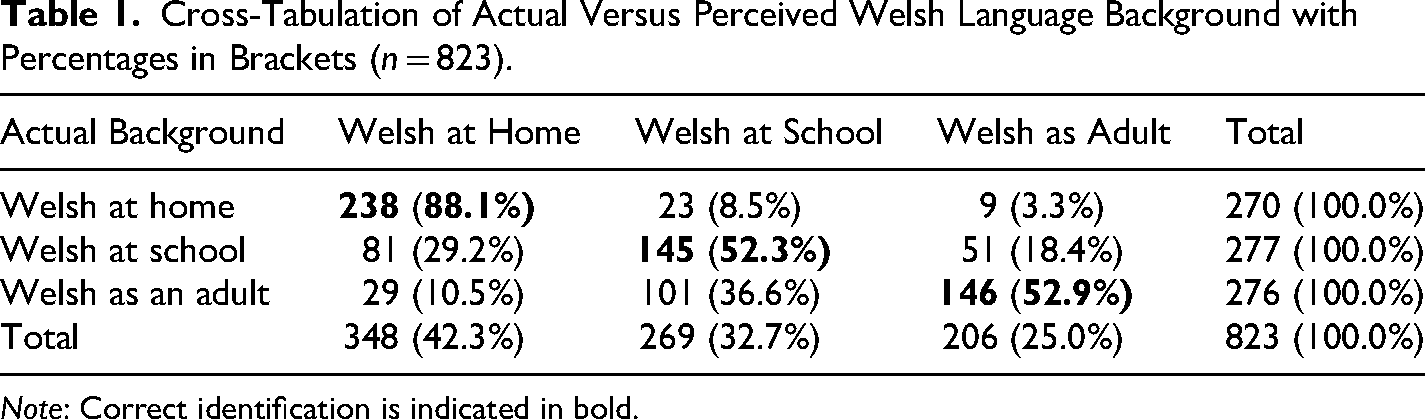
Cross-Tabulation of Actual Versus Perceived Welsh Language Background with Percentages in Brackets (n = 823).
Note: Correct identification is indicated in bold.
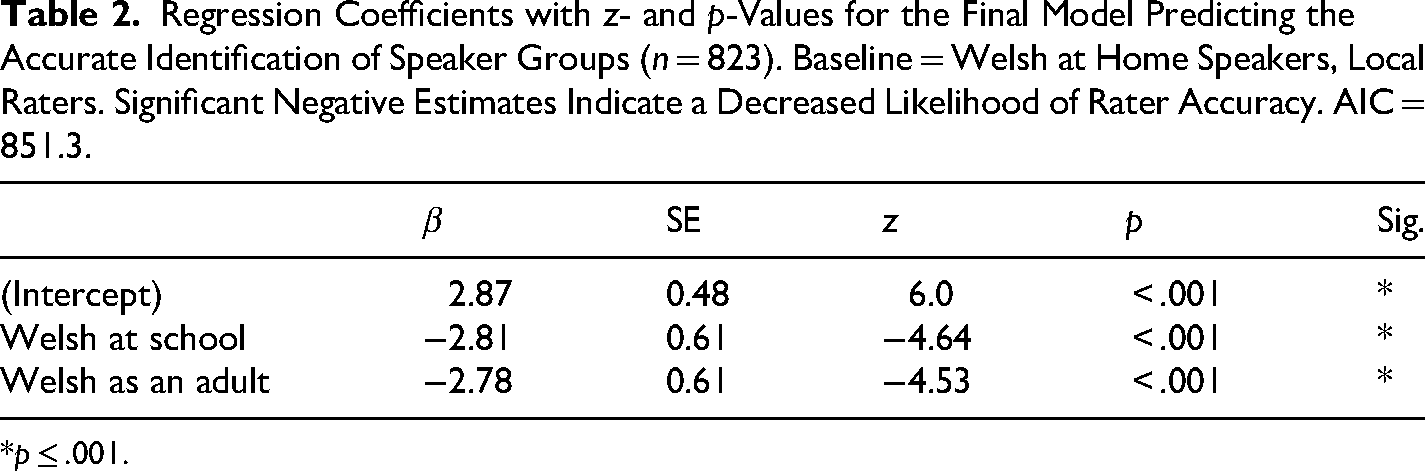
In order to ascertain whether both the speakers’ language background and the raters’ geographical background influenced the likelihood of a correct answer, we ran a mixed-effects logistic regression, which was selected after meeting the assumptions associated with a mixed-effects logistic regression. Namely, these were collinearity through the inspection of VIF scores, all of which were below 5; independence of residuals through an ACF plot indicating no significant autocorrelation of residuals; and dispersion through a nonparametric dispersion test of the residuals (dispersion = 1.03, p = 0.536). Accuracy was selected as the dependent variable and speaker background and rater local area as fixed factors. Rater and speaker were included in the models as random factors. Likelihood-ratio testing revealed that the inclusion of rater local area (p = .17) and interactions between speaker background and rater local area (p = .22) in the model did not statistically improve the model fit. We conducted a post-hoc power analysis using the simr package in R to estimate the statistical power of our model. Power was estimated using 100 simulations based on the observed dataset (n = 823 observations). The analysis indicated that our model had 100% power (95% CI: 96.38%, 100%) to detect an effect of speaker background at α = 0.05. Table 2 shows the final model.
Regression Coefficients with z- and p-Values for the Final Model Predicting the Accurate Identification of Speaker Groups (n = 823). Baseline = Welsh at Home Speakers, Local Raters. Significant Negative Estimates Indicate a Decreased Likelihood of Rater Accuracy. AIC = 851.3.
*p ≤ .001.
The results of the statistical modelling in Table 2 indicate that Welsh at Home are more likely to be identified correctly by raters than Welsh at School (β = −2.81, z = −4.64, p < .001) and Welsh as an Adult groups (β = −2.78, z = −4.53, p < .001). The local area of the raters, included in the modelling on the assumption that those from north-west Wales would be more accustomed to local accentual differences, was not significant.
In order to shed light on the incorrect answers, we examined the percentage of incorrect answers by speaker background. Of the Welsh at Home samples that were identified incorrectly by the raters, 71.9% were identified as Welsh at School (n = 23/32). The results of a chi-square test showed that the difference between the proportion of raters who incorrectly identified the Welsh at Home samples as Welsh at School, and those who incorrectly identified the samples as Welsh as an Adult, was significant [χ² (2, n = 32) = 25.19, p < .0001]. Of the Welsh at School samples that were incorrectly identified, 61.4% were identified as Welsh at Home (n = 81/132). The incorrectly identified Welsh at School samples were more likely to be identified as Welsh at Home than Welsh as an Adult [χ² (2, n = 132) = 76.23, p < .0001]. Finally, 77.7% of incorrectly identified Welsh as an Adult samples were classed as Welsh at School (n = 101/130) and the difference between Welsh at School and Welsh at Home was significant [χ² (2, n = 130) = 124.82, p < .0001].
Social Evaluations
The next part of the results presents the findings for the social evaluations gathered via VGT and aims to discover whether more positive evaluations were more likely among different speaker groups, and whether rater gender and location also influenced more positive evaluations (RQ2). As discussed in the methodology, raters were asked to evaluate speakers based on the following attributes: friendliness, attractiveness, open-mindedness, funniness, politeness, and intelligence.
First, we conducted a Principal Components Analysis in order to ascertain whether it was viable to treat the individual attributes as one dependent variable (social evaluation). A Principal Axis Factor (PAF) with a Varimax (orthogonal) rotation of the six attributes was conducted on the data. Table 3 shows the results of this analysis.
Orthogonally Rotated Component Coefficient for Six Social Evaluation Factors (Extraction Method: Principal Component Analysis; Rotation Method: Varimax with Kaiser Normalization; Rotation Converged in Three Iterations).
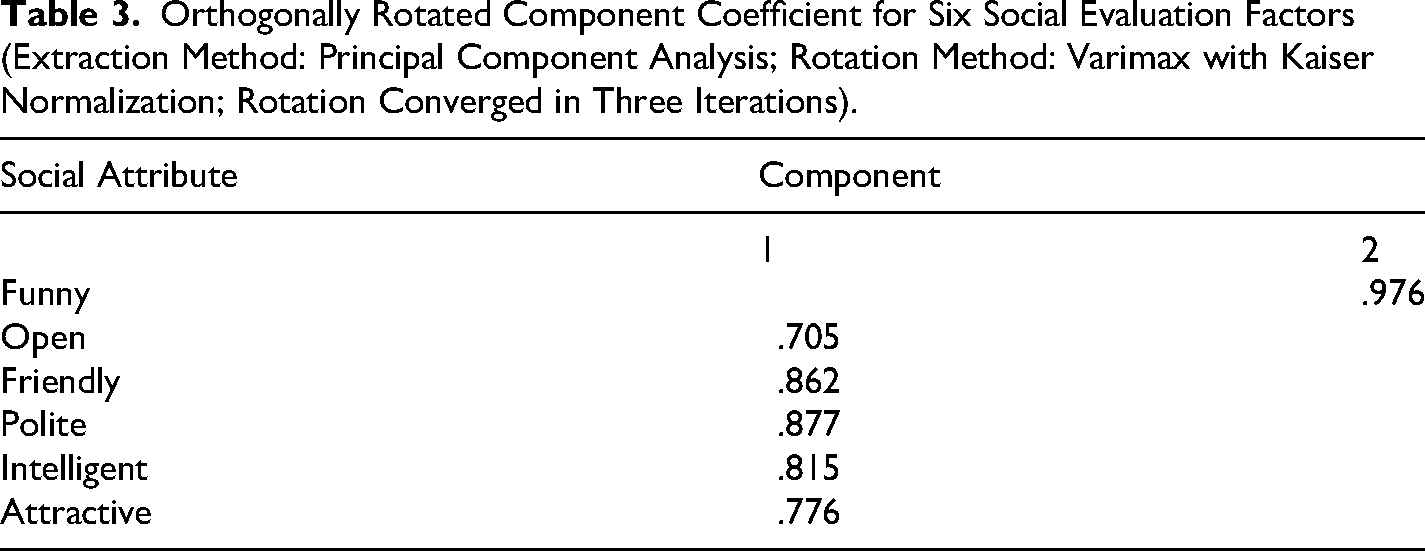
The results shown in Table 3 suggest that the attribute “funny” cannot be grouped with the other attributes. In order to examine social evaluations as one predictor variable, we combined the other five attributes (from component 1) and excluded funniness from subsequent analyses.
A mixed-effects linear regression was conducted on the data in order to examine the possible influence of speaker background, rater gender, and rater location on the mean combined social evaluation score. We selected a mixed-effects linear regression after meeting the assumptions of linearity and independence of residuals: linearity was observed visually via plotting the residuals against the fitted values which revealed a random patterning more concentrated near the horizontal line, and independence of residuals through an ACF plot indicating no significant autocorrelation of residuals. However, non-normality of residuals was observed via a significant Kolmogorov-Smirnov test (p < .005), as was homoscedasticity via a significant Breusch-Pagan test (p < .001). Therefore, standard errors were adjusted using the robustlmm package.
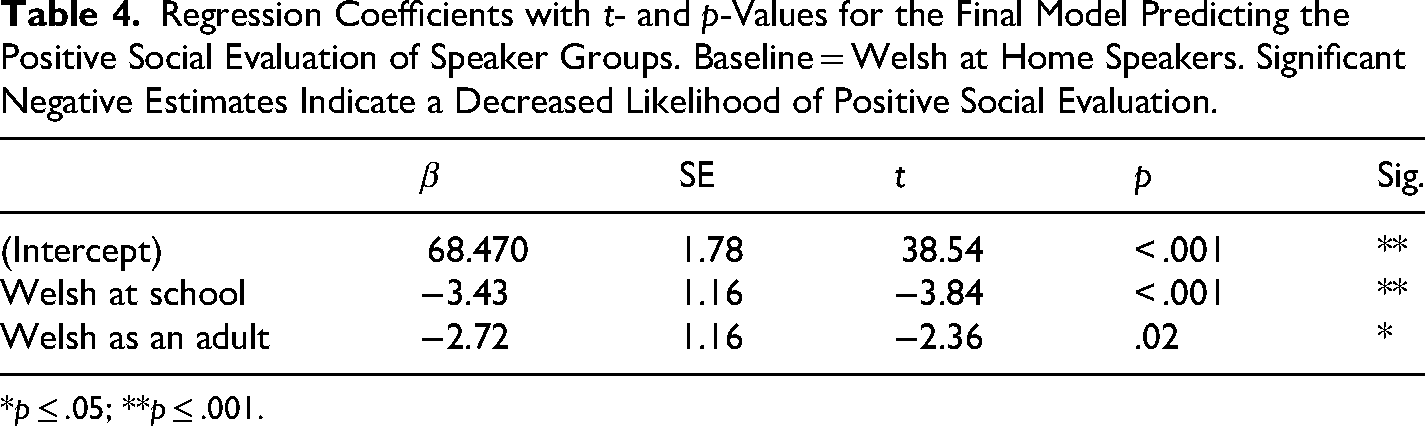
As in previous analyses, the possible effects of individual speakers and individual raters were minimized by including these as random factors. Likelihood-ratio testing revealed that the inclusion of rater gender (p = .86) and rater location (p = .83) did not improve the non-robust model fit and therefore were not included in the robust model. We conducted a post-hoc power analysis using the simr package in R to estimate the statistical power of our model. Power was estimated using 100 simulations based on the observed dataset (n = 823 observations). The analysis indicated that our model had 94% power (95% CI: 87.4%, 97.77%) to detect an effect of speaker background at α = 0.05. The results of the linear regression are shown in Table 4.
Regression Coefficients with t- and p-Values for the Final Model Predicting the Positive Social Evaluation of Speaker Groups. Baseline = Welsh at Home Speakers. Significant Negative Estimates Indicate a Decreased Likelihood of Positive Social Evaluation.
*p ≤ .05; **p ≤ .001.
Figure 1 visualizes the results for the mean combined social evaluations by speaker background. The score is the mean of all five attributes with a higher score indicating a more positive evaluation. The highest social evaluation score was obtained by the Welsh at Home group (M = 69.8), followed by the Welsh as an Adult group (M = 66.1) and the Welsh at School group (M = 64.3).
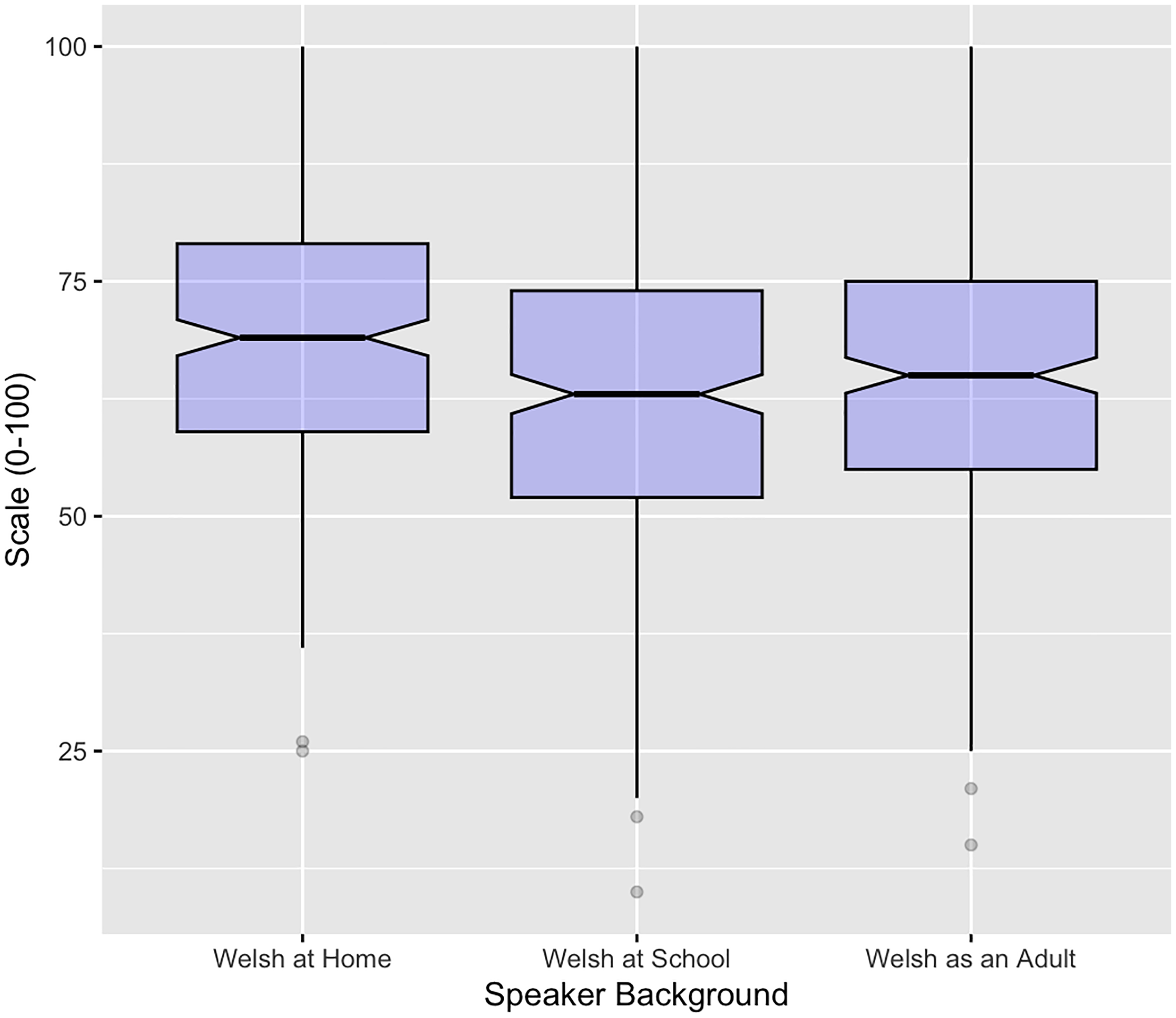
Mean Combined Social Evaluation Scores by Speaker Background.
The results of the linear regression indicate that both Welsh at School and Welsh as an Adult are less likely to receive positive evaluations than the Welsh at Home speakers. Welsh at School speakers (β = −3.84, t = −3.84, p < .001) are more likely to receive negative evaluations than Welsh as an Adult speakers (β = −2.72, t = −2.36, p = .02). In order to examine this result further, the following section considers the qualitative data.
Feature Analysis
The feature analysis is based on a content analysis of the free-text comments given by the raters without linguistics background. Raters were asked to tell us why they had chosen a particular speaker group for each sample, and identify any pronunciation features which had influenced this decision (RQ3).
The comments were firstly coded for content and keywords were assigned to each comment. A single comment often contained reference to several features and was therefore coded using multiple keywords (n = 801). Furthermore, certain comments contained no reference to accentual features but were also labelled according to the content. For instance, the comment “mae hi'n swnio fel merch wnaeth ddysgu Cymraeg yn yr ysgol ond sydd heb ddefnyddio'r iaith lawer ers hynny” (she sounds like a girl who learnt Welsh at school and who hasn't used the language a lot since then) was labelled as too vague to code as it is not clear on what basis the rater had drawn this conclusion.
Following initial coding, only comments which mentioned accentual features were retained (n = 543) with the remaining comments either too vague to code, blank, or related to non-accentual features (n = 258). The keywords were then further scrutinized, and a final list of keywords was developed. Specifically, individual consonantal and vocalic features were grouped as “consonants” and “vowels” respectively, and labels which had been separately coded as “speech rate” and “fluency” were merged. We firstly present the results for those samples identified as Welsh at Home, followed by those identified as Welsh at School, and Welsh as an Adult.
A total of 10% of comments were blind recoded (n = 55). There was an agreement level between coders of 85.4% (n = 88/103). Any differences between coders were resolved by consensus.
Welsh at Home Speakers
Table 5 shows the number and percentage of mentions of specific features of the Welsh at Home group of speakers. There was a total of 392 mentions of accentual features in 276 comments.
Linguistic Features of Welsh at Home Speech Mentioned by Raters.
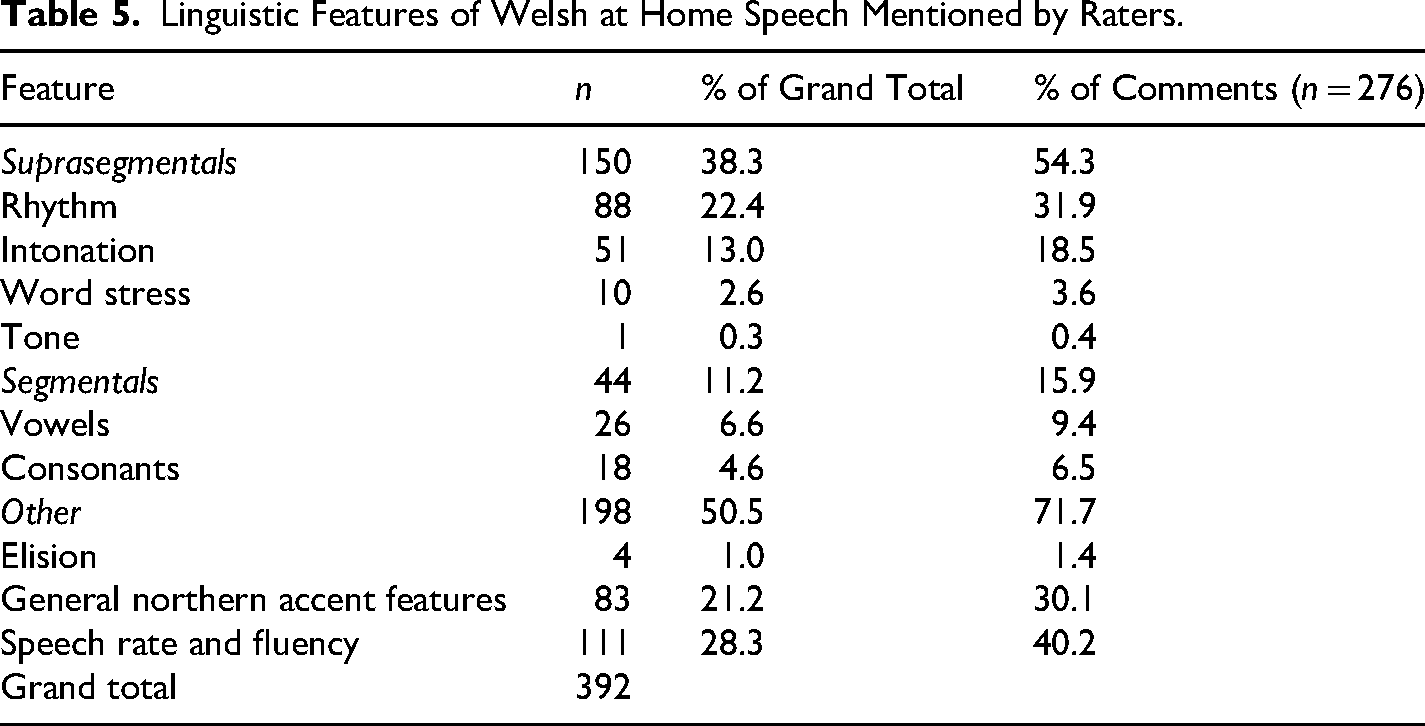
The most frequent comments referred to suprasegmental aspects of speech. Rhythm was referred to in 31.9% of the comments (n = 88) and intonation was mentioned in 18.5% of comments (n = 51). In the comments, both rhythm and intonation were frequently referred to as “natural,” as exemplified in the comments “rhythm cyfforddus a goslef hollol naturiol ar y frawddeg” (the sentence has a comfortable rhythm and a completely natural intonation) and “rhythm cloi a naturiol” (quick and natural rhythm).
The presence of northern accentual features in the speech of the Welsh at Home group was also mentioned by raters. Reference to the northern (particularly north-western) accent was mentioned in 30.1% of the comments made by the raters (n = 83). The raters’ comments suggested that the production of features associated with north-west Wales, where the majority of people can speak Welsh, was an indication that a speaker had acquired the language at home. For example, one rater noted that “Mae'r acen gogleddol naturiol yn gwneud iddo swnio fel mai Cymraeg yw ei iaith gynta” (The natural northern accent makes him sound like Welsh is his first language).
The highest proportion of mentions referred to fluency and speech rate (40.2%, n = 111). This is reflected in comments such as “Cymraeg yn llifo’n hawdd fan hyn” (Welsh flows easily here) and “yn brysio trwy geiriau a methu llythrenau mewn ffordd disgwyliedig” (rushes through words and missed letters in an expected way). Comments on segments, in contrast, were relatively limited, accounting for only 15.9% of the total.
The percentage of mentions of specific linguistic features among the Welsh at School speakers is reported in Table 6. There were a total of 122 mentions of accentual features in 124 comments.
Linguistic Features of Welsh at School Speech Mentioned by Raters.
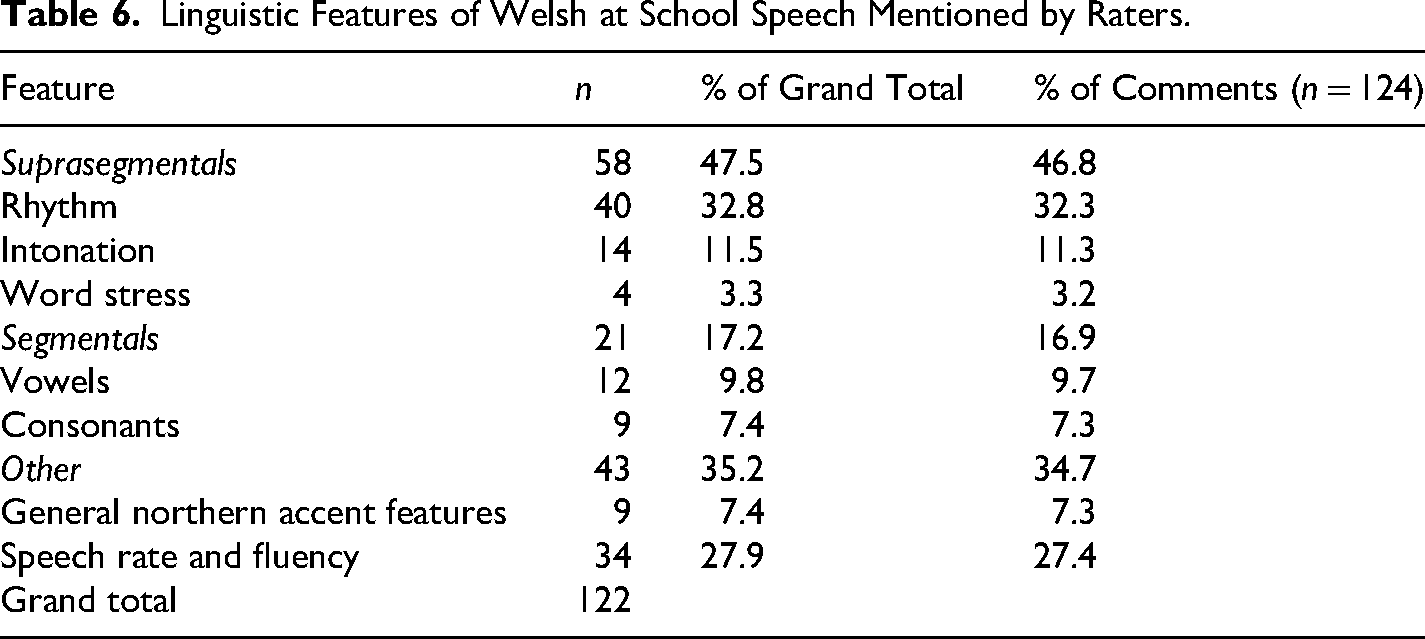
The most common feature mentioned in relation to the Welsh at School sample was rhythm. Rhythm was mentioned in 32.3% of comments (n = 40) and comments tended to center on comparisons with Welsh at Home speakers. For instance, one rater noted that “mae’r rhythm ychydig yn wahanol i’r arfer – ond ddim rhy anhebyg i siaradwyr iaith gyntaf” (the rhythm is a little bit different to normal – but doesn’t sound too dissimilar to first-language speakers). Intonation, which was mentioned in 11.3% of comments (n = 14), was also referred to in comparison with Welsh at Home speakers, for instance “goslef ddim yn gwbl naturiol – mae’n undonog iawn” (intonation isn’t completely natural – it's very monotone).
Speech rate and fluency were referred to in 27.4% of comments (n = 34). In many cases, hesitation was referred to as a sign that the speaker did not speak Welsh regularly, which, in turn, was associated with the Welsh at School group. For example, one rater noted that “Cymraeg weddol doredig ac amherffaith yn gneud i mi feddwl eu bod wedi dysgu yn yr ysgol ond ddim o reidrwydd yn siarad llawer bellach” (quite broken Welsh and imperfect makes me think that they have learned it in school but don’t necessarily speak much anymore). Another rater noted that “mae’r oedi yn awgrymu nad yw’r siaradwr yn defnyddio’r Gymraeg yn ddyddiol” (the delay suggests that the speaker doesn’t use Welsh daily).
Welsh as an Adult Speakers
The percentage of mentions of specific linguistic features among the Welsh as an Adult speakers is reported in Table 7. There were a total of 180 mentions of accentual features in 143 comments.
Linguistic Features of Welsh as an Adult Speech Mentioned by Raters.
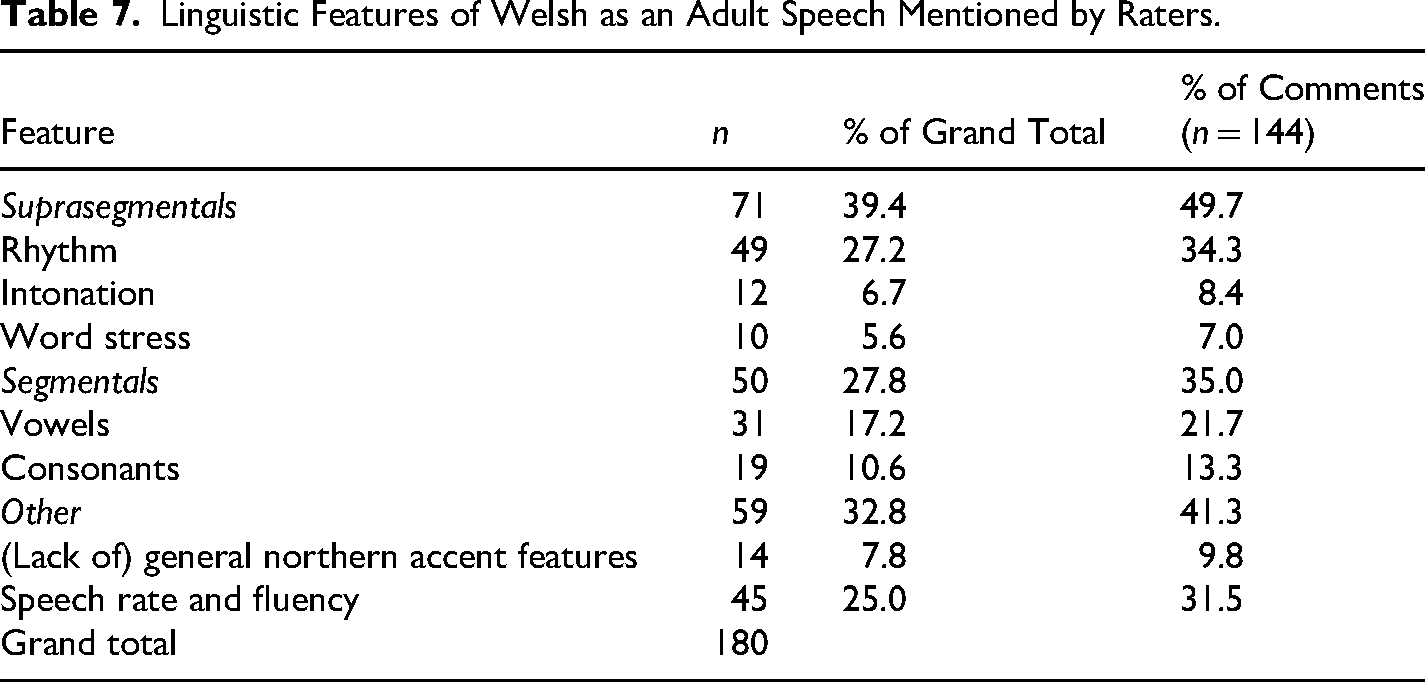
The majority of comments on the Welsh as an Adult samples mentioned dysfluent rhythm as an indicator of adult learners’ speech (34.3%, n = 49). For example, one rater suggested that “Dwi'n meddwl y prif beth sy'n awgrymu ei fod wedi dysgu fel oedolyn yw rhythm y ffordd mae'n siarad. Mae'n araf iawn ac yn cymryd seibiant o bryd i'w gilydd, fel petai'n meddwl trwy ei eiriau” (I think the main thing which suggests that he's learned Welsh as an adult is the rhythm of the way he speaks. It's very slow and takes breaks now and again, as if he's thinking through his words). Similarly, speech rate and fluency were mentioned in 31.5% of comments (n = 45) as a sign that the speaker felt “unsure” or “not confident” in Welsh.
The production of vowels and consonants was mentioned more frequently in the evaluations of the Welsh as an Adult samples compared to the Welsh at School and Welsh at Home samples (35%, n = 50). Of the comments on the Welsh as an Adult samples, 21.7% mentioned vowels (n = 31) and 13.3% mentioned consonants (n = 19). The vowels tended to be mentioned with regard to a possible English influence, as exemplified by this comment: “Llafariaid y tro yma os rhywbeth yn fwy main, o bosib yn fwy ‘Seisnigaidd’?” (Vowels this time if anything, more delicate, possibly more ‘English’?). The comments about consonants, however, talked more about a lack of acquisition of phonemes which are not present in many varieties of British English, such as/r/,/χ/, and/ɬ/.
Discussion
This study is the first to examine the extent to which traditional Welsh speakers and two groups of new speakers are identifiable based on their accent, how raters evaluate these three accents socially, and what phonetic features they associate with them. The results revealed that all three speaker groups could be identified well above chance, but the Welsh at Home speakers were correctly identified significantly more often than the speakers in the other two groups. On the other hand, rater gender and rater area did not significantly predict identification performance. The results for the social evaluations, in turn, revealed that all three speaker groups were positively evaluated. However, the Welsh at Home speakers attracted significantly more positive evaluations than the Welsh at School and Welsh as an Adult speakers. Finally, in the phonetic feature analysis the raters described the new speaker accents mostly in terms of their deviance from Welsh at Home speakers’. This mirrors work on global Englishes which has shown that “the native/non-native distinction is paramount for the informants in the identification process” (McKenzie, 2010, p. 142).
The Identification of Traditional and New Speakers of Welsh
The accuracy results revealed significantly better identification of the Welsh at Home speakers’ accent than that of the two new speaker groups, with a score of 88.1% correct. This is perhaps not surprising since it matches the raters’ own accent background and is widely heard in the media and in communities across Wales, despite originating in north Wales. As such, it conforms to Robert (2009) which also found superior identification of traditional Welsh speakers compared to new speakers. The widespread use and familiarity of the Welsh at Home speaker's accent, in turn, is also the likely reason why non-local raters from areas outside North Wales performed equally well in the accuracy ratings as local raters from North Wales.
Identification accuracy of the two new speaker groups, in contrast, was significantly lower with both attaining scores around 52% correct. In Tomé Lourido and Evans (2021), the only other accent perception study with new speakers, Galician neofalantes were only correctly identified in 26% of instances, which was below the 33% chance level in their study. The authors argued, based on an analysis of raters’ comments and neofalantes’ speech productions (Mayr et al., 2019; Tomé Lourido & Evans, 2019), that this finding is due to confusion about the phonetic properties of the accent, with some features shared with Galician-dominant bilinguals and others with Spanish-dominant ones, but none that were exclusively associated with neofalantes.
The analysis of misidentifications (see section Identification) indicates that Welsh at Home and Welsh at School samples were predominantly confused with each other, suggesting that Welsh at School speakers’ accents are perceived as more similar to Welsh at Home speakers’ than Welsh as an Adult speakers’. This is consistent with the fact that Welsh at School speakers are exposed to Welsh at an earlier age and to a greater extent than Welsh as an Adult speakers. This is also reflected in the raters’ qualitative comments, where only the Welsh as an Adult speakers’ samples attracted comments on the “Englishness” of consonant and vowel productions. Together, we conclude tentatively on the basis of our results that the association of specific accent features with the Welsh at School and Welsh as an Adult labels is not sufficiently clear-cut at this point, and hence further work is needed before any strong conclusions can be drawn.
Social Perceptions of Welsh New Speaker Accents
The results of the social evaluations from our VGT analysis indicated significantly more favorable ratings for the Welsh at Home speakers than the two new speaker groups. Robert (2009, p. 112) argues that positive social evaluations of Welsh speakers are linked to competence rather than language background. The results of the analysis of raters’ comments suggests that there is an inherent link between the perception of competence and language background and that Welsh at Home speakers are judged more positively. The comments given by raters often focused on speech rate and fluency which can be viewed as markers of competency and comments relating to other features were largely judged in comparison to a “native” speaker norm. This could be said to mirror previous work on the perception of nonnative accents, where “native” speakers are often perceived more positively by other native speakers (e.g., McKenzie et al., 2016; Neuliep & Speten-Hansen, 2013).
It should also be remembered that the raters in this study were all traditional speakers of Welsh from across Wales. It might be the case, therefore, that the raters identified more strongly with the Welsh at Home speakers, which resulted in more positive evaluations (cf. Social Identity Theory, e.g., Tajfel & Turner, 1979). Further work which includes Welsh at Home speakers from different areas could examine the extent to which prestige and social attractiveness varies between traditional speakers from different areas and, perhaps more importantly, whether the inclusion of new speakers as raters also replicates this result.
As for the two new speaker accents, to what extent do the results suggest negative stereotypes and potential accent bias? On the one hand, the rating scores were generally positive, with a mean score of 66.1 for the Welsh as an Adult speakers and 64.3 for the Welsh at School speakers, compared with 69.8 for the Welsh at Home speakers. The findings are hence encouraging and suggest that Welsh home language speakers do not exhibit strong negative emotions against Welsh new speakers. Nevertheless, despite similar mean scores, it needs to be borne in mind that the Welsh at Home speakers obtained significantly more favorable evaluations than the two new speaker groups. On the other hand, as stated above, the raters’ comments largely reflect a deficiency-based view of the Welsh at School and Welsh as an Adult speakers’ accents, with the latter defined negatively in terms of their lack of “naturalness,” “fluency” or “Welshness” compared with Welsh at Home speakers’ accents. Overall, the results of the social evaluation of Welsh new speaker accents are hence mixed. Future research is needed that builds on these findings and examines social perceptions across a wider range of traits, social groupings and geographical areas.
Implications for Welsh Language Policy
The findings from this study have important implications for Welsh language policy. The Welsh Government's (2017) ambitious strategy to increase the number of Welsh speakers to one million by 2050 emphasizes the role that all people in Wales have in creating “a truly bilingual Wales with a living language for all” (Welsh Government, 2017, p. 3). The strategy takes an inclusive approach, therefore, and aims to create the conditions whereby everyone in Wales will have access to the Welsh language, and that every speaker […] will be able to choose to use their Welsh language skills and receive encouragement and support to further develop their skills if they so wish, in an inclusive and positive environment. (Welsh Government, 2017, p. 11)
While inclusivity may be a policy aim, the results obtained here suggest an implied hierarchy whereby traditional speakers are viewed more favorably than new speakers. This finding reflects work on new speaker attitudes and suggests that traditional speakers are still thought of as “the ideal speaker” which has consequences for new speakers’ use of Welsh and engagement with the language (Daly, 2025). Taken together, both strands of research indicate that further work is needed to create favorable conditions for greater acceptability of new speaker accents. After all, new speakers constitute the most significant population in the government's target of reaching one million Welsh speakers.
To give concrete examples, initiatives could be taken to “normalize” new speaker accents in the media, and ensure that new speakers are represented in Welsh cultural institutions. Furthermore, initiatives with education practitioners around language variation in bilingual contexts could influence behavior change among young people. Generally, accent bias is a topic that has recently received attention in the UK (Levon et al., 2020) as it directly affects access to elite professional jobs as well as social mobility, but has not been addressed relative to Welsh. In a Welsh context, accent bias warrants further attention due to the implied hierarchy of perception highlighted in this paper. Taken together, implementing initiatives to improve perceptions of new speaker accents and their linguistic identities could strengthen Welsh Government policy efforts by seeking proper inclusivity for the most significant population relative to reaching one million Welsh speakers by 2050.
Conclusion
This study aimed to enhance our understanding of the social and linguistic perceptions of new speaker accents in general, and those of two sets of Welsh new speakers in particular. The results indicated that traditional Welsh speakers were easier to identify and attracted more favorable social evaluations than the Welsh at School and Welsh as an Adult speakers. Nevertheless, identifiability of the latter two was fair and raters’ comments indicated some distinctive features. The results of the social perceptions, in turn, showed overall positive perceptions for the two new speaker accents, suggesting that neither of them evoke strong negative reactions and stereotypes. At the same time, one needs to be cautious not to be overly optimistic since the raters characterized the two new speaker accents predominantly as deficient compared with the accent of traditional Welsh speakers. Further work is needed to examine the experiences of new speakers, who constitute an important population in the Welsh Government's language strategy (Welsh Government, 2017).
As with all research, the present study has a number of limitations. To begin with, it only examined the social and linguistic perceptions of speakers from North Wales. Since previous production studies have indicated fewer distinctive features between traditional and new speakers in other parts of Wales (Gruffydd, 2022; Mayr et al., 2017; Mennen et al., 2020), we need to collect additional perception data from diverse geographical areas. It stands to reason that speakers from these areas may be perceived more favorably by raters with matching accent backgrounds, but this would need to be established empirically. Moreover, data from different age cohorts and socio-economic groupings are required to establish whether the findings obtained here are generalizable. Second, in the present study only Welsh home language speakers acted as raters. We decided on this group since they constitute the most established set of Welsh speakers and hence provide a useful initial yardstick for evaluations. Including new speakers as raters as well would have been beyond the scope and timescale of the current project. Future work is therefore needed that examines how well Welsh new speakers can identify different speaker groups and how they evaluate them socially. Third, the traits for the social evaluations in our VGT experimental design were limited in number and preselected from previous studies. While we carefully selected the traits in the present study, their suitability for the current context could have been assessed more rigorously by running a pilot. In future work, such a pilot could be incorporated in the design and examine social evaluations within a dedicated VGT experiment. Finally, the phonetic feature analysis required the raters to enter free-text information immediately upon exposure to individual samples. While this resulted in many useful comments on specific areas of pronunciation, some had to be discarded as they were either too general or too unclear to interpret with confidence. In future research, qualitative interviews could be conducted with raters upon completion of the rating task, similar to Mayr et al. (2020b) for Welsh English accents, which would allow back-channeling and enable them to elaborate on their perceptions. Together, these initiatives will further enhance our understanding of linguistic variation in Welsh accents and the social perceptions they attract.
Footnotes
Acknowledgments
The authors wish to thank Nicholas Palomares and three anonymous reviewers for their helpful feedback as well as the individuals who participated in the study.

Funding
The authors disclosed receipt of the following financial support for the research, authorship, and/or publication of this article: This research has been funded by an Accelerator Grant from Cardiff Metropolitan University awarded to Robert Mayr.
Declaration of Conflicting Interests
The authors declared no potential conflicts of interest with respect to the research, authorship, and/or publication of this article.
Data Availability Statement
Supplemental material
Supplemental material for this article is available online on the above OSF link.