



Abstract
Language can be considered as not simply playing a role in behavior change but as being foundational to how we understand people's behavior in itself. Focusing on the use of discursive categories in everyday social interaction, this paper examines how dispositional categories (such as food “likes”) become “sticky” through being invoked during one social action but treated as relatively stable over time and used to account for past and future behavior. Data are video recordings of children's eating practices taken from two large corpuses of family meals in Scotland and preschool lunches in Sweden. Discursive Psychology was used to explicate the ways in which categories of food likes and dislikes are implicated in social actions during mealtimes, such as offering food, encouraging children to eat, or responding to food already eaten. The analysis unpacks the central argument in three parts: (1) that discursive practices construct psychological categories, (2) that categories are embedded within social actions, and (3) that social actions may change, but the categories stick. The paper contributes to discursive and interactional work on the use of categories through shifting the analytical gaze to dispositional categories and examining mundane (as well as institutional) settings. The implications of this work extend to a much broader field of research on language and behavior change through illustrating the embedded resistance of certain discursive categories and their consequences for the possibilities for change.
Introduction
This paper examines the discursive practices used to categorize individuals as having a particular disposition and how these shape not only the person but also their subsequent conduct. Using examples of talk about food “likes” during children's eating practices, the paper demonstrates how these psychological categories are embedded within routine and mundane sequences of everyday life yet have potentially long-lasting implications for behavior. These discursive categories are considered sticky in that they not only attribute a disposition to an individual on the basis of a specific interactional moment, but this disposition is then used to account for past and future social actions. The paper thus contributes to research on the role of language in behavior change and proposes that more attention be paid to the constructive nature of language categories, such as those involving dispositional states, in which resistance is already embedded.
Language has long been examined for its role in behavioral or social change within research that examines concepts such as communication strategies, compliance, persuasion, and social influence. Much of this work examines how language, to a greater or lesser extent, can be used to exert changes in other people's behavior or conduct. For instance, in a review of the role of parental influence on children's eating practices, language is present though rather obscured behind other terms such as coercion, restricting strategies, or soothing with food (Mitchell et al., 2013). Language can thus be considered as playing a role in behavior change but as one factor among others, and not necessarily as foundational. By contrast, approaches that take a constructive rather than representative approach to language argue that language—typically referred to as discourse, discursive practices, or talk-in-interaction—is not simply one of many factors but is foundational to the way in which we understand the world. This literature spans a broad range of work from examining change at the granular level of social interaction (e.g., Stokoe, 2014; Wilkinson, 2011) to the ways in which discourse can be used for change at a societal level (e.g., Cushman, 1996; Fairclough, 2007). It is within the literature on the granular, micro-level aspects of discursive practices that the current paper is situated, and to which it adds a specific contribution concerning discursive categories in talk.
Categories in Talk
There is a rich history of research using Conversation Analysis (CA), Discursive Psychology (DP), and Membership Categorisation Analysis (MCA) that examines how categories are constructed in talk and the social actions that these accomplish (see Edwards, 1991; Stokoe et al., 2025; Whitehead et al., 2025). This work has considered categories of person as defined by, for instance, race (e.g., Shrikant & Sambaraju, 2021; Whitehead, 2009; Xie et al., 2021), age (e.g., Nikander, 2000; Previtali et al., 2023), and gender (e.g., Korobov, 2013; Stokoe, 2010). Categorizing people as one type of person rather than another can have social consequences that range from the mundane to the life-threatening. These categories might also be called labels or identities, depending on how they are theorized, though they all revolve around the construction of “who we are.” Regardless of how people might identify themselves, it is argued that it is within specific interactional contexts that this category work becomes relevant for social actions, such as being held accountable, praising or criticizing, requesting or refusing, or making decisions. For instance, categories such as being vegan (Sneijder & Te Molder, 2009) or eating healthily (Bouwman et al., 2009) have been examined in terms of how they are used to justify food choices.
In keeping with the analytical shift from “using categories to study people to studying how people use categories” (Stokoe et al., 2025, p. 534), when examining everyday social interaction, a greater range of categories are invoked than those typically used in academic research. An example of this is talk about “food likes,” such as when parents (and children) formulate their children's likes and dislikes during family mealtimes (van der Heijden et al., 2022; Wiggins, 2014a, 2023). While a “like” might be categorized in research as a food preference and then understood as a predisposition toward particular foods (e.g., Birch, 1999), in everyday social interaction the term can be used as either a noun or a verb (Wiggins, 2014a). That is, it can be used to describe something a person is (a like as a disposition) or something they do (liking as an activity). This paper thus examines food likes talk as an example of a category that attributes an individual disposition, and the consequences of this for research on language and behavior change. In this way, it extends the reach of discursive work on categories that has to date mostly focused on the “big three” (age, race, and gender; see Stokoe et al., 2025, and the examples above) to consider dispositional categories in everyday interaction.
Changing People, Changing Practices
It is no simple matter to consider the topic of behavior change when one considers the myriad ways in which the concepts of behavior and change can be defined. This paper contributes to the field, however, through directing attention to the ways in which discursive categories might themselves infer stability or variability. That is, that the words we use—as researchers as well as in everyday life—are already concepts that come with a set of assumptions that are tied to that particular language. As Mol (2024) argues, for instance, the word “eating” in the English language not only means very different things in English (we can eat for pleasure, hunger, requirement, or boredom, for instance) but it also differs considerably from words in other languages that can also be roughly (though clumsily) translated as “the ingestion of food” (see also Mol, 2014, on the Dutch word “lekker” as contrasted with the English “tasty”). The focus in this paper is thus on the English word “like” as used in the context of food, and how this is used in mundane settings as a psychological category that attributes dispositions to individuals (as in, “you like eggs”) which then has implications for behavior change. Liking or not liking foods is constructed as an individual disposition, generally stable and something that is used as a primary explanation for eating behavior. It will be argued that language use in everyday life has created a psychological category which, regardless of its ontological status (that is, how someone experiences a food), has consequences for how an individual's conduct is interpreted in everyday settings.
The argument developed in this paper has parallels with work in applied Conversation Analysis (e.g., Antaki, 2011; Richards & Seedhouse, 2016; see also Stokoe, 2014; Wilkinson, 2011). This body of work has to date typically focused on institutional settings, such as how the use of different words can be consequential in negotiations with persons in crisis (Sikveland & Stokoe, 2020) or in behavior change conversations in healthcare settings (Albury et al., 2019). Some of this work has begun to examine, for example, how concepts such as resistance can be respecified not as personal characteristics but in terms of the progression of conversation and thus analytically available in the sequential order of social interaction (Humă et al., 2023). The current argument seeks to extend this analytical gaze to more mundane settings (such as children's mealtimes) and to consider not only how words might change situational outcomes but may also be imbued with a resistance to change that is itself problematic. In other words, this paper contributes to this literature by examining word use in mundane as well as institutional settings and offers another analytical tool (in the use of dispositional categories) through which such applied work might be further developed.
Sticky Categories
This paper builds on some of the foundational aspects of DP in that it examines how psychological categories are constructed as part of particular social actions within everyday social interaction (Edwards & Potter, 1992) and furthermore argues that this has implications for how we approach the topic of behavior change. The core argument of this paper is that these discursive practices invoke “sticky” psychological categories that constrain the potential to adapt behavior. They are considered sticky in terms of how they are produced within a specific interactional moment but treated as resistant to change; as being applicable to account for past and future behavior. The stickiness thus resides at the interactional level, rather than with any supposed cognitive or perceptual categories (cf. Lagermann, 2015 and Mikulak et al., 2024 for two alternative conceptualizations of sticky categories). At the granular level, discursive categories can be examined for how they become, through interaction, imbued with a stickiness that renders the individual resistant to change. It is furthermore in these interactional moments that behavior becomes consequential. In the context of children's mealtimes, for instance, talk about likes and dislikes has implications for how children's behavior is negotiated and what might or might not be eaten.
It will be argued that, despite being locally produced and occasioned within social interaction, discursive categories such as food “likes” attribute dispositions to individuals that suggest that it is the individuals, rather than the language, that are resistant to change. The argument in this paper will be discussed in three parts, the first two of which build on DP principles: (1) Discursive practices construct psychological categories, (2) Categories are embedded within social actions, and (3) Social actions may change, but the categories stick. The paper extends current discursive work on categories by not only demonstrating the use of a dispositional category but also by examining this in mundane as well as institutional settings. The paper will conclude with a discussion concerning how eating talk might be adapted to more closely accommodate eating as an active and contextually dependent set of practices and processes, alongside the wider implications of this argument.
Methods
Data Collection and Participants
The data on which this argument is based is taken from two sources:
The first corpus consists of around 100 video-recorded mealtimes from circa 10 families in Scotland, recorded between 2011 and 2014. Ethical approval was obtained from the University of Strathclyde, and informed written consent was provided by all parents in the families before data collection took place. The families were provided with recording equipment and asked to record as many mealtimes as they could over a set period (typically 2–3 weeks). All families had at least one child living at home; no other demographic details were recorded. The children's ages ranged from 5 months to 10 years old. The majority of this data was collected without any funding support.
The second corpus consists of 97 video-recorded lunches from four preschools in Sweden, recorded between 2021 and 2022. Ethical approval was obtained from the Swedish Ethical Review Authority (number 2020–00496) and informed written consent was provided by all parents and staff members before data collection took place. Each lunchtime consisted of between 2 and 7 children (aged 1–6 years old), with 1 and 3 adults (referred to as “teachers” in this paper, though their qualifications and roles varied), eating a hot meal together in the middle of the preschool day. Three video cameras and microphones were used to record each mealtime. The project was funded by the Swedish Research Council (number 2019–03890).
Analytic Procedure
The data was analyzed using DP (Edwards & Potter, 1992; Wiggins, 2017). DP adopts a social constructionist stance in which language is treated as constructive, rather than reflective, of psychological states (Edwards & Potter, 1993; Humă et al., 2020). The focus is therefore on the discursive practices through which psychological topics become managed and consequential as part of everyday social interaction: on how such matters are talked into being (Humă & Potter, 2023). The methodological procedure for DP involves first creating collections of instances from the data on a specific topic (e.g., talking about food likes) or action (e.g., offering food) and transcribing this in sufficient detail to capture features such as pauses, intonation, and embodied gestures (Humă & Potter, 2023; see Jefferson, 1984, for the transcription system). For the Swedish preschool lunches, both the original language and the translation into English have been included. The analysis involved examining both the original video data and the transcripts with a focus on how psychological topics were constructed and embedded within social actions, considering how these unfolded turn-by-turn (i.e., sequentially). This involved analyzing the ways in which talk was formulated (such as the use of object- and subject-side assessments; Edwards & Potter, 2017), how categories were not only constructed but also negotiated between speakers, and on the turn-taking management of psychological states (in this case, food likes). Some of the extracts in this paper have been used in previously published work.
Analysis
The analysis section is divided into the three parts of the argument: (1) Discursive practices construct psychological categories, (2) Categories are embedded within social actions, and (3) Social actions may change, but the categories stick.
Discursive Practices Construct Psychological Categories
The concept of food likes has a long history, with the original hedonic scale used to measure this concept (Peryam & Pilgrim, 1957) still being the predominant way to investigate food likes in contemporary research. Psychological research on eating, for instance, typically conceptualizes liking as “a measure of hedonic response to a single stimulus” (Mennella et al., 2018, p. 9), assessed using individual rating scales. By contrast, a DP perspective examines food likes and dislikes as an interactional topic: how they are talked into being and produced at certain moments in social interaction to differentiate between people with regard to food experiences or responses (Wiggins & Potter, 2003). Regardless of their ontological status and of any hedonic responses to food, therefore, they can be examined in terms of how they are formulated and become consequential in social interaction. This can be illustrated with the following example, Extract 1, which demonstrates how “liking” becomes formulated as a response to food by parents during the first moments of eating solid foods. In this extract, an infant (Daisy, 5 months old) is being assisted to eat cooked sweet potato by her parents (Mum, Dad) who are sitting close by. Dad is using a spoon to transfer food into Daisy's mouth.
Daisy loves sweet potato (see Wiggins, 2023)
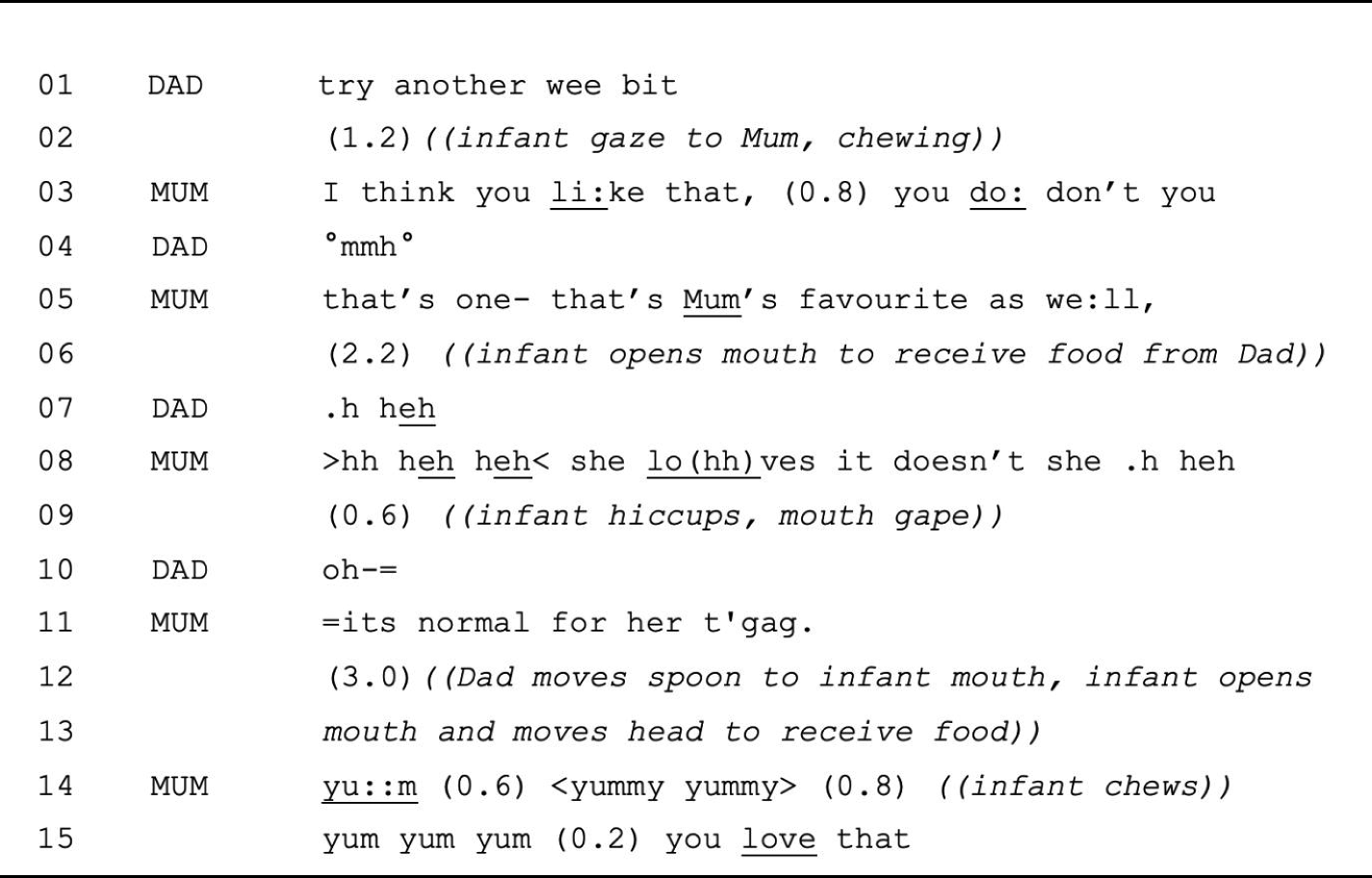
The construction of a dispositional category of food likes and it's association with children's consumption continues beyond infancy. The next example (Extract 2) comes from a preschool lunch in Sweden. The teacher in this instance asks Lucas (aged 5 years) if he will try some of the veggie burger that is his assigned food (he follows a vegetarian diet). She has placed a small piece on his plate, which Lucas then puts into his mouth (line 06).
you won’t know if you don’t try (see Wiggins, Cromdal, & Willemsen, 2024)
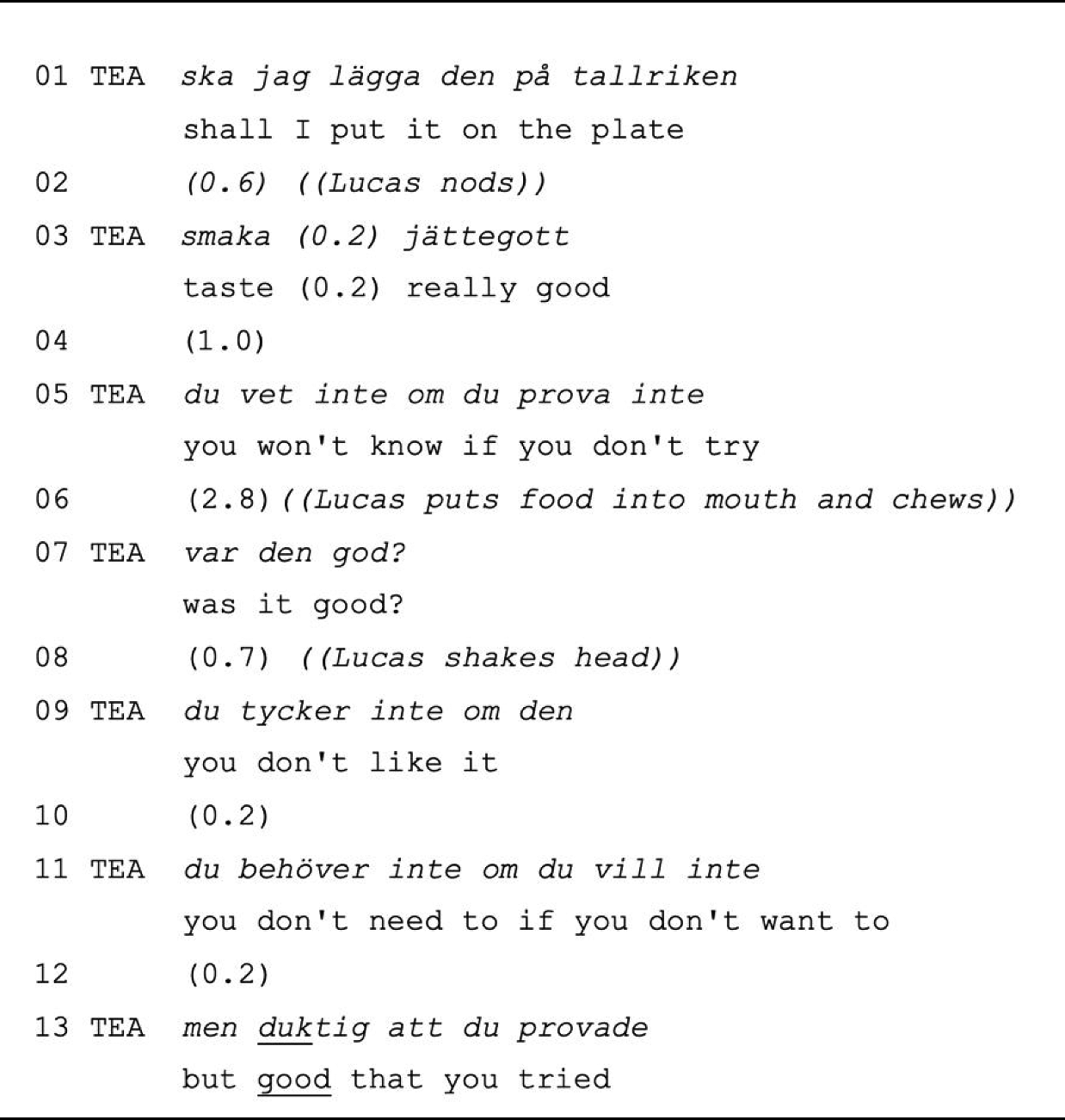
The extract also highlights some potential differences in the kinds of interactional resources that are available to adults working in preschool (or similar early childhood education and care settings) compared to the dynamics within family mealtimes. In preschool, there is an institutional focus on attending to, and respecting, children's needs and supporting their development as competent and independent individuals. Formulating the embodied head shake as a subject-side assessment thus enables the teacher to attend to Lucas as an individual who has the right to make their own judgements about food (see also Wiggins, Cromdal, & Willemsen, 2024, on tasting in these settings). The use of the psychological category of “want” (line 11) further attributes the not eating of the food as grounded in Lucas’ independent psychological state and thus further strengthens the categorization as dispositionally based. While much more analytic work would be needed to tease out the differences between institutional versus familial eating practices, this extract is a clear example of how children's food dislikes might be more readily accepted in preschool settings (see lines 11 and 13) than in family mealtimes (see van der Heijden et al., 2022; Wiggins, 2014a).
Categorizing infants and children in terms of whether or not they like food is thus evident not just in the first months of eating but also when children are much older. There appears to be a normative pattern that food assessments attributed to children are often produced in the form of subject-side assessments (van der Heijden et al., 2022; Wiggins, 2014a). That is, they are formulated as an individual response to food and primarily in the form of a like/don’t like dichotomy; it can be one or the other, but not both at the same time. Once this psychological category of “person likes/loves X” has been established in this particular syntactic form, it can then be used to account for subsequent eating occasions with the child. Formulated as subject-side, and often using category rather than item assessments (you love sweet potato rather than you love this sweet potato), they imply an enduring state of being. That is, that the category of a food like reaches beyond the here-and-now to extend forwards and backwards in time (Wiggins, 2014a, 2023). It is in this sense that the category can be regarded as “sticky,” adhering to the person as a dispositional attribution rather than something connected only with the immediate circumstances of the current food consumption. This discursive practice is evidenced when infants are tasting their first foods (Wiggins, 2023) and continues with older children (van der Heijden et al., 2022; Wiggins, 2014a). Moreover, these discursive practices are used by adults to talk about children in a way that is not typically reciprocated: children typically do not talk about their parents' food likes or dislikes in quite the same manner (Wiggins, 2014a).
Categories are Embedded Within Social Actions
To be concerned that children like what they eat does not in itself seem like a bad thing. In fact, it seems very positive: showing a concern that food is enjoyed and attending to the individual tastes of the child appears on the surface a supportive way to encourage children to eat. It could also be considered the rhetoric of the privileged, to eat what you like, where choice of food is an option. It is not in every situation that there is so much food to eat that one can choose between one food or another on the basis of “likes.” What is problematic, however, is that these psychological categories are embedded within social actions that have implications for what (and how much) children eat. This is another key principle of DP at work: that discourse is primarily a site for social action, not individual cognition (Edwards, 2006; Edwards & Potter, 1992). That is, that words do things: they accomplish particular actions. Drawing on the work of the philosopher Wittgenstein, and speech act theorists Austin and Searle, discourse is therefore understood as being functional and situated within specific social contexts within which its particular “meaning” must be understood (Wiggins, 2017). The psychological categories constructed in the extracts in the previous section are not produced randomly but rather as part of social practices; they are produced in the service of social actions (Edwards, 1991). Specifically, these actions were checking Daisy's response to her first taste of food and determining whether Lucas would accept the veggie burgers. Food likes talk is thus never neutral but rather embedded within moments in social interaction in which one person becomes involved in another person's eating practices.
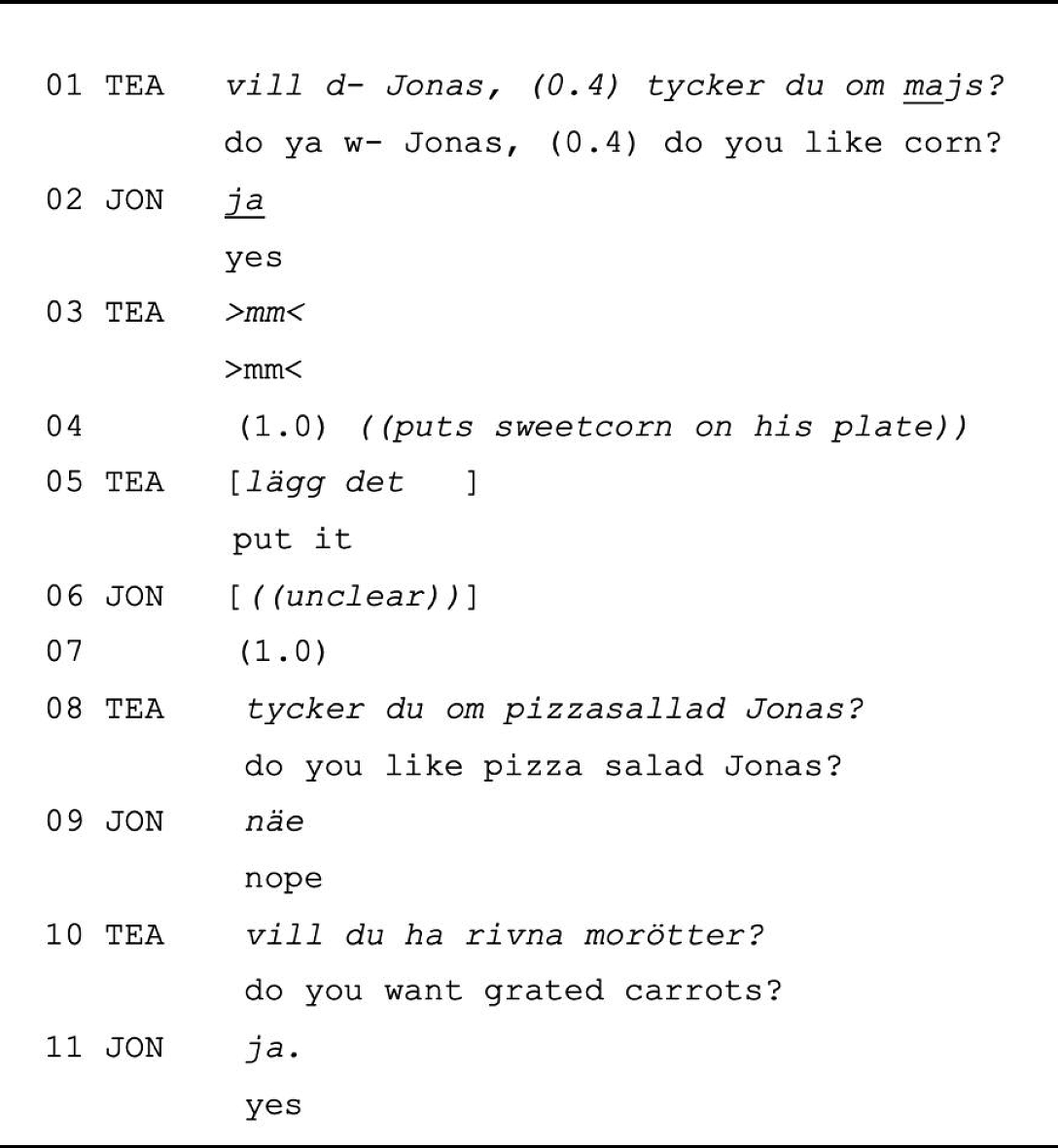
To appreciate how this works with regard to children's eating practices, it helps to zoom into the detail of mealtimes. Children's food consumption (or ingestion behavior) can be understood as a series of stages that include moving food from the adult to the child (to the child's plate or hand or mouth), and, with older children, from their hand or plate to their mouth. In other words, what is typically glossed as “eating” is in fact a sequence of embodied and multisensorial actions (Mondada, 2018, 2021; Wiggins, Majlesi et al., 2024; see also Mol, 2024 for further consideration of how “eating” can be understood in multiple ways). Each stage brings with it a range of social actions, such as food offers, persuasion, negotiation, acceptance, reluctance, and so on. The transfer of food to mouth can be hastened or hindered at any point in relation to the unfolding social interaction within which food is being consumed. The aforementioned psychological categories of food likes/dislikes are embedded within these social actions and thus invoked and formulated for particular purposes. The rest of this section demonstrates examples of how the category is invoked at some point before food is placed in the mouth (and in many cases, even before it gets to the plate). The next two extracts provide examples of what might be termed an offer of food, at the point at which the food might be moved from the adult's plate or serving dish to the child's plate, and illustrate how the category of liking food might be invoked in such sequences (see Majlesi et al., 2020, for a related example where a caregiver invokes a food like while assisting a person with late-stage dementia during a mealtime). In Extract 3, the teacher is offering vegetables to 2-year-old Jonas during a preschool lunch, and in Extract 4, Mum tries to persuade 10-year-old Poppy to taste some chicken soup during a family lunch.
Jonas do you like corn
you like chicken (see Wiggins, 2014a)
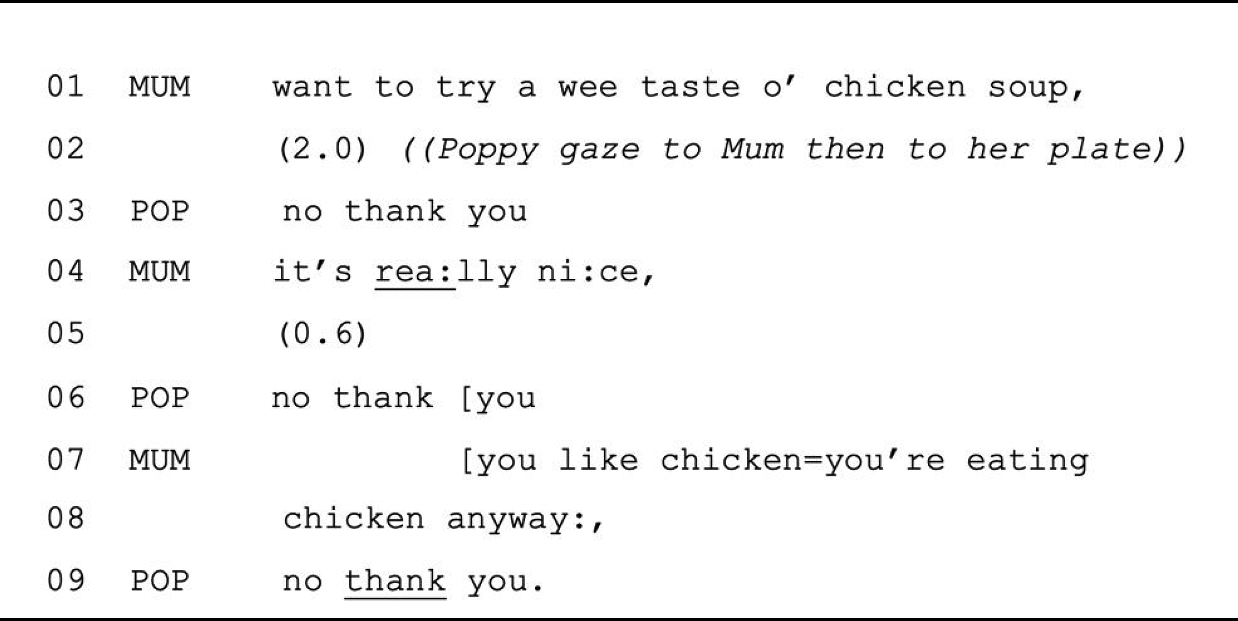
In Extract 3, the teacher is dishing out vegetables and holds them up in front of Jonas as she asks him, “do you like corn?.” It is therefore not an explicit offer in the same way that line 10 is, but it has the same effect: if he replies “yes,” then the food is put on his plate, if he replies “no,” it is not. In this context, therefore, the category of liking food is treated by both the teacher and Jonas as equivalent to wanting that food. Regardless of how food likes might be measured as hedonic responses and as distinct from wanting in neuropsychological paradigms (Finlayson et al., 2007), in conversation they are often treated as semantically equivalent to desiring food. In Extract 4, the offer begins as a more direct offer, “want to try” (line 1), which is then followed up with first an object-side assessment (line 4) then a subject-side assessment (line 7), in what might be glossed as persuasion or encouragement. Poppy's repeated response (“no thank you,” uttered similarly on lines 03 and 06, then with further emphasis on the “thank” in line 09) resonates with Humă et al.'s (2023) work on resistance as an interactional accomplishment and the blocking of an upcoming action (a food offer). While there are further nuances that could be drawn out, what is important here is how these examples demonstrate the ways in which the psychological category of liking food can be embedded within the stage at which food is offered to a child.
It is not only adults who use these categories during mealtimes. In Extract 5 taken from a preschool lunch, 4-year-old Pippi is in the process of putting some cottage cheese onto her plate when she accounts for how much she will take based on whether she likes it. Another child, Sophia (also 4 years old), and the teacher are watching as she does so.
I don't think I like this (Wiggins, Cromdal, & Willemsen, 2024)
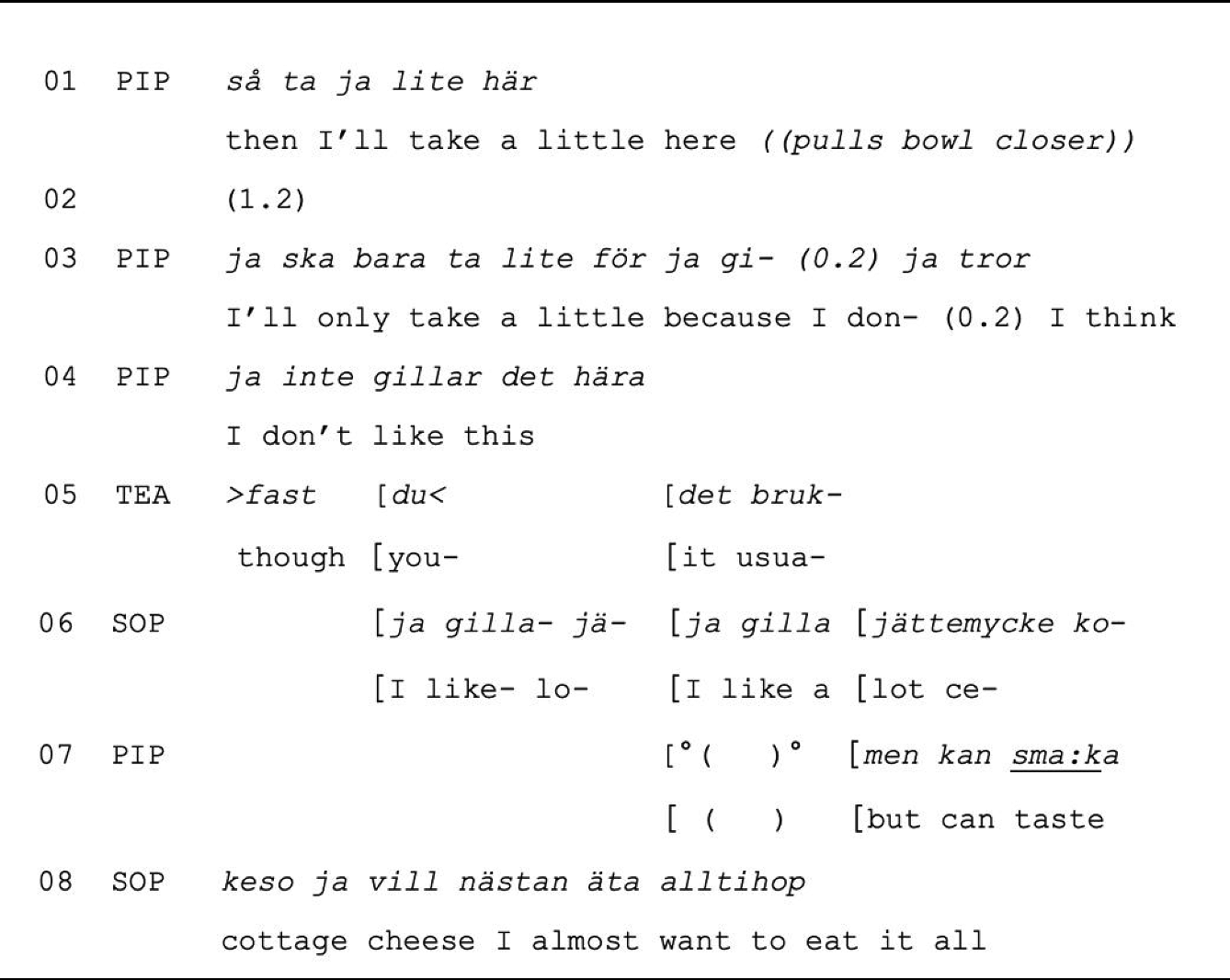
Examining how everyday language around children's eating practices in the home or in preschool reveals how psychological categories—in this case, food likes—are not only constructed through syntax (in the form, “person likes X”) but are also embedded within social actions. As the examples above illustrate, even before food reaches the plate or mouth, a food like might be invoked as a way to offer, encourage, or account for how much food is taken. That children might want food on the basis of liking is thus a connection that is made in multiple ways, by adults and children alike (and certainly there is much more that could be discussed in relation to the liking/wanting connection in everyday discourse). It is, however, when food is not eaten or when children claim not to like food, that the inverse of this relationship (that not eating might mean not liking, or vice versa) becomes a matter for dispute between adults and children.
Social Actions may Change, but the Categories Stick
It was noted earlier that food likes and dislikes are an example of what could be referred to as sticky categories: dispositional labels or identities that are treated as applying to individuals regardless of the original situation or context within which they were invoked. It is the psychological category of having food likes, or rather, food dislikes that then becomes troublesome. Just as the association between liking and wanting/eating food might be invoked to offer food or encourage children to eat, so is the inverse association used to hold children accountable when food is not eaten. While the social action may have changed, the category sticks and is treated as a (relatively) stable psychological state that should be consistent over time, and the social action then focuses on changing the child to fit that category or trying to establish a cause for the change in the first place. Extract 6 is taken from a family lunchtime in which Mum is assisting her 7-month-old infant, Sarah. The family uses a method known as baby-led weaning, in which infants who are moving from liquid to solid foods (i.e., complementary feeding) are offered small pieces of food from which they not only learn how to eat but also develop motor skills and become familiar with textures (Brown et al., 2017). The food in question is scrambled eggs and Sarah is handling the spoon but showing little interest in the food itself.
An aversion to eggs (see Wiggins, 2023)
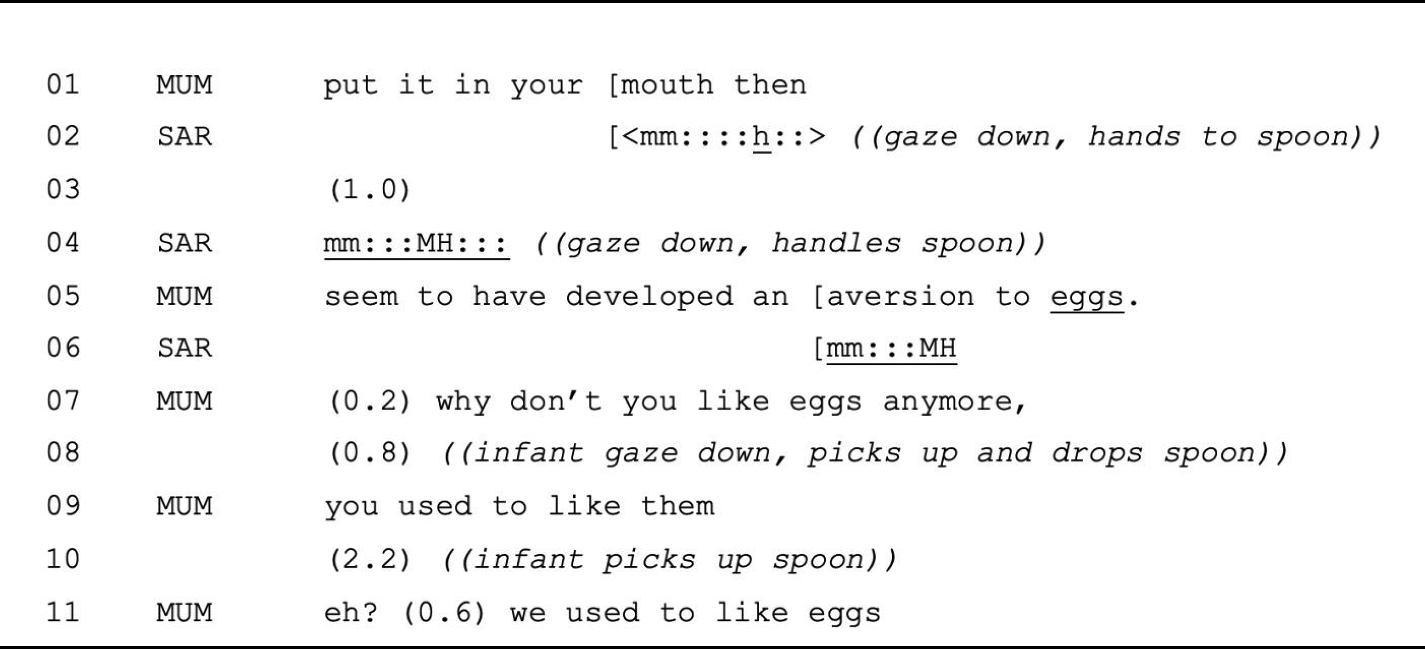
While Sarah is vocalizing and their eye gaze and hands are focused on picking up the spoon, Mum formulates the current situation as not simply a lack of interest in eating but as an “aversion to eggs” (line 5). That is, that there is a psychological state that underlies the behavior and that this state is something different to what has been understood previously: that Sarah used to like eggs (lines 9 and 11). Of importance here is the fact that there can be several reasons why infants (or people of any age) don’t eat food, such as not being hungry, having a more urgent need (such as needing to use the toilet, being tired or having some other discomfort), or that their attention is drawn elsewhere (such as playing with a spoon). As with other examples during infant eating where parents attribute lack of eating to “not liking” (Wiggins, 2023), the focus of the interaction then turns to resolving this apparent trouble. The infant's behavior is treated as indicative of a psychological state and the challenge then becomes to understand the causal factor (“why don’t you like eggs anymore,” line 7) that apparently led to this situation.
Sarah's behavior is thus treated as accountable in terms of it apparently representing a psychological state that is different from a previous state. Mum's request to “put it in your mouth then” (line 1) has made consumption relevant at just this moment in the mealtime, following a period in which Sarah was engaged with moving things around on her plate. By doing something that is visibly not eating, Sarah's behavior is now immediately accountable at this moment. That is, it is problematic precisely because the food is not going into the mouth. This interactional trouble then becomes a matter of making sense of this apparent change of state (of having developed an aversion to eggs). The noun form of “like” has therefore defined eating behavior in a particular way, as remaining fairly stable across different settings, rather than as something that might fluctuate depending on other factors such as hunger, mood, energy levels, or motivation. The pervasive rhetoric of food likes reduces the consumption of food to being primarily based on hedonic state alone.
Even when children are eating, their facial responses can also be treated as indicative of a food dislike that can be contrasted to previous experiences. It is not just the case that not putting food in the mouth is the problem. Children can also be held accountable for not enjoying the food, since this might then suggest that there will be refusals to eat it in the future. In Extract 7, Daisy (as seen in Extract 1) is eating porridge, when her facial expressions become the focus of the conversation.
You liked it yesterday (see Wiggins, 2023)
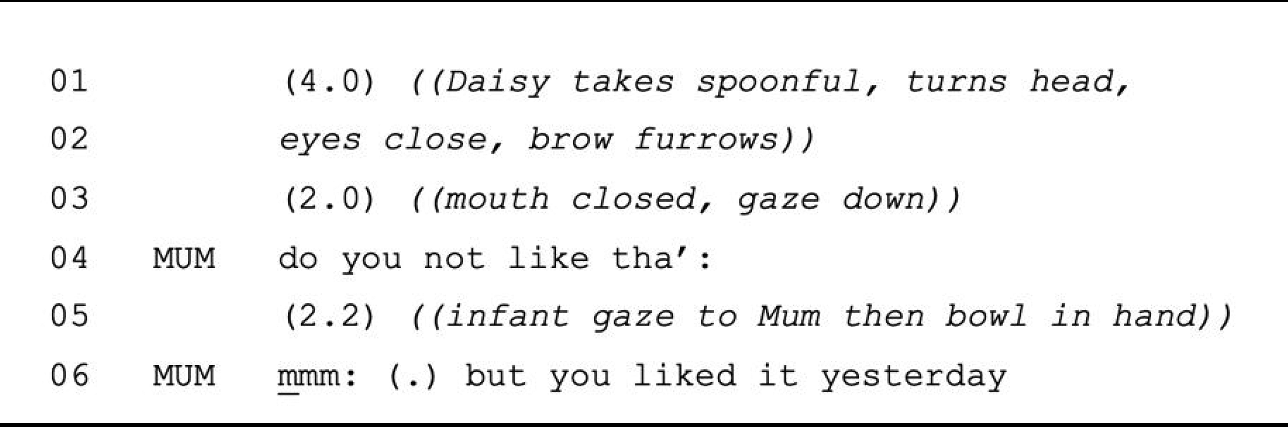
When infants are not yet able to express themselves verbally, facial expressions become central to how caregivers make sense of their responses to food (Hetherington, 2017). A furrowed brow and head turned to one side, therefore, becomes particularly meaningful of a potential discomfort or bitter taste. While it is important that parents are responsive to infant's facial expressions during eating (Hetherington, 2020), the example above demonstrates that, again, food dis/likes are typically attributed as the cause of the infant's reaction; that the facial gestures indicate a “dislike” rather than, for instance, an automatic muscle response to sour or bitter flavors. Once attributed to a dislike (line 4) as a dispositional state, the reaction then becomes a problem in that it is contrasted to a previous state: “but you liked it yesterday” (line 6). The rhetoric of food likes thus has a binary or dichotomous quality, in that it can be one or the other (or in a more extreme form, such as loving or hating food), but not both simultaneously. There is little room for ambivalence, nor room for considering other causes of the facial expression. It is important to note that it is almost always food dislikes that become a challenge during children's mealtimes; it is rare to find examples where adults might try to change a “like” to a “dislike.”
Food dislikes can also become troublesome when food is being offered. As seen in the extracts in the previous section, just as food likes can be used to encourage taking food, so can food dislikes signal a potential rejection of the upcoming food. In Extract 8, 2-year-old Dennis is being offered a range of vegetables during a preschool lunch; the teacher has several vegetables on a tray and is showing these to Dennis before serving them onto his plate.
don’t you like grated carrots?
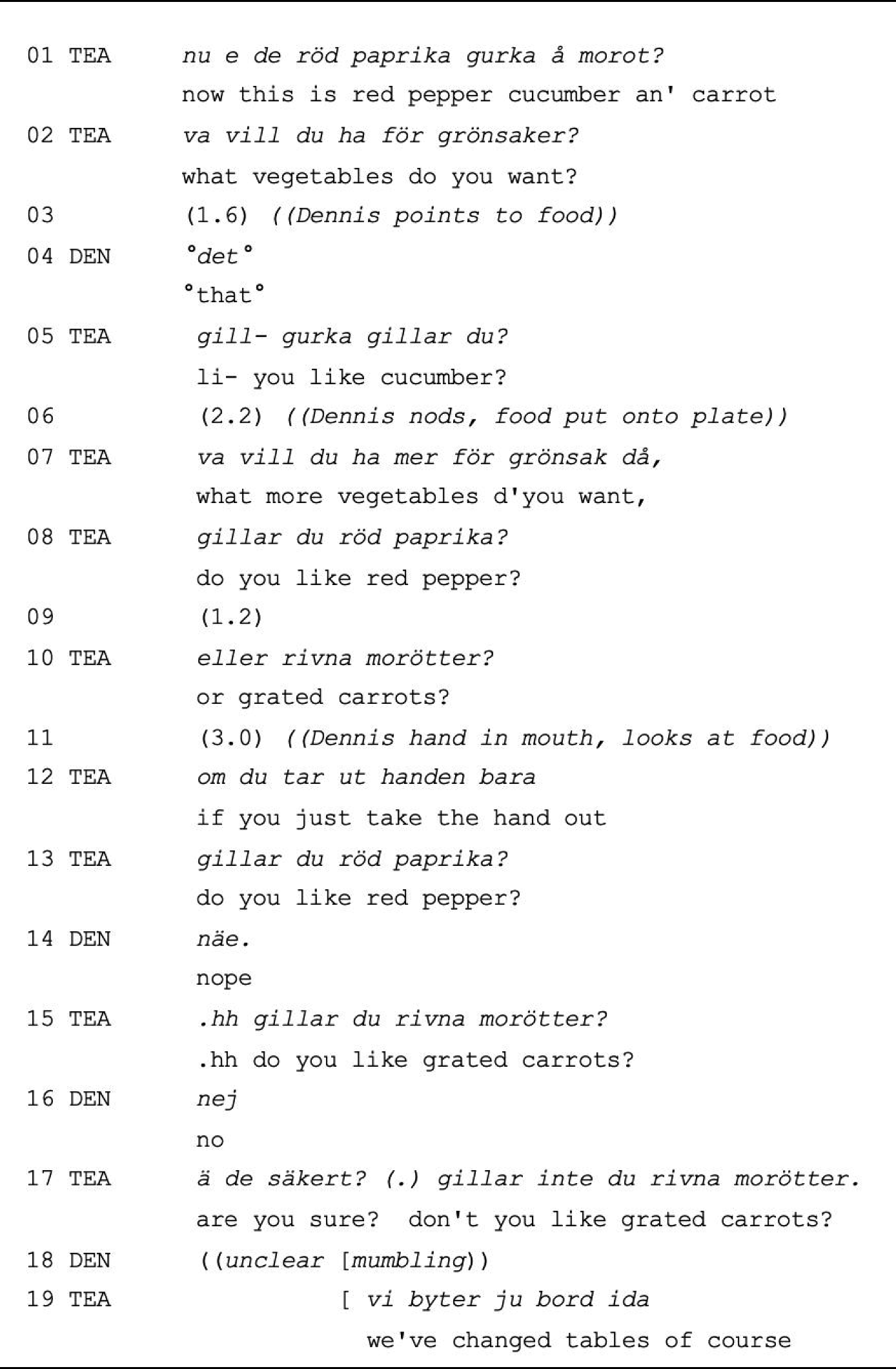
The offer of vegetables begins with an open question (line 2) and Dennis’ embodied request is then receipted by a formulation in terms of a food like (line 5) while the teacher puts that food on his plate. While encouraging him to have more (line 7), there is some delay from Dennis who also puts his hand in his mouth (line 11) and the food offer is reformulated in terms of food likes (lines 8, 13, and 15). A stated dislike of red pepper (line 14) is accepted in a way that is strikingly different from Extract 9 below, and from other family mealtimes in which parents might challenge or disregard children's claims to not liking food (Wiggins, 2014a, 2023; van der Heijden et al., 2022; see also the analysis of Extract 2 earlier). It is when Dennis claims to not like grated carrots (line 16), however, that this is questioned by the teacher (line 17). Once again, the trouble is formulated in terms of a disjuncture between the person (Dennis) and the dispositional state (liking grated carrots). The teacher then provides an account (“we’ve changed tables of course,” line 19) that could explain it: perhaps she was getting him mixed up with another child. What should be becoming clear, however, is that the discursive construction of food likes and dislikes as psychological categories is not only used to assess food but to hold children accountable for not accepting that food on future occasions.
You do so like Tropicana (see Wiggins, 2014b)
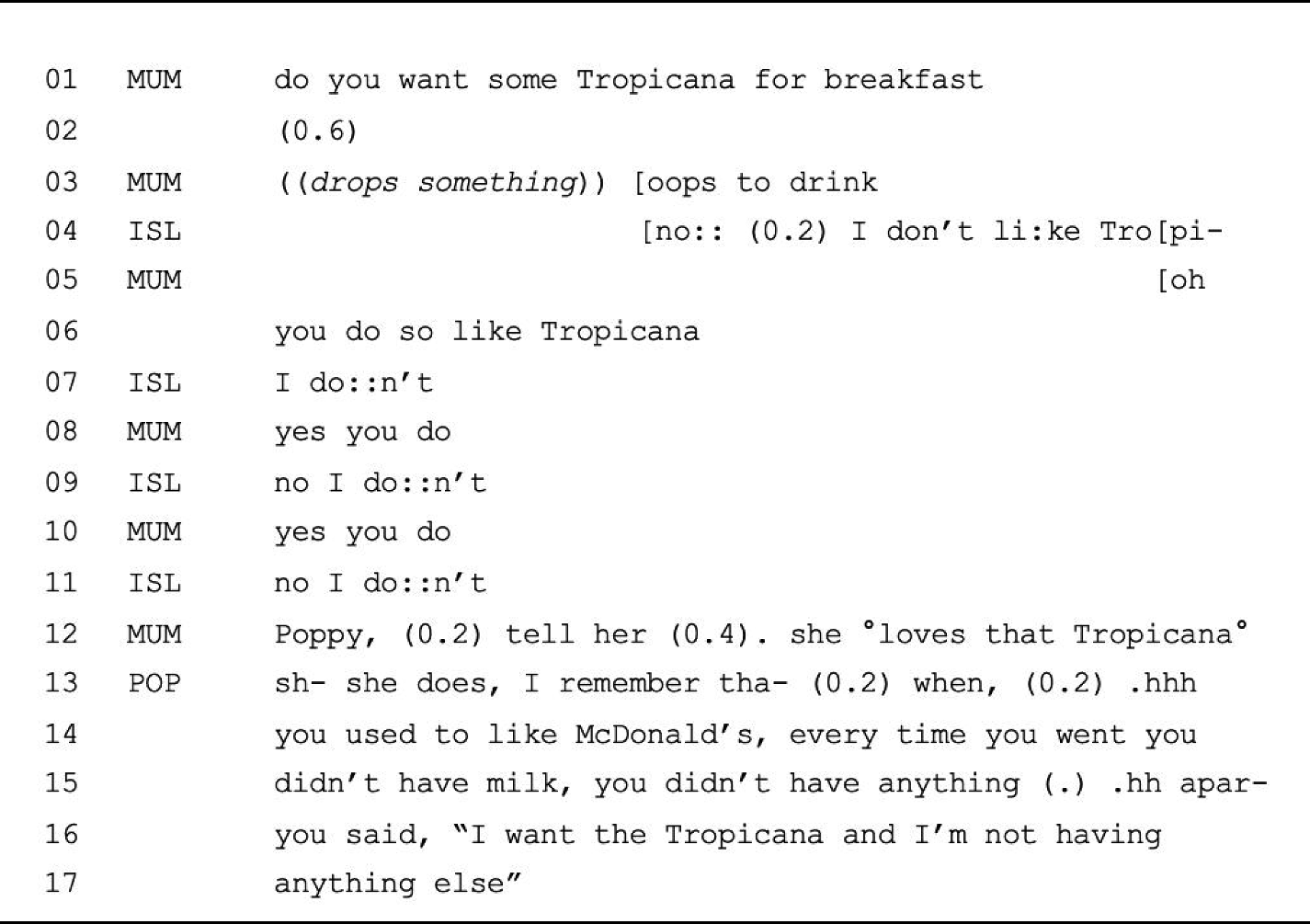
A food dislike is also treated as problematic in the family breakfast in Extract 9, though this is handled very differently to the teacher and Dennis in the previous extract (and to Lucas in Extract 2). Immediately apparent is how a food like is treated as an enduring state by other family members, regardless of the protestations of the child in focus. In this extract, Isla (5 years) is eating breakfast with her 10-year-old sister, Poppy (as in Extract 4), while Mum is nearby in the kitchen.
In this example, Isla's rejection of the offer of Tropicana (an orange flavored drink) is supplemented with a dislike claim (line 4). She barely has time to finish her sentence (line 4) when Mum provides a counter-claim: “oh you do so like Tropicana” (lines 5–6). Thereafter follows the equivalent of a verbal tennis match in which claim and counter-claim are bounced to and fro (lines 6–11) with one negating the other. At what might be a stale-mate, Mum calls on the help of Poppy (line 12), who then proceeds with a detailed account of Isla's apparent desire for the drink on previous occasions (lines 13–17). Poppy's account not only uses a script formulation (Edwards, 1994), “every time you went” (line 13), and reported speech (Holt & Clift, 2006; line 14), but it also invokes another food like: “when you used to like McDonalds” (lines 12–13). This construction therefore provides a robust challenge to Isla, in terms of its detail and specificity. It is hard to argue back when, as a younger child, an older sibling or parent can claim a better memory than you might be able to. The conclusion to this exchange is that Isla “loves that Tropicana” (line 12) and the family move onto talking about other matters.
The dispositional and psychological category of “person likes X” is therefore not only a way of making sense of eating experiences but is also used to hold children accountable when food is not accepted, not eaten, or when it is eaten but seemingly not enjoyed. Regardless of what else is going on during the mealtime, the category of food likes plays a central role in how children's mealtimes are managed. Moreover, it is a sticky category that is oriented to as resistant to change. It is treated not only as an obvious fact (it is never disputed as being a real category) but also as a stable characteristic that transcends time and eating practices. What was liked before should be liked again, even years later (see, for example, Extract 9). Children are held accountable for not fitting the same category on separate occasions, and in this way, the food likes talk has become something that limits how eating practices can be understood as variable in different situations and circumstances.
Discussion
The analysis has demonstrated how “food likes” talk, as an example of how dispositions are attributed to individuals in everyday social interaction, constructs psychological categories that are not only pervasive throughout children's mealtimes in different settings, but also treated as enduring or sticky. That is, that they are something that extend and can be attributed to behaviors beyond the here-and-now to other occasions in which food is eaten. When considering language and behavior change, therefore, much can be gained from examining the constructive power of the words themselves and how these might already be trapping people into routine behaviors through the way in which they construct a particular version of behavior as indicating a stable dispositional state. This paper builds on previous research to demonstrate how, in certain cultures, food dis/likes are typically invoked as a way to make sense of children's verbal or nonverbal reactions to food, even when they are not directly expressed by children themselves (van der Heijden et al., 2022; Wiggins, 2014a, 2023). Furthermore, the analysis here demonstrates how work on discursive categories can be extended to not only include dispositional categories—which are arguably more subtle and pervasive than the “big three” categories of age, gender, and race—but also to consider this categorial work in mundane situations that have immediate consequences for individuals. This in turn could provide an additional analytical tool (dispositional categories) through which applied CA work (cf. Antaki, 2011) could be developed in mundane (e.g., family meals) as well as institutional settings (e.g., preschool lunches).
The situations in which children (and adults) eat are, of course, varied and this paper uses examples from only two contexts (homes, preschools) and two cultures (Scotland, Sweden). Further research is needed to examine issues such as the variability across cultural settings, institutional (vs. mundane) contexts, and the epistemic and deontic resources used to manage the dispositional states of others. The examples used here were suggestive of some differences but further analytic work would be needed to demonstrate more concretely the use of food likes according to institutional context. This need not be restricted to the asymmetry between adults and children but could also consider other asymmetries (e.g., expert/novice, teacher/student, staff/employee) and other contexts in which food is being consumed or assessed. Furthermore, the use of likes talk in relation to food consumption is just one example of how such discursive practices might be used. There are many other situations in which dispositions are attributed to people on the basis of observed conduct, such as physical exercise, the ingestion of alcohol or other substances, or sexual behavior. The implications of this argument therefore extend beyond eating to other practices that have consequences for our mental and physical health, and in which behavior change might feature.
In terms of the implications of this argument for food ingestion in particular, however, there are two points that can be raised that highlight aspects of eating practices that could be incorporated into our discursive practices.
The first is that eating (or the ingestion of food) should be understood as a practice or process rather than a state of being. The act of putting food into our mouths and assessing taste is only one part of a much broader set of practices that can range from the geographical and cultural to the individual and physiological. We might define ourselves by the food we eat, for instance, or align with certain eating identities, and these categories can be useful as a means to guide our food choices and establish commonalities with other people. They are not in themselves problematic categories, until they are used in the context of mealtimes when they become embedded in social actions that focus on how much, or what, someone is required to eat, particularly in those mealtimes when one person has some responsibility over another person's consumption. “Who we are” in relation to food needs to be balanced alongside the many other factors that determine how, what, and when we eat.
The example of food likes is a case in point. It was noted earlier that the word “like” is often used as a noun rather than as a verb, though of course it can be both. In noun form, it constructs a psychological category that is resistant to change: as if it were something that could be known about that person, to understand who they are. In the examples above, for instance, Daisy loves sweet potato (Extract 1) and Isla loves Tropicana (Extract 9). While these seem entirely positive words, it is their psychological stickiness that becomes problematic. By contrast, using words that are more verb-like, which suggest behaviors rather than categories or identities, open up the possibility of change (Wiggins, 2022). “Like” could become “liking” or “enjoying,” for instance. In doing so, it retains the same positive assessment but ties it to the occasion not the person. Verbing language thus could focus the attention on behaviors rather than identities (or dispositions) and reduce the reliance on sticky categories. Further research could examine how such verbing practices work in everyday interaction and how they might reshape the eating practices themselves.
The second point is related to the first, and it is that eating is context-dependent. Context here can refer to everything from physical location to persons present, to the time of day or year, and to variations such as hunger or mood states. Quite simply, food is never the same on two different occasions (nor, as Mol, 2024, reminds us, is eating the same thing on different occasions). Despite this, certain discursive practices enact food likes as enduring over time and place. These could be adapted to take into account situational or contextual variations. For instance, the phrase “are you not enjoying it this time?” or “does that taste strange?” rather than “do you not like that?,” might be used if a child expresses some discomfort with food. Similarly, “don’t like” could become “not liking it at the moment” or “not enjoying it this time”: either one leaves it open for the child (or caregivers) to assess it differently at a different point in time, whether that be the next day or in the next half an hour. Moreover, object-side assessments could be used exclusively, thus avoiding reference to individual states-of-being while still focusing attention of the sensory experience of the food. Again, these are suggestions that could be examined in further research across different eating settings.
Conclusion
The argument set out in this paper is that the discursive practice of talking about food likes during children's mealtimes in the home and in preschools (in certain cultures) constructs psychological categories that not only define responses to food but are also embedded within social actions such as offering food, encouraging children to eat, or responding to food as it is eaten. Children's current and future eating behavior in these cultural contexts is typically attributed to these categories of liking or not liking, setting up an almost binary state that leaves little room for ambiguity. Food likes are an example of a sticky category, a psychological label or identity that is oriented to as being relatively stable disposition across different contexts. It is proposed, therefore, that a change in discursive practices could afford greater possibilities for people to change their eating practices. To talk about enjoying food as a practice or process not a state of being, for instance, and to move away from binary states to a greater variety of sensory practices. The context for this argument is situated within cultural settings in which there is plentiful access to food and in which people have choice in their eating habits. Talk about food likes could thus be considered a privileged rhetoric. Moreover, language is not all there is to eating practices and there are many other economic, political, and social factors at play that can impede our efforts to change our food consumption. With these caveats, therefore, food liking talk is only one part of a much bigger picture, but it is a part that could be the easiest to change. Given the vast and rapidly increasing range of interdisciplinary research on eating practices, there is so much potential in developing our discursive practices to match.
Footnotes
Acknowledgments
This paper is based on a plenary talk, presented at the ICLASP18 conference in Tallinn, June 2024. The author would like to thank JLSP guest editor Anastassia Zabrodskaja and the reviewers for constructive comments on an earlier version of the manuscript, and to the ICLASP conference delegates for engaging with the presentation. The research could not have been conducted without the kind permission of participants to allow their mealtimes to be recorded, nor without the financial support of the Swedish Research Council for enabling the preschool lunch research.
Declaration of Conflicting Interests
The author declared no potential conflicts of interest with respect to the research, authorship, and/or publication of this article.
Funding
The author disclosed receipt of the following financial support for the research, authorship, and/or publication of this article: This work was supported by the Vetenskapsrådet (grant number 2019-03890).
