




Abstract
Developing effective messages to promote climate action requires an understanding of how these messages are processed by different groups. Though the influence of partisan identity on this processing is well established, much less is known about the role of preexisting climate beliefs. Furthermore, scholars have recently raised the possibility that what appear to be partisan effects on message judgments may simply be byproducts of accuracy-driven differences in perceived source credibility. Three online experiments revealed evidence that speaks to these conversations. The results show that message source, political affiliation, and preexisting climate beliefs combine nonadditively to affect persuasion. Furthermore, their effects are mediated by perceived source credibility. However, the evidence also suggests that this pattern emerged not because accuracy goals drive different perceptions of credibility but because credibility judgments are equally susceptible to directional motivated reasoning.
The Sixth Assessment Report of the Intergovernmental Panel on Climate Change provides ample cause for alarm. In particular, evidence clearly suggests that if far-reaching mitigation strategies are not implemented quickly, it will be all but impossible to avoid global warming of at least 1.5°C and the associated threats to human and nonhuman life (IPCC, 2023). The challenge for communication scholars and practitioners, then, is how to encourage people to support and implement the necessary changes. Although the field of science communication has generally moved past the assumption that merely providing scientific information will be sufficient to accomplish this goal (what is generally referred to as the deficit model of science communication; see Simis et al., 2016; Sturgis & Allum, 2004), much still remains to be understood about which alternative message strategies are effective, for whom, and why.
One of the reasons why developing effective messaging strategies has been challenging is the strong potential for messages about climate change to elicit motivated reasoning. Especially in the U.S., where climate change remains a politically divisive issue (Carmichael & Brulle, 2017; McCright & Dunlap, 2011; Merkley & Stecula, 2021; Tesler, 2018), people may prioritize defending their preexisting opinion or the position espoused by their preferred political party over considering a message with an open mind. Although Druckman and McGrath (2019) have pointed out that there is only indirect evidence of motivated reasoning for the issue of climate change in many cases, there is a growing body of literature that has begun to explore its effects (e.g., Bolsen et al., 2019; Hart & Nisbet, 2012; Zhou, 2016).
Across three studies, we seek to contribute to this literature in two main ways. First, we examine the roles of both identity-driven motivated reasoning (specifically partisan-motivated reasoning; Bolsen et al., 2014) and belief-driven motivated reasoning in determining how attitudes change in response to persuasive messages. Although previous research indicates that both defending one's identity (Unsworth & Fielding, 2014) and defending one's preexisting beliefs (Lord et al., 1979) can be goals that prompt motivated reasoning, the two have rarely been examined concurrently. Second, we provide evidence pertinent to recent conversations about the role of source credibility in shaping motivated reasoning effects (see Druckman & McGrath, 2019), including how credibility judgments are affected by both partisanship and preexisting beliefs. We also consider the implications of these findings for the language used in tailoring messages to different audience segments.
Motivated Reasoning
In general, motivated reasoning occurs when the processing of a message is impacted by “any wish, desire, or preference that concerns the outcome of a given reasoning task” (Kunda, 1990, p. 480). This definition highlights two important components of the motivated reasoning process: (1) the goal(s) or motive(s) that the person has (whether conscious or unconscious) going into a reasoning or judgment task and (2) the nature of the processing that occurs during the reasoning or judgment task. In the present investigation, our focus is on the former of these components. Kunda (1990) notes that motivated reasoning can be driven by an accuracy goal—when the aim is to come to an accurate conclusion about a given issue. Often, however, the phrase “motivated reasoning” is used as shorthand to refer to cases in which there is an explicit directional goal, which is any “goal or end extrinsic to accuracy” (Kahan, 2013, p. 408; see also Carpenter, 2019). Directional goals may be either identity-based or belief-based, both of which may be relevant to understanding how people process messages about climate change.
Identity-Driven Motivated Reasoning
Identity-driven motivated reasoning occurs when information is processed with the goal of forming or maintaining an opinion consistent with one's personal identity (see Leeper & Slothuus, 2014; Unsworth & Fielding, 2014). Though this could conceivably include any aspect of identity, evidence suggests that political partisanship is particularly powerful (Bolsen et al., 2014; Cohen, 2003). Not all scholars agree that partisan-motivated reasoning necessarily implies a directional goal, but there is widespread agreement that political identity plays an important role in motivated reasoning (Bayes et al., 2020; Bolsen et al., 2014; Leeper & Slothuus, 2014) and clear meta-analytic evidence of its effect on public opinion (Ditto et al., 2019).
Recent studies also provide evidence of the influence of partisan-motivated reasoning for climate change in particular. For example, Bolsen et al. (2019) found that Republicans were persuaded by an appeal attributed to Republican Party leaders, but an appeal attributed to Democratic Party leaders only served to heighten beliefs that climate change was a hoax and that research was politically motivated. Other studies have also consistently found that support for climate mitigation policies is greater when people receive cues that the policies are supported by their own political party's elites as opposed to elites from the opposing political party (Ehret et al., 2018; Rinscheid et al., 2020; Van Boven et al., 2018).
Belief-Driven Motivated Reasoning
Belief-driven motivated reasoning occurs when information is processed with the goal of supporting one's preexisting opinion. Lord et al. (1979), for instance, found that when proponents and opponents of capital punishment were shown the same set of equivocal research findings on the death penalty, both groups interpreted the evidence as supportive of their preexisting position. Thus, when people are strongly convinced of a particular position, motivated reasoning can occur in the absence of any partisan identity cues. In extreme cases, beliefs may even become strong enough that they constitute distinct, opinion-based social identities of their own (Bliuc et al., 2015). For instance, someone could conceivably identify as a “climate activist” more strongly than they do as a member of a particular political party.
Although research on motivated reasoning about climate change has frequently focused on partisan goals, some authors suggest it is really beliefs that have a predominant role (Bliuc et al., 2015; Druckman & McGrath, 2019; Roser-Renouf et al., 2015). For instance, the Yale Project on Climate Change Communication divides the U.S. public into “six Americas” based on their climate attitudes and beliefs (Leiserowitz et al., 2020). Concern about climate change, confidence in climate science, and motivation to take action are highest among the alarmed segment and steadily decrease as one moves through the concerned, cautious, disengaged, doubtful, and dismissive segments of the public. Although partisanship differs in obvious ways across these groups, Roser-Renouf et al. (2015) suggest that responses to messages are more a function of the segment to which someone belongs than the party with which they identify.
In sum, responses to messages about climate change may be shaped by multiple directional goals. People may have a goal of upholding the position espoused by the political party with which they identify (Republican or Democrat, in the U.S.), of defending their preexisting beliefs about climate change (either skeptical or not), or both.
Source Credibility
Recently, motivated reasoning scholars have also argued that perceptions of source credibility deserve greater attention when evaluating the mechanisms underlying differential message effects. Source credibility refers to a source's image in the minds of the audience, which is composed of perceptions of the source's competence, trustworthiness, and goodwill (McCroskey, 1966; McCroskey & Teven, 1999). Because source credibility is an important determinant of persuasive effects, Druckman and McGrath (2019) recently suggested that many cases that appear to be motivated reasoning may simply come down to differences in perceived source credibility. When it comes to political messages, for instance, it may simply be that Republicans perceive conservative sources to be more credible, whereas Democrats perceive liberal sources to be more credible, which can lead to the appearance of directional motivated reasoning even when each group actually has an accuracy goal (see also Bayes et al., 2020; Leeper & Slothuus, 2014).
The plausibility of the claim that partisan perceptions of source credibility are motivated by accuracy, however, is less clear. Evidence indicates that partisans exhibit strong in-group biases that can affect their judgments of and behavior toward others (e.g., Amira et al., 2021; Iyengar & Westwood, 2015). Accordingly, it may be that source credibility judgments are equally susceptible to directional motivated reasoning effects. Just as they do with message content, people may process source information with the conscious or unconscious goal of maintaining a favorable impression of people who share their identity or beliefs and an unfavorable impression of those who do not. Such biases have clearly been observed in other contexts where credibility judgments are the central task, such as hiring decisions (e.g., Bertrand & Mullainathan, 2004; Grant & Mizzi, 2014; Isaac et al., 2009; Iyengar & Westwood, 2015). Clearly, there is a need for additional research that begins to unravel how political identity, beliefs, and source credibility work together to shape message effects.
The Present Investigation
To begin to address these questions, the present investigation included three studies. In the first study, we examined how political identity and climate beliefs affected responses to a message advocating a climate policy (cap-and-trade). The objective was to establish whether the pattern of message effects was consistent with motivated reasoning and, if so, how identity- and belief-based directional goals might combine. In the second study, we turned to the question of how political party affects perceptions of source credibility for a variety of partisan sources. The objective was to establish how these perceptions differ and investigate the plausibility of the claim that such perceptions can be treated as accuracy driven. In the third study, we integrated Study 1 and Study 2 to examine how identity, beliefs, and credibility perceptions intertwine to predict responses to a message advocating another climate policy (a meat tax). The specifics of each study are described below.
Study 1
As noted above, Study 1 began by investigating the roles of both partisanship and climate beliefs in message effects. In particular, we investigated how each one influences the ways that people respond to messages from partisan sources. Based on the weight of existing evidence, we hypothesized that the effect of message source on attitudes would be moderated by political party, such that self-identified Republicans would be more persuaded by a message about climate change when it was attributed to a conservative source than when it was attributed to a liberal source, but the opposite would be true for Democrats (H1.1).
We also expected climate change beliefs to have a similar effect. Given the ideological divide on environmental issues in the U.S. (Cruz, 2017), we anticipated that skeptics (regardless of partisanship) would assume a conservative source was likely to share their beliefs, whereas nonskeptics (regardless of partisanship) would assume a liberal source was likely to share their beliefs. As a result, we expected that the effect of message source would also be moderated by climate change beliefs, such that skeptics would be persuaded more by a conservative source than a liberal source, whereas the opposite would be true for nonskeptics (H1.2).
We were also interested in the possible interaction of political affiliation with climate beliefs. Roser-Renouf et al. (2015) argue that doubtful and dismissive groups will respond in a similar manner regardless of political affiliation, but it seems unlikely that source matching effects would disappear altogether for this group. There are also not firm empirical grounds on which to base a hypothesis about this interaction because previous research has often treated each political party as monolithic in its beliefs. Although Democrats make up the majority of the alarmed and concerned segments, and Republicans make up the majority of the doubtful and dismissive segments, there are still many who violate perceived party norms about climate beliefs. Instead of attending to how these variables interact, however, research tends to focus most often on how to persuade Republican climate skeptics, ignoring both Republicans who endorse the reality of climate change and Democrats who are climate skeptics. This tendency is reflective of a larger pattern among both the general public and the news media to emphasize “the relatively large fraction of Republicans among climate skeptics…rather than the smaller, but less newsworthy, fraction of skeptics among Republicans” (Van Boven et al., 2018, p. 495).
If identity-driven, partisan-motivated reasoning is the predominant force guiding message responses, then a monolithic approach may be appropriate. If belief-driven motivated reasoning also plays a role, however—as several authors suggest that it does—then ignoring intraparty differences in beliefs is problematic. Thus, we posed the following research question (RQ1.1): Will the source-by-party interaction be further moderated by climate beliefs?
Method
Sample
Participants were recruited online through Qualtrics Services, using quota sampling to collect pretest data from approximately equal numbers of skeptics and nonskeptics among both Republicans and Democrats (total N = 935). Of these participants, 518 later completed the posttest survey (a 55.4% retention rate). 1 The final sample included somewhat more skeptics (n = 307) than nonskeptics (n = 203). 2 Demographic characteristics can be found in Table 1.
Sample Demographics.
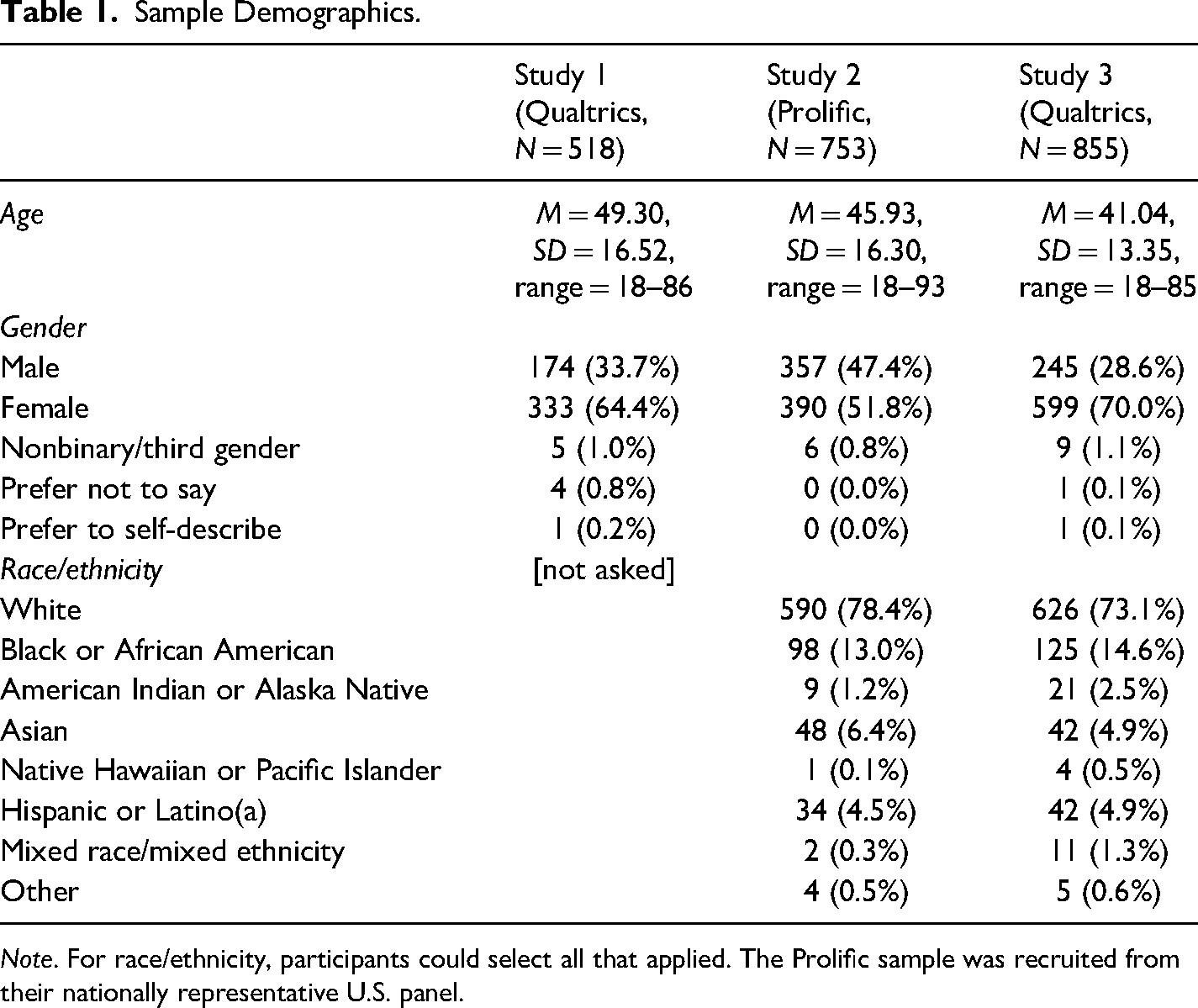
Note. For race/ethnicity, participants could select all that applied. The Prolific sample was recruited from their nationally representative U.S. panel.
Procedure
At the pretest, participants were informed that the purpose of the study was to evaluate their opinions about a series of policy proposals. The main proposal of interest was a cap-and-trade policy, but participants were also shown two policy proposals that did not relate to climate change, which helped conceal the true focus of the study. For each topic, they were asked to read a brief description of the proposal, then fill out a measure of their attitudes toward the proposed policy. Subjects also filled out the two quota measures (political party affiliation and climate change beliefs) and indicated their demographic characteristics at this time.
At the posttest, approximately two weeks later, participants were randomly assigned to one of two source conditions. In the liberal source condition (n = 259), the message was attributed to the fictional Mother Earth Coalition for Saving the Environment, which was described as a nonprofit with the mission of promoting liberal, Democratic leadership on environmental issues. In the conservative source condition (n = 259), the message was attributed to the fictional Conservative Coalition for Free Market Environmental Solutions, which was described as a nonprofit with the mission of promoting conservative, Republican leadership on environmental issues. Both groups then read the same message advocating for a cap-and-trade policy and completed a posttest measure of their attitudes (see Supplemental Materials, Appendix 1 for the full text of the source descriptions and message). At the conclusion of the survey, participants were debriefed as to the true nature of the source and study.
Measures
Political party affiliation was evaluated with one item (1 = strong Republican, 6 = strong Democrat). For the purposes of the quota, those responding on the lower half of the scale were considered Republicans, and those responding on the upper half of the scale were considered Democrats, 3 though the continuous variable was used for analyses.
Climate beliefs (M = 4.55, SD = 1.73, α = .84) were evaluated using two items measured on 7-point Likert-type scales (1 = strongly disagree, 7 = strongly agree): “Climate change is happening” and “Climate change is caused mostly by human activities.” For the purposes of the quota, skeptics (n = 162 Republicans, n = 133 Democrats) were those responding at or below the midpoint on either item; nonskeptics (n = 87 Republicans, n = 108 Democrats) were those responding above the midpoint on both. Again, the continuous variable was used for analyses.
Cap-and-trade attitudes were measured with four items, using 7-point semantic differential scales (pretest: M = 4.32, SD = 1.93, α = .97; posttest: M = 4.77, SD = 1.64, α = .96). The items evaluated the extent to which participants thought the proposal was wise (vs. foolish), beneficial (vs. harmful), good (vs. bad), and right (vs. wrong). The same items were used at both time points.
Factor Analyses. Using R 4.3.0, a confirmatory factor analysis (CFA) was conducted to examine the fit of the pretest data on cap-and-trade attitudes and climate beliefs to the proposed two-factor structure and the fit of the posttest data on cap-and-trade attitudes to a unidimensional structure. Specifically, the lessR statistical package (Gerbing, 2023), which uses iterated centroid estimation to estimate parameters (see Hunter & Gerbing, 1982), was used to identify items associated with large residuals for removal from the model. Then, additional fit statistics for the final model were obtained with the lavaan statistical package (Rosseel et al., 2023), using maximum likelihood estimation. The results revealed excellent fit of the model to the data at both the pretest (CFI = 1.00, SRMR = .02, RMSE = .05) and posttest (CFI = 1.00, SRMR = .01, RMSE = .01). The items were thus averaged to produce a composite score for each variable.
Results
Prior to conducting the main analyses, we checked for any differences between the source conditions on the variables of interest. There were no statistically significant differences in initial attitudes, climate beliefs, or party affiliation (all ts < 1.00, ps > .40). The main analyses were then conducted using a series of linear regressions. Continuous variables were standardized before being included as predictors in the regressions or in the calculation of interaction terms. Message source was coded as conservative source = −1 and liberal source = +1.
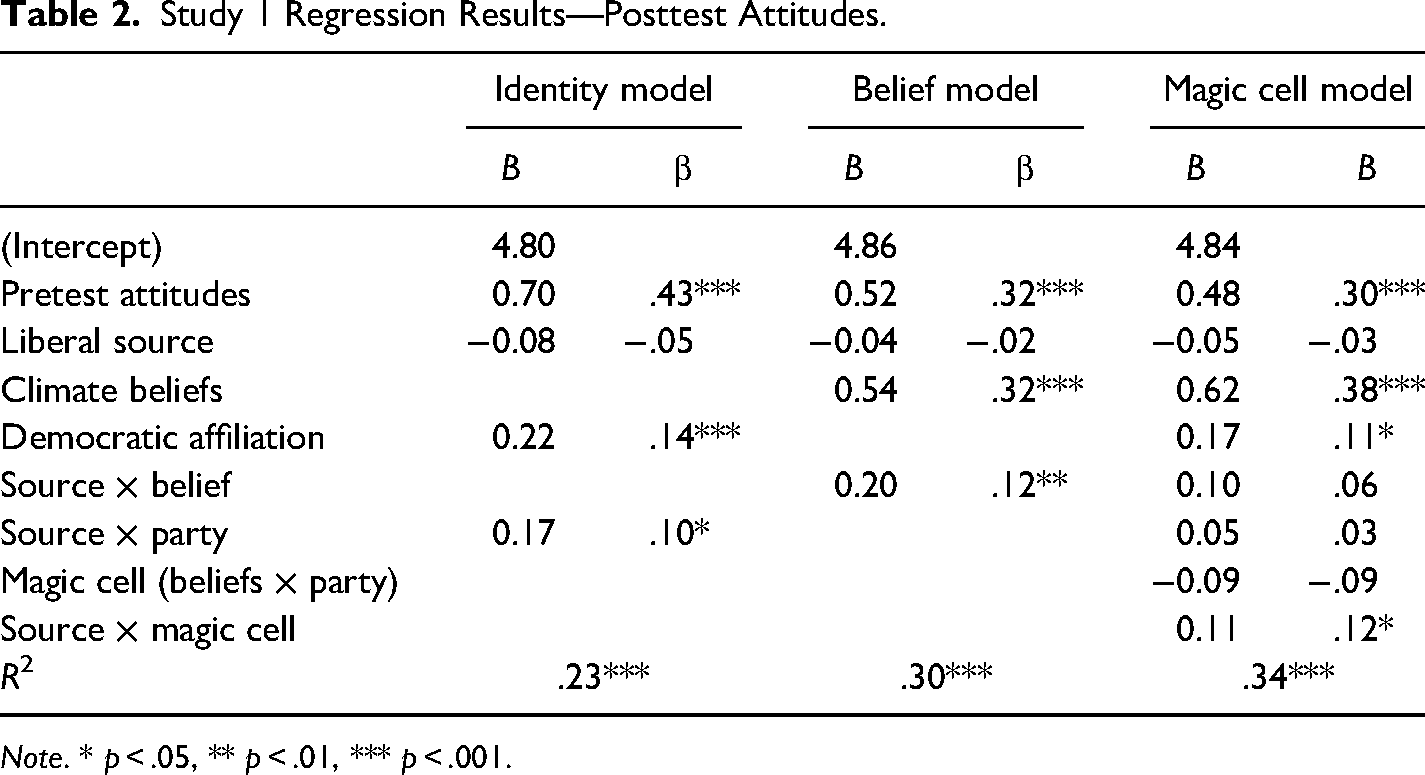
To test the identity-driven motivated reasoning hypothesis (H1.1), which predicted that party affiliation would moderate the effect of source on attitudes, posttest cap-and-trade attitudes were regressed onto pretest attitudes, message source, political affiliation, and the two-way interaction effect (see Table 2, Identity Model). Consistent with H1.1, the source-by-party interaction effect was statistically significant in the expected direction (unstandardized B = 0.17, p = .01). Republicans were persuaded more by the conservative source than the liberal source, whereas Democrats exhibited the opposite pattern.
Study 1 Regression Results—Posttest Attitudes.
Note. * p < .05, ** p < .01, *** p < .001.
To test the belief-driven motivated reasoning hypothesis (H1.2), which predicted that climate beliefs would moderate the effect of source on attitudes, posttest cap and trade attitudes were regressed onto pretest attitudes, message source, climate beliefs, and the two-way interaction effect (see Table 2, Belief Model). Consistent with H1.2, the source-by-beliefs interaction effect was statistically significant in the expected direction (unstandardized B = 0.20, p = .002). Climate skeptics were persuaded more by the conservative source than the liberal source, whereas nonskeptics exhibited the opposite pattern.
Finally, to examine the possibility of a three-way interaction between source, party, and climate beliefs (RQ1.1), posttest cap and trade attitudes were regressed onto pretest attitudes, message source, political affiliation, climate beliefs, the two-way interactions, and the three-way interaction. The main effect of beliefs (β = .31, p < .001) and the source-by-beliefs interaction effect (unstandardized B = 0.19, p < .01) both remained statistically significant in this analysis, but neither the main effect of party (β = .06, p = .13) nor the source-by-party interaction effect (unstandardized B = 0.11, p = .10) were substantial once beliefs were taken into account. Thus, the results provide some evidence to suggest that beliefs played a larger role in message processing than partisan identity.
The three-way interaction between source, party, and beliefs failed to reach statistical significance (unstandardized B = 0.03, p = .65), though examining attitude change in more detail did reveal an interesting pattern. Specifically, inspection of the predicted values in Figure 1 suggested that the reason for this nonsignificant result was the complex nature of the interaction. Among Republicans, there tended to be simple main effects of source and beliefs, such that the conservative was more persuasive than the liberal and nonskeptics exhibited more persuasion than skeptics. Among Democrats, on the other hand, there was evidence of an interaction between source and climate beliefs. Specifically, whereas Democrat nonskeptics were persuaded more by the liberal than the conservative, Democrat skeptics were actually more persuaded by the conservative than the liberal, mirroring the pattern observed among Republicans. Put together, these effects suggested that Democrat nonskeptics exhibited one pattern of source effects and all other groups exhibited another pattern.
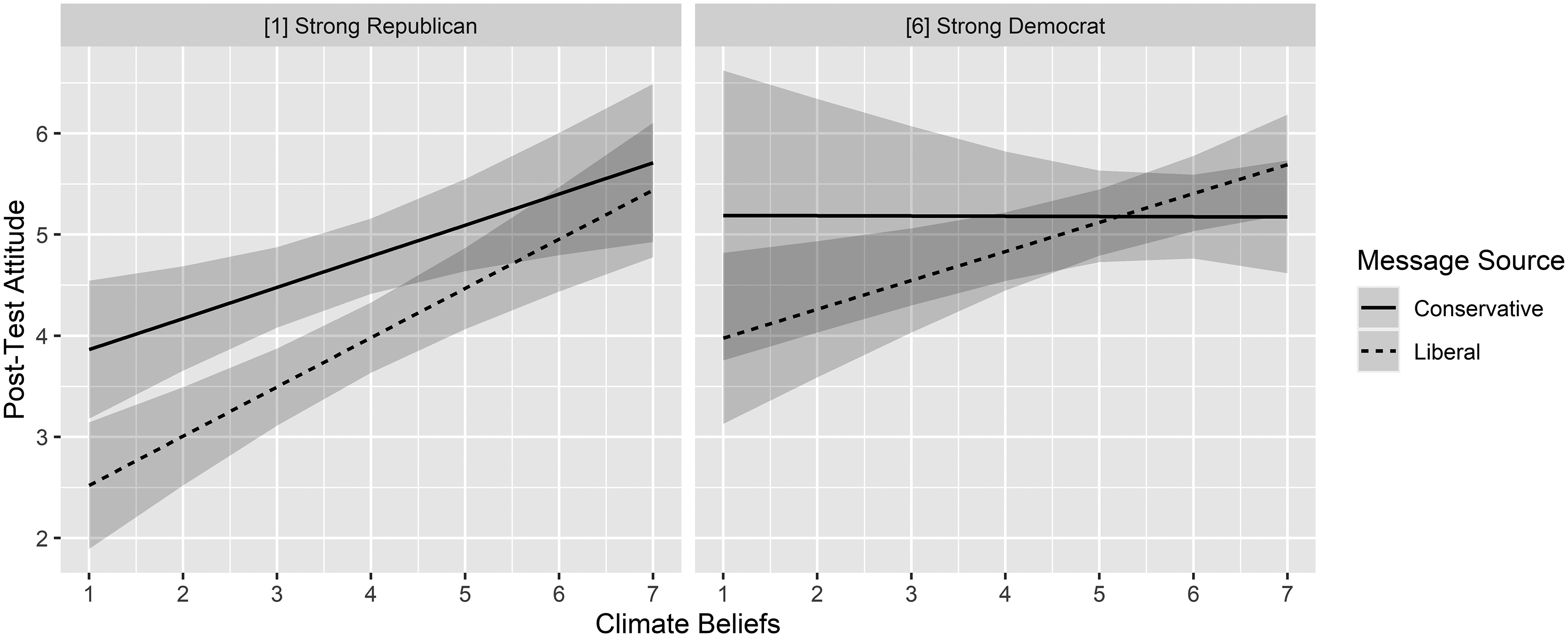
Study 1: Predicted values of the three-way interaction between message source, party affiliation, and climate beliefs at extreme levels of party affiliation.
The challenge is that the power to detect this “magic cell interaction” (in which one cell differs from the others; see Levine & Boster, 1996) is limited unless the contrast coding scheme adequately reflects that pattern of means (Cohen et al., 2003). In order to reexamine the interaction effect with greater power, a post hoc analysis was thus conducted by creating a magic cell variable coded as Democrat nonskeptics = +3 and all other groups = −1, then computing the interaction term between this variable and message source. Regressing posttest cap and trade attitudes onto pretest attitudes, message source, political affiliation, climate beliefs, the magic cell variable, the other two-way interactions, and the interaction between the magic cell variable and source (i.e., the three-way interaction term) corroborated our conjecture, based on inspection of Figure 1, that this contrast coding scheme better reflected the true pattern of means (unstandardized B = 0.11, p = .03; see Table 2, Magic Cell Model). In sum, the source-by-party interaction effect was indeed further moderated by beliefs, but only for Democrats.
Study 1 Discussion
The purpose of Study 1 was to investigate identity-driven (partisan) motivated reasoning and belief-driven motivated reasoning in response to persuasive messages about climate change. The results replicated the oft-discovered party-matching effect, to the effect that Democrats were more persuaded by a liberal source and Republicans by a conservative source, as is predicted by basic motivated reasoning theory. But more importantly, the results also provided support for arguments that preexisting climate beliefs are another driver of motivated reasoning. As suggested by Roser-Renouf et al. (2015), climate skeptics and nonskeptics responded differently to the message based on the source. Skeptics were persuaded more by a conservative source than a liberal source, whereas nonskeptics showed the opposite pattern. Furthermore, belief-driven motivated reasoning appeared to have greater explanatory power than identity-driven motivated reasoning in this study, as party affiliation no longer had a significant influence on posttest-attitudes once beliefs were included in the model.
The results also provided preliminary evidence to suggest that these two types of motivated reasoning can combine nonadditively, although the form of the interaction was unexpected. Specifically, post hoc analyses uncovered a magic cell interaction, whereby Democrat nonskeptics exhibited a different pattern of source effects than all other groups. Examining this effect in more detail revealed that among Republicans, partisan identity and beliefs had simple main effects on attitude change; both skeptics and nonskeptics were more likely to be persuaded by the conservative source than the liberal, and nonskeptics exhibited more persuasion than skeptics regardless of source. Thus, although both partisan identity and beliefs played an important role in determining overall persuasive effects, the two types of goals did not interact. Among Democrats, on the other hand, the effects were more complicated. Democrat nonskeptics exhibited the expected source effect, such that they were persuaded more by the liberal source than the conservative, whereas Democrat skeptics responded more like Republicans, such that they showed a tendency to change their attitudes more when the message came from the conservative source rather than from the liberal. To understand persuasive effects among Democrats, it was thus necessary to account for how identity-based goals and belief-based goals interact to shape motivated reasoning.
Study 2
Although the pattern of findings is compelling, it does not point directly to the mechanism responsible. As described at the outset of this paper, different message effects could hypothetically be accounted for by differences in source credibility even if the participants were motivated by accuracy and not by the need to defend their political identities or climate beliefs (Druckman & McGrath, 2019). In Study 2, therefore, we focused on examining partisan judgments of source credibility in more detail.
More specifically, we sought to examine the plausibility of the claim that partisan perceptions of source credibility are driven by an accuracy goal. If this is indeed the case, then people's own beliefs should have no influence on credibility judgments. Their perceptions should also be responsive to relevant cues about credibility, such as education and topical expertise. If people have a goal (conscious or not) of affirming their preexisting views and beliefs, on the other hand, then they will be likely to rate as more credible the sources that are mostly likely to support their own point of view, regardless of the credentials of these sources.
To examine these possibilities, we investigated Republicans’ and Democrats’ judgments of the credibility of several different sources, including an academic, an industry leader, a politician, and a talk radio host. We also examined how these judgments differed depending on whether these sources were described in ways that implied or specified a liberal leaning or in ways that implied or specified a conservative leaning. We expected that party affiliation and source type would interact, such that Democrats would rate liberal sources as more credible, on average, than conservative sources, but Republicans would rate conservative sources as more credible, on average, than liberal sources (H2.1). Our primary interest, however, was in what between-source differences in perceived credibility would emerge for the two sets of sources (RQ2.1). In particular, we were interested in whether Republicans and Democrats, respectively, would evaluate credibility cues consistently for both the liberal and conservative sources—as we would expect with an accuracy goal—or if credibility cues would be evaluated differently depending on source ideology—as we would expect with a directional goal.
Method
Sample
A nationally representative U.S. sample was recruited online through Prolific (N = 1026). Because a core purpose of the study was to examine effects of party affiliation, the analysis excluded participants who identified as Independent (n = 243) or did not indicate their affiliation (n = 30). Demographic information for the remaining participants can be found in Table 1.
Procedure
Participants were randomly assigned to either the conservative sources condition or the liberal sources condition. Each condition employed a repeated measures design, such that participants were asked to evaluate four different sources: an academic, an industry leader (either a CEO or nonprofit director), a politician, and a talk radio host. Descriptions of the sources were similar in both conditions, but were altered to include information that either explicitly specified or implicitly suggested a given political leaning (see Appendix 2). For each source, participants read a description, then filled out measures of perceived credibility.
Measures
Source credibility was evaluated using McCroskey's scales, which evaluate perceptions of a source's competence, trustworthiness, and goodwill (McCroskey, 1966; McCroskey & Teven, 1999). Each subscale was measured with six semantic differential items (e.g., intelligent–unintelligent, honest–dishonest, sensitive–insensitive) on 7-point scales (αs = .94–.97).
Factor Analysis. The fit of the data to the presumed three-factor measurement model was assessed using a multilevel CFA (MCFA; Muthén, 1994). An MCFA was employed in this case because each subject responded to these scales about four different sources, creating a nested data structure and introducing substantial dependence in the data, ICC(1)s = .32–.54. The MCFA was conducted in R 4.3.0 using the lavaan package (Rosseel et al., 2023). The initial analysis suggested inadequate fit to the data, CFI = .95, SRMR within = .09, SRMR between = .35, χ2 (264) = 4320.90, p < .001. Inspection of the residuals (using the lessR package; Gerbing, 2023) revealed that the lack of fit could be attributed to several items in the goodwill factor that were associated with more errors than would be expected to occur due to chance alone. Removing these three invalid items resulted in excellent fit, CFI = .98, SRMR within = .03, SRMR between = .02, χ2 (174) = 1408.57, p < .001. Fit of the three factors to a second-order unidimensional model could not be examined because this model was just identified, but the correlations among the three factors were quite high (rs = .54–.81). To simplify the analysis, the three factors were thus averaged to form an overall source credibility composite for each source.
Results
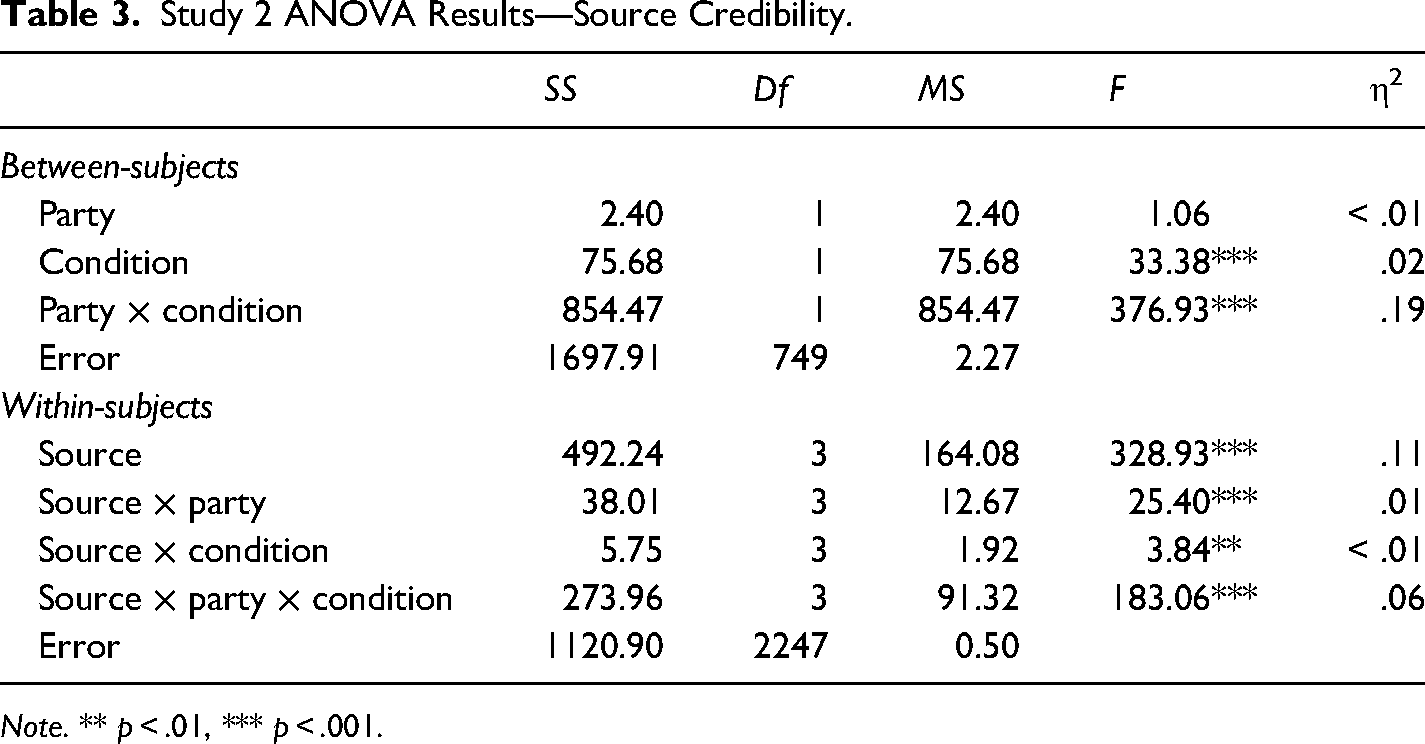
A 2 (source conditions) × 2 (party affiliations) × 4 (source types) mixed ANOVA was conducted to examine effects on source credibility (see Table 3). Source had a significant main effect, F (3, 2247) = 328.93, p < .001, η2 = .11, such that the academic and industry sources were rated as most credible overall, followed by the politician and then the radio host. There was also a small but statistically significant main effect of condition, F (1, 749) = 33.38, p = .001, η2 = .02, such that the liberal sources tended to be rated as slightly more credible, on average, than the conservative sources. As predicted in H2.1, there was also a substantial party-by-condition interaction effect, F (1, 749) = 376.93, p < .001, η2 = .19. Republicans tended to rate the conservative sources as more credible, on average, than the liberal sources (Ms = 4.89 vs. 4.04), whereas Democrats showed the opposite pattern (Ms = 3.74 vs. 5.32).
Study 2 ANOVA Results—Source Credibility.
Note. ** p < .01, *** p < .001.
Beyond the expected effect of partisanship, there was also a small but statistically significant party-by-source interaction effect, F (3, 2247) = 25.40, p < .001, η2 = .01. Although both Democrats and Republicans evaluated the radio host to be the least credible source, followed by the politician, Republicans evaluated the industry leader as the most credible source, whereas Democrats evaluated both the academic and industry source as equally credible. Democrats’ judgments also appeared to be more sensitive to source cues, in that the difference in perceived credibility between the highest and the lowest rated source was somewhat larger for them (Ms = 5.12 vs. 3.79, MD = 1.33) than for Republicans (Ms = 4.97 vs. 4.02, MD = 0.95).
Finally, there was also a significant three-way interaction effect between source type, party, and condition, F (3, 2247) = 183.06, p < .001, η2 = .06. The nature of the interaction was such that people were much more sensitive to source cues when evaluating sources from an opposing political ideology. For Republicans evaluating liberal sources and Democrats evaluating conservative sources, credibility ratings differed sharply between the highest and lowest rated source (for Dems: Ms = 4.67 vs. 2.45, MD = 2.22; for Reps: Ms = 4.94 vs. 3.15, MD = 1.79). Both groups were also consistent in evaluating the radio host and politician as least credible and the academic and industry leader as most credible (the only difference being that Democrats rated the academic and industry sources equally highly, whereas Republicans preferred the industry source). On the other hand, for Republicans evaluating conservative sources and Democrats evaluating liberal sources, ratings of credibility were consistently high regardless of source (for Dems: Ms = 5.57 vs. 5.06, MD = 0.51; for Reps: Ms = 5.01 vs. 4.83, MD = .18). The differences were so extreme that for both parties, participants perceived the least credible source with a congenial ideology (the politician, for both) to be more credible than the most credible source with an opposing ideology (the academic, for Democrats; the industry leader, for Republicans).
Study 2 Discussion
The results of Study 2 revealed that overall perceptions of source credibility differ in predictable ways based on partisanship, with members of each party evaluating sources that share their ideology as more credible than those who do not. However, the analysis also suggests that this difference does not indicate a simple disagreement about which sources are best to consult in pursuit of an accuracy goal. Instead, the evidence suggests that different perceptions emerged because people were relatively insensitive to credibility cues when it came to sources that shared their ideology, but critically evaluated those cues when it came to sources that did not. This pattern of effects is consistent with previous research on motivated reasoning (e.g., Lord et al., 1979), with the simple distinction that effects were observed for evaluations of sources rather than arguments. There is no logical reason why someone with an accuracy goal would perceive a local radio host to be a more competent source of information on policy issues than a distinguished professor with expertise on relevant topics, regardless of either source's ideological views. The fact that they were evaluated in such a manner suggests perceptions of source credibility are indeed susceptible to directional motivated reasoning effects.
Study 3
To integrate the findings from Study 1 and Study 2, the goal of Study 3 was to reexamine effects of different types of directional goals on attitude change, incorporating an additional test of whether biased perceptions of source credibility might be the mechanism by which those effects occurred. As in Study 2, we expected that message source and political party would again interact to affect perceived source credibility, such that Republicans would perceive a conservative source to be more credible than a liberal source, whereas Democrats would perceive the opposite (H3.1).
Reflecting on Study 1, we also expected climate change beliefs to have a similar effect, such that skeptics would perceive a conservative source to be more credible than a liberal source, whereas nonskeptics would perceive the opposite (H3.2). We were also interested in the possibility that the effects of party and beliefs would combine nonadditively to affect perceived source credibility, including whether this would replicate the unexpected pattern identified in Study 1 (RQ3.1).
Ultimately, we expected that perceived source credibility would mediate the effects of these variables on attitude change (H3.3), such that biased perceptions of credibility would lead to greater attitude change for sources with a shared ideology and beliefs.
Method
Sample
Participants were recruited online through Qualtrics Services. The recruitment process was designed to provide a guaranteed posttest sample of approximately N = 850, using quota sampling to obtain roughly equal numbers of Democrats (final n = 417) and Republicans (final n = 438). 4 Sample demographics were similar to Study 1 (see Table 1). 5
Procedure
The procedure remained largely the same as in Study 1. Again, pretest participants were told the purpose of the study was to evaluate their opinions on several policy proposals, including the main proposal of interest and two unrelated proposals. The main difference was that a different proposal was selected as the focus of this study: a meat tax. Similar to the cap-and-trade proposal in Study 1, the meat tax was described as a potential option for addressing climate change in that it would reduce meat consumption and generate revenues that could help promote other pro-environmental behavioral changes. Focusing on a different proposal for this study permitted us to examine whether effects found in Study 1 would replicate for a different, but related, issue. Participants read a brief description of the proposal, then filled out measures of their attitudes toward the meat tax, political affiliation, climate beliefs, and demographics.
At the posttest, approximately two weeks later, participants were randomly assigned to one of three source conditions: a conservative radio host, a liberal professor, or a neutral agricultural CEO. In each condition, subjects were first asked to read a description of the source, which remained largely the same as in Study 2 (see Appendix 3 for full source descriptions and messages). Next, participants read a statement attributed to that source. The message text was largely the same and included the same arguments in each case, but with slight alterations to language to make them sound more realistic and maintain consistency with the (non)partisan nature of the source. Although using an identical message for all three would have been beneficial in some ways, it would also have been likely to arouse suspicion, as radio hosts, CEOs, and professors are unlikely to use the same language or speak in the same contexts. Because our goal was to maximize the contrast between the sources and their ecological validity for participants, not to reexamine the specific source cues manipulated in Study 2, this approach was best suited to our purposes. In other words, we combined different source linguistic styles and source descriptions even at the risk of “confounding” source language and source type because we were more interested in the ecological validity of source bias than in carefully testing for effects of source linguistic style and source description as separate constructs. Those separate constructs may be worthy of theoretical examination in other contexts but were not the focus of our theoretical model.
After reading the message, subjects completed an attention check item about the industry in which the source worked (radio, agriculture, or higher education), a posttest measure of their attitudes toward the meat tax, and the measure of source credibility.
Measures
Political party affiliation was evaluated with one item (1 = strong Republican, 7 = strong Democrat). Those responding on the lower half of the scale were considered Republicans; those responding on the upper half of the scale were considered Democrats. If participants selected the midpoint (4 = Independent), they were asked a follow-up question about which party they felt closer to (1 = definitely feel closer to the Republican Party, 5 = definitely feel closer to the Democratic Party). Those who identified as Republican or felt closer to the Republican Party were considered Republicans for the purpose of the quota, and vice versa for Democrats; analyses focused on the continuous measure of affiliation.
Climate beliefs (α = .93; M = 5.43, SD = 1.51) were measured using the two items from Study 1 and two additional items intended to increase variance in beliefs and preclude the need for quota sampling on this measure (“We are already seeing harmful effects of climate change” and “Climate change will have devastating effects on the planet in the next 50 years”). All four items were measured on 7-point Likert-type scales (1 = strongly disagree, 7 = strongly agree).
Source credibility (α = .95, M = 4.23, SD = 1.38) was measured in the same manner as in Study 2, using McCroskey's scales (McCroskey, 1966; McCroskey & Teven, 1999).
Attitudes toward the meat tax (pretest: α = .96, M = 2.22, SD = 1.26; posttest: α = .97, M = 3.38, SD = 1.91) were measured using the same four 7-point semantic differential items used to evaluate the proposal in Study 1 (e.g., foolish-wise).
Factor Analyses. The same procedures as in Study 1 were used to test the fit of the pretest meat tax and climate beliefs data to a two-factor structure and the posttest meat tax and source credibility data to a four-factor structure. The model provided excellent fit to the data at the pretest, CFI = .99, SRMR = .03, χ2 (19) = 68.66, p < .001, but not at the posttest, CFI = .90, SRMR = .05, χ2 (203) = 1890.20, p < .001. Inspection of the residuals at the posttest revealed that the credibility scales better reflected a first-order unidimensional model for these participants. Furthermore, several of the credibility items were associated with larger errors than would be expected to occur due to chance alone. Respecifying the factor structure and removing those invalid items (one competence item, two trustworthiness items, and four goodwill items) resulted in improved model fit, CFI = .94, SRMR = .04, χ2 (103) = 749.31, p < .001. The remaining items were averaged to form composite scores for each variable.
Results
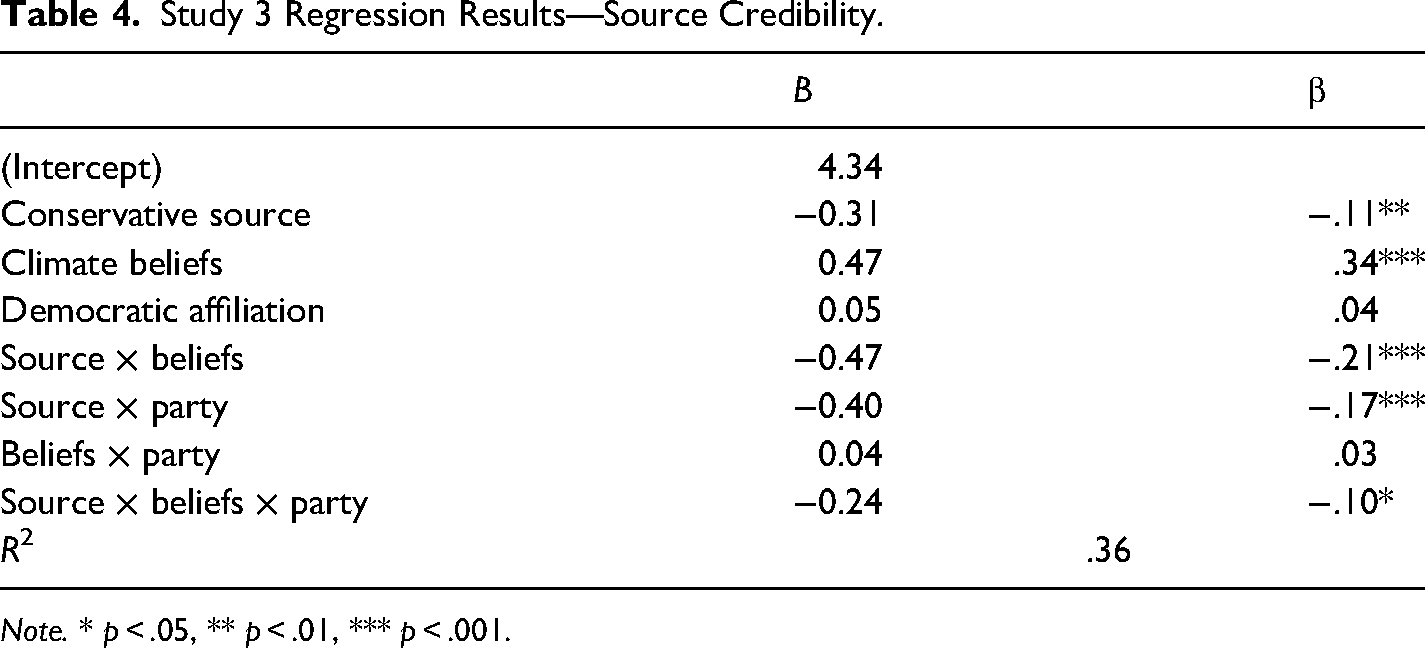
To examine H3.1, H3.2, and RQ3.1, source credibility was first regressed on the dummy coded source variables (with liberal as the comparison group), political affiliation, and climate beliefs. The affiliation and beliefs scales were both standardized before inclusion in the model. This preliminary analysis revealed that the neutral source was not evaluated differently from the liberal source (β = −.02, p = .62), so the main analysis proceeded with only the conservative source dummy variable included. Accordingly, source credibility was regressed on the conservative dummy variable, political affiliation, climate beliefs, and the two- and three-way interactions among them (see Table 4).
Study 3 Regression Results—Source Credibility.
Note. * p < .05, ** p < .01, *** p < .001.
Consistent with H3.1, there was a substantial source-by-party interaction effect (unstandardized B = −0.40, p < .001). Ratings of the conservative source's credibility decreased as participants’ affiliation shifted from Republican to Democrat, whereas ratings of the liberal source's credibility increased. Consistent with H3.2, there was also a substantial source-by-beliefs interaction effect (unstandardized B = −0.47, p < .001). Skeptical participants perceived the conservative source to be more credible than the other sources, whereas nonskeptical participants perceived the opposite.
RQ3.1 was also answered in the affirmative (see Figure 2). There was a significant three-way interaction effect between affiliation, beliefs, and source (unstandardized B = −0.24, p = .04). As before, skeptical Republicans tended to view the conservative source as somewhat more credible, but this difference disappeared as climate beliefs became stronger. Likewise, skeptical Democrats again viewed the conservative source as more credible, but increasingly preferred the liberal source as their beliefs became stronger. Notably, however, the nature of the interaction was not identical to that identified in Study 1; beliefs and source interacted for both Republicans and Democrats here, rather than only for Democrats.
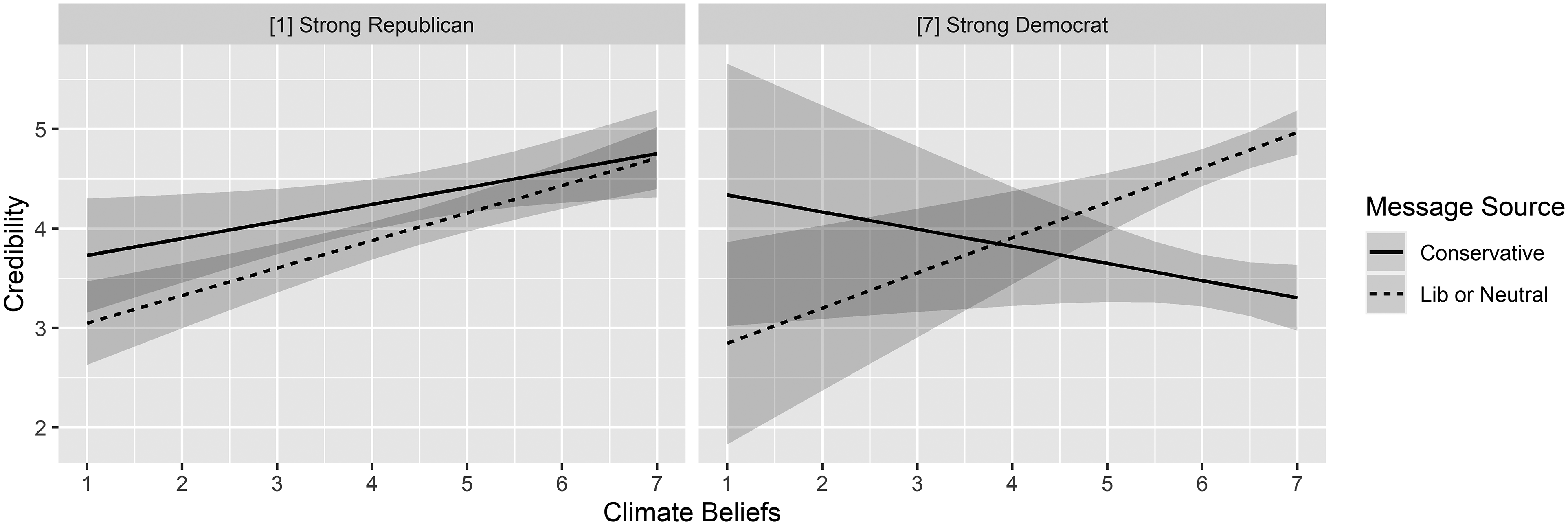
Study 3: Predicted values of the three-way interaction between message source, party affiliation, and climate beliefs at extreme levels of party affiliation.
Finally, to test H3.3, we tested the fit of a three-variable causal model in which the three-way interaction between the conservative source dummy variable, political affiliation, and climate beliefs (X) impacted source credibility (Y), which in turn impacted posttest attitudes (Z). The XY path and XZ indirect effect were estimated as the standardized regression coefficients for the three-way interaction effect when controlling for all other main effects and interactions (βs = −.11 and −.04, respectively). The YZ path was estimated as the standardized regression coefficient for source credibility when controlling for pretest attitudes (β = .45). Fit of the model was tested in R using the lavaan package. Results revealed that the causal model provided excellent fit to the data, CFI = 1.00, SRMR = .004, χ2 (1) = 0.09, p = .76. Thus, consistent with H3.3, perceptions of source credibility mediated effects of identity- and belief-driven motivated reasoning on attitude change. 6
General Discussion
These findings have implications for both the motivated reasoning literature and for applied communication campaigns. On the one hand, the results speak to the debate about the extent to which beliefs contribute to motivated reasoning in ways outside of self-concept related identities like political party. Aronson (1992) and Carpenter (2019) argued that the primary driver of motivated reasoning is the self-concept, whereas Kunda (1990, 1992) predicted that motivated reasoning could be produced by a mere discrepancy between the source position and the position the audience desires to be true, even if that desire is not related to the self-concept. The results provide support for both perspectives. For more skeptical Republicans and less skeptical Democrats, partisan identity had the strongest influence, consistent with the self-concept approach. For these groups, the amount of attitude change and perceptions of source credibility depended substantially on whether the source shared the recipients’ own political views. For less skeptical Republicans, both beliefs and identity mattered to some extent, consistent with both perspectives. There was still a tendency for a conservative source to be more persuasive, but substantial attitude change was observed for a liberal source as well. This group also perceived the credibility of both types of sources to be equally high. Finally, for Democrat skeptics, beliefs had the strongest influence, consistent with Kunda's approach. For this group, both perceived credibility and persuasion depended on whether the message came from a source that would be expected to share their skeptical views of climate change. 7
These findings also raise the question of why identity-driven motivated reasoning appears to predominate for some groups but belief-driven motivated reasoning for others. One possibility is that identity-driven motivated reasoning is stronger for those who have beliefs that are perceived to be normative for a group to which their self-concept is connected than for those who have beliefs perceived to be non-normative (or what Abeles et al., 2019, refer to as opinion deviants). The results revealed that those with historically normative climate beliefs (Republican skeptics and Democrat nonskeptics) exhibited a straightforward partisan-motivated reasoning effect. On the other hand, those with historically non-normative climate beliefs (Republican nonskeptics and Democrat skeptics) were much more receptive to a source that did not share their political views, either in addition to or instead of an ideologically matched source.
A possible explanation for this finding is that those with beliefs that are perceived to be non-normative are more open-minded in general. Given that these subjects embrace views that they believe to be different from those avowed by most others with their political affiliation, it makes sense that they would embrace diverse sources as well. Notably, this tendency could occur both for those who correctly perceive their beliefs to be non-normative—as with Democrat skeptics—and for those who are incorrect—as with Republican nonskeptics, for whom public perceptions of what is normative have lagged behind actual descriptive norms (a form of pluralistic ignorance, Prentice & Miller, 1996; see Abeles et al., 2019; Van Boven et al., 2018).
This explanation is not sufficient to explain why Democrat skeptics did not see a liberal source as credible or persuasive, though, so it is likely that other factors are relevant as well. For instance, it may be that Democrat skeptics have had negative experiences when talking to other liberals about their views on climate change, which leads them to distrust liberal sources on this topic. Research on the black sheep effect (Marques & Yzerbyt, 1988) demonstrates that judgments of in-group members are often more extreme than judgments of out-group members, suggesting that Democrats may judge climate denialism even more harshly when it comes from a fellow Democrat than when it comes from a Republican. This tendency may also be exacerbated by the tendency for those with historically normative climate beliefs to exaggerate the extent to members of their own party share their views (Abeles et al., 2019), which would make those with different beliefs seem more deviant than they are in actuality. For Democrat skeptics, a conservative source may thus be more appealing because the message does not come with the presumed judgment or scorn that liberal sources might often convey.
Whatever the explanation, these results suggest that researchers and practitioners can ill afford to ignore the unique contributions of party and beliefs to responses to messages about climate change. Previous research has often assumed that all Republicans can functionally be treated as skeptics and all Democrats can functionally be treated as nonskeptics, but these findings indicate that such an assumption is problematic and is likely to overlook important intraparty differences. Future research would benefit from greater attention to the role of both identity and beliefs in shaping motivated reasoning on this topic, and perhaps on other politically divisive issues as well.
The results also speak to recent conversations about the extent to which different patterns of message effects indicate directional motivated reasoning as opposed to accuracy-driven differences in perceived source credibility (e.g., Druckman & McGrath, 2019). In particular, the findings suggest that although judgments of source credibility do differ in predictable ways between Democrats and Republicans, they appear to do so in ways that reflect directional goals rather than accuracy goals. Both groups tended to be very generous in evaluating the credibility of ideologically congenial sources, but critical and discerning when evaluating the credibility of sources with an opposing ideology. These judgments also mediated effects of message exposure on persuasive outcomes, such that shared beliefs and ideology predicted perceived credibility, which in turn predicted attitude change. In general, these findings suggest that evaluations of source credibility are just as susceptible to directional motivated reasoning effects as evaluations of message content are. Accordingly, future research that attends to both types of effects would be beneficial. For instance, it would be useful to know whether it would be more effective to design interventions to encourage more accurate judgments of source credibility or to encourage more accurate judgments of message content.
Attention to these nuances would also be beneficial for applied communication campaigns. Specifically, the results suggest that liberal sources can be effective for members of both parties, but only among those who are less skeptical. On the other hand, conservative sources are effective among skeptics of both parties and for less skeptical Republicans. Accordingly, campaigns that work to amplify the messages of conservative sources working to promote climate action may have the biggest overall impact on attitudes. There is a growing pro-climate movement among young Republicans in the U.S. (Weir, 2020), including groups such as the Young Conservatives for Carbon Dividends (https://www.yccdaction.org/), the American Conservation Coalition (https://www.acc.eco/), and the EcoRight project (https://republicen.org/). Making Republicans more aware of these groups and working with them to develop persuasive campaigns may be a particularly effective solution for promoting climate action among a wide swath of the U.S. population. Republican sources that are also likely to be viewed as more credible by Democrats (academics and industry leaders, e.g., as compared to politicians or public personalities) may also help temper unfavorable responses among groups who are not the target of these campaigns.
Finally, the results suggest that the impact of the specific language used to discuss climate change may deserve additional research and consideration when designing tailored messages for particular audience segments. Previous research has suggested that partisans react to different environmental terms in different ways. For instance, Republicans are more likely to endorse a belief in “climate change” than in “global warming” whereas Democrats are equally likely to endorse either (Schuldt et al., 2011, 2017), which has clear implications for message design. Still, this research, as with the research on partisan-motivated reasoning, has paid limited attention to possible within-party differences in these effects. Understanding how Republican nonskeptics and Democrat skeptics, in particular, react to particular terms may be useful for further refining our understanding of how linguistic choices impact outcomes for messages about climate change and other environmental issues.
The finding that partisan motivated reasoning can affect both perceptions of source credibility and message content also points to the need to carefully consider the ideological cues that may be present in both source and message information available to an audience, even when source partisanship is not made explicit. Specifically, both Study 2 and 3 revealed that participants easily and quickly made judgments about a source's political ideology based on details about their geographical location, field of expertise, and manner of speaking. As one Study 3 participant noted in an open-ended comment—echoing existing research on the linguistic differences between conservatives and liberals (e.g., Holtzman et al., 2015; Okdie & Rempala, 2019; Robinson et al., 2017)—“buzz words give away some people's political views” (Participant 725, Republican nonskeptic, conservative source). People also readily relied on these judgments when reacting to the message, as exemplified by Republican participants commenting that the source “sounds like [a] liberal and also not thinking through the tax on meat” (Participant 380, Republican skeptic, liberal source) and that “liberals are crazy” (Participant 515, Republican skeptic, liberal source) and by Democrat participants stating that “I think that I would listen to the things that were said more if they weren't so politically charged” (Participant 680, Democrat nonskeptic, conservative source) and “That does not mean that the Republicans know how to care for it [the Earth]” (Participant 627, Democrat nonskeptic, conservative source). One participant even stated explicitly that it felt strange to find an argument persuasive when it came from someone of a different political ideology: “It's weird because Mark's statements made me look at the issue in a different way” (Participant 573, Democrat nonskeptic, conservative source).
Altogether, these findings suggest that people are likely to be closely attuned to any political cues available in information they are given and may readily jump to conclusions about a source's ideology or affiliation even when limited information is available. Furthermore, even bipartisan or neutral sources are unlikely to be immune from this scrutiny. As one Study 3 participant in the neutral source condition noted, “I just wish it would of told us what his political association was” (Participant 245, Democrat nonskeptic). As such, both researchers and practitioners would benefit from attention to both unintended assumptions that audiences may make based on language and how language can be used strategically to either reinforce or counteract these assumptions.
Finally, it is important to consider the social justice implications of these findings. As Hathaway (2020) observed, climate justice is an intersectional issue: people's identities, in terms of race, sex, class, and gender, intersect in ways that cause people to experience climate change effects differently. As such, communication campaigns targeting climate change need to be cognizant of these differences. Future work must recognize that political power is unevenly distributed, such that those most likely to be affected by climate change often have the least political power. The message source tailoring approach developed in these studies might be developed with the help of marginalized groups so that climate change policy advocacy could be used as a route to coalition building around environmental justice themes. As our findings suggest, source credibility is not just a matter of shared identity but it is also a matter of shared language. Building on these insights, activists must involve marginalized communities more directly in developing advocacy messages that address the unique systems of oppression that climate change exacerbates.
Limitations
There are some limitations of the present study. For one, the findings are specific to the U.S. Although there is a particular need for U.S.-focused climate communication research, given that the political divide tends to be more problematic in the U.S. than in other countries (McCright & Dunlap, 2011), tackling climate change ultimately requires global support. Thus, additional research is needed to understand the extent to which identity-driven and belief-driven motivated reasoning are relevant in countries where climate change is less politicized and in which there are different party systems and different political structures altogether.
In addition, the findings would benefit from replication with other types of climate action beyond policy support. Although the fact that the findings replicated across two different types of policies is encouraging, it is not clear to what extent the same results might be found if the message focused on other outcomes, such as individual behavior (e.g., carpooling, composting). Although policy support is an important goal, in that it would conceivably encourage other important actions such as voting for political candidates that endorse those policies and donating time and money to relevant causes, future research on other behaviors would also be beneficial.
Conclusion
The present study provides evidence that both partisan identity and climate beliefs play important roles in shaping motivated reasoning in response to persuasive messages about climate change, suggesting that treating Democrats and Republicans as unified blocs conceals important nuances of their responses. The evidence also suggests that biased perceptions of source credibility can account for this pattern of effects. Future research and campaign design that attend to how both types of directional goals combine and interact to affect perceptions of both sources and messages, including the ways that the language used shapes outcomes for different audience segments, would be beneficial. Tailoring messages and sources to groups on the basis of both partisanship and beliefs may help create more powerful, more widespread change.
Supplemental Material
sj-docx-1-jls-10.1177_0261927X241291572 - Supplemental material for The Roles of Identity- and Belief-Driven Motivated Reasoning and Source Credibility in Persuasion on Climate Change Policy
Supplemental material, sj-docx-1-jls-10.1177_0261927X241291572 for The Roles of Identity- and Belief-Driven Motivated Reasoning and Source Credibility in Persuasion on Climate Change Policy by Shannon M. Cruz and Christopher J. Carpenter in Journal of Language and Social Psychology
Footnotes
Data Availability Statement
Data are available upon request to the corresponding author.
Declaration of Conflicting Interests
The authors declared no potential conflicts of interest with respect to the research, authorship, and/or publication of this article.
Funding
The authors received no financial support for the research, authorship, and/or publication of this article.

Supplemental Material
Supplemental material for this article is available online.
Notes
Author Biographies
References
Supplementary Material
Please find the following supplemental material available below.
For Open Access articles published under a Creative Commons License, all supplemental material carries the same license as the article it is associated with.
For non-Open Access articles published, all supplemental material carries a non-exclusive license, and permission requests for re-use of supplemental material or any part of supplemental material shall be sent directly to the copyright owner as specified in the copyright notice associated with the article.
