



Abstract
We examined whether source accent moderates jargon's effects on listeners’ processing fluency and receptivity to science communication. Americans heard a speaker describing science using either jargon or non-jargon and speaking with either a native (standard American) or foreign (Hispanic) accent. Compared to non-jargon, jargon disrupted listeners’ fluency for both speakers, but especially the foreign-accented speaker; jargon also reduced information-seeking intentions and perceived source and message credibility, but only for the foreign-accented speaker. Fluency mediated the effects of jargon on outcomes.
Effectively communicating scientific information to the public is an important social goal because it can lead to more informed citizens, allowing them to make better decisions and lead better lives, as well as increase public support for scientific endeavors, potentially precipitating further scientific progress (Rice & Giles, 2017). Consequently, understanding which factors facilitate and diminish the effectiveness of science communication and, most importantly why, are not only important theoretical but also practical questions (Krieger & Gallois, 2017).
One factor that has received considerable empirical attention is jargon. Science communication often contains complex language, particularly jargon, or technical, specialized vocabulary (Sharon & Baram-Tsabari, 2014). Compared to non-jargon, jargon can disrupt people's processing fluency or the subjective ease or difficulty people experience processing information (Alter & Oppenheimer, 2009). This effect has been widely demonstrated (Shulman & Bullock, 2020; Shulman et al., 2020, 2021) and emerges independent of actual message comprehension (Bullock et al., 2019). Processing fluency, in turn, can be a potent metacognitive cue to judgment: Generally, decreased fluency promotes less favorable judgments, including more negative source and message evaluations (for a review, see Alter & Oppenheimer, 2009). In the context of science communication, specifically, jargon-caused fluency disruptions have been associated with various adverse outcomes, including lower perceived message credibility and knowledge, and reduced scientific engagement (Shulman et al., 2020, 2021).
In addition to jargon, however, many other linguistic and nonlinguistic factors can influence message processing fluency, including syntactic complexity (Shulman & Sweitzer, 2018), font style and size (Oppenheimer, 2006), source accent (Dragojevic & Goatley-Soan, 2022), and background noise (Munro, 1998), among others (for a review, see Alter & Oppenheimer, 2009). In practice, science communication messages may contain multiple such factors simultaneously. This raises an important empirical question: Are the negative effects of jargon on people's processing fluency and receptivity to science communication exacerbated in the presence of other fluency-disrupting factors? The present study sought to begin to answer this question by exploring one such factor: source accent.
The Present Study
Whereas past research examining the adverse effects of jargon in science communication has focused exclusively on written language, our study extends this work to spoken language. One factor that significantly impacts how easily people process a speaker's speech is the speaker's accent, or manner of pronunciation (Giles, 1970). Generally, the more a speaker's accent differs from listeners’ own, the more difficulty listeners experience processing that person's speech (Cristia et al., 2012). Unsurprisingly, then, Americans typically experience more difficulty processing foreign- than native-accented speech (Dragojevic & Goatley-Soan, 2022; Munro, 1998). Consistent with the theoretical model depicted in Figure 1, we examined whether the additional disfluency caused by foreign- relative to native-accented speech exacerbates jargon's negative effects on listeners’ processing fluency and receptivity to science communication.
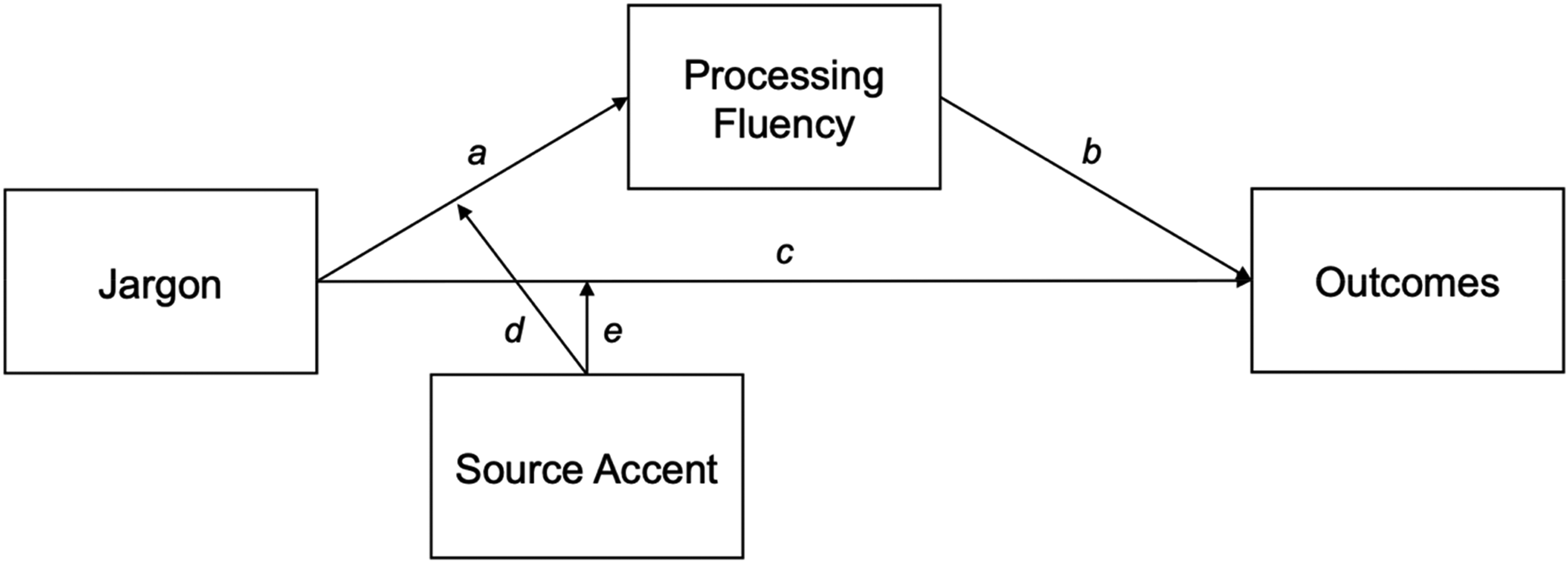
Theoretical model depicting the effects of jargon on outcomes via processing fluency and the moderating role of source accent.
In the present study, Americans listened to a male speaker describing various new technologies using either jargon or non-jargon semantic equivalents and speaking with either a native (i.e., standard American English [SAE]) or a foreign (i.e., Hispanic) accent. Consistent with past research (Bullock et al., 2019; Shulman et al., 2020, 2021), we expected jargon to reduce listeners’ processing fluency relative to non-jargon (Figure 1, path a). Additionally, however, we expected this disruption to be greater for the foreign- than native-accented speaker (Figure 1, path d), for two reasons. First, research on speech processing suggests that the co-occurrence of multiple fluency-disrupting factors can incur synergistic processing costs. For instance, Imai et al. (2005) found that the increased processing costs incurred by low- relative to high-frequency words were greater for foreign- than native-accented speech (see also, Munro, 1998). Second, processing fluency is a subjective experience (Alter & Oppenheimer, 2009), prone to perceptual distortions (Shen et al., 2010). Small, communicatively inconsequential distortions may go unnoticed or be perceptually muted, whereas substantial, communicatively consequential disruptions can be perceptually magnified (see assimilation and contrast effects: Sherif & Hovland, 1961). Although jargon alone can substantially disrupt people's processing fluency, this threshold is more likely to be reached (and crossed) in the presence of other fluency-disrupting factors, such as a foreign accent. Accordingly, we predicted that:
H1a−b: Compared to non-jargon, jargon will (a) reduce listeners’ processing fluency and (b) this effect will be greater for the foreign- than native-accented speaker.
Disruptions in fluency should, in turn, engender more negative evaluations (Figure 1, path b), with greater disruptions resulting in more pronounced evaluative consequences (Alter & Oppenheimer, 2009). Two parallel mechanisms underlie this effect: (a) fluency disruptions elicit a negative affective reaction, which can negatively bias subsequent judgments; and (b) disfluency can itself be a cue to subsequent judgments through the application of context-specific naive theories (see Schwarz, 2010). In the present study, we focused on three frequently explored outcomes relating to people's receptivity to science communication: perceived source credibility, perceived message credibility, and information-seeking intentions regarding science (i.e., scientific engagement; Shulman et al., 2020). To the extent that jargon disrupts fluency relative to non-jargon and this disruption is exacerbated by foreign-accented speech, then jargon should result in more negative judgments than non-jargon, and this effect should be greater for the foreign- than native-accented speaker. Accordingly, we predicted that:
H2a−c: Compared to non-jargon, jargon will reduce (a) perceived source credibility, (b) perceived message credibility; and (c) information-seeking intentions. H3a−c: The effects described in H2a−c will be greater for the foreign- than native-accented speaker.
Implicit in the above rationale is the notion that jargon exerts its effects on outcomes indirectly via fluency (i.e., mediation; Figure 1, path ab)—a relationship well-established in the literature (Bullock et al., 2019; Shulman et al., 2020, 2021)—and that this indirect effect is conditional on source accent (Figure 1, path d), being more pronounced for the foreign- than native-accented speaker (i.e., moderated mediation). Accordingly, we predicted that:
H4a−c: The negative effects of jargon on (a) perceived source credibility; (b) perceived message credibility; and (c) information-seeking intentions will be mediated by fluency. H5a−c: Source accent will moderate the negative indirect effects described in H4a−c, such that they will be larger for the foreign- than native-accented speaker.
We were also interested in whether jargon would exert direct effects on any outcomes, after controlling for fluency (Figure 1, path c). Conceivably, jargon could influence outcomes through mechanisms other than fluency, including directly. For instance, jargon may index expertise (Zimmerman & Jucks, 2018) and exert a positive direct effect on outcomes. To the extent that significant direct effects do emerge, we were also interested in whether any would be moderated by source accent (Figure 1, path e). For example, given that Americans typically attribute more competence to native- than foreign-accented speakers (Dragojevic & Goatley-Soan, 2022), their tendency to associate jargon with expertise may be greater for native- than foreign-accented speakers. We posed the following research questions:
RQ1a−b: Will jargon (a) exert direct effects on any of the outcomes and, if so, will (b) source accent moderate any of those effects?
Method
Participants
Participants were 525 undergraduate students at a large public university in the southern United States; all were American nationals and native English speakers. They (73.7% women) ranged in age from 18 to 72 years old (M = 19.62, SD = 3.49) and reported their ethnicity as White (91.8%), Black/African-American (5.5%), Asian-American (4.8%), Hispanic/Latino/Latina (2.5%), American Indian/Alaska Native (0.2%), and other (1.0%).
Stimuli
Jargon and non-jargon versions of three texts—each describing a different new technology (i.e., self-driving cars, 3D bioprinters, surgical robots)—were adopted from past research, as they have been shown to produce significant differences in processing fluency (for full texts, see Shulman et al., 2020). 1 Audio versions of the six texts were produced using the matched-guise technique (Lambert et al., 1960), which involves a bidialectical speaker reading the same passage of text in different language varieties (e.g., accents), or guises. This method ensures that the primary difference across guises is the language feature of interest (e.g., accent), rather than extraneous vocal characteristics (e.g., pitch), which naturally vary across speakers (see Loureiro-Rodríguez & Acar, 2022). Audio stimuli were produced by a male, professional dialect coach in his 40 s, who recorded each text in a native (i.e., SAE) and a foreign (i.e., Hispanic) accent, resulting in 12 recordings total. The Hispanic accent was selected because it typically disrupts Americans’ processing fluency relative to SAE (Dragojevic & Goatley-Soan, 2022) and is a variety many Americans encounter in their daily lives (Dailey et al., 2005).
Procedures and Measures
The study was conducted online. 2 After successfully completing a sound check item, participants were randomly assigned to one of four experimental conditions, defined by a 2 (jargon: absent, present) × 2 (source accent: native, foreign) factorial design. In all conditions, participants listened to three audio recordings—each describing a different new technology (see above)—in random order. Depending on experimental condition, the speaker in all three recordings used either jargon or non-jargon semantic equivalents and spoke with either a native or a foreign accent. Each recording began playing automatically and could not be paused, skipped, or repeated, ensuring all participants heard each recording once in its entirety.
After each recording, participants reported their experience of processing fluency (three items; Dragojevic et al., 2017); perceptions of message credibility (four items; Appelman & Sundar, 2016); and information-seeking intentions regarding the respective technology (three items; Yang & Kahlor, 2013). Multiple message topics (see above) were used solely for generalizability. Accordingly, ratings across the three topics were averaged for each item, and these items were averaged to create overall scale composites. Having listened to all three recordings, participants reported their perceptions of source credibility (five items; Dragojevic et al., 2017); these items were also averaged to create a composite. As manipulation checks, participants then reported how strong, familiar, and similar to their own the speaker's accent sounded; and indicated the speaker's perceived origin using an open-ended question. Finally, participants provided demographic information. All scale items appear in Appendix A. Means, standard deviations, reliabilities, and zero-order correlations for each dependent variable appear in Table 1.
Scale Reliabilities, Means, Standard Deviations, and Zero-Order Correlations Between All Variables.
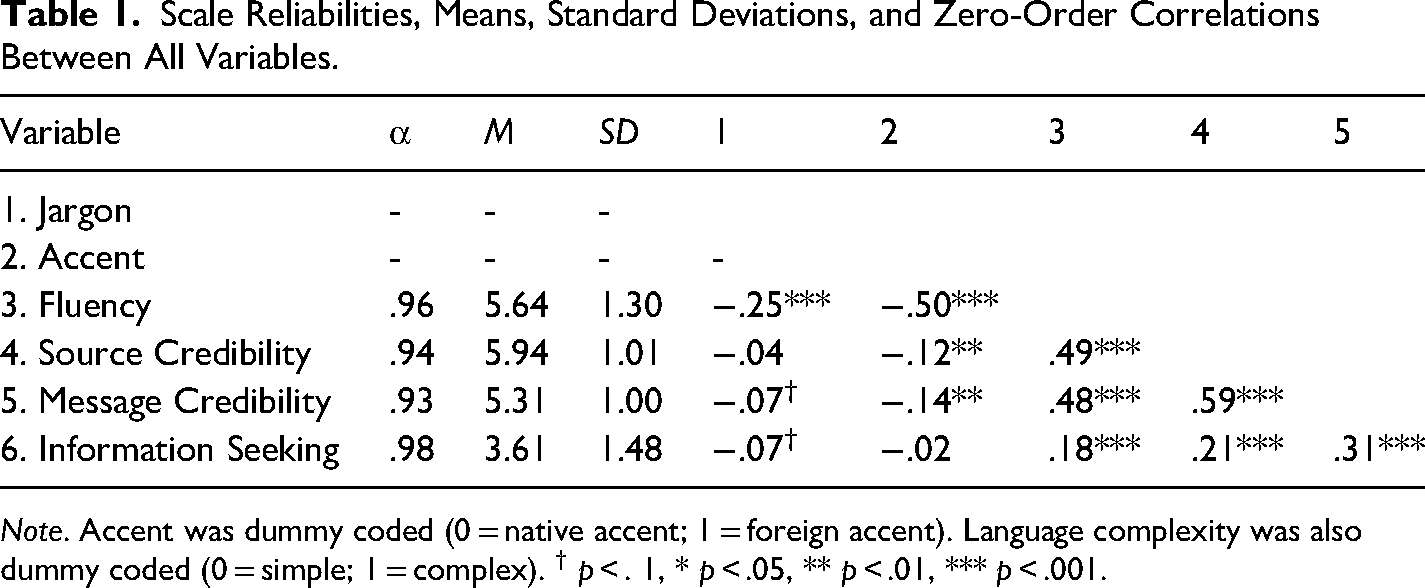
Note. Accent was dummy coded (0 = native accent; 1 = foreign accent). Language complexity was also dummy coded (0 = simple; 1 = complex). † p < . 1, * p < .05, ** p < .01, *** p < .001.
Power
All tests had sufficient power (>.80; see Cohen, 1992), assuming a two-tailed α of .05 and a small-to-medium effect size (d = 0.35).
Results
Preliminary Analyses
The accent manipulation functioned as intended (see Table 2). Participants rated the speaker's accent as stronger, less familiar, and less similar to their own accent when he spoke with a foreign than native accent. Nearly all participants who completed the open-ended question about speaker origin (n = 512) listed a foreign country for the foreign-accented speaker and the U.S. for the native-accented speaker. Participants also reported lower processing fluency when listening to a foreign- than a native-accented speaker, regardless of jargon use (see Table 3).
Effects of Source Accent on Manipulation Check Items.
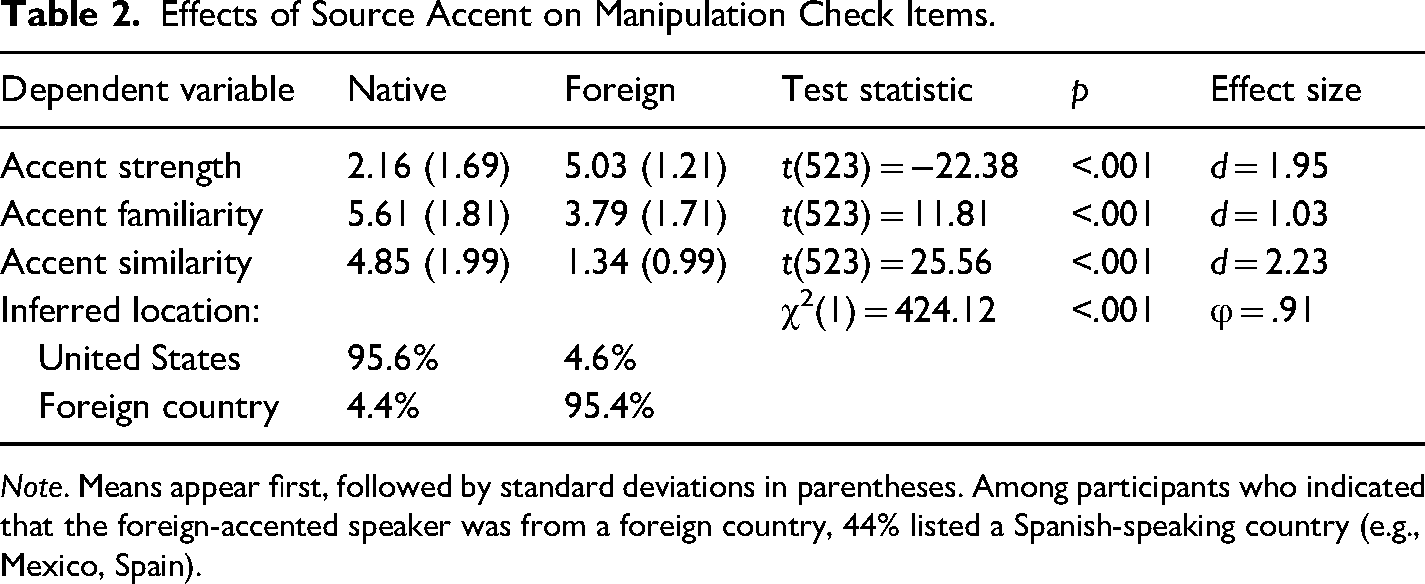
Note. Means appear first, followed by standard deviations in parentheses. Among participants who indicated that the foreign-accented speaker was from a foreign country, 44% listed a Spanish-speaking country (e.g., Mexico, Spain).
Effects of Jargon and Accent on Dependent Variables.
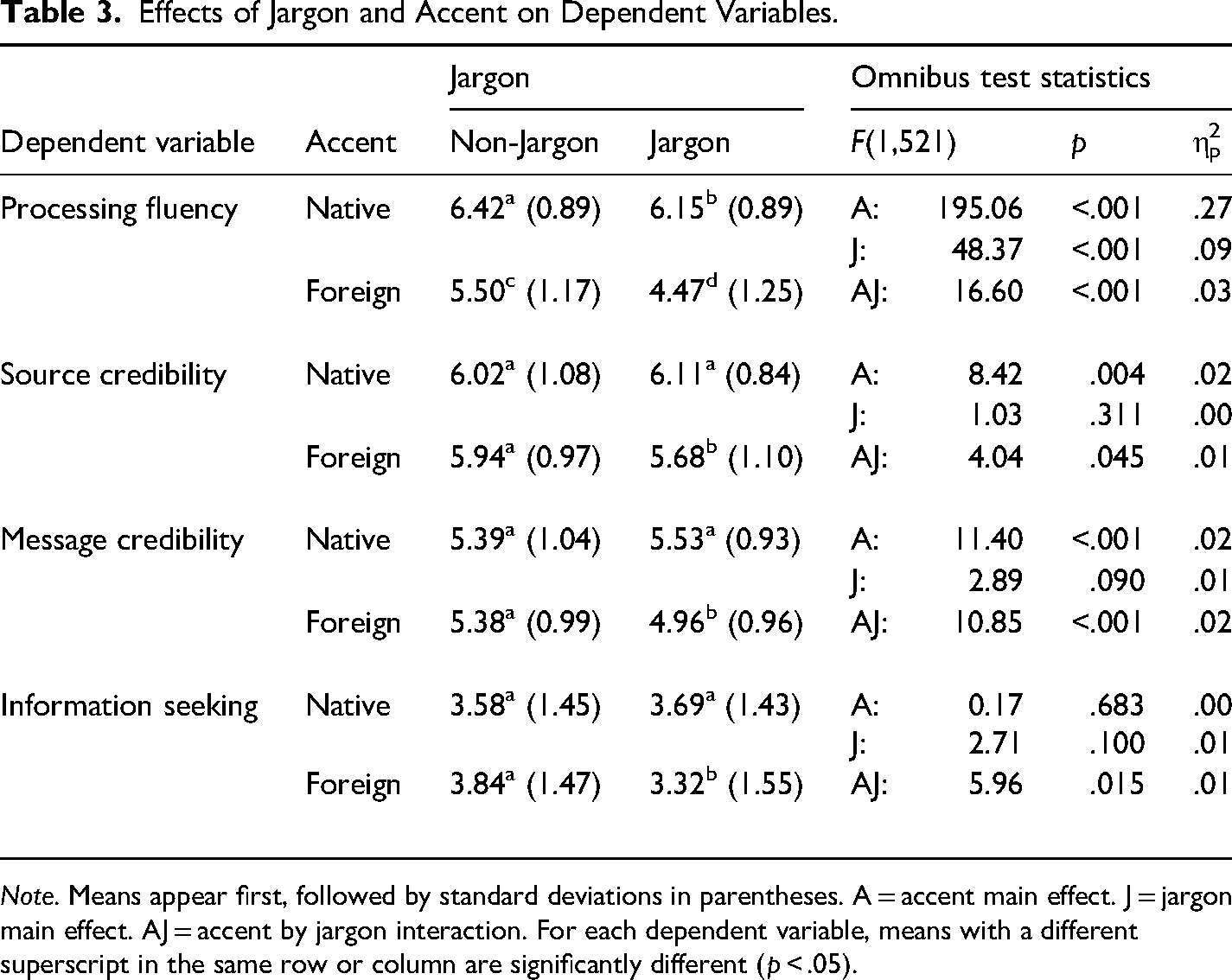
Note. Means appear first, followed by standard deviations in parentheses. A = accent main effect. J = jargon main effect. AJ = accent by jargon interaction. For each dependent variable, means with a different superscript in the same row or column are significantly different (p < .05).
Focal Analyses
Hypotheses were tested using a series of two-way ANOVAs. Omnibus test statistics, cell means, and standard deviations appear in Table 3. For all dependent measures, a significant interaction emerged, which was decomposed by analyzing simple main effects. Compared to non-jargon, jargon reduced listeners’ processing fluency for both the native-, p < .05, and foreign-accented speaker, p < .001, but this disruption was greater for the latter. Compared to non-jargon, jargon also reduced perceived source credibility, perceived message credibility, and information-seeking intentions, but only for the foreign-accented speaker, ps < .05. For the native-accented speaker, no significant differences emerged, ps > .25.
Moderated Mediation
Moderated mediation was tested using Model 8 of Hayes’ (2018) PROCESS macro. Results appear in Table 4. Jargon exerted negative indirect effects via fluency on perceived source credibility, perceived message credibility, and information-seeking intentions for both speakers, but these effects were larger in magnitude for the foreign- than native-accented speaker, as revealed by significant indices of moderated mediation. After controlling for fluency, jargon also exerted positive direct effects on the perceived source and message credibility, neither of which was conditional on source accent. The direct effect of jargon on information-seeking intentions was positive, but nonsignificant.
Moderated Mediation Results.
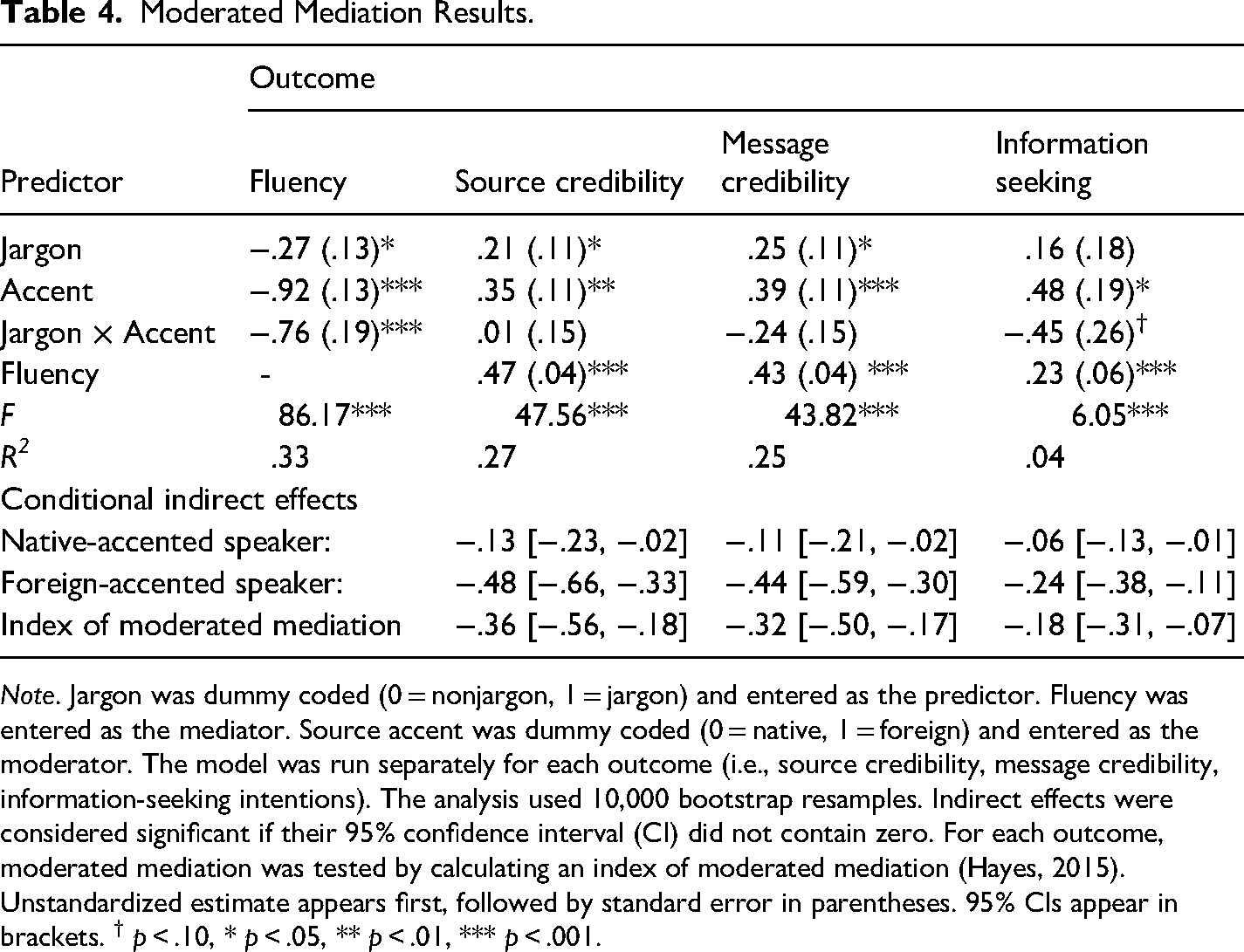
Note. Jargon was dummy coded (0 = nonjargon, 1 = jargon) and entered as the predictor. Fluency was entered as the mediator. Source accent was dummy coded (0 = native, 1 = foreign) and entered as the moderator. The model was run separately for each outcome (i.e., source credibility, message credibility, information-seeking intentions). The analysis used 10,000 bootstrap resamples. Indirect effects were considered significant if their 95% confidence interval (CI) did not contain zero. For each outcome, moderated mediation was tested by calculating an index of moderated mediation (Hayes, 2015). Unstandardized estimate appears first, followed by standard error in parentheses. 95% CIs appear in brackets. † p < .10, * p < .05, ** p < .01, *** p < .001.
Discussion
We examined whether source accent moderates the negative effects of jargon on listeners’ processing fluency and receptivity to science communication. Americans listened to a speaker describing various new technologies using either jargon or non-jargon semantic equivalents and speaking with either a native (i.e., SAE) or a foreign (i.e., Hispanic) accent. Compared to non-jargon, jargon disrupted listeners’ processing fluency for both the native- and foreign-accented speaker, but this disruption was greater for the latter. Compared to non-jargon, jargon also reduced listeners’ information-seeking intentions and perceived source and message credibility, but only for the foreign-accented speaker; for the native-accented speaker, no differences emerged in any outcomes.
Why did jargon produce no significant differences in any outcomes for the native-accented speaker, even though it significantly disrupted listeners’ processing fluency in that condition? Our moderated mediation model sheds light on this question. Jargon exerted negative indirect effects on outcomes via fluency for both speakers, but these were larger in magnitude for the foreign- than native-accented speaker. After controlling for fluency, jargon also exerted positive direct effects on outcomes, which were not conditional on source accent. For the foreign-accented speaker, the negative indirect effects were larger in magnitude than the positive direct effects, resulting in negative total effects of jargon on outcomes. For the native-accented source, however, the negative indirect and positive direct effects were of similar magnitude, resulting in null total effects of jargon on outcomes. In other words, had the negative indirect effects for the native-accented speaker been larger (e.g., due to a stronger jargon manipulation), jargon would likely have produced significant differences in message receptivity for the native-accented speaker as well.
Collectively, our findings echo past research showing that jargon can disrupt listeners’ processing fluency and that this disruption is evaluatively consequential, promoting more negative judgments (Bullock et al., 2019; Shulman et al., 2020, 2021). Our findings also extend past research in three important ways. First, they suggest that the negative effects of jargon on fluency and subsequent outcomes may be exacerbated in the presence of other fluency-disrupting factors, such as a foreign accent (see also, Imai et al., 2005; Munro, 1998). Accordingly, practitioners wishing to design effective science communication messages aimed at general audiences should be cognizant not only of jargon use but also the co-presence of other linguistic and nonlinguistic fluency-disrupting message features. We are not suggesting that foreign-accented speakers—who are a growing share of the country's STEM (science, technology, engineering, math) workforce (American Immigration Council, 2022)—should not deliver science communication messages, nor do our data support that conclusion. Rather, our data suggest that when foreign-accented speakers do deliver such messages, they especially—and more so than SAE speakers—should be cognizant of their jargon use and its fluency-disrupting potential. Indeed, in the present study, neither jargon nor a foreign accent alone had appreciable effects on listeners’ receptivity to science communication; rather, it was the co-occurrence of both factors which reduced receptivity.
Second, our results demonstrate that—in addition to exerting negative indirect effects on outcomes via fluency—jargon may also have positive connotations. After controlling for fluency, the direct effects of jargon on perceived source and message credibility were positive and significant. We interpret these positive direct effects as tentative evidence that jargon itself may index expertise and—irrespective of its effects on fluency—exert a positive direct effect on credibility judgments (Zimmerman & Jucks, 2018). Third, and related, the overall effects of jargon on people's receptivity to science communication may not be uniformly negative. As our findings demonstrate, negative indirect effects of jargon on message outcomes via fluency do not necessarily imply negative total effects of jargon on outcomes in the presence of positive direct effects; instead, total effects may be negative, null, or even positive, depending on the relative magnitude of indirect and direct effects.
Limitations and Future Directions
This study has several limitations. First, our university student sample is likely more familiar with scientific jargon than the general population, which may have attenuated the fluency-disrupting effects of our jargon manipulation; the effects observed herein may be more pronounced with less educated audiences. Second, although we included three different message topics to increase generalizability, all focused on one domain of science communication (i.e., new technologies). Future studies should extend this work to other domains (e.g., health messaging, science education), and explore a wider range of outcomes relevant to science communication (e.g., information recall, learning). Third, we examined how only one other fluency-disrupting factor (i.e., source accent) moderates jargon's effects on processing fluency and message receptivity. As noted throughout, many linguistic and nonlinguistic factors can disrupt fluency (Alter & Oppenheimer, 2009); to what extent our findings generalize to other factors remains an important empirical question.
Fourth, and related, we relied on a single foreign accent. Different foreign accents can disrupt fluency to different degrees (Dragojevic & Goatley-Soan, 2022), depending on accent strength (Dragojevic et al., 2017) and listeners’ familiarity with the accent (Gass & Varonis, 1984). Accordingly, we suspect that the effects observed herein may be accentuated for foreign accents with greater fluency-disrupting potential and attenuated for foreign accents with lower fluency-disrupting potential. Moreover, irrespective of their fluency-disrupting potential, different foreign accents activate different stereotypes; accordingly, not all foreign accents are equally denigrated in the U.S. (Dragojevic & Goatley-Soan, 2022). For instance, some foreign accents, such as British Received Pronunciation, are sometimes attributed to more competence than SAE (Stewart et al., 1985), likely reflecting Americans’ positive stereotypes toward British people (Bergsieker et al., 2012). For such accents, jargon's negative effects may be attenuated (or nullified), as the positive stereotypes those accents activate may partly (or entirely) compensate for their fluency-disrupting potential. Future research should explore this possibility by examining jargon's effects on a wider range of foreign accents.
Conclusion
In sum, our findings support the theoretical claim that factors which substantially disrupt listeners’ processing fluency can also have negative evaluative consequences (Alter & Oppenheimer, 2009). In the context of science communication, jargon has the potential to disrupt listeners’ fluency and reduce message receptivity, particularly in the presence of other fluency-disrupting factors, such as a foreign accent. Accordingly, practitioners wishing to design effective science communication messages should be cognizant not only of jargon use but also of other linguistic and nonlinguistic message features with fluency-disruptive potential.
Footnotes
Acknowledgments
The authors would like to thank both the editor and our anonymous reviewers for their insightful and detailed feedback on the initial drafts of this paper.
Declaration of Conflicting Interests
The author(s) declared no potential conflicts of interest with respect to the research, authorship, and/or publication of this article.
Funding
The author(s) received no financial support for the research, authorship, and/or publication of this article.

Notes
Appendix A
Dependent Measures
How strong was the speaker's accent? How similar was the speaker's accent to your own accent? How easy was the speaker to understand? How clear was the speaker? How comprehensible was the speaker? 1. Accurate 2. Authentic 3. Believable 4. Reputable* I plan to seek more information about [TOPIC] in the near future. I plan to find more information about [TOPIC] in the near future. I will try to learn more about [TOPIC] in the near future. 1. Competent 2. Intelligent 3. Capable* 4. Educated 5. Smart
*Item added for this study.