



Abstract
This study investigates whether interpersonal coordination of language style in written text message communication relates to past-year depressive symptoms and lifetime major depressive disorder (MDD) in young adults. Consistent with application of Joiner's integrative interpersonal framework to interpersonal coordination, we hypothesized that students with more experiences of depression, and their conversation partners, would engage in less interpersonal coordination in text messages (indexed by reciprocal language style matching of function words; rLSM). College students at a large southeastern university (N = 263) contributed two weeks of text messages in 2014−2015, alongside a mental health survey. Texts were filtered to dyads that used formal English (207,942 talk turns), accommodating limitations of LSM measurement. Structural equation models showed that students with more past-year depressive symptoms and lifetime MDD coordinated more (opposite the hypothesized direction of effect). Implications for interpersonal processes in depression and measurement of rLSM in text messages are discussed.
Keywords
Depression is an increasingly common challenge among college students, with considerable public health impact (Center for Collegiate Mental Health, 2020). In young adulthood, interpersonal problems predict onset of major depressive disorder (MDD) and increase of depressive symptoms over time, whereas positive relationships are protective (Eberhart & Hammen, 2006; Goodman et al., 2019). Relationships, good or bad, influence success at meeting developmental tasks during the transition to adulthood (Schulenberg et al., 2004).
Depressed people often show deficits in interpersonal skills, and an interpersonal skill that might be disrupted in depression is interpersonal coordination. Here we investigate whether interpersonal coordination of language style in written text message communication relates to past-year depressive symptoms and qualifying for a lifetime diagnosis of MDD in young adults. Consistent with Joiner's integrative interpersonal framework (Joiner, 2000), we hypothesized that individuals with more experiences of depression engage in less interpersonal coordination of language style in their sent text messages, and that their texting partners also coordinate their language style less.
Interpersonal Effectiveness and Depression
A long body of research has consistently demonstrated that depressed individuals are less effective interpersonally than non-depressed individuals, across a variety of classic (Lewinsohn et al., 1980; Segrin, 2000) and more recent (Moeller & Seehuus, 2019; Pereira-Lima & Loureiro, 2015) studies. Associations between depression and interpersonal ineffectiveness are likely bidirectional, with some studies suggesting that deficits in interpersonal effectiveness may predate depression (serving as a risk factor and potential preventive intervention target; Segrin & Rynes, 2009); the experience of depression undermines interpersonal effectiveness during a depressive episode (serving as a symptom or time-limited consequence; Snippe et al., 2016), and/or a history of depression may have lasting impacts on later social processes (with interpersonal ineffectiveness serving as a long-term outcome; Hammen & Brennan, 2002; van Eeden et al., 2019). Studies supporting all three of these potential pathways to some extent (Eberhart & Hammen, 2006) suggest that deficits in interpersonal effectiveness are important factors in the etiology, maintenance, and consequences of depression.
Not only do depressed people behave differently than non-depressed people in interpersonal relationships, but their partners do as well. Links between partner interpersonal ineffectiveness and depression have been most pronounced in close relationships. For example, romantic partners of currently or formerly depressed people were more submissive or hostile (Knobloch-Fedders et al., 2013) and engaged in less dyadic coping (Alves et al., 2018). Similarly, mothers of teenage daughters who were more depressed were more hostile a month later (Milan & Carlone, 2018). Partner effects of depression have also been observed to a lesser extent in other relationships, even among strangers (Baddeley et al., 2013; Segrin & Flora, 1998).
Theories of Interpersonal Processes and Depression
Several prominent theories recognize interpersonal processes in depression (Coyne, 1976; Joiner, 2000; Lewinsohn et al., 1980). The integrative interpersonal framework for depression and its chronicity (Joiner, 2000), which guided hypotheses in the present study, integrates prior theories. This framework focuses on explaining how depression is maintained and recurs through interpersonal processes that fall under the following three categories: persistent vulnerability, self-propagatory, and erosive processes. Persistent vulnerabilities contribute to both onset and maintenance, such as the often-studied idea that social skills deficits precede the onset of depression. Self-propagatory processes are when depressive symptoms or behaviors produce negative consequences such as negative interpersonal interactions that further worsen depression. Erosive processes explain how protective social factors may gradually erode over the course of depressive episodes, as when a person's reassurance seeking during depressive episodes (a self-propagatory process) permanently alienates a friend or partner. Joiner's perspective highlights that depression impacts both stable/global and specific interpersonal processes, and interplay among all these factors worsens depression. We use the Joiner framework to guide our construction of a model (summarized in Figure 1) that captures potential associations between depression and one specific manifestation of interpersonal effectiveness—the ability of a target and partner to “link-up” with one another during conversation (interpersonal coordination).
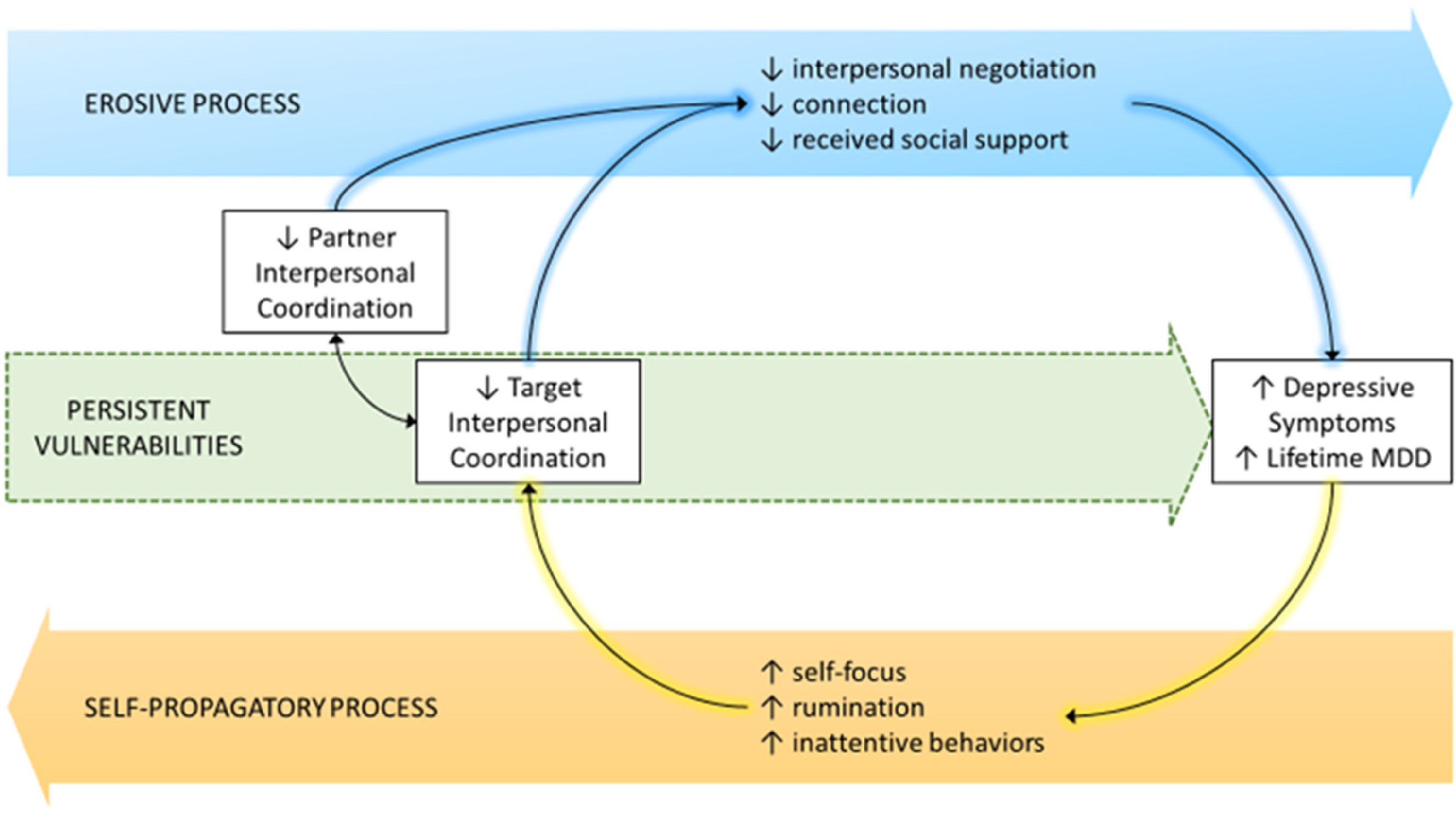
Application of Joiner's integrative interpersonal model to interpersonal coordination and depression.
Interpersonal Coordination as a Key Tool for Connection
Interpersonal coordination is one aspect of interpersonal effectiveness that encompasses several related constructs (i.e., mimicry, synchrony, coregulation, matching, mirroring, convergence, and accommodation) that all capture the extent to which interactors engage in the spontaneous coordination of behavior, emotions, and physiology. Interpersonal coordination is generally associated with the quality of interactions and interpersonal connectedness (e.g., feelings of closeness and similarity; Pickering & Garrod, 2006). Overall, evidence supports that interpersonal coordination reflects and facilitates positive interactions, although there is increasing indication that this is through interpersonal engagement, and not just by directly fostering rapport (Gonzales et al., 2010; Niederhoffer & Pennebaker, 2002).
Various theories conceptualize interpersonal coordination as an indicator of interpersonal effectiveness and explain why coordination occurs (Brennan & Hanna, 2009; Dale et al., 2013; Giles, 2016; Pickering & Garrod, 2004). One theory stands out for its parsimony in explaining both why and how linguistic coordination occurs. The interactive alignment account details how coordination at various linguistic levels (including lexical and syntactic levels relevant to this study) occurs via a spontaneous, low-effort, cognitive process. Briefly, the interactive alignment account of dialogue is a proposed cognitive (psycholinguistic) mechanism by which partners in a dialogue prime one another at every linguistic level as they develop an aligned representation of the situation that they iteratively correct. It is proposed that this process characterizes most everyday conversations, and only rarely do people engage in a more intentional and effortful process (Pickering & Garrod, 2006). Building on the interactive alignment account, Ireland et al. (2011) propose that interpersonal coordination is a result of closely attending to one's interaction partner. This attention can occur during positive or negative valence interactions, and in any case, it fosters a sense of engagement. Consistent with this proposed mechanism, coordination in language style of chatroom conversations increases when participants are asked to pay close attention to their conversation partner (Tausczik, 2012). This theoretical understanding of how coordination occurs informs our view that depression might disrupt coordination by disrupting the depressed person and their conversation partners’ abilities or motivations to pay close attention to the other person's verbal communication.
Forms of Interpersonal Coordination
Interpersonal coordination occurs in physiology, emotions, non-verbal behavior, and multiple forms of verbal communication. Physiological and affective synchrony occur in young adults with friends (Cook, 2020), romantic partners (Helm et al., 2012), and parents (Lougheed, 2020). Many studies have examined interpersonal coordination in non-verbal behaviors (Niederhoffer & Pennebaker, 2002). Verbal interpersonal coordination can be indexed either based on what people say (content) or how they say it (style). A number of studies have examined coordination in semantic content (Babcock et al., 2014). However, a weakness of measuring coordination in content is that the process of interpersonal coordination (adapting to the pattern of another person) is confounded with similarity in the interests or vocabularies of conversation partners (Niederhoffer & Pennebaker, 2002).
Language style, in contrast, refers to aspects of language other than semantic content. For example, when people converge dialects and accents, they perform better as a team (Kozlowski, 2018). Function words are especially apt for capturing alignment in style that is separate from content, because a small number of function words make up over 60% of the words people say and carry little content on their own (Chung & Pennebaker, 2007). Interpersonal coordination of function words was first explored by Niederhoffer and Pennebaker (2002) and is dubbed language style matching (LSM). Studies so far have examined LSM and its associations with relational outcomes in a variety of relational contexts, including business (Ireland & Henderson, 2014; Meinecke & Kauffeld, 2019), therapeutic (Aafjes-van Doorn & Müller-Frommeyer, 2020; Borelli et al., 2019; Lord et al., 2015), and intimate (Ireland et al., 2011) relationships. For example, in a small study of depressed substance-using mothers, higher depressive symptoms prior to treatment predicted lower LSM in client-therapist dyads, and less LSM predicted posttreatment distress (Borelli et al., 2019).
A much less studied medium for interpersonal coordination is written conversation, particularly LSM via digital communication technology, which is important for communication in the digital age. In the original study of LSM—which used internet chat rooms with scripted topics among strangers in the laboratory (a highly artificial relationship)—participants exhibited high LSM, but LSM did not relate to self-reports or coder reports of how well the conversation partners got along, consistent with the view that LSM indexes engagement and effectiveness but not directly rapport (Niederhoffer & Pennebaker, 2002). In another laboratory, LSM in small work groups held via instant messenger was related to degree of engagement in the group project, although not to how much participants liked one another (Gonzales et al., 2010). Other studies have begun to exploit the potential to capture naturalistic interactions via technology: in instant messages between dating college students gathered over 10 days (1,000 words on average per person), couples with more LSM had higher odds of still being together three months later (Ireland et al., 2011). More intensive forms of online communication (more conversation over more time), in semi-public contexts, have also been related to relationship connectedness: in responses to health bloggers, LSM of comments predicted perceived social support from the blogger (Rains, 2016) and in breast cancer support groups, comments with more LSM in response to self-disclosure contained more self-disclosure (Malloch & Taylor, 2019).
Taken together, evidence from these diverse fields and various operationalizations of LSM (Müller-Frommeyer et al., 2019; Niederhoffer & Pennebaker, 2002) across forms and contexts of communication supports the notion that LSM is a meaningful form of interpersonal coordination. Most often it seems that LSM reflects positive relationship outcomes, although several studies indicate the LSM is not simply a measure of liking but instead reflects how much partners are attending to and engaging with one another. Additionally, these studies show that LSM occurs in technology-mediated written communication with people across the spectrum of relationship closeness, and that it predicts outcomes such as group cohesiveness, emotional self-disclosure, perceived social support, and relationship stability.
One limitation of the LSM metric usually used, which provides a summary score of how much conversation partners matched in their use of function words, is that it does not distinguish who was matching who. A more recently developed metric, reciprocal language style matching (rLSM; Müller-Frommeyer et al., 2019), addresses this limitation by capturing how much what each person said matched the last thing the other person said. In other words, rLSM yields one score for every turn in speech. This talk-turn level score can then be combined in multiple ways to capture the construct of interest, such as how much a person matches the other on any given day, on average in the whole conversation, or how much that person matches others on average across conversations (as here).
Our study builds on these previous approaches by using a fine-grained measure of LSM (rLSM) to examine interpersonal coordination in intensive, dyadic, private, and naturalistic conversation (for the first time via text messages exchanged with all conversation partners over two weeks). We focused on an individual-level metric of how much each person matched others and how much others matched that person (a weighted average across all their partners, intended to reflect the level of matching that a person elicits from people in general). We tested whether target and partner coordination related to the target participant's depression experiences.
Interpersonal Coordination and Depression
Some of the social skills deficits that accompany depression can be described as deficits in interpersonal coordination (Sloan et al., 2002). Experimental studies in the domains of nonverbal coordination and affect found that induced negative affect led to decreased facial mimicry of all types of emotions (Likowski et al., 2011) and depressed people mimicked both sad and happy facial expressions less than non-depressed controls (Wexler et al., 1994). In an observational coding paradigm, people in remission from depression who coordinated non-verbal behaviors less with an interviewer were more likely to relapse in the next 2 years (Bos et al., 2006). Depressed mothers coordinated less with their infants (Granat et al., 2017). In addition, not experiencing moments of coordination with a mother predicted less coordination from infants, and these infants experienced more internalizing symptoms across the first decade of their lives (Priel et al., 2019). Low interpersonal coordination in infancy contributed to persistent vulnerabilities to depression, potentially by disrupting attachment, cognitive development, and parent–child communication (Beebe et al., 2008). In adolescence, mothers and daughters who both had depression showed vagal responses that were blunted and slightly negatively correlated (when one engaged, the other withdrew); in contrast, among non-depressed dyads, both mother and daughter showed stronger vagal activation, and their responses were positively correlated (both engaged with one another, even in conflict conversations; Amole et al., 2017). Taken together, these studies suggest that adults who are depressed coordinate less with their children, and that these children are at risk of coordinating less and developing internalizing symptoms.
Interpersonal coordination in depression has been studied in the context of the therapist–client alliance. A recent systematic review of interpersonal coordination in psychotherapy included 12 of these studies of psychotherapy for depression and found that increased coordination between depressed clients and therapists predicted improvement in client depressive symptoms (Wiltshire et al., 2020). Interpersonal coordination appeared to be malleable with therapy, and therapy appeared most effective for those who coordinated more at the outset and throughout therapy (Lord et al., 2015; Paulick et al., 2018), suggesting that low coordination may erode the ability to elicit or benefit from social resources. However, deficits in interpersonal coordination did not seem to accumulate across depressive episodes (Bouhuys & Sam, 2000).
We are aware of only one (quite relevant) study that has examined depression and interpersonal coordination measured by LSM in written, computer-mediated communication. In a doctoral dissertation, Baddeley (2012) compared the written, organic email communications of 30 women—who included women with MDD, women in remission from MDD, or never depressed women—on their degree of written interpersonal coordination as indexed by LSM in sent and received emails with 10 close contacts of choice (friends, family, or romantic partners). Findings revealed that women in remission from MDD were the most likely to coordinate language style, and the difference between the never-depressed and currently depressed women was not statistically significant. Also, more email-based interpersonal coordination during remission predicted stronger social support later (the same trend emerged for emails sent during depressive episodes, but was not statistically significant). Overall, these findings may suggest that interpersonal coordination plays an enhanced role in modulating social relationships for individuals with a history of depression, since coordination during remission was elevated compared to non-depressed controls and best predicted perceived social support during subsequent MDD episodes.
The absence of a significant difference in the coordination of currently depressed versus never-depressed women was surprising based on existing theory and evidence—which suggests that low interpersonal coordination would be associated with more depression. However, we believed that the methodological limitations of Baddeley (2012), including the relatively small number and variety of individuals and relationships, warranted a further examination without changing the hypothesis that less coordination would relate to more depression. The present study sought to extend these findings by examining whether a lifetime history of MDD and severity of past-year depressive symptoms were related to interpersonal coordination in language style, this time in text message communication.
Application of Joiner's Integrative Interpersonal Framework to Interpersonal Coordination
Although interpersonal coordination has not yet been formally considered in Joiner's framework, the framework elucidates how deficits like low interpersonal coordination might both arise from and contribute to depression. Interpersonal coordination fosters belonging, empathy, and overall interpersonal effectiveness (Aguilar et al., 2016; Gonzales et al., 2010). Thus, low interpersonal coordination over time may erode relationship quality and social support that are protective against depression (Segrin et al., 2016). Depression may also self-propagate by decreasing interpersonal coordination via distinctive features of depression including rumination (Nolen-Hoeksema et al., 2008) and self-focused attention (Brockmeyer et al., 2015). These tendencies are directly in conflict with attending to the behaviors and emotions of another person—the cognitive process that appears to spontaneously give rise to interpersonal coordination (Tausczik, 2012). Therefore, these processes may lower coordination, which in turn increases interpersonal problems that precipitate and maintain depression (Hames et al., 2013). These theorized processes are summarized in Figure 1. Although our study here does not directly test the theorized self-propagatory and erosive pathways driving the predicted linkages between interpersonal coordination and depression, it does test whether less interpersonal coordination is associated with depression symptoms and lifetime MDD (to potentially serve as a building block for future research on mechanisms of this hypothesized association).
The Present Study
The present study improved upon Baddeley's (2012) design by utilizing a much larger sample (263 vs. 30, with associated increases in power) and examined the interpersonal coordination of the study participants (henceforth, the “targets”) and their conversation partners (henceforth “partners”) in text message communications (one of the most frequent mediums of communication among youth today). Additionally, it included all text messages exchanged with all relationship types, rather than a subset of conversation partners, and calculated LSM at the level of turn-by-turn matching (rLSM) which might be more sensitive to interpersonal dynamics. Specifically we sought to understand whether interpersonal coordination (as measured by rLSM) in text message communications is associated with depression experiences (as measured by self-report of past-year depressive symptoms and qualifying for lifetime MDD) by testing the following specific hypotheses: (1) consistent with evidence suggesting that interpersonal ineffectiveness co-occurs with depressive symptoms, we hypothesized that target participants with less interpersonal coordination in their sent text messages would exhibit higher past-year depressive symptoms; (2) consistent with evidence suggesting that interpersonal ineffectiveness relates to onset and relapse of MDD, we hypothesized that targets who coordinate less in their sent text messages would be more likely to have a lifetime history of MDD; (3) furthermore, consistent with evidence suggesting that negative interpersonal interactions (evoked by the depressed person) maintain depression, we hypothesized that students with conversation partners who engage in less interpersonal coordination would be more likely to qualify for lifetime MDD.
Method
Sample and Procedures
The present study is a secondary data analysis of an existing sample of college students’ text message communications and self-report survey data collected in 2014-15 (described in detail in Hussong et al., 2021), which recruited alcohol-using students through email invitations sent to 9,000 undergraduate students at a southeastern university, randomly sampled from all enrolled students who were aged 18–23, with oversampling for males and African Americans given their underrepresentation in the student body (compared to the US population in that age bracket). The larger study (N = 854) included two lab visits (including quantitative surveys) for which participants were compensated $20 for the first lab visit and $25 for the second lab visit, after which participants were invited to participate in the Text Messaging Study if they met the eligibility criteria of having an Android or an iPhone with them (n = 780). A total of 531 participants consented to the secure wired download of all text messages (no images) exchanged over the past two weeks with all conversation partners; consistent with state law (N.C. Gen. Stat. Ann. § 15A-287; Rasmussen et al., 2012), the IRB waived consent for these conversation partners. Text message study participants were entered in a drawing for four $100 cash prizes.
The text message sample comprised 267 college students (mean age = 19.87; 40.8% male; 56.82% White, 21.97% Black, 7.58% Asian, 0.38% Native American, 6.44% two or more races, and 7.58% Hispanic of any race). On average, these participants sent 932 texts and received 1,294 texts over the two-week study period (for a cumulative 569,172 texts sent and received over the study period). Of these 267 target participants, 96.9% identified a mother as a texting partner, 88.6% identified a father, 50.6% identified a romantic partner, and 100% identified at least one friend. Other than being more likely to have an iPhone, text message study participants did not differ substantially from others in the larger study on demographic and risk factors and were overall quite similar to the university's study body demographics (Hussong et al., 2021). Phone numbers and contact names were automatically stripped and replaced with unique identifiers based on student designations (e.g., mother, father, friend 1, romantic partner). All study procedures for the larger study and the text message study were IRB approved.
Measures
Participants filled out survey measures in both lab visits and contributed their past two weeks of text-message data at the second lab visit. Here, demographic variables and past-year depression symptoms were drawn from the first lab visit, while lifetime MDD was drawn from both lab visits. These measures are self-reported and only available for target study participants and not for conversation partners.
Demographic covariates. Covariates included gender (male/female), race/ethnicity (dummy coded as White, Black, and Other race/ethnicity), and parental education computed as the highest of mother and father education (as a proxy for SES; response options included 1 = less than high school, 2 = high school graduate, 3 = some college or technical school, 4 = college graduate, 5 = some graduate, medical or professional school, and 6 = completed graduate, medical or professional school). These covariates were chosen because they often overlap with verbal and written speech style (Ireland & Pennebaker, 2010) and with depression (Brody et al., 2018) and could thus serve as potential confounds.
Past-year depressive symptoms. Past-year depression symptoms were measured using the 13-item, unidimensional Short Mood and Feelings Questionnaire (SMFQ; Angold et al., 1995). Participants were provided with 13 “I statements” that reflected symptoms of depression (e.g., “I felt miserable or unhappy,” “I found it hard to think or concentrate”). Participants responded using the original SMFQ response scale (0 = not true, 1 = sometimes, 2 = true) to indicate if the item described how they have acted or felt in the past 12 months. The SMFQ has high internal consistency (α = 0.85) and is found to correlate moderately with the Diagnostic Interview Schedule for Children and the adult Clinical Interview Schedule-Revised Form (Angold et al., 1995). Although three depressive symptoms in the DSM are not evaluated in the SMFQ (changes in sleeping patterns, changes in eating patterns, and suicidal ideation), the SMFQ is still found to have very high discriminant validity for MDD in late adolescence (AUC = 0.90; Turner et al., 2014).
Due to the purpose of the parent study's design (on harmonization techniques for pooling data across different item administrations), the SMFQ was administered in two different (randomly assigned) versions: One version was the original scale and the second had half of the item stems altered for wording (not meaning). Both used the same response scale. We harmonized the two forms using moderated nonlinear factor analysis (MNLFA; Bauer, 2017; Bauer & Hussong, 2009; Curran & Bauer, 2011), an iterative model-testing and scoring procedure (as described by Gottfredson et al., 2015) that takes into account potential differential item functioning across groups (in this case survey form; Cole & Hussong, 2020). In a similar (overlapping) sample, MNLFA yielded final SMFQ scores which adjusted for differential item functioning and evidenced high internal consistency (α = 0.91 in Test Form A; α = 0.92 in Test Form B) and test–retest reliability (β = 0.80 in Test Form A; β = 0.85 in Test Form B; Cole & Hussong, 2020). Here, we used factor scores of depressive symptoms adjusted for these systematic differences and measurement artifacts as a cohesive measure of depressive symptoms.
Lifetime MDD. At each lab visit, part of the sample (randomly selected) received a measure based on the structured clinical interview for DSM-5 (SCID-5) (First et al., 2015) assessment of MDD, while others received a measure based on the composite international diagnostic interview short form (CIDI-SF; Kessler et al., 1998). Unfortunately, there was a survey coding error which rendered the CIDI-SF unusable. Thus, here, SCID-5 MDD diagnosis from both lab visits was utilized; if the participant qualified for a diagnosis at either visit, they were coded as having (1), versus not having (0) a lifetime history of MDD. Of the 192 participants who completed the SCID-5 interview at either lab visit, 26 (13.5%) qualified for lifetime MDD and 11 (5.7%) qualified for past-year MDD. Thus, 15 people (7.8%) qualified for lifetime but not recent MDD—a remitted group (here we do not distinguish remitted vs. recent depression in analyses due to a small sample size of people who had experienced MDD). MDD scores from 75 people (28.5% of our sample) were missing completely at random (MCAR; due to never being administered the SCID-5).
Missing MDD data was handled using full information maximum likelihood estimation (FIML; Enders & Bandalos, 2001). FIML assumes that missing data are at least missing at random (MAR; Muthén et al., 1987), and works best with data that is MCAR. Work on modern missing data analysis methods (e.g., review by Baraldi & Enders, 2010) suggests that about a third of data missing is within an acceptable range when using FIML especially when data conforms more closely to MAR structure. In fact, planned missingness designs (Little & Rhemtulla, 2013) often include one variable that is complete, along with a third of data missing (intentionally to save time and resources) for each of the rest of variables. Our MDD data is MCAR, missing less than one-third of the sample, and complete for many observations, exceeding the requisites for FIML.
Language Style Matching
Interpersonal coordination of language style (LSM) has been operationalized in multiple metrics. We used a measure developed by Müller-Frommeyer et al. (2019) called reciprocal language style matching (rLSM) that captures statement-to-statement matching, permits distinguishing how much each speaker is matching, does not confound matching with overall word count, and is simple to compute.
Several data preparation steps preceded computing rLSM (see Table 1 for a summary of the number of targets, dyads, and texts/talk turns at each step of data preparation). To aid with data cleaning and visualization, and later with data analysis, we used the R (R Core Team, 2020) packages dplyr (Wickham et al., 2021), ggplot2 (Wickham, 2016), and psych (Revelle, 2021). We used language detection R packages cldr2 and cldr3 (Ooms, 2020a; 2020b) which replicate the Google language detection algorithms for the R open-source platform. We filtered by dyad rather than removing individual texts, since rLSM is computed on a turn-by-turn basis within dyads so excluding text messages within adjacent turns would disrupt the succession of the natural conversation and meaning of rLSM.
Data Preparation.
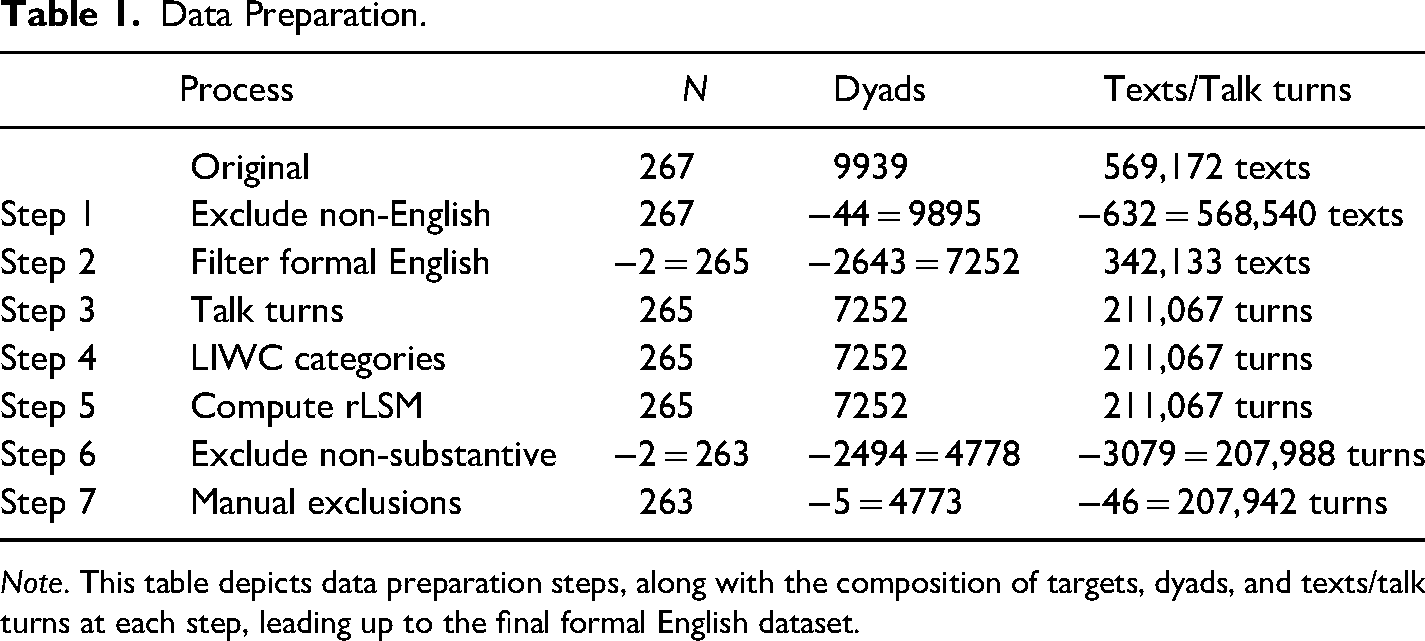
Note. This table depicts data preparation steps, along with the composition of targets, dyads, and texts/talk turns at each step, leading up to the final formal English dataset.
Text filtering approach. When handling text message data, we faced a substantial limitation of the word counting software (Linguistic Inquiry and Word Count LIWC-2015, Pennebaker et al., 2015) software, namely that LIWC-2015 does not recognize the meaning of “text lingo” which is extremely common in text message communication especially among youth. For example, a text message might say “tbh” and LIWC-2015 would count a word but not recognize nor convert this to its intended meaning of “to be honest.” This is especially challenging for the present study because LSM (including rLSM) relies on function words that are often part of abbreviations. In “text lingo,” many function words are embedded in abbreviations or alternate spellings such as these: “wby” (what ‘bout you?), “hby” (how ‘bout you?), “np” (no problem), “tty” (talk to you), “idk” (we don’t know), “annnd” (and), “meeeee” (me), “ur” (your), “gimme” (give me), “gonna” (going to) and even idiosyncratic ones like “water” (what are).
Given this challenge, we weighed two approaches for addressing data cleaning in this natural and text-based language. The first option, which we term the “minimal exclusions approach” took the common tact of leaving possible misspellings, non-formal English, and text lingo unaltered, which had the benefit of retaining as many of the conversations as possible, but the cost of including many words that were not recognized by LIWC-2015 and could potentially obscure hypothesized associations.
The second option, which we term the “formal English approach,” took the tact of filtering out dyadic conversations with a preponderance of “text-lingo” that would not be captured by our LIWC-2015 technique for computing rLSM. The advantage of the formal English approach is that it retains only conversations where rLSM is likely to be captured accurately with LIWC-2015 software (as opposed to conversations in which many function words would be missed due to abbreviation or misspelling). The drawback is excluding many meaningful conversations that were high in text lingo, which is especially prevalent among youth and in relationships such as peers. The resulting limitations are further explored in the discussion section.
Ultimately, we opted to report the formal English approach in primary analyses here because we think that our findings with that approach are meaningful despite the limitations. However, we also briefly present alternate analyses using the minimal exclusions approach. Our results were not replicated in the minimal exclusions approach, and the methodological and possible substantive implications are further explored in the discussion.
Step 1: Excluding non-English. All dyads that had at least one text classified as a non-English language by both detectors were examined for the proportion of texts classified as non-English by both detectors. From visual inspection, in dyads with 25% or more texts classified as non-English by both detectors, most texts were not in English, and thus this was used as the cutoff for dropping the dyad. This left 267 targets, 9,895 dyads, and 568,540 texts.
Step 2: Filtering Formal English. We then used language detectors to implement the formal English approach, so that a higher proportion of function words in our filtered sample (compared to the minimal exclusions approach high in text-lingo) would be captured by LIWC-2015 and the rLSM metric. Upon visual inspection, texts that were classified as English by both detectors appeared to be all or almost all in English, with more formal spellings, and more full sentences. We retained dyads with at least 50% of text messages that were classified as English by both detectors, leaving 265 targets, 7,252 dyads, and 342,133 texts.
Step 3: Collapsing into talk turns. When texting, sometimes people send multiple messages in succession before their conversation partner responds, sometimes across days. Successive texts (without interruption from the partner) were collapsed into a single talk turn. This left 265 targets, 7,252 dyads, and 211,067 talk turns.
Step 4: Computing word counts in language categories
Step 5: Computing rLSM. We computed an rLSM value for each target and partner in several sub-steps. First, we computed rLSM scores for every function word category in every talk-turn (other than the first talk turn per dyad, as the first speaker has no previous talk turn to match) for each texting partner. At the talk-turn level (the basic unit of rLSM) rLSM is calculated via the equations below, representing the matching of function words in consecutive statements from one texting partner to the other, as a proportion of the total statements by both speakers. Speaker A is simply the first in a dyad to speak, and speaker B is the second. Equation 1, a measure of speaker A's rLSM, quantifies how much the i + 1 statement of speaker (A) matches the ith statement of the other speaker (B). Equation 2, a measure of speaker B's rLSM, quantifies how much the ith statement of speaker B matches the ith statement of speaker A. Matching is the absolute difference in the proportion of words in a given LIWC category (C; here, our categories include the nine function word categories personal pronouns, impersonal pronouns, auxiliary verbs, articles, common adverbs, prepositions, negations, conjunctions, and quantifiers) by each speaker. For example, for pronouns (P) in speaker A's first statement, we can write the term 

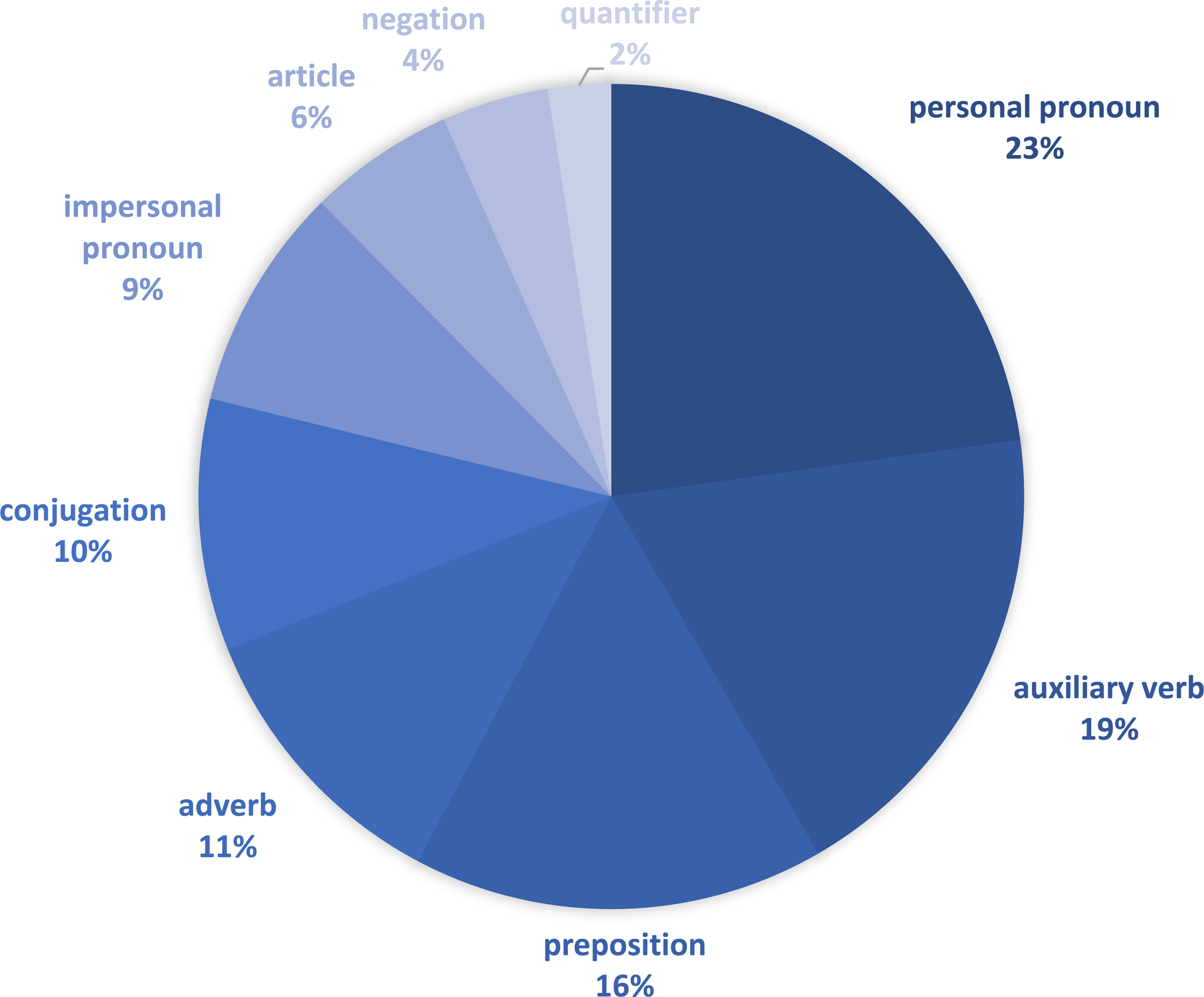
Function word type proportions.
Third, we computed an unweighted average of rLSM scores for each participant (across all that person's talk turns, separately for sent and received messages). This yielded two rLSM scores per participant, which captured the individual (person-level) differences in how much talk turns matched the language style of their partner's last talk turn (measured by rLSM) in the messages participants sent (target rLSM) and received (partner rLSM) over the two-week study period. Computing an unweighted score means that those conversation partners with whom a target participant texts more will contribute more heavily to that participant's partner rLSM score than conversation partners with whom they text less frequently. For example, if a participant sent twice as many talk turns to their romantic partner than to their mother, then how much they matched their romantic partner influenced their rLSM score more than how much they matched their mother. This is in accordance with our interest in individual differences that transcend relationship context; individual-level rLSM scores are of primary interest for this investigation, as we hypothesize that a target student's depression will relate to their rLSM across all dyad types.
Fourth and finally, rLSM values were scaled to be between 0 and 100 (rather than 0 to 1) to facilitate interpretation of results (i.e., a 1 unit increase in rLSM now represents a 1% increase in rLSM).
Step 6: Excluding non-substantive dyads. We noticed that some dyads evidenced zero or one rLSM values, and that these dyads did not appear to be meaningful samples of interpersonal coordination because their text message exchanges were too short, one-sided, or mostly non-verbal. For example, some dyads exchanged only a name and email address, others were automated reminders, and others were mostly emojis or pictures that cannot be captured with the LIWC-2015 language detection program. We elected to retain conversations with two or more rLSM values.
Step 7: Manual exclusions. Lastly, dyads in which all valid rLSM values were from a single member were examined manually since it is unusual to use no function words in a substantive conversation. While many were short (four talk turns) but meaningful exchanges between humans, some were non-substantive interactions with an automated system, including a bus line, a banking system, a class poll, or a ride service, and thus were excluded.
Text sample descriptive statistics. In this final formal English sample (263 targets, 4,773 dyads, and 207,942 talk turns), word count ranged from 11 to 29,375 (M = 637.51, SD = 1,669.64, Median = 208) per dyad. Function words made up most (64.5%) of the word count. Talk turns came from conversations with parents (N = 199, talk turns = 15,180, 7.3%), romantic partners (N = 80, talk turns = 37,828, 18.2%), three closest friends (N = 226, talk turns = 53,102, 25.5%), and other relationships (N = 260, talk turns = 101,832, 49.0%). Descriptive statistics for the rLSM values of targets and partners are shown in Table 2.
Descriptive Statistics of Reciprocal Language Style Matching by Individual.
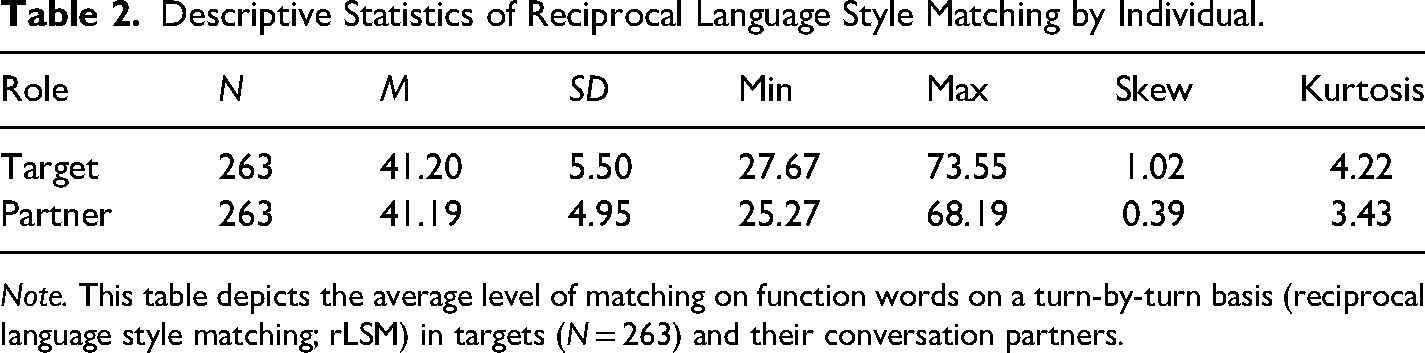
Note. This table depicts the average level of matching on function words on a turn-by-turn basis (reciprocal language style matching; rLSM) in targets (N = 263) and their conversation partners.
Analyses
The primary question of interest is whether interpersonal coordination (as measured by rLSM) is associated with more depression experiences (past-year depressive symptoms and lifetime MDD). We expected that targets who coordinate less or whose texting partners coordinate less would be more likely to have more depression experiences. To test this, we ran four separate models testing how interpersonal coordination (rLSM by target or partner) was associated with depression experiences of the target (depressive symptoms or lifetime MDD). More specifically, these structural equation models (SEM; see Figure 3) tested the association between (1) target rLSM and depressive symptoms, (2) target rLSM and lifetime MDD, (3) partner rLSM and depressive symptoms, and (4) partner rLSM and lifetime MDD, alongside demographic covariates: gender, age, parental education (as a proxy for SES), and dummy coded race/ethnicity (Black, White, and other (reference)). We conducted analyses in MPlus (8.1, Muthén & Muthén, 1998–2017) using MLR, which examines the incremental relationships of each of the predictor variables over and above salient covariates and which yields regression estimates, confidence intervals, and effect size measures for both depression symptoms (a continuous endogenous variable) and lifetime MDD (a binary endogenous variable). To handle missing data, we used FIML, an efficient method for handling missing data in SEM that reduces biases present in other methods (Enders & Bandalos, 2001).
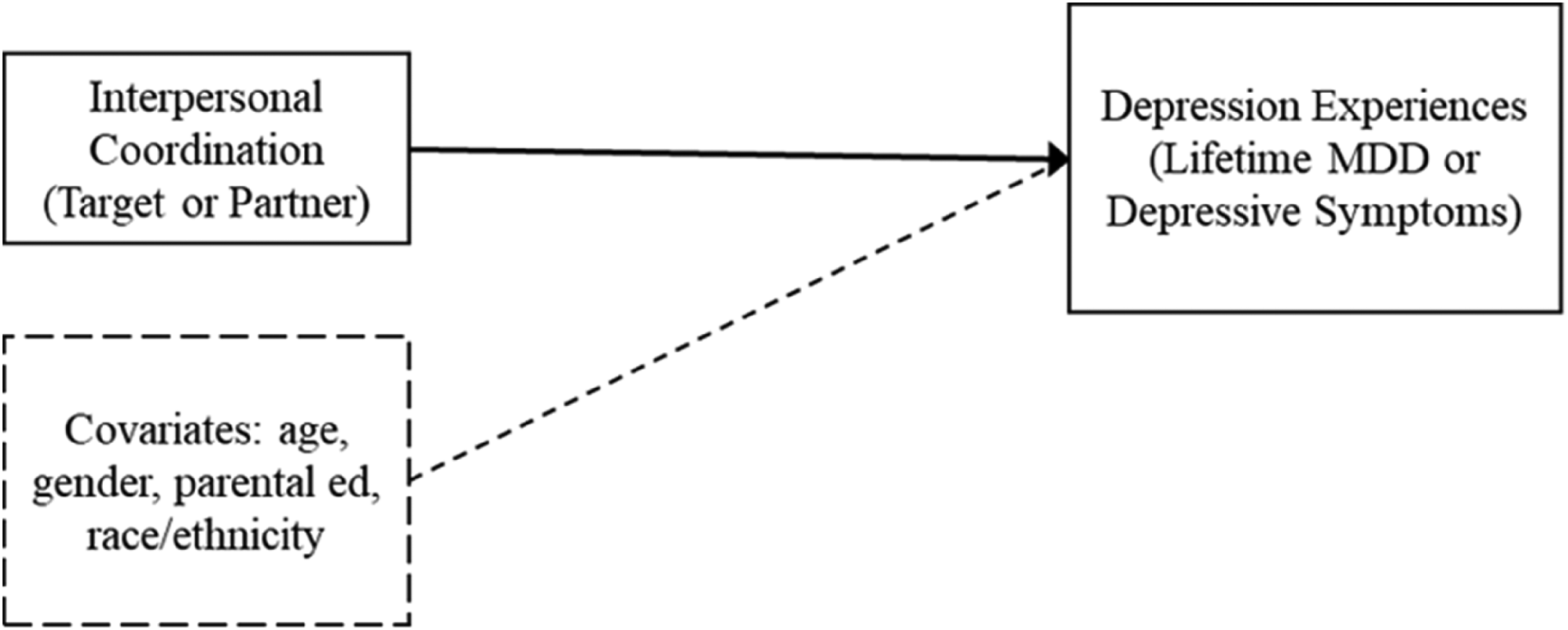
Analytic model.
Results
As seen in Table 3, there was a statistically significant association between interpersonal coordination (measured by rLSM) of targets and depression experiences (both lifetime MDD and depressive symptoms), such that those students who evidenced more interpersonal coordination in their text messages were more likely to qualify for lifetime MDD and reported significantly more past-year symptoms of depression. The size of these associations was non-trivial: For every 1 standard deviation unit increase in target rLSM, depressive symptoms increased by an estimated 0.121 standard deviations (CI 0.001, 0.241). For every 1 standard deviation unit increase in target rLSM, the likelihood of qualifying for lifetime MDD was estimated at 8.1% greater (OR(SE)= 1.081 (0.042), CI 1.002, 1.167). However, partner rLSM was not significantly associated with depression experiences for either lifetime MDD or past-year depressive symptoms. Of note, in an alternate analysis which used the minimal exclusions approach to text data cleaning (less restrictive but with more potential confounds), neither target nor partner rLSM was significantly associated with depression experiences.
Interpersonal Coordination and Depression.
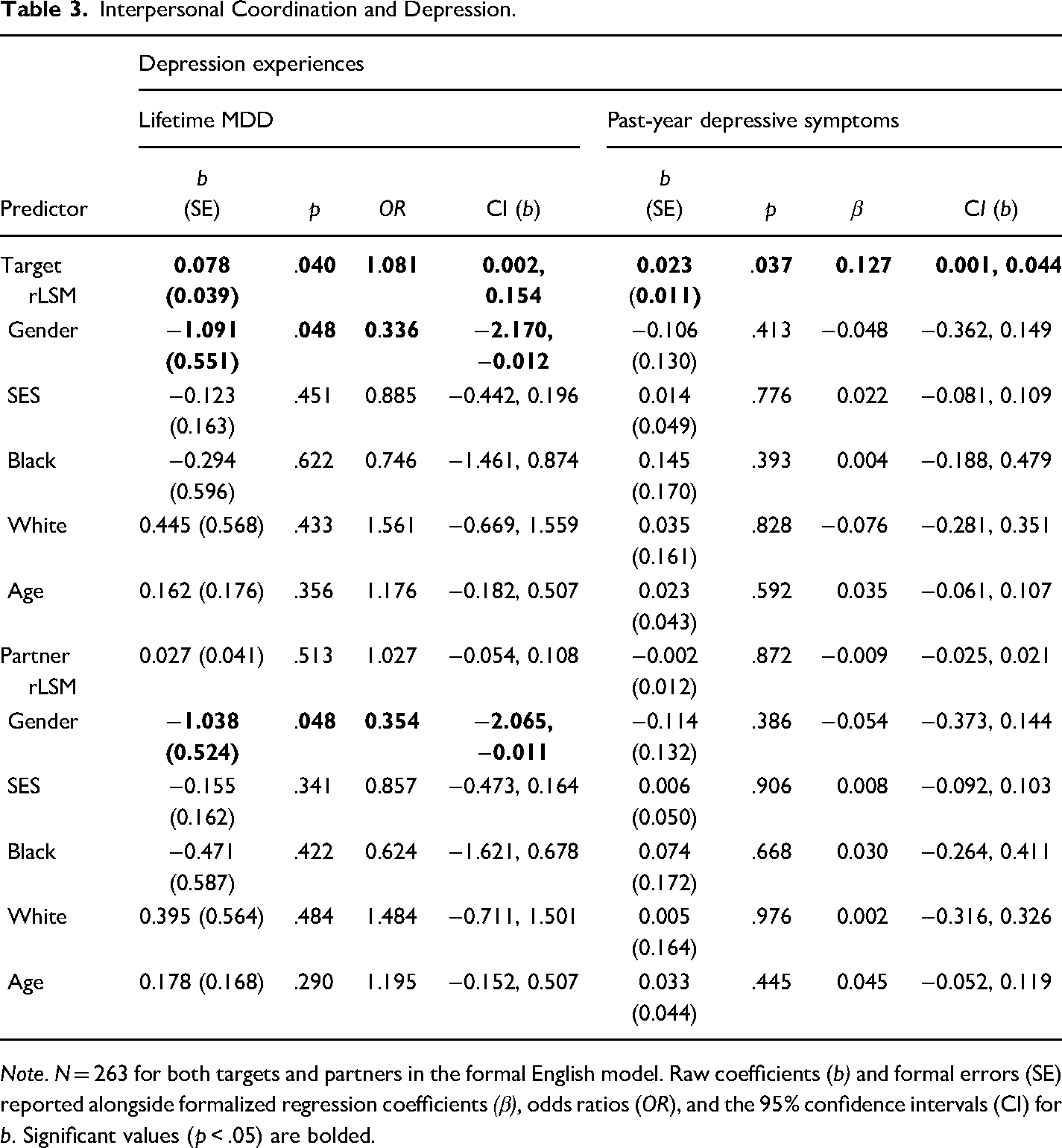
Note. N = 263 for both targets and partners in the formal English model. Raw coefficients (b) and formal errors (SE) reported alongside formalized regression coefficients (β), odds ratios (OR), and the 95% confidence intervals (CI) for b. Significant values (p < .05) are bolded.
Discussion
Interpersonal ineffectiveness has been widely implicated as a correlate of depression, and a varied body of research suggests linkages with interpersonal coordination specifically. Fewer studies, however, have examined coordination of language style with depression, and no previous study had examined whether this association emerges in one of the most common modes of communication among young people today: text messages. This study used a recently-developed approach to calculating LSM (rLSM; Müller-Frommeyer et al., 2019) in a large sample of naturalistic text messages exchanged by college students over two weeks to examine whether depressive experiences in target college students were related to their own and their partners’ interpersonal coordination.
In a restricted sample of 207,942 talk turns sent and received in formal English (marked by fewer abbreviations and text lingo and more use of full sentences), we saw evidence that those college students with more depression experiences tended to have text message conversations characterized by more interpersonal coordination of language style of meaningful effect sizes. Notably, this was opposite the hypothesized direction, with students evidencing more rLSM experiencing more depression, whereas we had hypothesized that students with more depression experiences would evidence less interpersonal coordination. Nonetheless, this direction of association is not entirely inconsistent with research to date. For example, Baddley (2012) found a trend that people in remission from MDD coordinated more than never-depressed people. One interpretation of the pattern is that when people are depressed, they feel lonely or rejected, and thus they are driven to reengage with others (Coyne, 1976). Concordantly, when people feel rejected, they tend to respond temporarily with more coordination, which sometimes enhances their belonging (Aguilar et al., 2016; Lakin et al., 2008). One way to understand the current results through Joiner's integrative interpersonal model is that more coordination is an effort to counteract other erosive interpersonal processes. Over time, people with depression might learn to coordinate more to build social capital.
Another reason depression may relate to more coordination here is that the text message modality may mask social skills deficits, perhaps by giving individuals additional time to consider their responses and “feign” coordination. This affordance of better managing their interpersonal skills and hiding nonverbal indicators of depression such as their posture or tone could mean that asynchronous text message communication gives depressed people an opportunity to enter an upwards interpersonal cycle. Future research that compares in-person and text message coordination and its impact on perceived social support (as done by Baddeley, 2012) could explore this possibility.
A third potential explanation for increased coordination among more depressed students is that rLSM may serve as an indicator of a different type of social skill deficit. Our observation of increased coordination (often associated with good outcomes through the mechanism of attention and engagement with another person) is dissonant with previous studies that found deficits in the quality of communication (e.g., more self-focus) among depressed people (Bernard et al., 2015; Smirnova et al., 2018). Several other researchers who have come upon unexpected associations with LSM reflect that matching appears to be an indicator of the intensity of engagement, not the valence of the interaction, and thus social skills deficits in LSM could look like too much matching or lack of flexibility in matching across contexts. For example, romantic partners who are more engaged in more intense conflict show more LSM (Bowen et al., 2017). Further research could look at non-linear and dynamic indicators (e.g., flexibility) of coordination.
We strove to enrich the Integrative Interpersonal Model by adding a dyadic component (in recognition that mental illness has impacts on the relational unit including the behavior of conversation partners). Considering our unexpected finding that depressed targets coordinated more, it makes sense that partners did not coordinate less as we had hypothesized. Rather, we found null partner associations. It could be that the text message modality minimizes the extent to which partners are picking up on cues that the target is depressed compared to in-person interaction cues (e.g., tone and posture). However, there is heterogeneity in the relationship partners included in this sample, and the overall null partner effect could obscure nuances within some (e.g., closer) relationships.
Limitations and Future Directions
This study had many strengths, including a large naturalistic text sample, studying the texting behaviors of both targets and their texting partners, including texts from multiple types of relationships, and examining both depressive symptoms and lifetime MDD. However, several limitations merit consideration and point to future directions.
The most challenging limitations relate to the formal English approach as opposed to the minimal exclusions approach. First, several norms of text message communication are not well captured by our rLSM metric due to limitations of automatic language detection with LIWC-2015 (e.g., alternate spellings common in text messages) or current operationalizations of the LSM method (e.g., omission of function words in short text parlance)—hence our use of a reduced sample of people who rely less on these text-message-specific ways of speaking. Future directions should consider other indicators of interpersonal coordination in text messages, such as emojis or text lingo. Excitingly, the newly released LIWC-2022 (Boyd et al., 2022) supports reading emoticons, which could allow for an expanded conceptualization of LSM (e.g., is responding to an emoticon with a different emoticon LSM?).
Second, the formal English sample examined here, compared to the minimal exclusions sample in which all results were null, had different demographic and relational characteristics including lower proportions of romantic partners and friends but higher proportions of parents and others. It is possible that findings were specific to some demographics (e.g., older age) or relationships (e.g., parent–child dyads) but do not generalize to other relationships. Future studies should collect demographic information from conversation partners to disentangle substantive differences across demographic groups from limitations of the rLSM metric when used to analyze lingo-laden text messages.
Third, our predictions focused on between person, linear associations. However, recent research has suggested that flexibility—how much relationships adapt to situations and contexts—may be an important component of whether LSM relates to positive outcomes, rather than high overall matching alone (Mayo & Gordon, 2020). Future studies could examine whether text-based interpersonal coordination changes over time within person, and whether these fluctuations relate to depression.
Fourth, with only a small subgroup of targets in this community (non-clinical) sample who qualified for lifetime MDD (N = 26 who exchanged 21,322 texts), we were likely underpowered in detecting effects in this population, and did not have a large enough sample to compare current versus remitted depression. There is some literature to suggest that people with a history of depression, particularly during remission, exhibit higher than average interpersonal coordination (Baddeley, 2012; Bernard et al., 2015). As signs of this pattern emerged again in the current study, it warrants future studies in more clinical samples that can carefully parse apart remitted and current MDD diagnosis in relation to interpersonal coordination of language style.
Conclusion
This study applied the integrative interpersonal framework of depression and its chronicity (Joiner, 2000) to LSM in text message conversations of college students. We found that students with more depression experiences (qualifying for lifetime MDD diagnosis and past-year symptoms) coordinated more with their partners than those with fewer depression experiences. Future studies should examine whether people who are in a current MDD episode, in remission, or who have depressive symptoms coordinate more than non-depressed, never-depressed, and less depressed people. This study also joins others in suggesting that LSM may indicate engaged communication, not necessarily adaptive communication, and that dynamic and contextual factors of coordination may be important. Lastly, this study puts in question the “match” between the construct of LSM (which relies on function words that connect formally-structured sentences) and the modality of text messages (in which speaking only in full sentences and even full words is not the norm, at least in the conversations of college students). Given the rich potential of text messages to offer us a window into naturalistic communications, a future direction would be to creatively tap into LSM with a metric more tailored to the text message modality (e.g., one that includes a dictionary of text lingo and considers alternative aspects of language style such as punctuation and emojis). It would be worthwhile for our field to continue to study how the interpersonal disengagement that characterizes depression may appear and be perpetuated in language, including virtual communication in a digital age.
Footnotes
Acknowledgments
Thank you to our anonymous reviewer whose thorough, thoughtful, and encouraging comments helped us more clearly communicate the strengths, limitations, and methods of our study. Thank you to Editor Giles for his outstanding guidance through the editorial process. Thank you to all the research assistants who made this work possible, especially Michael Puerto for his help computing rLSM here.
Declaration of Conflicting Interests
The authors declared no potential conflicts of interest with respect to the research, authorship, and/or publication of this article.
Funding
Data used in the present study were collected with the support of the National Institute on Drug Abuse of the National Institutes of Health under award number 1R01DA034636-01A1.
