



Abstract
Languages differ in how grammatically salient gender is. We explored if grammatically gender-neutral pronouns in Finnish and Turkish, two grammatically genderless languages, are gender neutral or male biased, thereby activating male, rather than female, exemplars. We also tested whether differences in national level gender equality influence the male bias. Results indicated a male bias in both languages, whereas national level gender equality had no influence. Implications for gender-fair language reforms in grammatically genderless languages are discussed.
Gender is more or less grammatically salient in different languages. Grammatical language structures can be categorized by how nouns and pronouns are gendered (Gygax et al., 2019; Prewitt-Freilino et al., 2012). Three language groups have been classified; languages with natural gender where pronouns but not nouns are gendered (e.g., English and Norwegian), grammatically gendered languages where both nouns and pronouns are gendered (e.g., French and Russian), and grammatically genderless languages where neither nouns nor pronouns are gendered (e.g., Finnish and Turkish) (Prewitt-Freilino et al., 2012; Siewierska, 2013; Stahlberg et al., 2007).
Distinguishing between languages based on the gendering of nouns and pronouns is important because the grammatical gender language structure can bias perception and cognition (Gygax et al., 2019). For instance, in many grammatical gendered languages, the generic form of social roles is often the masculine form, although exceptions exist. In natural gender languages, the generic pronoun used to be “he”. Such use of masculine generic forms influences cognitive processes, biasing the retrieval of male exemplars to a greater extent than female exemplars resulting in a male bias (Hellinger, 2002; Stahlberg et al., 2007). In such cases, the male bias is evoked due to linguistic cues associated with men. However, a male bias is also observed when non-gendered words are associated with masculinity (Lindqvist et al., 2019; Liu et al., 2018). For example, an undefined person is often perceived as a man (Bailey & LaFrance, 2017; Bem, 1993; Hegarty & Buechel, 2006). This bias has been found for linguistically neutral words (e.g., the word “the applicant”) that do not carry any grammatical or semantical gender cues (Lindqvist et al., 2019). That such neutral terms are associated with masculinity, exemplifies an androcentric worldview where men constitute the norm (Eagly & Kite, 1987)
To increase the salience of women, gender-fair language reforms have been implemented in many languages (Sczesny et al., 2016). In natural and grammatical gender languages, balancing pronouns (he and she) or occupational roles (in grammatical gender languages: actor/actress) have been successful strategies to increase the linguistic visibility of women. As gender diversity rises and identities beyond the traditional binary identities of women and men become increasingly acknowledged (Hyde et al., 2019), initiatives to increase the salience of such identities in languages by including a complementary pronoun to the often existing ones representing “she” and “he”, is now seen in several languages, such as Swedish (Bäck et al., 2018; Gustafsson Sendén et al., 2015). However, some languages do not have gendered pronouns to begin with. An open question is whether gender-neutral pronouns in languages without gendered pronouns, that is, genderless languages (Prewitt-Freilino et al., 2012), are male biased or if they function in a similar manner as implemented gender-neutral pronouns and evoke associations to both women and men equally (Lindqvist et al., 2019).
Pronouns and Gender Biases
Pronouns are often used in communication when referring to others. In natural and grammatical gender languages, gendered pronouns are often used more or less automatically, as gender is processed automatically and can reflect gender stereotypes. For example, a nurse is often combined with the pronoun “she” and a doctor with the pronoun “he” (Gustafsson Sendén et al., 2020; Stahlberg et al., 2007). In generic person references, using either balanced forms such as “he/she” or using non-gendered approaches (such as singular they in English) is common nowadays.
In grammatically genderless languages (e.g., Finnish and Turkish), where only gender-neutral pronouns exist, feminine forms to increase the visibility of women cannot be used. The use of such non-gendered pronouns may lead to a situation where “androcentricity in a genderless language may even increase the lexical, semantic and conceptual invisibility of women” (Engelberg, 2002, p. 128). This would indicate that gender-neutral pronouns in genderless languages may be male biased.
National Level Gender Equality
Among grammatically genderless languages that do not differentiate between women and men in their pronoun use, countries are found both at the top and at the bottom of the global Gender Equality Index (GEI, World Economic Forum, 2021). The GEI includes national level measures of gender-based gaps in economic participation and opportunity, educational attainment, health and survival, and political empowerment. The GEI ranges from 0%, indicating the lowest possible gender equality to 100%, indicating the highest possible gender equality. Finland, having a genderless language (third-person pronoun singular is hän) is ranked second place on GEI (World Economic Forum, 2021), with a GEI of 86.10%. Turkey (third-person pronoun singular is o), is found on place 132 (out of 156), with a GEI of 63.80%. In the present study, we include these two countries to compare the influence of national level gender equality on the male bias.
Hypotheses
In the current research, we formulate and test two hypotheses. First, we expect that pronouns in grammatically genderless languages are male biased in activating more mental representations of men than women (H1). We also compare a gender-neutral pronoun to a gender-neutral noun (i.e., “person”) that can be assumed to be male biased (Bailey & LaFrance, 2017; Lindqvist et al., 2019). Second, we expect that National level gender equality influences a male bias, such that gender-neutral pronouns in Turkish activate a stronger male bias than gender-neutral pronouns in Finnish (H2). We also include analyses of participant gender as some research show gender differences in male bias (Bailey & LaFrance, 2017).
Method
Participants and Design
In total, 428 participants took part in the study (Finland: n = 220, women = 41.8%, men = 43.6, blank response = 14.5%); Turkey: n = 208, women = 46.2% men = 46.6%, blank response = 7.2%). 1 Mean age for the total sample was 43.4, SD = 16.3 (Finland: M = 48.9, SD = 17.7; Turkey: M = 38.1, SD = 12.7). Data were collected by the survey company Enkätfabriken. A between-groups design with two conditions (pronoun/neutral word) was used where participants read a short text describing an American citizen who was referred to using either a pronoun (o in the Turkish version, hän in the Finnish version) or simply as “the person”. Participants were randomly assigned to the conditions. Country was included as a between participant's factor.
Procedure and Measures
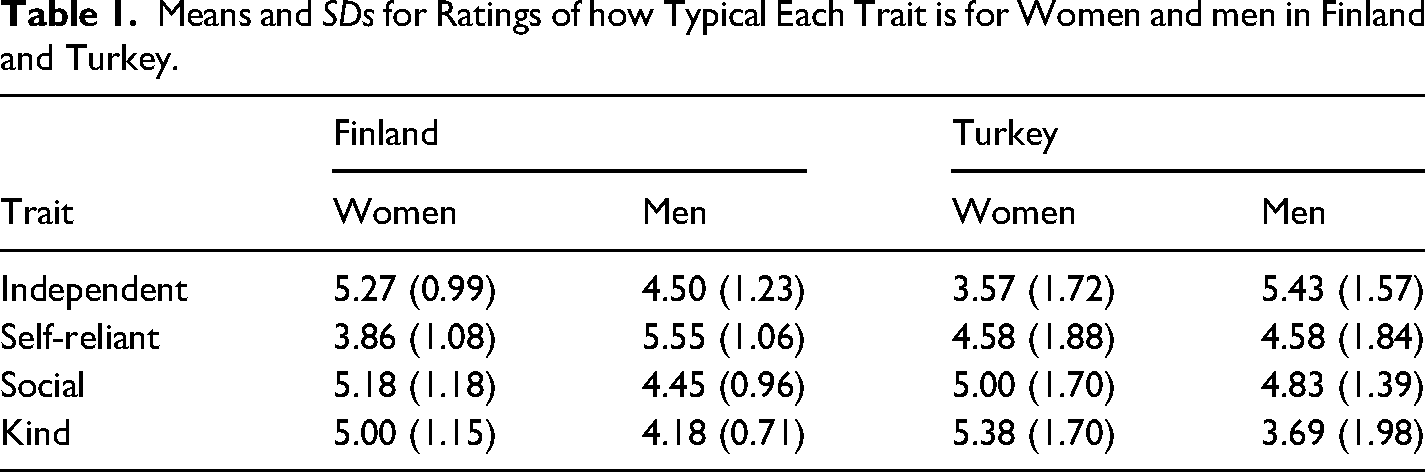
Participants were invited to take part in a survey about language and provided their informed consent before they started the survey. First, participants were asked to read a short text in respective languages (Turkish and Finnish) describing an American citizen and then select a photo among a set of four photos that they believed was the person they read about (two women and two men). The target was described in general terms, such as the person likes to watch movies, hangs out with friends, and walks their dog. The text was carefully formulated to balance any gendered information (e.g., four descriptive traits were included of which two were traditionally feminine [social and kind] and two traditionally masculine [independent and self-reliant]). 2 We chose to describe an American citizen so that the same photos could be used in both countries. The text and translations are found in the Appendix. The photo selected (woman or man) was the dependent variable. The photos (bought from IStock by Getty Images; https://www.istockphoto.com) were cropped to show the face and pretested in both countries to assure they represented two normative women and men of about the same age (Figure 1). Participant age and gender were measured with open-ended responses.

Photos used as dependent variable.
Means and SDs for Ratings of how Typical Each Trait is for Women and men in Finland and Turkey.
Results
Hypothesis 1 stated that gender-neutral pronouns in genderless languages (o and hän) are male biased—that is, participants should select a photo of a man significantly more often than chance level. This was tested in a chi-square test where we first explored the pronoun condition across both languages. In support of the hypothesis, the chi-square test was significant, χ2 (1, N = 219) = 56.40, p < .001. In total, 155 participants (76.35%) selected a man, and 48 (23.64%) selected a woman. 3 Hence, genderless pronouns were clearly male biased supporting H1.
We also compared the results for the gender-neutral pronouns to a gender-neutral noun (i.e., “the person”). To this aim, we included all participants, and compared the distribution of photos of women and men across both languages, with a chi-square test. There was no significant difference between pronoun and noun in selection of photo, χ2 (1, N = 407) = 0.99, p = .32. Hence, the male bias was equally strong when participants read the text using “the person” (80.4%) as it was when reading a pronoun (76.4%; see Figure 2). Thus, gender-neutral pronouns were equally male biased as the neutral noun “the person”.
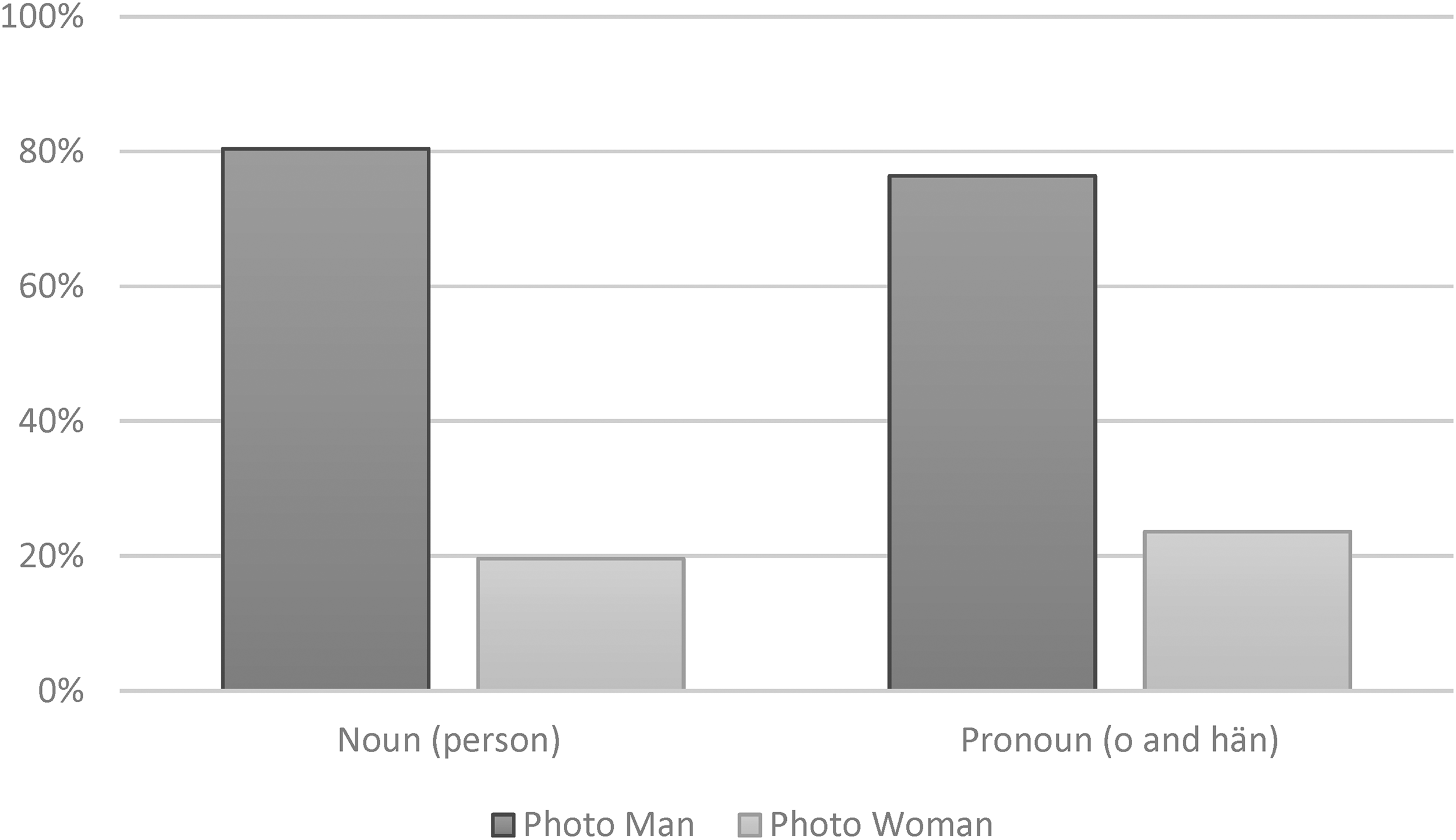
Percentages of selected photos of women and men across the two conditions, noun and pronoun.
We also tested if there was a gender difference in who selected a photo of a woman/man. In the pronoun condition (across both countries), more women (n = 29, 64%) than men (n = 16, 36%) selected a photo of a woman, χ2 (1, N = 45) = 3.76, p = .05, and more men (n = 88, 61%) than women (n = 57, 39%) selected a photo of a man, χ2 (1, N = 145) = 6.63, p = .01 (Figure 3). In the person condition, there was no association between participant gender and photo selection, χ2 (1, N = 185) = 1.29, p = .26.
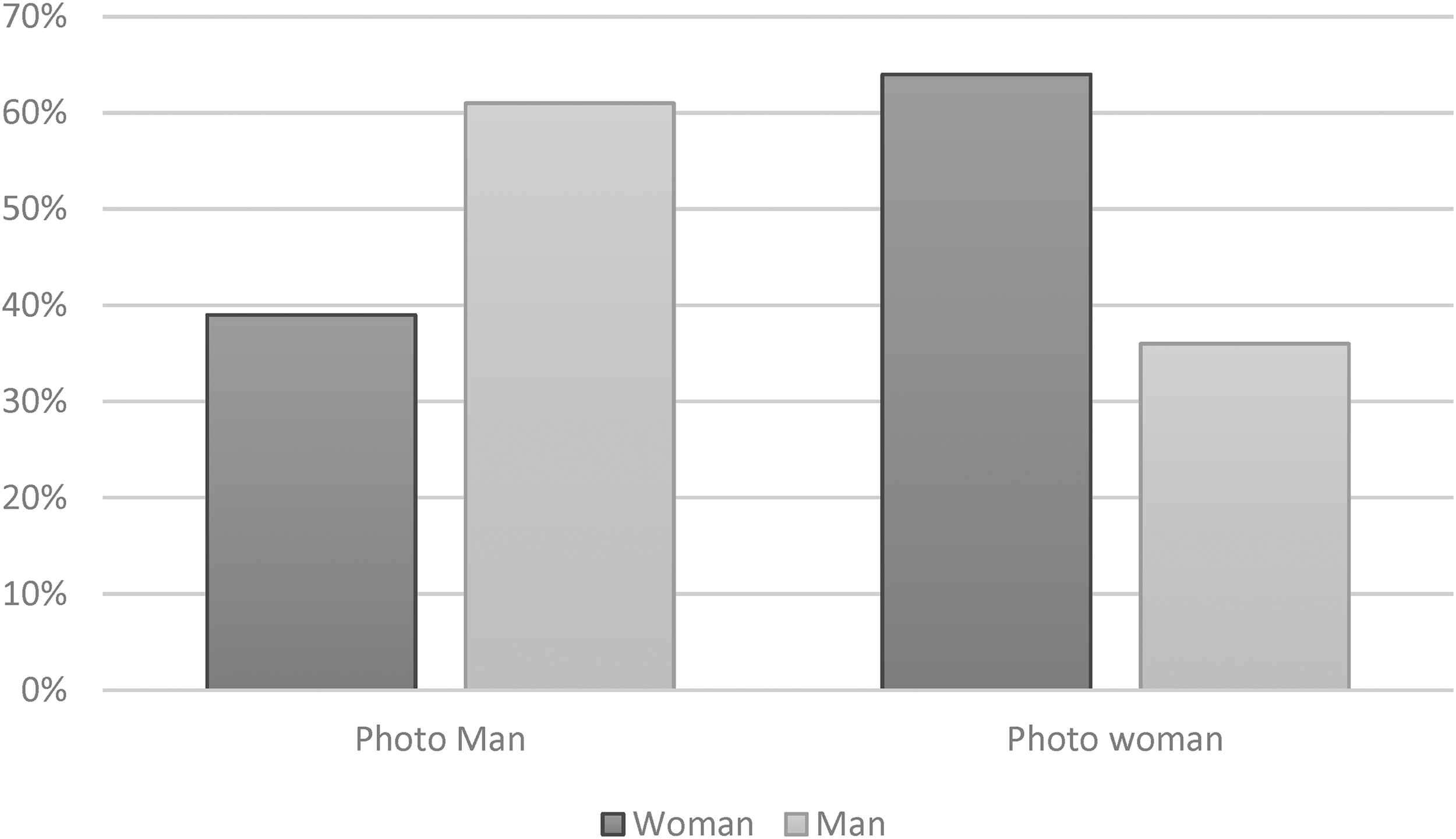
Percentages of women and men who selected photos of women and men in the pronoun condition.
Hypothesis 2 stated that the gender-neutral pronoun in Turkish should activate a stronger male bias than the gender-neutral pronoun in Finnish. A chi-square test was computed to analyze if there was a difference between country and selected photo. The chi-square test was not significant, χ2 (1, N = 203) = 2.30, p = .13, indicating that regardless of whether the country was high or low on the GEI, the male bias was equally strong (Finland = 71.7%; Turkey = 80.8%). The results are shown in Figure 4. Thus, H2 was not supported.
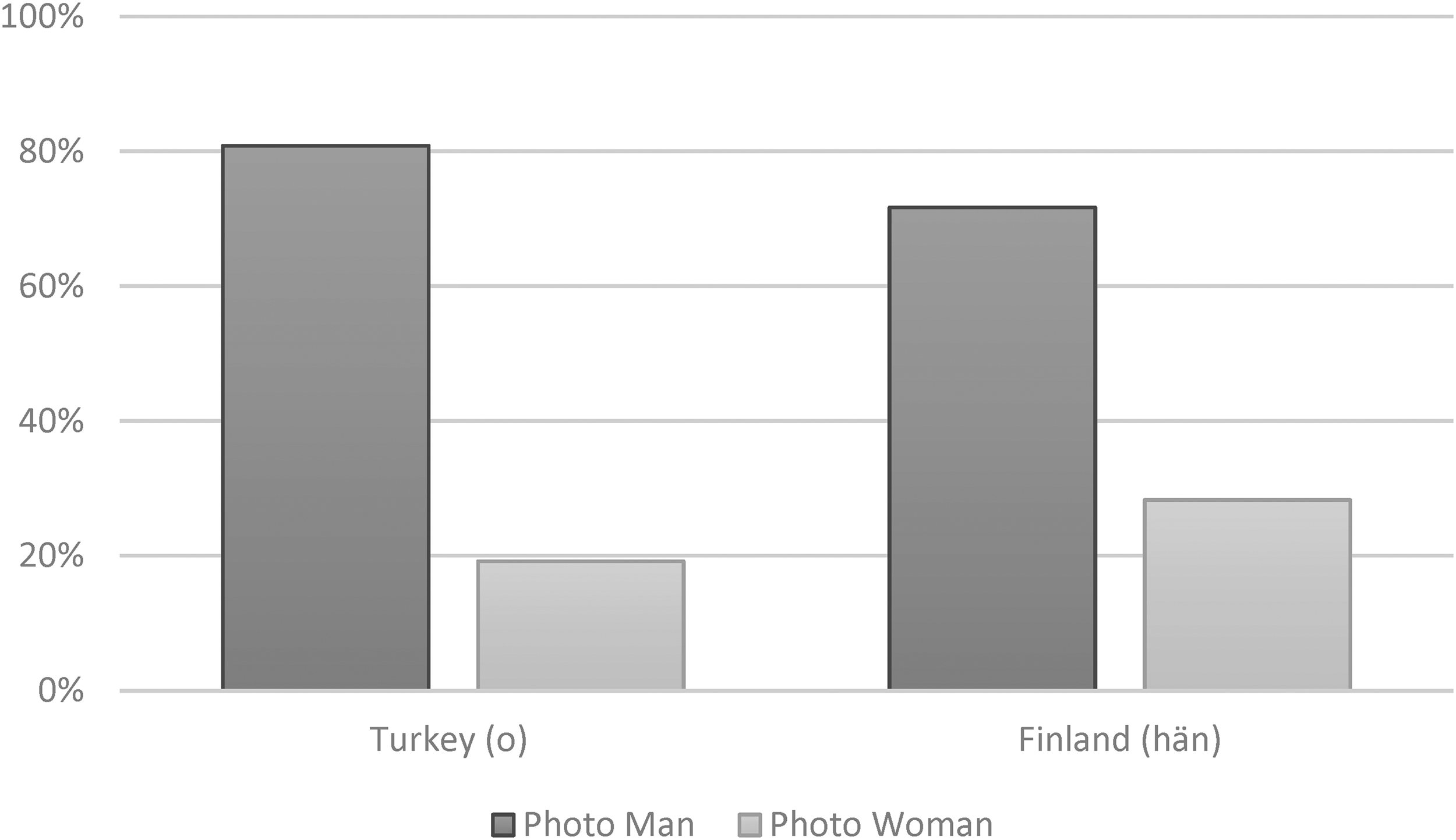
Percentages of photo selections of women and men across the countries for the pronoun condition.
Discussion
In the present research, we tested whether pronouns in genderless languages are male biased. Pronouns in genderless languages do not have any grammatical gender and hence are used to refer to both women and men. Thus, cognitive retrieval of both female and male exemplars should be equally occurring. However, in many languages, a male bias has been documented to the extent that even gender-neutral words are assocated with male representations and masculinity (Bailey & LaFrance, 2017; Engelberg, 2016; Lindqvist et al., 2019). Engelberg (2002) even argues that the inability to use feminine forms to increase the visibility of women in genderless languages may lead to enhanced androcentric views. Therefore, we hypothesized that neutral pronouns in genderless languages should be male biased. The survey experiment was conducted in two countries with genderless languages, Finland and Turkey. First, we tested if pronouns in genderless languages were male biased and if they were more or less male biased compared to a gender-neutral noun, in this case, “the person”. Further, the two countries we chose are diametrically different on national level gender equality (World Economic Forum, 2021), and we tested whether Finnish language speakers showed less male bias than Turkish speakers.
The results showed a strong male bias for both the noun condition and the gender-neutral pronouns in both languages. These results align with other research on masculine generics (Gygax et al., 2019), and neutral forms describing a person (Lindqvist et al., 2019). However, there is a major difference between masculine generics and gender-neutral pronouns in genderless languages in that gender-neutral pronoun do not carry any linguistic gender cues. We interpret the findings as deeply rooted in androcentrism, indicating that men and masculinity are the default gender category (Bailey & LaFrance, 2017).
We also explored potential gender differences in the tendency for androcentric choices. We found that more women than men selected a photo of a woman, while more men than women selected a photo of a man when the pronoun was used. This indicates that the gender of the evaluator matters, which has also been found in previous research (Bailey & LaFrance, 2017). Interestingly, this was not true for “the person” condition, as there was no significant association between selection of photo and participant gender. Hence, the generic noun seems to be more rooted in androcentrism than the pronouns. As Bailey and LaFrance (2017) also concluded, androcentric thinking varies with both gender and context.
Second, national level gender equality did not influence a male bias by pronoun use. The male bias was lower in Finland, but the statistical test was not significant. Instead, the male bias mirrored each other for one of the most egalitarian countries in the world (Finland) and one of the lowest ranking countries in the world (Turkey) (World Economic Forum, 2021). Again, an androcentric worldview seems heavily rooted in the human mind. Such an interpretation indicates that the male bias is strongly associated to a patriarchal culture. It is important to keep in mind that even though Finland scores high on the GEI, this does not mean that Finland has reached an end point of being gender equal. As in other high scoring countries, such as Sweden, there is still a strong gender segregation in the labor and domestic areas, and in education (Gustafsson Sendén et al., 2019; Perander et al., 2021; Stoet & Geary, 2018).
Gender-fair language reforms have been implemented in many languages to increase the salience of women (Sczesny et al., 2016). In natural and grammatical gender languages, balancing pronouns (he and she) or occupational roles (actor/actress) have been successful strategies in reducing the male bias. Currently, an ongoing reform in many languages is to include gender-neutral pronouns to include people with identities beyond the binary (Hyde et al., 2019) and to avoid presenting women and men as a unit. Studies indicate that these language reforms reduce a male bias in comparison to other neutral words (Lindqvist et al., 2019). These strategies are not possible in grammatically genderless languages and gender-fair language initiatives need to come up with other alternatives. For example, would it be possible to introduce a new personal pronoun that more explicitly captures people of all genders? Such reforms have been successful in languages with gendered pronouns, such as Swedish (Renström et al., 2022). It may also be possible to redefine the gender-neutral pronouns o and hän to become more associated with women and also nonbinary individuals. However, past studies on singular they have shown that the male bias might be harder to reduce with redefinition, at least in a short time perspective (Lindqvist et al., 2019). Also, it seems that Finnish hän becomes more associated to masculinity as children grow older (Engelberg, 2016), indicating again that androcentrism is responsible for the observed gender bias and that redefinition will take time to take effect. To conclude, the mere fact that a word is supposed to be gender-neutral does not guarantee it functions as such, which much research on generic use of “he” has shown.
While the results are strong and clear for the male bias, there are limitations of this study to note. To limit the influence of culture on the material and make it possible to use the same photos in both countries, we opted for describing “an American citizen”. This meant that the person described and the persons on the photos may have felt distant to the participants. We opted for high experimental control to avoid that appearance differences between the photos shown to the Finnish and Turkish participants, as using different photos might have been a source of bias. We acknowledge the need for future research where the material is better adapted to the participant's cultural context. However, there is also a need for more varied ethnic representation in the photos, as previous research has shown not only a male bias, but also a Whiteness bias, where the prototype of “human” seems to be a White man (Bailey & LaFrance, 2017; Merritt & Harrison, 2006). We included photos of white people only in our study to control for ethnicity. However, this may contribute to the existing Whiteness bias.
Moreover, the influence of ingroup- or outgroup status of the outcome photos for the participant should be another future venue. We encourage researchers to explore the role of for instance a specific job context of the person described. In our material, the description did not indicate a specific job or position that could be more frequently occupied by a man than a woman. Future studies could test whether the context of the person description influences the male bias, for example, using a job context where women or men dominate.
Another venue is to further explore gender differences. Our sample was too small to divide on both participant gender and country. A larger sample, which allows testing if the gender differences found in the present study is due to cultural differences would be good.
Finally, it would be good to test the notion that genderless languages may increase a male bias since women cannot be made linguistically salient as easily as in natural gender or grammatical gender languages. This could for instance be achieved by comparing the present results with a similar study in a grammatical gender language using paired pronouns (he/she).
To conclude, the present studies indicate that gender-neutral pronouns in genderless languages are associated with a male bias and that cultural level gender equality does not influence this bias.
Footnotes
Acknowledgment
The authors would like to thank the anonymous reviewers for their thoughtful and constructive comments on earlier versions of this manuscript.
Declaration of Conflicting Interests
The author(s) declared no potential conflicts of interest with respect to the research, authorship, and/or publication of this article.
Funding
The author(s) disclosed receipt of the following financial support for the research, authorship, and/or publication of this article: This work was supported by the Forskningsrådet om Hälsa, Arbetsliv och Välfärd (grant number 253099-131526).

Notes
Author Biographies
Appendix
English
Turkish
Finnish
This is a description of someone living in a medium-sized suburban region in the United States. The person is 30 years old and is very interested in movies. Before the pandemic, [the person/pronoun] went to the cinema as often as possible, but now it has become more complicated. Instead, [the person/pronoun] watches series at Netflix a lot.
Bu, Amerika Birleşik Devletleri'nde orta büyüklükte bir banliyö bölgesinde (bir kentin, şehir merkezinden uzak, dış bölgeleri) yaşayan bir kişinin tarifidir. Bu kişi 30 yaşındadır ve sinemaya çok meraklıdır. Pandemiden önce [bu kişi/o] sinemaya olabildiğince sık giderdi, ancak şimdi bu durum oldukça zorlaştı. Bunun yerine [bu kişi/o] Netflix'te bir sürü dizi izliyor.
Tämä on kuvaus henkilöstä, joka asuu keskikokoisella esikaupunkialueella Yhdysvalloissa. Henkilö on 30 vuotta vanha ja erityisen kiinnostunut elokuvista. Ennen pandemiaa [henkilö/hän] kävi elokuvissa niin usein kuin mahdollista, mutta nyt elokuvissa käymisestä on tullut hankalampaa. Tästä syystä [henkilö/hän] on alkanut katsomaan paljon sarjoja Netflixistä.
The person has a dog and is interested in training it. Every day, [the person/pronoun] takes a long walk with their dog and do some exercises with the dog—teaching it tricks.
Bu kişinin bir köpeği var ve onu eğitmekle ilgileniyor. [bu kişi/o] her gün köpeğiyle uzun bir yürüyüşe çıkıyor ve onunla bazı egzersizler yapıyor—ona oyunlar öğretiyor.
Henkilöllä on koira ja henkilö on kiinnostunut koiran koulutuksesta. [henkilö/hän] käy joka päivä koiran kanssa pitkällä lenkillä ja tekee koiran kanssa erilaisia harjoituksia, opettaen sille temppuja.
Besides from liking movies and dogs, [the person/pronoun] enjoys travelling, and spending time with friends. The person is currently single but goes on occasional dates. On the weekends [The person/pronoun] likes to sleep in and have a long breakfast, catching up on news or reading a book.
Filmleri ve köpekleri sevmenin yanı sıra, [bu kişi/o] seyahat etmekten ve arkadaşlarıyla vakit geçirmekten keyif alıyor. Bu kişinin şu anda bir ilişkisi yok ama ara sıra randevulara çıkıyor. Hafta sonları [bu kişi/o] uyumayı ve uzun uzun kahvaltı yapmayı, haberleri takip etmeyi veya kitap okumayı seviyor.
Elokuvista ja koirista pitämisen lisäksi, tämä [henkilö/hän] pitää myös matkustamisesta ja viettää mielellään aikaa ystävien kanssa. Henkilö on tällä hetkellä sinkku, mutta käy ajoittain treffeillä. Viikonloppuisin [henkilö/hän] nukkuu mielellään myöhään ja syö sitten rauhassa aamiaisen, lukien uutisia tai kirjaa.
Characteristics of [the person/pronoun] that friends appreciate include social, independent, kind, and self-reliant.
[Bu kişinin/o] arkadaşları tarafından takdir edilen özellikleri sosyal, bağımsız, kibar ve kendine güvenen biri olmasıdır.
Ystävät kuvailevat [henkilö/hän] sosiaaliseksi, itsenäiseksi, ystävälliseksi ja omiin kykyihinsä luottavaksi henkilöksi.