



Abstract
What is the role of national identities in doing antiracism? In social psychology, much research on racism has examined processes and practices of exclusion. Scant research however has examined practices of inclusion. In this paper, I examine practices of national majority group members doing antiracism in response to complaints by ethnic minority members about facing racism on Twitter about their national belonging. I examine these instances and responses to these in the Irish context, as in Ireland, being “Irish” can mean both ethnic and national identity. Findings show that respondents’ national identification was central to practices of inclusion, such as that of affirming the Irishness of those facing exclusion. For respondents’ national belonging was oriented to as significant for those complaining about inclusion, for themselves, and for those who were engaging in racist exclusion of ethnic minority members. Together the findings show that while national identities allow for antiracism, these problematically suppress the relevance of race in favor of nations and nationalisms.
In response to a series of police killings of Black people in the United States (AlJazeera, 2020) and inspired by movements like the Black Lives Matter (Shrikant & Sambaraju, 2021), this Special Issue and others (e.g.,: Sambaraju & McVittie, in press) are directed at possibilities for developing knowledge and research-informed practices for antiracism. In this paper, I examine the interactional aspects of solidarity in response to claims about being targets or victims of racism, to contribute to such knowledge and practices. Researchers who study race and racism at the intersection of language and social psychology have extensively examined how racism takes place at the macro and micro levels through concepts of othering and denials or suppression of racism (Augoustinos & Every, 2007; Goodman, 2020; van Dijk, 1992). Researchers have also examined how nations and national belonging offer potent resources for common-sense notions of ethnicity and belonging (Eriksen, 2001). At the same time, these offer potential grounds for doing exclusion in the form of ethnic prejudice. Little research has examined processes in the other direction, such as those that are around inclusion and antiracism. In this paper, I examine practices of antiracism that manage inclusion in instances where racial/ethnic group membership is treated as a reason for exclusion from national group membership. I examine interactions on the social media platform Twitter in Ireland as in Ireland being Irish is routinely associated with being White. As a consequence, ethnic/racial minority members are targets of racism in the form of undermining their nationality as Irish. Antiracism is then likely to engage with the national identities of both targets and those in the majority group. This paper makes a novel contribution to the language and social psychology of inclusion through showing the centrality of national identities in doing antiracism.
For social psychologists, “who we are” or identity, is centrally implicated in a range of social behaviors (McKinlay & McVittie, 2011). Issues of identity are particularly important for racism and other forms of social exclusion (Durrheim et al., 2011). Identification with a nation, ethnic/racial group, or majority group is core to developing a sense of “others” who are different and consequently targets of problematic behavior (Allport, 1954; Brown, 2011; Tajfel & Turner, 1979; van Dijk, 1992). Indeed, one of the earliest definitions of prejudice by Allport (1954) treats identification based on group membership and consequent negative attitudes as central (Durrheim, 2014). Social constructionist approaches in social psychology are notable in their emphasis on the construction of identities, identification, and consequent treatment of individuals as comembers (or not) in identity categories (Wetherell & Potter, 1992). Researchers examine the various ways in which language is used to construct individuals—themselves and others—as members in specific groups and national entities in ways to claim for themselves and ascribe to others specific identities (McKinlay & McVittie, 2011). Discursive researchers have extensively examined how these various forms of identities—ethnic/racial, national, or regional identities—can coalesce in concerns with racism.
Racism, and Ethnic and National Identities
The confluence of ethnic and national identities poses unique problems for minority group members. This becomes much more salient when our ethnic identities are routinely constructed in reference to national identities (Eriksen, 2001). Nations and our identification with them have been the subject of much research focus in discursive research and social psychology broadly. Discursive work has shown the importance of mundane practices in constructing and promoting ideas of nations and national identities. Billig (1995) has argued that mundane referents work to produce “banal nationalism,” which can signal belonging and at times exclusion. His ground-breaking thesis on banal nationalism argues that nation and national belonging are inscribed in our mundane language practices such as through the use of pronouns like “we” and “us,” or deictic markers like “here.” Importantly, Billig argues that these mundane referents imagine and re-inscribe the nation into our practices without making it explicit. These issues become especially salient in the context of migration where ethnic identities come in tension with other majority ethnic identities that are also national identities. Their ethnic identities become the reason for their exclusion from the national group.
Discursive researchers have particularly examined how problematic descriptions of ethnic others occur in close relations to national identities. For discursive researchers, a core aspect of exclusion is othering, defined as a process whereby descriptions and categorizations of individuals are done in ways to treat them as a problematic “other” (Riggins, 1997) through making relevant ethnic membership (Reeves, 1983), citizenship (Goodman & Speer, 2007), or culture (Hanson-Easey & Augoustinos, 2010). Augoustinos et al. (1999) demonstrate that descriptions of Aboriginal peoples as “lazy” are made in ways to treat them as distinct to being Australian. Verkuyten (2001) shows that Dutch participants in the Netherlands similarly described ethnic minorities as “abnormal” and deviating from versions of being Dutch. Similar findings were seen in Durrheim and Dixon’s (2001) study in South Africa where descriptions of Black South Africans were made in ways to characterize them in extremely problematic ways and consequently justify their exclusion from public places.
For minority ethnic group members, negotiating inclusion is a routine part of their lives. They might claim for themselves authentic ethnic identities in ways to resist being taken-up by an ethnic majority. For instance, Verkuyten (2005) shows that South Moluccans in the Netherlands, foreground their unique culture and language to develop a separateness from the Dutch majority. Sala et al. (2010), show that constructions of minority ethnic identities cannot but engage with the majority ways of life including majority understandings of minorities. Their study examines how Italian migrants in Australia make claims to their everyday activities as more Italian than Australian. Their identity claims as Italians in Australia also incorporated elements of the Australian ways of life and identity positions, such as the ownership of the pejorative term “wog.” This allowed them to negotiate belonging in terms of being uniquely Italian, but in an Australian majority context.
Minority ethnic or migrant group members might also produce and claim for themselves hybrid or hyphenated identities (Bélanger & Verkuyten, 2010) to negotiate their belonging with the nation. Shrikant (2018) shows how Asian-Americans can flexibly foreground their Asian or Asian American identities in ways to navigate immediate concerns of an institutional context and their ethnic membership in the United States.
Ethnic minority members however face the issue of acceptance by majority group members of their identities as unique ethnic minority members or those with hyphenated identities. Anjum et al. (2017) show that for British Muslims their ethnic identities and consequent belonging in the UK is treated as contingent on the attitudes of majority group members. Their British identities were not merely derived from their own status as British citizens but also by acceptance from their White British peers. Majority group members then are uniquely positioned to, both, participate in exclusion and effect inclusion. In both sets of practices, national identities and belonging are a means to organize identities for ethnic minorities. National identities are indeed presented as a possible form of “common identities” that can serve to reduce prejudice (Reynolds et al., 2015; but see: Dovidio et al., 2016). It is then important to examine practices of majority group members to effect inclusion when national belonging is salient for racist exclusion.
Some research has shown various practices of antiracism practiced by majority group members. For instance, Fozdar (2008) shows how discourses, such as those around the history of injustice and oppression, that function to exclude minority members can also be used for antiracist action. Benwell (2012) examines the role of common-sense notions of antiracism as a shared value and as a morally appropriate stance are routinely used in treating racists as problematic others. Whitehead (2012) shows that practices of racial categorization that routinely contribute to racial othering can also be used for nonracialism, as race categories allow for making sense of actions. Robles (2015) identifies specific discursive practices that can work to counter mundane racist practices. In these practices, participants see themselves as members of racial majority groups. What among antiracist practices implicate the majority group members as part of the national majority? In this paper, I examine interactional practices where majority group members practice antiracism when the racial exclusion targets ethnic minority members’ national belonging.
The Present Study
The Irish context provides unique features for the study of these practices. First, the results of a citizenship referendum in 2004 meant that only those born to Irish citizens would automatically obtain Irish citizenship, even if they were born in Ireland. This 27th Amendment of the Constitution Bill, 2004 resulted in laws that meant that others would have to avail of Irish citizenship through other processes. Recently instances of deportations of those who were born to non-Irish persons and lived in Ireland for several years highlight the problems with citizenship laws in Ireland (Thornton, 2018). Second, the commonsense notion that only those with Irish heritage can make claims to being Irish (Fanning & Mutwarasibo, 2007). Researchers show that the citizenship amendment actively re-racialized the Irish state where being White and with Irish heritage became synonymous with being Irish and consequently, ethnically others had to make alternative claims to their Irish identities (Carr & Haynes, 2013; Fanning, 2018; Mhurchú, 2011). In other words, those who are from non-White groups but may well be Irish, are not seen as Irish.
Fanning (2018) argues that nation building in Ireland fostered specific forms of Irish national identities that discounted claims to nationhood for ethnic minorities. For instance, Irish Travelers 1 were only officially recognized as ethnic minorities in 2017. Tracey (2000) uses the acronym WHISC—White, heterosexual, Irish, sedentary, and Catholic—to refer to those who are routinely considered Irish to the possible exclusion of others. Coupled with this, various forms of racism in Ireland center on the nonbelonging of targets in Ireland (INAR, 2021). For instance, Carr and Haynes (2013) show that Muslims in Ireland must negotiate their racialization as Muslims and exclusionary Irishness. Lentin and Morena (2012) show that in the face of such discrimination and exclusion several forms of migrant activism are prevalent in Ireland. Increasingly, however there has been social mobilization as part of the Black Lives Matter movement in Ireland (Gaffney, 2020) there have been calls for the ethnic majority in Ireland to take-up specific practices to counter exclusion and racism (Freyne, 2020). Similar issues and concerns are seen with the Irish government starting a nationwide public consultation for an Action Plan against racism (Govie, 2021). These suggest unique roles and possibilities for the majority group members in Ireland to take up specific sets of actions to counter racism.
Twitter and Racism
Twitter is a significant social media platform. It attracts in excess of 330 million monthly active users and around 500 million tweets are sent each day (Smith, 2020). Popular public figures extensively use the site to interact with followers (Cole, 2015). Problematically, there have been increasing reports of racial abuse on Twitter directed at popular figures and other users alike (TwitterUK, 2021). At the same time, Twitter allows for those who are targets of abuse to express their experiences, and report or respond to such abuse (McVittie et al., 2021). McVittie et al. (2021) show that in responding to abuse, the targets routinely re-cycle the terms in which the abuse was made. Reports of being targets/victims of racism can then similarly invite responses that are in solidarity with those reporting. In Ireland, given the confluence of ethnic and national identities, it is likely that racial abuse involves references to the Irishness of the targets. Responses to these reports are also likely to involve attempts at inclusiveness of these targets in the ethnic/national category “Irish.” It is this that is the focus of the present paper. In these interactions, I specifically ask: how are claims about targets’ national identity made to achieve inclusion in responding to claims about the racism they face?
Method
Data and Participants
The data for this study come from natural interactions on Twitter, where users made claims about being victims/targets of racism. The data comprised instances of these claims and responses to them. In distinction to routine methods for discursive work (Wiggins, 2016), I undertook a minimally motivated search procedure that reflected my own routine interactions on Twitter over a 3-month period from January 15 to April 15. The data collected are Twitter interactions that I came across on random days of browsing Twitter, where issues of racism in Ireland were discussed. I maintained a .docx file with screenshots of the Tweets and responses as I came across them. This form of netnography (Kozinets, 2015), which is a nonparticipant observation and data collection, resulted in a corpus of 15 sets of Tweets about being victims/targets of racism and responses. In line with processes of minimal motivated searching, I copied responses that extended up to five pages on a word document or “naturally” came to an end with the message “click to see more replies,” whichever appeared earlier in the scrolling. This amounted to an overall corpus of 756 individual tweets.
As a consequence of this method of data collection, (a) not all replies were expanded and included in the corpus; (b) only those users/Tweets that were prominent or influenced by my earlier browsing history would have come up, and (c) the order of tweets appearing would be influenced by the time at which I accessed Twitter. Tweets and responses were then collected, read, and coded from the point of my browsing habits and preferences. The corpus and data reflect my personal browsing history and habits, as is likely for several other Twitter users. An outcome then has been that users who either have a “blue tick,” which indicates an account of public interest or are otherwise popular on Twitter would have a higher likelihood of appearing in my search practices. Although these may be considered as constraints, this procedure brings us close to how users themselves would access and engage with Twitter.
Coding
The data collected contained a range of responses to Tweets about users being targets/victims of racism. These include responses that were further aggravating and hearable as racist, undermining of these claims and others that were broadly supportive of the claims. This latter set was identified as those that included welcome, specified solidarity, agreed with the claims in the Tweets and offered others forms of support. From this set, the Tweets and responses that focused on issues of identity concerns and negotiation were selected for close analysis, with a particular focus on the term “Irish,” plurals “we,” “us,” and “our,” place names and deictic referents such as “Ireland” and “here.”
Analytical Procedure
The data were analyzed using discursive psychology (Edwards & Potter, 1992; Wiggins, 2016) as particularly applicable to topics in social psychology (McKinlay & McVittie, 2008). In particular, I employed discursive techniques developed for the examination of Twitter data by Sambaraju and McVittie (2020) and McVittie et al. (2020). These approaches build on existing methodological practices of conversation analysis (Sacks, 1995) and discursive psychology (Edwards & Potter, 1992), with a focus on examining Tweets for the construction of specific versions of events, actors, and actions, and accomplishing social action in their sequential position (McVittie et al., 2021; McVittie et al., 2020). Tweets are examined as communicative practices that accomplish specific action in their sequential location.
Here the Tweets were named based on their position: Initial Tweet that treats the user as a target/victim of racism, a screenshot or other evidence of this claim, and a response. The response tweet was examined as a second pair-part to the Tweet claiming the user as a target/victim of racism, which was treated as a first pair-part (Clift, 2016). The response was examined for how it is shaped in ways to act as a response to the initial tweet. The focus on the sequential position allowed for examining the response tweets as effecting specific forms of social action such as solidarity with the initial tweet/user.
It is here the concerns with identity became the focus of the study. In these types of social actions, solidarity was examined in instances where the identity of the complainer was treated as the source of potential racism (Xie et al., 2021). The analysis examined how issues with targets’ identities were responded to: how did the respondents orient to claims by targets? How did they accomplish inclusion? How did they manage possibly dilemmatic issues with accomplishing inclusion? Finally, what do these actions mean for antiracism as an accomplishment?
Before presenting the results, it is useful to cover some of the pertinent features of Twitter, as these relate to both presentation of data and the analysis. Here, I have presented the data in a format modified from that found on Twitter to assist readability for those who are unfamiliar with Twitter. The contributions to each exchange are presented in chronological order following the date of posting, and each contribution is presented as a numbered turn within the extract. The first tweet is the tweet from the target, which routinely included further elements like screenshots of other responses, links to articles, or photographs. Next is the response from the respondents, labeled as respondent’. I have included some of the features of Twitter such as the @ mention symbol that precedes a username denotes a Twitter account, and the hashtag (#) symbol is a convention used to denote and emphasize user-defined topics (see Calvin et al., 2015). It should be noted though that these features are built into the digital architecture of the platform; thus, the use of the “reply” button will automatically insert the name of the originating user. In the extracts below, I only included names of those more popular users who had complained about being targets of racism than respondents, to ensure some amount of anonymity.
Results
The analysis examined discursive practices where avowals of being victims/targets of racism are responded to in ways that accept those avowals and are favorable. I examined instances where either the complaint or the responses implicated national/ethnic identities of both those who claimed to be targets and those responding. Respondents orient to these as complaints about race-based exclusion made against those who are their co-members in the national category. Their responses then work to affirm targets’ inclusion while managing the relevance of those who are acting in racist ways. Below, I examine this in four forms of responses: (a) Indexing respondents’ Irish identities, (b) Banal referents to respondents’ Irish identities, (c) Affirming targets’ Irish identities over others, and (d) developing alternative “new” Irish identities. In all these cases, respondents’ treated targets’ Irish identities as in doubt and proceed to offer affirmations while foregrounding the status of their own identities.
Irish Identity
In the following two extracts, targets’ complaints were around their Irish identity. Responses then affirm the complainers’ Irish identities, while making references to their own membership.
In Extract 1, Dr Bashir Otukoya refers to being targeted on grounds that his Irishness is not recognized by other unspecified Irish persons. He had made an appearance on Ireland's premier late-night talk show, Tommy Tiernan Show, and routinely appears in other public speaking events about racism in Ireland. The response addresses this issue. The tweet was posted on January 17, 2021.
Extract 1
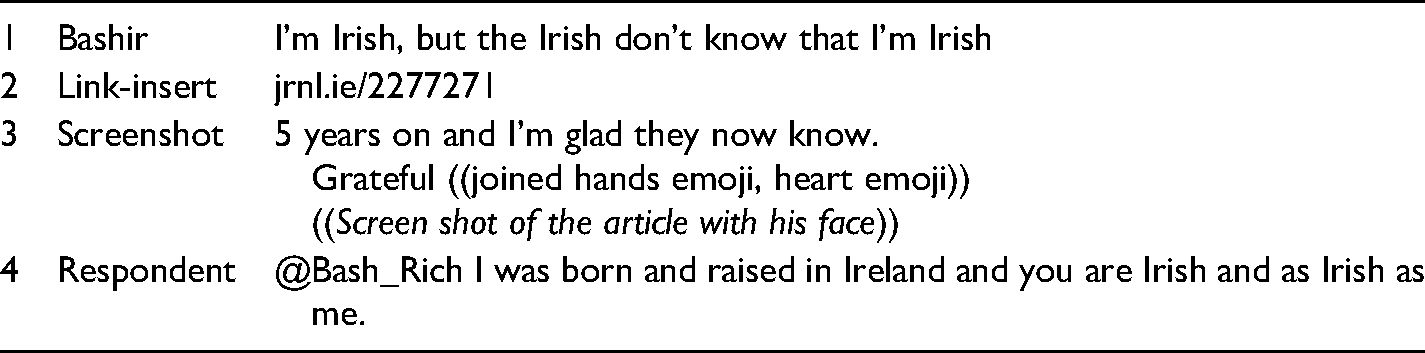
The tweet (1) by Bashir includes a national identity-related complaint with three elements. First, is a description of the complaint— “I’m Irish, but the Irish don't know that I’m Irish” and an evidential source for the complaint (Link-insert at line 2). Second, is a counter to that complaint, specifically pointing to change in knowledge states of “the Irish” about his own identity as “Irish.” Third, is a gratitude token given with the term “Grateful” and a joined hands and heart emoji, which treat being Irish as a desirable status.
That this is a complaint, is hearable in both the contradiction between claiming an Irish identity and the absence of similar knowledge among others categorized as Irish and the subsequent avowal that such absence has been rectified (see: Xie et al., 2021). The tweet also contains Bashir's photograph showing him as a Black person. The tweet then treats the issue as one where Bashir's identity as Irish is not yet affirmed by co-members in the category Irish, presumably because of the color of his skin. In doing this, Bashir develops a distinction between himself and “the Irish” in ways that implies a contested membership status for him in the national group.
However, Bashir is careful not to come across as ascribing blame to fellow Irish persons through explicitly indicating his gratitude for being able to show that he is now recognized as Irish. Bashir is then seemingly managing a dilemma where he has a complaint about fellow Irish persons while not fully condemning Irish persons for practicing exclusion of persons like himself who might not readily be seen as Irish.
The response at line 4 orients to Bashir's tweet as a complaint about how fellow Irish members do not treat or see Bashir as an Irish person and affirms Bashir's Irish identity. The respondent self-selects themselves as the type of person who can address Bashir's concern through indexing their Irishness and treating it as to allow for rights to do so: “I was born and raised in Ireland.” Two points are of note here: first, the respondent treats being Irish as relevant for being in a position to affirm others’ Irishness. Second, the respondent undermines the relevance of being born in Ireland or race for membership in the category Irish in affirming Bashir's Irishness, who was not born in Ireland. Together, the respondent addresses Bashir's dilemma by explicitly affirming Bashir's identity as an Irish person, while undermining possible nonrecognition.
In Extract 2, a similar response is made to affirm the Irish identity of another person with a similar complaint regarding their Irishness. Here, Ms. Hazel Chu who is the current Mayor of Dublin claims is being a target of racism. Again, Chu treats the issue as that which deals with the Irishness of herself and her family. The response addresses this issue. The tweet was posted on January 24, 2021.
Extract 2
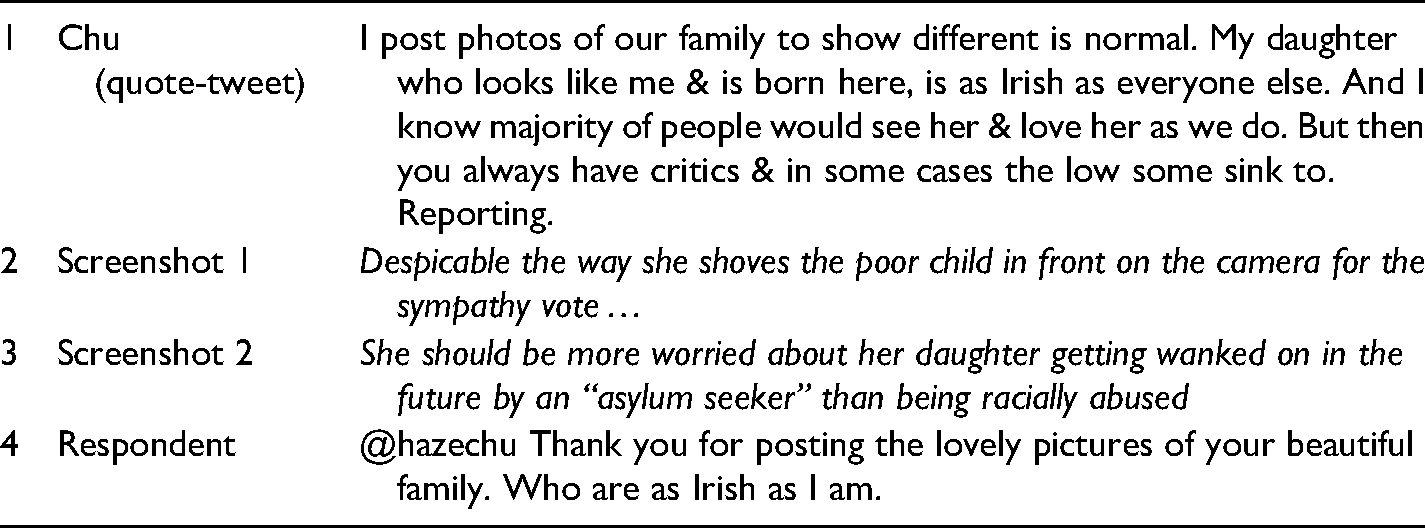
Chu treats the screenshots (lines 2 and 3) as severely problematic for not accepting that she and her daughter are Irish just in the way that others who are “born” in Ireland. Her tweet also offers an alternative reason for posting photographs of her family to that offered in the screenshot tweets: Chu recruits an unspecified “majority of people” to respond favorably to the photographs in contrast to the descriptions in the screenshots. In explicitly stating that she is going to report these tweets (2 and 3), Chu treats these as severely problematic. As Bashir above, Chu treats it that her complaints are not about the “majority” of Irish persons and explicitly projects at anticipation that others would be favorably disposed to her and her family's Irishness.
The response at line 4 offers a favorable evaluation of Chu's posting of family pictures echoing Chu's claim that a “majority” will be favorable: “lovely,” “beautiful,” and “Thank you.” In doing this the respondent presents themselves as one of those “majority” who will be favorable to the photographs of Chu's family. However, the respondent goes further and affirms Chu and her family's identity as “Irish” in ways similar to themselves: “as I am.” Although the respondent does not support their claims about their Irishness, their confirmation echoes Chu's claim that her daughters are Irish because they were “born” in Ireland. In doing this, the respondent self-selects as the type of persons who can resolve Chu's dilemma. In Extracts 1 and 2 then respondents readily present themselves as those who will affirm and treat the targets as Irish, without taking on the issue of those who are racist towards Bashir and Chu.
Banal Irishness
The two extracts below, targets similarly set-up possibilities for others to offer inclusive responses. Here, however, the respondents respond with affirmations that use banal referents to Irishness. In Extracts 3 and 4, these referents work to construct a national polity that is inclusive of highly favourable evaluations of the target, rather than taking up actions that are racist.
The next Extract comes from the same set of interactions as shown in Extract 1.
Extract 3
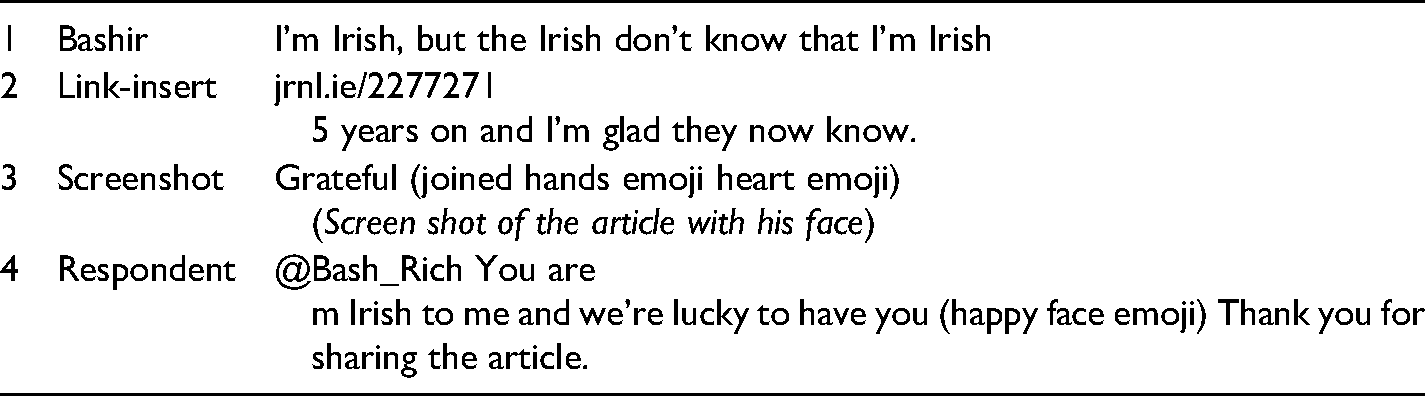
The respondent at line 4 offers a ready affirmation that Bashir is Irish. Of interest here is the next part of the response that refers to the respondent's own identity along with unspecified others, who are hearable as Irish persons—“we,” It is noteworthy that the respondent shifts their footing (Goffman, 1979) from “me” to “we” in reference to affirming Bashir's identity and the consequent favorable evaluation of Bashir, given as an appreciation. The shift manages the possible inference that it is only the respondent who is favorably disposed to Bashir's Irishness and not other Irish persons, which is precisely Bashir's complaint. In so doing, the respondent manages to address Bashir's complaint about his racist exclusion, while snubbing others who might reject Bashir's Irishness.
In Extract 4 Úna Minh Caomhánach explicitly shows how she's a target of racism. In response, a similar form of inclusiveness is given. The tweets were posted on January 17, 2021.
Extract 4
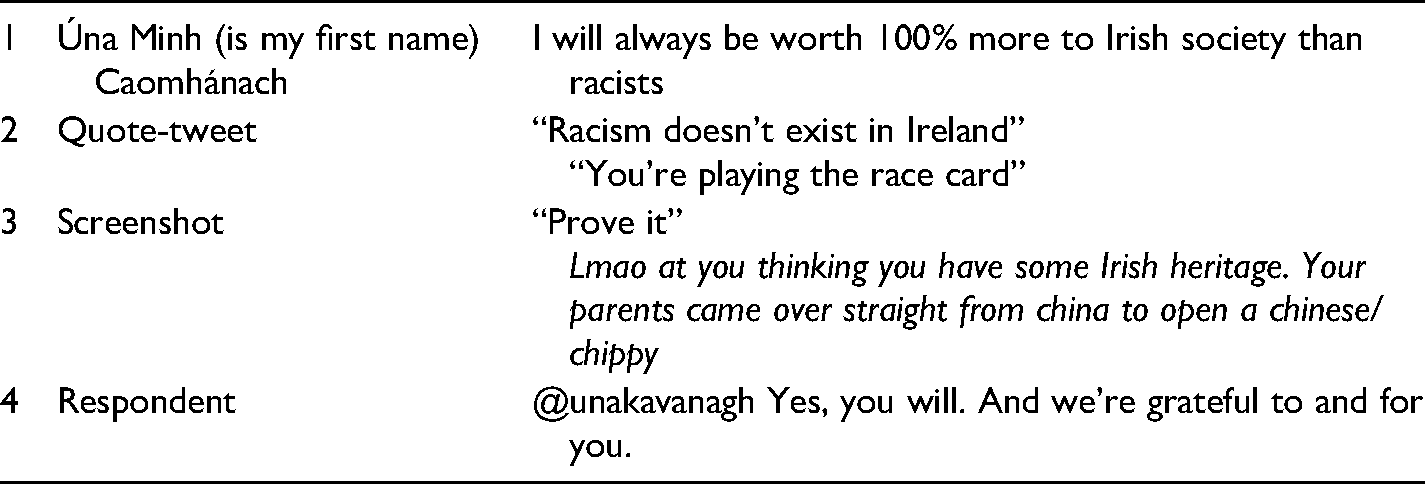
Caomhánach has quote-tweeted (2) a screenshot of a possibly racist statement directed at her to treat this as an example of racism. Tweet 1 is another quote-tweet of her own (2) Tweet making a claim about her value to the “Irish society.” Notably, screenshot (3) undermines Caomhánach claims for an Irish identity and offers an alternative ethnic/national belonging: “China.” Moreover, it is derogatory in ascribing motives of mere money-making on part of Caomhánach's parents. Her quote-tweet (2) then treats the screenshot (3) as racist and rejects these claims in claiming for herself an Irish identity. Similar to other tweets seen, Caomhánach complains about being treated as non-Irish, while avowing a favorable stance towards Ireland and co-membership with other Irish persons. The distinction however is that she explicitly treats herself as a more worthy member of the Irish community than other members who are categorized as “racists.” In doing this, she sets-up possible responses that are favorable about her and dismissive of those unspecified “racists.”
The respondent echoes Caomhánach's claims about her contribution to the “Irish society” and offers gratitude to Caomhánach for her co-membership in Ireland through the pronoun “we.” The pronoun use presents Irish persons as favorably disposed to Caomhánach in affirming her inclusion. It then raises the issue of how this fits with the racist responses directed at her. What is then inferable is that those others are not representative of Irishness.
Thus far, respondents do not explicitly offer descriptions of those Irish persons who are subject of the complainers’ tweets. In the extracts below, the respondents develop alternative versions of the category Irish in ways to complicate the action of including those who are targets.
“Real” Irish People
In the two extracts below, respondents readily differentiate between Irish people who are participating in problematic actions such as targeting those who are not White and those who are inclusive. This contrast, however, readily marks a distinction in terms of respondents themselves as those are accomplishing a moral task of antiracism in distinction to those others.
In Extract 5, Denise Chaila, a musician, reports being targeted for her work. Notably, however, the claim does not involve any reference to her ethnicity or national identity. The response however treats her Irishness as relevant.
Extract 5
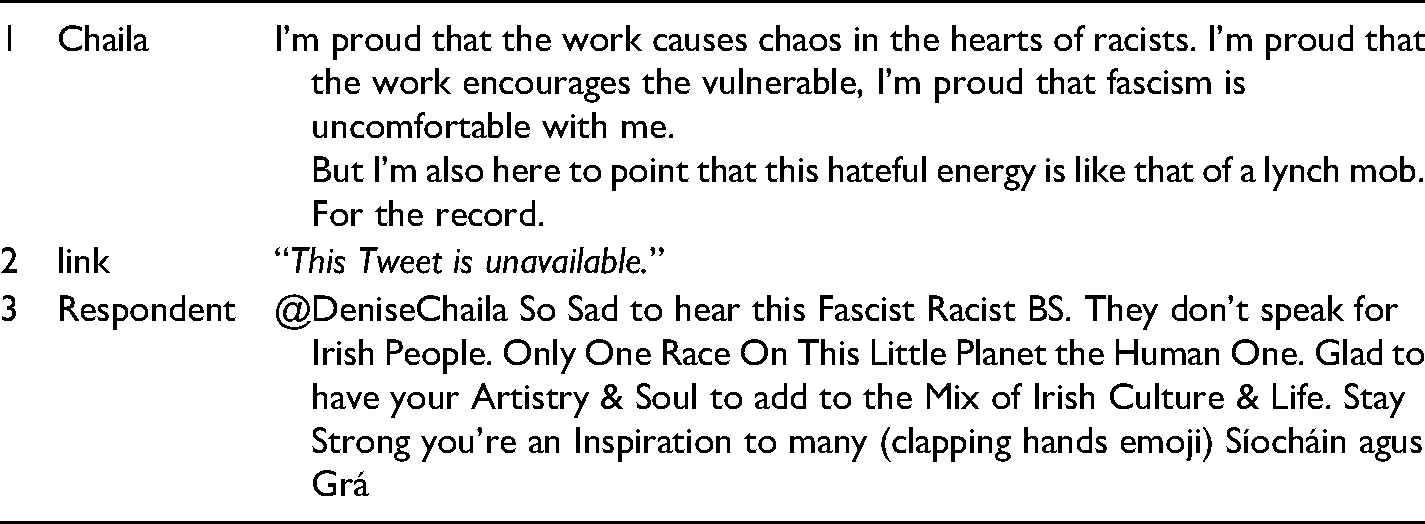
In her tweet (1) Chaila claims that she is a target of “hateful energy” and that her work is the focus of “racists” and “fascism.” She claims that on the one hand her work causes problems for racists and fascists and, on the other hand, is helpful to those who are vulnerable. This is made in reference to another tweet, which remains unavailable. However, she indicates that her reasons for posting the tweet are to show that she is the target of concerted hatred that she likens to a “lynch mob.”
The respondent in line 3, accepts the complaint and echoes the terms used by Chaila. The respondent dismisses those engaging in problematic actions not only in treating these actions as racist and fascist but also as deviating from routine and unspecified aspects associated with “Irish people.” Juxtaposed to this, the respondent treats Chaila and her musical activities as contributing to “Irish Culture” in specific ways, namely her “Artistry & Soul,” and that she adds to “the Mix of Irish Culture & Life.” The respondent also offers praise for Chaila's actions—“Inspiration to many (Clapping hands emoji).” In doing this, the respondent dismisses racist comments made at Chaila in favor of his own evaluations of her, which are highly favorable.
In Extract 6, the responses treat the Irishness of those participating in problematic actions against Chaila as important in affiliating and accepting her complaints.
Extract 6
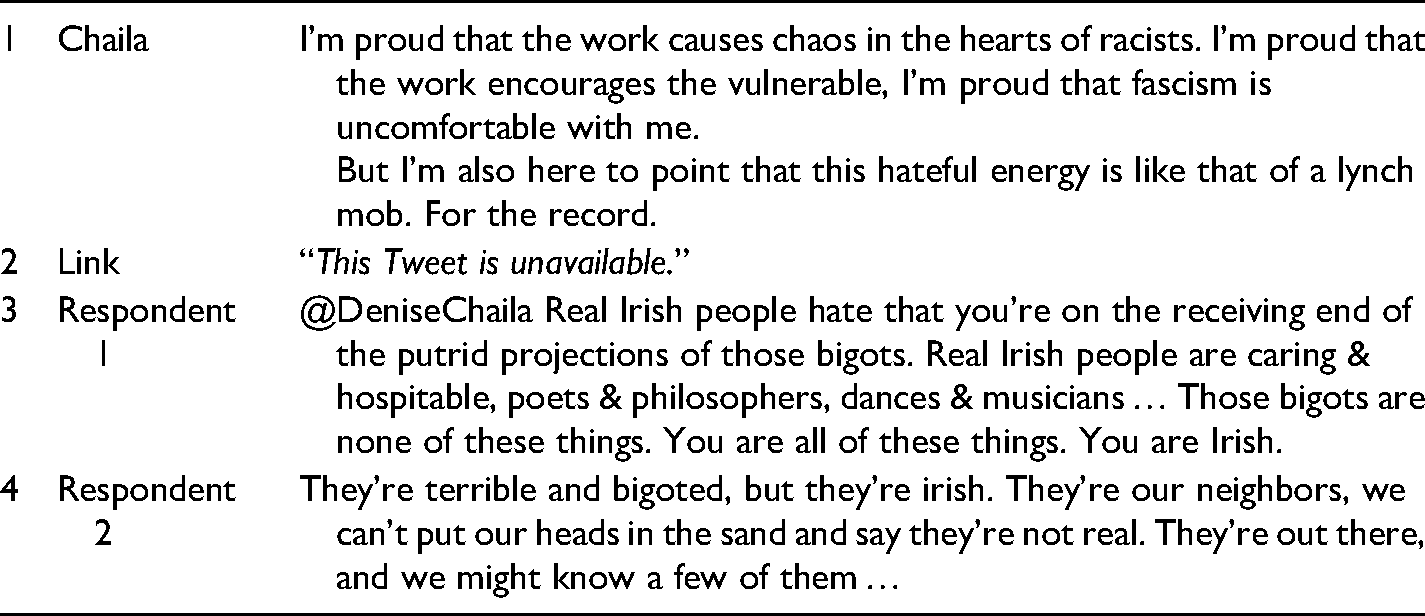
Respondent 1 develops a contrast between “Real Irish people” and others who might engage in bigotry. Respondent 1 supplies details about what constitutes the category “Real Irish people,” which details are extremely favorable: “caring & hospitable, poets & philosophers, dances & musicians …”. As a three-part list (Jefferson, 1990), this set of characteristics gives the inference that “Real Irish people” are those who are unlikely to engage in harmful actions such as bigotry. Respondent 1 explicitly makes this claim: “Those bigots are none of these things.” However, the user does not relegate racism to those others who are not “Real Irish people” but treats Chaila as someone who possess these characteristics and is “Irish.” In doing so, the respondent treats racism and bigotry as related to Chaila's and others’ identities. In ascribing to Chaila an Irish identity, the respondent undermines racism directed at her.
Respondent 2 directs their comments to Response 1 and challenges the distinction developed between “Real Irish people” and others while maintaining a negative assessment of those who were racist: “They’re terrible and bigoted, but they’re irish.” Respondent 2 then develops an alternative view of those who might engage in such problematic actions, which re-ascribes to them their Irish identity. Further, the response allows for much more closeness between those who might take up bigoted actions and individuals such as the respondents, through offering the possibility that there might be social relations between them: “They’re our neighbors” and “we might know a few of them.” In doing this, Respondent 2 problematizes a simplistic distinction between Irish persons who are inclusive and therefore “Real Irish” and those who might be participating in racist actions.
“New” Irish
In the extracts above, respondents indicated an uncontested claim to being Irish. In the extracts here, respondents foreground their status as somewhat similar to that of the targets. Extract 7 comes from the same tweet interaction as Extract 2, where Hazel Chu has made a claim to be the target of racism. The response however makes references to racial identities.
Extract 7
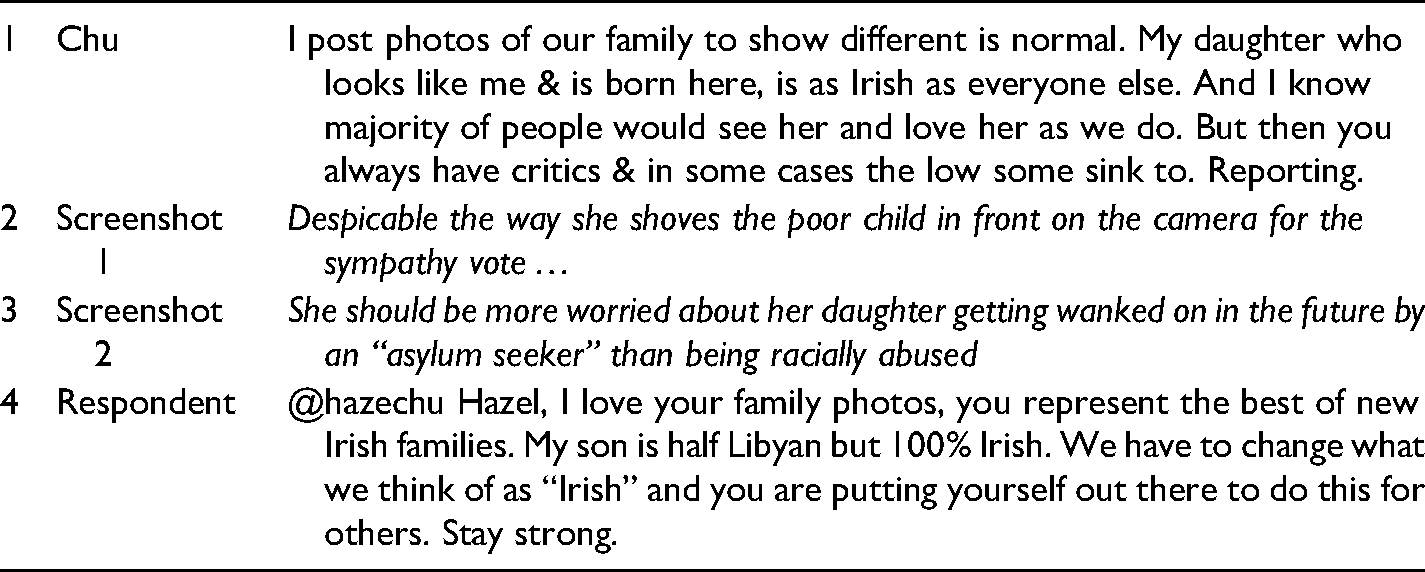
The respondent in line 4, offers a favorable evaluation of Chu's family photographs and an extremely favorable evaluation of her family: “the best of new Irish families.” This latter evaluation treats Chu and her family as “new Irish,” which is subsequently elaborated on. The user describes their son as “half Libyan but 100% Irish” pointing to possible similarities between their and Chu's children. Further, the user treats Chu's actions of posting photographs of her family as having a societal impact in terms of influencing understandings of which type of person is “Irish.” This again is evaluated favorably in terms of indicating courage: “putting yourself out there.”
It is noteworthy that in distinction to the responses seen earlier, the respondent neither offers a ready affirmation of Chu or her family's Irish identity nor develops a distinction between those who might be targeting Chu and others such as the respondent who is inclusive. Rather, the respondent constructs an alternative identity category “new Irish” and treats themselves and Chu as co-members in this category. This however is not treated as distinct to any other version of “Irish.”
In Extract 8, Amanullah DeSondy, claims about being targeted of racism related to his Irishness. The response similarly makes relevant racial and national identities in ways to offer alternatives to a singular Irish identity. Extract 8 was posted on January 17, 2021.
Extract 8
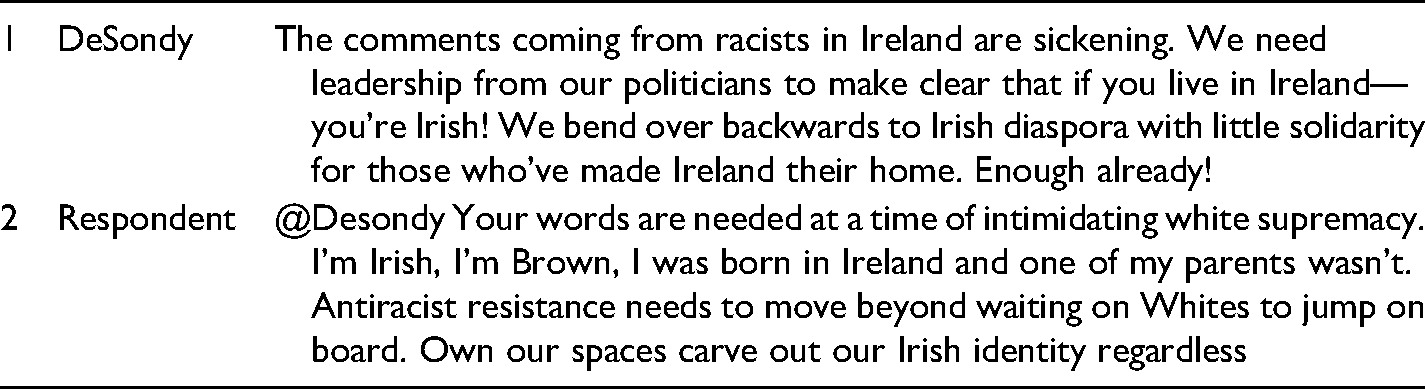
In his tweet (1), DeSondy does not explicitly indicate being a target/victim of racism. Rather, his tweet is aimed at bringing to notice prevalent “comments coming from racists in Ireland.” He specifically identifies the issue as that which deals with rights to being seen as “Irish.” To this issue, he makes the claim that people who “live in Ireland” are to be seen as “Irish” and not subject to problematic treatment.
The respondent at 2, orients to the issues at hand as those which deal with identity and belonging with the national group “Irish.” The respondent explicitly includes their national and racial identities (I’m Irish, I’m Brown) in ways to present themselves as possible targets of racism as mentioned by DeSondy. The respondent offers additional detail that might make their national belonging an issue of potential contention by “racists”: “I was born in Ireland and one of my parents wasn't.” Both identity claims present the user as straddling two distinct identities. Similar to Extract 7, this duality is treated as a possible reason for being targets of racism. Here, the respondent offers an alternative to the suggestion made by DeSondy in terms of taking initiative in developing an Irish identity that is relevant to individuals such as themselves, rather than look to politicians or other agents.
In both cases, users responding to claims of being targets/victims of racism used their own racial and Irish identities to offer an alternative to a normative Irish identity. It is then notable that the respondents here did not offer an affirmation of the targets’ Irishness. Rather, their responses were around how best to change what is routinely understood by “Irish.”
Discussion
In this paper, I examined heretofore unexamined interactional practices of antiracism in doing inclusion when concerns over belonging with the national group are salient. The paper examined intergroup communication in the form of complaining about race-based exclusion and responses to these that affirmed targets’ membership in the national group and thus constituted antiracist practices. I examined this phenomenon in the case of interactions on Twitter in the Irish context, where the routine common-sense notion is that Irish ethnicity is synonymous with nationality. The findings show that in doing inclusiveness, respondents attended to their own positions as Irish persons and as different to those others who were undermining the Irishness of those who were targets of racism. In the present data, interactions are initiated by complaints about being targets of racist exclusion or what has been identified as misrecognition (Xie et al., 2021). Respondents’ practices of doing inclusion bring-up their own status as Irish persons. Overall, the findings show that national identities provide fertile ground to do antiracism (Anjum et al., 2017).
First, participants identified and responded to targets’ complaints about their national inclusion through reaffirmations. Respondents did so either by directly affirming that the targets were Irish (Extracts 1 and 2), using banal referents for national identity (Extracts 3 and 4) or highlighting the Irishness of the target over those others (Extracts 5 and 6). Instead of downplaying the importance of national belonging respondents treated this as relevant over those of targets’ ethnic/racial identities. Previous research identifies the importance of majority group members’ practices, for the inclusion of minority group members (Anjum et al., 2017; Verkuyten, 2001, 2005). Research also shows that minority groups’ identities are shaped in response to majority group members’ practices. The present findings show that reiterating the importance of national belonging by majority group members’ practices is one way to address concerns over inclusion.
Second, respondents oriented to the implications that the complaints reflect upon Ireland and their Irishness, which echoed targets’ favorable dispositions towards Ireland and Irish persons. Respondents constructed Ireland and Irish persons as welcoming of diversity and inclusive alongside offering highly favorable evaluations of targets (all except Extract 1). Respondents also developed a contrast between Irish persons who are inclusive and those others who engage in exclusionary activities. For instance, respondents’ highly favorable evaluations of the targets were produced on behalf of a national polity through practices of banal nationalism (Billig, 1995) in using pronouns like “we” (Extracts 3 and 4). This constructed routine Irishness as that which is inclusive, similar to other research findings (Every & Augoustinos, 2007). Respondents also developed an explicit contrast between “Real” Irish persons and those who might take up racist or fascist actions (Extracts 5 and 6) (Benwell, 2012). However, this contrast was treated as problematic for implying that the respondents were somehow better than those who the targets were complaining about.
Third, for respondents, their status either as uncontested (Extracts 1 through 6) or potentially troublesome (Extracts 7 and 8) claims to be Irish was relevant for their efforts at inclusion (Freyne, 2020). Respondents did so through claims such as “born and raised” (Extract 1), “as Irish as me” (Extract 2) or “we” (Extract 3). In that, their solidarity took the form of foregrounding their Irish identities than moral or antiracist stances. In Extracts 7 and 8 however, respondents indexed their own racial or ethnic identities alongside their Irish status to claim for themselves and the targets hybrid identities that changed the meaning of being Irish, similar to that identified by Bélanger and Verkuyten (2010). Of note also is that this practice offers an alternative to routine understandings of Irishness to mean White, as examined by Carr and Haynes (2013).
Extensive discursive research points to denials and suppression of accusations of racism (Augoustinos & Every, 2007; van Dijk, 1992). Sambaraju and Minescu (2018) show that majority group members do not treat themselves as having the rights to make claims about racism that ethnic minority members may face. In the present case, majority group members treat their majority status to mean having rights and responsibilities to be antiracist. They not only affirmed the identities of those facing noninclusion and racism, but also downgraded the membership of “racist others.” For respondents, national belonging was oriented to as significant for those complaining about inclusion, for themselves, and for those who were engaging in racist exclusion of targets. They affirmed the inclusion of those complaining, foregrounded their uncontested or complicated belonging in Ireland and downgraded racist others’ membership in Ireland. Respondents were then invested in promoting belonging in the Irish nation as an overall progressive and inclusive position.
National identities can be treated as overarching identities that can accommodate various forms of racial/ethnic identities. This is particularly so in increasingly racially diverse nation-states. For instance, Shrikant (2018) points to the importance of the availability of hyphenated Asian-American identities for flexible negotiation of inclusion in the United States. For Anjum et al. (2017) British Muslim participants could see themselves as British while not being White. Reynolds et al. (2015) argue that national identities can be promoted in ways to be more inclusive and thus counter prejudice and racist discrimination. In the present data, similar issues are at stake. The complaints about racism stem from noninclusion in the national category. Respondents’ status vis-à-vis Ireland informs their ways of affirming inclusion of those complaining and addressing issues with other parties. Notably, respondents eschewed the relevance of race/ethnicity for themselves and targets. Rather national identities and belonging were given priority (Augoustinos & Every, 2007). In Extracts 7 and 8, those with potentially contested claims to Irishness foregrounded their racial group membership. Together, these point to potential pitfalls in foregrounding nations and national identities for antiracism: issues of race/ethnicity can be treated as less important than those of national group membership.
Given these findings, antiracism in Ireland to the extent that it prioritizes national belonging in the aftermath of BLM movements could be more cognizant of reproducing nations and nationalisms. Although the White majority in Ireland participate as White allies, they might unwittingly reinforce national identities over that of racial pluralism (Sambaraju, 2020). At a more interpersonal and intergroup level, the findings point to the possibilities and constraints of doing antiracism on digital media. Acts of affirming identities can work to challenge acts of exclusion that ethnic minority members may face. In doing so, constitute an antiracist practice in the face of notable hate speech on digital media (Siapera, 2019).
The present data come from a specific practice of self-directed data collection process. These also come from a social media platform designed to further user engagement. Further, the present data are from the Irish context, without any mention of anti-Traveler2 racism or exclusion. In combination, these yield unique interactions where rather privileged migrants or ethnic others are targets of and make claims about being targets of racism in terms of national group membership as seen in the complaints and the redressals by the national majority. The present claims are then about how national identities can work as means of complaining about racism and addressing these complaints through antiracism.
Conclusion
The present findings show the importance of national identities in antiracism. Affirming minority group members’ national identities was a core practice of doing antiracism. It is counter to othering (Riggins, 1997), in so far as this addresses those who might be othered from the national group because of their ethnicity. However, prioritizing national identities can result in edifying nations and nationalism as the only means of doing antiracism. Future research can then usefully examine possibilities for antiracism that complicate ideas about nations and national identities, through for instance examining possibilities for full racial inclusion in national identities.
Footnotes
Declaration of Conflicting Interests
The authors declared no potential conflicts of interest with respect to the research, authorship, and/or publication of this article.
Funding
The authors received no financial support for the research, authorship, and/or publication of this article.
