




Abstract
Verbal mimicry research claims that repeating words spoken by another makes people more eager to comply with requests made by the mimicker (e.g., fulfilling a request to donate to charity). Instead, another mechanism might explain these results. Recent studies found that when a request was preceded by engaging a participant in dialogue (defined as a short conversation), the participant was more willing to fulfill the request. Thus, verbal mimicry might be perceived in the same way as dialogue. If this is the case, a theoretical confound would be revealed. To test whether the mechanisms are different of the same, two field studies were conducted using a 2 (dialogue: yes/no) × 2 (mimicry: yes/no) design. The study results revealed two main effects and no interaction effects, which means that verbal mimicry and dialogue are two distinct mechanisms. Interestingly, additive effects for these mechanisms were found.
Introduction
On one hand, it is trivial to say that people are social animals. While on the other, delivering an enumerative list of all the mechanisms involved in making this so may be considered a challenge for social psychology. One such mechanism, verbal mimicry, is thought to play a key role as new relationships are formed and existing ones are maintained (Garrod & Pickering, 2009; Giles, Taylor, & Bourhis, 1973). Research into mimicry during social interactions reveals that we tend to mimic others’ accents (Giles & Powesland, 1975), tone of voice (Neumann & Strack, 2000), rate of speech (Webb, 1969), rhythm of speech (Cappella & Planalp, 1981), speech melody (Mantell & Pfordresher, 2013), and syntax (Levelt & Kelter, 1982).
Why do we do these things? Well simply put, we mimic because it is in our individual or collective interest to do so (Jacob, Guéguen, Martin, & Boulbry, 2011; van Baaren, Holland, Kawakami, & van Knippenberg, 2004). The literature identifies a wide range of positive outcomes the use of verbal mimicry can yield: financial benefits for the mimicker (van Baaren, Holland, Steenaert, & van Knippenberg, 2003), increased trust toward the mimicker (Swaab, Maddux, & Sinaceur, 2011), increased sales numbers (Jacob et al., 2011), increased compliance with requests for charitable donations (Kulesza, Dolinski, Huisman, & Majewski, 2014), and increased sexual attractiveness ratings of the mimicker (Guéguen, 2009). In each of these cases, speaking back words spoken by the participant benefited the mimicker or those associated with them (e.g., the store in which mimicker works: Jacob et al., 2011; fulfilling requests by other people: van Baaren et al., 2004).
How do we use verbal mimicry for our benefit? It is fairly easy. In van Baaren et al. (2003), the confederate, a waitress, either repeated everything the customers said to her or, in the control condition, responded only with brief statements like “okay!” or “coming up!” Jacob et al. (2011) set their experiment in a household store. In this case, the confederate (acting as a clerk) when asked by the client, “Could you please give me some advice about an MP3 player?” repeated, “Advice about an MP3 player? Yes, of course,” in the mimicking condition. While in the nonmimicry condition, the confederate only said, “Yes, of course.” Alternatively, Guéguen (2009) used the setting of speed-dating parties. In this study, the confederate mimicked expressions like “It’s great” or “It’s fun,” or when the participant asked, “You really do this?” she replied, “Yes, I really do this.” In the nonmimicry condition, the confederate stayed silent and did not benefit.
However real and supported by research the link between verbal mimicry and its outcomes seems, there is at least one alternate explanation. A quick look through the verbal mimicry literature reveals that during the mimicry condition, the confederate speaks with participants, so they are in dialogue. On the contrary, during the nonmimicry condition, they are not in dialogue. Thus, the results attributed to mimicry may actually be a result of dialogue, which is well-known to be an effective tool of social influence (Dolinski, Grzyb, Olejnik, Prusakowski, & Urban, 2005; Dolinski, Nawrat, & Rudak, 2001). From this perspective, one could argue that it is incorrect to treat verbal mimicry and the echo effect (a term recently introduced in the Journal of Language and Social Psychology to describe the outcome of verbal mimicry by Kulesza et al., 2014) as separate from dialogue, with “the dialogue effect” explaining both lines of research.
On the other hand, of course, the exact opposite relationship is also possible, where the echo effect and dialogue share no theoretical common ground. Simply stated, the goal of the present research is to determine if the outcomes of verbal mimicry and dialogue interactions are the result of two distinct mechanisms, or whether the effects of verbal mimicry arise from engaging people in dialogue.
Dialogue
As a social influence technique, the definition of dialogue is close to that of the dictionary definition of dialogue. The Oxford Dictionary online defines dialogue as “a conversation, or discussion between two or more people” (“Dialogue,” n.d.). Under normal conditions, dialogue is simply a conversation, or verbal interaction, between two people. As a social influence technique, it is a conversation where one party has a goal and is using dialogue to increase the likelihood that that goal will be reached.
Looking into dialogue as a social influence technique, Dolinski et al. (2001) found that when a request was preceded by engaging a participant in dialogue, the participant was more willing to fulfill a request. For example, students at a local university were approached by the experimenter saying, “Hi! Has this semester been hard for you? How many courses are you taking?” After listening to the answer provided by the student, another question was asked, “So how are you feeling before exams?” After hearing the answer, the experimenter asked the participant to help raise money for a local orphanage. In the control condition, the same request was preceded by the brief greeting “Hi!” Analyses revealed that involving participants in a short conservation resulted in a greater likelihood of compliance with the request.
In a second study, the experimenter asked people walking on the street a question: “Good afternoon! How are you feeling today?” After hearing the reply (positive: “I am feeling okay,” or negative: “Not so good”), the experimenter responded accordingly (“I am happy to hear that/I am sorry to hear that”) and asked whether they were interested in buying aromatic incense sticks. During the control condition, the experimenter initiated the interaction with a simple “Good afternoon.” Analysis revealed that more people were willing to purchase the incense sticks in the experimental condition than in the control condition.
In the third experiment, the experimenter engaged in either a monologue or a dialogue with students at a local university. Every interaction started with the monologue or dialogue and was followed by a request to donate money to a children’s charity. In the monologue condition, a simple “Hi! I hope you are fine today!” or “I guess you are studying here” preceded this request. In the dialogue condition, the experimenter asked, “May I ask what you are majoring in?” and followed up with, “Well, do you consider it worth studying?” or alternatively asked, “How are you today? How are you feeling?” The students were more likely to comply with the request to support charity organization when involved in a dialogue than when a request was preceded by the monologue condition. This result was replicated in the fourth experiment, where pedestrians were asked to donate money to charity. The authors concluded that engaging a person in dialogue increases her or his willingness to comply with a request. This result was attributed to dialogue drawing participants in the dialogue condition into a “friendship” script, leading to their increased willingness to comply with the request from the confederate (we tend to fulfill requests made by our friends at a higher rate, as opposed to those made by strangers). It is characteristic for an interaction between friends to be in the form of a conversation or dialogue, while in comparison, encounters with a stranger more often occur in the form of a monologue (Burger, 2007; Burger, Messian, Patel, del Prado, & Anderson, 2004). This distinction explains why participants were more eager to fulfill the confederate’s request.
Verbal Mimicry From the Perspective of Dialogue
Over the course of two studies, recent research by Kulesza et al. (2014) included manipulations of verbal mimicry and dialogue in the real-world setting of a currency exchange office. The experiment was designed so that the currency exchange office clients interacted with a cashier in one of five conditions. During the first experimental condition, the customer’s statement was mimicked in such a way that word order was held constant, as was the content of the statement. In the second scenario, the cashier changed the word order used by the customer but mimicked their words. For example, if the customer said, “Transaction: exchange of 1,000 US dollars,” the reply was, “Transaction: 1,000 US dollars exchange.” In the third experimental condition, the cashier only mimicked the number of words used by the customer. In this scenario, the cashier would reply by saying, “The currency exchange rate varies lately.” Two other experimental conditions tested control scenarios. In the first, a brief reply was given to the customer, as in van Baaren et al. (2003), “Okay” or “right away!” In the second, the cashier stayed silent. The results of their study indicated that while repetition of words is important in increasing an individual’s tendency to perform prosocial behaviors, the order in which they are repeated back is not. In addition, for nonmimicry control conditions, no response produced the same result as a brief response. As such, they concluded that verbal mimicry is a more powerful mechanism than dialogue.
However, Kulesza et al. (2014) did not set out to determine whether verbal mimicry was different from dialogue, so their study was not set up to make this distinction. Also, their research design did not include a “real dialogue” condition (i.e., Dolinski et al., 2001; Dolinski et al., 2005). In Kulesza et al. (2014), the experimenter might be perceived as not being engaged in or invested in the interaction since he only stated a general opinion about the day’s current currency exchange rates. Indeed, there was no extended dialogue interaction sequence, as in the studies by Dolinski et al. (2001) and Dolinski et al. (2005), where the experimenter would ask about the weather or how the participant was feeling, respond accordingly, and thereafter engage in verbal mimicry. Thus, with these data in hand, one cannot determine if the proposed theoretical confound between dialogue and verbal mimicry is real, and so to date, this issue remains unresolved. Kulesza et al. (2014) suggested a follow-up study to do so using an experimental design of 2 (mimicry—yes vs. no) × 2 (dialogue—yes vs. no). In the present research, we chose to implement this design across two studies conducted in real-world settings.
The Goal of the Study
Looking at verbal mimicry experiments through the lens of dialogue, it becomes clear that results attributed to verbal mimicry could, in fact, be a result of dialogue. In other words, the effects of engaging others in dialogue and verbal mimicry might result from the same mechanism (where each is triggered by the process of verbally interacting with another, and there is nothing special in the act of speaking back words), or they could be the outcome of two distinct mechanisms. For example, the waitress’s echoing behavior may have yielded positive results because it was perceived by clients as a form of dialogue. Had an additional scenario been included where a neutral topic was raised, such as the weather, then it would be possible to determine if verbal mimicry or dialogue (or both) led to the positive result.
The aim of the present study is to test whether engaging participants in dialogue followed by verbal mimicry will produce the same outcome as engaging participants in dialogue without following up with verbal mimicry. If this were to turn out to be true, it would pose a serious challenge to verbal mimicry as an independent social influence technique. Dialogue, rather than mimicry, would prove to be the key factor driving the positive outcomes found in previous research, and one could not claim the existence of an “echo effect” that exists separately from the “dialogue effect.” On the other hand, if the results reveal a significant difference between the experimental conditions (dialogue + mimicry vs. dialogue + no-mimicry), the theoretical distinction between dialogue and verbal mimicry would remain valid.
The current research split the sequence of each interaction into two phases. In the first phase, we manipulated the presence of dialogue (dialogue: present vs. not present). In the second phase, we manipulated the presence of verbal mimicry (verbal mimicry: present vs. not present). This experimental design enabled us to compare two specific experimental conditions: (a) dialogue present in Phase 1 + verbal mimicry not present in Phase 2 and (b) dialogue present in Phase 1 + verbal mimicry present in Phase 2. If no differences were found between these two conditions, then we could claim that there is no real distinction between verbal mimicry and dialogue since adding verbal mimicry does not change the pattern of the results. If each of these conditions were to produce different results, then we would have to conclude that they are distinct mechanisms of social influence.
Finally, this experimental design will also reveal whether verbal mimicry accompanied by another technique results in greater compliance or if there is a ceiling effect. Answering this question is not a primary goal of this research; however, determining if there is an additive effect will enrich the verbal mimicry literature since there is no such research to date.
Experiment 1
Method
Participants
One hundred and eighty news and ticket kiosk customers took part in the study (99 women and 81 men; age was not recorded due to the naturalistic design of the experiment; the number of participants was fixed: 45 per experimental condition following recommendations by Simmons, Nelson, & Simonsohn, 2011). Participants were randomly assigned to one of four conditions.
Variables
The first independent variable was dialogue. This manipulation took place first and was Phase 1 of the experimental scenario. Modeled after the procedure introduced by Dolinski et al. (2001), during the dialogue condition, the confederate (kiosk clerk) initiated a conversation by asking about the participant’s health or talking about the weather. In the nondialogue condition, the confederate remained silent at the beginning of the interaction and did not initiate the interaction (Though she did always return greetings like “hello, good morning.” This behavior was in the script and happened at the beginning of every interaction, and under the circumstances, not replying with the expected response would be surprising for the client, and it could result in eagerness to fulfill the clerk’s requests; see Davis & Knowles, 1999; Vallacher & Wegner, 1987).
The second independent variable was verbal mimicry: see van Baaren et al. (2003) and others cited earlier. This manipulation comprised Phase 2 of the experimental scenario. In the mimicry condition, the confederate verbally mimicked statements expressed by the client while placing an order. In the nonmimicry condition, the experimenter responded only with short confirmations of the client’s order by saying “okay” or “right away.”
Following the experimental designs of van Baaren et al. (2004; verbal mimicry) and Dolinski et al. (2001; dialogue), on concluding the transaction, the confederate addressed the customer asking that he or she donate money to a charity organization (for other studies on mimicry where this type of dependent measure was used, see Fischer-Lokou, Martin, Guéguen, & Lamy, 2011; Guéguen, Martin, & Meineri, 2011; Müller, Maaskant, van Baaren, & Dijksterhuis, 2012; Stel, van Baaren, & Vonk, 2008). Within the current study, the amount of money donated comprised the dependent variable and was treated as a proxy for prosocial behavior, as the act of donating demonstrated their willingness to fulfill the clerk’s request. All money collected during the study was transferred directly to the organization’s bank account. Only data from 174 participants (97 women and 77 men) were evaluated. Six participants whose donations were above 3 Polish zloty (PLN; >3 standard deviations) were eliminated. 1
Procedure
The experiment took place in a news and ticket kiosk (where customers buy tickets for public transportation, cigarettes, newspapers, etc.). The confederate was a woman around 30 years old who was blind to the hypothesis and recruited to work in the kiosk for the study. To rule out self-presentation behaviors (e.g., donating to charity to impress others; Rind & Benjamin, 1994 ), the study began when only one customer was present in the kiosk.
First, the dialogue manipulation took place. Depending on the condition, the confederate, following the procedure of Dolinski et al. (2001; Dolinski et al., 2005), either welcomed the client by asking about the weather/health and commented on the answer (dialogue condition) or said nothing (nondialogue condition). In the second step, the confederate verbally mimicked (or not) customer’s order (as in van Baaren et al., 2004). For example, when the customer said, “One pack of cigarettes,” the confederate repeated, “One pack of cigarettes,” while handing the order to the customer. At the end of the interaction, the customer was asked to donate money to a charity organization and a collection box with the logo of the organization was presented to him or her. Finally, the value of each participant’s donation was noted.
Importantly, in each condition, the customer could see the request being carried out immediately and correctly. In this way, we have excluded a challenge not fully managed by van Baaren et al. (2003), where the order was delivered several minutes after verbal mimicry was performed, which may have influenced customers’ behavior or attitude by introducing the potential for them to perceive the confederate’s behavior as inattentive.
Results
Preliminary analyses revealed that the sex of participants had no impact on the percentage of participants who donated money (χ2 < 1) nor on the amount of money donated (F < 1). For this reason, this variable was dropped from further analysis.
More participants donated money in the dialogue condition (86%) than in the no-dialogue condition (63%; χ2[1, N = 174] = 12.17, p < .001) and in the mimicry condition (85%) than in the nonmimicry condition (65%), χ2(1, N = 174) = 7.79, p < .006. An analysis of variance of 2 (dialogue vs. no-dialogue) × 2 (verbal mimicry vs. no-mimicry) for the amount donated as a dependent variable revealed two main effects. When a short conversation took place at the beginning of the interaction, participants donated more money (M = 1.35 PLN, SD = 0.87) than in the condition where the confederate stayed silent (M = 0.62 PLN, SD = 0.69), F(1, 170) = 40.62, p < .001, η2 = .19. Mimicked participants donated significantly more money (M = 1.12 PLN, SD = 0.82) than nonmimicked participants (M = 0.77 PLN, SD = 0.86), F(1, 170) = 13.85, p < .01, η2 = .07. There was not a significant interaction effect between dialogue and mimicry for the amount of money donated, F(1, 170) < 1, n.s. To test if there was an additive effect for both techniques, pairwise comparisons (Bonferroni correction) were performed. This analysis revealed significant differences between several experimental conditions. A summary of these analyses may be found in Table 1.
Experiment 1: Percentage of Participants Who Donated and Mean Donation in Polish Zlotys (SD in Parentheses) for Each Experimental Condition.
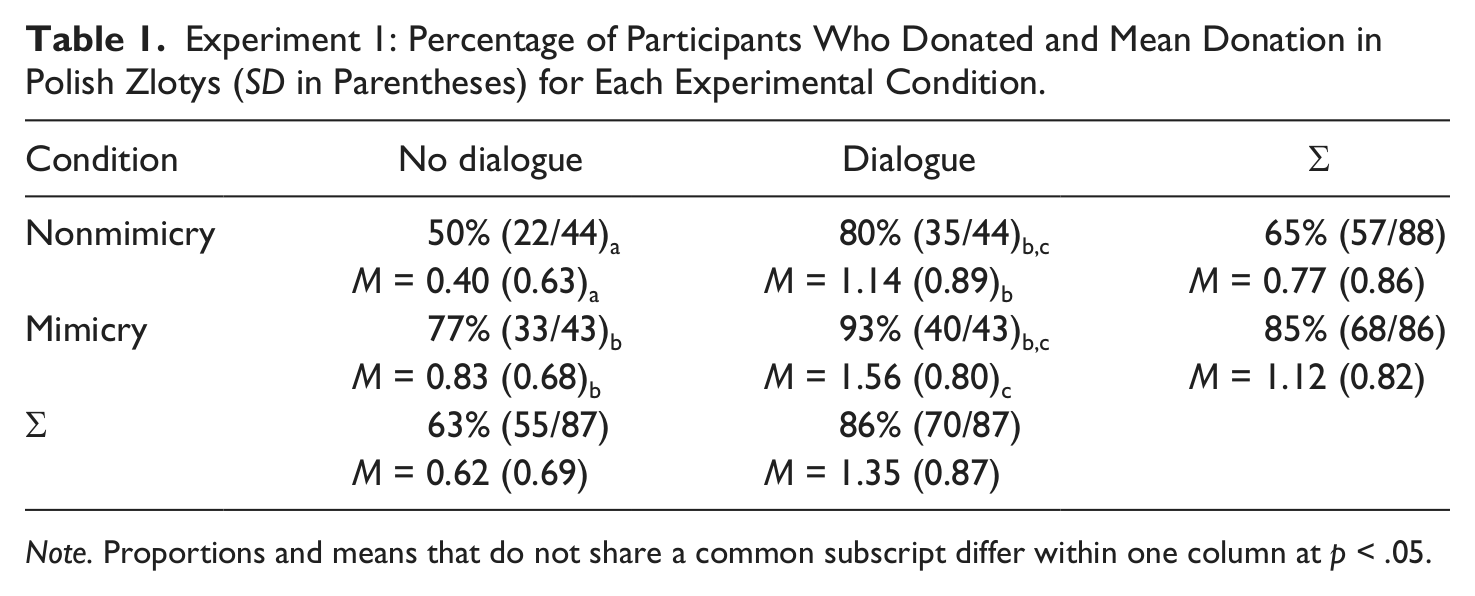
Note. Proportions and means that do not share a common subscript differ within one column at p < .05.
Discussion
A key finding here was that there was a significant difference between the results of the condition where dialogue was followed by verbal mimicry and where dialogue alone was present. Thus, the results of Experiment 1 seem to point to the conclusion that verbal mimicry is a different phenomenon from dialogue as a social influence technique.
The aim of the second study was to replicate the previous results in a different real-world setting. There are several reasons for replicating the experiment under new conditions. For example, as tipping a waiter or waitress in a restaurant is part of a behavioral script for that place (van Baaren et al., 2003), it may be suggested that a news and ticket kiosk is a place where asking for a charity donation may be the part of the script (since it is common to ask for donations to charity at such places). Thus, like using the tip percentage as a dependent variable, charitable donations at a sales kiosk may too heavily rely on that portion of the behavioral script. Rather, a behavior that would not normally occur as part of the behavioral script of this setting should have been tested. The next study was designed to address this issue and answer a call for the replication of a previous study.
Experiment 2
Method
Participants
One hundred and four participants (clients of a currency exchange office) took part in the second study (51 women and 53 men; again age was not recorded). The number of participants was fixed (26 per experimental condition), and we did not drop any data (Simmons et al., 2011). Participants were randomly assigned to one of four conditions performed by the confederate (a male in his 40s who was blind to the hypothesis).
Variables
As in the first study, the experimental design was created by 2 × 2 schema: dialogue and mimicry, and donations created the dependent variable. The manipulation of variables occurred in the same order as in Experiment 1.
Procedure
The experiment was conducted at a foreign currency exchange office. As in the first study, participants had to be alone. In addition, since the confederate (highly experienced in the position of a cashier) was asking participants to donate money to a charity organization, the participants also had to be exchanging money into PLN. Finally, participants were all native Poles to ensure a high level of competency in the language (foreigners are not rare in such places).
When the client entered, the experiment began. First, the dialogue manipulation took place. In the next step, the confederate verbally mimicked (or not) the client’s order. At the end of the interaction, the customer was asked to donate money to a charity organization. Again, in each condition, the customer could see the request being carried out immediately and correctly. Finally, all of the donated funds were immediately wire-transferred to the charity organization. When the interaction ended and the customer left the exchange office, the value of each participant’s donation was recorded, as were the details of the transaction (euro = 51%, U.S. dollars = 20.2%, and British pounds = 14.4%, with other currencies making up the remaining 14.4%) and the gender of the participant.
Results
As in the previous study, preliminary analyses showed that the sex of participants had no impact on the percentage of donations in each condition (χ2 < 1) nor on the amount of money donated (F < 1). For this reason, this variable was dropped from further analysis.
Analysis revealed that the frequency of donations across the dialogue and verbal mimicry conditions alone did not reach significance for either scenario. In the dialogue condition, participants donated money slightly more often (87%) than in the no-dialogue condition (75%; χ2[1, N = 104] = 3.0, p < .08). The difference between the mimicry condition (85%) and nonmimicry condition (77%) was not significant; χ2(1, N = 104) = 2.42, p < .12.
To test the impact of dialogue and verbal mimicry on the amount of money donated, an analysis of variance was performed (for dialogue × verbal mimicry), and again, two main effects were found. The main effect of dialogue was close to statistical significance, F(1, 100) = 3.81, p = .054, η2 = .037. Participants involved in dialogue donated more money (M = 2.98 PLN, SD = 2.28) than those in the nondialogue condition (M = 2.19 PLN, SD = 2.21). Also, a main effect for mimicry was found, F(1, 100) = 20.77, p < .001, η2 = .17. When verbal mimicry was present, the participants donated more money (M = 3.50 PLN, SD = 2.47) than in nonmimicry condition (M = 1.67 PLN, SD = 1.62). Again, no interaction effect was found, F(1, 100) = 2.07, n.s. As in Experiment 1, pairwise comparisons (Bonferroni correction) were performed to test for a possible additive effect. This analysis revealed several significant differences that are presented in Table 2. As one can see, the results indicate that the dialogue and mimicry effects are additive.
Experiment 2: Percentage of Participants Who Donated and Mean Donation in Polish Zlotys (SD in Parentheses) for Each Experimental Condition.
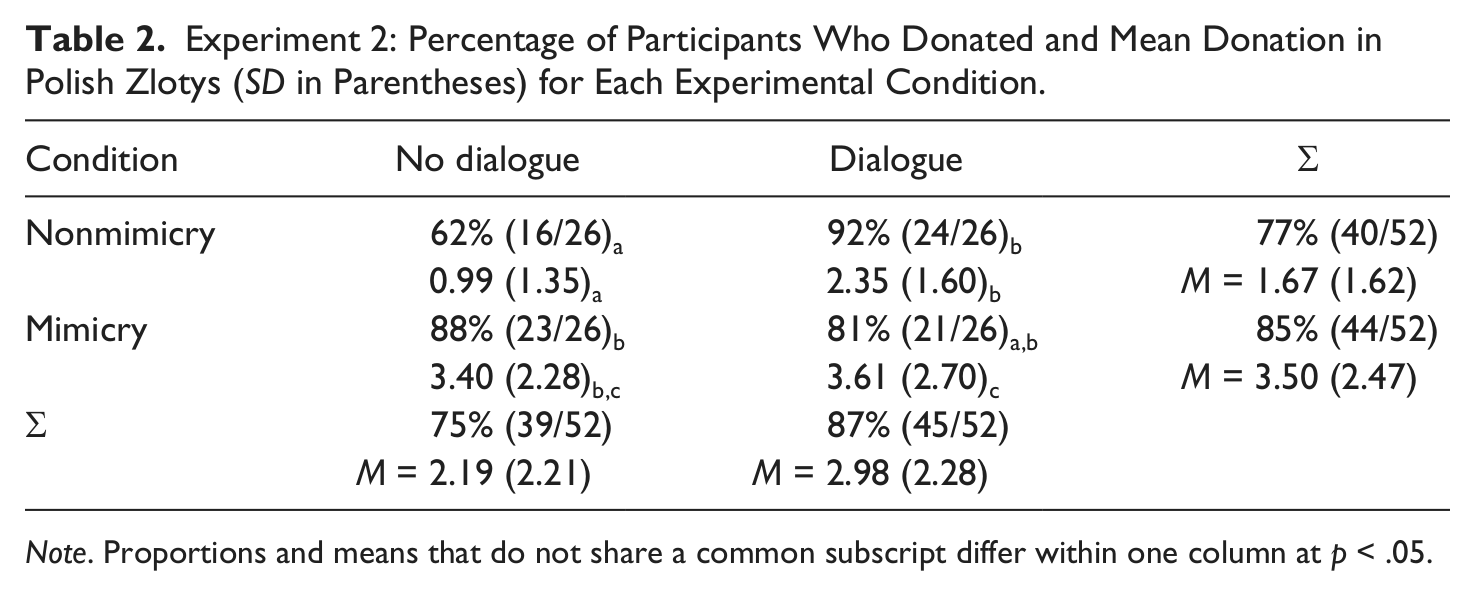
Note. Proportions and means that do not share a common subscript differ within one column at p < .05.
Discussion
A similar pattern of results was observed in Experiment 2 as in Experiment 1. These results lead us to conclude that dialogue and verbal mimicry are two different social influence mechanisms and should be treated as such. In other words, when verbal mimicry was removed from the interaction script, the tendency to fulfill requests made by the mimicker decreased. This suggests that verbal mimicry is the mechanism responsible for the pattern of the results. The results also demonstrate that the combination of dialogue and verbal mimicry increases the participant’s tendency to donate more money, as compared with dialogue alone. Additionally, changing the location of the study from a setting where asking for a donation might be perceived as part of the behavioral script did not change the pattern of the results.
General Discussion
The goal of the article was to investigate the concern that the results attributed to verbal mimicry may actually be a result of dialogue. If this were to turn out to be true then verbal mimicry could no longer be treated as an independent social influence mechanism. The rationale for this concern was built on results from research into dialogue as a tool for social influence. Under this assumption, it was proposed that had dialogue been used in place of verbal mimicry in mimicry research, dialogue may have led to the same results. If this turned out to be the case, then these two psychological concepts could not continue to be treated as separate mechanisms and would instead have to be merged into a single area of study.
Since it is impossible to propose a method to test the impact of verbal mimicry entirely absent of dialogue, because a verbal mimicry interaction is at its most basic level dialogue, another, indirect method was employed where dialogue and verbal mimicry were paired or presented independently. The purpose of this design was to investigate the influence of dialogue and verbal mimicry by tracking the pattern of results and comparing them across conditions. If the pattern of results was different across conditions, that would allow us to conclude that the mechanisms of dialogue and verbal mimicry were different; if they turned out to be the same, then we must conclude that the mechanisms of dialogue and verbal mimicry were the same and that the echo effect (Kulesza et al., 2014) is real.
Ultimately, the research herein makes the case for keeping the two lines of research separate. Neither was there an interaction effect between the dialogue and verbal mimicry techniques, nor was there an overlapping of the effects. This means that these two mechanisms are separate and should continue to be investigated independently of one another. This pattern allows us to conclude that foundations of verbal mimicry are not located in the dialogue mechanism. These results provide new insight into the study of verbal mimicry, distinguishing it from dialogue and shedding light on how using other social influence techniques in conjunction with verbal mimicry can enhance the mechanisms’ power.
Since the area of verbal mimicry is still not well researched, the present study is initial rather than definitive. Thus, more research is needed to fully understand all the aspects of this phenomenon. For example, one might propose manipulating the sequence of the two independent variables. Within the current research, the dialogue manipulation always took place first and the mimicry manipulation came second. This sequence (dialogue and then mimicry) was an intentional part of the experimental design. While conducting pilot research, we discovered that mimicry performed at the beginning of an interaction might be perceived as a dialogue. We managed this issue by conducting the dialogue manipulation first and the mimicry manipulation second. Future research may take on the challenge of developing an experimental design that would address this sequence issue.
Another interesting area of human interaction that has not been well researched is touch. Recent work by Dolinski (2010) indicated that touching another person during an interaction may be an effective tool for social influence. As mentioned previously, it is thought that mimicry evolved as a social influence tool to support the creation and maintenance of social bonds with others. If this is the case, touch may be another way to influence the formation and solidification of social bonds. This in and of itself is worth future investigation, but it would also be interesting to see how adding touch to a mimicry or dialogue interaction may affect the many possible outcomes. One might ask whether adding nonverbal aspects of human communication to a verbal mimicry manipulation might result in higher compliance to requests. Or, on the other hand, is there a maximum level of compliance one can expect the use of social influence mechanisms to yield—where doing more will lead to the same result as doing less?
As an area of study, verbal mimicry holds a lot of promise in the way of shedding some light onto the mysteries and nuances of human interaction. Currently, the field is wide open for exploration into the conditions under which its influence will hold, but the question lingers as to why verbal mimicry influences the mimickee. A likely explanation comes from the communication accommodation theory (Gallois & Giles, 1998; Giles et al., 1973). The communication accommodation theory states that when two people are interacting, they adjust speech, vocal patterns, and gestures in reaction to changes made by one party of the interaction. In comparison, mimicry may be perceived as a tool used by the mimicker to manage interpersonal relations with the mimickee. From this perspective, the mimicker accommodates and converges with the partner of the interaction (Giles, 2008), which leads the mimickee to the feeling of affiliation. Such behavior performed by the mimicker signals full comprehension (Gallois, Ogay, & Giles, 2005; Gasiorek & Giles, 2012), mutual empathy, and common social identities (Harwood, Soliz, & Lin, 2006), thus causing the mimickee to be more vulnerable to requests made by the mimicker, as a result of mimicry evoking the feeling that there is a better mutual understanding/trust (Maddux, Mullen, & Galinsky, 2008; Swaab et al., 2011) between them than actually exists. Understanding the difference between communication accommodation theory and the mimicry phenomenon is key to understanding each theory’s relevance in social interactions. In the first, it is assumed that the tendency to accommodate changes during the interaction happens when both parties wish to affiliate, be appreciated, and maintain positive identity (e.g., Dragojevic & Giles, 2014). The second shows that the reason to do so is to create social glue (Dijksterhuis, 2005; Lakin, Jefferis, Cheng, & Chartrand, 2003), which is a clear exemplification of affiliative tendencies.
Interestingly, the benefits of verbal mimicry can extend beyond just the mimicker (Jacob et al., 2011; Lakin & Chartrand, 2005, 2012; Lakin et al., 2003; van Baaren et al., 2003). This is evidenced in the case of a store clerk using mimicry to increase sales or a cashier soliciting charitable donations. In each of these cases, the benefit does not go to the mimicker, yet the outcome can be attributed to the positive feelings and desire to comply evoked by the use of mimicry. Thus, it is mimicry that forced this pattern of results, even though the direct benefit is linked to the third party.
Footnotes
Acknowledgements
Special thanks to the editor and reviewers for their helpful feedback on previous drafts of this article and to Robert Majewski and Ilona Ambrożkiewicz for their help in data collection.
Declaration of Conflict Interests
The author(s) declared no potential conflicts of interest with respect to the research, authorship, and/or publication of this article.
Funding
The author(s) disclosed receipt of the following financial support for the research, authorship, and/or publication of this article: This research was supported by the Polish Ministry of Science and Higher Education (25504/E-560/M-2012).