




Abstract
The story of Vietnam’s education together with its formulae for success and remaining issues have been much researched. However, there is a rather mysterious group of institutions in the country’s education system that is much less explored yet in close relation to its top ranking in international academic competitions: trường chuyên (specialization schools for the gifted, or in short, gifted schools). Through reviewing government legal documents and relevant reports, this article sketches the overview picture of various fundamental aspects of gifted education in Vietnam, including the evolution history, merits, limitations, and recommendations to improve the system quality. The contribution and shortcomings of this most prestigious group of schools will be examined given the prioritized investment from the Government, current societal context and demands in Vietnam and across the world, alongside most recent global movements in the educational domain.
Introduction
Despite still remaining in the lower-middle income tier, Vietnam’s economy has undergone impressive growth since 1986 and is viewed as ‘the next Asian Tiger’ (Barker & Üngör, 2019). Economic development has formed the basis for increasing attention to investment in education in Vietnam. In addition, as the Vietnamese culture is deeply Confucianism rooted, education is always one of the top priorities in the country, with special focus on talent cultivation (T. M. P. Nguyen et al., 2010, 2013; Tho, 2016; S. D. Tommis, 2015). In addition to achieving significant milestones in ensuring large-scale standard of education quality such as universal access to primary and lower secondary education (Rolleston & Iyer, 2019), the nation has also topped the ranking tables in international assessment programmes and competition and even outweighed the OECD (The Organisation for Economic Cooperation and Development) average ranking in some of the development indices (Barker & Üngör, 2019; Kataoka et al., 2020; Parandeka & Sedmik, 2016).
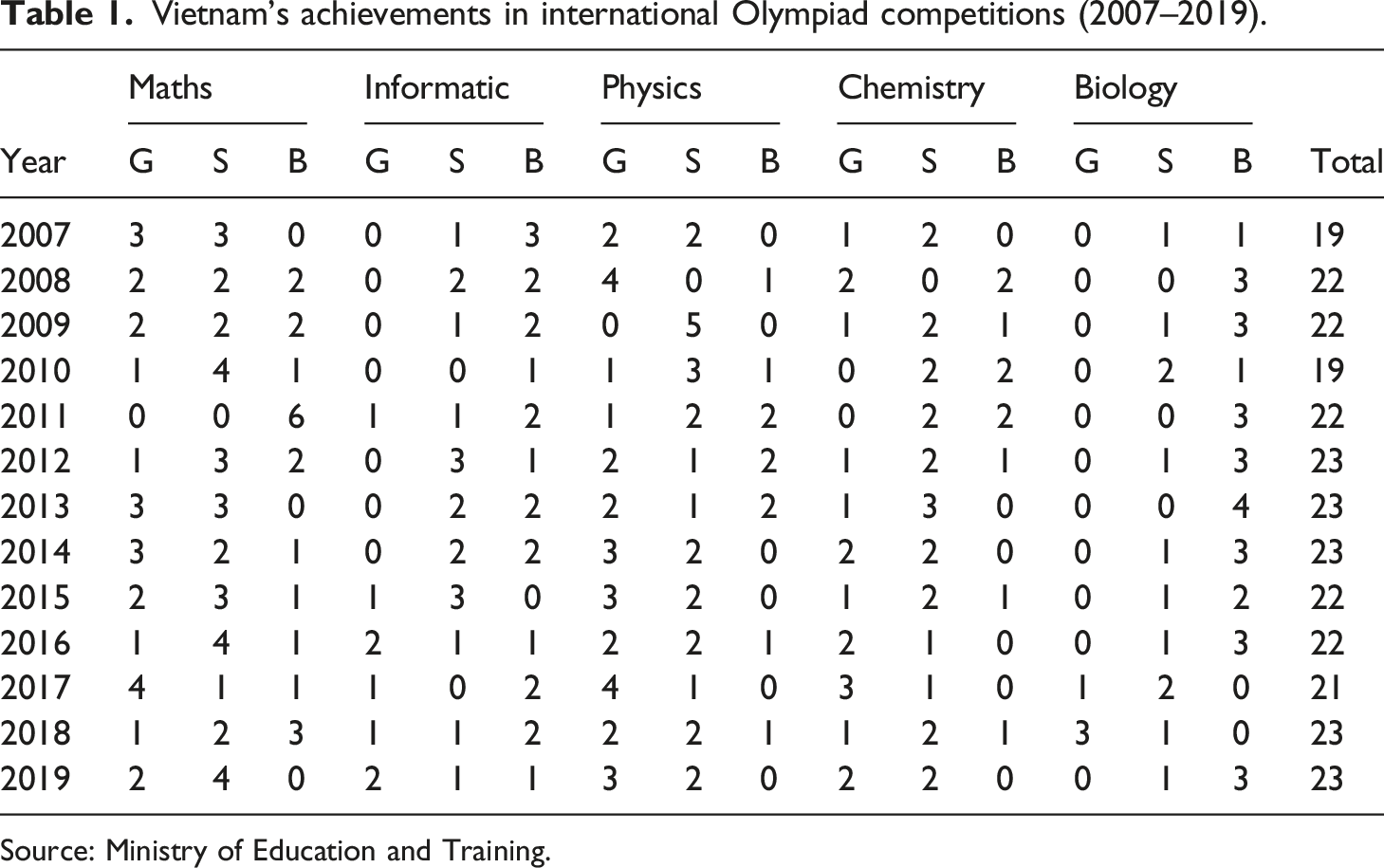
Vietnam’s achievements in international Olympiad competitions (2007–2019).
Source: Ministry of Education and Training.
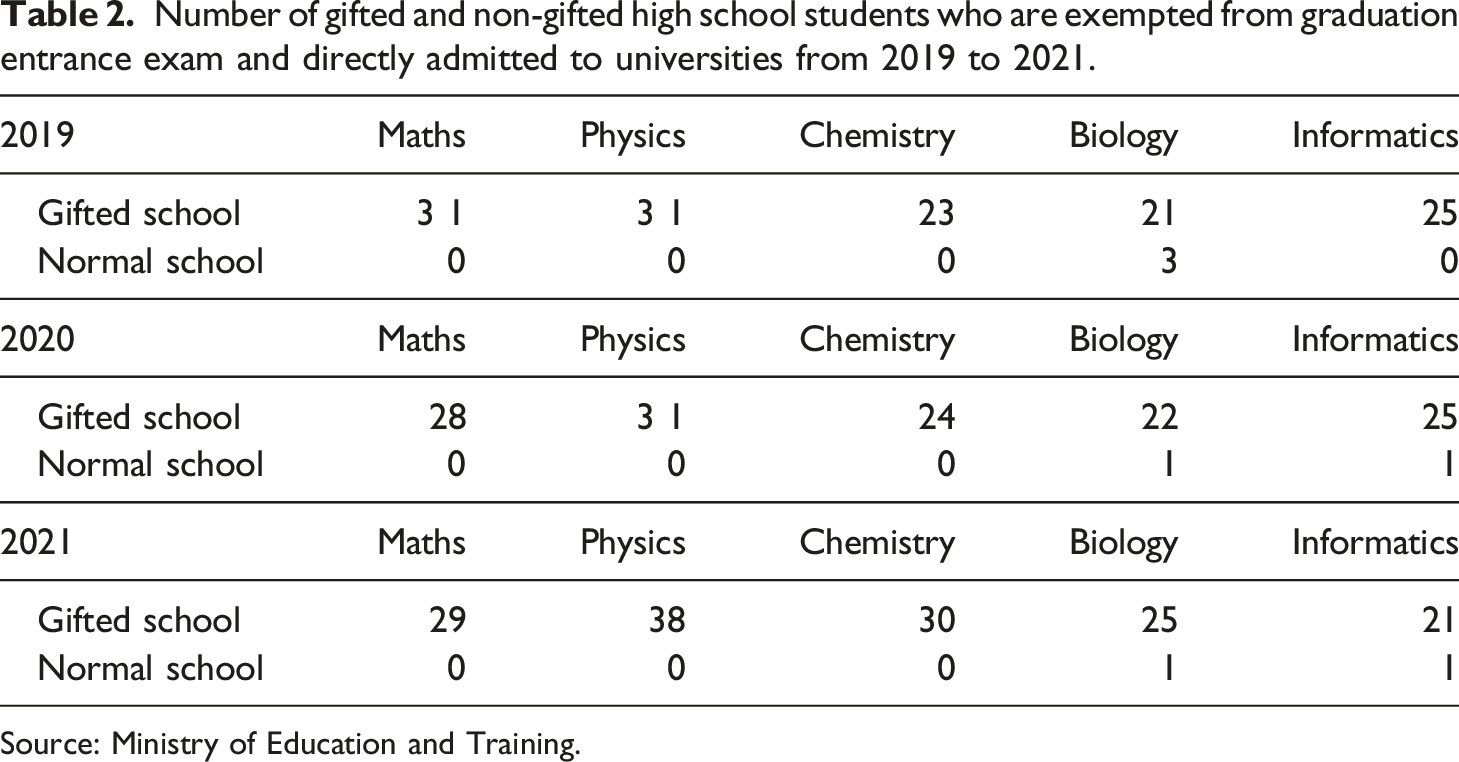
Statistics show that the majority of medal prizes in national and international Olympiads and direct offers to universities are held by gifted school students. In particular, from 2019 to 2021, 97% of prize winners in Vietnam National Olympiads and 96% of international ones are from gifted schools (MOET, 2021). From 2007, there have only been two medal winners in International Olympiads not from gifted school. This is understandable as participation in Olympiads is among one of the top priorities of gifted schools in Vietnam (VNIES, 2021).
Number of gifted and non-gifted high school students who are exempted from graduation entrance exam and directly admitted to universities from 2019 to 2021.
Source: Ministry of Education and Training.
Results of the national high school graduation exam by gifted schools and whole-country schools from 2018 to 2020.

The story of Vietnam’s education together with its formulae for success and remaining issues have been much researched (Kataoka et al., 2020; Parandeka & Sedmik, 2016; Rolleston & Iyer, 2019). The achievements of the country could be attributed to its Government’s commitment and focus on education development with particularly high percentage of public expenditure on education – up to 20%, together with the tradition of valuing education and scholarship among Vietnamese people (Kataoka et al., 2020). Existing issues behind the good grades and ranking on paper of the country, however, are the problem of relevancy – whether the high results actually reflect better skills and abilities of students in reality (Kataoka et al., 2020; Rolleston & Iyer, 2019). Nevertheless, these findings refer to the whole education system while trường chuyên (specialization schools for the gifted, or in short, gifted schools) remains a mysterious group of institutions in the country’s education system that is much less explored yet in close relation to its top ranking in international academic competitions. This article sketches the overview picture of fundamental aspects of gifted education in Vietnam, including the evolution history, systematic characteristics, limitations, and as well as recommendations to improve the system quality, given the prioritized investment from the Government, current societal context and demands in Vietnam and across the world, alongside most recent global movements in the educational domain.
Method
The objective of this paper is, through review of literature and pubic documents, to provide an overview of gifted education in Vietnam, with major themes concerning history, organization, achievements, and implications. Data collection was carried out in three stages (Cronin et al., 2008). Stage 1: Specifying the scope of the study. An initial topic was decided as a search strategy to conduct the literature study. In this paper, the chosen focus was gifted education system for high school students in Vietnam. Stage 2: Searching for literature and public documents concerning the topic. The search language is Vietnamese. Used keywords included: gifted education, gifted students, high school for the gifted, gifted school curriculum, gifted education history, gifted students achievements, evaluation of gifted education, future of gifted education, etc. Source document and data concerning gifted education in Vietnam were accumulated by navigating to the websites and mining the databases of central and local educational agencies such as the Ministry of Education and Training, gifted schools, universities. Government document, including the legislations, circulars and regulations regarding education of gifted students and national reports (in both electronic and printed format) were reviewed in order to gather information relevant to the scope of the study. Stage 3: Compiling, reading, and analysing the text content. The obtained documents were reread several times to create an overview of what was discussed. The entire literature was analysed systematically and critically using categories of pre-determined and emerging codes. This stage will be rolled over at least twice: one to create initial codes and the other to group similar or create more specific codes. The first step began with the generalisation of common themes and concepts frequently mentioned in the data (Rubin & Rubin, 2005). During the second step, more focused and specific codes were created according to the themes and concepts analysed during the initial coding. For example, under the theme “quality”, more specific codes emerged included “curriculum”, or “pedagogy”. A two-column, color-coded technique was used for the coding of the data. Patterns, themes, and concepts will be color-coded based on: (a) their occurrences in all sources of data, (b) evidence/examples of their appearing in the text, and (c) their relevance to the topic guiding this study. In order to ensure all perspectives of the studied topic have been addressed, data will be reviewed and analysed at least three times to identify recurring themes or overlapping concepts.
Gifted Education in Vietnam: A Brief History
The Year 1965 marked the official establishment of gifted education in Vietnam with the foundation of a high school class for Maths talents (now known as HUS High School for Gifted Students) under Hanoi University of Sciences, Vietnam National University. This initiative, envisioned by the Government, was ambitious given the Vietnam’s political and economic situation at the time, with a view to preparing for the country’s post-war development. This model was later generalized for Physics, Chemistry, Informatics and Biology classes and adopted by other universities in Vietnam with the aim of nurturing talents in natural sciences. Gradually, gifted classes with specialization in Mathematics, Vietnamese Literature, Natural and Social Sciences were also established under provincial upper secondary high schools across the countries. Since the 1980s, gifted school system had developed markedly with the birth of provincial comprehensive gifted high schools, combining those gifted classes in each province, which selected and admitted highly able students in natural and social sciences subjects, as well as foreign languages and physical education (SESDP2, 2019).
History of gifted education in Vietnam.
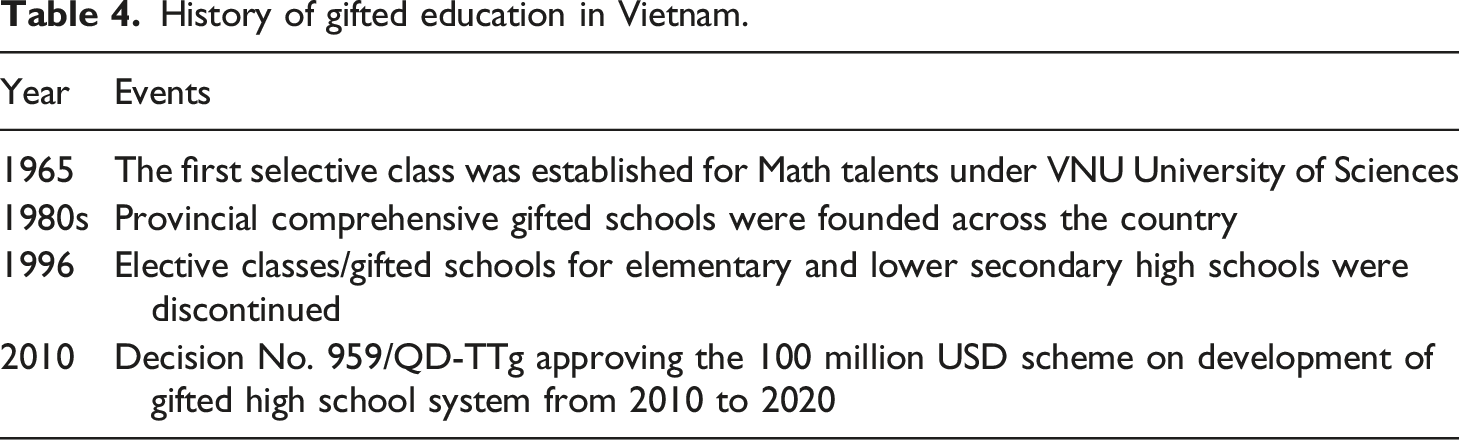
In recent years, gifted education has consistently been focused and invested by the Government with the aim to develop high-quality human resources. On June 24, 2010, the Prime Minister issued Decision No. 959/QD-TTg approving the 125 million USD Scheme on development of Gifted high school system for the period 2010–2020 - a huge amount of funding given the average income level of the country (VPM, 2010). As of 2018–2019, all 63 provinces in Vietnam has founded at least one gifted school. There are a total of 76 gifted schools, in which 71 are provincially controlled and 5 are under universities.
The educational objectives of gifted education, as stated in the Scheme, is to develop gifted high schools of high quality, meeting national standards with modern equipment to identify and nurture talents serving the country. These elite schools are entitled for top-notch facilities, highly capable teachers and extensive and comprehensive educational activities. It is aimed that each province has at least one gifted high school with the number of talented students accounting for the top 2% of the total high school students. After 8 years (2010–2018), the system of gifted high schools has seen expansion in the scale of schools and students, enhancement in the capacity of teachers and improvements in facilities and teaching equipment (SESDP2, 2019; VNIES, 2021). From 56,654 gifted students across the country in academic year 2010–2011, the number had sprung to 69,554 five years later in 2015 (Tung, 2016). However, given the current sustainable developmental goals of the country in the context of globalization with the need to address many socioeconomic issues concerning the mobilization of resources, social justice and labour capacity, the effectiveness of investment in gifted education system needs to be re-examined and justified from different aspects.
Vietnamese Perspective on Giftedness
A common feature of gifted education in Vietnam is the mission to identify and develop talents serving the country, which follow the trends of Confucian rooted nations (Chan, 2018). For example, the Circular of the Regulation On Organization And Operation Of Gifted High Schools asserted the goal of gifted schools is to identify highly abled students and develop their ability in some academic areas, not without ensuring general comprehensive education (MOET, 2012). However, at the time when the first gifted classes in Mathematics were established around the 1960s, another less well-known mission was to provide equitable specialized tuition for Math talents regardless of their socioeconomic background. Therefore, gifted students from conditions with hardship could afford to enrol in these gifted classes thanks to the tuition fee exemption and allowance policy for gifted students by the state.
After over half a century of development, gifted education in Vietnam is still subject-based and content-based. Tuition in gifted schools focuses on knowledge subjects such as mathematics, physics, chemistry, biology, literature, history, geography, computer science, and language. Institutions with specialisation in fine arts, music or physical education are available under both the Ministry of Culture, Sports and Tourism and Ministry of Education and Training but not listed as gifted. Learning and testing mainly focus on students’ memorization of knowledge and exam practice skills rather than competencies (T. P. Nguyen, 2018; Thi et al., 2019).
Identification Paradigm
Admission into gifted schools in Vietnam is by application and exam-based. This identification paradigm is by far still predominant in education systems across the globe, more so in East Asian countries where exam-based meritocracy is adopted (Dai & Kuo, 2015). The race to gifted high schools consists of two rounds. The first round is the prequalification process with fixed criteria considering academic performance and extracurricular activities during 4 years of lower secondary school (MOET, 2014). Only shortlisted applicants can take part in the second round which is an entrance exam with four subjects: Mathematics, Vietnamese Language and Literature, English and a specialized subject (out of Mathematics, Biology, Physics, Chemistry, History, Geography, Vietnamese Language and Literature, and Foreign Languages) in which the score for the specialized subject is doubled before summing up to the total score.
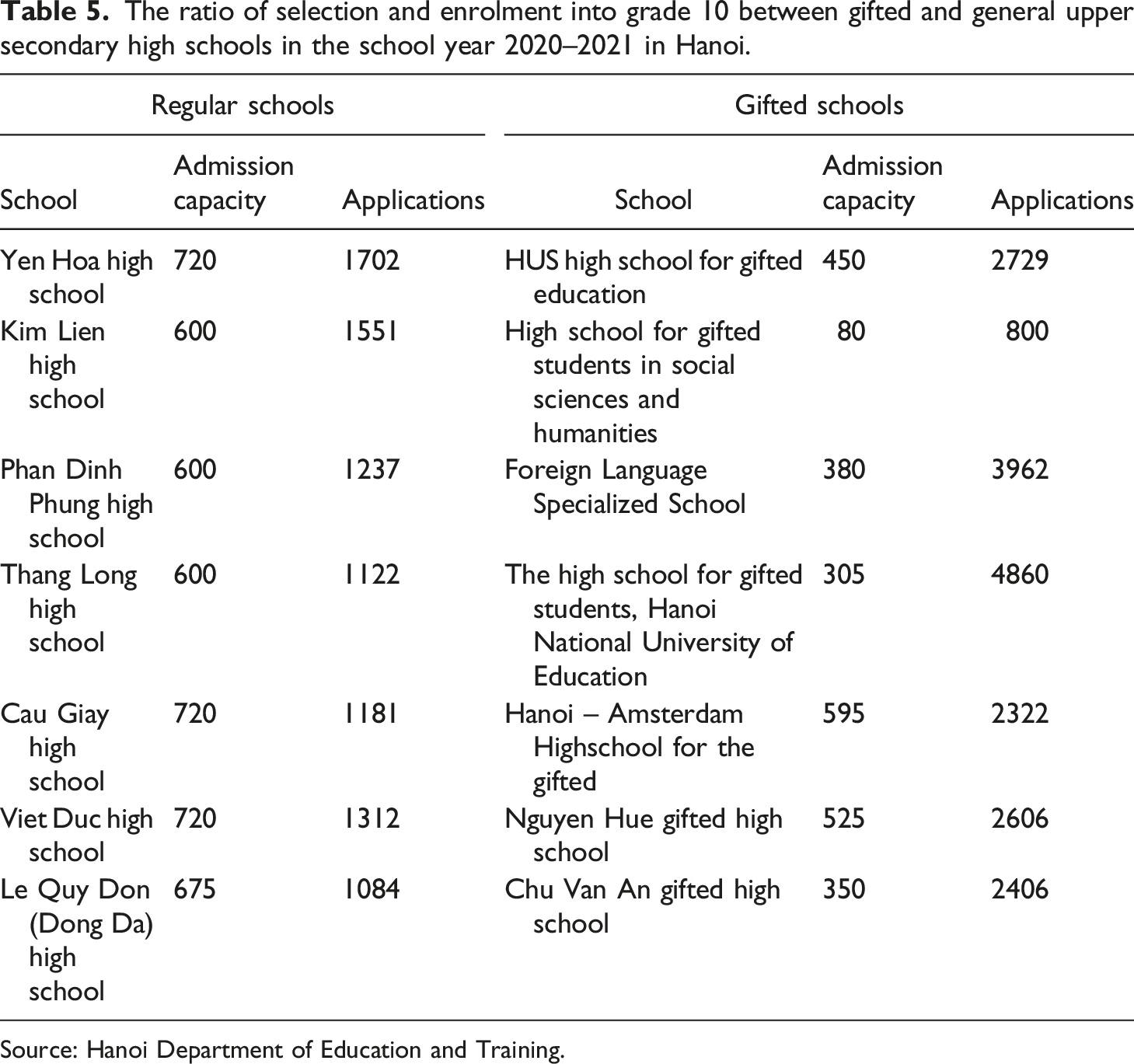
The ratio of selection and enrolment into grade 10 between gifted and general upper secondary high schools in the school year 2020–2021 in Hanoi.
Source: Hanoi Department of Education and Training.
It can be seen that the level of competitiveness for admission into gifted schools is always many times higher than that of normal schools. As a typical example, The High School for Gifted Students at Hanoi National University of Education received nearly 16 times applications compare to enrolment quota. In fact, the competition for gifted schools in Vietnam is even considered to be much fiercer than the university entrance exam.
Due to the fierce competition to gifted schools, hundreds of tutoring centres, also called “incubators”, were opened to help students prepare for gifted school entrance exams. Research has showed that the majority of students had taken private lessons for the exam and ‘successful admission seemed to be guaranteed by paying for tutoring services’ (Vu, 2011). Exam papers for admission to Vietnamese gifted education is still heavily knowledge-based and rote learning (Tran, 2020). Thus, intensive practice and access to various types of exam papers are crucial for success rather than cognitive competencies. This situation has resulted in inequality of access to gifted education in Vietnam. If students cannot afford private tuition, it will be very difficult for them to pass the entrance exam which requires typical advanced knowledge only provided by the “incubators” (Tuoitrenews, 2021). Influences of household wealth and support are found even in progression to general upper secondary education in Vietnam (Rolleston & Iyer, 2019).
Curriculum
Students in gifted schools share the same national curriculum in all other subjects with those from general schools, except for their specialized subject. Curriculum for the specialized subject takes the combination of general curriculum and a proportion of extra advanced knowledge topics. According to Decision No. 10,803/BGDĐT-GDTrH −2009 on Guidelines for implementation of the Intensive Program in Gifted High School by MOET, advanced topics have to account for 50% of education curriculum for the gifted (MOET, 2009). Circular No. 06/2012/TT-BGDDT on organization and operation of specialized high schools states that MOET only issued general guidelines focusing on intensive teaching content (MOET, 2012). Without a specific program, teachers are given maximum control and flexibility over their teaching in class based on guidance from MOET and the school's educational plan. The top gifted schools such as those in big cities have been developing rigorous gifted programmes with continuous reference from updated international curriculums while in some other gifted institutions, learning and teaching objectives are limited to passing the university entrance examination so there is no difference in their curriculums compared to those implemented in general schools (VNIES, 2021). Therefore, quality of gifted services varies considerably across the country without control for large-scale quality.
The content of curriculums offered at gifted institutions is generally criticized for being too theoretically and technically heavy, as suggested by gifted students and alumni in a study by Vietnam Institute of Educational Sciences, an institute under The Ministry of Education and Training (VNIES, 2021). Students are trained to work on various exam questions with little relevance or application in real life problems. Out-of-class enrichment programmes are only offered to a small group of selected students to take part in the national and international Olympiad competitions. There is very little room for students to explore the specialized subject to more advanced level (VNIES, 2021). In fact, although Vietnam Law of Education stipulates that students with outstanding ability are entitled to skip grades and take the acceleration pathway (VNA, 2019), there has not been any official and specific framework for identifying students with exceptional abilities. Besides, students are not allowed to skip grades for only one specialised subject. This causes boredom and limits the potential of students to advance their understanding in the chosen field. In addition, the lack of openness in the design and implementation of gifted programmes leads to the fact that students cannot be stimulated to develop higher levels of cognitive strategies and essential competencies in the modern society such as critical thinking, creativity and problem-solving skills (Sanchez-Escobedo, 2013; Tran, 2020).
Pedagogy and Assessment
In-service training for teachers in gifted schools is regularly held by MOET. However, these sessions mainly focus on improving subject-related understanding of teachers rather than teaching capacity in a gifted class. There is no specific pre-service teacher training program at degree level particularly for teaching the gifted. As a result, the quality of teaching in gifted classes has been raising serious concerns. While gifted adolescents should benefit from a flexible and input-rich environment to self-direct their study, many teachers are unaware of these learning needs and core concept of gifted education, hence focus only on practicing exam techniques (Tran, 2020; Vu, 2011). Students are not stimulated to develop thinking skills as well as encouraged to actively and independently lead their study due to the heavy focus on exam preparation. Despite the wider context of the country’s fundamental and comprehensive renovation in education, pedagogical methods in gifted institutions are still more content knowledge oriented and teacher led, which are relatively slow to update.
Regarding assessment, the mechanism for testing and assessment in gifted schools are not much different from general high schools, which are mainly knowledge based, following the Regulations on assessment and classification of lower secondary and upper secondary students issued under Circular No 58/2011/TT-BGDĐT. The only difference is gifted students have to achieve a GPA of above 8.0 in their specialised subject to be classified as excellence. There is a serious lack of process-oriented assessment which focuses on student’s progress over time rather than their performance at a single standpoint to help inform educators about their teaching practices (Cao et al., 2017). In certain gifted schools, students are encouraged to concentrate on the specialized subject only so teaching and assessment of other subjects are loosely controlled and even neglected, which diminishes the overall quality of education. Students selected for National and International Olympiad competitions are not required to attend classes and exempted from taking examinations in many gifted schools. Assessment of students’ competencies is also not widely applied in the system of gifted institutions. This situation significantly hinders the development of gifted education in Vietnam.
Public Investment and Effectiveness
Annual recurrent expenditure (USD per student) for upper secondary school (gifted and general) in 10 provinces from 2015 to 2020 according to authors’ calculation based on Resolution on the allocation of distribution of local budget by the provincial peopled’s committee.
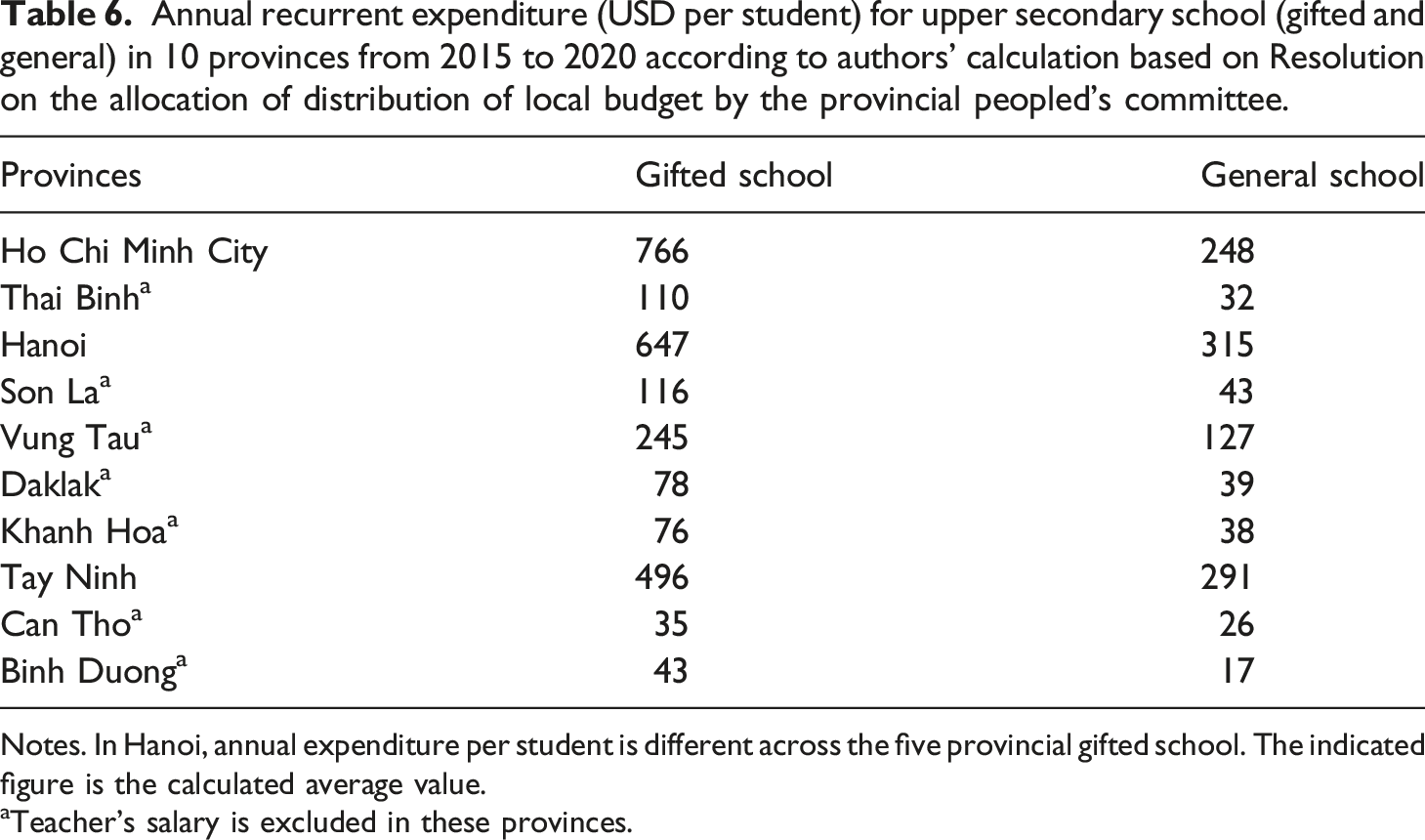
Notes. In Hanoi, annual expenditure per student is different across the five provincial gifted school. The indicated figure is the calculated average value.
aTeacher’s salary is excluded in these provinces.
In addition, both teachers and students in gifted schools are given incentives in terms of salary and benefits. Specifically, according to the Government's Decree No. 61/2006/ND-CP, teachers in gifted institutions are entitled to an allowance of 70% of basic salary, compared to 30% for their colleagues in normal schools (Vietnam Government, 2006). In addition, depending on different provinces, gifted school teachers also receive a lot of additional payments and allowances. For example, teachers in Vinh Phuc gifted schools receive an extra amount of 96 USD per month (VPP Committee, 2019), which is equivalent to 50% of the basic monthly salary of a state high school teacher. Those leading the selected group of students taking national and international Olympiad competitions can earn up to 200 USD (whole month salary of a normal teacher) per lesson (Vietnam Government, 2006).
Similar to their teachers, gifted students have access to a lot of benefits and allowances. For example, while the tuition fee for state high school students in Vietnam in 2020 is only 10 USD/month in major cities and 4 USD/month in rural areas, gifted students in Vinh Phuc are given a one-off 97 USD for school supplies and personal utensils (VPP Committee, 2019). Gifted students from disadvantaged background, including those with financial constraints, orphans or mountainous ethnic minority students are entitled to 1-month basic salary of 65 USD every month. In addition, all students in gifted institutions are eligible for a merit-based scholarship of 25 USD per month. Especially, reward for students who win medals in International Olympiad competitions is huge, even up to 17 000 USD in the case of Vinh Phuc or Hai Phong (VPP Committee, 2019).
Despite the enormous public funding given the whole country’s economic development status, the effectiveness of gifted education in Vietnam is yet unclear. Every year, there are only a few students winning medals in International Olympiad competitions in each subject while the rest transition to universities just like their peers in other general schools. There has not been any extensive research in Vietnam about the superiority and competitiveness of gifted upper secondary students when continuing on to degree level or contribution to society in the later stages of their life (VNIES, 2021). Considering the initial goals to develop learning aptitude and cultivate talents to meet the country's development requirements, the effectiveness of gifted education in Vietnam remains vague and requires thorough examination.
Future Directions
Founded in 1965, gifted education in Vietnam has since thrived and despite many turbulences, still takes an important position in the Vietnamese education system. The Ministry of Education and Training of Vietnam remains steadfast in its policy of training and fostering talents for the country. However, given its enormous amount of public funding, the effectiveness of gifted education model in Vietnam remains controversial. Throughout the history of nearly 60 years with a lot of socioeconomic changes, the operation model of gifted schools in Vietnam remained more or less static without comprehensive adaptations and modifications. It is important to consider existing limitations to improve the quality of gifted education in Vietnam, as a case study of reference for other gifted education systems with similar characteristics.
Re-examination of the “Giftedness Concept”
First of all, from the theoretical perspective, the concept of “giftedness”, the vision, mission and ultimate objectives of gifted education should be re-examined and understood correctly by teachers, educational managers, policymakers and the general public. Gifted students are defined as those with exceptional or superior capacity in terms of cognitive competence, creativity, or ability in arts and sports, that is potential to create significant and valuable contributions in a discipline (Martison, 1973). Talented individuals differentiate themselves from others by their ability to process unfamiliar materials with ease and passion to explore and master topics of interest (Winebrenner, 2000). However, these individuals may also be susceptible to academic difficulties and socioemotional problems, particularly when their educational environment does not address and fulfil their needs (Conejeros-Solar & Gómez-Arízaga, 2015; Gross, 2006; Salmela & Määttä, 2015), especially given the current situation of how young talents are identified and educated in Vietnam. The development of gifted education in Vietnam is largely hindered by the country’s emphasis on high stakes testing, which is also the case in many Asian education systems (Neihart & Teo, 2013; Stevenson et al., 1994; S. Tommis, 2013). Instead of being given freedom to explore their learning strengths and needs, highly able students are made to spend too much time and efforts trying to perform well in different national and international examinations. The pressure for achievements of students also makes teachers in gifted schools struggle to address and serve individual learning needs of their students or even focus on research and training for their own professional development.
In addition to addressing these systemic constraints, renovating gifted education to tackle the situation of students being underserved in gifted programmes requires changes in national, local educational and school leadership together with policy and systemic reform efforts (Mun et al., 2020). The role of gifted education should, therefore, be focusing on fostering the gifted to thrive their potential and preventing the risk of being underachievers due to their outstanding ability. One of the key aspects in gifted education is promoting self-regulated learning, which is essential when individuals strive for excellence (Efklides, 2019), rather than racing for top positions in different competitions. Besides the mainstream curriculum, different enrichment programmes and courses with comprehensive learning materials for both academic and socioemotional learning, particularly stimulation of learner’s autonomy, are much important in motivating gifted students (VNIES, 2021).
Efficient Use of Funds
Regarding investment, the allocation and management of funding in gifted institutions needs to be adjusted for being more cost-effective in terms of educational quality (VNIES, 2021). Besides raising the physical facility condition standard, more resources should be directed to gifted curriculum development, learning materials and resources for students, as well as capacity building (Dai & Kuo, 2015; Kataoka et al., 2020; Tung, 2016; Vinh & Hanh, 2021). A specific curriculum framework together with a rigorous mechanism of assessment are needed in order to monitor the quality of gifted schools, particularly in comparison with regular ones, which will serve as a basis for financing the system (MOET, 2020; Mun et al., 2020). Cognitive and skills development, academic readiness when transitioning to higher education as well as academic and societal contribution of students are among the key aspects for research in examination of the significance of the system (Cao et al., 2017; Dai & Kuo, 2015). One potential approach is socialisation, which means calling for a wider diversity of funding sources into the cultivation of talents for the country (MOET, 2020). Independent organisations and funds can be involved to supply for and supervise the quality of the system. This also works in the long term since investment on talent education needs to be sustainable, not only at secondary level but also continue to higher education (Conejeros-Solar & Gómez-Arízaga, 2015; Gross, 2006).
As the global socioeconomic context evolves over time, together with immense development of educational research, gifted education in the world has been witnessing transformative transition in its paradigm, from identification of the gifted to education that is gifted, or the transaction paradigm, in which giftedness is no longer viewed as a static trait to be identified but rather a dynamic sociocultural value resulting from the interaction between the learner with certain effectivity sets and the environment offering sufficient appropriate affordances to nurture these effectivities (Lo & Porath, 2017). Therefore, schools should be able to provide a rich context that can accommodate the diversification of talents and abilities of a vast body of students (Cao et al., 2017; Chan, 2018; Cho & Lee, 2015; Efklides, 2019). In light of this emerging paradigm of gifted transaction, the current model of education for the gifted in Vietnam with school full time attendance and specialization in fixed subjects is in need of fundamental and comprehensive revision and renovation, including alterations in educational approach from admission, pedagogy to testing and assessment as well as teacher professional development (Gross, 2006; Keating, 1989; Lo & Porath, 2017). Extensive research into both theoretical and practical features of the system is essential to inform stakeholders in search of the optimal solutions to gifted education systems similar to Vietnam.
Footnotes
Declaration of conflicting interests
The author(s) declared no potential conflicts of interest with respect to the research, authorship, and/or publication of this article.
Funding
The author(s) disclosed receipt of the following financial support for the research, authorship, and/or publication of this article: This study is supported by Ministry of Education and Training - Vietnam.
