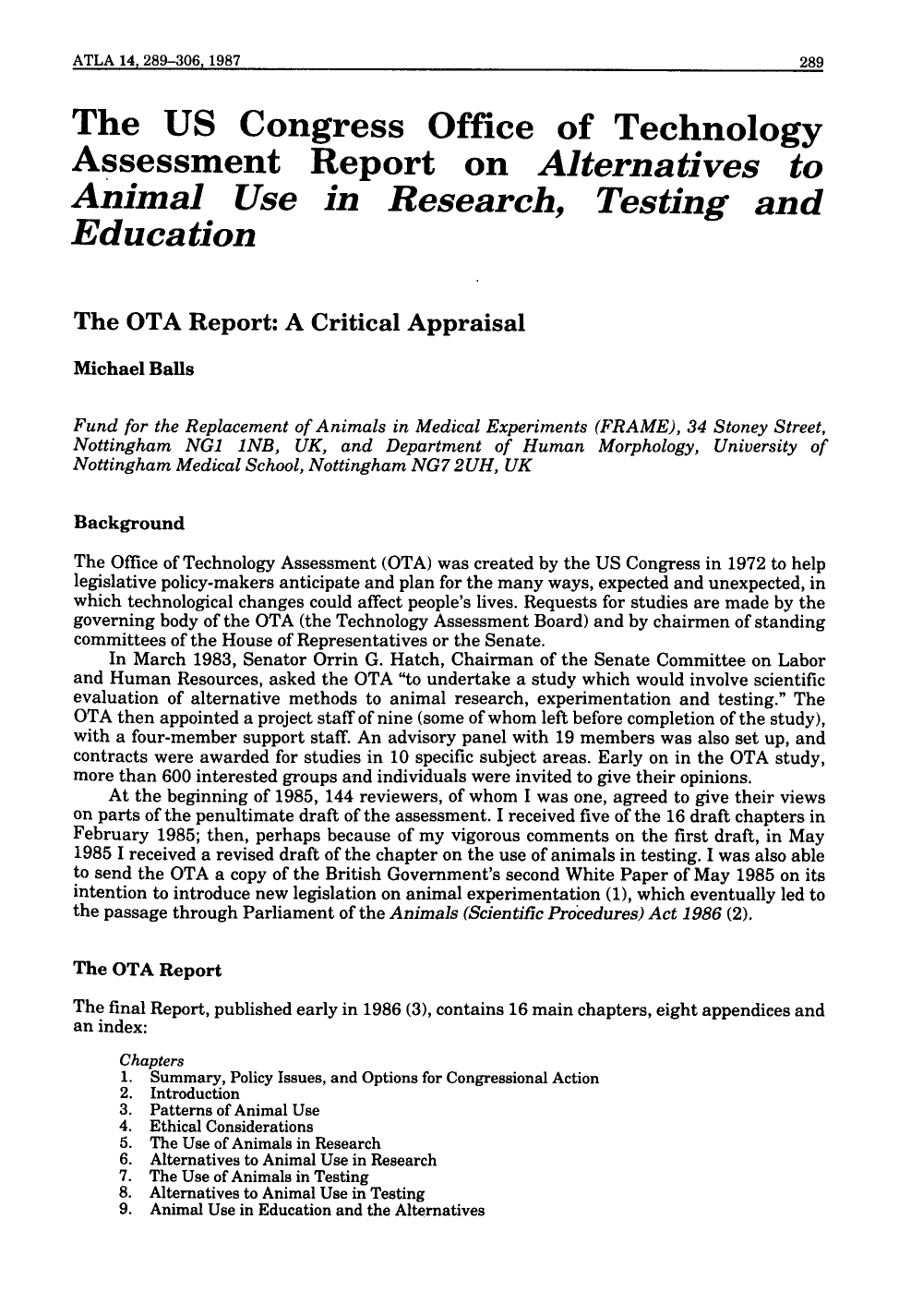
Alternatives to Animal Use in Research, Testing and Education. (1986). 441 pp. Washington, DC: US Congress, Office of Technology Assessment.
4.
Summary, Alternatives to Animal Use in Research, Testing and Education. (1986). 49 pp. Washington, DC: US Congress, Office of Technology Assessment.
5.
Contractor Documents for the OTA Report, Alternatives to Animal Use in Research, Testing and Education. (1986). Vol. I, Overview. Springfield, VA: National Technical Information Service.
6.
Contractor Documents for the OTA Report, Alternatives to Animal Use in Research, Testing and Education. (1986). Vol. II, Research. Springfield, VA: National Technical Information Service.
7.
Contractor Documents for the OTA Report, Alternatives to Animal Use in Research, Testing and Education. (1986). Vol III, Testing and Economics. Springfield, VA: National Technical Information Service.
8.
Statistics of Experiments on Living Animals in Great Britain 1985. (1986). Cmnd 9839. London: HMSO.
9.
EnsleinK. (1986). Survey and estimates of laboratory animal use in the United States. In reference 5, above.
10.
HollandsC. (1987). Legislative control of animal experimentation.ATLA14, 361–368.
11.
SpriggeT.L.S. (1987). Ethical considerations on animal experimentation.ATLA14, 307–311.
12.
FlemmingA.H. (1986). Ethical considerations. In reference 5, above.
13.
CohenC. (1986). The case for the use of animal in biomedical research.New England Journal of Medicine315, 865–870.
14.
European Convention for the Protection of Vertebrate Animals Used for Experimental and Other Purposes. (1985). 51 pp. Strasbourg: Council of Europe.
15.
Council Directive of 24 November 1986 on the Approximation of Laws, Regulations and Administrative Provisions of the Member States Regarding the Protection of Animals Used for Experimental and Other Purposes. (1986). Official Journal of the European Communities29 (L 358), 1–29.
16.
Beyond the Laboratory Door. (1985). 266 pp. Washington DC: Animal Welfare Institute.
17.
Editorial. (1985). Guilt by association: the Glasgow-Pennsylvania connection.FRAME NEWS7, 1–2.
18.
Anon. (1986). More on misuse of primates.FRAME NEWS8, 10.
19.
FRAME/CRAE. (1987). The Use of Non-Human Primates as Laboratory Animals in Great Britain., 20 pp. Nottingham: FRAME.
20.
GallupG.G. (1986). Alternatives to the use of animals in behavioral research. In reference 6, above.
21.
DrewettR.F. (1987). Alternatives to the use of animals in behavioural research.ATLA14, 312–317.
22.
BlackmanD.E. (1985). Legal and ethical constraints on animal experimentation. In Animal Experimentation: Improvements and Alternatives (ed. MarshN., HaywoodS.), pp. 7–17. Nottingham: FRAME.
23.
BenfordD.J. (1987). Biological models as alternatives to animal experimentation.ATLA14, 318–328.
24.
HeywoodR. (1987). The use of animals in testing.ATLA14, 329–333.
25.
Report of the FRAME Toxicity Committee. (1983). 44 pp. Nottingham: FRAME.
26.
BallsM., RiddellR.J., and WordenA.N. eds. (1985). Animals and Alternatives in Toxicity Testing, 550 pp. London & New York: Academic Press.
27.
MortonD.B. (1987). Animal use in education and the alternatives.ATLA14, 334–343.
28.
OrlansF.B. (1985). Science fairs—a sampling of misguided experiments.Animal Welfare Institute Quarterly34(3), 108–11.
29.
Anon. (1986). School science fairs: all too often, where animals are concerned, they aren't science and they aren't fair.Humane Society of Utah3(3), 3–4.
30.
BawdenD. (1987). Information resources and computer systems as alternatives.ATLA14, 344–352.
31.
CraigP.N. (1986). Overview of computer use in research, testing and education. In reference 5, above.
32.
HertzfeldH.R., and MyersT.D. (1986). Economic and policy considerations. In reference 7, above.
33.
McCormickH. (1987). Animals and alternatives: economic and political considerations.ATLA14, 353–360.
34.
Anon. (1987). Money for alternatives.Caring for Animals4(1), 4.
35.
Anon. (1987). NIH announces grants for alternatives.Scientists Center Newsletter9(1), 6.
36.
Anon. (1987). Bubble, bubble, toil and trouble.The Animals’ Agenda7, 16–17.
37.
Anon. (1987). NIH offers classes for investigators on humane use of animals.Scientists Centre Newsletter9(1), 8.
38.
HaywoodS. (1987). Attitudes to animal usage and the review system in the US.ATLA14, 369–374.
39.
DoddsW.J., and OrlansF.B. eds. (1982). Scientific Perspectives on Animal Welfare, 131 pp. New York: Academic Press.
40.
LawrenceR.S., GroomM.H., AckroydD.M., and ParishW.E. (1986). The chorioallantoic membrane in irritation testing.Food and Chemical Toxicology24, 497–502.
41.
PriceJ.B., BarryM.P., and AndrewsI.J. (1986). The use of the chick chorioallantoic membrane to predict eye irritants.Food and Chemical Toxicology24, 503–505.
42.
BallsM. (1986). Replacing experiments on laboratory animals.Trends in Biochemical Sciences11, 236–238.