




Abstract
This report is a result of an interdisciplinary workshop held at the Collegium Helveticum in Zurich, Switzerland in February 2024, in which ideas for accelerating NAMs (New Approach Methodologies) in Swiss universities were shared and discussed. Due to regional differences in university organisation and funding structures, not all recommendations will be transferable to all regions worldwide. All participants were qualified to contribute to the discussion, due to their knowledge and experience of the Three Rs, in particular with regard to their implementation. The workshop participants believed that universities, which play a pioneering role in so many other areas, should also exploit their innovative potential in the field of animal-free research. The workshop uncovered four areas that would need to be addressed in order to achieve a significant change in university science culture and do more justice to the Three Rs, namely: language — innovative framing (pro-replacement framing in official university statements); knowledge transfer — communicating innovative findings in teaching (redirecting curriculum); change of values within science faculties; and structured implementation and well-coordinated planning of the transformation (establishment of a ‘transition unit’). Specific strategies for implementing these four areas are outlined. In addition, we discuss why the replacement of animal testing should be an essential goal for universities, why this goal has not yet been achieved, and why concerted efforts toward change are required.
Keywords
Introduction: Why replacement must be accelerated
The Three Rs principles (replacement, reduction and refinement), which were proposed over 60 years ago to positively influence the practice of humane experimentation on animals, have led to substantial innovation. However, in the last 30 years, Three Rs-related interventions have been insufficient to outpace the rise in animal experimentation.1–3 Consensus is accruing from diverse stakeholders both within and outside scientific research, and pressure is significantly rising from the political field to accelerate the pace at which animal studies are being replaced by alternative technologies. The belief is that, with the right interventions, the innovation landscape might finally tilt in favour of these fast-developing non-animal alternatives.4–8 A desire to reduce and eliminate the suffering of sentient animals used in experimentation partly propels this growing consensus.2,7,9–11 However, it is also fuelled by the increasing awareness of the limitations and the risks of relying on non-human animal experimentation to improve human health, as well as the greater availability and scientific support of the development of technologies that do not rely on animals.2,12–16 These alternative technologies may involve in vitro, in chemico, in silico, ex vivo or other methods, and are often referred to as ‘New Approach Methodologies’ (NAMs). 17 NAMs include the “use of human biology, cells, and data to mimic complex human physiological states and therapeutic responses”. 15 The orthodox view that animal experimentation is the ‘gold standard’ for scientific research has recently been highlighted for closer appraisal, with regard to the following key aspects: the ethical issue of harming animals for human science (the animal suffering aspect); the scientific limitation of modelling human biology with non-human animals (the human health aspect); and the growing scientific confidence in NAMs (the scientific progress aspect).18–20
Reservations over the continued suitability of animal studies as the gold standard have entered the political arena in a growing number of jurisdictions. Such concerns have influenced, for example, the ToxCast Programme of the US Environmental Protection Agency (EPA), that makes in vitro screening data publicly available. 21 In India, the active promotion of alternatives has been on the central government agenda since at least 2009, when the precursor to the National Centre for Alternatives to Animal Experiments was established. 22 As another example, in 2014 the Dutch Ministry of Agriculture set out an aim for the Netherlands to become a world leader in innovation without laboratory animals by 2025.23,24 Before that, in 2003, the Netherlands had banned experiments on apes such as chimpanzees and gorillas. 25 In Switzerland, in 2021, the Swiss Federal Council launched the National Research Programme Advancing 3R: Animals, Research and Society, which stressed the need to innovate to reduce the number of animals used in science and lessen the harms they experience, as well as prioritise the replacement of animals altogether. 26 The European Commission indicated, in its reply to the European Citizens’ Initiative to phase out all animal testing in the short-term, 27 a desire to “modernise science in the EU” and “continue to strongly support the development of alternative approaches with appropriate funding” and otherwise “initiate a series of actions”. 28 Finally, perhaps most impactfully, in the USA (ranked in the top-three globally in terms of the number of animals used in experimentation), 29 the Food and Drug Administration (FDA) relaxed its animal testing requirements for drug approvals in 2022, allowing drug companies to try to demonstrate efficacy and safety through non-animal methods. 30
Despite growing support for the replacement of animal models in these multiple arenas, a paradigm shift remains extremely challenging. For example, in 2022 in Switzerland, 585,991 animals were used for testing purposes, which represents a 2% increase on the year before. 31 Existing literature highlights the complexity of the problem, discussing “scientific barriers […], legal barriers […], economic barriers […], cultural obstacles […] and difficulties changing the established mindset”. 32 These barriers are extensive — so much so that the above-named governments have reversed a few of the above-mentioned nascent legislative measures seeking to accelerate replacement. 11
The current report draws from this literature, to explore why animal models still remain central in many fields, even after decades of commitment to the Three Rs around the world. It seeks to highlight the particular ways in which universities (where a substantial number of animals are used in research and in practical taught courses), and the academic sector in general, contribute to creating a “rather inert system in which change is difficult”. 32 The report then turns to its main focus: to address how universities that undertake animal experimentation can stop contributing to the inertia and instead accelerate replacement by playing an active and formative role in the current process, even in the absence of laws requiring them to do so. While the focus is on universities in Switzerland, the ideas put forward may be relevant for universities in other countries, particularly institutions from the ‘Global North’. Several recommendations are provided, particularly with regard to measures that universities can implement to address the structural and cultural barriers over which they have strong influence and control. This would allow universities to better position themselves to lead as role models in terms of innovative, independent and ethical research.
These recommendations flow from an interactive 1-day workshop held at the Collegium Helveticum in Zurich, Switzerland in February 2024, where all the authors of this article, save one, participated. The participants had an interest in studying and implementing the Three Rs principles, and most were affiliated with European universities, particularly in Switzerland. Thus, much of the literature presented here to critically appraise the Three Rs, is based upon this European context. During the workshop, participants shared their individual ideas for accelerating the development and uptake of NAMs in Swiss universities, and collectively discussed their priorities for action. The concrete outcome of this discussion on the priorities was formally recorded, and feedback on this was obtained from all workshop participants. The resulting workshop report was compiled by the organisers, and was also approved by all participants. There were differences in views among participants, due to their varying disciplinary backgrounds and national contexts, but all authors listed were happy to be named on the current paper. The recommendations below are meant to guide individual departmental units, central university decision-makers and larger policy initiatives aimed at making meaningful inroads into accelerating the uptake of replacement strategies. While different contexts may demand different approaches, these recommendations can also be instructive to academic reform in the rest of Europe and beyond. 33
Understanding the challenges of capacity-building for change and how universities contribute to animal experimentation inertia
There is evident widespread support for the Three Rs principles in the international research community, 34 an increase in the availability of non-animal alternatives, and an EU Directive prioritising replacement that has been in place since 2010. Despite all of these factors, the numbers of animals used for research purposes in Switzerland, the UK and the EU (where the most pro-replacement legislation exists) are not decreasing significantly. In fact, in many jurisdictions, the numbers of animals used are actually rising.2,32,35 In recent years, in the EU as a whole, the numbers have started going down, but only gradually. However, the numbers of experimental procedures involving severe pain have actually gone up, even in jurisdictions where there is constitutional recognition of animal rights. In the EU, the total number of animals used for experimental or other scientific purposes has decreased very slowly and marginally — from approximately 11.6 million in 1996, to 9.8 million in 1999, before rising again to approximately 10.7 million in 2002. In 2017, the figure was around 9.6 million, dipping slightly to 8.7 million in 2019, and then to 8.0 million in 2020.2,36
In Switzerland, where there is constitutional recognition of animal rights, between 2021 and 2022 there was an increase of 5% in experiments of the highest degree of severity (i.e. degree 3). 37 A significant proportion of these experiments occur in a university research setting, even though many researchers in academic laboratories are no doubt committed to implementing the Three Rs and eager to use non-animal methods. For example, in Switzerland in 2022, a total of 330,654 animals were used at universities, while only 155,947 animals were used in industry. While the total numbers of animals used at Swiss universities decreased between 2015 and 2022 — from 408,678 to 330,654, respectively — there was an alarming increase in the number of animals used in experimental procedures involving severe pain (i.e. degree 3), from 5715 (in 2015) to 19,651 (in 2022). 38 The impression of the workshop participants was that universities partly contribute to this situation of inertia by not capacity-building for change, but instead they continue to reinforce a pre-existing animal model-biased science culture.
The lack of expertise
Consider firstly the infrastructure that leads to a lack of expertise in university research departments when it comes to NAMs.1,3,39,40 Over decades, biological science course structures in universities have been reinforced, that are tethered to animal studies. 15 Lectures and courses at science faculties often seem to focus heavily on animal experimentation as a crucial method for gaining insights and generating knowledge.3,41,42 Even the Swiss 3R Competence Centre aims to teach undergraduates attending their Three Rs classes to “understand the purposes of animal experimentation” and to “demonstrate knowledge on what justifies animal experimentation”, which is precisely how the research culture of animal experimentation is preserved instead of questioned. 43
In the eyes of some researchers, animal testing has always been one important part of valid research and still is “the best available science”, 44 even with the advent of NAMs. For example, arguments supportive of the practice point out that animal experimentation has been used in science “since the 5th century BC” 45 and is still “considered a widespread activity in the scientific environment”, 45 as well as that “it is evident that the use of animals in both research and teaching has offered great contributions, especially to health sciences […] for many important discoveries”, 45 and that “various substances that are essential to human health, such as medicines and vaccines, have been and will continue to be developed thanks to these experiments.” 45 Therefore, the time and effort that is required to instruct students in modern methods such as in vitro and in silico research approaches (which can deliver valid results and are fairly accessible) 46 is often neglected in favour of the ‘old’ methods. Further, there is a lack of resources to foster competence in non-animal methods. 40 New and not fully established methods require certain entry costs, and usually different equipment within the laboratories, which can constitute barriers for researchers to learn about NAMs and try such methods. 15 Thus, graduate students and junior researchers are often schooled in the use of conventional methods — and will, in all probability, later become established scientists who adopt what they have learnt during these formative years. 42
Issues associated with curriculum organisation
One challenge in the implementation of a paradigm shift stems from how universities are organised in terms of conceptual disciplinary boundaries and the corresponding physical ones. The majority of academic discourse and research on animal-related issues, animal welfare aspects, ethical questions concerning the treatment of animals, and the resulting interest in replacement, might not take place in a medical school or a biomedical science faculty where animal experiments are performed. 47 Instead, these types of animal-related course are mostly offered (and animal ethics routinely discussed) in the humanities — typically in philosophy, ethics or law departments. Thus, the “revolution in our thinking about animals” 42 of the past decades (especially since the 1970s) has not reached the majority of individuals working and studying in animal-using laboratories. Rather, a view seems to persist in the biomedical sciences that concern for animals and animal ethics are threats to contain. 42 In effect, a segregated system is in place: 47 ethical issues are discussed mainly in the humanities, and only to a limited extent in the medical and biomedical faculties where the actual doing of animal experimentation takes place. This bifurcation creates not only physical distance, but also conceptual cleavage that inhibits academic exchange and co-operation. 42 Universities in Europe and North America mostly defer to science departments over the continued need for research, and look to them to defend the research carried out on campus; the universities also remain active in pro-animal experimentation public advocacy, despite the rising criticism of many animal studies for being obsolete, ineffective and expensive.35,48
Cultural issues
Culture is a critical element in understanding how universities inhibit the development of NAMs-relevant competence. Some scientific researchers report a general science culture at universities which includes an enormous pressure for scientists to: a) demonstrate their objectivity through emotional distancing and sublimation of compassion, “untarnished by speech, language and opinion” 47 ; and b) generate publications and funding for their laboratories. 47 Both of these cultural factors rely on predominantly treating animals as objects for study, from which data for publication can be obtained.
In terms of the first factor — the need for emotional distancing and sublimation of compassion — part of the culture of science at universities is the concept of ‘desensitisation’ instead of sensitisation, with a view that researchers would then be able to maintain “emotional detachment when working with laboratory animals, viewing it as a hallmark of professionalism and a prerequisite for upholding scientific objectivity”. 1 Junior scientists can be sanctioned for refusing to kill an animal, instead of being rewarded for their sensitivity and interest in animal ethics; senior scientists responsible for the project often practice ‘from a distance’ and thus lose practical reference to what they decide to delegate and who suffers from these decisions. 42 Through desensitisation, the process of reflection, the experience of compassion and the awareness of problematic situations are hindered, as is any motivation to change this status quo or place it under any ethical or moral scrutiny.
With respect to the second cultural factor — the pressure to generate publications and funding to advance through professorial ranks and further establish one’s scholarly reputation — publication in high-impact journals and grants may flow more easily for studies that include animal experiments. 48 Due to the fact that animal data are often considered the default and ‘gold standard’ in human health and biomedical research, scientists who try to publish studies grounded in human-based research often fail at the level of peer review (a system that involves other university scholars and is an internal academic loop). Reviewers routinely request evidence from animal experiments, even when the authors explain why they have not used animals, but have instead used valid alternative methods. 15 This is referred to as “animal methods bias”. 15 Due to the dependence of a scientist’s career on high-impact publications, 15 this system incentivises the use of animals to ensure that studies have the highest chance of publication. The long-recognised issue of ‘publication bias’ — i.e. the non-publication of studies that do not produce statistically significant results 49 — compounds this problem. As ‘unsuccessful’ animal experiments are ignored and do not appear in the statistics, it makes the impact of animal experimentation appear more promising in the literature; this has been proven by various studies. 49 These combined factors make animal-based research appear more successful than it actually is. The intense cultural pressure to attract funding and secure publications can make it unfavourable to apply new methods. In addition, the ‘good’ reputation of animal testing (partly caused by the above-mentioned ‘animal methods bias’) means that there could be a potential long-term career risk for those scientists who display a critical attitude toward it. 35
Recommendations to accelerate replacement
Recommendations to accelerate replacement.
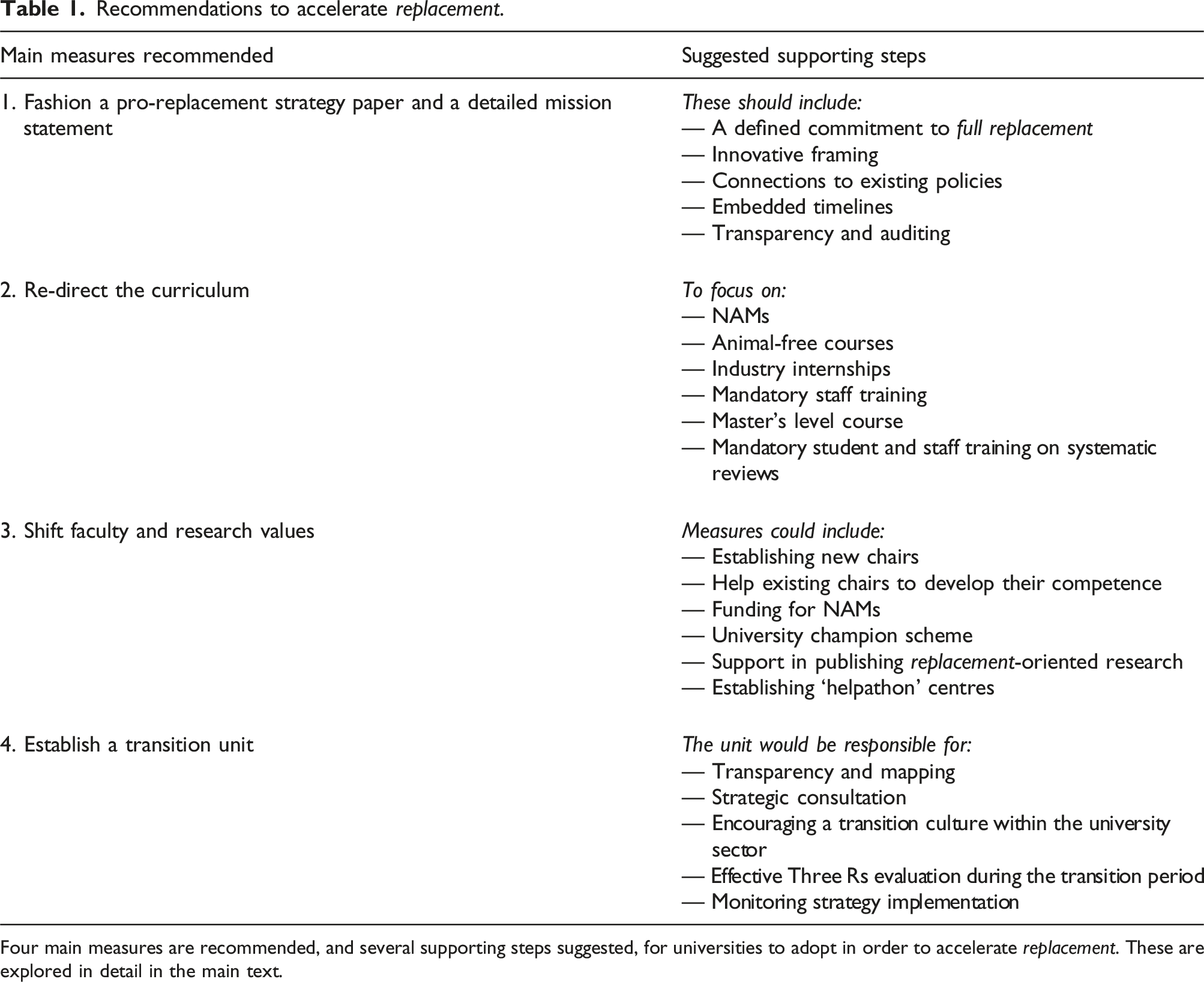
Four main measures are recommended, and several supporting steps suggested, for universities to adopt in order to accelerate replacement. These are explored in detail in the main text.
Fashion a pro-replacement strategy paper and a detailed mission statement
Our efforts to use the Three Rs to move beyond animal research may ultimately be limited by the conventional framing vocabulary of the Three Rs, which centres the animal model as the research norm. This has the effect of pushing research that does not involve the use of animals to a marginal, or alternative, position. The concept of animal methods being considered the default (or ‘gold’) standard is referred to as ‘animal methods bias’. 15 This can lead to researchers who use NAMs being confronted with unfair requests for animal experiments to be performed, from peer-reviewers who prefer their own methodologies or are ill-equipped to evaluate novel ones. This “adds additional and unnecessary work for researchers who use animal-free approaches, and it perpetuates the idea that animal-free approaches are not sufficiently valuable on their own.” 15 We need to create a landscape where replacements become the established toolkit, underpinned by a transformation in language and mindset to become more focused on what is innovative about the replacements themselves; these measures will help to foster wider scientific invention and imagination. 32 Universities can generate this discursive shift by formalising their commitment to replacement and clearly communicating that NAMs are the preferred standard.
In an analysis of 346 US universities, it was apparent that the positive effect of a university’s mission statement or strategy paper depended on the precision of the wording used — i.e. it was found to be more likely that the aims were put in practice when the strategy was articulated more specifically and when more keywords were used. 50 Thus, we recommend that universities articulate their commitment to full replacement in a central mission statement, based on a strategy paper that is as specific as possible with regard to the elements listed below.
A defined commitment to full replacement
The strategy paper should clearly declare the university’s goal of, and commitment to, full replacement. In fact, EU legislation officially aim toward full replacement, as is shown by Recital 10 in EU Directive 2010/63/EU that identifies full replacement as the final goal. The strategy paper should stipulate the university’s goal to become home to cutting-edge animal-free research, as part of fostering excellent research in all its areas of activity.
Innovative framing
The strategy paper must state what is innovative about NAMs. This means that it must outline the high potential of NAMs in overcoming the problem of inter-species genetic differences (the so-called ‘poor translation’) and thus highlight their potential in improving the reliability of human health research. 2 Furthermore, the strategy paper must explain the potential of NAMs, “such as in vitro systems, in silico models, machine learning (ML) and artificial intelligence (AI)”, to break through the history of failure in drug development (92% failure rate) by virtue of them being novel human-based approaches. 14 It is also important to note the value of NAMs in speeding up drug development, as shown during the COVID-19 pandemic where NAMs played an important role: while Pfizer/Biontech were researching the urgently needed vaccine, “the number of animal studies performed and required had indeed declined, more alternatives had been used and accepted, human studies started earlier and ran in parallel with (rather than sequential to) animal studies, and regulators accepted historical data from earlier vaccine research” with a very successful, life-saving outcome. 19
Connections to existing policies
Animals are part of a shared ecosystem and hence part of a holistic welfare approach. Given that universities have adopted policies on other topics — for example, climate change, social responsibility and inclusion — a larger concept such as ‘One Welfare’ or even ‘One Rights’ might help as a new overarching theme which drives holistic thinking about humans, non-humans and ecosystems. Legal scientists have shown how this could be charted at a legal level and why human rights would also be supported by such an encapsulation. 51
Embedded timelines
The strategy paper needs to explicitly state the interim targets and chart a roadmap to full replacement. Alongside a clear vision, concrete steps toward this vision should be specified and defined timelines set. In most countries that acknowledge replacement as a goal, the current legislation generally includes a mention of the phasing in of replacement over time. This type of general declaration does not set a defined timeline, and thus does not permit any accountability. A strategy paper would need to quantify the level of expected change — for example, a 50% increase in replacement research funding at state or university level, every five years. Universities should define concrete strategies, timelines and milestones in consultation with their faculties. Existing roadmaps created by governments or animal organisations can be used as guides, namely: Innovate UK’s ‘Non-animal technologies roadmap for the UK’ (Innovate UK, 2015); EPA’s ‘New approach methods work plan’ (EPA, 2020, 2021); or PETA’s campaign ‘The research modernization deal’ (PETA, 2021). 11 Even industry roadmaps, such as the Merck Group’s ‘Approach for a roadmap to phase out animal testing’ can serve as inspiration. 52 Timelines need to combine clearly defined milestones with contingencies, in case a timeline is missed.
Transparency and auditing
The strategy paper should be made public and communicated accordingly. Similarly to climate change goals, if agreement on a timeline is difficult, then there should at least be some other indicators of leadership and structured reporting on achievements, in relation to the replacement goals. 53
Re-direct the curriculum
The current taught curriculum at universities is largely based on conventional methods of doing science, i.e. heavily relying on animal testing as the gold standard in human health and biomedical research. Instead, replacement strategies need to be centred in a more active way, both within training and the institutional mindset. We propose that universities can play a key role in moving beyond the Three Rs principles by creating new pathways for accelerating the use of NAMs. This could be achieved through the training of both early career researchers and already-appointed senior scientists, in the use, validation, acceptance and implementation of NAMs, since “training and knowledge transfer are essential to overcome differences in expertise”. 20 As a role model, we can look to the Johns Hopkins Center for Alternatives to Animal Testing (CAAT) in Baltimore, MD, USA, where NAMs are discussed, courses are taught and “active efforts are made to really reduce” animal testing. 42
Additionally, systematic review training should be prioritised to reduce repetition of studies and reduce bias. Systematic review is defined as a rigorous and comprehensive process, aimed at identifying, evaluating and synthesising all relevant research, to answer a specific question and thus reduce selection bias. 54 According to Cochrane, a not-for-profit organisation that supports systematic reviews and meta-analyses in the healthcare field, 54 a systematic review seeks to collate all empirical evidence that fits pre-determined eligibility criteria to comprehensively answer a specific research query. 55 The methodology used to conduct systematic reviews is explicit and systematic, and chosen deliberately to reduce bias, thus yielding more reliable results that can guide decision-making. Experts have suggested that educational programmes incorporate systematic review training within their curricula. 56 Systematic reviews have significant implications for researchers, potentially altering research trajectories and funding opportunities due to their international scope and reduced bias. They encourage a shift toward more objective and comprehensive research practices. To ensure productive participation, high-quality training and supervision is essential; systematic reviews need to be conducted to a high standard, to safeguard against any potential risks and downfalls.
Our suggested measures for re-directing the current university curriculum focus on the following areas:
NAMs
The mandatory taught curriculum on research methodologies should be comprehensively dedicated to animal-free methodologies and the need to mainstream them in universities. These modules should also include mandatory and supplemental information on animal sentience, as well as the field of animal ethics more generally. Universities should instruct their science faculties to give NAMs a more prominent place in the curriculum, and advise them to report on their implementation.
Animal-free courses
Animal-free courses should be included in all relevant Bachelor and Master’s curricula at universities, to ensure that students can complete their studies without engaging in research projects that harm animals.
Industry internships
Universities should facilitate internships focusing on animal-free methods with industry partners that are already using replacement methods (e.g. Roche).
Mandatory staff training
Universities should organise mandatory training on animal-free methods for all research staff in the natural sciences and medicine faculties (such as safety training and good scientific practices). This training should introduce staff to animal sentience and the field of animal ethics more generally.
Master’s level course
Universities should develop a specialised Master’s course on animal-free research, including regulatory framework, ethics, communication, animal law and systematic reviews (see further discussion below).
Mandatory student and staff training on systematic reviews
At the Bachelor’s level, an introduction to the basic methodology and the rationale behind conducting a systematic review should be provided. At the Master’s level, the focus should expand to further develop the methodology and include critical appraisal of published research, employing tools like the ARRIVE guidelines 57 or the RIVER recommendations, 58 to create transparent, reproducible study protocols that make the experiments carried out usable, prevent duplication and make in vitro procedures comprehensible and thus useful. Additionally, the systematic review should become a component of the Master’s thesis. For ethical review processes, it is recommended that ethics committees and regulatory bodies receive training in systematic review methodologies, to ensure that ethical oversight is informed by comprehensive and unbiased research evidence. Support is crucial for this initiative to succeed, including training programmes for student supervisors and introductory courses followed by ongoing training or coaching. An interdisciplinary team with expertise in library sciences, specific subjects, statistics and laboratory animal science or alternative methodologies is essential for effective systematic review training. This interdisciplinary approach not only enhances learning, but also fosters teamwork skills.
Implementing systematic review training requires that enough time is dedicated to it within the taught curriculum. The allocation of European Credit Transfer and Accumulation System (ECTS) credit points for participation in relevant training could encourage participation by university students. These initiatives should be designed and implemented at the faculty level, and they could also be approved and overseen by the Transition Unit (see below).
Shift faculty and research values
As noted above, accelerating the uptake of non-animal methods requires a major value shift within a university. There are different ways of promoting such value shifts, and in supporting the planned actions that result. These will differ from institution to institution, and precise recommendations on how to change the culture within an individual faculty would require a more detailed understanding of the power structures within a particular university. However, there is much to learn from initiatives that have sought to change values in science through schemes that focus on champions — for example, in relation to environmental sustainability (e.g. QS World Rankings) or equality, diversity and inclusion, or developing new expertise. Universities and researchers are currently subject to a variety of demands, and it is important to recognise that there may be conflicting values at institutional level and a risk of overload for individuals. This suggests that individual faculty units must be robustly supported to shift their culture regarding the ‘gold standard’, in order to make a bold re-direction possible. We suggest the following measures to promote value shifts at the faculty level:
Establishing new chairs
New chairs could be established to cover NAMs-related topics, including their pre-validation and validation (the requirement for validation depending on the context of use — i.e. basic research versus regulatory testing), as well as their acceptance and implementation. One example is the chair for ‘Evidence-based transition to animal-free innovations’, held by one of the authors (Prof. Dr J. (Merel) Ritskes-Hoitinga) at Utrecht University (the Netherlands). These new chairs should commit to leading innovation in research methodology. This development should also be reflected in the establishing of similar dedicated chairs in the humanities.
Help existing chairs to develop their competence
Existing chairs should be helped to develop their competence toward formulating research questions in a way that can be answered by using NAMs.
Funding for NAMs
For scientists to take the option of NAMs-based research seriously, it needs to be an attractive and secure career option. University research funding should be redirected from animal-based research to NAMs-based research. To create a sustainable and financially stable future for researchers, substantial funding should be dedicated to the infrastructure and trained scientific staff that are required to support replacement. The following funding interventions are suggested: — Offer incentives: The responsible authorities for university internal research funding could offer incentives such as awards, research funding and fellowships to support non-animal research. At Swiss universities, there is usually an office for research funding that regularly calls for project ideas and awards grants for specific projects (see the ‘champion scheme’ measure, below). — Involve private funders: Private funding could help researchers, through seed grants or other support, to secure external funding to establish new research projects based on NAMs. Clear rules would be needed to clarify the extent to which private funding can (or should) influence research priorities and positions. — Support start-ups: Universities should fund innovative individuals coming up with NAMs, and empower them to initiate their own start-ups. Additional ‘Tech Transfer’ support should be offered for animal-free innovations.
University champion scheme
This scheme would establish incentives for researchers to accelerate and champion replacement methods, and support those who want to adopt new methods in their research. This scheme could provide funding for placements, skills exchange and outreach, as well as facilitate wider conversations and celebrations of success that contribute to a more visible shift in the values and culture surrounding animal research.
Support in publishing replacement-oriented research
Publications are an important incentive for researchers. Universities should foster structures for establishing journals or other platforms that do not require animal studies to be carried out to ensure consideration for publication. These platforms should be supported, in order to flourish in the long-term and gain high impact.
Establishing ‘helpathon’ centres
Universities should establish ‘helpathon’ centres as an innovative approach to promote high-quality research while avoiding animal experimentation. A ‘helpathon’ is a collaborative event where experts from various fields come together to refine a research question or methodology, with the aim of finding solutions to a problem — which, in this case, is finding alternatives to animal testing. According to the original Dutch model, a helpathon involves a minimum of eight experts and lasts at least 24 hours, facilitating diverse and dynamic discussions. 59 For example, a researcher may enter the helpathon event with a research question about burn wounds that requires animal experimentation. Through open-minded discussion and mutual advice, a slightly revised, but equally valid research question arises, that has been refined in such a way that it can be answered with a novel organ-on-chip model. Establishing helpathon centres at universities (akin to Clinical Trials Centres) is suggested, in order to provide specialised support for researchers. Not every university necessarily needs its own helpathon centre, but universities should try to work together to provide a suitable helpathon facility for researchers located within a particular region.
Before embarking upon an animal research project, or even submitting a funding application, researchers should be mandated to participate in a helpathon. The helpathon centres would play a crucial role in facilitating the transition to animal-free research methods. Funding mechanisms, including reimbursement for services and project funding, along with certification for helpathon participation, could incentivise and ensure researcher engagement, thereby fostering trust in alternative research methods. Helpathon centres should seek international and cross-disciplinary collaboration, inviting expertise across national boundaries.
Establish a transition unit
The overarching university strategy should be to commit to animal-free research and define a phase-out and transition plan. Universities should be aware that the topic of replacement and the need for change will not vanish into thin air, even though change is inevitably uncomfortable and controversial. Thus, universities should therefore act out of conviction that it is important to think ahead and accelerate replacement, even where resistance is encountered.
We recommend that every university establishes a Transition Unit, to design and coordinate a phase-out plan for animal experiments, with clear timelines that aim toward the successful implementation of advanced/innovative Three Rs measures. Such a unit might include the heads of the university (e.g. president, vice-chancellor or rector), heads of all relevant faculties (e.g. deans), as well as student representatives. Record-keeping (ideally anonymous to encourage candour) should be mandatory for the meetings, and the records made accessible to members of the university and the general public.
In addition to identifying concrete goals and timelines for the university to stop using animals for experimentation, it is suggested that the unit would be responsible for the following considerations, to ensure a smooth and effective transition to animal-free research:
Transparency and mapping
Research has many associated dimensions, including individual and institutional research integrity, research ethics and research culture. Ensuring that responsible research is carried out (both animal-based and animal-free research) requires consideration of these associated dimensions in a transparent manner, and outlining the ways in which these different interests shape the field in which new research projects are constructed. A prerequisite for transforming animal-based research in universities is the disclosure of the wide range of vested interests in its continuation, including those of industry and those of university employees. The different points at which opportunities occur for making decisions about implementing replacement methods should then be highlighted.
The aim would be to map the points at which replacement-positive decisions and interventions can be made, recognising that many of these decisions need input prior to any harm–benefit analysis of animal-based research. Inputs can include engaging with a wider constituency of people in setting research priorities — e.g. involving patient groups to help set the agenda by offering options for future research. To prevent duplicating studies and to promote systematic reviews, the unit could guarantee data sharing in a way that safeguards protection-worthy interests (such as intellectual property rights, identities, etc.).
Strategic consultation
Ideally, the transition effort should be made on the university’s own initiative. As universities have different approaches, it often depends on individual people who can play a key role in submitting a transition plan to an executive board. In order for a plan to be broadly supported within a university, it should be backed by an interdisciplinary team, and all departments should agree to it (not just, for example, the ‘Faculty of Natural Sciences’ or the ‘Faculty of Medicine’). 60
Encouraging a transition culture within the university sector
Universities can enlist national funding agencies to demand that all funding applications include a transition strategy (not what it should contain, but a defined concrete strategy that must be implemented). Universities can also apply pressure for more funding to be made available in the field of animal-free research. To drive these efforts forward, universities could encourage national funding agencies to encourage competition between institutions, with a league table established to chart their relative progress toward predefined goals.
Effective Three Rs evaluation during the transition period
During the period of transition, the unit should ensure that the Three Rs innovations put forward are implemented and monitored. The unit would oversee the scientific quality of planned ethics committee applications. This oversight could also extend to creating a list of experimental procedures that are no longer acceptable, as well as supporting the helpathons discussed above to help researchers find alternatives and implement all of the Three Rs measures available.
Monitoring strategy implementation
The unit should monitor the progress of the university and that of individual faculties in reaching the goals and timelines defined in the phase-out plan.
Summary
Implementing the above recommendations and suggested measures would mean that animals are better recognised as having inherent worth, and that they can never be considered as a mere means to an end. European countries have consistently shown a strong political will toward prioritising the replacement of animal experimentation. Phasing out animal experimentation is a challenge, albeit one that can be tackled on a multi-stakeholder level, whereby universities are required (and have a real chance) to play an active role. 61 Rethinking university structure and direction, in order to move toward animal-free science, is arguably the best practice for acting ethically toward animals in the 21st century and productively innovating in terms of human research goals.
This holds especially for Swiss universities, since Switzerland was the first country to recognise the rights of living beings in its constitution. 62 Moreover, the Swiss Federal Constitution includes various fundamental values relating to human and animal ethics, which must be harmonised as far as possible. What this means is that animal experimentation law is based on the principle of indispensability (Art. 17 TSchG/AWA). As a result, the Confederation has a duty to actively work toward the abandonment of animal experiments to protect human and animal health, even though the Three Rs principles are neither explicitly enshrined in Switzerland (although their components are) nor are they considered as guiding principles (but merely components of the legal concept).
Conclusions
The existence of the Three Rs principles has failed to prevent the rise of animal experimentation, which continues as an entrenched norm, not only in Switzerland but also in other European countries and worldwide. In order to accelerate replacement, a paradigm shift that displaces animal-based studies as the ‘gold standard’ must occur across all regions. In the Global North countries, this requires the involvement of universities and the academic sector, where a considerable proportion of animal studies are performed. To truly be responsive to the Three Rs principles, in line with current political and policy efforts, replacement must be prioritised and accelerated. 63 For their part, universities should undertake the following measures to advance replacement: adopting strategy plans, redirecting curricula, shifting faculty research values, and establishing transition units to successfully coordinate a bold re-direction. Such action can occur now, without having to wait for legislative or other externally-mandated restructuring demands.
We would further suggest that universities have a heightened responsibility in undertaking such replacement efforts compared to other institutional sectors. Universities are formally classed as either public or private institutions, but even when a university is classed as ‘private’, it is still nonetheless aimed at the pursuit of knowledge for the greater good. Universities are “living labs”, 64 well-positioned and socially entrusted to lead in terms of safe science innovation, social change and ethical actions. 65 For example, there is a “widespread recognition that higher education institutions have an important role to play in the transition toward a more sustainable global society”. 66 Indeed, in terms of sustainability issues amidst climate crises, universities emerged as an early institutional thought and praxis leader, in contrast to the private sector. In this context, universities as higher education institutions have charted a number of declarations, for example: “The Stockholm Declaration (1972), the Talloires Declaration (1990), the Copernicus University Charter (1993), the Lüneburg Declaration on Higher Education for Sustainable Development (2001), and the Torino Declaration on Education and Research for Sustainable and Responsible Development (2009)”. 67
Universities have also responded at an accelerated pace in recent years, to demands for better human equity and inclusion practices on campus. 68 In considerable contrast, in terms of animal-free research, universities rather seem to be the poorer performer, or only equivalent at best, when compared to private industry. In Switzerland, over the time-period 1997–2022, industry managed to reduce the numbers of animals used for experiments by 60% (from 398,501 in 1997, down to 155,947 in 2022), whereas universities and hospitals recorded an increase of 126% for the same time-period (from 146,050 in 1997, up to 330,654 in 2022). 38 Changing this situation needs to be seen not only as an obligation for public-facing higher educational institutions, but also as a necessity toward fulfilling general higher educational mandates to advance critical thinking, provide socially incisive education, and have a positive impact on society.
Footnotes
Acknowledgements
We are grateful to all the participants of the workshop, which was held at the Collegium Helveticum at the Federal Institute of Technology Zurich (ETH) on 27 February 2024, and from which the core ideas for the recommendations in this Report emerged. We thank the numerous participants, inter alia Eva Bernet Kempers, who shared their ideas and input that partly was integrated into this paper. We are also indebted to the following, for their generous funding for the workshop itself, as well as for funding further research work toward the writing of this report while guaranteeing freedom of the research: Collegium Helveticum, Zurich; Center for Animal Law and Ethics, Faculty of Law at the University of Zurich; Haldimann Foundation; Fondation J. Fischlin (FJF) and Swiss National Science Foundation NRP 79 (in which many of the authors are participating and for which they receive financial support).
Declaration of conflicting interests
The author(s) declared no potential conflicts of interest with respect to the research, authorship, and/or publication of this article.
Funding
The author(s) disclosed receipt of the following financial support for the research, authorship, and/or publication of this article: Haldimann Foundation, Collegium Helveticum, Zurich, Fondation J. Fischlin (FJF), Swiss National Science Foundation NRP 79 Grant.
