



Abstract

The EU Legislation on the Protection of Animals Used for Scientific Purposes
 The Three Rs concept — that is, the replacement, reduction and refinement of the use of animals in science — is the cornerstone of Directive 2010/63/EU on the protection of animals used for scientific purposes,
1
which has been in force in the EU since 2013. The scope of this legislation covers all breeding, care and use of animals (including later-stage larval and fetal forms) in procedures — essentially the lifetime experience of the animal.
The Three Rs concept — that is, the replacement, reduction and refinement of the use of animals in science — is the cornerstone of Directive 2010/63/EU on the protection of animals used for scientific purposes,
1
which has been in force in the EU since 2013. The scope of this legislation covers all breeding, care and use of animals (including later-stage larval and fetal forms) in procedures — essentially the lifetime experience of the animal.
All procedures involving the use of live animals are subject to a project evaluation that must take ethical considerations into account and be authorised by a competent authority. These procedures are permitted only when there are no available alternatives. The legislation is cross-cutting and impacts on any policy area where animal testing may be required, for example to ensure the safety of chemicals or medicinal products. Whilst the Commission acknowledges that there is still a need for animals to be used in science, Directive 2010/63/EU 2 assures the ethical treatment of the animals that are used and, uniquely in the world, the Directive makes replacement of an animal method with a non-animal method mandatory whenever an alternative is available.
Furthermore, the Directive requires the Commission and the Member States to contribute to the development and validation of alternative approaches. It formally established the European Union Reference Laboratory for alternatives to animal testing (EURL ECVAM), which coordinates the validation of alternative approaches at the EU level. EURL ECVAM also acts as a focal point for the exchange of information on the development of alternative approaches and promotes dialogue between legislators, regulators and all relevant stakeholders.
Smooth implementation
Adopting the legislation was the primary achievement, but ensuring its smooth implementation by Member States is equally as important. The Commission, together with all key stakeholders, has developed specific guidance, and continues to do so, on elements such as: — the assessment of severity of procedures; — project evaluation; — retrospective assessment; — education and training; — the functioning of Animal Welfare Bodies and National Committees; and — inspection and enforcement.
3
To provide further support, the Commission holds regular meetings of National Contact Points (competent authorities) on the implementation of the Directive, in order to discuss and resolve questions arising from the implementation and to exchange best practices.
Thanks to the Directive, we have a powerful toolbox, not only to make animal use in science more humane and reduce the numbers used, but also to boost the development of technologies that will replace animal use altogether — which is the ultimate goal of the EU’s policy on protecting animals used for scientific research. The Directive easily affords some of the highest standards of experimental animal welfare in the world, but it also allows Member States to work well together whilst facilitating the competitiveness of EU research and industry. Perhaps most importantly, this legislation reflects society’s animal welfare concerns. It does this in the following ways: by cultivating a ‘culture of care’ in animal establishments (supported by the Animal Welfare Body); by carefully assessing an application in terms of severity classification of the procedures to be performed on live animals; and by furthering ‘transparency’ through, inter alia, the gathering of annual detailed statistics, the publication of non-technical project summaries and the retrospective assessment of completed projects.
The importance of ‘transparency’
Transparency is key to making the legislation work as it is intended. It has also been enhanced through the publication of a review of the Directive in November 2017 (COM(2017)631 4 ) and, in 2020, the first statistical report 5 — covering the years 2015–2017 — accompanied by the first EU report on the implementation of the Directive (COM(2020)15 6 ). In addition:
— The
— The
— The
Thanks to the mandatory reporting and available tools, we now have — more than ever before — information that gives us a comprehensive picture of how and why animals are used in science and more about the related severities of those uses. This allows us to focus on areas where alternatives are most urgently needed and where their impact will be the greatest. It will also highlight where education, training and guidance are needed, and, in some cases, it will inform enforcement actions — for example, where a non-animal method is available but not used.
Finally, education and training are considered to be key elements in the further uptake of the Three Rs principles and in the development of alternatives. To this end, educational tools have been developed by the European Commission thanks to European Parliament Pilot funding, and this work will continue between 2021 and 2023 under European Parliament Preparatory Action funding.9,10 These education and training tools (as discussed in more detail below) include: guidance for educators; a report on incorporating Three Rs into school curricula; lesson plans and editable slides for use in secondary schools; and an online course for teachers. At time of writing, there are also two open-access eLearning modules for researchers — focused on searching for existing (non-animal) alternatives, and on developing in vitro methods and approaches for scientific and regulatory use. Such initiatives help to promote the development and uptake of non-animal alternatives and further facilitate progression towards the ultimate goal of full replacement. 1. European Commission. Animals Used for Scientific Purposes: EU Statistical Reports on the Use of Animals for Scientific Purposes, https://ec.europa.eu/environment/chemicals/lab_animals/reports_en.htm (undated, accessed 12 August 2021). 2. European Commission. Directive 2010/63/EU of the European Parliament and of the Council of 22 September 2010 on the protection of animals used for scientific purposes. Text with EEA relevance. Off J Euro Union 2010; L276: 33–79. 3. European Commission. Animals Used for Scientific Purposes, http://ec.europa.eu/environment/chemicals/lab_animals/pubs_guidance_en.htm (undated, accessed 12 August 2021). 4. European Commission. Report from the Commission to the European Parliament, the Council, the European Economic and Social Committee and the Committee of the Regions in Accordance with Article 58 of Directive 2010/63/EU on the Protection of Animals Used For Scientific Purposes. [COM(2017)631 final]. Brussels: European Commission, 2017, 10 pp. 5. European Commission. Report from the Commission to the European Parliament and the Council: 2019 Report on the Statistics on the Use of Animals for Scientific Purposes in the Member States of the European Union in 2015–2017. [COM(2020)16 final]. Brussels: European Commission, 2020, 21 pp. 6. European Commission. Report from the Commission to the European Parliament and the Council on the Implementation of Directive 2010/63/EU on the Protection of Animals Used For Scientific Purposes in the Member States of the European Union. [COM(2020)15 final]. Brussels: European Commission, 2020, 14 pp. 7. European Commission. Animals Used for Scientific Purposes: ALURES Statistical EU Database, https://ec.europa.eu/environment/chemicals/lab_animals/alures_en.htm (undated, accessed 12 August 2021). 8. European Commission. Commission Implementing Decision (EU) 2020/569 of 16 April 2020 establishing a common format and information content for the submission of the information to be reported by Member States pursuant to Directive 2010/63/EU of the European Parliament and of the Council on the protection of animals used for scientific purposes and repealing Commission Implementing Decision 2012/707/EU (notified under document C(2020) 2179). Text with EEA relevance. Off J Euro Union 2020; L129(4): 16–50. 9. European Commission. Education and Training, https://ec.europa.eu/jrc/en/eurl/ecvam/knowledge-sharing-3rs/education-and-training (2021, accessed 12 August 2021). 10. ETPLAS. Education and Training Platform for Laboratory Animal Science: E-Learning Modules on EU-Functions, https://etplas.eu/ (undated, accessed 12 August 2021).
References
EURL ECVAM Celebrates 30 Years of Supporting Non-animal Approaches in Science in the EU
 This year, we celebrate our 30 year anniversary as the EU Reference Laboratory for alternatives to animal testing (EURL ECVAM).
1
Indeed, on 29 October 1991, a Communication from the Commission to the Council and the Parliament (SEC (91)1794) established the European Centre for the Validation of Alternative Methods (ECVAM) at the Joint Research Centre (JRC; the science and knowledge service of the European Commission) at its Ispra site in Italy.
This year, we celebrate our 30 year anniversary as the EU Reference Laboratory for alternatives to animal testing (EURL ECVAM).
1
Indeed, on 29 October 1991, a Communication from the Commission to the Council and the Parliament (SEC (91)1794) established the European Centre for the Validation of Alternative Methods (ECVAM) at the Joint Research Centre (JRC; the science and knowledge service of the European Commission) at its Ispra site in Italy.
The current scenario of non-animal approaches hardly resembles the situation in 1991. When the EU Directive 2010/63 on the protection of animals used for scientific purposes 2 entered into force, replacing the previous legislation, there was a strong push towards non-animal methods. This new Directive widened our mission beyond merely validating alternative methods and clearly set out full replacement of animal methods as the ultimate policy goal. In 2013, another important milestone followed, stimulating acceleration of the development of alternative methods. The EU ban on the marketing of cosmetic products containing ingredients tested on animals, further required the support of EURL ECVAM in the evaluation, development and validation of alternative methods.
Although a lot has been accomplished since 1991, we are still not there yet. We continue to work with great passion and enthusiasm towards the ultimate goal of phasing out animal testing and advancing the replacement, reduction and refinement of animal procedures. This is achieved through: —contributing to EU and international research initiatives; — coordinating the validation of alternative methods; — disseminating information and sharing of knowledge across disciplines and sectors; and — promoting alternative methods and the Three Rs in an international context.
Today, non-animal approaches built around stem cells, engineered tissues, organ-on-a-chip systems, genomic techniques, computer modelling and artificial intelligence are already proving themselves to be the tools of choice for research and testing, and are strongly contributing to an improved understanding of biological mechanisms. This encourages innovation in biotechnology and, subsequently, the introduction of new approaches — for example, in drug development. Alternative methodologies also provide valuable means to assess complex situations, such as combined exposure to chemicals introduced in food production.
However, in a regulatory context, the international adoption of existing alternative test methods plays a critical role in the advancement of the Three Rs. In 1991, there were only seven test guidelines based on in vitro methods that were internationally recognised by the Organisation for Economic Co-operation and Development (OECD). Over the past 30 years, we have strongly contributed to the work of the OECD, and today there are 29 OECD test guidelines based on 49 alternative methods that cover many areas, including skin corrosion and irritation, eye damage and endocrine disruptors. 3 In addition, three new test guidelines based on alternative methods addressing other toxicological effects are currently in the pipeline for international regulatory acceptance.
EURL ECVAM has also contributed to drafting several OECD guidance documents, to inform scientists on areas such as how to interpret the outcome of individual in vitro tests, and how to characterise and validate mathematical models used for regulatory purposes. EURL ECVAM has also been strongly involved in establishing standard data formats for reporting information used for the risk assessment of chemicals (such as the OHT 201 on intermediated effects). We are strongly supported by our networks 4 and consultation bodies, 5 such as the EU NETVAL laboratories, regulatory network (PARERE), scientific committee (ESAC) and stakeholders (ESTAF). In recent years, we have reinforced our collaboration within biomedical research, and we are involved in evaluating and promoting alternatives used in various fields of expertise.
The current challenge in biomedical research, as well as in regulatory toxicology and ecotoxicology, is to understand systemic effects. This allows us to predict and avoid disease or adverse outcome effects, based on biological events at the cellular and tissue level, and combine this with a better understanding of biokinetics. This requires a new mindset and could represent a boost in further innovation in the life sciences, while opening up pathways towards the complete replacement of animal testing. Education and training are essential in changing mindsets and driving progress in the development and uptake of alternative methods. For this reason, we are extensively involved in a range of education activities, and some of these are described in the next section.
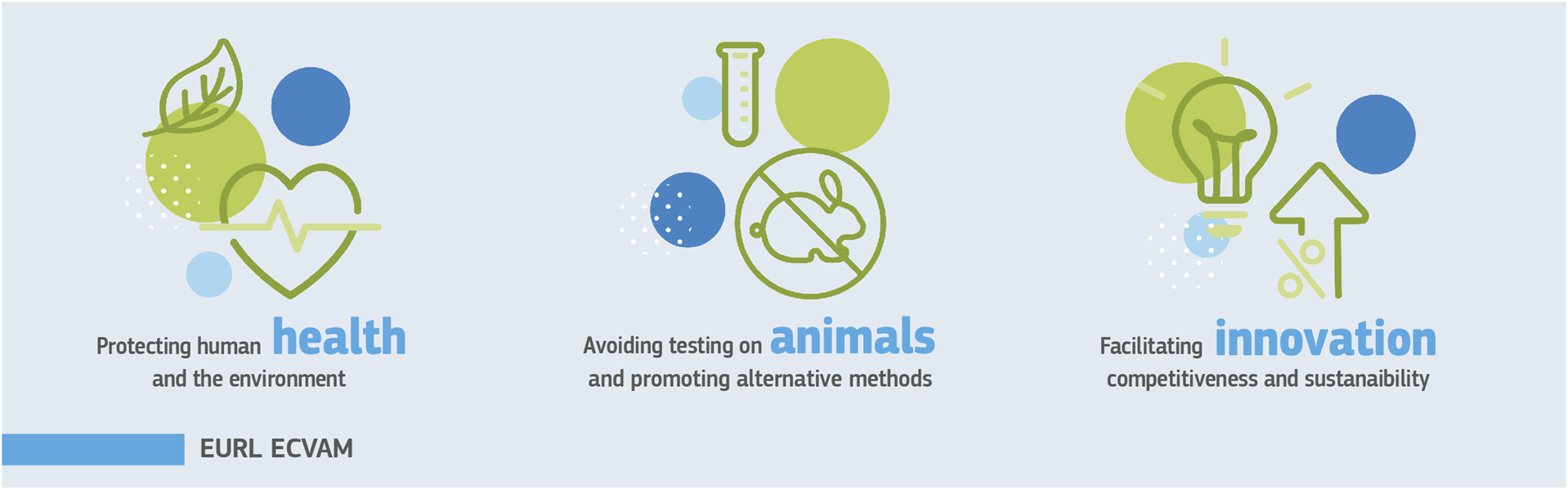
The challenge is not over yet and EURL ECVAM will continue to firmly believe in the ‘triple win’ scenario: one which protects human health and the environment while avoiding testing on animals and facilitating innovation, competitiveness and sustainability. 1.European Commission. EU Reference Laboratory for Alternatives to Animal Testing, https://ec.europa.eu/jrc/en/eurl/ecvam (2021, accessed 12 August 2021). 2.European Commission. Directive 2010/63/EU of the European Parliament and of the Council of 22 September 2010 on the protection of animals used for scientific purposes. Text with EEA relevance. Off J Euro Union 2010; L276: 33–79. 3.Pistollato F, Madia F, Corvi R, et al. Current EU regulatory requirements for the assessment of chemicals and cosmetic products: Challenges and opportunities for introducing new approach methodologies. Arch Toxicol 2021; 95: 1867–1897. 4.European Commission. ESTAF — EURL ECVAM Stakeholder Forum, https://ec.europa.eu/jrc/en/eurl/ecvam/knowledge-sharing-3rs/knowledge-networks/estaf (2021, accessed 12 August 2021). 5.European Commission. Advisory and Consultation Bodies, https://ec.europa.eu/jrc/en/eurl/ecvam/alternative-methods-toxicity-testing/advisory-bodies (2017, accessed 12 August 2021).
References
Introducing the Three Rs into Secondary Schools, Universities and Continuing Education Programmes
 Education and training are fundamental to boosting the uptake of alternative methods and application of the Three Rs principles in science. In particular, knowledge sharing is an effective and sustainable way to enlighten and inspire the next generation of scientists, instilling an informed, open and creative mindset at an early stage of their educational career. It can also help to build respect for the Three Rs and heighten their sense of opportunities to progress the life sciences through application of the Three Rs.
In addition to organising our Summer Schools in 2017, 2019 and 2021, EURL ECVAM has been engaged in several other education and training activities 1 — at secondary school, university and early professional training levels — each aimed at increasing awareness of the Three Rs principles and alternative methods and approaches.
Underpinning these activities was a report written in 2020, 2 designed to stimulate and facilitate the uptake of new Three Rs educational material. The target readers of this report are the decision-makers and influencers within education systems who contribute to educational policy-making at European, Member State or local level. This represents an audience who is not necessarily familiar with the Three Rs and its associated topics. The report contains an introduction to the Three Rs, the EU legalities surrounding animal use in science, the ethical considerations, as well as examples of the innovative science reaching beyond the use of traditional animal models. It also raises awareness of new career and future job opportunities for students. The report further describes the current state-of-the-art of the Three Rs in education and suggests how to introduce new elements into the curriculum to make the Three Rs a more robust and continuously taught subject – primarily at secondary school, then through university and onward into professional training.
Educational resources
EURL ECVAM has created a range of freely available resources, providing the foundation for Three Rs course building and integration of the Three Rs, as a subject, into everyday teaching in a variety of educational settings. These resources include background material on the Three Rs for use at all levels, in the form of a storyboard with an accompanying slide set, infographics and two editions of a Massive Open Online Course (MOOC 3 ). They are aimed at secondary school teachers, as well as other educators and stakeholders, to help support their teaching of an introduction to animal-use in science, as well as the Three Rs concept. The introduction of the MOOC took place in January 2020. It was based on six ‘learning scenarios’ (or structured lesson plans) on the subject of the Three Rs and was designed to support teachers in the classroom who were using the plans. In September 2021, the course will be run again under a new phase of our project, continuing to target secondary schools. We are also adapting the materials for use in primary schools, so the Three Rs can be introduced to younger children. Overall, the age range covered is 8–19 years of age.
The MOOC is not the only activity taking place over the course of 2021 and 2022. There will also be a number of outreach campaigns, including a competition to build further Three Rs learning scenarios, 4 and further promotion of the new resources co-created by the teachers involved in the project. These 20 teachers will be with us for the entire project, and they will also help with preparing and delivering training courses for other teachers. Later on, teachers who have implemented these learning scenarios in their classrooms will be invited to report back with their feedback. Towards the end of the project, we will promote our secondary school work to the Ministries of Education, to encourage further inclusion of the Three Rs into the curriculum.
In the case of universities, we have to face the overarching challenge of extremely heterogeneous and independent curricula. Furthermore, the European Commission cannot directly influence national curricula at this or any other level, and any curriculum changes tend to take place at Member State level. Nevertheless, we should ensure that national players and contact points are also aware of the need for inclusion of the Three Rs into the relevant curriculum areas. We can reach academics in the biosciences and other Three Rs-related disciplines by targeting an information campaign at the range of European specialist organisations where the Three Rs have relevance, but also offering resources (e.g. learning scenarios, slide sets, infographics and storyboard content) that they can readily use. During a JRC workshop, selected experts in Three Rs teaching provided a learning scenario from their own particular courses, with the aim of making them available to the intended target group — either as it is, or customised according to their needs. This collection of learning scenarios can also be seen as a collaborative activity towards further developments and implementation. The full version of these learning scenarios can be downloaded through the JRC data catalogue. 5
Educating the professionals and teaching the regulators is crucial. This necessity could facilitate widespread inclusion of Three Rs content in various curricula at this level, through engaging trainers in the process. In order to expand the number of tutors, ‘train-the-trainer’ approaches, and support in the form of sharing educational content and materials, are considered very helpful. Based on this approach, education and training on the Three Rs should be included in the continuous education courses of every national professional programme. The JRC could play a crucial role in coordinating this information, with the aim of sharing their experience of using scientific evidence for policy making, providing relevant information and material, as well as representing a hub to share information, not only for professionals but also for people from a variety of backgrounds.
Interdisciplinary subjects are pivotal for encouraging connections between disciplines and helping students construct broad knowledge schema. Skills such as critical thinking, communication and analysis are important for this and are being continuously developed throughout all stages of life. Overall, these considerations strongly reinforce the concept that the early introduction of the Three Rs into educational curricula may represent an exciting strategy for better-tailored education and training programmes for future generations.