




Abstract
In the UK, migrants with No Recourse to Public Funds (NRPF) conditions are denied full access to social security benefits and the labour market, rendering them ‘invisible’ and dependent on third sector organisations, like foodbanks. This qualitative study explored how third sector organisations used food aid to challenge the invisibilising of those with NRPF. In 2022, semi-structured interviews and focus groups were carried out with 17 organisations supporting migrant households across the UK; and with 13 London-based migrants with experience of NRPF status. Organisations such as foodbanks have the resources to intervene in the uncertainty and liminality that NRPF confers by providing material and temporal structure. However, providing crucial support to migrants inadvertently perpetuates the shadow welfare regime that has grown around the ever-expanding gaps in state provision. This paper highlights some of the ways that food aid organisations mitigate the harms of immigration regimes against the problematic backdrop of uncertainty and welfare failure.
Introduction
Migration and the hostile environment
In the UK, immigration policies have historically been subject to racial prejudice and othering. The early twenty-first century saw a turn towards increasingly more exclusionary and punitive policies. In 2012, then Home Secretary Teresa May, announced her commitment to drastically reduce net migration, making the country a less attractive destination for migrants, and creating a ‘hostile environment’ for those who did try to make their home in the UK (Griffiths and Yeo, 2021). Since 2012, the hostile environment has substantially restricted access to residency and amplified racialised migrants’ vulnerability to poverty and destitution (Reynolds et al., 2024). Brexit signified a surge of cultural politics and anti-immigration rhetoric; with anxieties over British citizenship and access to resources and services (Spiliopoulos and Timmons, 2023), especially social security benefits, housing and healthcare. This was discursively linked to the influx of refugees into Europe following the Syrian conflict in 2015. Although Germany took in far more refugees than other EU countries, it was widely covered in UK media. An anti-immigration stance became core to populist campaigning to vote leave in the European Union membership referendum (Mondon, 2025). The Brexit Party was formed by Nigel Farage in April 2019 to contest the European Parliament elections following delays to the UK's departure from the EU. In early 2021, The Brexit Party became Reform.
Reform remained a persistent presence at the political margins until 2023, when sustained pressure from the political right and far-right prompted the Sunak government to adopt policies further restricting the rights of migrants. This effort to bolster its failing support with hardline anti-immigration hostility laid the groundwork for ensuing discourse (Heath et al., 2025). Anti-immigration sentiment was effectively deployed in a ‘culture war’ strategy that positioned Remainers, Muslims, immigrants and transgender people (among others) as ‘threats’ to the nation (Hampshire, 2024). This culminated in April 2024, when the UK Parliament approved the contentious so-called ‘Rwanda policy’ (i.e., the Migration and Economic Development Partnership), whereby people identified as ‘illegal asylum seekers’ would be relocated to Rwanda for processing and resettlement. The next British Prime Minister, Sir Keir Starmer, quickly abandoned the scheme when he took office in July 2024. However, this did not signal a reversal of escalating anti-immigration movements. Reform, buoyed by local election successes in May 2025, now largely sets the tone for mainstream British domestic politics, with Labour and Conservative parities responding to and legitimising the politics of anti-immigration (Choonara, 2025).
The current Home Secretary (at the time of writing), Shabana Mahmood, has announced far reaching changes to the UK immigration system, which will position it amongst the most restrictive amid comparable high-income countries (Sumption, 2025). Introducing a longer qualifying period for settlement, increasing English language requirements, and further tightening visa conditions will restrict legal migration (McKinney and Gower, 2025). Asylum system reforms will make refugee status temporary and introduce a new 20-year wait for settlement. Controversially, legal duties to house and support migrants will be replaced by discretionary powers at the local level (Pike, 2025).
Hostile environment policies go beyond deterrence. Immigration has become increasingly politicised by the far right, with migrants frequently attacked and demonised as a means to build their popularity and advance political agendas (KhosraviNik, 2010). Donald Trump credits his punitive stance on migrants with helping him win the US presidential election (Cooper et al., 2021). Hostile environments also serve to ‘wear down’ migrants, regardless of their reason for migration (Ryan et al., 2024) and are underpinned by deliberate intentions on the part of the state to exclude certain groups from accessing services, legal rights or protection on the grounds that they are undeserving (Sales, 2002). This can be understood as migrants being purposefully rendered ‘invisible’ by different technologies of migration governance (Humphris and Sigona, 2019).
The invisibilising of migrants with no recourse to public funds (NRPF)
People deemed to have No Recourse to Public Funds (NRPF) status are among the most ‘invisibilised’ of migrants. Introduced in the Immigration Act of 1971, the rule imposes conditions on leave-to-enter or remain in the UK including the requirement for applicants to financially maintain themselves and their dependents (Jolly et al., 2022). NRPF excludes people from claiming benefits that are classed as ‘public funds’ for immigration purposes. These conditions usually apply if a person has leave-to-enter or leave-to-remain immigration status for a temporary purpose, are seeking asylum, or do not have lawful status in the UK. Table 1 summarises the benefit entitlement and right-to-work statuses of these groups. It is worth restating the complexity and variability of the system. Some people with limited leave-to-remain will have access to public funds. Additionally, some people who would normally be subject to a NRPF condition may not have this imposed or can apply to the Home Office for it to be lifted.
Main categories of migrant with no access to public funds (NRPF).
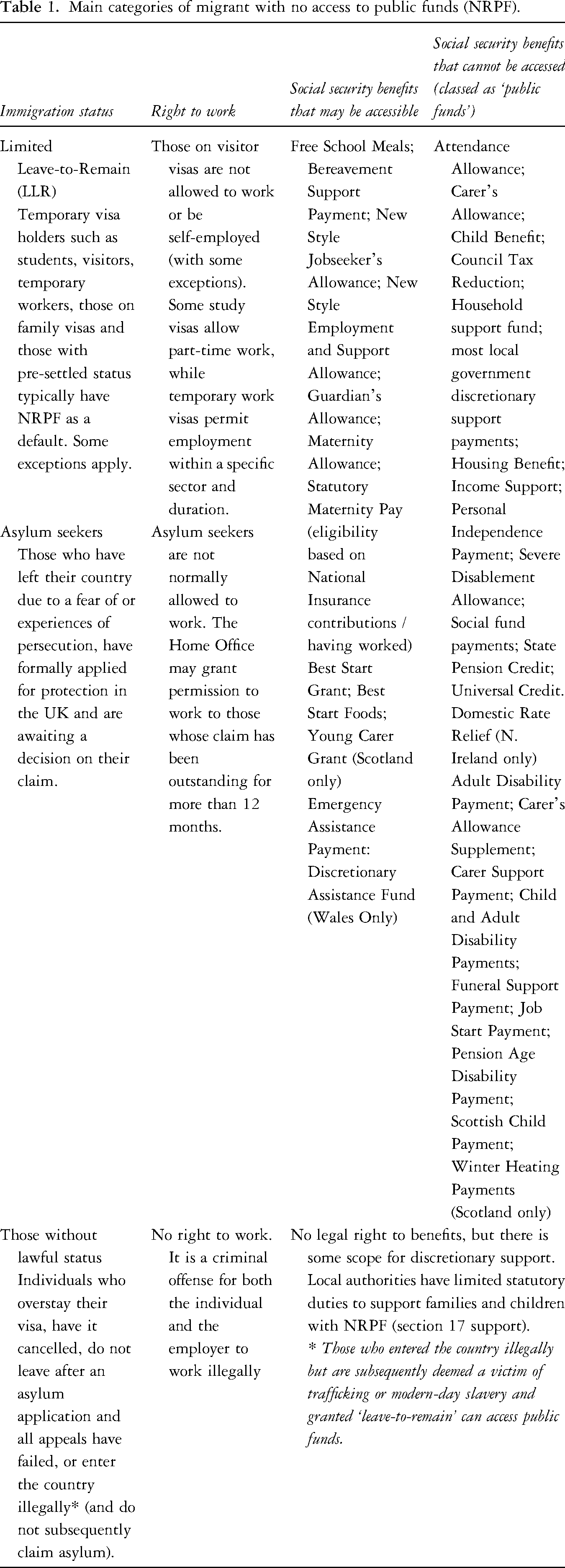
Asylum seeker is demonstrably the most politicised and demonised migrant status (Cooper et al., 2021), and refers to those who have fled to another country to seek protection. Due to decades of underfunding and resulting backlogs, it can take months or years for the Home Office to accept or reject their claim for asylum (Yeo, 2024). It is a system designed to fail, especially along racial line (Lonergan, 2024). Asylum seekers are not usually permitted to work. Given that most of the benefits not classed as public funds are only available to people who have previously worked and/or paid National Insurance, they are typically left without income. In order to subsist, they receive minimal financial support (less than £50 per person per week if they have self-catering accommodation and less than £10 per week if food is provided) from the Home Office whilst their asylum case is being processed (NRPF Network, 2025).
Settlement (indefinite leave-to-remain) is the point at which most migrants become eligible to access public funds, but it is not automatic or guaranteed. For example, those with leave-to-enter or remain for settlement (as a relative of a British citizen or settled resident) and those with leave-to enter or remain subject to a maintenance undertaking (being dependent on a named relative) will likely have a NRPF condition (Asylum Matters, 2020).
Housing and accommodation for migrants is rooted in structural racism (Rogaly et al., 2021). The hostile environment makes people homeless, principally though NRPF, high visa fees, long routes to settlement, and asylum accommodation evictions of newly recognised refugees (Praxis, 2024). Those with NRPF are not typically eligible for homelessness assistance (NRPF Network, 2025). In practice, they are housed through a combination of local authority support, charities, shelters, hostels, and contracted providers. Those with a right to work have to try and find options like working accommodation or low-cost rental schemes.
Asylum seekers at risk of destitution and rough sleeping will be offered contingency accommodation, which is temporary housing while they await dispersal accommodation. Most commonly, this is in catered and uncatered hotels managed by private companies contracted by the Home Office. The medical consequences of longer stays in contingency accommodation can be dire, with reports of mental health problems, isolation, lack of access to primary care and essential services, and suicide attempts (Dobbin et al., 2023). Dispersal accommodation is longer-term more permanent housing. Usually, this involves the use of private properties split into HMOs and allocated by the Home Office, with a policy to spread the cost of housing migrants (and therefore migrants themselves) across the country. Migrants have no choice in where or how they are housed, limiting their mobility and subjugating them into new spaces of surveillance (Stavropoulou, 2024).
The third sector, food aid and state retreat
In the UK, and across Europe more widely, third sector responses to welfare reform, state retreat, reduced eligibility to services, public spending cuts, and the pandemic, have been led by food aid providers, and especially by foodbanks (Jenkins et al., 2021; Lambie-Mumford and Green, 2017). During the COVID-19 lockdowns, charitable food aid organisations were at the forefront of efforts to prevent vulnerable migrants becoming destitute and going hungry (Dickson et al., 2020). Former UK Prime Minister, Gordon Brown, stated publicly that foodbanks are taking over from the (welfare) state in fighting poverty, to the extent that they have become the last line of defence against destitution (Savage, 2023). Food aid is emblematic of welfare state failure (Riches, 2014), with its remit progressively expanding beyond emergency food and into areas such as debt advice, advocacy, and even legal assistance (Thompson et al., 2025). Foodbanks report that their clients, especially migrants, often have not received any help from local statutory services (The Trussell Trust, 2023).
By engaging and offering support, food aid settings provide episodes of interpellation (Bassel et al., 2018) through which the production of ‘legitimate’ migrant identities is supported. According to Althusser, individuals are always already subjects (Althusser, 2012) and are made so via interpellation; the process by whereby ideology constitutes the nature of an individual's identity by hailing them in social interactions (Payne, 1997). Interpellation operates not only at the individual level, but also at the institutional level, as subjects are woven into relations with state apparatus (Butler, 1993; Korteweg, 2003). The identities made in food aid settings can run counter to othering and practices of exclusion experienced elsewhere. Food aid providers recognise and interact with migrants as legitimate citizens-in-waiting (Haas, 2017) who need to be supported through the many processes of being ‘seen’ by the state. In this paper, we explore the processes through which support and visibility are achieved in food aid settings.
Methods
The results presented here are based on a qualitative study, commissioned by The Food Foundation, looking at immigration and food poverty in the UK, with a specific focus on (NRPF) (Hamilton et al., 2022). Data were collected with two participant groups: 17 individuals from third sector organisations supporting NRPF families in locations across the four UK nations; and a cohort of 13 London-based migrants (12 from Nigeria and one from China) who had or recently had NRPF as a condition of their immigration status and were being supported by the same local charity. All data were collected remotely, by telephone or video call. Ethics approval was granted by the University of Hertfordshire [Protocol No. aHSK/SF/UH/04760(1)]. Data were collected over a five-month period in 2022.
Recruitment of organisations supporting migrants
The supporting organisation sample was recruited first through a combination of the authors’ contacts, introductions made by The Food Foundation, and cold-calling. Initially, we used a snowballing technique and then a purposive approach, using the authors’ knowledge of the UK food aid system, to make sure that we recruited organisations from across the UK to capture a range of different permutations of food aid (e.g., pantries, foodbanks, holiday hunger provision). The Food Foundation's scope of work and research spans the entire UK, with the explicit aim of generating recommendations that have wide-reaching relevance for policy makers (The Food Foundation, 2022). As such, we were motivated to elicit narratives and approaches to supporting migrants from a broad geographic range of organisations in order to maximise the reach and relevance of our findings for the funders. For the purposes of the research team (the authors), this also presented the opportunity to address the research gap on UK-wide studies of NRPF (Leon and Broadhead, 2024), albeit on a very modest scale. Indeed, the range of people we were fortunate enough to talk discussed a variety of diverse topics including the rural plight of migrants with NRPF, forced labour, involving migrants in food growing schemes, the challenges of feeding migrants in cities where Halal food was not readily available, and migrant families rough-sleeping in suburban areas.
We sought respondents with significant experience as frontline practitioners and/or with senior policy input. A total of 17 services and organisations were recruited to the study, including advocacy and campaign groups providing various forms of support (e.g., food, housing, legal advice). Of these, seven were from organisations in England, four from Wales, four from Scotland, and two from Northern Ireland.
Recruitment of migrants
The migrant sample was recruited via the supporting organisations. Migrants, particularly the undocumented or those trying to gain citizenship, present unique vulnerabilities and ethical considerations (McLaughlin and Alfaro-Velcamp, 2015). Given the long-term and often high-stakes relationships of support between migrants and Refugee Third Sector (RTS) organisations, a tendency to protect and shield clients from potentially exploitative or burdensome interactions becomes commonplace. As data collection progressed with the supporting organisations, we developed a relationship with one London-based advocacy group who agreed to pass our details on to groups of NRPF clients they thought might be interested in the study, leaving it up to potential participants to contact us.
This approach had its limitations. Despite the dearth of demographic data around UK migrants with NRPF, we do know that this group is highly diverse and stratified by their specific immigration status, which shapes their risk of exclusion. This risk is compounded by intersecting characteristics such as gender, ethnicity, nationality, age, disability, and English language ability (Johnson-Hunter, 2025). By recruiting from a community of migrants who were all supported by the same charity, and many of whom knew each other, we engaged with a specific, situated group living in London (mostly – but not exclusively – Nigerian mothers of young children who were asylum seekers at the time of interview). Therefore, we are not able to explore a broad range of issues and challenges in a similar way to the breadth of experience detailed by the organisational sample. Recruitment was driven both by practicalities and the richness of the data. We had finite time within the project to form productive relationships with potential gatekeepers and participants. However, talking to people from just one city and charity-relationship allowed us to generate an in-depth understanding of how that charity worked with migrants and how they experienced it.
Consent to participate
Informed consent was obtained in writing, via email, following an explanation of the study and a discussion of the participant consent form. Permission to publish findings from the study was included in the informed consent process.
Data collection: semi-structured and group interviews
The organisations sample were interviewed either one-to-one or in group interviews. A total of six participants took part in two online group interviews (three in each interview) and the remaining 11 took part in individual telephone interviews, often in the evening and/or while commuting. Participants were asked about the type of support their organisation provided, the main challenges of NRPF policies, and the impact of NRPF on families with children. Further, we asked participants to comment on their food aid provision and/or referral to food aid providers, and how they perceived NRPF to shape both dietary practices and experiences of poverty.
The migrant sample were also offered the option of an online or telephone interview. All participants chose telephone interviews, typically explaining that it helped overcome time constraints and a lack of childcare options because they could talk on the phone while doing something else, like making their way to pick children up from school or doing housework. We took time to build connections with participants, sometimes over several telephone calls, and reassured them that we understood the necessity of rearranging or cancelling interviews to accommodate other (and much more important) calls on their time. Although efficient, remote interviews did present some problems. Namely, potential difficulties with rapport when visual cues are lost. During the interview, participants were asked about the circumstances related to their NRPF status; their housing situation; details of any support they received; how they accessed food; and their food practices at home. They were reimbursed for their time with supermarket vouchers (of their choice) worth £35.
Data analysis
All interviews were audio recorded, transcribed, anonymised, uploaded to NVivo software, and subject to a thematic analysis, which sought to identify patterns of experience, talk and behaviour (Aronson, 1994). Initially, open coding was used to categorise interactions with food aid in terms of social context, perceptions, and identities. Selective coding was subsequently used to identify the values, practices, and perceived outcomes of food aid-based interactions. The transcripts were then re-examined for contradictions, dilemmas and omissions. Finally, a coding frame was developed and refined to capture the main concepts. We drew upon both the notion of in/visibility (Humphris and Sigona, 2019) and the concept of citizen-in-waiting (Haas, 2017) as an analytical framework.
Results
Upon entering the UK, migrants can find themselves in a hostile environment, unable to meet their basic needs or integrate into communities (Farmer, 2017). In this context, relationships with food aid providers can be transformative. Organisations such as foodbanks have the resources to intervene in the uncertainty and liminality that NRPF confers by providing material and temporal structure. They meet basic material needs (where possible) and provide episodes of support that signify the beginning of a journey towards settlement and legitimacy, even if it cannot always be realised. Providing this crucial support also, and inadvertently, perpetuates and reinforces the shadow welfare regime that has grown around the ever-expanding gaps in state provision. The advocacy of the third sector on behalf of migrants compels it to engage in the well-worn and self-defeating discourses of need, deservedness, and othering, somewhat reproducing the dynamics of marginalisation. In the sections that follow, this paper will explore the crucial roles that food aid plays in rendering migrant visible to the state against the problematic backdrop of uncertainty and welfare failure. All names are pseudonyms.
Liminality: the protracted waiting of citizens-in-waiting
Migrants’ accounts were characterised by descriptions of long and uncertain waits, spanning months and years, trying to resolve their migration status. This type of waiting is a defining and corrosive feature of immigration regimes. It is not a passive waiting, but rather a performative one. Migrants are required to interact with the bureaucratic mechanisms of the immigration regime, attending appointments with professionals, providing documentation, appealing, and awaiting decisions. These protracted performances necessitate resources, knowledge, and resiliencies that migrants do not possess or even know – initially – that they need to possess. Haas (2017) describes this as an existential limbo that places the very viability of migrants’ lives is a state of profound uncertainty. Similarly, Rainbird draws attention to the ‘liminal existence’ of asylum systems that induces existential (not to mention material) crises (Rainbird, 2014).
Food aid providers actively intervene in this limbo and uncertainty. The provision of food, one of the most basic of human needs, is material and tangible. The physicality of this help stands in stark relief to the liminality and abstract notions of the immigration system and the legal processes involved in the pursuit of citizenship. Migrants typically came into contact with organisations providing food aid via referral (individually or as a group) by local authorities or by other charities. For participants, the provision of food by third sector organisations represented one of the few, and perhaps the first, episodes of welcome and acceptance amongst the hostilities and refusals they had encountered thus far. For Grace, a mother to four children, a foodbank being run in a church provided a source of food and a place to stay that meant she could avoid sleeping-rough with her children.
Yeah, I couldn't have access to anything, because I don't have no recourse to public funds. Yeah. So I live on a foodbank… I had to sleep, like, in the church, where they have space in the church, that's where I was… Yeah, with my children… I slept, like, one year
…
I'm in temporary accommodation now.
Remaining unacknowledged and unseen by statutory services, despite having come forward for help is a facet of cultivated invisibility; one of the multiple ways in which migrants internalised invisibilisation as an embodied disposition (Stewart and Sanders, 2023). Being recognised and legitimised by food aid providers was a process. Organisations in different settings developed programmes for migrants, weaving them around the anticipated challenges, waits and uncertainty that they were almost certain to face while trying to become settled residents and citizens. In the extract below, Alicia, the manager of a community integration charity (with its own foodbank) in Scotland, described their programme for welcoming migrants.
Mostly, our intervention is for newcomers, so what we aim to do is to provide services and activities that help newcomers in [City] to settle comfortably and achieve their full potential … our main services are free English classes, from beginners to advanced. Then we have an employability and business guidance support …. …. Yeah, so basically we started working on food growing, initially; that's how we entered this area of work. We developed a community garden, and we were helping refugees’ families to start their own food growing at home.
However, such identities are ambiguous and contested (Ní Mhurchú, 2015). Power's work, for example, highlights that other foodbank users do not always share organisational and sector priorities around welcoming and supporting migrants, particularly asylum seekers (Power and Baxter, 2024). Issues of race, resentment, and stigmatisation run counter to the narratives of integration (Ibid). Our study focused exclusively on those with NRPF, so we are not able to contextualise these accounts alongside those of non-migrant food aid recipients.
There is no legal entitlement or right to third sector support. As such, while food aid organisations work to mitigate uncertainty for migrants, they also function as liminal spaces. They operate and mediate access through a pastoral (rather than state) power, which typically requires confessions of crises from service users, and their obedience to an expert regime in the diagnosis and treatment of (food) poverty (Möller, 2021). Identities formed inside sites such as foodbanks are exceptional and would otherwise be unacceptable for UK citizens (Farmer, 2021). While the positioning of migrants as citizens-in-waiting ultimately confers visibility, even if only partially, it remains a negotiated and uncomfortable identity that can be rooted in both acceptance and marginalisation. The interpellation of migrants, via interactions with food aid providers, can operate through regimes of difference (Bassel et al., 2018) that engender states of tolerated citizenship, in which deservingness is precarious and fragile (Rosen and Dickson, 2024).
Food is used by RTS organisations to welcome and support migrants, but it is not an adequate welcome. A diet of donated and surplus food lacks dignity. The biopolitics of precarity lock people into an endless state of uncertainty and its associated distress through ‘crisis’ as both a mode of governance and an everyday experience (Gentili, 2021). A citizen-in-waiting identity, and the uncertainty it entails, is not a dignified experience. Martha is a single parent to four children. When she first moved to the UK, she had NRPF status attached to her family visa for four years. She was permitted to work but could not claim benefits classed as public funds. During this time, she lived in temporary shared accommodation. She had to work multiple jobs with long hours and rarely got to see her children or cook and eat with them. It was also very difficult for her to cook because other residents would take her food (Hamilton et al., 2022). She listed her use of foodbanks as one of the many corrosive privations resulting from her status. I found myself going to foodbanks most of the time […] And it devalued your dignity […] it affects you a lot. […] Even if you’re tired, you still have to go out to work […] because you know they’re not going to pay you; the government is not going to pay you for being sick.
The refugee third sector (RTS): shadow welfare
The third sector attempts to fill a widening and significant gap between the residual support provided by the state and the material and social needs of migrants. A refugee third sector (RTS) has developed around the needs of this group. It is an ad hoc parallel welfare system of unofficial, piecemeal support for people who are excluded from mainstream social security (Mayblin and James, 2019; Price and Spencer, 2015). Where interactions with the state can be characterised by bureaucracy, exclusion and hostility, the RTS attempts to compensate with acceptance, long term support, and the possibility of resistance to everyday bordering. In doing so, third sector support can counter the emotional and legal distanciation (Potter and Meier, 2024) that is mobilised as a technology of exclusion and control.
Distanciation is the active production of distance as a method of control, perpetuation of the hostile environment, and a means of racializing and criminalising migrants (Potter and Meier, 2024). One of the ways distanciation plays out and is subsequently resisted is through migrant parenting and the needs of children. Parents with NRPF routinely face the dilemma of needing to seek help but, at the same time, fearing that disclosing their struggles will brand them an inadequate parent and may even result in them being separated from their children. This can be understood as a result of emotional distanciation, which leaves people with a feeling or sense of never being safe and fully at home (Ibid), and therefore inherently distrustful of potential sources of support. Juliette, a campaigns co-ordinator for a refugee support charity in England, explained how this double-bind plays out and exactly why migrants were sometimes reluctant to ask local authorities for help: When they get into crisis, there is no mainstream support for them. So the local authority cannot support, unless they have a child and are destitute. And this, of course, leads to people getting into cycles of homelessness, deep poverty, destitution, and, of course, that ricochets into all sorts of really bad problems … Lots of people don't want to report to local authorities, because there is a feeling of bad faith from those local authorities. There have been experiences of people being told, ‘you're not a fit mother, we're going to take away your child’.
Those advocating on behalf of migrant families were very much aware that migrants could be rendered visible through their children. Having initiated relationships with migrant families by helping to meet their basic needs, like food and shelter, RTS organisations went on to advocate for them. They leveraged their status as parents and the needs of their children to compel statutory agencies to activate rights and entitlements. In this way, feeding migrant children hailed migrants as parent-citizens. Kaleem, the policy advisor for a children's charity in London, explained how that charity used the bureaucratic failings and under-resourcing of local government as a mechanism to legally compel it to support and provide housing for migrant NRPF families: We ended up, in 2008, making referrals for families to [City Council] Children's Services, horrific conditions, kids with cerebral palsy, pregnant women sleeping in bus shelters etc, and the local authority wouldn’t support. We found an angle, a loophole, in regards to getting support for critical families. This was around 2008, 2009. That loophole was that we would take them to Court every single time on the basis that they have to complete an assessment and support the family at the same time. Because they were overworked, they couldn’t get the assessments done on time, so the judge would every single time support our cases.
The gaps left by welfare reform and state spending cuts have engendering new forms of responsibility that are, unfortunately, unevenly distributed and performed. Austerity, and more recently, the COVID-19 pandemic and the cost of living crisis, have prompted a spatial shifting of responsibility away from public institutions with diminishing budgets, and onto those communities most effected by the ‘gaps’ (Strong, 2020). The move towards wrap-around support and family-centred provision on the part of food aid organisations is an outcome and manifestation of these new forms of responsibility. Brian, a project manager for a community youth charity in Northern Ireland, described how the service had evolved from a youth centre to a family support hub.
It's more than a youth centre, really, it's very active, so there would have been ongoing provisions … it was much more than food. It was, I suppose, like a summer club with a meal provided. So, absolutely, there would have been a really good relationship with the young people, and increasingly their families as well. That's where we found the big change over a long number of years … it has helped the organisation work with families a lot more, and there'll be a much better relationship with the
parent
s
I should show some appreciation [to the foodbank], I know that, yeah….
I know we're undocumented, I know the system fails the asylum seekers. They are just nobody with the system and feel we are not human … but if the foodbank can give us food that has not expired, because sometimes you take it home, and half of it is gone, and I can't eat it … sometimes I figure that I get home and I start crying and I say, is it because of my condition, I have to take this food that is expired? … I felt bad. I felt rejected. I felt I was worthless.
And later: I know we’re undocumented, I know the system fails asylum seekers […] It's just as if we are not even existing.
Conclusion
This study provides insight as to how migrants with NRPF experience the technologies of migration governance and how organisations providing food aid help to mitigate and resist them. Typically, food aid serves as an entry point for migrants into relationships with third sector organisations that will advocate for them and help them to resolve these tensions. In turn, third sector organisations offering support face their own contradictions: seeking to challenge prevailing social inequalities (Anitha and Gill, 2022) but, in doing so, also being implicated in the perpetuation of a ‘shadow welfare state’ that exists in a hierarchically inferior position to statutory services (Trudeau, 2008). Migrants can become mired in the subjectivities of citizens-in-waiting (Haas, 2017) or tolerated citizenship (Rosen and Dickson, 2024), even with the support of food aid providers. In which case, the episodes of interpellation performed in food aid settings can also be understood as misinterpellation (Martel, 2015) and migrants with NRPF as misinterpellated subjects. They answer the hail, but they are not wanted by the state to which they are gradually being rendered visible. Their presence is viewed as potentially damaging and dangerous (Martel, 2015) because of deliberate misinformation and a growing political consensus that most migrants, and asylum seekers especially, are not genuine (Ryan et al., 2024). The findings presented here go some way to challenging the empirically dubious but politically expedient rhetoric that underpins this consensus.
Footnotes
Acknowledgements
The authors would like to thank the participants of the study for their time and engagement. Claire Thompson and Wendy Wills are supported by the National Institute for Health and Care Research (NIHR) Applied Research Collaboration East of England (NIHR ARC EoE) at Cambridgeshire and Peterborough NHS Foundation Trust. The views expressed are those of the authors and not necessarily those of the NIHR or the Department of Health and Social Care.
Data availability statement
Authors elect to not share data.
Declaration of conflicting interests
The authors declared no potential conflicts of interest with respect to the research, authorship, and/or publication of this article.
Ethical considerations
Ethics approval was granted by the University of Hertfordshire [Protocol No. aHSK/SF/UH/04760(1)].
Funding
The authors disclosed receipt of the following financial support for the research, authorship, and/or publication of this article: The University of Hertfordshire research team were commissioned by The Food Foundation to carry out this research and the research was funded by the Nuffield Foundation.
