




Abstract
Since being introduced in 2014, Community Protection Notices (CPNs) have changed the anti-social behaviour (ASB) policy landscape in England and Wales. Using Cohen's (1985) net-widening analogy as an analytical framework, we evidence how CPNs are an example of the creeping criminalisation of sub-criminal behaviours from first-wave to second-wave ASB policy. In doing so, we highlight how frontline policing bodies have lowered the behavioural threshold at which ASB enforcement takes place, demonstrate how CPNs are employed to fill gaps to regulate behaviour not traditionally associated with the criminal justice system, and show how CPNs are escalated to a Criminal Behaviour Order in a way that shortcuts due process and results in disproportionate punishment.
Introduction
This article explores how the nature of behavioural regulation in England and Wales has evolved through the introduction and use of Community Protection Notices (CPNs) to tackle anti-social behaviour (ASB). Utilising data from 36 qualitative interviews with frontline practitioners and ASB trainers, we offer three significant contributions to our contemporary understanding of preventive social control. Drawing on Cohen's (1985) analogy of ‘net-widening’ and ‘mesh-thinning’, we first explain how the shrinking behavioural threshold associated with the use of CPNs has made a wider range of behaviours subject to regulation, drawing more people into contact with policing bodies. Second, we detail how CPNs are stretched to the limit of their flexibility to sanction behaviours not traditionally associated with the criminal justice system to fill in the gaps and act as a quick fix instead of pursuing established criminal law. Third, we expose how the breach of a CPN can be escalated to a Criminal Behaviour Order (CBO) in a manner that shortcuts traditional due process and its associated procedural safeguards, which results in punishment disproportionate to the behaviour in question and/or the risk of harm posed by the individual. Together, these contributions highlight the further rolling-back of legal protections under the auspices of preventive social control and early intervention, which puts citizens at risk of unnecessary criminalisation.
Community Protection Notices (CPNs) were introduced through the Anti-Social Behaviour, Crime and Policing Act (2014). They are civil preventive notices that can be issued to individuals aged over 16, or organisations, to regulate behaviour if ‘the conduct of the individual or body is having a detrimental effect, of a persistent and continuing nature, on the quality of life of those in the locality, and the conduct is unreasonable’ (Anti-Social Behaviour, Crime and Policing Act, 2014, section 43(1)). This definitional threshold is more flexible and subjective than the updated legal definition of ASB which is ‘conduct that has caused, or is likely to cause, harassment, alarm or distress to any person’ (Anti-Social Behaviour, Crime and Policing Act, 2014, section 2(1)(a)). A CPN operates by imposing a set of behavioural requirements upon the recipient, to either cease and/or undertake specific actions. For example, to keep a dog on a lead in public, or to not shout obscenities in the street. There is no limit on the type or number of requirements a single CPN can contain nor is there a specified duration for how long it can last, with some notices due to last indefinitely. Research by the Manifesto Club (2021) has shown how CPNs have been used to manage a wide range of behaviours perceived to have a detrimental effect on the quality of life including neighbour disputes, inconsiderate parking, rough sleeping, and dangerous dogs. The biggest departure from previous similar ASB powers is that CPNs are issued out of court by individual frontline officers from the local council, police, and registered social landlords if they have been delegated responsibility. The individuals that usually issue CPNs include street wardens, community safety officers, and environmental protection officers from the local council, alongside police constables and police community support officers.
Prior to issuing a CPN, the recipient must receive a formal written Community Protection Warning (CPW). This should outline the behaviour causing a problem, request the cessation of that behaviour, and outline the consequences for non-compliance, which is the issuing of a CPN. The CPW should also provide a timeframe within which the behaviour should be addressed. How a CPW is issued and the timescale for compliance is at the discretion of the issuing officer and there is no legal basis for a CPW to be appealed, although there is evidence they can be informally rescinded (Heap et al., 2024). A CPN can be appealed at the Magistrates’ Court within 21 days of issue on a range of grounds, which include if the recipient asserts the behaviour did not take place, the behaviour itself was not unreasonable, or that any of the requirements imposed by the notice are unreasonable. Breach of a CPN is a criminal offence which is punishable by a fixed penalty notice (FPN) up to £100, with payment discharging any liability for conviction of the offence. On conviction, for example if the FPN is not paid, the punishment is a fine of up to £2500 for individuals, or £20,000 for organisations. Sanctions for breach also include paying for remedial work, or the forfeiture/seizure of items (for example noise-making equipment). The flexibility of CPN legislation demonstrates how this new power has the potential to widen the net of social control due to the out of court issuing process, the range of officers that can issue the notices, and the limited options for appeal.
To highlight the development of ASB powers, we begin by detailing two waves of ASB policy; the first reflecting the New Labour years (1998–2010) and the second outlining reforms enacted by the Conservative-Liberal Democrat Coalition, which have been adopted by successive Conservative governments and the recently elected Labour government until present day (2010 onwards). Our aim is to demonstrate the creeping criminalisation of sub-criminal behaviours, illustrating how second-wave powers are more pernicious than the first. To do this, we utilise Cohen's (1985: 41–42) work, which is based on the analogy of the ‘deviancy control system’ acting like a fishing net, where policing bodies work the net and the ‘deviants are the fish’. Cohen (1985) described three types of fishing net, all of which are applicable to ASB policy. Wider nets, which increase the number of people brought into the system, many of whom have not previously been involved. Denser nets, that reflect an increase in the intensity of the intervention by the system, which may not have been present before. Finally, different nets supplement rather than supersede previous methods of social control. Ultimately, more individuals are captured by these new nets, which brings a greater range of people into the deviancy control system, with a particular emphasis on ‘shallow-end’ delinquents (Cohen, 1985: 50) entering the system for the first time. This reflects the often sub-criminal nature of behaviour considered to be anti-social.
Anti-social behaviour and the widening net of preventive social control
First-wave anti-social behaviour policy
Since the introduction of the Crime and Disorder Act by the New Labour government in 1998, ASB policy has faced fierce and sustained criticism from a range of quarters (Ashworth et al., 1998; Chakrabarti and Russell, 2008; Fletcher, 2005). The flagship sanction, which attracted most attention, was the Anti-Social Behaviour Order (ASBO). ASBOs were a civil preventive order known for its two-step, hybrid nature. Applying the definition of acting ‘in a manner that caused or was likely to cause harassment, alarm or distress to one or more persons not of the same household’ (Crime and Disorder Act, 1998 Section 1 (1)(a)), the orders were issued under civil procedure in the Magistrates’ court. They prevented the recipient from undertaking specific behaviours, such as associating with particular individuals or entering defined geographical spaces. Breach of the order was a criminal offence punishable by up to five years in prison. Thus, individuals could be imprisoned for engaging in initial behaviours not considered a criminal offence.
Many scholars have used Cohen's (1985) analogy of net-widening to express their concerns about the broad range of behaviours captured by the all-encompassing ASB definition, the hybrid nature of the ASBO, and how this extension of social control brought more people into the criminal justice system (Ashworth and Zedner, 2014; Brown, 2004; Cracknell, 2000; Crawford, 2009; Hopkins Burke and Morill, 2004; Mooney and Young, 2006; Squires, 2006, 2008, 2017; Squires and Stephen, 2005).
With reference to ASBOs, Mooney and Young (2006) detail how net-widening reflected a process of defining deviancy up, which subsequently regulated a greater number of behaviours and exaggerated perceptions of ASB. Various analyses have been offered as to the rationale for developing ASB policy, indeed Mooney and Young (2006: 399) suggest New Labour created ‘a new territory of concern’ in response to a declining crime rate. Others, such as Burney (2005), proposed it was a reaction to perceived inefficiencies in the criminal justice system, where the new powers gave the authorities greater freedom to act. This appeared to play out in practice, with Squires (2008: 320) raising concerns about the way ASB policy ‘fast-tracked, augmented and relativised the process of criminalisation’. In fact, Burney (2002) suggested the main benefit of the ASBO to practitioners was the custodial sanction upon breach, rather than the premise it would change an individual's behaviour. This approach to behavioural regulation circumvented core legal principles such as due process and proportionality (Ashworth and Zedner, 2014; Crawford, 2009), both widening the net and making it denser.
The pursuit of harsher punishments during that period reflects broader discussions about crime control in the US and UK, which were politically motivated by law and order rhetoric that reassured the public (Garland, 2001). This ‘sovereign state strategy’, according to Garland (2000), was characterised by policing and state punishment to satisfy popular punitiveness and reinforce state authority. Garland (2000: 350) uses the term ‘expressive justice’ to conceptualise how ‘this process of condemnation and punishment serves as an expressive release of tension and a gratifying moment of unity in the face of crime.’ Burney (2005) acknowledges the general applicability of this thesis to New Labour's crime control policies, which characterised a punitive approach. From an ASB perspective, this chimes with Mooney and Young's (2006) argument regarding the development of ASB powers being created to look tough in response to a falling crime rate. Overall, the development of ASB policy, and particularly the implementation of the ASBO, exemplifies what Matthews (2005: 196) calls ‘an increasingly complex, opaque and expanding network of crime control’. Squires (2017: 45) extends this analysis by characterising it as ‘a profound refashioning of criminal justice interventions and processes’. Nevertheless, despite such substantial policy changes, one of the biggest problems with first-wave ASB policy is the lack of government funded evaluation (Crawford, 2009). Consequently, there is little empirical evidence of exactly how the tools and powers widened the net and whether they delivered a reduction in ASB. Therefore, given these policies were so contentious, the introduction of new legislation in 2014 offered a potential opportunity to address the multitude of concerns.
Second-wave anti-social behaviour policy
Following the election of the Conservative-Liberal Democrat Coalition government in 2010, ASB policy was substantially revised through the Anti-Social Behaviour, Crime and Policing Act (2014). Politically, there was a desire to move away from New Labour's flagship ASBO due to their cost, inability to address the underlying cause(s) of the problem, and high breach rates (Home Office, 2011), whilst continuing to prioritise the reduction of ASB (Hodgkinson and Tilley, 2011). Coalition ASB policy rhetoric also introduced a new focus on supporting vulnerable victims, brought about by several high-profile tragedies including the death of Fiona Pilkington following a sustained period of harassment and intimidation (see Heap, 2016). With an emphasis on making the legislation simpler and quicker to use in order to better protect victims (Home Office, 2011), the Act repealed previous ASB legislation and streamlined the number of powers from nineteen to six, with the new powers continuing to reflect the preventive, hybrid nature of their predecessors. The six powers included: Civil Injunctions, Criminal Behaviour Orders, Community Protection Notices (outlined above), Public Spaces Protection Orders, Dispersal Orders, and Closure Powers.
Concerns were raised, however, about how the new legislation appeared to simply re-shape the first-wave powers rather than offer a more progressive alternative (Hodgkinson and Tilley, 2011). Central to the reforms was a commitment to localism, with the original Home Office statutory guidance for frontline professionals stating (2014: 2): This [approach] marks a decisive shift from the target-driven, top-down, directive approach of the past. It makes no sense for officials in Whitehall to decide local anti-social behaviour priorities, say how agencies should respond to specific issues, or set crude targets that can result in perverse working practices and outcomes.
This shift to localism represents Garland's (2000: 348) ‘adaptive strategy’ of ‘prevention and partnership’; delivering expressive justice at a distance through new and extended policing bodies, rather than directly via the ‘sovereign state strategy’ of state control. This philosophy continued with the 2017 iteration of the statutory guidance, which stated the powers were ‘deliberately local in nature’ (Home Office, 2017: 1), exhibiting rhetoric that was present elsewhere within criminal justice policies at the time, particularly policing (see Jones and Lister, 2019). The commitment to local ASB provision was underlined by the Home Office's decision not to collect or monitor any data on the use of powers from the Anti-Social Behaviour, Crime and Policing Act (Heap and Dickinson, 2018), which has contributed to a lack of overall understanding about how second-wave powers operate in practice.
The Civil Injunction repurposed the ASBO as a wholly civil tool, but with the additional option to include ‘positive’ requirements to address the underlying causes of ASB, such as addiction. Breach is treated as civil contempt of court, but due to the potential for imprisonment, the criminal standard of proof is used as the evidential threshold. Convicted adults face up to two years in prison or an unlimited fine, which compares to five years in prison for its predecessor the ASBO. Similarly, the Criminal Behaviour Order (CBO) directly replaced the Criminal Anti-Social Behaviour Order (CrASBO). The prosecution can apply for a CBO which is available on conviction for any criminal offence, including breach of a CPN on conviction, to prevent serious and persistent offenders from engaging in ASB (Home Office, 2023). They operate for a minimum of two years but can last indefinitely and may contain any prohibitions/requirements, including positive requirements, deemed necessary to curb ASB. For example, an individual convicted of shoplifting can be issued with a CBO that prevents them from entering designated shops and requires them to seek treatment for any underlying problems considered to precipitate the shoplifting, such as addiction. For adults, CBO breach is a criminal offence which can result in a summary conviction in the Magistrates’ court that attracts a custodial sentence of up to six months, with this increasing to five years on indictment at the Crown court, or a fine, or both.
The most novel second-wave power, and perhaps the least well-known, is the Community Protection Notice (CPN) which is the focus of this paper. CPNs replaced Litter Abatement Notices, Litter Clearing Notices, Street Litter Clearing Notices, and Defacement Removal Notices, which all dealt with environmental ASB. CPNs differ greatly because they target any ASB that has a detrimental effect on the quality of life of the community and act as a supplementary enforcement stage prior to a Civil Injunction or CBO. We have little understanding about the extent of CPN usage due to the lack of Home Office data collection (Heap and Dickinson, 2018). Issuing data has been collected from local councils by means of Freedom of Information requests by the campaign organisation Manifesto Club, which demonstrates an upwards usage trajectory. For example, 3943 CPNs were issued in 2014/15, compared to 7437 in 2019/20. The use of CPWs also increased from 9546 in 2014/15 to 24,733 in 2019/20. These figures do not include CPWs or CPNs issued by the police or registered social landlords, therefore the actual figure is likely to be significantly higher. Cumulatively, Manifesto Club data shows that between 2014/15 and 2019/20 36,480 CPNs were issued (Manifesto Club, 2016, 2021). These figures compare to a total of 24,427 ASBOs issued between 1999 and 2013 (Home Office, 2016), demonstrating that a greater number of people have had their behaviour regulated by CPWs/CPNs than during the ASBO-boom of the early 2000s. The lack of formal data collection also means we do not know the personal characteristics of CPN recipients. Therefore, any bias in issuing cannot be ascertained. JUSTICE (2023) has raised concerns about the impact behaviour control orders, which includes CPNs, can have on groups who are marginalised due to socio-economic circumstances, race, age, gender, and health.
There is a small but growing body of evidence about the use of CPNs as a preventive tool. Research investigating recipients’ experiences of CPNs found that a range of procedural issues negatively affected their perceptions of legitimacy and fairness of the issuing process, specifically relating to communication with issuing officers, disproportionality of the sanction to the behaviour, and a lack of opportunity to appeal (Heap et al., 2022). Black and Heap (2022) found that CPNs target behaviours with greater moral ambiguity, thus creating the potential to coerce compliance behaviour, which damages legitimacy in the eyes of recipients. Examining frontline practitioners, Heap et al. (2024) found they issued CPNs in divergent ways, which compromised procedural safeguards and disregarded statutory Home Office guidance. Finally, Heap et al. (2023) highlighted how CPNs were being used to tackle behaviours related to rough sleeping that were perceived to be anti-social, specifically begging. The research to date has highlighted a range of issues with the power, but none of the work so far has considered the process of criminalisation and how that is shaped by frontline ASB practitioners.
This paper makes a significant contribution to our understanding of preventive social control and the criminalisation process by highlighting how CPNs are being used by frontline practitioners that widen the net of social control. Resultantly, this work moves beyond the established set of concerned commentaries by providing an empirical analysis. The findings detailed below demonstrate how CPNs have widened the net through operational practice. We detail how CPNs are being used to erode behavioural thresholds, fill the gaps, and shortcut due process to accelerate individuals into the criminal justice system.
Methodology
A qualitative case study methodology was used to explore the practices of frontline officers from four areas in England between 2019 and 2021. This approach was necessary to assess the extent to which issuing practices varied due to location, something indicated by our prior research with CPN recipients (Heap et al., 2022). A non-probability purposive cluster sample was employed to locate the areas from which our participants were drawn. As a starting point, we utilised the most recent CPN usage data collected by the Manifesto Club (2019) to determine the local councils that issued the most CPNs. We invited the most frequent issuers to take part in turn until we achieved our sample. Thirty-six semi-structured interviews were undertaken. Thirty were with frontline practitioners, which included 14 local authority officers, 15 police officers, and 1 officer from a private company. We supplemented the sample with 6 ASB professionals who provide training to frontline practitioners, a decision based on findings from previous research which highlighted the importance of training (Heap et al., 2022). The trainers had a range of experience, with the sub-sample containing one police officer, two local authority officers, and three independent consultants. All interviews were conducted by telephone because it offered greater flexibility for our frontline participants, enabling us to research a wider geographical spread of locations in a cost-effective way. Furthermore, this approach allowed us to continue our research during the various phases of lockdown during the coronavirus pandemic (COVID-19), with 18 interviews conducted prior to, and 18 interviews during the pandemic. Recruiting participants following the onset of COVID-19 was challenging due to the nature of our participants’ roles. At various stages we paused data collection to avoid placing undue pressure on potential participants given their key worker status. The interviews were audio recorded, transcribed, and analysed using Braun and Clarke's (2006) six-stage thematic analysis framework. Ethical approval was granted by the authors’ institution. All participants referred to in this article are anonymised and presented by their case study area, role, and number.
Findings
Behavioural thresholds and widening the net
The CPN issuing process is initiated by frontline officers deciding whether the ASB in question meets the legal threshold for intervention. Consensus was evident amongst our participants who interpreted this definition to reflect minor, trivial or ‘low-level’ incidents of ASB, as a police officer illustrates: ‘So the warning [CPW] is quite low level, it's very much, again, slap on the wrist sort of thing, it's very, very low-level’ (Area B, Police Officer 4).
The term ‘low-level’ in ASB policy and practice is contentious because it is seen by victims’ advocates, such as the Victims’ Commissioner (2019), to undermine the seriousness of ASB and the impact it can have on peoples’ lives. However, given this was how our participants defined ASB, we utilise their description here. Our participants also framed the issuing of a CPW as the first step on an enforcement trajectory: I'd probably say they're at the earlier stage, especially for the warning because obviously with the slight change in the legislation that they can be used as an introductory warning prior to using stat[tutory] legislation, I think it does serve as a good, almost shot across the bows to say, actually, we are looking at your behaviour and it needs to change, otherwise you will be dealt with, whether that be full CPN or stat[tutory] legislation. (Area B, Council Officer 4)
Utilising a ‘low-level’ behavioural threshold indicates practitioners’ starting point on the enforcement trajectory, which shows how the practice of issuing CPNs has shifted the site of intervention earlier and demonstrates how CPNs act as a ‘different net’ to previous ASB powers such as ASBOs. This is because CPNs demonstrate a marked shift from first to second-wave ASB powers due to the supplementary formal intervention stage they provide prior to a Civil Injunction or CBO. Given the CPN definition is subjective, we were keen to hear about the specific types of behaviours our participants sanctioned using CPNs to consider how ‘low-level’ was operationalised in practice. Our participants discussed an extensive range of behaviours where CPWs and CPNs were issued, which can be classified under the broad categories of environmental, neighbour-related, public space-related, street homelessness-related, animal-related, and personal ASB, which are outlined in Table 1.
Types of ASB sanctioned by CPWs/CPNs classified by behavioural theme.
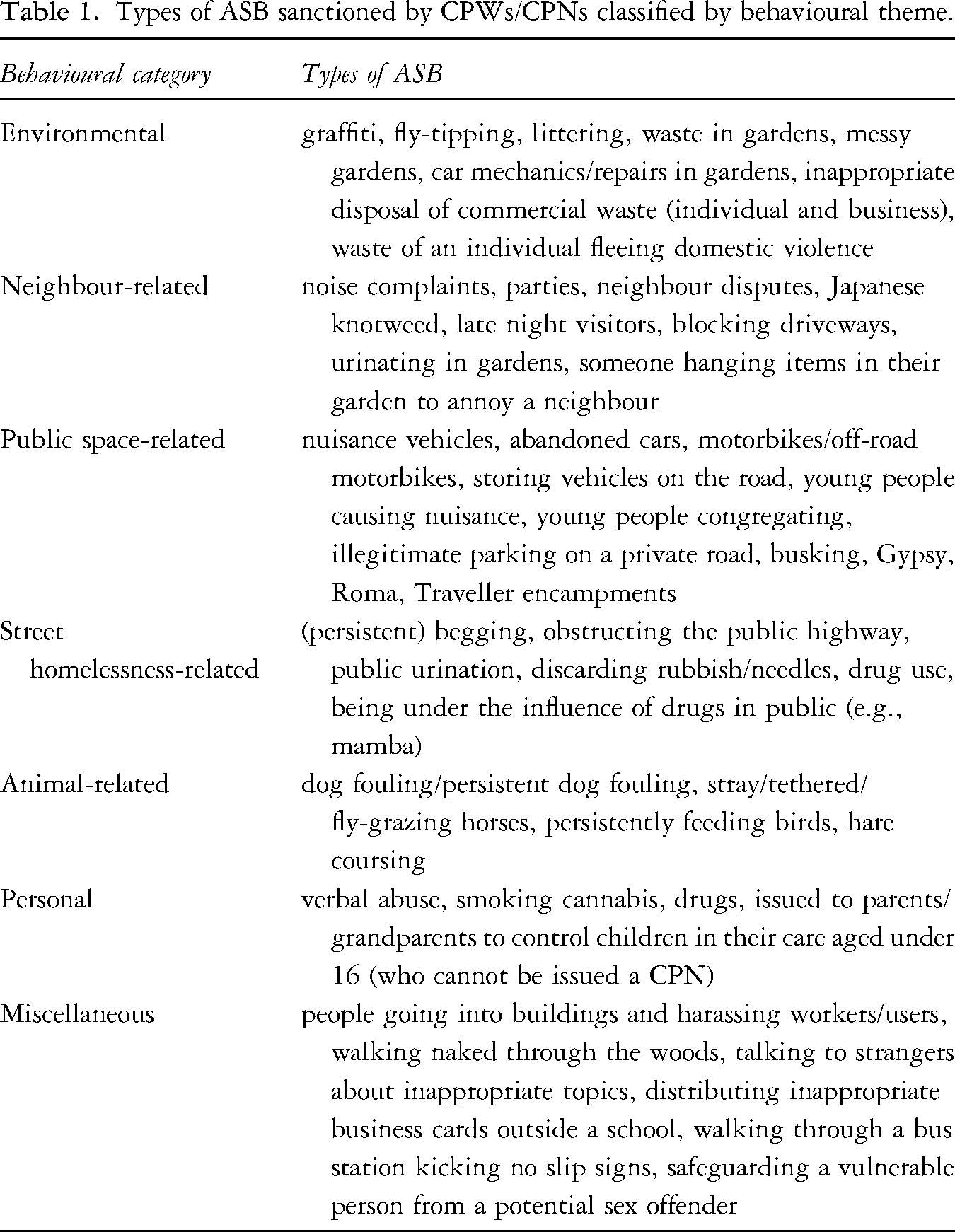
The behaviours listed in Table 1 detail familiar types of ASB that have been defined as anti-social since the Crime and Disorder Act (1998), with many featuring on the original Home Office ASB typology, such as noise nuisance, littering, and abandoned cars (Harradine et al., 2004). Some incidents also reflected participants’ accounts of using CPNs to target ‘low-level’ ASB. For example, the inclusion of ‘messy gardens’ and ‘late night visitors’. This shows how the nature of ASB policy has evolved, expanding the range of behaviours subject to sanction through this different net, whilst also widening the net of social control.
Considering net-widening, we also uncovered a curious practice used by some of our participants associated with the issuing of CPWs/CPNs for neighbour disputes. A police officer stated: ‘Sometimes we have to give it to both sides, both neighbours, other side of neighbours, both sides to just give them the CPNW [CPW] with the same terms just for them to keep them calm and quiet’ (Area B, Police Officer 6). Issuing CPWs to both parties involved in the dispute plus additional neighbours on the street to ‘keep them calm and quiet’ illustrates how CPWs are being used at the margins of the definitional threshold; the conduct of neighbours on each side of the dispute is unlikely to meet the definition to issue a full CPN.
In contrast, other participants would not consider issuing a CPW or CPN for neighbour disputes, as a trainer explains: ‘One of the things that we don’t use it for is neighbour disputes, with “he said/she said”, because it's just – how are you going to prove the point either way to use these?’ (Trainer 2). In addition to neighbour disputes, there were other behaviours that showed stark differences in participants’ issuing practices related to begging, people experiencing street homelessness, and overgrown gardens. Individual differences in officer interpretations of the CPN power are not new and have been discussed elsewhere (see Heap et al., 2022, 2023, 2024). However, a pivotal factor here is that individual frontline officers have the responsibility to decide what behaviours meet the threshold and pose a risk to the community, thus cast the net of unacceptable behaviour. This is problematic because these boundaries do not fall equally across the population, as illustrated by the large number of behaviours in Table 1 related to people experiencing street homelessness. This is exacerbated by officers who refuse to issue CPNs for the same behaviours. At a banal/base level this means that some citizens can have a messy garden if they wish, but for individuals experiencing street homelessness in an area where CPNs are applied to their behaviours, it could have life-changing consequences. This aligns with Millie's (2008) argument that whether something is deemed as anti-social or not is dependent on the behavioural and aesthetic standards of acceptability within a particular context. For example, street drinking engaged in by people experiencing street homelessness may be deemed unacceptable to the aesthetics of a space of urban consumption in the daytime. Though comparatively, intoxication and associated behaviours in the nighttime economy may be expected and welcomed. This ASB ‘differential interpretation perspective’ results in ‘the same behaviour to be censured as ASB (or as crime), tolerated, or even celebrated’ (ibid: 390).
The various types of ‘low-level’ behaviours highlighted in this section demonstrate the extensive spectrum of behaviours subject to sanction through CPNs as a ‘different net’ that offers a pre-Civil Injunction stage of intervention, illustrating how the net of social control has been both supplemented and widened by the more encompassing definition alongside a lower enforcement threshold.
Filling the legislative gap and quick fixes
Related to widening the net, is how our participants also utilised CPNs as a different net to capture and sanction behaviours that could be defined as anti-social, which are not traditionally associated with the criminal justice system. CPNs were used in this manner to regulate ‘odd’ behaviours when there was no perceived alternative. This practice is not new, Squires and Stephen (2010: 28) explained how first-wave powers were used to ‘facilitate some notional closure of the so-called ‘Justice Gap’ (the gap between the number of victims and number of prosecutions). However, what we see here is how second-wave powers are being used at an earlier stage to sanction a wider range of behaviours, and as a substitute for more time-consuming and costly criminal proceedings.
It was evident our practitioner participants valued CPNs due to their flexibility to tackle unusual issues and fill gaps that could not be addressed in other ways, such as people persistently feeding pigeons, an individual walking naked in woodland, and someone repeatedly kicking over no-slip signs in a bus station. A council officer stated: … you get some weird and wonderful things where they don't fit into a particular box if that makes sense? The Community Protection Warning is a good way … and the CPN is a good way of dealing with those. (Area A, Council Officer 2)
From practitioners’ perspectives, the perceived utility of CPNs was clear. Their use enabled action to be taken in challenging cases where nothing could have been done previously. Our participants also explained how CPNs were used to solve problems by targeting specific issues. For example: They served a Community Protection Warning early in the evening, they got a further call back later on in the night, again witnessed everything, recorded on bodycam and served a Community Protection Notice, and so it can speed things up in that aspect. (Area D, Council Officer 15)
The process mentioned by Council Officer 15 loosely interprets the ‘continuing and persistent nature’ aspect of the legal definition by suggesting this can be within one day. This practice demonstrates the use of different and wider nets, illustrating how CPN policy is being stretched to the edges of its legal remit based on individual officer's decision making. Consequently, more people are drawn into the ambit of ASB regulation.
We also found evidence of practitioners issuing CPNs to achieve quick fix solutions instead of using existing criminal legislation. A council officer explained how this approach reduced the burden on other agencies such as the police, as well as being an effective means of tackling the problem: So this piece of legislation really did help us have our own powers to actually deal with the problem all the way to court which actually is quite rare isn't it in local authority jurisdiction terms (Area A, Council Officer 1).
Several behaviours discussed by our participants are covered by existing legislation. With reference to Table 1, hare coursing is covered by Game Act 1831 and Night Poaching Act 1828 (revised in 2022, post data collection); the inappropriate disposal of commercial waste is governed by the Environmental Protection Act (1990); and the Criminal Justice and Public Order Act (1994) (again, revised in 2022, post data collection) provides powers to respond to unauthorised Gypsy, Roma and Traveller encampments. Issuing a CPN instead of pursuing criminal charges could be interpreted positively because this stops the perpetrator(s) from being drawn immediately into the formal criminal justice system, therefore it prevents criminalisation and the prospect of more severe punishment. However, if arrested for a crime, the accused will be afforded the protections associated with due process, have access to legal representation, and the opportunity to dispute the claims/evidence against them before being charged, which does not happen with a CPW or CPN. Further, any punishments metered out will be proportionate to the crime committed in line with sentencing guidelines. Thus, criminal law serves the core societal function of controlling and sanctioning defined behaviours, and it is not appropriate for individual officers using CPNs to run roughshod over those established processes simply because it is quick and easy to do so.
Shortcut justice: The CPN to CBO pathway
Despite our research focussing on the practice of issuing CPNs, it was common for our participants to talk about the enforcement pathway from CPN to Criminal Behaviour Order (CBO).
In our research, a criminal conviction for breach of a CPN was used as justification to seek a CBO, a deliberate decision made at the point on the pathway marked by the shaded box in Figure 1. By utilising a CBO as the final step of the enforcement pathway, the recipient is subject to more severe criminal sanctions for continuing to commit the same ASB they were responsible for at the CPW stage, or any other ‘low-level’ ASB they were prevented from engaging with as part of their CPN, or if they progressed through the Civil Injunction route. Participants highlighted multiple reasons why they favoured the CPN-CBO trajectory, but a common theme was that CBOs were easier, quicker, and cheaper to obtain than Civil Injunctions, which are an entirely civil order. Council Officer 3's testimony typifies practitioners’ rationales: If the victim has been traumatised and we need a quick fix we would use that because obviously [Civil] Injunctions, we only generally get them for six months, so it seems a long laborious way …. in a few weeks you can have a Criminal Behaviour Order for more persistent ones, whereas Injunctions are just … they're just too slow, you need loads of evidence. … They're cost effective [CBOs]. Injunctions, our solicitors want … evidence, it only lasts for six months, and you generally only get – they need more evidence whereas these, you could have somebody in court within four or five incidents and have a Criminal Behaviour Order, which is minimum two years, whereas Injunctions are a waste of time as far as I'm concerned. (Area A, Council Officer 3).
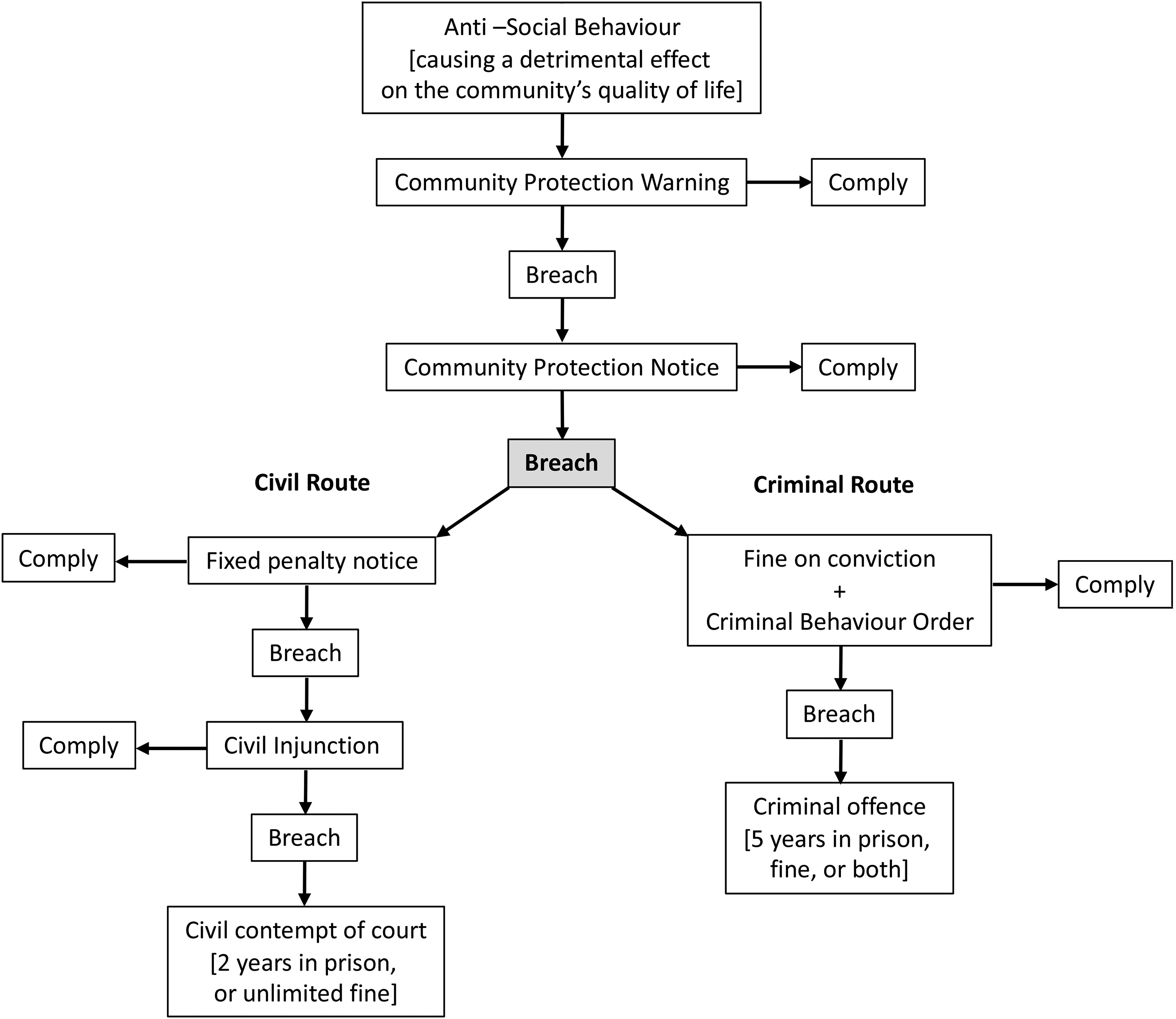
The CPN to CBO enforcement pathway.
Trainers 1 and 3 were aware of the practice of obtaining a CBO as an easier route to a custodial sentence instead of applying for a Civil Injunction. Trainer 3 voiced their concerns about the use of CBO legislation, stating it was an ‘abuse of power’: The only argument that I can see for doing it, and why people do it, is that if we have issued a Community Protection Notice and this person keeps breaching it then I can apply for a Criminal Behaviour Order and then there is the possibility of a custodial. But that for me – there's a big flaw in that and I'm not sure whether it fits in with your research but for me it's really critical, is that as I said before, I think that the way that CPNs are being used is an abuse of power because to my mind, if I am looking to take action against somebody for harassment, alarm and distress, as a council officer that is not for me to decide. That is for a court to decide. … So people should be taking the cases to court and applying for a Civil Injunction. And people are using CPNs as a shortcut to avoid putting together a Civil Injunction application and going to court and they are either, in my view, either doing that because their legal team are obstructive and useless, or because their cases are weak and when they get to court, they won’t get a Civil Injunction. (Trainer 3)
The CPN-CBO trajectory, which was favoured more by local councils than the police in our sample, demonstrates how frontline officers can circumvent traditional legal protections to secure quick fixes to challenging behavioural problems. The use of CPN and CBO powers in this way, particularly when limited evidence is required, sets a dangerous precedent about how individual officers have the power to shortcut due process, which can result in a custodial sentence that can be both disproportionate to the behaviour in question and the risk of harm posed by the individual, especially if the ASB is not a criminal offence. This practice raises the criminalisation stakes and, as Trainer 1 explains, can have further consequences for the individuals in respect of a lasting criminal record: It's different to an Injunction and an Injunction is serious enough, but it's a civil order that if it's breached it doesn’t go on your criminal record, whereas a CBO is a criminal order where if it's breached it will go on your criminal record. (Trainer 1)
Returning to Cohen's (1985) fishing analogy; the route to CBO and the associated consequences reflects how the enforcement pathway acts as a ‘denser net’, with a newly available increase in the intensity of the intervention. Precedent exists for the use of CrASBOs in a first-wave ASB policy context (see Johnsen and Fitzpatrick, 2007). However, it has been the introduction of the CPN, with the associated CPW and ‘low-level’ behavioural threshold as the entry point, that has created this shortcut justice pathway. The prospect of continued criminalisation is compounded by the lack of opportunities to appeal the various sanctions. For example, there is no formal mechanism to rescind or even dispute a CPW and recipients have reported difficulties appealing a CPN, particularly accessing legal aid (Heap et al., 2022). Applications to vary or discharge a CBO can be made to the issuing court by the prosecution or the offender, but if this is dismissed, neither party can make a further application without the consent of the court or the other party.
Discussion and conclusion
Our empirical evidence presents net-widening in action, with CPN issuing practices demonstrating the introduction of different nets that are wider and denser, which have extended the preventive control and regulation of ASB in England and Wales. This intensification of behavioural regulation, particularly of ASB that practitioners consider ‘low-level’, reflects a more coercive ASB policy shift through the second-wave powers. Extending Cohen's (1985) fishing net analogy, frontline practitioners’ accounts of issuing CPNs indicates how the mesh of the net is now virtually non-existent. Recipients who are drawn into the process have almost no chance of escaping due to the limited grounds of appeal, with the few escapees being those with enough social capital and resources to mount a successful challenge (Black and Heap, 2022). This situation is exacerbated by the number of practitioners ‘fishing’, due to the availability of CPNs to frontline officers from the wider policing family, such as local council officers and designated housing providers. However, not everyone is using these different nets in the same way. Our participants disagreed about which types of behaviour met the definitional threshold and should be sanctioned by a CPN, such as behaviours associated with people experiencing street homelessness and neighbour disputes. This reflects the discretion of individual officers, which we have discussed at length elsewhere (Heap et al., 2023, 2024). This situation has developed unchallenged due to a lack of central oversight and scrutiny into local issuing practices and their outcomes, which fails to hold policing bodies to account. Even more concerning, due to a continued lack of data collection, we have little evidence whether CPNs actually stop and/or prevent ASB. Our research demonstrates that despite the evolution of ASB policy and practice, its evaluation and our understanding of effectiveness remains as poor as ever.
Fishing analogy aside, a core driver of the extension of criminalisation is the process of shortcut justice. This is characterised by practitioners using CPNs as a cheap, quick fix for ASB that could, and should, be tackled by other legislation (e.g., Civil Injunctions). Shortcut justice reflects frontline officers’ use of the ASB powers, specifically CPNs, to move an individual into and through the criminal justice system and potentially towards a custodial sentence via a CBO, without them ever engaging in criminal behaviour. Previously, scholars have argued that ASB powers ‘fast-tracked’ criminalisation (Squires, 2008). Our research further emphasises how these traditional processes are being shortcut and circumvented because the nature of the CPN power allows it. The flexibility of the legislation is so great, and the oversight so little, that the creation and implementation of this shortcut approach has become normalised. This trend is reflective of O’Neill and Loftus’ (2013: 451) suggestion that ‘there has been an intensification of the state gaze on the problem individual – but quietly, indirectly and in a way which is valued for its ability to make the daily work of the various state agents easier’. It also echoes some of the earliest criticism of first-wave policy from Burney (2002) regarding how practitioners ultimately benefited from the prospect of a custodial sentence through the ASBO. However, the largely out of court CPN-CBO pathway demonstrates how second-wave policy is more punitive and injurious than the first.
At the time of writing, further ASB policy development was in progress driven by the Criminal Justice Bill (2023). The Bill operationalised several commitments set out in the Anti-Social Behaviour Action Plan launched by the Conservative government in March 2023 (HM Government, 2023). Of relevance to our arguments was the plan to enable CPNs to be issued to children as young as ten (Section 67). This would have widened the net even further and exposed children to the consequences of shortcut justice. However, the general election held in July 2024 meant the Bill was discontinued and we must now wait to see what ASB policy changes the new Labour government will pursue. Based on our findings, before any new measures are introduced to further criminalise and sanction ‘low-level’ ASB, policy reform is required to improve existing ASB practice. First, the purpose of CPNs needs to be rethought and reconfigured with more specific requirements about how and when they should be used, with greater detail provided in the statutory guidance for frontline professionals. Second, better data collection about usage, including the personal characteristics of recipients, is required to understand how CPNs are being utilised across England and Wales, which can be used to hold policing bodies to account. This call has already been made by the authors (Heap et al., 2024), as well as the Civil Justice Council (2020), and JUSTICE (2023). Third, there must be a commitment to evaluate the effectiveness of CPNs, as well as the other powers from the Anti-Social Behaviour, Crime and Policing Act (2014), to understand the impact of their use. This is vital to ensure that ASB is dealt with proportionately in relation to the risk posed and harm caused, without recklessly widening the net of social control any further.
Footnotes
Acknowledgements
We would like to thank Zoe Rodgers for her research assistance on this project. We are also grateful to the anonymous reviewers and Benjamin Archer for their useful feedback on earlier versions of this article.
Funding
The authors disclosed receipt of the following financial support for the research, authorship, and/or publication of this article: This work was supported by the British Academy in partnership with the Department for Business, Energy and Industrial Strategy [SRG19\190003].