



Abstract
Based on freedom of information request data supplied by English local authorities, this paper identifies significant under-reporting of out of area housing placements in government statistics alongside an overrepresentation of Black and minoritised households amongst such placements. In a context of neoliberalism, housing policy has become abstracted from contextual factors that shape experiences of housing. With housing increasingly commodified, this paper explores housing challenges beyond economic factors to include historical legacies and exclusion. Housing is therefore positioned as a conduit between people and place, with place understood as a spatial representation of social and economic networks. The fracturing of these networks illustrates a geographical manifestation of housing policy, crisis, and exclusion. This paper reflects on the social and economic context that drives such experiences and situates the overrepresentation of out of area housing for Black and minoritised households.
Introduction
This article explores housing precarity and its interplay with Black and minoritised populations, arguing that systemic social and economic inequalities are amplified through experiences of housing. Importantly, despite its significance, the relationship between housing and Black and minoritised populations remains an under-researched area. This paper uses original freedom of information (FoI) data to explore out of area (OOA) housing placements, whereby local authorities discharge their statutory duty to accommodate vulnerable households by placing them in other local authority areas. This is permitted under Section 208 of the Housing Act (1996) if there is no suitable accommodation in the area, and the receiving local authority must be notified within 14 days. Significantly, suitable accommodation can be interpreted as affordable, and it is increasingly unusual for receiving local authorities to be notified. Predominantly, most OOA placements emanate from local authorities in the South-East of England where housing prices are highest, with the practice being driven by economic factors. Additionally, this paper examines the overrepresentation of Black and minoritised households in OOA housing placements and explores the socio-economic context to help understand the drivers.
Importantly, the FoI data received from local governments identifies that the number of those placed OOA is significantly higher than government homelessness data indicates (DLUHC, 2022). Furthermore, whilst the research identifies a disproportionate number of Black and minoritised households affected, there are gaps in government data that do not fully identify the extent of these disproportionate experiences. In this research, housing is understood as a key structure for maintaining connections between people and place, as well as a way by which systemic inequalities might be mitigated or otherwise exacerbated. Within this, ‘place’ represents not solely a geographical point of reference, but rather a complex spatial locus of economic and social networks that can be fractured through OOA placements. Whilst specifically focusing on the connection between Black and minoritised households and OOA housing placements, the research has parallels for other households experiencing involuntary moves such as the resettlement of asylum seekers, loss of Section 17 support for those with children moving from asylum seeker to refugee status, travellers, and those escaping domestic abuse. While not an exhaustive list, this highlights the relevance of the research across a variety of settings and examples and emphasises its national and international significance.
As a context for OOA placements, the conceptualisation of a ‘housing crisis’ has attained such a level of political acceptance as to create an almost hegemonic use, whereby genuine debate has been hidden behind political rhetoric. In this respect, hegemony defines a position whereby ‘dominant perspectives become dominant as the result of the imposition of one definition of reality upon the consciousness of researchers’ (Kemeny, 1988: 206). In doing so, the conceptualisation of a housing crisis has at times been variously positioned to castigate those lacking personal responsibility and to promote an ideological vision of a property-owning democracy. Problematically, the concept of a housing crisis remains somewhat reductionist as, firstly, it conceptualises neither the causes nor solutions to the perceived crisis. Secondly, it risks creating a binary within housing policy that focuses on people being either homeless or housed and, in doing so, overlooks the growing grey area of housing precarity. Furthermore, it risks failing to see the ways in which the housing crisis is experienced differently by different demographic groups.
Debates exploring the relationship between housing precarity and Black and minoritised populations remain a significant yet under researched topic. At the heart of this paper lies the argument that housing, within a context of unaffordability and socio-economic vulnerability, has the potential to be an amplifier of inequalities rather than being a source of welfare that minimises personal risk and provides security. The argument of this paper is, therefore, not that Black and minoritised households are deliberately targeted for OOA housing by local authorities, but instead that antecedent social and economic inequalities, coupled with historical legacies, make Black and minoritised households more likely to be vulnerably housed and removed from wider community support and safety nets through the OOA system, making them yet more vulnerable. Whilst this can partly be attributed to the ‘slippery nature of housing discrimination’ (Lukes et al., 2019), this paper recognises the political, economic, social, geographical, and historical contexts through which access to housing has been distilled.
Unpicking the crisis
In recent years, there has been no shortage of talk across political divisions of a housing crisis (Crisis, 2022; CSJ, 2021; Wilson and Barton, 2023), though it can be argued that the conceptualisation of crisis in relation to housing is nothing new. Aneurin Bevan's vision of mixed communities housed in modernist new estates, new housing, and new communities characterised a post war settlement in response to slum housing and bomb damage (Boughton, 2018). Within this vision, housing was positioned at the heart of welfare where it could play a pivotal role in rebalancing and mitigating social and economic inequalities. Approximately 30 years after Bevan's vision came awareness of grassless dystopian concrete jungles of urban living with high densities of families in estates portrayed as menacing and decaying (Carter, 2023; Romyn, 2020). What had once seemed the solution to slum housing and overcrowding, particularly for Black and minoritised populations who had faced exclusion from public housing as well as experiences of poor-quality rented accommodation (Davis, 2001; Ginsburg, 1988) had become a new form of marginalisation.
By the 1980s, with the dawning of an age of neoliberal politics, the solution to a costly and seemingly dated model of public housing was the 1980 Housing Act that introduced the Right to Buy, which was a ‘process of transfer of risk from the state to the responsibilized individuals’ (Blandy and Hunter, 2013: 22). This began to expand the role of housing as a commodity to be traded and, consequently, was as much about economic change as it was about a political shift (Preece et al., 2020). In doing so, it reversed Bevan's vision of housing from local government to the private sector (Cooper et al., 2020; Copley, 2014). Whilst the context of neoliberalism led by ‘political actors such as Thatcher and Reagan sought to evolve their domestic and international policies in order to facilitate free markets, trade, economic prosperity and reduced government spending’ (Naqvi et al., 2021: 246), it also led to ‘policy logics, demanding the sanctity of property ownership and inheritance rights’ (Cooper et al., 2020: 1368). For the most desirable houses in what might be perceived to be better areas, sales were rapid and discounted for those who could secure a mortgage.
However, the least desirable properties and those with the highest maintenance costs remained in possession of local authorities in a process of residualisation whereby ‘those with greatest needs were prioritised for the reduced supply of homes’ (Tunstall and Pleace, 2018: 28). The process of residualisation has, arguably, contributed not only to the condition and political relevance of affordable social housing, but it has also individualised and marginalised the tenant (Carr et al., 2022). Whilst it has been argued that the process of residualisation in social housing may have halted (Pearce and Vine, 2014; Tunstall and Pleace, 2018), it would be wrong to overlook tensions within social housing arising from the ‘relationship between financialisation and bordering within racial capitalism’ (Clare et al., 2022) and the parallel (re)growth of the private rented sector (PRS) (Bailey, 2020) amidst calls for more affordable housing (Bramley, 2018). This is not to deny the presence of what may well be described as a housing crisis as housing precarity is seen to be increasing (Clare et al., 2023; Lombard, 2023) while housing becomes increasingly commodified (Heslop and Ormerod, 2020; Hodkinson and Robbins, 2013).
Exploring this connection between housing vulnerability and ‘racial capitalism’, there exists an overrepresentation of Black and minoritised households in the PRS (Finney and Harries, 2015; Shankley and Finney, 2020), which will disproportionately expose Black and minoritised households to risk such as increased use of Section 21 ‘no fault’ evictions that make it easier to evict tenants with only two months’ notice (Shelter, 2023) and rents rising faster than wages and benefits (Waters and Wernham, 2023; Wheatley et al., 2019). The marginalisation of Black and minoritised populations within housing is not a new phenomenon (Bourne et al., 2023; Peach, 1998) and it can be argued that the post war experience of housing for migrant populations can be understood in terms of commodification whereby housing ceased to be an area of welfare that improved their lives and was instead a commodity negotiated through the cash nexus and characterised by economic opportunism. Examples of this can be seen in Rex and Moore's (1967) analysis of Sparkhill in Birmingham and Schofield and Jones (2019) analysis of Notting Hill in London.
The legacy is seen most graphically and tragically with the Grenfell Tower fire where the majority of those who died were from Black and minoritised populations and had intersections with class inequalities (Danewid, 2020; Hodkinson, 2018). The problem is therefore that an increasingly marketised allocation of housing is going to be challenging for those with the least market power. In this respect, market power is systemic and can be taken to include income and wealth. But it can also be taken to include social networks, legacies of discrimination, and even the political rhetoric of citizenship whereby new arrivals can be portrayed in terms of moral panics (Krzyżanowski, 2020). Importantly, this takes awareness of crises in housing beyond the binary of commodification and supply whereby access to housing is shaped by economic factors, and instead to recognise a range of social, historical, and political factors that point towards housing being more complex than initial commodification debates might suggest.
At the same time, there is growing recognition of the diverse nature of precarious housing that includes ‘generation rent’ (McKee et al., 2017), growing numbers of families in temporary accommodation (TA) (Wilson and Barton, 2022), ‘sofa surfing’ (Sanders et al., 2019), the ‘shadow rented sector’ (Spencer et al., 2020), and being housed out of area (Iafrati, 2021). In addition, it is also important to recognise conceptualisations of ‘multiple exclusion homelessness’ (England et al., 2022; Fitzpatrick et al., 2013). This diversity of research is welcome in the ways that it recognises the presence of the grey areas and diversity of housing precarity. However, there still exists very little research that explores the interplay of housing precarity with the specific experiences of Black and minoritised households (Perera, 2019).
Placing this in a policy context, the Equality Act (2010) is a wide-reaching piece of legislation that gives a duty to all organisations including local authorities to remove discrimination, harassment and victimisation, advance equality of opportunity and foster good relations between all. The Act also includes the Public Sector Equality Duty which requires public bodies, including local authorities and housing departments, to consider how their policies and decisions may impact those with protected characteristics. Additionally, the Equality Act sets out a context where treatment should be equal, and no one should be disadvantaged because of protected characteristics. However, here lies a fundamental argument of the research. If a disproportionate number of households presenting for help due to housing precarity are Black and minoritised, then it might be assumed that this is an outcome of a complex interplay of preceding factors such as employment, welfare reforms, discrimination, and historical legacies of housing. And yet, there remains little formal recognition of the issue, as illustrated by the white paper ‘Fixing our Broken Housing Market’ proposed in the wake of the Grenfell Tower tragedy, which makes no mention of ethnicity, inequality, or discrimination. Similarly, ‘Awaab's Law’ (Cromarty, 2023) as part of the Social Housing (Regulation) Bill that places a duty on social landlords following the death of Awaab Ishak due to long-term exposure to mould also makes no reference to systemic inequalities.
Additionally, the Local Government Association's (LGA) Equality Framework (LGA, 2021) outlines four principles for delivering excellence in equality outcomes, including specific mention of the collection and use of data. Their benchmark for achieving the highest quality outcomes includes that data relating to protected characteristics is regularly updated and used to maintain effective priorities, improved quality of data, and that various stakeholders, allowing for GDPR regulations, are able to access and use any information gathered (LGA, 2021). On a final policy point of context, there has been a reintroduction of Section 21 ‘no fault’ evictions after the ending of Covid restrictions. This means that a household in the PRS and housing association properties can be evicted with two months’ notice without there being an element of fault or tenancy problems. With Black and minoritised households being overrepresented in the PRS and social housing, they will therefore be disproportionately likely to experience Section 21 evictions that may lead to a local authority duty (Wilson et al., 2023).
Methodology
The research was based on FoI requests sent to every English local authority, based on the fact that housing policy is different in Scotland and Wales, and not the responsibility of local government in Northern Ireland. This was a total of 289 local authorities that had FoI departments. There were two reasons for using FoI as a way of exploring the role of OOA housing placements in England. Firstly, whilst OOA data exists on the government homelessness live tables, there are a number of local authorities who do not return data. Furthermore, working with local authority housing managers on this and previous research has highlighted that Section 208 of the Housing Act 1996 is now rarely used by local authorities. This is the section that covers OOA placements and specifically states that the placing local authority should inform the receiving local authority within two weeks of an OOA placement. Together, this has pointed to a belief that there may be some level of inaccuracy in government data that is reliant on self-reporting by local authorities.
Secondly, the OOA placement data on the government's homelessness live table does not link to demographic data, such as the homelessness live tables recording of ‘Ethnicity of main applicants assessed as owed a prevention or relief duty by local authority’ (DLUHC, 2022). This is significant because whilst Black and minoritised populations are overrepresented amongst those owed a prevention or relief duty, the data cannot be mapped across to those being placed OOA. In this instance, in 2022/23, in London, which is where the majority of OOA placements emanate, only 30% of those owed a prevention or relief duty were classified as white, 16% were unknown and the remaining 54% were Black and minoritised households (DLUHC, 2022). In terms of data compliance, there are 32 local authorities that fail to provide data return to the Department for Levelling Up, Housing and Communities (DLUHC), of which seven did not respond to our request, though the other 25 did provide the necessary data.
Of the 289 requests, 241 local authorities provided the necessary information. The request specifically asked about the number of households placed OOA in the financial year 2022/23, where these households were placed, and the ethnicity of these households. While this is an extremely significant 83.4% response rate, not all of the FoI responses were completed in full because, as detailed below, some local authorities choose not to record ethnicity data. In terms of a regional aggregate of responses, Yorkshire and Humber (66.7% response rate), the North-West (70.6%), and the South-West (75.9%) were the regions with below average responses. Other regional response rates were in the 80–89% category, including London (81.3%) while some were in the 90%+ range, such as East Midlands (97.1%), West Midlands (92%), and the North-East (91.7%). Statistically, this makes the research very robust and provides a good basis for the findings. In terms of reflecting on the quality of the research, the response rate allows for the findings to be seen as both valid and generalisable, especially with the high response rate from London, which is the region making the highest number of OOA placements.
The research consequently adopts a fundamentally critical realist methodology that recognises the ontological reality of a housing crisis, whilst also recognising the hegemonic manner in which it is used. As such, the investigation of OOA placements is real in the way that it identifies a particular dimension of what constitutes a crisis. Alongside this, the findings explore the way in which the crisis is experienced differentially, in this case, the relationship between housing and Black and minoritised populations. The purpose of this paper, however, is not to debate critical realism, which would divert from the main focus, but to use it as a method to explore the relationship between housing and Black and minoritised populations. For further debate about the ways in which critical realism has been used in housing research and as a basis for this research, it is possible to look at the works of Fitzpatrick (2005) and Hastings (2021).
The data provided in response to the FoI requests was essential in exploring the true extent of OOA placements and the relationship with Black and minoritised populations. The responses were collated into a single database from which filtering and formulae were used to establish connections and trends. The data, as shown below, highlighted the inaccuracy of government statistics and the need for further research into the disproportionate experience of OOA placements for Black and minoritised households. However, the data is only as good as the way in which it is or is not recorded, and it is concerning that some local authorities are not recording the ethnicity of households placed out of area, given the implications for monitoring and equality of impact. This paper proceeds by reporting on findings from the research examining the extent and the experiences of households being accommodated out of area.
Amplifying inequalities: findings and reflections
The inaccuracy of government data
One of the first research findings is the inaccuracy of government data. According to official government homelessness live tables (DLUHC, 2022), the number of households placed out of area was approximately 10,950 for 2022/23, yet the FoI data identified the figure as being 36,723 in 2022/23. Extrapolating this figure from our response rate of 83.4%, a national level might be expected to be in the region of 44,000. The latter figure aligns more closely with other FoI studies that have shown a growing trend in the numbers of households placed OOA (Iafrati, 2021) (Figure 1).
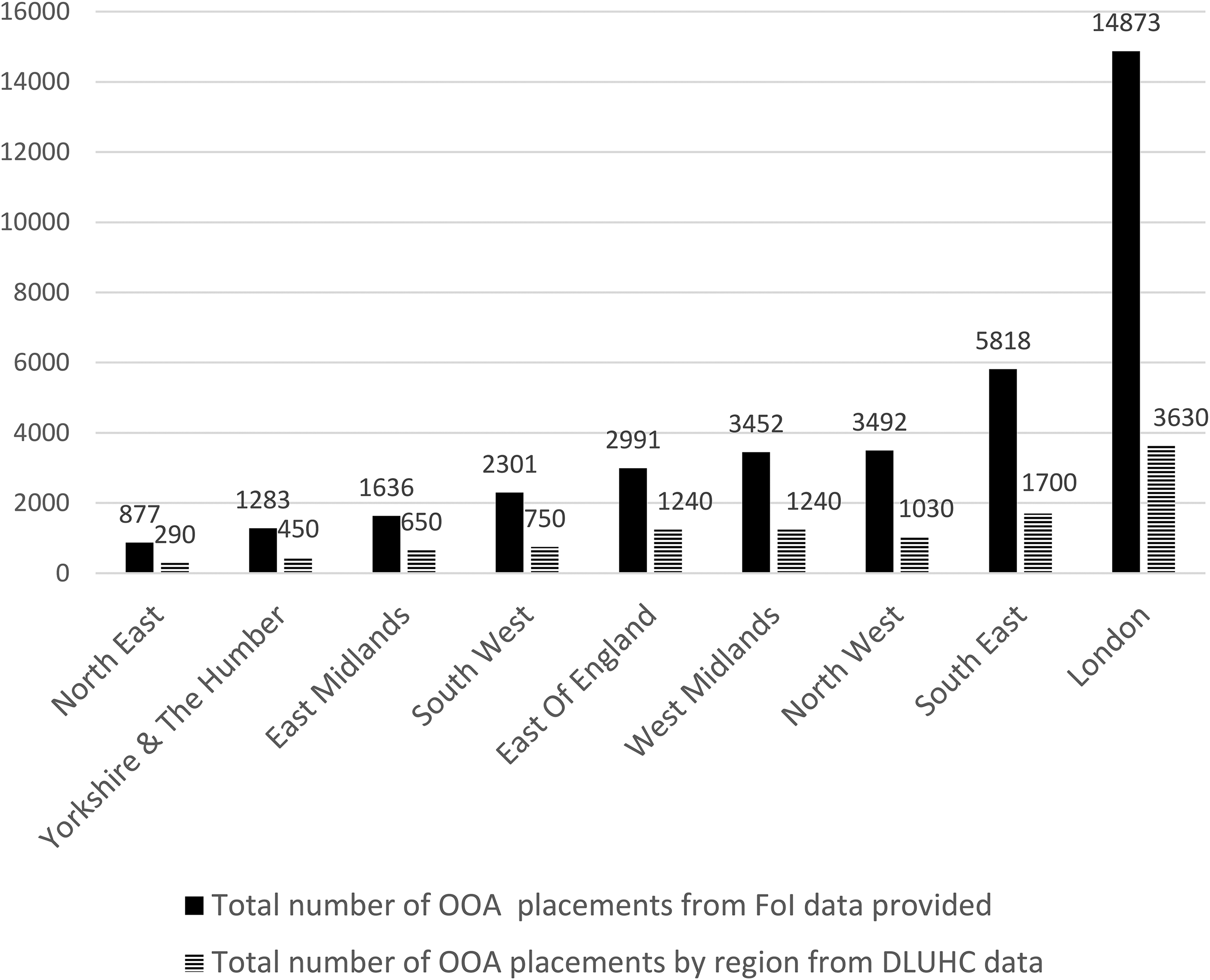
Total number of placements made by local authorities by region, from FoI and DHLUC data provided (2022/23).
This demonstrates that the number of OOA placements made in 2022/23 is more than triple the official number provided by DLUHC. Undoubtedly this is a difficult area to measure, there are single households that have been moved multiple times by single local authorities into TA in different areas. However, the discrepancy in the data is sufficient to call into question the validity of government tables. The upshot of this is that official statistics can be seen as the tip of the iceberg for what is really happening. Exacerbating this position is the fact that coupled with a lack of data relating to ethnicity from non-recording local authorities, it can be argued that the FoI data raises significant questions regarding the validity of official data on this topic. Matching findings from a previous study on OOA housing (Iafrati, 2021), government live tables on homelessness still do not provide cross referenced data relating to ethnicity and OOA placements. Further to this, revealed in the FoI responses, 42.3% of local authorities declared some households as being ‘unknown ethnicity’ in their statistics, which constitutes at least 19,724 of all OOA placements in 2022/2023.
Though the number of OOA placements made by local authorities across England varies significantly, of those local authorities responding that made more than 100 OOA placements, over 90% disproportionately placed Black and minoritised households OOA when compared with local demographic data (Figure 2).
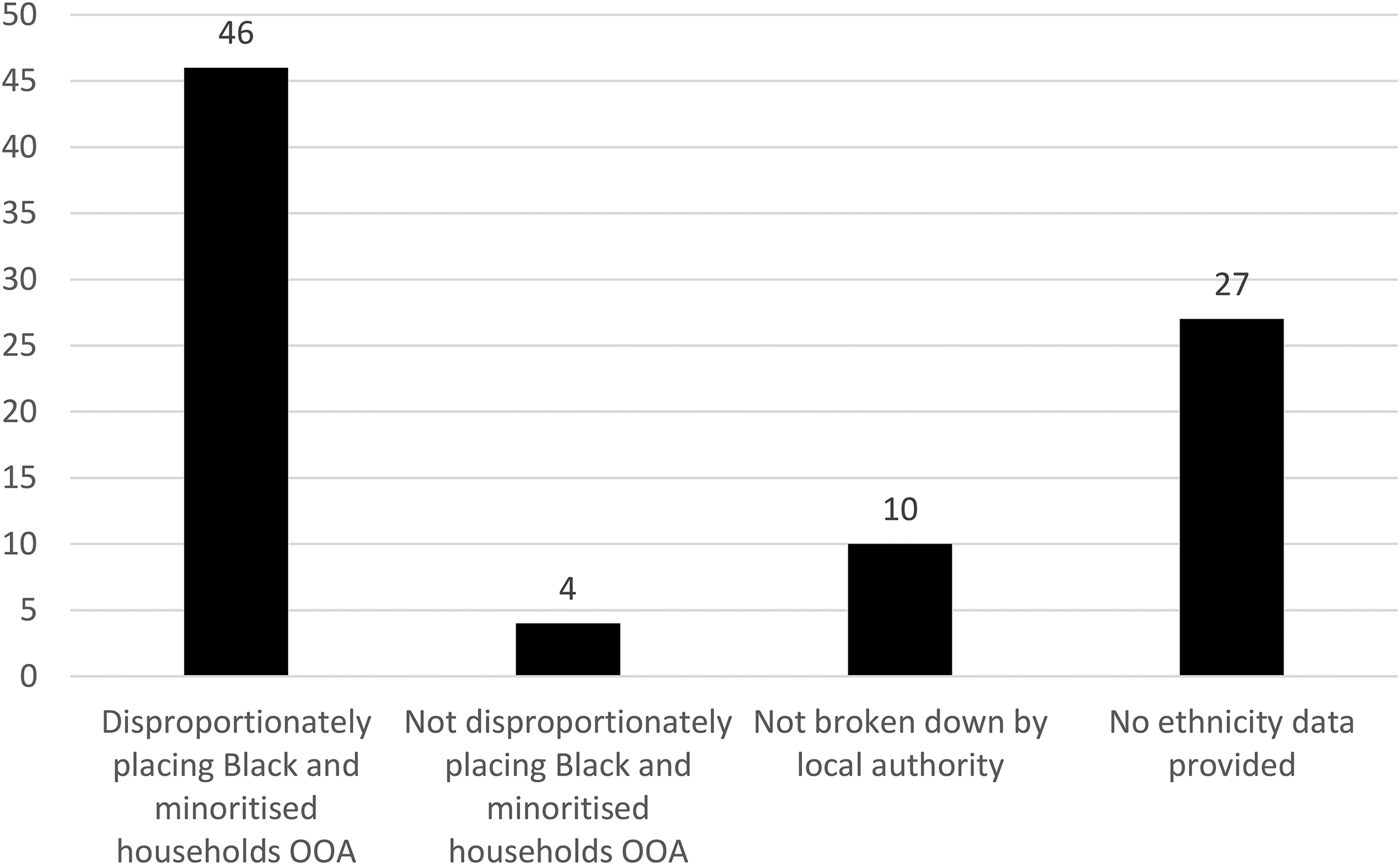
Local authorities that placed over 100 households OOA disproportionately placing Black people OOA (2022/23) from FoI data.
The figure of one-hundred placements was determined as significant for two reasons. First, for statistical validity and second that those local authorities declaring that they made less than this often refused to provide ethnicity data on the grounds that it could be used to identify households due to small figures. Accordingly, attempting to include these authorities within analysis of the overrepresentation of Black and minoritised households would reduce validity significantly, potentially providing false results. Furthermore, 24.9% of authorities responding to the FoI requests did not provide ethnicity data in their responses, citing varying reasons. Some stated that their systems were not capable of exporting this data and 14 local authorities stated that they do not record ethnicity data at all when taking homeless applications. Within the FOI responses collected, reasons identified for not providing data on ethnicity varied. Some identified that their software was incapable of providing this data in a reportable format, some refused citing reasons such as “the data is available in DLUHC statistics”, some declared that in doing so they would be risking providing identifying information. Further to this was the stated reason that compiling this data would exceed reasonable costs under Section 12 of the Freedom of Information Act (2000) and therefore were able to refuse the request on this basis.
However, these reasons are explicitly at odds with the LGA's Equality Framework which outlines four principles for delivering excellence in equality outcomes, including detailed mention of the collection and use of data. Their benchmark for achieving the highest quality outcomes in understanding and working with communities include that data relating to protected characteristics is regularly updated and used to maintain effective priorities (LGA, 2021). 20% of those not recording ethnicity data in their homeless approaches placed more than one hundred households out of area in 2022/23, further calling into question our understanding of the practice of OOA placements on Black and minoritised households. Combined, these authorities placed 2374 households OOA in 2022/23, making up for 6.5% of total OOA placements in this time, a significant gap in our understanding of the overrepresentation of Black and minoritised households. This can be further broken down into regions, with 40% of the households who were not asked for ethnicity located within the South-East of England and a further 29% in London, one of the most ethnically diverse areas of England.
The implications of not recording ethnicity data are significant. Firstly, a lack of data relating to those who are most often affected by housing precarity and homelessness may be interpreted as a lack of concern for appropriate solutions (Bramley et al., 2022). Clear data relating to protected characteristics such as ethnicity allows local authorities and legislators to identify where the most support should be directed and as mentioned above, the LGA guidance advocates for this approach. The recording of data relating to ethnicity allows disparity, both in terms of representation and impact, to be identified, just as it has been in this paper. With 24.9% of those local authorities responding failing to provide detailed information relating to ethnicity, the data fails to identify the full extent of the inequality and precarity of housing for Black and minoritised households.
Importantly, in relation to those local authorities not gathering ethnicity data and also in relation to the under-reporting in government data, this allows potential policy makers and influencers to be unaware of the size of the problem, with the starting point in the development of policy responses being to recognise the presence of a problem.
Geography
The second key finding of the research is the presence of a geographical dimension to OOA housing. Looking at price variations across England, housing in the South-East of England is the most expensive, with rents being significantly higher than other parts of the country. This partly explains why most OOA placements originate from the South-East of England and are placed in more affordable areas. This is a relatively complex issue however, and we should be mindful of the economic and demographic influences at play. From an economic perspective, as mentioned, house prices and rents in the South-East of England are expensive to the point that ‘The most affordable area in London was less affordable than the least affordable area in the North-East’ (ONS, 2022). This has pushed increasing numbers of people into the low-cost PRS in the absence of sufficient council or social housing. With the government being reticent to implement rent controls, this has allowed private rent to increase not just at a higher rate than inflation, but more meaningfully for those paying rent, at a higher rate than wage increases and benefit increases. At the same time, the cap on local housing allowance has meant that low-income households accessing sections of the PRS will increasingly be concentrated in certain geographical areas of the South-East of England. This means that for local authorities in the South-East, there will be increased pressure on services at a time of less help from central government as local government budgets have been cut.
Importantly, this moves the debate away from blaming local authorities and recognises a process of subsidiarisation of housing in the absence of a national housing strategy. This is not to say that local governments in certain areas of London have not been relatively proactive in adopting a policy of OOA placements, whether that policy be explicit or otherwise. However, it is important to recognise the pressures that are placed on these local authorities. Consequently, what we see, is a movement of some of the poorest and most vulnerable households from the South-East of England to areas of the country that have lower rental rates. The FoI data demonstrates that within the South-East of England, 50% of local authorities placed households into TA more than 50 miles away which is significantly higher than the average in other regions of 34.8%. Previously, in similar and comparable situations, this process has been described as social cleansing (Lees and White, 2020), though this term is somewhat problematic as it infers a deliberate attempt to remove the poorest and most vulnerable from the South-East of England in order to boost the economy. In this respect, there is some discomfort in using the term as it appears that the movement of the poorest and most vulnerable is not a deliberate process of social cleansing, but instead an outcome of economic factors rather than an explicit goal. The data does, however, recognise a movement of the poorest and most vulnerable from the most economically prosperous parts of the country to those areas with lower levels of economic prosperity.
Identifying an overlay of geographical and ethnic inequalities, data from one local authority within the West Midlands, for example, identified that within TA placements made in 2022/2023, Black and minoritised households are disproportionately sent OOA with 28.1% of OOA placements being Black and minoritised households despite them making up only 11% of the population within the local authority. Similarly, one London Borough revealed that 27.6% of their TA placements who were moved OOA were Black and minoritised households compared with the overall population of that local authority of 7.6%. These illustrate the stark differences when breaking down the FoI data into regions with 56.5% of responding London local authorities disproportionately placing Black and minoritised households in TA OOA in 2022/23. This is in comparison to a combined median for all other regions of 15%. Compounding such concerns, FoI data reveals that the South-East region had the highest percentage of local authorities that did not record ethnicity data at all, compared with all local authorities in Yorkshire and The Humber, South-West England and North-East England recording ethnicity data.
Black and minoritised households
The third key finding, and the one that makes the most significant new contribution, is that Black and minoritised households are disproportionately overrepresented in OOA placements. Even when allowing for demographic data showing high proportions of Black and minoritised populations in certain areas, there remains a notable over representation of such households in OOA housing. This is significant because it emphasises the structural yet ‘slippery’ (Lukes et al., 2019) nature of discrimination in housing and homelessness: there is no claim being made that local authorities are directly targeting Black and minoritised households. As such we can start to presume that there are other factors in play that are influencing people's relationships with housing. The exact nature of such factors is complex, and there is strong evidence to suggest that race and ethnicity plays a large role in shaping housing inequalities as well as its overlap with class (Bramley et al., 2022). Furthermore, given that Black and minoritised households are disproportionately in need of social housing that is affordable in their area, significantly this begins to recognise a racial or ethnic dimension to what we perceive as the housing crisis.
Providing some context to the research, it has been shown that Black and minoritised households are overrepresented in vulnerable housing and statutory homelessness figures. Consequently, within England, Shelter identifies that a quarter of households approaching their local authority for homelessness assistance are Black and minoritised despite making up only 11% of all households within the UK (Shelter, 2023). Ethnicity is, in fact, one of the key factors that heightens the risk of becoming homeless and, as discussed previously, the continuing effects of austerity (Shankley and Finney, 2020) as well as the further evolving cost of living crisis are likely to disproportionately impact upon Black and minoritised households (Zacharek, 2022). Analysis of the 2021 Census alongside the DLUHC statistics for 2021/22 (DLUHC, 2022) demonstrate that the most overrepresented ethnic group within homelessness are households who are Black, Black African, Black Caribbean and Black British. The Census reveals that this demographic represents 4% of the population across England and Wales, though 10% of those assessed as being owed a prevention or relief duty across England are Black, Black African, Black Caribbean or Black British, further rising to 30% of those owed prevention and relief duties in London (DLUHC, 2022; ONS, 2022). This is further supported by the FoI data that demonstrates that in 2022/23 15 local authorities placed more than 350 households OOA, 9 placed more than 400 households OOA and 7 placed more than 500 households OOA. Only one of the authorities who placed more than 500 households did not disproportionately place Black and minoritised households OOA. Despite this, the relationship between Black and minoritised populations and housing precarity remains under-researched. Current research generally focuses on a nebulous concept of a ‘housing crisis’ and increasingly on precarious housing without fully exploring the differential experiences.
The evidence of OOA impact on Black and minoritised households remains far from complete, meaning that it is necessary to extrapolate from the available data. In total, 241 LAs responded to FoI requests sent relating to OOA placements, of which 60 of these LAs failed to provide ethnicity data. Of the 185 local authorities responding who did provide ethnicity data, 42.2% declared that they did not know or did not record the ethnicity of at least some of their applicants, thereby recording some as ‘unknown’. The significance of only recording some households’ ethnicity data is that any exploration of figures given provides only a partial representation of both the prevalence of Black and minoritised homeless households approaching authorities for assistance and their overrepresentation in OOA placements. Again, not only does this contrast with the LGA equality framework, which suggests that high quality data relating to protected characteristics should be utilised to specifically target and develop services (LGA, 2021), but also has significant consequences for Black and minoritised households who are themselves already disproportionately affected by the cost of living crisis.
Further exploration of FoI responses shows that 16 local authorities, out of 241 responding, where more than 100 OOA placements are made per year also own TA stock in another local authority area, once more reinforcing the relational nature of the housing crisis's geography. Although statistically significant on its own, further analysis reveals that 75% of these authorities are disproportionately placing Black and minoritised households OOA. Further to this, 58% of local authorities are within London. Although there is significant data showing that OOA placements disproportionately affect Black and minoritised households, there is very limited understanding of what drives this trend and so more research is required.
Conclusions
Explaining such outcomes is complex and reflects the positioning in this paper of housing as an interplay of social, economic, geographic, and political factors, with the growing commodification of housing underpinning an increasingly marketised provision. This contrasts with an understanding of housing as welfare, with it no longer performing the welfare role of minimising social risk, providing security, and mitigating or offsetting socio-economic inequalities. Placing this within a broader political context, this paper recognises the confluence of housing and neoliberalism. However, having begun to argue that housing cannot be understood in abstraction from an economic and social context, the conceptualisation of neoliberalism takes us beyond housing and recognises the experience of those prerequisites required to access housing. From this position, it is useful to recognise the concept of late-neoliberalism (McGimpsey, 2017) that makes qualitative distinctions from the neoliberalism of the 1980s and 1990s. In doing so, McGimpsey (2017) recognises a ‘distinct phase of policy-making’, which identifies a regime of government that determines public services. In doing so, he explicitly identifies a period of post-austerity government that, in effect, has further retreated from meeting the social and economic needs of the population. The resultant opportunities for marketisation and commodification allow for an understanding of housing as an essential need that is increasingly delivered through market forces. Writing from an US perspective that has distinct parallels to the UK, Rolnik (2013) positions housing as ‘one of the most dynamic frontiers of late neoliberalism’ that has seen the increased use of housing as a commodity and investment asset, resulting in what Madden (2024) positions as increased ‘rentability’ based on ‘interconnections between space, class, property, and power’. Therefore, recognising a more pronounced and possibly more vigorous form of neoliberalism in contemporary society, this provides us with a framework by which to understand the realities of welfare reforms, precarious employment, austerity, and cuts to public services and local authorities. Importantly, Black and minoritised households have been shown to be overrepresented in welfare and precarious employment, making them more likely to require housing support, which has ultimately made them even more vulnerable, supporting arguments that neoliberalism itself has become enmeshed with race and ethnicity and is manifested through housing (Clare et al., 2022; Danewid, 2020).
In conclusion, this paper started by arguing that the term housing crisis lacks the nuance necessary to explore the precarity of the grey areas of housing and homelessness while also potentially fuelling a binary focus on people being either rough sleepers or home dwellers. In doing so, the arguably hegemonic nature of the way in which the housing crisis has been framed in political rhetoric and narratives allows for a focus on housing supply, despite the apparent absence of solutions. However, this paper helps to shine a spotlight on these debates (Stott and Fava, 2019) by recognising a key and under-researched area of the housing crisis, which is the phenomenon of OOA housing and the ways in which it connects with Black and minoritised populations. The role of TA and the unsettling nature of enforced movement of OOA placement is disproportionately experienced by Black and minoritised households. This can be understood as a way by which antecedent and systemic inequalities are amplified through people's experiences of housing.
On one level, this starts to move away from assumptions that the housing crisis is purely about supply by recognising instead the unaffordability of the PRS, especially in the South-East of England. Furthermore, it recognises that those with what might be classed as structural vulnerabilities are more likely to be affected than other people, potentially because they lack the market power to navigate a commodified housing system. The paper further explores the impacts of OOA housing by seeing how some of the more vulnerable households are affected by a process that fractures connections with support networks, service providers, children's education, and families. This has the potential to exacerbate those factors that were identified in the first place as being vulnerabilities, although the concept of vulnerability should not be seen as being a personal failing. Instead, the concept of vulnerability illustrates the potential risk of inequality and a lack of market power in the context of commodification.
Importantly, this paper recognises that beyond such issues, there exists a dimension of race and ethnicity within the process that is under-researched by academics and, in some cases, not even recognised by policy makers. Those placed OOA are disproportionately from Black and minoritised populations, which reflects the way in which such households are overrepresented in poverty and low-income jobs, and as such are more likely to require affordable housing that is increasingly scarce in the South-East. Consequently, the housing crisis cannot be abstracted from social and economic factors. In conclusion therefore, the solution to OOA housing is not solely to increase the supply of housing, but to increase the supply of affordable housing alongside rent controls and addressing the drivers of poverty.
Footnotes
Funding
The author(s) received no financial support for the research, authorship, and/or publication of this article.
Author biographies
Address: University of Nottingham, School of Sociology and Social Policy, Law and Social Science Building, University Park, Nottingham, NG7 2RD
Email:
Helen Lawrence is a PhD student at the University of Nottingham where she is researching the connections between supporting housing and employment. Previously, she was a research assistant on the out of area research project identified in this article.