




Abstract
The environmental crisis, increased inequality and an aging population are likely to increase the demand for welfare services in the OECD countries. Economic growth has long been seen as a solution to these problems. However, this is no longer the case. Very few countries have managed to decouple economic performance from ecological footprints and greenhouse gas emissions. Even where this has been achieved, the rates of emission-decline are too slow to match the Paris climate targets. Consequently, interdisciplinary research is key to probe how welfare systems may cope with these challenges, and how welfare provision and economic growth may be decoupled. By drawing on the basic human needs approach and a unique set of data, we explore the social and ecological performances of OECD countries relative to their economic performances. While high-income countries display diminishing welfare returns as economic performance is not improving the satisfaction of health-related needs, the lower-income countries might yield significant surplus if moving to the level of moderate-income countries. However, the satisfaction of autonomy-related needs is so far strongly coupled to economic performance and thus much harder to achieve in an ecologically sustainable way.
Introduction
Welfare systems across the OECD provide foundational goods and services such as education, healthcare and social security (Fanning et al. 2020; Corlet Walker et al. 2021; Vogel et al. 2021). They are vital to the health and wellbeing of citizens and are central pillars of ‘just transition’ strategies to cope with climate change. However, these systems now face a range of multiple and interconnected challenges (Rouzet et al. 2019), including rising inequality, the demographic development (‘aging societies’) and, particularly, the crises of the climate and ecological systems. Yet the traditional prioritization of economic growth in policymaking is no longer a sustainable answer to the challenges outlined above (Corlet Walker et al. 2021; Büchs 2021, Koch 2022). Very few countries have managed to decouple economic growth from the ecological footprints of production and consumption or from greenhouse gas emissions in absolute terms. Even where this has been achieved, the rates of emission declines are far too slow to match the Paris climate targets (Parrique et al. 2019; Haberl et al. 2020). The future of growth in the global North is also uncertain due a range of ‘headwinds’ (Gordon 2016) including the deceleration of technological innovation, global population growth (Gordon 2016; Vollset et al. 2020), as well as possible long-term implications from the global COVID-19 pandemic, the war in Ukraine and the Israel-Palestine conflict. The combined effect for wealthy nations may well be that of a period characterized by either no or slow growth, for which the term of a ‘secular stagnation’ has been suggested (Corlet Walker et al. 2021). Given these multiple challenges, policymakers would indeed be well advised if they applied the precautionary principle and developed scenarios and strategies for coping with low or no growth in the future – whether they like it or not.
For any ‘postgrowth’ policy strategy to succeed, knowledge into how economic performance and social welfare currently interact, how existing welfare systems rely on and in fact promote growth, and how the two could be decoupled (cf. Büchs 2021) is vital. In this paper, we apply an explorative approach when examining the relationships between economic, ecological and needs satisfaction indicators. We operationalize human needs in close alignment to Doyal and Goughs original theory (Doyal and Gough 1991). While using indicators for all eleven intermediate needs identified by Doyal and Gough (p. 170), we also distinguish between physical or health related needs and autonomy related needs. Regarding economic factors we include both the size of an economy as GDP per capita and the dynamic element of GDP growth. Plenty of scholars have criticized the use of GDP as an indicator of welfare (e.g., Fioramonti, 2013). While we share this criticism, we maintain that GDP could still be used for measuring economic performance and market output, but not welfare, prosperity or well-being. Our analysis contains the ecological indicators of carbon emissions and material footprints of consumption.
Our empirical focus is the OECD countries. We choose these countries not only because they provide high-quality data, but also because they represent different countries that all have achieved basic levels of welfare provision. Taking a theoretical sustainable welfare (Brandstedt and Emmelin 2016) and, particularly, human needs (Doyal and Gough 1991; Max-Neef 1991) perspective, we study which welfare states across the OECD world are able to deliver needs satisfaction for all at the lowest possible environmental and climate impacts and delineate the degree of GDP dependence of these welfare performances. How do countries fare in meeting basic human needs such as the provision of adequate nutrition, water, housing, childcare, education, economic security, non-hazardous work and physical environments as well as having significant social relationships relative to GDP/capita and environmental standard parameters?
The article is structured as follows: We next summarize the scholarly discussion about de-/postgrowth, sustainable welfare and human needs as well as relevant previous studies to prepare the empirical research steps (2). We subsequently operationalize what Gough (2017) calls ‘intermediate human needs’ and present the corresponding data (3). Section 4 studies and compares ecological, social and needs satisfaction indicators between four groups of countries that reflect their economic performance or income level, respectively (4.1–4.3). Applying principal components analysis, we then explore the relationships between needs satisfaction and ecological indicators in the OECD (4.4) and compare the outcomes by economic indicators (4.5). We finally highlight and discuss the main results and delineate future research corridors (5).
De-/postgrowth, sustainable welfare and human needs: Theoretical approach and previous empirical studies
With the deepening of the ecological crisis and the continuing lack of evidence for absolute decoupling of gross domestic product (GDP) growth from material resource use and carbon emissions, growth-critical schools of thought and movements have emerged. While various growth-critical perspectives have been tabled to re-embed Western economies and societies in planetary boundaries and meet the Paris climate targets, ‘degrowth’ (Buch-Hansen et al. 2024) is one of the most widely debated concepts. Its point of departure is an analysis and critique of the growth imperative in production and consumption patterns which is inherent to the historically specific arrangement of the capitalist mode of production but nevertheless appears as natural necessity of ‘the’ economy in general (Koch 2018). Degrowth aims to achieve a post-capitalist economy and society through a range of parallel transformations at different levels of nature-society relations resulting in a significant decrease in material and energy throughputs, while also reducing structural inequalities and maintaining critical levels of well-being and care (Dengler and Lang 2022). However, if (perceived and/or actual) well-being losses are to be kept within critical limits during these transformations, a range of social institutions, which historically evolved with and are currently coupled to the provision of economic growth, would need to change at roughly the same speed and various scales (local, national and global). This opens up a range of questions and problems regarding the complexity of such change (Büchs and Koch 2017).
The concept of sustainable welfare (Koch et al. 2023) contributes towards reducing this complexity by addressing the intersection of the environment and welfare. An improved understanding of this intersection is necessary, since climate policies to meet ambitious targets, such as those of the Paris Agreement, have distributional repercussions (Fitzpatrick 2011). For example, low-income households spend a relatively high proportion of their income on energy-intensive needs, such as heating and/or cooling, and would thus be hardest hit by a general rise in energy prices (Gough 2017). Hence, different societal groups have different responsibilities for fighting climate change, and experience different impacts (Chancel 2022). Sustainable welfare brings together environmental sustainability and social welfare concerns and raises normative questions such as whose welfare should be represented in welfare societies (Brandstedt and Emmelin 2016). If contemporary welfare provision considered that the satisfaction of current welfare demands should not undermine the ability of future generations to meet their welfare needs, critical thresholds and limitations would immediately need to be recognized. Aspirations and wants would be reviewed, and most likely restrained. Hence, the understanding of climate change, in particular, as a devastating threat and the idea of environmental sustainability, in general, have significant implications for the scope and direction of welfare policies in the Global North, which would need to give greater weight to distribution and justice across nations and generations. The lack of evidence for absolute decoupling of GDP growth from environmental parameters indicates that the corresponding changes in existing welfare systems would need to take place in postgrowth contexts.
In relation to issues of intergenerational concerns and universality in the context of climate change, Gough (2017: 19–37) suggests ‘policy auditing’, during which critical thresholds for a ‘minimally decent life’ (Gough 2017: 146–70) are constantly (re-)defined considering the advancement of academic and practical knowledge. While it may be possible to satisfy basic human needs on a global scale and into the future, the degree to which more than basic needs can be provided on a planet with finite resources remains subject to empirical inquiry. Need theories can provide the analytical tools for distinguishing necessities from luxuries, that is, between goods and services that are necessary for critical levels of well-being, and those that are surplus to this requirement. Hence, by prioritizing the former, the need perspective provides a bridge between social, global and intergenerational justice debates. It also allows for the definition of consumption (Di Giulio and Fuchs 2014) and production corridors (Bärnthaler and Gough 2023) between minimum standards, allowing every individual to live a good life, and maximum standards (Buch-Hansen and Koch 2019) ensuring a limit on every individual's use of natural and social resources to guarantee a good life for others.
The two most systematic approaches have been tabled by Max-Neef (1991) and Doyal and Gough (1991). The former understands needs as an interrelated, interactive and non-hierarchical system and proposes a two-dimensional typology with nine ‘axiological needs’ (subsistence, protection, affection, understanding, participation, identity, idleness, creation and freedom). Doyal and Gough's approach is hierarchical, moving from universal goals, through basic needs to intermediate needs. We use the latter approach due to the centrality of the notion of environmental and social limits allowing for a definition of maximum and minimum levels (ceilings and floors) of need satisfaction (Gough 2015; Gough 2020; Khan et al. 2023). 1
Doyal and Gough identify health and personal autonomy as the most basic human needs. Physical and mental health are absolute preconditions for pursuing goals, whatever these goals are, and completing a range of practical tasks in any society. ‘Autonomy’ is defined as ‘the ability to make informed choices about what should be done and how to go about doing it’ (Doyal and Gough 1991: 53). The conceptual bridge between needs and needs satisfiers is the identification of ‘universal satisfier characteristics’. Hence, it is assumed that there are general features of need satisfiers applicable to all cultures at all times. These universal needs satisfiers are referred to as ‘intermediate needs’ (ibid: 191) and grouped in eleven categories, whereby the first five contribute to physical and mental health and the last six to autonomy: adequate nutritional food and water, protective housing, non-hazardous work environment, non-hazardous physical environment, appropriate healthcare; and security in childhood, significant primary relationships, physical security, economic security, safe birth control and child-bearing, as well as basic and adequate education. Though there are universal characteristics of needs satisfiers, their kinds and amounts are historically and socially relative and dependent on social and cultural factors. These include the available and applicable scientific knowledge, but also comparative anthropological cultures, subcultures and political systems. In his later work, Gough (2017) made this approach compatible with ecological limits and planetary boundaries. Critical thresholds for the universal provision of human needs (and wants) or for a ‘minimally decent life’ are to be constantly (re-)defined considering the advancement of scientific (sustainability science in particular) and practical knowledge. If basic human needs remain largely the same for future people as for those of the present, this has repercussions for the structure of the present economy. Economic and welfare systems would need to be organized and assessed according to their capability of producing enough appropriate need satisfiers and at the possibly lowest environmental cost. Building upon the work by Fanning et al. (2022), we found detailed data to operationalize Doyal and Gough's ‘intermediate human needs’ (see section 3).
Previous empirical studies on the relationship between economic growth and/or the scale of an economy, on the one hand, and welfare, on the other hand, have operationalized both concepts differently. The economy is often conceptualized either in terms of economic indicators such as GDP or via biophysical indicators such as resource and energy use. Welfare is operationalized as multidimensional prosperity or as provisioning systems geared to the satisfaction of human needs. We now briefly depict the results of five influential recent studies and subsequently elucidate how our approach can broaden the knowledge on the relationship between economic growth and welfare and provide a novel perspective on the economy-welfare nexus.
Fritz and Koch (2016) mainly demonstrate that achieving ‘prosperity’ is coupled to GDP per capita and to negative ecological effects. However, they also identify some exceptions: Their dual multiple factor analysis reveals that equality and security can be established without ecological damages, while this does not apply for other factors such as life expectancy, literacy and wellbeing. Another important result of this study is that the correlation of Co2 emissions with prosperity is weaker for richer countries, while the relation between prosperity and material footprints remains high; hence, the study indicates that there are structural potentials for rich economies to decarbonize but much less so to dematerialize. The results of Steinberger et al. (2020) point in a similar direction: They investigate life expectancy as the most general indicator for health. Using their novel method of functional dynamic decomposition, they test whether the result of many prior studies holds that there is a strong correlation between emissions and human development. They find that emission-intensive economic growth per se cannot be accounted for providing better living conditions. Other factors must play a more important role.
Vogel et al. (2021) show that ‘beneficial provisioning factors’ can explain need satisfaction at lower rates of energy use. In a multivariate regression-based moderation approach on data for 106 countries, they find that such factors are for example the quality of public services, income equality, democracy, and access to electricity. They also identified a range of ‘detrimental provisioning factors’ that are linked to lower needs satisfaction and higher energy use, namely extractivism and economic growth ‘beyond moderate levels of affluence’. Improving beneficial provisioning factors and getting rid of detrimental ones would therefore facilitate the satisfaction of human needs within ecological boundaries. O’Neill et al. (2018) explore the quality and quantity of resources used by over 150 countries for meeting the basic human needs of their citizens. Applying different regression analyses, they show that no country provides needs satisfaction within planetary boundaries. However, while physical needs such as nutrition and sanitation could in principle be met for all people in an ecologically sustainable way, achieving rather qualitative goals such as a high life satisfaction would currently transgress sustainable levels of resource use by far. Fanning et al. (2022) analyze the historical trends of needs satisfaction indicators and biophysical indicators across more than 140 countries. Using Kate Raworth's doughnut model of a ‘safe and just operating space’ (Raworth 2017) within which production and consumption patterns would need to proceed without transgressing ecological limits and social floors, Fanning et al. (2022) find that countries overshoot sustainable levels of resource use faster than they achieve the social goals of needs satisfaction. Moreover, they show through statistical forecasting models that current trends will worsen the ecological crisis without providing sufficient needs satisfaction.
While all these studies find a strong coupling of economic and social factors with environmental parameters, they also point to potentials for decoupling or at least show where this coupling is less strong: Economic growth is currently accountable for higher emissions and does not automatically improve the satisfaction of human needs. Growth can more easily be decoupled from carbon emissions than material impacts in general. If we now assume that any economy needs to have a certain size to be capable of effectively providing the infrastructure or the beneficial provisioning factors for satisfying human needs, there must also be levels of economic activity which overshoot this sufficient size and, hence, produce more ecological bads than social goods. In this study, we shed light on whether there are such diminishing returns of economic performance for social welfare understood as the satisfaction of basic and universal human needs.
Data sources and methods
The data we used for measuring intermediate human needs were collected from publicly available sources, including the World Bank, OECD (How's life data set), ILO, UNOCD and Reporters without borders. Table 1 displays the data sources for each of the indicators. We chose to collect data for the year 2019 due to good availability of data across the OECD countries, and because we intended to avoid the impact of the Covid 19 pandemic to influence the data.
Indicators and data sources.
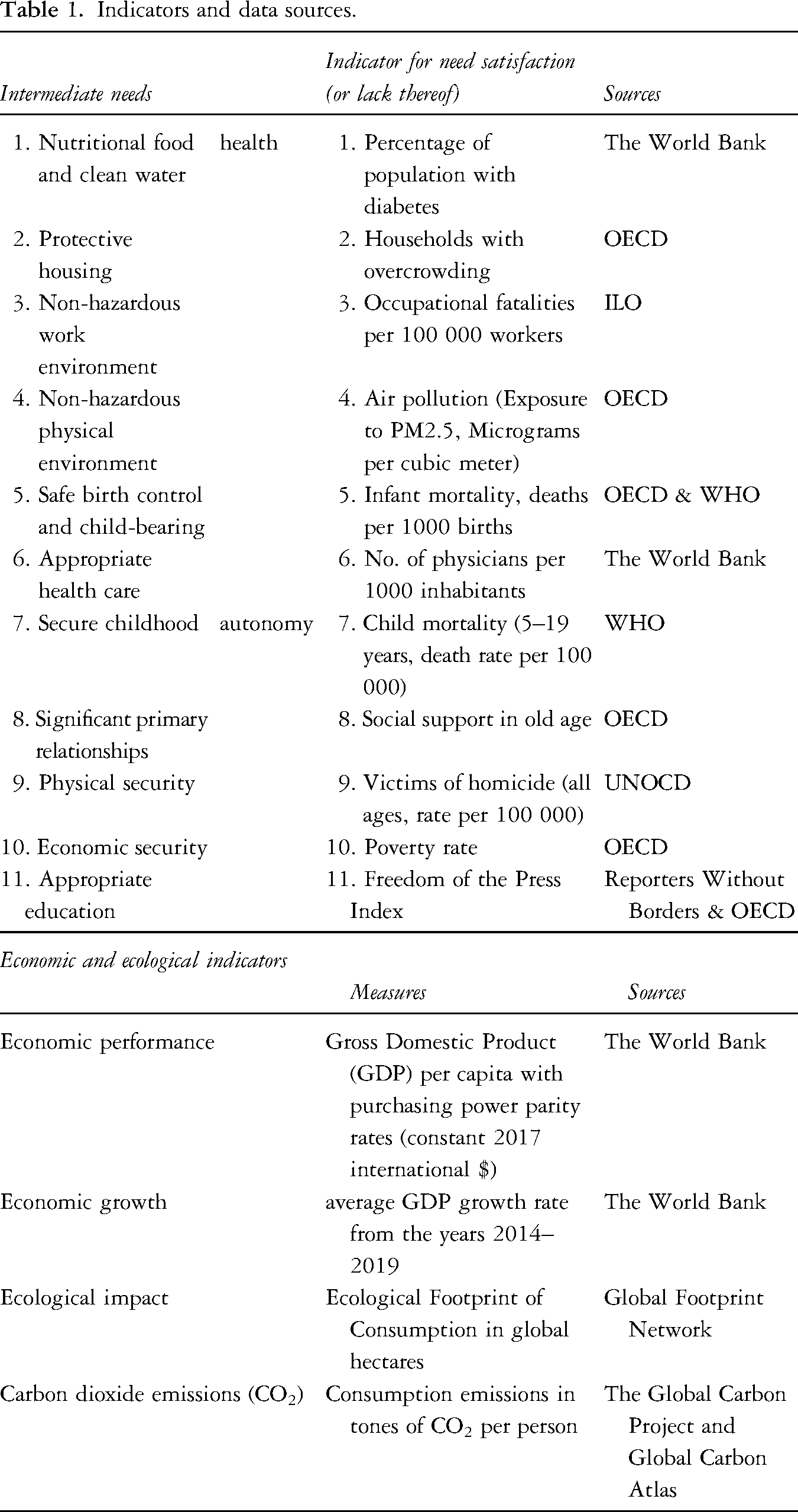
We grouped the 36 OECD countries into GDP per capita quartiles and compared the needs indicators between these (Figure 1). Our dataset includes 15 indicators. Eight out of the 540 data points were missing values. They were replaced with multiple imputation under the missing at random assumption (Sterne et al. 2009). Subsequently we conducted principal component analysis with varimax rotation (Bro and Smilde 2014) over eleven needs satisfaction and the two ecological indicators to detect underlying patterns in needs satisfaction of OECD countries. We then tested whether the resulting factor scores differ between GDP quartiles. We also divided the countries into three groups regarding their average GDP growth over the years 2014–19. The first group called ‘low growth’ had a growth of <=1.1 percent and n = 15 countries, the second was ‘medium growth’ of >1.1 and <=2.0 percent including n = 9 countries and the third group was ‘high growth’ with >2.0 percent and n = 12 countries.
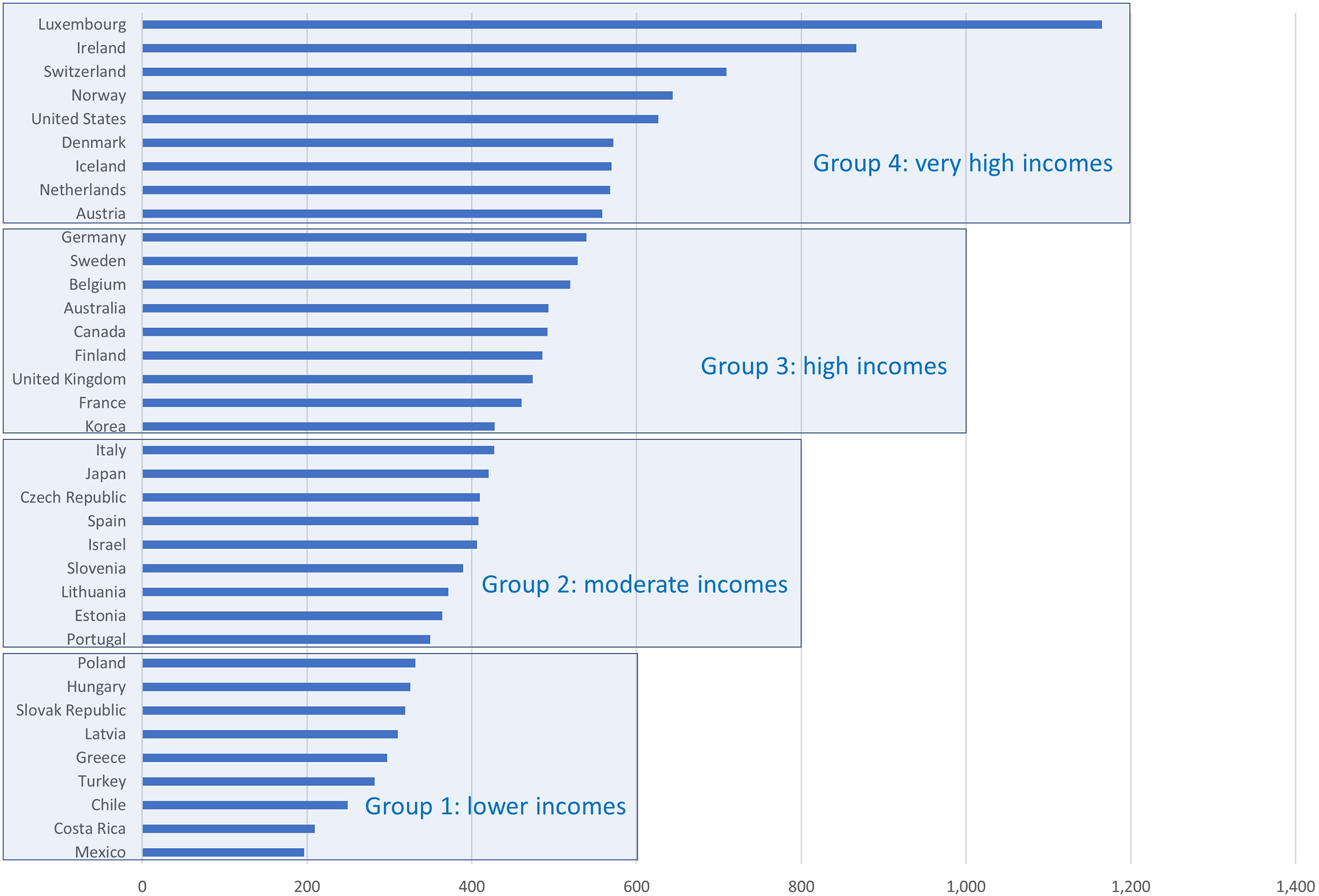
OECD countries grouped by GDP per capita in constant 2017 international $.
Results
We first describe how social and ecological indicators differ between income groups (4.1). Subsequently, we compare needs satisfaction between OECD countries grouped by income, starting with health-related needs in 4.2 and continuing with autonomy-related needs in 4.3. Applying principal components analysis, we then explore the relationships between needs satisfaction and ecological indicators in the OECD (4.4) and compare the outcomes by economic indicators (4.5).
Description of ecological and social indicators
Ecological Footprint: All OECD countries carry Ecological Footprints of Consumption way above sustainability levels. 2 The general pattern (Table 2) is that the higher the economic performance of an OECD country the higher is its Ecological Footprint. There are few exceptions: countries with the highest GDP per capita such as Luxembourg and Ireland are below the countries from the group with the second highest GDP per capita. The reason is that the second group contains Finland, Sweden, Canada and Australia – four countries that feature very high footprints due to their extreme geographical conditions combined with low population density which make maintaining infrastructures more inefficient than in moderate, more populated countries.
Satisfaction of intermediate needs, socio-economic and ecological indicators by income group.
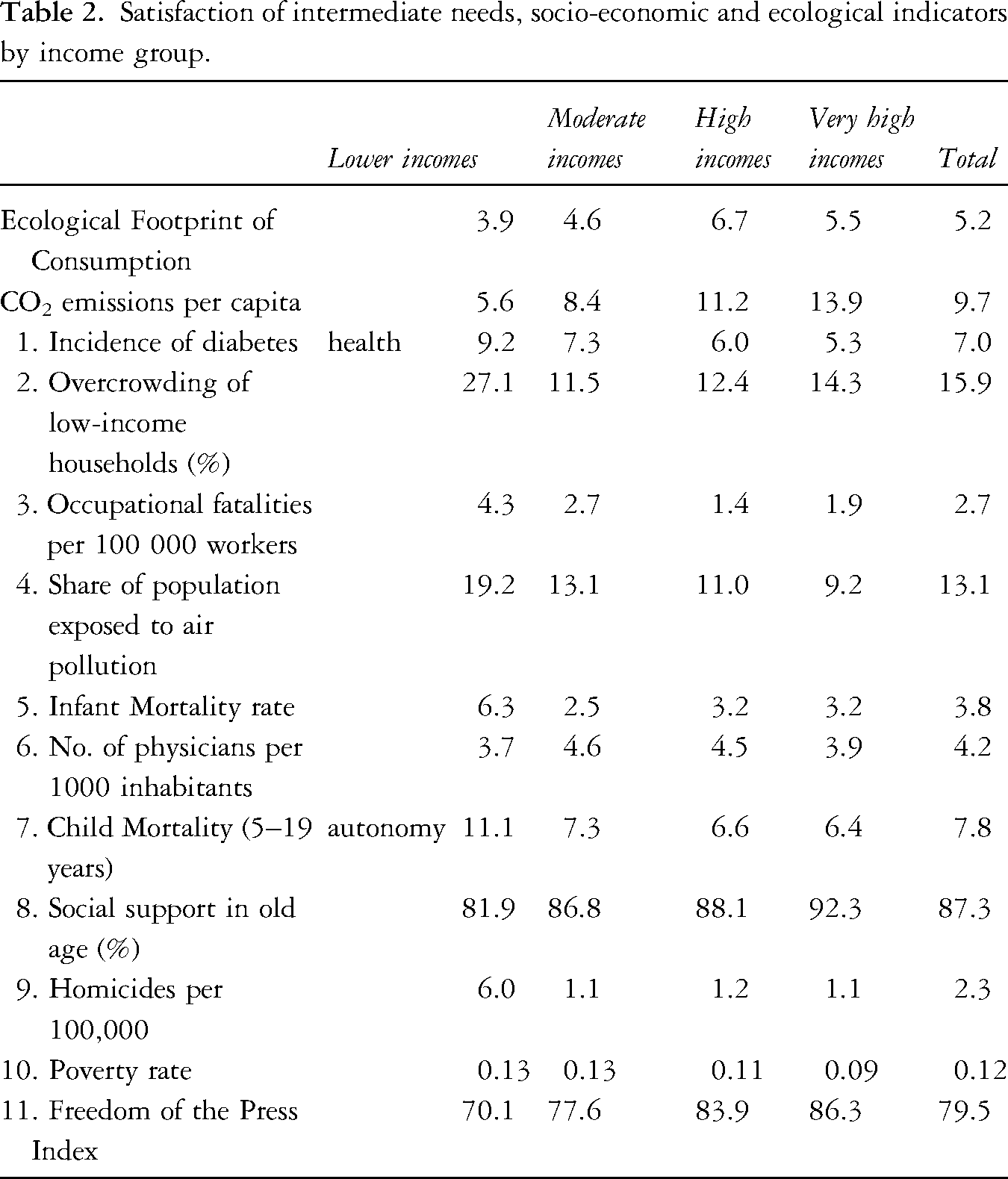
CO2 emissions: Average per capita emissions of carbon dioxide increase steadily over GDP groups. This confirms previous studies indicating a rather tight coupling of economic activity with emissions (Parrique et al. 2019).
Needs satisfaction – health
Diabetes: Table 2 indicates that the incidence of type 2 diabetes is negatively related with income on a country level: the higher the level of income, the lower the level of diabetes. To prevent diabetes a good quality of food (fresh, varied, little sugar and animal fat) and regular physical activity is important. Our data suggest that the populations of richer countries tend to pay more attention to healthy lifestyles, not least because they have the means to do this (more free time, more knowledge, more capital).
Overcrowding: Overcrowding means that people have less space in their homes for privacy and health, which may imply that children have difficulties in finding a space for studying, playing with friends, or just finding some peace of mind. Comparing the incidence of overcrowding among the lowest income quintile of households across OECD countries, those countries with the lowest levels of GDP feature the highest shares of persons suffering from overcrowding (27%). In the group of moderate-income countries, overcrowding is markedly lower at around 12%. Interestingly, overcrowding is then again higher in the high-income and very high-income countries with between 12–14%. A reason could be higher costs of real estate complicating the search for affordable and spacious accommodation for poorer groups.
Occupational fatalities: Fatal work accidents in the OECD occur most often in countries in the group with lower per capita GDP (4.3 per 100 000). They are less frequent in moderate-income countries (2.7), and the rate is even lower in high and very-high income countries (1.4 and 1.9). The small difference between the last two mentioned country groups cannot be interpreted substantially. However, possible explanations for the overall trend of the lower number of fatal work accidents in higher per capita GDP countries are that more resources are available for safety measures, more worker-friendly regulations exist and more workers survive potentially fatal accidents due to the availability of advanced medical treatment. Moreover, it could be that jobs prone to occupational hazards have been off-shored from high-income countries to low-income countries as part of a reproduced imperial division of labour between the global North and South (Lessenich 2019).
Air pollution: The share of the population exposed to air pollution decreases with GDP/capita. However, the biggest increment is again between the lower- and moderate-income countries: while in the former almost every fifth citizen is exposed to air pollution, this share is just over 13% in the latter. The fact that the very-high income countries still feature an over 9% share suggests that not even here sufficient capital was utilized to build greener infrastructures. The continued predominance of fossil-fuel driven automobility is just one example (Mattioli et al. 2020).
Infant mortality: The infant mortality rate (deaths per 1000 births) is smallest in the moderate-income countries, and only slightly higher in countries with additional GDP/capita. However, this rate is more than twice as high in the lower-income countries. This indicates that investment in appropriate health infrastructure would be worthwhile in the low-income countries. Conversely, beyond the level of moderate incomes, it seems that additional GDP/capita does not have any positive effect on infant mortality rates.
Number of physicians: The differences between country groups regarding the number of physicians per 1000 persons are small and follow a bell-shaped curve. Among the low-income and very-high-income countries, there are fewer doctors than in the mid- and high-income countries. Finding an explanation to this is difficult as many factors are involved in the supply and demand of specific occupations on labour markets.
Needs satisfaction – autonomy
Child mortality: There is a clear tendency towards diminishing child mortality from the poorer to the richer countries. However, as with other needs indicators, the increments flatten beyond the moderate-income threshold. The by far biggest difference is between the lower- and moderate-income countries, which, similarly as in the case of infant mortality, suggests that particularly low-income countries would profit from additional investments into preventing child mortality. Beyond moderate-income levels the potential for improvement is rather small. Social support in old age: Measured as the share of people aged 50 years and older who report to have friends or relatives to count on, this intermediate need is better satisfied in countries with higher GDP per capita than in poorer countries. Constituting a clear relation, the share of socially supported older persons increases from GDP group to GDP group. The total difference between the low-income countries (82%) and the very-high income countries (92%) is ten percentage points. Affluence seems, hence, to benefit social relationships. Homicides: Being exposed to crime and violence means that personal security is at risk. Homicides, which are perhaps the most extreme form of crime we can imagine, are six times more likely to occur in the low-income group than in the other groups. In the moderate to very high-income groups, which range from Portugal to Luxembourg, there is no substantial difference in the homicide rates – they range between 1.1 and 1.2 per 100,000 inhabitants. As in the cases of infant and child mortality, the biggest leap in improving needs satisfaction occurs between the low- and the moderate-income countries. Lifting incomes to this level seems to be sufficient to enable the provision of more security, probably mostly in public spaces, and improves people's lives considerably. A further decline from the moderate to very high-income group would be hard to achieve as homicide rates are already close to the possible minimum of zero. Poverty: Considering relative poverty (income below half of median income) we observe that rates are smaller in richer countries. In the low and moderate-income countries about 13% of the people have incomes below the poverty line, whereas in high-income countries these are eleven percent, and in very high-income countries nine percent. Though differences are small, the pattern is clear-cut: The higher the GDP per capita, the lower the share of people in relative poverty. Freedom of the Press: The index for the freedom of the press ranges from 0 to 100 and is used here as an indicator for ‘appropriate education’. While the existence of formal school education is the norm in the OECD world, independent quality media are important additional prerequisites for cognitive autonomy. Within the OECD the index varies between around 70 and 86 with a clear positive relationship with GDP per capita: it is lower among the less affluent countries and higher among the richer ones. The direction of this relationship is however unclear: A free press may contribute to a flourishing economy while affluent conditions may conversely benefit the independence and quality of the media.
In summary, the comparison of needs satisfaction and ecological indicators between OECD countries grouped according to their GDP per capita, reveals two patterns: First, a general improvement of living conditions and needs satisfaction with rising GDP at the cost of nature. But there is also, second, the finding of ‘diminishing returns’ of income and wealth in relation to a range of needs satisfaction indicators including infant and child mortality, work safety and physical security. Yet, interestingly, we found an additional difference regarding the satisfaction of ‘health’- and ‘autonomy’-related intermediate needs: While the very high GDP per capita group does perform best in just two out of six cases (diabetes, air pollution) of health-related need satisfaction, it performs best in all autonomy-related needs. This seems to indicate an underlying pattern according to which basic health needs are satiable at comparatively low levels of GDP, while autonomy-related intermediate needs require efforts that have so far benefited from higher GDP levels. In short, there are ‘diminishing returns’ of GDP for most health-related needs but not for autonomy-related ones. This resonates with O’Neill et al. (2018) who found that physical needs can be met for all people within ecological limits while qualitative goals are harder to achieve. In our data set, this would particularly apply to the indicators ‘freedom of the press’ and ‘social support in old age’ which both seem to presuppose the existence of specific institutions and norms, which are so far coupled to economic growth, rather than technology and knowledge.
In the next steps, we analyze the relationships between all indicators more in-depth to find patterns that may help to answer the question of and under what conditions needs satisfaction is possible within ecological limits.
Underlying patterns within OECD needs satisfaction and relationships with ecological indicators
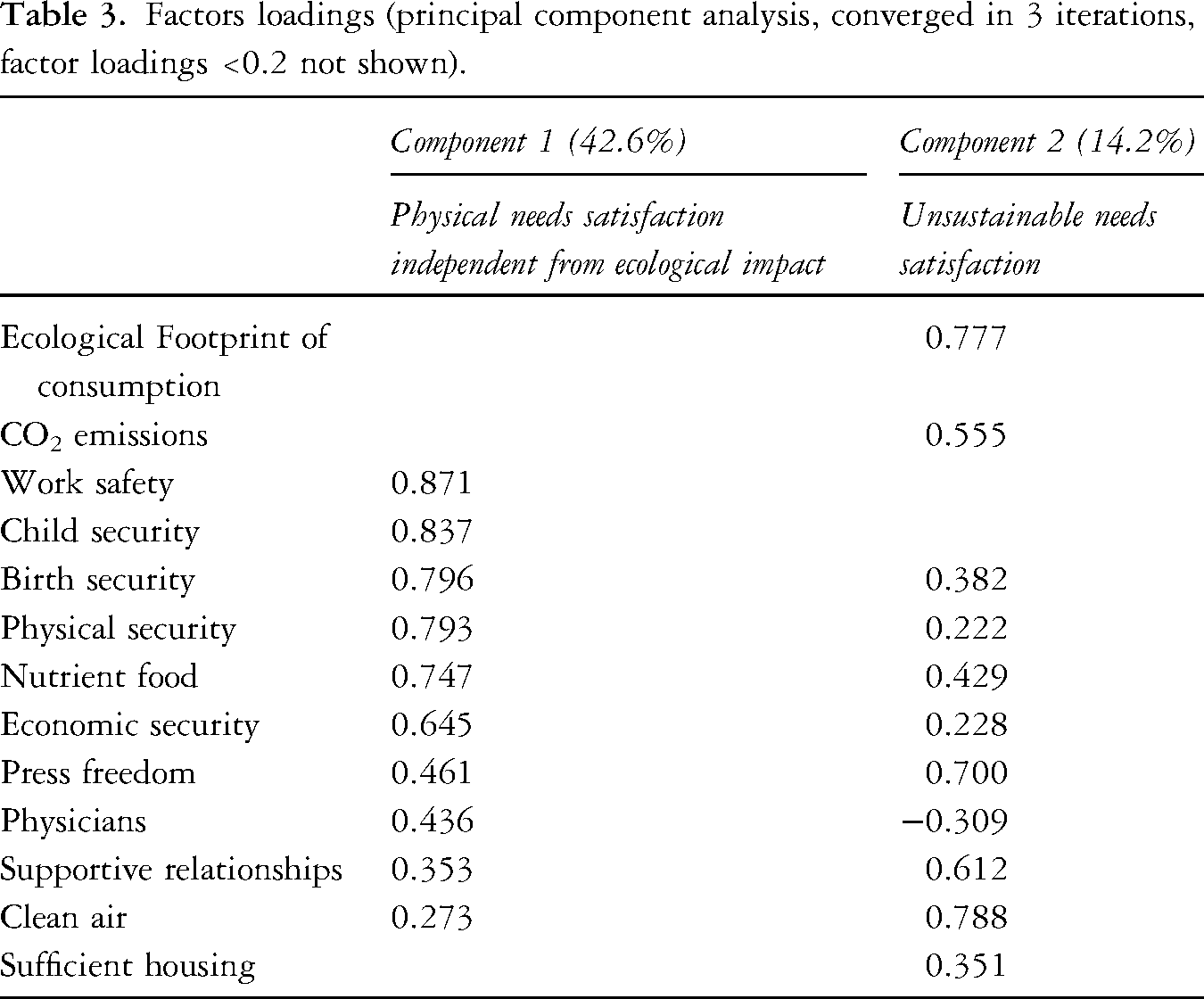
We conducted a principal component analysis (PCA) among the eleven indicators measuring human needs and the two indicators measuring the ecological impact of the countries (CO2 emissions and Ecological Footprint of Consumption). Before conducting the analysis, the scale of some of the indicators was reversed to reflect the satisfaction of a need rather than the lack thereof, e.g., the indicator “homicides” was reversed so that high values indicate high levels of “physical security” (Table 3).
Factors loadings (principal component analysis, converged in 3 iterations, factor loadings <0.2 not shown).
The Kaiser–Meyer–Olkin measure of sampling adequacy was .726, suggesting a good factor analysis. Bartlett's test of Sphericity was highly significant (p < .001), indicating that the correlations between indicators were sufficiently large for performing a PCA (Kaiser, 1960). Inspection of Kaiser's criteria and applying the elbow rule-of-thumb to the Scree plot (Figure 2) justify retaining two factors with eigenvalues greater 1 which accounted for 57 percent of the total variance. In the varimax-rotated two-factor solution most indicators loaded highly on one of the two factors. 3
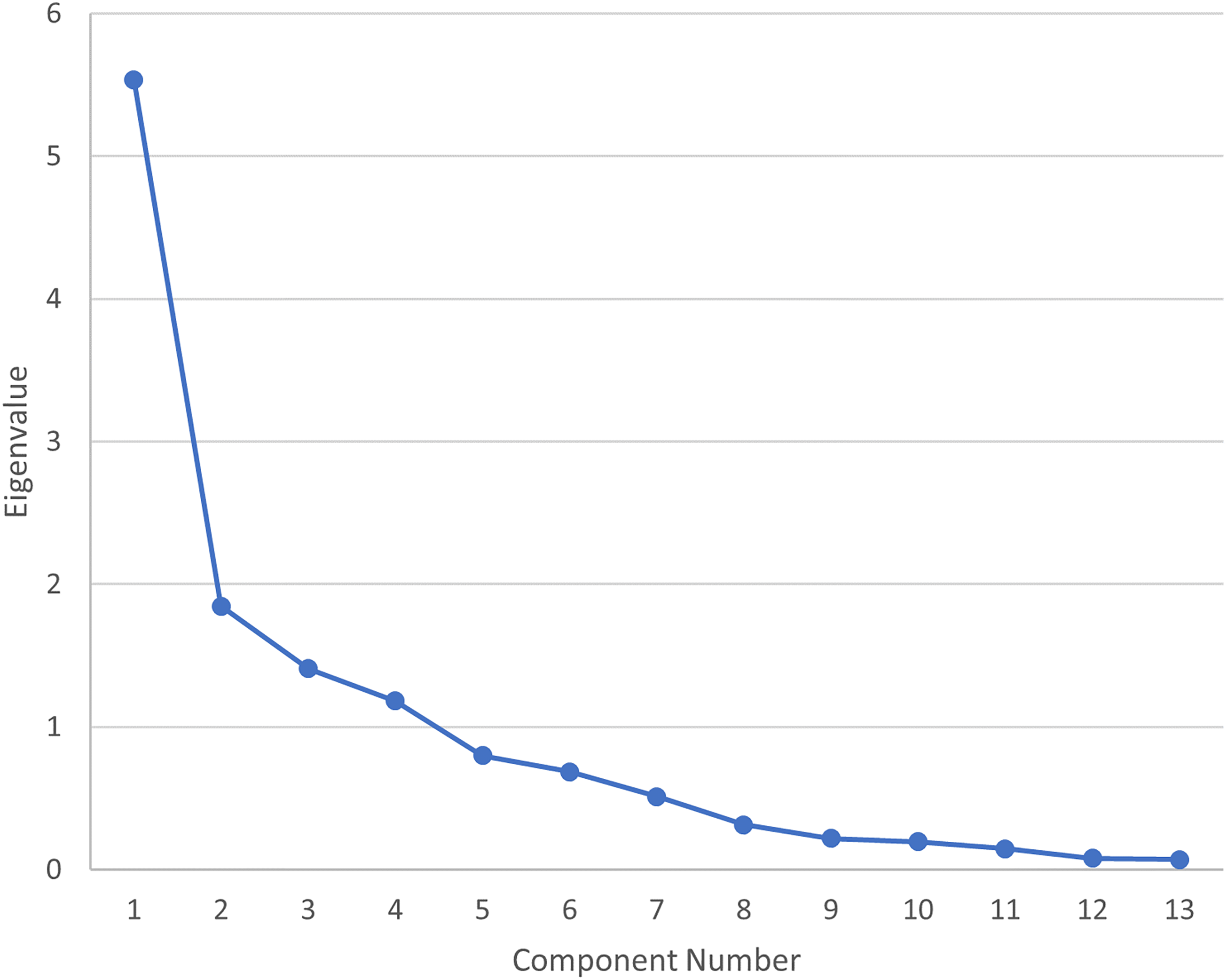
Scree plot of the principal component analysis. 5
The results of the PCA show that differences in the satisfaction of human needs among OECD countries are largely independent from their ecological impacts. This is reflected in the first extracted component capturing 42.6 percent of the variance in the data. High factor loadings 4 on this component come from work safety, child security, birth security, physical security, nutrient food and economic security (Table 3). While these are indicators from both need domains (health and autonomy), we note that a) the four strongest loading indicators have the pattern of “diminishing returns” and b) the Ecological Footprint of Consumption and CO2 emissions do not load on this component. In other words, meeting the intermediate needs of OECD citizens, particularly those that are related to physical security, is possible under relatively sustainable conditions.
Factor loadings for other needs indicators like press freedom, number of physicians and supportive relationships are less strong on this component – they are between 0.3 and 0.5 which indicates a moderate correlation (Cohen 1988) – and only display the tendency that the satisfaction of physical needs is linked to them. The loadings of clean air and sufficient housing are low (less than 0.3) and not relevant for this first component.
The second component reflects a pattern where a high ecological impact correlates with clean air (0.8), press freedom (0.7) and supportive relationships (0.6). These are three indicators that constantly are higher the richer a country is and where no pattern of “diminishing returns” occurs. Thus, this component appears to reflect an underlying mechanism of unsustainable needs satisfaction where it is difficult to decouple ‘progress’ from ecological damages. In the case of clean air, this may be attributed to externalization effects (Lessenich 2019) due to which richer countries can offshore their polluting industries to low-income countries. Rich countries can also afford better filters and cleaner technologies, such as zero-emission vehicles. This contributes to better local air quality, but at the same time causes global ecological damages, since the technologies are built on resource extractivism (such as in the case of lithium batteries), which are included in our two consumption (and not production) based indicators. In general, while health-related intermediate needs may be satisfied relatively easily by investing a limited quantity of economic resources, social and cognitive needs seem more difficult to satisfy because, under current conditions, this would require unsustainable levels of economic resources. More research is required to shed light on the somewhat ambiguous coupling of supportive relationships and press freedom, on the one hand, and footprints and emissions, on the other.
Needs satisfaction and the economy
To further investigate how needs satisfaction in OECD countries is dependent on the size of the economy and economic growth, we compare the degree of needs satisfaction measured by the two PCA components (physical needs satisfaction independent from ecological impact, unsustainable needs satisfaction) among the four GDP per capita groups and among three groups with regard to the degree of their economic growth in the 2014–19 period (low, medium and high growth).
The comparison of OECD countries grouped into GDP per capita quartiles (n = 9 countries each) and needs satisfaction mirrors and summarizes the two patterns we found before (Figure 3): While there is an increase of needs satisfaction with the level of GDP – the values for both components represented by the blue and the red columns, increase from the poorest first to the richest forth quartile, there are also diminishing returns or levelling-off effects in countries with incomes higher than “moderate”. Whereas ‘physical needs satisfaction independent from ecological impact’ and ‘unsustainable needs satisfaction’ are low in the 1st quartile, physical needs satisfaction increases to above average values in the 2nd quartile and only very slightly increases further in the 3rd and 4th quartile. The statistical significance of this effect is p < .05. On the other hand, unsustainable needs satisfaction is continuously increasing with GDP per capita, reflecting the well-known coupling of ecological damages with economic activity, but also showing that autonomy-related needs are better met in richer economies. The statistical effect of this continuous increase is even stronger with p < .01.
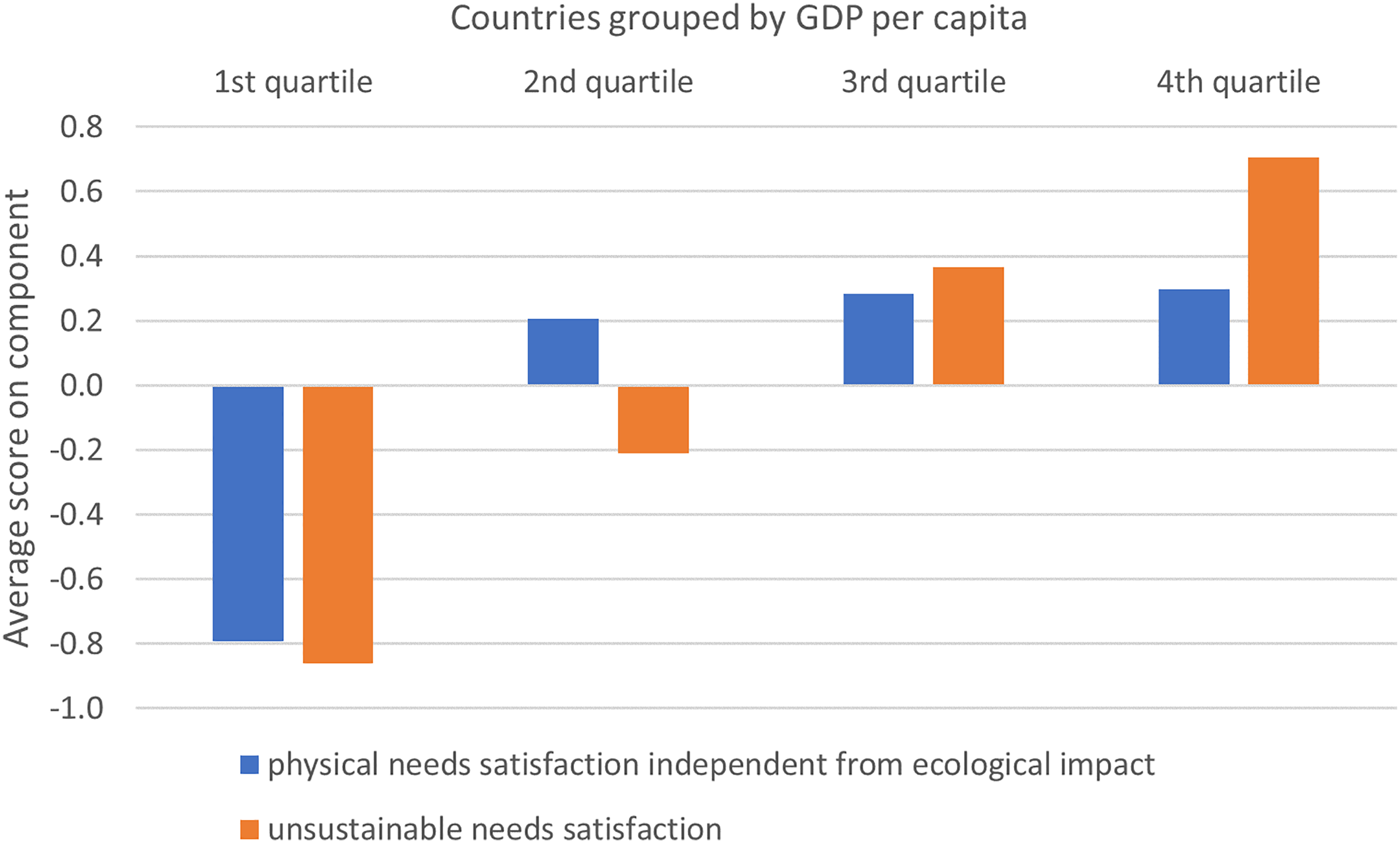
GDP per capita and needs satisfaction (Reading example: countries in the group of moderate incomes (2nd quartile) have slightly above average physical needs satisfaction (0.2) and below average unsustainable needs satisfaction (−0.2).
Crucially, the relationship between economic growth and needs satisfaction does not seem to follow any clear-cut structure (Figure 4). In countries with low GDP growth (<=1.1%, n = 15), physical needs satisfaction and unsustainable needs satisfaction are both around average. In countries with medium growth (>1.1<=2.0%, n = 9), unsustainable needs satisfaction is above the average but not statistically significant. In high growth contexts (>2.0%, n = 12), both needs satisfaction components are slightly below average. Since none of the differences here are statistically significant, we conclude that actual growth rates are not (at least not directly) linked to needs satisfaction within the OECD. Reinforcing the results of Steinberger et al. (2020), growth per se is not a prerequisite to improve needs satisfaction.
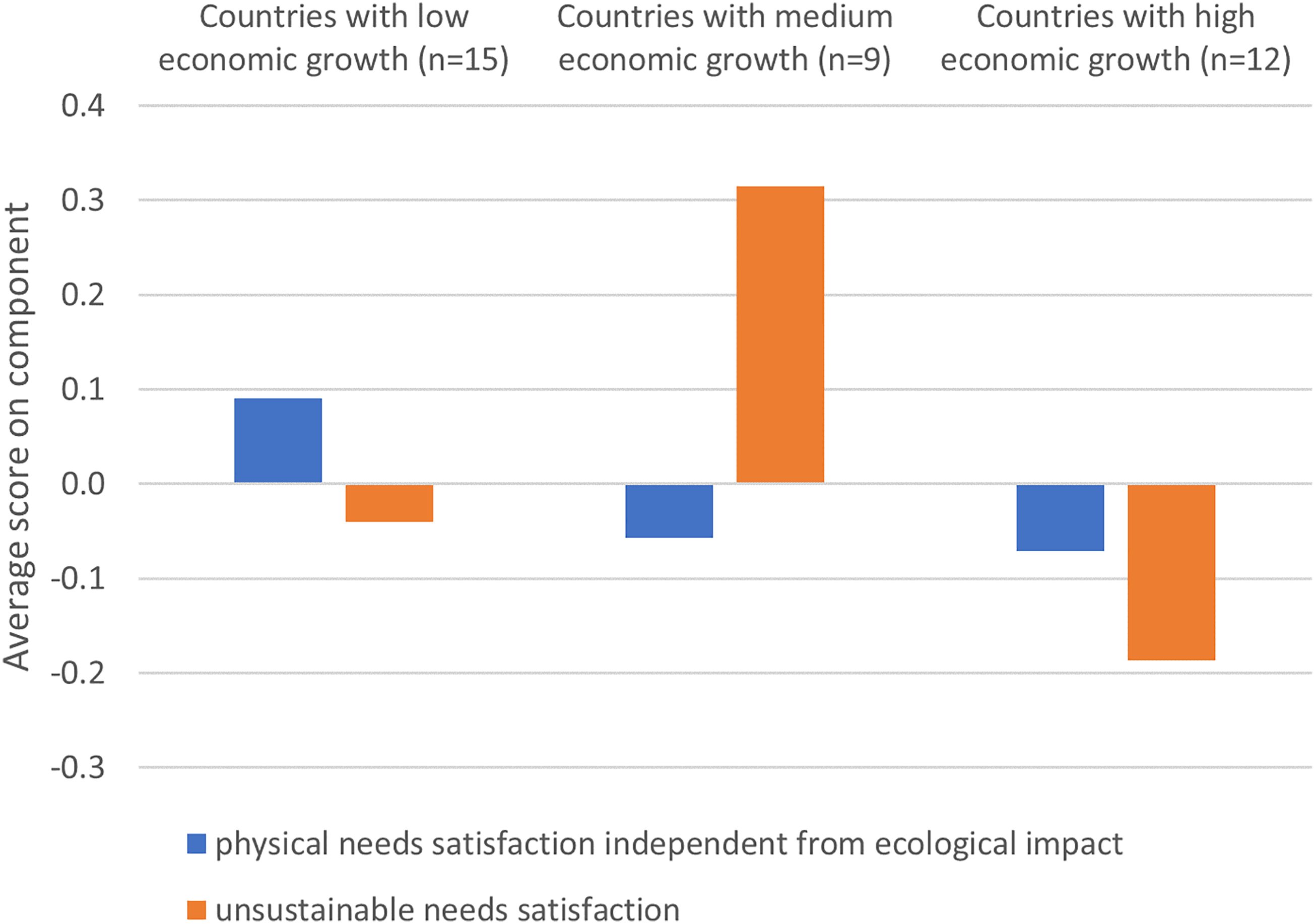
GDP growth and needs satisfaction (Reading example: countries which experienced medium economic growth from 2014-19 have the highest score (0.3) for unsustainable needs satisfaction).
Concluding discussion
We set out to explore how the provision of welfare, here understood in terms of the degree of satisfaction of intermediate human needs (Doyal and Gough 1991), is linked to economic performance and growth as well as to ecological indicators. Drawing on a novel dataset referring to the OECD countries, we have observed that most relatively well-off countries display diminishing returns in terms of welfare relative to increasing economic power. Levels of well-being do not differ substantially between moderate and high-income countries. Yet we observed other substantial differences. Especially in relation to Doyal and Gough's intermediate needs of the domain ‘physical and mental health’, the differences in needs satisfaction are most significant between lower- and moderate-income countries. After this threshold, needs satisfaction curves begin to flatten and social limits to further economic ‘development’ measured in GDP/capita become identifiable. Hence, while any investment bringing lower-income countries to the level of moderate-income countries is likely to yield significant surplus in needs satisfaction, the same does not apply if moderate-income countries were brought to ‘higher’ income levels. Not only does our explorative analysis indicate that social indicator scores do not substantially improve beyond the level of ‘moderate’ income countries, some indicators such as overcrowding display in fact even lower scores in very high GDP per capita countries than in the next poorer cluster. These results resonate with prior research into existing ‘provisioning systems’ undermining the ability of future generations to meet their welfare needs (Fanning et al. 2020; Fanning et al. 2022).
However, in relation to the satisfaction of intermediate needs of the domain ‘critical autonomy’ our results are somewhat different, displaying increasing needs satisfaction with GDP/capita. While ‘critical autonomy’ denotes the ability to make life our own and to actively find our place in society, this seems to hinge on the access to and use of external resources, which economic growth so far seems to provide at least in parts. Our results point to the temporary conclusion that progress in satisfying autonomy-related needs is of a more complicated and complex nature than, for example, funding universal welfare systems which would be beneficial for the satisfaction of a range of health-related intermediate needs. More research of an in-depth and case study nature is needed into why exactly ‘adequate education’, for example, is linked to the level of GDP and ecological footprints under current conditions and how this may be changed via public policies in postgrowth circumstances. Not much seems, for example, to speak against the broadening of educational forms that are based on learning craft-skills and involve outdoor activities that would presuppose low levels of financial investment. It may be exactly this kind of practical knowledge that turns out to be required during degrowth transformations. Similarly, alternatives to the current ways of social support in old age including multi-generational housing are being already tested and should be explored further.
When also considering environmental impacts, which increase with GDP/capita, the safeguarding of the satisfaction of the needs of future generations would necessitate, as discussed in section 2, the review and constrain of the wants and aspirations of the present generation. Due to the lack of evidence for absolute decoupling between economic performance and environmental parameters, social welfare reforms in the OECD countries should resonate with socio-ecological policies that move countries onto a postgrowth path. In terms of public policy reform, this could be initiated by abolishing private health care and introducing/broadening universal and public health care systems, which would allow many OECD citizens to meet most of the physical intermediate needs at lower economic and ecological costs.
Insofar as our results reveal diminishing welfare returns relative to the environmental costs of additional economic growth, they also contribute to the emerging research field of postgrowth welfare systems (Koch and Fritz 2014; Corlet Walker et al. 2021). Since most OECD countries cannot afford additional GDP growth if planetary boundaries are to be respected, governments, NGOs and citizens will have to explore alternative forms of welfare that are less, or not at all, dependent on economic growth and high levels of national income. In relation to health-related intermediate needs (Doyal and Gough 1991), this move towards postgrowth welfare systems is likely to be structurally facilitated by the here observed diminishing welfare returns of existent growth economies. Much more challenging, however, is this move when considering needs in the ‘critical autonomy’ category, because ‘progress’ here has so far gone hand in hand with increasing GDPs. Future research should therefore help develop welfare systems at low-environmental cost with focus on intermediate needs such as secure childhood, physical and economic security as well as education.
Footnotes
Acknowledgements
We would like to express our sincere gratitude to Mine Islar, Riya Raphael, Timothée Parrique, Jennifer Hinton, and Johanna Alkan Olsson for their contributions to our discussion on postgrowth and welfare, which took place during the completion of this paper. This paper was produced as part of a larger project, Postgrowth welfare systems, which is funded by Lund University's research program for excellence, focusing on Agenda 2030 and sustainable development. Martin Fritz’ work for this paper was funded by the German Federal Ministry of Education and Research as part of the work of the junior research group ‘Mentalities in Flux’ (flumen) (2019–2025, Grant Number 031B0749).
Funding
The author(s) disclosed receipt of the following financial support for the research, authorship, and/or publication of this article: This research was funded by Lund University's research program for excellence, focusing on Agenda 2030 and sustainable development. Martin Fritz' work for this paper was funded by the German Federal Ministry of Education and Research as part of the work of the junior research group ‘Mentalities in Flux’ (flumen) (2019–2025, Grant Number 031B0749).