




Abstract
Quantitative well-being studies have shown that welfare recipients performing work activities in activation programmes report relatively high levels of well-being. This article asks how these findings can be explained, given welfare recipients’ constrained autonomy. To answer this question a qualitative study was conducted in the Netherlands to explore the interaction between welfare recipients’ constrained autonomy and how they experience work in Mandatory Work Programmes. This article uses concepts from critical theoretical approaches to meaningful work and autonomy to analyze the data. The findings show how the restrained autonomy of programme impacted the participants’ work experiences in various, sometimes contradictory ways. It is concluded, among other things, that quantitative well-being research does not seem to fully capture people's experiences as having the status of a welfare recipient and, related to that, what it means for them when their autonomy is constrained in one or more dimensions. It is also recommended that future quantitative well-being studies clearly distinguish between types of activation programmes, particularly regarding their mandatory nature, their goals and their target groups.
Introduction
Since the 1990s, welfare states’ practice of compelling recipients of social assistance benefits to participate in sanction-backed Mandatory Work Programmes (MWP[s]) has become widespread, both in European welfare states (Lødemel and Trickey 2000) and ‘Anglo-Liberal’ welfare states outside Europe (Borland and Tseng 2004; Crisp and Fletcher 2008; Krinsky 2007). Some of these MWPs do not offer training, but are aimed exclusively at developing basic employment skills, such as being at work on time, developing work discipline and answering to a boss. While some countries are currently implementing these kinds of MWPs on a reduced scale (for the UK, see Eleveld et al. 2020; for Germany, see Harrer and Stockinger 2019), many welfare states continue to force recipients of last-resort benefits to participate in such programmes (for the US, see Hatton 2020; for Canada, see Pennisi and Baker Collins 2017; for Australia, see Cross 2020; for Denmark, see Schmidt Hansen and Herup Nielsen 2023; and for the Netherlands, see Eleveld et al. 2020).
MWP participants’ autonomy, defined as their ability to control and determine their lifegoals (Raz 1988), is usually restrained. For example, social assistance recipients participating in MWPs are not only economically dependent on social assistance benefits, but also have little say in the choice of the MWP and their benefits are usually cut if they refuse to work in an MWP. Notwithstanding these restraining conditions, MWP participants report relatively high levels of well-being, measured as the level of life satisfaction (Hoang and Knabe 2021; Knabe et al. 2017; Strandh 2001; Wolf et al. 2019; Wulfgramm 2011). This raises the question of how these high levels of well-being among MWP participants can be explained.
Well-being studies have offered several explanations. In the first place, they have pointed at the deprivation theory developed by Jahoda (1982). This theory highlights the socio-psychological downsides of being unemployed. It argues that being deprived of work activities (whether paid or unpaid) usually implies that a person becomes bored, is deprived of regular social contacts other than with their own family, and lacks both a purpose in life transcending their own life and a sense of status and identity. Based on Jehoda's deprivation theory, it could be argued that working in an MWP positively affects participants’ well-being because it gives them something to do, increases their social contacts and enables them to pursue useful activities and, as a result, gain self-esteem.
Quantitative well-being studies have also suggested that MWP participants report higher life satisfaction than unemployed people (Hoang and Knabe 2021; Wolf et al. 2019) because they are to some extent able to fulfil their desire to comply with the social norm to work (Sage 2019; Roex and Rözer 2018) and related to this, by their expectations of moving to a paid job (Knabe et al. 2017; Roex and Rözer 2018; Sage 2019; Strandh 2001; Wulfgramm 2011). This conclusion is based on studies showing that despite people being satisfied with their lives when they have a regular job, they do not necessarily enjoy work as an activity. For example, the well-being people experienced when performing work activities (i.e., affective well-being) was found to be low compared to the well-being they experienced during leisure activities (e.g., browsing the internet) and non-market work (e.g., preparing meals or care-giving). The inference that people seek to comply with the social norm to work has been confirmed in studies indicating that the difference between the level of life satisfaction between employed and unemployed people increases if unemployed people show a high work ethic (Sage 2019) or if people (in a specific country) generally endorse a strong social norm to work (Roex and Rözer 2018). Indeed, the work ethic, which is deeply embedded in European and Anglo-Liberal welfare states, has together with neoliberal discourses profoundly affected ways in which unemployed people perceive themselves and others (Arts and Van den Berg 2019; Eleveld 2019; Boland 2016; Weeks 2011). Yet, as Whelan (2021) points out, in the welfare to work context, we should especially consider the combined effect of the strong work ethic and welfare recipients’ stigmatisation (also see Tyler 2020) as this has resulted in a ‘toxic symbiosis’ of worklessness and welfare dependency, manifesting itself in ‘low self-esteem and negative introspection’ (p. 26).
Furthermore, while quantitative well-being studies provide convincing explanations regarding MWP participants’ well-being, they do not explain how the punitive welfare to work system (Watts and Fitzpatrick 2018) that restricts the welfare recipients’ autonomy in several ways, interacts with their well-being. This is remarkable as psychological studies have shown that autonomy is a basic psychological need that positively affects people's well-being (Ryan and Deci 2017). The study by Knabe and colleagues (2017) is an exception, but this study neither distinguishes between different ways in which the autonomy of MWP participants can be limited, nor reflects on possible explanations for MWP participant's high scores on life satisfaction under conditions of constrained autonomy.
Scholars engaged in theoretical approaches to meaningful work have examined the issue of workers’ autonomy, with some meaningful-work scholars considering autonomy an important factor, or even prerequisite, for ‘meaningful work’ (Veltman 2016; Roessler 2012; Yeoman 2014). At the same time, it has been argued that restricting people's autonomy in a work context may also encourage them to act and, as such, to develop and flourish (see, for example, Dejours et al. 2018; Deranty 2022; Veltman 2016). So far, however, the relationship between restrictions on workers’ autonomy and meaningful work experiences (which are positively associated with workers’ well-being) has been under-researched in empirical meaningful-work studies (Bailey et al. 2019).
This article aims to contribute both to meaningful-work and well-being studies by providing more insight into the interaction between welfare recipients’ (constrained) autonomy and the way they experience work in activation programmes. To this end, a qualitative research project was conducted in three municipalities in the Netherlands, which investigated how social assistance recipients experienced work in MWPs aimed at developing their basic working skills and how these experiences relate to their (restrained) autonomy. This article analyses the findings from this research project, using critical theory approaches to meaningful work and autonomy developed by Dejours and colleagues (2018) and Veltman (2016). As such, it reveals many complexities in the interaction between welfare recipients’’ restrained autonomy, their meaningful work experiences and their well-being, which thus far have not been highlighted in quantitative studies.
The next section of this article introduces the theoretical approaches that will be used as an analytical framework. Subsequently, the methods and findings will be presented.
Theoretical approaches to meaningful work and autonomy
Following Rosso and colleagues (2010), meaningful work is defined as the extent of significance that people attach to their work. Meaningful work is thus distinguished from the ‘meaning of work’. Scholars in diverse theoretical traditions have examined meaningful work in relation to workers’ autonomy. Marxist approaches have delineated three main ways in which workers’ autonomy can be restricted: through forced labour, exploitation and restrained conditions in the labour process (LeBaron 2015). For Marx, any of these restraints on workers’ autonomy would result in the alienation of workers. Hence, worker alienation could only be overcome by removing restrictions on workers’ autonomy as much as possible (Sayers 2005). Under these conditions, the worker would be able to focus ‘on his being able to realize his talents and abilities, his “individuality,” in the work and the producing activity in a self-determinate way’ (Roessler, 2012: 88). Thus, if restrictions on workers’ autonomy were removed, work could even be a fulfilling activity. Marx, however, also acknowledged that restrictions on workers’ autonomy could be beneficial as they could encourage workers to act and, as such, provide opportunities for their self-development (Marx, 1973: 611 cited by Deranty 2022: 429). This latter point has been taken up by scholars in critical theory such as Dejours, Deranty, Renault and Smith, who give reasons why constraints may sometimes be needed for people (workers) to develop themselves. As they put it, even if workers are required to carry out work in specific, prescribed manners, there ‘is always a gap between the prescribed task and the actual realization of this task’ (Dejours et al. 2018: 73). This may then result in workers being able to actualize their capabilities and to ‘flourish’ (Dejours et al. 2018: 81). Deranty argues that, depending on the exact nature of the work, the worker will have to: mobilise all her capacities, physical, emotional, psychological, cognitive, to achieve the task. It is then precisely because of all its surrounding constraints that work can be the type of activity that promotes self-development. The subject is forced to grow, as it were. (2022: 429).
Like post-Marxist and critical theory thinkers, Veltman (2016) acknowledges that work can be a potential context for allowing people to grow. She builds her argumentation on the Aristotelean tradition, according to which human flourishing is achieved through people's own effort and requires them to undertake activities – such as self-reflection, decision-making, good judgement and self-control – that develop their human capabilities. Veltman argues that work allows people to develop a capability for agency, which, in turn, is a vital aspect of exercising autonomy within their work and lives. This means that even where people's autonomy is constrained in some dimensions, they may nevertheless flourish in their work, as long as they are still able to exercise some autonomy in this work. In addition to autonomy within work, Veltman recognizes two other dimensions of autonomy that, in her view, are important prerequisites for meaningful work, namely autonomous choice of work and autonomy as economic independence achieved through work. These three dimensions of autonomy can be seen as the corollary to the oppressive nature of work identified in the Marxist literature (i.e., forced labour, exploitation and restrained conditions in the labour process) and Veltman (like post-Marxists) recognizes that workers’ autonomy will often be impeded in one or more of these dimensions. First of all, an autonomous choice of work is often absent as most workers, especially those in precarious jobs, do not perform work activities that entirely represent their personal, freely chosen life goals. In addition, precarious workers who are financially dependent on their employers may, as a result, be exploited by and placed at the will of the employer (i.e., no autonomy as economic independence). Finally, workers may lack substantial freedom in the way they carry out their work (no autonomy within work).
If we apply the three ways in which workers’ autonomy can be restricted, according to Veltman's meaningful-work approach, to MWP participants’ situation, we can argue, first, that MWP participants’ autonomous choice of work is restricted, given that welfare recipients who refuse to participate in an MWP (or a specific MWP) usually receive a financial sanction. This also means that MWP work does not necessarily reflect participants’ own life goals. Second, participants’ economic independence is restricted because they cannot simply leave the MWP and cancel their benefits as this would leave them without any means of existence. This lack of an exit option makes MWP participants particularly vulnerable to abuse and exploitation (Eleveld 2020). MWP participants are also exploited (in a more Marxian meaning of ‘exploitation’) as they produce goods of economic value without being sufficiently rewarded for these activities. Third, MWP participants’ autonomy is restricted if they are forced to participate in an MWP (particularly a disciplinary MWP) that gives them very little leeway to act and consequently hampers their flourishing. Based on the work of Dejours and colleagues (2018) and Deranty (2022), it may also be inferred that working in an MWP could be a context in which constraints are needed for individuals to exercise agency and to flourish, at least providing they are granted some autonomy (within work) and their tasks align with their conception of a good life (Dejours et al. 2018). Finally, a recent publication by Laaser and Karlsson (2022) reminds us that an analysis of the relationship between meaningful work and autonomy should also take account of the ways in which workers as agents seek to overcome, oppose or resist their limited autonomy within their work. According to these authors, they do so by establishing independent free spaces where they create and defend their dignity, value each other's contributions and develop informal values and norms independent of organizational power structures. Hence, based on the work of Laaser and Karlsson, our analysis should also be mindful of ways in which MWP participants reclaim their lost autonomy.
The findings section explores how each of the three ways in which MWP participants’ autonomy can be constrained interacts with the way these participants experience work in an MWP. It also examines the extent to which the MWP itself forms the context needed for individuals to exercise agency and to flourish, and how MWP participants create free, independent spaces in opposition to their constrained autonomy.
Context and methods
In the Netherlands, municipalities are responsible for welfare-to-work transitions and, since the Participation Act came into force in 2015, have been obliged to cut benefits by 100% for one month (or for longer in the event of recidivism) if, for example, a recipient of social assistance refuses to participate in an MWP. Recipients of social assistance benefits under the Participation Act are unemployed, and may also be partly or fully incapacitated to perform work. As Dutch municipalities have some freedom in implementing the Participation Act, the study was conducted in three different municipalities: two medium-sized municipalities with just over 60,000 inhabitants each and one large municipality (one of the four Dutch municipalities with over 300,000 inhabitants). In all three municipalities, welfare recipients could be referred to an MWP. The main data for this research consisted of semi-structured interviews with 42 MWP participants (13–15 MWP participants in each municipality) and four days of participant observations of welfare recipients working in MWPs at two locations. The MWPs researched entailed various types of unskilled work (see Table 1). In most of these MWPs, the official goals were to develop and maintain basic working skills (such as arriving at work on time, following an employer's instructions and so on); to develop work abilities; and, if possible, to further explore participants’ work preferences. In general, all welfare recipients who had not been able to find a job within a specific period could be referred to an MWP, although there was some variety between the municipalities regarding frontline officers’ scope of discretion and the extent to which the participants were allowed to participate in the decision-making process as to which MWP they would be referred to (Eleveld 2023). Nine participants worked in what are known as ‘disciplinary MWPs’, to which welfare recipients who had failed to sufficiently comply with their obligations could be referred. Alongside their ‘re-integration function’, therefore, these latter programmes were used to punish welfare recipients. However, one of these MWPs was also used for partly incapacitated welfare recipients or for participants who could only work during their children's school hours. In this MWP, participants sat at tables performing very simple production work, such as putting a sticker on a package or folding washcloths. In the other disciplinary MWP observed, participants had to pick up litter in the streets.
Type of MWP and number of participants.
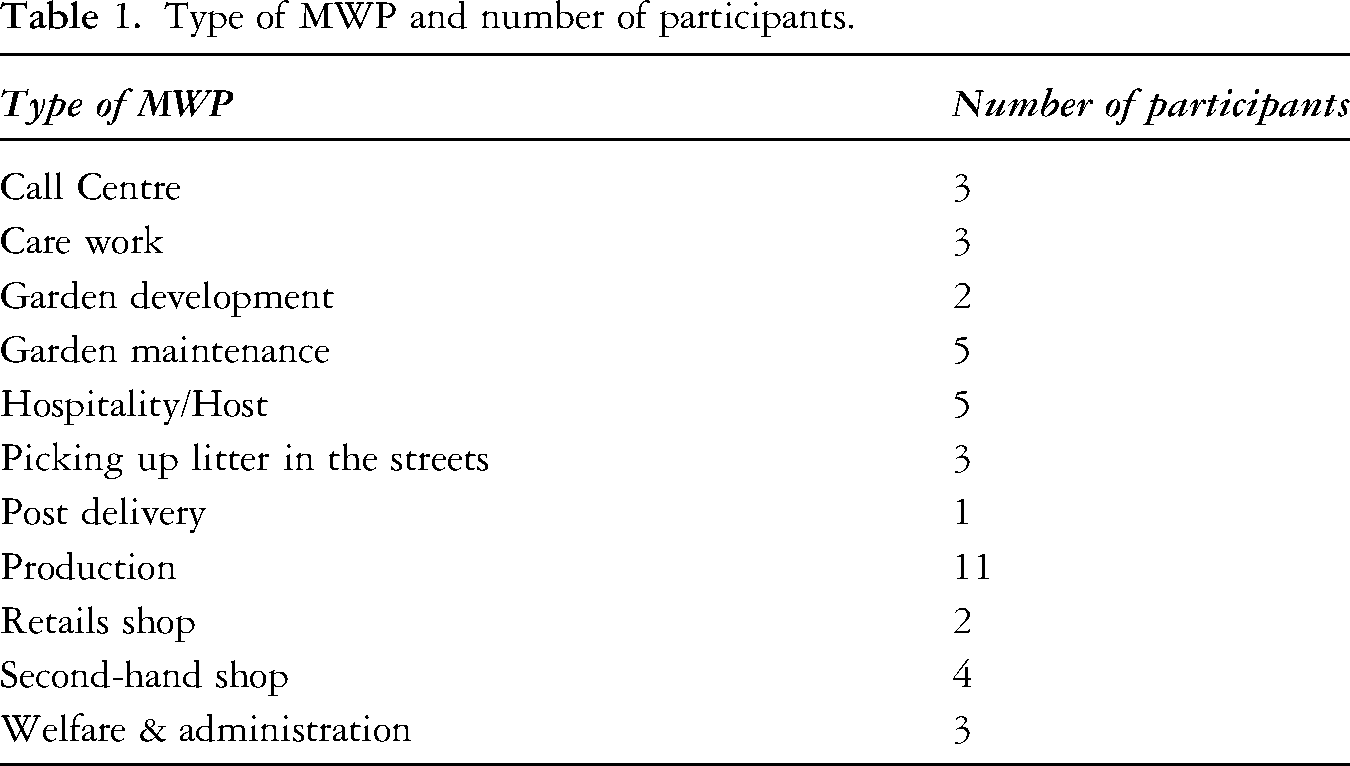
In most MWPs, recipients worked for between 20 and 32 h a week for a minimum of three months and often for longer, or even much longer. Five respondents had already been participating in one or more MWPs for over two years. A total of 24 women and 18 men were interviewed. Most respondents were 40 or older, and three-quarters of them had a Dutch ethnic background. The relative old age of the participants was due to the fact that 1) the programmes were generally designed for welfare recipients who had been unemployed for a longer period of time; 2) overall people older than 45 are overrepresented in the population of welfare recipients in the Netherlands (CBS 2023). Other interview data (61 interviews with frontline officers and work supervisors) and some 45 observations at welfare offices (such as conversations between a frontline officer and welfare recipient, and mandatory welfare-to-work courses) were used to help interpret the interviews with the MWP participants.
The research was conducted according to the relevant guidelines aimed to ensure ethically appropriate research procedure (Wager and Kleinert 2011). All interviews and observations were conducted in 2017 and 2018 as part of a research project on the role of rules in protecting MWP participants against arbitrary power (Eleveld 2023). The interviewees gave written consent to participate in the research. The interviews were recorded and transcribed. Personal information, such as participants’ age and ethnic background, was not recorded on tape, in order to protect the respondents’ anonymity. Most of the interviews were recorded at the MWP where the participant was working. Five respondents were interviewed in their homes. The interviews lasted between one and two hours, and interview topics included, inter alia, participants’ evaluation of the MWP, their prospects of a paid job, their relationships with colleagues and supervisors, working conditions and the role of sanctions.
The transcripts of the interviews were inductively coded in Atlas TI, using methods loosely based on grounded theory (Charmaz 2012). In the first round, parts of the text that directly or indirectly referred to the participants’ evaluation of MWP work were marked. These texts were then re-read and re-coded, predominantly using gerunds as primary codes to describe what was going on in the text, such as ‘excusing herself’, ‘thinking along with the work programme's management’, ‘receiving positive feedback at work’ and ‘feeling depressed at home’. In the third round, these primary codes were merged with similar codes and, where possible, re-worded in more abstract terms and classified under second-order categories such as ‘positive work experiences’, ‘negative work experiences’, ‘positive experiences with municipality’, ‘negative experiences with municipality’, ‘desired alternatives’, ‘coping strategies’, ‘contradictions’ and ‘identification with work’.
After re-reading the quotations classified in the category of ‘positive work experiences’ and ‘negative work experiences’ and reflecting on the literature on meaningful work, I further categorized the codes. In the final, analytical round, I considered whether the data on positive work experiences showed patterns (for a detailed explanation of the coding process in this study, see Bijleveld 2023, chapter 10).
Findings
In general, the findings showed that MWP participants experienced their work both as meaningful and as meaningless work. These experiences could not be associated with the participants’ gender and ethnic background, or the nature of the work (see Table 1), except for the amount of autonomy granted within the work. For example, participants who were granted a relatively great amount of autonomy within their work, more often referred to the fact that the work enabled them to develop their inner selves. Participants whose autonomy within work was more restrained, such as those doing production work, or picking up litter in the streets, more often referred to meaningless work experiences (see later in this section).
Participants who experienced the work in the MWP as meaningful work often recalled the time when they had lost control over their lives. Some respondents said that they had suffered feelings of depression and self-doubt in the period preceding their MWP participation. Other damaging conditions mentioned included becoming overweight, spending too much money, sleeping all day, being tired all day and drinking too much. For these respondents, working in an MWP established a basic rhythm in their lives and, as such, pulled them out of a destructive situation (see Budd 2011).
Based on the analysis of the interview data, four main dimensions of meaningful work experiences were constructed: developing skills; being yourself/knowing yourself; feeling useful or contributing; and building and enjoying personal relationships. More than half of the respondents reflected on one or more of these experiences. They often also explicitly mentioned that they were either proud of what they had achieved when working in the MWP or that they felt recognized because of their work. The various ways in which work in an MWP was experienced as meaningful can be illustrated by the following quotation from Jeroen, who was working in a second-hand shop. He said:
What I like about this work? First of all, the camaraderie and the atmosphere. I’m happy to be working again. I am among people. I like to help customers. They come to me asking questions and sometimes I am able to help them and sometimes not. I feel that I am meaningful for society. I’m not only sitting at home, alone, a loner. I am someone. I can be myself again. I can do things, have a drink with colleagues. That is fun, you are connecting with new people. And the best thing of all is that you can simply be human and be yourself.
The meaningful work experiences found in this study seem to resonate with Jehoda's deprivation theory (1982), according to which being engaged in work positively affects people's well-being because it provides them with activities (ideally of a useful nature), social contacts and self-esteem. However, as Boland and Griffin (2015) rightfully note, deprivation theory only addresses what people lack if they do not participate in work activities; it fails to examine what it means to be unemployed and to be dependent on social benefits, a perspective which also seems to miss in quantitative well-being studies mentioned in the introduction.
Instead, the findings in this study also indicate a loss in self-esteem due to having the status of a welfare recipient. For example, Glenda who worked in an MPW (production work) where she had to fold washcloths, which sometimes were still dirty, argued that she would have refused to carry out this dirty work, had she not been threatened by a benefit cut. She said: The boss said: “You will have to do all the work that you are ordered to do”. You have to do it. You have no choice (…) those washcloths have been washed but they are still dirty. There are some really disgusting things among them. I would rather not sort them out, but it has to be done. I was against it in the beginning. I have to do it, so I do it. You must show that you do not come here for nothing.
Like Glenda, a quarter of all interviewed participants experienced their work exclusively as meaningless work. They argued, for instance, that this work neither contributed to their personal development, nor enabled them to make a meaningful contribution. Some also felt bored during the work and said that they would have preferred to perform other (unpaid) activities they found really inspiring and useful. Participants also mentioned that welfare officers did not treat them with dignity and that participants lacked social recognition when performing the work. Other participants experienced the work both as meaningful and meaningless work. Indeed, more than half of the participants who were positive about their work experienced their work, at the same time, as intrinsically meaningless.
In order to obtain a deeper understanding of the relationship between MWP participants’ limited autonomy and their work experiences, I further analyzed the interview data by using two criteria to categorize participants’ experiences. The first criterion was whether the participants experienced their work entirely positively (i.e., as meaningful work), entirely negatively (i.e., as meaningless work) or both positively and negatively. The second criterion related to the ways in which participants assumed that participating in the MWP would contribute to their transition to paid work. In addition, I considered how participants in each of these categories dealt with their restrained autonomy. Five approaches could be delineated: 1) not bothered about a lack of autonomy; 2) enjoying and playing with autonomy within work; 3) suffering from unfulfilled expectations regarding autonomy in their work; 4) reclaiming autonomy; and 5) struggling with unfulfilled expectations regarding future autonomy. It should be noted that participants often showed more than one way, and sometimes contradictory ways, of dealing with their restrained autonomy.
Not bothered about a lack of autonomy
Some of the participants did not really seem to care about one or more ways in which they lacked autonomy. The data suggest that this could be explained by having participated in the decision-making process regarding their MWP placement, as a result of which they were able to align their MWP work with their personal life goals (i.e., ‘autonomous choice of work’), or because they enjoyed considerable autonomy in their work (see also ‘enjoying and playing with autonomy within work’ below). These participants primarily experienced their work as meaningful because it enabled them to develop their inner selves: it helped them to be themselves and to know themselves better. These included Bert who participated in the garden development programme, who said:
You start to discover yourself again (…) I really needed this. I have to know where I am in my life.
Enjoying and playing with autonomy within work
Some of the participants emphasized how they enjoyed the autonomy in their MWP work. The absence of an employee status played a central role in this respect. Helene, for example, who worked at a nursing home for people with non-congenital brain injuries, said that: [because I’m not an employee], I have my freedom, I do not have a to-do list. There are no expectations (…); it is simply fun, right? I’m here for their well-being, for the well-being of the people living here. I do not have the pressure that I have to check someone for diabetes, or to help them go to the toilet, etc.
In principle, you’re not an employee. I have had this discussion before [with my boss]. I say: “I’m off work those days.” “But those days, you can’t” [said my boss]. Then I say: “I am not your employee”. Then it goes quiet […] “I just do my job and I do it well, but when I say I’m not there, the reason is none of your business. I am not an employee, so how can you force me by saying I have to come that day?” I just take a day off when I want to and if my boss says anything about it, I say that I’m not employed by him; therefore, I can determine what I want to do.
I thought: “Leave me alone. They need me there [at the MWP]!” That is how it feels for me.
Suffering from unfulfilled expectations regarding autonomy within work
Some participants, especially, but not exclusively, those in the disciplinary MWPs, complained about boredom and the general pointlessness of the MWP work (see Schmidt Hansen & Herup Nielsen 2023). These participants often characterized their work as ‘forced work’. They particularly seemed to suffer from unfulfilled expectations regarding autonomy within work as the work did not meet their expectations about the quality of work or the participants’ conceptions of a good life (see Dejours et al. 2018). Yildrim, for example, who wanted to finish his Bachelor's degree at university and was performing production activities in a disciplinary project, said: It is boring, the day lasts too long; it would have been better if we worked parttime.
Reclaiming autonomy
While Raymond to a great extent played with his autonomy within work, his behaviour (e.g., taking a day off when he wanted to) can also be seen as an act of resistance and a way of reclaiming autonomy. This conduct was observed in several participants. They would, for example, resist wearing work clothes, or slip away from the group of participants picking up litter in the street, out of sight of the work supervisors, and hardly pick up any litter. As in the case of Raymond, it could be argued that these acts of resistance were partly performed in expression of participants’ autonomy within their work. That is, the supervisors knew what was going on, and admitted that this happened more often, but had decided to let it go.
Laaser and Karlsson (2022) interpret such acts of resistance as ways in which workers increased their self-esteem by creating free spaces independent of organizational power structures. Given, however, that one of the main reasons for refusing to wear work clothes was so that a person would not be recognized as an MWP participant, the findings suggest that MWP participants’ acts of resistance could also be seen as a reaction to the loss of self-esteem resulting from the stigma attached to these MWPs.
Struggling with unfulfilled expectations regarding future autonomy
Participants also experienced unfulfilled expectations regarding their future autonomy. These participants were usually more ambitious and more eager to move to paid work than other participants. They were particularly disappointed because the MWPs offered little opportunity to develop skills and/or few clear job prospects. As Robert who helped people with their home administration, argued: It's all fun, but at some point you think: “Yes, there's really no point to it all because no one will hire you”. And then you stop looking at it positively. In the beginning you’re bursting with energy and really want to do it. But at some point you think: “Yes, that's it, yes”.
Discussion and conclusion
This case study has illustrated how MWP participants’ autonomy can be enabled, restrained, deployed and reclaimed. The findings also show how restrained or enabled autonomy impacted on how participants experienced their work. They suggest that quantitative well-being studies are limited in the ways they are able to assess MWP participants’ experiences, due to their pre-structured surveys, which are 1) only accessible to a part of the MWP participants (e.g., those who are able to understand the questions); 2) do not allow for follow-up questions to further explore participants’ feelings and experiences; and 3) which design does not sufficiently distinguish between different types of activation programmes. Overall, quantitative well-being research does not seem to fully capture people's experiences as being unemployed and having the status of a welfare recipient (Boland and Griffin 2015), and related to that, what it means for people when their autonomy is constrained in one or more of the three dimensions delineated by Veltman (2016). Regarding the latter aspects, the findings show that participants who were granted some autonomous choice of work or experienced autonomy within work were generally more positive about their work. By contrast, participants who believed they had realistic prospects to transfer to the paid labour market (autonomy as economic independence) more often considered their work in an MWP to be meaningless work. It should be recalled in this respect that quantitative well-being studies attribute MWP participants’ relatively high reported levels of well-being to their expectations that they will be able to move to paid work (Knabe et al. 2017; Strandh 2001). The findings in this study additionally suggest that the absence of prospects to move to paid work negatively impacts on ambitious MWP participants’ well-being, especially where they have no choice but to accept participation in a ‘useless’ MWP. Indeed, these disappointed participants generally felt that they were stuck in the MWPs and left to welfare officers’ whims. Possibly activation programmes examined in previous well-being studies were less harsh or more efficient regarding welfare-to-work transitions. It is therefore recommended that future quantitative well-being studies should clearly distinguish between types of activation programmes, particularly regarding their mandatory nature (e.g., how sanction-backed obligations to participate in such programmes are implemented in practice), their goals and their target groups.
In addition, and given that participants with few opportunities on the paid labour market because of their age or incapacity for work tended to experience the MWP work rather positively, future studies could explore in more depth the extent to which these positive experiences should be seen as adaptive preferences (Elster 1983). Given, too, that some MWP participants preferred the sanction-backed obligation to work in an MWP over transitioning to the precarious labour market, future qualitative research on the interaction of restrained autonomy and workers’ meaningful work experiences and well-being could compare experiences of MWP participants with those of precarious workers.
This study also suggests the development of the inner self to be more relevant in explaining meaningful or positive work experiences of MWP participants than any other factor or meaningful-work dimension mentioned in the literature, such as having social contacts, being engaged in useful work or gaining recognition (Jehoda 1982) Based on this finding, it can be hypothesized that, in conditions of restrained autonomy, the ability to develop the inner self is an essential, perhaps even necessary, factor for meaningful work experiences. In addition, the findings affirm the assumption found in the theoretical approaches developed by Dejours et al. (2018), Deranty (2022) and Veltman (2016), whereby constraints may sometimes be needed if workers are to flourish, at least providing the work is in accordance with the workers’ conception of a good life and is not too routine. Indeed, whereas the obligation to work encouraged some participants to act and, as such, to develop their inner selves and to flourish, other participants felt that they were being forced to perform the work in the MWP and hoped to be allowed to leave as soon as possible.
Another interesting finding concerns MWP participants’ resistance. According to Laaser and Karlsson (2022), the creating of resistant informal spaces generally emerges in opposition to workers’ limited autonomy within work. This study's findings indicate, however, that MWP participants may also engage in (small) acts of resistance within their formally granted discretionary spaces. They also suggest a thin line between workers’ formally granted discretionary spaces and acts of resistance. Future research could explore in greater depth the restrained conditions in which welfare recipients possessing a fair amount of autonomy within their work (in their activation programme) engage in acts of resistance and the meaning they attach to these acts.
Finally, a few words regarding the social policy implications of this research. First of all, in line with Dejours and colleagues (2018) and Deranty (2022), we can conclude that MWPs can be valuable and meaningful for participants who, for example, are recovering from depression and have very limited opportunities on the regular labour market. On the other hand, however, the findings also suggest that these participants were in need of structured and meaningful lives rather than learning basic working skills, or disciplining attitudes towards work. Moreover, MWP participants’ (positive) work experiences were probably also to a great extent coloured by the dominant work ethic and neoliberal welfare to work discourses (Sage 2019; Boland 2016), which induce welfare recipients to behave as active jobseekers or optimistic entrepreneurs who are constantly working on themselves (Whitworth 2016). In addition, it could be argued that given, ambitious participants’ ‘liminal experiences’, the loss in self-esteem (Whelan 2021) and complaints about the forced nature of the work, even among ‘flourishing’ participants, a different, less restrained and less stigmatizing approach could be a more effective way of enabling welfare recipients to flourish. In that respect it should be noted that, both for Veltman (2016) and Dejours and colleagues (2018), work is not the only source of recognition, self-esteem and a meaningful life. First, meaningful work does not need to comprise paid work (Veltman 2016; Dejours et al. 2018). Second, people may also flourish in non-work activities, such as civic activities, education or leisure (Veltman 2016, 2022). I would suggest moving away from mandatory forms of work and introducing bottom-up, experimental social assistance policies focusing on developing activities that promote both meaningful work and meaningful lives. As a side effect, such policies may also alter our current low valuation of not being engaged in work (and particularly paid work) (Sage 2019).
Footnotes
Acknowledgements
First, I want to thank all participants in the interviews without whom I wouldn’t have been able to conduct the research. In addition, I want to thank Josien Arts (University of Amsterdam) and three anonymous peer reviewers for their very useful comments on earlier drafts of this paper.
Funding
The author disclosed receipt of the following financial support for the research, authorship, and/or publication of this article: This research has been funded by NWO (Dutch Institute for Scientific Research), grant number: 451-15-005, NIAS (Netherlands Institute for Advanced Study in the Humanities and Social Sciences) and Institute GAK (Dutch Institute for funding social security research).